An Inversion of Categories

Via Instapundit, a 'sociological law' (subject to the same limitation as all such 'laws,' which is that they are not laws if they do not apply).

I had a crack at coming up with my own sociological ‘law’ and my first effort went as follows: “The more progressive a country is when it comes to sex and gender, the more authoritarian it is when it comes to speech and language.” I was thinking of Ireland which, having legalised abortion in 2018, is about to impose the most draconian speech restrictions in Europe. I now propose a second law: “^Any group described as privileged is in fact marginalised; and any group described as marginalised is in fact privileged.’

A case in point is white men – and in particular cisgendered, heterosexual, able-bodied, middle-class white men – who are now at the bottom of the intersectional hierarchy of oppression in most professions. But to add to their misery, these poor, benighted souls have to pretend they’re at the top of that self-same pyramid if they’re to retain their jobs, apologising for their ‘privilege’ in front of their more powerful black, female, non-binary, gay and disabled colleagues.

The author is apparently British; he goes on to provide some data backing up that claim.  

Some will think I’m being deliberately provocative, so I’ll reel off some facts and figures to illustrate this point with respect to just two groups: men and women. Their relative status is the exact opposite of how it’s usually described, making it the perfect illustration of Young’s Second Law. Some of the stats about just how underprivileged men are probably won’t come as a surprise. We all know boys fare worse than girls at school, one reason 35,000 fewer 18-year-old boys will go to university this month than 18-year-old girls. We also know that men are more likely to be addicted to drugs and alcohol, account for three-quarters of all suicides and almost 90 per cent of the homeless. But did you know men make up 96.2 per cent of Britain’s prison population and are 23 times more likely to die at work than women? Research carried out by the Future Men charity found that 29 per cent of young men feel ignored, which perhaps isn’t surprising given that we have a minister for women and equalities and a women’s health ambassador, but no minister for men.

The figures are similar in the United States, where men are on the order of 90% of the (much larger) prison population, and the majority of suicides; we hear a great deal in our media about the problem of teenage girls' suicidal ideation (which is clearly undesirable) and not much about the fact that teenage males actually kill themselves more. Men are the victims of all forms of violent crime at higher rates, including rape once you include the ubiquitous rape culture of our detestable prison system and it's 90+% male population.

What strikes me often, though, is the cultural blindness attendant to all of this. I got an ad somewhere advising me to read an article about a young singer named Olivia Rodrigo -- perhaps all of you but me know who that is -- who has a new album expressing female rage against the unfair 'expectations' of her society. "The singer-songwriter says “All-American Bitch” is “sort of about that,” and is a song she’s 'very proud of.'"

It's presumptively impolite to suggest that someone's feelings aren't valid, and she has doubtless felt such things at times. Yet it should be striking that such an expression receives not disapproval, but elevation including not only an article in People magazine but purchased internet ads distributing it so far as to have it on my desk, who must be as far from the demographic who listens to her music as is possible to get within America's context. Nor is she a rare exception to a generalized hostility to 'female rage'; the Barbie movie the sociological piece begins with is a billion dollar project; the most famous singer in the world right now, I gather, is one Taylor Swift who, I also gather having not listened to her music, made her name with a series of angry songs about men generalized to men in general. Nor is this in any way new; a generation ago (when I was more likely to hear such music) Alanis Morissette also sang about how "I'm a bitch" and made millions doing it; Tori Amos, who really was a fantastic musician capable of crafting songs of great beauty, sang about almost nothing else than her rage. 

What strikes me, again, is the blindness: for decades I've been hearing this talk, and the people who are culturally aligned with it really can't see that it's not true. The world oppresses women, they repeat every  year, and it won't allow women to express rage or their true feelings. Yet every year they do so to wild acclaim and success, while living in a society in which they are practically better off by all these demonstrable metrics. 

Another one: we always hear about men being paid more per hour than women, and arguments about whether or to what degree that is true; we almost never hear about the fact that, since metrics were kept, women control about 85% of spending decisions. Whoever earns the money, women mostly decide how to spend it, and for that reason they have intense cultural and economic power. Every shopping mall in America has a store or three devoted to more-or-less exclusively female interests like boutiques or pedicure places; you have to go a long way to find a store that's about mostly or exclusively male interests. 

Women may still be full of rage, even though they now have a vast amount of power and a significant set of advantages. I suppose they must be if they keep, generation after generation, being willing to shell out such coin to celebrate expressions of their rage. I wonder, though, how much that rage could be addressed if it were possible to have a clear-eyed recognition of their privileged position in much of American and British society; or if, indeed, there is any set of facts that would resolve the rage that arises in the female experience. It may not entirely be a product of the physical facts of the situation; there may be some core of it that is permanent and eternal. 

A Tail of Chickens and Snakes


That snake was in the chicken coop this afternoon, trying to feast on eggs. The only problem he had was that the real eggs get removed every morning, so what he'd found was my wife’s fake concrete eggs that are glued down in the nesting boxes. (They're to show the hens where to lay, apparently.) 

She collected him up and put him in a sack I held for her, which we tied off and then took off the property. I had to go by the VFD to sign some training forms, so we took him over there on the motorcycles. She said she'd let him go while I went in and signed the forms.

"No," I said, "bring him in so Terry can meet him." Terry's the Fire Chief. 

"Is he afraid of snakes?" she asked.

"Reckon we'll find out shortly."

Oliver Anthony Update

Since we're on the subject of country music, that artist Douglas introduced us to a few weeks ago has had an interesting few weeks. I understand there is some concern that he might have been a put-up -- I've seen D29 voice that concern at his place -- but I really don't think so. It's an understandable concern, though: in the wake of the TEA Party movement, suddenly there were all kinds of TEA Party groups emailing you for money, backed by people like Karl Rove. The idea that this too could just be an attempt to exploit and (more importantly) control people's rage is not an unreasonable one.

That said, I've been watching him now and he looks pretty genuine to me. The fake groups were all about the money: he just canceled a show because he found out people were being charged extra to meet him, and declared that his future shows will be priced between $25 and $40. He took personal responsibility for that, too, stating that it was his fault for not having been involved enough in the contract negotiations and that he would do better in the future. 

Also, I've seen him doing interviews a couple of times, and what he tends to do when asked what he wants is pull out a Bible and start reading from it. The verses he picks aren't partisan favorites -- nothing about smiting or Sodom and Gomorrah or millstones about necks -- but verses about praying for forgiveness and healing of the nation. Another time he was asked about the fact that he was apparently mentioned at the Republican presidential debate, and he laughed and said that those guys were what his song was about

He's a young man navigating sudden fame, and all kinds of people must be coming out of the woodwork to try to tempt him. He seems to be doing as well with it as can be expected. Some mistakes are sure, and it would be easy to misinterpret them in this atmosphere of understandable concern. I think he's just an honest kid who's trying to do right, and speak the truth as he sees it. 

Congratulations, Hank

Bocephus married this weekend, to a long time friend. He had spent a year in mourning for his previous wife of some 32 years after her tragic death. Congratulations and best wishes to Mr. and Mrs. Hank Williams, Jr.

Classical Guitar in Medieval Churches

James Russell along the Camino de Santiago pilgrimage route

"Beorn’s Honey Cakes"

Baking on the hearth in an iron camp stove.

Someone recently bought me a cookbook of recipes "inspired by" the world of Tolkien; I do not recommend it, unless for a young person who is learning how to cook for themselves. It is in no wise an attempt at authentic versions of the meals cooked in Tolkien's stories: their version of "Beorn's Honey Cakes" is banana-bread muffins cooked in cupcake papers. Bananas and other tropical fruits were somewhat thin on the ground near northern Mirkwood, and unlike the Elvish king Beorn enjoyed no wide trade network with which to provide himself with foods. The recipe was even worse than that: the 'honey cakes' were made with no honey! You were just to drizzle honey on top when finished. 

Now admittedly baking with honey is a little advanced, and a popular cookbook targeted at a general audience might well fall back on an easy recipe like this. I will, later, construct a genuine recipe for a Beorn-style honey cake and do a separate post about that. Today, I substituted apple sauce for the ridiculous banana, and baked it in an iron oven over (and under) wood coals.

Rights versus "Public Health"

The governor of New Mexico has issued a decree purporting to "suspend" the right to carry a firearm in Albuquerque -- most famously the site of Bugs Bunny's repeated failures to take the right turn -- after a series of shootings.  I say "purporting to" as an antidote to the news reports, which breathlessly claim that she did "suspend the right," as if that were something she has legitimate power to do.

I don't have the figures in front of me, but my guess would be that approximately zero percent of the shootings were the product of people lawfully carrying firearms using permits. None of the stories in the press sound like they were the products of people with concealed carry permits: they sound like a collection of mostly crimes and a few accidents that wouldn't actually be affected by this edict at all. 

I do see that several law enforcement leaders have already said they won't enforce her unconstitutional order, that lawsuits are expected, and that there is talk of impeachment for having issued it. Those things are good. 

Supporters are not bothered by either the unconstitutionality nor the fact that it wouldn't have any effect on the actual problem, and instead resort to genuinely stupid mottos.
Miranda Viscoli, co-president of New Mexicans to Prevent Gun Violence, applauded the governor’s order as a courageous and necessary step to curbing gun violence, even if its legal fate is uncertain.

“If it saves one life, then it’s worth doing,” she said.

Normally I try to refrain from calling my opponents stupid, but that rhetoric is not compatible with thought. Here's a humorous video illustrating the point.


Of interest, though, is that the purported excuse granting the governor power to ignore the constitution and basic rights is "public health." 

The firearms suspension, classified as an emergency public health order, applies to open and concealed carry in most public places, from city sidewalks to urban recreational parks.

One might give a slippery slope argument here -- at first they're just going after guns which they never thought of as a 'real' right, but if you let this stand they might use 'public health' as an excuse to go after First Amendment rights like religious exercise or Free Speech. One might, except that of course it's the other way around: they started with religious exercise and free speech, as well as freedom of movement and association and other rights. 

That was during the COVID period, of course, and although many expect a renewed attempt to restore COVID restrictions in order to -- frankly -- defraud the 2024 election using similar measures to the 2020 one, the circumstances are different. In 2020, COVID was novel virus apparently leaked from a bioweapons lab: we had no natural immunity to it, and no idea how horrible it might prove to be. It was rational to treat it like a genuine emergency. These days, almost everyone has been exposed to COVID and has natural antibodies; there are also, er, treatments available some of which are apparently better than others. It's annoying to have what amounts to a second flu, which will kill a certain number of people every year as the flu does, but it's not an emergency on the same scale as before. 

Still, the idea that the COVID emergencies allowed the camel to get its nose into the tent should be alarming. "Public Health" was used as an excuse to limit even the most basic freedoms, by pure executive orders like this one. This was done, and enforced, even in cases like this one where the evidence strongly suggested that the order would have no effect on public health ("wear one of those cloth masks you made at home, or maybe a bandana") or kept in force long after they had proven to have no effect.

There is a reasonable debate -- allied to the general discussion we are having about anarchism and volunteerism -- about whether a government is necessary to address genuine emergencies like the Black Death, and if so what powers it should have for that purpose, for how long, and what limits it should be required to obey even in such an emergency. Actions like this one are well outside the parameters of any such reasonable discussion. 

Anarcho-Capitalism in Argentina

The story is in Jacobin, whose name heralds their opinion of the philosophy without the need of reading it. Still, Wretchard took note of it so I read it anyway. Anything a man as intelligent as himself finds interesting usually is. 
[T]he self-described “anarcho-capitalist” made a name for himself by excoriating right-wing politicians for their moderation and quoting obscure paleolibertarians.… Discounting the possibility that ten million Argentines made a midnight conversion to free-market fundamentalism, explanations tend to focus on the fact that Milei’s rebellious image struck a chord with an increasingly disillusioned electorate. 

…[the] two-party system is coming undone, insists Pryluka, under the weight of decades of inflation and economic stagnation.

If government is the problem, anarchy is certainly a solution. Combining it with free markets may prove difficult, as governments are usually thought to have a key role in protecting property and enforcing contracts. Whether the coercion can be done without is a question with which I am also keenly interested.  

Tintagel

The British have decided to protect the lands around Tintagel Castle, preserving a natural character to the area. Tintagel was of course the castle where Arthur was supposed to have been conceived, and later born, according to Sir Thomas Malory's account (and many others on which he drew, or which drew on him).
Smith’s Cliff, on the north Cornwall coast, will be cared for by the conservation charity as a space for wildlife to flourish, for heritage to be conserved and for people to access and enjoy forever.

The 55-acre (22.6 hectares) acquisition puts in place a vital piece of the coastal ‘jigsaw’ for the National Trust in the area, joining up land that the charity looks after at Barras Nose, which lies north of the castle, all the way to Bossiney, to become a continuous 2.7-mile stretch of coastal land.

Knitting together these sections will create a coastal corridor that connects and encourages the spread of wildlife within a naturally and culturally significant landscape. The site sits within the Cornwall Area of Outstanding Natural Beauty (AONB) and the Pentire-Widemouth Heritage Coast, and forms part of the setting of the spectacular Tintagel Castle.

Tintagel is also the home to an interesting sculpture of Arthur. The castle itself is a kind of memorial to Arthur: it was built in 1230, but " inspired by the association with Arthur, [Richard, Earl of Cornwall] had the castle styled to appear older."

It strikes me that this attempt to build a natural corridor around Tintagel will actually make it less like it was in Arthur's day (i.e., around 500 AD, not that we are sure that Arthur actually ever lived at all), because then it was a bustling area rich enough to build and sustain a castle. There would have been farms and bakeries and wells and wagons all up and down the nearby areas, commerce and merchants, peasants and men of the church. 

The influence of the idea of the Wilderness on how we envision Arthur is long and striking, though; it is as old as the desire to build monuments either physical or literary to him and his tradition. Merlin in the earliest stories is tied to a man who went mad in the wilderness, and long dwelt there; as is Lancelot, in much later stories. The knights are always going to the wild to seek adventure, encamped in some forest or by some crossing to offer joust or battle to any who pass by. 

An Example to All

The Orthosphere on a recent sentencing in the J6 case:

I believe John Derbyshire coined the phrase “cold civil war” as a name for the ever-worsening feud...[the phrase] came to mind when I read in this morning’s paper that... Enrique Tarrio has been sentenced to twenty-two years in prison for “inspiring followers with his charisma and penchant for propaganda.”  This was in connection with the 2021 Capital Hill protest, which Tarrio did not attend, but about which he appears not to have felt sufficiently sorry.

The judge in Tarrio’s case, one Timothy Kelly, told the court that the sentence was exemplary: “we need to make sure the consequences are abundantly clear to anyone who might be unhappy with the results of 2024, 2028, 2032 or any future election.”  I trust Judge Kelly did not mean that unhappiness with election results is now a crime punished by twenty-two years in prison, but prudent losers... should in future limit their expressions of disappointment to a quiet “darn it” or “shucks.”

I would think it would be grounds for appeal of a sentence if it was given on an 'exemplary' basis: that is, not out of considerations of justice for a particular act of which one had been found guilty, but out of concern for future acts that might (or might not!) be committed by someone else. 

Nevertheless the idea of punishing in this way is very old. In Plato's Protagoras, the title character argues the point to Socrates as a proof that virtue can be taught:

[If] you will think, Socrates, of the nature of punishment, you will see at once that in the opinion of mankind virtue may be acquired; no one punishes the evil-doer under the notion, or for the reason, that he has done wrong, only the unreasonable fury of a beast acts in that manner. But he who desires to inflict rational punishment does not retaliate for a past wrong which cannot be undone; he has regard to the future, and is desirous that the man who is punished, and he who sees him punished, may be deterred from doing wrong again. He punishes for the sake of prevention, thereby clearly implying that virtue is capable of being taught. 

On this argument punishment is really only defensible as a means of avoiding future harms, not of creating a sort of justice for past ones. This puts the Proud Boy in the position of the sacrificial animal: he suffers that we may benefit, and become better people by his suffering. 

So it is really we, you see, who are being sentenced to prison: it is a suspended sentence, for us, but we are meant to understand that anyone who 'might be unhappy with the results of 2024, 2028, 2032 or any future election' is the judge's target. Torres (who is widely reported to have been a Federal informant at least) is just the one who has to suffer for our conversion. 

UPDATE: Here's another exemplar. It's a much shorter sentence being sought, but he also didn't enter the Capitol; he's being prosecuted for exercising what is usually considered protected free speech outside.

The Biden DOJ claimed that Shroyer "spread election disinformation paired with violent rhetoric" to viewers in the months leading up to January 6, and that on the day, "Shroyer took to a megaphone before leading a crowd to the Capitol" and said "The Democrats are posing as communists, but we know what they really are: they’re just tyrants, they’re tyrants. And so today, on January 6, we declare death to tyranny! Death to tyrants!"

"Shroyer did not stop at the sight of tear gas or sounds of explosions on the west side of the Capitol. He continued marching around to the top of the east steps chanting '1776!,' where rioters would eventually violently breach the Capitol and its police line and halt the transfer of presidential power," the court document states.

The usual standard is that a threat isn't protected if and only if it's a real threat against an actual individual that you plausibly intend to carry out. Vague statements like "Death to Tyrants" are usually protected as political rhetoric; heck, people set up fake gallows and guillotines (depending on their own political orientation) to convey the same idea, but without any actual violence occurring.

Meanwhile, remember how the anti-police protests in Seattle and Portland actively protected arsonists and others physically attacking Federal buildings and personnel from arrest? The one-sided nature of these prosecutions is galling even to ordinary people who would never attend a protest of any kind.

Here as elsewhere, I get the sense that our system is so bent on destroying Trump and his movement that they're ripping up their own pillars. A political system is analogously like a building: it's built to withstand force, but only so much. The more force you apply, the more danger you'll rip out a supporting wall (and thus bring the whole thing down).

RICO

The Racketeer-Influenced and Corrupt Organizations Act (RICO) has had a troubled history even before this year. As an act it is only dubiously aligned with the Anglo-American tradition of law, which ordinarily requires proof beyond a reasonable doubt that someone broke a particular law on a particular occasion. RICO bypasses via what you might call a dramatic approach: instead of establishing that Person X did Crime Y on occasion Z, it tells a story about how Person X and Person Q and perhaps several other persons have been engaged in an ongoing criminal conspiracy. You have to prove a couple of crimes still -- a historic one and a more recent one, more or less -- but you are then allowed to assume the conspiracy as an ongoing fact.

There are reasons to be suspicious of granting prosecutors this power to bypass ordinary standards. Humans are storytelling creatures by nature, and having a story that explains can end up enabling a lot of cognitive biases that often lead humans to bad decisions. Cognitive bias is a dread fact afflicting even the most rigorous science. Achieving reasonable clarity on the facts is hard in criminal law, and a great deal is at stake. Letting prosecutors tack up a story with only a couple of things they can actually nail down is likely to lead to suspect convictions. 

Sometimes juries don't buy it. One of the most famous RICO prosecutions was 1979's US vs. Barger, in which the US Federal government tried and failed to paint the Hells Angels Motorcycle Club as a racketeering organization. It was clear that some Angels had guns, and others had drugs; they never could show that the club was in the business of guns or drugs. Even with a story the prosecutors told in the blackest terms, the jury saw the club in a different light. They saw the guns and drugs as individual acts within a culture that embraced outlaw imagery, and didn't buy that it was a criminal enterprise. Prosecutors spent a lot of money, as well as a lot of time, trying to build their case; in the end, the audience for whatever reason wouldn't believe it. 

Georgia is now running two RICO cases [correction: under Georgia's version of the Federal statute, which is even broader] in which the political bias of the jury is likely to play a big role in what kind of story they are prepared to believe. Personally I think it's simultaneously ridiculous and also highly plausible to view a political campaign's efforts to work recounts as a racketeering conspiracy: ridiculous because it's not criminal, and indeed universal to high-level campaigns, but plausible because frankly all these politicians are criminals and the whole business has become a species of corrupt racketeering. 

That, though, is a reason to indict all the major politicians; it won't do for us to pretend that they aren't all engaged in corrupt conspiracies, just this one guy and his team. (The irony of seeing former prosecutor Rudy Giuliani of all people indicted under RICO, after he made his name using it against the mob, is striking.) We're not bringing charges against the Biden crime family? The Clintons? The Pelosis? All of them? 

Yet I suspect that the indictment inside Atlanta is likely to produce a jury for whom the story of the Trump organization as an ongoing criminal conspiracy won't even have to be sold. The jury may well come into the room believing that, and confirmation bias will then allow them to believe everything else. A conviction there is highly probable unless his lawyers succeed in getting a jury from the state more broadly, as they might for example by a change of venue or a shift to prosecution in Federal court. 

The second case is against a group of what it is popular to call ANTIFA organizations, some 60 members of them who are protesting the 'cop city' development of the Atlanta Police Department. The thing about these sorts of organizations is that they're not criminal enterprises, because they're not enterprises. They are conspiracies, certainly; and they are often criminal conspiracies, in that they conspire about the practicalities of violating the law and getting away with it. But to be convicted under RICO, you have to show that the acts are part of an ongoing criminal enterprise, and these kids aren't trying to make any money. They're trying to effect political change, even if it costs them money (or jail time). 

I personally think that prosecutors should have to prove everything they want to punish you for to the 'beyond a reasonable doubt' standard. These dramatic prosecutions don't seem to me to be in good order, or in the best of our traditions of ordered liberty. The state should always have to prove its case before a jury if it wants to deprive any citizen of life or liberty; I don't even think plea bargains should be permitted, as that loophole has expanded to embrace 90% of prosecutions (98% in Federal court). The state almost never now has to actually prove its case, even when they aren't granted the power to go spinning stories that are barely tacked up with facts. 

Generally I see commentary about this that the prosecutions show a kind of fairness, as Georgia's prosecutors are going against both Trump and ANTIFA. That's an optimistic way of looking at it. In both cases, the establishment is going after its enemies. Calling that evenhanded is fair only insofar as you are likening them to a swordsman, who slays his foes on his right hand as well as on his left. 

Was the Georgia Election Stolen?

Roger Stone, a man with a tattoo of Nixon on his back, suggests that it was. Hot Air is gravely upset at the suggestion:

Brian Kemp didn’t steal the 2022 election from Stacey Abrams. The truth is that rightly or wrongly Kemp believes that Trump lost Georgia fair and square and is unwilling to lie about it. Guess what? Lying is a bad trait, and while common enough in politics it is hardly something to be admired. How many of us hate politicians because they are a bunch of liars? Count me in that camp.... it is just... disgusting. Every Trump “influencer” repeats the same tired lines about Trump’s opponents and regurgitates the most fanciful and slanderous attacks.

I don't know if the 2022 election was stolen, but it was a repeat contest from an election in 2018 that I actually voted in. That election was as shady as it was possible for an election to be; I've written about it in detail (scroll to "Georgia"). I don't have any confidence at all that Kemp isn't cheating in every election, because his behavior in that one was absolutely disgraceful. The system they had in place was perfect for fraud, too, lacking any capacity to be audited because there were no actual ballots to check it against. 

Hot Air points out that Kemp won by 300,000 votes, which you might think was outside the margin of fraud. The un-auditable system they  had in 2018 was replaced with another vote system, Dominion, at the order of a Federal court. Yet over 400,000 votes in Georgia's 2020 election lacked chain of custody, which was 67% of the 'drop box' votes. That election was decided by 12,000 votes.

Ultimately the establishment remains invested in assuring us that our elections are reliable and, therefore, that they justify and legitimate the power of the elected. I don't believe that anymore, and I definitely don't believe it in Georgia's case particularly. Anything Kemp and his ilk are in charge of is is untrustworthy, as they have proven by their own actions. 

Active Shooters Mostly Stopped by Armed Citizens

Two pieces today find that the percentage is on the order of sixty. 

The Language of Trees


Yesterday I took a hike on the Mountains-to-Sea Trail. I didn't do the whole thing, just a section near Haywood Gap. 

Much of the trail in the mountains is like the Appalachian Trail: although you know you are in the mountains because of the slope of the land and the difficulty of the terrain, rather than long views you are just in a green tunnel. The Appalachians do not generally rise above the tree line, like the Tetons or the Big Holes, so you are always surrounded by trees -- many of them evergreens, especially Red Spruce and Hemlocks.

Rest in Peace, Mr. Buffett

I remember first hearing this one playing on the radio in the family car when I was a kid. It gave us all a laugh and I've enjoyed his music ever since.


Local Government

Continuing the topic of rebuilding, one of the themes that emerged in the recent discussion was that of local government. AVI suggested that a lot of the difference in the need of government has to do with the facts on the ground about a locality: dense populations may need more, he suggests, whereas rural areas may be able to make do with much less. Douglas added that he thought there was a general problem about trying to nationalize rather than localize problem-solutions, and that a focus on locality might be beneficial. Elise's proposal makes a lot of sense in a community in which people know each other, and is harder to implement as actual knowledge of candidates has to be mediated by, well, media. 

By coincidence, Thos. and I had a discussion on the same subject in person over some Thai food (which is improbably popular in the Teton Valley: there are a surprising number of Thai restaurants given a population that is relatively non-diverse, mostly descended from the Mormon settlers of the late 19th to early 20th centuries). The role of the local is often underexamined, but it is also where I have been focusing my practical efforts for several years now: abandoning national and state politics as hopelessly corrupt, nevertheless there is a lot of practical good to be done in your own community. 

One of the reasons that a  voluntarist society has come to make sense to me is that I can see how much practical good is actually done by such organizations in communities, which compares extremely favorably to the good actually accomplished by larger-scale government organizations (or professional organizations like public schools even at the local level). There's no reason that you can't make your living privately, and still contribute to the public good as a member of a volunteer local 'government' organization -- to whatever degree it is really proper to refer to such an organization as a government, since no one acting in the public interest here is employed by the government.* 

There is another question about the importance of planning. Localities really do benefit from planning at a higher level than the individual: while the market can do a lot to align interests about how various properties are used, it can also be helpful to have a higher-level perspective to ensure that there are not bottlenecks in traffic, pollution of water sources that are of general utility, a large amount of wild space that does not get developed so that the natural beauty and wildlife continue to flourish, and so forth. In principle a voluntary council like the old Icelandic Thing could do this, but in practice America has long chosen to depend on coercive organizations -- even privately, as with Home Owners Assocations -- in order to compel obedience to the decision of the planning council. There is an important discussion to be had as to whether coercion is really required, and if so to what degree, and how to ensure that it minimally troubles human liberty. 

So again: what do you think about all of that? 


* I think I've told the story of an old man who was upset that we had temporarily blocked his driveway with a fire truck while fighting a wildfire that was literally just over the ridge behind his house -- indeed, the truck was stationed there specifically to protect his house. He was furious with us anyway, and finally said the worst thing he could think to say to us: "The Fire Department is no better than the government."

A Well-Earned Ale

Today I got up and lit my smoker before my first meeting. Over the course of the day, in addition to work, I smoked two whole Boston Butts and a beef Chuck roast. I also pressure washed the motorcycles and my deck, then waxed the bike, then made dinner out of some of the smoked meats. Then I broke the rest down and stowed it — three gallons of pulled pork alone.

Sierra Nevada has a brewery over by the airport, so we get their local stuff. I haven’t tried this one before. I’m pretty sure I have earned it, though, so I hope it’s good. 

'The Gun-Show Loophole'

Wyoming just had a major restoration of civil rights for non-violent felons. There remain problems. 
A restoration of rights for nonviolent felons in Wyoming took effect July 1 and includes the right to “use or knowingly possess” a firearm.

But it remains unclear for some whether that means nonviolent felons can buy firearms from licensed gun dealers. Having and using a gun is one thing, but legally being able to buy a gun, which still requires a federal background check, isn't as clear....

Dennis Mazet, who owns High Country Sporting Goods in Riverton, told Cowboy State Daily that he was also OK with selling firearms to nonviolent felons who meet all the same qualifications as anybody else legally eligible to buy them.

However, he also wondered if somebody with any sort of felony on their record could pass a federal background check. Dealers must refuse any sales to people who don’t pass.

“I would have no problem with it, but I don’t know if they could pass the federal background check,” he said. “That’s done through the FBI.”

The rest of the piece includes an interesting perspective from GOA, whose opinion is that the right to keep and bear arms was never barred to nonviolent felons under Wyoming law anyway. They opposed the section restoring the right to bear arms -- along with the rights to vote, hold office, and several others -- on the grounds that it gave the impression that the right had been 'restored' when it was never removed.

This is, of course, exactly what is meant when you hear people talk about 'closing the gun-show loophole.' Only gun dealers have to go through the FBI before they can sell you a gun; private citizens do not. You could buy a gun from me if I had one I wanted to sell you at a price we agreed upon, just as with any other piece of property I own that I wish to sell. The FBI has no part in our private business. Dealers at gun shows still have to run the FBI checks, but private citizens who happen to meet there and want to trade, buy, or sell their private property can do so lawfully. These restored Wyoming citizens therefore have an option to lawfully purchase the arms they may lawfully carry. 

That's what the advocates of control would like to change. Then it wouldn't matter what your state legislature said, as long as they could trust the Federal agents at the FBI to say "no."

So Close

My mother sent me this photo today. If I’d been there another week, alas. 


A Funny Skit


DC To Pay Millions for 2A Violations

This is a refreshing story.

A Pricey Renovation in W. Asheville

It’s a sign of the changing city that an auto shop should be renovated into a feminist bookstore, but what a price tag: a million dollars! 

Believe me, I love a good bookstore. How many of them ever clear a million dollars, though? Even the big corporations who used to be in that game have mostly folded since Amazon. A ‘queer, feminist, anarchist’ bookstore is intentionally targeted at fringe portions of society even in Asheville. Admittedly the fringe is somewhat larger there than elsewhere; but the population is smaller than major markets like Atlanta or Charlotte, which evens things out a bit. 

Somebody ponied up the money in the form of a loan from an NGO, which might have generous terms if the NGO supports their social goals. Still, the business case for this has to be slim, doesn’t it?

Tennessee Holds the Line

The governor of Tennessee decided that he wanted gun control laws, and when the legislature refused to pass any he called them back for a special session. Of course such a session promised the usual theatrics from those politicians aligned with disarming the public, and the promised theater occurred

Nevertheless, the special session of the Tennessee General Assembly has now adjourned sine die with no new gun control laws passed. There was pushing and shoving on the floor as a closing act to the theatrics, but no laws restricting the rights of the people of Tennessee.

The Athenian Way

Last week the NYT published an opinion piece suggesting what the author described as a better way for American democracy: dispensing with elections in favor of the distribution of offices by lottery. Students of history will know that this was in fact tried during the Athenian Democracy.

There are two broad things to be said here. The first is that, like all suggested reforms, this is bootless because the system is too corrupt at this stage to be reformed. There will be no elimination of mass-scale deficit spending until the dollar collapses because the political class is too addicted to the power of spending money. Nor will the size of government will be reduced, certainly not at the scale that would be required to make it affordable. The bureaucracy will not return its stolen legislative function to Congress, and Congress doesn't want it back in any event. The national debt will not be reined in, but will eventually destroy the dollar at least and the nation most likely. There will be no term limits because Congress itself would have to vote on them, and so too here. They will not replace the system they've already learned how to control in a manner that reliably lends them power. We can only wait patiently for the collapse that is coming, and we can afford to be patient because the course they are determined upon leads there inevitably. 

That first thing said, the second thing is that ideas about how to rebuild once the collapse occurs are wisely considered. We shall have to do so eventually, and probably sooner than later. So what about this one? 

Plato was hotly against it, to start. He felt that this lottery idea took the notion of equality much too far; or, more precisely, that it arose from the error of deciding that equality meant that everyone was equally good rather than that everyone should have the same test of their goodness applied to them. On the former view, the lottery seems sensible since anyone is as good as anyone else, and therefore it hardly matters who is sheriff or mayor or President; on the latter, it's obvious that you want to apply the test and then select only the best candidate. 

The old saying, that "equality makes friendship," is happy and also true; but there is obscurity and confusion as to what sort of equality is meant. For there are two equalities which are called by the same name, but are in reality in many ways almost the opposite of one another; one of them may be introduced without difficulty, by any state or any legislator in the distribution of honours: this is the rule of measure, weight, and number, which regulates and apportions them. But there is another equality, of a better and higher kind, which is not so easily recognized. This is the judgment of Zeus; among men it avails but little; that little, however, is the source of the greatest good to individuals and states. For it gives to the greater more, and to the inferior less and in proportion to the nature of each; and, above all, greater honour always to the greater virtue, and to the less less; and to either in proportion to their respective measure of virtue and education. And this is justice, and is ever the true principle of states, at which we ought to aim, and according to this rule order the new city which is now being founded, and any other city which may be hereafter founded. To this the legislator should look-not to the interests of tyrants one or more, or to the power of the people, but to justice always; which, as I was saying, the distribution of natural equality among unequals in each case. 
But there are times at which every state is compelled to use the words, "just," "equal," in a secondary sense, in the hope of escaping in some degree from factions. For equity and indulgence are infractions of the perfect and strict rule of justice. And this is the reason why we are obliged to use the equality of the lot, in order to avoid the discontent of the people; and so we invoke God and fortune in our prayers, and beg that they themselves will direct the lot with a view to supreme justice. And therefore, although we are compelled to use both equalities, we should use that into which the element of chance enters as seldom as possible. (Lawx VI 757b-d)

Plato thinks that the need to appease the jealousy of the ordinary, the poor, the 'democrats,' will require at least some offices to be distributed by lot; and he advises you to pray, every time it is necessary to do so, in the hope that the gods will find a good candidate rather than a bad one. 

At our present moment, one might argue (thinking of WF Buckley's dictum, perhaps) that we could hardly do worse. Indeed, how much worse could the lottery do than to assign powers to the senile, to crackheads, to those so aged or infirm as to be incapable of effectively wielding office? To the corrupt, the wicked, etc? I could easily provide links to exemplars of each of those charges, but each of you can readily call to mind examples of them also. 

Since we cannot reform things in the present moment, however, it is sensible to take Plato's objection on board in anticipation of the rebuilding to come. We do need a system for identifying those with the right virtues for any offices that we decide are necessary. 

That leads to another question: what offices are those, really? I am increasingly of the view that there should be none, or almost none; and those that do exist should be filled voluntarily and without pay, thus having neither power nor money to entice the corrupt to enter into the business. Yet it is worth pausing, first, to list what functions we really want a government to perform -- and, then, whether or not those functions might be performed as well or better by a private agency. Presumably we will still want roads, for example; but here in Western North Carolina roads are built by private contractors, and the only role the government plays is a fundraising one (well, and regrettably also a planning one: that would be far more wisely outsourced to private engineers than the corrupt officials who end up in charge of it). 

Presumably there needs to be someone to fight fires, but volunteers do that well in most of the country already; again, the government's primary role is in funding the volunteer effort. I think policing could be done at least as well by a volunteer group, perhaps an elected (and unpaid) sheriff backed as necessary by a posse drawn from the trusted members of the community. Perhaps we could do without prisons, even, if we resumed hangings and beatings of the criminal; I suspect that would be more effective at reducing predatory crimes, as well. Juries are in fact already drawn by lottery, more or less; perhaps judges could be, at least from a pool of people admitted as qualified to serve as a judge. 

What else? Food safety? We already rely on private ratings (even free ones, like Yelp) to make many purchasing decisions. If someone wanted to rate food or drug safety and developed a reputation for reliable ratings and honest work, would they not enjoy more public trust than the CDC or FDA? 

It might seem as if there might be a need for concentrated power to resist concentrated power: perhaps only a government could effectively restrain a powerful corporation. Yet we have seen, in Afghanistan as elsewhere, that distributed power is often most effective at resisting concentrated power. In spite of the President's favored suggestion that you would need an F-15 rather than an AR-15 to resist the US government, in fact the opposite is true. F-15s require easily broken supply chains and easily-killed experts to be effective; what worked was a vast number of determined men, widely distributed, with rifles. 

It is worth thinking about all of this. What do you think?

"30% Chance of Rain"

In fairness, that was the Weather Channel. The radar app on my phone said 90%. I had a pretty good feeling which one was going to prove to be correct.

All the same, I got a lot wetter today riding the motorcycle than I'd hoped. 


Home on the Mountain

With faith and patience, purgatories end. I have passed through the fire and noise, and returned at last to the peace and coolth of my mountain. 

Atlanta in August

Last night I was supposed to transfer in Atlanta to a midnight flight to Asheville, the last of the night. Our flight arrived about five minutes late, but then when we got to the terminal the jet bridge wouldn’t deploy. We sat there for about half an hour while the mechanics worked on it, then had to push back and move to another gate. Before we could do that, they had to remove all the service vehicles, re-stow the luggage, and ensure that everyone was buckled back in. Then it took a while to get a vehicle to shove the plane back…

Ultimately my flight left during the more than an hour we spent trapped on a plane elsewhere in the airport. As a result I’m still here, having slept about five hours at a hotel before returning to the airport and standing in a vast security line for two hours. I am enrolled in Global Entry, which also grants TSA Pre-Check, so I imagine I was better off than most. 

Now my flight is delayed, and the air conditioning at ATL is no match for the August heat. Atlanta in August is rather akin to a stay in the warmer regions of Purgatory. 

I suppose one pays for the opportunity to travel in various coins, including the ugliness of major airports. Hopefully this last leg of the flight home will happen sometime today, and I’ll be free again in the mountains of home. 

Goodbye to the West

A few last images of the Big Hole Mountains and the distant Teton Range from later on today once I got up high. 

A Socratic Pastiche

Dad29 sends this imagination of what Socrates might say about current events. 

Saving dogs

My work on the county committee to look into our animal shelter's critical overcrowding is going well. We've reduced the shelter's adult dog population from over 60 to 41 as of yesterday. We just raised $16K in about a week by publicizing the need to buy some temporary outdoor kennels to relieve overcrowding. The public is stepping up, and it warms my heart tremendously.

A Perfect Tracking Day

This is my last full day out West; by this time tomorrow I’ll be headed home. So, I took the day off to do one more hike. I decided to hike to a mountaintop of the Big Holes, but the guidebook was misleading as to where the trailhead was (some five miles back in the National Forest) so I initially got on the wrong trail. I realized it quickly, but I decided to follow it a while because it was perfect tracking weather. 

Disgruntled Jujitsu

I went to see my niece get awarded a stripe for her belt in jujitsu, and while I was there I’m afraid I hurt her instructor’s pride. 

I didn’t mean to. He likes to draw the adult observers into the lesson, like he did one of the moms. I think he thinks they might get interested and sign up. She couldn’t break out of his headlock. 

He asked me if I thought I could break a headlock, and I said I could. I threw him, broke his headlock, put him in a headlock, and then held him in spite of his best efforts for a minute or two until I let him go.

He was embarrassed and angry, but he could have tapped. I didn’t do anything else, I just held the lock. I was just giving him a chance to figure it out. Normally in jujitsu class, if you don’t tap and keep struggling it’s a sign that you want to continue trying. I’d have let him up at once if he’d tapped out, or otherwise asked. 

Oh, well. He literally asked me for it. 

Travels West

Traveled out west myself for a bit, somewhat south of Grim.


Some fellow travelers

A Good Feed

Tonight we were invited to a party by my mother’s friends, and they put out a good table. Yesterday I made braised moose again — wine rather than beer braise, packed with fresh basil — fresh basil pesto, and fire-roasted tomato, mango, and chipotle salsa. The previous day I grilled a chicken, with fried potatoes and a salad that mom made. 

Mom says that she’s gained six pounds since I arrived. 

UPDATE: My mother’s final total was seven-and-a-half pounds gained. She says she’ll have to diet until my next visit. 

Top of the Summit

From left, Mt. Owen, the Grand Teton, the Middle Teton, and South Teton. Below, the Jedediah Smith Wilderness. 

Cairns to the Tetons


Wind Cave


Of all the hikes I have taken, this destination looks and feels most like it belongs in Arthurian myth. 


Off to the Rodeo


I’m Going to Jackson

A bona fide Stetson hat, with fake dirt, $265 new.

Flying into Jackson Hole airport (JAC) a week and a half ago, I rode a nearly empty jet with a completely full First Class cabin. 

Playground of the rich, the old cowboy town is a sad sight. All isn’t lost: at The Million Dollar Cowboy Bar I ran into a group of the Punishers MC, off-duty cops coming home from Sturgis. 

Mostly it’s just rich people wondering if people will consider their newly-purchased hats fake. I advised one lady that the straw hat she was considering would be legitimate until Labor Day. If you buy one of these faux-dirt Stetsons, Dude, you’re on your own. 

Conservatism Properly Understood

 I have long thought the true value of conservatism is it's cultural and philosophical component, as opposed to the various political movements contending for power under its banner. I certainly think that conservatism should be, and is, more than a single-minded focus on free market economics. The free market is simply a tool, a means to an end and not an end in and of itself. 

Consequently, I was pleasantly surprised to read this excellent article.  I had never heard of the poet Peter Viereck before, but thanks to Mr. Syck's article I was directed to Peter Viereck's equally excellent article, "But - I'm a Conservative! While I certainly didn't agree with every point he made, I still think his essay makes some valuable points that conservatives would do well to embrace. That essay reminded me of one of my favorite quotes from another conservative writer, Russell Kirk.


This should boost EV sales

First California wanted to force people to quit using gasoline to power their cars. Use the electric grid instead! Then it became apparent that an already stressed grid would get worse if California continued to close nuclear and fossil-fuel power plants, while at the same time encouraging drivers to charge up their EVs on the grid. The answer is breathtaking in its brilliance: if the grid is stressed, run the EV-charging stations backwards, so the EV batteries are drawn down to support the grid they're supposed to be using to charge up on. Apparently some EV charging systems already work as a two-way device, the idea being that owners might want to use them as emergency power for their households. The new idea is to require all EV charging systems to work that way, and not for the benefit of the owners' households but for the whole grid instead.

The Horse Pull

After a pleasant early dinner with Thos., I took my mother to the horse pull. 

The winner, pulling 9,500 pounds for over eight feet, was a local team. 

It’s an interesting sport. The ‘full pull’ is 27.5 feet for no reason anyone seems to know. They pull in stages that increase by a thousand pounds to eight thousand, then by five hundred each thereafter. Beautiful draft horses. 

Singing the Song of the Common Man

Virginian Oliver Anthony came across my twitter feed today, and instantly I'm a fan.  Have a listen and maybe you'll be too.

The song that got him attention is "Rich Men North of Richmond" (in other words, around D.C.)-


I also liked this Waylon cover of his, recorded on his cell phone, so forgive the sound quality-


And he seems like a pretty nice guy who it would be nice to sit a spell with-

(h/t @shouse)s://twitter.com/Shouse34/status/1689793700224733184?s=20

Down Teton Canyon


Cowboy Cooking


My mother favors the ease of a propane grill at her age, so it’s not the wood fire I usually grill over. The steaks are legit, though. I found a real butcher and bought a whole Chuck eye roast, which I then further butchered into two Chuck eye steaks and two Denver steaks. 

Tonight I grilled them up for my mother and brother-in-law, served with Idaho potatoes and homemade dry chile salsas. Pretty decent eating, and for a fraction of what ribeyes would have cost. 

More Beer News

Giant Anheuser-Busch sells eight companies amid blue can beer struggles. Analysts suggest that there are long term problems across their brands, and that blue can may never recover. 

Good. Drink local. Here’s one crew of brewers I found out West. 


That Eugenics Though

Richard Dawkins says it out loud
It’s one thing to deplore eugenics on ideological, political, moral grounds. It’s quite another to conclude that it wouldn’t work in practice. Of course it would. It works for cows, horses, pigs, dogs & roses. Why on earth wouldn’t it work for humans? Facts ignore ideology.
I would argue that the reason it wouldn’t work is ideology. People would want to make more people of the kind they like, which would lead to failures in the species. Consider how Dalmatians are selected for color, but that means they’re now mostly stupid.

Generally speaking whenever people who think they’re smarter or better than others try to organize things ‘for the common good / the betterment of humanity’ they end up making things objectively worse. Sometimes it’s because their class interests blind them; sometimes they just aren’t as smart as they thought they were. Sometimes they’re plain evil, like Mao, and all that talk of improvement was smoke. 

Pig Wrestling

This county fair doesn’t disappoint. What better entertainment on a Monday night in August than pig wrestling?


Teton Canyon


New homes

Our first, somewhat experimental dog adoption day went well yesterday, with over half the animals placed. The numbers, though small, were big for a community this size. We'll keep working on getting the shelter population down to a manageable size.

It's good to work out the logistical bugs on an event like this. I'm not particularly experienced an organizing a volunteer army to handle all the details. It was a little chaotic at times, but people did show up to lend a hand. I believe we'll hold a series of events now that the word is trickling out about the urgent need.

Here's one of the lucky dogs in her new home, absolutely relaxed. She's been stuck in a cage for a long time.

A County Fair

Teton County is having its 100th anniversary fair this week. I dropped in for the afternoon. 


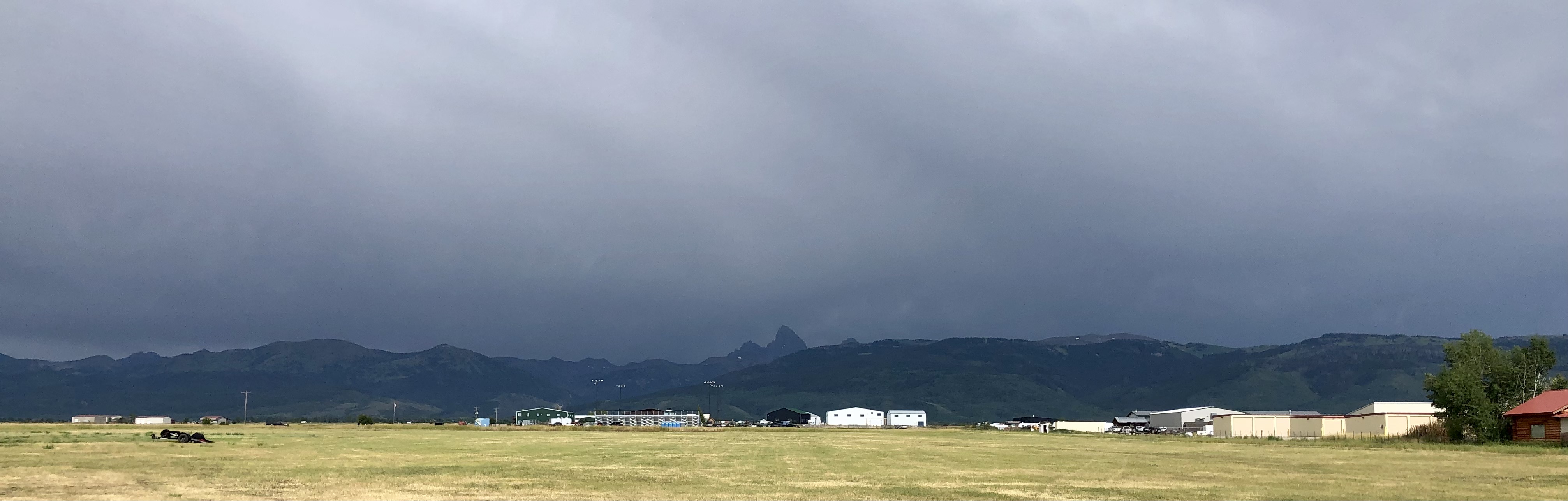
The Grand Teton under a darkening sky. 


Motherly Love

My niece Clio, in the midst of a story about kids who were mean: "But my mom always says, if somebody does something mean to you, do it back."

Me: "Wait, what does your mother say?"

Clio: "Do it back to them."

Me: "Your momma taught you 'Get revenge'?"

Clio: "Yes."

"Are we the baddies?"

Periodically I watch this classic skit.


David Brooks is channeling the skit today in "What If We're the Bad Guys Here?" He gently chides his posh NYT readership with lots of chummy assumptions about "our" elite status, but points out that those smelly Trump supporters do have just a bit of a point about how the smug illuminati are making out like bandits at the expense of their pathetic protegees.

Not that he doesn't pull himself back from the brink; he knows he can't completely lose his audience. "Are Trump supporters right that the indictments are just a political witch hunt? Of course not." Heavens to Betsy, no, we're not that wrong.

To give him credit, though, he closes on a good thought:
“History is a graveyard of classes which have preferred caste privileges to leadership.”
Unearned caste privileges are a good way to get the guillotines to be rolled out.

That stuff that never happened was OK and we knew all about it anyway

Every day I have to ask myself whether there's a limit to how low this process can go. The new establishment spin on Hunter Biden is that he was a con man selling what only "appeared" to be access to his powerful father. I hope he vetted that approach with the shady guys who paid him, or they might be wondering about a refund. On the other hand, if they got their expected merchandise long ago, maybe they're fine with the new story.

Meanwhile, it's nice to know that Biden Sr. didn't mind helping create this harmless illusion of access. It's just a service that powerful men in public service naturally perform for the smart beloved sons they trust implicitly. Nothing to see here, certainly nothing to consider when casting a ballot in 2024.

Dreaming and thinking

From Maggie's Farm today:
“I slept and dreamt that life was joy. I awoke and saw that life was service. I acted and behold, service was joy.”
Rabindranath Tagore
Another way to say "dreaming and waking" is "gut and head," or feeling and discerning: the wise heart. Add action, and you have the will, or soul.

Way Out West

For the next three weeks I will be visiting my mother, sister, and niece on the border of Wyoming and Idaho. It’s a very different land than the one I usually frequent, with bigger skies and Rocky Mountains— indeed, the Grand Tetons— different weather, and different flora and fauna. 

Tonight, for example, I am making beer-braised moose for supper. It’s just like the venison braise I described on the sidebar, but with a different beast in the pot. 

Rescue

I haven't saved anyone from physical peril lately, unlike our host. What I have been, is involved in a local crisis with the animal shelter. To make a long story short, I was afraid we'd turned some kind of awful corner and would have to abandon our long-standing program that more or less prevented any need to kill animals to make space. I'm now thinking we hit more of a temporary blip and just need to scramble to take some emergency Dunkirk-like action to get the sudden population pressure off the shelter, and that we'll be able to get back on an even keel and still avoid killing animals for space.

More about that later. What I want to say today is that I come unspooled in the face of dogs under threat. Our new County Judge named a committee to step in and made me the chair. I'm scrambling and finding some useful concrete immediate things to do to get a grip on the problem. My committee has excellent members. There's all kinds of good news.

In the middle of all this, I had a shattering experience at my church on Sunday, making an impassioned plea for help that I felt fell on deaf ears. I was in tears in front of the lot of them, and I felt they ghosted me. Again, long story, there's more to it, I get that it wasn't all it seemed, and we'll deal with it.

No, here's the real point. I have a friend at church between whom and myself a terrible rift opened up years ago over how she had put her dogs in danger. I’ve been icy ever since, with my conscience upbraiding me. Yesterday, alone among all my co-parishioners, she showed up in Commissioners Court to support me and the dogs. I realized I had to make this right by finding her and confessing my fault in my part of the rift. Today she asked my forgiveness before I could even speak first. We buried the hatchet. It’s moments like that that make life worth living. (And on top of that, we've savings some dogs.)

I think God sees that there are things in me that can't be helped until other things are broken down. He puts me in a crisis where I have to crack open and become fully human, because I can't coast by in a state of cool control. If it takes dogs in peril, He'll put me in charge of saving some dogs in peril. Because it's not only dogs to whom I owe a duty of love, it's also my fellow human beings, especially the ones I haven't managed to forgive. I'm so solitary; I'm barely in contact with human beings at all most of the time. But that's not what I was put on Earth for.