We are taking increased risks with men who are, each one of them, strategic assets of the United States. Every one of these operators who dies represents a significant loss to our capacity as a nation to project force, in addition to an unutterable loss to their families and loved ones.
We are taking this risk in order to cut down on the loss of innocent life, unavoidable in a war in which the enemy intentionally leverages civilians as shields.
Remember that the next time you hear someone shout about how the US doesn't care as much as it should about civilian casualties. Those civilians benefit more than anyone else in the world from the destruction of ISIS. We are risking the lives of our very best to bring that about in the least destructive way possible. May God defend the innocent who have been thrust into this war, but may God defend the right.


Jim Webb Declines Naval Academy Alumni Association’s Distinguished Graduate Award
He is one of the more distinguished graduates of that institution -- Navy Cross, Silver Star, Secretary of the Navy, Senator, author, scholar, and diplomat. But he wrote an article critical of including women in combat forces back in 1979(!), so of course there were loud protests toward him being honored today. He put out a statement on his decision to decline the award, rather than cause a scene at Annapolis.
While this article was controversial, many of these protests have wrongly characterized my reasons for having written it, my views of women, and also my record of government leadership in addressing opportunities for women in the military and in our society. Having opened up more billets for women in the Navy than any Secretary of the Navy before me, it is particularly ironic to see that these same women who are criticizing me for a magazine article in 1979 have benefited so greatly from the policies I unilaterally put into place in 1987.To defend his own honor, he compiled some statements from women who have worked with him. The truth is, he needn't have bothered. It won't convince the first one of his critics, none of whom did so much as he did himself -- not even on this score. When the field of accomplishment is widened to include the whole of human activity, he remains distinguished well above almost any of his contemporaries.
Visits to Mars Not Yet Possible
A new technology aims to do something like this.
I don't know enough about how this works to say much about it. In general, though, I don't patronize businesses that don't want me there. If you don't want my business, posting a sign is enough.
I don't know enough about how this works to say much about it. In general, though, I don't patronize businesses that don't want me there. If you don't want my business, posting a sign is enough.
The Good of an AR-15
It's a soft-shooting rifle that almost anyone can handle accurately with training. That's what makes it dangerous, but "dangerous" does not equal "bad." Sometimes, having one can be very good.
"These three individuals came to this residence with the intent to burglarize it," Deputy Nick Mahoney said, "One was with brass knuckles, the other one was with a knife."The right three.
They said the 23-year-old resident was sleeping in the home when he heard "loud bangs" coming from the back door.
Mahoney said, "They were masked at the time, all had gloves on. They entered in through a black door, shattering the back door and they entered into the residence."
Deputies said the resident armed himself with an AR-15 rifle and walked toward the back door where he encountered the three masked burglars.
"Armed with a rifle, there were some shots fired, and, at this point, three people are deceased,” Mahoney said.
Associated Press: We Will Now Sometimes Refer to Single Persons as "They"
The one use of 'they' where this makes a kind of sense is not, of course, the one they're using it for. That use is as a pronoun for "someone," "anyone," "a person," or similar constructions that are technically single, but also not strictly single as they could refer to many different individuals. "No one," for example, refers literally not even to a single person, but in the same act invokes every person. It makes a kind of sense to use a plural pronoun in these cases, e.g., "If anyone wants to join the expedition, they should send notice by Friday."
No, the AP means to do it as a half-step between applying logic and accepting a duty to refer to people by "preferred pronouns."
No, the AP means to do it as a half-step between applying logic and accepting a duty to refer to people by "preferred pronouns."
In stories about people who identify as neither male nor female or ask not to be referred to as he/she/him/her: Use the person’s name in place of a pronoun, or otherwise reword the sentence, whenever possible. If they/them/their use is essential, explain in the text that the person prefers a gender-neutral pronoun. Be sure that the phrasing does not imply more than one person.So, 'avoid this nonsense as far as you can, but if you absolutely cannot, at least make clear that you're dealing with someone who absolutely refuses to be referred to in standard English.' Making them sound like difficult weirdos should do wonders for the acceptance of *trans* persons!
Dual Loyalty in Philadelphia
The author of this Politico piece makes one of the nastiest accusations one can make against an immigrant community, but it's Russian immigrants so no one cares.
Here, in a self-created cocoon of familiar cultural touchstones, I detected a kind of dual nationalism among the residents—a manifest love for countries that once were home and an equal adoration for the populist president many of them voted for. “Trump is a fighter, a negotiator, a successful businessman. Four times he go through the bankruptcy. He understand how the world works from a business perspective,” says Alexander Shapiro, who came to the states in the early-1990s from what’s now Ukraine. “During the campaign, he ran against governors and senators. He beat everybody like babies.”What's so wrong with them? Turns out, they're not Democrats, and they don't want a government handout.
Hearing how jazzed residents sounded about Trump’s first 60 days in office, I half expected to find shelves laden with Russian nesting dolls featuring Barron, Ivanka, Don Jr. and the whole gang. There was nothing so brazen inside the Knizhnik gift store, a mom-and-pop-looking place where I was repeatedly reminded that the inventory was “all Russian —all.” There was, however, a Russian biography of Trump prominently displayed. It was the same book that became a popular giveaway at Trump-friendly election watch parties in Moscow, the one whose title has been dubbed in English as “The Black Swan.”
It’s an apt metaphor for how Bustleton and Somerton fit into Philadelphia writ large. Meaning, hardly at all.
In fact, Lipkovskaya suggests that the population hailing from ex-Soviet states might be predisposed to an up-by-the-bootstraps message like that of the Trump campaign, and a drain-the-swamp message, too. “In my family, we paid for everything with our hard work and great attitude toward this country,” she says. “Eastern Europeans are not so much depend on public benefits. We’re not waiting for dollars to fall from the trees.”Sounds a lot like that "mountain pride" that the last administration made it a priority to undermine. Maybe we could use some more immigrants from Russia, if they're of this mold.
After all, many of these immigrants ended up here, during the 1990s, seeking freedom from ethnic or religious persecution in their respective states. “Most of the Russians here are almost libertarians,” says Andre Krug, president and CEO of KleinLife, a senior-citizen program that caters to many Russian-speaking adults. “They came from a country where the country dictated how they were going to live their lives, so when they came to this country, they feel like the less government does, the better they’re going to be ultimately.” Their ideology—to draw a generality—is more like an attitude of rugged individualism, Krug says.
"John Brown Gun Club"
In Phoenix, Arizona, a journalist encounters a left-leaning armed protest group. Also, a group called the Brown Berets, which also literally wears brown shirts with their uniforms.
Boston Antifa has a message for you: "There's a war going on, and if you're not part of it, you're in the way."
Amazingly, they have decided that while fighting a 'war' to 'overthrow this fascist regime' is the perfect time to press their own diversity agenda to try to make sure their leadership ranks aren't so darn male.
"Start dressing as women at home for practice, to see if you wouldn't mind it."
That's how you want to train for the revolution, by trying on clothes? The 101st Airborne won't have a chance, huh?
"Because as we know, women are better public speakers and far more eloquent than men."
Right, that's why all the famous speeches of human history were given by women.
They're apparently not joking about any of this, which is funnier still.
Boston Antifa has a message for you: "There's a war going on, and if you're not part of it, you're in the way."
Amazingly, they have decided that while fighting a 'war' to 'overthrow this fascist regime' is the perfect time to press their own diversity agenda to try to make sure their leadership ranks aren't so darn male.
"Start dressing as women at home for practice, to see if you wouldn't mind it."
That's how you want to train for the revolution, by trying on clothes? The 101st Airborne won't have a chance, huh?
"Because as we know, women are better public speakers and far more eloquent than men."
Right, that's why all the famous speeches of human history were given by women.
They're apparently not joking about any of this, which is funnier still.
Naming Conventions
The state of Georgia won't let parents name their kid Allah. Why not? Not for the reason you may think.
State officials, however, said the child's name — ZalyKha Graceful Lorraina Allah — does not fit the naming conventions set up by state law. They say that ZalyKha's last name should either be Handy, Walk or a combination of the two.The Feds have naming conventions for us, too. My wife apparently changed her name when we married in a way that the Social Security Bureau accepted but the IRS refused to recognize. That left her with a Social Security Number that the tax people refused to associate with her FICA taxes. It took her ages to get that straightened out.
Flashback: The War on 'Mountain Pride'
How much of it is left?
While researching the efforts by the administration to expand food stamp participation, Caroline May of the Daily Caller unearthed one particular point of frustration for food stamp officials: "mountain pride."That article was from 2012, so we had a whole second term of trying to cut down on mountain pride. I wonder how it turned out. Some of it's left, I can well warrant, but I wonder just how much.
Mountain pride prevents many Appalachian residents from accepting food stamps even though they're eligible, according to the Ashe County North Carolina Department of Social Services. As a result, social workers in the rural Appalachian county, which borders Tennessee and Virginia, are developing strategies and offering rewards for defeating mountain pride. Apparently, as they see it, they need to get more silly hillbillies to take their government handouts like other Americans.
Appalachian culture, above all else, is defined by self-reliance. Where cities had specialists -- carpenters, blacksmiths, tanners and bakers, for example -- isolation created by the difficult terrain meant Appalachian settlers and generations of their descendants were forced to be jacks of all trades. Every person was his own butcher, baker and candlestick maker.
If hard times hit or tragedy struck, these tough souls didn't rely on the government for assistance. They simply persevered, maybe with a helping hand from their church or their closest neighbors, who were often miles away.
While there might be fewer outhouses and more satellite dishes in hollows of rural Appalachia today than in times past, that independent spirit and self-reliance persists. As a result, some people would sooner go to bed hungry than accept a government handout. That is the essence of mountain pride.
The Unity of the Virtues
One of the things that has been debated since ancient times is whether the virtues are a collection of things, or a whole. Socrates, who argued that virtue was a whole (and a form of knowledge that -- somehow -- could not be taught) argued the point with the famous Protagoras in the dialogue of the same name. [I will annotate the speakers for the convenience of the reader.--Grim]
But the unity is a problem, too. It is clearly the case that the virtues do not come to be as a unity, as everyone knows someone who is brave but not wise, or wise but not brave; just in his dealings with others, but not moderate at the dinner table; etc. If the virtues were one, then to have one would be to have them all.
I think that the virtues are like the parts of a house, so that they are all part of a whole, but they have to come to be in a certain order. You can't put the roof on first; you have to have a foundation before you can put up walls. There's a little bit of variability in the order -- you could put up two walls and then a roof, if you wanted. Each virtue has a different purpose in a way, in that the roof provides shelter from the sun or rain while the walls provide shelter from the wind, but they are also all unified in a common purpose of providing shelter. This seems to address how virtues can be unified without losing either their different character or their capacity to exist separately in a given person.
Yet this isn't fully satisfying either, as it would seem as if you could say more than I can say about what precisely is the foundation of virtue, which ones come next, and so forth. The capstone virtue -- the roof -- might well be Aristotle's magnanimity; yet others might argue it is justice. Aristotle says that both are, in a way, complete virtue. I think magnanimity is the stronger candidate, as it crowns complete virtue with the activity of using that complete virtue to pursue the most honorable things, whereas justice (in its character as lawfulness) compels you to do the right things rather than making you desire to do them. Still, you see the point: you could argue either way, and if my view is right, it ought to be able to draw out something more specific about the order.
In any case, I was thinking of the question because of a scandal at Berkeley involving the philosopher John Searle. I think we were just discussing his Chinese Room thought experiment recently. Most philosophers take the ability to think clearly and come to deep philosophical insights as a fairly high degree of virtue; the ability to control one's sexual urges is supposed to be a more basic virtue, expected to come about earlier. And maybe it did; Searle is 84, and perhaps is less capable (or less willing) to behave himself now than when he was younger (as well as less famous and powerful). Or perhaps the ability to think clever thoughts isn't such a highly-placed virtue, but something more like athletic ability (which only some can attain in any great measure, for reasons that have nothing to do with virtue). Then the virtue to actualize one's native capacities may not be so very great; only a bit of discipline and practice, combined with a great deal of natural talent. Developing self-control over deep impulses could be much higher and harder than developing the self-control necessary to practice things one finds enjoyable and to which one is naturally inclined, which would account for why so many great athletes also end up demonstrating a lack in this area.
Alternatively, perhaps the view that these virtues come about in any kind of order is wrong. Perhaps you can just have some of them without others. But it does seem odd to say that you could be just without being capable of moderation, or be wise without being capable of self-control.
UPDATE: Speaking of Searle, here is a recent interview with him, with a heartwarming headline.
Socrates: And has each of [the virtues] a distinct function like the parts of the face;-the eye, for example, is not like the ear, and has not the same functions; and the other parts are none of them like one another, either in their functions, or in any other way? I want to know whether the comparison holds concerning the parts of virtue. Do they also differ from one another in themselves and in their functions? For that is clearly what the simile would imply.You can see the issue. If the virtues are not in a sense the same, then justice and holiness -- or any two virtues -- are completely different. That is clearly wrong, as it requires that we say that it is never just to behave moderately, nor is it just to behave immoderately; nor is it courage to behave with self-control, nor is it courage to behave without self-control. The division makes no sense at all.
Protagoras: Yes, Socrates, you are right in supposing that they differ.
S: Then, I said, no other part of virtue is like knowledge, or like justice, or like courage, or like temperance, or like holiness?
P: No, he answered.
S: Well then, I said, suppose that you and I enquire into their natures. And first, you would agree with me that justice is of the nature of a thing, would you not? That is my opinion: would it not be yours also?
P: Mine also, he said.
S: And suppose that some one were to ask us, saying, "O Protagoras, and you, Socrates, what about this thing which you were calling justice, is it just or unjust?"-and I were to answer, just: would you vote with me or against me?
P: With you, he said.
S: Thereupon I should answer to him who asked me, that justice is of the nature of the just: would not you?
P: Yes, he said.
S: And suppose that he went on to say: "Well now, is there also such a thing as holiness? "we should answer, "Yes," if I am not mistaken?
P: Yes, he said....
S: Well then, Protagoras, we will assume this; and now supposing that he proceeded to say further, "Then holiness is not of the nature of justice, nor justice of the nature of holiness, but of the nature of unholiness; and holiness is of the nature of the not just, and therefore of the unjust, and the unjust is the unholy": how shall we answer him? I should certainly answer him on my own behalf that justice is holy, and that holiness is just; and I would say in like manner on your behalf also, if you would allow me, that justice is either the same with holiness, or very nearly the same; and above all I would assert that justice is like holiness and holiness is like justice; and I wish that you would tell me whether I may be permitted to give this answer on your behalf, and whether you would agree with me.
P: He replied, I cannot simply agree, Socrates, to the proposition that justice is holy and that holiness is just, for there appears to me to be a difference between them.... I admit that justice bears a resemblance to holiness, for there is always some point of view in which everything is like every other thing; white is in a certain way like black, and hard is like soft, and the most extreme opposites have some qualities in common; even the parts of the face which, as we were saying before, are distinct and have different functions, are still in a certain point of view similar, and one of them is like another of them. And you may prove that they are like one another on the same principle that all things are like one another; and yet things which are like in some particular ought not to be called alike, nor things which are unlike in some particular, however slight, unlike.
S: And do you think, I said in a tone of surprise, that justice and holiness have but a small degree of likeness?
But the unity is a problem, too. It is clearly the case that the virtues do not come to be as a unity, as everyone knows someone who is brave but not wise, or wise but not brave; just in his dealings with others, but not moderate at the dinner table; etc. If the virtues were one, then to have one would be to have them all.
I think that the virtues are like the parts of a house, so that they are all part of a whole, but they have to come to be in a certain order. You can't put the roof on first; you have to have a foundation before you can put up walls. There's a little bit of variability in the order -- you could put up two walls and then a roof, if you wanted. Each virtue has a different purpose in a way, in that the roof provides shelter from the sun or rain while the walls provide shelter from the wind, but they are also all unified in a common purpose of providing shelter. This seems to address how virtues can be unified without losing either their different character or their capacity to exist separately in a given person.
Yet this isn't fully satisfying either, as it would seem as if you could say more than I can say about what precisely is the foundation of virtue, which ones come next, and so forth. The capstone virtue -- the roof -- might well be Aristotle's magnanimity; yet others might argue it is justice. Aristotle says that both are, in a way, complete virtue. I think magnanimity is the stronger candidate, as it crowns complete virtue with the activity of using that complete virtue to pursue the most honorable things, whereas justice (in its character as lawfulness) compels you to do the right things rather than making you desire to do them. Still, you see the point: you could argue either way, and if my view is right, it ought to be able to draw out something more specific about the order.
In any case, I was thinking of the question because of a scandal at Berkeley involving the philosopher John Searle. I think we were just discussing his Chinese Room thought experiment recently. Most philosophers take the ability to think clearly and come to deep philosophical insights as a fairly high degree of virtue; the ability to control one's sexual urges is supposed to be a more basic virtue, expected to come about earlier. And maybe it did; Searle is 84, and perhaps is less capable (or less willing) to behave himself now than when he was younger (as well as less famous and powerful). Or perhaps the ability to think clever thoughts isn't such a highly-placed virtue, but something more like athletic ability (which only some can attain in any great measure, for reasons that have nothing to do with virtue). Then the virtue to actualize one's native capacities may not be so very great; only a bit of discipline and practice, combined with a great deal of natural talent. Developing self-control over deep impulses could be much higher and harder than developing the self-control necessary to practice things one finds enjoyable and to which one is naturally inclined, which would account for why so many great athletes also end up demonstrating a lack in this area.
Alternatively, perhaps the view that these virtues come about in any kind of order is wrong. Perhaps you can just have some of them without others. But it does seem odd to say that you could be just without being capable of moderation, or be wise without being capable of self-control.
UPDATE: Speaking of Searle, here is a recent interview with him, with a heartwarming headline.
My precious

About sums it up for me.
Sure, I know, Republicans had a narrow majority, and they could only pass something through the Senate by reconciliation, which imposes limitations. But the thing is, Republicans don't hide behind the vagaries of Senate procedure during campaign season. Trump did not win the Republican nomination telling rallies of thousands of people, "We're going to repeal and replace Obamacare — as long as it satisfies the Byrd rule in the judgment of the Senate parliamentarian!"
What's so utterly disgraceful, is not just that Republicans failed so miserably, but that they barely tried, raising questions about whether they ever actually wanted to repeal Obamacare in the first place.
Honky Tonk Rock
This piece comes from a list of ten similar pieces compiled by Rolling Stone. They describe them as Mike Ness' "country-punk covers," although in this case it's just a honky tonk version of a song Ness wrote himself. Unlike the others in the list, then, it's not really a cover.
Speaking of Rolling Stones, that band did one of these things too. Here's their honky tonk version of "Honky Tonk Women."
Best Thing Under the Circumstances
The Republican-led health care act was hideous, and we're better off without it. Someday we'll get the Federal government out of health care, but this didn't even pretend to do that. Someday we'll get to price transparency and fee-for-service instead of an insurance model, so we can have true markets. This bill didn't do that either. It didn't do anything I'd want done to try to fix the way we pay for health care, but it would have propped up all the worst features of the current system.
Hopefully the Trump administration learned that Congress is a co-equal branch that can't be just ordered to support a policy whether it makes sense or not. Failing that, hopefully at least Congress learned that about itself today.
They can take their time and get it right, or they can just repeal O-care with a one-year delay to give time for alternative solutions appear, either at the state level or from the market itself. Or they can do nothing and hope it all falls apart someday on its own, which would still be better than this. Under the circumstances, killing this bill was the best idea.
Hopefully the Trump administration learned that Congress is a co-equal branch that can't be just ordered to support a policy whether it makes sense or not. Failing that, hopefully at least Congress learned that about itself today.
They can take their time and get it right, or they can just repeal O-care with a one-year delay to give time for alternative solutions appear, either at the state level or from the market itself. Or they can do nothing and hope it all falls apart someday on its own, which would still be better than this. Under the circumstances, killing this bill was the best idea.
Christianity is Irrelevant
So argues this writer, who is quite pleased about it:
It's true that I meet fewer and fewer young people who recognize obvious Biblical references in movies or television. "That's Ecclesiastes," I'll tell them, and they kind of seem surprised that something so cool could have come out of the Bible. We none of us control any of this, and what is going to happen will happen. Still, there is some reason to hope that it won't all be bad.
I’m excited the North American church is dying. Christians not having the influence we once had in the 1900s gives me great hope. For the past 100 years we’ve had a lot of cultural converts. Everyone is a Christian because they grew up in Texas. Or they go to church. Or their mom and dad raised them that way. Hell, according to the U.S. census 70% of Americans identify as “Christian.” But the vast majority of those responses are nothing more than cultural identification, not Christianity. I imagine that’s why so many people despise Christians. Their belief is cultural, and no one intends to follow the man they claim governs their life, so we end up this giant homogenous blob of hypocrites that judge and condemn people, instead of looking like they did in 165 AD. Instead of rushing to the aid of others, or paying for pagan burials like our ancestors did, we have half-hearted followers who run rampant through the streets of social media pointing the finger to everyone except themselves.Last night I watched another '70s counterculture movie -- Vanishing Point, which has an awesome Dodge Challenger as its real main character -- and was reminded of how 'small and strange' that version of Christianity is. It's really strange, but not really bad: the "Long Haired Friends of Jesus" in the song (and movie) Convoy.
The reason I’m excited about the shift is because as the cultural converts die, vibrant Christians will take their place. Churches will be smaller and stranger to the public, but they’ll be healthier.
It's true that I meet fewer and fewer young people who recognize obvious Biblical references in movies or television. "That's Ecclesiastes," I'll tell them, and they kind of seem surprised that something so cool could have come out of the Bible. We none of us control any of this, and what is going to happen will happen. Still, there is some reason to hope that it won't all be bad.
The Guy Who Got Ben Rhodes' Job
The Atlantic has a piece on him, which a friend of mine who is quoted in it describes as fair and accurate. The guy's name is Michael Anton, and you probably read an article he wrote during the election last year.
We traded up, in this respect at least.
We traded up, in this respect at least.
Air Assault in Raqqa
U.S.-backed Syrian Arab forces landed on American military helicopters with Apache gunships flying overhead.There's something you don't see every day.
The indigenous forces were accompanied by U.S. special operations “advisors,” the spokesman added.
“It takes a special breed of warrior to pull off an airborne operation or air assault behind enemy lines,” said Col. Joe Scrocca “There is nothing easy about this – it takes audacity and courage. And the SDF (Syrian Democratic Forces) has that in spades.”
UPDATE:
Related.
How the Irish Were Always White
David Bernstein, in "Sorry, but the Irish were always 'white' (and so were Italians, Jews and so on)" over at the Volokh Conspiracy, touches on a topic that relates to my own past research.
One factor that Bernstein does not touch on, probably because it is not widely recognized, is that nativism in America prior to the Civil War was not about immigration per se but rather religion. The nativists had no problem with many other immigrant groups coming in, but they had huge objections to Catholic immigration.
Read nativist writings and over and over you will read about how Catholics can never be true Americans because they owe their final allegiance to the Pope, whom nativists often depicted as a foreign prince. As millions of Catholics poured into the US, they developed a separate Catholic school system, avoiding one of the main ways immigrants were assimilated in the North. There were legal battles fought over whether states could mandate that schools use the Protestant version of the Bible (it wasn't questioned that they could mandate study of the Bible). The separate school system and various other Catholic social organizations that sprang up seemed like an effort by the whole population of Catholic immigrants to avoid becoming American. That's why the "nativists" (an epithet invented by their political enemies) called themselves "native Americans" and formed the American Party. As Catholics became important voting blocks in Northern cities and began to exercise political power, the nativists began to view mass Catholic immigration as an invasion by a foreign power.
All of this built on centuries of anti-Catholic sentiment in England which came to America early on. The Puritans, after all, wanted to purify the Church of England of all its Catholic aspects. Anti-Catholic bigotry was probably the oldest kind of bigotry in the American colonies, and it continued into the new nation. I've read that at the Constitutional Convention there was a debate over whether Catholics should be allowed to vote. The winning argument was that there were so few of them in the nation that it couldn't hurt anything to let them vote. That began to change with Irish immigration during the famines.
The relevant scholarly literature seems to have started with Noel Ignatiev’s book “How the Irish Became White,” and taken off from there. But what the relevant authors mean by white is ahistorical. They are referring to a stylized, sociological or anthropological understanding of “whiteness,” which means either “fully socially accepted as the equals of Americans of Anglo-Saxon and Germanic stock,” or, in the more politicized version, “an accepted part of the dominant ruling class in the United States.”Some of my graduate research in history involved looking into Irish immigration to the US from the 1830s to 1850s and the nativist response to it. At the time, the Irish were considered white even by the Anglo-Saxon Americans who opposed them. Race was understood quite differently then than it is now (as Bernstein points out later in the article), and the idea that the Irish were not white when they arrived uses today's race and ethnic studies definitions and projects them onto American society in the past. It has nothing to do with how Americans in the 19th century viewed the Irish and everything to do with how race and ethnic studies researchers view race today.
Those may be interesting sociological and anthropological angles to pursue, but it has nothing to do with whether the relevant groups were considered to be white.
Here are some objective tests as to whether a group was historically considered “white” in the United States: Were members of the group allowed to go to “whites-only” schools in the South, or otherwise partake of the advantages that accrued to whites under Jim Crow? Were they ever segregated in schools by law, anywhere in the United States, such that “whites” went to one school, and the group in question was relegated to another? When laws banned interracial marriage in many states (not just in the South), if a white Anglo-Saxon wanted to marry a member of the group, would that have been against the law? Some labor unions restricted their membership to whites. Did such unions exclude members of the group in question? Were members of the group ever entirely excluded from being able to immigrate to the United States, or face special bans or restrictions in becoming citizens?
If you use such objective tests, you find that Irish, Jews, Italians and other white ethnics were indeed considered white by law and by custom (as in the case of labor unions).
One factor that Bernstein does not touch on, probably because it is not widely recognized, is that nativism in America prior to the Civil War was not about immigration per se but rather religion. The nativists had no problem with many other immigrant groups coming in, but they had huge objections to Catholic immigration.
Read nativist writings and over and over you will read about how Catholics can never be true Americans because they owe their final allegiance to the Pope, whom nativists often depicted as a foreign prince. As millions of Catholics poured into the US, they developed a separate Catholic school system, avoiding one of the main ways immigrants were assimilated in the North. There were legal battles fought over whether states could mandate that schools use the Protestant version of the Bible (it wasn't questioned that they could mandate study of the Bible). The separate school system and various other Catholic social organizations that sprang up seemed like an effort by the whole population of Catholic immigrants to avoid becoming American. That's why the "nativists" (an epithet invented by their political enemies) called themselves "native Americans" and formed the American Party. As Catholics became important voting blocks in Northern cities and began to exercise political power, the nativists began to view mass Catholic immigration as an invasion by a foreign power.
All of this built on centuries of anti-Catholic sentiment in England which came to America early on. The Puritans, after all, wanted to purify the Church of England of all its Catholic aspects. Anti-Catholic bigotry was probably the oldest kind of bigotry in the American colonies, and it continued into the new nation. I've read that at the Constitutional Convention there was a debate over whether Catholics should be allowed to vote. The winning argument was that there were so few of them in the nation that it couldn't hurt anything to let them vote. That began to change with Irish immigration during the famines.
No Problem, Boss
A teenage boy was told by school leaders that he had to “tolerate” undressing in front of a female student and to make it as “natural” as possible, according to a blockbuster lawsuit filed in a Pennsylvania federal district court.You might think that teen pregnancy is something to be avoided. No worries, mate: the female student identifies as male, so he couldn't possibly get pregnant.
"Reasons to Vote for Democrats" Becomes Amazon #1 Best-Seller
Earlier this month we looked at the insightful book Reasons to Vote for Democrats: A Comprehensive Guide by Michael J. Knowles with its amazing reviews. It looks like the book has reached #1 best-seller status on Amazon.


It currently has 1747 reviews and a 5-star rating. Since the book is almost entirely blank, that's an interesting feat. It does apparently have a real bibliography, though, which makes me curious ... Is it worth six bucks to see what's in the bibliography? I guess I could keep it at the office to annoy co-workers with, too ...
The reviews really are worth reading, if you haven't been over yet.
Terrorism as Boredom
So, today there was another terrorist attack in London, involving ramming people with autos as has become usual. The attacker was exactly who you'd expect, and indeed he was exactly who authorities expected, because as usual they admit he was known to them before hand. The head of police in London said, as usual, that we should keep an open mind and not assume anything about motives (from this guy they already knew about), but also that we must take time to remember the stress that this puts on Muslim members of the community, who are especially prone to feeling unwelcome at times like this.
It's so routine now. This time the Prime Minister was nearly within arms' reach of the attack, but so what? You can always get another Prime Minister. They're just as disposable as everyone else. The important thing is that no one jump to conclusions about that thing we already know about.
It's so routine now. This time the Prime Minister was nearly within arms' reach of the attack, but so what? You can always get another Prime Minister. They're just as disposable as everyone else. The important thing is that no one jump to conclusions about that thing we already know about.
Insanity Abounds
So, just this week, we had a hearing in Congress in which the FBI director admitted that someone -- probably on Team Obama -- had committed a serious felony by leaking FISA warrant information.
Democrats: 'You're trying to change the subject!'
Republicans: 'This is a serious crime!'
Today, the head of House Intelligence revealed FISA warrant information to the press.
Democrats: 'This is a serious crime!'
Republicans: 'You're trying to change the subject!'
Do any of you in Washington care about national security at all?
UPDATE: I wonder how much of this turns on 'need to know.' The President has whatever security clearance he needs, ex officio, but he doesn't necessarily need to know everything. Normally there's nothing he wouldn't 'need to know,' but a collection effort targeting him and his companions for possible action might qualify. Now the Congress might really 'need to know' that, because they have legitimate oversight purposes.
The press has neither the clearance nor the need to know. Does the citizenry need to know? Most wouldn't have the clearance, so it's an irrelevant question. Until it isn't, because the formal structures begin to fail and there's no hope but a recourse to the People.
Democrats: 'You're trying to change the subject!'
Republicans: 'This is a serious crime!'
Today, the head of House Intelligence revealed FISA warrant information to the press.
Democrats: 'This is a serious crime!'
Republicans: 'You're trying to change the subject!'
Do any of you in Washington care about national security at all?
UPDATE: I wonder how much of this turns on 'need to know.' The President has whatever security clearance he needs, ex officio, but he doesn't necessarily need to know everything. Normally there's nothing he wouldn't 'need to know,' but a collection effort targeting him and his companions for possible action might qualify. Now the Congress might really 'need to know' that, because they have legitimate oversight purposes.
The press has neither the clearance nor the need to know. Does the citizenry need to know? Most wouldn't have the clearance, so it's an irrelevant question. Until it isn't, because the formal structures begin to fail and there's no hope but a recourse to the People.
Reflections
Did you ever wonder why artists painted such obsessively realistic still-lifes, including shiny objects? Apparently because it's simply an absorbing task to trick the eye into seeing distorted reflections by using only flat color. This is the newest Chrismon I've completed:


Originalism vs Textualism?
In a discussion below, there was a thread about how originalism is inferior to textualism. The second, as described, sounded to me like a subset of the first. Judge Gorsuch seems to think they're the same thing:
[The] second point I would make is it would be a mistake to suggest that originalism turns on the secret intentions of the drafters of the language of the law. The point of originalism, textualism, whatever label you want to put on it–what a good judge always strives to do and what we all do–is to understand what the words on the page mean, not [to] import words that come from us, but [to] apply what you, the people’s representatives, the lawmakers, have done. And so when it comes to equal protection of the laws, for example, it matters not a whit that some of the drafters of the Fourteenth Amendment were racists–because they were–or sexists–because they were. The law they drafted promises equal protection of the law to all persons… I think that guarantee… is the most radical guarantee in all of the Constitution and maybe in all of human history.
"Tribal Epistemology"
In which Vox hits upon the truth, but thinks it applies to the other side.
I mean, by all means read it -- some of their allegations against our side are serious, and you should prove them wrong by considering them fairly. It is amazing, though, to see them come right to the very edge and not ask, "Hey -- do we do this too?" The closest approach to that is an assertion that the problem disproportionately affects Republicans, which is at least a wave in the direction of the idea that it might sometimes appear on the left as well.
I mean, by all means read it -- some of their allegations against our side are serious, and you should prove them wrong by considering them fairly. It is amazing, though, to see them come right to the very edge and not ask, "Hey -- do we do this too?" The closest approach to that is an assertion that the problem disproportionately affects Republicans, which is at least a wave in the direction of the idea that it might sometimes appear on the left as well.
In Praise of Hierarchy (and Bureaucracy!)
Several leading philosophers, including Kwame Anthony Appiah, have a piece calling for a reconsideration of how important these things are.
Appiah is on my radar for his work on honor, which I think is incomplete but nevertheless interesting. Honor is like hierarchy in that relatively few thinkers today want to spend much time praising it, perhaps for similar reasons.
Appiah is on my radar for his work on honor, which I think is incomplete but nevertheless interesting. Honor is like hierarchy in that relatively few thinkers today want to spend much time praising it, perhaps for similar reasons.
Susan Rice on Honesty and the White House
The Washington Post decided to publish an article by the least credible person in America on the importance of White House officials speaking the truth. They seem to be completely oblivious to the irony of having Susan Rice lecture us on this question.
Credibility is the currency in rhetoric, and Rice could not be less credible than she is. However, there's more to life than rhetoric. Philosophically, it is improper to dismiss her simply because she is a hypocrite who is manifestly guilty of the same offense -- or an even worse one, as her lies were carefully planned. That would be the logical fallacy of tu quoque, combined with the fallacy of ad hominem. She might have a point, even though she's a horrible person and a hypocrite.
And, indeed, she does have a point. Honor holds the world together. Truth is a force multiplier. Those things are true, whoever says them.
Credibility is the currency in rhetoric, and Rice could not be less credible than she is. However, there's more to life than rhetoric. Philosophically, it is improper to dismiss her simply because she is a hypocrite who is manifestly guilty of the same offense -- or an even worse one, as her lies were carefully planned. That would be the logical fallacy of tu quoque, combined with the fallacy of ad hominem. She might have a point, even though she's a horrible person and a hypocrite.
And, indeed, she does have a point. Honor holds the world together. Truth is a force multiplier. Those things are true, whoever says them.
More Cultural Appropriation
I think they may be appropriating us, actually, but whatever. Maybe that's all to the good.
If you don't know the artist, she went on to be somebody. Cultural appropriation was a big part of that.
If you don't know the artist, she went on to be somebody. Cultural appropriation was a big part of that.

What Originalism Puts at Risk
CNN published this, so I assume they must think it's plausible.
I figured it would say things like, "It could force the transfer of Social Security and Medicare to the states, as there is no obvious Constitutional warrant for the Federal government to run things like that." Or "Great Society Programs." Or "the EPA, already under threat from the Trump administration."
What it says instead is that originalism is about taking rights away from minority groups. That's either a complete misunderstanding of what the philosophy is about, or else it's a willful slander of the first order. The rights of minority groups are protected by explicit Constitutional language. Insisting on the original understanding of, say, the 14th Amendment is a way of preventing rights from getting watered down.
So too with originalism pointed toward the Bill of Rights. The way that rights get washed away is very often by sliding words into new meanings. Originalism is a stronghold against that move: it insists that, if you want to strip away the right, you have to actually go through the Article V process. Nothing else but that process will do, ensuring that decisions to alter basic rights must enjoy very broad public support.
My guess is that the misunderstanding -- if it is that -- is created by the reality that the original Founders didn't trust everyone equally, especially with what we have come to call "voting rights." However, that misses the point: the Founders didn't consider voting to be a right in the same way that free exercise of religion or free speech was a right. They thought that citizenship was a kind of office. Like any office, it should be filled only by people who have shown they are qualified for it. That's why they imposed things like property tests, which demonstrated 'skin in the game' as well as a kind of practical economic independence. The last was important because they doubted that those who were wholly dependent on someone else could really reason independently of that interest, which meant that giving votes to servants (say) would really mean giving extra votes to the landlord.
Originalism does not threaten to restore that idea of citizenship, because the concept of voting rights was created through explicit Constitutional actions such as the ratification of the 15th Amendment. An originalist couldn't rule in favor of a return to the earlier conception of citizenship even if he or she thought it was a better idea, just because of their commitment to originalism.
This should be better understood. Originalism is the only mode of interpretation that should be supported in a candidate for the Supreme Court. Otherwise, the court exists not to apply the laws chosen by the People in accordance with the Constitution, but to make new laws and alter the Constitution. That is no proper role for the Supreme Court, not even when they vote unanimously.
I figured it would say things like, "It could force the transfer of Social Security and Medicare to the states, as there is no obvious Constitutional warrant for the Federal government to run things like that." Or "Great Society Programs." Or "the EPA, already under threat from the Trump administration."
What it says instead is that originalism is about taking rights away from minority groups. That's either a complete misunderstanding of what the philosophy is about, or else it's a willful slander of the first order. The rights of minority groups are protected by explicit Constitutional language. Insisting on the original understanding of, say, the 14th Amendment is a way of preventing rights from getting watered down.
So too with originalism pointed toward the Bill of Rights. The way that rights get washed away is very often by sliding words into new meanings. Originalism is a stronghold against that move: it insists that, if you want to strip away the right, you have to actually go through the Article V process. Nothing else but that process will do, ensuring that decisions to alter basic rights must enjoy very broad public support.
My guess is that the misunderstanding -- if it is that -- is created by the reality that the original Founders didn't trust everyone equally, especially with what we have come to call "voting rights." However, that misses the point: the Founders didn't consider voting to be a right in the same way that free exercise of religion or free speech was a right. They thought that citizenship was a kind of office. Like any office, it should be filled only by people who have shown they are qualified for it. That's why they imposed things like property tests, which demonstrated 'skin in the game' as well as a kind of practical economic independence. The last was important because they doubted that those who were wholly dependent on someone else could really reason independently of that interest, which meant that giving votes to servants (say) would really mean giving extra votes to the landlord.
Originalism does not threaten to restore that idea of citizenship, because the concept of voting rights was created through explicit Constitutional actions such as the ratification of the 15th Amendment. An originalist couldn't rule in favor of a return to the earlier conception of citizenship even if he or she thought it was a better idea, just because of their commitment to originalism.
This should be better understood. Originalism is the only mode of interpretation that should be supported in a candidate for the Supreme Court. Otherwise, the court exists not to apply the laws chosen by the People in accordance with the Constitution, but to make new laws and alter the Constitution. That is no proper role for the Supreme Court, not even when they vote unanimously.
"The Coding of 'White Trash' in Academia"
A lady named Holly Genovese has some thoughts.
I bought The Professor Is In by Karen Kelsky, a terrifying book full of blunt (and much needed) advice about navigating the academic job market. While the author gives outspoken advice about the struggles of the job market, particularly for women, she also implicitly argues for the importance of hiding one’s class. She wrote about clothing and makeup and speaking patterns in women. Around the time I read this book, I realized that I, for a lack of a better term, code “white trash.” I have bad teeth, frequently say “ya’ll” and “how come,” and have a habit of running around South Philadelphia in a Dale Earnhardt Jr. t-shirt. It is one thing to have your hometown judged by your peers, but it is quite another to realize that qualities you possess, habits born of a lifetime that you don’t even realize you have, make you read as unqualified or unfit for your chosen profession.
But you can’t go home either, as they say. The more formal education I acquired, the larger the gap between my family and I became.
Enforcing Standards
Two different right-wing media personalities got suspended tonight, one for backing up the President's claims of a wiretap, and one for a philosophical difference that is widely shared by millions of Americans -- even some conservatives.
Both suspensions are defensible, even though they are in another sense completely opposed. One is backing his side in apparent absence of facts; the other is differing from her side, in a place where complete facts would be inadequate even in principle. Moral reason doesn't turn only on facts, after all: tell a computer all the facts about a case, but give it no moral rules, and it might not even understand that you were asking it a question. It certainly would not have any method for coming to a reasonable answer.
It is good for organizations to enforce standards, as it is good for people to uphold ideals. Which one of these seems best to you? Does either seem wrong? Can you say why?
Both suspensions are defensible, even though they are in another sense completely opposed. One is backing his side in apparent absence of facts; the other is differing from her side, in a place where complete facts would be inadequate even in principle. Moral reason doesn't turn only on facts, after all: tell a computer all the facts about a case, but give it no moral rules, and it might not even understand that you were asking it a question. It certainly would not have any method for coming to a reasonable answer.
It is good for organizations to enforce standards, as it is good for people to uphold ideals. Which one of these seems best to you? Does either seem wrong? Can you say why?
The Comey/Rogers Hearing
The headlines I'm seeing everywhere: "FBI confirms Trump campaign being investigated for Russia ties! Trump's wiretapping lies refuted!"
The actual news, as far as I can see, is that the FBI confirmed an investigation into something by someone having something to do with Russia, but refused to comment.
Then, the FBI and the NSA chiefs both confirmed that a number of serious felonies had definitely been committed.
So, in the Russia matter, it may yet prove that someone connected in some way to Team Trump did something wrong. However, it is definitely the case that at least one person in high position committed serious felonies -- and the list of people to investigate is not all that long. Most of them were ranking political appointees in the previous administration.
This is the point at which a smart, thoughtful opposition would ask itself, "Do we really want to have this fight, or might we quietly reach an accommodation that would let all this slide into the rear view mirror?"
I doubt that is what is going to happen here.
The actual news, as far as I can see, is that the FBI confirmed an investigation into something by someone having something to do with Russia, but refused to comment.
Then, the FBI and the NSA chiefs both confirmed that a number of serious felonies had definitely been committed.
NUNES: Would an unauthorized disclosure of FISA-derived information to the press violate 18 USC 798, a section of the Espionage Act that criminalizes the disclosure of information concerning the communication and intelligence activities of the United States?Gowdy's second line of questioning, which is too long to excerpt, went through a list of candidates for the honor of having committed that felony.
COMEY: Yes[.]
...
COMEY: All FISA applications review by the court collection by us pursuant to our FISA authority is classified.
GOWDY: The dissemination of which is a felony punishable by up to 10 years in prison?
COMEY: Sure, dissemination -- unauthorized dissemination.
GOWDY: Unauthorized dissemination of classified or otherwise legally protected material punishable by a felony up to 10 years in federal prison.
COMEY: Yes. Yes, as it should be.
So, in the Russia matter, it may yet prove that someone connected in some way to Team Trump did something wrong. However, it is definitely the case that at least one person in high position committed serious felonies -- and the list of people to investigate is not all that long. Most of them were ranking political appointees in the previous administration.
This is the point at which a smart, thoughtful opposition would ask itself, "Do we really want to have this fight, or might we quietly reach an accommodation that would let all this slide into the rear view mirror?"
I doubt that is what is going to happen here.
Sauflied
A sauflied is a drinking song, in the same way that the Nibelungenlied is the song of the Nibelungs.
DB: HVT Disappointed to be Raided by Rangers Instead of SEALs
Aminullah, who has countless books and films on the elite naval special operations forces, says being raided by a bunch of guys he had never heard of was a big let down....
"It's b******t. SEALs raided my brother's and cousin's houses just last month," he said. "They're probably gonna write books about that.... And seriously, my mother could graduate from Ranger School with a cloth over her eyes — which there is at all times — because she would be beaten otherwise."
RIP Chuck Berry
I'm sure in the long series of musical deaths of 2016, you probably saw this image:
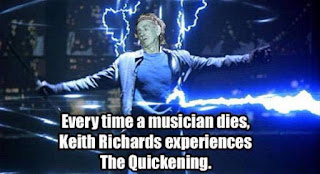
This time, there's a genuine violent connection.
Chuck Berry was one of the greats, though, as Richards himself says at some length in the clip as a whole. We were lucky to know his work.

This time, there's a genuine violent connection.
Chuck Berry was one of the greats, though, as Richards himself says at some length in the clip as a whole. We were lucky to know his work.
A Lack of Faith
Yours is disturbing.
That's how you got Trump in the first place. Congress wouldn't step up and do anything to stop this stuff, so people on the right picked someone who seemed unconstrained by norms of civility or honor.
A failure of respect for the institution of the President will be followed, almost immediately, by a failure of respect for the office of judge. Those positions cannot function without respect, except through the raw exercise of power. And power, frankly, doesn't get you all that far. It's a very big country to try to rule by force.
The lengthy recitations of large numbers of perfectly objectionable presidential statements about Muslims coexist with a bunch of other textual indicia showing not merely that the judges doubt Trump’s secular purpose but that they doubt the good faith of his purpose at all—indeed, that they suspect that he is simply lying about his own motivations....Left-leaning judges now feel about the President the way that conservatives did after Lois Lerner, in other words: we no longer trusted a word of their explanations about their conduct, but believed our eyes about what their real intent and purpose was. One of the reason that the email scandal dogged Clinton so much was that the IRS has already burned the bridges of public trust on mysteriously-vanishing email records, inexplicable failures to back up servers as required by both law and contract, and an administration-led legal process that somehow just never found anyone accountable even when it couldn't avoid admitting that something had been done wrong.Imagine a world in which other actors have no expectation of civic virtue from the President and thus no concept of deference to him. Imagine a world in which the words of the President are not presumed to carry any weight. Imagine a world in which far more judicial review of presidential conduct is de novo, and in which the executive has to find highly coercive means of enforcing message discipline on its staff because it can’t depend on loyalty. That’s a very different presidency than the one we have come to expect.
It’s actually a presidency without the principle that we separate the man from the office. It’s a presidency in which we owe nothing to the office institutionally and make individual decisions about how to interact with it based on how much we trust, like, or hate its occupant.
That's how you got Trump in the first place. Congress wouldn't step up and do anything to stop this stuff, so people on the right picked someone who seemed unconstrained by norms of civility or honor.
A failure of respect for the institution of the President will be followed, almost immediately, by a failure of respect for the office of judge. Those positions cannot function without respect, except through the raw exercise of power. And power, frankly, doesn't get you all that far. It's a very big country to try to rule by force.
Friday night MMV
Stumbled across this; not a bad use of the song. I didn't see the movie, but I probably don't need to now.
A St. Patrick's Day Roundup
From the Hall's 2012 archive, here is a list of several good Irish tunes appropriate for the holiday.
"Campaign Pledges Haunt Trump in Court"
So says the NYT, correctly enough for a change. It's a major change in jurisprudence, as up until now campaign rhetoric has been off-limits for judicial interpretation. The idea is that it would be bad for democracy if politicians couldn't speak freely in election campaigns, out of fear of being constrained by courts after-the-fact.
On the other hand, it also makes a kind of sense. Trump has been taking his campaign promises relatively seriously compared to previous presidents. It may be the reason that judges have been so willing to wink at campaign rhetoric in the past is the sense of, c'mon, it's just talk for the rubes. Nobody's seriously going to do that stuff in office. They just have to say it to get elected.
What happens when somebody comes along who maybe really is going to 'do that stuff in office'? It's easy to understand the panic. Nothing terrifies a cynic more than sincerity.
Nevertheless, I think Powerline has it right (previous link):
However great this idea is as a pure theory, it's completely impossible in practice. There is no mechanism for making it work other than forcing the executive branch to completely relinquish the relevant power for as long as Trump is president. It's not that, since Trump is a bad guy in certain ways, the courts will delegate the powers to someone else they do trust -- Mattis or whomever. It's that America, not just Trump, would lose the capacity to make national security decisions based on immigration for four years.
That's unworkable. Many people might argue that other bits of campaign rhetoric make Trump unacceptably dangerous as commander in chief. (Indeed, one person who made that argument repeatedly was Hillary Clinton.) So does that mean the courts should prevent him from taking any military actions -- meaning, that America should stop defending herself for four years? Maybe just against the Muslim world, plus China, if those are the areas where Trump's rhetoric was especially explosive?
Obviously that isn't acceptable. Neither is it workable for every executive policy to have to satisfy each of the several hundred Federal judges out there in order to go into effect. This is going to cause problems, though, because the judges appear to be committed to the idea that they should have that power.
On the other hand, it also makes a kind of sense. Trump has been taking his campaign promises relatively seriously compared to previous presidents. It may be the reason that judges have been so willing to wink at campaign rhetoric in the past is the sense of, c'mon, it's just talk for the rubes. Nobody's seriously going to do that stuff in office. They just have to say it to get elected.
What happens when somebody comes along who maybe really is going to 'do that stuff in office'? It's easy to understand the panic. Nothing terrifies a cynic more than sincerity.
Nevertheless, I think Powerline has it right (previous link):
The states’ argument is in essence that Trump is a bigot, and thus his winning presidential campaign in fact impeaches him from exercising key constitutional and statutory powers, such as administering the immigration laws.I kind of like the idea that you could elect a partial-president, one whose powers are limited by the flaws in their character. As a purely theoretical idea, it would be great if people who had the right virtues to execute the powers well were the ones entrusted with those powers. If someone without the right virtues was elected, it would be great -- in theory -- if the powers were temporarily entrusted in someone else who had those virtues.
However great this idea is as a pure theory, it's completely impossible in practice. There is no mechanism for making it work other than forcing the executive branch to completely relinquish the relevant power for as long as Trump is president. It's not that, since Trump is a bad guy in certain ways, the courts will delegate the powers to someone else they do trust -- Mattis or whomever. It's that America, not just Trump, would lose the capacity to make national security decisions based on immigration for four years.
That's unworkable. Many people might argue that other bits of campaign rhetoric make Trump unacceptably dangerous as commander in chief. (Indeed, one person who made that argument repeatedly was Hillary Clinton.) So does that mean the courts should prevent him from taking any military actions -- meaning, that America should stop defending herself for four years? Maybe just against the Muslim world, plus China, if those are the areas where Trump's rhetoric was especially explosive?
Obviously that isn't acceptable. Neither is it workable for every executive policy to have to satisfy each of the several hundred Federal judges out there in order to go into effect. This is going to cause problems, though, because the judges appear to be committed to the idea that they should have that power.
"St. Patrick Was An Immigrant"
The Irish PM intends to slam Donald Trump, but ends up defending Ben Carson.
St. Patrick's 'immigration' to Ireland came at the hand of Irish pirates, who kidnapped him from his family's estate in Britain and sold him to work as a slave tending sheep. Is that 'immigration'? Well, in a way; in the way that Carson (and Obama) used the word.
St. Patrick's 'immigration' to Ireland came at the hand of Irish pirates, who kidnapped him from his family's estate in Britain and sold him to work as a slave tending sheep. Is that 'immigration'? Well, in a way; in the way that Carson (and Obama) used the word.
A Sadly Predictable Outcome Awaits
Headline: "Venezuela has a bread shortage. The government has decided bakers are the problem."
UPDATE: "Speculators who hide the bread from the people."
Why doesn't that happen in America, I wonder?
UPDATE: "Speculators who hide the bread from the people."
Why doesn't that happen in America, I wonder?
Wearin' o' the Green

My great-nephew, not only Scots-Irish on our side but half genuine Irish via his immigrant Dad, who has the adorable accent and everything.
Cleaning Up History
Josh McKoon, whom longtime readers may recall from previous yearly sessions of the Georgia Legislature, has decided to spend some time cleaning up old segregationist language passed by earlier legislatures.
The resolutions themselves are purely symbolic, but the Columbus Republican said they have no place in Georgia’s code.
One would rescind a 1958 resolution that censured President Dwight Eisenhower for federalizing the National Guard to enforce integration at Central High School in Little Rock. The resolution said Eisenhower “sacrificed the honesty and integrity of our highest executive office on an altar of political expediency to appease the NAACP and other radical, communist-sympathizing organizations.”
A second would roll back a 1956 resolution that criticized the Justice Department and FBI for “flagrant invasion” into local affairs with an investigation of a black man convicted in a controversial trial of raping a white woman. He was later executed.
And a third targets a 1956 resolution adopted in the wake of the landmark Brown v. Board of Education decision by the U.S. Supreme Court, which Georgia lawmakers declared “null, void and of no effect.”
UGA Study on Hispanic Buying Power
The University of Georgia has just produced a study that claims to show Hispanics in America have a buying power that exceeds Mexico's entire GDP.
NYPD Calls for Federal Cash
The Trump budget, which is causing much wailing and gnashing of teeth, has a lot to like about it if you are one of us who really wants the Federal government to stop doing a lot of things. Some of those things are worth doing, of course: but it isn't the Federal government who ought to be doing them. Case in point.
If taxes need to go up, raise taxes. Once we've cut the Federal government down to size, especially if we ever manage to tackle entitlements, there should be plenty of room for taxes at the state or local level to go up a bit.
I understand that the NYPD's counterterrorism division provides an important service. However, they work for the city of New York. That's who should pay them. It makes no sense to push the cost off onto the American taxpayer more broadly, nor is 'providing funds for local police' anywhere to be found in Article I, Section 8.
“Under the president’s proposal, nearly all federal funding to the NYPD would be eradicated. This funding is absolutely critical. It is the backbone of our entire counter-terrorism apparatus,” NYPD Commissioner James P. O’Neill said during a press briefing....For a billion dollars, I would certainly like to see measurable results. The larger point, though, is that it should very rarely be the case that a local police department -- even the NYPD -- should be Federally funded. There are two levels of government between the NYPD and the Feds. New York is a tremendously rich city, the home of Wall Street and many millionaires. It can't pay for its own police department? The state of New York can't make up whatever shortfalls remain?
The White House budget proposal states that it reduces or eliminates $667 million for Federal Emergency Management Agency (FEMA) programs "that are either unauthorized by the Congress ... or that must provide more measurable results."
The blueprint lists the Homeland Security Grant Program as an example of a program requiring "more measurable results." The program had more than $1 billion in overall funding in 2016, according to FEMA's website.
If taxes need to go up, raise taxes. Once we've cut the Federal government down to size, especially if we ever manage to tackle entitlements, there should be plenty of room for taxes at the state or local level to go up a bit.
I understand that the NYPD's counterterrorism division provides an important service. However, they work for the city of New York. That's who should pay them. It makes no sense to push the cost off onto the American taxpayer more broadly, nor is 'providing funds for local police' anywhere to be found in Article I, Section 8.
A Word from The Spokesman of Marines United
We've considered various takes on this USMC photo-sharing scandal. It turns out the group has appointed a spokesman, who would like to address concerns about his organization.
The headline is unfair to his argument, I think: it suggests that he is opposed to women serving. That's not actually what he said at all.
The headline is unfair to his argument, I think: it suggests that he is opposed to women serving. That's not actually what he said at all.
Murder is illegal on the streets of America, but people still do it. So sexual crimes are still going to happen in the military regardless of how they [Pentagon and Congress] try to clamp down on it or revise [policies]. It’s still going to happen and at that point, I don’t really question the physicality of women. I question the logistics of the Marine Corps and if they will be able to keep up with it...This would be a strong point if and only if the complications of integration are going to be long term problems and not (as with racial integration) short term problems; and if and only if those complications are going to make the Marine Corps less effective as a fighting force. Are either of those 'if and only if' criteria implausible?
“Sen. Elizabeth Warren was a prime example, pushing for a co-ed boot camp and she questioned the commandant on why we’re not doing that,” he told the Daily Beast. “So I think it’s coming down from civilian leadership and I think the Marine Corps should stand up for itself and say, ‘Look, we have been winning wars for America since 1775. Why should we continue to change the wheels when they’re not broke? We need to look at American defense first before looking at integration.”
Paglia in Tablet
This is a fairly compelling interview at times. This part sounds to me a lot like some of Tex's regular points:
Especially this is true for the young, I think: past a certain age it is easier to set aside. The young need jobs too: indeed, they need them more, as they lack the stored or inherited wealth of the older. And we need them to have jobs more, too, if we expect them to pay for their elders through various entitlements or public pension programs.
You can tell people in their 20s and early 30s that they have to act completely asexually in the professional environment, but telling them that it is obligatory doesn't make it attainable. At minimum, you need to support them with standards that minimize the temptation to think sexually about those with whom they share a workplace. Yet even the military, considered as a workplace, has failed to do this. How will the civilian workplace manage what military discipline has failed to accomplish, or even in many cases to find the will to attempt?
The Industrial Revolution, a capitalist phenomenon, created low-level jobs for women that allowed them for the first time to be truly self-supporting, freed from economic dependence upon father or husband. Over the past century, women have gained access to higher-status jobs, many with real power and authority over men. But the main issue is that men and women are working side by side in the workplace in a way they have never done before, except in outdoor field work during the agrarian era. This is something new in human experience, and I believe it is destabilizing sexual relations in ways that we have scarcely observed, much less analyzed.Keeping the workplace 'neutral' may be impossible, though, if she is right about her broader argument. Sexuality is at least partially irrational, arising without will from the subconscious. Control over expression can be rationally determined, at least sometimes and to some degree, but stripping it completely out of any area of life may be a bridge too far.
First of all, too much familiarity may undercut sexual passion. When mystery goes, so does the sizzle. Second, despite a brief fad in the 1970s for the asexual uniform of John Molloy’s “dress for success” look, affluent women professionals today (with their svelte skirts and pricey Louboutin stilettos) are clearly still using their own sexual appeal to gain power in the workplace—while at the same time oddly forbidding male co-workers to notice or, Venus forbid, comment (which would spark an instant kangaroo court). What I have been saying throughout my work is that sexual tension and conflict may be built into human life (by virtue of women’s monopoly over procreation) and that women, in order to be truly free, must stop relying on the bureaucratic regulatory state to manage their relations with men. Men too have an inherent right to be free—to think and express their own views and desires without women’s hectoring oversight and censorship. However, the workplace must remain a neutral zone, where the professional (and not the personal) should rule.
Especially this is true for the young, I think: past a certain age it is easier to set aside. The young need jobs too: indeed, they need them more, as they lack the stored or inherited wealth of the older. And we need them to have jobs more, too, if we expect them to pay for their elders through various entitlements or public pension programs.
You can tell people in their 20s and early 30s that they have to act completely asexually in the professional environment, but telling them that it is obligatory doesn't make it attainable. At minimum, you need to support them with standards that minimize the temptation to think sexually about those with whom they share a workplace. Yet even the military, considered as a workplace, has failed to do this. How will the civilian workplace manage what military discipline has failed to accomplish, or even in many cases to find the will to attempt?
Rights for Rivers
New Zealand has just granted legal personhood to a river.
UPDATE: A piece from my cousin, who is a pro-life doctor, on why unborn children might plausibly be extended legal personhood.
In a world-first a New Zealand river has been granted the same legal rights as a human being....Unborn children in New Zealand do not enjoy legal personhood, but rivers do. Got it.
On Wednesday, hundreds of tribal representatives wept with joy when their bid to have their kin awarded legal status as a living entity was passed into law.
“The reason we have taken this approach is because we consider the river an ancestor and always have,” said Gerrard Albert, the lead negotiator for the Whanganui iwi [tribe].
“We have fought to find an approximation in law so that all others can understand that from our perspective treating the river as a living entity is the correct way to approach it, as in indivisible whole, instead of the traditional model for the last 100 years of treating it from a perspective of ownership and management.”
The new status of the river means if someone abused or harmed it the law now sees no differentiation between harming the tribe or harming the river because they are one and the same.
UPDATE: A piece from my cousin, who is a pro-life doctor, on why unborn children might plausibly be extended legal personhood.
This is Inefficient
Want to shoot down an off-the-shelf drone that cost a few hundred bucks? Why not use a $3 Million Patriot missile?
If anybody wants a better answer, I know a falconer who can train eagles to take the things down. I don't know what the range of an eagle is compared to a Patriot, but I figure it's got to be good enough to kill a drone.
If anybody wants a better answer, I know a falconer who can train eagles to take the things down. I don't know what the range of an eagle is compared to a Patriot, but I figure it's got to be good enough to kill a drone.
Trump to Honor Andrew Jackson, American Muscle Cars
Pony car lovers will celebrate the change in fuel efficiency standards.
After the speech, Trump will head to Nashville, Tennessee, to lay a wreath at President Andrew Jackson’s tomb to mark what would have been Jackson’s 250th birthday, before holding a campaign-style rally in the city.At least in terms of American muscle cars, maybe we are going to Make America(n) Great Again.
Trump will tour Jackson’s home, according to Howard Kittell, president and CEO of the Hermitage mansion. Jackson has enjoyed something of a resurgence thanks to Trump. During the campaign, some of Trump’s aides took to comparing him to the former president — a fellow populist outsider who took on a member of the Washington establishment and ran a campaign railing against corrupt elites.
Trump mused during his first days in Washington that “there hasn’t been anything like this since Andrew Jackson” and hung a portrait of Jackson in the Oval Office.
Speculative Fiction
Today's claim that Steve Bannon is a "white supremacist" turns on his praise of a work of speculative fiction, The Camp of the Saints. I have never read this book, so I can neither praise nor condemn it. However, the description and excepts make it sound like it falls squarely within a genre of books that includes some highly celebrated on the Left: The Handmaid's Tale, for example, or 1984, or Brave New World, or Fahrenheit 451.
Each of these includes awful images of a highly undesirable future, for the purpose of criticizing present trends with dangerous conclusions. According to Wikipedia, for whatever that's worth, this piece was written in 1973, and was widely praised by intellectuals at the time of its publication. That it is of lasting interest more than forty years after its original publication suggests there might be something to the book; that it provokes such discomfort among its critics, likewise.
I haven't read it. Perhaps it's awful. Still, what an odd ground for criticism. The quite-Left American Library Association organizes a "Banned Books Week" every year, and maintains a part of its online store devoted to banned and challenged books.
Yet here is the alleged proof of Bannon's evil: "He likes a disapproved book."
Each of these includes awful images of a highly undesirable future, for the purpose of criticizing present trends with dangerous conclusions. According to Wikipedia, for whatever that's worth, this piece was written in 1973, and was widely praised by intellectuals at the time of its publication. That it is of lasting interest more than forty years after its original publication suggests there might be something to the book; that it provokes such discomfort among its critics, likewise.
I haven't read it. Perhaps it's awful. Still, what an odd ground for criticism. The quite-Left American Library Association organizes a "Banned Books Week" every year, and maintains a part of its online store devoted to banned and challenged books.
Yet here is the alleged proof of Bannon's evil: "He likes a disapproved book."
A Problem with Chesterton's Fence
In general, I agree with G. K. Chesterton's principle here:
There are a couple of problems here. The first is that, over time, the reason a very useful institution was created may get lost so that no one really knows why it was created or how exactly it is useful, or it may have developed empirically over centuries or millennia to be the best way of doing things but no one ever fully articulated the reasons why. When the modernizer challenges it, the conservative isn't ready with a good explanation, and the modernizer then assumes there isn't one.
Another issue is that Chesterton's statement of his maxim assumes the conservative (i.e., "more intelligent") reformer has the power to stop the modernizer, but that's often not the case. Often in society both put their arguments out there and a bunch of fence-sitters cast the deciding votes.
As a result, some important American institutions have been torn down in part because conservatives seemed unable to adequately explain their purpose. When they tried to preserve them, they seemed tied to dead traditions, stupid, or bigoted. Decades later the negative effects of the destruction become apparent; in hindsight we can see the purposes of those institutions fairly clearly, but we can't go back in time to deliver our now-learned retort.
Some human institutions, like government, are consciously created and we have something like the Federalist Papers that explains them. However, some are not consciously created. They developed empirically, by accumulated experience, over many generations. That's what living tradition is, the accumulated experience and wisdom of a culture.
Wisdom, though, can be ineffable. Sometimes you know something is right, but you cannot intellectualize why. That is the problem in miniature: How can we tell the difference between ineffable wisdom and baloney? It's a difficult problem.
Chesterton's fence is the principle that reforms should not be made until the reasoning behind the existing state of affairs is understood. The quotation is from Chesterton’s 1929 book The Thing: Why I am a Catholic, in the chapter entitled "The Drift from Domesticity": "In the matter of reforming things, as distinct from deforming them, there is one plain and simple principle; a principle which will probably be called a paradox. There exists in such a case a certain institution or law; let us say, for the sake of simplicity, a fence or gate erected across a road. The more modern type of reformer goes gaily up to it and says, “I don’t see the use of this; let us clear it away." To which the more intelligent type of reformer will do well to answer: "If you don’t see the use of it, I certainly won’t let you clear it away. Go away and think. Then, when you can come back and tell me that you do see the use of it, I may allow you to destroy it."
There are a couple of problems here. The first is that, over time, the reason a very useful institution was created may get lost so that no one really knows why it was created or how exactly it is useful, or it may have developed empirically over centuries or millennia to be the best way of doing things but no one ever fully articulated the reasons why. When the modernizer challenges it, the conservative isn't ready with a good explanation, and the modernizer then assumes there isn't one.
Another issue is that Chesterton's statement of his maxim assumes the conservative (i.e., "more intelligent") reformer has the power to stop the modernizer, but that's often not the case. Often in society both put their arguments out there and a bunch of fence-sitters cast the deciding votes.
As a result, some important American institutions have been torn down in part because conservatives seemed unable to adequately explain their purpose. When they tried to preserve them, they seemed tied to dead traditions, stupid, or bigoted. Decades later the negative effects of the destruction become apparent; in hindsight we can see the purposes of those institutions fairly clearly, but we can't go back in time to deliver our now-learned retort.
Some human institutions, like government, are consciously created and we have something like the Federalist Papers that explains them. However, some are not consciously created. They developed empirically, by accumulated experience, over many generations. That's what living tradition is, the accumulated experience and wisdom of a culture.
Wisdom, though, can be ineffable. Sometimes you know something is right, but you cannot intellectualize why. That is the problem in miniature: How can we tell the difference between ineffable wisdom and baloney? It's a difficult problem.
Plato vs. Aristotle
Joel Gehrke gives an interesting review and discussion of Arthur Herman's The Cave and The Light: Plato versus Aristotle and the Struggle for the Soul of Western Civilization over at the Federalist.
I enjoyed the review and the book sounds pretty good, though Gehrke points out some problems with the argument.
Herman sets out to show that the debate between these two thinkers, who lived about 400 years before the birth of Jesus Christ, provides the distinctive, even governing, feature of Western civilization.
“One path – Plato’s path – sees the world through the eyes of the religious mystic as well as the artist,” he writes in The Cave and the Light. “The path of Aristotle, by contrast, observes reality through the sober eyes of science and reveals the power of logic and analysis as tools of human freedom.”
Western civilization depends on both for its vigor, according to Herman. “It’s the constant tension between these two ways of seeing the world – the material versus the spiritual, the practical versus the insightful-intuitive side – it’s the creative tension, like the drawing of a string of a bow, that creates the dynamism that’s been so characteristic of western culture throughout its history,” he said ...
I enjoyed the review and the book sounds pretty good, though Gehrke points out some problems with the argument.
You Might Pack A Separate Sock
I mean, I always carry one pair of extra socks when backpacking just to sleep in. One more additional single sock would not be the end of the world.
Maddow Gets Played
So Donald Trump's 2005 tax returns just 'show up' in one of her people's mailboxes, with no names attached. And she gets all excited, goes to press with it, and -- it just so happens -- team Trump is ready to release the documents themselves that afternoon in order to scoop her. And then she goes over the top, of course, trying to tie this to various conspiracy theories. Then the returns prove mainly that he paid a massive amount of taxes that year, hundreds of times more than the average taxpayer will pay in a lifetime of paying taxes.
I'll bet I know who mailed those tax forms to Maddow's assistant.
And now Trump is immunized against the whole "show us your taxes!" issue.
I'll bet I know who mailed those tax forms to Maddow's assistant.
And now Trump is immunized against the whole "show us your taxes!" issue.
"Are We Raising Racists?"
Since this article appears in the New York Times, I guessed before reading it that the answer was "Yes." It turns out that the answer may be, 'No, but we should be.'
Parents of black and Latino children have long made thoughtful choices about when and how to engage in difficult and nuanced discussions about difference. Studies show that such parents are two to five times more likely than whites to teach their children explicitly about race from very young ages to counter negative social messages and build a strong sense of identity.Is that really what you want me to do? Raise my children to think "explicitly about race" and to have a "strong sense of [racial] identity"? Have you thought this through?
I Certainly Hope This Is True
Attack on the administrative state allegedly planned by Trump's legal team. That might go a long way to restoring the Constitutional order.
The Chieftains
Tonight, at the University of Georgia, the greatest remaining Irish band came to play. They are celebrating their 55th year of playing as a group, which might lead you -- as it did me -- to expect the concert to be a sort of sober greatest-hits affair, suitably slowed down to respect the needs of aging performers.
I was wrong. They were off the chain. In a lifetime of going to concerts, symphonies, and shows, I have never seen their equals.
For the encore, following a standing ovation, they did a Medieval piece from Brittany called "Andro." Dancers who had come to join the concert, just kids from a local school, came out and formed a "snake dance" line with the Chieftains' own dancers. It wound through the audience, pulling in anyone who wanted to join. All these old hippies with beards who had come to see the show joined in, holding hands, dancing up and down. The Chieftains ensemble's performance was joined by the Atlanta Pipe Band, with a sextet of Great Highland Bagpipes paired to military drums, perfectly blended into their work -- apparently without rehersal, as the Chieftains just rolled into town and had a wedding to go to last night.
The whole was a performance of high energy and spirit from first to last. I wish I could recreate any part of it here, but no recorded performance of theirs even implied to me how powerful their live performances really are. What a treat to see them after all these years, and to find them so strong.
I was wrong. They were off the chain. In a lifetime of going to concerts, symphonies, and shows, I have never seen their equals.
For the encore, following a standing ovation, they did a Medieval piece from Brittany called "Andro." Dancers who had come to join the concert, just kids from a local school, came out and formed a "snake dance" line with the Chieftains' own dancers. It wound through the audience, pulling in anyone who wanted to join. All these old hippies with beards who had come to see the show joined in, holding hands, dancing up and down. The Chieftains ensemble's performance was joined by the Atlanta Pipe Band, with a sextet of Great Highland Bagpipes paired to military drums, perfectly blended into their work -- apparently without rehersal, as the Chieftains just rolled into town and had a wedding to go to last night.
The whole was a performance of high energy and spirit from first to last. I wish I could recreate any part of it here, but no recorded performance of theirs even implied to me how powerful their live performances really are. What a treat to see them after all these years, and to find them so strong.
Tenth Amendment Lawsuit
The state of Tennessee is suing over the refugee resettlement program, arguing that it violates the Tenth Amendment.
Given all the areas where the Federal government is manifestly violating the Tenth Amendment, they had to pick this one to test the principle? I suppose one could argue that the Federal government has the power to admit anyone to the United States that it wants to do, but that states can't be required to participate in resettlement programs. Still, this has to be the least clear case for reasserting the Tenth that I can think of given that the Federal government does have a legitimate, outward-looking role to play here.
Given all the areas where the Federal government is manifestly violating the Tenth Amendment, they had to pick this one to test the principle? I suppose one could argue that the Federal government has the power to admit anyone to the United States that it wants to do, but that states can't be required to participate in resettlement programs. Still, this has to be the least clear case for reasserting the Tenth that I can think of given that the Federal government does have a legitimate, outward-looking role to play here.
Are You Kidding Me?
This is the sort of news story that should never get published. Freedom of the press is a cherished value. All the same, publishing the details of a secret unit's training exercises can do no good whatsoever, and might get some fine Americans killed into the bargain.
We Apologize for Providing Your Refuge
A small town in Iowa has forced its high school students to apologize for wearing red, white, and blue attire to a sporting event. "The Valley High School students' USA-themed attire was seen as offensive because some of the rival school's players were from refugee families."
Oh, well, instead let's wear colors to celebrate whatever place was so hellish that you fled halfway around the world to get here.
Oh, well, instead let's wear colors to celebrate whatever place was so hellish that you fled halfway around the world to get here.
Longing for the Klan
The Washington Post would just love it if Southerners would play along with their script by demonstrating a resurgence of racism. This story from Dahlonega -- home of Georgia's military college, North Georgia University, and a place where I have spent many of my days -- shows how much they want this.
They actually did figure out the real story, if you read far enough -- they just put it in paragraph twenty-five.
Then there's this one 84 year old woman, who would like to be even richer than she is, but the town won't go along with her hotel plans. So, here's a way she can pressure the town government. 'Don't like the Klan signs? Well, I can think of a way to convince me to stop approving them.'
I guess that "Town in Georgia Has Two Bad People" wasn't enough of a headline to justify flying somebody down here, though, so they put in 24 paragraphs of 'atmosphere' in front of it, and what looks like another hundred paragraphs of '...and people were really upset' behind it.
But it's not a story, not really. It's just these two very old people, only one of whom actually cares about the Klan in the slightest degree. The other one only cares about herself.
They actually did figure out the real story, if you read far enough -- they just put it in paragraph twenty-five.
By evening, though, people had found out who was really responsible: It was one of their own, an 84-year-old white woman named Roberta Green-Garrett, the owner of the building in question who lives in a brick mansion with four white columns on a hill overlooking the town.That's basically the whole story. There's forever been this one a guy who runs a booth in one of the antique/thrift stores who is a Klan fan -- in addition to ordinary antiques and Confederate flags it used to be you could buy old copies of Song of the South from him, because Disney wouldn't sell them to you any more.
Offering no explanation and declining to speak with reporters, she had told town officials that she had allowed the banner to go up and might try to put it up again. She had been seeking permission to build a hotel on the square, and people speculated that it was all an audacious ploy to embarrass the town into approving her plans.
Then there's this one 84 year old woman, who would like to be even richer than she is, but the town won't go along with her hotel plans. So, here's a way she can pressure the town government. 'Don't like the Klan signs? Well, I can think of a way to convince me to stop approving them.'
I guess that "Town in Georgia Has Two Bad People" wasn't enough of a headline to justify flying somebody down here, though, so they put in 24 paragraphs of 'atmosphere' in front of it, and what looks like another hundred paragraphs of '...and people were really upset' behind it.
But it's not a story, not really. It's just these two very old people, only one of whom actually cares about the Klan in the slightest degree. The other one only cares about herself.
Crusaders
In World War One, a group of Crusaders in chain mail appeared to ask how to join the war. It happened in Georgia, of course.
Say it Ain't So
Another federal judge has scalded the unprofessional conduct of Justice Department lawyers inside the Civil Rights Division.... Now it's unprofessional behavior and bigotry toward the South[.]Why, I can't imagine. Well, frankly, what I can't imagine is them doing anything else.
...
"[T]hey entered these proceedings with arrogance and condescension. One of the Department’s lawyers even exhibited her contempt for Texas and its representatives and her disdain for these proceedings by regularly rolling her eyes at State witnesses’ answers that she did not like, and she amused herself by chewing gum while court was in session.
It was obvious, from the start, that the DoJ attorneys viewed state officials and the legislative majority and their staffs as a bunch of backwoods hayseed bigots who bemoan the abolition of the poll tax and pine for the days of literacy tests and lynchings.
I've Been Chewed Out Before
The Navy punished the SEALs who flew the Trump flag from their Humvee.
According to the documents, the commanding Seals officer directed a teamwide remedial training on safe convoy operations and partisan political activity.Yeah, I've seen that movie.
Jury Rules on Malheur Militia
A jury refused to convict on any Federal charges in the Malheur National Wildlife Refuge case last year. This year, on a different set of charges, the jury came to a split decision. The decision is a little strange, but at least one felony conviction came back against each participant -- even though the minor players seem to have gotten off worse than the leaders, and people who plainly did the same things were sometimes convicted and sometimes not.
Njardarheimr
A Viking re-enactment society in Norway is building a Viking village in a truly beautiful setting.
DB: "Black Hawk Down" Reboot
Changes to the original story include adding a number of LGBTQI+ soldiers to the cast who try to make friends with enemy fighters instead of shooting them, while Medal of Honor recipients Master Sgt. Gordon and Sgt. 1st Class Shugart will be played by Chinese actors....I imagine it'll do as well as the Ghostbusters reboot.
Still, the film will include nods to the original film [including] a version of the compelling speech given by the character "Hoot," who explains why he serves in the Army at a time of war.
"When I go back home, people ask me, 'why do you do it, man? Why? Are you some kind of war junkie?'" the character says in the new film. "I just tell them no. War is a terrible thing and nothing good ever comes from violence."
Incitatus
It's never a good sign for the IRS when the judge's very first step is to compare their conduct to Caligula's.

I Guess If You Were Going to Play One Leningrad Cowboys Song for Lent
... it might be this one.
But probably not these ...
But probably not these ...
The Political: Not So Personal
Hot Air looks at a study on the recent campaigns for President, and it finds that Hillary Clinton's was run in almost entirely personal terms. Oddly enough, the Trump campaign was far more policy-oriented both in its positive message and its criticisms of its opponent's.
Be grateful the lights are on
Jordan Peterson is a Canadian psychologist with a conservative bent. From Maggie's Farm, this is a lovely short clip in which he explores the idea that life includes a good bit of irreducible suffering, and maybe our job is to quit pretending there's a world in which that won't be so if everyone stops oppressing us, and if we can finally fractionate down to the very last citizen exactly where we all fit on the oppressed-victim spectrum so we can calculate the reparations we are due. Then we can get to work trying to pull ourselves together and make small, incremental improvements in how we act. We can control whom we oppress, in other words, though we can never control who oppresses us--only our response to them.
Best Amazon Reviews EVER
Reasons to Vote for Democrats: A Comprehensive Guide
The blurb:
Here are a couple of shorter reviews:
Here's a snippet of one of my favorite longer reviews, by Coriolis:
There's nearly 1,200 reviews right now. This should be days of good reading.
The blurb:
The most exhaustively researched and coherently argued Democrat Party apologia to date, "Reasons To Vote For Democrats: A Comprehensive Guide" is a political treatise sure to stand the test of time. A must-have addition to any political observer's coffee table. "Thorough" --Ben Shapiro, nationally syndicated columnist and New York Times bestselling author
Here are a couple of shorter reviews:
Here's a snippet of one of my favorite longer reviews, by Coriolis:
A few years ago, as I was studying for my master's degree in engineering, I had the inspiration to sit in on a Women's Studies lecture. Never in my academic career have I been so profoundly affected. Truly, the depth of logic, critical thinking, and openness to challenging views displayed by the professor was unlike any other educator I had ever encountered. Having been exposed to the quality of scholarship one can only find at my university by auditing one of its Women's Studies lectures, I knew I would never be able to truly comprehend the subject because of my thrice-be-damned white cis-gendered male heterosexual privilege. Wallowing in full-time employment and chained to my role in the patriarchy as a husband and father, I had given up on ever truly grasping the profound moral and philosophical core behind the modern social justice movement, progressives, and those who understand the true worth of pursuing diversity for its own sake. ...
There's nearly 1,200 reviews right now. This should be days of good reading.
Subscribe to:
Posts (Atom)