
Or as they prefer to put it, “Our models are based on statistical analysis, and are only probabilities.” If the predictions happen to be close, we want the credit; if they’re nowhere nearby, well, some days the long shot animal comes in first.

This defense comes at a high cost. The United States and Japan lose dozens of ships, hundreds of aircraft, and thousands of servicemembers. Such losses would damage the U.S. global position for many years. While Taiwan’s military is unbroken, it is severely degraded and left to defend a damaged economy on an island without electricity and basic services. China also suffers heavily. Its navy is in shambles, the core of its amphibious forces is broken, and tens of thousands of soldiers are prisoners of war.
In total, the United States lost four carriers, 43 cruisers and destroyers, and 15 [nuclear attack submarines].
That outcome ends in the PRC conquering Taiwan, and the US withdrawing in abject defeat.
[Egil] took in his hand a hazel-pole, and went to a rocky eminence that looked inward to the mainland. Then he took a horse's head and fixed it on the pole. After that, in solemn form of curse, he thus spake: 'Here set I up a curse-pole, and this curse I turn on king Eric and queen Gunnhilda. (Here he turned the horse's head landwards.) This curse I turn also on the guardian-spirits who dwell in this land, that they may all wander astray, nor reach or find their home till they have driven out of the land king Eric and Gunnhilda.'This spoken, he planted the pole down in a rift of the rock, and let it stand there. The horse's head he turned inwards to the mainland; but on the pole he cut runes, expressing the whole form of curse.
Immediately after this is a nice poem, which is not part of the curse.
After this Egil went aboard the ship. They made sail, and sailed out to sea. Soon the breeze freshened, and blew strong from a good quarter; so the ship ran on apace. Then sang Egil:
'Forest-foe, fiercely blowing,
Flogs hard and unceasing
With sharp storm the sea-way
That ship's stern doth plow.
The wind, willow-render,
With icy gust ruthless
Our sea-swan doth buffet
O'er bowsprit and beak.'
"Forest-foe" is a hard wind, as is "willow-render"; the "sea-swan" is of course the ship itself.
The Senate report on COINTELPRO concluded: “Only a combination of legislative prohibition and Departmental control can guarantee that COINTELPRO will not happen again.” But the Ford administration derailed legislative reforms by promising an administrative fix. In 2002, Attorney General John Ashcroft threw out many of those reforms as part of “a concerted effort to free the [FBI] field agents… from the bureaucratic, organizational, and operational restrictions” imposed after their prior abuses. Ashcroft declared: “In its 94-year history, the Federal Bureau of Investigation has been… the tireless protector of civil rights and civil liberties for all Americans.” ...The FBI’s latest war on wrong-thinking Americans took off after the FBI helped fabricate the 2016 RussiaGate fraud.... In our time, FBI officials pressured Twitter to suppress Americans based on false claims of fighting foreign influence. The same pretext was used by the Department of Homeland Security to massively suppress Americans’ criticism of election procedures (especially mail-in ballots) for the 2020 presidential election. As the covert war against “misinformation” expands, the list of federally prohibited online thoughts is snowballing. DHS is targeting “inaccurate information on the… U.S. withdrawal from Afghanistan and the nature of U.S. support to Ukraine,”...One of the biggest “misses” in the media coverage of the Twitter Files is the stunning failure of Congress to expose the abuses that Elon Musk is revealing.... Is Congress terrified of the FBI nowadays like congressmen were in the COINTELPRO era? In 1971, House Majority Leader Hale Boggs revealed the shameless kowtowing on Capitol Hill: “Our very fear of speaking out [against the FBI] … has watered the roots and hastened the growth of a vine of tyranny…. Our society cannot survive a planned and programmed fear of its own government bureaus and agencies.”
That last point is one I've been hearing more often lately. Society cannot survive a collapse of trust in public institutions; therefore, it is suggested, we have a moral obligation to extend trust to those institutions. High-trust societies definitely do better than low-trust ones.
Trust has to be earned, however. When our institutions regularly betray their society and defy their constitutional limits, trust is not merited.
The circumstances and fate of people of British-Irish ancestry who arrived in Scandinavia at this time are likely to have been variable, ranging from the forced migration of slaves to the voluntary immigration of more high-ranking individuals such as Christian missionaries and monks.
OK, although the monks should have been celibate, so their influence on the population's genetics ought not to have been great.
I have long reflected on the fact that the Norse sagas don't really mention Irish female slaves in great numbers -- in fact I can't think of even one example -- but they must have been pretty thick on the ground if they made up half the genetic heritage for a while. The sagas weren't written down until much later, and tend to be about high-status families or individuals, but still you'd think they'd come up.
Now there's a parallel discussion as to whether the Jews were ever slaves in Egypt, with some reform Jews arguing that the traditions are falsified because the only evidence for them is Biblical. However, the historic evidence for Jewish slaves in Egypt is much stronger than the evidence for female Irish slaves in Iceland; and there were very clearly a lot of Irish slave-women in Iceland. Maybe the Egyptians were no more interested in documenting their slaves' activities than were the Vikings, and the Irish women less literate and capable of documenting it themselves.
A landmark peace agreement in 2014 reconciled the Philippine government with the Moro Islamic Liberation Front (MILF), the largest — and formerly secessionist — Moro Muslim rebel group. Bringing about peace, however, has been more complicated. Islamist outfits have formed outside the MILF and gained increasing popularity as the pact was delayed and formal Moro autonomy slowed despite the peace deal....Things escalated after the third battle in Butig in November 2016. Isnilon Hapilon, one of the few surviving leaders of the infamous Abu Sayyaf Group, a loose network of criminal and militant cells in the Sulu Archipelago, arrived in Lanao and was appointed emir (commander) of the local Islamic State franchise. Hapilon had left his home island, Basilan, when his group came under military pressure. Details remain murky, but the plan to take over Marawi likely emerged around this time, with militants linking up with criminal syndicates. Local politicians supported the militants with cash and protection. Foreign money was arriving through remittance centers and bank accounts.
To appreciate how similar these stories are, you need to know that the Moro Islamic Liberation Front was itself an offshoot of the Moro National Liberation Front, which had signed a "landmark peace agreement" in the 1990s. The MNLF deal brought in most of the militants in the southern Philippines, who were moved as much by Moro nationalism as by Islam; but a radical offshoot, MILF, splintered off and continued the fight.
Abu Sayyaf, meanwhile, was an ally of Al Qaeda instead of the manner in which this new ultra-radical group was an ally of the Islamic State (itself containing members of the old Al Qaeda in Iraq, an offshoot of AQ that came to exist only to fight us in Iraq, and who married to Saddamist insurgents in American prisons in Iraq where they were kept from killing each other long enough to find common cause). Al Qaeda friends Jemmah Islamiyah helped set up and fund 'the sons of the Sword' (a literal translation of Abu Sayyaf) to push for a Qaeda-led caliphate in the very same Islam-friendly territory. They used the MILF as militia capable of holding territory; the MILF used them as shock troops.
I guess you could say that the waves are getting smaller and smaller, which might be reason for hope. The same process happened in Ireland, where the Irish Republican Army was brought in but the Provisional Irish Republican Army stayed out, until the Provos came in but the Real IRA stayed out, until at last there is relative peace. That too makes this a familiar story; I hope it works out well. The Southern Philippines are one of the most beautiful places on earth, unbelievably beautiful, and it is a shame that such paradise has so long been marred by poverty and war.
As the discussion in the comments has illuminated, today marks the end of Christmas and the start of Epiphanytide, though in another sense the “Christmastide” continues for some time until Candlemas.
Growing up I was misled by Christmas pageants and Nativity scenes to believe that all the events happened at once: the Magi standing around the manger with the shepherds and the donkeys, everyone gathered together in celebration as we were ourselves come together as a family on Christmas morning. Epiphany was never mentioned. Of course it makes sense, though, that a journey in those days took quite some time. The mind prefers the easy, complete picture.
The relevant festival for today seems to be informal: it is the eve of Epiphany, which brings about some duties and preparations. The formal feasts for today are several, including St. Syncletica who died after she gave away her wealth to the poor; and St. John Neumann, an important Eastern European figure of the 19th century.
For the purpose of the Christmas holiday, the Epiphany marks the end of the 12 days of Christmas (but not the Christmastide, which lasts until Candlemas at the end of what is also known as Epiphanytide -- see discussion below).
In many Western Churches, the eve of the feast is celebrated as Twelfth Night (Epiphany Eve). The Monday after Epiphany is known as Plough Monday.
Popular Epiphany customs include Epiphany singing, chalking the door, having one's house blessed, consuming Three Kings Cake, winter swimming, as well as attending church services. It is customary for Christians in many localities to remove their Christmas decorations on Epiphany Eve (Twelfth Night), although those in other Christian countries historically remove them on Candlemas, the conclusion of Epiphanytide. According to the first tradition, those who fail to remember to remove their Christmas decorations on Epiphany Eve must leave them untouched until Candlemas, the second opportunity to remove them; failure to observe this custom is considered inauspicious.
So if you are going to remove Christmas decorations according to this tradition, today is the day for it (as we are doing here). If you want to eat Three Kings Cakes tomorrow, today may be the day for preparing them. At least if you are Roman Catholic; the Eastern church has a whole different set of dates for all of this, and a more intense set of traditions about it.
If you are wondering about the name, it is Greek, which might explain why the Greek Orthodox church is more wedded to it.
The word Epiphany is from Koine Greek ἐπιφάνεια, epipháneia, meaning manifestation or appearance. It is derived from the verb φαίνειν, phainein, meaning "to appear". In classical Greek it was used for the appearance of dawn, of an enemy in war, but especially of a manifestation of a deity to a worshiper (a theophany). In the Septuagint the word is used of a manifestation of the God of Israel (2 Maccabees 15:27). In the New Testament the word is used in 2 Timothy 1:10 to refer either to the birth of Christ or to his appearance after his resurrection, and five times to refer to his Second Coming.
Since Bilbo had been a ring-bearer, he was allowed to accompany Frodo to the Undying Lands. On September 22, 3021, Bilbo turned 131 and became the oldest hobbit ever to have lived. On September 29, he, Gandalf, Elrond, Galadriel, and Frodo had boarded a ship docked at the Grey Havens and sailed away from Middle-earth. His fate afterward is not known but as he too was a mortal being, he most likely died in the light of the Blessed Realm of Valinor.

A strange line in a piece on sacred music.
Where Beethoven composed for eternity, Bach was a hired gun, concerned day-to-day with writing a banger for church on Sunday and providing for his huge family – 20 children from two marriages (his first wife died in 1720). We can guess, because Bach was hopeless at preserving the music of predecessors at his many postings, that he probably did not expect anyone to keep a record of his.
Bach wrote music of eternal beauty for all of that -- as well as some 'bangers,' as they say.
The giant laughter of Christian men-Chesterton, "Ballad of the White Horse"
That roars through a thousand tales,
Where greed is an ape and pride is an ass,
And Jack's away with his master's lass,
And the miser is banged with all his brass,
The farmer with all his flails;
Tales that tumble and tales that trick,
Yet end not all in scorning—
Of kings and clowns in a merry plight,
And the clock gone wrong and the world gone right,
That the mummers sing upon Christmas night
And Christmas Day in the morning.
In the spirit of the Midnight Mass, I send you greetings on the earliest hour. Enjoy these songs from last year's Christmas.
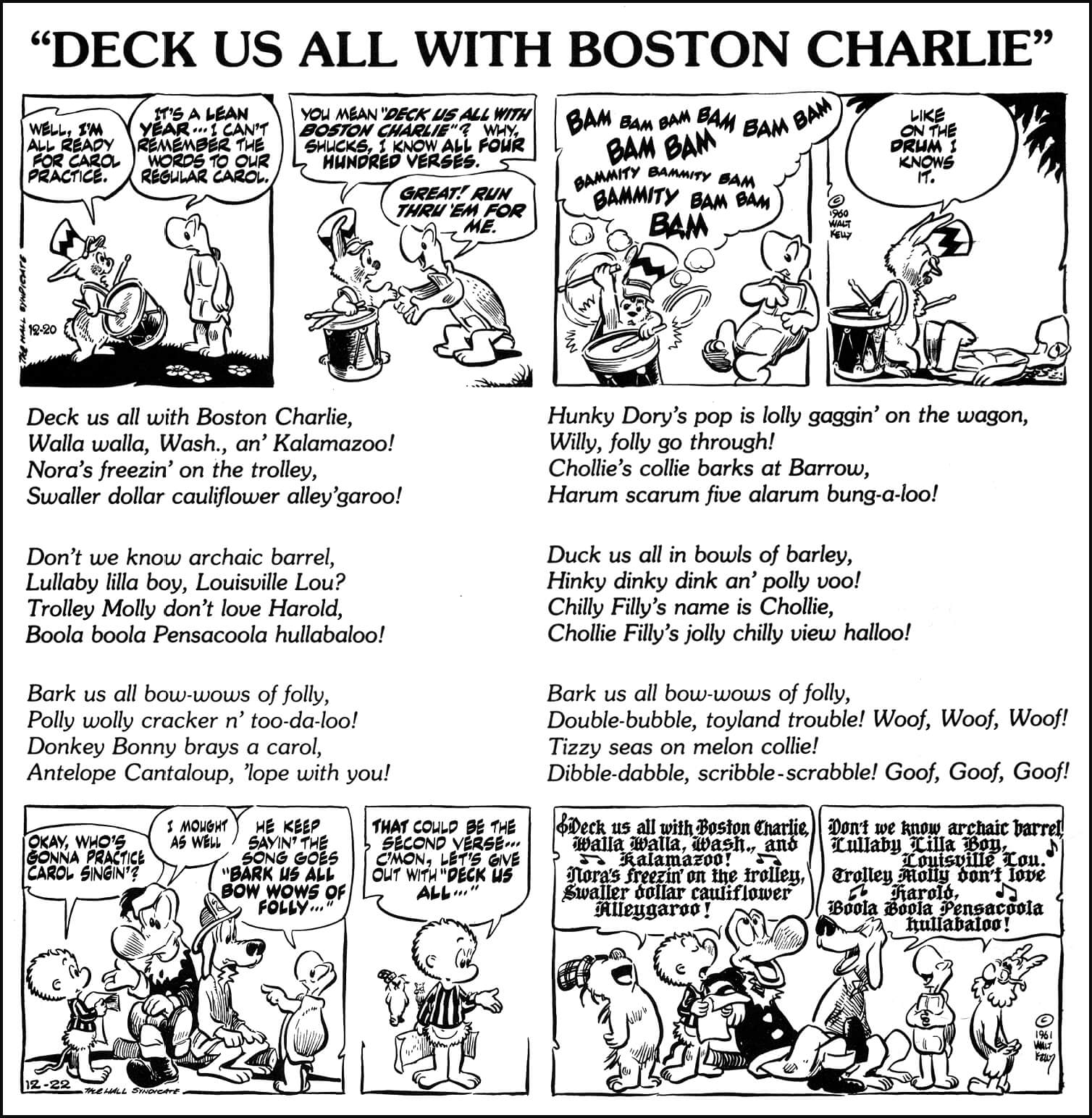
As usual, Right Click|Open in Separate Tab to get a larger image.
Merry Christmas, all.
Eric Hines


In a true Dad move -- I mean my Dad especially -- I just stuffed my wife’s and son’s stockings with tire puncture repair kits, tire pressure gauges, and battery terminal cleaning tools.
I've never been addictive, except the very small things like food. And the awful thing about getting older is food tastes better. It's just wonderful. I eat nothing else now.Defining "humor" has been a durable cottage industry, but the best stabs at it center on the upending of expectations. Cleese, who understandably conflates creativity with his own genius for humor, argues that creativity is about jumping out of ruts, exploring something new that might work better. The novelty can't appear for its own sake; it has to add something unexpectedly valuable. I tend to be somewhat fearful and controlled. My creative impulses take flight in solitude, with puzzles or crafts, fields where my impulse to limit risk doesn't intrude much. In both puzzles and crafts, the pleasure springs from solutions that bubble up from the unconscious. Naturally the process always depends on organized analysis--I say "naturally" because I clearly most enjoy challenges in which orderly, concentrated thought confer an advantage--but the pleasure depends on a healthy dose of right-brain wandering, the aha! moment of delight springing up from some deep well. The special delight of word puzzles (I'm addicted to the daily crossword, Wordle, and Spelling Bee) is not only the conscious strategies that can be learned and perfected, but the involuntary mental gymnastics that operate out of sight and pop solutions into the conscious mind as if by sorcery. Much of solving a crossword puzzle involves taking the mind out of gear and letting the unconscious process hum along. Successful "Jeopardy!" contestants have reported something similar in the past, though recently they all seem to concentrate on buzzer technique and gambling strategy. Cleese reports that creative people put off decisions until the last possible moment, a trait that drives me mad in other people. For my own part, if I'm willing to make a decision at all, I prefer to make it rapidly so I can move onto the next one. Much domestic strife stems from my impatience with my fence-sitting husband, who has a fantastic aversion to making choices in areas where I can't see why anything important is riding on the outcome. As long as the choice does get made at some point, however, there seems to be no particular problem in deferring it until it really is required. Does that signal creativity? I don't know, but it's worth a try. Certainly the mental processes that always have given me the most joy derive their power from the ability to jump out of a rut. Early in childhood I absorbed my father's childlike delight in both jokes and puzzles that operated on this principle. Satisfying dramas, for instance, put a character under stress and watch him squirt in an expected direction. Whether the field is drama, visual art, science, technology, or humor, the reaction we want is "Oh! yes!" The reaction we don't want is "But where's the fun in that?"


It is possible, I said, to make a distinction between moral philosophy and rhetoric, which is to say a distinction between the pursuit of truth and the pursuit of politics. Rhetoric is the methodology of politics, at least the happier side of politics. Von Clausewitz was right that war is politics 'by other means,' but rhetoric can be more persuasive than an army with guns. This has been true since at least Aristotle's time.
Of old, the demagogue was also a general, and then democracies changed into tyrannies. Most of the ancient tyrants were originally demagogues. They are not so now, but they were then; and the reason is that they were generals and not orators, for oratory had not yet come into fashion. Whereas in our day, when the art of rhetoric has made such progress, the orators lead the people, but their ignorance of military matters prevents them from usurping power; at any rate instances to the contrary are few and slight.
What that means is that superior generals were unable to use their skill at war to overthrow a popular leader, and the popular leader was incapable of managing a competent military action.
This is probably true today. Should the US military decide to overthrow the government by coup the populace would reject it, and they would do so because of the many fine words that they were raised with about the value of democracy. The military would be faced by titanic protests in the street, and even if they responded with force they would only see the population shift to other means of resistance. That is true, I think, even though our great orators are all dead, and our current leaders mouthing slogans that they do not really believe.
Nor can these people successfully host a coup, being ignorant; their clear attempt to convey their preferred outcome in 2020 has led only to a hapless "January 6th Panel" dragging on forever, while effective systems of response are being derived to prevent such 'fortification of democracy' from occurring again. There was a moment when Washington D.C. looked like an armed encampment, with soldiers and walls drawn up about the Capitol, but they eventually did not understand how to cement their revolution. They just kept tottering on the road they thought they knew.
So, rhetoric is much more powerful than people sometimes believe; and if it often empowers incompetent but persuasive people, at least they are less able to cause harm than a talented general might be.
Thus it is reasonable to look at rhetoric as a way of responding to advocates of Care/Sensitivity Ethics, even if the ethics themselves do not merit great consideration.
In the comments to last week's post, Tom raises a concern that the discussion did not point to a way forward. I thought it had; my sense was that we already have several ethical systems that insist on the supremacy of morality, all of which include some way of handling the issue of caring or sensitivity. I think the logic of reducing a moral concern like 'speak the truth' to a level playing field with social concerns about expressing feelings of care is sufficiently deadly that no further consideration should be given to the proposition that Care Ethics be taken to be a serous alternative to existing moral philosophies.
Tom says that he thinks that you have to find a way to give them something in order to be persuasive. It is possible to distinguish between the work of moral philosophy (on the one hand) and rhetoric (on the other). Moral philosophy can dispose of views that prove to be incoherent or unworkable, at least a philosopher can do so. Utilitarianism, one of the three major schools of moral philosophy in the West, somehow continues to have a certain number of proponents who keep trying to find ways to make it work even though it is expressly incoherent (i.e., it requires you to judge actions by their results, which in fact you can't know at the time you have to take the actions). I don't feel the need to take it seriously or consider that it might prove to be workable if you kept fiddling with it, but I do like J.S. Mill all the same.
This one is also incoherent: its stated goal is to increase social harmony and general caring/empathy, but by dethroning the practical reason that we all share in common they remove the only standard of judgment that is the same for everyone. By shifting these conflicts to the irrational areas of feeling, conflict is assured because feelings differ (and often strongly): the social harmony they take as their goal dissolves into the kinds of endless disputes we were talking about last time; the appeal to empathy for 'others' leads to people saying the worst sort of offensive things to the person they are actually talking with right now.








Even if you only ever burned coal to create the electricity to power EVs, that's still less CO2 than is released by burning gasoline.... ICE ['internal combustion engine'] vehicles only send between 16 to 25 percent of the energy created from burning gasoline to the wheels. The other 75 to 84 percent is lost due to inherent inefficiencies. Most of the loss is heat and noise, although about 10 percent is sacrificed to stuff like drivetrain losses, essentially the difference between crank horsepower and wheel horsepower....
Electric vehicles (eventually) send 87 to 91 percent of the energy in the battery to the wheels. I say "eventually" because 22 percent of that energy needs to be "recaptured" through regenerative braking. Put another way, 31 to 35 percent of the energy stored in the battery is lost for various reasons, but 22 percent can be regenerated by the "brakes."... To summarize, replacing gasoline with coal (which, for the record, is an abysmal idea) would reduce energy usage by 31 percent. Another way to think about it: Right now, Americans use about 9 million barrels of oil a day for our automotive transportation needs. Magically switching to EVs charged via burning coal would result in only needing the equivalent of about 6 million barrels. That's a big reduction.
That seems like a significant rebuttal on the one point, at least.
In the discussion to the Riddle of Steel post below, a matter has come up that deserves its own discussion.
Blogger jabrwok said...
The State is just a way of organizing human beings. It's neither intrinsically good or evil, any more than a gun or automobile or whatever.
A definition of "evil" would be useful here. I'd say "evil" is any action which undermines social trust (some actions do so more than others, hence greater and lesser evils). States can certainly *engage* in evil, and have a lot more power to do so than individuals, but I wouldn't say that a State is *inherently* evil.
E Hines said...
States can certainly *engage* in evil....
This is another misapprehension. States do nothing at all; they're merely, as noted, a means of organizing. That organization, though, is populated by particular men and women. It is those men and women who engage (no quote marks needed) in any action, and those men and women can use or abuse that organization's power to more or less good (however defined) or more or less evil (however defined).
It's important, too, to keep in mind that those definitions of good and evil, while perhaps originally the definitions of the population who created their State organization, quickly become the changing definitions of the changing men and women who populate the organization.
Grim said...
St Augustine says that evil is, purely, a privation from the good intended by God in creation. I think the administrative nation state we have today is an evil in that pure sense. Humanity organizes naturally into families; Aristotle claims that it organizes even more naturally into polities, because (he claims) that is the only place where humanity's full range can be realized. In a polity, one can be free of oppression by other families or clans or bandits; one can enjoy a sort of equality with others that is not found in nature; one can take actions as a member of that polity to govern one's self and to express one's virtues through practical action. One can help others in the community express their own virtues by electing them to other offices to which they are well-suited.
Weber's criticism of the administrative state -- you can read my notes on it by following the links at the sidebar -- shows clear privation from these goods. The need of the elected officials to constantly run for office means that they have to defer their powers to administrators who aren't elected; this means that the good of self-governance is lost, because the people we elected don't end up being the ones with power over our lives.
The need for money for those campaigns means that the elected officials also end up chasing donations instead of doing good to deserve election; that means they don't actually end up doing even their limited duties, or exercising their limited virtues.
The need to use power to perform favors for donations is inherently corrupt. It also draws into the political class not the virtuous, but the most successful at corruption.
It also creates an administrative class that is both unelected and really powerful, thus eliminating the sort-of equality that free citizens had with each other.
Thus, all the goods intended by human nature -- according to Aristotle -- end up being achieved either not at all or only privatively. Thus, per Augustine, the state is evil: and really evil, not just rhetorically evil.
E Hines said...
Except it's not the State doing any of that. It's the men and women populating the State. The State is just a tool.
Grim said...
Yes, but at the same time also no. It's true that only living beings, and not formal organizations, can act -- yes, in that sense. But it's also true that the form of organization creates effects, even they aren't willed actions. One form of organization has a structure that does the one thing; the modern administrative state's structure does the other. It's not that the right people, choosing the right things, could fix it. The right people won't be successful in obtaining offices under this structure; should they by accident, they couldn't keep them over successive cycles without becoming corrupt; the elected offices don't end up having the power to fix the problems anyway because it gets delegated to administrators; and the administrators interests are necessarily separated from those of the governed so they are sorted into separate classes.
It's similar to the materialist/immaterial issue. One can say that 'only material things exist,' and in a way that seems true: everything we can observe is composed of material parts. But it really matters how those parts are organized. The same parts can be organized into a table, and it will function as a table and provide the goods for which a table was wanted. Or they can be organized into a loose heap on the floor, in which case it's all and only the same parts -- but the form of organization prevents them from attaining any of the goods that they might have if they'd been organized into a table instead of a heap.
My sense is that the Conan-style band of adventurers is a kind of political organization, non-family members choosing a leader and striving towards a common goal, each contributing according to their own virtues and by voluntary participation. That's an ideal, more Homeric than Aristotelian as it does not attempt (nor really contemplate) the sort of organization that would entail all of the human goods that Aristotle wants from the polis.

The research, which appears Nov. 28 in JAMA Internal Medicine, shows that in the regions where the seven largest motorcycle rallies were held throughout the United States between 2005 and 2021, there were 21 percent more organ donors per day, on average, and 26 percent more transplant recipients per day, on average, during these events, compared with days just before and after the rallies....Bike rallies are generally large, crowded events that take place in rural areas or small towns with traffic infrastructure intended for much smaller populations and far less traffic, the researchers noted.This means that to increase overall safety for all motorists and pedestrians, event organizers should pay close attention to overall traffic management in addition to encouraging wearing of helmets and safe motorcycle operation.
It was not until many years later, while studying Ludwig von Mises’ text Human Action, that Thulsa Doom’s answer made complete sense to me. Mises, like Thulsa Doom, understood that power comes from action, and ideas are what drive human action.“Ideologies have might over men,” Mises wrote. “Might is the faculty or power of directing actions.”When Thulsa Doom, with a mere word, beckens a beautiful young woman to throw herself from a cliff, he’s showing Conan his power, or what Mises called “might.”“Might is the power to direct,” Mises wrote. That power, Mises understood, stems not from swords or “steel,” but ideas.“He who is mighty, owes his might to an ideology. Only ideologies can convey to a man the power to influence other people's choices and conduct. One can become a leader only if one is supported by an ideology which makes other people tractable and accommodating. Might is thus not a physical and tangible thing, but a moral and spiritual phenomenon.”This is what Thulsa Doom meant when he says it’s not steel that’s strong, but flesh. The person who can use ideas to command people is a person who has true power, true might.Unlike Thulsa Doom, Mises of course saw power as a dangerous and corrupting force, which is why he opposed concentrating might in the most powerful, and deadly institution in modern history: the state.
Doom too, in fairness: he was intending, at the time of his death, to sweep away all the governments of the world in an epic of murderous assassination. There is no reason to think he meant to replace them, as their continuing absence would eliminate any institution with the ability to oppose him and his cult.
Ironically that is the only defense for the existence of any state: such things are inherently evil, but they are effective forms of organization for opposing other organizations that are also evil. You end up having to set the evils against each other: the state against the corporation, the cartel, the mafia, the murderous cult.
The question is whether there is a way to organize along voluntary lines, as Conan's band of adventurers, to hold back the other evils without needing courts and police, law and taxation, prisons and gallows.


