More Canadian Nazis

This time it’s Trudeau’s deputy. In fairness she probably had no idea what that said or meant; but if we were being fair, they’d have admitted that the only one guy with a Nazi flag at the trucker rally wore a mask at an anti-COVID-mandate outdoor rally, only showed up one time, was not representative of the movement, and was probably a paid government agent whose job was to be photographed with the flag so Trudeau could reference it every five minutes. 

As Col. Kurt likes to say, these are the new rules. They wrote them. 

Deep Thinking

Victoria Coates was on the Trump administration’s National Security Council. She has a mild criticism

PSA on Captured Tanks, Equipment


Local victory

My county is so Republican that winning the primary virtually assures a candidate of winning the office in November.  Today was our primary election, and I'm wildly pleased with the county results.  The County Judge who's been giving me fits since I took office 3 years ago was voted out and replaced with a guy I persuaded to run.  Since I was elected, we've managed to oust the worst Commissioner, the awful County Attorney, and now the County Judge.  Their replacements are excellent.  Things are definitely looking up.  I'm not running again this year, but I'm pretty happy with the guy who won the primary today for my seat.  I actually liked both candidates who were competing for my position, but this was the one I voted for.

The Commissioners Court will be a very different place next year.  It strikes me as a good legacy.

If

At a local government meeting the other night -- I'll spare the details to keep people out of trouble -- someone was describing the particular powers of a particular office, which under the right circumstances are extraordinary. The governor can't step in and overrule this local officer, the speaker pointed out, "and if we had a President of the United States, he couldn't either." 

The room was appreciative of the nuance.

I gather there was a State of the Union address tonight, but it never occurred to me to watch it. That's the first time I think I've ever missed one. I don't care anymore. 

Enchiridion L

L

Whatever rules you have adopted, abide by them as laws, and as if you would be impious to transgress them; and do not regard what anyone says of you, for this, after all, is no concern of yours. How long, then, will you delay to demand of yourself the noblest improvements, and in no instance to transgress the judgments of reason? You have received the philosophic principles with which you ought to be conversant; and you have been conversant with them. For what other master, then, do you wait as an excuse for this delay in self-reformation? You are no longer a boy but a grown man. If, therefore, you will be negligent and slothful, and always add procrastination to procrastination, purpose to purpose, and fix day after day in which you will attend to yourself, you will insensibly continue to accomplish nothing and, living and dying, remain of vulgar mind. This instant, then, think yourself worthy of living as a man grown up and a proficient. Let whatever appears to be the best be to you an inviolable law. And if any instance of pain or pleasure, glory or disgrace, be set before you, remember that now is the combat, now the Olympiad comes on, nor can it be put off; and that by one failure and defeat honor may be lost or—won. Thus Socrates became perfect, improving himself by everything, following reason alone. And though you are not yet a Socrates, you ought, however, to live as one seeking to be a Socrates.

 This is excellent advice.

The Orthosphere on St. Anslem

In general the Orthosphere is a good site that is worth reading, and this post is also. I simply wish to correct a point about which they are mistaken.
The actual existence of God is implicit in, and so necessitated by, the very concept of God. This is what Aquinas is getting at in his argument that the actual existence of God is essential to his nature.
That is not at all what St. Thomas Aquinas was 'getting at' in that argument, an which is less his than Avicenna's; what you get in Aquinas is a summary of what is fully spelled out in Avicenna's Metaphysics, which is the thirteenth book of his Healing.* 

What these philosophers meant is to elaborate a point of Aristotle's, which defines goodness in terms of desire. Aristotle says that the good is what is desirable, and for the most part that differs based on what the thing is doing the desiring. Rain may be very desirable from the perspective of the grass, and therefore it is good for the grass; it may be less good for the sailors at sea, because it is less desirable. If we want to talk about The Good per se, then, we would need to find something that is desirable for all things. Everything, Aristotle suggests, desires existence: both grass and sailors, squirrels and trees all seek to preserve their existence and to extend it through reproduction. In the Metaphysics, the great spirits that drive the stars seek to imitate the perfection of the Unmoved Mover, which they are able to do only by rough imitation: they travel in circles (as the Greeks believed they did, based on empirical observation) because the circle has a kind of infinity in its eternal surface that never ends. 

Avicenna goes on to point out that existence is, then, goodness per se: "to exist" and "to be good" are thus phrases that differ only in emphasis. (Aquinas gives his summary of this part in ST I 5a1.) Of these two concepts, being has priority (next article in Aquinas); and thus the idea of goodness derives from existence. 

But God's existence is necessary -- and here is where Avicenna greatly outpaces Aquinas' summary. Avicenna demonstrates with two long form arguments that the universe would not exist if it were not for the existence of another being that exists necessarily: and, having proven that such a being must exist, he also proves through another set of arguments that there can be only one of them. Thus, the Orthosphere is wrong to suggest that Aquinas is merely suggesting that necessity is 'contained in the concept' of God. The proof Aquinas is citing is a proof of the logical necessity of exactly one being whose existence is necessary. It is not contained in the concept, but separately established.

Aquinas' summary of this is in ST I 2a3. He gives summaries of five arguments for God's existence. The first one is from Aristotle's Metaphysics, the argument for unmoved movers. He then gives summaries of both of Avicenna's arguments.
The second way [to prove God's existence] is from the nature of the efficient cause. In the world of sense we find there is an order of efficient causes. There is no case known (neither is it, indeed, possible) in which a thing is found to be the efficient cause of itself; for so it would be prior to itself, which is impossible. Now in efficient causes it is not possible to go on to infinity, because in all efficient causes following in order, the first is the cause of the intermediate cause, and the intermediate is the cause of the ultimate cause, whether the intermediate cause be several, or only one. Now to take away the cause is to take away the effect. Therefore, if there be no first cause among efficient causes, there will be no ultimate, nor any intermediate cause. But if in efficient causes it is possible to go on to infinity, there will be no first efficient cause, neither will there be an ultimate effect, nor any intermediate efficient causes; all of which is plainly false. Therefore it is necessary to admit a first efficient cause, to which everyone gives the name of God.

The third way is taken from possibility and necessity, and runs thus. We find in nature things that are possible to be and not to be, since they are found to be generated, and to corrupt, and consequently, they are possible to be and not to be. But it is impossible for these always to exist, for that which is possible not to be at some time is not. Therefore, if everything is possible not to be, then at one time there could have been nothing in existence. Now if this were true, even now there would be nothing in existence, because that which does not exist only begins to exist by something already existing. Therefore, if at one time nothing was in existence, it would have been impossible for anything to have begun to exist; and thus even now nothing would be in existence — which is absurd. Therefore, not all beings are merely possible, but there must exist something the existence of which is necessary. But every necessary thing either has its necessity caused by another, or not. Now it is impossible to go on to infinity in necessary things which have their necessity caused by another, as has been already proved in regard to efficient causes. Therefore we cannot but postulate the existence of some being having of itself its own necessity, and not receiving it from another, but rather causing in others their necessity. This all men speak of as God.
God's existence is necessary, then; and his goodness is then both not only also necessary, but of a kind that is just as different from ours as our possible and temporary existence is different from God's necessary and eternal one. 

His fourth and fifth proofs are also Aristotelian -- he explicitly cites Aristotle for the fourth one. His invocations of Anslem are generally critical, though as he was criticizing a canonized saint while he was yet a living man he had to couch his criticisms in respectful terms. Still, Anslem was not what he was 'getting at' in his work.

 More here and here, for the interested.

* Usually "The Healing," because Arabic is one of those languages that prefixes nouns with a definite article, as French does "la" or "le," and Spanish does "el" or "la." Just as "La France" is really "France" in English, though, the definite article is not really always necessary or appropriate in translation.

Enchiridion XLIX

XLIX

When anyone shows himself vain on being able to understand and interpret the works of Chrysippus, say to yourself: “Unless Chrysippus had written obscurely, this person would have had nothing to be vain of. But what do I desire? To understand nature, and follow her. I ask, then, who interprets her; and hearing that Chrysippus does, I have recourse to him. I do not understand his writings. I seek, therefore, one to interpret them.” So far there is nothing to value myself upon. And when I find an interpreter, what remains is to make use of his instructions. This alone is the valuable thing. But if I admire merely the interpretation, what do I become more than a grammarian, instead of a philosopher, except, indeed, that instead of Homer I interpret Chrysippus? When anyone, therefore, desires me to read Chrysippus to him, I rather blush when I cannot exhibit actions that are harmonious and consonant with his discourse.

You will never meet anyone who understands the works of Chrysippus, as they were lost. It is understood that they were respected and influential in his day, and clearly were in Epictetus', but no one now remembers what he said. 

Enchiridion XLVIII

XLVIII

The condition and characteristic of a vulgar person is that he never looks for either help or harm from himself, but only from externals. The condition and characteristic of a philosopher is that he looks to himself for all help or harm. The marks of a proficient are that he censures no one, praises no one, blames no one, accuses no one; says nothing concerning himself as being anybody or knowing anything. When he is in any instance hindered or restrained, he accuses himself; and if he is praised, he smiles to himself at the person who praises him; and if he is censured, he makes no defense. But he goes about with the caution of a convalescent, careful of interference with anything that is doing well but not yet quite secure. He restrains desire; he transfers his aversion to those things only which thwart the proper use of our own will; he employs his energies moderately in all directions; if he appears stupid or ignorant, he does not care; and, in a word, he keeps watch over himself as over an enemy and one in ambush.

Indeed on this model only one's self is one's proper enemy. The semblances outside cannot hurt you, not really; but you can hurt yourself, and badly, by doing wrong. If any of you actually read that novel I wrote, you'll recognize this principle: death cannot hurt you, but you can be hurt by life. Those parts that hurt you are the things you do that you shouldn't have done. 

Yet Epictetus' instruction here is in tension with an earlier description, from chapter V: "When, therefore, we are hindered or disturbed, or grieved, let us never impute it to others, but to ourselves—that is, to our own views. It is the action of an uninstructed person to reproach others for his own misfortunes; of one entering upon instruction, to reproach himself; and one perfectly instructed, to reproach neither others nor himself." 

The tension is resolved if we accept this as degrees of mastery. It is the mark of a proficient to accuse himself if he is hindered or restrained; but the master reproaches no one, neither himself nor anyone else. The master takes the ride: he forgives everything, and he forgives others as he forgives himself. In this way the Stoic satisfies the most powerful commandments of a religion he did not share. 

When they're just lying to us again

In the annals of meta, prepared to be shocked by the news that status pages for the big internet hubs sometimes are less than candid about the true state of their service, doggedly proclaiming that All Is Well.  Now there is a Status Page Status Page that cheekily compares the official pronouncements with the reported user experience, thus threatening morale and inciting insurgency.  Presumably the Attorney General, the CDC, and Justin Trudeau are already on the case.  Fact-checking is all very well if top men do it, but this kind of thing is the Wild West, dog-eat-dog capitalism.

Missing links

I play for team eukaryote myself, and have never thought of transitioning to prokaryote.  It would seem like abandoning complexity and specialization, and is the simple and undifferentiated life worth living?  I don't even have any friends who lack a nucleus or organelles, or who identify as unicellular (pronouns one/one).  Also, we are all detectable without a microscope.

The startling news from the world of biology is that this yawning divide, thought to have been complete billions of years ago, is not as nonbinary as we thought.

Enchiridion XLVII

XLVII

When you have learned to nourish your body frugally, do not pique yourself upon it; nor, if you drink water, be saying upon every occasion, “I drink water.” But first consider how much more frugal are the poor than we, and how much more patient of hardship. If at any time you would inure yourself by exercise to labor and privation, for your own sake and not for the public, do not attempt great feats; but when you are violently thirsty, just rinse your mouth with water, and tell nobody.

This part bears very strong resemblance to Matthew 6, but the motivation is completely different. "[W]hen you pray, go into your inner room, shut your door, and pray to your Father, who is unseen. And your Father, who sees what is done in secret, will reward you." Here there is no expectation of a divine reward; but the practical advice is the same.

"I drink water" as opposed to wine, I expect; the point is not to be 'virtue signaling,' as we call it today. "Oh, I used to eat expensive dinners at fine restaurants, but these days I cook all my own food. It's just so much healthier, and it leaves us extra money to travel -- which is so important, you know, to opening your mind and understanding the world." There are several good reasons not to do this even apart from Jesus' suggestion that God will reward virtue, such as that it annoys everyone to hear you do it. That isn't Epictetus' point either. 

The point is itself about virtue, in the Aristotelian sense of "excellence." If you want to realize this philosophy as fully as possible, this is the way. 

And yet, notice the tension with the last chapter. It was said you should be a living example of your philosophy so that people might learn better from your example than from your words. Now you are being told to hide your actions, so that no one can see them or know of them. This protects you, the Stoic, from vainglory and pride and all similar failings. But now the ignorant will remain ignorant; they will never know that you have trained yourself only to wash your mouth when thirsty, and so bear hardship and privation. 

Not in the basement


Elon Musk steps up again

During the Canadian truck protests, Elon Musk was reported to have established Starlink stations on top of trucks parked near the capitol, when the authorities threatened to interrupt communications.  Apparently he did the same for the Tonganese after the volcano. Now he's done the same in Ukraine.


Ukraine and America

Ukraine's defense has been bold and admirable; they have shown us that the Russian forces, even their elite forces, are structurally and doctrinally weak. Russia is almost certain to win, but it is paying a huge price for it. Americans would never accept losing two companies of the 82nd Airborne en route to seize an airfield they never reached; nor having deployed airborne and special operations units to another airfield, only to see them wiped out. The losses of tanks and mobile infantry are already staggering. Yesterday some pundits were speaking of how Putin would press on to seize the rest of Eastern Europe, which he plainly couldn't do with 150,000 troops; today, it's clear that he will be grateful if he manages to swallow, let alone digest, what he has undertaken.

Having said all of that, Lee Smith has an important point on how America has led Ukraine to the bleeding point. It's a long piece, but needs to be considered: the basic lesson is that our intelligence agencies played them for their own advantage, and used them to destabilize other states -- and of course the hated Trump administration, impeached over Ukraine but the administration that actually gave them the weapons they needed to fight Russian tanks. 

Enchiridion XLVI

XLVI

Never proclaim yourself a philosopher, nor make much talk among the ignorant about your principles, but show them by actions. Thus, at an entertainment, do not discourse how people ought to eat, but eat as you ought. For remember that thus Socrates also universally avoided all ostentation. And when persons came to him and desired to be introduced by him to philosophers, he took them and introduced them; so well did he bear being overlooked. So if ever there should be among the ignorant any discussion of principles, be for the most part silent. For there is great danger in hastily throwing out what is undigested. And if anyone tells you that you know nothing, and you are not nettled at it, then you may be sure that you have really entered on your work. For sheep do not hastily throw up the grass to show the shepherds how much they have eaten, but, inwardly digesting their food, they produce it outwardly in wool and milk. Thus, therefore, do you not make an exhibition before the ignorant of your principles, but of the actions to which their digestion gives rise.

Note that the discussion of principles is not itself to be avoided, but talking about them among the ignorant. Discussions among those interested in philosophy can be beneficial, and of course for those who wish to become students they are necessary. One can only learn by being exposed to the arguments, and one learns best by working them through with a good teacher.

So if a teacher must talk about principles in order to educate the student, and the student must by necessity begin as ignorant, how can it be wrong to talk among the ignorant about principles? The difficulty is not in talking to a single student, but in talking 'among' the ignorant. The dynamics of the crowd make it difficult for a crowd to hear and learn anything. What is popular will often seem to have the greatest force. Education comes in a different environment than the crowd. 

There is a parallel here in Jewish philosophy. Moses Maimonides notes the tradition among the wise of his faith to teach the interpretation of the vision of the prophet Ezekiel "only viva voce," and not to commit it to writing. (He then, of course, commits a great deal of his interpretation to writing; it makes up the first section of Part III of The Guide for the Perplexed.) It was sometimes said that this particular subject should never be taught in the presence of two (or more). Serious matters require a serious, intent discussion among people with the right kind of relationship of trust and respect. 

Epictetus is giving two pieces of advice here: the first on how to prevent philosophical thought from coming under mockery by the ignorant, which could bring disrepute upon most worthy ideas and ideals. More importantly, though, he is showing you how to prove your philosophy. If it is the right thing to do, then do it, don't talk about it. By observing your actions, people will come to understand your ideals; and by seeing how well they work, they will better understand their value than by having them explained.

Like the sheep who produces milk and wool, a Stoic who lives his ideas is creating real good in the world. Aristotle's ethics also turns on the importance of actually being virtuous, not just understanding what is and is not a virtue. Practice is essential; it is what makes the real good, virtue, so that the world has virtuous men to rely upon.

Can't you trust any crowdfunding sites?

 Patreon has shut down donations to a Ukrainian defense group.  Wouldn't want them to use the money for any of those nasty violent weapons.  Someone might get hurt.

Good news on the Texas border

 Not about immigration, of course, just about the defection of a large swath of formerly loyal Democratic voters to the GOP.

I've always thought it was "swathe," by the way, but that turns out to be the Brit spelling.  These are things I learn by obsessively working the Wordle puzzle, which is based on 5-letter words.

Enchiridion XLV

XLV

Does anyone bathe hastily? Do not say that he does it ill, but hastily. Does anyone drink much wine? Do not say that he does ill, but that he drinks a great deal. For unless you perfectly understand his motives, how should you know if he acts ill? Thus you will not risk yielding to any appearances but such as you fully comprehend.

We tried to instill timely bathing, and especially showers, although I'm not sure how much success we had in doing so. Regular bathing, too. Well, boys are a slow crop as Cassandra used to say.

Moderation in wine consumption is also a longstanding goal, one achieved as well as it has been and neither better nor worse. 

Canadian Tyranny Continues

Thirty-nine trucking businesses are shut down by the government. 

So they’re protesters who — as far as we know — have not been charged with any crime. But they’ve just had their businesses shut down. What does that mean?

A business they’ve built up their whole lives, maybe. A truck, a company, a licence, insurance — all the parts of it — just ended. No trial. No judge. No hearing. No appeal. Just happened. And of course it was done by Doug Ford — but at Ottawa’s direction.

Well, there's no law. That's the point. 

UPDATE: Some well-deserved mockery.

A Bright Note on a Dark Day

Those Javelin missiles Trump sent Ukraine turn out to work really well on Russian tanks. 

Unpatriotic Conservatives

My reason for wanting to avoid war, shifting to containment rather than deterrence, is that it is strategically the only sensible move. We cannot fight a war with Russia from our present position without losing it and/or escalating into truly disastrous territory. 

However, there are others who are opposed to fighting the war for other reasons. Rod Dreher at The American Conservative writes on this today. He begins by reminding us that "Unpatriotic Conservatives" was also a line used to oppose those, like Pat Buchanan, who opposed the Iraq war. [There is a lot of cursing in this post, which normally we don't do at the Hall, but it's an emotional moment and topic.]
[T]he world is full of evil bastards, not all of whom can or should be fought by American soldiers. War is a great clarifier. As I type this, I’m thinking of the gentle kid from my summer baseball league in the 1970s, who grew up to be sent to Iraq with the Louisiana National Guard, and who came home traumatized and unable to set foot inside his family’s church, because he said God could never forgive him for what he did over there. To my knowledge, he has never told a soul what it was (I heard about it from his anguished wife....

The people who need to hear it most are utterly incapable of listening. So I’m going to say it both to lay down a marker for the future (for when the talking heads puzzle over how things got to this disastrous point) and to encourage fellow conservatives who are thinking these thoughts, but are confused by them, because they’re new, and feel strange and even kind of dirty.

To repeat myself: I am opposed to Russia’s actions in Ukraine. I think Russia should leave Ukraine alone, but whatever happens, I am adamantly against following the US leadership into hawkish actions against the Russians. It’s not at all because I support Russia or in any way approve of what it’s doing. (I hope Russian families and Russian soldiers stop to think about what exorbitant cost is extracted from them so that Putin can restore Greater Russia.) It’s rather that I am sick to the point of puking of these people — the American elites — sh*tting all over so many of us, yet expecting us to send our sons (and daughters) to fight its damn wars. 

I would definitely not send my son to fight in a war that cannot be won. I might go myself, although Aquinas reminds us that wars are only justifiable if they have a hope of victory -- otherwise there is no potential good to balance against the certain evil that results from war. It may be, though, that Dreher and Reaboi and others he cites are correct about where our real struggles properly lie. 

Thoughts on Ukraine

The great, indeed grave, danger in Ukraine is that our politicians will talk themselves into trying to join the fight. Reportedly NATO has been cleared to execute war plans at the discretion of the Supreme Allied Commander - Europe, who is a fighter pilot by training rather than a maneuver warfare veteran. The war as it is unfolding is a classic maneuver war, with pinning forces and attempted envelopments, plus a flanking maneuver that has already seized the airport at the Ukrainian capital. It is too late now to do anything of value except contain the war to Ukraine if possible. 

As I said in January, the West signaled very strongly that Ukraine would be left to the wolves. Changing our minds now, when we are out of position, would lead to a widening war -- the example I used was the Korean conflict, but it might be far worse. The time to move the forces into place that would have been necessary to deter this war is past. The only thing to do now is to try to keep the war from spreading, and start laying the groundwork for a future strategy. 

Putin's plan initially seems bolder than my estimate, which assumed he would try only to seize the Russian-majority regions in the east. That may still be his actual plan; claiming that he intends to seize the whole and "demilitarize" it gives him a strong opening negotiation position should he care to bid for having sanctions dropped in return for letting the rest of the country go. Holding the whole thing would be expensive, and insurgency is very likely especially in the west.

In December of last year I suggested raising that cost in Ukraine and Taiwan by urging the adoption of a version of the Second Amendment. I notice that Ukraine has, this morning, granted all citizens the right to bear arms. Better late than never, but this would have been more effective two months ago when there was still time to distribute arms to the people (and ammunition), and to conduct training in their use and maintenance. 

There are only long-term answers that are good answers now. We need to do the following:

1) Revisit energy policy, with an eye on nuclearization here at home. We should restore the last administration's all-in approach to production in the meantime, but electrification with clean nuclear power -- the stuff is way cleaner now than in the old days, and actually much cleaner than coal -- would provide us with energy independence in the long term.

2) We need all-new leadership. The political leadership must be replaced, but that is insufficient. The bureaucracies need to be scalped at least: every flag officer should be cashiered for going along with the degradation of our armed forces into an Army that can't execute a withdrawal maneuver without chaos and a Navy that can't paint its ships or prevent collisions or put out fires on them. Some of the bureaucracies should be entirely dissolved and not replaced; others, like State, should be replaced throughout. We need people who understand what national security is actually about, which is not trying to implement 'the successor ideology.' It is preparing for war, and using that strength to prevent war.

3) The United Nations should dissolve in disgrace like the League of Nations before it, and for the same reason: utter failure to perform its claimed mission of preventing war. It should be replaced with nothing. Instead we should reinforce alliance networks where we need to deter predatory powers. (This may include NATO-ally Turkey, which is spending today conducting mock air raids on Greece -- as China is, today, on Taiwan.)

Those are all long-term steps, and we cannot get started on any of them until next year -- after the election seats a partially-new government. So, for now, there's nothing to do but let the wolves take the sacrificial lambs. It may be possible to interfere with their digestion by supporting armed populations and covertly supporting insurgencies, but it is not now possible to stop Russia from eating as much of Ukraine as it decides it really wants to do.

Enchiridion XLIV

XLIV

These reasonings have no logical connection: “I am richer than you, therefore I am your superior.” “I am more eloquent than you, therefore I am your superior.” The true logical connection is rather this: “I am richer than you, therefore my possessions must exceed yours.” “I am more eloquent than you, therefore my style must surpass yours.” But you, after all, consist neither in property nor in style.

This is straightforward, although I suppose it would be surprising to some people to learn that neither wealth nor properly creased pants convey superiority. That was Tyler Durden's insight: "You are not your job. You are not how much money you make. You are not the car you drive; you are not the contents of your wallet. You are not your khakis." 

What are you, then?

Canadian Senate Reins in Trudeau

Canada has a parliament modeled on the British one, though the upper house of that parliament is called the Senate rather than "the House of Lords." The Senate was described by Canada's first prime minister as the house of 'sober second thought.' In England this became true of the House of Lords because all real power passed over time to the House of Commons, but the House of Lords was entitled to delay the enforcement of laws passed by the 'lower' house for as much as two years. In Canada, the Senate has an actual veto power.

In advance of the Senate's vote on his Emergency Act decree, Justin Trudeau has withdrawn the decree. Plainly this is because he did not have the votes. He only got it through the lower house by a parliamentary maneuver that allowed him to declare it a 'confidence vote,' such that if he lost the vote his entire governing coalition would lose power and face a new election. His allies in the New Democratic Party expressed great reluctance about having to vote for this act, and about its wisdom, but they finally went along with it to avoid losing power. No similar tactic was available in the Senate.

It is worth noting, however, that the financial powers used under this act have been made permanent by the bureaucracy separate from the need to invoke the Emergencies Act. Banks are already moving to unfreeze accounts, but the power to make the banks freeze accounts in retribution for political disagreement will remain in place.

For now, at least. This is a significant defeat for the forces of evil -- I use the term unironically and advisedly -- that may perhaps lead to other defeats. They showed their faces, and now must wait the judgment of the Canadian voter's 'sober reflection.' 

Weak Bones

The Pentagon weighs in on that exercise question. 

All Our Leaders are Unworthy

A solid rebuke to the State Department on the Ukraine situation.

Addendum to XLI

Enchiridion XLI had some commentary on the question of whether 'excessive' exercise is good or bad. Here is an opinion from Socrates, as related not by Plato -- whom we usually read for discussion of Socrates -- but by Xenophon, a friend whose great fame comes from his work as a soldier, mercenary, and horseman. Indeed his work on horsemanship is the earliest treatise I know of on the topic; and his discussion of his mercenary work, the Anabasis, is one of the great works of Western literature. This comes from Xenophon's Memorabilia, Book 3. As in the prior example, the Olympics are cited. I have highlighted some particularly relevant parts.
"Just as much as the competitors entered for Olympia,” [Socrates] retorted. “Or do you count the life and death struggle with their enemies, upon which, it may be, the Athenians will enter, but a small thing?  Why, many, thanks to their bad condition, lose their life in the perils of war or save it disgracefully: many, just for this same cause, are taken prisoners, and then either pass the rest of their days, perhaps, in slavery of the hardest kind, or, after meeting with cruel sufferings and paying, sometimes, more than they have, live on, destitute and in misery. Many, again, by their bodily weakness earn infamy, being thought cowards. Or do you despise these, the rewards of bad condition, and think that you can easily endure such things? And yet I suppose that what has to be borne by anyone who takes care to keep his body in good condition is far lighter and far pleasanter than these things. Or is it that you think bad condition healthier and generally more serviceable than good, or do you despise the effects of good condition? And yet the results of physical fitness are the direct opposite of those that follow from unfitness. The fit are healthy and strong; and many, as a consequence, save themselves decorously on the battle-field and escape all the dangers of war; many help friends and do good to their country and for this cause earn gratitude; get great glory and gain very high honours, and for this cause live henceforth a pleasanter and better life, and leave to their children better means of winning a livelihood.  
“I tell you, because military training is not publicly recognised by the state, you must not make that an excuse for being a whit less careful in attending to it yourself. For you may rest assured that there is no kind of struggle, apart from war, and no undertaking in which you will be worse off by keeping your body in better fettle. For in everything that men do the body is useful; and in all uses of the body it is of great importance to be in as high a state of physical efficiency as possible. Why, even in the process of thinking, in which the use of the body seems to be reduced to a minimum, it is matter of common knowledge that grave mistakes may often be traced to bad health. And because the body is in a bad condition, loss of memory, depression, discontent, insanity often assail the mind so violently as to drive whatever knowledge it contains clean out of it. But a sound and healthy body is a strong protection to a man, and at least there is no danger then of such a calamity happening to him through physical weakness: on the contrary, it is likely that his sound condition will serve to produce effects the opposite of those that arise from bad condition. And surely a man of sense would submit to anything to obtain the effects that are the opposite of those mentioned in my list.

Besides, it is a disgrace to grow old through sheer carelessness before seeing what manner of man you may become by developing your bodily strength and beauty to their highest limit. But you cannot see that, if you are careless; for it will not come of its own accord.”

That all seems opposed to Epictetus' dictum, as recorded in a discussion among men who were famous for wartime courage and activity. Naturally, I endorse the Socratic and Xenophonic view.

Enchiridion XLIII

XLIII

Everything has two handles: one by which it may be borne, another by which it cannot. If your brother acts unjustly, do not lay hold on the affair by the handle of his injustice, for by that it cannot be borne, but rather by the opposite—that he is your brother, that he was brought up with you; and thus you will lay hold on it as it is to be borne.

Sometimes I find it very easy to bear that someone needs to be cut out of my life, whoever they were before. This is possible to do when it must be done, as everyone who has walked away from a once-beloved who proved to be incompatible with you has learned. Sometimes even a cousin who develops a drug problem (and consequently a theft problem) can be cut out without much trouble. Still, one might say in the case of a brother that normally there ought to be a duty of blood that overcomes that.  

More broadly considered, this is a general principle. If one were in a failing state like the Weimar Republic, one could bear it because one knew it would pass and worked as well as one could for something better. If the state then failed more completely, as Weimar did, one could bear it because one could do little to support the new state and only one's duty to family and friends. 

Yet there comes a point at which things are not to be borne. The Stoic here is advising you on how to survive and learn to live with horrible things. That is a breaking point between their philosophy and my own, which holds that death is preferable to dishonor. Somethings ought not to be borne; somethings, even 'semblances,' must be opposed by a decent internal soul. Even if it destroys us.

Poll: Democrats Support Suspending Rule of Law to Crush Truckers

Sixty-five percent of Democrats told the Trafalgar Group so, anyway. I am not sure Americans fully understand how grave a violation of what we would ordinarily consider to be the rule-of-law this Canadian move is. They just know that they hate the truckers, and wanted to see them crushed, and the government crushed them.

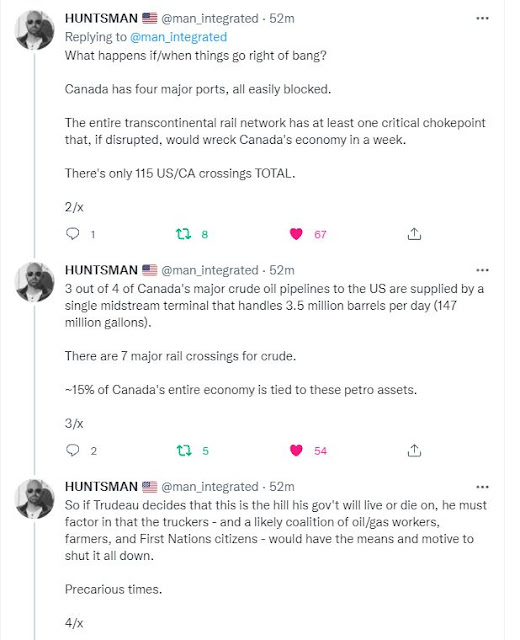
Well, for now it has, although if the truckers decide to fight they could easily blockade several parts of the Canadian economy that would compel the regime to surrender fairly quickly. Canada remains extremely vulnerable to this strategy, which is partly why the government is willing to throw out their whole legal tradition and basic Constitutional protections in order to oppose it. 

Yet it is important to grasp just how severe a violation of the rule-of-law this move really is. The Canadian government has ordered banks to freeze the bank accounts of people merely suspected, not proven, to have supported the truckers in any way -- without a court order or any due process, and barring you for suing for damages over it. Some bank accounts have been frozen for donations as small as $40. For the price of dinner out, the government is willing to see you lose your life savings and home if you can't pay  your mortgage. I can't think of any crime involving $40 that isn't a misdemeanor, not a felony.

Those small, deadly donations were not made to a terrorist organization, either, but to a perfectly legal registered nonprofit. So it is not just that the donors are being punished for a crime without due process: they are being punished for behaving in a perfectly legal way, and without due process.

Even for those who engaged in civil disobedience and therefore did break some law, the laws involved are minor violations:  literally they are honking too loud, or parking a motor vehicle in an unauthorized location, or refusing verbal police instructions. Civil disobedience does normally require that you accept the lawful punishment for your choice to express discontent in an extralegal manner, but these are '30 days if convicted at trial' offenses, not 'held-without-bail and then ten years in prison' offenses under the laws that actually existed at the time of the actions. Ex post facto laws have been created, and are being retroactively applied, which is a violation of ordinary Anglo-American principles of justice (it would be formally unconstitutional here).

So your life can be destroyed by ex post facto laws that targeted perfectly legal behavior, or what were minor violations of civil order at the time they were done, on suspicion alone and without due process. These powers are totalitarian in scope, in other words: they presume not only to govern according to the law, but to change the law after the fact to fit whatever they decide they wanted to govern. All aspects of life, including those currently strictly legal, fall under this scope.

Those are only the broad-brush strokes of the challenge. There are other worthy issues, for example, the fact that actually violent protests in Canada from left-wing actors are never punished in any similar way. In three weeks of trucker protests, they committed not one single assault or battery or violence of any kind; in that environmentalist protest, they set wildfires and destroyed construction equipment, then attacked responding security and Royal Canadian Mounted Police with axes. Equality under the law, then, is also being violated here.

Ultimately this a much more serious challenge to the Western tradition of liberty just because it's being done in a once-secure Western state. If bedrock principles like the rule-of-law, no ex post facto laws, and equality under the law can be simply set aside in Canada, it can happen anywhere.

There is also a pragmatic danger. Venezuela did this kind of thing once Chavez took power, and declined from being one of the richest and happiest nations on earth to an impoverished tyranny. Canada could follow a similar route, even with all its wealth -- Venezuela also had wealth, and still sits atop massive oil reserves. Not only would that be terrible for Canadians, Americans must consider that we could end up with failed or failing states on both of our long land borders. Although taking on qualified truck-driver refugees would actually benefit our economy, the costs of Canada falling into a Venezuelan-style death spiral will be bad for us as well as them. 

So reflect carefully, everyone, on just how serious this action by Trudeau really is. It is not just winning a political fight: it threatens the death of some of the most basic principles of our whole political tradition.

Enchiridion XLII

 XLII

When any person does ill by you, or speaks ill of you, remember that he acts or speaks from an impression that it is right for him to do so. Now it is not possible that he should follow what appears right to you, but only what appears so to himself. Therefore, if he judges from false appearances, he is the person hurt, since he, too, is the person deceived. For if anyone takes a true proposition to be false, the proposition is not hurt, but only the man is deceived. Setting out, then, from these principles, you will meekly bear with a person who reviles you, for you will say upon every occasion, “It seemed so to him.”

This reminds me strongly of the Quakers, as explained in the excellent 1947 John Wayne movie "Angel and the Badman."

Quirt: That on the wall [indicating an inscribed plaque]. "Each human being has an integrity that can be hurt only by the act of that same human being and not by the act of another human being." Is that Quaker stuff? [Penny silently affirms the question.] You mean, nobody can hurt you but yourself? 

Penny: That's a Friends' belief.

Quirt: Well, supposin' somebody whacks you over the head with a branding iron? Would that hurt?

Penny: Physically, of course. But in reality it would injure only the
person doing the act of force or violence. Only the doer can be hurt by a
mean or evil act.

Quirt: Are there very many of you Quakers? 

Penny: Very few. 

Quirt: I sort of figured that.

 There aren't a lot today, either.

Why can't a woman be more like a man?

 This is getting very Meta.  Facebook removed the following Bee post for "hate speech."


Enchiridion XLI

XLI

It is a mark of want of intellect to spend much time in things relating to the body, as to be immoderate in exercises, in eating and drinking, and in the discharge of other animal functions. These things should be done incidentally and our main strength be applied to our reason.

Calls to moderation are a regular feature of Greek philosophy, and all philosophies strongly informed by them. It is interesting that 'exercise' is included, here, though; remember in XXIX striving to win the Olympic Games was offered as an analogy to philosophy. Here we seem to be counseled against Olympic ambitions, but to seek philosophy with our real strength.

There is a counterpoint in Aristotle, where he offers an account of the soul that also summons us to philosophy as the main and most proper human pursuit. Yet we should strive to master our lesser faculties, just because it makes it easier to be good at philosophy. A healthy body will think clearer thoughts, and not being distracted with illness and medications and treatments of various sorts, the pursuit of health is wise just because it improves our ability to philosophize. 

A Teachable Moment

I don't know if these are the sort of people who learn lessons, but they have at least been presented with an opportunity.
According to Antifa protesters who took over the presser, identified by the Post Millennial as “Hailley Nolan and Dustin Ferreira,” the previous night their comrades had gone to confront members of the notorious Portland area biker gang [motorcycle club], the Gypsy Jokers. Police say at least one of the Antifa militants was armed (which they usually are).

That went exactly as well as you'd expect.  

The Asheville Celtic Festival

Glorious, two years on from the last occasion. Albannach was there, and they performed the best live show I’ve ever attended. 

Thousands came, mead flowed and beer, Highland games and swordplay, a great time for all. 


To Hell With the Washington Post

Not to put too fine a point on it.
The primarily White supporters of the Freedom Convoy argue that pandemic mandates infringe upon their constitutional rights to freedom. The notion of “freedom” was historically and remains intertwined with Whiteness, as historian Tyler Stovall has argued. The belief that one’s entitlement to freedom is a key component of White supremacy. This explains why the Freedom Convoy members see themselves as entitled to freedom, no matter the public health consequences to those around them.

Historian Tyler Stovall can jump in the lake too. How about an alternative perspective, less in favor now than once in Washington and elsewhere:

We hold these truths to be self-evident, that all men are created equal, that they are endowed by their Creator with certain unalienable Rights, that among these are Life, Liberty and the pursuit of Happiness.--That to secure these rights, Governments are instituted among Men, deriving their just powers from the consent of the governed, --That whenever any Form of Government becomes destructive of these ends, it is the Right of the People to alter or to abolish it, and to institute new Government, laying its foundation on such principles and organizing its powers in such form, as to them shall seem most likely to effect their Safety and Happiness. Prudence, indeed, will dictate that Governments long established should not be changed for light and transient causes; and accordingly all experience hath shewn, that mankind are more disposed to suffer, while evils are sufferable, than to right themselves by abolishing the forms to which they are accustomed. But when a long train of abuses and usurpations, pursuing invariably the same Object evinces a design to reduce them under absolute Despotism, it is their right, it is their duty, to throw off such Government, and to provide new Guards for their future security.

Emphasis added, because emphasis is needed. 

Enchiridion XL

XL

Women from fourteen years old are flattered by men with the title of mistresses. Therefore, perceiving that they are regarded only as qualified to give men pleasure, they begin to adorn themselves, and in that to place all their hopes. It is worth while, therefore, to try that they may perceive themselves honored only so far as they appear beautiful in their demeanor and modestly virtuous.

It is unusual to hear ancient philosophers speak about women; Aristotle was famously incurious about them, at least in his writing. Socrates apparently said something like, "By all means marry; for if you get a good wife you shall become happy, and if you get a bad one you shall become a philosopher."

Epictetus has said little enough about women, but it is kind and decent: understand why they might seem vain, for society puts little value on anything except their attractiveness, on which everything for them may depend; but honor them rightly, for virtue and character. 

Meanwhile, Back at the Ranch

Don Surber brings up the other Canadian protests that apparently GoFundMe is okay supporting and Trudeau isn't using emergency powers against. From the Vancouver Sun:

Very early Thursday, just after midnight, Coastal GasLink security called RCMP for help, reporting it was under attack by about 20 people, some wielding axes.

RCMP Chief Supt. Warren Brown, commander for the north district, called the attack a “calculated and organized violent attack that left its victims shaken and a multi-million dollar path of destruction.”

Coastal GasLink said in a statement the attackers surrounded some of its workers in a “highly planned” and “unprovoked” assault near the Morice River drill pad site off the forest service road.

“In one of the most concerning acts, an attempt was made to set a vehicle on fire while workers were inside,” said the company in a statement. “The attackers also wielded axes, swinging them at vehicles and through a truck’s window. Flare guns were also fired at workers.”


"No"

Nunchuk, a bitcoin outfit, responded politely to the Canadian government's request that it freeze the bitcoin assets of its customers:


Then it added:

EdgeWallet also sent back a polite response, saying its considered response to this important request was "No."

Enchiridion XXXIX

XXXIX

The body is to everyone the proper measure of its possessions, as the foot is of the shoe. If, therefore, you stop at this, you will keep the measure; but if you move beyond it, you must necessarily be carried forward, as down a precipice; as in the case of a shoe, if you go beyond its fitness to the foot, it comes first to be gilded, then purple, and then studded with jewels. For to that which once exceeds the fit measure there is no bound.

Fascism in the North


Illicit Profit

The Department of Justice goes Communist

Inflation is treason, comrade. 

Enchiridion XXXVIII

XXXVIII

As in walking you take care not to tread upon a nail, or turn your foot, so likewise take care not to hurt the ruling faculty of your mind. And if we were to guard against this in every action, we should enter upon action more safely. 

Enchiridion XXXVII

XXXVII

If you have assumed any character beyond your strength, you have both demeaned yourself ill in that and quitted one which you might have supported.

What is a character beyond your strength? It is a character that professes that it can determine events in the world outside the mind. This is a great human desire; even Aristotle falls prone to it in the later parts of the Nicomachean Ethics, in which he describes the virtue of courage as the virtue that wins wars. In the earlier parts he is more careful: virtues are to be judged by probability of outcome, and courage is said to be a virtue even though it is sometimes the very thing that destroys you. On average, however, courage works out with reasonable reliability. In the later books, he offers what philosophers sometimes describe as a 'thicker' version: courage wins wars, and thus wars are in a way a competition of virtue. The most virtuous in this particular way will be the winner.  

That is not true. The bravest does not always prevail. To assume a character that asserts that it is so courageous as to be undefeatable is to lie to one's self, and to those who believe you. Many a man has promised his wife and children to return from the war victorious, and then never returned at all. It was not because they were not brave men.

Epictetus suggests that lying to yourself is demeaning; and asserting a greater power than you have is a lie. A better man would not lie to himself, but would be honest about his limits as well as his powers. 

If you abandon that honest character in order to assert more boldly than you can really defend, then you are exactly as he describes in this chapter. You quit the honest character you could have defended, and demeaned yourself by lying. This is not virtue, neither courage nor any other.

Thought Crimes Will Be Prosecuted

Pastor Artur Pawlowski, who remains in solitary confinement for 23 hours per day, according to his lawyer, was arrested last Monday after he spoke to members of the trucker blockade along the U.S.-Canada border in Coutts, Alberta, on Feb. 3.

During a 20-minute speech to the truckers, the pastor urged them to "hold the line" against government overreach without resorting to violence. They had reportedly reached an agreement to abandon their blockade of the U.S. border and travel to Edmonton until changing their minds following Pawlowski's address.

So, the crime is having given a speech urging continued defiance of the government.  It's not even "he incited defiance," because they were already engaged in defiance when he got there. He just persuaded them to keep it up a while longer.

Enchiridion XXXVI

XXXVI

As the proposition, “either it is day or it is night,” has much force in a disjunctive argument, but none at all in a conjunctive one, so, at a feast, to choose the largest share is very suitable to the bodily appetite, but utterly inconsistent with the social spirit of the entertainment. Remember, then, when you eat with another, not only the value to the body of those things which are set before you, but also the value of proper courtesy toward your host.

Courtesy towards your host is a praiseworthy thing; overall, this section is another that is similar in tone to the Havamal in several respects. 

A greedy man, if he be not mindful,
eats to his own life's hurt:
oft the belly of the fool will bring him to scorn
when he seeks the circle of the wise.

Herds know the hour of their going home
and turn them again from the grass;
but never is found a foolish man
who knows the measure of his maw.

The translation of the first line is confusing, because it gives 'it is day / it is night' as already in a disjunctive form. That makes it hard to get the point about why it lacks force as a conjunctiver argument. In symbolic logic, the two propositions look like this:

x(Dx∨Nx) [Disjunctive: "For any time x, either x is day or x is night"]
x(Dx∧Nx) [Conjunctive: "For any time x, x is day and x is night."]

The point is just that a proposition about day/night works well as a disjunctive in ordinary language, and not at all well as a conjunctive. Although, notice that the conjunctive is also* a true statement: at any time x on planet Earth, it is both day (on the light side of the planet) and also night (on the dark). One might also make arguments about the disjunctive's truth conditions during periods of twilight or dawning. 


* Strictly speaking a true disjunction is satisfied, i.e. evaluates as true, at least one of the conditions is true. Thus, the disjunctive is true if it is either day or night, or both day and night; and thus the disjunctive is true and the conjunctive is true. There is another logical operator called 'exclusive OR' that is like the disjunctive, but only satisfied if -- in the present case -- D is true and N is false, or alternatively D is false and N is true. It would not be satisfied if D and N are both true at the same time, as is really the case on Earth. 

Enchiridion XXXV

XXXV

When you do anything from a clear judgment that it ought to be done, never shrink from being seen to do it, even though the world should misunderstand it; for if you are not acting rightly, shun the action itself; if you are, why fear those who wrongly censure you?

Timely advice for the peaceful protesters in Canada today. For us all, perhaps, soon enough.

Canada's Prime Minister to Invoke Emergencies Act

The Prime Minister is too scared to talk to the truckers, whom he regards as such a threat that he is invoking these extraordinary powers for the first time in Canadian history. This act replaced what was previously called the "War Measures Act." 

Whatever one thinks of the position of the truckers on vaccine mandates, their core complaint has been the way in which the democratic legislative branch has been stripped of its lawmaking function in favor of executive assertions of 'emergency powers.' This complaint was fully justified even before this move: last week honking became an arrestable offense, and parking in a proscribed area a felony punishable with a year in prison and a hundred-thousand dollar fine. No legislature considered these updates to the motor vehicle code: they were asserted by bald executive privilege. 

Now the Prime Minister is going for what amounts to wartime powers to crush a peaceful, if robust, domestic protest movement. 

Options for resistance to this abuse of authority are significant, however:


These options are nonviolent, but it is not clear that the Canadian government can defeat them. Even if they take to shooting blockaders, they still may not be able to move the trucks. 

UPDATE: Emergencies Act invoked. Anyone supporting the truckers, or being a trucker, is to have their bank accounts seized without warrant or court order; banks immunized against any damages they cause. The legal excuse for this is "counterterror laws," i.e., perfectly peaceful (though effective) protests are now terrorism in Canada. 

ATF: Happy Snitch on Your Beloved Day!

Ex-boyfriend, or girlfriend, or ex-husband, anyone really.


Sean Davis and Jesse Kelly have candidates for them.

Enchiridion XXXIV

XXXIV

If you are dazzled by the semblance of any promised pleasure, guard yourself against being bewildered by it; but let the affair wait your leisure, and procure yourself some delay. Then bring to your mind both points of time—that in which you shall enjoy the pleasure, and that in which you will repent and reproach yourself, after you have enjoyed it—and set before you, in opposition to these, how you will rejoice and applaud yourself if you abstain. And even though it should appear to you a seasonable gratification, take heed that its enticements and allurements and seductions may not subdue you, but set in opposition to this how much better it is to be conscious of having gained so great a victory.

This is especially excellent advice for those considering an extramarital affair, I think. 

There's a problem here with some pleasures, though, which are not obviously semblances in the sense that he has been using the term. A good drunk gets in where you live; it's as real as any other internal experience, an elation of the mind whose activity and experience is our proper business. A woman (or man, for some of you) might seduce by outward semblance, and bewilder the mind with her beauty; her attention might be thrilling and exciting in the way he is discussing here. A drink isn't like that. There's no excitement to be had in looking at a bottle or a glass; a good Scotch tastes good, but some of it doesn't even do that. The whole experience is in the mind.

You can still easily do what he's talking about: delay, and then think through two potential tomorrows. Wouldn't you rather wake up early, feeling good physically and also good about your virtue in having done the right thing? Wouldn't you rather avoid a day of hangovers and reminding yourself that you only feel bad because you didn't stop yourself from feeling bad? The advice is still worthy; I just question to what degree it counts as a semblance. That may be why drug and alcohol issues are so difficult for people to overcome; it's a thing that lives in one's own proper seat of power. 

Canada Clears Ambassador Bridge

The bridge had been closed for a week of business days. It sounds like almost everyone had gone home of their own accord by this morning.
"A 27 yr old male was arrested at Huron Church Rd at Millen St. for a criminal offence in relation to the demonstration. Officers will intervene when necessary to ensure the safety of the public & maintain peace & order," the Windsor Police tweeted late Saturday. 

The arrests come after a Canadian judge ordered the protesters to vacate the area on Friday. Windsor Police said Sunday morning they are taking a "zero tolerance" policy toward "illegal activity." 

Only two pickup trucks and less than a dozen protesters blocked the road to the bridge before police moved in.

That means they can put the blockade back, using trucks that aren't easy to tow, whenever they want. Round one is over at the bridge, but not elsewhere. 

UPDATE: The American Mind has a piece by a central organizer on the future of the work, and their intent to remain outside Parliament until they win or are removed by force.

A Small Story of No Particular Importance

Durham’s court filing claims that Hillary Clinton’s campaign paid a tech company to hack into Donald Trump’s servers in his residence and in Trump Tower during the presidential campaign. The surveillance continued on into the White House when he became president.

It can't be important because it's not mentioned at all on the front page of the Washington Post today, nor the New York Times. ABC mentions someone being stoned to death in Pakistan, but not anything about this. Even FOX has nothing about it on the front page. 

Well, it's just a court filing. 

UPDATE: Not on the front page, but FOX did at least have a story about it.

Enchiridion XXXIII

XXXIII
Begin by prescribing to yourself some character and demeanor, such as you may preserve both alone and in company.

Be mostly silent, or speak merely what is needful, and in few words. We may, however, enter sparingly into discourse sometimes, when occasion calls for it; but let it not run on any of the common subjects, as gladiators, or horse races, or athletic champions, or food, or drink—the vulgar topics of conversation—and especially not on men, so as either to blame, or praise, or make comparisons. If you are able, then, by your own conversation, bring over that of your company to proper subjects; but if you happen to find yourself among strangers, be silent.

Let not your laughter be loud, frequent, or abundant.

Avoid taking oaths, if possible, altogether; at any rate, so far as you are able.

Avoid public and vulgar entertainments; but if ever an occasion calls you to them, keep your attention upon the stretch, that you may not imperceptibly slide into vulgarity. For be assured that if a person be ever so pure himself, yet, if his companion be corrupted, he who converses with him will be corrupted likewise.

Provide things relating to the body no further than absolute need requires, as meat, drink, clothing, house, retinue. But cut off everything that looks toward show and luxury.

Before marriage guard yourself with all your ability from unlawful intercourse with women; yet be not uncharitable or severe to those who are led into this, nor boast frequently that you yourself do otherwise.

If anyone tells you that a certain person speaks ill of you, do not make excuses about what is said of you, but answer: “He was ignorant of my other faults, else he would not have mentioned these alone.”

It is not necessary for you to appear often at public spectacles; but if ever there is a proper occasion for you to be there, do not appear more solicitous for any other than for yourself—that is, wish things to be only just as they are, and only the best man to win; for thus nothing will go against you. But abstain entirely from acclamations and derision and violent emotions. And when you come away, do not discourse a great deal on what has passed and what contributes nothing to your own amendment. For it would appear by such discourse that you were dazzled by the show.

Be not prompt or ready to attend private recitations; but if you do attend, preserve your gravity and dignity, and yet avoid making yourself disagreeable.

When you are going to confer with anyone, and especially with one who seems your superior, represent to yourself how Socrates or Zeno* would behave in such a case, and you will not be at a loss to meet properly whatever may occur.

When you are going before anyone in power, fancy to yourself that you may not find him at home, that you may be shut out, that the doors may not be opened to you, that he may not notice you. If, with all this, it be your duty to go, bear what happens and never say to yourself, “It was not worth so much”; for this is vulgar, and like a man bewildered by externals.

In company, avoid a frequent and excessive mention of your own actions and dangers. For however agreeable it may be to yourself to allude to the risks you have run, it is not equally agreeable to others to hear your adventures. Avoid likewise an endeavor to excite laughter, for this may readily slide you into vulgarity, and, besides, may be apt to lower you in the esteem of your acquaintance. Approaches to indecent discourse are likewise dangerous. Therefore, when anything of this sort happens, use the first fit opportunity to rebuke him who makes advances that way, or, at least, by silence and blushing and a serious look show yourself to be displeased by such talk.
These are interesting maxims, as nearly all pertain to semblances and how to relate to them. In a way this doesn't seem like the proper business of a Stoic; on the other hand, you can imagine Epictetus saying "one must do something from day to day during ordinary activities, so here's some guidelines." 

They remind me of the opening verses of the Havamal, and indeed much of the advice is the same: advice to tend towards silence in company, advice to be moderate at gatherings and feasts, advice to think about how others will receive your boasting and, therefore, to avoid it.
For the unwise man 'tis best to be mute
when he come amid the crowd,
for none is aware of his lack of wit
if he wastes not too many words;
for he who lacks wit shall never learn
though his words flow ne'er so fast.
The advice about how to respond to insult is hard to keep today, for the habit of so many is to go to the worst insults possible right off the bat. It would be a bold man who responded to accusations that one is a racist Nazi white-supremacist sexist misogynist fascist by saying, "Well, but what about my other faults?" Yet something like that might be more effective than either denial -- which is pointless, because it will not be believed and anyway the accusations are obviously false -- or apology, the latter of which is never accepted and instead taken to be proof of your deserving punishment. 


* The note at the original says this is probably Zeno of Cyprus, the founder of the Stoic school, and not the Zeno you know from earlier commentaries. 

Enchiridion XXXII

XXXII

When you have recourse to divination, remember that you know not what the event will be, and you come to learn it of the diviner; but of what nature it is you knew before coming; at least, if you are of philosophic mind. For if it is among the things not within our own power, it can by no means be either good or evil. Do not, therefore, bring with you to the diviner either desire or aversion—else you will approach him trembling—but first clearly understand that every event is indifferent and nothing to you, of whatever sort it may be; for it will be in your power to make a right use of it, and this no one can hinder. Then come with confidence to the gods as your counselors; and afterwards, when any counsel is given you, remember what counselors you have assumed, and whose advice you will neglect if you disobey. Come to divination as Socrates prescribed, in cases of which the whole consideration relates to the event, and in which no opportunities are afforded by reason or any other art to discover the matter in view. When, therefore, it is our duty to share the danger of a friend or of our country, we ought not to consult the oracle as to whether we shall share it with them or not. For though the diviner should forewarn you that the auspices are unfavorable, this means no more than that either death or mutilation or exile is portended. But we have reason within us; and it directs us, even with these hazards, to stand by our friend and our country. Attend, therefore, to the greater diviner, the Pythian God, who once cast out of the temple him who neglected to save his friend.

Divination has fallen out of favor in the West since Epictetus' day, although of late there is an interest in things like Tarot cards and whatnot. What the Romans and Greeks thought they were doing was seeking counsel from the divine. It was at this time considered a perfectly decent thing to do, to try to consult the divine beings through their appointed oracles.

Socrates got himself killed doing this, as Epictetus invites us to remember by invoking him. The Oracle of Delphi told him that he was the wisest among Athenians; and he (claimed, at least that he) did not believe it. So he went about questioning those who called themselves wise, and showing that they were not wise in fact. He, at least, knew that he knew nothing: and therefore he was wiser than they, who thought they knew something they did not in fact know. 

Once again I have highlighted what I take to be the most important part for our purposes. Whatever happens, you can make the right use of it -- the best use, by doing the right thing in the face of whatever it is. No one can stop you from doing that. As long as you always do the right thing in the face of whatever comes before you, in a sense it hardly matters what does come before you. That is the sense in which "every event is indifferent and nothing to you." Events arise, and perish: duty is done in the face of each and if done, that is enough.

Prayers for Truckers

Tonight the claim is that 'all measures are on the table,' as convoys appear in France, Australia, and New Zealand as well. 
Yesterday, [Ontario Premier] Ford’s government froze nearly $11 million of their money.

Today, Ford declared a state of emergency and said anyone blockading border crossings or Ottawa streets could be hit with a $100,000 fine or a year in jail.

People have been living with governments enacting a steady stream of unconstitutional edicts with no parliamentary oversight and little political opposition, so I’m not sure “state of emergency” feels like much of a departure from what’s become the new normal.

It’s this descent into the permanent emergency that has galvanized the trucker convoy in the first place.
That's why they can't afford to lose -- and neither can we. Support your local outlaws.

A Thoroughly Pleasant Interlude

 A glass of wine and Tatiana Eva-Marie singing


And another, in French


Lethal

A retired Marine officer has wise words that will, sadly, not be heeded. 

Enchiridion XXXI

XXXI

Be assured that the essence of piety toward the gods lies in this—to form right opinions concerning them, as existing and as governing the universe justly and well. And fix yourself in this resolution, to obey them, and yield to them, and willingly follow them amidst all events, as being ruled by the most perfect wisdom. For thus you will never find fault with the gods, nor accuse them of neglecting you. And it is not possible for this to be affected in any other way than by withdrawing yourself from things which are not within our own power, and by making good or evil to consist only in those which are. For if you suppose any other things to be either good or evil, it is inevitable that, when you are disappointed of what you wish or incur what you would avoid, you should reproach and blame their authors. For every creature is naturally formed to flee and abhor things that appear hurtful and that which causes them; and to pursue and admire those which appear beneficial and that which causes them. It is impracticable, then, that one who supposes himself to be hurt should rejoice in the person who, as he thinks, hurts him, just as it is impossible to rejoice in the hurt itself. Hence, also, a father is reviled by his son when he does not impart the things which seem to be good; and this made Polynices and Eteocles mutually enemies—that empire seemed good to both. On this account the husbandman reviles the gods; [and so do] the sailor, the merchant, or those who have lost wife or child. For where our interest is, there, too, is piety directed. So that whoever is careful to regulate his desires and aversions as he ought is thus made careful of piety likewise. But it also becomes incumbent on everyone to offer libations and sacrifices and first fruits, according to the customs of his country, purely, and not heedlessly nor negligently; not avariciously, nor yet extravagantly.

I think the bolded word is more properly "effected." The Perseus Project translation agrees with me.

I have italicized what I think is the hinge of this chapter. Confer with Aristotle's dictum that 'The Good is what all things desire.' This becomes important, in a different way, for Aquinas. For Aristotle, it is obvious that all things desire to continue to exist, to perfect their existence, and to extend it (as through reproduction). The good of a thing, say a dog, is that which allows that thing to flourish: food, shelter, a relationship with a kind master, a chance to breed. 

The good per se is thus, as Aquinas notes, existence; but not, he warns, the kind of existence that we things have. It is existence in the divine sense, which is everlasting and eternal and incapable of eradication: a kind of good to which our souls aspire, but which we cannot have without yielding up our own natural good. Yet in coming to know the divine, as much as we can, we realize that God is truly good in a way that no earthly thing is. The nature of his existence proves that his goodness is truer than ours: Good itself.

In Epictetus dictum is complicated by the possibility of error: beings desire (and thus pursue and admire) that which causes them to flourish, or appears to; and they "flee and abhor" those things that harm them, or that appear to do. Yet, he says, we can fall into error if we mistake good and evil: if we take it to be human existence, as he notes, the man who loses a wife or a child may come to flee and abhor the gods who are presumably in charge of fateful events such as that. The danger of falling into impiety, of hating the gods instead of loving them, lies in failing to see the philosophical truth about what is truly good and, therefore, evil.

Now re-read Enchiridion XXVII. Aquinas' view is not Epictetus', who is centuries too early. His view of what the true good for humans is, and is not, is laid out there. The gods built the good for us into the world, and we should never doubt it -- nor should we doubt them and their goodness, either, because they built us a world in which the human good is both available and attainable. Mistaking the random acts of fate for evil is an error; just as, for Aquinas, it will prove to be an error to mistake human survival for the true good, the latter being a kind of existence that we do not have naturally but might obtain through divine grace. For Aquinas too the good is available and attainable, and via a divine action that made it so: but it is a different conception of the good.

Hamburger Misogyny

See how long you can listen to this without laughter. I made it to “girls and women.” But don’t worry. If that doesn’t get you, there’s more! 

The whole room breaks out in laughter at one point. 

Boots Not Made for Walking

A top nuclear DOE official the Biden administration has hired has an interesting choice of footwear.
Sam has worn his stilettos to Congress to advise legislators about nuclear policy and to the White House where he advised President Obama and Michelle Obama on LGBT issues. He shows young men and women everywhere he goes that they can be who they are and gives them courage. Once, while he was walking around Disney World in 6 inch stilettos with his boyfriend, a young gay boy saw Sam with his boyfriend and started crying. He told his mother, ‘”t’s true, Mom. WE can be our own princess here.”
I shouldn't talk. I've worn both cowboy boots and combat boots to the White House campus, though in my case it was just the Old Executive Building / Eisenhower Building to meet with the NSC. Sometimes you just need to go with what feels most comfortable on your feet.

He has identified the contradiction

The title of this Intelligencer piece is "Pro-worker conservatives are just union-busters in disguise," though what the article itself is saying is closer to "Conservatives are appealing to workers more and more, even though we believe the workers are mistaken about their own best interests." A conservative worker might put it a different way and say "Pro-union progressives are just union-boss-lovers in disguise, and will drop the actual workers in the ditch without a second thought."

"The Republican Party," the author complains, "has an interest in spotlighting the political divides between culturally conservative workers and progressive union officials."  As usual, the leftist spin is not that union officials are ignoring the preferences of the members whose dues buy their country houses, but that Republicans have pounced on a weakness and engaged in their usual divisive tactics, using a wedge issue to show union members that they have a good reason to resent the use of their dues to support a party whose platform they abhor.

The author complains further that "Republicans do not need to advance working-class interests in order to gain working-class vote share."  Now, why might that be?  Because workers have an idea what they want out of a political system, and the Democratic party platform ain't it?  Are we really supposed to believe it's unfair that Republicans can get workers to vote for them because they have outperformed Democrats in identifying what the workers want?