All the Small Things


This is kind of the opposite of the 'old Country sound' post. This was never a beautiful song as a punk rock bit. Put in this context, and it suddenly is.

Somehow it's not even ironic that a guy in clown makeup is singing the thing straight, which the original band couldn't do. The irony of being a clown cancels out the irony of being sincere, owning the emotions honestly and expressing them truly. I have trouble doing that myself, sometimes. There's a huge weight. Maybe I'm getting better at being honest about my feelings; maybe. 

In the end the band stops playing after several renditions of "Carry me home," with the last one being incomplete. The band simply walks away, muted, sad. This is exactly how life leaves us: finally, home no longer exists. The home of my youth, which I dream about almost every night, has been washed away by time. There's no home to go to. 

So perhaps felt Chesterton, who sought another home in Mary.

          And I thought, "I will go with you,
          As man with God has gone,
          And wander with a wandering star,
          The wandering heart of things that are,
          The fiery cross of love and war
          That like yourself, goes on."

          O go you onward; where you are
          Shall honour and laughter be,
          Past purpled forest and pearled foam,
          God's winged pavilion free to roam,
          Your face, that is a wandering home,
          A flying home for me.

          Ride through the silent earthquake lands,
          Wide as a waste is wide,
          Across these days like deserts, when
          Pride and a little scratching pen
          Have dried and split the hearts of men,
          Heart of the heroes, ride.

          Up through an empty house of stars,
          Being what heart you are,
          Up the inhuman steeps of space
          As on a staircase go in grace,
          Carrying the firelight on your face
          Beyond the loneliest star.

I make no apology for linking a punk rock song to punishing questions of metaphysics. It only proves that punk rock is a real form of art; it can be, at least, even if it needs the double-blind form of a painted clown singing it to make it clear.

Yankees Can’t Make Biscuits

The Atlantic explains

National Tartan Day


This is the Firefighter tartan, which I guess Tex and I can both wear. My father, were he living; my son, after me, who has also earned the right.


Aquinas on Anger, II

More needs to be said about the role of 'contraries.' This is a fundamental concept for Aristotelian philosophy. The basic explanation is in Physics I. For Aristotle, contraries explain the possibility of any kind of change or motion at all. This comes out of an inquiry into what is necessary for change or motion to be possible. By Aristotle's time this inquiry had been going on for a while, and he gives an account of what his predecessors had thought about the subject.

(Some of them thought that motion and change just weren't possible. Aristotle has an account of why Zeno et al were wrong, in his opinion.)

The basic idea is that change from one thing into another thing requires that there be two states that are opposed -- contrary -- to each other. A favored example is white and black. A thing can start out as white and eventually become black. But white can't become black: they're contraries. Thus, the universe must contain at least things that are contraries to each other, and also things that are substrates which can move between the contraries. This gives us the basic view of the universe: there are substances (substrates), and accidents (things which they happen to have, but could gain or lose or move between).

The problem that Aquinas is wrestling with in the first article is that anger doesn't seem to have a contrary
I answer that, The passion of anger is peculiar in this, that it cannot have a contrary, either according to approach and withdrawal, or according to the contrariety of good and evil. For anger is caused by a difficult evil already present: and when such an evil is present, the appetite must needs either succumb, so that it does not go beyond the limits of "sadness," which is a concupiscible passion; or else it has a movement of attack on the hurtful evil, which movement is that of "anger." But it cannot have a movement of withdrawal: because the evil is supposed to be already present or past. Thus no passion is contrary to anger according to contrariety of approach and withdrawal.

In like manner neither can there be according to contrariety of good and evil. Because the opposite of present evil is good obtained, which can be no longer have the aspect of arduousness or difficulty. Nor, when once good is obtained, does there remain any other movement, except the appetite's repose in the good obtained; which repose belongs to joy, which is a passion of the concupiscible faculty.

Accordingly no movement of the soul can be contrary to the movement of anger, and nothing else than cessation from its movement is contrary thereto; thus the Philosopher says (Rhet. ii, 3) that "calm is contrary to anger," by opposition not of contrariety but of negation or privation.
NB that "The Philosopher" in this work is always Aristotle, and "The Commentator" is Averroes (i.e. the Islamic Aristotelian philosopher Ibn Rushd). Avicenna, who is of fundamental importance to Aquinas, gets mentioned by name and only once.

This is a weird position, which you can see in part because of the rejection of it in the last paragraph. It would make perfect sense to talk about a movement from calm to anger, and then back to calm as a difficulty is worked out. The presence of the difficulty -- 'the hurtful evil' -- is supposed to produce anger naturally, and it is only by eliminating (or accepting) the evil that you eliminate the anger. 

This is further complicated by the fact that Aquinas has to work it out not in ancient Greek terms but in terms of St. Augustine's account of evil. According to Augustine, evil is a privation rather than something that really exists in its own right. (This is why God can be the all powerful force of Creation, and all Good, but apparent evils still haunt us here.) Thus, the presence of a 'real and hurtful evil' is a sort of impossibility, though one can speak that way about the absence of a longed-for good. 

That's the way to make sense of anger, anyway, according to this tradition. This is also why experiencing anger is appropriate when motivated by real injustice: you're talking about a natural reaction to the failure to live up to God's intent, which a just soul ought to find ugly and outrageous. 

Confederate Jews

Princeton canceled a celebration of 19th century Jewish art because the central figure — and one other — supported the Confederacy.
Ezekiel is a complicated historical figure who fought for the Confederacy and supported the Lost Cause, the idea that the Civil War was about the southern states defending themselves from northern aggression. A second artist whose work would have bee uh n part of the exhibition, Theodore Moise, also served in the Confederate Army. But of course, history is filled with flawed people who nevertheless made important contributions to literature, art, science, and philosophy.

Indeed there is no one else who made important contributions to literature, art, science, or philosophy. To say that any man is damnable is strictly orthodox, as Chesterton said.

Jews had good reason to embrace the Confederacy. The deep tension between the black and white population meant that all other tensions were lessened. George Washington addressed the Jewish community in Savannah, already firmly established. The Irish were welcomed in the South when they were subjected to significant prejudice in the North. Jews in the Antebellum South fought duels, which may not seem desirable until you realize that gentlemen only dueled with equals. If you’d let a Jew take a shot at you in a duel, you accepted him as just as good as you were, no better and no worse. 

It’s not too surprising to find respect being returned.  

Aquinas on Anger, I

This weekend I was busy with emergency vehicle qualification, so I didn't have time to respond at length to an anonymous comment* citing St. Thomas Aquinas on anger. Now Aquinas' discussion of anger is one of the least helpful, most dense things he ever wrote. It requires a Ph.D. in philosophy to understand what he's even talking about. 

Fortunately for you if you were interested in the question, I happen to have a Ph.D. in philosophy. I'm going to spend a few days working through this to try to make it sensible to a contemporary audience.

First, a general comment on reading the Summa Theologiae. The ST is written in a style that was unique to its age. Every single part of it begins not with a statement of doctrine, but with objections to the doctrine. You get the actual doctrine in the middle, and then replies to the objections. People think the Middle Ages was all about stoning heretics, but in fact it gave a lot of attention to considering their objections and replying to them thoughtfully. Objections to the doctrine of faith were centered, as the philosophy kids say today. 

Here we are in the second part of the first part of the ST, the first part of the first part dealing with God. Here we are dealing with God's principal creation, man. This is a proto-psychological reading of how the insides of a man work. Because it predates psychology by a long time, it may be a better or worse understanding than the ones that psychology itself has developed. I tend to be pretty suspicious of psychology as bad philosophy, but it's fair to argue either side here.

So, article one of question 46 asks "if anger is a special passion." What on earth does that mean?

It might be helpful to compare with fear, which also proves to be a "special passion." The contrast is with a "general passion," i.e., a passion that is overriding of everything else. Aquinas notes that all the passions are connected, though, through love: so you can still get an overriding special passion if it is intense enough.

Well, hold on: let's drop back. What is a passion? It is important to note the cognate between "passion" and "passive." In ancient and medieval philosophy, a passion is something that happens to you. You're not in charge of it, it acts upon  you. (The Irish speak this way: "Joy was on me," "Sadness was on me," "Anger came on me.")

Anger is confusing, because it is caused by contraries. You are angry because you hoped for something better, but are confronted by something worse. The arising of contrary emotions in the soul is disruptive (cf. cognitive dissonance theory in current psychology).

Note that Aquinas is defending the prospect that anger is a "special" and not a "general" passion, but in fact isn't really able to come down solidly on the point. "But, in a third way, anger may be called a general passion, inasmuch as it is caused by a concurrence of several passions."

He was a genius and a miracle, Aquinas, but not every single thing he said is going to prove out. We're going to see some more problems as we work through it.

* Hall rules require comments to be signed; the name can be a pen name, but we need to keep track of which person is talking. Fully anonymous comments are not allowed as a consequence.

War on Grass

The Mongols had it down. 

How to Get That Old Country Sound

Last we heard Buddy Brown here he didn't fare so well. He's an openly conservative country musician with a sense of humor, but he's playing contemporary country and it sounds like all the rest on the radio today.

Now he's put out an album in an early 70s style. This quick video explains all the stuff he did to try to get that sound. I'm not that familiar with everything that goes into making an album, so it was interesting for me. It explains why it's hard to put out songs like Merle's today.


Here's one of the songs from the album:


If you don't mind some bawdy language, here's a fun one:


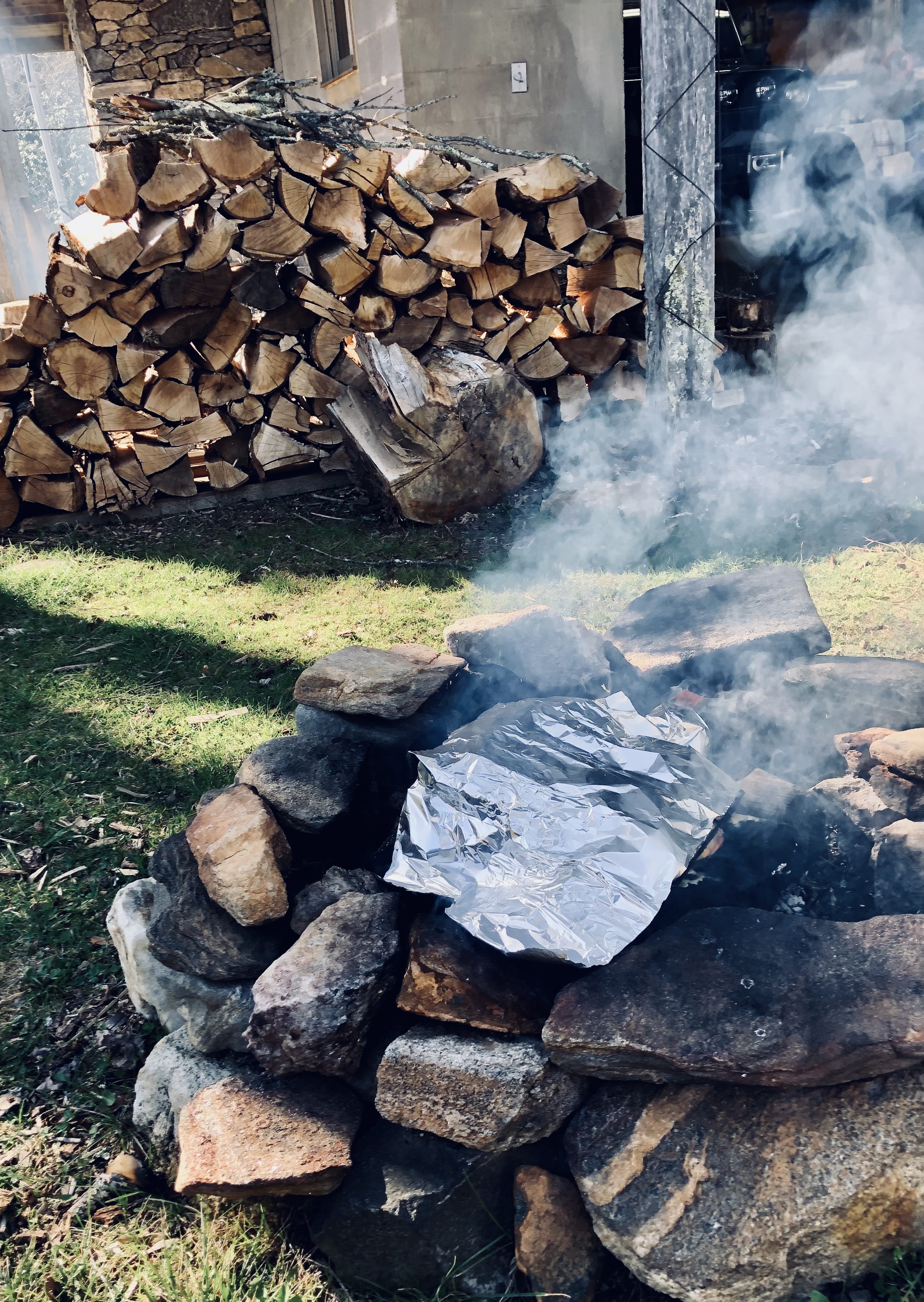
Smoked Chicken Sunday

Not as artful as Tex, but I’ll bet it will be tasty. 

Pizzapalooza

We tried pizza in the outdoor bread oven for the first time last night. We started with a quick (8-hour) dough recipe made for a medium-hot oven, around 500-600 degrees, and baked about 10 smallish pizzas for the 8 of us, with a variety of toppings. The crust came out amazingly well: crisp with a well-developed flavor.

Since we had several dough balls left over in the fridge, I tried again using the indoor oven today for lunch and found that worked pretty well, too, even though I can't get my oven much above 500. At that temperature, with refrigerated but not frozen dough, it baked in 8 minutes. Apparently the refrigerated balls of dough will last perfectly well in the fridge for several days, and in the freezer for several weeks. Unrefrigerated, they're good for several hours after they've reached their recommended fermentation stage. Pizza dough, unlike bread dough, has an extremely brief first rise followed by a longer second rise. You can finish the whole process in 6-8 hours if you can keep the dough at 80-90 degrees. If you rush it a bit, it will still taste good, but will be a bit springy when you try to stretch it out into a suitably large round. That doesn't turn out to be much of a problem. None of our crusts were thick enough to fail in crispness, and no one minded the wavy perimeters.

We'll definitely be doing this again. If we were going to shoot for a larger crowd, we'd have to use a wetter recipe calibrated for a much hotter oven, so we could cycle the pies faster. They say a Neapolitan pizza bakes in 90 seconds at 900 degrees. We can definitely get the wood-fired outdoor oven up that high, though I'm not sure how easy it will be to hold it there. We'll have to see how much harder it is to work with a wetter, softer dough.

My favorite turned out to be the extremely simple Margherita: a little fresh tomato sauce, mozzarella, and fresh basil leaves. I was surprised to find that the ordinary all-purpose flour version was a little tastier than the fancy Anson Mills pizza flour. So that's lucky, because the local grocery store stocks a good King Arthur AP flour. It can also usually be counted on to carry some fresh basil out of season. For tomatoes, we used a high-quality canned San Marzano brand that we order online by the case year-round, but the grocery store's hydroponic fresh tomatoes have been quite good in the last few years, too. The tomato industry has figured out how to transport a fresh tomato with flavor. The tomato sauce is really just an instant puree; no need to cook it down unless your tomato source is too watery.

We oversupplied ourselves with a wide variety of other toppings, such as onions, mushrooms, bell peppers, olives, sausage, feta, and Alfredo sauce, but another time I may not bother, considering how tasty the Margherita was. The volume of toppings was vastly more than necesssary, as well, but most of the leftover veg went into some excellent omelettes this morning for us and our two houseguests. (Last night we were joined by four neighbors.)

Here's the indoor slice from today, which had a decent crust, though not as crisp as the outdoor pies from last night:

Emergency Vehicle Driving

This weekend is the annual recertification exercise for driving big fire trucks and such. The over the road exercises are fine, as is most of the obstacle course, with the exception of the serpentine event. There you have to weave the vehicle through a series of cones, which is fine; but then you have to back it through the cones in the opposite direction from how you went forward. Everyone eventually passed it, but there were numerous second tries. 

By coincidence the exercise coincided with the 50th birthday of a member. Thus, a surprise party. 


Less happily it also coincided with a benefit barbecue by a neighbor county for a firefighter who was burned in a recent emergency. We sent the birthday boy over to pick up some Boston butts from their benefit, which also gave us time to set up the surprise party. 

There’s a lot of value in these civic organizations. Even apart from the rescue and fire protection, the community is stronger and better because of these common efforts. 

Garden Expansion


 We’ve decided to lay in a third raised bed this year, expecting food to be somewhat expensive or even somewhat short. The older beds are turned over and ready. The new one is framed, but the hard work of breaking the earth is yet to be done. 

Exposure in Maryland

Restoration of a traditional practice is usually, but not always, a good thing. 

Cesspool of Sellouts

Or possibly it’s a ‘cesspool of sin,’ as this out-of-shape Yankee* explains. Either way I was there yesterday. 

The city is actually looking much less like a cesspool of any sort following a campaign to drive out the homeless and clean up the town. One of the small parks near this sign on Patton avenue was being used by families with small children instead of the usual sleeping addicts. I’m not sure what occasions this radical departure from the city’s deeply held values of tolerance and inclusion, but it was surprising. My wife had asked me to link up with her because she needed to walk by that park, and disliked the usual harassment she faces when doing so. This time, cute children instead. 

We also saw a pair of immature bald eagles struggling for dominance on the east fork of the Pigeon river. This was heading back along US 276. There was massive flooding there recently, and though progress has been made there are still clear signs of the disaster. The road is no longer closed between the Parkway and Waynesville, though. And there’s a new Scottish pub in Waynesville, an ideal motorcycle destination provided virtuous moderation is practiced (or else accommodation in Waynesville is found).


* AVI and others from the real North occasionally note that their own usage of "Yankee" has a very different content than the one that Southerners intend. In this case, though, 'Yankee' is the speaker's own choice of appellation -- if you watch his channel's intro video, that's the word he chose to describe himself. 

R.I.P. Good Dog

I took in this beautiful creature, Greta, several weeks ago. She turned out to be 12 years old and heart worm positive, with liver enzymes too high to stand treatment unless we could get them down. She was emaciated and had tapeworms. After we got rid of the heart worms, she led the life of Riley here for two weeks, eating all day every day and fattening up nicely.

But Friday night she sustained a trifling injury in a scuffle with one of my other dogs. I thought nothing of it until the next day when she swelled up everywhere and was prostrated. She spent all weekend at the emergency vet hospital, where I thought she was improving, but it seems that the minor injury triggered what must have been a serious auto-immune disease, because she seemingly lost all ability for her cells or vessels to retain fluid, and her own system was destroying all her red blood cells. Her immune system may have been on crazy high alert from the heart worms.  That probably means it wasn't ever going to be in the cards for me to get her strong enough to treat the heart worms, and when we put her down this morning she escaped what otherwise would have been a long decline with heart disease.

She was such a sweetie. I don't regret taking her in and giving her two good weeks with all the food she could eat and a safe place to sleep. This is her just last Friday, right before she cratered.  We have buried her here with all our other dogs.

Good for Will

This was very satisfying video of Will Smith punching Chris Rock at the Oscars. Straightforward and heartfelt. I'll bet he didn't stop to agonize about whether it was woke or fashionable.

Another Exciting Afternoon


Up here we’re so far from everything that whenever we call for Medivac it’s always to some totally improvised LZ. 

Childhood

Over at An Eccentric Culinary History:

If you want a single dramatic example of how much America has changed in the last century or so, stop talking about trips to the moon and super computers and start talking about this: in 1910, two brothers, Temple and Louis Abernathy, saddled up a pair of ponies and rode alone from their home in Frederick, Oklahoma, to New York City, almost 2000 miles away, to see Teddy Roosevelt give a speech. At the time, Louis, called “Bud”, was 10 years old, Temp was 6.

It's a good story.

Saturday Night Firefight


Part of the Nantahala National Forest burned tonight, but not a very big part. The National Weather Service warned that the high winds would make for a fire hazard, and sure enough they blew down a power line. That caused a fire, which the high winds quickly fanned up and over the ridge and down into the next valley. We managed to contain it between the road and a nearby cold water creek, plus some artificial fire breaks created by guys with leaf blowers. That worked until the Forest Service got up there with a bulldozer to plow in a proper fire break.

Whose Lamentations?

Conan The Barbarian Acquires Biology Degree So He Can Know Whose Lamentations He's Hearing

Bonus: The Babylon Bee's Man Of The Year Is Rachel Levine