Illusions of Moral Change

AVI asked earlier if we are experiencing an illusion of moral decline. There are arguments for and against this idea.

He presents a long comment as evidence that it might be, and evidence also that deniers are just looking at evidence they prefer to look at. I have a counterargument to that idea, which I've been making for some years. 

For some years I've argued that 'moral progress' is a mere illusion. Joseph W. and I used to fight about this, in that joyous and pleasant way in which we contested each other's ideas. My sense is that mostly people's values change by encountering other people -- ideas 'rub off,' as it were. Now people closer to you rub off on you more than people further away. It is possible to be distant in both time and space, such that people further away from you in time will look less like you than people closer. That means that we should ordinarily expect to see an illusion of progress, because (a) we take our own values to be right, and (b) the further back you go, the less people agree with us.

There are some obvious additional factors that make it easier or harder for people to 'rub off' on you: sharing a language makes it more likely at distance; belonging to a civilization makes it more likely that you will share at least some values with your ancestors, too. Still, by and large I think it's obvious that you would think of society as progressing morally simply by looking back and discovering that, the further away from yourself you go, the less people agree with your (obviously correct!) moral values.

A consequence of this reading is that the conservative and progressive moral projects are both illusions (but see the important exception at the link). Conservatives are always under the illusion that things are getting worse because there has been constant movement from a prior time they've marked out as an ideal: their childhood, the Victorian era, Arthur's Camelot, the Age of Muhammad and his Companions, the ancient Roman Republic. 

Progressives, by contrast, assume wrongly that there is moral progress in their direction just because the current age agrees with them and all prior ages disagree more and more. Thus, there is an arrow of morality that points in their direction.

Both of these views are illusions. 

However, there's an important empirical point AVI gets to and returns to as well: we can say that rates of violence, for example, goes up or down. That's not perfect; some violence is moral, and the loss of that kind of violence may worsen society. (Consider a society, like the present-day Canada, that bars violent self-defense. You may run from a criminal, but not resist him.) 

That kind of empirical consideration of morality is what I was getting at by the end of the linked post. 

I once heard a Buddhist argument that held something like: "To say that you have forgiven but not forgotten is to say that you have not forgiven." This is that argument in a developed form.

If you truly did forget, you would lose both any sense of moral progress, and any sense of moral crumbling. What would be left? Would it be enough?

There's a good debate in the comments of that post featuring many of you, dear readers. You might want to review what you thought at the time and see how it compares to what you might think now. For that matter, it might be helpful to write down what you think now first to see how it compares to what you thought then.

Highwaymen

This interview starts off with a very aggressive question from the journalist: can you imagine suggesting to Johnny Cash at any point in his career that he couldn’t fill a venue? He came close to calling the man a liar over it. 

Waylon, though, had the best response. 

The Highwaymen had four of my very favorite performers of all time, but I never was able to enjoy them as a group. They were too self conscious of standing at the end: it was mournful, more than anything else. I like this interview for the spirit, which was not so ready to concede the end. 

Dark Times

Leavening

As I was browsing a number of articles about wild yeast, I read several that mentioned the early evidence of deliberate fermentation, including some kind of Chinese alcoholic drink from 7,000 B.C. and leavened Egyptian bread from 1,000 B.C. Considering that the Jews appear to have shown up on the eastern shores of the Mediterranean shortly after the catastrophic collapse of Bronze Age civilizations around 1,200 B.C., and considering also the Jews' complicated relationship with Egyptian culture during the next millennium, this reminded me of something that surprised me in the Biblical exegeses I've been working on in recent years at Project Gutenberg.

In both the Old and New Testaments, "leavening" has a strangely negative connotation of impurity and corruption. I'd always assumed that the point of unleavened Passover bread was that the homemakers were in a rush, but there's more to it than that. Part of the Passover ritual is a strenuous disinfection of the home from all leavening, not just so that the bread will be truly unleavened and therefore qualify for the ritual, but also apparently as a symbol of purification. Exodus 12:15, 13:6-7. Leviticus 2:11 forbids the burning of yeast on the altar at any time, not just during Passover. Both Jesus and St. Paul used leavening as a metaphor for spiritual or psychological infection that can start with a small fault and bloom until it consumes the person: hypocrisy in Matthew 6:6-12 and Luke 12:1, and sexual immorality in 1 Corinthians 5:1-8.

For some reason this opprobrious attitude didn't extent to alcoholic fermentation, which the Jews apparently didn't connect closely with bread fermentation. The Jews never have thought much of drunkenness, but they don't react to alcohol with horror at impurity in the manner of temperance zealots. I have cousins who, in my youth, startled me by casually explaining that they wouldn't eat things like olives because they were produced by a variety of fermentation. The fermenting bacteria break down the bitter flavor in raw olives, without producing any mind-altering substances, but apparently even the presense of the word "ferment" was enough to make my cousins swear the whole thing off. They didn't object to leavened bread, however.

More Orienteering


Always a good way to spend a weekend. 

A heavily trafficked area of the West Wing

From PowerLine:
Is there no fingerprint or DNA on the baggie? Is video unavailable, as in the matter of Jeffrey Epstein’s death? This is probably not the toughest case in the world to “crack” — unless you don’t want to, or unless Inspector Clouseau is in charge of the investigation.

Sourdough

My lurking neighbor persuaded me to take some of the natural starter she began developing from local airborne yeast several years back. I've been experimenting with loaves this week and have managed today to produce a loaf with good strong sour flavor and a decent rise and crumb. The crust is outstanding.

Reason for the Season


Stay down, man

Revolutionary Colors


For Love of Treason

Happy Independence Day, the greatest day of the year— at least excluding religious holidays. 

Not too Sure About This


I really thought he’d like the river, but look at that face. 


The hot takes

After 24 hours to let the Supreme Court's partial ban on affirmative action sink in, the twin responses I'm seeing from the left are:
(1) Anyone can see that Justice Thomas couldn't have gotten where he is without affirmative action to prop him up--I mean, just look at his skin--and
(2) Legacy admissions seem pretty unfair, so what's the big deal with institutionalizing racism in admissions too?
I'd have more respect for Harvard et al. if they got rid of legacy admissions, too, but few of us will be supporting a general "no unfairness" Constitutional amendment, so it seems unlikely the Supreme Court will be asked to take care of that particular bit of dirty business for us. Those of us who object to legacy admission might consider not donating to universities that practice them. We could even pass federal legislation denying tax subsidies to universities that don't get it right. We don't have to embrace racism in order to get rid of legacy admissions.

A Busy Month

Between now and a month from now I will be finishing up the Technical Rescue certification series I've been pursuing since April. This will put me in night classes on Mondays and Wednesdays every week, and on two of the four weeks also on Fridays, as well as all day Saturdays and Sundays. This is of course in addition to my regular professional and family duties. 

If it's been a little quiet lately, it's because I'm busy. It's worthwhile stuff, however, that I think is not a waste of time. Still, it may be August before I can relax. 

Number 21 with a bullet

Some slight coverage of the Biden family corruption is making its way into mainstream news.

Jesus as Capricorn


I don't actually know anything about astrology, aside from the fact that I'm aware that the various 'signs' are supposed to align with dates, and my own supposed sign is ridiculously out of line with any facts about my character. Apparently the Capricorn dates line up with the Christmas holiday, though, so I guess you have to give old Kris the point as a matter of theology.

 All the same, the song reminds me of this bit by Johnny Paycheck in certain ways.

Is he wrong about any of that? Well, no; and yet, also, yes. Johnny Paycheck was much in need of grace. He once shot a man in the head because he was high on cocaine. Of course that's just the kind of person you ought to admit to the church if he's willing to come, exactly as he says. But it's also true that he's falling easily in on his grievances, rather than thinking on the mote -- or log -- in his own eye. 

Kyrie Eleison.

You Bet Your Life

More Marxism:


And more Foil Arms and Hog. No, really, it's good guidance on giving an acceptance speech in today's world.

Nonconventional Intelligence

Allegedly this stencil test fools 90% regardless of IQ.

No Idea

I have no idea what's going on in Russia, so here's Foil Arms and Hog:

And your nightly dose of Marxism:

Cone of Silence

Dad29 asks about the weird 'cone of silence' surrounding the Biden administration's obvious corruption.
Biden bragging about threatening the Ukrainians never raised any alarms in Washington, because it was the new normal. Hunter getting a no-show job at a foreign company raised no eyebrows because everyone was doing it....
Umnnnhhhh, yes.  Yes, indeed!

Where is "Clean Jeans" Paul Ryan?  Bill Barr, the self-proclaimed 'ultra-Catholic'?  We know McConnell can't possibly come out of his Red Chinese-owned shell on this, but what about Tester?  Tuberville?  Hawley? 

I'd like to add something else to that: Ukraine was the proximate cause of Trump's first impeachment. At that time we learned that the one thing the Congressional leadership would not tolerate was poking around with Ukraine and corruption.

This was all before the Russian war, but at the time there were claims that Pelosi and Romney also had family members working with Ukraine's gas and oil industry. Fact check organizations attempted to say this was dubious, although at least one of the claims remains unprovable either way: 

Pelosi did visit Ukraine in 2017 — as another video shows — in which he said in an interview he was visiting on behalf of an organization he was running called the Corporate Governance Initiative (he served as executive director). Hammill told us the visit was “a vacation at personal expense.” It’s unclear if the Corporate Governance Initiative — a company registered in Arizona with a stated purpose of helping organizations develop structures and policies — is still active. Attempts to contact it were unsuccessful.

Russia's war has only increased the opportunity for corruption, as vast sums of money -- we really have no idea how much, as the Pentagon has admitted it is billions of dollars off in its estimate and the intelligence budgets are black -- have flowed to various programs, classified and otherwise. 

The odds that members of Congress have had the opportunity to arrange kickbacks or other payoffs to themselves, friends, or family are close to 100%. The odds that our Congress' members are above taking advantage of such opportunities? Eh, somewhat less than 100%.

Another reason next year's elections cannot be lost by the establishment is that it might open up the opportunity to look under the hood. They dodged the bullet last time, but only through an unwinnable impeachment coupled with a trial designed to make it look like treason to try to pressure Ukraine to get answers about it.

Cracking more culinary codes

This is my year for finding out how to make things at home that are hard to find in restaurants out here in the boonies. We have a Vietnamese restaurant that makes a wonderful pho, but it's not open on the days I'm most likely to be in town. So I acquired a pho cookbook, followed the directions, and produced a fantastic stock. This one was redfish stock, made from the frames that our fisherman neighbor discards after filleting, but the same technique would work on chicken stock: just simmer it for a while with a chunk of ginger cut in half, a cinnamon stock, some anise pods, some coriander seeds, and some fennel seeds, plus a bit of salt and sugar.

The cookbook advised cooking the shrimp and the rice noodles separately in plain water, but I was disappointed in the results: too flat. With the other half of the fish stock today, I cooked scallops and a new brand of rice noodles right in the stock, then towards the end added the bean sprouts, a cross-cut Thai pepper (bushels of them coming from the garden now), and sliced mushrooms. Squeeze in a copy of lime wedges, add some cilantro and Thai basil if you've got it, and you're done.

Soon I'll try again, with chicken stock. My limited little local grocery store charmed me to my toes by stocking chicken feet this week. Chicken feet make great stock.

Is this for real?

Is Russia cracking, or is this story a crock?

Solstice


High summer is upon us.

Laws Are For The Little People.

 The Hunter Biden plea deal proves that in our two-tiered justice system, only the connected are protected.


The Study of Beauty

 These give me hope; in spite of the ugliness of contemporary music and society, at least a few of the young study to keep the secret fire alive. 


An Important Day

Today marks both the 21st birthday of my only son, and also my 24th wedding anniversary. 

I spoke to my son this morning and congratulated him on making it to legal adulthood. "It only gets harder from here," I warned.

"Oh, I know," he said, which was the worst possible thing to say. Thank God he does not know how much harder it gets. 

Unfortunately all the planned festivities are offline because my truck decided to break down last night -- initially it looks like more computer troubles, the bane of my existence because I can easily repair simple mechanical problems -- and it is going to pour rain for days here in western North Carolina. Nobody's much inclined to ride motorcycles in a downpour for hours. 

It's a big day anyway. 

UPDATE: Relatively good news about the truck. In spite of showing all the signs of a computer issue, it was a mechanical failure after all. Got it back running this afternoon. 

Top of the Park

Happy Father’s Day.  

A Pleasant Day in Western North Carolina

Yesterday my wife and I rode out to Franklin, where the annual Scottish festival was underway. Ethnic festivals are always interesting in terms of what they have to say about the story the group likes to tell about itself and the kind of people they are. Scottish heritage festivals invariably feature Highland strength sports -- I believe the sheaf toss is underway in the background of this photo.

In addition, there was free axe throwing, and Atlas stone lifting. Stone lifting is one of the ancient strength sports of Scotland, which is also a major sport even today in Iceland. These are with natural stones, however. The Atlas stone is a spherical 'stone' made of concrete, which is quite hard to lift because it wants to roll out of your arms. It is a regular feature of Strongman competitions. There were about six of us there who were both Strongman competitors and also regulars at Scottish Highland Games, and we had fun lifting the big 250 pound stone. (My inner arms are quite abraded this morning, a feature that is called 'stone kisses' in the games.)

Then my wife and I rode up through the Cullasaja Gorge, and through various mountain back roads.

Cullasaja Falls

We went to both the city of Highlands and the unincorporated town of Cashiers. There we stopped for dinner at the Whiteside Brewing Company in order to attend a concert I'd heard about. This was by The Maggie Valley Band, which is built around a pair of sisters. They sing Americana with a psychedelic twinge. Their stuff is available on YouTube and Spotify, though I have to admit that the polished stuff there doesn't sound as good to me. Live, they have a very nice sound that is reminiscent of Mazzy Star. 

They know their stuff, too. They covered standards like Jolene and The Long Black Veil, as well as their own work. Every time they'd start a song I'd be wrong about which one they were going to do, because they were adept enough to adapt standard songs to other melodies or meters, giving a pleasant element of surprise to the listening audience. I'd still know the song, if it was one of the covers, but it'd be set to a tune I expected to be a different song.

Overall, a nice day for riding.

More Lies

The Firearms Policy Coalition is a fighting organization. 


If you include Americans under one, the leading cause of death is abortion. In fact, if unborn Americans count, abortion is the leading cause of death for all Americans. Heart disease is right around 700,000/year; abortion, per Guttmacher (which compiles its statistics through a direct count made by contacting all providers in the country) is over 960,000.

Just to keep the numbers consistent, there were about 48,000 gun deaths for all Americans in 2021, the vast majority of which were suicides rather than crimes or accidents. Accidental gun deaths are fairly rare these days, especially among children.

Riding Weather

Tomorrow we ride!

Well, one of us. 

An Ancient, Octagonal Sword

Found in Germany, it is extremely old.  

Come Off It, Washington Post

Today's attack on Americana is an attempt to tar the Gadsden flag by comparing it to... some other flag that nobody has used in a hundred and sixty-three years.

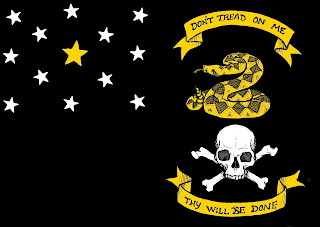
The rattlesnake motif, along with "Don't Tread on Me," have been widely used by Americans for various purposes over various years. My favorite version -- which is on my annual Independence Day post, the flag pictured on the right atop the sidebar -- is the flag of the Veteran's Exempt. These guys fought in the American Revolution under the Declaration of Independence. They were Americans under the Articles of Confederation. They were Americans under the Constitution. Then, as men too old to be drafted in the war of 1812, they volunteered and fought for the American project again. Nobody is more American than they were: to date, they are the only ones of all of us to have lived under all the American systems, and to have supported all of them.

It is also the only American flag to feature a skull and crossbones, which is particularly appropriate given the long connection of pirates and privateers to the success of our democratic ideals. This is likewise not popularly recognized by the elites of the nation, but it is so all the same.

A Materialist Looks at Chesterton

One does not expect to find an essay praising G. K. Chesterton that begins with this sort of assertion.
When you die — when these organized atoms that shimmer with fascination and feeling — disband into disorder to become unfeeling stardust once more, everything that filled your particular mind and its rosary of days with meaning will be gone too. From its particular vantage point, there will be no more meaning, for the point itself will have dissolved — there will only be other humans left, making meaning of their own lives, including any meaning they might make of the residue of yours.  
These are the thoughts coursing through this temporary constellation of consciousness as I pause at the lush mid-June dandelion at the foot of the hill on my morning run — the dandelion, now a fiesta of green where a season ago the small sun of its bloom had been, then the ethereal orb of its seeds, now long dispersed; the dandelion, existing for no better reason than do I, than do you — and no worse — by the same laws of physics beyond meaning: these clauses of exquisite precision punctuated by chance.

Nevertheless this is an essay that particularly appreciates Chesterton's insights into the wonder of the world. The author cites his autobiography, but ironically the admired thoughts are nowhere better expressed than in one especially astonishing chapter of Orthodoxy: "The Ethics of Elfland." I am likewise inclined to agree that the issues he addressed there have never been better described than by him, and that they are exactly as he says of fundamental importance.

Indeed the autobiographical quote the author pulls makes a lot of optimists and pessimists right after making the point of astonishment at natural beauty, a move that follows the narrative structure of Orthodoxy exactly. Chesterton goes right on from "The Ethics of Elfland" to "The Flag of the World." If the essay's author should wish to consider the issue both further and deeper, that work is the one to consult. 

Chesterton himself is thus described: "philosopher, impassioned early eugenics opponent, prolific author of several dozen books, several hundred poems and short stories, and several thousand essays." I think Chesterton himself might have lead with "Catholic" or "Christian," perhaps even with "lover and husband," but certainly it is pleasing to see his opposition to eugenics correctly recognized as deserving of praise. 

The Flag Code

Although part of the US Code, the Flag Code is a non-enforceable law because it lacks any sort of punishment. This happens more often than you might expect. A lot of laws governing the behavior of the government itself lack any sort of punitive clauses, so that -- for example -- if a government should conduct its election in an unconstitutional manner, there's just nothing to be done about it. The Flag Code is like that.

Nor was it any surprise to me to see articles to the effect the Biden Administration had violated it by presenting the Trans-* flag in the position of  honor in a vertical flag arrangement. I was more surprised by Forbes' claim that this wasn't a violation because, however the vertical flags were arranged, there was an American flag atop the building that was in an even more elevated position and that somehow saved the day.

Is Forbes right about that? They are not. The ordering of displays considers the display as a group, not the presence or absence of other flags that are not connected to the display. If I were to arrange a display of fifty national flags that put America's in the last place, the fact that there was a flag somewhere else nearby that was on a taller pole wouldn't have any bearing on my display's intent or effect.

The flagpole atop the building was not part of the group that made up this display, and thus is not relevant to the question. It is a permanent feature, whereas this display was arranged as a unit for a particular event at a particular time for a particular purpose. That is why the offending flags were always photographed together: they were a display meant to be seen together, to create their particular effect. Nobody noticed the flag pole twenty feet up because it wasn't part of the display or the event; it was just a permanent feature of the building. 

The fact is that the question never occurred to these people, for whom the matter is not even of idle interest and never has been. It never occurred to them that they shouldn't put the Trans-* flag at the center of the display, since that was of course the center of the event. It never occurred to them that the United States flag should not be displayed as supporters of the Trans-* flag, as the whole point of the event was in fact that the United States government was in support of the Trans-* movement. It makes perfect sense according to the symbolic logic of their actual system of beliefs, which just don't happen to be the same ones that were held by the earlier generation of Americans who wrote the Flag Code. They are not Americans in the same sense.

Buying Your Way Out of the Constitution

“This report makes it clear that the government continues to think it can buy its way out of constitutional protections using taxpayers’ own money," says Chris Baumohl, a law fellow at [Electronic Privacy Information Center].
That's a good line. It's a nice statement of the problem, which the article explores: the government has decided it needs no warrants for persistent, universal surveillance -- even of people never suspected of any crime -- just as long as it buys the data on the market. If your name ever comes up later, well, they'll already have a ready file with which to prosecute you. 

This Rescue Brought to You by the Number 8

I hadn't realized how many times the Number 8 comes up in this stuff. Just in rescue knots:


The Figure 8 On a Bight (aka "Figure 8 Double Loop")

The Figure 8 Follow Through (almost the same as the Figure 8 Bend, but tied with one rope as a hitch rather than as a means of joining two ropes, which is what a 'bend' is)


But wait, there's more! The rappelling descender of choice for distances of not more than 75-100 feet is "The Rescue 8," so called because of the rabbit-ear design that prevents the rope from slipping over the top of the larger 8 into a girth hitch (which we, in the old Boy Scout days, used to called the 'Lark's Head,' but which is also called a 'cow hitch').

A Rescue 8 descent device

I feel like I should put up one of those Sesame Street videos: "This Rescue brought to you by the letters E, M, S and the Number 8."

Heads must have rolled

Someone at Fox News must have been having fun with the Chyron machine. For nearly half a minute the fresh new post-Dominion-settlement face of the formerly conservative news outlet was marred by the statement "WANNABE DICTATOR SPEAKS AT THE WHITE HOUSE AFTER HAVING HIS POLITICAL RIVAL ARRESTED." Fox quickly reported that “the chyron was taken down immediately and was addressed.” I'll bet it was!

Who can forget the rogue teleprompter operators who got ditzy left coast news anchors to announce with a straight face the purported names of the pilots of the Asiana Flight 214, including "Sum Ting Wong and Wi Tu Lo"?

Make Way, Women!

Lesbian

A non-man attracted to non-men. While past definitions refer to ‘lesbian’ as a woman who is emotionally, romantically, and/or sexually attracted to other women, this updated definition includes non-binary people who may also identify with the label.
I was going to link this to the old joke about the biker who realized that he was a lesbian, but he's actually still excluded from this definition. It's only males who aren't men who are now eligible to be lesbians. Women have to move over to make room for them, here as elsewhere. 


Red Balloon Work Ad


RedBalloon.work seems worthwhile if you're looking for a non-woke work environment.

It could complement PublicSq, a site for shopping at businesses that align with more conservative values (or for selling, if you own such a business).

Update: Just because it's a good story about work, here's "Welding in the Desert."

A Maia on the Bed

Gandalf with halo. 

A Biography of Plato

We know little about the famous philosopher for certain, including whether or not he was ever enslaved -- or, if so, by whom:
Contrary to many people’s perception of him, Plato did not spend his entire life listening to Socrates philosophising in colonnades in Athens or writing dialogues meandering through complex ideas. He was once captured in the middle of the Mediterranean Sea and put up for sale in a slave market....

The enslavement allegedly occurred while Plato was travelling home from Sicily in 384 BC. A number of ancient biographers claim that the philosopher boarded a ship with a Spartan who enslaved him on the orders of the tyrant of Syracuse, but Plato’s new biographer, Robin Waterfield, suggests it’s more likely that he was on board a merchant ship which caught the eye of pirates. The seas were full of marauders in this period and it is entirely possible that Plato sailed into treacherous waters. His luck changed after he was spotted in the market by an admirer who agreed to pay a ransom to secure his release.

Plato never mentioned any of this in his own writings, but then he rarely wrote about himself at all... Waterfield is reluctant to dismiss the episode of Plato’s capture as pure fallacy because the circumstances are credible and the chronology seems to fit with what we know of his movements.

Well, the story certainly isn't a fallacy because a fallacy is an error in logic, not an error of fact. That is on the reviewer, though, not the author. The author sounds like he's done a creditable job at constructing a history of Plato, which is a task well worth doing even if it is not always as exciting as the stories about Plato. 

Computers Still Learning

I was reading a piece about GPT and humor the other day (which I won't bother to look up again to link because I don't remember where I saw it and all it said is what I'm about to tell you) that said that these large language models are good at explaining jokes, but not good at making new ones. It's interesting how those are different projects. Analytical understanding of why something is funny really is different from the ability to craft an emotional experience that will provoke laughter. It's easier after the fact to process why it worked, and harder to do the thing.

Whatever Spotify is using to categorize songs is imperfect in a similar way. It likes to do 'mood' playlists, and it often produces notable failures. For example, on today's "Romantic" playlist the first song was this one:


That's a beautifully sung song, but it is not a romantic song. It's about the heartbreaking failure of a romance.

Likewise, they recently had a "Happy" playlist that headlined with this piece:


This song kind of sounds happy, because of the band's signature strategy (which I believe they adopted from the Blues Brothers) of marching through blues pieces in major chords. It's definitely not a happy song, though: it's about a man who is dying of alcoholism, and finds himself powerless to stop it.

I guess it's good that it's still easy to fool the Terminator.

Bluegrass Genocide

I realize not everyone here reads Instapundit, but here's a piece linked there (by one of Glenn's co-bloggers) that merits attention.
In his terrific Shiny Herd substack, Ted Balaker interviewed me on the mania for eugenic sterilization of those deemed “unfit to reproduce” for the first 75+ years of the 20th century. As Ted and I discussed:
“They were forced to undergo hysterectomies. Their tubes were tied and they were given vasectomies, sometimes without anesthesia.”
The scientific and political communities in America were solidly behind the project. Those performing the sterilizations were considered humanitarian heroes, and academics who questioned the idea were subject to vilification, loss of employment, and loss of academic funding. The press and political activists formed a solid phalanx to protect the pro-eugenics side....
Then I heard of the Family Planning Services Act and began to wonder if there was in 1971 a federally-funded bias toward sterilizing poor young women in Appalachia. Is this why I never had siblings and face being the sole caretaker and provider for my aging mother?

But I can only wonder because I can’t find any research or data or even articles inquiring about changes in birth and sterilization rates among women in Appalachia before/after the Family Planning Services Act took hold.

Maybe the Act didn’t make a difference at all. Or maybe it was a quiet Bluegrass Genocide....
This writer’s expression, “bluegrass genocide,” is a marvel of imagery, simplicity, and power. Nowhere to be found on the internet (till now), the term lashes an arcadian adjective to a dystopian noun. Just two words and five syllables describe a sweeping saga, imparting both sense of place and sense of horror. It starkly captures the inhumanity that, for the better part of the last century, exerted a vise grip over science, medicine, culture, politics, journalism, and public policy—the notion that experts are entitled to play God with lives in pursuit of their favored social goals. The writer’s addition of “quiet”—”a quiet Bluegrass Genocide”—makes the events described all the more vile.

Sometimes, the word “genocide” is used in a hyperbolic and, in my view, inappropriate ways, but here, the term is more than apt. 

Usually one hears about the eugenics movement in terms of the eugenics crowd's fascination with the idea of 'race,' and the desire to limit the growth of 'races' that they deemed inferior; or one hears about the sterilization of those deemed mentally inferior. Here, though, it's really often just poor folks from Appalachia; useless eaters in the eyes of the Wise of that era, I suppose.

The Great Montrose

A kind of week-late addendum to the discussion of pirates and outlaws: one of the points AVI brought up was that pirates were all but certain to be executed if caught, which might suggest that there was a particular infamy associated with their ways. Yet the greatest of all men might be executed torturously and grievously, even the Great Montrose. (Well, even Jesus.)
Montrose studied at age twelve at the college of Glasgow under William Forrett who later tutored his sons. At Glasgow, he read Xenophon and Seneca, and Tasso in translation.... The king signed a warrant for his Marquessate and appointed Montrose Lord Lieutenant of Scotland, both in 1644. A year later in 1645, the king commissioned him captain general. His military campaigns were fought quickly and used the element of surprise to overcome his opponents even when sometimes dauntingly outnumbered....

Highlanders had never before been known to combine, but Montrose knew that many of the West Highland clans, who were largely Catholic, detested Argyll and his Campbell clansmen, and none more so than the MacDonalds who with many of the other clans rallied to his summons. The Royalist allied Irish Confederates sent 2000 disciplined Irish soldiers led by Alasdair MacColla across the sea to assist him. The Irish proved to be formidable fighters.

In two campaigns, distinguished by rapidity of movement, he met and defeated his opponents in six battles....

The fiery enthusiasm of the Gordons and other clans often carried the day, but Montrose relied more upon the disciplined infantry from Ireland. His strategy at Inverlochy, and his tactics at Aberdeen, Auldearn and Kilsyth furnished models of the military art, but above all his daring and constancy marked him out as one of the greatest soldiers of the war. His career of victory was crowned by the great Battle of Kilsyth on 15 August 1645. Such was the extent of his military fame that King Louis XIV offered him the position of Marshal of France.

He fell into the power of his political enemies and was hanged, his body dismembered and buried in unhallowed ground. Years later Charles II had his body moved to a church and gave a lavish funeral, but that didn't do anything to repair the execution. Bear in mind that this is almost exactly the same time -- and the same king, Chares II -- that was rewarding Sir Henry Morgan with a knighthood and governorship of Jamaica.  

Here's a song about the Great Montrose. The particular battle is apocryphal, but of a piece with the actual battles he so frequently won.

Love Doesn't Equal Love

The Orthosphere objects to the current formulation.
A neighbor flies a colorful flag. “Love is Love” it proclaims. Since it is merely a dogmatic assertion with no argument provided, it seems somehow aggressive. Worse. It is aggressive. Like all other utterances, it must be understood in context. In context, it is a poke in the eye of anyone favoring heterosexual adult romantic love. Ironically, that kind of love one is welcome to attack. In that case, perhaps the slogan should be “Love is Oppressive.” ...

The image on the flag is of a central huge rainbow-colored clenched fist surrounded by little open palms with love hearts on them. I know of no symbolism whereby balling up your first means love.

The rhetorical flourish of the bumper sticker that simply says " = " was the point at which I realized that they were going to win this fight. It's simple, requires no explanation, and although it is quite terribly wrong one needs a thousand words to explain why. They didn't need any words at all. 

The gay marriage thing has worked out a lot better than I feared it would, given that it represented a massive change to a fundamental social organization. It hasn't, as far as I can tell, caused any problems at all. I don't mention this to re-open that fight, which was lost and fortunately has not been as destructive as we warned that it might be. 

Rather, the point is just to clarify that the mathematical expression of equality is not the right use of the notion of equality in politics or in the personal relationships between individuals. Love is not love: think of any two people you love, and you'll find the differences immediately. I love my mother; I loved my father. The content of the emotional relationship was quite different, for me and for everyone who has ever loved. It's not a 1=1, A=A case, love; it is neither mathematical nor strictly logical.

When we talk about citizens being equal, we don't mean that they're exactly alike or even roughly equivalent. It is not a case like 2+2=2x2=4x1. One citizen may be an astronaut and a Ph.D.; the other one may be a crackhead. They are definitely not equals in most respects. There is only one way in which they really are equals, which is that they were alike endowed by their Creator with inalienable rights that the government's sole legitimate purpose is to protect. In that way, they really are equals: and they are equals not because of any qualities of their own, but because the endowment from on high was bestowed equally upon them.

We see something similar in the same field: "Transwomen are women." To set aside the empirical truth of that proposition entirely, I am struck by the fact that the statement itself is logically self-refuting. Two categories are being discussed, W and tW. We instantly know that they are not the same category; tW is at best a subset of W. (Many would argue it isn't even that, empirically, but that issue is being set aside here.) There are definitely members of the set W that aren't members of tW. That being the case, the sets are not "equal" -- here the term is used in its strict mathematical sense -- but distinct. The assertion that tW=W on the lines that A=A is obviously false. 

The clever rhetorical destruction of distinctions is not the font of justice, nor wisdom, nor right. It is, if anything, their enemy. Justice is more likely to be found in careful, disciplined thought and reason. I mean no one any harm by saying this; it is not an expression of malice, let alone hatred. It is simply my duty as a philosopher to stand up for clarity of thought.

RIP Pat Robertson

Pat Robertson has died at the age of 93. Robertson is a sept of the Clan Donnachaidh, my own, which is indeed sometimes called Clan Robertson. As such I always thought of him as a distant relative. 

On days like this I am always taken a bit aback by the hateful speech that pours out of the mouths of people who I know think of themselves as tolerant, thoughtful, and decent. Indeed, mostly they are; they just aren’t immune to hate, even though in most contexts they would regard hate as the greatest of evils. 

Cowboy Fire/Rescue

In tonight’s episode, Grim rescues some horses that had found their way out onto a twisty mountain road in the middle of the night.

We were on our way back from rappeling training in Transylvania County when I saw some beautiful white horses (grey, technically) kicking up their heels in the storm. They weren't hard to herd home. A little push and they showed me the way to the gap they'd forced in their fence. Another push and they ran back in. I fixed their fence as well as I could with bare hands.

This morning I contacted one of our firefighters who lives in the part of the district. He said that he knows the family and will let them know to take care of the fence. Hopefully that sets it right.

Cracking more code

We're thinking of doing a banh mi smorgasbord for a July 4th weekend BBQ. I got a cookbook in the mail and tried its recipe, and sure enough, lovely porpoise-shaped crusty rolls for sandwiches.


All I accomplished today was the roll, not any of the recipes for pâté or one of the Vietnamese-style sausages or cold cuts. So I just made a basic ham sandwich with garden tomatoes and sweet pickles. For the spread I used ordinary mayo tarted up with some homemade sweet hot chile sauce, which was great.

My lurking neighbor makes a fabulous wild-yeast sourdough that's nice and chewy, really my favorite bread. I don't know how to make that kind of lovely artisanal bread yet, but it turns out that all the basic instant-yeast breads are pretty easy. For banh mi, you don't really want a seriously crusty, chewy bread anyway.

I tried to order some Kaiser rolls through the mail but thought I had failed, so I found a recipe and ingredients and was about to try them next. Today, however, a dozen Kaiser rolls arrived, so we'll need to work through those before I bake. My lurking neighbors having absconded to their Oklahoma cabin for several weeks, I don't have as much help eating this stuff as I might usually have. They really need to get back here. Anyway, we're going to make hamburgers this week with some of the rolls, and in the meantime have found room in our tiny freezer for the rest. We don't trust ourselves with a big freezer. We've seen what happens.

First X-Ray of a Single Atom

There are size limits to knowledge; for example, we can’t say much about the world as it exists smaller than the electron scale because electrons are the smallest things we know how to manipulate. Thus, an electron microscope works on stuff electrons bounce off of, but not on stuff so small that they push it out of the way. 

Here’s a size limit being transcended. Pretty neat stuff. 

I'm Getting Too Old For This

Canada reshuffles its acronyms.
2SLGBTQI+ terminology and acronyms are continuously evolving. In 2016, the Government of Canada began using the term ‘LGBTQ2.’ The term was applied to the name of the LGBTQ2 Secretariat, the LGBTQ2 Community Capacity Fund, and LGBTQ2 Projects Fund, among other initiatives. LGBTI is often used in an international context. 2SLGBTQQIA+ is the acronym adopted by the 2SLGBTQQIA+ Committee, which contributed to the 2021 Missing and Murdered Indigenous Women, Girls, and the 2SLGBTQQIA+ People National Action Plan.

During the engagement process, 2SLGBTQI+ communities in Canada called for the acronym used by the Government of Canada to be updated. The Government of Canada will adopt and encourage the use of 2SLGBTQI+ as a more inclusive term. This includes changing the name of the LGBTQ2 Secretariat to the 2SLGBTQI+ Secretariat, which is the title used throughout this Action Plan.

The military also loves acronyms, and frequently reshuffles and/or reuses them. The intelligence community, likewise (and probably because its largest component is the Defense Intelligence Agency). There can be confusion when members of different branches or levels of organization meet and find that a simple acronym means different things to different people. There has been a longstanding joint process to try to resolve this as much as possible, but especially at working levels easy acronyms just get reused: CAB, for example, has 38 possible meanings in the military context according to this acronym finder. Several of them are very commonly employed, like "Combat Aviation Brigade," "Civil Affairs Battalion" (the finder lists 'brigade' there too, which is a further confusion possible here) and "Combat Action Badge." And those are all from the Army!

No one is probably ever going to reuse 2SLGBTQI+, at least. But good luck remembering it, especially if it's going to change every few years. Inclusivity as a goal has to be balanced with the needs of concise communication. Very quickly this kind of thing makes communication impossible. Ultimately the most inclusive thing would be to include absolutely everyone, so instead of an acronym we should just mention everyone we want to talk about by name -- and, since names can also be repeated, add their street address. By the time you finished doing that, you'd have forgotten what you wanted to say about them.

Two on Education

The Orthosphere has a post on the topic, which begins with a sentiment I think will be popular here:
In common usage, being “educated” means having gone to a Western-style secular school, and being “highly educated” means having gone to college. Thus, for example, it is said that America battled the Taliban so that “Afghan girls could be educated”, and it is said that, in America, all of the “educated” classes vote for the Democratic Party. This usage should be contested. It is false and insulting to so cavalierly assert that Afghan housewives and American plumbers are less knowledgeable in some absolute sense than those with four years of indoctrination in the Regime’s race and gender ideology, as if only Regime ideology counts as knowledge, and not what is picked up from parents, religious tradition, or on-the-job training and experience.

From that root, though, the post develops a brief but sophisticated account of other modes of education:

A much more important skill is sympathetic thinking, the ability to understand different and novel points of view. When confronted with an argument, a theory, a foreign worldview, one must deliberately postpone criticism until after understanding. First, one must be clear about what the other party believes and why he believes it, an understanding sufficiently faithful that one could explain it back to him in one’s own words, and he would agree that it is a fair statement of his views. No criticism can be valid until after this step has been achieved. Thinking sympathetically does not mean abandoning one’s own beliefs and taking up another’s, except imaginatively....

Shall we consider other dimensions of thinking? There is analytic thinking, whereby one advances by a chain of logic from premises to conclusions, the sort of reasoning exemplified in Euclid’s Elements, which is not “critical” but is not on that account to be despised. There is synthetic thinking, whereby one relates disparate facts into a coherent worldview, distinguishing to unite, noting tensions where they cannot yet be resolved. This is related to the dialectic thinking of Socrates whereby one tries to uncover the general principles underlying one’s specific beliefs. There is criticism in the old Kantian sense–thinking about thinking, Barfield’s “beta thinking”–which recognizes the inescapable limits and partiality of our own thinking, to which I would add our inadequate standing to issue sweeping moral condemnations of others, an epistemological truth historically connected to Jesus Christ. 

A fully educated man should be able to do all of those things, and to switch between the modes as necessary without losing sight of the fact that the mode has been switched.

AVI also has a post on education, with a follow up on 'real rules' here. There is some sympathetic thinking on display.

So schools fall back on teaching values, which is what they have always done.  Not so much as they hope, and often not quite the values they intended. There is also conflict when the professional educators teach the values they think are important, regardless of surrounding culture. That's why you got taught so much pointless grammar, because it was supposed to be important for schools to turn out kids who sounded middle-class. Ditto Latin, which is a class signifier more than an education.  The energy would have been far better spent on a living language. Conservatives look back fondly on what was taught for values then, but I'm less impressed. We were taught a lot of patriotism, but that turned out to be a lot of "respect for the flag" and some songs....

We were also taught not to jaywalk, to register our bikes, not to be too noisy, not to be tardy or (horrors) skip school, to do our homework. To stay within the lines, do what authorities told us. That was citizenship, and thus indirectly, patriotism. Now citizenship is more focused on environmentalism, being extra-careful to being respectful of other groups (rather than of older people and government people), but still staying within the lines.  It's the patriotism that Obama talks about, and I don't think it's an act.  He thinks that is what is supposed to be good about America and he wants to see more of it.  Respect for the flag?  Well, fine, but really, not so important.

In the comments to AVI's post, I offered an Aristotelian point that I think our schools miss entirely. I'll reproduce it here.

Aristotle says (and Plato, separately and with somewhat different emphasis) that the most important thing about education is that it should fit a citizen for the kind of state they will live in. Plato tries to give a universal answer for what kind of education is best, but Aristotle says it depends on the kind of state one lives under: one education is right for free men in a republic, another for democrats, a different one for those who live under an oligarchy or a tyranny.... [O]ur system is allegedly pursuing the production of people fit to be free citizens of a self-governing order, but what it actually pursues is producing people who obey authority and submit to daily, ongoing violations of the rights they are told they have. We are supposed to enjoy a kind of political equality (the 'President' is just primus inter pares), but our paternalistic system of education elevates the state into the role of parent and trains students to accept being treated as subordinate children. I think that's a problem that lies behind many of our other political problems, because the citizenry has been trained wrong from youth to be citizens of a free and equal society.

Cracking the code

For years we've struggled to make ordinary TexMex-dive cheese enchiladas at home. I was sure it couldn't be that complicated, considering that TexMex places all over the state seem able to crank it out cheap. We solved the tortilla and cheese part but ran into problems with the gravy. I kept looking up recipes or using canned stuff that got good reviews, but those sauces, while tasty, were absolutely not TexMex chili gravy; they tended to be what I think of as New Mexico chili sauce, very good in its way, but not TexMex. Finally I found a recipe for what we were aiming at, and it couldn't be simpler: a light roux made with 1/4 cup each of oil and flour, seasoned with chili powder (basically ancho), Mexican oregano, garlic powder, cumin, and salt, then thinned with 2 cups of stock or water. In other words, Southern biscuit gravy with a few extra spices, and Bob's your uncle.

I don't cook that much as a daily matter. My idea of a great meal, if my husband hasn't made something, is GrapeNuts or butter noodles. This week, however, I've caught the cooking bug. Since our tomato harvest is coming in, I whipped up some excellent gazpacho for lunch today. I also blanched, peeled, and seeded several pounds of the tomatoes for use in a dinner party we're having this weekend, with shrimp creole on the menu. Recently I've made Caesar salads complete with homemade dressing and croutons for dinner, then enjoyed them again for lunch the next day with leftover roast chicken. This week I went on a cookbook-buying spree and acquired a North African cookbook along books for Vietnamese banh mi (including how to make the bread at home), Vietnamese pho, and a variety of Thai dishes from a restaurant somewhere called Pok Pok.

We're also in the time of year when, besides the tomato harvest, we're getting covered up in eggplant and peppers. Luckily my husband has perfected a dozen or more excellent eggplant recipes, and this year has begun making terrific fermented pepper sauces as well.

For dessert this weekend we'll be serving a "Lemon butter pie" I ran into online: basically a Graham-cracker-butter crust filled with a lemon curd into which a solid cup of butter has been whisked. It's all assembled and chilling now, so we'll try it tonight and see if it's ready for guests. I used pounded-up Spekulaas cookies, the thinking man's Graham cracker.

We'll make the Shrimp creole with a lot of fantastic fish stock from nine redfish frames our neighbor gave us last week after he fileted them. Even after reduction, that yielded a solid gallon of fish stock in the freezer. Paul Prudhomme's Shrimp creole with fresh stock is just the best stuff imaginable, though normally we get by just fine with a very quick stock made from the shrimp shells. It's hard to get them with the heads these days, but even if all you have is a shell with legs and tail it makes a perfectly lovely quick stock. Still, this redfish stock should be something special.

Not Dehumanization, But Not Prejudice Either

 A NYT author reports that Republicans and Democrats currently express what he describes as "dehumanization" towards each other at extreme rates of 30 points, which he says is twice what has been found expressed towards Muslims and about eight times what is expressed towards Mexican migrants.

This is not properly understood as dehumanization. Dehumanization is a problem: it is the problem that we see in abortion, for example, where a whole group of human beings refuses to recognize the humanity and personhood of another group. We saw the same thing at work in slavery, and in the racism used to justify the reintroduction of slavery to the West in the later Middle Ages.

This is rather a kind of distrust, but it is not a kind of prejudice. Prejudice is a pre-judgment, imposed on people due to traits that may be suggestive but not dispositive. Republicans and Democrats distrust each other for reasons. It's a considered judgment by both sides that the other side cannot be trusted with power over them. 

What that means is the polity is in a dire state, but perhaps not unfairly. He argues that the current spending bill is an indicator that there aren't really serious differences; but that's only true of the party elites who negotiated it. It is definitely true of ordinary Americans, whose differences on substantial and fundamental questions of morality are incompatible. 

Conan and Outlawry

[Attribution in graphic: text by Robert E. Howard, from "The Phoenix on the Sword," art by Frank Frazetta.]

This essay aims to explore the issues of outlawry and civilization, topics broached in AVI's post and in the addenda post

Robert E. Howard [REH], the author of the Conan stories, set up the mythos in a way that makes Conan a kind of original or essential outlaw: Conan is born in Cimmeria, a wilderness apparently without a government, which is never visited in the stories and always described in wild terms. He therefore appears to arise from no civilization or even family with a code of its own, contra Aristotle: rather, Conan thus enters civilization as an outsider, and in the stories about his youth he remains one: a solitary thief in Zamora during the story "Tower of the Elephant," or in Corinthia in "Rogues in the House."

After his youthful career as a thief, though, Conan finds exactly the "the importance of 'having a flag to sail under,' whether national or piratical," as mentioned in the addenda post. [Maybe; or maybe the Viking-style story I'm about to discuss came first. Several attempts have been made to work out the timeline (here is one for reference); REH wrote the stories as they came to him, and not in a chronological order.] 

I will only consider REH's stories, and not those added by other authors. It appears that Conan went north and joined a Viking-style warband ("The Frost Giant's Daughter"), the first of several such bands that he joins. Each of these has its own independent code of conduct. Later, he comes into the service of formal ("legitimate"?) nations as a mercenary; eventually he uses that status to conquer and rule the nation of Aquilonia. There he commands as the king the formal armies as well as the mercenaries of that nation, and deals with the laws and customs of the nation as he had earlier dealt with the different warbands.

Outlaws and Civilizations

Before I try to develop the essay about Conan and what that literature tells us about outlawry and civilization, I'd like to say some general things as addenda to AVI's post. This is addenda; it's meant to be read after his post.

I. Outlawry is a part of civilization

AVI starts with a very good point: the word outlaw has meant different things in different times and places. I think the Danelaw versus the Saxon law example he gives is a good one, but there were also different laws in place in the region we would now call Scotland (which really came to be Scotland around this same period of time). The Danelaw was ruled by Danes, and it pressed well into the north until Scottish geography posed sufficiently defensible barriers as to allow them to stop it. Thus Cnut the Mighty did not conquer Scotland, but instead accepted the submission of the Scottish king Malcolm II but did not actually attempt to impose any sort of rulership or law. Malcolm appears to have ignored Cnut even more effectively than Western North Carolina ignores its governor. Or, as Frans Bengtsson put it in The Long Ships:


Meanwhile in the Isles to Scotland's west and north, a Norse rather than Danish population of Vikings had brought their own laws and customs, as they had to Ireland (from whence they raided even the Danelaw, and captured even York). They made different but similar relations with the Scottish kings, allegedly promising fealty but in fact running things their own way.

And in Iceland, men went forth who were tired of all of these systems but who wanted the freedom of a frontier. They, too, ended up making their own laws once there were too many not to have agreements of some sort between them; and they also handled the idea of outlawry differently. Some of our best material comes from Iceland's stories of its outlaws.

When we are going to talk about pirates, well, we already are: most of those early Vikings were in fact pirates, and not kings in their own land. We will return to how little a distinction there is between piracy and "legitimate government" in a while, but the concept was not new even then: no less than St. Augustine relates a story about a pirate captured by Alexander the Great, who asked the pirate how he dared molest peaceful shipping. The pirate asked him, "How dare you molest the whole world?"

It is a much fairer point than people admit. If we look at our own American notions of legitimacy in government, the pirates look far more legitimate than the kings: they made compacts to which the people who joined those compacts actually gave their consent. Iceland's government looks like the only one that we would find legitimate on anything like the American model; even Scotland's doesn't have the legitimacy of the Declaration of Arbroath until 1320, much later.

The point of this section is that outlawry turns out to be a reflection of the civilization that produces it. You cannot, as an American, be an Icelandic Saga outlaw because there is simply no way to escape the laws. You can't opt out of them, and you can't be thrust outside them. You can live in defiance of them, but even should you fly the country the government will do its best to pursue you, arrest you, or have you arrested and extradited to face the judgments of its courts. 

In Iraq, meanwhile, a system very similar to the system of wergild existed in the wake of the failure of the central state (which was never just, but was tyrannically effective at suppressing feuds). The outlaw laws of Iceland had been a kind of pressure-relief valve for its own system: as we see in the Saga of Burnt Njal, Gunnar kills many people (as do others) and the matter is resolved with blood price payments. But when that becomes evidently ineffective, and Gunnar kills multiple times within one family, outlawry basically makes him no longer capable of resolving the matter through lawsuits or payments. It exposes him to being handled however his enemies wish, and they will not be held responsible under the law for whatever they do. He trusts to his own right arm and it avails him for a while, though eventually -- well, we read that story together at length some thirteen years ago. 

The urge to escape tyrannical government is universal, but it exists in tension with the government and the civilization. Those who make the laws determine the shape of outlawry. 

II. Other forms of separateness sometimes enabled by civilization

This is also true of other forms, and in fact it is the mark of a decent government to support them. (Perhaps it is only the mark of a weak government; but if you believe, as I do, that power exercised over others is a corrupting force, it might be reasoned that weak governments are generally also more decent even if only accidentally so.) Contrast allowed forms of separation with, say, Mussolini's vision: 'Everything within the state, nothing outside the state, nothing against the state.' Totalitarian forms cannot abide the idea of this sort of separateness.

One of the clearest early example is the hermit. The hermit (somewhat like Edward Abbey, recently discussed) goes to the desert to find the transcendent divine. We picture the actual desert, but the root is Latin and simply means a wilderness. Monasteries and churches came to offer an additional separation, originally a taking-on of additional laws not applicable to everyone else, but coming to offer a sacred alternative to the positive law. An order of Templars might claim the right to live only under their own laws, for example.

Consider the tradition of church sanctuary for criminals, which was honored in English law from the fourth to the seventeenth century. It offered via the Church an opportunity to choose to outlaw one's self: 
[Sanctuary] seekers then had forty days to decide whether to surrender to secular authorities and stand trial for their alleged crimes, or to confess their guilt, abjure the realm, and go into exile by the shortest route and never return without the king's permission. Those who did return faced execution under the law or excommunication from the Church.

If the suspects chose to confess their guilt and abjure, they did so in a public ceremony, usually at the church gates. They would surrender their possessions to the church, and any landed property to the crown. The coroner, a medieval official, would then choose a port city from which the fugitive should leave England (though the fugitive sometimes had this privilege). The fugitive would set out barefooted and bareheaded, carrying a wooden cross-staff as a symbol of protection under the church. Theoretically they would stay to the main highway, reach the port and take the first ship out of England. In practice, however, the fugitive could get a safe distance away, abandon the cross-staff and take off and start a new life. However, one can safely assume the friends and relatives of the victim knew of this ploy and would do everything in their power to make sure this did not happen; or indeed that the fugitives never reached their intended port of call, becoming victims of vigilante justice under the pretense of a fugitive who wandered too far off the main highway while trying to "escape".
This use of exile is currently forbidden by international law, but consider it in terms of the recent discussions of prison alternatives. Would it really be worse for the United States to allow criminals to deport themselves rather than pay to feed and house and care for and guard them for five or ten years? It might be worse for whichever country they were going to, but assuming that a country was willing to admit fugitives, what's wrong with the practice? 

There are other examples like the heroic orders such as the Fianna or the Jomsvikings, which were similar to the military orders of knighthood but not inherently religious in nature. In the United States, we long had privateers and private militias co-existing with the US Navy, Army, and Marine Corps; and actual pirates, too, such as Lafitte who assisted in the Battle of New Orleans.

III. Lack of distinction between 'legitimate' governments and pirate/outlaw ones

Since the Declaration of Independence we have a recognized standard for legitimacy in government; the older standard depended on the Divine Right of Kings, which was itself an evolution of a corporatist model of society that the Catholic Church developed in company with various royal and noble families. The American project is much more like the pirate project than it is like the royalist one. AVI writes:
The old language of "masterless men," and the importance of having a flag to sail under or a protector over you will be part of [the later post on outlaws, linked above -Grim]. For our purposes here, it is important to note that becoming a pirate placed one in a position of almost certain execution if caught. The exception was Africans and ex-slaves, who would be sold back into slavery. For blacks and New World natives, on board pirate ships were a place of near-equality with whites, and in many instances entire equality. There was democratic election to the various roles on the ship, and this likely had influence on the countries on Atlantic coasts, especially in the New World. It can be overstated - they did force captives to join them, especially if they had a needed skill, and that's hardly freedom-loving. They also made their livings by taking what was not theirs and doing so with extreme violence. 

On the other hand, the legitimate governments of Europe impressed sailors and regularly took each other's stuff on the sea via violence. So not a lot of difference. Piracy was a more extreme version of what everyone else was doing, perhaps. 
I noted in the comments that the distinction wasn't even as great as that, because the 'legitimate' kings were happy to employ pirates as "privateers" in their wars. Sir Henry Morgan, the Welsh adventurer who surpassed all other buccaneers in his accomplishments, was rewarded with knighthood for his successful plunder -- using quite hideous tortures to force Spaniards to reveal hidden wealth -- of several Spanish cities in the Americas, including when done during a period of a peace treaty. (Whether or not he used priests and nuns as human shields in his conquest of Porto Bello was the subject of a libel suit that Morgan won; you can read about that in the linked article.) 

American privateers carried the Revolutionary War's naval victories for the nascent republic, the Navy being a bare consideration at that time. More than two thousand American privateers ravaged British shipping, showing the King that free men governing themselves by consent were just as capable of fighting against him as they had been of fighting for him. They were better behaved, though: Congress required bonds of up to thousands of pounds as assurance that they would not harm innocents, neither persons nor the shipping of neutral nations. 

IV. Importance of joining a pact (frith)

AVI mentions in passing the importance of 'having a flag to sail under,' whether national or piratical. There is a whole section of links on this concept on the sidebar, under 'frith and freedom.' A lot of these point to the importance of pulling together to make each other free, and thereby being able to stave off the terrors of the world -- to include tyrants, as well as other harms. In passing I would like to note that if you follow the link regarding church sanctuary, above, you will see that word employed: they note that some of the churches required a sanctuary seeker to reach and sit down upon a "frith stool" in order to obtain the peace and sanctuary offered. 

Now in the post I wanted to write, which this is a preface to as much as an addenda to AVI's, I will be able to look at how Conan -- AVI mentions him by name -- used such bonds and friendships, laws and codes, to move through a series of relationships. In the end he became king by his own hand, having previously become captain of a series of pirates, bands of kozak ('Cossack') raiders, mercenaries, and so forth; and whether there was really all that much difference between the latter and the former is as much a live issue for us as it was for Alexander the Great. 

Polling and Politics

Today I saw an AP story that claimed that "most Americans" favor using race in college admissions. That was surprising to me, because for years now the polling has shown the opposite: strong majorities have suggested that college admissions should not consider race at all. For example, here's a Reuters/Ipsos poll from February with 62% rejecting any use of race or ethnicity; here's a Washington Post poll from October 2022 showing approximately the same numbers (63% of all US adults, but sixty+ percent among all categories of US adults except black Americans who were the only ones who majority-favor race-factoring in admissions); here's a Pew poll from early 2019 showing very strong majorities in opposition to race-based admissions. The Post poll even asked a similar question to the AP poll: should the Supreme Court ban such usage of race in admissions?

It turns out that the AP poll was structured to give people opportunities to suggest that race could be considered 'but not in a major' or 'not in an important' way. 68% even in the AP poll oppose race being a 'major' factor. In other words, the polling really hasn't changed; the poll was just structured to give people an opportunity to hedge, which people generally love to do. (Practically, though, any approved usage will just be the excuse for colleges to continue doing whatever they want; and that might be fine for private schools, but public colleges ought not to discriminate based on race.)

Now that the Supreme Court is likely to issue a ruling on the subject, I suppose it is time for the push-polling even from once-reliable outlets like the Associated Press. There is a strong push to delegitimize the Supreme Court, which must always be shown to be unpopular and therefore anti-democratic (as, indeed, the Founders intended the Supreme Court to be: they were intended to be the aristocratic rule-by-the-chosen-few branch, just as the executive is the rule-by-one branch that Aristotle called Monarchy if it works well and Tyranny if it does not, and as the Congress is supposed to be the rule-by-many branch).

Disappointing, but not surprising. 

Memorial Day

You may not know, but NATO’s Kosovo force (KFOR) has deployed in opposition to a Serbian incursion this morning. We may see yet another war in the Balkans, led by Italian commanders but mostly featuring US troops. 

Honor to the dead, our dead. How little gain we spend their lives to win.