Jimmie Rodgers

AVI mentioned the famous singer at his place yesterday. As I noted in the comments, he continues to be remembered. Here's Coulter Wall, from the recent music analysis post, citing Jimmie Rodger's famous "Blue Yodel #9" during an imagined encounter with the RCMP.


Here's Jimmie Rodgers' original.


And here's Waylon Jennings memorializing Jimmie in his own time. In addition to the direct reference, he adapts some lines from the song above.


Sidebar and Authors

I added James' blog to the sidebar, the absence of which was merely an oversight on my part. If any regular readers/commenters have blogs they want added, drop them in the comments. I'll be happy to include anyone of good will in the links.

Also, regular commenters who might like to write/post here occasionally should reach out to me, either in the comments or at grimbeornr (note final 'r') at yahoo. I'm 

Arms and Human Dignity

I. The Necessity of Arms to Human Dignity

The necessity of arms to a dignified human being arises from self-defense. That already assumes dignity, though, which ought to be explained. Unlike a rock or a fallen twig, a human being cannot just be broken or otherwise used for your amusement or instrumental purpose. A child might enjoy throwing rocks in a stream, or floating twigs down it; it might be useful to repurpose a rock as part of the foundation of your house, or a set of twigs to start a fire to warm that house. Another human being cannot be seized by force and used without their permission: this is to say that they have a dignity that rocks and twigs and the other merely material stuff of the world does not.

That dignity entails a right of self-defense. Should someone attempt to seize you, use you, or destroy you in order to advance their own ends, as a dignified being you have a right to resist. You have a right to insist on having your dignity respected, and to using such means -- including force and violence -- as are necessary to that defense of your dignity. Because you have this right, you have also a right to the necessary means to the end of defending your dignity. Because those means are a necessary condition of the right, to deny the means is also to deny the realization of the right. 

To deny you the realization of the right of defense therefore entails denying you your dignity. Note that such a denial itself is the kind of attack on your dignity against which you are entitled to defend yourself. The potential for such a denial therefore itself entitles you to the means to defend yourself against such a denial.

II. Why Government Does Not Satisfy this Necessary Condition

Readers will note that the discussion so far follows the logic of the opening lines of the Declaration of Independence
(Assumption) All men are created equal.
(Assumption) All men have certain inalienable rights (such as this dignity).
(Unstated Assumption) There are dangers in the world that imperil these rights.
∴ Governments are instituted among men to protect these rights.
One might argue that the establishment of a government -- with an army, a police force, etc. -- itself satisfies the provision of a means to defend one's dignity. Arms could then be restricted to the police, army, etc., without such a restriction being an attack on human dignity.

The pragmatic lesson of the 20th century (and likely most or all other centuries also) is that one's government is in fact the chief danger to dignity, as well as to life, liberty, and other rights. Imperial Japan in its domination of the Chinese nation used terrible modes of oppression, and tested plague bombs and other weapons on the Chinese people. Even so, it did not come close to killing as many Chinese people as did their own government under Mao Zedong: the Great Leap Forward alone killed at least thirty million Chinese people, and perhaps twice that many. German losses in World War II were over three million people, which is approximately half as many of their people as the government killed through its genocidal policies. The Soviet losses were far worse, but nowhere near as significant as the number starved to death on purpose by their own government. 

Given the clear evidence that one's government is itself a chief danger to one's human dignity, the provision of the means to defend human dignity must also include the means -- at least collectively, in such large scale cases -- to reject one's government. 

This, not coincidentally, lines up exactly in agreement with the logic and conclusions of the next section of the Declaration of Independence. Far from being a radical opinion, it is the founding logic of the United States and of the American model.

Therefore: the right of the people to keep and bear arms is a right that no government, this nor any other, can infringe upon without a basic denial of human dignity. Such a denial itself entails a right of self-defense against such a government; and the everlasting potential for such a denial therefore entails an everlasting, permanent, and basic right to arms. Human dignity does not merely entail but absolutely requires the right to keep and bear arms.

America is a Safe Country

A fact about the United States that is apparently difficult to grasp is that almost all homicide happens in a very small number of neighborhoods. Most American counties have a murder rate of zero -- not zero percent, zero murders. The vast majority of the remnant have very few murders. The murder rate of the United States as a whole is driven as high as it is not even by a few bad cities. It is driven there by a few neighborhoods within a few cities. For the most part, America has no violence problem, no 'gun violence' problem, no crime problem.

This should have major public policy implications, but it doesn't because the Democratic party and the Republican establishment that enables it prefer global solutions. Officially the argument is that focusing on the problem smacks of discrimination. Imposing new rules on everybody everywhere is fair because it treats everyone according to the same rules. That this approach also enables the government to assert power over the lives of everyone -- and not the tiny minority in a tiny subset of places who are causing the problem -- is of course merely a coincidence. 

A similar issue occurs in the gun control debate. Almost all gun crime occurs in those same places, not across the broad country that owns hundreds of millions of guns peacefully. Also, gun crime is the product of handguns, not so-called 'assault weapons,' nor long guns in general. 
In 2020, handguns were involved in 59% of the 13,620 U.S. gun murders and non-negligent manslaughters for which data is available, according to the FBI. Rifles – the category that includes guns sometimes referred to as “assault weapons” – were involved in 3% of firearm murders. Shotguns were involved in 1%. 
Likewise, 80% of gun crime is carried out with illegally possessed firearms. Gun control laws won't affect these guns at all: to have any effect, they'd have to drop the level of legally-owned firearms so low that stealing guns was very difficult. That's a non-starter in a nation that has more guns than people, as well as a constitutional right to keep and bear them that is vigorously and rightly defended by the citizenry. 

Any sensible gun control proposal would thus focus on (a) handguns carried in (b) the particular neighborhoods that produce the crime and violence problem. The police there would react to handguns they lawfully encounter, whether via arrests or legal searches, by checking to see if they are stolen; if so, arrest would be followed by intense prosecution. At most this policy might extend to nearby neighborhoods; it need not trouble the most of the United States, where mostly lawful people engage in the exercise of their constitutional rights responsibly and to the common good. 

While this would impose a higher incidence of police interaction on those poor people living in these troubled neighborhoods, I'd wager they'd mostly be grateful for it. They probably want to know why the police are so hard to find in their neighborhoods. Concentrating the resources where the problems are would almost certainly improve the lives of the suffering majority in those areas. Those who found the police unbearable could, of course, move: they are free to do so now. 

Yet the desire of the powerful is not, of course, to fix the problem. It is to cement control, and to destroy a constitutional right that they find troublesome to their overweening ambitions -- to their hubris, to put it in a single meaningful word. 

An Interlude of Musical Analysis

In an attempt to find a different way to appreciate music during this time, I recalled The Charismatic Voice, which we looked at last year in a reaction video to a version of "You're a Mean one, Mr. Grinch." What I recalled about her videos was the clear joy she is capable of expressing through her facial expressions as she listens to music. I thought perhaps it would be helpful to see how she reacts to music that is sounding dull and uninteresting to me just now.

Sadly, for the most part her tastes in music and mine differ strongly enough that even her enviable example will not save many of these songs for me. 

There are exceptions. She has a couple of contemporary country artists who are worthy. There aren't many; most of contemporary country music is garbage. Nashville seems to have decided that it should breed its product together with hip-hop, which is a perfectly fine musical form on its own, but definitely an urban form that does not mesh well with the roots music that makes up country. That use of 'urban' is meant literally, not as an euphemism for 'black' as it is often used: blues music is a roots music that has strongly black roots, but which melds very well with country music. (Indeed, many great country and rockabilly songs are called '... Blues,' e.g. Hank William Sr.'s "Honky-Tonk Blues.") Likewise Nashville has embraced a lot of cultural influences that are foreign and hostile to the tradition; and even when it cleaves more closely to its heritage, it tends to produce the same kind of over-produced mess that pop music is all about these days. The great Dale Watson satirized this in a piece of his own a few years ago.

There are a few really good younger artists working around the edges, though. That probably deserves a post of its own: Sturgill Simpson is probably the best actual artist among them, though he's good enough as an artist that a lot of his work ventures beyond the boundaries of what you might call 'country'; Whitey Morgan and the 78s had the good sense to go back to Waylon Jennings' surviving band members and learn how they used to create a sound that bestrode the later 70s but was already lost by the 2000s. Whiskey Myers (which is a group, sadly not a man's name) is good, and Jamie Johnson.  Jesse Dayton is a little older but he's therefore old enough to have gotten to play with Johnny Cash and Waylon in his youth. Something similar can be said for Wayne "the Train" Hancock, who has produced good music and also helped to shepherd younger artists. 

And then there are these two that she chose to sample.


These aren't my favorite songs by either of these artists, and both of them are -- speaking of blues -- very bluesy numbers. She clearly enjoys them, though, and that is inspiring to see. In addition, her analysis of them is highly informative. There is a lot going on in these seemingly-simple numbers that is opaque to a non-musician who simply enjoys music.

UPDATE: In the second video, I'm deeply amused by the moment when she declares, "I don't really know this song. I've only heard it once before by, uh... the first guy who did it." What was that guy's name again?

Scalloway Fire Festival 2023


The first since the outdoor festival was canceled during the early days of COVID, the festival was presided over by Jarl Magnus Gray. 

Colder Than Advertised

Can’t trust those weathermen. They lie. 


Or as they prefer to put it, “Our models are based on statistical analysis, and are only probabilities.” If the predictions happen to be close, we want the credit; if they’re nowhere nearby, well, some days the long shot animal comes in first.  


The Blight of January

We are today about halfway through the long, dark month of January. This year as usual I am engaged in the Dry January fast -- I used to do it during Lent, but that entails being dry on St. Patrick's Day; this version entails being dry on Robert Burns' Night. 

One must make one sacrifice or another for the sake of virtue and health. Kant's argument about proving one's freedom is brought to bear here.  One does not prove one's freedom by doing what you want, Kant argues, but by choosing not to do what your body wants to do out of rational decision. In that way, similar I suppose to the test of the Gom Jabbar, one proves that one is a free human being and not what Dune calls 'an animal,' which accords with Kant's view of animals. In fact many or all animals are probably also free, and not merely enacting biological programming; it would be closer to the point to say that one is proving that one is an actual intelligence and not an artificial one. Perhaps even artificial ones may someday be free in the same sense; if so, may they absorb the lesson that one proves one's freedom by choosing virtue over preference.

For me the experience of a prolonged 'dry' period is always the same. It is no difficulty, and especially for the first few days it is novel and even pleasant. I notice improvements in my sleep and digestion, and surprising improvements in things like my sinuses. By perhaps day seven I begin to wonder why I don't do this all the time, since it saves money and improves ordinary life in many aspects. Yet by the end I am always very glad for it to be ending, and eager to renew my friendship with beer and wine, cider and mead.

I've been trying to figure out what could be driving that reliable experience. It shouldn't be simple biochemical reactions: those should occur early in the experience. It might be because of the time of year: the darkness comes early and lasts long, and the cold already entraps one more often than one prefers in one's home. Today is sunny and will rise into the upper forties by midafternoon; I shall certainly go ride my motorcycle in such weather. Yet only a few hours after it stops freezing it will become dark, and shortly thereafter resume freezing. I can ride in the freezing weather and the dark, but I prefer to ride in the sun. The morning will thus find me having slept in my own bed for many hours, only to rekindle the fire in the furnace and brew another pot of coffee. On sunny days like this, I often split wood outside. On snowy, icy, or rainy days I may not go out at all. The relief and transportation offered by a cheering brew or a cup of wine might be more heavily missed in wintertime.

Yet what I notice the most is that the music sounds less good. Normally I increase my collection of music to listen to in small but consistent additions, adding to playlists or building new ones. Lately I have not heard a single song I cared about much, and even listening to old favorites brings little pleasure. I am instead reading old favorite books again, in silence. 

This loss of both the phenomenological pleasure of wine and ale and the auditory pleasure of music drains the world of much of its sense of meaning, I think. Perhaps it is worsened by being accompanied by a loss of some opportunities for physical exercise, an enclosure in a colder, darker world, and a lack of the usual mobility. For these reasons and perhaps additional ones that have not occurred to me, the coming of even so poor a month as February will bring a welcome release. 

A Red Warning on Taiwan

The Center for Strategic and International Studies (CSIS) conducted a study of multiple outcomes should the Chinese invade Taiwan. The results are not encouraging.

Although "most" of the scenarios they studied resulted in a US victory, all of them were very costly. The happy case is already bad:
This defense comes at a high cost. The United States and Japan lose dozens of ships, hundreds of aircraft, and thousands of servicemembers. Such losses would damage the U.S. global position for many years. While Taiwan’s military is unbroken, it is severely degraded and left to defend a damaged economy on an island without electricity and basic services. China also suffers heavily. Its navy is in shambles, the core of its amphibious forces is broken, and tens of thousands of soldiers are prisoners of war. 
There are two additional warnings contained in the report on the study. The first is that the worst, "Ragnarok" scenario -- one in which Japan chooses to stay neutral and the PRC finds a way to keep US bombers from playing a significant role, an admittedly difficult task -- results in even more terrible losses.
In total, the United States lost four carriers, 43 cruisers and destroyers, and 15 [nuclear attack submarines].

That outcome ends in the PRC conquering Taiwan, and the US withdrawing in abject defeat. 

The second is contained in a later section of the report, which analyzes why the CSIS report has much cheerier outcomes than internal, classified US military war games. As bad as this is, it is a much rosier picture than the one the military has been coming up with during its own studies.

A Norse Curse and Poem


A metal interpretation of the sort of cursing described in Egils saga Skallagrímssonar
[Egil] took in his hand a hazel-pole, and went to a rocky eminence that looked inward to the mainland. Then he took a horse's head and fixed it on the pole. After that, in solemn form of curse, he thus spake: 'Here set I up a curse-pole, and this curse I turn on king Eric and queen Gunnhilda. (Here he turned the horse's head landwards.) This curse I turn also on the guardian-spirits who dwell in this land, that they may all wander astray, nor reach or find their home till they have driven out of the land king Eric and Gunnhilda.'

This spoken, he planted the pole down in a rift of the rock, and let it stand there. The horse's head he turned inwards to the mainland; but on the pole he cut runes, expressing the whole form of curse.

Immediately after this is a nice poem, which is not part of the curse. 

After this Egil went aboard the ship. They made sail, and sailed out to sea. Soon the breeze freshened, and blew strong from a good quarter; so the ship ran on apace. Then sang Egil:

'Forest-foe, fiercely blowing,
Flogs hard and unceasing
With sharp storm the sea-way
That ship's stern doth plow.
The wind, willow-render,
With icy gust ruthless
Our sea-swan doth buffet
O'er bowsprit and beak.'

"Forest-foe" is a hard wind, as is "willow-render"; the "sea-swan" is of course the ship itself. 

Go Mighty Bulldogs

I missed the first quarter due to Fire/Rescue training, which I suppose demonstrates my dedication to the latter. Tonight’s National Championship College Football Game is the most important game in any sport all year; indeed, as any true Southerner knows, college football is the only actual sport played anywhere in the world. 

Go Dawgs. 

UPDATE: Final score 65-7. Congratulations to the back to back champions. 

CounterPunch: COINTELPRO is Back

I noted this article last week, but I wanted to avoid politics for the holidays. It is highly unusual for the radical, normally-left site CounterPunch to publish something that is sympathetic to the right wing, but criticism of the FBI is in their lane. 
The Senate report on COINTELPRO concluded: “Only a combination of legislative prohibition and Departmental control can guarantee that COINTELPRO will not happen again.” But the Ford administration derailed legislative reforms by promising an administrative fix. In 2002, Attorney General John Ashcroft threw out many of those reforms as part of “a concerted effort to free the [FBI] field agents… from the bureaucratic, organizational, and operational restrictions” imposed after their prior abuses. Ashcroft declared: “In its 94-year history, the Federal Bureau of Investigation has been… the tireless protector of civil rights and civil liberties for all Americans.”  ...

The FBI’s latest war on wrong-thinking Americans took off after the FBI helped fabricate the 2016 RussiaGate fraud.... In our time, FBI officials pressured Twitter to suppress Americans based on false claims of fighting foreign influence.  The same pretext was used by the Department of Homeland Security to massively suppress Americans’ criticism of election procedures (especially mail-in ballots) for the 2020 presidential election. As the covert war against “misinformation” expands, the list of federally prohibited online thoughts is snowballing. DHS is targeting “inaccurate information on the… U.S. withdrawal from Afghanistan and the nature of U.S. support to Ukraine,”...

One of the biggest “misses” in the media coverage of the Twitter Files is the stunning failure of Congress to expose the abuses that Elon Musk is revealing.... Is Congress terrified of the FBI nowadays like congressmen were in the COINTELPRO era? In 1971, House Majority Leader Hale Boggs revealed the shameless kowtowing on  Capitol Hill: “Our very fear of speaking out [against the FBI] … has watered the roots and hastened the growth of a vine of tyranny…. Our society cannot survive a planned and programmed fear of its own government bureaus and agencies.” 

That last point is one I've been hearing more often lately. Society cannot survive a collapse of trust in public institutions; therefore, it is suggested, we have a moral obligation to extend trust to those institutions. High-trust societies definitely do better than low-trust ones. 

Trust has to be earned, however. When our institutions regularly betray their society and defy their constitutional limits, trust is not merited. 

More on Viking Age "Migration"

A few years ago there was a famous study that showed that the early population of Iceland was made up almost 50-50 of Norsemen and Gaels -- that is, of Viking men and Scottish or Irish women. Now a study shows that there was a substantial amount of Celtic migration to Scandinavia proper, too. 
The circumstances and fate of people of British-Irish ancestry who arrived in Scandinavia at this time are likely to have been variable, ranging from the forced migration of slaves to the voluntary immigration of more high-ranking individuals such as Christian missionaries and monks. 

OK, although the monks should have been celibate, so their influence on the population's genetics ought not to have been great.

I have long reflected on the fact that the Norse sagas don't really mention Irish female slaves in great numbers -- in fact I can't think of even one example -- but they must have been pretty thick on the ground if they made up half the genetic heritage for a while. The sagas weren't written down until much later, and tend to be about high-status families or individuals, but still you'd think they'd come up. 

Now there's a parallel discussion as to whether the Jews were ever slaves in Egypt, with some reform Jews arguing that the traditions are falsified because the only evidence for them is Biblical. However, the historic evidence for Jewish slaves in Egypt is much stronger than the evidence for female Irish slaves in Iceland; and there were very clearly a lot of Irish slave-women in Iceland. Maybe the Egyptians were no more interested in documenting their slaves' activities than were the Vikings, and the Irish women less literate and capable of documenting it themselves.

A Familiar Story

Writing from the southern Philippines, Georgi Engelbrecht describes a failed jihadist movement's attempts to establish a stronghold there.

I was in the southern Philippines myself in 2007, and this story about the Islamic State's attempt to do so is almost precisely a mirror of the earlier attempt by the Moro Islamic Liberation Front and Abu Sayyaf - both of whom get mentioned.
A landmark peace agreement in 2014 reconciled the Philippine government with the Moro Islamic Liberation Front (MILF), the largest — and formerly secessionist — Moro Muslim rebel group. Bringing about peace, however, has been more complicated. Islamist outfits have formed outside the MILF and gained increasing popularity as the pact was delayed and formal Moro autonomy slowed despite the peace deal....

Things escalated after the third battle in Butig in November 2016. Isnilon Hapilon, one of the few surviving leaders of the infamous Abu Sayyaf Group, a loose network of criminal and militant cells in the Sulu Archipelago, arrived in Lanao and was appointed emir (commander) of the local Islamic State franchise. Hapilon had left his home island, Basilan, when his group came under military pressure. Details remain murky, but the plan to take over Marawi likely emerged around this time, with militants linking up with criminal syndicates. Local politicians supported the militants with cash and protection. Foreign money was arriving through remittance centers and bank accounts.

To appreciate how similar these stories are, you need to know that the Moro Islamic Liberation Front was itself an offshoot of the Moro National Liberation Front, which had signed a "landmark peace agreement" in the 1990s. The MNLF deal brought in most of the militants in the southern Philippines, who were moved as much by Moro nationalism as by Islam; but a radical offshoot, MILF, splintered off and continued the fight. 

Abu Sayyaf, meanwhile, was an ally of Al Qaeda instead of the manner in which this new ultra-radical group was an ally of the Islamic State (itself containing members of the old Al Qaeda in Iraq, an offshoot of AQ that came to exist only to fight us in Iraq, and who married to Saddamist insurgents in American prisons in Iraq where they were kept from killing each other long enough to find common cause). Al Qaeda friends Jemmah Islamiyah helped set up and fund 'the sons of the Sword' (a literal translation of Abu Sayyaf) to push for a Qaeda-led caliphate in the very same Islam-friendly territory. They used the MILF as militia capable of holding territory; the MILF used them as shock troops. 

I guess you could say that the waves are getting smaller and smaller, which might be reason for hope. The same process happened in Ireland, where the Irish Republican Army was brought in but the Provisional Irish Republican Army stayed out, until the Provos came in but the Real IRA stayed out, until at last there is relative peace. That too makes this a familiar story; I hope it works out well. The Southern Philippines are one of the most beautiful places on earth, unbelievably beautiful, and it is a shame that such paradise has so long been marred by poverty and war.

The Feast of the Epiphany

As the discussion in the comments has illuminated, today marks the end of Christmas and the start of Epiphanytide, though in another sense the “Christmastide” continues for some time until Candlemas. 

Growing up I was misled by Christmas pageants and Nativity scenes to believe that all the events happened at once: the Magi standing around the manger with the shepherds and the donkeys, everyone gathered together in celebration as we were ourselves come together as a family on Christmas morning. Epiphany was never mentioned. Of course it makes sense, though, that a journey in those days took quite some time. The mind prefers the easy, complete picture. 

Epiphany Eve

The relevant festival for today seems to be informal: it is the eve of Epiphany, which brings about some duties and preparations. The formal feasts for today are several, including St. Syncletica who died after she gave away her wealth to the poor; and St. John Neumann, an important Eastern European figure of the 19th century. 

For the purpose of the Christmas holiday, the Epiphany marks the end of the 12 days of Christmas (but not the Christmastide, which lasts until Candlemas at the end of what is also known as Epiphanytide -- see discussion below).

In many Western Churches, the eve of the feast is celebrated as Twelfth Night (Epiphany Eve). The Monday after Epiphany is known as Plough Monday.

Popular Epiphany customs include Epiphany singing, chalking the door, having one's house blessed, consuming Three Kings Cake, winter swimming, as well as attending church services. It is customary for Christians in many localities to remove their Christmas decorations on Epiphany Eve (Twelfth Night),  although those in other Christian countries historically remove them on Candlemas, the conclusion of Epiphanytide. According to the first tradition, those who fail to remember to remove their Christmas decorations on Epiphany Eve must leave them untouched until Candlemas, the second opportunity to remove them; failure to observe this custom is considered inauspicious.

So if you are going to remove Christmas decorations according to this tradition, today is the day for it (as we are doing here). If you want to eat Three Kings Cakes tomorrow, today may be the day for preparing them. At least if you are Roman Catholic; the Eastern church has a whole different set of dates for all of this, and a more intense set of traditions about it.

If you are wondering about the name, it is Greek, which might explain why the Greek Orthodox church is more wedded to it.

The word Epiphany is from Koine Greek ἐπιφάνεια, epipháneia, meaning manifestation or appearance. It is derived from the verb φαίνειν, phainein, meaning "to appear". In classical Greek it was used for the appearance of dawn, of an enemy in war, but especially of a manifestation of a deity to a worshiper (a theophany). In the Septuagint the word is used of a manifestation of the God of Israel (2 Maccabees 15:27). In the New Testament the word is used in 2 Timothy 1:10 to refer either to the birth of Christ or to his appearance after his resurrection, and five times to refer to his Second Coming.

The Evils of Coca-Cola

I'm not doing political posts by intention during the Christmas season, so look for those to resume not sooner than Monday. This one is more about corporate corruption, though it bleeds over into government corruption -- especially the manner in which the government refused to discuss obesity as a risk during the COVID massacre period, which doubtless cost lives and in poor, disadvantaged communities. 

We can hold fire on the rest of it until Monday. Hopefully the House Speakership won't be determined by then, or ever, so we can talk at length about it.

Feast of Elizabeth Ann Seton

Today is the feast day for St. Elizabeth Ann Seton, an eighteenth century(!) saint who is by far the furthest removed from the events of Christmas. She is the first US citizen to be canonized. She converted to Catholicism fairly late in life, and was influential in the establishment of the faith in a new nation dominated by Protestant churches.

This raises a general point I have been wondering about regarding the Twelve Days of Christmas. Some of these feasts, solemnities, and memorials are clearly "of" the 12 Days, such as Childermas, the Feast of the Holy Family, and the Solemnity of Mary. Others are perhaps only 'during' the 12 days, including perhaps this one, St. Thomas Beckett, and some others. I've never seen a clear answer on which is which. Is St. Stephen's Day 'of' or 'during'? John the Evangelist? 

Perhaps one of you has better information on that than I do. D29?

Tomorrow is Epiphany Eve, which closes the 12 Days: The Feast of the Epiphany, which has a clear connection to Christmas, is outside the range. So too the Feast of the Baptism of Jesus, which is Monday the 8th. 

Happy Birthday Tolkien

Today is also the 131st birthday of JRR Tolkien. The age has an analogue:
Since Bilbo had been a ring-bearer, he was allowed to accompany Frodo to the Undying Lands. On September 22, 3021, Bilbo turned 131 and became the oldest hobbit ever to have lived. On September 29, he, Gandalf, Elrond, Galadriel, and Frodo had boarded a ship docked at the Grey Havens and sailed away from Middle-earth. His fate afterward is not known but as he too was a mortal being, he most likely died in the light of the Blessed Realm of Valinor.

Memorial of the Holy Name

January 3rd marks the day on which the baby was formally named by Joseph. One might object that the Son’s name predates the formality, having been given by the Father (perhaps in eternity) and certainly transmitted to Joseph by an Angel in a dream well before. However, the incarnation was an incarnation into a particular time and place, family and tradition; and Joseph was assigned thereby the formal duty of naming the child. 

Today marks the day on which that naming occurred, and is an occasion to reflect on the name and its meaning. 

Feast of St. Basil and St. Gregory

Today is the feast day of both St. Basil the Great and St. Gregory of Nyssa, who were brothers. They are as 4th century saints quite late compared to most of those whose feast days fall in the 12 days of Christmas (although Thomas Beckett is even quite a bit later); their role was in resisting the Arian heresy and developing the theology by which the exact nature of the relationship of Father, Son, and Holy Spirit is understood. 

Solemnity of Mary

The first of the year is the Solemnity of Mary

Go Mighty Bulldogs

Oh, and ah, happy new year. 

Haud Hogmanay


You’ve all been around here long enough to know about Hogmanay

Venison steak pie.

Have a merry one. 


The Feast Day of Sebastian I

The 31st of December was the death day of Pope Sebastian I, later canonized as St. Sebastian I. He was Pope at the time of the conversion of the Roman Empire under Constantine the Great, and as such was an important influence on the Roman Catholic Church as it assumed a new role at the center of Western life. 

Also today marks the death day of Pope Benedict XVI. May his soul rest in peace. 

There's looting, and then there's this guy

Merry Christmas, Jay.

Duet

It's hard to beat either Bonnie Raitt or Allison Krauss, but I wouldn't have guessed they'd sing so well together. "You and I were created to be true."

Feast of the Holy Family

This one of the 12 Days of Christmas travels around the calendar. It’s normally the Sunday after Christmas, but when Christmas itself falls on a Sunday it’s 30 December. 

The intent of this feast is to celebrate the Holy Family, and to draw inspiration from them for your own family. 

Year-Round Riding


 It’s always nice to get a warm day in the wintertime. 

The Feast of Thomas a Becket

A martyr, St. Thomas of Becket was the Archbishop of Canterbury. I assume that the story is well known here. 

Crum’s Grim Hot Sauce


Continuing the theme of women buying me military-themed hot sauces, I received this Christmas the following entries from Crum’s Sauces of Alexandria, VA. This company is Veteran owned and donates 5% of profits to the Green Beret Foundation. 

Crum’s Grim is I gather its flagship sauce, made of Carolina Reaper peppers. It’s nicely flavored, and is supported by an array of recipes at their website. 

The Peach Habanero sauce is quite pleasant, though not killer-hot. 

Recommended. 

Home cam his guid horse, but never cam he

The Feast of John the Evangelist

The third day of Christmas is the feast day of the author of the Gospel according to John, the one most influenced by Greek philosophy. 

"Bach Was A Hired Gun"

 A strange line in a piece on sacred music.

Where Beethoven composed for eternity, Bach was a hired gun, concerned day-to-day with writing a banger for church on Sunday and providing for his huge family – 20 children from two marriages (his first wife died in 1720). We can guess, because Bach was hopeless at preserving the music of predecessors at his many postings, that he probably did not expect anyone to keep a record of his. 

Bach wrote music of eternal beauty for all of that -- as well as some 'bangers,' as they say.

The Feast of Stephen

The High Feast of Christmas

The giant laughter of Christian men
That roars through a thousand tales,
Where greed is an ape and pride is an ass,
And Jack's away with his master's lass,
And the miser is banged with all his brass,
The farmer with all his flails;

Tales that tumble and tales that trick,
Yet end not all in scorning—
Of kings and clowns in a merry plight,
And the clock gone wrong and the world gone right,
That the mummers sing upon Christmas night
And Christmas Day in the morning.
-Chesterton, "Ballad of the White Horse"

Merry Christmas

In the spirit of the Midnight Mass, I send you greetings on the earliest hour. Enjoy these songs from last year's Christmas.

Absurdities on Christmas Eve

The local county emergency services administrator has issued a ridiculous and overweening Declaration of Emergency, one forbidding travel on public highways and giving himself the power to issue mandatory evacuations. 

The declaration is a classic government response, being too late and too much. It came out at 3:30 this afternoon, but the cold nights were last night and the night before. This afternoon was sunny and pleasant enough for twenty-something weather. Tonight it will be chilly -- teens -- but nothing like the below-zero weather with -20 wind chills we've been having. Tomorrow will be a pretty normal December day, weather-wise. 

My favorite part is the order that all emergency services personnel should assist in carrying out this decree. In Canada? There's no way I am going to attempt to 'assist' in making one of the Old Men of the Mountains leave his nice, fire-warmed home on Christmas Eve. He's lived there for seventy years, and has seen cold weather and no power before. Some of the old ones lived up here before there was power. They're safe and warm in their homes, safer and likely warmer than they'd be in any shelter the county cared to throw up anyway. Their kin watch over them, but my experience is that they ask for nothing because they need nothing. There probably aren't enough deputies in the county to move three of them, let alone all the ones in the district.

Here's an equally ridiculous Christmas song in the spirit of the thing.

A Blast from Christmas Past


As usual, Right Click|Open in Separate Tab to get a larger image.

Merry Christmas, all.

Eric Hines

Flapping-ear hats

This is the first year I've seen caps with ears that flap. I found them irresistible. This is one on my nextdoor neighbor's visiting granddaughter:

Christmas Eve Bee Stings


A Less-Cowboy Version


How about this one? I was sure we’d have chimney fires, and we may yet, but none happened today. Since we didn’t have any fires to fight, and also no power, I drug Dad’s old generator outside into the -20 windchill and got it working. It hadn’t been started in a year so it had multiple problems, but it’s running fine now. Fortunately we don’t need it because the power company got our lights back on before dark. 

This is a less elaborate version of a major element of Christmas dinner that I ended up making today instead. That was because of the need to adapt to no power earlier today. I’ll have to figure out something else for Christmas. 

God sent the storm. I don’t imagine he’ll mind my altering my plans so they better fit with his own. 

Cowboy Cooking

Since the power is out, I made cowboy coffee this morning. I had meant to put the ham in the refrigerator this morning, but that should stay closed, so we decided to reshuffle the menu a bit and eat it now. The propane range will light with no power, but I wanted to bake some sort of bread. The oven is electric. 

My wife proposed that I just use my big campfire Dutch oven and the fire in the furnace. 

Evaporated milk biscuits, rather than the famous powder milk ones. 

Cast iron in the fire. 

Biscuits and fried ham. 

A Gap in the Electrification Theory

Last night the rain came in heavy for the last hours before the Arctic blast dropped temperatures thirty degrees and far below freezing. Naturally that meant ice in the trees, which meant lots of treefalls onto power lines. This morning power is out across five counties for thousands of households. 

By coincidence, an increasing number of households use heat pumps to keep their homes warm. This is an excellent technology under the right circumstances. It is perfectly useless right now, exactly when needed the most. 

My home is mostly heated by firewood. It works just as well without the power, although the lack of fans to move the warm air about limits the efficiency somewhat. Still, a fire in the furnace means warm floors and unfrozen water pipes even in deep cold. 

Christmas Bee Stings


Easy ornament

I sliced some lemons and left them in the dehydrator overnight. They came out great! Here’s one hanging from my neighbor’s tree. They’d probably do fine in an oven on low heat overnight, too.

Stocking Stuffers

In a true Dad move -- I mean my Dad especially -- I just stuffed my wife’s and son’s stockings with tire puncture repair kits, tire pressure gauges, and battery terminal cleaning tools.

Fun

John Cleese has published a short book about creativity. In a recent interview he cracked me up, as usual, with a throwaway line:
I've never been addictive, except the very small things like food. And the awful thing about getting older is food tastes better. It's just wonderful. I eat nothing else now.
Defining "humor" has been a durable cottage industry, but the best stabs at it center on the upending of expectations. Cleese, who understandably conflates creativity with his own genius for humor, argues that creativity is about jumping out of ruts, exploring something new that might work better. The novelty can't appear for its own sake; it has to add something unexpectedly valuable.

I tend to be somewhat fearful and controlled. My creative impulses take flight in solitude, with puzzles or crafts, fields where my impulse to limit risk doesn't intrude much. In both puzzles and crafts, the pleasure springs from solutions that bubble up from the unconscious. Naturally the process always depends on organized analysis--I say "naturally" because I clearly most enjoy challenges in which orderly, concentrated thought confer an advantage--but the pleasure depends on a healthy dose of right-brain wandering, the aha! moment of delight springing up from some deep well. The special delight of word puzzles (I'm addicted to the daily crossword, Wordle, and Spelling Bee) is not only the conscious strategies that can be learned and perfected, but the involuntary mental gymnastics that operate out of sight and pop solutions into the conscious mind as if by sorcery. Much of solving a crossword puzzle involves taking the mind out of gear and letting the unconscious process hum along. Successful "Jeopardy!" contestants have reported something similar in the past, though recently they all seem to concentrate on buzzer technique and gambling strategy.

Cleese reports that creative people put off decisions until the last possible moment, a trait that drives me mad in other people. For my own part, if I'm willing to make a decision at all, I prefer to make it rapidly so I can move onto the next one. Much domestic strife stems from my impatience with my fence-sitting husband, who has a fantastic aversion to making choices in areas where I can't see why anything important is riding on the outcome. As long as the choice does get made at some point, however, there seems to be no particular problem in deferring it until it really is required. Does that signal creativity? I don't know, but it's worth a try.

Certainly the mental processes that always have given me the most joy derive their power from the ability to jump out of a rut. Early in childhood I absorbed my father's childlike delight in both jokes and puzzles that operated on this principle. Satisfying dramas, for instance, put a character under stress and watch him squirt in an expected direction. Whether the field is drama, visual art, science, technology, or humor, the reaction we want is "Oh! yes!" The reaction we don't want is "But where's the fun in that?"

Yuletide


Yuletide is upon us with the arrival of the Solstice. Preparations for the nearby Christmastide are well underway. 

Sensitivity / Care Ethics III: Rhetoric and Politics

 It is possible, I said, to make a distinction between moral philosophy and rhetoric, which is to say a distinction between the pursuit of truth and the pursuit of politics. Rhetoric is the methodology of politics, at least the happier side of politics. Von Clausewitz was right that war is politics 'by other means,' but rhetoric can be more persuasive than an army with guns. This has been true since at least Aristotle's time.

Of old, the demagogue was also a general, and then democracies changed into tyrannies. Most of the ancient tyrants were originally demagogues. They are not so now, but they were then; and the reason is that they were generals and not orators, for oratory had not yet come into fashion. Whereas in our day, when the art of rhetoric has made such progress, the orators lead the people, but their ignorance of military matters prevents them from usurping power; at any rate instances to the contrary are few and slight. 

What that means is that superior generals were unable to use their skill at war to overthrow a popular leader, and the popular leader was incapable of managing a competent military action. 

This is probably true today. Should the US military decide to overthrow the government by coup the populace would reject it, and they would do so because of the many fine words that they were raised with about the value of democracy. The military would be faced by titanic protests in the street, and even if they responded with force they would only see the population shift to other means of resistance. That is true, I think, even though our great orators are all dead, and our current leaders mouthing slogans that they do not really believe. 

Nor can these people successfully host a coup, being ignorant; their clear attempt to convey their preferred outcome in 2020 has led only to a hapless "January 6th Panel" dragging on forever, while effective systems of response are being derived to prevent such 'fortification of democracy' from occurring again. There was a moment when Washington D.C. looked like an armed encampment, with soldiers and walls drawn up about the Capitol, but they eventually did not understand how to cement their revolution. They just kept tottering on the road they thought they knew.

So, rhetoric is much more powerful than people sometimes believe; and if it often empowers incompetent but persuasive people, at least they are less able to cause harm than a talented general might be.

Thus it is reasonable to look at rhetoric as a way of responding to advocates of Care/Sensitivity Ethics, even if the ethics themselves do not merit great consideration.

Sensitivity/Care Ethics II: Moral Philosophy

In the comments to last week's post, Tom raises a concern that the discussion did not point to a way forward. I thought it had; my sense was that we already have several ethical systems that insist on the supremacy of morality, all of which include some way of handling the issue of caring or sensitivity. I think the logic of reducing a moral concern like 'speak the truth' to a level playing field with social concerns about expressing feelings of care is sufficiently deadly that no further consideration should be given to the proposition that Care Ethics be taken to be a serous alternative to existing moral philosophies.

Tom says that he thinks that you have to find a way to give them something in order to be persuasive. It is possible to distinguish between the work of moral philosophy (on the one hand) and rhetoric (on the other). Moral philosophy can dispose of views that prove to be incoherent or unworkable, at least a philosopher can do so. Utilitarianism, one of the three major schools of moral philosophy in the West, somehow continues to have a certain number of proponents who keep trying to find ways to make it work even though it is expressly incoherent (i.e., it requires you to judge actions by their results, which in fact you can't know at the time you have to take the actions). I don't feel the need to take it seriously or consider that it might prove to be workable if you kept fiddling with it, but I do like J.S. Mill all the same.

This one is also incoherent: its stated goal is to increase social harmony and general caring/empathy, but by dethroning the practical reason that we all share in common they remove the only standard of judgment that is the same for everyone. By shifting these conflicts to the irrational areas of feeling, conflict is assured because feelings differ (and often strongly): the social harmony they take as their goal dissolves into the kinds of endless disputes we were talking about last time; the appeal to empathy for 'others' leads to people saying the worst sort of offensive things to the person they are actually talking with right now. 

The Humbling River


In truth almost nothing I’ve ever done was as humbling as my Swiftwater rescue technician certification. I earned it, but I earned it the hard way. 

Kamala Harris's Speech Writer


Christian Nationalists


Grow some bark

Probably not mask time again

If I did a chart of frantic media messaging on COVID (or, increasingly, random respiratory disease panic) over the last couple of months, the spike would hit the stratosphere. The CDC reports of COVID hospitalizations, however, show essentially no trend for those under 75, and a hummock dwarfed by last winter's spike for those 75 and over.

Fusion?

David Strom is skeptical.

On the Road

I shall be traveling to DC for a few days. This is the first time in three years. I don’t believe that any of you reside there, but shout out if you do. 

Some Thoughts on Sensitivity Ethics

A number of interactions and observations online lately have me thinking about sensitivity to others' feelings as an ethical duty. By chance these both arise from the intersection of fantasy worlds and women, though I don't mean to suggest that the women are responsible: in at least one case, it seems to be entirely or almost-entirely men fighting with each other about the portrayal of women. 

One of these has to do with an interpretative theory I have about the scene in the Lord of the Rings where Eowyn and the Witch-King of Angmar fight.* I will describe only at the end and after the jump as I have observed that it upsets some people. You can read it if you want, or not. The point is that some people, both women and men who think themselves to be standing up for women, strongly object to this theory. I advance it only because I think it is the correct view of this particular scene, not as part of a broader agenda to speak about the role of women in Tolkien, and especially not to speak about the role of women in general. Yet some women, especially feminists who love Tolkien and for whom this is Tolkien's redeeming moment, strongly object to this theory. Men (who, I believe, mostly want the attention of these women) often also stridently object to it without showing an ability to produce strong evidence against it. 

The other one has to do with a group on FB that is for people who grew up playing D&D in the 70s and 80s. It is chiefly a place for nostalgia among what are now middle aged or older men, and my own nostalgic love of the old books and works is strong enough that I continue to show and and look at it even in spite of the several problems I shall describe.** One of the things that people are often nostalgic about is the artwork they remember from these works, on the covers of books, or in allied works like Conan and Red Sonja comics. This occasions regular, indeed almost endless, objections as those works often posed women in improbable forms of maille armor, chain, scale, or otherwise. There is both a Woke group of older men (one imagines bald men with grey ponytails, but perhaps that is unfair) and a Christian*** one who objects to such displays as being an affront to the virtue of chastity. Given the demographic -- 70/80s D&D players -- there are almost no women involved, just as there were almost none involved back then. They can't seem to shut up about it and leave it alone, neither the side that likes to post the old artwork, nor either of the sides that object to them. 

More winter traditions

The whooping cranes arrived several weeks ago. A friend just posted this picture on Facebook to show how truly huge they are. This picture was taken within a mile or two or us, I think, where they've been hanging out pretty consistently:

You can see that our local oaks are still looking a little beat up on top, but they're slowly recovering from the hurricane five years ago.

Christmas prep

Strictly speaking, "Christmas prep" is "Advent," but I'm talking about housekeeping matters. I was just about to post an account of our latest foray into pepper sauces when I saw Grim's post about mango hot sauce, which happens to be one of the two we made this year, along with a sweet-and-sour chile sauce. Actually, both are sweet and sour, but the second sauce is tomato-based. Greg made it into a killer sweet-and-sour pork last night, quite fiery. The pork was flour-dusted rather than batter-fried, and I was skeptical, but it was great. If we ever try to serve it to guests, we may tone down the heat a bit. This ended up about as hot as Vindaloo, which suits us both.

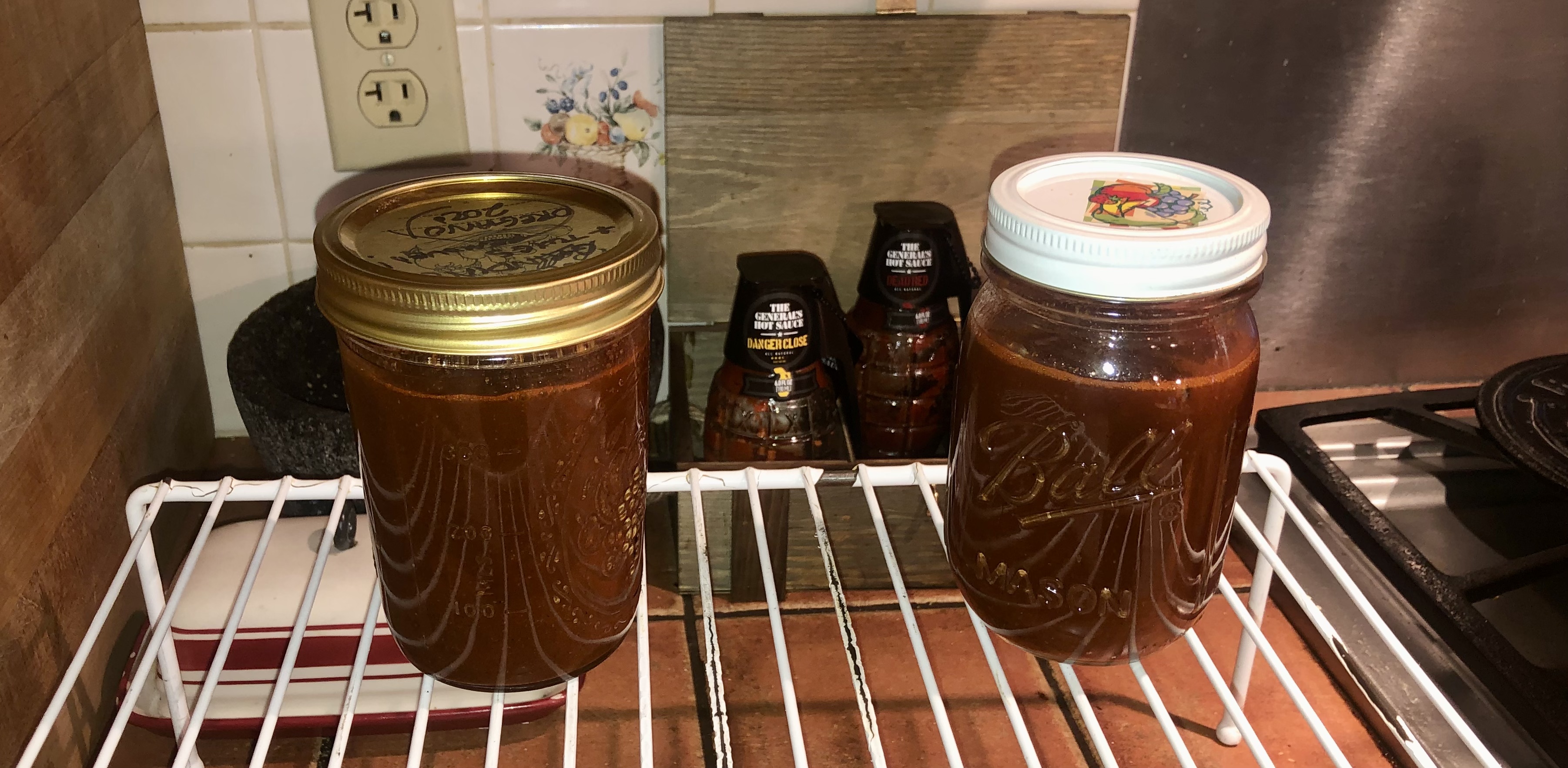
We mailed off batches of both kinds of hot sauce to various relatives. (All parcel mailing complete by Dec. 12, a record!) The sauces we've been making since the pepper harvest began to arrive are from this fermented hot sauce cookbook. These are easy recipes, using either with a specialized crock or just a Mason jar that you burp daily for the week or two of the ferment. Usually you cook or blend up the ferment with fresh ingredients when its time is up. You can use fresh or dried peppers.

In other holiday prep news, I set up a dog-proof miniature tree grove on top of the piano for all the little disks I painted last year. They didn't seem to blend well with the crystals and snowflakes on the bigger trees. One display is transparent, lacy, and pastel while the other is large, opaque, regular, primary-colored, and blunt-edged.


I continue to produce about one snowflake a day.

Grim's Christmas Barbecue Sauce

Cast iron cooking gives the best flavor.

A year or so ago I posted a recipe for barbecue sauce. I have a Christmas version that differs slightly, which I made today in order to ship as gifts. I've also refined my technique slightly as I will explain. Here are the recipes, both the Christmas version and the original for ease of reference. 

Grim's Christmas Barbecue Sauce

Tomato powder (see note) or 1 can (8oz) tomato paste
Several cups brewed black coffee (more if using tomato powder)
1 tbsp packed brown sugar
1 tbsp blackstrap molasses
1 tbsp onion powder
1 tbsp garlic powder
1 tbsp chipotle powder (a smaller amount of cayenne would be more typical for a Georgia sauce, but the larger quantity of chipotle adds to the smoky flavor)
1 tbsp smoked paprika
1 tsp chili powder (or just ancho chili powder)
1 tsp black pepper
Small shot, Apple cider vinegar
Full shot, Rye whiskey
Salt to taste

The major differences from the original are the addition of Rye whiskey, the increase in smoked paprika to a whole tablespoon, and the use of tomato powder. 

This last is an innovation my wife and I have discovered as part of our ongoing Victory Garden efforts. I always make many gallons of spaghetti sauces and various salsas at tomato harvest time, which I can in an over-the-top water bath as it is sufficiently acidic for that method. We still have lots of tomatoes. In the past I've run these through a dehydrator and sealed up like sun-dried tomatoes, but this year my wife learned to make them into tomato powder instead. By crushing the dehydrated tomato slices into powder, you can seal them up with an oxygen absorber that can almost entirely eliminate oxidation. The powder is then shelf-stable for up to 25 years.

At first I didn't know what I'd do with tomato powder, but it turns out to be a real advantage in the kitchen. It allows for a very fine control over both the tomato-y-ness of the sauce, stew, chili, or whatever else you are making; and it's a great thickener. You can add another dash, a teaspoon, a cup, or whatever else you'd like to achieve the desired thickness and tomato flavor. I highly recommend it. 

Tomato Powder.

I also learned to make Hungarian Chicken Paprikash this year, and learned thereby that you can use much larger quantities of paprika to create a richer sauce. I thus tripled the amount of smoked paprika (and only smoked for this version: with the chipotle, it gives the sauce a spicy, smoky kick).

The original sauce was a Georgia-style spicy tomato-based barbecue sauce. The major difference between that style and the eastern Tennessee style is whiskey. This version is for gifting, and all my family is from east Tennessee. I tried Tennessee whiskey in it, but the corn flavor is unpleasant to me. Rye whiskey compliments the spiciness nicely. I used Bulleit Frontier Whiskey Rye.  

If you use the 8oz of tomato paste, you'll only need maybe four cups of coffee; if you use the tomato powder, you'll need to add quite a bit more (or hot water if you prefer to keep the coffee content near the original). Once it's all cooked together, adding water and/or tomato powder to give it the desired flavor and thickness, this should produce almost exactly one quart of sauce. I recommend dividing this into two pints and over-the-top water canning it, which allows it to be stored or shipped as gifts to appreciative family or friends.

The original recipe is below for ease of reference and comparison. 

Grim's Barbecue Sauce (Original)

1 can (8 oz) tomato paste
Several cups brewed black coffee
1 tbsp packed brown sugar
1 tbsp blackstrap molasses
1 tbsp onion powder
1 tbsp garlic powder
1 tbsp chipotle powder (a smaller amount of cayenne would be more typical for a Georgia sauce, but the larger quantity of chipotle adds to the smoky flavor)
1 tsp smoked or hot paprika
1 tsp chili powder (or just ancho chili powder)
1 tsp black pepper
Small shot, Apple cider vinegar
Salt to taste

UPDATE:
Canning complete. 

UPDATE:
While I had the canning gear out, I also whipped up some fire-roasted mango habanero salsa. That’s not a secret recipe or anything. 

草泥馬

When we lived in China many years ago now, my wife and I encountered a form of Chinese humor that is really quite dominant there: the homophonic pun. Chinese is a monosyllabic language: every character is named by a syllable, and there being only so many monosyllabic sounds you can make, many of them sound exactly or almost exactly alike. Some of them differ in tone -- Chinese is a heavily tonal language, with a big difference in meaning possible if you employ this tone instead of that one in sounding the word. Others of them don't differ at all, and you just have to know that two different meanings are possible. 

An interesting work project lately has been researching Chinese anti-regime online protest language. An important figure is the mythical Grass Mud Horse, which fights the evil River Crab. The words for "River Crab" are a homophone for "Harmony," the excuse the regime uses for censorship online; and the words for "Mud Grass Horse" are a homonym for "F*** your Mother." 

Also, the Chinese Communist Party is colloquially referred to as "Mother."

The Cantonese dialect -- like many dialects -- uses the same writing system as Mandarin and all* the other Chinese languages, but the characters are pronounced differently by verbal speakers. What that means practically is that a whole different set of puns are possible if you speak Cantonese, like they do in Hong Kong, and the Mandarin-speaking Party elites can't really censor them because they don't understand the jokes. They don't realize what is being said, and so Cantonese protest puns are going wild right now in spite of the whole PRC Great Firewall effort.


* Except Cantonese as used in Taiwan. This uses the original, traditional form of the written language; all of the People's Republic parts have switched to 'Simplified' Chinese characters. For example, the Chinese people is written in Simplified Chinese as  汉人; in traditional Chinese 漢人.

Easy tree

Putting up and decorating a large, natural Christmas tree was fomenting domestic discord, so for the last several years I've been experimenting with faux bare-branch beech trees. This tree uses mostly crocheted snowflakes, paper Froebel stars, and crystal pendants.

A Partial Defense of E-Cars

The author is not successful in establishing his thesis, which would require a defense of the massive issues around batteries and e-waste. He does, however, have an interesting claim about power generation. A regular critique is that electrical cars are powered mostly by electricity generated with coal. He points out that, even if it were 100% coal-generated power, e-cars would still have a significant advantage.
Even if you only ever burned coal to create the electricity to power EVs, that's still less CO2 than is released by burning gasoline.... ICE ['internal combustion engine'] vehicles only send between 16 to 25 percent of the energy created from burning gasoline to the wheels. The other 75 to 84 percent is lost due to inherent inefficiencies. Most of the loss is heat and noise, although about 10 percent is sacrificed to stuff like drivetrain losses, essentially the difference between crank horsepower and wheel horsepower.... 
Electric vehicles (eventually) send 87 to 91 percent of the energy in the battery to the wheels. I say "eventually" because 22 percent of that energy needs to be "recaptured" through regenerative braking. Put another way, 31 to 35 percent of the energy stored in the battery is lost for various reasons, but 22 percent can be regenerated by the "brakes."... To summarize, replacing gasoline with coal (which, for the record, is an abysmal idea) would reduce energy usage by 31 percent. Another way to think about it: Right now, Americans use about 9 million barrels of oil a day for our automotive transportation needs. Magically switching to EVs charged via burning coal would result in only needing the equivalent of about 6 million barrels. That's a big reduction. 

That seems like a significant rebuttal on the one point, at least. 

Scaramouche

After Captain Blood, I decided to give Sabatini another try and read Scaramouche.

I definitely learned more reading this book than the prior one, whose background material was well-known to me. I had never really encountered the Italian theatrical tradition commedia dell'arte on which it draws so heavily (including for its title). The form uses stock characters who, instead of having lines, are put into scenarios and asked to improvise a performance that is different every time. Because the stock characters are well known to the audience and have obvious costumes to designate their role, the audience can quickly ascertain the motivations at work on stage and understand the comedy. 

Sabatini decided to draw heavily on this for his own storytelling. He regularly refers to a character as being "a Rhodomont" or "our Pantaloon" in order to convey to his audience what role to expect them to play. This conveys nothing but confusion until you study the form enough to have some notion of who those stock character are. A Scaramouche is a 'skirmisher,' one who engages in or provokes fights but then flees from them -- somewhat like the little dog that will start a fight among the big dogs and then go hide while they have it out. 

I shall put the rest after the jump, to avoid spoilers in case any of you want to read the work.