Should we think differently about this Goldman-Sachs case than the Snowden case? Both involve a kind of basic disloyalty, a thieving of secrets not one's own, a revealing of them to the world in violation of trust and given word. Both were done (at least allegedly) out of a basic patriotism: the one because the government's spying apparatus had been turned on Americans in overwhelming ways and the violator thought the public ought to know; the other because the government had proven to be captured by the banks it was allegedly supposed to regulate, with the effect that both key institutions had become corrupt to the core. In both cases, the idea was that revealing it all to the public was the way to begin to right the ship.
If we think differently about it, it is because we think a primal loyalty is owed to the political system -- the nation state -- that is not owed to one's employer. That's a plausible distinction. We ordinarily hope that people who discover that their company is violating the state's laws will come forward and report them. Perhaps we should also hope that people who discover that their company is violating the country's basic system of beliefs, and is not violating the laws only because it has corrupted the laws, will also come forward and report it. The reporting agency is then the citizenry, because the government can't be trusted. It is implicated in the corruption.
Does that distinction hold up? Is there another valid difference? Or should we condemn or spare them as equivalent cases?


Changing life
This is a fascinating account of a stroke that affected a young woman's thalamus. Don't worry; she seems to have come out pretty well in the end.
Handedness
Earlier today when I was looking for background materials on gravity waves, I stumbled on a Wiki page listing some prominent unsolved problems in various fields of science, and very interesting they were, too: most of them not purely armchair curiosities but specific examples of theoretical predictions that annoyingly fail to match the best experimental data we have so far. Anyway, one of them was "homochirality," or the puzzling tendency of life on Earth to settle on either the right-handed or the left-handed version of various prominent biological molecules. DNA helices, for instance, always twist in the same direction. Was it a primordial accident that simply got copied and spread in the case of each molecule?
By coincidence, Not Exactly Rocket Science linked today to an article about a new idea on the subject: electrons are unusual elementary particles in that they have a consistent spin. Electrons that are spit out in various reactions, such as beta decay (in which a neutron leaves a nucleus and decays into a proton, a neutrino, and an electron, previously bound together by the nuclear "weak force"), appear to exert a consistent, predictable twisting action on some biological molecules.
By coincidence, Not Exactly Rocket Science linked today to an article about a new idea on the subject: electrons are unusual elementary particles in that they have a consistent spin. Electrons that are spit out in various reactions, such as beta decay (in which a neutron leaves a nucleus and decays into a proton, a neutrino, and an electron, previously bound together by the nuclear "weak force"), appear to exert a consistent, predictable twisting action on some biological molecules.
The researchers found that left-handed bromocamphor was just slightly more likely to react with right-handed electrons than with left-handed ones. The converse was true when they used right-handed bromocamphor molecules. At the lowest energies, the direction of the preference flipped, causing an opposite asymmetry.
In all cases the asymmetry was tiny, but consistent, like flipping a not-quite-fair coin. “The scale of the asymmetry is as though we flip 20,000 coins again and again, and on average, 10,003 of them land on heads while 9,997 land on tails,” says Dreiling.Over evolutionary periods of time, even tiny assymmetries can add up.
Such a bad idea
I completely understand the desperate temptation to buy the blood of Ebola survivors, to get the advantage of their antibodies. Hospitals have been using survivor serum, with some success, since the first Ebola cases in the 1970s. But talk about procedures that won't "scale up"! It's one thing for a first-world hospital to do transfusions with blood that's been subjected to tests for other diseases, especially when at most one patient, already in grave danger, will be exposed. I hardly like to think what will happen if a large third-world population starts trading blood products willy-nilly. Despite my preference for free markets, there are a few areas where I've always felt strong central controls make sense, and epidemiology is right up there.
Ebola very probably got a foothold in Africa in the first place, way back in the 20th century, because people didn't know any better than to initiate vaccination campaigns with not-particularly-sterilized reusable needles. The first documented Ebola outbreak, in the 70s, was hugely amplified by the same problem: Belgian nuns doing the best they could with reusable needles, only indifferently sterilized. Direct blood-to-blood contact on a large scale could create an amazing Ebola nightmare, to say nothing of the other diseases it might inadvertently amplify.
Ebola very probably got a foothold in Africa in the first place, way back in the 20th century, because people didn't know any better than to initiate vaccination campaigns with not-particularly-sterilized reusable needles. The first documented Ebola outbreak, in the 70s, was hugely amplified by the same problem: Belgian nuns doing the best they could with reusable needles, only indifferently sterilized. Direct blood-to-blood contact on a large scale could create an amazing Ebola nightmare, to say nothing of the other diseases it might inadvertently amplify.
Family Civil War, 2014 Edition
That was an amazing game. In the end, it was the Mighty Bulldogs.

Certain cousins, aunts, and uncles are just going to have to deal with it this year.
Certain cousins, aunts, and uncles are just going to have to deal with it this year.
Fuel alternatives
It'll never work! The infrastructure challenges are insurmountable! . . . OK, maybe they're not so bad, but fracking is evil.
We can confidently predict a concerted effort to prevent the development of a clean, reliable natural gas fuel for cars.
We can confidently predict a concerted effort to prevent the development of a clean, reliable natural gas fuel for cars.
No Big Bang?
It hasn't been a good month for the Big Bang Theory. First, a much-ballyhooed interpretation of data that was supposed, in March of this year, to demonstrate left-over gravity waves from the primordial explosion now turns out to have been premature. Now, a respectable mathematician claims to have demonstrated that the usual explanation for the formation of a black hole is internally inconsistent, thus potentially calling into question another assumption critical to standard Big Bang mechanisms.
It's not at all clear I'll live long enough to see results from the Laser Interferometer Space Antenna (LISA), whose "projected" 2034 launch date can't inspire much confidence, but that's the sort of detection device that may be needed before we can clarify the business of whether gravity waves can be detected and, if so, what they show about events almost impossibly distant in space and time. Work proceeds apace, but the project presents some staggering challenges. For one thing, the interferometer array is intended to follow a trailing-Earth solar orbit, which means it will be seriously out there, and not amenable to casual repair like the Hubble telescope.
As for black holes and "Hawking radiation," I've never known what to think; it's another area in which I'm curious whether things will get cleared up in my lifetime. By "cleared up," of course, I mean nailed down to the point where the explanations can penetrate even to laymen such as myself. In the meantime, the events of this month are generating spirited discussions about the human temptation to cling to elegant theories when, as one commenter put it, sometimes Nature makes us erase the blackboard.
It's not at all clear I'll live long enough to see results from the Laser Interferometer Space Antenna (LISA), whose "projected" 2034 launch date can't inspire much confidence, but that's the sort of detection device that may be needed before we can clarify the business of whether gravity waves can be detected and, if so, what they show about events almost impossibly distant in space and time. Work proceeds apace, but the project presents some staggering challenges. For one thing, the interferometer array is intended to follow a trailing-Earth solar orbit, which means it will be seriously out there, and not amenable to casual repair like the Hubble telescope.
As for black holes and "Hawking radiation," I've never known what to think; it's another area in which I'm curious whether things will get cleared up in my lifetime. By "cleared up," of course, I mean nailed down to the point where the explanations can penetrate even to laymen such as myself. In the meantime, the events of this month are generating spirited discussions about the human temptation to cling to elegant theories when, as one commenter put it, sometimes Nature makes us erase the blackboard.
Credit is not a substitute for progress
This Weekly Standard article ostensibly is about Neil deGrasse Tyson's dishonesty, but on that subject it's a mere re-hash of a sordid record and a banal career. The fresher material is this quotation from Peter Thiel:
Like technology, credit also makes claims on the future. "I will gladly pay you a dollar on Tuesday for a hamburger today" works only if a dollar gets earned byTuesday. A credit crisis happens when earnings disappoint and the present does not live up to past expectations of the future. The current crisis of housing and financial leverage contains many hidden links to broader questions concerning long-term progress in science and technology. On one hand, the lack of easy progress makes leverage more dangerous, because when something goes wrong, macroeconomic growth cannot offer a salve; time will not cure liquidity or solvency problems in a world where little grows or improves with time. On the other hand, the lack of easy progress also makes leverage far more tempting, as unleveraged real returns fall below the expectations of pension funds and other investors.
This analysis suggests an explanation for the strange way the technology bubble of the 1990s gave rise to the real-estate bubble of the 2000s. After betting heavily on technology growth that did not materialize, investors tried to achieve the needed double-digit returns through massive leverage in seemingly safe real-estate investments. This did not work either, because a major reason for the bubble in real estate turned out to be the same as the reason for the bubble in technology: a mistaken but nearly universal background assumption about easy progress. Without fundamental gains in productivity (presumably driven by technology), real-estate values could not go up forever. Leverage is not a substitute for scientific progress.
Handcuffs
Common Core remains a mystery, but there's no mystery about how disturbing it is to see two parents arrested and led out of school board meetings, or to see the rest of the crowd put up with it.
I may have mentioned before that I support vouchers and home schooling, not to mention casting an informed ballot in school board elections.
I may have mentioned before that I support vouchers and home schooling, not to mention casting an informed ballot in school board elections.
Beheaded in Oklahoma
No link to terror groups say the authorities, which is plausible given some definitions of what it means to be "linked to terror groups."
Good shooting by the COO, though.
Good shooting by the COO, though.
Privacy
Should we be outraged that Apple is making virtually unbreakable encryption a default option on iPhones? I'm not seeing it. Allahpundit argues that law enforcement should be able to get into your phone with a warrant. I'm content to let people expose themselves to penalties for contempt if they refuse to unlock an encrypted phone and a warrant holds up on appeal. Also, it's a little hard to take seriously claims that an encryption technique will stay unbreakable for long.
Sheep & Horses
Especially for Tex, but also anyone interested in her course on the history of English, some a tale from the Proto-Indo-European.
Cop shootings no one cares about
Some weeks back I posted about a fishy shooting of a black man by cops in a WalMart, which got practically zero coverage or comment. Every time I found a brief update in the news, the story got a little uglier for the cops, but for some reason the event didn't resonate with the American public and now has dropped into a deep, dark hole.
This week videotape has surfaced of a white cop shooting a black guy in South Carolina about three weeks ago under nearly inexplicable circumstances. Again, little apparent interest.
What in the world makes a murky case like Ferguson fertile ground for race riots and national posturing while these other two shootings fall right off the radar? A cynical view might be that the Ferguson cop wasn't immediately disciplined, while the South Carolina cop was promptly fired and may face 20 years in prison, but that theory doesn't quite work: as far as I could tell no one has suggested any disciplinary action in the WalMart shooting, which seems hunky-dory with both Al Sharpton and Eric Holder.
It's pretty clear no one should put me in charge of propaganda. I lack the touch.
This week videotape has surfaced of a white cop shooting a black guy in South Carolina about three weeks ago under nearly inexplicable circumstances. Again, little apparent interest.
What in the world makes a murky case like Ferguson fertile ground for race riots and national posturing while these other two shootings fall right off the radar? A cynical view might be that the Ferguson cop wasn't immediately disciplined, while the South Carolina cop was promptly fired and may face 20 years in prison, but that theory doesn't quite work: as far as I could tell no one has suggested any disciplinary action in the WalMart shooting, which seems hunky-dory with both Al Sharpton and Eric Holder.
It's pretty clear no one should put me in charge of propaganda. I lack the touch.
So That's How They Do It!
If, like me, you've been wondering how smugglers so easily pass by the US Border Patrol, at last there is video exposing their methods!
Three Hundred Percent
One of my old Iraq comrades used to be a big fan of a play called "Avenue Q." It was a kind of parody of Sesame Street. This was his favorite song:
I was thinking about this because of a headline I saw that suggests that 'Every man's a little bit rapist.'
To say that a frat boy is 300% more likely than other men on campus to rape a woman is to say that your control group is at least a little bit likely to rape a woman. After all, if a frat boy is 300% more likely than I am to rape a woman -- or even if he were three hundred times more likely -- nevertheless there's no problem. Zero multiplied by anything yields zero, which is the appropriate number of rapes.
It's only if any given man in the control group can be assigned a 'little rapist' factor that you can get the multiple to work. So, in pushing these numbers, we really need to conceptualize every man in college as having at least some rapist in his constitution.
How much? Well, according to the study you can read if you track back a couple of links, the figure for frat boys who admitted to rape or attempted rape is nine percent. Now one way of expressing that is that 91% of frat boys are not rapists. That means that 97% of the general population of college men are not rapists. That's a pretty substantial percentage. We may not be all the way to where we want to be, but we've still established that the overwhelming majority of these men don't commit rape.
But if we express it the way the headline expresses it, we can condemn all frat boys -- including the 91% who haven't raped anyone -- for being more rapist than the general population of men. By the same logic, we can condemn the whole population of college men -- 97% non-rapist -- as being part of a group that includes a statistical number of rapists.
Alternatively, you could say that your 97% of college men who never rape women are the norm. Then, of course, you can't make a statistical claim about how much more likely frat boys are to rape than normal college men -- presumably you would have to say that they are infinitely more likely to do so!
Fun with statistics. But there's a serious consequence to the way we end up conceptualizing college. Is it a place of tremendous sexual danger, with college men who are as a class statistically likely to rape young women? Or is it a place where, actually, almost every man you meet is the kind of man who doesn't rape? A lot hangs on that answer.
I was thinking about this because of a headline I saw that suggests that 'Every man's a little bit rapist.'
To say that a frat boy is 300% more likely than other men on campus to rape a woman is to say that your control group is at least a little bit likely to rape a woman. After all, if a frat boy is 300% more likely than I am to rape a woman -- or even if he were three hundred times more likely -- nevertheless there's no problem. Zero multiplied by anything yields zero, which is the appropriate number of rapes.
It's only if any given man in the control group can be assigned a 'little rapist' factor that you can get the multiple to work. So, in pushing these numbers, we really need to conceptualize every man in college as having at least some rapist in his constitution.
How much? Well, according to the study you can read if you track back a couple of links, the figure for frat boys who admitted to rape or attempted rape is nine percent. Now one way of expressing that is that 91% of frat boys are not rapists. That means that 97% of the general population of college men are not rapists. That's a pretty substantial percentage. We may not be all the way to where we want to be, but we've still established that the overwhelming majority of these men don't commit rape.
But if we express it the way the headline expresses it, we can condemn all frat boys -- including the 91% who haven't raped anyone -- for being more rapist than the general population of men. By the same logic, we can condemn the whole population of college men -- 97% non-rapist -- as being part of a group that includes a statistical number of rapists.
Alternatively, you could say that your 97% of college men who never rape women are the norm. Then, of course, you can't make a statistical claim about how much more likely frat boys are to rape than normal college men -- presumably you would have to say that they are infinitely more likely to do so!
Fun with statistics. But there's a serious consequence to the way we end up conceptualizing college. Is it a place of tremendous sexual danger, with college men who are as a class statistically likely to rape young women? Or is it a place where, actually, almost every man you meet is the kind of man who doesn't rape? A lot hangs on that answer.
1st ID HQ to Deploy to Iraq for a Year
This is a really interesting deployment decision. In a way they're pushing the command down, since currently the ARCENT Deputy Commander is doing what the 1st ID CG will now be doing. In another way, although they're falling in on some existing structures and duties, it's very odd to split the headquarters the way they're going to do.
A serious commitment, though, and one that could very easily expand outward. Once you have a division headquarters in place, you have everything you need to insert several Brigade Combat Teams. 1/1 ID is in Kuwait already.
A serious commitment, though, and one that could very easily expand outward. Once you have a division headquarters in place, you have everything you need to insert several Brigade Combat Teams. 1/1 ID is in Kuwait already.
Cory Gardner goes too far
The DSCC has strong words to say about this vicious attack ad from Cory Gardner, the republican candidate for U.S. Senator from Colorado, who is running against Democratic incumbent Mark Udall.
It’s clear Congressman Cory Gardner’s campaign is struggling to overcome the damage done by his support for laws that could block a woman’s access to common forms of birth control, take away women’s personal health care decisions even in cases of rape or incest, and roll women’s health care rights back decades. It’s disgusting that Congressman Gardner would stoop as low as attacking Senator Mark Udall’s late father and it is beneath a candidate running for the U.S. Senate. Congressman Gardner should apologize to Senator Udall and his family and pull the ad off the air.And yet if you watch the actual ad, you'll see that Gardner says his opponent, Mark Udall, is a nice guy who will never change the Senate, that he comes from a political family, and that his father ran for President. Did you ever hear such a scurrilous attack?
Sound the Pibroch
Since we were talking about the Clancy firm, and lately have spoken much of Scotland, here is their retelling of Culloden:
The Highland Clearances were the great betrayal of the late 1700s, to which we owe a kind of debt for the good we got from those who came here. They were a grave betrayal, all the same.
The Highland Clearances were the great betrayal of the late 1700s, to which we owe a kind of debt for the good we got from those who came here. They were a grave betrayal, all the same.
'America & The Cycle of Neverending War'
I was kind of disappointed by the article, which I had hoped would refer to something a little more like this:

Finding out what's in it
Obamacare's been around for more than four years now, and I should have thought the many, many people who hate it like death would by now have discovered everything incredibly stupid that's written right into it. But it turns out that massive new insanities are surfacing as the tens of thousands of pages of implementary regulations gradually come to light. Here's a fabulous one: all new plans must be Bronze, Silver, Gold, or Platinum, defined by their actuarial valuation. Bronze means the average plan pays 60% of bills, Silver pays 70%, Gold 80%, and Platinum 90%. I'll bet you would have assumed that Bronze was really 60-69% and so on. Nope! The "safe zone" is only 2% in either direction. If your plan turns out to pay 65% on average, it's neither Bronze nor Silver and must be cancelled at the end of the year. No problem, you'll just sign up for a new one, right? Sure, but it will have all new terms to learn, and there's no guarantee that you'll keep your doctor or your hospital. Not that there was any guarantee of that anyway, since we can all expect our networks to degrade steadily.
I really have to ask myself: what kind of moron thought it was a good idea to make all plans fit within four bands and outlaw big chunks of actuarial rating that fall between them?
I really have to ask myself: what kind of moron thought it was a good idea to make all plans fit within four bands and outlaw big chunks of actuarial rating that fall between them?
Speaking of things that aren't science
Never liked Tyson. Liking him less and less, and shame on Wikipedia.
Cracks in ivy walls
There's getting to be so much education available on the Internet that I don't feel there are enough hours in the day to stuff into my head even the things I'm most interested in. It's a shame how much time I wasted in school.
I'm interested to see what kind of market can be developed in selling education now, with so much of it free. Of course the credentials are irrelevant to me, but not to a big potential market, so it should be feasible to charge for those.
I'm interested to see what kind of market can be developed in selling education now, with so much of it free. Of course the credentials are irrelevant to me, but not to a big potential market, so it should be feasible to charge for those.
Nine lives
Just as the main facade of this hotel is starting to tip over into the street, at 0:17, you can see a cat appear in an opening about halfway up, to the left of the "S" in "Towers."
The Strangest Civil War Argument I've Ever Heard
At the end of this piece on that pro-secession poll, the author posits a cause of the war that I've never heard anyone float.
I understand the argument for slavery as cause. I understand the argument for economics as cause. I understand the argument for culture as cause. My own sense is that all of those things were factors in the tension that led to the conflict, but that the proximate cause -- the thing that made a war necessary, and a peaceful secession impossible -- was the union of technology and geography. No President of the United States in 1860 could accept control of the port city at the mouth of the Mississippi river passing to the hands of a foreign power. Before the proliferation of railroads, before trucks and interstates, before airplanes, there was no alternative to the Mississippi to move the wealth of the middle of the country to market. It was as critical a national interest of the United States then as access to warm-water ports has always been to Russia.
Quite possibly it still is.
It would never have occurred to me, though, that the North couldn't have held itself together except on the principle that the Constitution was a suicide pact. Nobody gets out alive, because then the whole thing would fall apart!
Much of the fervor for war in 1860 was driven by a moral crusade against slavery. Some of it was fueled by patriotism, and some by state, local, and even just family affinities.So Lincoln fought the war because the North lacked any other organizing principle?
At the highest level, however, Lincoln recognized that the cosmopolitan North—teeming with immigrants, churning with class conflict, surging into the prairie and mountain west—would have lacked a logic of unity if the South were permitted to break off in peace. The Southerners had history, ethnicity, culture, slavery, religion, and a quasi-aristocratic honor society to hold them together.
What did the North have?
Not much more than we have today. Although the spell of American superpower and an almighty government is in some ways more dominant than ever, the moment that spell is broken, many will find themselves in a kind of freefall of political principle.
I understand the argument for slavery as cause. I understand the argument for economics as cause. I understand the argument for culture as cause. My own sense is that all of those things were factors in the tension that led to the conflict, but that the proximate cause -- the thing that made a war necessary, and a peaceful secession impossible -- was the union of technology and geography. No President of the United States in 1860 could accept control of the port city at the mouth of the Mississippi river passing to the hands of a foreign power. Before the proliferation of railroads, before trucks and interstates, before airplanes, there was no alternative to the Mississippi to move the wealth of the middle of the country to market. It was as critical a national interest of the United States then as access to warm-water ports has always been to Russia.
Quite possibly it still is.
It would never have occurred to me, though, that the North couldn't have held itself together except on the principle that the Constitution was a suicide pact. Nobody gets out alive, because then the whole thing would fall apart!
Carry a Sharp Stick but Then Speak Softly
This Ain't Hell links to a heartwarming tale of a Texas homeowner who defended his (small) home with a spear. Probably took the Havamal literally: "Unsure is the knowing when need shall arise / Of a spear on the way without." Or within, either. But he should've paid attention to another part: "The hasty tongue sings its own mishap / If it be not bridled in."
In the TV interview he handled himself well but admitted that the intruder appeared to be unarmed. Now I'm convinced he was still in the right -- just looking at the invader's size, I'd say the homeowner was properly in fear of life and limb; and he stopped stabbing when the intruder retreated, which looks good on him (it shows he was after "defense" and not "revenge"). But intimate facts like that don't need to be spoken out in the open air which is full of police and prosecutors too. If someone wants to make an issue out of it (and in some places, the difference in races alone would make that likely), better to make the prosecution prove what did or didn't appear, rather than to offer it as a gift to the public.
I wouldn't wish a home invasion on anyone, but if I were faced with that situation and the press came 'round for an interview, I'd take my advice from the firm of Clancy and Makem.
In the TV interview he handled himself well but admitted that the intruder appeared to be unarmed. Now I'm convinced he was still in the right -- just looking at the invader's size, I'd say the homeowner was properly in fear of life and limb; and he stopped stabbing when the intruder retreated, which looks good on him (it shows he was after "defense" and not "revenge"). But intimate facts like that don't need to be spoken out in the open air which is full of police and prosecutors too. If someone wants to make an issue out of it (and in some places, the difference in races alone would make that likely), better to make the prosecution prove what did or didn't appear, rather than to offer it as a gift to the public.
I wouldn't wish a home invasion on anyone, but if I were faced with that situation and the press came 'round for an interview, I'd take my advice from the firm of Clancy and Makem.
Is Oklahoma next?
The shale boom that has transformed the economies of Texas and North Dakota may be about to hit Oklahoma.
The Autumn King
Hail the Equinox, and the coming of Autumn! No day of the year is more welcome in Georgia. This has been a difficult, but productive, summer. I am glad to bring it to a close, and complete its work.
Since Cassandra was reminding us of him, some of you might wonder how King Arthur Pendragon is celebrating the Equinox. He's celebrating at Stonehenge, of course. Would I could join him -- I imagine it's quite a party.

Horns of a dilemma
An interesting perspective on the Scottish independence vote at Protein Wisdom, starting with the reflection that Scotland can't have a socialist paradise if it continues to belong to the UK, or the funds to pay for it if it doesn't. Beyond that, though, the votes didn't break down quite the way everyone expected. Generally, for instance, my impression was that older voters said "no" while young ones said "yes," but it turns out that the very youngest voters said "no" by 57%. Also, the Labour Party was officially against independence, possibly because the UK Parliament stood to lose so many Labour members if it lost the Scottish contingent, but the rank and file tended to vote "yes."
Death Threats and the "Sex-Positive" Blogger
So let's say you were to read that a "sex-positive" blogger was forced to go underground and shut down her efforts for a while because she was getting death threats. Who would you suppose would be the most likely candidates to be sending such threats?
I'm not sure how 'sex-positive' I am, although I certainly approve of sex in its proper and well-reasoned bounds. I'm sure not going to be forced to adhere to anyone's special-snowflake vocabulary about how I allegedly have to refer to them. Her mistake was apparently caring what they thought enough to listen to them and show some sensitivity to their feelings. Once they smelled out that she could be intimidated, it was time to pile on.
Or, as John Wayne put it: "Never apologize. It's a sign of weakness."
The trouble began Friday when Green received a message from Tumblr user doctorswithoutboners accusing her of transphobia:Good job, Robespierre. That'll teach her to agree with you.
“Hi Laci. Why do you use the word ‘tranny’ in your video about Haters from 2009? … You really shouldn't be using that word as a cis girl and it's really disappointing for the people who look up to you.”
Green conceded her mistake and apologized (emphasis her own):
“Probably because I was 18 and ignorant. You are totally right and I sincerely apologize for my mistake. Before I educated myself about trans issues I had not the slightest inkling of how the word is used to dehumanize nor its place in the cycle of violence against transfolk. Now I have seen people hurt by it and seen it used as a nasty slur. Words have power, and ‘tranny’ is not a word for anybody but transfolk themselves to use because only they can reclaim it. If I knew that was in a video, it would have been long long ago removed. Consider it banished forever.”
Green took down the video, but some Tumblr users apparently didn’t find this adequate, also citing an apparent opinion Green once made about sexism and Islam.
The blogger tweeted she’d spent the morning on the phone with police and was becoming deeply concerned for her safety.
I'm not sure how 'sex-positive' I am, although I certainly approve of sex in its proper and well-reasoned bounds. I'm sure not going to be forced to adhere to anyone's special-snowflake vocabulary about how I allegedly have to refer to them. Her mistake was apparently caring what they thought enough to listen to them and show some sensitivity to their feelings. Once they smelled out that she could be intimidated, it was time to pile on.
Or, as John Wayne put it: "Never apologize. It's a sign of weakness."
What we heard at the People's March
Via Reason Magazine, via HotAir:
“We live in a grotesque era where we have everything we want right now,” one protester told Foster, graciously packaging her entire movement up in one self-hating nutshell.
Getting over the bad boyfriend
Good political ad. "I'm stuck with him for two more years, I know that. But I'm not stuck with his friends."
Another reason not to overwithhold taxes
IRS refund checks have never been part of my life, since I go to great lengths never to have too much tax withheld, or to have any withheld at all if I can help it. This is simple matter, in my case, of not wishing to loan the government money interest-free, but it turns out there's another good reason not to do it. It's fantastically easy for criminals to file electronic tax returns in your name and claim a fraudulent tax refund. The con man in the video linked here found that about 40% of the dozens of returns he used to file every week would be paid within 7 days. When the real taxpayer later files a return seeking a refund, he finds that he will have to spend months standing in line and fighting with the IRS to prove his identity.
Have a Smoke, Brother
The NYT says:
Now that I'm home, and for as long as I stay, I'll smoke less -- as I said, very nearly not at all. Just once in a while, to remember bold men and brothers. That's worth any tiny risk coming from the rare single smoke, that memory almost like being with them once again.
Most likely I'll be lucky to live long enough for it to threaten me, as has always been the case. Best to live that way, anyhow. Cuts down on the meddlers trying to tell you how you ought to live.
THIS weekend, the singer and songwriter Leonard Cohen is celebrating his 80th birthday — with a cigarette. Last year he announced that he would resume smoking when he turned 80. “It’s the right age to recommence,” he explained.I took up smoking cigars when I went to Iraq, and largely -- nearly entirely -- gave it up after coming back. But I figured, how much worse could the cigar be than the polluted, dust-filled air we were breathing anyway? And it was the only pleasure General Order #1 licensed, so we often smoked cigars together in the rare moments of rest. Finally, when the sky drops rockets and mortars and heavy-caliber rounds on you regularly, who gives a damn about the threat of cancer twenty years on?
At any age, taking up smoking is not sensible. Both the smoker and those who breathe his secondhand smoke can suffer not only long-term but acute health problems, including infections and asthma. And yet, Mr. Cohen’s plan presents a provocative question: When should we set aside a life lived for the future and, instead, embrace the pleasures of the present?
Now that I'm home, and for as long as I stay, I'll smoke less -- as I said, very nearly not at all. Just once in a while, to remember bold men and brothers. That's worth any tiny risk coming from the rare single smoke, that memory almost like being with them once again.
Most likely I'll be lucky to live long enough for it to threaten me, as has always been the case. Best to live that way, anyhow. Cuts down on the meddlers trying to tell you how you ought to live.
Orpheus In The Underworld
Two armed “polygamist women” dressed like “ninjas” were subdued by a sword-wielding man during a home invasion, according to police in suburban Utah....Cassandra couldn't dream so well as that.
The women “violently attacked one of the adult males in the house who came to see who was coming,” Ian Adams of the West Jordan police department told the Guardian.
“Another adult male joined the fray in defense of the first male victim. He was armed with a sword, and using a sword…”
“I went to the bottom of the stairs and saw a couple of ninjas coming down,” the man was quoted as saying. “They were all dark gray or black, and they had black rubber gloves on and masks. All I could see was their eyes.”
Attorney-Client Privilege?
So, what happened here?
The FBI wiretapped 2 conversations and one voicemail defense investigators for Mohamed Osman Mohamud had with Khan in June 2011 and then handed those recordings over to the prosecutor who prosecuted Mohamud and is prosecuting Khan.
In a filing in April, Khan’s lawyers moved to obtain information about the government’s minimization procedures. They pointed to 4 different privileged conversations that had been included in discovery...
While all this doesn’t explain what the tie between Khan and Mohamud is — in its response, the government actually claims it is “unrelated” and that it was not handed over to prosecutors until after the conclusion of Mohamud’s case (which would mean it wasn’t provided to the prosecutor before he indicted Khan) — it does make it clear that the government would share the privileged conversations of one defendant with that defendant’s prosecutor via the prosecution of another defendant under FISA.
Transparent rigor
A surprisingly sane take on climate science from a guy who was politically connected enough to serve as Energy Undersecretary in Pres. Obama's first term:
We can and should take steps to make climate projections more useful over time. An international commitment to a sustained global climate observation system would generate an ever-lengthening record of more precise observations. And increasingly powerful computers can allow a better understanding of the uncertainties in our models, finer model grids and more sophisticated descriptions of the processes that occur within them. The science is urgent, since we could be caught flat-footed if our understanding does not improve more rapidly than the climate itself changes.
A transparent rigor would also be a welcome development, especially given the momentous political and policy decisions at stake. That could be supported by regular, independent, "red team" reviews to stress-test and challenge the projections by focusing on their deficiencies and uncertainties; that would certainly be the best practice of the scientific method. But because the natural climate changes over decades, it will take many years to get the data needed to confidently isolate and quantify the effects of human influences.
Policy makers and the public may wish for the comfort of certainty in their climate science. But I fear that rigidly promulgating the idea that climate science is "settled" (or is a "hoax") demeans and chills the scientific enterprise, retarding its progress in these important matters. Uncertainty is a prime mover and motivator of science and must be faced head-on. It should not be confined to hushed sidebar conversations at academic conferences.
Society's choices in the years ahead will necessarily be based on uncertain knowledge of future climates. That uncertainty need not be an excuse for inaction. There is well-justified prudence in accelerating the development of low-emissions technologies and in cost-effective energy-efficiency measures.
But climate strategies beyond such "no regrets" efforts carry costs, risks and questions of effectiveness, so nonscientific factors inevitably enter the decision. These include our tolerance for risk and the priorities that we assign to economic development, poverty reduction, environmental quality, and intergenerational and geographical equity.
Individuals and countries can legitimately disagree about these matters, so the discussion should not be about "believing" or "denying" the science. Despite the statements of numerous scientific societies, the scientific community cannot claim any special expertise in addressing issues related to humanity's deepest goals and values. The political and diplomatic spheres are best suited to debating and resolving such questions, and misrepresenting the current state of climate science does nothing to advance that effort.
Any serious discussion of the changing climate must begin by acknowledging not only the scientific certainties but also the uncertainties, especially in projecting the future. Recognizing those limits, rather than ignoring them, will lead to a more sober and ultimately more productive discussion of climate change and climate policies. To do otherwise is a great disservice to climate science itself.
"Who Are You?"
From the Archives, 2008:
The most dangerous question Sen. Obama has ever had to face is, "Who are you?"Archives, 2010:
From the New York Times, today:Today's Wall Street Journal:
"Who is Barack Obama?"
The danger isn't, though, the one that Bob Herbert expects: that we'll answer the question for him in a way that will be a negative for his agenda.
The danger is that there may be no answer at all.
At this dramatic time, with a world on fire, we look at the president and ponder again who he is.It turns out that the question was less dangerous to him than to the rest of us. A pity we didn't take more interest in it.
A Scientific Theory of Chess
As part of an article about a major feat in Chess, an introduction to the governing body:
As the tournament began on Aug. 27, Carlsen was mired in an ongoing faceoff with FIDE, the international governing body of chess. There are a few things you should probably know about FIDE—or the Federation Internationale des Echecs, if you’re feeling continental. FIDE is, by all accounts, comically corrupt, in the vein of other fishy global sporting bodies like FIFA and the IOC. Its Russian president, Kirsan Ilyumzhinov, who has hunkered in office for nearly two decades now, was once abducted by a group of space aliens dressed in yellow costumes who transported him to a faraway star. Though I am relying here on Ilyumzhinov’s personal attestations, I have no reason to doubt him, as this is something about which he has spoken quite extensively. He is of the firm belief that chess was invented by extraterrestrials, and further “insists that there is ‘some kind of code’ in chess, evidence for which he finds in the fact that there are 64 squares on the chessboard and 64 codons in human DNA.”
What Science Is, and Is Not
Though apparently a conservative on the right side of many things, when Pascal-Emmanuel Gobry is no Aristotle.
It turns out that Gobry is wrong about almost everything he says about Aristotle, starting with what Aristotelian science is about and how it connects to the search for what Gobry calls "capital-T Truth." One of the distinguishing features of Aristotelian sciences is that they are separate. There is a science for every genus. Where there is not a proper genus to unify a field of human endeavor, no science is possible. This is why dialectical logic and rhetoric are not sciences, Aristotle says: they aren't restricted to one genus, so we can't have scientific knowledge of them. We use logic in many fields of inquiry, and rhetoric in political and ethical problems. We can't separate them cleanly enough for scientific knowledge, we can just study them as a kind of art.
This is why Aristotle spends so much time asking whether it is proper to have a science of different fields of knowledge. If you read the Metaphysics, which is the part of Aristotle's work most closely connected to anything like "capital-T Truth," the very first question he treats is whether there is a subject matter for this science. You can have a science of biology, because it treats living things. You can have a science of physics, because it treats motion. What sense would it make, Aristotle asks, to have a science of everything? Each has its own separate science, after all, so what point is there to trying to unify them? What's the subject matter that makes this a sensible project?
The answer is that Metaphysics is the study of existence itself, not of anything that exists. The idea is not to put it all together and get to a knowledge of the ultimate causes of, say, your horse in the pasture. It's to try to understand what is necessary for existence of the sort we observe to be possible.
Now as for all this being a setback, the slightest acquaintance with history would disprove the remark. (As, also, the remark about Aristotle being the first among these -- even if you only read Aristotle, you would discover the names of dozens of men whose work he references and considers.) The boom in Islamic civilization in the early Middle Ages came as they encountered and translated Aristotle, which is what changed them from a merely warlike collection of conquerors into a civilization proper. When their translations in Arabic were recovered by the Spanish during the reconquista, it produced a scientific and technical revolution that was revolutionary in the West. Without it, there would have been no development of the kind of science we do today at all. The foundations were laid by the recovery of Greek thought.
Further, it is not Aristotelian but modern science that believes you can unify the fields of knowledge. That is why you hear talk of 'unified field theories.' Aristotle thought you should study animals under one science, and motions of things under another, and chemical reactions under another. Modern science thinks that motions are produced by physics, which at a higher level of organization is chemistry, and certain kinds of chemicals become biochemistry, which ultimately leads to biology. Many Determinists have argued that everything, including the fields we call psychology or sociology, will prove to be reducible to physics -- with adequate knowledge, we would get to the ultimate causes of everything.
Well, sort of. The problem of existence, Metaphysics, isn't solvable that way. Commonly physicists respond that this means it is a non-problem, one we should ignore as not very interesting. Of course things exist; we can observe them. Why ask how it could be possible for there to be something rather than nothing? Obviously it is possible, and as far as we know it's not possible for there to be nothing (indeed, the laws of conservation suggest something like that).
By the way, who knows the story of how Einstein came to his revolutionary theories? It turns out it wasn't by careful, systematic observation. Gobry's picture of how modern science work doesn't even apply there: what Einstein did was philosophy, starting with a return to the Greeks and the problems they raised.
The other thing that he's wrong about is the idea that we could do 'scientific' studies of things like welfare issues. You can't, because you can't control and repeat in what are called 'social sciences,' but which are properly arts and not science at all (as Aristotle would have told you). That means your theories about what would have happened if you'd done something else instead are non-falsifiable. This is a problem raised by Karl Popper.
The other problem is that you can't control for variables in these very complex fields. To do a truly scientific experiment, you should hold everything constant except one variable. There is no potential to do that in a study involving human beings, especially human beings who are going about their lives in an uncontrolled fashion.
What we get in these artistic studies of human behavior and thought is only an analogy to science. It is characteristic of analogies that they always break at some point, because the only way to have an analogy that doesn't break is for the analogs to be identical (in which case you don't have an analogy at all, you have an identity). It may be worth doing -- we learn a lot from analogies. All our political and ethical reasoning is ultimately based on analogies, and those projects are worthwhile. But they are not, and cannot be, sciences.
History is not a science; if you try to do history as a science, your efforts are only analogous to science. Sociology and psychology and 'political science' are often conducted in analogical ways to science, but they don't offer control of variables nor can their theories be falsified.
That's why there are still all those Marxists in all those fields.
I'm sympathetic to a lot of Gobry's project, but he needs to go back to school and rethink his basic understanding of science -- and learn some history.
A little history: The first proto-scientist was the Greek intellectual Aristotle, who wrote many manuals of his observations of the natural world and who also was the first person to propose a systematic epistemology, i.e., a philosophy of what science is and how people should go about it. Aristotle's definition of science became famous in its Latin translation as: rerum cognoscere causas, or, "knowledge of the ultimate causes of things." For this, you can often see in manuals Aristotle described as the Father of Science.The first 'proto-scientist' represented a setback? A setback to what? A tradition that didn't exist?
The problem with that is that it's absolutely not true. Aristotelian "science" was a major setback for all of human civilization.
It turns out that Gobry is wrong about almost everything he says about Aristotle, starting with what Aristotelian science is about and how it connects to the search for what Gobry calls "capital-T Truth." One of the distinguishing features of Aristotelian sciences is that they are separate. There is a science for every genus. Where there is not a proper genus to unify a field of human endeavor, no science is possible. This is why dialectical logic and rhetoric are not sciences, Aristotle says: they aren't restricted to one genus, so we can't have scientific knowledge of them. We use logic in many fields of inquiry, and rhetoric in political and ethical problems. We can't separate them cleanly enough for scientific knowledge, we can just study them as a kind of art.
This is why Aristotle spends so much time asking whether it is proper to have a science of different fields of knowledge. If you read the Metaphysics, which is the part of Aristotle's work most closely connected to anything like "capital-T Truth," the very first question he treats is whether there is a subject matter for this science. You can have a science of biology, because it treats living things. You can have a science of physics, because it treats motion. What sense would it make, Aristotle asks, to have a science of everything? Each has its own separate science, after all, so what point is there to trying to unify them? What's the subject matter that makes this a sensible project?
The answer is that Metaphysics is the study of existence itself, not of anything that exists. The idea is not to put it all together and get to a knowledge of the ultimate causes of, say, your horse in the pasture. It's to try to understand what is necessary for existence of the sort we observe to be possible.
Now as for all this being a setback, the slightest acquaintance with history would disprove the remark. (As, also, the remark about Aristotle being the first among these -- even if you only read Aristotle, you would discover the names of dozens of men whose work he references and considers.) The boom in Islamic civilization in the early Middle Ages came as they encountered and translated Aristotle, which is what changed them from a merely warlike collection of conquerors into a civilization proper. When their translations in Arabic were recovered by the Spanish during the reconquista, it produced a scientific and technical revolution that was revolutionary in the West. Without it, there would have been no development of the kind of science we do today at all. The foundations were laid by the recovery of Greek thought.
Further, it is not Aristotelian but modern science that believes you can unify the fields of knowledge. That is why you hear talk of 'unified field theories.' Aristotle thought you should study animals under one science, and motions of things under another, and chemical reactions under another. Modern science thinks that motions are produced by physics, which at a higher level of organization is chemistry, and certain kinds of chemicals become biochemistry, which ultimately leads to biology. Many Determinists have argued that everything, including the fields we call psychology or sociology, will prove to be reducible to physics -- with adequate knowledge, we would get to the ultimate causes of everything.
Well, sort of. The problem of existence, Metaphysics, isn't solvable that way. Commonly physicists respond that this means it is a non-problem, one we should ignore as not very interesting. Of course things exist; we can observe them. Why ask how it could be possible for there to be something rather than nothing? Obviously it is possible, and as far as we know it's not possible for there to be nothing (indeed, the laws of conservation suggest something like that).
By the way, who knows the story of how Einstein came to his revolutionary theories? It turns out it wasn't by careful, systematic observation. Gobry's picture of how modern science work doesn't even apply there: what Einstein did was philosophy, starting with a return to the Greeks and the problems they raised.
The other thing that he's wrong about is the idea that we could do 'scientific' studies of things like welfare issues. You can't, because you can't control and repeat in what are called 'social sciences,' but which are properly arts and not science at all (as Aristotle would have told you). That means your theories about what would have happened if you'd done something else instead are non-falsifiable. This is a problem raised by Karl Popper.
The other problem is that you can't control for variables in these very complex fields. To do a truly scientific experiment, you should hold everything constant except one variable. There is no potential to do that in a study involving human beings, especially human beings who are going about their lives in an uncontrolled fashion.
What we get in these artistic studies of human behavior and thought is only an analogy to science. It is characteristic of analogies that they always break at some point, because the only way to have an analogy that doesn't break is for the analogs to be identical (in which case you don't have an analogy at all, you have an identity). It may be worth doing -- we learn a lot from analogies. All our political and ethical reasoning is ultimately based on analogies, and those projects are worthwhile. But they are not, and cannot be, sciences.
History is not a science; if you try to do history as a science, your efforts are only analogous to science. Sociology and psychology and 'political science' are often conducted in analogical ways to science, but they don't offer control of variables nor can their theories be falsified.
That's why there are still all those Marxists in all those fields.
I'm sympathetic to a lot of Gobry's project, but he needs to go back to school and rethink his basic understanding of science -- and learn some history.
Friday Night MV
Ain't it a shame.
(Sung, appropriately enough, by Bon Scott)
(sorry, couldn't resist)
"Westminster vows never to allow vote on anything that matters ever again"
House of Commons Speaker, John Bercow, said: “An 84 per cent turnout, rallies in the streets, and intelligent, informed debates are all the stuff of nightmares.You know what happens if the right people don't have the power.
“By some dreadful miscalculation the future of this nation was, for a brief time, in the hands of the people who live in it.
“Never, ever again.”
Bomb Threat at UGA
So today Athens, Georgia was turned upside down for a little while in the middle of the afternoon by an old-fashioned bomb threat. Actually, the threat wasn't super specific about just what was going to happen, just that 'if you want to live' you should 'stay away' from a particular building 'at 12:15.' Said building, named after former lieutenant-governor, Governor, and Senator Zell Miller, is a rather large and cavernous brick building that probably took an hour or more to clear once they got the dogs up there to do it.
I mention all this because I've been a little amused by some friends who are foreign-born but teaching at UGA. They are acting exactly like soldiers in Iraq after their first IED or mortar strike. Nothing happened, just an empty anonymous threat, but you'd think they'll be needing PTSD counseling.
It's all this media coverage of school shootings and whatnot. It's got people scared out of their minds. Crime and violence are actually down across the board, but you can't say "boo" without terrifying people. It's not healthy to be this heavily swayed by images on TV.
I mention all this because I've been a little amused by some friends who are foreign-born but teaching at UGA. They are acting exactly like soldiers in Iraq after their first IED or mortar strike. Nothing happened, just an empty anonymous threat, but you'd think they'll be needing PTSD counseling.
It's all this media coverage of school shootings and whatnot. It's got people scared out of their minds. Crime and violence are actually down across the board, but you can't say "boo" without terrifying people. It's not healthy to be this heavily swayed by images on TV.
The Challenge of Authority
One of the most damning facts about Rotherdam was the ways in which the police departments not only did not stop the abuses, but lost evidence and suppressed reports that might have compelled an earlier settlement.
There's always a general problem of 'who watches the watchmen?' How much bigger is the problem when you discover that the watchmen have an especially troubling record compared to the general population?
So, what to do about this kind of thing? I've seen a lot of suggestions that police wear videocameras on duty at all times -- I noticed some police wearing them just the other day, actually -- and the automatic reporting seems wise. Automatic firing based on a conviction? Increased legal penalties for those who engage in these acts 'under color of law,' as we used to say in civil rights legislation?
There's always a general problem of 'who watches the watchmen?' How much bigger is the problem when you discover that the watchmen have an especially troubling record compared to the general population?
There is no more damaging perpetrator of domestic violence than a police officer, who harms his partner as profoundly as any abuser, and is then particularly ill-suited to helping victims of abuse in a culture where they are often afraid of coming forward. The evidence of a domestic-abuse problem in police departments around the United States is overwhelming. The situation is significantly bigger than what the NFL faces, orders of magnitude more damaging to society, and yet far less known to the public, which hasn't demanded changes.That's a substantial charge. What backs it up?
As the National Center for Women and Policing noted in a heavily footnoted information sheet, "Two studies have found that at least 40 percent of police officer families experience domestic violence, in contrast to 10 percent of families in the general population. A third study of older and more experienced officers found a rate of 24 percent, indicating that domestic violence is two to four times more common among police families than American families in general." Cops "typically handle cases of police family violence informally, often without an official report, investigation, or even check of the victim's safety," the summary continues. "This 'informal' method is often in direct contradiction to legislative mandates and departmental policies regarding the appropriate response to domestic violence crimes." Finally, "even officers who are found guilty of domestic violence are unlikely to be fired, arrested, or referred for prosecution."Florida adopted an automatic reporting scheme for police domestic violence in 2008, and found that the number of incidents on record doubled. Police Chief Magazine, taking the problem seriously and trying to study it as you would expect a group that is both law-enforcement and journalist in its makeup, tracked all the news reports they could find.
Data on final organizational outcomes were available for 233 of the cases. About one-third of those cases involved officers who were separated from their jobs either through resignation or termination. The majority of cases in which the final employment outcome was known resulted in a suspension without job separation (n = 152). Of those cases where there was a conviction on at least one offense charged, officers are known to have lost their jobs through either termination or resignation in less than half of those cases (n = 52).There's a lot more at the link.
So, what to do about this kind of thing? I've seen a lot of suggestions that police wear videocameras on duty at all times -- I noticed some police wearing them just the other day, actually -- and the automatic reporting seems wise. Automatic firing based on a conviction? Increased legal penalties for those who engage in these acts 'under color of law,' as we used to say in civil rights legislation?
Ejjimacashun
AEI reports that there's a move afoot to ensure that schoolkids learn some basic civics facts:
[On September 17,] the Civics Education Initiative announced its intentions to introduce legislation in seven states—Arizona, Louisiana, Missouri, Oklahoma, South Carolina, South Dakota, and Utah—to require students to take and pass the same exam required for immigrants to become US Citizens before receiving their high school diploma or a general equivalency degree.The article also mentions a sense among civics teachers that they feel overshadowed by the emphasis of STEM. That's understandable, perhaps, but surely it would be helpful to the knowledge of civics for students to learn, via STEM studies, that the way to answer a number of questions is to consult the unambiguous facts, so far as they may be available to us, in an initial inquiry. Lots of civics questions may be imponderable matters of opinion, but not questions like "how many votes does it take to override a veto" or "which party holds a majority in the Senate at the present moment."
War for the Greater Middle East
If you follow Andrew Bacevich's writing, you probably can guess that this online course is not going to be very complimentary to the United States or its policies. Still, if you want to hear in detail how his argument is put together, looking back several decades, the course is free.
As Long As There's One Hundred
Since we're doing Scottish songs of independence, here's a folk tune about William Wallace and Robert the Bruce. The chorus is from the Declaration of Arbroath.
Little wat ye wha's comin
This "Highland Muster Roll" is said to date from the Fifteen, the first of the two disastrous Jacobite Rebellions, one in 1715 and the other in 1745.
The Stuarts were less than impressive as a royal house, though hard to beat from the point of tragic romance and inspiration for centuries of really good novels and music. The memorable Mary Queen of Scots wasn't easy to take seriously as a monarch. After she languished in prison for years and was beheaded by Elizabeth I, her son became James I of England (and VI of Scotland) in 1603, when Elizabeth died without issue. We'll cut James I some slack because of the Bible. After his death in 1625, however, his moderately useless son and successor Charles I channeled his grandmother by contriving to get himself executed by Parliament in 1649. Then, after an Interregnum of eleven years, in 1660, Charles I's son Charles II was ecstatically welcomed back in the Restoration, but the honeymoon didn't last long.
On his death without legitimate issue in 1685 (his impressive list of little FitzRoys notwithstanding), Charles II was succeeded by his younger brother James II (and VII of Scotland). James II got everyone's knickers in a twist with his crypto-Catholicism and other unpopular traits. After producing two reasonably solid Protestant daughters, he terrified everyone in 1688, in only the third year of his reign, by producing a male Catholic heir, the man who would have been James III but instead comes down to history as James "the Old Pretender."
Upon the birth of the Old Pretender, James II's elder daughter Mary had to be asked to come over from Holland with her husband William of Orange, who was also a Stuart of sorts. James II, having fled to the Continent in 1688, was conveniently considered to have abdicated. (He made an abortive attempt at recapturing his throne in 1689, then took shelter with Louis XIV of France until his death in 1701.) William and Mary assumed the throne jointly in 1688 as Mary II and William II (and III of Scotland). They produced no heirs. After Mary's death in 1694 and William's in 1702, Mary's younger sister Anne reigned until her death in 1714, leaving no surviving issue despite 17 pregnancies. At this point, the succession becomes hopelessly confused, because James II and his son and grandson were still pressing their noses against the windowpane from exile, but when the dust settled everyone had agreed that the great point was never to let anyone associated with James II get near the crown again. In 1707, planning ahead, Parliament had passed an Act awarding the throne in advance to a second cousin from Germany called George, who was maternally descended from James I. George I ruled from 1714 through 1727 and was succeeded by George II.
Meanwhile, James II's son, the Old Pretender, entertained designs on the English and Scottish thrones in a more or less serious fashion for his entire life (he died in exile 1766), of which the Fifteen, in the first year of George I's reign, was the most serious example. The Old Pretender's son Charles (a/k/a the Young Pretender or Bonnie Prince Charlie) carried on the family tradition in the equally disastrous '45 Uprising, during the reign of George II, after which the whole Stuart business was more or less thoroughly crushed. The Young Pretender died in exile 1788.
The Georges may have been Stuarts of a sort, but they associated themselves more strongly with the name of Hanover. The name George lives on in a series of infuriated Jacobite Rebellion songs about little German nitwits names Geordie.
The Loom of History
Bill Whittle closes with an urging to "get sensible people behind the loom of history." I'm surprised a man of his education does not know who weaves on that loom. The poem is in Njal's Saga.
Blood rains from the cloudy webIt has something of the ring of Kipling's poem The Gods of the Copybook Headings, doesn't it? Except it was written before the copybooks, long before.
On the broad loom of slaughter.
The web of man, grey as armour, is now being woven;
The Valkyries will cross it with a crimson weft.
The warp is made of human entrail;
Human heads are used a weights;
The heddle-rods are blood-wet spears;
the shafts are iron-bound, and arrows are the shuttles.
With swords we will weave this web of battle.
The Valkyries go weaving with drawn swords
Hild and Hjorthrimul, Sanngrid and Svipul,
Spears will shatter, Shields will splinter,
Swords will gnaw like wolves through armour.
Let us now wind the web of war
which the young king once waged
let us advance and wade through the ranks
where friends of ours are exchanging blows.
Let us now wind the web of war
and then follow the king to battle
Gunn and Gondul can see there
the blood-spattered shields that guarded the king.
Let us now wind the web of war
where the warrior banners are forging foreward
let his life not be taken;
Only the Valkyries can choose the slain.
Lands will be ruled by new peoples
who once inhabited the headlands,
We pronounce a great king destined to die;
Now an earl is felled by spears.
The men of Ireland will suffer a grief
that will never grow old in the minds of men.
The web is now woven and the battlefield reddened;
The news of disaster will spread through lands.
It is horrible now to look around,
As a blood-red cloud darkens the sky.
The heavens are stained with the blood of men,
As the Valkyries sing their song.
We sang well victory songs for the young king,
Hail to our singing!
Let him who listens to our Valkyrie song
Learn it well and tell it to others.
Let us ride our horses hard on the bare backs
With swords unsheathed away from here.
Facing Death From a Place of Safety
Boswell did, over and over:
(H/t: Arts & Letters Daily)
Here we find the practising barrister, who regularly defended individuals against capital charges, reporting executions. Boswell had an unsavoury reputation as an inveterate execution goer in an age when such activity was considered prurient for a gentleman. He was not only a lawyer and man of letters; he was also a journalist in an age when reports of executions were hard news. During this period, public executions in London were carried out at Tyburn and Newgate, with as many as 15 convicts meeting their fate at the same time. Boswell diligently noted the names and crimes of the condemned: robbery, theft, escaping a prison hulk, forgery and murder. He describes a brother and sister convicted of burglary who met their deaths holding hands, only to be separated when they were cut down from the gallows.Is there really no difference between weakness of character, and weakness of will?
The deaths were not always quick and Boswell confessed in his diary that executions gave him nightmares for nights afterwards and plunged him into bouts of depression. So why did he attend at least 21 public hangings? He explained it thus: ‘Dying publicly at Tyburn, and dying privately in one’s Bed, are only different Modes of the same Thing. They are both Death; they are both that wondrous, that alarming Scene of quitting all that we have ever seen, heard and known, and at once passing into a State of being totally unknown to us, and in which we cannot tell what may be our Situation: Therefore it is that I feel an irresistible Impulse to be present at every Execution, as I there behold the various Effects of the near Approach of Death, according to the various Tempers of the unhappy Sufferers: and by studying them, I learn to quiet and fortify my own Mind.’
Aside from the salutary nature of the experience, executions held an almost pornographic appeal for Boswell. He promised not to attend more executions but ultimately always gave in to his morbid compulsion. Boswell’s frequenting of executions despite foreswearing them, his philandering and his heavy drinking – along with myriad minor faults, such as impulsive acquisitiveness and chronic laziness – all indicate an underlying weakness of will (or ‘weakness of character’, as it would have been put in the past).
(H/t: Arts & Letters Daily)
Saltire and Slander
Are the 'neck and neck' polls in Scotland on independence wrong? We saw something like that happen in the Eric Cantor race here, so it certainly does come up once in a while. In addition to the other potential errors the newspaper identifies the samples I've seen have been very small, so it could be we don't really know what people are thinking.
There is another problem, reports The Guardian: journalists are committed to rooting against independence.
Well, that all-hands-on-deck approach worked here in 2008. Maybe they'll carry the fight for their friends in the United Kingdom, too.
We'll see soon enough.
There is another problem, reports The Guardian: journalists are committed to rooting against independence.
Perhaps the most arresting fact about the Scottish referendum is this: that there is no newspaper – local, regional or national, English or Scottish – that supports independence except the Sunday Herald. The Scots who will vote yes have been almost without representation in the media.There's a lot of that here at home, too. The TEA Party did so badly in the press in part because, in its early days when it was a genuinely popular movement, it really wanted to make some major changes -- and the press' bills are paid by relationships with existing powers. The huge defense of then-Senator Obama, which is similar to the huge defense being put on for the 'Better Together' campaign in the UK, was motivated not by a desire for "Change!" but out of a sense that he was a committed member of their own class. The movement represented change for the rest of us, but for the elite press it was the most soothing and constant of opinions that he forwarded.
There is nothing unusual about this. Change in any direction... requires the defiance of almost the entire battery of salaried opinion.
Well, that all-hands-on-deck approach worked here in 2008. Maybe they'll carry the fight for their friends in the United Kingdom, too.
We'll see soon enough.
And lemme have a package of those Corn Nuts
Evidence of reverent funerals is often taken as a sign of cognitive function in early man.
What, I'm supposed to be an executive or something?
The buck may or may not stop moving somewhere between here and there:
One comes away from Baker’s account with the sense what what really offends Obama about ISIS is that the terrorist group has forced him to make a decision:
I don't know. Someone who's more quote-unquote decisive might not be so terrible. I mean, we don't want him to be "decisive" decisive, but he could at least make a multi-sided decision, provisionally.Mr. Haass said attention to nuance was a double-edged attribute. “This is someone who, more than most in the political world, is comfortable in the gray rather than the black and white,” he said. “So many other people in the political world do operate in the black and white and are more quote-unquote decisive, and that’s a mixed blessing. He clearly falls on the side of those who are slow or reluctant to decide because deciding often forces you into a more one-sided position than you’re comfortable with.”
Milestones in diplomacy
We've gone beyond "WRDC and are CMTS" and are solidly into "there's going to be some kind of coalition at some point."
Disturbing the Peace
"The woman was arrested on suspicion of racially aggravated public order offences."
Checking off the boxes
This pedagogical rant hits all the high spots about the Man keeping us down in Math: culturally responsive, gatekeeper, internalized deep anxiety, old white men, role models, motivation, activating voices, self-advocation for communities, equity, rote, drill, high-stakes testing, and meaningful dialogue.
The Founding Adolescents
The Death of Adulthood in American Culture.
In suggesting that patriarchy is dead, I am not claiming that sexism is finished, that men are obsolete or that the triumph of feminism is at hand. I may be a middle-aged white man, but I’m not an idiot. . . . This slow unwinding has been the work of generations. For the most part, it has been understood — rightly in my view, and this is not really an argument I want to have right now — as a narrative of progress. A society that was exclusive and repressive is now freer and more open. But there may be other less unequivocally happy consequences. It seems that, in doing away with patriarchal authority, we have also, perhaps unwittingly, killed off all the grown-ups.
* * *
From the start, American culture was notably resistant to the claims of parental authority and the imperatives of adulthood. Surveying the canon of American literature in his magisterial “Love and Death in the American Novel,” Leslie A. Fiedler suggested, more than half a century before Ruth Graham, that “the great works of American fiction are notoriously at home in the children’s section of the library.” Musing on the legacy of Rip Van Winkle and Huckleberry Finn, he broadened this observation into a sweeping (and still very much relevant) diagnosis of the national personality: “The typical male protagonist of our fiction has been a man on the run, harried into the forest and out to sea, down the river or into combat — anywhere to avoid ‘civilization,’ which is to say the confrontation of a man and woman which leads to the fall to sex, marriage and responsibility. One of the factors that determine theme and form in our great books is this strategy of evasion, this retreat to nature and childhood which makes our literature (and life!) so charmingly and infuriatingly ‘boyish.’”
Pakistan with exposed knees
P.J. O'Rourke delivers a nuanced appeal for intercultural respect, drawing on his mellow days as a foreign correspondent to speculate on future coverage of an independent Scotland. The comments thread is a little excitable.
The peaceful savage
From Before the Dawn: Recovering the Lost History of Our Ancestors, by Nicholas Wade:
Both [Lawrence H.] Keeley and [Steven] LeBlanc believe that for a variety of reasons anthropologists and their fellow archaeologists have seriously underreported the prevalence of warfare among primitive societies. "While my purpose here is not to rail against my colleagues, it is impossible to ignore the fact that academia has missed what I consider to be some of the essence of human history," writes LeBlanc. "I realized that archaeologists of the postwar period had artificially 'pacified the past' and shared a pervasive bias against the possibility of prehistoric warfare," says Keeley.
Keeley suggests that warfare and conquest fell out of favor as subjects of academic study after Europeans' experiences of the Nazis, who treat them, also in the name of might makes right, as badly as they were accustomed to treating their colonial subjects. Be that as it may, there does seem a certain reluctance among archaeologists to recognize the full extent of ancient warfare. Keeley reports that his grant application to study a nine-foot-deep Neolithic ditch and palisade was rejected until he changed his description of the structure of "fortification" to "enclosure." Most archaeologists, says LeBlanc, ignored the fortifications around Mayan cities and viewed the Mayan elite as peaceful priests. But over the last 20 years Mayan records have been deciphered. Contrary to archaeologists' wishful thinking, they show the allegedly peaceful elite was heavily into war, conquest and the sanguinary sacrifice of beaten opponents.
Archaeologists have described caches of large round stones as being designed for use in boiling water, ignoring the commonsense possibility that they were slingshots. When spears, swords, shields, parts of a chariot and a male corpse dressed in armor emerged from a burial, archaeologists asserted that these were status symbols and not, heaven forbid, weapons for actual military use. The large number of copper and bronze axes found in Late Neolithic and Bronze Age burials were held to be not battle axes but a form of money. The spectacularly intact 5,000-year-old man discovered in a melting glacier in 1991, named Ötzi by researchers, carried just such a copper axe. He was found, Keeley writes dryly, "with one of these moneys mischievously hafted as an ax. He also had with him a dagger, a bow, and some arrows; presumably these were his small change."It was a peaceful religion, as they say.
A Point of Commonality
I don't know if it's true, as Charles Barkley says, that every black parent in the South whips their children with willow switches. I do know it's true that my grandmother, who was Southern but quite white, certainly made use of them as she felt appropriate. I only received such a lesson from her once, and at the time I thought it was unfair because she was angry that we were playing ball near the street -- but we hadn't even gone into the street. I later discovered that my great-grandfather was killed by a car, walking across the street to get the mail from his mailbox. The woman driving the car that killed him never saw him, apparently.
I'm of the opinion that it did me no harm, even if the particular incident was in a sense unjust. My father, who was on the receiving end of far more whippings from her as a boy, is one of the best men I've ever known. He is generous, gentle, and -- far from being a 'child abuser,' as the overwrought discussion suggests of any parent raised as he was -- my sister would always try to arrange to be punished by him instead of my mother, because he was too scared of hurting her to paddle with any strength.
Ecclesiasticus gives advice on raising children that begins "Whoever loves his son will beat him frequently," and of course Proverbs 13:24 holds that "whoever spares the rod hates his son."
Certainly you shouldn't abuse children. But can we stop painting people like my grandmother as monsters, 'child abusers,' and the like? Is it too much to ask that we express our culture's desire to move away from spanking children in terms that don't require us to despise and hate so many who were doing what they thought was best, and had been taught was right, even by the wise of their communities and cultures?
I'm of the opinion that it did me no harm, even if the particular incident was in a sense unjust. My father, who was on the receiving end of far more whippings from her as a boy, is one of the best men I've ever known. He is generous, gentle, and -- far from being a 'child abuser,' as the overwrought discussion suggests of any parent raised as he was -- my sister would always try to arrange to be punished by him instead of my mother, because he was too scared of hurting her to paddle with any strength.
Ecclesiasticus gives advice on raising children that begins "Whoever loves his son will beat him frequently," and of course Proverbs 13:24 holds that "whoever spares the rod hates his son."
Certainly you shouldn't abuse children. But can we stop painting people like my grandmother as monsters, 'child abusers,' and the like? Is it too much to ask that we express our culture's desire to move away from spanking children in terms that don't require us to despise and hate so many who were doing what they thought was best, and had been taught was right, even by the wise of their communities and cultures?
'Your Dossier Is Fat With The Blood Of Kittens'
Apparently Sergeant Shlock and my dog have something in common.
He's a great dog, really. It's just that he's a country dog, and there's just no explaining to him the difference between squirrels and cats. Everybody's happy when you catch the squirrel!
He's a great dog, really. It's just that he's a country dog, and there's just no explaining to him the difference between squirrels and cats. Everybody's happy when you catch the squirrel!
"Can't tame woild rabbit"
...says the girl's father in Watership Down...explaining why she can't keep Hazel (whom she's rescued from her cat), so that he ends up being released at a critical point in the story. Adams put a lot of trouble into researching rabbits for his story, and now I see evidence of why he was right.
According to this story, the genetic code of domestic rabbits (who've been living with humans for 1400 years or so) is different from their wild cousins' in about a hundred places...some of those important for development of behavior.
According to this story, the genetic code of domestic rabbits (who've been living with humans for 1400 years or so) is different from their wild cousins' in about a hundred places...some of those important for development of behavior.
"Selection during domestication might have focused on tameness and lack of fear," says Pat Heslop-Harrison of the University of Leicester in the UK. "As a farmer, you neither want the animal to hurt you, nor for the animal to die from stress." Keeping lookout and fleeing from potential predators uses up lots of an animal's energy, which humans would rather see turned into meat. Because rabbits were only domesticated relatively recently, the new sequences are not all present in all domestic rabbits. As a result, Andersson says escaped domestic rabbits could revert to wild-like forms over just a few generations - assuming they survived in the wild.It's unsurprising when you know about the famous Russian fur fox experiment...which took under 50 years to breed the wild foxes into something far more doglike (down to the floppy ears the breeders weren't expecting...they were just looking for tameness). The wiki on domestication gives estimated dates for various creatures that live with us...at least some of that based on genetic evidence.
We gotcher veto, right here
Nothing says "You're on the unpopular side of an issue" like a legislative veto override.
How to reduce federal spending
Michelle Obama came up with it, and it's brilliant: impose unpopular regulations on the programs funded with the federal spending until the public rejects their products or services, to the point where it becomes more cost-effective for the programs to decline the federal subsidies. Bonus: less regulation.
Here's another effective response to dumb, intrusive regulations. The Bank Street Brewhouse in New Albany, Indiana, wanted to serve only beer to customers, and to encourage them to complete their meals by patronizing nearby street-food vendors. Indiana liquor laws, however, permit a business to maintain a retail liquor license only if it operates a restaurant on the premises, defined as the ability to serve hot sandwiches, hot soup, coffee with milk, and soft drinks in a sanitary manner. Thus was born the "Bank Street Brewhouse Indiana Statutory Compliance Restaurant Menu":
H/t AEI.
Here's another effective response to dumb, intrusive regulations. The Bank Street Brewhouse in New Albany, Indiana, wanted to serve only beer to customers, and to encourage them to complete their meals by patronizing nearby street-food vendors. Indiana liquor laws, however, permit a business to maintain a retail liquor license only if it operates a restaurant on the premises, defined as the ability to serve hot sandwiches, hot soup, coffee with milk, and soft drinks in a sanitary manner. Thus was born the "Bank Street Brewhouse Indiana Statutory Compliance Restaurant Menu":
Our Famous Hotdog Sandwich
Microwaved to perfection, including both weenie
and bun, sans condiments.
$10.00
Chef Campbell's Soup of the Day
Served in a bowl. Your choice of whichever can is
on top of the stack.
$10.00
Instant Coffee
Caffeinated only. Available black, or black.
$5.00
Powdered Milk
With or without water.
$5.00
Sprecher Craft Soft Drinks
Different flavors . . . market pricing.
H/t AEI.
The prisoner's lament
King Richard I of England (the Lion-Hearted) composed this song at the end of the 12th century, while imprisoned by the Duke of Austria during the Third Crusade. He wrote it in his first language, an Old French dialect, with another version in a related Romance dialect that still maintains a precarious existence in Provençe and the Catalan areas of Spain. Richard's enemies claimed he didn't even know English, but he probably did, though it's true that he exhibited almost no attachment to the country that revered him, preferring instead to live in France.
No prisoner can tell his tale well without expressing his pain,
But to console himself he can write a song.
I've many friends, but all their gifts are poor;
They'd be ashamed to know how for two winters I've been held for ransom.
My men-at-arms and barons know full well:
The English, Normans, Poitevins, Gascons.
I would not abandon the poorest companion in prison,Richard did finally win his release, through the help of his mother, Eleanor of Aquitaine, despite the connivances to the contrary by his brother John and King Phillip II of France, the son (by a later wife) of Eleanor's ex-husband Louis VII.
And I don't say this merely to reproach, but still, I am a prisoner.
Friday Night AMV
Learning to fly.
I was a pilot once, I wish I'd had one of these. At least I can still enjoy listening to Tom.
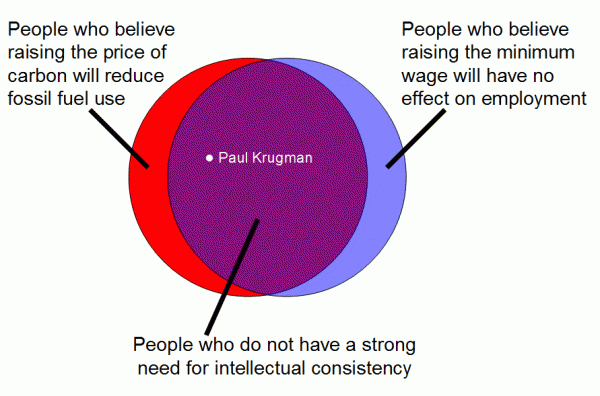
Stormy weather
Over the last hour my internet (wifi) connection got wonkier than usual, and we noticed that we kept losing the satellite TV as we tried to watch the news over lunch. It may an effect of the second and more powerful wave of this week's predicted solar storm, which apparently arrived at midday today.
Building a self
Steven Pinker, via Maggie's Farm, on "What's Wrong with Harvard":
I submit that if “building a self” is the goal of a university education, you’re going to be reading anguished articles about how the universities are failing at it for a long, long time.
I think we can be more specific. It seems to me that educated people should know something about the 13-billion-year prehistory of our species and the basic laws governing the physical and living world, including our bodies and brains. They should grasp the timeline of human history from the dawn of agriculture to the present. They should be exposed to the diversity of human cultures, and the major systems of belief and value with which they have made sense of their lives. They should know about the formative events in human history, including the blunders we can hope not to repeat. They should understand the principles behind democratic governance and the rule of law. They should know how to appreciate works of fiction and art as sources of aesthetic pleasure and as impetuses to reflect on the human condition.
On top of this knowledge, a liberal education should make certain habits of rationality second nature. Educated people should be able to express complex ideas in clear writing and speech. They should appreciate that objective knowledge is a precious commodity, and know how to distinguish vetted fact from superstition, rumor, and unexamined conventional wisdom. They should know how to reason logically and statistically, avoiding the fallacies and biases to which the untutored human mind is vulnerable. They should think causally rather than magically, and know what it takes to distinguish causation from correlation and coincidence. They should be acutely aware of human fallibility, most notably their own, and appreciate that people who disagree with them are not stupid or evil. Accordingly, they should appreciate the value of trying to change minds by persuasion rather than intimidation or demagoguery.
I believe (and believe I can persuade you) that the more deeply a society cultivates this knowledge and mindset, the more it will flourish. The conviction that they are teachable gets me out of bed in the morning. Laying the foundations in just four years is a formidable challenge. If on top of all this, students want to build a self, they can do it on their own time.
A New Day
That's when it happened. Someone said, "I can't believe it will be nine years this week since 9/11". And one by one we began to remember where we were, what we were doing, how it felt. It was this generation's "Where were you when they shot JFK?" moment and for a brief shining moment the shared memory pulled us back from the brink and made us one again.In retrospect, 9/11 divides my life more clearly and cleanly than when I married or when my child was born. Before, I was committed to a life that was organized around the pursuit of knowledge. After, I was a man of war. I remember the day well, unlike the other momentous days: the hours spent watching the towers fall I recall far better than the hours in the delivery room, helping with a difficult birth. Though it was a dry wedding due to it being Sunday in rural Georgia, I barely remember my wedding day at all.
But like everything that seems impossibly perfect, that moment wasn't meant to last.
I don't object. I have the sense that I was sent, to live in this hour and place for a reason I'm not given to wholly understand. So be it.
Sounds like we are going to war again, against a foe not so very terrible. I think we can take them. The hard part won't be defeating them, or breaking their armies; the armies of the region are fragile, structurally, when on defense. The hard part will be not beating them until we've developed something better, and organic to the region, to step in and take our enemy's place.
Because it's organic, we can't make it happen faster than it naturally happens. That means we can't win this war by pushing too fast. We can break and destroy the enemy as fast as we wish, but we must be patient, to let the enemy develop its own opposition so we can nurture it. This is war as gardening.
Why doesn't that bother me? Shouldn't we rush to destroy the enemy and restore peace as fast as possible, especially given the brutality of the foe?
Perhaps it is because this is what works, and -- finally -- I believe that the rules of the world are not our fault. Things are as they are not because I wish it that way, but because that's how it is. We play the game that was put in front of us.
Could we refuse? Should we? Those are harder questions, really at the juncture of why someone might elect to be a Christian and not a Hindu or -- more radically -- a Buddhist. You have that choice. It is important to think about what is entailed in making that decision.
I am going to Jerusalem in December. The old tradition held that it is the center of the world. Perhaps it is the place for clarity.
We shall see.
Enid & Geraint
By custom and tradition of the Hall, today there are no posts except this poem.
Enid & Geraint
Once strong, from solid
Camelot he came
Glory with him, Geraint,
Whose sword tamed the wild.
Fabled the fortune he won,
Fame, and a wife.
The beasts he battled
With horn and lance;
Stood farms where fens lay.
When bandits returned
To old beast-holds
Geraint gave them the same.
And then long peace,
Purchased by the manful blade.
Light delights filled it,
Tournaments softened, tempered
By ladies; in peace lingers
the dream of safety.
They dreamed together. Darkness
Gathered on the old wood,
Wild things troubled the edges,
Then crept closer.
The whispers of weakness
Are echoed with evil.
At last even Enid
Whose eyes are as dusk
Looked on her Lord
And weighed him wanting.
Her gaze gored him:
He dressed in red-rust mail.
And put her on palfrey
To ride before or beside
And they went to the wilds,
Which were no longer
So far. Ill-used,
His sword hung beside.
By the long wood, where
Once he laid pastures,
The knight halted, horsed,
Gazing on the grim trees.
He opened his helm
Beholding a bandit realm.
Enid cried at the charge
Of a criminal clad in mail!
The Lord turned his horse,
Set his untended shield:
There lacked time, there
Lacked thought for more.
Villanous lance licked the
Ancient shield. It split,
Broke, that badge of the knight!
The spearhead searched
Old, rust-red mail.
Geraint awoke.
Master and black mount
Rediscovered their rich love,
And armor, though old
Though red with thick rust,
Broke the felon blade.
The spear to-brast, shattered.
And now Enid sees
In Geraint's cold eyes
What shivers her to the spine.
And now his hand
Draws the ill-used sword:
Ill-used, but well-forged.
And the shock from the spear-break
Rang from bandit-towers
Rattled the wood, and the world!
Men dwelt there in wonder.
Who had heard that tone?
They did not remember that sound.
His best spear broken
On old, rusted mail,
The felon sought his forest.
Enid's dusk eyes sense
The strength of old steel:
Geraint grips his reins.
And he winds his old horn,
And he spurs his proud horse,
And the wood to his wrath trembles.
And every bird
From the wild forest flies,
But the Ravens.
Enid & Geraint
Once strong, from solid
Camelot he came
Glory with him, Geraint,
Whose sword tamed the wild.
Fabled the fortune he won,
Fame, and a wife.
The beasts he battled
With horn and lance;
Stood farms where fens lay.
When bandits returned
To old beast-holds
Geraint gave them the same.
And then long peace,
Purchased by the manful blade.
Light delights filled it,
Tournaments softened, tempered
By ladies; in peace lingers
the dream of safety.
They dreamed together. Darkness
Gathered on the old wood,
Wild things troubled the edges,
Then crept closer.
The whispers of weakness
Are echoed with evil.
At last even Enid
Whose eyes are as dusk
Looked on her Lord
And weighed him wanting.
Her gaze gored him:
He dressed in red-rust mail.
And put her on palfrey
To ride before or beside
And they went to the wilds,
Which were no longer
So far. Ill-used,
His sword hung beside.
By the long wood, where
Once he laid pastures,
The knight halted, horsed,
Gazing on the grim trees.
He opened his helm
Beholding a bandit realm.
Enid cried at the charge
Of a criminal clad in mail!
The Lord turned his horse,
Set his untended shield:
There lacked time, there
Lacked thought for more.
Villanous lance licked the
Ancient shield. It split,
Broke, that badge of the knight!
The spearhead searched
Old, rust-red mail.
Geraint awoke.
Master and black mount
Rediscovered their rich love,
And armor, though old
Though red with thick rust,
Broke the felon blade.
The spear to-brast, shattered.
And now Enid sees
In Geraint's cold eyes
What shivers her to the spine.
And now his hand
Draws the ill-used sword:
Ill-used, but well-forged.
And the shock from the spear-break
Rang from bandit-towers
Rattled the wood, and the world!
Men dwelt there in wonder.
Who had heard that tone?
They did not remember that sound.
His best spear broken
On old, rusted mail,
The felon sought his forest.
Enid's dusk eyes sense
The strength of old steel:
Geraint grips his reins.
And he winds his old horn,
And he spurs his proud horse,
And the wood to his wrath trembles.
And every bird
From the wild forest flies,
But the Ravens.
Civilization v. Celebrity
Foul language warning, though nothing you won't expect if you know who Mike Tyson is.
I have never seen a celebrity called out like that before. Not just any celebrity, either, but a former heavyweight champion of the world who is a demonstrated violent felon.
This host has some guts.
More Richard Thompson
A version of a Child ballad, King Henry V's Conquest of France, making a little fast and loose with history:
A version of another Child ballad, the ubiquitous "Cruel Mother" ballad; this one fills out most of each verse with "Edinburgh; Stirling for aye; the Bonnie St. Johnstone lies fair upon Tay":
A version of another Child ballad, the ubiquitous "Cruel Mother" ballad; this one fills out most of each verse with "Edinburgh; Stirling for aye; the Bonnie St. Johnstone lies fair upon Tay":
More on Trash
Skip ahead a few minutes, and you can hear an Oxford scholar talking about a hundred-year old find of trash that includes, among other things, lost sayings attributed to Jesus in the early period.
In a hundred years of work, they've gotten through a very small percentage of the trash. Old copies of the Iliad, tempting fragments...
The author's top three finds:
#3: A copy of the Book of Revelations' passage with the Number of the Beast, the earliest known copy we have... which gives a different number.
#2: A non-Homeric version of the story of the Iliad in which the Greeks lose the Trojan war.
#1: Turns out one document that they found in the trash mounds over, and over, and over, and over... well, let's call it a "romance novel."
In a hundred years of work, they've gotten through a very small percentage of the trash. Old copies of the Iliad, tempting fragments...
The author's top three finds:
#3: A copy of the Book of Revelations' passage with the Number of the Beast, the earliest known copy we have... which gives a different number.
#2: A non-Homeric version of the story of the Iliad in which the Greeks lose the Trojan war.
#1: Turns out one document that they found in the trash mounds over, and over, and over, and over... well, let's call it a "romance novel."
28 weeks later
The Ebola epidemic, as expected, is getting worse: about 3,600 infected and 2,000 dead so far. More ominous is the even more complete breakdown of a medical system that could only have been described a rudimentary even before 79 healthcare workers died of the disease. Hysterical rage is setting in:
“A US federal air marshal has been quarantined after being attacked by a man with a syringe, suspected to be containing an Ebola-spreading substance, at the Lagos international airport,” read a report out of Nigeria in the International Business Times on Tuesday.
Today's outrage in education
A young piano prodigy's parents would prefer to leave her in public school in Washington, D.C., but then she'd have to give up the piano competitions she keeps traveling to--while maintaining stellar grades--in order to avoid exposing her parents to truancy charges. So now she's home schooling, a solution that suits no one involved.
Retirement and satisfaction
Statistics about Americans' retirement planning have a tendency to be a bit alarming. This AEI article by Andrew Biggs and Sylvester Schieber takes an interesting approach, which is to examine the effect of children on retirement savings. Apparently there was some recent scare-mongering about a discrepancy between the savings of families with children and those without. Biggs and Schieber note that families with children spend a lot while the kids are at home or in college, then cut way back. They don't drop their standard of living, though, so much as keep consuming what they always did, not counting what the kids consumed. Parents save, therefore, not to permit themselves to adopt the standard of living common among childless people with equal income, but to preserve roughly the same standard of living they were used to, which of course makes sense.
The childless Texan99 household always adopted a standard of living significantly below that of my colleagues, even those with children. Apparently they weren't as fanatically focused on retirement as I was; many of them seemed terrified of the idea of retirement, to be truthful. In any case, if we get along in our working years at about the level we'd like to preserve in our retirement years, we'll be able to save a lot more than most people think is ordinarily prudent for whatever income we have. It's not about the income, anyway, it's about getting used to whatever standard of living the income permits. People are remarkably flexible that way. The big thing is to be uninterested in how other people live; even if their incomes are comparable, their circumstances often are not, depending on how large a family they choose to raise and how prudent they are about emergencies and the future.
The childless Texan99 household always adopted a standard of living significantly below that of my colleagues, even those with children. Apparently they weren't as fanatically focused on retirement as I was; many of them seemed terrified of the idea of retirement, to be truthful. In any case, if we get along in our working years at about the level we'd like to preserve in our retirement years, we'll be able to save a lot more than most people think is ordinarily prudent for whatever income we have. It's not about the income, anyway, it's about getting used to whatever standard of living the income permits. People are remarkably flexible that way. The big thing is to be uninterested in how other people live; even if their incomes are comparable, their circumstances often are not, depending on how large a family they choose to raise and how prudent they are about emergencies and the future.
Subscribe to:
Posts (Atom)