He and Willie Nelson are the last of the old crew still alive.


A Targeted Gun Control
After the latest school shooting, there has been the usual round of pointless politicking by people who know perfectly well that there will be no global changes in our firearms regimen but who think they can profit from the tragedy. Likewise, there has been the usual pointing-out that the security systems knew about this threat perfectly well, and did nothing to stop it as is so often the case (the "known wolf" problem, which occurs both here and in the UK).
What I haven't seen people discussing is that we have as a society arrived at, and indeed instituted, a novel form of gun control targeting these cases.
The father of Colt Gray, the teen suspect in the Apalachee High School shooting, was arrested, the Georgia Bureau of Investigation announced Thursday.Colin Gray, 54, is being charged with four counts of involuntary manslaughter, two counts of second-degree murder and eight counts of cruelty to children, the GBI said. The 14-year-old shooting suspect has been charged with four counts of felony murder.GBI Director Chris Hosey said at a news conference Thursday night that the charges against Colin Gray stem from "knowingly allowing his son to possess a weapon." During a brief court hearing Friday morning, Judge Currie Mingledorff II told Colin Gray he faced up to 180 years in prison if he was convicted on all counts. The judge also advised him of his rights, and the father said, "Yes, sir," in response to some questions from the judge.
To my knowledge, this is only the second time this approach has been employed; to be effective, it will need to become a regular and expected thing.
It's novel to charge people with murder when they never killed anyone nor tried to kill anyone. It may be pernicious to do so even if courts and juries agree to the approach.
However, it strikes me that it is a far more likely approach to achieve success at reducing the incidence of these shootings than the sort of global gun-control efforts that tend to be suggested.
Statistically, AR-15s and similar rifles are used in almost no crime; the fact that the exceptions are spectacularly tragic doesn't change the fact that almost all such rifles are "in common use for lawful purposes." There are estimated to be around 20 million of them, but in 2022 rifles of all kinds accounted for only 541 of the ~8,000 firearm homicides. If we assumed for the sake of argument (without evidence, and as is in fact unlikely) that 500 of those were with ARs, and that each death used a separate AR, that would give you a rate of 0.0025%; that means that in a given year, 99.9975% of ARs are not used to murder anyone. Any attempt to solve the problem with global solutions is thus already way up against the point of diminishing returns. The effort required to reduce below 99.9975% is going to be huge and expensive.
Raising the cost for parents who ought to know that their own particular kid is a risk, however, localizes the effort in places where there is a heightened risk. It addresses that 'known wolf' issue: the FBI and the local police knew this kid was a risk, and had in fact interviewed him and his father about it. The tool of holding the parent or guardian responsible gives them a tool they can use to encourage safer gun storage around dangerous youth, or even a decision by the parent to forgo having guns for a few years until the teenager moves on out to other things.
I still have concerns about the morality of charging people for crimes they never even contemplated, let alone committed. Speaking merely about the effectiveness of the tactic, though, it seems like a better bet than other approaches people like to suggest.
Congratulations to AVI
AVI notes his 10,000th post, and 10,001st. The latter is an ABBA tune, whose name reminds me of this classic from Bobby Bare.
It takes grit and good luck to stick to something that long. Good work.
WWII Unravelling
A remarkable interview -- I usually don't sit still for verbal talk and only read transcripts, but this guy caught my attention. What's really going on right now, he says, is that the order established by the Allied victory in WWII is unravelling. That's why all this is happening, and why it's all so strange.
"While You Cowered, We Studied the Blade"
Germany follows the UK in introducing a knife ban in response to terror attacks.
In the aftermath of a recent attack in which a Syrian Islamic extremist wielding a knife murdered three innocent festival goers and wounded eight others, authorities in Germany are pushing forward with a plan to ban knives.According to a report at nbcnews.com, the Islamic State claimed responsibility for the attack by Issa Al H in the western German city of Solingen, a city of about 160,000 residents where a celebration of the city’s anniversary was taking place.
It would be a tremendous irony for Solingen, "The City of Blades," whose steel and sword-making was legendary for centuries, to be the proximate cause of such a ban. Ironic, but they are a fallen people.
UPDATE: Meanwhile in Massachusetts, a ban on blades is struck down on 2nd Amendment grounds.
Legendary
In spite of the fact that I spent a lot of my life around universities, I never had anything to do with "Greek life." My father had belonged to an agricultural fraternity at East Tennessee State, though, and always liked the movie Animal House, so I knew what it was supposedly about.
These boys at Chapel Hill put Animal House to shame. Can you imagine getting Lee Greenwood to play your frat party?
Festivities commenced with singing the national anthem, complete with a colorful prop-plane flyover by local pilots who only charged for gas. About 1,000 attendees turned out on Labor Day weekend to see a lineup that included John Ondrasik of Five for Fighting, Rome Ramirez of Sublime, Aaron Lewis, Cowboy Troy, and Lee Greenwood.
These are the young men who saved an American flag from pro-Hamas protests at their college, to whom half a million dollars was donated for a party. I gather they used only part of it, and plan to donate the rest.
Journalists and other anti-freedom scolds pounced and seized on the specter of Flagstock, demanding answers to questions only they would ask: Should parties be fun? Should country music exist? Should celebrities be allowed to criticize Democrats in public? The New York Times, for example, reported on the handful of angsty UNC fraternity brothers who wished that "a significant portion" of the party funds would be donated to "relief efforts in Gaza." Some of the funds raised will eventually be dispersed to charities such as Back the Blue N.C., the Wounded Warrior Project, and organizations that combat anti-Semitism. The Free Beacon is still awaiting a response about how much money will be donated to Palestinian trans rights organizations.
Yeah, let us know as soon as you hear about that.
Greens Defrauded Too
Jill Stein, once again the Green Party’s presidential candidate, explains at length the fraud and manipulation used by the Democrats to keep her party off the ballots. She says they infiltrated her campaign, like RFK’s, and used fraudulent members to get the Greens thrown off the ballot in the recent NC Senate race.
Because he’s thought to draw votes from Trump, however, the Democrats who control NC’s ballot have refused RFK’s request to remove him from the ballot this year. He’s suing in a last ditch attempt to get off of the ballot.
"Well, it hasn't happened"
Earlier this year, my sister kept trying to wind me up over the usual predictions of a busier Atlantic hurricane season than usual. Every year like clockwork, and she falls for it every time.
It's turned out a bit of a flop so far, leading this "climate expert" to explain why you should still totally believe us, you guys, the next time we try to rev you up. See, it didn't happen for us in the Atlantic because, ironically, the temperatures were too low. But they were high in the Pacific, and it's been pretty active out there! So we were in the ballpark, and besides, climate change can mean that it's colder, or hotter, or dryer, or wetter. Because science. Favorite line: "This is a good example of how climate change can change from place to place," a sentence construction that our Vice President might admire.

The Education of a Free People
[O]f all the things which I have mentioned that which most contributes to the permanence of constitutions is the adaptation of education to the form of government, and yet in our own day this principle is universally neglected. The best laws, though sanctioned by every citizen of the state, will be of no avail unless the young are trained by habit and education in the spirit of the constitution, if the laws are democratical, democratically or oligarchically, if the laws are oligarchical....
Now, to have been educated in the spirit of the constitution is not to perform the actions in which oligarchs or democrats delight, but those by which the existence of an oligarchy or of a democracy is made possible. Whereas among ourselves the sons of the ruling class in an oligarchy live in luxury, but the sons of the poor are hardened by exercise and toil, and hence they are both more inclined and better able to make a revolution. And in democracies of the more extreme type there has arisen a false idea of freedom which is contradictory to the true interests of the state. For two principles are characteristic of democracy, the government of the majority and freedom. Men think that what is just is equal; and that equality is the supremacy of the popular will; and that freedom means the doing what a man likes. In such democracies every one lives as he pleases, or in the words of Euripides, 'according to his fancy.' But this is all wrong; men should not think it slavery to live according to the rule of the constitution; for it is their salvation.
-Aristotle, Politics V.9
In the comments to a post below, I remarked that Tex once said that they want to turn America into the security zone of an airport, but that public schools are run much the same way.
Our public school system is terribly designed for educating a free people. All the rights of citizens are suspended while you are on school grounds. You have no freedom of speech, but may be punished for speaking without permission on any topic. You may certainly not publish and post flyers critical of the government authorities. You have no freedom of movement: you have assigned seats in assigned classes, and to skip school is punishable by law as well as administratively. You certainly have no right to keep and bear arms, nor even to self defense -- our local high school has the policy of having all parties to a fight arrested by the school resource officers, and charged with assault, even if the were clearly defending themselves from a bully with a record of harassing them. There is no freedom from unreasonable search and seizure -- just like at the airport, all bags are subject to search and seizure at any time.
There is no right to a fair trial, or any trial; punishments are meted out by administrative fiat. There is no guarantee the punishment will not be cruel or unusual. Every right an American has by birth and the grace of God is suspended by the schools, and the children are educated that way for a dozen years and more.
A free people needs a different education. Our system is unfit for our purposes. Aristotle said the same thing about his own, and it was in the next generation that democracy was swept away for almost two millennia. One of his students, indeed, was the author of that: someone who'd gotten the education Aristotle thought worthy of a prince rather than a democrat.
It is a powerful thing, education. We allow its corruption at our peril.
Jacobin Not Impressed
As you will infer by the name if you aren't already familiar with the publication, Jacobin is a formally-left aligned magazine. They have reviewed Ms. Harris' economic plans, and the top flight ones are not impressive to them.
1. A $25,000 subsidy for first-time homebuyersThis is a bad idea. It is unfair to people who, even with the subsidy, cannot afford to buy a home and those who prefer to rent. Because it is a demand subsidy without any corresponding price controls, some of the money will also just get captured as higher home prices, negating the affordability goals of the policy....2. A tax credit for building starter homesThis is a bad idea. There is absolutely no reason to believe that the proximate barrier to building more housing is that it is not sufficiently profitable and that we need to therefore sweeten the pot with public subsidies. This is just a waste of money. Moreover, conditioning the receipt of the tax credit on whether the person who buys the home turns out to be a first-time homebuyer, as this proposal does, makes no sense. Home builders do not typically know in advance who they are going to sell it to....3. A ban on price gouging for groceries and foodIt is unclear what this even means.
As noted, these haven't been getting good reviews anywhere. If even Jacobin is against them, it's hard to know who the audience is supposed to be.
Rasmussen: Biden did not win Georgia in 2020
So they say, citing the ongoing refusal by Fulton County to comply with open records laws and lawsuits demanding the unsealed ballots.
This is something that was obviously true for me as a longtime resident of Georgia who has been writing about its election fraud problem since 2018. Some would rather not continue to discuss this, but as they point out election security is an ongoing issue. It's not like any of the problems were fixed. Work is ongoing on several fronts, but it's also important that the truth gets out. People need to understand that the government isn't legitimate if the elections aren't legitimate: you owe no loyalty to a government that was imposed upon you by fraud or force.
UPDATE: Rasmussen wasn't done.
Let's Review: Georgia 2020 Trust DeficitForensic audit blocked100 drop boxes lack surveillance videos20K ballot images - vanished13 election routers - vanished10 Dominion tabulators - vanished148,000 Fulton Cty Mail-ballot signatures unverified
Nor yet done:
Georgia: No records were created capturing 148,000 2020 mail-in ballot outer envelope signatures for matching to Fulton County records because their new electronic sig verification equipment - wasn't used.
Here the wording is actually "Nothing was scanned, your honor." Uh Oh
Nor yet:
Georgia:We have an electronic verification system, but we didn’t use it.We have records of voter signatures, but we didn’t use them.We could check our records for you, but it would take forever.Aside from that, judge, is there anything else you’d like?
"...And It Has to Stop."
Also from the same fellow, a video clip of Kamala Harris calling for an end to free speech and freedom of the press, at least for social media. See if you read it differently.
"He has lost his privileges and it [X.com] should be taken down.... The same rule has to apply, which is that there has to be a responsibility that is placed on these social media sites to understand their power. They are directly speaking to millions and millions of people without any level of oversight, or regulation, and that has to stop."
Coors Beer Joins Harley Davidson
...and Tractor Supply, John Deere, and others, in giving in to pressure to abandon DEI and similar programs. This Starbuck guy is getting results. I'm sure they're trying to find ways to sneak the stuff in, but they're clearly responding to the public pressure. No doubt the Silver Bullet doesn't want to join the Blue Can beer in losing its place in the rankings.
The Dangerous Constitution
As an update to Saturday's post about the NYT asking whether the Constitution is "dangerous," ("And so am I, very dangerous," said Gandalf), a reader on Twitter points out that this has been a constant theme there lately.
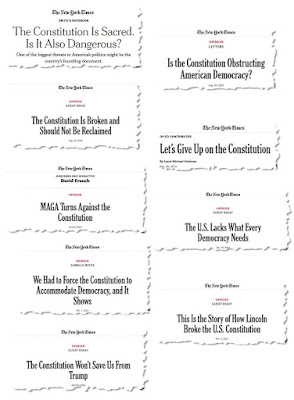

Free speech and inquiry are important values, so I don't object to them publishing such things; but by the same token, one should pay attention and take note of it as well.

"Spark" and School Reform
The headline reads, "With his 1776 Commission on patriotism, Trump helped spark a culture war." The very first paragraph gives the lie to the headline: he was responding, they note, to the 1619 Project. The theme continues throughout.
Trump ripped into “left-wing indoctrination in our schools,” slammed the 1619 Project and asserted that “propaganda” in schools was making students ashamed of their history.To fix all this, he had a solution: a new 1776 Commission that would promote patriotic education.
A national curriculum is probably a bad idea, but so too are almost all existing state and local curricula. We really need to abolish the public school system and start over. In any case, the idea that this 'divisive' 'culture war' is his fault is silly. It was the earlier revisionism that he was reacting to, angrily because it was based on some outright lies. (The link is to a set of criticisms by no less than the World Socialist; the 1619 Project later admitted that it was "not a history" but a fight to "control the national narrative.")
Replacing public schools with private ones sounds radical to a lot of people, but the earlier schools were better than the ones we have now. Consider this very early school on what was at that time the frontier:
The first recorded school in Jackson County actually predates the formation of the county by 31 years, as a school was started in Cullowhee Township in 1820.... the East LaPorte school started by Professor A.M. Dawson was renowned for its rigor and quality. A summary written for the Historical Committee of Jackson County NCEA in 1954 recounted, “Prof. A.M. Dawson who with Prof. Hughes, Misses Amaria and Jardedie Dawson, and Misses Ida and Lula Rogers, as assistants, conducted a high school at East LaPorte. This school… was the most notable and efficient one ever taught in this county before 1881.“Dawson had graduated from Western Reserve University in Cleveland, Ohio. He came to Jackson County from Tennessee. “With well-balanced scholarship, being equally at home in mathematics, history, science and the languages, and with established reputation, Professor Dawson auspiciously began his four-year remarkable career in Jackson County. Arithmetic, Latin, Greek, philosophy and English grammar were the principal subjects of the curriculum taught. Geography and reading were also taught… Mr. Dawson was a strict disciplinarian and exacted thoroughness from his students. Intolerant of laziness, negligence, disobedience or disorder, he was a stern, unrelenting schoolmaster… There were two Literary Societies. They were the Olympiam, which meant ‘lovers of games,’ and the Phylomathin, which meant ‘lovers of learning.’ These societies met on Friday evenings. Dawson was also the first to introduce baseball as a school sport.”
Emphasis added.
This was not a public school but a private "subscription school," but its presence on the frontier showed that it was not limited to the elites of the day. Voucher programs that aim to replace public school with independent funding would begin to address the downfall our education has suffered by being brought under control of government.
Switching to a model that provided parents with the means to subscribe to a 'subscription school' would not change the fact that we have a class of teachers who are miseducated themselves; finding the right people to instruct the children could be the chief problem.
UPDATE: Dad29 sends an eighth-grade final exam from 1895. The arithmetic section's difficulty sometimes turns on the use of what are now unusual forms of measure (bushel, rod), but clearly students were expected to manage complex calculations for the exam. I'm curious what the measure for 'bushel' was myself; the exam treats it both as a measure of volume and a measure of weight. Question 2 expects you to calculate the number of bushels from a given volume; the third one asks you to calculate it from weight. That implies some specialized knowledge that most of us wouldn't have.
Still, pretty interesting to examine.
The New Yorker on Soldier of Fortune
If you never expected to see The New Yorker write a warm and positive piece about Soldier of Fortune magazine, today is a surprising day!
Some years ago now Susan Katz Keating, the editor of Soldier of Fortune, at that time an independent journalist, interviewed me at length for a book she was writing about a project with which I was involved. The book she was writing didn't come off, which in a way is a shame because it would have exposed some serious problems with US intelligence in Afghanistan. Given how Afghanistan ultimately turned out, it might have been nice to know sooner. I asked her about it a year or so ago, and she told me that the laptop she had her notes on had crashed and burned, and she was left with nothing useful.
All the same, I found her to be an insightful and committed independent journalist of the old fashion. It's nice to see her considered opinion on the potential for violence in our current moment:
Not long after their meeting, Donald Trump was wounded on the ear in an assassination attempt. Keating provided an update on her violence forecast: she had become surprisingly sanguine.“There have not been any follow-on attacks or counterattacks, which I think would have happened by now if this had been an Archduke Ferdinand moment,” she said. “I see the hit on Trump as another iteration of the school-shooter, mall-shooter phenomenon, and not as a political flash point. We are not headed for a civil war.”
“Of course," she added, "I could be wrong.”
Interesting Political Videos
From Nicole Shanahan (RFK Jr's VP choice):
From the American Independent Party (whom I'd never heard of before):
They seem to be saying the military industrial complex assassinated both Kennedys. It's well-produced and the TH White quotes are a nice touch. The AIP claims to be the "fastest growing political party in California."
Here's one from the RFK Jr campaign, posted 2 days before he endorsed Trump:
The references to civil war and unity are interesting, but I wonder how he thought he could achieve unity. Or was it just campaign blather?
Is the Constitution Dangerous?
The New York Times publishes a book review that asks the question.
The Constitution Is Sacred. Is It Also Dangerous?One of the biggest threats to America’s politics might be the country’s founding document.
The content here is not going to surprise you; it turns out that the Constitution is uncomfortably difficult to amend (if you want to change things fundamentally, especially so). It tends to empower courts to resolve questions that the political branches find difficult (it doesn't, actually; that was a seizure of power during and following Marbury v. Madison). It has a lot of "compromises" that the NYT would like to track to slavery, especially the Electoral College, which is really not about slavery so much as the desire of the Founders not to concentrate power in the cities just as they sought the separation of powers elsewhere. (They were, after all, scholars of Greek and Roman history, and worried about exactly the transformations warned about by Aristotle and witnessed at the end of the Roman Republic.)
The weirdness about these sorts of articles is how they don't seem to grasp that a very similar set of compromises would be necessary even if you were to renegotiate the terms today. You couldn't get the rural parts of America to give up the Electoral College, or the equal representation of states in the Senate (another regular bugaboo by those who resent that Wyoming gets equal representation with California or New York). You couldn't get them to give away the Second Amendment. If you sat down in a Convention of the States and asked the people to work out a deal they could agree to accept, it would look very similar to the deal that you have now. These so-called historical reviews just lament that compromise with the non-urbane and non-urban is a necessary feature of peace and stability.
You could try to force the issue, just as the urban elites might have in 1787. Wise men and educated, though deeply divided on certain issues they elected to compromise rather than fight among themselves.
Well, for a while.
You might think that such disputes would have been laid to rest by a bloody Civil War and the Reconstruction amendments, which outlawed slavery and granted all men the right to vote, regardless of race. Not to mention that the Constitution continued to change in the century after: Senators were to be directly elected; women were granted the right to vote.
You might well think so, since none of those items is in dispute. I would prefer to reverse the unmentioned 16th and the mentioned 17th Amendment, and the 18th we've already disposed of, but as far as I know there is no contest from anywhere to the 13th, 15th, or 19th. The 14th is argued about over its interpretation; very few ever suggest its repeal.
The clear tone of the article, though, is that the sweeping away by violent victory in the Civil War is the preferred mode; the continued compromises by courts interested in considering Originalism is as bad as having ever compromised at all. Victory and not peace is the desideratum.
Sadly easy to find, the end of peace by those who seek violent victory over their opponents. Victory itself may prove to be more elusive.
Do You Know Something I Don't Know?
It's a well-known fact that social media companies spy on you relentlessly. They use this information to pump ads in your direction that they believe are relevant to your life. I get lots of ads for motorcycle gloves and knives and camping equipment, but also some that are weirdly specific.
For example, last week my doctor prescribed a new medicine for me she thought might be helpful, and noted out loud that it had a specific side effect she didn't think I'd find too bothersome. She prescribed the drug, and I ordered it from the Amazon pharmacy. By the time I got home, Facebook was offering up ads from numerous companies offering herbal remedies for the condition or else for the side effect.
Most likely Amazon sold me out as a customer; less likely, my iPhone is listening in and Apple is reporting it to Facebook. Somehow, however, they knew almost as soon as I did that I had a new hook for their advertisers.
I mention this because, in the last couple of days, I've received a similarly aggressive spur in ads for expunging my criminal records so that I can seek gainful employment again. Readers, I have never been arrested for anything nor charged with anything more serious than speeding or improper backing of a vehicle. Do you think they know something I don't know?
The Ship-Knife
Many years ago, while I lived in China, a much younger version of me wrote but never published a novel about Vikings in the Byzantine Empire. This novel, The Ship-Knife, seemed appropriate to me to write at the time because I was like the Varangians present in an alien and ancient civilization, a foreigner enmired in strange architecture, food, culture, values. I was also writing my Master's (European history) thesis, and it was a pleasant break from the academic work while also being a way of exploring allied themes.
It involves among other things a retelling of the adventures of Harald Hardrada in Sicily, the original being in the Heimskringla by Snorri Sturluson. He was also the author of the Prose Edda, which was itself a retelling of older stories he had encountered and wanted to formalize. I had copies of both with me in China and was familiarizing myself with them at the same time.
I located a copy of the thing recently. Looking through it I realize how much I've changed in the ensuing 25 years. I don't know that I can even edit it now, or if it's worth bothering to edit. My thoughts as a younger man might not even be worth preserving (indeed, it predates even the oldest entries of Grim's Hall, which date to 2003 after the China expedition).
If any of you would like to read it, and possibly help to edit it, please feel free to say so. I can't promise that it's great; it's probably not worse than most. It might at least be on a subject that interests some of you.
Evil Simpliciter Does Not Exist
Over at the Orthosphere, a propositional argument for the existence of God.
The syllogism is simple. Let P = God is ultimate; let Q = there is evil. Then:
- ¬ P → ¬ Q
- ¬ ¬ Q
- ¬ ¬ P
In English:
- If God is not ultimate, then there is no evil.
- It is false that there is no evil.
- It is false that God is not ultimate.
Clever, but wrong. It has been the position since St. Augustine that evil does not in fact exist because it cannot exist; and it cannot exist precisely because of God's ultimate status as creator of all, combined with God's goodness. Evil simpliciter would be a created thing that was not in any way good; but everything that follows from God must be good, because God is perfectly so (and in a way that is higher and better than things we encounter in the world are).
The orthodox position is that "evil is a privation," that is, a failure of the material to realize God's perfect design. Thus, all evil turns out to be is an imperfect realization of the good. Everything that exists must be good to some degree just because God created it.
[Even more emphatically in the later Aristotelian Christianity of Aquinas and his era, God's existence and his goodness are a mere prioritization of thought about the same quality. God's essence is existence: and as existence is the thing that all things desire, existence is just another name for the good (per Aristotle; because all things desire to continue to exist, to reproduce, to perfect their health and thus their existence, etc, 'the good' simpliciter is existence). Therefore, everything is good insofar as it has being; and evil thus cannot exist because it cannot have being, i.e. goodness.]
Then the syllogism doesn't work:
- ¬ P → ¬ Q
- ¬ Q
- ¬ P
That syllogism is a known fallacy, "Affirming the Consequent" or the "converse error." It doesn't prove anything because the form is invalid. For example, you could give the argument:
- If she screams, someone pinched her.
- She screamed.
- Therefore, someone pinched her.
In fact it's obvious that there could have been several additional causes for the scream; she might have seen a dead body instead of being pinched.
Of course one can take the position that orthodoxy is wrong, and evil simpliciter does exist: that's the Manichaeist position, which in Christianity is traditionally considered a heresy. It doesn't work out logically to have two basic creative principles, as Avicenna explains: either one is really superior, or there must a third thing that holds them together and allows them to interact, in which case that thing is the ultimate creative principle (and you're back to one). Since this is the case, any syllogism that asserts that 'God is ultimate' but that evil simpliciter also exists as a countering force will prove to be illogical.
One could further take the position that logic does not give you access to knowledge, but only preservation of knowledge, and that knowledge about God is ultimately ineffable at best (and thus inadmissible to logical forms). This is close to the Buddhist position, which might be true but won't be logical. At that point there's just no reason to even talk about syllogisms.
Eyeball Numbers
We have fairly reliable Nielsen numbers, as that technology was invented in the golden age of America when television was the gold-standard of that golden age. It's had to adapt to changes since it was new, but it's had both time and resources to do so. So these figures are probably close:
The nearly 6 million viewers [of the Harris interview] is CNN’s best performance in the 9 p.m. ET hour since more than 9.5 million people tuned in for the June 27 debate between President Joe Biden and Republican nominee Donald Trump.
Internet numbers are wildly contested today, especially when the claim is made by a widely-detested figure like Elon Musk and the contest is coming from an outlet that is outright hostile to him. These figures are therefore not as reliable.
Later on in the interview, Trump appeared to be looking at the views on his post that shared the Space, which was at around 60 million views at the time. Post views on X function more like impressions, tracking each instance a post appears in front of a user, whether they actively clicked on it — or it just appeared on their feed as they scrolled.
The live audio Space itself between Trump and Musk peaked at around 1.4 million concurrent viewers.
Musk has leaned into Trump's inaccurate viewership references though.
"Combined views of the conversation with @realDonaldTrump and subsequent discussion by other accounts now ~1 billion," Musk said on X, calculating the total of all post views or impressions about the Space chat.
As of publishing time, the X Space between Trump and Musk has roughly 24 million views, which includes the live viewership numbers as well as replays. The post itself, however, claims 183 million views or impressions.
That's a pretty big delta, between a billion and 24 million.
I notice, however, that even the lowest figure is four times the Nielsen figure.
Does it matter? Who knows. The thing about the internet is people from everywhere could be watching it (making "a billion" more plausible than it would be if limited to the USA, while Nielsen numbers are localized to America). Most of those people don't vote; and anyway, just having an interest in what they have to say doesn't mean you're going to vote for them. I'd guess that most supporters of either candidate are planning to vote for them without regard to what they might say.
Still, it's interesting to see how much more attention there is for the one candidate than the other.
A Soaking Rain
After two hot days, rain broke the heat and made it nice out. I decided to take an evening walk. Well, the rain came back and I was quite wet by the time I got back under shelter.
That’s fine. In the late August, even a cooling soak is welcome.
Chicken Killing Dog
Conan killed one of the chickens, for no apparent reason. Any of my grandparents, kind and gentle people though they were, would have shot him for that. Of course, they came up in the Great Depression when chicken-killing dogs were a life or death matter potentially. I didn't shoot him or hurt him at all, but it raises a dilemma about what ought to be done -- or how to teach him not to do it without harming him.
My wife suggested the old folk trick of tying the dead bird around his neck and leaving it there until it rots, but that also seemed pretty horrible to me.
What do you think should be done? Ultimately I would miss having the fresh eggs if he killed all the chickens, but it wouldn't hurt my family's prosperity much. On the other hand, I do think there's an issue about having a dog who kills for pleasure. Back on the first hand, though, my last dog killed cats whenever he could, and he was a great dog. I'm a little mystified about how to approach this problem, and would like your advice.
Heresy
Dad29, who is having a lot of trouble with the recent commenting problems from Google, would like to draw your attention to this article on Heresy.
The basic idea is that heresy is the removal of one of the planks of a systematic understanding of the world; Newtonian physics is an example. So too Euclidean geometry, which in fact we know is false. Well, and Newton's physics also.
So on this model heresy isn't necessarily wrong or even a mistake; it could be a step forward towards a better system. Yet it isn't obviously so; it could just be a new error.
Selah, as they say.
They'd Do It Here Too
Black-clad agents from the Bolivarian National Intelligence Service, Sebin, were seen smashing their way inside. They carried guns and a picture of the 19-year-old law student they had come to arrest. López was bundled into a vehicle as panicked relatives looked on.“Neighbours came out to try and protect her but they pointed their weapons at them and took the girl,” said the witness, asking to remain anonymous for fear of suffering a similar fate.
Keep your rifle by your side. It's the only thing that keeps you free. Our politicians aren't any better than theirs.
High Stakes Gambling
FPC asks SCOTUS to explain whether there is or is not a 2A right to own an AR-15.
There is, according to the logic of all three major SCOTUS decisions on the subject. US v. Miller held that arms are protected insofar as they have a militia quality, and the AR-15 is the most suitable militia rifle due to its commonality in parts and ammunition with the military service rifle(s), as well as the ability of almost every Marine or Soldier to train citizens in its effective use. Heller holds that we have a right to common weapons used for legal purposes; the AR-15 is the most common of all rifles, and rifles account for only around 2% of gun crimes. Bruen holds that tradition matters, and the AR-15 has traditionally been lawful for citizens in most of the country.
It's high stakes, though. Thomas authored a concurring opinion holding that any ban of America's favorite rifle should draw Constitutional review; but he's the only one on the record.
An End to Night
I kind of like night, though. This project would let the rich decide if we get to have it.
“I had an interesting way to solve the real issue with solar power. It’s this unstoppable force,” Nowack said in the interview. “Everybody’s installing so many solar panels everywhere. It’s really a great candidate to power humanity. But sunlight turns off. It’s called nighttime. If you solve that fundamental problem, you fix solar everywhere.”The company’s orbital mirror is set to launch in 2025, and you can “apply for sunlight” for the next few months. There’s “limited availability,” and already supposedly over 30,000 applications. It really just sounds like a one-time test, though: you only get four minutes for a diameter of 5km. No price is listed.
An Interesting Summary of Today's Division
Tom Klingenstein recently interviewed political philosopher* Glenn Ellmers about the state of the West today. In one of his responses, Ellmers gives what I think is a good summary of the current political division not only the in the US but in the West in general. I don't think there's much here that's new to the regulars here, but the clear summary of a division that is often put in more vague and ambiguous terms is worthwhile, I think.
There is a long and interesting story about how the Left got to this point, which can be traced to modern philosophy becoming more and more radical. Again, it is extremely useful, practically speaking, to study these matters. The point is that, apart from the apolitical or undecided people in the middle, we have two diametrically opposed factions in the United States today — whose differences are basically theological. One side still believes in traditional morality and the importance of the family, in the founder’s Constitution, and the idea that we are born into a world we didn’t create and can’t completely control. That is a world governed by the laws of nature and nature’s God, which means we are limited and guided by human nature, which is fixed.
The woke Leftists reject all that in the name of complete individual freedom and total personal autonomy, without any limits imposed by God or nature or anything else. The role of the government, for them, is to facilitate the ability of everyone to meet their own subjective view of personal fulfillment. The whole architecture of racial grievances, group preferences, and white privilege is directed to removing the barriers imposed by racism, western colonialism, toxic masculinity, etc., which stand in the way of complete personal autonomy.
This deep, theological division is not confined to the United States. Look at the recent opening ceremony at the Paris Olympics. It included a mockery of the Last Supper, with drag queens and transvestites standing in for Jesus and the Apostles. And there was a rider “on a pale horse” — a clear celebration of death from the Book of Revelation. This had nothing to do with sports or athletics, so what was the point? Why do the Olympics have to become a celebration of radical sexual autonomy?
How you respond to this will depend on which basic view of the world you have. And this division — between the older morality and the new celebration of unbounded personal expression — can be seen all over the world. There is an emerging global elite, motivated by a radical ideology, that wants to eliminate the rule of the people in every nation. This is the great battle of our time.
It's interesting that he sees it as a conflict between theologies. He doesn't explain what he means by that, and I wonder how he defines theology.
*Update: I tried to find an email address for Ellmer and discovered his PhD was in political science. I think I just inferred he was a philosopher from the topics he writes about.
Plato on Tyrants and the US Today
In a previous post we discussed how relevant Aristotle's Politics were today. In the following video on Plato's idea of the tyrant, I feel again that the professor is describing the US today to a striking degree.
The presenter is Daniel Bonevac, professor of philosophy at UT Austin.
Christmas
They saw the mighty angel of God coming toward them. He spoke to the guards face to face and told them they should not fear any harm from the light. "I am going to tell you," he said, "something very wonderful, something very deeply desired. I want to let you know something very powerful: Christ is now born, on this very night, God's holy child, the good Chieftain, at David's hill-fort. What happiness for the human race, a boon for all men! You can find Him, the most powerful Child, at Fort Bethlehem.

It Is Saturday
According to Military.com, the Navy has run out of pants.
Since we're here, Don McMillan seems like a comedian some of us can relate to.
Update: McMillan has a short skit on pi that's great.
The Heliand

Occasionally in this space I have cited "Lean Times in Lankhmar" by Fritz Leiber, a delightful story of how two companion heroes fall away from each other in hard times. One of them joins a religion, a lightly-fictionalized early Christianity. Being himself a heroic barbarian skaldic poet, he begins to adapt the story a bit.
As delivered over and over by Fafhrd, the History of Issek of the Jug gradually altered, by small steps which even Bwadres could hardly cavil at had he wished, into something considerably more like the saga of a Northern hero, though toned down in some respects. Issek had not slain dragons and other monsters as a child—that would have been against his Creed—he had only sported with them, swimming with leviathan, frisking with behemoth, and flying through the trackless spaces of air on the backs of wivern, griffin and hippogryph. Nor had Issek as a man scattered kings and emperors in battle, he had merely dumbfounded them and their quaking ministers by striding about on fields of poisoned sword-points, standing at attention in fiery furnaces, and treading water in tanks of boiling oil—all the while delivering majestic sermons on brotherly love in perfect, intricately rhymed stanzas.
Leiber was well-educated enough to know that such a translation had actually been performed by an ancient Saxon poet, and this volume is the result: the Heliand. I came across a copy today at a used scholarly bookstore, much to my delight, and purchased it immediately. I fell in love with the opening lines:
Song 1The Creator's spell, by which the whole world is held together, is taught to four heroes.There were many whose hearts told them that they should begin to tell the secret runes, the word of God, the famous feats that the powerful Christ accomplished in words and deeds among human beings. There were many of the wise who wanted to praise the teaching of Christ, the holy Word of God, and wanted to write a bright-shining book with their own hands, telling how the sons of men should carry out His commands. Among all these, however, there were only four who had the power of God, help from heaven, the Holy Spirit, the strength from Christ to do it. They were chosen. They alone were to write down the evangelium in a book, and to write down the commands of God, the holy heavenly word. No one else among the heroic sons of men was to attempt it[.]
I am really going to enjoy reading this book.
UPDATE: Within a page, there's a tremendous insight given in a footnote. The four heroes -- Luke, Mark, Matthew and John -- have the Holy Spirit implanted in their hearts so they can "chant God's spell." The footnote to this reads, "godspell, God's speech, gospel," and notes that in the Anglo-Saxon this is naturally either "God's word" or "good speech" or "a good spell" or "God's spell." In the thought and the language of the heroic era of the poem, these concepts blend together naturally.
UPDATE: This is so good. "In Jerusalem, Herod was chosen to be king over the Jewish people. Caesar, ruling the empire from the hill-fort Rome, placed him there -- among the warrior-companions -- even though Herod did not belong by clan to the noble and well-born descendants of Israel. He did not come from their kinsmen."
A White Stout

In spite of the light color, this is a stout. It’s the Whiteout Breakfast Stout Ale, with strong coffee flavors as well as maple and bacon. Delicious.
Kind of a dog-friendly place.

Decolonizing: What Does it Mean?
A pair of articles consider the issue, via the always-valuable Arts & Letters Daily.
For those of you who liked Tom's videos the other day, they also have an article on Chaucer.
An Amusing Moment
Hot Air covers the withdrawal of RFK from swing states and his endorsement of Trump over the Democrats:
Kennedy accused American media outlets of colluding with both the DNC and government agencies on censorship. It's a "naked exercise of executive power" against its political opponents, and told reporters in the room that they and their employers are responsible for the decline of American democracy as a result."Governments don't censor lies," Kennedy observed. "They don't fear lies. They censor the truth."...Fun fact: almost all of the US media outlets cut their live coverage after he accused them of participating in government censorship.
UPDATE: A transcript of his speech. Sadly, some these words are important and momentous rather than the wild ravings they would have appeared even a few years ago.
President Biden mocked Vladimir Putin's 88% landslide in the Russian elections, observing that Putin and his party controlled the Russian press and that Putin prevented serious opponents from appearing on the ballot.
But here in America, the DNC also prevented opponents from appearing on the ballot, and our television networks exposed themselves as Democratic Party organs. Over the course of more than a year in a campaign where my poll numbers reached at times in the high twenties, the DNC-allied mainstream media networks maintained a near-perfect embargo on interviews with me.
During his 10-month presidential campaign in 1992, Ross Perot gave 34 interviews on mainstream networks. In contrast, during the 16 months since I declared, ABC, NBC, CBS, MSNBC, and CNN combined gave only two live interviews from me.
Those networks instead ran a continuous deluge of hit pieces with inaccurate, often vile pejoratives and defamatory smears. Some of those same networks then colluded with the DNC to keep me off the debate stage....
This week, a federal judge, Terry Doughty, upheld my injunction against President Biden, calling the White House's censorship project, quote, "The most egregious violation of the First Amendment in the history of the United States of America."
Doughty’s previous 155-page decision details how just 37 hours after he took the oath of office, swearing to uphold the Constitution, President Biden and his White House opened up a portal and invited the CIA, the FBI, CISA—which is a censorship agency, it's the center of the censorship-industrial complex—DHS, the IRS, and other agencies to censor me and other political dissidents on social media.
Even today, users who try to post my campaign videos to Facebook or YouTube get messages that this content violates community standards. Two days after Judge Doughty rendered his decision this week, Facebook was still attaching warning labels to an online petition calling on ABC to include me in the upcoming debate.

Unrealized Gains
Another item of economic instability under discussion is a tax on 'unrealized capital gains,' which is apparently in the Biden budgetary proposals that have been more or less uncritically adopted by the Harris campaign.
It reminds me of the story about a poor student tenet in Paris who was sued by a nearby restaurant's chef because he had been subsisting on his poor food more comfortably because of the incredible smells from the restaurant, for which he had provided no compensation. The judge is supposed to have agreed that the chef deserved compensation, and had the student shake the coins in his pocket. "You have been paid for the smell of your food," he said to the chef, "with the sound of his money."
That's the only way something like this could work. Markets go up and down. If my house is worth a lot more now than when I bought it, nevertheless I sunk money into it six years ago and have gotten no money out of it. I couldn't pay you for its appreciation, but even if I somehow managed to send the IRS a sufficient check to cover it, the market could crash next year. So now I've paid taxes on money I not only never received, but in fact will never receive. I should be able to pay these taxes with the sound of my money, since there's no actual money involved.
As the guy at the link points out, nobody seems to be trying to defend the idea; the ones on their side just laugh and say it'll never happen, so don't worry about it. This also reminds me of a joke, of sorts: the law of merited impossibility. "That'll never happen, and you'll deserve it when it does."
Nicole Shanahan and Political Sabotage
This is part of a Twitter interview with RFK Jr's vice-presidential running mate Nicole Shanahan. Her description of the different ways the Democratic Party sabotaged their campaign is rather shocking, at least to me.
Elitist Philosophy
Here is a study of to what degree belonging to a wealthy family correlates with your likelihood of being cited in key academic journals. This is studied in two ways: whether you come from a family that has risen in wealth over recent generations or not ("intergenerational persistence"), and whether you were able to rise to the same rank within the profession as your mentor professor ("rank-rank correlation"). Those who went to Ivy League schools are much more likely, for example, to attain full professorships than those who went to state schools. In some fields, if you didn't go to one of the top schools (and thus probably come from a wealthier background) you really have little chance of ever obtaining tenure.
Unsurprisingly, it depends on your field, with harder sciences tending to cite papers from academics or give them good jobs regardless of whether they are also from the rich.
There are some surprising lessons, though.


Philosophy is far and away the worst on both measures. If your terminal degree didn't come from one of those top schools, you probably will never have tenure; there's too much competition from those who did, and too few jobs in the field to exhaust the supply of Ivy Leaguers who want to teach. Likewise, the major philosophers as measured by citation form a sort of club, one that is sensitive to social class.
Note that mathematics is not too far away. To some degree, this may reflect that the wealthy are more likely to choose a pure knowledge field rather than one that will improve their station in life -- mathematics you'd think would be a field like microbiology where hard, demonstrable results mattered most. But maybe you don't usually study pure math (or philosophy) if your family is struggling. You'd go into engineering of some sort if you were good at math and needed social mobility.
I'm also surprised to see that Experimental Psychology falls where it does. I'm guessing that's a product of the replication crisis that is often tied to that field in particular: the ease of relative nobodies to get cited if they at least studied under somebody known suggests that the field is open to new ideas and ready to publish them. Since this study covers 2000-2013, when the crisis was in full effect, being positioned on that side of the graph may not always be an unalloyed good even if it's also a measure of relative equality of opportunity.
Heron on the Tuck
A Great Blue Heron joined us for tonight’s walk by the Tuckasegee River.


They’re frequently seen on the Tuck.
Undermining the Ground of Rebellion
This morning I was watching a short part of this video from a rally involving bikers in favor of Trump. Just below four minutes in, this guy plugs his new song: "It's about faith, family, and freedom."
Now that surprised me because I know that guy and his band from way back in 2003 when they were new. The band is called the Moonshine Bandits, and their first album is the only one I have ever heard, because the fusion of hip-hop and country -- new back then and novel -- didn't prove to be interesting enough to me to continue with over time. That debut album was not about "faith" or "family," although it was about freedom in the sense of rebellion. Here's the new song if you want to hear it. Apparently the pressure against faith, freedom, and family has come to alarm the rebels and called them back to a defense of the flag.
The case isn't unique, though. I remember that a couple of years ago Sonny Barger of the Hells Angels had died at age 83. "Barger is less well known for his more recent life, but if you followed him more recently you'd have found that in his older years he became a devout Christian and helped to publish a series of charming children's books." Faith and family, again, as well as freedom.
I wonder how much of this has to do with the fact that this mode of rebellion is ironically grounded in the culture against which it rebels. To be a Hells Angel is to be rooted in a universe that has both Hell and angels. Trying to sweep away their metaphysical world -- to imagine there's no heaven -- undermines even the rebel's view: indeed, it suggests that mode of rebellion is perhaps a safety valve of the culture, a way of making a home within itself for its outlaws, rather than an attempt to supplant or replace it.
Or possibly it is the dynamic at play in Sir Walter Scott's "Harold the Dauntless," which has this most excellent opening passage:
List to the valorous deeds that were doneBy Harold the Dauntless, Count Witikind's son!Count Witikind came of a regal strain,And roved with his Norsemen the land and the main.Woe to the realms which he coasted! for thereWas shedding of blood and rending of hair,Rape of maiden and slaughter of priest,Gathering of ravens and wolves to the feast:When he hoisted his standard black,Before him was battle, behind him wrack,And he burned the churches, that heathen Dane,To light his band to their barks again.
The poem's story is that Witikind grows old and converts from the heathen path to the Christian one, causing his son to disown him as cowardly; but then, over the course of six cantos, Harold in turn becomes mature enough to see the wisdom of it. What seemed right to Sonny Barger in 1969 and the Moonshine bandits in 2003 may have faded with age, and the spiritual promises seem brighter as the physical eye dims.
Or, perhaps, it is not that: even in 1980 when they were assembling a documentary involving a lawyer for the Angels, he and his lawyerly companions noted their conservative ethics.
There was Hells Angels Forever on YouTube, and at 29 minutes in, there was my father.He is seated with Herman Graber at a conference table in their office: soft, heavy men in wide ties and long sideburns. Herman explains to the camera not to be fooled by the swastikas and Nazi regalia, that the Angels are patriots, enthusiastic supporters of the Vietnam War, what you might in fact call right-wingers. He pauses, blinks, concerned that he might have gone too far. “But not fascists, no, I’m not saying they’re fascists.”My father cuts in. “Perhaps best suited to the most conservative wing of the Republican party — the Goldwater wing.”
It is and always has been an interesting dynamic. I noticed it too growing up in the South in the '70s and early '80s, when the most ardent Confederate flag displayers and Outlaw Country listeners were also firm patriots who loved Ronald Reagan. Charlie Daniels went from long hair to distrusting Gorbachev in a few years' time.
RFK
I don't listen to podcasts, but I did read in the paper that Joe Rogan got into some trouble with Trump over positive comments about Robert F. Kennedy, Jr.
What he actually said was this:
“That’s politics. They do it on the left. They do it on the right. They gaslight you, they manipulate you. They promote narratives,” Rogan said on the podcast.“The only one who’s not doing that is Robert F. Kennedy Jr. I am a fan [of RFK Jr]. He’s the only one that makes sense to me. He doesn’t attack people. He attacks actions and ideas. He’s much more reasonable and intelligent.”
That's very similar to my own thoughts on RFK. I've listened to him talk about several problems he thinks we need to address, and what I notice is that about half the time he is thoughtful, intelligent, and sincerely trying to solve the problem. (Sadly the other half of the time it's brain worms and dead bear cubs, but he's a Kennedy.)
It's also clear that he is enamored of his father's America, and his father's Democratic Party, which is doubtless why the current Democratic leadership had such a convulsive allergic reaction to him. They cannot praise JFK, hardly more than they can praise Jefferson or Jackson, because of his 'imperialism' and certainty that the American nation was a positive influence on the world, and capable of internal reform even in matters of race if only we would appeal to its inherent decency. RFK is a genuine patriot of the old America, and that's not welcome right now among Democrats.
RFK now says he's thinking of dropping out and endorsing Trump to prevent a Harris presidency -- perhaps due to the communism that JFK was himself so committed to opposing -- and Trump has signaled that he'd be open to brining RFK into his administration. (Also Elon Musk.)
I don't know if a restoration of mid-century solutions and ideas about what America is like and how it should proceed can actually improve things at this point. America was already committed to the managerial/administrative state by Kennedy's time, and dismantling all that should be the chief business of any attempt at reforming the United States.
Still, it is nice to hear someone talk through problems, identify causal factors, and then propose solutions that might actually work. It certainly couldn't hurt to have someone like that around to talk things through with while trying to figure out the way. (Ditto for Musk.)
The Principle of Reproductive Freedom
In the comments to yesterday's post, I mentioned the reframing of the abortion debate with the term "reproductive freedom." It's distinct from both pro-life and pro-choice because it eliminates any mention of the child.
Abortion for Harris/Walz doesn't consider the existence of the child at all. They frame it as purely an issue of reproductive freedom, one into which the child and the child's life does not rightly come as any sort of consideration. It's a more unrestricted liberty for them than the first amendment's, which Walz says doesn't apply to people who are spreading 'hate speech or misinformation,' certainly more than the second's, and based on Ms. Harris' prosecutorial days, more than the fourth, fifth, sixth, or eighth. It's the only genuinely unrestricted Constitutional liberty in their opinion; I notice it's also the one the Constitution doesn't protect or mention at all.
Today Reason makes note of the striking contrast between a party which is espousing a pro-family agenda, and one that is featuring vasectomy and abortion vans outside its convention hall. (The schedules for those vans filled up well before the convention began, too.)
Yet the principle of reproductive freedom doesn't have any enemies. The most devout Catholic agrees that no one should be forced into pregnancy; the Church opposes rape and teaches how to track ovulation cycles as a way of achieving that freedom.* This method may not be foolproof, but it is aligned with the principle that it's perfectly fine to want to be in control of one's reproduction or lack thereof. There is no group in America that opposes the principle being advocated.
What does concern some people is that business about the life of the child. That there is a living human being who is killed by an abortion is incontestably true as a matter of fact. That this killing is morally significant and shouldn't be excluded from the discussion of how to exercise this right of reproductive freedom is apparently controversial; but it's surely a reasonable position that killing a living human being is morally significant, and therefore deserves consideration in constructing any relevant ethical position.
We are a long way from the 1990s, when abortion advocates appended a desire that abortion be rare to their desire that it should be safe and legal. We are at the point at which the debate threatens to slide past a recognition that there is any issue at all about the necessary killing here, pitting a principle that everyone accepts against... well, nothing. On this formulation there is really nothing to oppose the right, because even the strongest pro-life advocate doesn't reject the principle being asserted; they were only concerned about the life. If the life is no longer a consideration, there's really nothing to discuss.
* The Church also teaches men reproductive freedom via chastity until marriage, which is in fact the most effective way for men to assert it. The principle of reproductive freedom doesn't extend to men on the left, as they have no parallel capacity to engender a child and then reject it in the way that abortion allows.
A Message from Harley-Davidson

Still, a start.
Lunatic
That is what one of the NYT's top opinion authors is telling their readers about the new plan for price controls. Bret Stephens, in a conversation with Gail Collins:
The best thing that can be said about her promise to go after price “gouging” is that she knows it has no hope of passing and that she understands that every serious economist on the planet will warn her that the consequences of price controls would be shortages, hoarding and, soon enough, black markets. In fact, my only hope for Harris is that her agenda is for campaign purposes only and that she’ll become a normal Democrat once in office....I just think that a vote needs to be earned, and so far Harris — unlike Hillary Clinton or Joe Biden — has done absolutely nothing to earn mine. She hasn’t won a primary. She hasn’t had a major legislative achievement of her own. She hasn’t had a distinguished vice presidency. Instead of moving to the center with her veep pick, she moved further to the left with Tim Walz. Her signature economic proposal isn’t liberal; it’s lunatic.
Emphasis added.
Long-time blogger Vodkapundit thinks the point of the proposal isn't to win with it, but to introduce the idea of a socialist takeover of the economy so that it won't seem so wild and strange later. That's possible, but the Times is not doing much to pad the idea here -- and as we saw last week, the other big establishment newspaper is heatedly against it.
The DNC is this week. We'll see how that goes.
McCoy
Most people have heard of Tom Mix, the cowboy movie star of the generation before John Wayne. You might not have heard of Tim McCoy, who did really cowboy in Wyoming before he was a star. He fled Jesuit school and hopped a train west, not knowing where he was going.
It’s a great story. He cowboyed for eight years, including for the “Outlaw Train” that was reputed to steal and brand strays; met some of the remaining legends from the real Old West, including of the Hole in the Wall Gang; recruited cavalry for Teddy Roosevelt; and finally became a movie star.
Almonds are much Bigger than you Expect

These things are the size of peaches, to which they are closely related. My wife and son planted some raw almonds and now we have a tree.
The apples are doing well this year too. Not just ours; the other night at the concert I picked an apple off a nearby feral tree for my wife. She said it was delicious.
Riding the Rain

Last night my wife and I rode over to a mountain town and heard a local band singing the old songs, then we rode back on the very edge of a severe thunderstorm. We made it home so close to the edge that while my wife got into the garage dry, I was soaked because I parked less than a minute after her.
Tonight we just got caught in it.
Sometimes you get rainbows out of these thunderstorms near dusk. That one last night was a visible double.
The Conservative Case for Sauron
Conservative political thought can have limits, as when Aragon offered a revolutionary return of the king. It also seems to draw pretenders.
We are the children of Numenor... but who truly brings us back to Numenor and its values? Is it the directionless Stewards? The absent kings? Or will it be the One who served directly under Ar-Pharazôn himself in Numenor’s Golden Age? Character matters: record matters too, and Sauron has one.
One of each, as a matter of fact.
On Temptation
I believe most of you regularly read AVI's page, but I would like to direct your attention to this post in particular.
Progress!
We do now have a couple of economic proposals from the Harris campaign. The Washington Post was so upset about one of them that it attacked it in an editorial before she even gave the speech announcing it.
It’s hard to exaggerate how bad this policy is. It is, in all but name, a sweeping set of government-enforced price controls across every industry, not only food. Supply and demand would no longer determine prices or profit levels. Far-off Washington bureaucrats would. The FTC would be able to tell, say, a Kroger in Ohio the acceptable price it can charge for milk.At best, this would lead to shortages, black markets and hoarding, among other distortions seen previous times countries tried to limit price growth by fiat....If your opponent claims you’re a “communist,” maybe don’t start with an economic agenda that can (accurately) be labeled as federal price controls.
Transparency and public criticism. That's nice to see in the papers for a change.
The other one is a help-first-time-housebuyers-with-free-money scheme, which is drawing a lesser degree of fire but still reminds people of the global financial crisis of 2007-8 that was fueled by the collapse of subprime mortgage securities. That likewise began with a government push to make the market work with people who really couldn't afford what they were buying.
They also included price controls, of course:
The rent caps are the “ugly” part of Harris’ plan, said Lanhee Chen, director of domestic policy studies at the Hoover Institute at Stanford University and a past CNN opinion contributor who worked on campaigns for Republicans, including Utah Senator Mitt Romney.“What is effectively a federal rent-control measure … was a bad idea when President Biden proposed it a few weeks ago,” said Chen.
The pretty part? Repurposing public lands for housing. I wonder how well 'developing the national parks into cheap housing tracts' will poll?
UPDATE: The W. Post follows up its pre-speech editorial by a single author with a full-fledged editorial from its entire board condemning the Kamala plan as unserious "gimmicks."
More Scottish Geology
Around the time of "Snowball Earth," what is now Scotland was near the equator. As such, an outcropping of rocks from the Inner Hebrides may have the best surviving geological record of that period, after which animal life emerged.
Clues hidden in rocks about the freeze have been wiped out everywhere - except in the Garvellachs. Researchers hope the islands will tell us why Earth went into such an extreme icy state for so long and why it was necessary for complex life to emerge.
The relevant island is uninhabited except for researchers.
Subscribe to:
Posts (Atom)