Aquinas on Anger, VIII

I really wanted to get to Article VII because Aristotle here is quoted saying something that I think is badly argued. The question of the article is whether we can, or can't, have anger without having a relationship of justice with the object of our anger. 
I answer that, As stated above (Article 6), anger desires evil as being a means of just vengeance. 

This is a real problem, but we'll roll with it for now. A relationship of justice between you and whatever you're angry at (or vice versa) would seem to need to exist, because if there were no justice relationship you would presumably not be angry at having justice violated. That part is straightforward.

But what is a 'justice relationship'? Aristotle and I disagree about where justice arises in human relationships. For Aristotle it appears to arise at the level of politics, not at the level of family or individual relationships as between father and son. Indeed, Aquinas quotes him saying that in this article: "Further, "there is no justice towards oneself . . . nor is there justice towards one's own" (Ethic. v, 6)."

So here's what Aristotle says at Aquinas' 'link' to the EN: 

For justice exists only between men whose mutual relations are governed by law; and law exists for men between whom there is injustice; for legal justice is the discrimination of the just and the unjust. And between men between whom there is injustice there is also unjust action (though there is not injustice between all between whom there is unjust action), and this is assigning too much to oneself of things good in themselves and too little of things evil in themselves. This is why we do not allow a man to rule, but rational principle, because a man behaves thus in his own interests and becomes a tyrant. The magistrate on the other hand is the guardian of justice, and, if of justice, then of equality also. And since he is assumed to have no more than his share, if he is just (for he does not assign to himself more of what is good in itself, unless such a share is proportional to his merits-so that it is for others that he labours, and it is for this reason that men, as we stated previously, say that justice is 'another's good'), therefore a reward must be given him, and this is honour and privilege; but those for whom such things are not enough become tyrants.

The justice of a master and that of a father are not the same as the justice of citizens, though they are like it; for there can be no injustice in the unqualified sense towards thing that are one's own, but a man's chattel, and his child until it reaches a certain age and sets up for itself, are as it were part of himself, and no one chooses to hurt himself (for which reason there can be no injustice towards oneself). Therefore the justice or injustice of citizens is not manifested in these relations; for it was as we saw according to law, and between people naturally subject to law, and these as we saw' are people who have an equal share in ruling and being ruled. Hence justice can more truly be manifested towards a wife than towards children and chattels, for the former is household justice; but even this is different from political justice.

We should note immediately that most Americans -- at least -- would object to the formulation that a master cannot be unjust to his slave because the slave belongs to him. Most of us would argue that the master is already being unjust to the slave by pretending to own him. The Bible speaks of slavery a great deal, and does not categorically reject it as we; but in Aquinas' day the Church had moved to ban the practice between Christians as fundamentally unjust given the special equality Christians had as brother sons of God. 

Since you were supposed to try to save souls, if you encountered non-Christians you were supposed to convert them rather than enslave them. 

Also, I note that it is only at the level of politics coming to be that this kind of injustice is possible. There might be a natural capacity to enslave another, but there can't be a natural right to do it because the other has the same nature as you: a rational human being. If you have natural rights to freedom, he must as well. It is only the rise of positive law that creates this kind of injustice, and enshrines a 'right' to do this as a master and owner rather than just another free man. 

Therefore, I submit that Aristotle is wrong about where the justice relationship properly arises: that it arises not at the political level, but at the level of personal relationships. These are also, sadly, often the place where we most regularly and intensely experience anger. We may be unjust to each other there, too; but at least we do not have armies and towers and systems of justice standing over us and telling us that we must submit to a law that renders us a slave.

But set that aside: would we accept that a father cannot be unjust to his children? We would not accept that. There are many duties we think a father owes to his children, and failure to provide those things is an act of injustice. If you starve your children rather than feeding them, that is unjust. If you drink up the family wealth, you have acted unjustly and deprived your young sons of the standing they had a reason to hope to have when they became adults and masters of themselves.

For the purpose of the consequences of this bad argument, it is certainly not true that you cannot be angry with your children -- which would follow if we accepted Aristotle's argument. Since you cannot have a justice relationship with them -- and cannot be unjust to 'your own' -- it would therefore be impossible to be angry with them. This is manifestly untrue. I daresay no parent has ever raised a child without being angry at them, and vice versa. 

It is also not true, as Aristotle says and Aquinas endorses, that you cannot be angry with the dead.

"...according to the Philosopher (Rhet. ii, 3), 'it is impossible to be angry with insensible things, or with the dead': both because they feel no pain, which is, above all, what the angry man seeks in those with whom he is angry: and because there is no question of vengeance on them, since they can do us no harm."

This is another area disproven by human experience. Many times we are angry with the dead; although, unlike Aristotle, we are not obligated to imagine them as being free from all possibility of vengeance or pain. Yet even if we do so imagine them, often we are angry at them because of their tragic choices, and the harm and injustice they have done. This can certainly last well beyond the fact of their death.

In any case, this article strikes me as going wrong in a number of places. It relies on one of Aristotle's mistakes -- he was human, however great his mind, and made a few. That leads to bad consequences for our understanding.

Aquinas on Anger, VII

Article VI says that "anger desires evil." That is a very strange thing for Aristotle to say, because he defined the good in terms of desire: the good is what all things desire. (Aquinas followed him, and Avicenna, in the first part of the Summa which concerns the nature of God and thus goodness itself.) 
I answer that, Since goodness is that which all things desire, and since this has the aspect of an end, it is clear that goodness implies the aspect of an end.... Beauty and goodness in a thing are identical fundamentally; for they are based upon the same thing, namely, the form; and consequently goodness is praised as beauty. But they differ logically, for goodness properly relates to the appetite (goodness being what all things desire); and therefore it has the aspect of an end (the appetite being a kind of movement towards a thing).

So this is a real problem, because now evil is the object of desire -- and therefore a good to be pursued. But that can't be, Aquinas has already told us.  

No being can be spoken of as evil, formally as being, but only so far as it lacks being. Thus a man is said to be evil, because he lacks some virtue; and an eye is said to be evil, because it lacks the power to see well.

This is Augustine's point, which we were just discussing recently, and a place where Aquinas and Aristotle differ. Evil properly speaking can't exist for Aquinas; it is only a privation or a lack of something desirable, something beautiful, i.e. something good. To say that anger desires the lack of something desirable does not make sense. 

It especially does not make sense given that anger is associated here with justice, and has been said to be partially governed by reason and mercy. Justice is a good, not an evil. Injustice is an evil, because it is the lack of something desirable, i.e. justice. 

Human will, unlike God's, can be disordered and therefore sinful. If what anger desires is evil, though, it is very basically and radically disordered -- which is the opposite of what Aquinas has been arguing heretofore. 

Aquinas on Anger, VI

 Article V looks very dense, but its easy to sketch. The question is whether desire or anger is more natural to man. Aquinas references Aristotle's Physics II to say that things are 'natural' to us if they are things that arise from our own nature. This is Aristotle's answer to why things move in different ways: because they have different natures. If you drop a stone, which has the nature of earth, it will move toward the earth. If you pour out a bucket of water, which has the nature of water, it will move to a middle position -- the stone would fall through the lake, but the water will join it. Air naturally sits above them, and fire rises upwards. 

And if you turn loose of a bird, it will move through the air wherever it wants -- because it is free to follow its animal nature, and thus to move where it wants to move; but it will fly instead of crawling because of its specific nature, which is that of a bird rather than simply an animal generally. 

Desire is more natural in the general nature of man and all animals; all things want what they desire, and they desire the goods that allow them to continue their existence and that of their species. But specific creatures have specific natures too. Man's is that of a rational animal. Thus, anger -- which responds 'somewhat' to reason -- is more natural to him than desire. 

However, by the same argument reason is more proper to him yet; anger must be governed by reason to be fully in accord with his nature.

“Rich kids can always get Algebra or Calculus”

On Substack, Bari Weiss sums up the week's craziness, including California's decision to trap all 8th graders in pre-algebra in the interest of the usual murky goals. She quotes Freddie DeBoer's observation that families with extra cash will just hire tutors, so this equity-inclusion push will consign only the smart poor kids to the needlessly crummy education track. The truth is, though, that these days any kids can get decent algebra or calculus instruction with or without a tutor. Even the poor kids have some kind of access to the internet, where the educational resources are nearly endless. Any kid that was likely to be able to pick up calculus from high school lectures will be able to get it from internet lectures, if not from a book. You don't even have to be Isaac Newton, who, when he found he lacked this essential tool, simply created it during one of the Western World's more famous lockdowns.

On the other hand, the way things are going, will there still be colleges where you can go anywhere with higher math? I'd love to see aspiring young workers skip the whole thing, learn the math on their own, and get jobs in STEM industry, minus the political indoctrination.

The lockdown link by the way, is a windy attempt to explain why no one should feel bad about not doing world-changing work during lockdown because privilege or something. The problem certainly isn't just that we lack a one-in-a-billion talent! Probably any of us could have pulled it off if we had a Universal Basic Income and some domestic servants.

Wildlife

This fox made an appearance on my lurking neighbor's driveway:

Aquinas on Anger, V

I have time for a second round of this today, and I find I'm warming to the subject. So, Article 4: Does Anger require an act of reason? Passions usually don't, because --as mentioned -- they were thought to be things that you experience passively. They come upon you, and you experience them. 

Anger seems to be a passion, and thus it shouldn't require an act of reason. If that were true, it means several important things in the Aristotelian system. Most crucially, it means it is a lower thing that is more animal than human (this is raised directly in the article). Reason is the human quality; we share many sensations and passions with animals, but they were not thought to share our access to the order of reason. (This was held to be true through the Modern era, which in philosophy means the 18th century. There are strong reasons to doubt it now; but see the reply to objection 2, where even Aquinas creates some doubt.) 

Aquinas quotes Aristotle's discussion to show that anger is at least amenable to reason.  
...anger is a desire for vengeance. Now vengeance implies a comparison between the punishment to be inflicted and the hurt done; wherefore the Philosopher says (Ethic. vii, 6) that "anger, as if it had drawn the inference that it ought to quarrel with such a person, is therefore immediately exasperated." Now to compare and to draw an inference is an act of reason. Therefore anger, in a fashion, requires an act of reason.

That's a funny argument for Aristotelian psychology. Romantic love, the most canonical of passions, also seems to be amenable to reason in that way. You can (and we all do) reason about people you've fallen in love with, and if it's a really bad idea, you can often decide not to pursue your love. It doesn't make as good a novel, but it happens every day.

The answer to that objection is 'reply to objection one.' Aquinas has a part of the rational soul that was absent in Aristotle. The will -- which is Biblical and Christian rather than ancient Greek -- allows human beings to subject even their passions to reason. In that way it improves and perfects even the strongest passions, by making them subject to rational thought.

This cuts against the idea that anger and vengeance are per se good, however: if God gave you the capacity to moderate these feelings with reason, and if (as Aristotle had argued, and Aquinas agrees) reason is a higher faculty than sensitive emotions, then it is only proper to be angry if and insofar as reason agrees with anger. But reason is not a passion, but an activity; and it is not irrational, but rational by nature. A human being was given the faculty for a good cause, and it isn't wrong to experience anger or even to act upon it. Yet we see here why we are morally obligated to subject any sort of anger or desire for vengeance to our rational nature. 

Or, I suppose, we can go to Confession. As Captain Thomas Bartholomew Red said, "What do you think Confession's for?" That line, from a very immoral man's film about the very immoral business of piracy, always struck me as intensely pragmatically wise.

God Bless the American Jury

It’s the last stronghold of freedom. They just did it again. 

Aquinas on Anger, IV

This has been a deeply profitable, honorable and honest discussion which is almost entirely unlike the kind of useless talk we have so much of. Good for you. 

Article 3 gets us even into deeper Yoda territory: anger leads to hate, we are warned specifically in the second objection. It is a kind of desire, a longing of the sort that often leads to damnation. It mixes with sorrow, which is not itself bad -- it can sometimes be a very worthy emotion -- but how brightly that contrasts with the discussion of anger's beauty. 

Aquinas takes a bold strategy here: he simply makes a division. "On the contrary, The concupiscible is distinct from the irascible faculty. If, therefore, anger were in the concupiscible power, the irascible would not take its name from it."

That is to say, anger is too pure to be a kind of desire because anger is its own thing. And that's probably right. It ought to be, I guess, since it's included in the doctrine of the largest faith in human history. It's been true enough that we've accepted that argument for nigh a thousand years.

He actually gives more than a bald assertion. It's rooted in Aristotelian psychology, which you can give as much weight or not as you prefer.

"I answer that, As stated above (I-II:23:1), the passions of the irascible part differ from the passions of the concupiscible faculty, in that the objects of the concupiscible passions are good and evil absolutely considered, whereas the objects of the irascible passions are good and evil in a certain elevation or arduousness. Now it has been stated (Article 2) that anger regards two objects: viz. the vengeance that it seeks; and the person on whom it seeks vengeance; and in respect of both, anger requires a certain arduousness: for the movement of anger does not arise, unless there be some magnitude about both these objects; since "we make no ado about things that are naught or very minute," as the Philosopher observes (Rhet. ii, 2). It is therefore evident that anger is not in the concupiscible, but in the irascible faculty."

That may be hard to follow. Here's a helpful analogy, I hope: I said something very similar in the comments to the post on 1883. Yellowstone is like desire, what Aquinas is calling the 'concupiscible passions.' Yellowstone is about a man who loves his home, and wants to maintain it. Ultimately it means a lot to him, but in the end -- as people keep pointing out to him -- if he loses it won't be that bad. He'd just have to sell the land for a lot of money, and could go do something very similar somewhere else like Oklahoma.

1883 is high art. It's the best thing I've seen in years. 'The irascible passions are good and evil in a certain elevation or arduousness,' that's how Aquinas puts it. It's not just whether you cowboy here or there; it's life and death, good and evil, love and hate, the very highest things we know how to want as human beings. For Aquinas, that's so different from things like mere sexual passion as to be categorically different. It's literally not the same thing at all.

Snowfall

What we often call The Blizzard of ‘93 came in April, so it’s not like I have never see this before. I’ve seen it once. 

1883

I am only a few episodes into this, but I cannot recommend it strongly enough. It’s a work of real, substantial beauty. 

Passacaglia


That’s not a lute, exactly. It’s a theorbo, arguably the most beautiful musical instrument ever made by the hands of man. Almost the most beautiful instrument simpliciter, excepting only the sword. 

Aquinas on Anger, III

I'm going to move on to the second article: whether the object of anger is good or evil. It seems like anger is a bad thing; certainly our popular culture claims that it leads in bad directions. 


Aquinas says that's wrong. The argument he give is striking: "Augustine says (Confess. ii, 6) that "anger craves for revenge." But the desire for revenge is a desire for something good: since revenge belongs to justice. Therefore the object of anger is good."

Is that right? Is revenge good? You have here the authority of two canonized saints that it is.

You know, I'm just going to stop there for today. That's already plenty to discuss.


Voice of reason?

I'm less skeptical than many on the right about Ukraine, so Col. Douglas MacGregor is saying things in this interview that I don't like hearing. Nevertheless he's worth listening to. Obviously he has many views about the Trump and Biden administrations that line up very closely with my own prejudices.

All the Small Things


This is kind of the opposite of the 'old Country sound' post. This was never a beautiful song as a punk rock bit. Put in this context, and it suddenly is.

Somehow it's not even ironic that a guy in clown makeup is singing the thing straight, which the original band couldn't do. The irony of being a clown cancels out the irony of being sincere, owning the emotions honestly and expressing them truly. I have trouble doing that myself, sometimes. There's a huge weight. Maybe I'm getting better at being honest about my feelings; maybe. 

In the end the band stops playing after several renditions of "Carry me home," with the last one being incomplete. The band simply walks away, muted, sad. This is exactly how life leaves us: finally, home no longer exists. The home of my youth, which I dream about almost every night, has been washed away by time. There's no home to go to. 

So perhaps felt Chesterton, who sought another home in Mary.

          And I thought, "I will go with you,
          As man with God has gone,
          And wander with a wandering star,
          The wandering heart of things that are,
          The fiery cross of love and war
          That like yourself, goes on."

          O go you onward; where you are
          Shall honour and laughter be,
          Past purpled forest and pearled foam,
          God's winged pavilion free to roam,
          Your face, that is a wandering home,
          A flying home for me.

          Ride through the silent earthquake lands,
          Wide as a waste is wide,
          Across these days like deserts, when
          Pride and a little scratching pen
          Have dried and split the hearts of men,
          Heart of the heroes, ride.

          Up through an empty house of stars,
          Being what heart you are,
          Up the inhuman steeps of space
          As on a staircase go in grace,
          Carrying the firelight on your face
          Beyond the loneliest star.

I make no apology for linking a punk rock song to punishing questions of metaphysics. It only proves that punk rock is a real form of art; it can be, at least, even if it needs the double-blind form of a painted clown singing it to make it clear.

Yankees Can’t Make Biscuits

The Atlantic explains

National Tartan Day


This is the Firefighter tartan, which I guess Tex and I can both wear. My father, were he living; my son, after me, who has also earned the right.


Aquinas on Anger, II

More needs to be said about the role of 'contraries.' This is a fundamental concept for Aristotelian philosophy. The basic explanation is in Physics I. For Aristotle, contraries explain the possibility of any kind of change or motion at all. This comes out of an inquiry into what is necessary for change or motion to be possible. By Aristotle's time this inquiry had been going on for a while, and he gives an account of what his predecessors had thought about the subject.

(Some of them thought that motion and change just weren't possible. Aristotle has an account of why Zeno et al were wrong, in his opinion.)

The basic idea is that change from one thing into another thing requires that there be two states that are opposed -- contrary -- to each other. A favored example is white and black. A thing can start out as white and eventually become black. But white can't become black: they're contraries. Thus, the universe must contain at least things that are contraries to each other, and also things that are substrates which can move between the contraries. This gives us the basic view of the universe: there are substances (substrates), and accidents (things which they happen to have, but could gain or lose or move between).

The problem that Aquinas is wrestling with in the first article is that anger doesn't seem to have a contrary
I answer that, The passion of anger is peculiar in this, that it cannot have a contrary, either according to approach and withdrawal, or according to the contrariety of good and evil. For anger is caused by a difficult evil already present: and when such an evil is present, the appetite must needs either succumb, so that it does not go beyond the limits of "sadness," which is a concupiscible passion; or else it has a movement of attack on the hurtful evil, which movement is that of "anger." But it cannot have a movement of withdrawal: because the evil is supposed to be already present or past. Thus no passion is contrary to anger according to contrariety of approach and withdrawal.

In like manner neither can there be according to contrariety of good and evil. Because the opposite of present evil is good obtained, which can be no longer have the aspect of arduousness or difficulty. Nor, when once good is obtained, does there remain any other movement, except the appetite's repose in the good obtained; which repose belongs to joy, which is a passion of the concupiscible faculty.

Accordingly no movement of the soul can be contrary to the movement of anger, and nothing else than cessation from its movement is contrary thereto; thus the Philosopher says (Rhet. ii, 3) that "calm is contrary to anger," by opposition not of contrariety but of negation or privation.
NB that "The Philosopher" in this work is always Aristotle, and "The Commentator" is Averroes (i.e. the Islamic Aristotelian philosopher Ibn Rushd). Avicenna, who is of fundamental importance to Aquinas, gets mentioned by name and only once.

This is a weird position, which you can see in part because of the rejection of it in the last paragraph. It would make perfect sense to talk about a movement from calm to anger, and then back to calm as a difficulty is worked out. The presence of the difficulty -- 'the hurtful evil' -- is supposed to produce anger naturally, and it is only by eliminating (or accepting) the evil that you eliminate the anger. 

This is further complicated by the fact that Aquinas has to work it out not in ancient Greek terms but in terms of St. Augustine's account of evil. According to Augustine, evil is a privation rather than something that really exists in its own right. (This is why God can be the all powerful force of Creation, and all Good, but apparent evils still haunt us here.) Thus, the presence of a 'real and hurtful evil' is a sort of impossibility, though one can speak that way about the absence of a longed-for good. 

That's the way to make sense of anger, anyway, according to this tradition. This is also why experiencing anger is appropriate when motivated by real injustice: you're talking about a natural reaction to the failure to live up to God's intent, which a just soul ought to find ugly and outrageous. 

Confederate Jews

Princeton canceled a celebration of 19th century Jewish art because the central figure — and one other — supported the Confederacy.
Ezekiel is a complicated historical figure who fought for the Confederacy and supported the Lost Cause, the idea that the Civil War was about the southern states defending themselves from northern aggression. A second artist whose work would have bee uh n part of the exhibition, Theodore Moise, also served in the Confederate Army. But of course, history is filled with flawed people who nevertheless made important contributions to literature, art, science, and philosophy.

Indeed there is no one else who made important contributions to literature, art, science, or philosophy. To say that any man is damnable is strictly orthodox, as Chesterton said.

Jews had good reason to embrace the Confederacy. The deep tension between the black and white population meant that all other tensions were lessened. George Washington addressed the Jewish community in Savannah, already firmly established. The Irish were welcomed in the South when they were subjected to significant prejudice in the North. Jews in the Antebellum South fought duels, which may not seem desirable until you realize that gentlemen only dueled with equals. If you’d let a Jew take a shot at you in a duel, you accepted him as just as good as you were, no better and no worse. 

It’s not too surprising to find respect being returned.  

Aquinas on Anger, I

This weekend I was busy with emergency vehicle qualification, so I didn't have time to respond at length to an anonymous comment* citing St. Thomas Aquinas on anger. Now Aquinas' discussion of anger is one of the least helpful, most dense things he ever wrote. It requires a Ph.D. in philosophy to understand what he's even talking about. 

Fortunately for you if you were interested in the question, I happen to have a Ph.D. in philosophy. I'm going to spend a few days working through this to try to make it sensible to a contemporary audience.

First, a general comment on reading the Summa Theologiae. The ST is written in a style that was unique to its age. Every single part of it begins not with a statement of doctrine, but with objections to the doctrine. You get the actual doctrine in the middle, and then replies to the objections. People think the Middle Ages was all about stoning heretics, but in fact it gave a lot of attention to considering their objections and replying to them thoughtfully. Objections to the doctrine of faith were centered, as the philosophy kids say today. 

Here we are in the second part of the first part of the ST, the first part of the first part dealing with God. Here we are dealing with God's principal creation, man. This is a proto-psychological reading of how the insides of a man work. Because it predates psychology by a long time, it may be a better or worse understanding than the ones that psychology itself has developed. I tend to be pretty suspicious of psychology as bad philosophy, but it's fair to argue either side here.

So, article one of question 46 asks "if anger is a special passion." What on earth does that mean?

It might be helpful to compare with fear, which also proves to be a "special passion." The contrast is with a "general passion," i.e., a passion that is overriding of everything else. Aquinas notes that all the passions are connected, though, through love: so you can still get an overriding special passion if it is intense enough.

Well, hold on: let's drop back. What is a passion? It is important to note the cognate between "passion" and "passive." In ancient and medieval philosophy, a passion is something that happens to you. You're not in charge of it, it acts upon  you. (The Irish speak this way: "Joy was on me," "Sadness was on me," "Anger came on me.")

Anger is confusing, because it is caused by contraries. You are angry because you hoped for something better, but are confronted by something worse. The arising of contrary emotions in the soul is disruptive (cf. cognitive dissonance theory in current psychology).

Note that Aquinas is defending the prospect that anger is a "special" and not a "general" passion, but in fact isn't really able to come down solidly on the point. "But, in a third way, anger may be called a general passion, inasmuch as it is caused by a concurrence of several passions."

He was a genius and a miracle, Aquinas, but not every single thing he said is going to prove out. We're going to see some more problems as we work through it.

* Hall rules require comments to be signed; the name can be a pen name, but we need to keep track of which person is talking. Fully anonymous comments are not allowed as a consequence.

War on Grass

The Mongols had it down. 

How to Get That Old Country Sound

Last we heard Buddy Brown here he didn't fare so well. He's an openly conservative country musician with a sense of humor, but he's playing contemporary country and it sounds like all the rest on the radio today.

Now he's put out an album in an early 70s style. This quick video explains all the stuff he did to try to get that sound. I'm not that familiar with everything that goes into making an album, so it was interesting for me. It explains why it's hard to put out songs like Merle's today.


Here's one of the songs from the album:


If you don't mind some bawdy language, here's a fun one:


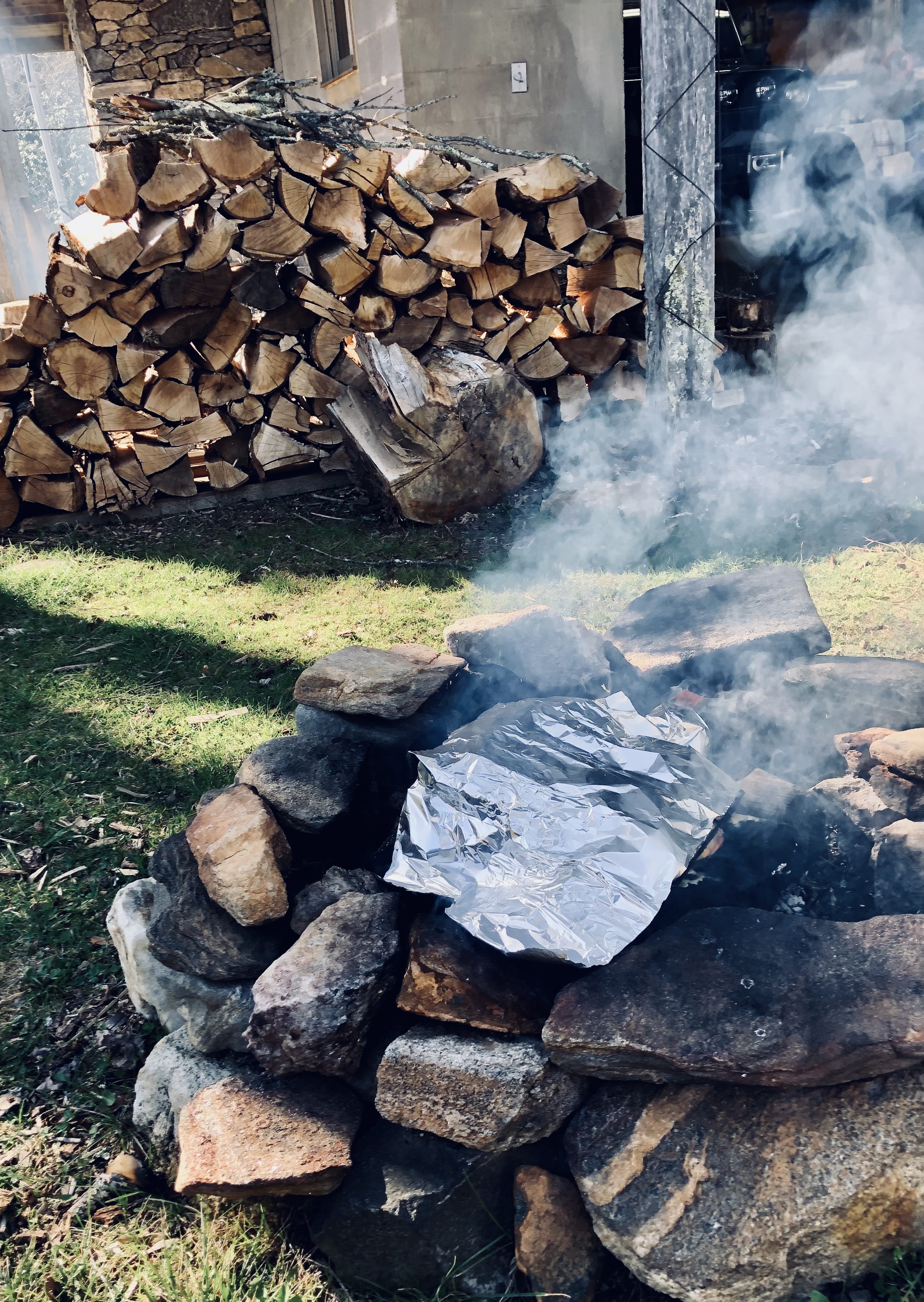
Smoked Chicken Sunday

Not as artful as Tex, but I’ll bet it will be tasty. 

Pizzapalooza

We tried pizza in the outdoor bread oven for the first time last night. We started with a quick (8-hour) dough recipe made for a medium-hot oven, around 500-600 degrees, and baked about 10 smallish pizzas for the 8 of us, with a variety of toppings. The crust came out amazingly well: crisp with a well-developed flavor.

Since we had several dough balls left over in the fridge, I tried again using the indoor oven today for lunch and found that worked pretty well, too, even though I can't get my oven much above 500. At that temperature, with refrigerated but not frozen dough, it baked in 8 minutes. Apparently the refrigerated balls of dough will last perfectly well in the fridge for several days, and in the freezer for several weeks. Unrefrigerated, they're good for several hours after they've reached their recommended fermentation stage. Pizza dough, unlike bread dough, has an extremely brief first rise followed by a longer second rise. You can finish the whole process in 6-8 hours if you can keep the dough at 80-90 degrees. If you rush it a bit, it will still taste good, but will be a bit springy when you try to stretch it out into a suitably large round. That doesn't turn out to be much of a problem. None of our crusts were thick enough to fail in crispness, and no one minded the wavy perimeters.

We'll definitely be doing this again. If we were going to shoot for a larger crowd, we'd have to use a wetter recipe calibrated for a much hotter oven, so we could cycle the pies faster. They say a Neapolitan pizza bakes in 90 seconds at 900 degrees. We can definitely get the wood-fired outdoor oven up that high, though I'm not sure how easy it will be to hold it there. We'll have to see how much harder it is to work with a wetter, softer dough.

My favorite turned out to be the extremely simple Margherita: a little fresh tomato sauce, mozzarella, and fresh basil leaves. I was surprised to find that the ordinary all-purpose flour version was a little tastier than the fancy Anson Mills pizza flour. So that's lucky, because the local grocery store stocks a good King Arthur AP flour. It can also usually be counted on to carry some fresh basil out of season. For tomatoes, we used a high-quality canned San Marzano brand that we order online by the case year-round, but the grocery store's hydroponic fresh tomatoes have been quite good in the last few years, too. The tomato industry has figured out how to transport a fresh tomato with flavor. The tomato sauce is really just an instant puree; no need to cook it down unless your tomato source is too watery.

We oversupplied ourselves with a wide variety of other toppings, such as onions, mushrooms, bell peppers, olives, sausage, feta, and Alfredo sauce, but another time I may not bother, considering how tasty the Margherita was. The volume of toppings was vastly more than necesssary, as well, but most of the leftover veg went into some excellent omelettes this morning for us and our two houseguests. (Last night we were joined by four neighbors.)

Here's the indoor slice from today, which had a decent crust, though not as crisp as the outdoor pies from last night:

Emergency Vehicle Driving

This weekend is the annual recertification exercise for driving big fire trucks and such. The over the road exercises are fine, as is most of the obstacle course, with the exception of the serpentine event. There you have to weave the vehicle through a series of cones, which is fine; but then you have to back it through the cones in the opposite direction from how you went forward. Everyone eventually passed it, but there were numerous second tries. 

By coincidence the exercise coincided with the 50th birthday of a member. Thus, a surprise party. 


Less happily it also coincided with a benefit barbecue by a neighbor county for a firefighter who was burned in a recent emergency. We sent the birthday boy over to pick up some Boston butts from their benefit, which also gave us time to set up the surprise party. 

There’s a lot of value in these civic organizations. Even apart from the rescue and fire protection, the community is stronger and better because of these common efforts. 

Garden Expansion


 We’ve decided to lay in a third raised bed this year, expecting food to be somewhat expensive or even somewhat short. The older beds are turned over and ready. The new one is framed, but the hard work of breaking the earth is yet to be done. 

Exposure in Maryland

Restoration of a traditional practice is usually, but not always, a good thing. 

Cesspool of Sellouts

Or possibly it’s a ‘cesspool of sin,’ as this out-of-shape Yankee* explains. Either way I was there yesterday. 

The city is actually looking much less like a cesspool of any sort following a campaign to drive out the homeless and clean up the town. One of the small parks near this sign on Patton avenue was being used by families with small children instead of the usual sleeping addicts. I’m not sure what occasions this radical departure from the city’s deeply held values of tolerance and inclusion, but it was surprising. My wife had asked me to link up with her because she needed to walk by that park, and disliked the usual harassment she faces when doing so. This time, cute children instead. 

We also saw a pair of immature bald eagles struggling for dominance on the east fork of the Pigeon river. This was heading back along US 276. There was massive flooding there recently, and though progress has been made there are still clear signs of the disaster. The road is no longer closed between the Parkway and Waynesville, though. And there’s a new Scottish pub in Waynesville, an ideal motorcycle destination provided virtuous moderation is practiced (or else accommodation in Waynesville is found).


* AVI and others from the real North occasionally note that their own usage of "Yankee" has a very different content than the one that Southerners intend. In this case, though, 'Yankee' is the speaker's own choice of appellation -- if you watch his channel's intro video, that's the word he chose to describe himself. 

R.I.P. Good Dog

I took in this beautiful creature, Greta, several weeks ago. She turned out to be 12 years old and heart worm positive, with liver enzymes too high to stand treatment unless we could get them down. She was emaciated and had tapeworms. After we got rid of the heart worms, she led the life of Riley here for two weeks, eating all day every day and fattening up nicely.

But Friday night she sustained a trifling injury in a scuffle with one of my other dogs. I thought nothing of it until the next day when she swelled up everywhere and was prostrated. She spent all weekend at the emergency vet hospital, where I thought she was improving, but it seems that the minor injury triggered what must have been a serious auto-immune disease, because she seemingly lost all ability for her cells or vessels to retain fluid, and her own system was destroying all her red blood cells. Her immune system may have been on crazy high alert from the heart worms.  That probably means it wasn't ever going to be in the cards for me to get her strong enough to treat the heart worms, and when we put her down this morning she escaped what otherwise would have been a long decline with heart disease.

She was such a sweetie. I don't regret taking her in and giving her two good weeks with all the food she could eat and a safe place to sleep. This is her just last Friday, right before she cratered.  We have buried her here with all our other dogs.

Good for Will

This was very satisfying video of Will Smith punching Chris Rock at the Oscars. Straightforward and heartfelt. I'll bet he didn't stop to agonize about whether it was woke or fashionable.

Another Exciting Afternoon


Up here we’re so far from everything that whenever we call for Medivac it’s always to some totally improvised LZ. 

Childhood

Over at An Eccentric Culinary History:

If you want a single dramatic example of how much America has changed in the last century or so, stop talking about trips to the moon and super computers and start talking about this: in 1910, two brothers, Temple and Louis Abernathy, saddled up a pair of ponies and rode alone from their home in Frederick, Oklahoma, to New York City, almost 2000 miles away, to see Teddy Roosevelt give a speech. At the time, Louis, called “Bud”, was 10 years old, Temp was 6.

It's a good story.

Saturday Night Firefight


Part of the Nantahala National Forest burned tonight, but not a very big part. The National Weather Service warned that the high winds would make for a fire hazard, and sure enough they blew down a power line. That caused a fire, which the high winds quickly fanned up and over the ridge and down into the next valley. We managed to contain it between the road and a nearby cold water creek, plus some artificial fire breaks created by guys with leaf blowers. That worked until the Forest Service got up there with a bulldozer to plow in a proper fire break.

Whose Lamentations?

Conan The Barbarian Acquires Biology Degree So He Can Know Whose Lamentations He's Hearing

Bonus: The Babylon Bee's Man Of The Year Is Rachel Levine

Believers


This Would Be A Good Year to Plant A Garden

Thirteen percent of global calories won't get raised this year due to the war in Ukraine.

The US has an option here: suspend ethanol for the year, and use that corn for food instead. That violates the dearly-held Green policies of the current administration and those in power in Congress, however. 


As Predicted

"Scientists, gender law scholars and philosophers of biology" have weighed in on the question of what a woman is and -- exactly as predicted yesterday -- they want to be clear that a biologist couldn't tell you either.

Slandering Americans Overseas

The 'very good people on both sides' slander aimed at Trump is bad enough, but -- as David Reaboi points out -- it is amazingly awful to slander American citizens as Nazis while in Europe supporting a government that actually has an openly neo-Nazi wing, the Azov Regiment.

Ukraine may still be worthy of support because they are being invaded, and we are supposedly devoted to opposing wars of aggression. Or they may be worthy of supporting because it is in our national interest to tie the Russian military down and degrade it, so that it is less of a competitor. 

However, if you support Ukraine it's not because you're opposed to Nazis in some sort of principled way. You're siding with a government that has formally integrated Nazis into its military; and while the government has suspended political parties that have any sort of pro-Russian agenda, the Nazi political party associated with Azov is still licensed to operate.

Army Approves Lower Standard for Women

The ongoing saga of the Army's new fitness test has reached a crescendo. As you will recall, the Army declared it was getting rid of its 'old fashioned' fitness test -- which consisted of a two mile run, pushups, and situps -- in favor of a new-fangled "Combat Fitness Test" that would test a wider range of capacities more directly related to the things you'd really do in combat. Unlike the old test, too, they declared that the test would be both gender neutral and age neutral.

It turned out that 65% of female soldiers failed the new test, which would have had to result in their expulsion from the force. The rest scored notably lower than male soldiers, which would have made them less able to obtain promotions as enlisted promotions are partly based on fitness scores. So, they started talking about redesigning the test -- but not, we were assured, in a way that would hold women to lower standards.

The next step was to admit that women would have to be scored only relative to each other, and not relative to the men in order for them to remain promotable under the new system.

That was not sufficient either. The test will now scrap the events women couldn't pass, and allow both women and older men to pass with lower scores

At this point, then, the ACFT has comprehensively failed: it will neither be age nor gender neutral, it will not hold women to equal standards, it has eliminated test of combat-related capacities that are difficult for women, and it has become thoroughly a political exercise designed to produce desirable results rather than to serve as a fitness exam. In addition, it still has the logistical problems that come from swapping from equipment-free events like running or pushups to tests that require equipment to perform. 

Comprehensive failure is becoming the norm, I notice, whenever the brass gets involved.

Beware Fitness & Good Health

Fitness especially may lead to terrible things. Allegedly Nazism, that perennial fear of leftists even though it’s a form of socialism. 

After discussion of how fitness is now feared as yet another gateway to right-wing politics, the author makes a good point: the left is who is building all these gateways. 
The Left has made a habit out of forbidding things that are normal or even admirable to pursue—physical excellence is just one of those things. Raise doubts about transgender pronouns or election integrity and you—moderate, well-adjusted, not-even-all-that-political you—are suddenly a potential Unabomber.

If you wanted to force people into the arms of conspiracy theorists, you could hardly come up with a better strategy than to pathologize normalcy and make observing basic facts into a thought crime.

Who among us can define woman, though? 

A Sword of Eisenhower

Well, it passed through his hands anyway. It originally dates from the tenth century.

The Definition of a Woman

FOX News mischaracterizes Supreme Court nominee Ketanji Brown Jackson's response as a "refusal" to give the definition of "a woman." She did not refuse so much as she claimed an incapacity to define it, stating that she was not a biologist. 

What's truly sad about this response is that it won't even satisfy the intended clientele. By implying that only a biologist could define 'a woman,' she is conceding that the answer is related to material biological reality. It is not, then, a matter of felt or claimed or chosen identity. It's something about one's physical body.

This is the kind of absurdity that must eventually collapse, but it may well not collapse quickly enough to avoid putting this person -- woman? -- on the Supreme Court.


UPDATE: The Federalist points out that Judge Jackson has used the word "woman" extensively in her legal rulings. 

Socrates got himself killed by talking to 'experts' who used terms that it turned out they couldn't define. My favorite of these dialogues is the Laches, on courage, but perhaps more to the point is Euthyphro. There the question is whether Euthyphro can define "piety," a serious matter because he is doing something many thought impious at the time -- bringing a suit for murder against his own aged father on the word of a slave. It turns out that his definitions could not hold up to inquiry, leaving him open to the charge that he was acting as if he had confident knowledge on a deadly subject he did not in fact understand. 

Jackson evades the danger of being tested on her definition by refusing to give one, but her regular usage of the term implies that she is subject to the same critique. If you have regularly issued judgments on the subject of women, you are acting like you know what a woman is -- how else could you make any sort of reasoned judgment about them? Yet she claims to be unable to explain it, except that by implication it is a matter of biology. Indeed, she has testified under oath that she cannot define the word that has been the subject of so many of her judgments.

Quoting Jesus to Justify Invasion

Jesus is a much sterner figure than many people imagine, thinking of him as the King of Peace, Love, and Forgiveness -- which is not wrong, but not complete. It is not impossible nor even incongruent to think of Jesus as one who 'brings not peace, but a sword,' or who encourages his followers to 'buy a sword even if you have to sell your coat.' 

Still, it's harder to see him justifying an invasion.
Speaking to the crowd in a turtleneck and down winter coat, Putin said he ordered the invasion "to get people out of their misery, out of this genocide, that is the main reason, the motive and purpose of the military operation that we began in Donbas and Ukraine," according to The Washington Post. Russia has repeatedly accused the Ukrainian government of committing genocide in separatist-controlled areas of eastern Ukraine.

"And this is where the words from the Scriptures come to my mind: 'There is no greater love than if someone gives his soul for his friends,'" Putin continued, paraphrasing John 15:13.

Both the Post and ABC News translate the Russian word душу (dushu) as "soul," but most English translations of the passage use "life." 

If in fact a genocide was occurring, as he claims -- and perhaps believes -- it might work. One of the justifications of the Iraq War was that Saddam was engaged in a sort-of genocide against the "Marsh Arabs," and there are arguments in Michael Walzer's Just and Unjust Wars that state that anyone who could stop a genocide has 'a right, at least, to try.' Walzer himself opposed the war, but the arguments exist whether or not he thought they fit the particular facts. 

So maybe, insofar as Putin truly believes these claims (and especially if he were right to believe them).

Push-Button Tyranny

A well-considered article in Tablet magazine warns of the perils of Trudeau-style cancelation without trial. It is a more dangerous power than may be apparent without such consideration. 

An Odd Correlation

Jordan Schachtel, a journalist who has been voicing a lot of skepticism about Ukraine, notes an odd correlation between vaccine status and support for risk military action in Ukraine.


Or perhaps not so odd: the same correlation shows up in Canada.


It's easy enough to guess why this is the case: those who have been inclined to take booster doses are more likely to be heavily exposed to information sources that have tended to portray this as the wise and responsible course; those same sources happen to be all about Ukraine right now. Those skeptics, by contrast, have been learning to discount those same sources and to trust alternative media -- which is more likely to be skeptical of the government here, as well. 

(Should you be skeptical of our government's support for Ukraine? The government there has barred opposition political parties -- but not formally neo-Nazi parties who are integrated with their armed forces -- and seized control of the media. Of course, it's wartime; on the other hand, those are totalitarian moves that contrast sharply with the narrative we're seeing in these pro-Ukraine US media sites. Make up your own mind how skeptical to be; I'm not here to tell you that.)

Maybe this all says less about Ukraine, and more about how deep the division is in our own society. Or maybe it says that this division is mostly a product of information choices, and otherwise might not be so deep after all. If it were possible to address that effectively, perhaps we would come together.

Or perhaps not; the divide may be more deeply rooted than where you get your news.

If you're interested in the Ukraine conflict, however, here's CDR Salamander on Russian amphibious operations.

Equinox

Happy springtime. The weather here is beginning to feature some nice days, but still freezing at night. There’s an eagle soaring on a thermal in the valley below. 

Another Twenty Minute Job

Lately it seems like every repair project has a broken bolt, or a head that rounds off, or some other weary complication. A job that ought to take a few minutes ends up taking all day, or in today's case will now take at least through tomorrow. Today I was just going to replace the front struts in my Ford, and I figured that if I was going to do that I ought to redo the brakes and maybe swap out that one wheel bearing that's been sounding funny. After all, you have to remove almost all the same stuff to get there. 

Well, maybe tomorrow. Or soon.

Also, my oil dipstick on that truck broke in my hand when I went to check the oil. Flush with the engine block, it did. Now I'll have to tap the thing with a drill, run a screw into it, and pull it out with Vice Grips. But that will have to wait until the new one I ordered comes in.

UPDATE: I finished that list on Tuesday due to issues with the upper ball joint on one side, but now I have a new list of things to fix just as AVI warmed. 

Whee

Trudeau was so upset that some guy showed up at the trucker protest wearing a mask (at a protest aimed at eliminating COVID measures) and carrying a swastika flag. He was so upset that he mentioned it over and over, trying to paint the whole movement as if that one guy -- that one faceless guy in a crowd of people with no masks -- was emblematic of the movement as a whole. He even accused a Jewish MP of 'standing with the swastika' for questioning his repressive measures. 

Prime Minister Justin Trudeau and Deputy Prime Minister Chrystia Freeland met with the co-founder of a far-right fascist party in Ukraine, which was styled off of Hilter’s Nazi Party, True North has learned.

Andriy Parubiy served as the equivalent of the legislative speaker of Ukrainian Parliament from 2016 to 2019, and during that time he personally met with Trudeau and Freeland several times.

Earlier in his career, Parubiy was an influential member of Ukraine’s far-right neo-Nazi movement. In 1991, he co-founded the Nazi-styled Social-National Party of Ukraine (SNPU) – a party focused on “racial nationalism” that even adopted the Nazi Wolfsangel symbol as its logo. 

Yeah, that's where we are with philosophical coherence and our leadership. There is none; it's just about power with them.

The Feast of St. Patrick

St. Patrick warns of dragons:
The Most High does not accept the gifts of evildoers. The one who offers a sacrifice taken from what belongs to the poor is like one who sacrifices a child in the very sight of the child's father. Riches, says Scripture, which a person gathers unjustly, will be vomited out of that person's stomach. The angel of death will drag such a one away, to be crushed by the anger of dragons. Such a one will the tongue of a serpent slay, and the fire which cannot be extinguished will consume.

I have read that in Ireland his feast day is generally somber, coming as it always does in Lent. 

Yellowstone

A friend of mine recommended this series -- now filming its fifth season -- to me recently. We've been watching it; we're now on season four. It has a lot to recommend it. This fellow thinks it's biblical in scale, and in a way it almost is. To be truly biblical, God should play a bigger role.

Its critics in the media get it wrong, though. As that linked article notes:
Reason reports that “media elites” are mystified by the success of “Yellowstone”: “It is not… saying anything grand or sweeping about our world.”
That's totally wrong, and the linked article gives an account of why. What "Yellowstone" is about is resistance to the fact that our whole economic and political system destroys traditional ways of life, forces settled people to become nomads, wipes out communities and families and homes. Nearly all human meaning derives from relationships with others: family, church, community, home. These are the things inexorably destroyed by the very system that sustains us.

These forces are titanic, and we both depend on them and struggle against them with all our might. When they win -- the county I grew up in was completely destroyed by the expansion of Atlanta, its way of life gone, almost all the people I grew up with forced into exile by rising property taxes and costs that could only be bone by the richer new arrivals -- they destroy almost all the meaning in our lives. Communities and churches are broken up when the congregation splits up and moves. Maybe family can survive in other places; maybe they can maintain their relationships in spite of the new distance and the fact they never see each other anymore. No one visits my father's grave down in Georgia. My mother and sister now live in Idaho. I haven't seen them in years. I have no idea where the friends of my youth now live. They aren't the sort of people who join Facebook, so they have vanished as completely as a sailor slipping beneath the waves.

Nothing grand or sweeping? This is almost everything. Only the one thing they leave out -- God, the hope of the dying -- remains when all these things are lost. Even God, for those who are neither hermits nor prophets, is harder to hear and know without a church.

"Yellowstone" is a fantasy because we usually can't sustain and survive. But it does lay out the task: hold the line as long as you can. Oppose progress in all its forms. No more roads; no more improvement. No more government, no more control. 

No more of any of it. No more. 

It's Important to Know Where You Are

At last night's training the instructor asked me where I was from, and I mentioned Dahlonega as a reference point close enough by that he'd know it. He did know it, and asked if I'd heard the story of the two Yankees who visited Dahlonega. He said they were traveling through and stopped at the Dairy Queen to get a milkshake. While they were waiting in line they were arguing about how to pronounce the Cherokee name of the town. They couldn't agree, and so when they got to the head of the line they asked the girl working the counter how to pronounce the name of the place.

She looked at them solemnly and said, "DAY-ree KWEEN."

Will we fight? Will we even struggle?

From Glenn Reynolds:
Also in the mix, somehow: Chinese think tank: China should cut Putin loose ASAP and make nice with the invigorated west. Yeah, all this Ukraine stuff runs the risk of reminding westerners what they believe in and convincing them to fight for it. Can’t have that!
Once the NYT figures that out, they’ll go from jingoist to pacifist overnight.
Plus: “China may be gambling that the western appetite for punishing Beijing if it sends military aid to Moscow will be weak at a moment of high inflation and sky-high gas prices. Western consumers can stand only so much pain; the U.S. and EU won’t open another front of global economic warfare when they’ve already gone nuclear with Russia via sanctions. But here’s the question: Is China in a position to risk that at the moment? They’re hurting economically already. . . . Putin also believed that the west wouldn’t dare wage economic war on him for attacking Ukraine by freezing his currency reserves or isolating Russia’s central bank. How’s that working out for him? Does China want to roll the dice that it won’t be hit surprisingly hard too at a moment when the U.S. and EU are in a mood to de-globalize? When China and Russia announced their “no limits” partnership against the west just six weeks ago, Beijing hoped that the alliance would be a force multiplier that gained each of them a sphere of influence at the expense of the U.S. Suddenly, to its horror, China is learning that Russia is a paper tiger not just economically but militarily.”
Imagine what trouble China would be in if the United States had a functional presidency.

Partisan Politics

Tonight at the VFD meeting yet another candidate for sheriff came to address us and seek our support. There are five candidates for the office this year. Sheriff is not a very political office, not usually, so none of them have made much of which party they are running with in the primary. It turns out that there are four Democrats and only one Republican (who will, perforce, make the general at least). The candidates are all older men, each boasting of decades of experience in law enforcement. When they picked their party as young men, it was as natural for them as for me to choose to be a Southern Democrat. 

That was the subject of significant discussion after the meeting, among a number of us firefighters. It turns out that all of us are Democrats too -- Southern, mountain Democrats of the old fashion. It must be the last place on earth where this faction, the Jacksonian faction, still exists. One fellow said he was going to go down to the registrar and change his party affiliation; another, the oldest of us, averred that he was ashamed now of his party membership. There were no kind words for the party, its leadership, its direction, its vision, nor any other facet of what it has become. 

The candidate seemed like a decent guy for a cop; when he's not doing work as a deputy US Marshal he sells auto parts and performs vehicle repairs. Like a good Southern Democrat, he addressed the meeting wearing a t-shirt with pictures of classic muscle cars. He had the sense to see that we were conducting a training session tonight that would take hours of our time, and the courtesy to keep his remarks short. 

I still won't vote for him because his solution to the problems was to bring in more Federal law enforcement, and more of the Federal government in my community is the last thing I want. He said that currently the Feds consider this county an almost forbidden zone for their activity; that's sweet news to my ears. Ordinary decent criminals I can deal with; indeed, they've never caused me one moment of trouble in my entire life. The political criminals are far worse. 

I probably will never switch to the Republican party, which is full of scoundrels as well -- especially its establishment wing. But the old party of my youth, still for the moment strong in these mountains, is probably in its last hours. 

Dressing as a Woman to Escape War

This is a story that occurs from time to time; it was said of Jefferson Davis, for example, that he fled Richmond dressed en femme. (Davis hotly denied this for the rest of his life.) This is the first time I've ever heard of a biological female confessing to dressing like a woman to evade war, but these are strange times.
But as a transgender man — a man assigned female at birth — different questions raced through his mind about leaving his homeland. Andriy is a pseudonym used to protect his identity.

He read the news that all men in Ukraine, ages 18 to 60, were not permitted to leave the country and were obligated to serve in the military.

He told Insider he needed to stay with his mother and care for her. Leaving her to flee Ukraine alone just was not an option....

"If the border force saw him as a man, he would have to stay in Ukraine and not care for his mother," Dubilewski said. "It was very painful for him to dress up as a woman, wear his mother's makeup, but it would have been more painful to leave her in a foreign country to start her life over." 

Yes, very painful.

I suppose 'Andriy' adequately proved he wasn't a man by dodging his duty to fight for his country in the face of invasion, but it's ironic to see someone who has been so insistent on the point reach for that female privilege just as soon as it matters. As usual the duties and hardships of  manhood aren't what 'Andriy' really wanted.

A Cold Day


Winter is having a last little laugh here, with wind chills down to negative ten and a shock of snow this morning. Of course, such a cold day almost demands a fire department call -- everyone gets their wood stoves or fireplaces good and hot, and you can just expect to be out there in it freezing to fight their fire. On the way we discovered that the wind had been blowing so hard that steel street signs and trees alike had been blown down and out into the road. 

Hopefully there won't be any repeat fires tonight, when it's going to be in the single digits before the wind chill. We're told it'll be back in the sixties next week. Spring is almost upon us.

What should I do?

I got this unusual email from Treasury Secretary Janet Yellen:
Janet Louise Yellen
Dear: Beneficiary,
Reply-To: mrsjanetlouiseyellen11@gmail.com
Attention: Fund Owner,
This office now understands the reason why you did not want to complete the process in regard to this transaction of yours. We are surprise to receive a message from unknown Woman Mrs. Donna Marie Guss this Morning who claims to be your representative and she explain to this office that you have an Auto Accident on the 10th of last Month on your way back from office and after taking you to so many Hospital’s you did not make it,
She also went ahead and explain to this office that before you pass away that you instructed her to contact this office so that she will pay the needed balance fee sum of $250 usd required regarding to your transaction to able us change the ownership Name in your Document to her Name so that the paying Bank will transfer the total fund sum of $20,6 Million United States Dallas Twenty Million Six Hundred Thousand Usd successfully into her local Bank Account as you can see below:
Bank Name: Wells Fargo Bank Account 6464449591. Routing No 121000248. Swift BIC.WFBIUS65
Please for your information this office is waiting to hear back from you as soon as you receive this message if you are alive. But if we did not hear from you in regard to this message we will have to confirm that Mrs. Donna Marie Guss is saying the truth and this office will instruct the paying Bank to release the total fund into her Bank Account,
From the Office of Janet Louise Yellen, United States Secretary of the U.S. Department of the Treasury Suite 4820 U.S. Department of State Washington, DC 20520-5820
I'd hate to leave her in suspense about my survival, after someone took me to so many Hospital's, and I could really use the $20.6 million Dallas.

More on the Gypsy Jokers vs. ANTIFA


Sose the Ghost on the confrontation. "If you say it a whole bunch of times, it doesn't make it true."

Targeting for Political Reasons

A wife of a January 6th detainee claims that she and other family members are being targeted by the FBI. That's plausible; putting pressure on family is a classic method of breaking people you're trying to get to plea so you don't have to prove your charges in court. That's how they got Mike Flynn, for example: by threatening charges against his son if he wouldn't plea. 

Meanwhile, in Michigan, we see the 'plot to kidnap the governor' turning on the testimony of FBI agents who were deeply involved in planning the alleged plot -- agents who hated Trump a whole lot.

Trump is not the issue; I'd prefer if he didn't run again. The FBI is proving itself to be too dangerous to survive. Whenever there's a chance for reform, it should be disbanded.

Among the Truckers

The convoy efforts in the US have shown none of the spirit, forethought, nor determination of the Canadian convoy movement. They appear to be purely for show. Nevertheless, they did draw a visit from Ted Cruz.
Landis’ truck carries a WWll flag that proudly waves on its flatbed. The flag had been draped over the casket of a soldier who died in WWll and was hand-delivered to the convoy in Oklahoma by one of the veteran’s grandsons. The flag traveled the rest of the trip into Hagerstown with the convoy....

Cruz did most of the talking at the press conference, with Brase speaking for only a few minutes. Cruz emphasized the importance of being informed voters because elected officials often make poor decisions on behalf of Americans....

Brase stepped up to the mic, adding his two cents on the Senator’s words:

“It is our freedoms. That’s what this is about, and it’s time to remind the American Government and governments truly around the world even that they work for us."

There has been some doubt expressed in the comments section here as to whether the government does, in fact, work for us.  They certainly tax us, although long ago now it was no longer appropriate to say that we thereby 'pay their salaries.' They spend far more money than they tax from us; their salaries are paid with just more printed money, underwritten by nothing but a promise they know cannot be kept. 

UPDATE:


Gas Hikes

My friend Hunstman breaks it down: even if you attribute 100% of the post-Ukraine gas price hike to Putin...
Total Increase since 1/21/21: $1.72/gal
Biden Increase: $1.20/gal
Putin Increase: $0.52/gal

Biden % of Total: 69.8%

"World War Three"

It's at least six by my count, but it's still not great to hear the President of the United States talking about it as a live possibility. Particularly not this president, with his mental and physical challenges; nor this military, crippled by having the same leadership that has not known accountability for its failure in Afghanistan. 

Are their Biological Weapons Labs in Ukraine?

We know for sure that there are biological labs of some sort in Ukraine, because our own government has admitted it in testimony before Congress. We also know for sure that at least some of them used to be biological warfare labs, because they were established as such under the Soviet Union.

Descriptions I've read of what has been going on there make it sound more like Wuhan-style 'gain of function' research on zoologicals, but that's very hard to distinguish from biological warfare research. It strikes me as probable that our government would have inherited and preserved/continued the Soviet research, just as they did with the WWII-era Japanese and German research into plague, nuclear weapons, and rocketry. Also, after the recent pandemic, I'm sure we'd all prefer that such laboratories be treated as extremely dangerous things to mess around with anyway.

Reuters reports that the UN has advised Ukraine to destroy whatever is in those labs on an expedited basis. 

Hillz does her part

Bee

Another Gigantic Bill No One Read

It's almost three thousand pages, released after midnight and voted on the same day by the House. It passed, of course, because Congress is full of scoundrels. Amber Athey skimmed at least some of it and found quite a bit of waste.
...an unspecified portion of the nearly $4 billion available in bilateral economic assistance — meaning direct transfers from the United States to other countries — shall “be made available for programs to promote democracy and for gender programs in Pakistan.”

Gender programs in Pakistan? How much are we sending to Saudi Arabia? They're actually making progress on that front. 

Be On the Lookout for Spider Paratroopers

An invasive species invades.
Researchers say there's nothing we can do. They're coming... I say let's pool our resources now and build a dome around Georgia and keep them there.

It's too late. 

Mafia Economics

An interesting thread on Russia's situation. I think this insight is important:
Why old oil and gas tycoons were expropriated, while metallurgy oligarchs were spared and largely remained rich through the entire Putin's era? Because metallurgy is too complicated for Putin's friends to control it directly. They spared it, because they are too mafia to run it
 
The closer you are to the seat of power, the more mafia like and thus simpler you are. You are just unable to administer anything complex. That's why the highest-ranked and the simplest interest group took oil and gas - something they could rip off without destroying. immediately

1990s oligarchs are more complex but lower in dominance hierarchy. They took something that they could administer without ruining it immediately - the metallurgy. Ofc they're ruining it slowly. They're depleting old deposits without developing new ones. But it will take time

And only really complex stuff like competitive machinery is left for nerds like a nengineer Skurov - the owner of that mining machine producing factory I talked about. That's very important. Complex machinery is administered by guys who are very low in Russian dominance hierarchy

That's quite important for understanding the economic prospects of Russia. Complex industries, especially hardware industries are run by very weak interest groups. Higher-ups tolerate the nerds because someone should do it, but they'll milk those miserables dry 

I imagine it's like the banker in this scene:


It's probably easier to navigate. The banker in that scene thinks he lives in a place where there's rule of law; the nerds in Russia don't have any such illusions. 
 

The Past was not Conservative

A fascinating study of our (mis)perception of public attitudes. 

"Some men kiss their chains"

But not all do. Niall Ferguson observes that it's foolish to assume everyone shares our value for freedom, but there's no need to ignore those who do.
It turns out that Americans grasp that it’s foolish to try to make people like themselves — but they sure are happy to lend a hand when they see people who are like themselves. It also turns out that Americans have a pretty good grasp of the national interest, and factor both sentiment and calculation into their preference on what ought to be done.

NYT Reporter: J6 Rife with Gov't Informants

Another Project Veritas sting, this has NYT Journalist Matthew Rosenberg -- who was present at the January 6th event -- talking through what happened. He attested that there were "a ton" of FBI informants "among the people who attacked the Capitol."

UPDATE: Tucker Carlson has a piece on this sting, with an interview from the editor of Revolver news.

Good Government at the DMV

The DMV has for decades been infamous for its customer service, but here in North Carolina the COVID period has brought it to abject tyranny. Our local DMV has reduced its hours for walk-in appointments to two hours a day, 2:15-4:15 PM. The door is locked at all times, and only one customer -- no parents with minors, or elders, but just one person -- is allowed inside and the door locked behind them. 

For two years they stopped doing road tests, 'because of COVID,' so if you were a younger driver who needed a road test to get a license you just couldn't drive. For years. Too bad. I arranged a temporary address in another state for a young relative so they could get a license, and then transfer it back here to their permanent address. The DMV doesn't care if it screws up your life. You don't matter at all.

Mornings are for appointments only, and you can only make an appointment online because they stopped answering their phone. You can call; they won't answer. I've called a dozen times trying to obtain information from them, and never once has anyone picked up the phone. No online appointments can be made sooner than two months out, not because they are busy -- today they had just one appointment -- but because. These go on until noon, at which point the DMV staff begins a two-hour lunch.

Then, at 2:15, they begin allowing people to come in one at a time according to the waiting list. Today the waiting list was two pages long at noon, two hours before they started seeing anyone, and many of the people there had been coming in for days to try to get seen. Some had come in at six in the morning in order to get their names on the list somewhat higher up.

I didn't actually need anything from the DMV myself today, I just was taking lunch to one of the poor citizens waiting for their government to deign to accept their tax money. They'd taken the day off work to be there, and because they came in at noon -- two hours early -- they were at the bottom of page two of the list. 

"Look," I said as I was passing off their lunch amid a very large crowd, "the DMV are the worst people in the world." The crowd laughed appreciatively, but in a kind of shocked tone at my audacity of speaking so of the mighty bureaucrats who govern their lives. "They have done everything they can to make themselves inaccessible and unaccountable to the citizens who pay their salaries. All you can do is wait on them and hope they do their jobs during the two hours a day they actually pretend to work." 

Just at this time one of the DMV employees walked into the building with his lunch.

"AND THERE'S ONE OF THEM RIGHT THERE!" I said quite loudly, raising my finger to point at him. "That guy is one of these who works only two hours a day while citizens wait for hours and hours!" 

He literally backed into his office and audibly locked the door trying to get away from all the people suddenly glaring at him. 

Now as I said, I didn't need anything from them and was just there to bring somebody lunch, so I left. I heard later, though, that the DMV employees somehow managed to get through every single person on the waiting list this afternoon. The people who'd been waiting for days were just stunned at how quickly the line moved today, compared to other days recently. Nobody was sent away without being seen today.

These people work for us. It's about time they remembered it. 

A Buck and a Half Gas

I was only able to put half a tank's worth of gasoline in my Ford today, because that was $75 and the new daily limit at the local gas station. That makes a full tank of gas $150. 

We were energy independent just a little over a year ago.