I wouldn’t be writing these words had your most recent video not been framed in biblical language. Its title held deep significance to me, as I am sure was your intention....If it is hard to imagine any other kind of man speaking this way to a woman in public, it ought to be. No other sort of man has the right. As he says, though, she has made it her business to make the private public, and she has mocked that which it is his charge to defend.
I believe I have your number. You will soon turn 42 and your destiny, as you stated, will not include children. You blame it on your depression, saying you don’t want to pass it on to another generation.
I find that confusing, coming from someone as perceptive as you are in dissecting flawed arguments. Surely you appreciate being alive and surely, if the wonder of your womb were afflicted with your weaknesses and blessed with your strengths, it would be happy to be alive, too.
You said you wouldn’t get married until gay people can. Now they can. And you still haven’t married. I think, Sarah, that marriage and childrearing are not in the cards for you because you can’t focus on building life when you spend your days and nights tearing it down.
You have made a career making public that which is private, making crude that which is intimate, making sensual that which is spiritual. You have experienced what traditional Judaism taught long ago: when you make sex a public thing it loses its potency. When the whisper is replaced with a shout there is no magic to speak about. And, in my opinion, Sarah, that is why you have had trouble forging a permanent relationship – the most basic desire of the feminine soul.
Human beings have many acquaintances and fewer friends, but only one spouse. Judaism celebrates the monogamous, intimate relationship with a spouse as the prototype of the intimate relationship with God. Marriage, in Judaism, is holy. Family, in Judaism, is celebrated. But for you, nothing is holy; in your world, nothing is permanent. Your ideology is secular. Your culture may be Jewish, but your mind is not.
I think you have latched on to politics because you are searching for something to build. There is only so much pulling down one can do without feeling utterly destructive. You want to fight for a value so you take your belief – secularism – and promote it. As an Orthodox rabbi, I disagree with just about everything you say, but respect your right to say it. All I ask, respectfully, is that you not use traditional Jewish terminology in your efforts. Because doing so is a lie.

Oratores
There was a long-lived ideal in Medieval society that there ought to be three classes of people: oratores, bellatores, and laboratores, that is, those who pray, those who fight, and those who work. We have lost the first class almost entirely, but here and there they still exist. Here one, a rabbi, speaks to a culturally Jewish comedienne in the way proper only to his class. I will quote a large part of it because the server is having trouble with the strain of so many people wanting to read an open letter from a rabbi to Sarah Silverman.

A plug for "Cook's Illustrated"
Maggie's Farm linked to a NYT review of the odd-duck "Cook's Illustrated." It's off the beaten path, certainly -- no advertising, no restaurant or chef reviews, and it features decidedly bizarre editorials that have nothing whatever to do with cooking. The recipes tend to be on the boring side. It's worth reading, nevertheless, as the only cooking guide I'm aware of that employs the scientific method. The test kitchen works on recipes obsessively to determine whether tweaking this or that ingredient, or the cooking time or technique, yields results approved by blind taste-testers. Common grocery-store or mail-order ingredients get an impartial "Consumer Reports"-style treatment as well. The NYT article confirms that the magazine's founder, Chris Kimball, isn't out to inspire cutting edge food trends for special occasions, but only to enable workaday cooks to produce reliable results with a minimum of effort, night after night. I swear by his biscuit recipe. And though his editorials apparently don't rate highly with his subscribers, I think they're great.
I'm not much of a cook, doing best when I stick to reliable, easy recipes. In contrast, my husband excels at difficult cooking: more Thomas Keller than Chris Kimball. He works at recipes until he can produce them perfectly, all appearing on the table at the right time. His attention span amazes me. If I try to cook three things at once, one of them is going to get forgotten at some critical stage, and smoke alarms are not out of the question.
Ace says today that the NYT has become a Democratic Party newsletter with a good crossword puzzle ("Democratic operatives with bylines"). That's fair, except that they still put out the occasional enjoyable Leisure/Style or Science/Health article.
A Difference of Opinion
Father whose son has broken his arm on the monkey bars: "That's a character-building experience, boy. Carry on like this, and in a few short years you'll be fit to join the cavalry."
Father whose daughter has done same: "Why do these monstrous monkey bars still exist in our civilized country?"
Well, maybe they should be marked "Boys Only."
On the other hand, by kindergarten I had my boy on horseback -- and that can break your neck. I haven't had a daughter, and maybe I'd feel differently about it, but I suspect I'd have had her on horseback by that age also. I could be wrong, but girls like horses. I doubt I'd have had the heart to keep her from them. Nor did Rhett Butler, I suppose, who lost a daughter just so.
Father whose daughter has done same: "Why do these monstrous monkey bars still exist in our civilized country?"
Well, maybe they should be marked "Boys Only."
On the other hand, by kindergarten I had my boy on horseback -- and that can break your neck. I haven't had a daughter, and maybe I'd feel differently about it, but I suspect I'd have had her on horseback by that age also. I could be wrong, but girls like horses. I doubt I'd have had the heart to keep her from them. Nor did Rhett Butler, I suppose, who lost a daughter just so.
I Am Bad News
Here's the trailer for the new 'Kill UBL' film.
Nearly the first thirty seconds are built around a monologue by an American torturer. This is kind of shocking, for a film that has been portrayed all along as an Obama re-election venue. It is one thing to accept that torture exists, and another to accept that your nation practices it. It is something else to valorize torture so much that you make it the introductory speech to your re-election video. This is what the man says, as we pass to a video of him standing before prison bars:
"Can I be honest with you? I am bad news. I am not your friend. I am not going to help you. I'm going to break you."
I doubt many Obama voters read this page. If any of you do, though: is this what you wanted when you voted for him four years ago? This is his work. That means it is yours.
Nearly the first thirty seconds are built around a monologue by an American torturer. This is kind of shocking, for a film that has been portrayed all along as an Obama re-election venue. It is one thing to accept that torture exists, and another to accept that your nation practices it. It is something else to valorize torture so much that you make it the introductory speech to your re-election video. This is what the man says, as we pass to a video of him standing before prison bars:
"Can I be honest with you? I am bad news. I am not your friend. I am not going to help you. I'm going to break you."
I doubt many Obama voters read this page. If any of you do, though: is this what you wanted when you voted for him four years ago? This is his work. That means it is yours.
"I'm going to leave it at that . . ."
. . . instead of answering your question, says Secy. Clinton. Joseph Curl outlines the shape-shifting story of the Benghazi attack, strangely reminiscent of the more triumphant, but still shape-shifting, story of the bin Laden raid:
On the eve of a House oversight committee hearing, the State Department called a briefing for the media. For an hour, over the telephone, top department officials spun a new tale that bore almost no resemblance to the official story they’d been telling for weeks.
There was no protest, the officials said, no protest that grew out of hand until a spontaneous mob — whipped into a rage over a video — poured into the consulate. In fact, “nothing was out of the ordinary” on the night of the attack, one official said. . . .
The FBI wouldn’t reach Benghazi for 17 days. When bureau agents finally did, they took tapes from the closed-circuit security cameras. More, reports emerged that an unmanned drone also captured the attack on video. The story was changing fast, and just before administration officials were to testify officially before Congress. The sudden respinning was reminiscent of the evolving story on the raid to get Osama bin Laden — first he had a gun, there was a firefight, he hid behind one of his wives; then, no gun, no firefight, no wife.Well, screenplays do get re-written all the time, as we discover what the audience likes. "The question is whether reporters will follow the trail of lies and deceit or leave off just as the whole mess is imploding," Curl suggests. But actually, if you're the New York Times, the question is whether reporters will start down the trail in the first place. As Mark Steyn noted:
Surely, even among Obama’s media sycophants, there must be someone who recognizes that all the cushy court eunuch posts are filled and, rather than being the umpteenth extra in the crowd scene, there’s a reputation, a Pulitzer and maybe a movie deal to be made here.
Death: Two Empirical Perspectives
[T]here is great reason to hope that death is a good, for one of two things: - either death is a state of nothingness and utter unconsciousness, or, as men say, there is a change and migration of the soul from this world to another. Now if you suppose that there is no consciousness, but a sleep like the sleep of him who is undisturbed even by the sight of dreams, death will be an unspeakable gain.... But if death is the journey to another place, and there, as men say, all the dead are, what good, O my friends and judges, can be greater than this? ... What would not a man give if he might converse with Orpheus and Musaeus and Hesiod and Homer? ... Above all, I shall be able to continue my search into true and false knowledge; as in this world, so also in that; I shall find out who is wise, and who pretends to be wise, and is not.
-Socrates, from Plato's Apology
I once had a professor of philosophy who was very interested in Near Death Experiences. These are the things you hear about where the brain is approaching death, and visions of light or transportation occur. I've had one myself, in fact, when choked out of consciousness for a minute or two by my old master of jujitsu. These things are kind of interesting, in a way, because they are often quite similar in spite of cultural differences or other inputs. They don't, however, speak very much to what it is like to be dead, even "brain dead." This is because we can't be sure that there isn't brain activity of some kind.
Recently, though, I've come across two people who present empirical accounts of long-term "brain death" -- we really mean a coma in both cases -- which were monitored in hospitals. They are really different sorts of accounts.
Gerard at American Digest gives this account: the lights went out, and then flipped back on. For the intervening 13 days, there was nothing at all: not even a darkness, not even sleep, just nothing.
Dr. Eben Alexander, a neurosurgeon who was comatose for eight days, gives an entirely different account: one of transportation, and beings of light, and a kind of maximum being that is not light but not yet darkness. There is emotional content: love, joy, and not so much forgiveness as the sense that there is, and can be, nothing to forgive.
Which account you find more plausible depends on your own assumptions, but from a scientific perspective it doesn't matter. What we have here are two roughly analogous events, with a surprisingly different phenomenal content. The first one lines up with what is suggested by what we think we know about the brain; the second lines up with numerous other empirical accounts of near-death from around the world.
None of this actually speaks to the real question, which is what it is like to be dead. There also remains enough shadow in our understanding of the brain that even with brain scans you might hope that the brain-only account can yet 'save the phenomena.'
Still, how interesting the difference.
-Socrates, from Plato's Apology
I once had a professor of philosophy who was very interested in Near Death Experiences. These are the things you hear about where the brain is approaching death, and visions of light or transportation occur. I've had one myself, in fact, when choked out of consciousness for a minute or two by my old master of jujitsu. These things are kind of interesting, in a way, because they are often quite similar in spite of cultural differences or other inputs. They don't, however, speak very much to what it is like to be dead, even "brain dead." This is because we can't be sure that there isn't brain activity of some kind.
Recently, though, I've come across two people who present empirical accounts of long-term "brain death" -- we really mean a coma in both cases -- which were monitored in hospitals. They are really different sorts of accounts.
Gerard at American Digest gives this account: the lights went out, and then flipped back on. For the intervening 13 days, there was nothing at all: not even a darkness, not even sleep, just nothing.
Dr. Eben Alexander, a neurosurgeon who was comatose for eight days, gives an entirely different account: one of transportation, and beings of light, and a kind of maximum being that is not light but not yet darkness. There is emotional content: love, joy, and not so much forgiveness as the sense that there is, and can be, nothing to forgive.
Which account you find more plausible depends on your own assumptions, but from a scientific perspective it doesn't matter. What we have here are two roughly analogous events, with a surprisingly different phenomenal content. The first one lines up with what is suggested by what we think we know about the brain; the second lines up with numerous other empirical accounts of near-death from around the world.
None of this actually speaks to the real question, which is what it is like to be dead. There also remains enough shadow in our understanding of the brain that even with brain scans you might hope that the brain-only account can yet 'save the phenomena.'
Still, how interesting the difference.
The Wages of Universal Healthcare
This year's statistics from the UK's Daily Telegraph:
* 43 people starved to death while in government-run hospital wards.
* 111 people died of thirst.
* 287 further people, though starvation was not the actual cause of death, were noted as being "severely malnourished" at the time of their deaths.
* Over a hundred died of infections from bedsores.
* Nearly twenty-two thousand were suffering from septicemia when they died.
So the good news is that it won't cost any money to go to the hospital. The bad news is that the strain on resources means that the hospitals lack the capacity to feed you, give you water, change your linens, or perform ordinary basic hygiene.
* 43 people starved to death while in government-run hospital wards.
* 111 people died of thirst.
* 287 further people, though starvation was not the actual cause of death, were noted as being "severely malnourished" at the time of their deaths.
* Over a hundred died of infections from bedsores.
* Nearly twenty-two thousand were suffering from septicemia when they died.
So the good news is that it won't cost any money to go to the hospital. The bad news is that the strain on resources means that the hospitals lack the capacity to feed you, give you water, change your linens, or perform ordinary basic hygiene.
What Do You Want?
Walter Russell Mead begins an article on how civil society cannot deliver world peace:
Economics is all about the question of assigning value. It believes in humankind as a collection of rational actors who are willing to trade things they value less for things they value more. This isn't just true at the marketplace, where we are trading money for products. It is also true before we get to the marketplace, when we are accepting opportunity costs in order to pursue a given opportunity (instead of others). If we are regularly willing to trade opportunities to pursue good A for opportunities to pursue good B, we value B more than A.
There is a tradition within epistemology that suggests something similar about belief. If you tell me that you believe that the world will end on Thursday, how can I tell if you are serious or not? One way I can tell is if you are taking steps coherent with the world ending on Thursday -- for example, spending all your money on short-term pleasures instead of investments, or mortgaging your house so you can spend your last hours on a world-wide cruise, or not showing up at work all week so that you can be praying in church. Depending on your value system, one of these mechanisms might be a more rational way to spend your last hours than your usual routine would be. If you carry on going to work and investing in your retirement plan as usual, I might have some reason to doubt that you sincerely believe in the end of the world on Thursday.
These are reasonably good arguments if the human mind is generally rational, and generally not compartmentalized. However, both of those assumptions seem to be false assumptions.
So it turns out we have two possibilities. Maybe we really do want world peace -- as Dr. Mead suggests -- but it is simply the case that human beings are very bad at it. Alternatively, maybe there are things you want more than world peace, so that you will reliably trade opportunities to pursue world peace for opportunities to pursue these things.
Let's try a thought experiment to see which is the case. Imagine a computer algorithm has been designed that can reliably achieve peace if humans obey the computers' instructions. Nothing really wild is asked for -- no one has to sacrifice his son, for example -- but you have to do what you are told whether it makes sense to you or not. This program has been proven by experiment at every level, from tribal disputes in Africa to corporate ones in Europe and Japan, and so far it has generated perfect peace and cooperation wherever it has been tried. There is now a proposal before the Senate to ratify a global treaty requiring all people in the world to obey the computer, at all times, without exception. The President has already signed the treaty, so ratification is the last step to making this treaty the law of the land.
If Dr. Mead is right, and we just are bad at making peace, this should be an enormously attractive proposition. Is it?
Every aspiring beauty-pageant queen knows what to say when asked what she wants most: "World peace." World peace is at least nominally what we all want most. But evidently, we are not very good at making it.Both economics and epistemology suggest that, this being the case, we may not really want world peace as much as we think we do.
Economics is all about the question of assigning value. It believes in humankind as a collection of rational actors who are willing to trade things they value less for things they value more. This isn't just true at the marketplace, where we are trading money for products. It is also true before we get to the marketplace, when we are accepting opportunity costs in order to pursue a given opportunity (instead of others). If we are regularly willing to trade opportunities to pursue good A for opportunities to pursue good B, we value B more than A.
There is a tradition within epistemology that suggests something similar about belief. If you tell me that you believe that the world will end on Thursday, how can I tell if you are serious or not? One way I can tell is if you are taking steps coherent with the world ending on Thursday -- for example, spending all your money on short-term pleasures instead of investments, or mortgaging your house so you can spend your last hours on a world-wide cruise, or not showing up at work all week so that you can be praying in church. Depending on your value system, one of these mechanisms might be a more rational way to spend your last hours than your usual routine would be. If you carry on going to work and investing in your retirement plan as usual, I might have some reason to doubt that you sincerely believe in the end of the world on Thursday.
These are reasonably good arguments if the human mind is generally rational, and generally not compartmentalized. However, both of those assumptions seem to be false assumptions.
So it turns out we have two possibilities. Maybe we really do want world peace -- as Dr. Mead suggests -- but it is simply the case that human beings are very bad at it. Alternatively, maybe there are things you want more than world peace, so that you will reliably trade opportunities to pursue world peace for opportunities to pursue these things.
Let's try a thought experiment to see which is the case. Imagine a computer algorithm has been designed that can reliably achieve peace if humans obey the computers' instructions. Nothing really wild is asked for -- no one has to sacrifice his son, for example -- but you have to do what you are told whether it makes sense to you or not. This program has been proven by experiment at every level, from tribal disputes in Africa to corporate ones in Europe and Japan, and so far it has generated perfect peace and cooperation wherever it has been tried. There is now a proposal before the Senate to ratify a global treaty requiring all people in the world to obey the computer, at all times, without exception. The President has already signed the treaty, so ratification is the last step to making this treaty the law of the land.
If Dr. Mead is right, and we just are bad at making peace, this should be an enormously attractive proposition. Is it?
Sleep tight
Bryan Preston of PJ Media reports that the White House had a live feed from an overhead drone as the attack on the Benghazi embassy wound down, when we still did not know the fate of our murdered ambassador. Technical difficulties involving closed eyelids prevented the President from watching. Preston wonders: "Would Obama have gone to bed during a nailbiter of a sports game?" Well, maybe so, if he had to get up early and fly out to Las Vegas for a fund-raiser.
It's a good thing he didn't spend a couple of minutes finishing the story he was reading to some schoolchildren.
Anyway, within a few weeks he'd wrung a full briefing out of all those uncooperative intelligence community and State Department operatives.
Is Hillary Clinton really a wise scapegoat to fix on? I'm trying to imagine how tempted Bill Clinton is to grab a microphone and update his thoughts on how "any president" would have stacked up in the face of this crisis.
It's a good thing he didn't spend a couple of minutes finishing the story he was reading to some schoolchildren.
Anyway, within a few weeks he'd wrung a full briefing out of all those uncooperative intelligence community and State Department operatives.
Is Hillary Clinton really a wise scapegoat to fix on? I'm trying to imagine how tempted Bill Clinton is to grab a microphone and update his thoughts on how "any president" would have stacked up in the face of this crisis.
Ve haff vays of making you compassionate
"The Long Arm of Academic Tolerance" explores the fate of teachers who dare to express political opinions -- oops, I mean hate speech -- in what they used to think of as their private lives. Or not even a political opinion, just a request that a particular issue be exposed to a public vote. We absolutely cannot have that.
H/t Maggie's Farm
H/t Maggie's Farm
Takes on the debate
From Ace and his merry band:
Also: it was surprising to hear Biden claim the White House didn't know about the threat in Libya because the intelligence community didn't tell them. Maybe if the President actually attended intelligence briefings . . . ?
It was like having an argument with your drunk, blowhard, dullwitted uncle at Thanksgiving. And your drunk blowhard dullwitted uncle, who is superior to you only in age, keeps asserting he's right about everything by shouting "I WAS THERE!!!"
Came off as a father-son fight about how dad is too senile to drive anymore and the wife/mother just wanting to move on to something the two of them could agree upon.
If you thought it wasn't the administration, that it was Congress, last night you saw why it wasn't Congress. The other night you saw a non-communicative president and last night you had attack dog Joe.
Two debates in a row in which the overriding takeaway was the personality of the incumbent. Not good.
Ryan should have looked at Slow Joe and asked him "Does President Obama think all our nations problems are as funny as you seem to?" Then hit him in the choppers with a right cross.And my own reaction: does Biden really believe the easy part of building a nuclear weapon is accumulating the fissile material, and the hard part is the detonation/delivery mechanism? We managed it in 1945 easily enough, and we were flying blind.
Also: it was surprising to hear Biden claim the White House didn't know about the threat in Libya because the intelligence community didn't tell them. Maybe if the President actually attended intelligence briefings . . . ?
Grand Slam
Yesterday I watched a few minutes of the Reds/Giants game. I happened to be watching when Georgia native "Buster" Posey stepped up to the plate, with the bases loaded, and saw a big fat beautiful pitch come to him that he knew exactly what to do with.
My guess is that Mitt Romney has a similar feeling this morning.
My guess is that Mitt Romney has a similar feeling this morning.
The new fight erupted when top President Barack Obama's aide Stephanie Cutter said on CNN that the September 11 attack on the US consulate in Benghazi only became a "political topic" because it was exploited by Romney....Yeah, that's right. That's just how you hit the ball.
"I think today we got another indication of how President Obama and his campaign fail to grasp the seriousness of the challenges that we face here in America," Romney said at a rally in North Carolina.
The Republican nominee went on to quote Cutter's remarks, before turning them against the president.
"No, President Obama, it's an issue because this is the first time in thirty-three years that a United States Ambassador has been assassinated.
"Mr President, this is an issue because we were attacked successfully by terrorists on the anniversary of 9/11.
"President Obama, this is an issue because Americans wonder why it was it took so long for you and your administration to admit that this was a terrorist attack," Romney said, demanding "serious answers" for the American people.
King Arthur Pendragon
So, maybe you're depressed about the election season. Maybe you wish there was a really different candidate, one who symbolizes all the things you deeply believe to be important. How about King Arthur?

Well, he's the provisional Arthur, anyway.
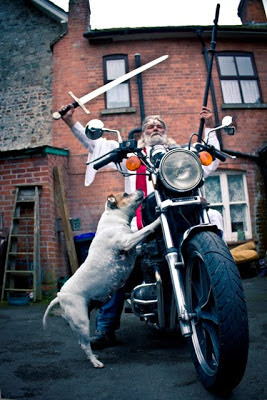
By the way, he does have one significant claim to genuine authority. He bears Excalibur.

Well, he's the provisional Arthur, anyway.
"I’ve been Arthur Uther Pendragon since ‘86. I’m generally known as King Arthur. There are three Arthurian ages and I’m the post-Thatcher Arthur. As far as I’m concerned, until another Arthur—bigger, badder and bolder—comes along, I’m it. So handle it."In fairness, though, the bigger badder Arthur is going to have to compete with his stature as the leader of an outlaw motorcycle club.
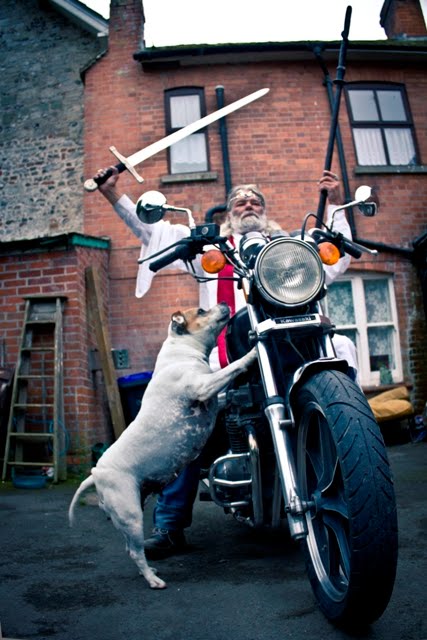
"I used to be the president of an outlaw bike club and a lot of my mates thought I was off on one, but 20-odd years later, I’m still doing it. I decided that the Goddess would sustain me if it was true, so I don’t claim any state benefit and—well, hey—something’s working. I’ve been known to have a tipple, but guess what? I speak exactly the same bollocks whether I’m pissed or sober, because I actually believe in it.”I have much the same feeling myself at times, although I've never thought I might actually be Arthur himself. Still, you get on that iron horse, and you take the road, and it takes you places.
Arthur told me how spiritual places, like Stonehenge, help him access the memories from his past life.
“I remember fightin’ on the Saxon shores against the Saxon armies. I also have a memory of fighting on the western shores against Irish pirates. See, the motorcycle is the modern iron steed, so I’m not doing it a lot different now to what I was doing 1500 years ago.”
By the way, he does have one significant claim to genuine authority. He bears Excalibur.
“Where did you find Excalibur?” I asked him.Now, you have to admit that's impressive. They didn't agree to sell it to him: they gave it to him, because they agreed it was his by right.
“Ah well, therein lies another tale. It was built for the film.”
“The film Excalibur?”
“Yeah, the armourer who built it had it on show in the window. He said 'Look, if the real King Arthur walks in here, he can bloody have it. Otherwise, it’s not for sale.' So I just threw me passport on the desk and walked out with the sword."
The VP Debate
Biden did better than the President. But that's to be expected. Biden's the better man. We'll have to wait a bit to see how it played with voters, but there's no doubt in my mind he did better than President Obama did.
Of course, we'll also have to see how many people watched it, and how much they like people interrupting and yelling. Maybe that sells. We'll see soon enough.
UPDATE: A CNN undecided voter interview.
The lady is from Virginia, which might explain her good sense.
Of course, we'll also have to see how many people watched it, and how much they like people interrupting and yelling. Maybe that sells. We'll see soon enough.
UPDATE: A CNN undecided voter interview.
The lady is from Virginia, which might explain her good sense.
Completely False Statements
So the responsible thing -- the American thing! -- is to allow the investigation to proceed to a responsible, careful, detailed conclusion. OK.
One question, though: how long did the administration allow the FBI to be on the ground investigating this incident? My impression is that the answer is "Zero minutes and zero seconds, during which they were able to conduct zero interviews of eye-witnesses."
To describe this as waiting for a full, responsible investigation is the highest level of horse manure. They pulled the investigation before it even got on the ground. This is top-quality stuff, the sort you'd use to fertilize a rose garden.
21 days left . . .
. . . to craft those costumes for defenseless pets and babies. As always, I'm here to offer inspiration:


Subscribe to:
Posts (Atom)