From yesterday's ride.

On Easter Sunday, Sen. Raphael Warnock (D-Ga.) — pastor of Ebenezer Baptist Church in Atlanta, the same church Martin Luther King, Jr. pastored — tweeted a message that subverted the gospel of Christianity and preached utter heresy, rejected by Christian churches for more than a millennium.“The meaning of Easter is more transcendent than the resurrection of Jesus Christ. Whether you are Christian or not, through a commitment to helping others we are able to save ourselves,” Warnock tweeted.
JAMA claims that suicide actually declined last year; deaths from overdoses etc. were up by 20,000. Reason reports; link to the JAMA study is there if you want the raw study.
It's always struck me as odd that Easter, as a holiday experienced by human beings, was so much less a cultural event than Christmas. It is liturgically the much more important feast, indeed the greatest feast of the year; but whereas our whole culture bends itself towards Christmas for a month every year (even in this more secular age), Easter has never been as big an event.
At Christmas we have grand feasts -- meat pies, every kind of cake and pastry, and as the song says, 'Hail to Christmas/ once a year/ when we may drink/ both ale and beer.' At Easter there is usually just a ham and some candies. At Christmas there is a huge festival of gift-giving; at Easter, children (only) get an Easter basket filled with fake grass and fake eggs, with more little candies or trinkets. At Christmas we sing Christmas Carols at Mass, and pageants involve the children merrily as shepherds or angels; at Easter, the services are interminable and children are forced to endure uncomfortable and unpleasant Easter costumes they will never wear a second time, but which they are nevertheless enjoined from playing in because they might get grass stains on the pure-white outfits.
For a long time I thought it was just a kind of accident, or perhaps a pagan inheritance; we could have given gifts at Easter instead of Christmas, but the old pagan holiday of the Winter Solstice was the big gift-giving holiday, and that transferred. Christianity was hampered in its choice to celebrate the spring instead of the winter because the existing cultural assumptions were too hard to transform.
I have come to realize, though, that the facts of the world inform this more than human culture. Christmas (or whatever Winter feast) comes right after the slaughter and harvest, when fresh meats and other good things are far more widely available. October was the season for the brewing of the best ale of the year, as we know from Robin Hood stories; those were readily on hand for the holiday. Also, the coming of the snows and the cold weather meant that there was less to do outside, so there was time on hand to commit to a big celebration.
This time of year we are still a long way from First Fruits. The winter stores are drained, and what remains needed to be stretched out -- summer was often the hungry time in the old days. A ham, cured last year, was the last festival item available; the alternative was to slaughter an Easter lamb, newborn just this year, to enjoy fresh meat. But that was quite a sacrifice, as you would be giving up the meat from the larger animal that would come later, as well as its wool. A poorer community, or those coming off a bad year (like last year!) could hardly afford it.
Thus on Easter we dress in fresh clothes, eat more sparingly of lesser foods, and give smaller gifts. But it is in the Springtime that the hope of new life comes, warmth returns to the world, and green begins to spring anew. The time of year better fits the Gospel story, dramatically; and it is perhaps for this reason that the divine decision was made to orient the liturgical year to the physical one in this way.
Except that only works for the Northern hemisphere, and Jesus lived near the equator. I've never been to the Southern hemisphere. Is Easter there more like our Thanksgiving in how it is celebrated? I don't know.

No kids, so no Easter egg hunt, but I dyed some eggs for a centerpiece anyway, as a handful of neighbors will join us for Easter lasagna.
Jared Whitley argues the proposition. Just one of his examples:
“Children who are fit to proceed to a higher class may be artificially kept back, because the others would get a trauma — Beelzebub, what a useful word! — by being left behind.”
Screwtape must be grinning at headlines about public schools eliminating gifted programs, knowing how much this hurts the segment of society most likely to build it up: the middle class.
His closing example is good, too.
It is a troubling matter. If there remains any society opposed to the actual practice of slavery and genocide, it is surely this one; its self-criticisms on this score are so intense that it often misses that it has not engaged in either for a hundred years, and also that other nations are actively practicing both right now. Yet in this, as in all else, it has been turned from the apparently noble purpose to the destruction of the very forces that might be aligned against those evils. Evil somehow profits where it is actively pursued and also where it is apparently actively resisted.
Holy Saturday is the day of the complete triumph of evil, at least to all appearances. Today is Holy Saturday, but not only today.
Sad: Day Of Remembrance For St. April O’Fool Reduced To A Day Of Pranks
Commercializing Christian holidays is, unfortunately, all too common. What was once a day of celebration marking a significant development in church history turns into a secular day for drinking, collecting candy, or getting a new Xbox.April Fools' Day is no exception. The world celebrates this day by pranking each other, making fake announcements on the internet, and other such tomfoolery. But we Christians know the true meaning of the holiday, as we somberly recall the brutal martyrdom of St. April O'Fool in 723 A.D. ...

Again, I'll put this past the jump. Just to remind you, this is a very extended discussion in which Parmenides proposes to talk through both sides of every part of the question. So the traps get run one way: "What if the One is not?" And then the other: "What if the One is?" Problems abound on every side. At this point the problems are going to start looking familiar, because we found them running the traps the one way; you'll see the same problems arising if we make the contrary assumption about the One.
With any luck we'll get through this in one more post after this one.
From Hugo Gurdon, Washington Examiner editor-in-chief:
In 1985, singer Bob Geldof was interviewed backstage at London’s Wembley Stadium about the massive Live Aid rock concert he’d organized . . . raising money for famine relief in Ethiopia . . . .
At this moment, the greatest triumph in his already successful career, Geldof remarked with a note of bitter irony that Live Aid involved “the privatization of compassion.” He didn’t mean it as a compliment. “Privatization” had become a dirty word in the left-wing lexicon, as industries previously taken over by socialist governments were released from central control and sold to the public as businesses quoted on stock exchanges.
Geldof’s comment struck me forcefully at the time, for it was the precise opposite of what I took then and still take to be the gem-like truth stated by columnist T.E. Utley that one of the cruelest aspects of socialism is that it delegates compassion to the state. Socialism encourages individuals to think caring for their neighbor is not their responsibility but is, instead, a function of government.
Socialists often suggest that private provision of help for the needy is a failure of the state. [Senator Bernie] Sanders has spoken disdainfully of charity, as have many unappealing politicians elsewhere. They regard the care of others through individual acts of kindness as demeaning the recipient because they believe or at least declare that goods and services received should be taken as a right rather than accepted as a gift. One also suspects that socialists dislike charity because it places a claim on them as individuals, which they’d rather shrug off.
I was going to leave this article alone, even though it addresses something I've been wondering about, until the last paragraph. The subject is the infusion of therapy-speak into everyday life.
It's from the New Yorker, so 'everyday' means 'everyday upper-middle-class-and-higher life within certain fashionable communities.' Still, I know at least one person who services such a community, and runs a business doing it centered on Facebook and Instagram. She is all the time telling her clients how important it is to "heal" their "trauma." As far as I can tell her clients are at least relatively rich white women. Maybe some of them genuinely have trauma, but it seems to be the kind of stuff the article talks about:
During this exchange, Twitter served me an advertisement that urged me to “understand my trauma” by purchasing a yoga membership. Ridiculous, I thought. I’m not a sexual-assault survivor. I’ve never been to a war zone. But, countered my brain, after four years of Trump and four seasons of covid, are you not hurting? The earth is dying. Your mother issues! Your daddy issues! A clammy wave engulfed me. My cursor hovered over the banner.
So, as I said, I was going to leave it alone. After all, I don't want to beat up on fragile people, and these people are genuinely so fragile that they think they are being traumatized by living the life of a wealthy white woman in the better neighborhoods of the richest country on earth. There's definitely something wrong with them, but it isn't "trauma." Pointing out that their entire worldview is fundamentally unhealthy might seem like I was beating up on the weak.
But then that last paragraph:
Therapy seems to have absorbed not just our language but our idea of the good life; its framework of fulfillment and reciprocity, compassion and care, increasingly drives our vision for society. Writing this piece, I thought especially of the Greek concept of eudaimonia, or human flourishing. Some might call it blessedness. In any case, it seems worth talking about.
No, you thought wrong.
Eudaimonia is often translated as "flourishing" or simply as "happiness," but the real thing it means is being fully engaged in pursuing excellence with all your vital powers. Now she says she's never been traumatized because she's never been to war; but in fact, war is the closest thing I've seen to eudaimonia.
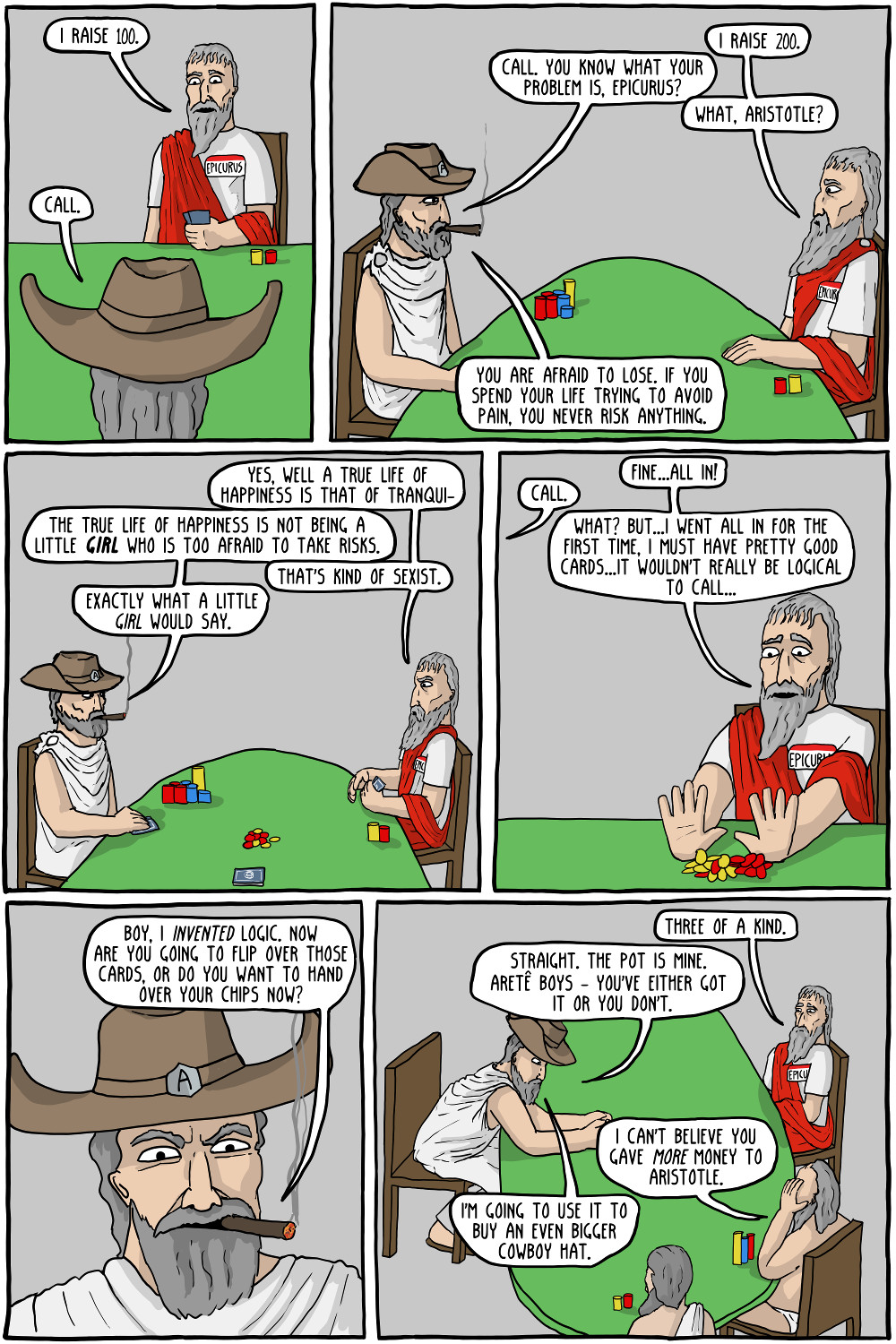
Aristotle says that the goal of ethics is eudaimonia, a state of happy flourishing that you find when all of your vital powers are aligned in rational activity. More, he says, to fully experience this state you need a community that is set up to support it. The military deployed comes much closer to attaining Aristotle's ideal than anything else I've seen in the world. Everyone is working together towards some strategic good. They all have different jobs, but those jobs must align. Thus, there is constant rational communication and consideration of how to align different fires on a target, or different staff sections on a mission. This 'small, close knit' community is also a community that works together toward some goods that they pursue together through rational activity.
War being war, as Clausewitz says, 'everything is simple, and the simplest things are hard.' Thus, one needs all of one's vital powers in alignment to accomplish these goals. It is a very engaging sort of life.
It may well be that the broader society lacks a number of things that these smaller, close-knit and rationally ordered communities offer. Are these goods we can replicate? Certainly: any number of organizations could be set up to pursue goods in this way, although they will not all be as fully engaging of all of one's vital powers absent the extremes of war.
Are they goods that we do replicate? No, not really, not for the most part.
You develop tight knit friendships at war -- and then, if you study philosophy, you notice that Aristotle's ethics ends with a long discussion of the importance of friendship.
If you want to find eudaimonia, stop ever going to therapy. Stop focusing on your problems, whatever they are. The only thing to do with death -- and whatever you disliked about your childhood -- is to ride off from it. Go join the local volunteer fire department, and work with them putting out fires or saving lives in medical emergencies. Study philosophy and argue about Truth and Justice with friends over beer. Take up an extreme sport with a good community that supports each other. Ride motorcycles. Ride horses. Learn a martial art and practice it intensely.
Do everything you can except dwelling issues of 'care' and 'sensitivity' and all the 'hurts' and 'trauma' you've suffered. Stay away from anyone who tries to convince you that you're a suffering victim, or who is willing to treat you like one if you ask -- or so you'll pay them to help you dwell on your 'problems.' Dwelling on your problems is in fact the problem. Do great things instead.
Raven mentioned this series, and this is the conclusion of it.
He says at the end that the collapse of Marxism -- a little over-eager, sadly -- left us with no alternative but "Heroic Materialism." By this I assume he meant that we should endeavor to live boldly and virtuously according to the ancient pattern, but with no belief in any metaphysical beings or realities that might reward such virtues in an afterlife. We should do well because doing well led to physical prosperity; and if it didn't, quite, we should work harder, because working harder might. But ultimately it is heroic because it is a fight without hope; and worse, without faith.
"Night shall be thrice night over you,
And heaven an iron cope.
Do you have joy without a cause,
Yea, faith without a hope?"
I've always liked Popper's answer, but hear them out. First, what is the answer?
Popper was struck by Einstein’s prediction. “Now the impressive thing about this case,” he wrote decades later, “is the risk involved in a prediction of this kind.” Had the measurements found Einstein in error, Popper said, the physicist would have been forced to abandon his theory. Popper built his demarcation criterion around the bravado of wagering against refutation: “One can sum up all this by saying that the criterion of the scientific status of a theory is its falsifiability, or refutability, or testability.”
Second, what was the answer meant to contrast?
All demarcation criteria are designed to exclude something. What Popper really wanted to do was to show why psychoanalysis and Marxism were not scientific. Those theories had been widely understood as “scientific” in his Viennese milieu because of a logical empiricist theory called verificationism. According to this view, a theory is scientific if it is verified by empirical data.
From my perspective, successfully excluding Marxism and psychoanalysis from science justifies the project. However, others have disagreed, and not only Marxists and psychoanalysts.
First, it is difficult to determine whether you have actually falsified a theory.... Not so fast. How do you know that your experimental result was accurate?
That's a terrible objection. Falsification is about whether or not the theory could in principle be falsified. The fact that it may be hard to do is quite different from the objection to Freud's theories, wherein a man who e.g. didn't appear to have any Oedipal concerns would just be said to be suppressing or projecting them or whatever. Marxism, too: Lenin wrote a book about how Marx's theory's failure to materialize was just a further proof of how right he was about the evils of capitalism. These theories aren't falsifiable because they let you just tell another story about how they were right all along.
Yes, the instrument could be wrong; do it again. But if there's not a fact of the matter that could falsify a theory if known, it's not science.
The second problem with Popper’s proposal has to do with the actual demarcations it gives us. The very minimum we should expect from a demarcation criterion is that it slices the sciences in the right places. We want our criterion to recognize as scientific those theories that are very generally accepted as hallmarks of contemporary science, such as quantum physics, natural selection, and plate tectonics. At the same time, we want our criterion to rule out doctrines such as astrology and dowsing. Popper’s falsifiability standard is not especially helpful in this regard. For starters, it is difficult to present the “historical” natural sciences, such as evolutionary biology, geology, or cosmology—those fields where we cannot “run the tape again” in the laboratory—exclusively in terms of falsifiable claims. Those sciences provide persuasive explanations of nature through the totality of a narrative chain of causal inference rather than a series of empirical yes-no votes. Popper thus inadvertently excludes important domains of contemporary science.
I would argue that this is also a terrible objection. To say that you want to "slice the sciences in the right places" indicates that you think you already know where the slices should be made. Actually, Popper raises an important objection to theories even from these widely recognized fields: they aren't doing quite the same thing as the sciences that can provide replicable testing, and their theories remain rather more theoretical as a consequence. They're not in the same category as Marxism, but maybe that only means that there is Hard Science, and then degrees of distance from it. I'm inclined to score this Popper 2, objections 0 so far.
The situation with inclusion is even worse. The difficulty was sharply expressed by philosopher of science Larry Laudan in an influential article from 1983. Popper’s criterion, he wrote,
has the untoward consequence of countenancing as “scientific” every crank claim that makes ascertainably false assertions. Thus flat Earthers, biblical creationists, proponents of laetrile or orgone boxes, Uri Geller devotees, Bermuda Triangulators, circle squarers, Lysenkoists, charioteers of the gods, perpetuum mobile builders, Big Foot searchers, Loch Nessians, faith healers, polywater dabblers, Rosicrucians, the-world-is-about-to-enders, primal screamers, water diviners, magicians, and astrologers all turn out to be scientific on Popper’s criterion—just so long as they are prepared to indicate some observation, however improbable, which (if it came to pass) would cause them to change their minds.
OK, that one's better. Popper's criterion may not be sufficient to exclude fields that are easily falsifiable because they are crazy. We might need to address that objection to have a proper definition of hard science. That seems to be the evolving position, and it's not that hostile to Popper: he said something important, but he may have mistaken that something for everything.
Other approaches might prove more successful. Philosopher and former professor of biology Massimo Pigliucci, for example, has suggested that the problem with falsicationism is its one-dimensionality, not its effort to establish clear criteria. Perhaps we could add more dimensions that correspond to the heterogeneity of scientific practice.
Theroux gets that readers might perceive him as cranky, but he thinks the problem might be with the readers.
Paul Theroux gets older.
His new novel tells the story of Joe Sharkey, an aging North Shore surfer... Sharkey feels acutely that he is being overtaken by younger surfers with big endorsements. For him, surfing was a way of life, an existence centered on catching waves, a commitment to the ocean.
Theroux sees surfing as a metaphor for his own life.... like the surfer past his prime, he is not immune to feeling forgotten, to the sense that the world has become hostile to the pure joy of the waves. There’s a fear of being overlooked, unread.
“I was once a hot shot, I was once the punk,” Theroux said. “And anyone who has once been a punk, eventually you’re older, and you see the turning of the years as it is."
Well, he has had more attention than most; and more wealth and success, too. But there is still a kind of universality to the experience of growing older.
Fewer are willing to take the next step and accept that most people living in the United States today—certainly more than half—are not Americans in any meaningful sense of the term.I don’t just mean the millions of illegal immigrants. Obviously, those foreigners who have bypassed the regular process for entering our country, and probably will never assimilate to our language and culture, are—politically as well as legally—aliens. I’m really referring to the many native-born people—some of whose families have been here since the Mayflower—who may technically be citizens of the United States but are no longer (if they ever were) Americans. They do not believe in, live by, or even like the principles, traditions, and ideals that until recently defined America as a nation and as a people. It is not obvious what we should call these citizen-aliens, these non-American Americans; but they are something else.
That's a very grave problem statement. Is it just? I wonder about the percentage -- "certainly more than half" may be overstating the numbers -- but it is certainly true of some percentage. Percentages aside, too, it seems to be true especially of the part that occupies all the seats of power: in government, both elected and the bureaucracy; in corporations; in the media, to include news, social media, and entertainment; and, at the moment at least, even in top positions of the military.
[C]alling for increased media literacy can often backfire: the instruction to ‘question more’ can lead to a weaponization of critical thinking and increased distrust of media and government institutions . . . . [C]alls for media literacy can often frame problems like fake news as ones of personal responsibility rather than a crisis of collective action. . . . [Anti-maskers] value unmediated access to information and privilege personal research and direct reading over "expert" interpretations. . . . As a subculture, anti-masking amplifies anti-establishment currents pervasive in U.S. political culture. . . . Data literacy, for anti-maskers, exemplifies distinctly American ideals of intellectual self-reliance, which historically takes the form of rejecting experts and other elites. The counter-visualizations that they produce and circulate not only challenge scientific consensus, but they also assert the value of independence in a society that they believe promotes an overall de-skilling and dumbing-down of the population for the sake of more effective social control. As they see it, to counter-visualize is to engage in an act of resistance against the stifling influence of central government, big business, and liberal academia . . . . Most fundamentally, the groups we studied believe that science is a process, and not an institution.The solution?
Convincing anti-maskers to support public health measures in the age of COVID-19 will require more than ‘better’ visualizations, data literacy campaigns, or increased public access to data. Rather, it requires a sustained engagement with the social world of visualizations and the people who make or interpret them."Social," posited as an alternative to data literacy and explained as a "sustained engagement with the social world," remains a little fuzzy to me. Shaming? Censorship? Police raids? How I hope this turns out to be a Sokal hoax.
28 After Jesus had said this, he went on ahead, going up to Jerusalem. 29 As he approached Bethphage and Bethany at the hill called the Mount of Olives, he sent two of his disciples, saying to them, 30 “Go to the village ahead of you, and as you enter it, you will find a colt tied there, which no one has ever ridden. Untie it and bring it here. 31 If anyone asks you, ‘Why are you untying it?’ say, ‘The Lord needs it.’ ” 32 Those who were sent ahead went and found it just as he had told them. 33 As they were untying the colt, its owners asked them, “Why are you untying the colt?” 34 They replied, “The Lord needs it.” 35 They brought it to Jesus, threw their cloaks on the colt and put Jesus on it. 36 As he went along, people spread their cloaks on the road.
You try riding an unbroken colt sometime, and see if it's as easy as that for you.
Preliminary data from EU statistics agency Eurostat compiled by Reuters showed Sweden had 7.7% more deaths in 2020 than its average for the preceding four years. Countries that opted for several periods of strict lockdowns, such as Spain and Belgium, had so-called excess mortality of 18.1% and 16.2% respectively.
UPDATE: Sorry about that; I posted this from my phone, and the mobile version of the Hall didn't show me the formatting error.
In honor of our heroes, some Tejano music you can blare as loudly as you wish.
“There is no right to carry arms openly in public; nor is any such right within the scope of the Second Amendment,” the court ruled in an “en banc” decision that involved all the panel’s judges.“We can find no general right to carry arms into the public square for self-defense,” the majority wrote, claiming that the Second Amendment applies to the “defense of hearth and home.”“The power of the government to regulate carrying arms in the public square does not infringe in any way on the right of an individual to defend his home or business,” the judges wrote.
Neither will [the One] be the same with itself or other; nor again, other
than itself or other.
How is that?
If other than itself it would be other than one, and would not be
one.
True.
And if the same with other, it would be that other, and not itself;
so that upon this supposition too, it would not have the nature of
one, but would be other than one?
It would.
Then it will not be the same with other, or other than itself?
It will not.
Neither will it be other than other, while it remains one; for notone, but only other, can be other than other, and nothing else.
True.
Then not by virtue of being one will it be other?
Certainly not.
But if not by virtue of being one, not by virtue of itself; and if
not by virtue of itself, not itself, and itself not being other at
all, will not be other than anything?
Right.
Neither will one be the same with itself.
How not?
Surely the nature of the one is not the nature of the same.
Why not?
It is not when anything becomes the same with anything that it becomes
one.What of that?
Anything which becomes the same with the many, necessarily becomes
many and not one.
True.
But, if there were no difference between the one and the same, when
a thing became the same, it would always become one; and when it became
one, the same?
Certainly.
And, therefore, if one be the same with itself, it is not one with
itself, and will therefore be one and also not one.
Surely that is impossible.
And therefore the one can neither be other than other, nor the samewith itself.
Impossible.
And thus the one can neither be the same, nor other, either in relation
to itself or other?
No.
Neither will the one be like anything or unlike itself or other.Why not?
Because likeness is sameness of affections.
Yes.
And sameness has been shown to be of a nature distinct from oneness?
That has been shown.
But if the one had any other affection than that of being one, it
would be affected in such a way as to be more than one; which is impossible.
True.The Archangel Michael's name is translated in a way that captures the Judeo-Christian-Islamic sense of this difficulty. "In art St. Michael is often represented as an angelic warrior, fully armed with helmet, sword, and shield, as he overcomes Satan, sometimes represented as a dragon and sometimes as a man-like figure. The shield at times bears the inscription: Quis ut Deus, the translation of the archangel's name, but capable also of being seen as his rhetorical and scornful question to Satan." The difference between God (or the One) and everything else is so categorical that it does not admit of likeness.
Then the one can never be so affected as to be the same either with
another or with itself?
Clearly not.
Then it cannot be like another, or like itself?
No.
Nor can it be affected so as to be other, for then it would be affected
in such a way as to be more than one.
It would.
That which is affected otherwise than itself or another, will be unlike
itself or another, for sameness of affections is likeness.
True.
But the one, as appears, never being affected otherwise, is never
unlike itself or other?
Never.
Then the one will never be either like or unlike itself or other?
Plainly not.
The next argument changes grounds from the previous series, so we'll proceed with it in the next post.Again, being of this nature, it can neither be equal nor unequal eitherto itself or to other.
How is that?
Why, because the one if equal must be of the same measures as that
to which it is equal.True.
And if greater or less than things which are commensurable with it,
the one will have more measures than that which is less, and fewer
than that which is greater?Yes.
And so of things which are not commensurate with it, the one will
have greater measures than that which is less and smaller than that
which is greater.Certainly.
But how can that which does not partake of sameness, have either the
same measures or have anything else the same?
Impossible.
And not having the same measures, the one cannot be equal either with
itself or with another?
It appears so.
But again, whether it have fewer or more measures, it will have as
many parts as it has measures; and thus again the one will be no longer
one but will have as many parts as measures.
Right.
And if it were of one measure, it would be equal to that measure;
yet it has been shown to be incapable of equality.
It has.
Then it will neither partake of one measure, nor of many, nor of few,
nor of the same at all, nor be equal to itself or another; nor be
greater or less than itself, or other?
Certainly.
Well, and do we suppose that one can be older, or younger than anything,
or of the same age with it?
Why not?
Why, because that which is of the same age with itself or other, must
partake of equality or likeness of time; and we said that the one
did not partake either of equality or of likeness?
We did say so.
And we also said, that it did not partake of inequality or unlikeness.
Very true.
How then can one, being of this nature, be either older or younger
than anything, or have the same age with it?
In no way.
Parmenides proceeded: If one is, he said, the one cannot be many?Now the first difficulty for me is Parmenides' decision to 'cash out' (as philosophers love to say) wholeness in terms of having parts. That seems circular: a part is a part of a whole, but a whole is that which has all its parts together. I would have preferred at least one of these terms to be defined independently of the other.
Impossible.
Then the one cannot have parts, and cannot be a whole?
Why not?
Because every part is part of a whole; is it not?
Yes.
And what is a whole? would not that of which no part is wanting be a whole?
Certainly.
Then, in either case, the one would be made up of parts; both as being a whole, and also as having parts?
To be sure.
And in either case, the one would be many, and not one?
True.
But, surely, it ought to be one and not many?
It ought.
Then, if the one is to remain one, it will not be a whole, and will not have parts?
No.
However, I spoke with a friend of mine who is a mereologist, and he thought it was a reasonable thing to do under the circumstances. His problem was that Parmenides might be confusing spatiotemporal wholes with the kinds of wholes that Socrates' ideas are meant to be. A thought can have parts, even though it has no spatiotemporal parts; if you think through a remembered psalm (to borrow an example from St. Augustine), you think through the first part before the last part. It's divisible without being spatial.
Socrates wants to get from discursive thinking to grasping a unitary idea, though; and Parmenides is exploring whether the idea of a unity like that has sense. What would it be like? Well, it wouldn't have parts; and therefore, it wouldn't be a whole.
But if it has no parts, it will have neither beginning, middle, nor end; for these would of course be parts of it.These are fairly straightforward consequences of what it is to be a unity like they are exploring, but it is useful because it ends up dismissing several analogies and metaphors. Later philosophers often speak as a circle as a kind of unity, for example; but it isn't this kind of unity. A circle has parts, is a whole, and has features that are definable. The Form of the Good ultimately will not have any of those things.
Right.
But then, again, a beginning and an end are the limits of everything?
Certainly.
Then the one, having neither beginning nor end, is unlimited?
Yes, unlimited.
And therefore formless; for it cannot partake either of round or straight.
But why?
Why, because the round is that of which all the extreme points are equidistant from the centre?
Yes.
And the straight is that of which the centre intercepts the view of the extremes?
True.
Then the one would have parts and would be many, if it partook either of a straight or of a circular form?
Assuredly.
But having no parts, it will be neither straight nor round?
Right.
And, being of such a nature, it cannot be in any place, for it cannot be either in another or in itself.Where is an idea? We might say "in my mind." Materialists will want us to 'cash that out' as "in my brain." But the brain is a place that occupies physical space; and Parmenides is proving that an idea like a Form, at least, can't be in any place. It therefore can't be contained, neither by a brain nor by anything else material.
How so?
Because if it were in another, it would be encircled by that in which it was, and would touch it at many places and with many parts; but that which is one and indivisible, and does not partake of a circular nature, cannot be touched all round in many places.
Certainly not.
But if, on the other hand, one were in itself, it would also be contained by nothing else but itself; that is to say, if it were really in itself; for nothing can be in anything which does not contain it.
Impossible.
But then, that which contains must be other than that which is contained? for the same whole cannot do and suffer both at once; and if so, one will be no longer one, but two?
True.
Then one cannot be anywhere, either in itself or in another?
No.
That's not a problem for ideas like Augustine's psalm, but it is definitely a problem for any kind of Greek Form -- and especially for Aristotle's, which is supposed to somehow be 'in the thing.' Where is the form of a table? It's in the table, somehow. If the parts of the table are laying on the ground in a heap, you don't have a table. It's when the right order comes to be that the thing becomes a table. For Aristotle, form is a kind of order or structure; and thus it must be in the thing. Yet, as Parmenides is showing, a form can't be.
You can say something here that is quasi-material about the table: the 'form' is a way of speaking about a bunch of relations between the material objects, so that a properly formed table will have electromagnetic force relations between the proper atoms that make it up, such that they allow other objects to be placed upon it at "our level" of organization; the atoms of the book placed onto the table interact with the atoms of the table, etc. Form ends up being supremely complex, but explicable in terms of material relations.
Yet even in that case form is immaterial; the table and book interact as they do only because they've been put in that order, and they were put there for a reason. There's a purpose, a telos, in the construction of the table; and the form of the organization is defined by that. That form isn't in the thing; it is an idea in the mind of the creator of the artifact. If it is a form in that sense, it is closer to Plato/Socrates/Parmenides' sense of a Form; and if so, it can't really 'be in the brain,' either, because it can't really exist in a physical place. It can perhaps be in a mind, but where then is the mind?
Further consider, whether that which is of such a nature can have either rest or motion.This is a huge challenge: if a Form is a kind of unity, and such a unity cannot have parts, then it cannot come to be in anything. Really, the conclusion here is that it cannot come to be at all. 'Coming to be' is a kind of motion, and Parmenides is going through all the kinds of motion and showing that a unity cannot experience any of them.
Why not?
Why, because the one, if it were moved, would be either moved in place or changed in nature; for these are the only kinds of motion.
Yes.
And the one, when it changes and ceases to be itself, cannot be any longer one.
It cannot.
It cannot therefore experience the sort of motion which is change of nature?
Clearly not.
Then can the motion of the one be in place?
Perhaps.
But if the one moved in place, must it not either move round and round in the same place, or from one place to another?
It must.
And that which moves in a circle must rest upon a centre; and that which goes round upon a centre must have parts which are different from the centre; but that which has no centre and no parts cannot possibly be carried round upon a centre?
Impossible.
But perhaps the motion of the one consists in change of place?
Perhaps so, if it moves at all.
And have we not already shown that it cannot be in anything?
Yes.
Then its coming into being in anything is still more impossible; is it not?
I do not see why.
Why, because anything which comes into being in anything, can neither as yet be in that other thing while still coming into being, nor be altogether out of it, if already coming into being in it.
Certainly not.
And therefore whatever comes into being in another must have parts, and then one part may be in, and another part out of that other; but that which has no parts can never be at one and the same time neither wholly within nor wholly without anything.
True.
And is there not a still greater impossibility in that which has no parts, and is not a whole, coming into being anywhere, since it cannot come into being either as a part or as a whole?
Clearly.
Then it does not change place by revolving in the same spot, not by going somewhere and coming into being in something; nor again, by change in itself?Questions? Discussion?
Very true.
Then in respect of any kind of motion the one is immoveable?
Immoveable.
But neither can the one be in anything, as we affirm.
Yes, we said so.
Then it is never in the same?
Why not?
Because if it were in the same it would be in something.
Certainly.
And we said that it could not be in itself, and could not be in other?
True.
Then one is never in the same place?
It would seem not.
But that which is never in the same place is never quiet or at rest?
Never.
One then, as would seem, is neither rest nor in motion?
It certainly appears so.
Project Veritas’ lawsuit came to be due to The New York Times’ labeling Project Veritas’ investigation into illegal ballot harvesting taking place in Minnesota during the 2020 election cycle as 'deceptive.'
The New York Times defended calling Project Veritas' Minnesota Ballot Harvesting videos 'deceptive' by arguing this was simply an 'unverifiable expression of opinion.'
Project Veritas pointed out this 'opinion' was printed in the news section of The New York Times and the Court agreed: 'if a writer interjects an opinion in a news article (and will seek to claim legal protections as opinion) it stands to reason that the writer should have an obligation to alert the reader ... that it is opinion.' The Times did not do so, and the Court found this troubling.As I was reading the other day, "Hey, we were just inserting our unverifiable opinion into the narrative in order to tell you what to think. Don't shoot the messenger!" Next step: depositions of the New York Times reporter and publisher.
A proposed curriculum in California for elementary and high school students would attempt to “decolonize” American society with an “ethnic studies” course.
In the course, children will be instructed in Aztec chants to various gods of human sacrifice and cannibalism, asking the gods to make them warriors for social justice.
This is all to help the children “challenge racist, bigoted, discriminatory, imperialist/colonial beliefs” rooted in “white supremacy, racism and other forms of power and oppression.”
For example, Huitzilopochtli, the Aztec god of war, was traditionally worshipped with human sacrifice. The school children will ask the deity to instill in them “a revolutionary spirit.”
The curriculum’s vision statement admits this is not about education, but rather a “tool for transformation, social, economic, and political change, and liberation.”
How the government shifted its “Counter-Extremism” strategy to target the mainstream.The narrative is here, and it doesn’t like you very much.In recent remarks before members of the U.S. House Homeland Security Committee, the chief of the D.C. Homeland Security and Emergency Management Agency claimed that domestic extremism has become “part of the cultural mainstream.”Former DHS official and USA Today contributor Elizabeth Neumann agrees: “Far-Right Extremists went mainstream under Trump.”“Extremists have gone mainstream,” echoes journalist Zahra Ahmad. “Lawyers, realtors and every-day folks make up their ranks.” Ahmad cites a figure suggesting a quarter of Americans hold “ideas incubated by white nationalists.”Not to be left out, NPR warns that white extremism “seeps” into the mainstream. The Atlantic says the mainstream has gone extremist too. A study by the Chicago Project on Security and Threats warns that most January 6 “insurrectionists” were mainstream to the extreme...
This is not sustainable. The mainstream of a society cannot be extremist. It might be foolish, or misled, or prone to irrational things, as crowds often are. The mainstream of a society might even be immoral or wicked in an objective sense when measured against other societies. But what it cannot be is extreme. An elite, however, can be extremist. An elite’s views may be so outside the mainstream of the society, beholden to foreign ideologies, that their views are unrecognizable to those they purport to lead.
During a House Judiciary Committee meeting Thursday, Rep. Chip Roy said Texans “believe in justice” while simultaneously invoking the imagery of one of America’s most unjust legacies.“There’s old sayings in Texas about ‘Find all the rope in Texas and get a tall oak tree,’” Roy said Wednesday during the House Judiciary Committee meeting. “We take justice very seriously, and we ought to do that. Round up the bad guys. That’s what we believe.”On Tuesday eight people were killed and another was injured after a suspect is alleged to have bought a gun and targeted three spas in the Atlanta area. Most of the victims were Asian women.
As if Roy’s point wasn’t convoluted enough, it was also patently ahistorical. Lynchings are not, in fact, complimentary to the “rule of law.” The 1871 “Chinese Massacre” in Los Angeles, in which at least 17 Asian immigrants were hanged, was one of the worst mass lynchings in U.S. history.
"My concern about this hearing is it seems to want to venture into the policing of rhetoric in a free society, free speech, and away from the rule of law, taking out bad guys,” Roy added.According to Roy, these “bad guys'' include the Chinese government, which he referred to as “Chi-Coms.” ... Former President Donald Trump often referred to COVID-19—which he repeatedly downplayed even as hundreds of Americans died on his watch—as the “Chinese virus” and “kung flu.” Current White House Press Secretary Jen Psaki said this week that there was “no question” that Trump’s statements “led to perceptions of the Asian American community that are inaccurate, unfair,” and that they “elevated threats against Asian Americans.”
Things that go south in a serious way will be met with a serious response. We'll form lawful militias to keep order if the government breaks down under disease or disaster. We'll volunteer for government-led efforts if they need us, or form private companies to take care of the jobs the government can't handle.... What comes, comes, but however hard it is we shall stand and fight it. It is our way, as it is our heritage.We are the Sons of Liberty. We have nothing to fear. When death comes for us, we will pass into that world of which so much has been written, where there is no fear but love and all love is without pain. If we have done our duty, we will leave behind us those we have bred or trained in the ways of America. They will take up our cause and bury our bones, and our names will be their warcry.There are names like that written in gold, below. The men they trained will give them voice. They are warriors, heroes, and riders of bulls. Perhaps there is a name like that on your lips as you read this: Washington's? Jackson's? Your father's? Another?So what is there to fear? Live boldly. This is America, the home of the brave.
God give me the strength to finish as I began. I don't mind to die at any time: even today is not too soon. Only let me die in such a way that this younger me would not be ashamed.
During military training sessions to address extremism in the ranks, some service members have challenged why the Pentagon is not treating the violence during racial injustice protests last summer as equal to the deadly riot at the U.S. Capitol.That the two events are viewed as equivalent by some troops has caught the Pentagon’s attention in its effort to educate service members that extremist views and activity — on either side of the political spectrum — go against the oath they took when they joined the military, the top enlisted leader told reporters on Thursday.“This is coming from every echelon that we’re talking to,” said Ramón Colón-López, the Senior Enlisted Advisor to the Chairman of the Joint Chiefs of Staff.
Possibly you should listen, if in fact every echelon is telling you the exact same thing.
What, by the way, is "extremism," and why is it forbidden? The military has traditionally permitted extreme pacifists to serve, even accommodating them by finding nonviolent forms of service for them to perform. What exactly is the philosophical principle at work here? Thou shalt not depart from commonly held opinions... well, thou might depart X far, but not X+1? Where is the X? What is the 1?
I couldn’t just barely meet the standards, because that would have given them ammunition to use against me. I had to crush the standards. And I did. I could easily do 100 push-ups in two minutes; got maximum scores on land navigation tests and always sprinted the entire course; and aced 12-mile road marches carrying 55-pound rucksacks (10 pounds more than the requirement). I weighed 120 pounds.Now I know Sam, so I believe every word of that. What I think, though, is that she makes a great case for accepting her as an exception to an ordinary rule against women in the combat arms. All rules need exceptions, for the same reason that logical proofs don't really apply to physical things. There are going to be exceptional cases, and the rules should be weak enough to make room for things to be what they are.
I've been trying to figure out how to approach the rest of the dialogue. This is where Parmenides is given the ability to speak most directly and plainly, and for himself. For that reason, I am disinclined to add a layer of summary or explication; maybe the best thing is to encounter it directly, with all that has been said before as support.
It's too long to quote, though, and probably will benefit from extended discussion. So let's try it this way: read it yourselves, encountering it directly. Ask any questions you have in the comments to this post. Then let's tackle it in three or four sessions next week.