Cuts

Cuts:

Reason offers an analysis of the current political situation, with a one-step solution.

We may not be France yet, but there are disturbing signs that Americans may be ready to take to the streets angrily in defense of their government deals and giveaways. (Some polls showing a lack of support for the very idea of public employee unions are encouraging, but it doesn’t take a majority to cause civil unrest.) Wisconsin may be the first sign that, no matter how much support one can gin up for shrinking government, actual attempts to restrain a free-spending government will be met with strong political counterforce—even when that interest is overpaid teachers and big-money unions.

The threat of federal government shutdown, happening simultaneously with the Wisconsin crisis, demonstrates that the fiscal crisis is multileveled, and no one wants to allow it to be dealt with seriously....

The only really serious position moving forward about government size and government spending is how to cut it, and how soon. While the fight to cut specifics here and there may seem ugly and unfair, all cuts need to be supported, wherever they seem politically possible.
All politically possible cuts must be supported. That's interesting, but it is not a solution to the current problems.

By this I do not mean that it isn't a good idea: in general, it probably is. The easiest way for a cut to become politically possible is if it is a Republican priority (say, a new engine for the F-35). While in the short term that means a government that is only executing the program of the left, it leads by example, and more importantly, it refocuses the minds of the party of the right on the question of cutting, not spending.

Even so, the runaway problems are three:

1) Medicare,

2) Medicaid,

3) Un- and underfunded retirement benefits, including Social Security, government pensions, and government health care plans.

Here is a chart showing the explosive growth of these three types of problems. This is not new; we've been talking about unfunded pensions here since 2007. My thoughts back then pretty much echo my thoughts now: the political system will not be able to address cutting these things, which means that the cuts will come in the form of systemic collapse. That means a kind of tribalism, not solely based on blood ties, but on ties of kinship and friendship.

Well, and that was the old system: and mostly it worked. Sometimes it didn't, which is why Social Security was a popular idea. Nobody wanted a situation where elderly people were dying in the street after a lifetime of work.

A bigger problem, though, is that our economic system has changed in fundamental ways over the last sixty years. The capitalist system of the 1950s assumed that everyone would be a jobholder, because there was so much labor that needed to be done. Automation was in its infancy, so even on an assembly line you needed a massive number of people to put things together. It was still difficult and expensive to ship things around the world, so you needed people for your factories who lived close by, and the factories needed to be close to their customers. In the offices, the absence of things like copiers and computers meant huge pools of typists were necessary just to ensure that adequate copies of important documents were made, properly formatted.

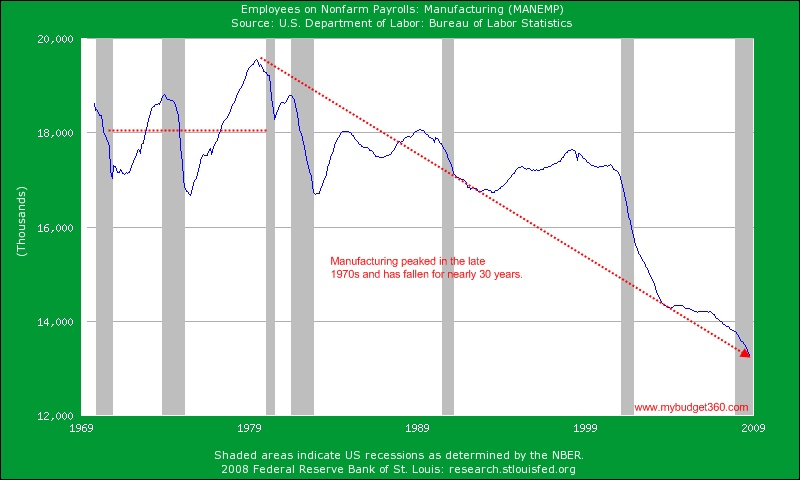
By the 2000s, automation had progressed to the point that a huge number of workers were no longer needed in the factories. Manufacturing as a sector of the economy continues to outproduce China and to grow in real dollars, but jobs in manufacturing shrank from the 1970s through today.

Similar things happened to typists and secretaries, whose jobs were steadily cut by improved technology. Now even executives tend to type their own letters in word processors, and as many copies as they need are a couple of clicks away.

That's called efficiency, and it is a major reason that the US economy remains so much more productive than the rest of the world. Capital is cheaper than labor, so the investment of capital meant that profits rose as costs fell.

Profits, though, don't go to everyone. The benefits of automation are for the owners of the machines: the workers without jobs not only do not benefit, but are positively harmed.

In addition, the ease and cheapness of global shipping means that it is now feasible to make things abroad. Improvements in telecommunications make it easier still.

The upshot of all of this is that -- not to put too fine a point on it -- there's a lot less labor that needs to be done. There will be less labor needing to be done in the future.

For now that means persistently high unemployment. In the future, it means a day when we have to face the reality of permanent unemployment for a large part of the population.

That means rethinking our basic model about how we adjudicate resource distribution in America. For as long as the nation has been in existence, that was done in terms of their pay for employment.

It may have to be done differently in the future, and we don't have a good model. On the one hand, it is simply unreasonable to ask people who are permanently out of work to get by on nothing. They can't. On the other, direct payments from the government -- entitlements, that is -- have a soul-destroying quality when applied as welfare instead of retirement pay. This is true in Saudi Arabia, for example, where the massive wealth of the society is such that everyone gets a stipend. They all hire servants to do all the labor; but it somehow fails to be the happiest place on earth.

For the short term, we need to cut spending and entitlements; but for the long term, we need to look at new ways of raising revenue. There are good arguments against corporate taxes, though it seems fair to suggest that some of the benefits of the efficiency of automation should go to the people who are put out of work. It may also be the case that we need to look at ways of raising revenue from the world at large to help pay for the Navy that guards their trade lanes, thus providing a benefit to their nations as well as our own.

This is a pretty sticky problem. The only answer we've come up with so far is to make-work through bubbles: that is, since we don't need any more than we have, we'll spend money on things we just want. That got us many McMansions with tile kitchens, and for a while it paid for many construction workers; but it was never sustainable. We need a better answer.

MikeD's Avatar

Meet MikeD's Avatar:

MikeD gave an amusing take on his experience with reality simulations in our recent discussion. We laughed, but apparently this is the fellow you were simulating.

H/t: Al Fin.

Age-Appropriate Stupidity

Age-Appropriate Stupidity

I enjoyed Assistant Village Idiot's essay today about "kids today" and "kids yesterday." He suggests that these complaints suffer from the usual problems of nostalgia's rose-colored lenses. He also posits his pet theory that the most economical explanation of the social changes of the last century is that teenagers in the 50s acquired disposable income for the first time in history. This theory parallels the notion that obesity and other diseases of plenty are a result of millions of years of evolution amid scarce resources, suddenly confronting an embarrassment of riches that our genes aren't prepared for.

Almost my favorite part, though, was this comment quoting an exchange between the writer and his 13-year-old daughter:

D: When you get your license, our auto insurance costs will increase dramatically.

E: Why?

D: Because 16 year olds are stupid.

E: Thanks Dad.

D: Nothing personal. All 16 year olds are stupid. I was stupid when I was 16. It's just the nature of things.

E: Nothing personal?

D: No. And it may be small comfort to know that older people are also stupid. People are just stupid generally. The difference is that as you get older, the kind of stupidity changes. It tends to be less immediately life-threatening, and tends more toward the kind of stupidity that merely ruins your life -- or what's left of it. Insurance companies don't care about that.

That gave her something to chew on.

Class Warfare vs. Anti-Cronyism

Class Warfare vs. Anti-Cronyism

Little Miss Attila links to an article by Timothy P. Carney in the Washington Examiner about the current administration's consternation over the public's drawing the wrong conclusions from the distribution of wealth and poverty. The administration hoped that resentment of Wall Street fat cats would propel Democrats to a mid-term victory; instead, much of the voting public identified the Democratic leadership with back-room deals for the well-connected. Even worse, they identified the Republican insurgents with genuine populism. Similarly, the public was cool towards the revival of the estate tax, no matter how much it was touted as a blow against the "rich." At heart, the Democrats mistook a popular revulsion against cronyism for a hostility to wealth. As Carney says:

[C]ronyism -- not wealth -- is the object of today's populist ire. . . . The Left has misread the postbailout populist sentiment all along, assuming public anger was directed at the rich. But American anger, I suspect, is directed not at some people who have money or success, but at those who profit through cronyism and their connections to power. . . . . In other words, anti-bailout anger is not anger at the rich, but anger at those unfairly getting rich -- at the taxpayer's expense.

Carney concludes that the Left is drawing the wrong conclusion about the Wisconsin battle over public sector unions, even as the battle spreads to other states. Paul Krugman, for instance, asserts that government unions provide a "counterweight to the political power of big money." That assertion, of course, draws horselaughs from voters who have begun to open their ears to the conservative counterargument: public sector unions are the ultimate example of the political power of big money.

I grew up thinking the Democrats were the champions of the ordinary citizen against an over-powerful government. I switched to the Republican Party when I concluded they did a better job at that task. Nothing disgusts me more in a RINO than a desertion of conservative principles in favor of country-club cronyism; I don't like it any better than I like public-sector unions. So I'd like to see the new Republican House majority go after ethanol subsidies, for instance, and to dismantle every bit of the Spendulus Bill that's still standing.

Democrat or Republican, what stands between us and cronyism is the principle of limited government. We need to keep government from interfering constantly in the economy to reward the good guys and punish the bad guys with tax policy and stimulus spending. They have no reliable skill at distinguishing one from the other, and no business getting in the game at all.

Arendt & the Suicide

Arendt & the Suicide:

A woman I've been spending a lot of time with lately is Hannah Arendt, the author of Eichmann in Jerusalem, The Origins of Totalitarianism and The Human Condition among other works. You may find this article about her interesting, as it treats her correspondence -- usually hostile -- with another Weimar-Republic thinker who resettled himself to Jerusalem after the war. It was occasioned by the suicide of a man named Walter Benjamin.

Best Presidents Evah

Best Presidents Evah

I keep reading about the recent Gallup poll asking who was the greatest U.S. president. I believe Ann Althouse correctly explains the otherwise perplexing results:

[T]he main thing going on here is people are being asked to come up with the name of a President, and they don't have that many names floating around in their heads. It's always safe to say "Lincoln." Beyond that, they're rooting around in the decades they remember personally.
Someone else suggested you might get more interesting results if you required people to give two reasons for each choice, then throw out the choices backed up by reasons that were obviously pulled out of thin air ("Like, he was the most awesome and saved the world and stuff").

But I'm more interested in the views on the subject I'm likely to find here. I believe my vote goes to Washington, for setting the example of a peaceful relinquishment of power in an age when it was practically unheard of. Frankly, even today, not many people worldwide can expect to enjoy that blessing in their lives. It's a signal achievement of the American experiment.

Stories I Like to Hear

Stories I Like to Hear

Per the New York Post, Lara Logan credits Egyptian women with preventing her being raped, by piling their bodies on top of her. That's morality and courage in action: placing your vulnerable body between someone else and harm. You don't have to be big and strong to do it.

It seems she was more scourged than beaten. If she'd been beaten for half an hour, she'd be dead. Instead she's covered in painful welts, obviously inflicted in a desire to shame and intimidate her. That's one reason I'm encouraged to hear that women in the crowd took it on themselves to intervene. I would imagine that Ms. Logan formed a lifelong bond with them in that moment.

Whither Morality

Wither Morality:

Philosophy Now is hosting a series of articles defending various versions of the idea that we should dispense with morality as an idea. Unfortunately, aside from that introduction, only one of the articles is available for nonsubscribers, Dr. Jesse Prinz' suggestion that all morality is cultural. This is actually one of the weaker claims, in that there is still a place for morality at the end of the discussion: the stronger claims are that morality should be abandoned even as a concept.

Read it through, and let's discuss it. I am myself a moral realist, so I don't agree with any of the positions being argued; but I'll be glad to explore them with you, to see why they might be stronger than they appear, or to suggest why they might not finally be right.

Winning

"The TEA Party is Winning":

So says E. J. Dionne, Jr., who notes:

Take five steps back and consider the nature of the political conversation in our nation's capital.... Washington is acting as if the only real problem the United States confronts is the budget deficit; the only test of leadership is whether the president is willing to make big cuts in programs that protect the elderly; and the largest threat to our prosperity comes from public employees.

...

The media are full of commentary on President Obama's "failure of leadership." There is some truth to the critique but not in the way the charge is typically made.

Obama is not at fault for his budget proposals.... In his State of the Union address, Obama made a good case that budget cutting is too small an agenda and that this is also a time for more government - yes, more government - in areas that would expand opportunities and strengthen the economy.
There are three separate assertions that concern us here.

1) The national conversation has turned (thanks, perhaps, to the TEA Party) to the importance of cutting the costs of government, especially entitlements and payments to government workers.

2) The President believes that the fact is that we need more, not less, in terms of government spending and involvement.

3) The media is unfairly hurting him by framing this as a failure of leadership instead of an attempt to lead, but in the opposite direction.

Let's compare that with a news story from the NYT, on the President and the Wisconsin situation:
"Wisconsin Puts Obama Between Competing Desires"

The battle in Wisconsin over public employee unions has left President Obama facing a tricky balance between showing solidarity with longtime political supporters and projecting a message in favor of deep spending cuts to reduce the debt.
There's not much in the article to suggest that "deep spending cuts to reduce the debt" is actually a "desire" of the President's (nor even "projecting a message" in favor of such cuts). It does mention his two-year freeze on pay raises, but that is clearly not a deep cut.

What it sounds like is that Mr. Dionne is right: the editors at the NYT are trying to "help" the President by portraying him as "leading" in a direction he doesn't want to go. In that way they may be hoping to shore him up against what they see as his own failure to understand and lead the national conversation; but they're masking his real attempts to lead in the other direction.

That's neither wise nor fair, even to President Obama. He was elected on a big-government platform, and it is clear that he believes in it, and has steadily argued for a larger government role in American society and the economy.

This is the political question of a generation for the United States of America: how to handle both the current economic disaster and the long-term problems of impossible entitlements, debt, and un- and under-funded government pensions. What we do now may save or doom us; the decisions made now will set a course that will be increasingly difficult to reverse by future governments should that course prove to be wrong.

Previous Congresses and administrations are at fault for us being here, by the same token: we wouldn't be facing these problems if they had not made promises to the sky on entitlements and pensions, while at the same time spending all the cash they were supposed to be saving up to pay for those promises.

Let's have the argument fairly. It may be that the TEA Party will win, or it may be that the President's party will win, but there is a clear difference between them.

The More Loving One

The More Loving One
W.H. Auden

Looking up at the stars, I know quite well
That, for all they care, I can go to hell,
But on earth indifference is the least
We have to dread from man or beast.

How should we like it were stars to burn
With a passion for us we could not return?
If equal affection cannot be,
Let the more loving one be me.

Admirer as I think I am
Of stars that do not give a damn,
I cannot, now I see them, say
I missed one terribly all day.

Were all stars to disappear or die,
I should learn to look at an empty sky
And feel its total dark sublime,
Though this might take me a little time.

1957

Get Some, Colonel

Get Some, Colonel:

I met Allen West when I was in D.C. last with Jimbo, and entirely by accident. He was most gracious.

It is refreshing to hear this kind of language from a member of Congress.

I am appalled.... Have they no shame in realizing that their inept, incompetent failures are the reason why we are debating this continuing resolution? They failed to pass a budget during the 111th Congress.

Have they no honor in realizing that their fiscal irresponsibility over the past four years has resulted in our standing on the precipice of a fiscal canyon from which we may not recover?
Honor and shame are qualities Congress could use.
"What Happens in Vagueness Stays in Vagueness."

One of the better titles for an article I have seen recently adorns this piece from City Journal.

Simulations

Simulations:

An interesting claim from The American Prospect:

I eventually got the hang of The Sims, the best-selling computer game in history, and my Sim self became productive and happy. She always reached the top of her career, her children always did well in school, and she always had enough money for a comfortable simulated life. Another pattern emerged as well, one that I feel powerless to stop: My Sims are conservative. I'm in complete control of them, but for some reason their lives aren't anything like the life I consider ideal in the real world. I'm a feminist graduate of an all-women's college who has vowed to never change my name or end my career to raise children full time--though I would never undervalue the work that many women do in their home. By contrast, my Sims rarely remain single long into adulthood. My wives always take their husbands' last names. They don't just have children; they bear lots of them. And they leave their careers to take on the lion's share of care-giving duties.
The idea here seems to be that the simulation is flawed in an anti-liberal way. An alternative interpretation is that the simulation is accurate: these are the rational choices for maximizing success in life, and the liberal program largely exists to make other choices sustainable.

That's not necessarily a bad thing -- there are several goods that may justify our arranging our society so that capitalism doesn't rule every single corner of it.

Now, I haven't played any of the games she mentions, but I expect that Ymar can fill in for me as our video game 'subject matter expert' (SME). With him to rely on for findings of fact, then, what do you folks think about this article and its claim? Are these games biased against liberals (and if so, can that be justified by her concept that it's to make them salable in poorer, less-populous red states)? Or is it just capitalism that is against liberalism (which would make more intuitive sense, as a good part of the liberal movements arose in opposition to problems resulting from capitalism)?

A Solution Appears

A Solution Appears:

Gatewaypundit is following this madness in Wisconsin, where legislators friendly to the public sector unions have fled the state to avoid doing their jobs a quorum being present in the legislature. That is, of course, a crime: but it's a state crime, and they're not in that state anymore.

Presumably the state police could request help from the Federal government, but how likely is it that the current Justice Department would provide such help? Not very!

Gatewaypundit suggests a solution:

TIME FOR A TEA PARTY CITIZEN’S ARREST!… I am offering $100 to the first person successful citizen’s arrest.
That sounds like an awesome idea to me. The citizens' arrest is of a piece with the renewed focus on the Second and Tenth Amendments: forgotten or ignored but never repealed, and still therefore the law of the land. It's a way of taking back the rightful duties and powers of a free citizen.

The Forfeit

The Forfeit:

What an interesting story:

On Thursday, a girl won a match at the most historic high school state wrestling tournament in the country, but she did so in an even more unusual and controversial way than most had imagined possible.

According to the Cedar Rapids Metro Sports Report, Des Moines Register and Associated Press, among other outlets, Cassy Herkelman, one of two girls who qualified for the Iowa state wrestling tournament, won the opening match in her Class 3-A, 112-pound classification by forfeit when her scheduled opponent, Joel Northrup, officially reported and withdrew from the bout, earning a loss but ensuring he could continue to participate in later matches at the tournament....

"I have a tremendous amount of respect for Cassy and Megan [Black] and their accomplishments," Northrup said in a statement given to the media following his official forfeit. "However, wrestling is a combat sport and it can get violent at times.

"As a matter of conscience and faith, I do not believe that it is appropriate for a boy to engage a girl in this manner."
I have a feeling that this reasoning is not going to win him any awards from the ladies of the Hall, who have often made a point of their desire to be engaged as an honest competitor. On the other hand, as a matter of freedom of conscience we must accept some space for people with differing views to live out their values, provided they are courteous about them and also willing to accept the consequences.

There's something elegant about his reason, too: that he is aware of the combative and violent feelings the sport brings out in him, and does not want to direct such emotions -- or violent, combative acts -- at a girl. That seems like a valid and reasonable objection, combining self-knowledge with values that oppose using physical force against women. I can't fault either point, even though I also see the value of free and honest competition.

Then again, I never found that wrestling brought out much aggression in me: it always struck me as a more mental and spiritual activity, more about analysis of their strengths and a kind of 'feeling through' their guard. In areas where I do feel strong emotions of violence, I would certainly also wish to avoid directing those at a lady. On those occasions when it has been necessary to argue fiercely against one, I have tried to rely on highly formal and courteous manners to ensure that it was done respectfully. That is not an option available here. Can you respectfully pin someone's head between your legs? Perhaps not!

Fake?

Fake?

This has to be fake, right? But it's very well done.


Apologies From Dubai. Nir Rosen: ‘I Feel Like Shrinking Now’ - FishbowlDC

Apologies From Dubai. Nir Rosen: ‘I Feel Like Shrinking Now’ - FishbowlDC

To paraphrase Jacques Chiraq: "He missed a good opportunity to shut up."
Rock and Rockabilly:

Joel reminds us that rock and country music have a certain connection. We can make that plainer with a few examples.


Jerry Reed is pretty much country, as is Johnny Cash; but you can see that Reed could stretch bluegrass into jazz just fine, while Cash is easily rendered into punk rock. Surf music? No problem. None of it is a problem for the masters, like 'the Killer' Jerry Lee Lewis, or Elvis himself. Consider the "walk away" quality of the Jerry Lee piece compared with the famous example from The Blues Brothers -- which isn't properly either rock or country, but blues music. Taking that on board, you can enjoy the piece with Ray Charles, B.B. King, and the Killer himself

Post up your favorite examples using the YouTube button, in the comments.

Parade Day

Parade Day

The preparations for the annual fire department fund-raiser are marginally less crazy this year, because our friend/neighbor/assistant chief is skipping his usual parade float. He sold his trailer a few months ago, and besides the parade has been going on for nine years and has attracted quite a few participants. None of them are quite as enthusiastic as our friend, of course, who in recent years has built a giant crawdad, a pirate ship, a Jimmy Buffet beach bar, and (last year) a flying saucer. We did have fun with the costumes, and even more with the Star Trek and Outer Limits music, but I'm just as glad not to be jamming the considerable painting work into this last few days before the festival starts on Friday. All I had to do this year was repaint the dates onto the festival signs.

Popping the Question

Popping the Question

In keeping with today's "Plug Maggie's Farm" theme, here's an article they linked this morning about the stubborn persistence of gender roles in the ancient ritual of the marriage proposal. As usual, I intrude my personal counter-experience: neither of us can remember how it was that we decided to get married, back in the Cretaceous. At some point, it just seemed that we were setting a date and informing the families. The NPH claims it was my idea, while I remember its being his.

The author of the linked article notes, nevertheless, that even in this gender-equalized, de-ritualized culture, one thing we never, ever witness is the woman getting down on bended knee. If there is a distinct proposal at all, it is the man who presents it. There does seem to be pressure to re-invent the ritual to show more verve:

Men who prefer a more intimate approach still must find a way to demonstrate wit and intelligence, qualities that are also good predictors of success in today's world. One author who achieved brief internet fame proposed to his girlfriend by asking for her hand in the preface of his latest book. It was a cunning trick, simultaneously showing off his impressive status for his beloved and letting him find out whether she actually reads his stuff.

. . . Some readers will doubtless rue the tired gender rules and status displays that define the contemporary proposal. But growing up in a culture whose idea of asking for a date is a midnight text message asking "u free?" a young man doesn't face many opportunities to demonstrate manly initiative in the romance department.

Speaking of manly initiative, you cain't hardly beat a Valentine's Morning presentation of my favorite almond chocolate bark shipped in from a little store in Houston. Way to improve my mood all week long! Better than roses any day.

In light of our recent discussions, I was amused to note that I didn't get past the first dozen comments in the linked article before the talk veered into the familiar territory of how terrible marriage was for men these days. Why do they pop the question, anyway?

Down on Maggie's Farm

Down on Maggie's Farm


I do like the Maggie's Farm site, and since they made an open appeal today to their readers for more exposure, I'm plugging them here.


Pickle

I Don't Want A Pickle:


Yeah.

So I took the motorcycle up to Tallulah gorge. It was like that. The late winter wind was strong enough to blow the wheels right out from under my cruiser; but, like a gyroscope, it pulled true as long as you had enough hammer under the throttle.

Therefore, as Lancelot said, "All shall be welcome that God sendeth."

Rock & Roll:

There was a recent discussion about whether rock and roll music was inherently degrading; and of course it mostly is.

There are certain subsets of the thing, though, which manage to avoid degradation. The best things point to the True and the Beautiful: the truth, and the beauty, of rock music is joy.


It's rare that they get to it honestly; mostly they lose it in other things. Once in a while, though, you get a song -- in rockabilly, or punk rock -- that is nothing more than an ode to joy. That's the real thing.

A Novel Concept

A Novel Concept -- Or, Perhaps, One From the Sagas:

The proposed law:

22-16-34. Homicide is justifiable if committed by any person while resisting any attempt to murder such person, or to harm the unborn child of such person in a manner and to a degree likely to result in the death of the unborn child, or to commit any felony upon him or her, or upon or in any dwelling house in which such person is.
Section 2. That § 22-16-35 be amended to read as follows:
22-16-35. Homicide is justifiable if committed by any person in the lawful defense of such person, or of his or her husband, wife, parent, child, master, mistress, or servant, or the unborn child of any such enumerated person, if there is reasonable ground to apprehend a design to commit a felony, or to do some great personal injury, and imminent danger of such design being accomplished.
Discuss. Points to consider:

1) "Master, mistress or servant"?

2) Usually homicide is justified on one of two grounds: because it is self-defense, which is a natural right; or because it entails defense of an innocent from suffering grievous bodily harm or death at the hands of a felon.

This law is interesting because it locates justifiable homicide in a different natural right: the right to protect one's offspring or blood-kin from harm.

Further, it brackets 'defense of an innocent from suffering grievous bodily harm and death' -- but not at the hands of a felon. The person you are justified in killing may be doing something perfectly legal.

That's new, and not only in American law. Even in the ancient laws on which our system is based -- Anglo-Saxon or Norse laws -- removal of legal protections against homicide was based on some offense against the law itself. Those systems recognized something like a legal right to kill in defense of your family (or to avenge a member of your family); but they also recognized your victim's legal status and the right of his family to pursue legal remedies. Removing the protection of the law entirely -- outlawry -- was reserved for cases where the law itself had been defied.

The harmony here is that the legal remedies available in the ancient system were more akin to our civil than criminal law: that is, you can still sue the killer of an abortion doctor for removing his family's income support. In that sense, this is something like an honest rendition of the ancient Icelandic code (which we discussed at length during the Book Club discussion of Njal's Saga). All that is being removed here is criminal law: the family of the slain abortion doctor would still be able to sue for monetary damages, akin to the 'weregild' (blood price) as in Anglo-Saxon or Norse courts.

So, with all that said: what do you think?

Kitty Rescue

Kitty Rescue

Those of you who aren't sentimental about cats will suspect this is played for laughs, especially considering the portentous music, but it was just the thing I needed to start my day.

FlashoverTV is powered by FireRescue1.com

iTunes

A Reason to Consider Apple:

In general I avoid anything with an "i-" in front of it; but this sounds worthwhile for those of you who don't share my sense.

Corey Olsen had a lot to say about J.R.R. Tolkien. But it seemed a pity to consign his thoughts to a scholarly journal, to be read by a few hundred fellow academics who already knew more than enough about the author of "The Lord of the Rings."

So in spring 2007, the Washington College professor took his scholarship public, with a podcast called "How to Read Tolkien and Why" and a Web site called the Tolkien Professor.

A million downloads later, Olsen is one of the most popular medievalists in America. His unusual path to success - a smartly branded Web site and a legion of iTunes listeners - marks an alternative to the publish-or-perish tradition of scholarship on the tenure track.
Looks like that website is here.

Smoked Oyster Dip

Smoked Oyster Dip

Family Recipe

8 oz. cream cheese
1 T lemon juice
2 t onion, grated
2 t horseradish
1/4 t Liquid Barbecue Smoke
3 drops tabasco sauce
1 tin smoked oysters

Oyster PIe

Oyster Pie

by Emeril Lagasse

Updated: We used a modified Alton Brown pie crust; this will make enough dough for one pie with a top and bottom crust. As you'll see, it's very, very short. If you were making a sweet pie, you'd add up to a tablespoon of sugar to the dough. In either case, you should brush the assembled raw pie with an egg white whisked with a little water, to get the dough to brown nicely. This one wasn't browned quite enough, and in any case looks paler in the picture than it really was. By the time we had re-heated it in the oven the next day (this was the last course, so we had one full pie left over!), it had browned perfectly and the dough was just right.

2 cups flour
12 T unsalted butter
4 T lard
(or just use two full sticks of butter and skip the lard)
scant 1/4 cup ice water, maybe no more than 1/8, as needed

Cut the butter and lard into small pieces and place in the freezer for 15 minutes. Drop the butter into the flour and cut it into small pieces, then add the lard and cut in again. Drizzle in ice water until you can just get the pastry to hold together into a ball, taking care not to overwork it. Refrigerate the pastry until you're ready to roll out a bottom and top shell.

Filling:

4 strips bacon, chopped
1 cup onions, chopped
1/2 cup celery, chopped
1/2 cup green onions, chopped
2 t garlic, minced
1/4 cup flour
1 T Essence (recipe online, but basically a mix of Cajun-style dry stuff)
3/4 t salt
1/8 t cayenne
1 quart oysters
3/4 cup oyster liquor
1/2 cup cream
1/3 cup parsley chopped
1 t lemon juice

Preheat the oven to 375 F. In a large skillet, cook the bacon over medium heat until brown and almost crisp, about 5 minutes. Remove with a slotted spoon, reserving 1/4 cup grease in the pan (add vegetable oil to equal 1/4 cup if more fat is needed). Add the onions and celery and cook, stirring, until soft, 3-4 minutes. Add the green onions, garlic, Essence, salt, and cayenne, and cook, stirring, for about 1 minute. Add the flour and cook, stirring, to make a light roux, about 3 minutes. Gradually add the oyster liquor, cream, and lemon juice, stirring constantly, until thickened, about 3-5 minutes. (We found that we had to add a good bit of corn starch to get the filling to thicken enough to permit us to serve the pie hot without its filling running out. Thinking back, my husband believes he didn't drain the oysters enough, and so had extra liquid.) Add the well-drained oysters and cook, stirring, until they start to curl, 1-2 minutes. Remove from the heat and fold in the bacon and parsley. Let cool slightly. Adjust seasoning to taste.

Bake in a 375 F oven for about 40 minutes. The recipe said 25 minutes, but ours took longer, even though the filling already was cooked. Anyway, bake it until it looks nice and golden brown, and by that time your bottom crust should be fairly crisp if you've gotten the filling firm enough. This holds up very well to re-heating for as long as you're comfortable with the freshness of the oysters -- at least two days in our case.

Oysters with Cilantro-Chili Sauce

Oysters with Cilantro-Chili Sauce

by Terry Thompson-Anderson, Texas on a Plate

2 oysters, on the half-shell
6 large garlic cloves, minced
3 T cilantro, minced
4 green onions, minced
1/3 cup Oriental chili paste
2 T sugar
1/2 t lime zest, minced
1/3 cup lime juice, freshly squeezed
1/3 cup Vietnamesse fish sauce
1-1/2 T pickled ginger, minced

Line a baking sheet with rock salt and nest the oysters in their shells in the salt. Refrigerate until ready to use. Combine the reserved oyster liquor and all the remaining ingredients in a large bowl. Whisk vigorously to blend well and dissolve the sugar. Allow the mixture to sit at room temperature for 1 hour.

Preheat the oven to 350 F. When ready to bake the oysters, spoon a generous portion of the sauce over each oyster. Bake in a preheated oven for 15 minutes or until the sauce is bubbly and the oysters are curled around the edges.

Chipotle Barbecue Oysters with Salsa Fresca

Chipotle Barbecue Oysters with Salsa Fresca

by Emeril Lagasse

Chipotle BBQ Sauce:
1/2 cup granulated sugar
1/4 cup cider vinegar
2 T tomato paste
1 T sesame oil
1 T molasses
1 T soy sauce
2 t chipotle peppers, finely chopped

Salsa Fresca:

1 cup tomatillos, peeled and chopped
1/ cup lime juice
1/4 cup red onion, minced
1-1/2 t jalapeno, minced
1/2 t salt
1/8 t pepper, ground

48 oysters on the half-shell

Chipotle BBQ Sauce: Combine the sugar, vinegar, tomato paste, sesame oil, molasses, soy sauce, and chili peppers in a small pan and bring to a boil. Reduce the heat and simmer until it starts to become syrupy and dime-sized bubbles form, 12-15 minutes. Remove from the heat and transfer to a blender or a food processor. Process on high speed until smooth.

Salsa Fresca: In a mixing bowl, combine the tomatillos, lime juice, red onion, cilantro, jalapeno, salt, and per and mix thoroughly. Cover and refrigerate until ready to use.

Preheat the broiler. Place the oysters on baking sheets and top each with a teaspoon of the chipotle graze. Broil until the edges of the oysters are curled and the sauce is bubbling. Spoon a teaspoon of the Salsa Fresca on top of each oyster and serve immediately.

Oysters in Spiced Tomato Sauce

Oysters in Spiced Tomato Sauce

by Terry Thompson-Anderson, Texas on a Plate

2 oysters on the half-shell
4 oz. prosciutto, minced
2 T Parmesan cheese, grated
16 oz. Italian-style tomatoes
1/2 cup extra virgin olive oil
1 small onion, finely chopped
3 large garlic cloves, minced
1/2 green bell pepper, finely chopped
1 T fresh basil, minced
1/4 t dried oregano
1 T flat-leaf parsley, minced
1 bay leaf, minced
2 t lemon juice, freshly squeezed
1 t Worcestershire sauce
12 t black pepper, freshly ground
1/2 t salt
2 t crushed red pepper flakes

Shuck the oysters and discard the flat top shells. Drain off and reserve the oyster liquor. Set oysters aside.

To make the spiced tomato sauce, puree the tomatoes and their juice until smooth. heat olive oil in a heavy 10-inch skillet over medium heat. Saute onion, garlic, bell pepper, basil, oregano, parsley, and bay leaf until the onion is wilted and transparent, about 5 minutes. Stir in the tomato puree and reserved oyster liquor. Add lemon juice, Worcestershire sauce, salt, black pepper, and red pepper flakes. Cook over medium heat, stirring occasionally, until the sauce has thickened, about 15-20 minutes.

Preheat the oven to 400 F. Line 2 baking sheets with rock salt. Nest the oysters in their shells in the rock salt. Top each oyster with a portion of the sauce. Scatter minced prosciutto and shredded Parmesan cheese over the sauce. Bake in the oven until the cheese is golden and the sauce is bubbly, about 10 minutes. Serve hot.

Oysters au Gratin

Oysters au Gratin

by Food & Wine

32 oysters, shucked
1/2 cup oyster liquor
1 cup milk
1 clove garlic, minced
1/4 t nutmeg, grated
1/ cup flour
1/2 t hot sauce
2 T parmesan cheese, grated
4 limes, cut into wedges

In a large heavy skillet, bring 1/4 inch of water to a simmer over moderate heat. Add the oysters in 2-3 batches and poach until the edges just begin to curl, about 1 minute.

Preheat the broiler. In a medium saucepan, combine the milk, 1/2 cup reserved oyster liquor, garlic, and nutmeg. Hold a sieve over the pan and add the flour to the sieve. Gently tap the sieve and whisk the flour into the liquid. Set over moderate heat and bring to a boil. Boil, whisking constantly, for 3 minutes. Remove from the heat and stir in the hot sauce. Set the sauce aside.

Return the oysters to their half-shells and place on 2 baking sheets. Coat each oyster with about 2 t of the sauce and a generous pinch of Parmesan cheese. Broil the oysters until the sauce is bubbly and speckled brown, 2-3 minutes. Serve hot with lime wedges on the side.

Oysters Rockefeller Soup with Gruyere Croutons

Oysters Rockefeller Soup with Gruyere Croutons

by Emeril Lagasse

4 slices bacon, diced
1 yellow onion, diced
1 t garlic, minced
1 pint oysters
4 cups cream
1 pound spinach, stems removed
4 t salt
licorice/anise liqueur to taste (1 T or so)

Garlic Croutons:

16 slices French bread
1 clove garlic, peeled and smashed
1/2 cup Gruyere cheese, grated

Soup: In a large, heavy stock pot, cook the bacon over medium-high heat until brown, about 5 minutes, stirring constantly. Add the onions and cook for 5 minutes, then the garlic and cook for 1 minute, stirring constantly. Add the oysters, the oyster liquor, and cream and bring the mixture to a boil. Remove the pot from the heat.

Using an immersion blender, or in batches in a blender, puree the mixture, adding the spinach in batches as you puree. Season with salt and white pepper, and stir in the anise liqueur.

Croutons: Place the sliced bread in 1 layer on a baking sheet and bake until just lightly brown on both sides, about 3-5 minutes per side. Remove the bread from the oven and rub garlic over 1 side of each slice. Top each slice with cheese and roast until the cheese is bubbly, about minutes. Serve with the soup.

Updated to correct errors in the original, which we discovered upon cooking it.

Pickled Oysters with Cucumber & Dill

Pickled Oysters with Cucumber & Dill

by Thomas Keller, The French Laundry Cookbook

Pickling liquid:

1 cup white wine vinegar
1/2 cup water
1/2 cup sugar
1 star anise
3 cloves
6 coriander seeds
3 dill stems
6 oysters

Capellini:

1 cucumber, peeled
1/2 t kosher salt
1 T rice wine vinegar
1 t dill, chopped
1 oz. sevruga caviar
6 sprigs dill

For the pickling liquid: Place all of the ingredients in a saucepan. Bring to a boil, cover, and allow to steep for 30 minutes. This is enough liquid to pickle up to 2 dozen oysters.

For the oysters: Shuck the oysters. Wash the deeper halves of the shells and reserve. Using scissors, cut away the muscle portion of the oysters and discard. Wash the trimmed oysters under cold running water to remove the milky residue, which would coagulate with the vinegar in the pickling liquid and create an unwanted coating on the oyster. Add the oysters to the pickling liquid and refrigerate in a covered container for at least 12 hours and up to 36 hours.

For the "capellini": Using a mandolin, cut 1/16-inch lengthwise slices form one side of the cucumber until you reach the seeds. Turn the cucumber and continue slicing for all four sides. Stack the slices and cut them lengthwise in 1/16-inch julienne strips to resemble capellini. You will need 1 cup of "capellini." Combine the cucumber strands with the kosher salt and rice wine vinegar in a bowl and allow them to marinate for about 30 minutes to extract the excess liquid. Drain the "capellini" and squeeze to remove the excess liquid. Place in a bowl and toss with the chopped dill.

To complete: place a bed of seaweed or rock salt mix one each of 6 serving plates. Twirl the cucumber with a fork, as you would pasta, and place a mound on each oyster shell. Remove the oysters from the pickling liquid and place an oyster on each mound of cucumber. Garnish each oyster with 1 t of caviar and a sprig of dill.

Oysters Brownefeller

Oysters Brownefeller

by Alton Brown

1 T unsalted butter
3/4 cup onion, chopped
3/4 cup celery, chopped
1 t salt
1 T garlic, minced
1 24-oz. can artichoke hearts, drained and chopped
1 cup breadcrumbs
2 t lemon zest, finely chopped
1/2 t black pepper, ground
1 t dried oregano
24 oysters on the half shell

Preheat the oven to 425 F. Melt the butter in a 12-inch saute pan over medium heat. Increase the heat slightly and add the onion, celery, and 1/2 t salt; sweat for 5-7 minutes. Add the garlic and cook for an additional 1-2 minutes. Reduce the heat to low and add the artichokes, bread crumbs, lemon zest, remaining 1/2 t salt, pepper, and oregano. Continue cooking for 2-3 minutes, then remove from the heat and set aside.

Place the oysters on a sheet pan and divide the bread mixture evenly among them. Place in the oven for 10-12 minutes. Bread crumbs should be slightly browned. Serve immediately.

Raw Oysters with Smoked Salmon & Caviar Cream

Raw Oysters with Smoked Salmon & Caviar Cream

From David Rosengarten:

1/2 cup creme fraiche
1/2 cup cream
1 T lemon juice
1 T dill, finely chopped
2 oz. smoked salmon, thinly sliced
12 oysters
2 ounces caviar

In a bowl, mix the creme fraiche, cream, 2 T of the caviar, lemon juice, and chopped dill. Refrigerate the sauce for 1 or 2 hours before serving. Just before serving, cut the salmon into 12 pieces large enough to wrap the oysters into roughly square little packets. Wrap the oysters.

Divide the cream sauce among the serving plates, creating a pool of sauce at the center of each plate. Divide the wrapped oysters among the plates, arranging them on the sauce pools. Garnish each packet with a generous 1 t of caviar and a dill sprig.

Cocktail Sauce

Cocktail Sauce

All oysterfests begin with raw oysters and cocktail sauce on crackers. Grim, you can put this on cooked fish instead.

3 cups catsup
1/3 cup celery, very finely chopped
1/3 cup onion, very finely chopped
1 t salt
1 t cracked black pepper
3 T horseradish
juice of 1 lemon
tabasco sauce to taste

UK v GA

UK v. GA:

UK: 'Don't put protective wire on your windows -- burglars could get hurt by it.'

GA: 'Who would put ugly wire on their windows when one of these is so much better for hurting burglars?'

Oysterfest

Oysterfest

Our annual Oysterfest was this weekend. It was more of a family and local affair this year than usual; our discombobulated schedule didn't firm up until the last minute, so not many friends from Houston could make it. But my husband outdid himself, as usual, with a dozen oyster dishes served over a five-hour feast period. Here are some of them:

Pickled oysters:


Oysters in spicy tomato sauce:


Oysters in smoked salmon packets with dill cream sauce:


Oysters Rockefeller soup with gruyere croutons:


Oyster pie:


Oysters in lime chile vinaigrette:


Oysters in chipotle with salsa verde:


Oyster au gratin:


Oysters "Brownefeller" (with artichoke hearts):

Useful Piece

The TEA Party & Montesquieu:

A useful piece by a professor of history on the TEA Party and its antecedents. He begins by acknowledging that it's a movement that some may find troubling:

It is perfectly understandable that Republican regulars thwarted in the primaries, Democrats defeated in the midterm elections, and adherents of both parties who found themselves suddenly deprived of political influence should find these developments disconcerting. It is equally understandable that those who find unpalatable either the Tea Party’s approach or some of the more colorful and/or questionable candidates to emerge victorious as a consequence of its rise might consider this leaderless and inchoate force’s impact worrisome or even frightening.
There are, though, earlier movements of this type, as he demonstrates, which inform our thinking. His argument does not demonstrate that the turmoil promised by the movement will end well. A repeat of Jefferson's or Jackson's electoral adjustment of the American project is fine; a repeat of the American or English Civil War, which he also cites as antecedents, would be less enjoyable for all concerned.

However, as he notes, the alternative is the end of the American project.
[I]t should be reassuring rather than frightening to the American elite that at the dawn of the third millennium, Americans know to become nervous and watchful when a presidential candidate who has presented himself to the public as a moderate devotee of bipartisanship intent on eliminating waste in federal programs suddenly endorses “spreading the wealth around” and on the eve of his election speaks of “fundamentally transforming America.” It should be of comfort to them that a small-business owner in Nebraska believes he has reason to express public qualms when a prospective White House chief of staff, in the midst of an economic downturn, announces that the new administration is not about to “let a serious crisis go to waste” and that it intends to exploit that crisis as “an opportunity to do things you couldn’t do before.” And it should be a source of pride to elites that the philosophical superstructure of the United States demonstrated extraordinary durability when a significant number of their fellow citizens refused to sit silent after an administration implied the inadequacy of the founding by promoting itself as the New Foundation, and after the head of government specifically questioned the special place of the United States in the world by denying “American exceptionalism.”...

In Europe, Jefferson explained, “under the pretence of government, they have divided their nations into two classes, wolves and sheep.” He feared that the same would in time happen in America. If the people in the United States should ever “become inattentive to the public affairs, you and I,” he wrote to one correspondent, “and Congress and Assemblies, judges and governors shall all become wolves.” From the outset, Jefferson feared that in this country the government would eventually find its way to what his friend James Madison would later call a “self directed course.” It was with this unwelcome prospect in mind that he asked, “What country can preserve its liberties if their rulers are not warned from time to time that their people preserve their spirit of resistance?” In the end, then, one does not have to agree with the Tea Party movement in every particular to welcome its appearance.
Emphasis added. This is a long quote, but the main reason to read the piece is the historical argument, which I have not attempted to excerpt. What is given here are only the framing arguments. We should discuss the whole.

Skillet-Broiler Pizza

Skillet-Broiler Pizza:

You probably saw this new pizza hack via InstaPundit. I gave their final version a try tonight:

1) Preheat the cast-iron skillet and turn the oven to highest broil,

2) Form the pizza in the hot skillet,

3) Place the skillet in the oven and broil until the top is browning and crispy,

4) Return to the hot eye and cook until the bottom is crispy.

The claim was that the pizza would not only be delicious, but that the dough would remain thin and crispy beneath, but with significant "spring" to the dough on the edges. This produces the puffy and light (but still strong) outer edge called the cornicione .

The problem is with oven spring (or a lack thereof). When a pizza (or any bread, for that matter) first gets blasted by the heat of an oven, the moist air pockets inside the dough rapidly heat and expand, causing the dough to puff out. If it expands rapidly enough, it's possible to get a serious amount of poofing before the proteins in the flour begin to set, locking those bubbles in place. So there are really three factors that affect it: the stretchiness of the gluten in the dough, the amount of air in the dough, and the efficiency of heat transfer in the oven.
So how did it turn out?


Note that this pizza was made with a whole wheat crust, which I made using King Arthur's White Whole Wheat flour. Even with this denser crust, you get significant "pop" on the edges, and a thin inner crust that has the right mix of crunchy and chewy.

Serve with Guinness, of course.

Legendary

Legendary:

I'm pretty sure this is how the game was meant to be played.

From D29

More on St. Paul and Homosexuality:

Dad29 had a reply that Echo doesn't seem to be handling properly. I'm going to post it here so that we can explore the issue further; you can find the thread he is responding to at the bottom of this discussion chain.

I should have been more precise. Apologies.

No one should condemn the PERSON who has such 'inclinations.' However, the Church has recently described such inclinations as a "grave disorder." IIRC, that was Ratzinger pre-Papacy.

Thus, Paul's teaching as you understand it has been re-affirmed.

The 'judge not' mandate follows the person, not the inclination.

As to the Paul/TA difference: I disagree that they differ in substance. Paul was highly educated in the Jewish tradition. What Paul recognized (without being explicit) was the fact of Original Sin. That means that Paul saw 'defects' here on Earth, particularly in men. TA teaches the same thing: that while all of creation is 'good,' man carries defects resulting from Original Sin. The defects do not obviate the good; they merely exist within the good.

Paul's discussion of punishment is an analogy to the Jewish Exile. They were punished for infidelity to God and His commands. He simply states that the same infidelity results in other 'punishments', IOW, Paul sees "punishment" in broader terms than we do. He sees it as God allowing us to "enjoy" that which is 'of earth' rather than that which is 'of God.'

This vision is similar to the Church's rule of excommunication: one excommunicates oneself. The Bishop's paperwork is merely a follow-on, formalizing the matter. Paul tells us that the wrong exercise of free will results in punishment. (This brings up 'conscience' and natural law, again.)

In that regard, it is useful to recall Christ's words: "I am the Way, the Truth, and the Life". "Way" (path) is critical to this discussion, but note well that Christ makes Truth, Life, and Way equivalent. (By the way, that makes the goodness-beauty-truth combination much more interesting, no? "Goodness" and "Beauty" are thus attributes of Christ/God, also.)

Vis-a-vis homosexual conduct: your understanding of TA's valuation of "life" is solid. But put "Life" (generation thereof, preservation thereof, etc.) into that saying of Christ and you have another dimension entirely. Thus the strictures on artificial birth control--which is sterile sex, just like homosexual conduct--and abortion, which is murder. Acts which are not, by nature or intent, 'for' life are 'against' it--and Christ is "Life."

Paul was blinded only to make the point that he did not 'see' correctly.
I have some further thoughts, but I will hold them for now in order to let D29 take and answer questions freely from you. The usual rules of the Hall apply, of course; I understand that this is a touchy subject for people these days, which is all the more reason to insist upon the courtesies.

UPDATE: D29 sends some additional material from St. John Chrysostom, including a military analogy. This is commentary on Romans 1, as you may know from reading the earlier thread.
Ver. 24. "Wherefore also God gave them up to uncleanness, through the lusts of their own hearts, to dishonor their own bodies between themselves."

Hence he shows, that even of the perversion of the laws it was ungodliness which was the cause, but He "gave them up," here is, let them alone. [1220] For as he that hath the command in an army, if upon the battle lying heavy upon him he retreat and go away, gives up his soldiers to the enemies not by thrusting them himself, but by stripping them of his own assistance; thus too did God leave those that were not minded to receive what cometh from Him, but were the first to bound off from Him, though Himself having wholly fulfilled His own part.

But consider; He set before them, for a form of doctrine, the world; He gave them reason, and an understanding capable of perceiving what was needful. None of these things did the men of that day use unto salvation, but they perverted to the opposite what they had received.

What was to be done then? to drag them by compulsion and force? But this were not to make them virtuous. It remained then, after that, for Him to leave them alone, and this He did too, that in this way, if by no other, having by trial come to know the things they lusted after, they might flee from what was so shameful (3 mss. add eikotos, and with reason).

For if any that was a king's son, dishonoring his father, should choose to be with robbers and murderers, and them that break up tombs, and prefer their doings to his father's house; the father leaves him, say, so that by actual trial, he may learn the extravagance of his own madness. But how comes he to mention no other sin, as murder, for instance, or covetousness, or other such besides, but only unchasteness? He seems to me to hint at his audience at the time, and those who were to receive the Epistle. "To uncleanness, to dishonor their own bodies between themselves."

Note the emphasis here, as it is most severe. For they stood not in need of any others, it means, to do insolent violence to them, but the very treatment the enemies would have shown them, this they did to themselves. And then, taking up the charge again, he says, Ver. 25. "Who changed the truth of God into a lie, and worshipped and served the creature more than the Creator."

Things which were matter for utter scorn, he puts down specially, but what seemed of a graver cast than the rest, in general terms; and by all he shows, that serving the creature is Grecian. And see how strong he makes his assertion, for he does not say, barely, "they served the creature," but "more than the Creator:" thus everywhere giving fresh force to the charge, and, by the comparison, taking from them all ground of mitigation. "Who is blessed forever. Amen." But by this, he means, He was not any whit injured. For Himself abideth "blessed for ever." Here he shows, that it was not in self-defence that He left them alone, inasmuch as He suffered nothing Himself. For even if these treated Him insolently, yet He was not insolently treated, neither was any scathe done to the bearings of His glory, but He abideth continually blessed. For if it often happen, that man through philosophy would not feel the insults men offered him, much less would God, the imperishable and unalterable Nature, the unchangeable and immovable Glory.
The analogy is interesting -- what should a general officer do if he finds a unit in mutiny, in clear defiance of commander's intent, and because of that loss of discipline now behind enemy lines? Is that a proper analogy to this case? Why or why not?

Gun Trusts

Gun Trusts

A friend has come to me for help setting up a gun trust. There are lawyers, I know, who specialize in this kind of thing. I wondered if anyone here had ever done one. As I understand it, the idea is that some kinds of weapons or associated paraphernalia (in this case, specifically, noise suppressors) are so restricted in their transfer that it can be a good idea to put title in a trust whose multiple trustees are the whole group of family or close friends that are likely to be using or even temporarily possessing the weapon. Use of a trust also makes some aspects of the initial licensing process more convenient.

This sounds like a skill I need to learn. Perhaps we all have someone special in our lives who would like to receive a gun trust for Valentine's Day.

Angels & Devils

Angels and Devils

From Neal Boortz via the always reliable Maggie's Farm, this clip from "Family Feud," where I guess the setup is that they ask 100 people in a shopping mall how they would complete a common phrase, and the contestants win money if they guess the most common answer. Here, they're asked for "something that you would be likely to pass around," and two contestants offer a suitable and an unsuitable answer. How do you stack up against mall-going America, readers?


Luxuries

Luxuries

The Maine Family Robinson site continues to serve as my own personal mouthpiece, in "10 Luxuries We Don't Do Without." Well, that is, except for the part about TV, which I still watch, so sue me. I'm really liking the new show "Justified," for instance. How can you go wrong with Timothy Olyphant and Elmore Leonard?

But about luxuries, Greg Sullivan recommends things like a real fire that doesn't use an on/off switch, sleeping according to one's need for rest, and actual food. His kids, he says, "aren't rousted like vagrants and put on buses before the sunrise because it suits the public school teachers." They wake up when they're rested, and then his wife starts to teach them.

You Just Maht Be a Historical Revisionist!

In the 1950s and '60s, there were still states that outlawed birth control, so I started funding court cases to challenge that. At the same time, I helped sponsor the lower-court cases that eventually led to Roe v. Wade. We were the amicus curiae in Roe v. Wade. I was a feminist before there was such a thing as feminism. That's a part of history very few people know.

- Hugh Marston Hefner

Or maybe it's just a part of history few people will admit.

Birth control, abortion, no fault divorce, the sexual revolution: these are the four horsemen of the American apocalypse. And we all know who is to blame for these blights on traditional morality: feminists. We know that because we see feminists blasted 24/7 on conservative blogs. So let me ask those of you who are so sure that all of society's ills can safely be laid at the door of women's liberation: when was the last time you saw a conservative blogger taking Hugh Hefner to task? Surely if we regret admitting these four horsemen into our midst, we ought to recognize that feminists were hardly the first - or the only - ones holding open that barn door? They were hardly the only ones to advocate free love at the expense of marriage and fidelity:
Hefner’s friend Burt Zollo wrote in one of the early issues:

Take a good look at the sorry, regimented husbands trudging down every woman dominated street in this woman-dominated land. Check what they’re doing when you’re out on the town with a different dish every night...Don’t bother asking their advice. Almost to a man, they’ll tell you marriage is the greatest. Naturally. Do you expect them to admit they made the biggest mistake of their lives?

This was strong stuff for the mid-fifties. The suburban migration was in full swing and Look had just coined the new noun “togetherness” to bless the isolated, exurban family. Yet here was Playboy exhorting its readers to resist marriage and “enjoy the pleasures the female has to offer without becoming emotionally involved”—or, of course, financially involved.

What fuels the selective outrage against feminism? Is it principle, or personal pique? Keep in mind that Playboy began bashing marriage in the 1950s - years before Betty Friedan wrote the book that launched second wave feminism. No fault divorce and Roe v. Wade were still decades away and birth control was still illegal in many states. Yet somehow, evil feminists found a way to go back in time and brainwash poor Hugh. Who knew they had such power? His Their message was a simple one: chumps settle down with one woman and raise families. Real men demonstrate their sophistication and manliness by ducking marriage and wallowing in commitment-free sex:
According to the writer, William Iversen, husbands were self-sacrificing romantics, toiling ceaselessly to provide their families with “bread, bacon, clothes, furniture, cars, appliances, entertainment, vacations and country-club memberships.” Nor was it enough to meet their daily needs; the heroic male must provide for them even after his own death by building up his savings and life insurance. “Day after day, and week after week the American hubby is thus invited to attend his own funeral.” Iversen acknowledged that there were some mutterings of discontent from the distaff side, but he saw no chance of a feminist revival: The role of the housewife “has become much too cushy to be abandoned, even in the teeth of the most crushing boredom.” Men, however, had had it with the breadwinner role, and the final paragraph was a stirring incitement to revolt:

The last straw has already been served, and a mere tendency to hemophilia cannot be counted upon to ensure that men will continue to bleed for the plight of the American woman. Neither double eyelashes nor the blindness of night or day can obscure the glaring fact that American marriage can no longer be accepted as an estate in which the sexes shall live half-slave and half-free.

The "slaves" in this utopian manifesto were married men and traditional family life was the enemy of happiness and fulfillment.

This is not to say that second wave feminism, which became prominent well over a decade after Playboy began touting its siren song of self uber alles, did not have its own part to play in the dissolute and rootless culture we live with today. But to blame feminism first and foremost is to put the cart before the horse. Looking back at the world Hugh Hefner and his cronies worked so assiduously to destroy (and conservatives praise so long as no one expects them to adhere to the "prudish" moral code that made it possible), one can't help but wonder at the blind folly of human nature:
It was a world largely constituted by what he calls “desire”—desire chastened by deliberation, restrained by prudence, constrained by self-respect and rendered noble by a concern for the welfare of others. Since the 1960s, thanks to “the democratic project”, we have lived to an ever increasing extent in a world constituted by what he calls “impulse”, passion liberated from restraints and constraints, unchastened and utterly irresponsible.


The founders we love to quote understood the difference between freedom and license. They also understood that without personal responsibility, freedom is short lived.

What if feminism were only one part of a sweeping shift in morality that was fed by many sources: the civil rights movement, activists like Hugh Hefner who funded landmark court cases and worked tirelessly against traditional morals and traditional marriage, progressives who sought to maximize individual freedom while transferring individual responsibility to the State? And yes - feminists?

What if life didn't lend itself to simple answers where the other guy (or gal) is always - and conveniently - at fault? There's no question about it: we live in Hef's world now. If only I could figure out how those durned feminists got him to do their bidding.

Free Space

Free Space:

Skip to about three minutes in -- past the familiar ranting about the problems of large government agencies, and to the part where he begins talking about what private actors are doing right now.


That's some good stuff.

Fair

Be Fair:

The man says, "I didn't raise taxes once." PolitiFact says that's false.

Be reasonable, now. There must have been once that he didn't raise taxes.