Speaking of the bad precedent we set with unjustified mask policies, this Powerline article pretty much nails the legal frailty of the CDC mandate. There are actually rules for how even benign and omniscient federal agencies can impose mandates, which the CDC refused to follow.
Congress delegated certain powers to CDC under the 1944 Public Health Services Act, 42 U.S.C. § 246(a), including the power to impose emergency "sanitation" requirements. U.S. District Court Kathryn Mizelle found that masks did not qualify as emergency "sanitation,
even assuming that the CDC was substantively correct that masks, if imposed legally, would slow COVID transmission. (A big "if," but she gave it to them.) Sanitation normally refers to things like disinfection of premises or euthanizing infected herds. These are precautionary measures that must be implemented immediately if they are to have effect. They are not comparable to masking the entire human population for two years. Federal nannies typically experience difficulty understanding the difference between a long-term situation that calls for considered legal action and an emergency that allows them to throw the rule book on the fire. You need an emergency measure? OK, impose it very briefly while you run the traps on the usual legal requirements for an extension.
Supposing for argument's sake that a case can be made to mask the entire human population for two years, there's a process for that, too. It includes a proposed regulation followed by a public notice and comment period. The CDC skipped this step entirely, employing the perfunctory defense that a public review would be “impracticable, unnecessary, or contrary to the public interest.” Why? Because we said so. The CDC merely recited the statutory language, except to make the extraordinary argument that public review would be futile because the CDC's mind was already made up. "Shut up, they explained."
It takes chutzpah to claim that one's mind is so made up that it would be pointless to discuss the issue, while failing to articulate the reasoning when hauled into court over it. I look forward to November. May these people be banished from power for a long, long time.


The unmasking
Masks are a touchy subject, and when I elect to post about the statistical evidence about the efficacy of any COVID strategy, I hesitate to tread on the sore spots felt by people who've lost friends to COVID. I'm thinking especially of AVI here. Nevertheless, I'm linking to this Powerline article because, if the chart is valid at all, it strikes me as powerful evidence that mask mandates were a hugely misguided strategy. Naturally anyone who wants to mask should do so, but we did unnecessary damage to our culture and our country by imposing masks on the unconvinced.
 It would have been nice if mask mandates had worked to lessen the toll of an ugly disease, but wishing don't make it so. It may even be the case that masks might have worked if the public had implemented them more effectively, but even if that was possible, mandates clearly weren't the tool to make it happen. Genuinely convincing people of the efficacy of masks might conceivably have made the public employ them in a way that might have worked, though we'll never know now. In any case, imposing the mandates on the unwilling made the job of convincing people otherwise at least less probable, if not downright impossible. We squandered credibility that we may regret having lost in some future crisis. We also set some horrible political precedents that I believe the most ardent mask proponents will live to regret.

Algorithms and Heuristics
Judging solely by the heuristic that she has dyed her hair light blue into middle age, I assume that Dr. Cathy O'Neil and I don't share many opinions in common. However, her new work on the harm caused by social media algorithms strikes me as correct and well-considered.
What, by your own understanding, constitutes shame? Is it universal?
It’s universal. But shaming always happens with respect to a norm. And those norms aren’t necessarily universal. Shame is a social thing that happens in the context of feeling like you’re unworthy and you’ll be unlovable by your community....
Do algorithms target shame, or just anything that is popular?
I think algorithms are optimised to service that which will arouse us the most. That usually means outraging us so we perform shame. In our filter bubble, our in-group, the algorithm serves to us the most outrageous thing that some other filter bubble has managed to arrive at, so we have the opportunity to be righteous and lob shame on to that other group, and to create this shame spiral.
That's a nice insight. Social media algorithms do two things, then: first, they identify by our likes and engagement how to aggregate us into online communities of norms; then, they pit those communities against each other by identifying the most egregious violations of one community's norms by another community (which is not, by its own norms, doing anything wrong).
The result is an online society that is tearing itself apart, screaming at each other all the time. If you actually go out into physical America, it's a nice place full of nice people. If they disagree with each other, they manage to live side-by-side by simply living and letting-live. Online, though, we are driven by the social media companies into intense, daily conflict that is profitable for them because it maximizes page views and advertising revenue -- and, by driving hotter and more frequent engagement, also helps them develop deeper pictures of our individual and communal likes and dislikes.
It is, in other words, a grave threat to the stability of this and any nation with a substantial online aspect.
A useful comparison and contrast is provided by the current conflict over Libs of TikTok, which is a meta social media aggregator: it lives on Twitter, but curates videos from TikTok. As Mark Hemingway points out, those doxing the curator in order to attack her don't actually grapple with the content she has been curating. They just assume it is bigoted by nature, and go after her for it.
The comparison lies in the fact that both she and Twitter are attempting to drive conflict within society by pointing out ways in which other parts of society violate the norms of her part. The contrast is that this is being done by a human being who is actually watching and considering the videos, and pushing out those that point to potentially serious issues that need addressing -- especially in terms of how children are being exposed to intense sexualities in public school, and at young ages. Living and letting-live is a good thing, but the public school aspect especially means that this is an area of common concern where commonly-acceptable standards are needed. Confer also Tex's linked powerful and disturbing essay from yesterday on the importance of protecting especially female children but also children and women in general from sexual violence: it isn't just bigotry, but a defense against predation.
Some of this stuff is necessary in a society that has very different norms embedded in its different parts, but which has to learn to live together. Yet the algorithmic violence, artificial and encouraged so that these corporations can profit off the strife they build up, is causing unnecessary and intense harm to us all.
Beauty Brings us Closer to God
...and this is particularly beautiful and of the season- I wish it were longer, but their primary job is education. Perhaps if we're lucky, they'll find a way to make some proper recordings.
The beautiful chant of the Easter Sequence, Victimae Paschali Laudes. pic.twitter.com/Y3EzGkJQXA
— Sisters of Aquinas @ QAS Online Academy (@QasOnline) April 17, 2022
All Things Censored
When we lived in China more than twenty years ago, I used to punish bad students by making them stand up and sing their national anthem. Being singled out and made a display was the punishment; I picked the anthem because I figured they couldn’t get in trouble for singing it.
Apparently that has changed.
Particularly bold students would try to defy me by singing some live song or something instead. They thought I couldn’t tell, which would have been true except for the reaction of the other students. I couldn’t have cared less, though.
Speaking the truth
There's a new genre of "how I transformed from a leftist to a conservative" stories, all fascinating, but this is one of the most harrowing and thoughtful I've read.
Because of my experiences, and the newly fashionable denial of reality being promoted by progressives, I find myself sitting with the politically homeless. For now, we are all retreating to old-fashioned liberalism with unlikely new friends—an exodus to a land none of us can see. This divergent group of progressive dissenters won’t find a land flowing with milk and honey, but we might find a place to speak the truth, to cling to those who belong to us, and protect the vulnerable. I’m not sure there is any higher purpose to politics anyway.
Easter
Some reflections on the divine consciousness on Easter, inspired by a pair of posts by AVI.
What was it like for God to look down upon his son on the cross? The short answer that we get from theology is that it is impossible to know because of the limitations of the human mind: we can say some things about it, but we can't experience it. The knowledge of God (here is Aquinas) is perfect, and it extends to all things that follow from his activity -- including the activity of creation. However (see article 7), God does not know things discursively, i.e., as we do via one thought following from another. God apprehends the whole at once, including all of time. (There is a whole lot more to say here, if anyone is interested and wants to ask questions about it.)
So teaches the theology of the Catholic Church, but also of the Aristotelian branches of Judaism and Islam. Specific to Easter, then, what was it like for God to look upon the cross? Not anything like what it would be for any of us. The point of the Incarnation may have been, then, to allow an aspect of God to experience this mode of mind that -- theologians think -- is not normally available to him.
But it was not God the Father, but Jesus, who went to Hell. Still too, there, Jesus did not go to Hell as any of us might if condemned to it: Jesus went as master and harrier, and with all the keys.
These experiences are therefore not like our experiences. They are God's own adventures, unique to himself, which we can observe but in which we cannot readily partake. The Lord giveth and the Lord taketh away, but this thing at least has not been given. Our imaginations are inadequate to grasping the mystery.
Happy Easter -- or Passover, if any of you are Jewish; or Ramadan, as it happens to be, if any of you are Muslim. I'm not aware of any, but I bid welcome to all people of honor and good will.
Dumas the Cook
When I was a youth I loved The Three Musketeers. I eventually read all million-plus words of the full series, though none of it was as satisfying as the original. I didn’t read a work as ambitiously long until I tackled the Prose Lancelot years later.
It turns out that Dumas also wrote an ambitious cookbook. Like Chesterton he was a man who greatly appreciated the table, so it’s probably pretty good stuff.
Good Evening

Gandalf responded to “Good morning!” rather explosively in The Hobbit. I mean that it is a pleasant evening, and I hope that yours is good also. I’m not suggesting that it is an evening to be especially good upon; but it is Good Friday, so I suppose it’s good in that way too.
I’m frying chicken. There seems to be a full moon rising. I had time for a motorcycle ride late this afternoon, and for a moment all seems well.
Will no one rid us of this pestilent free-speecher?
Can Elon Musk be stopped? They'll pull out all the stops to try. He's an existential threat, according to their own sniveling, hysterical complaints. Tyrants throughout history have seen this clearly.
If you are offering policies that really benefit nobody but yourself, you have to lie about them, and you must prevent anyone from complaining about it.
Do they care what they say any more?
When Texas Gov. Abbott first started threatening to ship illegal immigrants to blue strongholds, my concerns were only two: I don't want my own allies to join in the ongoing use individual immigrants as pawns in political theater, and I don't want to hear empty threats. The White House inadvertently made an almost valid point by observing that Texas has no authority to lock anyone up on a bus for transport.
This week Abbott resolved both concerns by following through, and by bussing only consenting immigrants to D.C. The White House rather adroitly, if not very credibly, took the line that they were pleased as punch. “So it’s nice the state of Texas is helping them get to their final destination as they await the outcomes of their immigration proceedings,” press secretary Jen Psaki said. The White House got several local communities to make public statements about how thrilled they were to welcome their new neighbors. These protestations may conceivably have been genuine; I wouldn't mind welcoming some immigrant families in my own neighborhood, as long as we were too overwhelmed by numbers and everyone understood that the goal was to assimilate, get employed, and stay off welfare. It was perhaps a little embarrassing to the D.C. spokesmen that the bus was full of single men, not families, but hey. They can meet nice girls here.
Today, however, the Department of Homeland Security showed that it hadn't been read in on the routine. Chris Magnus, head of Customs and Border Protection, complained that Texas can't just be bussing illegal immigrants to distant communities and dropping them off without asking first--that's the feds' job. Abbott was "hurting the government’s efforts to coordinate how the migrants are released." Abbott was "taking actions to move migrants without adequately coordinating with the federal government and local border communities"--again, exclusively the feds' prerogative. He objected that Texas was "interfering with those immigration proceedings by moving the migrants around to places the government may not be able to track"--like the nation's capital?
I suppose Mr. Magnus will get some help revising and extending his remarks today.
A Beautiful Morning

More wrench-turning this morning. I actually like vehicle maintenance as long as nothing goes wrong. This morning I set up my grandfather’s old air wrench, which is a joy to use. If I had a better compressor, I imagine that there’s little it couldn’t handle. As it is, even the little compressor is adequate to most jobs.
Little stuff today: an oil change and rear brakes. Hopefully it will be a pleasant job on a beautiful morning.

A Blackfoot Looks at Conan
His experience was very similar.
Imagine you’re a Blackfeet kid growing up in the windswept pastures twenty miles east of Midland, with no other Blackfeet around. Like Conan the Wanderer, -the Adventurer, -the Outcast, I was out in the trackless wastelands, far from civilization. The way I saw it, we’d come up the same. Conan’s homeland of Cimmeria was high and lonely? From our back porch in West Texas, I couldn’t see a single light. Cimmeria was packed with formative dangers? Every third step I took, I found myself entangled in barbed wire or jumping back from a rattlesnake. And when I mapped Cimmeria—the land Conan spent decades away from—onto my world, it could have been Montana, where the Blackfeet are.
For some values of "free"
A Princeton professor says he “envision[s] a free speech and academic discourse that is flexed to one specific aim, and that aim is the promotion of social justice, and an anti-racist social justice at that.”
Princeton presumably has some bright people on its faculty, so they should be able to work out that speech and academic discourse aren't particularly free if they're "flexed to one specific aim." He's free to flex his own speech toward that aim, of course. The problem arises when he "flexes" everyone else's to the same rigid direction.
I wouldn't censor this dolt, of course. I confine myself to ridiculing him. I'd even debate him if he'd up his intellectual game, starting with figuring out what words mean. "Flexing to an aim" is a seriously weird form of discourse.
Aquinas on Anger, Fin
This is the last article on anger, and I'm going to go through it a little differently because I want to talk about the Greek a bit. It is a technical question on the psychology, to whit, are the species of anger correctly assigned?
Here are the objections.
Objection 1. It would seem that Damascene (De Fide Orth. ii, 16) unsuitably assigns three species of anger—"wrath," "ill-will" and "rancor." For no genus derives its specific differences from accidents. But these three are diversified in respect of an accident: because "the beginning of the movement of anger is called wrath cholos, if anger continue it is called ill-will menis; while rancor kotos is anger waiting for an opportunity of vengeance." Therefore these are not different species of anger.
Note that this middle species, menis, is the term Homer used for the wrath of Achilles. I suppose the Trojans should be glad they didn't see his kotos.
To say that no species derives its specific differences from accidents is to say that all species differences are substantial. Aristotle divided the world into substances and attributes. A substance, classically, is the kind of thing that can reproduce itself -- man, horse, dog, but somehow also by extension stone, Accidents are qualities these substantial things have that they might not have had: a big stone, a grey stone, a buried stone. So what this objection is saying is that it's only accidental that an anger has 'just begun,' or 'has continued a while.' We'll see how Aquinas responds.
Objection 2. Further, Cicero says (De Quaest. Tusc. iv, 9) that "excandescentia [irascibility] is what the Greeks call thymosis, and is a kind of anger that arises and subsides intermittently"; while according to Damascene thymosis, is the same as the Greek kotos [rancor]. Therefore kotos does not bide its time for taking vengeance, but in course of time spends itself.
The Greek thymos is often translated as "spiritedness." Plato gives it as one of the three parts of the soul, below reason but above the base inclinations. He assigns it as the chief attribute of the warrior "Guardian" class in his ideal city, ruling over base people but being ruled and directed by those few who are guided chiefly by reason.
The -is is similar to the -icitis that you get in a medical diagnosis. Your appendix is a good thing, or at least not a bad one; appendicitis is a diseased condition of the organ. It is proper to be spirited; but anger is a diseased form.
Objection 3. Further, Gregory (Moral. xxi, 4) gives three degrees of anger, namely, "anger without utterance, anger with utterance, and anger with perfection of speech," corresponding to the three degrees mentioned by Our Lord (Matthew 5:22): "Whosoever is angry with his brother" [thus implying "anger without utterance"], and then, "whosoever shall say to his brother, 'Raca'" [implying "anger with utterance yet without full expression"], and lastly, "whosoever shall say 'Thou fool'" [where we have "perfection of speech"]. Therefore Damascene's division is imperfect, since it takes no account of utterance.
OK. Those are the objections. What does Aquinas say about them? He says that the division is correctly given, citing Aristotle as an authority to reinforce some Christian authorities. He replies to each of the objections in technical ways.
These questions of psychology aren't very interesting: 'how is joy divided into technical parts?' I can't get very excited about it, but read it if you'd like and ask questions if you'd enjoy. The Greek, though, is pretty fun.
More wildlife
My same lurking neighbor caught an excellent portrait of one of the three alligators who live in our pond. This one's getting big. He stays politely in his area and has never menaced our cats or dogs, thank goodness.


Ecclesia
On Palm Sunday, an etymological reflection of just how important the Ancient Greek world was to the Church. Both of the leading terms still used today derive from Greek, not Latin or Germanic forms — nor Aramaic. So too “Basilica,” not as common but used widely for very important churches.

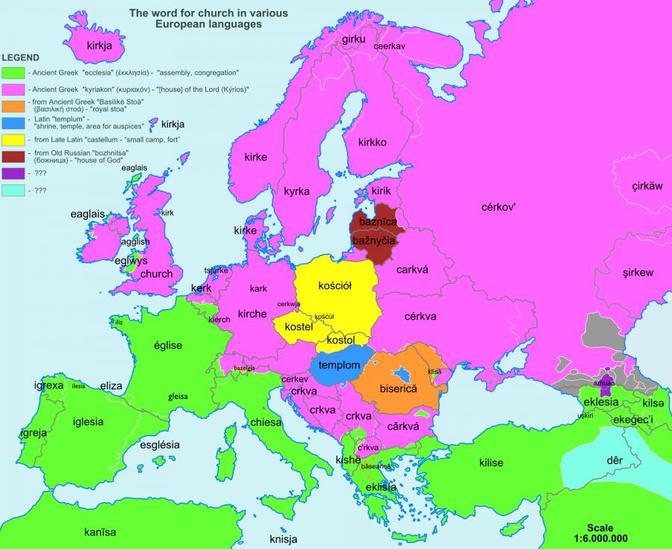
I would have told you that ‘kirk” was Germanic, being a Scots word related to “church” but derived from interaction with the Scandinavians (cf. Iceland). And it is, but based on an even older word derived from the Greek.
Aquinas on Anger, VIII
I really wanted to get to Article VII because Aristotle here is quoted saying something that I think is badly argued. The question of the article is whether we can, or can't, have anger without having a relationship of justice with the object of our anger.
I answer that, As stated above (Article 6), anger desires evil as being a means of just vengeance.
This is a real problem, but we'll roll with it for now. A relationship of justice between you and whatever you're angry at (or vice versa) would seem to need to exist, because if there were no justice relationship you would presumably not be angry at having justice violated. That part is straightforward.
But what is a 'justice relationship'? Aristotle and I disagree about where justice arises in human relationships. For Aristotle it appears to arise at the level of politics, not at the level of family or individual relationships as between father and son. Indeed, Aquinas quotes him saying that in this article: "Further, "there is no justice towards oneself . . . nor is there justice towards one's own" (Ethic. v, 6)."
So here's what Aristotle says at Aquinas' 'link' to the EN:
For justice exists only between men whose mutual relations are governed by law; and law exists for men between whom there is injustice; for legal justice is the discrimination of the just and the unjust. And between men between whom there is injustice there is also unjust action (though there is not injustice between all between whom there is unjust action), and this is assigning too much to oneself of things good in themselves and too little of things evil in themselves. This is why we do not allow a man to rule, but rational principle, because a man behaves thus in his own interests and becomes a tyrant. The magistrate on the other hand is the guardian of justice, and, if of justice, then of equality also. And since he is assumed to have no more than his share, if he is just (for he does not assign to himself more of what is good in itself, unless such a share is proportional to his merits-so that it is for others that he labours, and it is for this reason that men, as we stated previously, say that justice is 'another's good'), therefore a reward must be given him, and this is honour and privilege; but those for whom such things are not enough become tyrants.
The justice of a master and that of a father are not the same as the justice of citizens, though they are like it; for there can be no injustice in the unqualified sense towards thing that are one's own, but a man's chattel, and his child until it reaches a certain age and sets up for itself, are as it were part of himself, and no one chooses to hurt himself (for which reason there can be no injustice towards oneself). Therefore the justice or injustice of citizens is not manifested in these relations; for it was as we saw according to law, and between people naturally subject to law, and these as we saw' are people who have an equal share in ruling and being ruled. Hence justice can more truly be manifested towards a wife than towards children and chattels, for the former is household justice; but even this is different from political justice.
We should note immediately that most Americans -- at least -- would object to the formulation that a master cannot be unjust to his slave because the slave belongs to him. Most of us would argue that the master is already being unjust to the slave by pretending to own him. The Bible speaks of slavery a great deal, and does not categorically reject it as we; but in Aquinas' day the Church had moved to ban the practice between Christians as fundamentally unjust given the special equality Christians had as brother sons of God.
Since you were supposed to try to save souls, if you encountered non-Christians you were supposed to convert them rather than enslave them.
Also, I note that it is only at the level of politics coming to be that this kind of injustice is possible. There might be a natural capacity to enslave another, but there can't be a natural right to do it because the other has the same nature as you: a rational human being. If you have natural rights to freedom, he must as well. It is only the rise of positive law that creates this kind of injustice, and enshrines a 'right' to do this as a master and owner rather than just another free man.
Therefore, I submit that Aristotle is wrong about where the justice relationship properly arises: that it arises not at the political level, but at the level of personal relationships. These are also, sadly, often the place where we most regularly and intensely experience anger. We may be unjust to each other there, too; but at least we do not have armies and towers and systems of justice standing over us and telling us that we must submit to a law that renders us a slave.
But set that aside: would we accept that a father cannot be unjust to his children? We would not accept that. There are many duties we think a father owes to his children, and failure to provide those things is an act of injustice. If you starve your children rather than feeding them, that is unjust. If you drink up the family wealth, you have acted unjustly and deprived your young sons of the standing they had a reason to hope to have when they became adults and masters of themselves.
For the purpose of the consequences of this bad argument, it is certainly not true that you cannot be angry with your children -- which would follow if we accepted Aristotle's argument. Since you cannot have a justice relationship with them -- and cannot be unjust to 'your own' -- it would therefore be impossible to be angry with them. This is manifestly untrue. I daresay no parent has ever raised a child without being angry at them, and vice versa.
It is also not true, as Aristotle says and Aquinas endorses, that you cannot be angry with the dead.
"...according to the Philosopher (Rhet. ii, 3), 'it is impossible to be angry with insensible things, or with the dead': both because they feel no pain, which is, above all, what the angry man seeks in those with whom he is angry: and because there is no question of vengeance on them, since they can do us no harm."
This is another area disproven by human experience. Many times we are angry with the dead; although, unlike Aristotle, we are not obligated to imagine them as being free from all possibility of vengeance or pain. Yet even if we do so imagine them, often we are angry at them because of their tragic choices, and the harm and injustice they have done. This can certainly last well beyond the fact of their death.
In any case, this article strikes me as going wrong in a number of places. It relies on one of Aristotle's mistakes -- he was human, however great his mind, and made a few. That leads to bad consequences for our understanding.
Subscribe to:
Posts (Atom)