
Rolling Thunder
It turns out last year was the final ride, unless they reconstitute in future years. One year ago today I was there for what organizers billed as the last one. Joel was there too, though we didn’t happen to link up.

Memorial Day Ride
Taking Douglas’ suggestion, I took a ride today. This is Bear Lake.


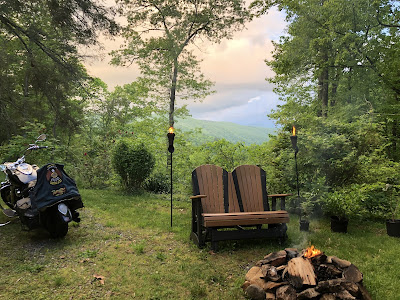

Looking East

Looking South
Bear Lake is near the mountain town of Cashiers, where I stopped for lunch at the newly-reopened (for outdoor seating only) Ugly Dog Pub. This was the first meal I’ve had seated at a restaurant in months.

After lunch came the ride home, for an evening cookout.

Local hero
We may never know what motivated this young man, Adam Salem Alsahi, but I'll bet we've got a good idea what motivated the MP, so kudos to her this Memorial Day. Two days ago, a Syrian-born naturalized American citizen with jihadist connections was killed trying to crash the gate of a naval base in Corpus Christi:
Great printing job on the dog's muzzle:

The active duty U.S. Navy military police woman at the Ocean Drive gate has probably checked thousands of IDs and allowed access to thousands of authorized people at NAS Corpus Christi.
But yesterday morning, at barely the first light of day, a terrorist tried to get past her. That terrorist, Adam Salem Alsahli (a Syrian born U.S. citizen), picked the wrong gate guard to try to get past. He must’ve thought that all he would have to do is lift the pistol off of his lap, point it at the gate guard (while she looked him in the face) shoot her point blank in the chest and then be able to drive on to the base and use his assault rifle and shotgun to kill as many people as he could.
He sure was wrong!
She took the bullet dead center in her chest, but that happens to be the area of the bullet resistant Kevlar vest, which has a steel, ceramic-coated plate over center mass to protect the heart and vital organs.
Yes, no doubt the impact knocked her down to the floor, but she got right back up and hit the emergency button that activated a very strong pop up barricade, which stopped and disabled the terrorist’s vehicle. Then, as he was getting his assault rifle out of his car, she shot him to death.In case he was wearing a vest as well, I hope she used a head-shot. The local press did not oblige with details.
Great printing job on the dog's muzzle:

Have a Grateful Memorial Day
When someone says "Have a happy Memorial Day", it always sounds a little odd. I saw "Have a <i>grateful</i> Memorial Day" recently, and thought that was perfect.
One reason we erect statues of great historical figures is out of gratitude for their service. One fine example, and that seems especially fitting for the Hall on Memorial Day is this one-
The Darby Legacy Monument, for BGen William O. Darby, of Darby's Rangers, KIA 30 April 1945 in Torbole, Italy.
The monument features a statue in the form of the classic equestrian statue, but with a twist- General Darby is astride an iron horse instead of one of flesh and bone. Unique and noble.
So, have a grateful Memorial Day, everyone. If you're lucky enough to have a steed- either steel or flesh- perhaps go for a ride to celebrate their memories.
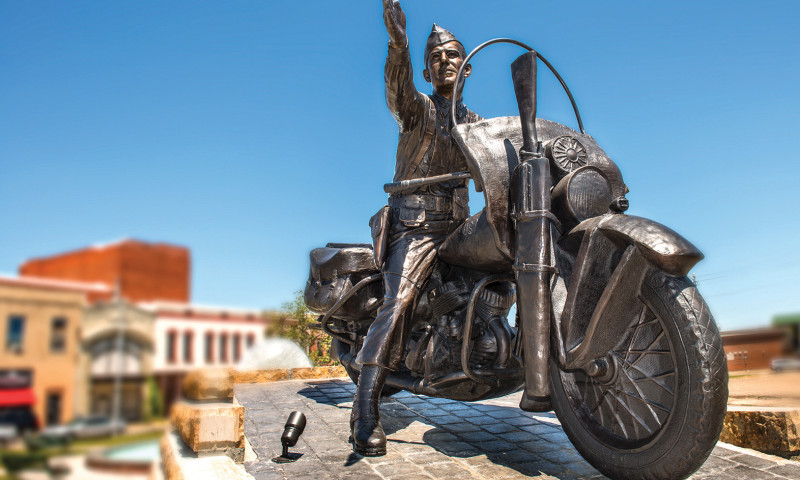
One reason we erect statues of great historical figures is out of gratitude for their service. One fine example, and that seems especially fitting for the Hall on Memorial Day is this one-
The Darby Legacy Monument, for BGen William O. Darby, of Darby's Rangers, KIA 30 April 1945 in Torbole, Italy.
The monument features a statue in the form of the classic equestrian statue, but with a twist- General Darby is astride an iron horse instead of one of flesh and bone. Unique and noble.
So, have a grateful Memorial Day, everyone. If you're lucky enough to have a steed- either steel or flesh- perhaps go for a ride to celebrate their memories.
The Oldest Saloon West of the Mississippi
Not closing, this American icon.
Hank Williams is moaning his 1949 hit “I’m So Lonesome I Could Cry,” high and mournful from the old quarter-a-song jukebox when we step off the sunny porch and into the neon light....
“Walls went up in the 1850s,” she says. “Was literally a trapping and trading post for mountain men in the area until 1879. When the town got big enough they moved the dry goods next door and this became a saloon ever since then, including the years of Prohibition.”
“The way that happened was the sheriff was in Ogden, so he either came up by mule or by rail,” she smiles, mischief in her eyes. “They knew he was coming. Sometimes he would arrest the owner, his wife would come over and open the bar back up. So that’s why we’ve kind of had a rebellious spirit.”...
The jukebox, underneath a ceiling one regular estimates has $14,000 in signed $1 bills stapled to it, features Willie, Johnny, Merle, Loretta Lynn, Patsy Cline, Charlie Pride, and the U.S. Navy Band’s rendition of “The National Anthem.” When they get a new commander, the airmen bring him by and Leslie lets them know he and his family can consider this their home. Some time later, airmen will fondly replace the old commander’s photograph with the new one in its place of honor — the base of the men’s toilet.
Some Good Songs about Motorcycles
LTC Allen West was injured in a motorcycle wreck this evening. I didn't know he was a rider, but I'm not surprised. I've met him in passing, and had him used as a bad example by two sets of JAG lawyers during pre-deployment briefings to Iraq. I hope he'll be just fine.
In his honor, some appropriate music.
That last one is apparently the whole movie, and it's quite a film. It was two years after Easy Rider, and had the same production crew but nothing like the budget. So it's a werewolf film, but they could only afford the makeup artist for three days at the end; and they couldn't mostly afford actors, so they just hired bikers. It's a better movie for both of those restrictions, a plausible new cinema psychedelic piece. I'm not sure it isn't better than Easy Rider, as a biker movie. The more famous film has a better soundtrack in places -- though check the intro to this film, 11:48, and also 31:23 -- and Easy Rider had some great sweeping visuals through Monument Valley, but is otherwise somewhat overrated. These guys were mostly for real.
There is nevertheless a substantial content warning, especially for nudity, sex, and violence. Language, drinking, drugs... well, it's psychedelic new cinema. You're all adults.
UPDATE: LTC West is resting in stable condition, with some fractures. He’s to be released soon.
In his honor, some appropriate music.
That last one is apparently the whole movie, and it's quite a film. It was two years after Easy Rider, and had the same production crew but nothing like the budget. So it's a werewolf film, but they could only afford the makeup artist for three days at the end; and they couldn't mostly afford actors, so they just hired bikers. It's a better movie for both of those restrictions, a plausible new cinema psychedelic piece. I'm not sure it isn't better than Easy Rider, as a biker movie. The more famous film has a better soundtrack in places -- though check the intro to this film, 11:48, and also 31:23 -- and Easy Rider had some great sweeping visuals through Monument Valley, but is otherwise somewhat overrated. These guys were mostly for real.
There is nevertheless a substantial content warning, especially for nudity, sex, and violence. Language, drinking, drugs... well, it's psychedelic new cinema. You're all adults.
UPDATE: LTC West is resting in stable condition, with some fractures. He’s to be released soon.
Herschel Walker?
This is going to go hard for the SEC states. Herschel is a minor god here, even after all this time.
Fauci: You Know, Locking Down Too Long is Harmful
I’m glad to see this, as it will encourage people to go beyond the simple partisan lock. None of you are there, but many are.
Koch conquers PBS?
We watched the brief Clarence Thomas bio "Created Equal" on PBS last night. Neither of us could figure out why PBS would run such a thing, unless the Koch money included in the credits actually had some effect, which is hard to imagine.
It wasn't the hack job I expected. The questions were sometimes mildly probing, but never in true "gotcha" territory. Justice Thomas was allowed to explain clearly and repeatedly how his judicial philosophy works, and to express his disgust at the idea that any political movement has the right to tell him what views a black man is required to hold. Anita Hill was treated briefly and respectfully, but Thomas's response got even more time and respect. If it hadn't been PBS, I'd have assumed I was watching a serious journalism outlet.
When Thomas graduated from Yale Law School in the mid-1970s, a committed Democrat, he snagged only one job offer, from then Missouri AG John Danforth, a Republican. Thomas's politics already had undergone a fundamental shakeup after a Marxist youth, but clearly the contact with a lot of thoughtful conservatives had a further impact. Within no more than a decade, many law firms with a strong progressive bent would be falling all over themselves to snag black Yale graduates, but they sure missed their chance with Thomas. Danforth, later a U.S. Senator, became a strong lifetime supporter and friend who sat next to Thomas in the grisly confirmation hearings.
Joe Biden presided over the travesty. He came off as an incomprehensible boob, though more cogent and fluent than he could appear today.
It wasn't the hack job I expected. The questions were sometimes mildly probing, but never in true "gotcha" territory. Justice Thomas was allowed to explain clearly and repeatedly how his judicial philosophy works, and to express his disgust at the idea that any political movement has the right to tell him what views a black man is required to hold. Anita Hill was treated briefly and respectfully, but Thomas's response got even more time and respect. If it hadn't been PBS, I'd have assumed I was watching a serious journalism outlet.
When Thomas graduated from Yale Law School in the mid-1970s, a committed Democrat, he snagged only one job offer, from then Missouri AG John Danforth, a Republican. Thomas's politics already had undergone a fundamental shakeup after a Marxist youth, but clearly the contact with a lot of thoughtful conservatives had a further impact. Within no more than a decade, many law firms with a strong progressive bent would be falling all over themselves to snag black Yale graduates, but they sure missed their chance with Thomas. Danforth, later a U.S. Senator, became a strong lifetime supporter and friend who sat next to Thomas in the grisly confirmation hearings.
Joe Biden presided over the travesty. He came off as an incomprehensible boob, though more cogent and fluent than he could appear today.
Why Are Liberals More Afraid of COVID?
Ezra Klein asks a really interesting question: a lot of research suggests that conservatives have a heightened sense that the world is dangerous, and a lot of the difference between liberals and conservatives comes down to this basic disjoint in our perception of the danger of reality. So why is it that conservatives tend to be less worried about the dangers of COVID, and liberals are the ones preparing to hide in their homes for as long as possible?
Unfortunately, it being Vox, while the question is interesting the answers pursued can be described as "Three theories of why conservatives are wrong." These are:
1) Liberals are acting out of care, as is their core value, while their fear is an expression of superior intellectual understanding of the science; conservatives, though panicked, are engaged in psychological transference of this panic to the economy because they are too afraid or too inferior to grapple honestly with the research.
2) Conservatives are expressing their fear through intensified partisan obedience to their leader, Donald Trump, who would like to downplay the virus.
3) Conservatives are showing fear, but are expressing it through their usual racism toward foreigners/outsiders rather than, like liberals, a wise and scientific approach to epidemiology.
Perhaps in some cases? But surely there are theoretical models that don't require assuming that conservatives are wrong.
1) Economic pressures differ: conservatives are much more likely to be small business owners or employees, whereas liberals are over-represented in government, academia, the press, and the tech sector; also, among workers likely to draw unemployment benefits. Conservatives are thus more likely to be feeling intense economic pressure without help. For liberals, a combination of continued pay and/or the ability to work from home is making 'stay at home forever' a more plausible option.
2) Liberals also feel partisan loyalties, especially to oppose Donald Trump. As we have seen elsewhere, especially in the Russia Collusion hoax, this can lead them to accept implausible storylines that might harm the hated enemy. They tend to see this as an expression of 'care,' because they view Trump as especially uncaring; but it is also an expression of injustice, as it leads them to do things like persist in calling people "traitors!" when in fact they have been shown to be falsely accused. There is no reason to think liberal partisanship is more rational nor more scientific.
3) Conservatives do tend to perceive threats more intensely, but they also tend to build their lives around modes of defending against those threats so they can be free, e.g., learning to carry a handgun and use it safely and effectively. In studying this threat, many conservatives have decided it really isn't an unmanageable danger: for example, the risk of death to a man of my age appears to be around 0.001%, concentrated on those with underlying health conditions that I don't have. While I want to take steps to avoid massive viral load exposure and/or the danger of carrying the disease to someone more vulnerable, I think it's both rational and scientific to learn from the data we've seen that this is a risk I can afford to run.
There may be other theories as well. Perhaps there are even theories in which neither side is 'right.'
Unfortunately, it being Vox, while the question is interesting the answers pursued can be described as "Three theories of why conservatives are wrong." These are:
1) Liberals are acting out of care, as is their core value, while their fear is an expression of superior intellectual understanding of the science; conservatives, though panicked, are engaged in psychological transference of this panic to the economy because they are too afraid or too inferior to grapple honestly with the research.
2) Conservatives are expressing their fear through intensified partisan obedience to their leader, Donald Trump, who would like to downplay the virus.
3) Conservatives are showing fear, but are expressing it through their usual racism toward foreigners/outsiders rather than, like liberals, a wise and scientific approach to epidemiology.
Perhaps in some cases? But surely there are theoretical models that don't require assuming that conservatives are wrong.
1) Economic pressures differ: conservatives are much more likely to be small business owners or employees, whereas liberals are over-represented in government, academia, the press, and the tech sector; also, among workers likely to draw unemployment benefits. Conservatives are thus more likely to be feeling intense economic pressure without help. For liberals, a combination of continued pay and/or the ability to work from home is making 'stay at home forever' a more plausible option.
2) Liberals also feel partisan loyalties, especially to oppose Donald Trump. As we have seen elsewhere, especially in the Russia Collusion hoax, this can lead them to accept implausible storylines that might harm the hated enemy. They tend to see this as an expression of 'care,' because they view Trump as especially uncaring; but it is also an expression of injustice, as it leads them to do things like persist in calling people "traitors!" when in fact they have been shown to be falsely accused. There is no reason to think liberal partisanship is more rational nor more scientific.
3) Conservatives do tend to perceive threats more intensely, but they also tend to build their lives around modes of defending against those threats so they can be free, e.g., learning to carry a handgun and use it safely and effectively. In studying this threat, many conservatives have decided it really isn't an unmanageable danger: for example, the risk of death to a man of my age appears to be around 0.001%, concentrated on those with underlying health conditions that I don't have. While I want to take steps to avoid massive viral load exposure and/or the danger of carrying the disease to someone more vulnerable, I think it's both rational and scientific to learn from the data we've seen that this is a risk I can afford to run.
There may be other theories as well. Perhaps there are even theories in which neither side is 'right.'
Machine Politics
J. Melcher dropped an old but fascinating story in the comments of the post on vote monitoring below. It's the sort of story that should have provoked intense reforms, but of course did not.
Why Did People Like General Flynn?
In the process of working through a theory on why Flynn was railroaded, Lee Smith of Tablet magazine gives a good account of what people like me liked about him.
Flynn did some good stuff in bringing the voices and warnings of the guys in the field forward. Smith's wider thesis is that fear of an audit of the intelligence community by a man who knew it well caused that community to back the outgoing Obama administration's play to destroy him. Maybe that's right; maybe not. It's not ridiculous as a theory, though.
Flynn had enemies at the very top of the intelligence bureaucracy. In 2014, he’d been fired as DIA head. Under oath in February of that year, he told the truth to a Senate committee—ISIS was not, as the president had said, a “JV team.” They were a serious threat to American citizens and interests and were getting stronger. Former Director of National Intelligence James Clapper and Undersecretary of Defense for Intelligence Michael Vickers then summoned Flynn to the Pentagon and told him he was done.Eli Lake has an allied piece in Commentary as well.
“Flynn’s warnings that extremists were regrouping and on the rise were inconvenient to an administration that didn’t want to hear any bad news,” says former DIA analyst Oubai Shahbandar. “Flynn’s prophetic warnings would play out exactly as he’d warned shortly after he was fired.”
Flynn’s firing appeared to be an end to one of the most remarkable careers in recent American intelligence history. He made his name during the Bush administration’s wars in Iraq and Afghanistan, where soldiers in the field desperately needed intelligence, often collected by other combat units. But there was a clog in the pipeline—the Beltway’s intelligence bureaucracy, which had a stranglehold over the distribution of intelligence.
Flynn described the problem in a 2010 article titled “Fixing Intel: A Blueprint for Making Intelligence Relevant in Afghanistan,” co-written with current Deputy National Security Adviser Matt Pottinger. “Moving up through levels of hierarchy,” they wrote, “is normally a journey into greater degrees of cluelessness.” Their solution was to cut Washington out of the process: Americans in uniform in Iraq and Afghanistan needed that information to accomplish their mission.
“What made Flynn revolutionary is that he got people out in the field,” says Shahbandar, who served in Iraq under Flynn in 2007-08 and in Afghanistan in 2010-11. “It wasn’t just enough to have intelligence, you needed to understand where it was coming from and what it meant. For instance, if you thought that insurgents were going to take over a village, the first people who would know what was going would be the villagers. So Flynn made sure we knew the environment, the culture, the people.”
Influential senior officers like Gens. David Petraeus and Stanley McChrystal credited Flynn for collecting the intelligence that helped defeat al-Qaida in Iraq in 2007. In 2012, he was named DIA chief.
Flynn did some good stuff in bringing the voices and warnings of the guys in the field forward. Smith's wider thesis is that fear of an audit of the intelligence community by a man who knew it well caused that community to back the outgoing Obama administration's play to destroy him. Maybe that's right; maybe not. It's not ridiculous as a theory, though.
The Best the Government Can Do
The SBA proved incapable of running the 'paycheck protection program,' and Congress' massive spending didn't manage to adequately fund it; economic disaster 'loans' may or may not materialize; unemployment seems to be hard to come by if you can get the systems to work at all; the IRS is apparently unable to process tax returns in a timely manner even though they're getting far less of them than usual. The FDA and CDC screwed up their basic jobs nine ways to Sunday, and hampered private efforts to find ways to test.
The one thing that the government has done that has worked is suspending itself. Suspending regulations let truck drivers get where they needed to be faster, suspending liability laws (via things like the Defense Production Act's temporary nationalization of meat plants) allows businesses to continue to operate. The best the government can do is to stop doing.
Which makes this move the right thing to do. You want job creation and economic growth? Shut down the regulatory agencies as hard as you can.
The one thing that the government has done that has worked is suspending itself. Suspending regulations let truck drivers get where they needed to be faster, suspending liability laws (via things like the Defense Production Act's temporary nationalization of meat plants) allows businesses to continue to operate. The best the government can do is to stop doing.
Which makes this move the right thing to do. You want job creation and economic growth? Shut down the regulatory agencies as hard as you can.
"Take Yourself to Work Day"
A Michigan entrepreneur is defying what may well be America's worst governor, Gretchen Whitmer.
In an interview with PJ Media, the business owner described Whitmer’s executive orders as “in a word, ludicrous.”The NY Post reports that Governor Whitmer is in talks with the Biden campaign about becoming the Vice Presidential nominee, which could easily make her President of the United States soon.
“Tell me how liquor, the lottery, and marijuana are essential while rakes, brooms, and paint aren’t,” Kiilunen said. “Tell me how it is safe to walk with a large crowd in Wal-Mart but not in a hometown business.”
Weird Numbers
Americans seem prepared to walk into socialism, but approve of Trump's handling of the crisis? These are huge majorities for the most part for universal healthcare, universal basic income (at least for the duration of the crisis), and more help for those who may have become unemployed.
It's too bad for Democrats that Bernie didn't win. This could have been his year.
By the way, @AVI, one of my progressive friends just used the phrase "billionaires hoarding Scrooge McDuck levels of wealth" in a conversation about the American response.
It's too bad for Democrats that Bernie didn't win. This could have been his year.
By the way, @AVI, one of my progressive friends just used the phrase "billionaires hoarding Scrooge McDuck levels of wealth" in a conversation about the American response.
Yes, But...
Alan Dershowitz on forced vaccination:
So it may be that the smallpox era ruling would stand up today; but it also might be that it would not. People had a lot of faith in government's ability to do good in the early 1900s. That's not true today, and it's not true for reasons that are sometimes well-founded.
"Let me put it very clearly," Dershowitz said. "You have no constitutional right to endanger the public and spread the disease, even if you disagree. You have no right not to be vaccinated, you have no right not to wear a mask, you have no right to open up your business."The 'but' is that I notice he didn't name the case. He's not wrong, but the precedents are not necessarily settled if they run deeply counter to the current sense of the American people. I think a lot of Americans would dissent from the Buck v. Bell SCOTUS ruling, from the Progressive era, that gave the state wide power to sterilize you against your will. For one thing it runs directly into the teeth of the reproductive rights movement. Although that is mostly about not reproducing, the logic of it is that reproduction is a kind of sacred and personal thing with which the state should never interfere.
The famed law professor added that if the disease in question is not contagious — for example, cancer — a person can refuse treatment.
He continued, "[But] If you refuse to be vaccinated [for a contagious disease], the state has the power to literally take you to a doctor's office and plunge a needle into your arm."
"You have no right to refuse to be vaccinated against a contagious disease," Dershowitz added. "Public health, the police power of the Constitution, gives the state the power to compel that. And there are cases in the United States Supreme Court."
So it may be that the smallpox era ruling would stand up today; but it also might be that it would not. People had a lot of faith in government's ability to do good in the early 1900s. That's not true today, and it's not true for reasons that are sometimes well-founded.
To See Ourselves as Others See Us
O wad some Pow'r the giftie gie us
To see oursels as ithers see us!
It wad frae mony a blunder free us,
An' foolish notion:
What airs in dress an' gait wad lea'e us,
An' ev'n devotion!
-Robert Burns, excerpt, "To a Louse"
Writer Jill Filipovic begins to wonder about possibly considering at least talking about reopening. This essay, from a progressive feminist to her audience, begins with a very large amount of throat-clearing to make sure she isn't misunderstood as one of those people.
This is common. In the comments to Tex's post below, I modified the article about 'what women are like' vs. 'what men are like' to replace the sexes with political labels. It turns out that the substitution very neatly fits the kind of descriptions you'll hear in Ms. Filipovic's piece.
To see oursels as ithers see us!
It wad frae mony a blunder free us,
An' foolish notion:
What airs in dress an' gait wad lea'e us,
An' ev'n devotion!
-Robert Burns, excerpt, "To a Louse"
Writer Jill Filipovic begins to wonder about possibly considering at least talking about reopening. This essay, from a progressive feminist to her audience, begins with a very large amount of throat-clearing to make sure she isn't misunderstood as one of those people.
This is common. In the comments to Tex's post below, I modified the article about 'what women are like' vs. 'what men are like' to replace the sexes with political labels. It turns out that the substitution very neatly fits the kind of descriptions you'll hear in Ms. Filipovic's piece.
"... progressives were found significantly more appreciative of art and beauty, were more open to inner feelings and emotions, more modest in playing down their achievements, and more reactive, affected by feelings, and easily upset. Progressives, on average, were more, outgoing, attentive to others, sensitive, aesthetic, sentimental, cooperative, accommodating, and deferential, warm toward others, showing selfless concern for others, sympathetic, enjoying company, and straightforward and undemanding. Conservatives, on average, were more reserved, utilitarian, unsentimental, dispassionate, and solitary.”We do have the advantage that Robbie Burns wished 'some Power' might give us: we are able to see exactly how others see us. This is true for both men and conservative women. I'm sorry to say that you do not please them much. Perhaps you can free yourselves, as Burns thought, from airs of dress and gait, if any of you have any; but the big question is freeing yourself from devotion.
Subscribe to:
Posts (Atom)