
What state are you?
Can't resist those quizzes. Psychically, my husband belongs in Montana and I in Colorado, but neither of us can tolerate the cold. I like to think that our atypical little Texas county is our own private Montana/Colorado.

Practical politics
Speaking of ways to achieve the necessary changes in Congress and the White House, such as ballot security, I enjoyed this comment on a forum:
Since Medicaid requires photo IDs, is it a health suppression law?
The possum
Things I did not know about opossums:

1. Natural immunity. Opossums are mostly immune to rabies, and in fact, they are eight times less likely to carry rabies compared to wild dogs.
2. Poison control. Opossums have superpowers against snakes. They have partial or total immunity to the venom produced by rattlesnakes, cottonmouths and other pit vipers.
3. Omnivores galore. . . . They have an unusually high need for calcium, which incites them to eat the skeletons of rodents and road kill they consume. They're the sanitation workers of the wild. . . .
7. Impressive tails. . . . Opossums have been observed carrying bundles of grasses and other materials by looping their tail around them; this conscious control leads many to consider the tail as a fifth appendage, like a hand.
And a bonus for the Scrabble players: Male opossums are called jacks and females are called jills. The young are referred to as joeys, just like their Australian cousins, and a group of opossums is called a passel.

Perils of the code
For you IT types. Go here for the whole thing, which is supposed to be set to a tune I'm not familiar with, "Leslie Fish":
Deep in engineering down where mortals seldom go,
A manager and customer come looking for a show.
They pass amused among us, and they sign in on the log.
They've come to see our pony and they've come to see our dog.
. . .
From briefcase then there comes a list of things we must revise,
And all but four within the room are taken by surprise,
And all but four are thinking of their last job with remorse;
The customer, the manager, the doggie, and the horse.
. . .
Three things are most perilous,
Connectors that corrode,
Unproven algorithms,
And self modifying code.
The manager and customer are quick to leave this bunch,
They take the dog and pony and they all go out to lunch.
Now how will we revenge ourselves on those who raise our ire?
Write code that self destructs the day the warranties expire.
We misunderstood him
When the president said, "If you like your coverage, you can keep it," what he really meant was, "If we like your coverage, you can keep it."
I want this law dead, and I want some political careers ended. We've got a lot of work to do in the coming election year.
The U.S. individual health insurance market currently totals about 19 million people. Because the Obama administration's regulations on grandfathering existing plans were so stringent about 85% of those, 16 million, are not grandfathered and must comply with Obamacare at their next renewal. The rules are very complex. For example, if you had an individual plan in March of 2010 when the law was passed and you only increased the deductible from $1,000 to $1,500 in the years since, your plan has lost its grandfather status and it will no longer be available to you when it would have renewed in 2014.
These 16 million people are now receiving letters from their carriers saying they are losing their current coverage and must re-enroll in order to avoid a break in coverage and comply with the new health law's benefit mandates––the vast majority by January 1. Most of these will be seeing some pretty big rate increases.We are excited to be among those 16 million Americans! Blue Cross tells me that my plan is not grandfathered, and that I get to pick a new one. The new options are much, much nicer. My betters in the Nanny State know that I never should have preferred low-cost high-deductible coverage of the sort that is now illegal for Blue Cross to offer me. Instead, I get a brand-new policy with a deductible that is $3,750 lower. And it only costs $4,800 a year more than my old policy! Thank you, Mr. President!
I want this law dead, and I want some political careers ended. We've got a lot of work to do in the coming election year.
Sigh no more
My linguistics reading of late is alerting me to survivals of archaic forms in popular culture. The genius of Shakespeare and the King James Bible translation ensures that we never quite stop incorporating the English of 500 years ago into modern speech. Last night I spent enjoyable hours watching Joss Whedon's recent production of Shakespeare's comedy "Much Ado About Nothing," staged in the present but using the original text. Beatrice and Benedick are two young misfits everyone knows have to get together, though they think they hate each other. They ultimately join forces to solve the problems of the secondary couple, Claudio and Hero, who have been tricked into an apparent tragedy that all comes right in the end.
Shakespeare often included bits of doggerel or folksong into his plays, with language that was archaic even in his time. Modern adaptations tend to set them to tunes either in a style they take to be period-appropriate or in a style that's current for the production. The song that caught my ear last night was "Sigh No More" (or, as we'd say today, with our Celtic restructuring of Germanic grammar: "Baby Don't You Cry"). It uses the old-fashioned trochaic meter (DAH-duh), to which Shakespeare often switches from his usual iambic (dah-DUH) when giving voice to the old powers, like the witches in "Macbeth" ("Double, double, toil and trouble/Fire burn and cauldron bubble") or the fairies in A Midsummer Night's Dream ("Lord, what fools these mortals be!").
"Sigh no more" is a lament over the inconstancy of men, the counterpoint about male infidelity set into a play about the deadly consequences of even a false suspicion of female unchastity:
Kenneth Branagh's "Much Ado" of a few years back set "Sigh, No More" to a pretty, old-fashioned tune and has the partygoers break into a fine barbershop-quartet performance. Great stuff.
Joss Whedon adapts the same song to a nice jazzy lounge number, suitable for some relaxing entertainment at an elegant house party, with pretty acrobats out by the pool. (The film was shot in twelve days at Whedon's home while he was taking a break from final editing on "The Avengers." The actors are many of his regulars.)
Here's a snappy 1940's take:
Branagh directed a playful "Love's Labour's Lost" (a financial flop) set in the 1939 and using show tunes and modern dance, including the "Charleston." He emphasized the play's iambic beat by setting the lines "Have at you now, affection's men at arms" to a tap-dance exercise, then breaks into Irving Berlin's "Cheek to Cheek":
I'm sorry that film didn't do well. It's the kind of thing that makes my husband run out of the room, but I love dramas in which people spontaneously burst into song and dancing.
Shakespeare often included bits of doggerel or folksong into his plays, with language that was archaic even in his time. Modern adaptations tend to set them to tunes either in a style they take to be period-appropriate or in a style that's current for the production. The song that caught my ear last night was "Sigh No More" (or, as we'd say today, with our Celtic restructuring of Germanic grammar: "Baby Don't You Cry"). It uses the old-fashioned trochaic meter (DAH-duh), to which Shakespeare often switches from his usual iambic (dah-DUH) when giving voice to the old powers, like the witches in "Macbeth" ("Double, double, toil and trouble/Fire burn and cauldron bubble") or the fairies in A Midsummer Night's Dream ("Lord, what fools these mortals be!").
"Sigh no more" is a lament over the inconstancy of men, the counterpoint about male infidelity set into a play about the deadly consequences of even a false suspicion of female unchastity:
Sigh no more, ladies, sigh no more;
    Men were deceivers ever;
One foot in sea and one on shore,
    To one thing constant never;
        Then sigh not so,
        But let them go,
    And be you blithe and bonny;
Converting all your sounds of woe
    Into "Hey nonny, nonny!"

Sing no more ditties, sing no more,
    Of dumps so dull and heavy;
The fraud of men was ever so,
    Since summer first was leavy.
        Then sigh not so,
        But let them go,
    And be you blithe and bonny;
Converting all your sounds of woe
    Into "Hey, nonny, nonny!"
Kenneth Branagh's "Much Ado" of a few years back set "Sigh, No More" to a pretty, old-fashioned tune and has the partygoers break into a fine barbershop-quartet performance. Great stuff.
Joss Whedon adapts the same song to a nice jazzy lounge number, suitable for some relaxing entertainment at an elegant house party, with pretty acrobats out by the pool. (The film was shot in twelve days at Whedon's home while he was taking a break from final editing on "The Avengers." The actors are many of his regulars.)
Here's a snappy 1940's take:
Branagh directed a playful "Love's Labour's Lost" (a financial flop) set in the 1939 and using show tunes and modern dance, including the "Charleston." He emphasized the play's iambic beat by setting the lines "Have at you now, affection's men at arms" to a tap-dance exercise, then breaks into Irving Berlin's "Cheek to Cheek":
I'm sorry that film didn't do well. It's the kind of thing that makes my husband run out of the room, but I love dramas in which people spontaneously burst into song and dancing.
Aristotle on Causality
I'm moving into Aristotle's Physics and it depends heavily on his theories of causality, so I thought I'd start with Andrea Falcon's SEP article on that.
According to Falcon, Aristotle proposes that we have knowledge of a thing only when we understand its causes, and he proposes four possible causes: material, formal, efficient, and final.
The final cause for a statue is the statue itself.
With the final cause, Aristotle's theory is teleological; the purpose of a thing is a kind of cause of it. Because of this, he has been accused of anthropomorphizing nature, attributing to it psychological reasons for the way things are. However, while the theory can take desire, intention, etc., into account, the final causes of natural things don't require psychological causes. For example, Aristotle explains that the 'final cause' for why frontal teeth are sharp and back teeth are flat is because that is the best arrangement for the survival of the animal.
A couple of other key points are that, in studying nature, we should look for generalities. We aren't concerned about exceptions; we are trying to discover the rules. He also doesn't require that we use all four causes. In some cases, like the bronze statue, the formal and final causes are the same. In some cases the efficient cause is enough. For example, Aristotle explains a lunar eclipse with an efficient cause: the earth comes between the moon and sun.
The idea of a final cause was controversial in Aristotle's day. (I think it became controversial again in the 18th or 19th century.) Many philosophers* proposed that material and efficient causes were good enough. Aristotle claimed that material and efficient causes alone failed to account for regularity. If we ask, why are front teeth sharp and back teeth flat, material and efficient causes alone leave us with coincidence; animals produce offspring like themselves, and that's it. There is no reference to this arrangement making survival easier. Final causes, on the other hand, allow us to say that teeth are arranged that way to make survival easier; they explain the regularity in ways that material and efficient causes do not.
Leaving Falcon behind for a moment, why did final causes become controversial in the 18th or 19th century? Because teleological explanations seem to imply Nature has a personality. Before this time, Christian philosophers who adopted Aristotle would often point to God to provide final causes: Why were front teeth sharp and back teeth flat? God designed the animal that way to improve its chances of surviving. But God had to be killed in the Enlightenment (Hegel proclaimed it long before Nietzsche) and all that sort of thing removed. Biology today still uses teleological terms, but they intend them in reverse: the animal survives better because the teeth are arranged that way, and survival means a better chance of reproducing, which produces offspring with teeth arranged that way.
Next up, a dive into the Physics.
---
* Science as the organized / methodical study of nature was a branch of philosophy up through the Scientific Revolution, and some branches of science (such as physics) were still called 'natural philosophy' up into the 19th century.
According to Falcon, Aristotle proposes that we have knowledge of a thing only when we understand its causes, and he proposes four possible causes: material, formal, efficient, and final.
The material cause: “that out of which”, e.g., the bronze of a statue.
The formal cause: “the form”, “the account of what-it-is-to-be”, e.g., the shape of a statue.
The efficient cause: “the primary source of the change or rest”, e.g., the artisan, the art of bronze-casting the statue, the man who gives advice, the father of the child.
The final cause: “the end, that for the sake of which a thing is done”, e.g., health is the end of walking, losing weight, purging, drugs, and surgical tools.
The final cause for a statue is the statue itself.
With the final cause, Aristotle's theory is teleological; the purpose of a thing is a kind of cause of it. Because of this, he has been accused of anthropomorphizing nature, attributing to it psychological reasons for the way things are. However, while the theory can take desire, intention, etc., into account, the final causes of natural things don't require psychological causes. For example, Aristotle explains that the 'final cause' for why frontal teeth are sharp and back teeth are flat is because that is the best arrangement for the survival of the animal.
A couple of other key points are that, in studying nature, we should look for generalities. We aren't concerned about exceptions; we are trying to discover the rules. He also doesn't require that we use all four causes. In some cases, like the bronze statue, the formal and final causes are the same. In some cases the efficient cause is enough. For example, Aristotle explains a lunar eclipse with an efficient cause: the earth comes between the moon and sun.
The idea of a final cause was controversial in Aristotle's day. (I think it became controversial again in the 18th or 19th century.) Many philosophers* proposed that material and efficient causes were good enough. Aristotle claimed that material and efficient causes alone failed to account for regularity. If we ask, why are front teeth sharp and back teeth flat, material and efficient causes alone leave us with coincidence; animals produce offspring like themselves, and that's it. There is no reference to this arrangement making survival easier. Final causes, on the other hand, allow us to say that teeth are arranged that way to make survival easier; they explain the regularity in ways that material and efficient causes do not.
Leaving Falcon behind for a moment, why did final causes become controversial in the 18th or 19th century? Because teleological explanations seem to imply Nature has a personality. Before this time, Christian philosophers who adopted Aristotle would often point to God to provide final causes: Why were front teeth sharp and back teeth flat? God designed the animal that way to improve its chances of surviving. But God had to be killed in the Enlightenment (Hegel proclaimed it long before Nietzsche) and all that sort of thing removed. Biology today still uses teleological terms, but they intend them in reverse: the animal survives better because the teeth are arranged that way, and survival means a better chance of reproducing, which produces offspring with teeth arranged that way.
Next up, a dive into the Physics.
---
* Science as the organized / methodical study of nature was a branch of philosophy up through the Scientific Revolution, and some branches of science (such as physics) were still called 'natural philosophy' up into the 19th century.
Lost arts
From the 1911 Encyclopedia Britannica entry on "Turkey" (the bird kind). You can't find genteel trashtalk like this any more:
The bibliography of the turkey is so large that there is here no room to name the various works that might be cited. Recent research has failed to add anything of importance to what has been said on this point by Buffon (Oiseaux, ii. 132-162), Pennant (Arctic Zoology, pp. 291-300)--an admirable summary--and Broderip (Zoological Recreations, pp. 120-137)--not that all their statements can be wholly accepted. Barrington's essay (Miscellanies, pp. 127-151), to prove that the bird was known before the discovery of America and was transported thither, is an ingenious piece of special pleading which his friend Pennant did him the real kindness of ignoring.
It's Not A Double-Standard If You Never Thought Of It
A friend of mine sent me this picture, which I found rather surprising. I don't think it's a double standard, so much as their just not being interested in the quality of boys' toys to the same degree. I had honestly never thought of their point at all. Of course I remember He-Man, who was just a cleaned-up kids version of Conan, a physically similar character.
All three are really popular, which may say something about what is really going on here. When we talk about Conan books, the usual screed against them is that they represent a simple kind of male wish-fulfillment. I think that's unfair: at least the original R. E. Howard stories are really quite good. But it might be true for He-Man.
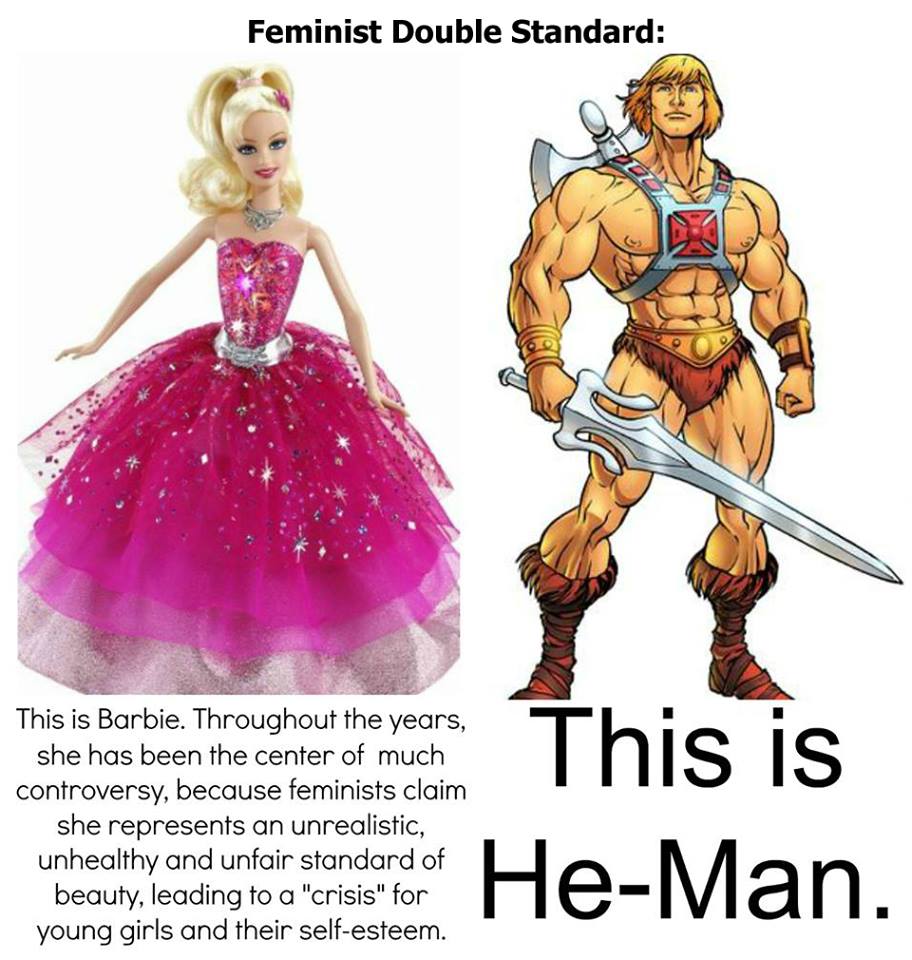
All three are really popular, which may say something about what is really going on here. When we talk about Conan books, the usual screed against them is that they represent a simple kind of male wish-fulfillment. I think that's unfair: at least the original R. E. Howard stories are really quite good. But it might be true for He-Man.
My New Favorite Syllogism
The moon is made of green cheese. Therefore, either it is raining in Ecuador now or it is not.
In our earlier discussions of logic, the failure of modern logic to take relevance into account seemed to me a great failure. Specifically, I maintain that the forms of natural language cannot be entirely separated from the content, no matter how many logicians deeply pine for such a situation.
Now, to the extent that modern logic is a branch of mathematics, I have no problem with it. It has found uses in computer programming and probably other fields, and it's an interesting intellectual exercise in itself. It is to the extent that modern logic attempts to use natural language to create or understand meaning that it fails.
Relevance / Relevant logicians have tried to develop formal expressions of relevance and have come closer to making premises and conclusions relevant to each other, but they haven't solved the problem entirely.
As for me, while I fully understand there are practical uses for modern logic, it seems that Aristotelean logic is superior for analyzing arguments in natural language. Else, it is either raining in Ecuador, or it is not, because the moon is made of green cheese.
Project Euler and Self-Directed Learning
Problem 2
Each new term in the Fibonacci sequence is generated by adding the previous two terms. By starting with 1 and 2, the first 10 terms will be:
1, 2, 3, 5, 8, 13, 21, 34, 55, 89, ...
By considering the terms in the Fibonacci sequence whose values do not exceed four million, find the sum of the even-valued terms.
Apropos of Tex's recent post on child-centered learning, I thought I'd add this.
Computer programming is a hobby of mine and something I am very interested in getting better at, but I was never good at math. Call me lazy, but the most difficult thing in math classes was keeping my eyes open; after missing the instruction, the problems were often impossible. (If it's impossible, it's not difficult, you see.) The textbooks were even more boring than the teachers, so they were no help, either.
In the last few years I've become increasingly interested in learning more math, but the problem is where to begin and how to approach it. I dread taking university math courses, an expensive cure for insomnia in my experience. Then I read James Somer's article, How I Failed, Failed and Finally Succeeded in Learning How to Code, where he introduces Colin Hughes, a British math teacher and the creator of Project Euler.
The core of Project Euler is a set of math problems designed to be solved by simple computer programs. Currently, there are more than 400 and Mr. Hughes adds a new one each weekend during the school year (he takes summers off). Interestingly, other than a simple explanation like the one above, he provides no instruction in math with the problem, but after you give the correct answer, it opens up a discussion thread for everyone who has solved the problem to share their solutions and comments with each other.
My route to solving these problems has generally been either to just start writing the program, if I immediately grasped the problem (like Problem 2 above), or if I didn't, to look up related math topics on Wikipedia, which has a surprisingly large number of helpful articles. I try to find a principle that will allow me to solve that type of problem (I avoid simply searching for the problem itself; some unsporting types have posted their solutions publicly). After solving the problem, I go through a dozen or so solutions from others who have also solved it.
Hughes explains his method like this: "The problems range in difficulty and for many the experience is inductive chain learning. That is, by solving one problem it will expose you to a new concept that allows you to undertake a previously inaccessible problem. So the determined participant will slowly but surely work his/her way through every problem."
That seems to be how it's working for me. While the problems have gotten more difficult, I've become quicker to pick up on patterns in numbers and, when I don't understand a problem, I have a better idea of how to approach finding the answer. I've built up a better understanding of how numbers work together, a clearer understanding of some math concepts, an appreciation for different types of math (number theory, graph theory, combinatorics, etc.) and am solving the problems faster. I am, in fact, learning math.
My proudest achievement there so far has been solving problem 15. Wikipedia was entirely useless (I later found out that I was looking in the wrong articles), so I had to sit down with pen and paper and work through simpler versions of the problem until I found a pattern. Then I created my own formula to solve the problem, implemented it, and it worked. It took me nearly a week of spare time. Then I went into the discussion forum for that problem and found two vastly simpler ways to solve it, and of course I got a good laugh out of that. Then it was on to the next problem.
Are Republican insurgents reactionary?
To the contrary, Richard Fernandez argues that they're the only ones looking forward:
The elite can only continue to sustain itself by borrowing. That was what the crisis was about, borrowing. Obama’s basic demand was simple: let me borrow and borrow without limit. His ‘victory’, if so it can be called, is the victory of a bankrupt who has compelled his relatives to mortgage the farm so he can return to his losing streak at the casino.
. . . It has been argued and proved by natural disasters that the entire fabric of civilization is but nine meals from anarchy. After 3 days without food most people are willing to do anything to anybody to get a meal. The hard reality is that the current deficit system will inexorably create a situation when the grub literally runs out.
. . . [William Galston's OpEd at the WSJ] argues that the conservative insurgency is rooted in some kind of atavism; that it arises from a nostalgic hankering after an America long past in the face of new demography. Nothing could be further from the truth. The hell with demography. People would be just fine with changes in demography if only times were good. When times are bad homogeneity is irrelevant. Rats of the exact same breed will fight to the death over the last piece of cheese.
It’s the cheese that matters. The conservative insurgency is rooted in a lack of money. And so will the coming liberal one. The unrest is not driven by a desire to return to the past. On the contrary it is propelled almost entirely by the growing belief that there is no future.
Government work in its purest form
More on yesterday's subject of how the executive training for President that consists of running a successful campaign doesn't necessarily translate into the expertise needed to run the nation's healthcare system:
Complex regulations, the flexibility of peanut brittle, and a system that rewards rule-followers and connections, not ability to do good work? Now that the problem has been identified, we learn that it couldn’t be fixed because of fear of transparency and political liability, and that no one will be held accountable for it. That’s not an isolated problem of government function. That’s a distillation of government function, a metaphor for the entire thing, and again, it was faith in this entity that animated Obamacare.
The budget that isn't
Peter Schiff nails it: "Whatever the crisis, the real one will be much worse because we did raise the debt ceiling. . . . The debt ceiling is not a ceiling. We should just call it the debt sky!" I'm increasingly impatient with stories about the cost of the government shutdown, the danger of default, the "gridlock" in Washington, and all the rest of it. Yes, it's all unappealing, but it pales in comparison with the alternative, which is a cheerful, cooperative status quo. When a boat is about to go over the falls, a snag in the river is the least of its worries. I feel more like Michael Walsh at PJ Media:
The GOP is not, in any meaningful sense, a conservative, first-principles, Constitutionalist party — and unless it’s subsumed by the Tea Party, it never will be. Rather, it’s content to be the lesser half of the Permanent Bipartisan Fusion Party as long as it can collect some of the pork scraps from underneath the table of the Permanent Bipartisan Fusion Government. No wonder they keep losing — they like it.Update: While Fitch generated some spookified coverage earlier this week by putting the U.S. credit rating on a downgrade watch, the Chinese rating agency Dagong went ahead and made it official. One big difference between the two, besides decisiveness, is that Fitch blamed its action on "political brinksmanship," as if a soothing compromise could fix the problem. Dagong, for its part, issued the downgrade after everyone got chummy on a compromise:
[T]he temporary fix of the debt issue would not defuse the fundamental conundrum of the U.S. fiscal deficit or improve repayment ability in the long-term, but could trigger defaults at any time in the future.
"The deal means only an escape from a debt default for the time being, but hasn't changed the fact that the growth of government borrowing has largely outpaced overall economic growth and fiscal revenues". . . .Who care what China thinks? Admittedly I don't look to a Communist regime for economic wisdom. On the other hand,
Dagong estimated that the U.S.'s foreign creditors could have suffered an estimated loss of $628.5 billion between 2008 and 2012 due to a weakening of the U.S. dollar.
China, sitting on the largest stockpile of foreign exchange reserves in the world, is the biggest holder of U.S. treasuries.For now, China seems not to have much choice but to invest in U.S. treasuries. It will be interesting to find out what happens when that changes.
The martial metaphor
Jonah Goldberg takes on the question of how government can be so good at somethings and so inept at others.
Whenever I make the argument that government is very bad at doing things like Obamacare, the liberal response is invariably to offer counter-examples. "The military is awesome! . . . "We sent a man to the moon!"
What liberals never appreciate is that in all of these counter-examples there's something else going on. The institutional cultures that won World War II or put a man on the moon or that discover some new protein are not strictly speaking government cultures. While none of them are immune from bureaucratic stupidity and inefficiency, ultimately higher motivations win out.
How the Marines' esprit de corps differs from the post office's esprit de corps should be pretty obvious. But even in the other examples, the cultural core of excellent government institutions is driven by something greater than a mere paycheck and significantly different from simple "public service." The NASA that sent men to the moon was imbued with a culture not just of excellence and patriotism but the kind of awe and wonder that cannot be replicated by the Department of Health and Human Services. Moreover, for scientists passionate about space and the race to get there, there was simply no place else to be. That meant the very best people were attracted to NASA. Even if, for some strange reason, you're passionate about writing billions of lines of code for a website and managing health-insurance data, there are still better things to do with your time than work on Obamacare.
I want to be fair to government workers. Many individuals who work for government are dedicated to doing excellent work for the public good. But I'm talking about culture here. President Obama talks as if, absent a war or other national crisis, the entire government can still be imbued with the spirit of sacrifice and excellence that won World War II or put a man on the moon. And that's just crazy talk.
Obama, the permanent campaigner, believes that governing should be more like campaigning. Everyone unified towards a single -- Obamacentric -- purpose. Everyone loyal to his needs. Everyone in agreement with his agenda. In 2008, when asked what management experience he had, he said that running his campaign proved he was ready for the presidency. That should have been the moment when we all heard the record-scratch sound effect and said "What's that now!?" Even if Obama deserved all of the credit for his campaign's successes, campaigning and governing are fundamentally different things. Campaign culture allows for people to be fired. It also rewards excellence, which is why some very young people rise very quickly in the campaign world, while it's far more rare in civil service. Campaigns have a deadline-driven, crisis-junky energy and sense of team loyalty that is at least somewhat analogous to a war or some other crisis. That's why the Obama campaign website was great. It's also why the Obamacare website's error page has an error page.
Re-poop-ulation
It's funny how much easier it is to talk about this kind of thing as long as we call it "probiotics."
Not fit to print
The L.A. Times isn't in the least embarrassed to admit that it censors all letters to the editor that challenge climate-change orthodoxy. You might wonder if that's not even more extraordinary in light of the recently updated IPCC climate-change report, which nearly comes right out and admits that the evidence for recent warming isn't there and that something is drastically wrong with the models. Not so. The only important part of the new IPCC report apparently is the conclusory statement that scientists are 95% certain that they're right about at least half of climate change. So what should we think about the fact that the IPCC's third, fourth and fifth assessment reports, with their increasingly strident warnings, were published against a background of rising CO2 levels combined with a complete absence of detectable warming? Shut up, the L.A. Times editorial staff explains. This isn't politics. This is science. Everything else is conspiracist ideation of the sort that you might expect from free-market enthusiasts.
Consensus is a great thing when you can screen out all the dissenting voices. What do they know, anyway? Are they on the approved government-funded commissions? No? Then they're politically suspect anarchists, and it's a shame that the First Amendment can't be revised to shut them up. Speaking of consensus, if we get to use that as a substitute for logic and evidence, Anthony Watts helpfully compares his traffic against anti-denier sites like Real Climate and Skeptical Science. Presto! He wins, so he must be right.
Consensus is a great thing when you can screen out all the dissenting voices. What do they know, anyway? Are they on the approved government-funded commissions? No? Then they're politically suspect anarchists, and it's a shame that the First Amendment can't be revised to shut them up. Speaking of consensus, if we get to use that as a substitute for logic and evidence, Anthony Watts helpfully compares his traffic against anti-denier sites like Real Climate and Skeptical Science. Presto! He wins, so he must be right.
What do these people want?
More fun as Ivy Leaguers try to come to grips with a Tea Party that won't go away. We have the classic Yalie approach in the post below. For another view of Tea Partiers, equally distorted by a prism of malice but not so ignorant, try Harvard professor Theda Skocpol's interview at Salon. To an impressive degree, she's allowing data about Tea Partiers to moderate her knee-jerk assumptions. For instance, while she spouts the usual line that a streak of racist xenophobia infects the movement, she also acknowledges that the more powerful meaning of symbols like the Confederate Flag is "regional resistance to federal power" and nullification. She also doesn't buy the usual accusation that the movement is Astroturfed, though she's alarmed by the big-money organization that allows a group like Jim DeMint's Heritage Foundation to scare the pants off of squishy Republicans who are thinking of caving on a vote, because the legislators know what's coming at them in the next primary if they do. (The TPs may not have the big numbers, but they're ferociously active in primaries.) Skocpol would like to think that moderate Republicans are going to start pouring money and organization into counterattacks at the primary level, but she's not fooling herself enough to predict it yet. She also warns that it's a mistake to predict a Democratic or moderate-Republican sweep in 2014, because mid-term behavior traditionally favors highly engaged activists.
There's an amusing section in which she struggles to understand what's got everyone's dress up over his head about a benevolent and moderate law like Obamacare. On that subject, she hasn't quite brought herself to look honestly at what motivates her opponents. To her credit, she's gone as far as to understand that the law is fundamentally redistributionist, and that some people don't much care for that aspect. Otherwise she's drawing a blank.
Skocpol closes with a doleful (and slightly sour-grapes) view of the Left's ability to go toe-to-toe with extremist Republicans:
There's an amusing section in which she struggles to understand what's got everyone's dress up over his head about a benevolent and moderate law like Obamacare. On that subject, she hasn't quite brought herself to look honestly at what motivates her opponents. To her credit, she's gone as far as to understand that the law is fundamentally redistributionist, and that some people don't much care for that aspect. Otherwise she's drawing a blank.
Skocpol closes with a doleful (and slightly sour-grapes) view of the Left's ability to go toe-to-toe with extremist Republicans:
There’s also a whole series of reasons why older conservative voters, backed by ideologues, have this combination of apocalyptic moral certitude with organization that really gets results. Especially in obstructing things in American politics.
I don’t happen to think that the left and the center-left could imitate this. For one thing, they don’t have the presence across as many states and districts. But it’s also not clear it’s a model worth imitating. I think the real problem that you’ve got right now on the left is how to defeat this stuff, how to contain it, how to beat it — given the permeability of American political institutions to this kind of thing. And I don’t think it’s clear what’s going to happen.
Those people
Yale's Daniel Kahan doesn't know any Tea Partiers, but disapproves of them heartily, so he was shocked to discover that there is a slight statistical correlation between Tea Party beliefs and scientific comprehension. Not that he lets this get in the way of his abiding faith in the inferiority of their beliefs:
Of course, I still subscribe to my various political and moral assessments--all very negative-- of what I understand the "Tea Party movement" to stand for. I just no longer assume that the people who happen to hold those values are less likely than people who share my political outlooks to have acquired the sorts of knowledge and dispositions that a decent science comprehension scale measures.
I'll now be much less surprised, too, if it turns out that someone I meet at, say, the Museum of Science in Boston, or the Chabot Space and Science Museum in Oakland, or the Museum of Science and Industry in Chicago is part of the 20% (geez-- I must know some of them) who would answer "yes" when asked if he or she identifies with the Tea Party. If the person is there, then it will almost certainly be the case that that he or she [and] I will agree on how cool the stuff is at the museum, even if we don't agree about many other matters of consequence.But, as Bookworm Room points out, it doesn't even occur to him that this means he might want to look more carefully at the basis for the political views of these people who, to his surprise, turn out not to be ignorant fools. The comments on Kahan's blogpost are brutal; apparently he got linked by Politico, Watts Up with That, and Ace of Spades. As one commenter said:
And they said George Bush [w]as incurious. If my business was studying the intelligence of the population, I'd be embarrassed admitting I hadn't met such a large swath of the population. Yet, this author takes joy in the fact. Or else he's just laying the groundwork to defend his findings from his peers. Either way, such a shame there's so little curiousity in academia these days.
Subscribe to:
Posts (Atom)