Nicomachean Ethics III.5a

Today's problem is whether or not people can be voluntarily wicked or involuntarily happy. This problem bothered Plato (and, apparently, Socrates) quite a lot. You may recall the problem from the Meno back when we were reading the Anabasis. It doesn't really make sense on the model of ethics in which virtue is a sort of knowledge; if you know how to do a virtue, why wouldn't you do it given that it's the most effective and happiest thing? Yet many people seem not to do so. Aristotle begins by pointing out that the answer can't be that it's not in out power to do right:
The end, then, being what we wish for, the means what we deliberate about and choose, actions concerning means must be according to choice and voluntary. Now the exercise of the virtues is concerned with means. Therefore virtue also is in our own power, and so too vice. For where it is in our power to act it is also in our power not to act, and vice versa; so that, if to act, where this is noble, is in our power, not to act, which will be base, will also be in our power, and if not to act, where this is noble, is in our power, to act, which will be base, will also be in our power. Now if it is in our power to do noble or base acts, and likewise in our power not to do them, and this was what being good or bad meant, then it is in our power to be virtuous or vicious.

The saying that 'no one is voluntarily wicked nor involuntarily happy' seems to be partly false and partly true; for no one is involuntarily happy, but wickedness is voluntary. Or else we shall have to dispute what has just been said, at any rate, and deny that man is a moving principle or begetter of his actions as of children. But if these facts are evident and we cannot refer actions to moving principles other than those in ourselves, the acts whose moving principles are in us must themselves also be in our power and voluntary.

A further proof, from Aristotle's perspective, is that the law is structured to reward virtue and punish vice, but the law does not (or at least should not) punish or reward things not in our control. 

Witness seems to be borne to this both by individuals in their private capacity and by legislators themselves; for these punish and take vengeance on those who do wicked acts (unless they have acted under compulsion or as a result of ignorance for which they are not themselves responsible), while they honour those who do noble acts, as though they meant to encourage the latter and deter the former. But no one is encouraged to do the things that are neither in our power nor voluntary; it is assumed that there is no gain in being persuaded not to be hot or in pain or hungry or the like, since we shall experience these feelings none the less. Indeed, we punish a man for his very ignorance, if he is thought responsible for the ignorance, as when penalties are doubled in the case of drunkenness; for the moving principle is in the man himself, since he had the power of not getting drunk and his getting drunk was the cause of his ignorance. And we punish those who are ignorant of anything in the laws that they ought to know and that is not difficult, and so too in the case of anything else that they are thought to be ignorant of through carelessness; we assume that it is in their power not to be ignorant, since they have the power of taking care.

So, if we willfully and knowingly do wicked things sometimes, why would we do them given the knowledge we have about what is noble and best? 

But perhaps a man is the kind of man not to take care. Still they are themselves by their slack lives responsible for becoming men of that kind, and men make themselves responsible for being unjust or self-indulgent, in the one case by cheating and in the other by spending their time in drinking bouts and the like; for it is activities exercised on particular objects that make the corresponding character.

In other words, we are responsible for what we become because we become what we practice. Once you develop a character it is binding. Everyone knows how hard it is to break a habit. 

This is plain from the case of people training for any contest or action; they practise the activity the whole time. Now not to know that it is from the exercise of activities on particular objects that states of character are produced is the mark of a thoroughly senseless person. Again, it is irrational to suppose that a man who acts unjustly does not wish to be unjust or a man who acts self-indulgently to be self-indulgent. But if without being ignorant a man does the things which will make him unjust, he will be unjust voluntarily. Yet it does not follow that if he wishes he will cease to be unjust and will be just. For neither does the man who is ill become well on those terms. We may suppose a case in which he is ill voluntarily, through living incontinently and disobeying his doctors. In that case it was then open to him not to be ill, but not now, when he has thrown away his chance, just as when you have let a stone go it is too late to recover it; but yet it was in your power to throw it, since the moving principle was in you. So, too, to the unjust and to the self-indulgent man it was open at the beginning not to become men of this kind, and so they are unjust and self indulgent voluntarily; but now that they have become so it is not possible for them not to be so.

This is an interesting answer, which continues in tomorrow's reading. We are free, in the sense that we were free; in that way, the wrong we do is voluntary because we chose to practice it. Yet we are not free in that we have now formed characters that are very difficult to alter; and in that way, the harm we do to ourselves is involuntary. 

"In one way yes; but in another way no" is a fairly typical move for Aristotle. Some think it is a weakness or even a contradictory way to philosophize. I think it to be sophisticated, in that he is able to explore questions more deeply and identify ambiguities. The ability to hold both ideas in the mind and to see where they contradict and where they do not allows a deeper understanding of the problems we are analyzing. 

Nicomachean Ethics III.4

We did one today already, but chapter four is very short.

That wish is for the end has already been stated; some think it is for the good, others for the apparent good. Now those who say that the good is the object of wish must admit in consequence that that which the man who does not choose aright wishes for is not an object of wish (for if it is to be so, it must also be good; but it was, if it so happened, bad); while those who say the apparent good is the object of wish must admit that there is no natural object of wish, but only what seems good to each man. Now different things appear good to different people, and, if it so happens, even contrary things.

Short but important. Do we direct our wills towards a good that is real in the world, or only an idea we have in our heads? This is highly consequential, partly because it will end up grounding proofs for the existence of God by thinkers like Avicenna.

If these consequences are unpleasing, are we to say that absolutely and in truth the good is the object of wish, but for each person the apparent good; that that which is in truth an object of wish is an object of wish to the good man, while any chance thing may be so the bad man, as in the case of bodies also the things that are in truth wholesome are wholesome for bodies which are in good condition, while for those that are diseased other things are wholesome- or bitter or sweet or hot or heavy, and so on; since the good man judges each class of things rightly, and in each the truth appears to him? For each state of character has its own ideas of the noble and the pleasant, and perhaps the good man differs from others most by seeing the truth in each class of things, being as it were the norm and measure of them. In most things the error seems to be due to pleasure; for it appears a good when it is not. We therefore choose the pleasant as a good, and avoid pain as an evil.

Aristotle has of course warned us against this common path. Tomorrow's reading will wrestle with one of the harder questions in moral philosophy.  

More Roy Clark


Nicomachean Ethics III.3

Do we deliberate about everything, and is everything a possible subject of deliberation, or is deliberation impossible about some things? We ought presumably to call not what a fool or a madman would deliberate about, but what a sensible man would deliberate about, a subject of deliberation. Now about eternal things no one deliberates, e.g. about the material universe or the incommensurability of the diagonal and the side of a square. But no more do we deliberate about the things that involve movement but always happen in the same way, whether of necessity or by nature or from any other cause, e.g. the solstices and the risings of the stars; nor about things that happen now in one way, now in another, e.g. droughts and rains; nor about chance events, like the finding of treasure. But we do not deliberate even about all human affairs; for instance, no Spartan deliberates about the best constitution for the Scythians. For none of these things can be brought about by our own efforts.

The word being translated as 'deliberation' -- prohairesis -- doesn't mean "think about" or "consider." Deliberation is about actions we should take; they are ends-to-means reasoning. As a result, the content of geometry or even theology is not where deliberation happens. 

Terence Irwin points out in his useful glossary accompanying his translation that the 'pro' here is etymologically temporal: hairesis is a choice, and 'pro-' means that you are taking the pre-decision step of thinking through what you should do. This can be done well in advance so that a decision in many cases can be made immediately based upon your existing moral principles; indeed, as we shall see, that is one of the best proofs of complete virtue.

We deliberate about things that are in our power and can be done; and these are in fact what is left. For nature, necessity, and chance are thought to be causes, and also reason and everything that depends on man. Now every class of men deliberates about the things that can be done by their own efforts. And in the case of exact and self-contained sciences there is no deliberation, e.g. about the letters of the alphabet (for we have no doubt how they should be written); but the things that are brought about by our own efforts, but not always in the same way, are the things about which we deliberate, e.g. questions of medical treatment or of money-making. And we do so more in the case of the art of navigation than in that of gymnastics, inasmuch as it has been less exactly worked out, and again about other things in the same ratio, and more also in the case of the arts than in that of the sciences; for we have more doubt about the former. Deliberation is concerned with things that happen in a certain way for the most part, but in which the event is obscure, and with things in which it is indeterminate. We call in others to aid us in deliberation on important questions, distrusting ourselves as not being equal to deciding.

Whenever Aristotle says that something happens "in a certain way for the most part" he is indicating the presence of a Form. Here is commentary I wrote about the difference between Platonic and Aristotelean forms and their effect on causality. The form for Aristotle is often two of the four causes he recognizes in the Physics, the 'formal' and 'final' causes. That still leaves the 'efficient' and 'material' causes, either of which can keep the form from being realized perfectly. Thus "for the most part"; sometimes the material fails, or some chance accidentally introduces an unexpected element into the efficient causality. The relative reliability of the matter, however, implies a form is at work. (You will note that this is another version of the warning at I.3 that ethics is about probabilities and not certainties.)

We deliberate not about ends but about means.

That might be surprising; politically at least we often seem to deliberate about ends. Politics is an extension of ethics for Aristotle; it is where we try to create the conditions for the good human life that the ethics describes. All the same, he holds that at least in ethics, we don't deliberate about our ends.

For a doctor does not deliberate whether he shall heal, nor an orator whether he shall persuade, nor a statesman whether he shall produce law and order, nor does any one else deliberate about his end. 

I'm not at all certain that Aristotle is correct about 'the statesman,' although perhaps he is assuming that his statesman is a good one. It isn't clear to me that some of our 'statesmen' aren't pursuing disorder as a strategy; certainly some of our city managers or mayors don't seem that interested in law and order. However, Aristotle believes that the end is assumed as obvious here as in his other cases.

They assume the end and consider how and by what means it is to be attained; and if it seems to be produced by several means they consider by which it is most easily and best produced, while if it is achieved by one only they consider how it will be achieved by this and by what means this will be achieved, till they come to the first cause, which in the order of discovery is last. 
For the person who deliberates seems to investigate and analyse in the way described as though he were analysing a geometrical construction (not all investigation appears to be deliberation- for instance mathematical investigations- but all deliberation is investigation), and what is last in the order of analysis seems to be first in the order of becoming.

The inversion of priority in discovery versus causality is an interesting question. When we look at an event, we often do track backwards to the first principles, or to the first event in a series of causes. I'm not sure that we do that necessarily: I think sometimes we grasp the first principle quickly, and it helps illuminate where to look for the individuals that caused the particular event. If there were an assassination of an official, for example, we might start by tracking backwards first to the assassin and then to his organization and then to their goals and finally to the first principles that are their ends; but we also might realize that a group with that set of ends was likely to be responsible, and start our investigation by looking to see which groups of that sort might have been involved. 

And if we come on an impossibility, we give up the search, e.g. if we need money and this cannot be got; but if a thing appears possible we try to do it.

The example shows that this is a pragmatic standard, again in line with I.3; 'we need money' is impossible in the sense that 'we need a square circle' would be. The latter is genuinely impossible, and indeed inconceivable in the proper sense of the word. 

By 'possible' things I mean things that might be brought about by our own efforts; and these in a sense include things that can be brought about by the efforts of our friends, since the moving principle is in ourselves. The subject of investigation is sometimes the instruments, sometimes the use of them; and similarly in the other cases- sometimes the means, sometimes the mode of using it or the means of bringing it about.

A "moving principle" here doesn't mean that the principle is moving, but that it is a thing responsible for the motion, which can include any sort of action. It may seem strange to contemporary readers to describe a principle in this way because our physics usually only admits of efficient causes. As mentioned above, Aristotelian causality has four causes, and a principle can be a formal or final cause. A thing might be put into motion for the sake of a principle, e.g., "It is in truth not for glory, nor riches, nor honours that we are fighting, but for freedom — for that alone, which no honest man gives up but with life itself."

It seems, then, as has been said, that man is a moving principle of actions; now deliberation is about the things to be done by the agent himself, and actions are for the sake of things other than themselves. For the end cannot be a subject of deliberation, but only the means; nor indeed can the particular facts be a subject of it, as whether this is bread or has been baked as it should; for these are matters of perception. If we are to be always deliberating, we shall have to go on to infinity.

Here the man is likely to be the efficient moving principle, his love of virtue hopefully the final principle of causation. It's ok that there are multiple principles for a single motion; the model in fact requires four, although often we find that two of them are the same (formal and final often are; efficient and material sometimes are).

The same thing is deliberated upon and is chosen, except that the object of choice is already determinate, since it is that which has been decided upon as a result of deliberation that is the object of choice.

This is a technical distinction. These are important sometimes in Aristotelian philosophy, as for example when Aquinas finds that "good" and "existence" are the same thing really, though one is prior to the other conceptually. Here the action decided upon is both the thing deliberated upon and the chosen thing; but conceptually it is different once it becomes the choice because it is now determined, rather than still open to consideration.

For every one ceases to inquire how he is to act when he has brought the moving principle back to himself and to the ruling part of himself; for this is what chooses. This is plain also from the ancient constitutions, which Homer represented; for the kings announced their choices to the people. The object of choice being one of the things in our own power which is desired after deliberation, choice will be deliberate desire of things in our own power; for when we have decided as a result of deliberation, we desire in accordance with our deliberation.
We may take it, then, that we have described choice in outline, and stated the nature of its objects and the fact that it is concerned with means.

MalagueƱa


Free Speech on Texas Campuses

The WaPo has a point this time. It's probably behind a paywall, so I'll quote the relevant part here.
The campus protest law actually directs public colleges and universities to implement a version of free-speech zones and adopt sweeping limitations on protests. Encampments? Banned. Megaphones or speakers during “class hours”? Forbidden — if anyone claims your “expressive activity” is one that “intimidates others” or “interferes” with an employee’s duties. Even wearing a mask during a protest — something many do for safety — could land a student or employee a disciplinary hearing resulting in “sanctions.” And any expressive activity between 10 p.m. and 8 a.m. is off-limits altogether.

Though each restriction raises potential First Amendment issues, this last one is perhaps the most concerning. State law defines “expressive activity” as “any speech or expressive conduct protected by the First Amendment” — speeches, writing, art, symbolic actions, even just talking to your friends. It’s problematic enough that legislators seek to prohibit nighttime or early-morning protest activity, but the language could affect late-night art events, student journalists, and even assigned research, course or thesis work for students or faculty in the habit of burning the midnight oil. 

Thus, Texas can't argue that it's not intending to infringe upon protected First Amendment activity; it is doing so by its own definition. In addition to being strictly forbidden by the Constitution, this is ridiculously broad:  apolitical events like concerts for college-aged people are often held until after 10 PM, and indeed may not start until midnight. I no longer wish to be out after ten, but it's not at all unusual for young people to enjoy it. 

Still, the First Amendment isn't chiefly about artistic entertainment events like concerts. It's especially about political speech. I can see the "no megaphones when it will make it impossible to conduct classes" rule, as the teachers' and students' work in class is also protected free expression (and something the students are paying a pretty penny to receive). I can see the rules against intimidating students or professors or interfering with their ability to do the thing that the institution exists to do. Banning First Amendment protected activity outright during hours when classes aren't even in session cannot survive any constitutional review. 

Nicomachean Ethics III.2

In the next chapter of Book III, Aristotle moves on to that which is chosen. The word being used is prohairesis, which can be translated either as "choice" or "decision." It's the same Greek word whichever of those English words is used.
Both the voluntary and the involuntary having been delimited, we must next discuss choice; for it is thought to be most closely bound up with virtue and to discriminate characters better than actions do.

Choice, then, seems to be voluntary, but not the same thing as the voluntary; the latter extends more widely. For both children and the lower animals share in voluntary action, but not in choice, and acts done on the spur of the moment we describe as voluntary, but not as chosen.

This is not how we today talk about choosing. Note that Aristotle is setting aside 'choice' as something that requires not only access to the Order of Reason, but in fact adult levels of reasoning. He is probably incorrect that neither children nor animals partake of that; some animals like crows and orcas seem to do so, and many children are more rational than he is giving them credit for here. Still, we can admit the exceptions without undermining the basic distinction he is making between that which is driven by impulse and that which is chosen after consideration. 

Those who say it is appetite or anger or wish or a kind of opinion do not seem to be right. For choice is not common to irrational creatures as well, but appetite and anger are. Again, the incontinent man acts with appetite, but not with choice; while the continent man on the contrary acts with choice, but not with appetite. Again, appetite is contrary to choice, but not appetite to appetite. Again, appetite relates to the pleasant and the painful, choice neither to the painful nor to the pleasant.

I mentioned this continent/incontinent distinction in I.13. We will hear a lot more about this, so you might want to review the note there.

Still less is it anger; for acts due to anger are thought to be less than any others objects of choice.

So much so that even today we have a lesser standard of punishment for murders committed in anger than murders that were premeditated in cold blood.

But neither is it wish, though it seems near to it; for choice cannot relate to impossibles, and if any one said he chose them he would be thought silly; but there may be a wish even for impossibles, e.g. for immortality. And wish may relate to things that could in no way be brought about by one's own efforts, e.g. that a particular actor or athlete should win in a competition; but no one chooses such things, but only the things that he thinks could be brought about by his own efforts. Again, wish relates rather to the end, choice to the means; for instance, we wish to be healthy, but we choose the acts which will make us healthy, and we wish to be happy and say we do, but we cannot well say we choose to be so; for, in general, choice seems to relate to the things that are in our own power.

You can't choose to ride a unicorn to work, obviously. There's a broader point here about the importance of ends and means being in alignment, and within one's own power. I wish for my favorite football team to win, but I can't really do anything about it; increasingly, our politics looks like that too. I wish for things to happen, but cannot control or even influence them through the means available to me.

This point is greatly elaborated by the Stoics, who will go on to find that much of the time we are fooling ourselves about what we actually have power to control. (If you are interested, follow the link on prohairesis for more.) That removes our responsibility for them, for Aristotle; for the Stoics, it should also liberate us from our need to be bothered about them. What we end up responsible for is how we choose to respond internally rather than what happens in the world outside of us. Aristotle does not go that far. He expects you still to care, even very deeply, about things you cannot control. He just doesn't think you are making choices that you are responsible for in doing so.

For this reason, too, it cannot be opinion; for opinion is thought to relate to all kinds of things, no less to eternal things and impossible things than to things in our own power; and it is distinguished by its falsity or truth, not by its badness or goodness, while choice is distinguished rather by these.

That point might be debatable to students of theology, and not merely Christian ones; your opinion about eternal things is often said by the monotheisms to be a choice of great significance. Some say your very soul may depend on this choice of what to believe about the eternal things. Terence Irwin's translation even gives this word not as "opinion" but as "belief," and framed that way we are used to hearing it described as a decision of the very first importance.

For Aristotle, it is not a decision nor choice at all, and definitely not something that would greatly inform us about your character. That is, pragmatically, how Americans tend to behave: we usually don't concern ourselves with others' religious views at all, but instead accept that anyone can be a good person (or a bad one) regardless of his or her religious opinions. Most of us have known people we greatly liked and considered to be good in spite of significant differences in religious opinions.

Whether Aristotle was right or wrong about that is, of course, an opinion of just the type under discussion. He goes on to dismiss all sorts of opinions (or 'beliefs' of this sort) from ethics; they are, he argues, not even the right kind of things to consider as ethical decisions.

Now with opinion in general perhaps no one even says it is identical [with decision]. But [decision] is not identical even with any kind of opinion; for by choosing what is good or bad we are men of a certain character, which we are not by holding certain opinions. And we choose to get or avoid something good or bad, but we have opinions about what a thing is or whom it is good for or how it is good for him; we can hardly be said to opine to get or avoid anything. And choice is praised for being related to the right object rather than for being rightly related to it, opinion for being truly related to its object. And we choose what we best know to be good, but we opine what we do not quite know; and it is not the same people that are thought to make the best choices and to have the best opinions, but some are thought to have fairly good opinions, but by reason of vice to choose what they should not. If opinion precedes choice or accompanies it, that makes no difference; for it is not this that we are considering, but whether it is identical with some kind of opinion.

What, then, or what kind of thing is [decision], since it is none of the things we have mentioned? It seems to be voluntary, but not all that is voluntary to be an object of choice. Is it, then, what has been decided on by previous deliberation? At any rate choice involves a rational principle and thought. Even the name seems to suggest that it is what is chosen before other things.

A consequence of that last is that all of ethics is limited to that which is or ought to be decided rationally. You can still be judged for irrational behaviors, but only if your reason should have controlled your actions and didn't. 

If You Like Pipes and Drums, Arab Christians, or Scouts


Pecking Order

The NYT published a piece (h/t Instapundit) on perhaps starting to not shun your right-wing kinfolk. The folks at Instapundit found something different in it than I did; what caught my eye was the following setup coupled with a later line:

The setup:
I met Matt Kappler in 2012, and it was immediately clear we had nothing in common. He lifted weights to death metal; I jogged to Sondheim. I was one of President Barack Obama’s speechwriters and had an Ivy League degree; he was a huge Joe Rogan fan and went on to get his electrician’s license.
The second line, after they begin surfing together:
It helped that in the ocean, our places in the pecking order reversed. Matt’s a very good surfer — one might call him “an elite” — and I am not. According to surfing’s unwritten rules, he had the right to look down on me. But he never did. His generosity of spirit in the water made me rethink my own behavior on land.

The author who thinks 'our places in the pecking order reversed' edited Yale's humor magazine and now writes for McSweeney's and the Onion. How did he ever imagine that he outranked a licensed electrician and expert surfer? Just because he wrote some speeches that a politician pretended to believe long enough to read them? 

Still, the open-mindedness is refreshing.

Matt and I haven’t really changed each other’s minds on major national issues. But we have changed each other. His fearlessness in consequential surf made me more courageous. His ability to go “over the ledge,” launching himself off breaking lips, helped me curb my overthinking. Ostracizing him wouldn’t have altered his behavior — and it would have made my own life worse.

That's not nothing.

Revolution

More from ChicagoBoyz, Jay Manifold this time:
If things go as I both fear and hope, it may become a modern-day (and admittedly far more comfortable) version of hunkering down in a Christian community in the Eastern Mediterranean in the 60s and 70s AD. This is where I note that for all the rationalizations of every imaginable political system by believers over the past two millennia, the political advice of the New Testament may be summarized as “stay out of trouble.”

He closes with a quotation from the libertarian POV character in the excellent "The Moon Is a Harsh Mistress":
I will accept the rules that you feel necessary to your freedom. I am free, no matter what rules surround me. If I find them tolerable, I tolerate them; if I find them too obnoxious, I break them. I am free because I know that I alone am morally responsible for everything I do.

Abundance

From David Foster at ChicagoBoyz:
I see posts from Left-oriented people who don’t seem to realize that production is necessary at all. The assertion is made that abundance is the natural state of man, and scarcity is caused by capitalists fencing everything off to deliberately create scarcity.
That golden goose belongs to us, and if we feel like it we can kill it! That'll show 'em!

The natural relationship between mother and infant does not scale up well to society.

Nicomachean Ethics III.1

In Book III we will get our first fully described virtue, courage. Courage is not the most important virtue for Aristotle -- indeed, it is not even one of his major virtues -- but it is the easiest to conceptualize. It therefore serves as a useful model for the more theoretical ones.

First, however, he wants to say a few more words about the importance of choice on what is or isn't virtue. He has already said once that virtue is only about things where we make a choice; here he expands on that by considering some things that can make our actions compelled or involuntary.

Since virtue is concerned with passions and actions, and on voluntary passions and actions praise and blame are bestowed, on those that are involuntary pardon, and sometimes also pity, to distinguish the voluntary and the involuntary is presumably necessary for those who are studying the nature of virtue, and useful also for legislators with a view to the assigning both of honours and of punishments. Those things, then, are thought-involuntary, which take place under compulsion or owing to ignorance; and that is compulsory of which the moving principle is outside, being a principle in which nothing is contributed by the person who is acting or is feeling the passion, e.g. if he were to be carried somewhere by a wind, or by men who had him in their power.

Emphasis added. This notion of the principle of action being outside is exactly parallel to his model in Physics II.1: "Of things that exist, some exist by nature, some from other causes." These 'things' include motions, so if a motion of yours (e.g. an action) exists, either it was caused by your own nature, or it was caused by something else. If it was caused by your nature -- your quest for food, or love, or honor -- then it was an action of yours that must be judged (although it could still have been done in ignorance). If it was caused by something else, like men forcing you as their prisoner, then it was not your action at all: it was involuntary. 

But with regard to the things that are done from fear of greater evils or for some noble object (e.g. if a tyrant were to order one to do something base, having one's parents and children in his power, and if one did the action they were to be saved, but otherwise would be put to death), it may be debated whether such actions are involuntary or voluntary.

As already mentioned, Aristotle will endorse a notion of justice that requires laws that compel virtue; but we will also see that he doesn't value such actions as real examples of the virtue. Hector's courage, for example, he will compare to a soldier whose action on the battlefield is driven by the law rather than by an inner drive; being at least partly externally compelled, it doesn't count for as much in the final judgment. 

Something of the sort happens also with regard to the throwing of goods overboard in a storm; for in the abstract no one throws goods away voluntarily, but on condition of its securing the safety of himself and his crew any sensible man does so. Such actions, then, are mixed, but are more like voluntary actions; for they are worthy of choice at the time when they are done, and the end of an action is relative to the occasion. Both the terms, then, 'voluntary' and 'involuntary', must be used with reference to the moment of action. Now the man acts voluntarily; for the principle that moves the instrumental parts of the body in such actions is in him, and the things of which the moving principle is in a man himself are in his power to do or not to do. Such actions, therefore, are voluntary, but in the abstract perhaps involuntary; for no one would choose any such act in itself.

Emphasis added. As in I.3, where we were talking about things that are true "probably" or "for the most part," here too we end up having to make some pragmatic distinctions. It's not a binary: some things are sort-of voluntary, or closer-to voluntary, but there are elements of the involuntary present, unchosen considerations like the storm. 

For such actions men are sometimes even praised, when they endure something base or painful in return for great and noble objects gained; in the opposite case they are blamed, since to endure the greatest indignities for no noble end or for a trifling end is the mark of an inferior person. On some actions praise indeed is not bestowed, but pardon is, when one does what he ought not under pressure which overstrains human nature and which no one could withstand. But some acts, perhaps, we cannot be forced to do, but ought rather to face death after the most fearful sufferings; for the things that 'forced' Euripides Alcmaeon to slay his mother seem absurd. It is difficult sometimes to determine what should be chosen at what cost, and what should be endured in return for what gain, and yet more difficult to abide by our decisions; for as a rule what is expected is painful, and what we are forced to do is base, whence praise and blame are bestowed on those who have been compelled or have not.

After the jump, more on how to decide what is compulsory, is not, and how to balance the judgments. I won't break this chapter up into multiple parts; it's fairly straightforward.

Si Vis Pacem

The videos today are of a sobbing female police officer in the UK crying that nobody from the crowd came to help her. Colonel Kurt points out that the UK has taught its subjects that they aren't entitled to self-defense; how then to expect them to know how, or be willing, to jump in to defend the police? Commenters note that it's even worse that the assailants were Muslims, because in the UK anyone jumping in would also have to fear hate crime prosecutions. The police have to take care of themselves, without necessarily having nearby backup, but it's no longer a hiring consideration whether or not they are physically capable.

Now one place that female police work pretty well is in Japan. Japanese society is intensely rule-following and group-harmony-directed. The odds of violence being turned against the police are very low there, so polite requests from the police and security personnel are usually sufficient. There too, however, they're finding themselves at a loss to deal with the assault situation from Islamic tourists. Fortunately in that case the assault was merely spittle. 

In both of these countries the police are generally not armed, so their congruent lack of physical strength and size is doubly risky. Disarming yourselves and trusting to the kindness of others is only fit for the hoped-for world to come; in our world, a government strong enough to make that viable has proven tyrannical.
For fear of his yasa and punishment his followers were so well 
disciplined that during his reign no traveller, so long as he was 
near his army, had need of guard or patrol on any stretch of road ; 
and, as is said by way of hyperbole, a woman with a golden 
vessel on her head might walk alone without fear or dread. 
And he enacted minute yasas that were an intolerable imposition 
upon such as the Taziks, e.g. that none might slaughter meat in 
the Moslem fashion nor sit by day in running water, and so on. 
The yasa forbidding the slaughter of sheep in the lawful manner 
he sent to every land ; and for a time no man slaughtered sheep 
openly in Khorasan, and Moslems were forced to eat carrion. 

-Juvayni, Ala-ad-Din 'Ata-Malik, trans. John Andrew Boyle, The History of the World Conqueror (Harvard: 1958), 272.

Safe enough for the submissive, but intolerable all the same. 

250 Years of USMC Service "Rifles"

The earliest ones are not technically rifles but muskets. This is an official Marines.mil site, so you can enjoy the history with confidence in spite of that little conflation on their part.

The Horrors of Syria

The Assad regime carried out mass bureaucratic murder. That story is quite horrifying; you may not wish to read it. I will not quote the more harrowing details here.
Inside the prison, a pair of concrete buildings ringed by razor wire on a mountainside near Damascus, Assad’s regime carried out industrial-scale torture and death that likely killed tens of thousands of people over more than a decade. The regime orchestrated the killing in a bureaucratic manner rarely seen in recent history. Assad’s security apparatus kept meticulous records of the detainees’ transfer to the prison and other facilities, court documents and death certificates of those executed. 

“It’s the worst atrocity of the 21st century in terms of the number killed and the way a government was directly involved,” said Stephen Rapp, a former U.S. ambassador-at-large for war crimes. “I do draw a line to the Nazis and to Soviet Russia in terms of the organized nature of state terror.”
...

In addition to the many thousands killed in organized executions, former detainees and war crimes experts say perhaps an equal number of people died in Saydnaya from torture and extreme conditions, including beatings with pipes and rods, along with starvation, thirst and disease.... 

The hundreds who walked free in December represented a tiny minority among the many thousands of Syrians who went missing during the war. Some 160,123 Syrians were forcibly disappeared by the Assad regime throughout the war according to the Syrian Network for Human Rights, a respected watchdog group.

The war also displaced more than thirteen million people, millions of them still refugees in Europe and elsewhere. 

Nicomachean Ethics II.9

This is the last chapter of Book II.  

That moral virtue is a mean, then, and in what sense it is so, and that it is a mean between two vices, the one involving excess, the other deficiency, and that it is such because its character is to aim at what is intermediate in passions and in actions, has been sufficiently stated. Hence also it is no easy task to be good. For in everything it is no easy task to find the middle, e.g. to find the middle of a circle is not for every one but for him who knows; so, too, any one can get angry- that is easy- or give or spend money; but to do this to the right person, to the right extent, at the right time, with the right motive, and in the right way, that is not for every one, nor is it easy; wherefore goodness is both rare and laudable and noble.

This is the point I was making in the update to the Bladesman's post. Because this is a pragmatic ethics, it is about adapting yourself to the world. It's not a purely internal exercise, where you determine how much courage or temperance or justice is right for your soul. You have to be right not just for yourself, but for the external situation. Sometimes more or less will be needed because the challenge you are facing is greater or lesser.

Hence he who aims at the intermediate must first depart from what is the more contrary to it, as Calypso advises-

Hold the ship out beyond that surf and spray.

Obviously that is the only way to push off in a ship, so the Homeric reference may seem superfluous. Unlike Plato, who was constantly at war with the poets, Aristotle has the greatest respect for Homer especially. It conveyed to his students, especially Alexander: "Aristotle taught Alexander and his companions about medicine, philosophy, morals, religion, logic, and art. Under Aristotle's tutelage, Alexander developed a passion for the works of Homer, and in particular the Iliad; Aristotle gave him an annotated copy, which Alexander later carried on his campaigns."  

For of the extremes one is more erroneous, one less so; therefore, since to hit the mean is hard in the extreme, we must as a second best, as people say, take the least of the evils; and this will be done best in the way we describe. But we must consider the things towards which we ourselves also are easily carried away; for some of us tend to one thing, some to another; and this will be recognizable from the pleasure and the pain we feel. We must drag ourselves away to the contrary extreme; for we shall get into the intermediate state by drawing well away from error, as people do in straightening sticks that are bent.

This is a restatement of yesterday's point about love of pleasure being much more dangerous than insensibility to pleasure, for example. He continues on the subject: 

Now in everything the pleasant or pleasure is most to be guarded against; for we do not judge it impartially. We ought, then, to feel towards pleasure as the elders of the people felt towards Helen, and in all circumstances repeat their saying; for if we dismiss pleasure thus we are less likely to go astray. It is by doing this, then, (to sum the matter up) that we shall best be able to hit the mean.

The reference is to Iliad 3: "The two sages, Ucalegon and Antenor, elders of the people, were seated by the Scaean gates, with Priam, Panthous, Thymoetes, Lampus, Clytius, and Hiketaon of the race of Mars. These were too old to fight, but they were fluent orators, and sat on the tower like cicales that chirrup delicately from the boughs of some high tree in a wood. When they saw Helen coming towards the tower, they said softly to one another, 'Small wonder that Trojans and Achaeans should endure so much and so long, for the sake of a woman so marvellously and divinely lovely. Still, fair though she be, let them take her and go, or she will breed sorrow for us and for our children after us.'"

But this is no doubt difficult, and especially in individual cases; for or is not easy to determine both how and with whom and on what provocation and how long one should be angry; for we too sometimes praise those who fall short and call them good-tempered, but sometimes we praise those who get angry and call them manly. The man, however, who deviates little from goodness is not blamed, whether he do so in the direction of the more or of the less, but only the man who deviates more widely; for he does not fail to be noticed. But up to what point and to what extent a man must deviate before he becomes blameworthy it is not easy to determine by reasoning, any more than anything else that is perceived by the senses; such things depend on particular facts, and the decision rests with perception. So much, then, is plain, that the intermediate state is in all things to be praised, but that we must incline sometimes towards the excess, sometimes towards the deficiency; for so shall we most easily hit the mean and what is right.

That's fair enough. This is hard work, and our reason can only get us so far sometimes given the depths of emotional entanglement and the difficulty of the problems. Sometimes we'll go astray, but if we err in the wisest direction we'll be closer to what was best.  

Managerialism vs. Democracy

It's really just an updated version of what Weber said a long time ago -- see the sidebar for that commentary -- but it is where we are.
[Democracy] risks extinction because the authorities that run our societies seem to find the practice, values, and very spirit of democracy to be increasingly intolerable.

In France, where the ruling government maintains power despite being the most widely hated in decades, the most popular candidate of the most popular political party has been barred from challenging that government in upcoming elections, on legal grounds that are openly political.

In Romania, when the “wrong” outsider candidate appeared poised to win an election, authorities canceled the election outright and then had him arrested, the unelected national security state inventing entirely unsupported excuses about foreign meddling to justify their coup d’Ć©tat against the democratic process.

In Germany, the state has now begun the process of banning the country’s most popular party, supported by more than a quarter of the voting population, in order to avoid facing any real political opposition. “We did it in Romania, and we will obviously have to do it in Germany, if necessary,” is how a former European Commissioner confidently foreshadowed events on live television a few months ago....In Brazil, a single Supreme Court judge, in alliance with the country’s leftist president, has effectively established a judicial dictatorship, locking up political rivals by decree, silencing the speech of opposition figures, and utilizing state leverage over the financial system to punish political enemies by banishing them from public economic life. 
But of course Brazil’s authorities learned these tactics by observation. Observation of Canada, to be precise, where Justin Trudeau’s government first employed debanking — along with a little brute force — as a tool to crush peaceful protest of his draconian and disastrous pandemic lockdown policies. 

As we've just seen in the Epstein case, even when a rejected candidate gets elected they often go along with the managers. The managers are the real danger; they are the real problem. Getting rid of them will not be accomplished by elections. What else?

An Actually-Helpful Suggestion

The boys at Free Beacon are misunderstanding this Russian offer, I think. 
"Russia has technological solutions for uranium depletion and is ready to work with Iran in this field," Lavrov said in remarks published by Iran’s state-controlled media. "We have technological capacities and we are ready to offer them, taking the excess of overly enriched uranium and returning the power-generation-grade uranium to the Islamic Republic and its nuclear facilities."
I understand that to be offering to take the Highly Enriched Uranium (HEU) remaining in Iran off their hands, and trading it for uranium that is a better fit for the power generation the Iranians claim to want.* That would be unsuitable for weapons production, and put Iran on a more plausible path towards having nuclear power but not a weapons program. 

Getting Iran's remaining stockpiles of HEU out of Iran's hands is helpful. Russia is already a nuclear power, so this wouldn't be a risk for proliferation. As long as Iran didn't set up its enrichment centrifuges again, everyone could relax if they gave up their HEU for reactor-grade material. 

* The distinction has to do with the isotopes found in the Uranium, 238 versus 235. An unnaturally high purity of U-235 is necessary to build nuclear weapons. You only need about 20% for power generation, 95% for weapons. Thus, the comment about 'overly enriched uranium' strikes me as one about getting rid of the stuff they've been working on for the weapons program. 

Complex Attack

A reasonably decent analysis of the Alvarado attack. The author is using the language of military intelligence, including specifying MLECOA and MDECOA (you’ll see it spelled out at the link). His alternative is that one I think is actually the most likely. 

A “complex attack” is one in which more than one element is involved, e.g. instead of just opening fire with a rifle, first setting off explosions and then opening fire. In Iraq, a common version was to use an IED to disable an American convoy, and then hit it with a team using small arms fire once the American soldiers dismounted. Here, an attention-drawing fireworks attack drew out law enforcement, who were then ambushed by shooters. 

Nicomachean Ethics Interlude: A Bladesman's Insight

In the comments to the post below, I mentioned that the 'balancing point' I keep talking about in my commentary is my own insight and not something I'm getting out of Aristotle's text. He uses words that are translated as "mean" or "intermediary," and students sometimes go wrong by missing that he doesn't mean the exact average or middle point. He is quite explicit about that repeatedly, as I've pointed out, but it remains a common misconception.
By the way, when I talk about the 'balancing point,' that's my own way of describing what Aristotle is after. He doesn't use that phrase or anything like it, but I think it's helpful in thinking about how a 'mean' or 'intermediate' can be 'closer to one end than the other.'

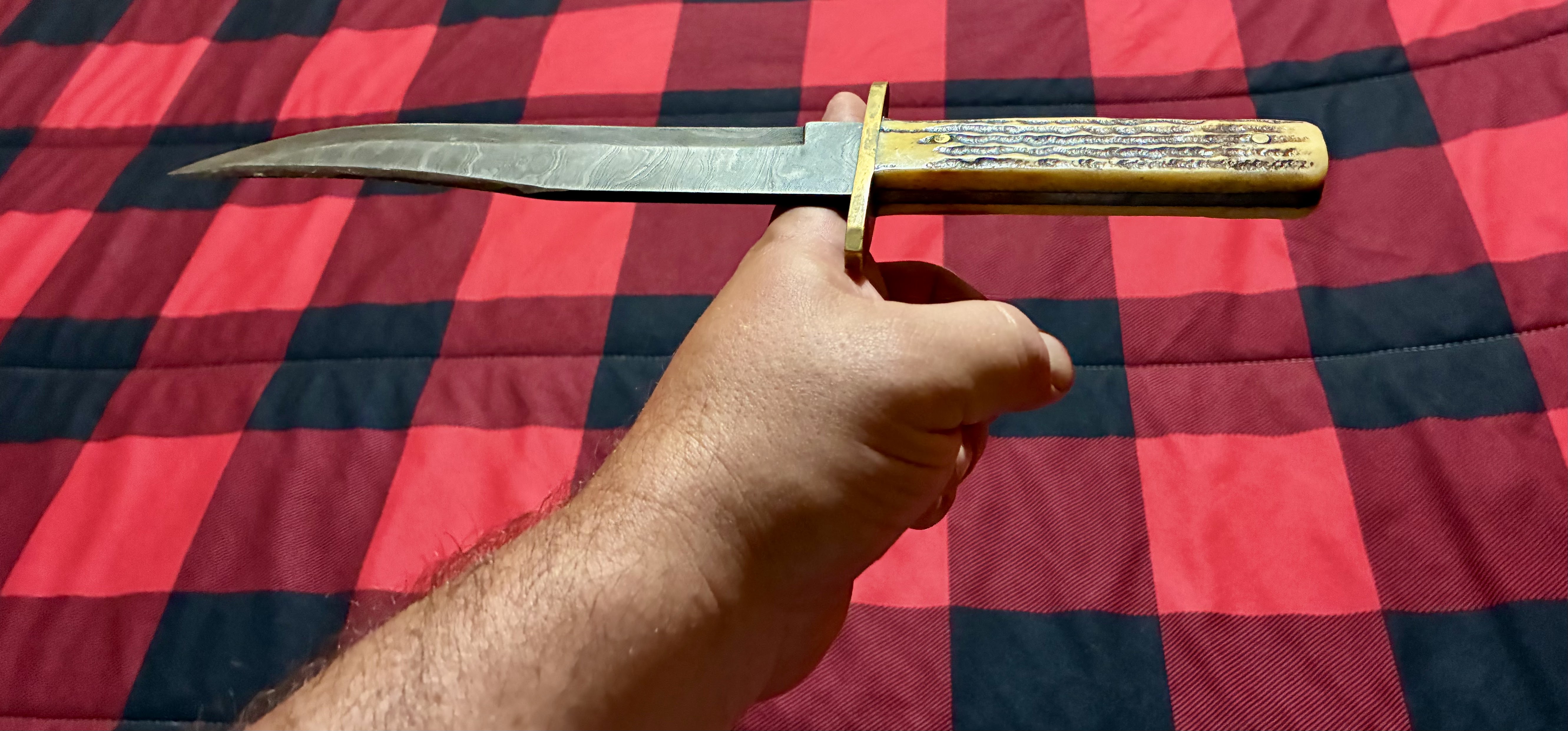
I'm thinking of that thing we do to test the balance of a blade, where you put it longways across one finger and find where it balances. The blade may be longer than the hilt, but the hilt is more densely constructed; if so, the blade's tip may be much further out from your finger than the tip of the hilt, but it balances there. That's just another analogy, of course, and it's one I'm creating and importing to the text. It's not there in the original; I just find it helpful in conceptualizing the model.
Here is what I mean by that.

Balancing point on a Type XII arming sword, common c. 13th century.

Balancing point on a typical American Bowie knife.

As you can see, the balancing point is sometimes much closer to the middle, and sometimes much closer to one end than the other. The blade is balanced perhaps well forward of the guard, perhaps nearly upon it. Sometimes it's the exact middle of the blade, which we sometimes refer to as 'perfectly balanced,' but sometimes the tip of the blade extends well beyond the balancing point.

Again, it's just another analogy, and it's mine instead of Aristotle's. If you find it helpful in conceptualizing the point he's making about finding the exactly right place between two extremes, however, that's good. Use the analogy as far as it is useful. 

It does amuse me to wonder if Aristotle's most famous student had this insight, and if he brought it to his master's attention. That student was well-familiar with such tools! If so, however, it didn't survive to us in the text.

UPDATE: It occurs to me that I ought to point out that blades are balanced the way they are for a reason: even if we speak of a 'perfectly balanced' blade as being in the exact middle, that doesn't mean another way is wrong. A perfectly balanced knife is good for throwing, though you can throw any of them if you can figure out their rotation properly. I enjoy axe throwing, and usually the axes aren't balanced with that consideration at all. You just have to figure out how far away you have to stand to have them strike at the correct point in their rotation.

A rapier (and similarly, thrusting weapons) is often balanced 'towards the hilt' as this allows the point to be moved rapidly and precisely to a desired position. Having most of the weight closer to the hand, or in the hand, means that smaller and gentler movements can be used to direct the point to exactly where you want it to go.

A slashing weapon is often balanced 'towards the blade.' This is because a sword is essentially a lever, and the lever's effect is greatest at the opposite end of the lever rather than in the middle. Since F=ma, putting more of the mass towards the place where the lever will exert more force on it increases the acceleration the lever produces, and thus the force of impact. 

All of these considerations also have analogs to ethics. Ethics is about getting things inside us right to deal with the world outside of us. Thus, we too may find that the correct balancing point is sometimes here, and sometimes over there. It's not an operation of looking inside of ourselves and determining how much bravery, or anger, or temperance is best for us: we also have to consider how much the external situation requires.

Departments of Analysis

Noting a 'professor of American studies' who wants to dismantle America, this Substack asks
Ironically, she’ll be teaching this anti-American rhetoric for Macalester’s American Studies Department. More like Anti-American Studies?
Well, no; the business of analyzing anything is the business of breaking it apart. That is what the word "analysis" means.
1580s, "resolution of anything complex into simple elements" (opposite of synthesis), from Medieval Latin analysis (15c.), from Greek analysis "solution of a problem by analysis," literally "a breaking up, a loosening, releasing," noun of action from analyein "unloose, release, set free; to loose a ship from its moorings," in Aristotle, "to analyze," from ana "up, back, throughout" (see ana-) + lysis "a loosening," from lyein "to unfasten" (from PIE root *leu- "to loosen, divide, cut apart").
There's a Chinese critique of the Western way of learning that we study a flower by cutting it into its component parts, then studying each in turn to understand the whole. We generate a deeper understanding, but we also thereby destroy the flower and its beauty.

When I was studying at the University of Georgia, one of their lawyers told me that they got by far the most civil rights complaints from the Department of Religion, because students would take courses on their own religion and be deeply offended at the analysis of its core claims. Naturally a department of 'American Studies' is going to do the same thing for America. 

You might say, "Well, Grim, what about the department of Women's Studies? Isn't that for promotion of women's interests?" "What about African-American studies?" Perhaps those departments are intended in that way; but look at the effect it has on the people who study them. The ones I know who've gone on to happiness have done so by walking away from the department's core claims and embracing a more traditional life at least in those core elements. 

Nicomachean Ethics II.8

This chapter is a fairly technical spelling-out of how Aristotle conceives of his model. It's an analog to mathematics, but it isn't meant to be a mathematical model, just like one. His model for motion in the Physics in which there are two contraries and a substrate is the real model, as I have already mentioned. We are, in this case, the substrate that unifies the contraries and allows for motion between them: we have the capacity to be cowardly or brave, and can shift our position between those extremes in search of the right balancing point.

There are three kinds of disposition, then, two of them vices, involving excess and deficiency respectively, and one a virtue, viz. the mean, and all are in a sense opposed to all; for the extreme states are contrary both to the intermediate state and to each other, and the intermediate to the extremes; as the equal is greater relatively to the less, less relatively to the greater, so the middle states are excessive relatively to the deficiencies, deficient relatively to the excesses, both in passions and in actions. For the brave man appears rash relatively to the coward, and cowardly relatively to the rash man; and similarly the temperate man appears self-indulgent relatively to the insensible man, insensible relatively to the self-indulgent, and the liberal man prodigal relatively to the mean man, mean relatively to the prodigal. Hence also the people at the extremes push the intermediate man each over to the other, and the brave man is called rash by the coward, cowardly by the rash man, and correspondingly in the other cases.

That's a good point about how we perceive each other, as well as the effect we tend to have on each other in deliberating together. The rash man thinks of the brave man as cowardly; and by associating with the rash, the brave man may move away from the correct balancing point as they draw him towards their position. It's important to choose your friends carefully if you are to live the best life. 

These states being thus opposed to one another, the greatest contrariety is that of the extremes to each other, rather than to the intermediate; for these are further from each other than from the intermediate, as the great is further from the small and the small from the great than both are from the equal. Again, to the intermediate some extremes show a certain likeness, as that of rashness to courage and that of prodigality to liberality; but the extremes show the greatest unlikeness to each other; now contraries are defined as the things that are furthest from each other, so that things that are further apart are more contrary.

To the mean in some cases the deficiency, in some the excess is more opposed; e.g. it is not rashness, which is an excess, but cowardice, which is a deficiency, that is more opposed to courage, and not insensibility, which is a deficiency, but self-indulgence, which is an excess, that is more opposed to temperance.

Another demonstration that the 'mean' he keeps talking about is not the middle point: sometimes one of the extremes is more opposed to the 'mean' than the other, i.e., the right balancing point may not be in the exact middle. 

This happens from two reasons, one being drawn from the thing itself; for because one extreme is nearer and liker to the intermediate, we oppose not this but rather its contrary to the intermediate. E.g. since rashness is thought liker and nearer to courage, and cowardice more unlike, we oppose rather the latter to courage; for things that are further from the intermediate are thought more contrary to it.

Again, "one extreme is nearer," i.e., we aren't talking about the 'mean' in a strictly mathematical sense even though that term is preferred by translators. The mathematical similarity is analogical, rather than logical.

This, then, is one cause, drawn from the thing itself; another is drawn from ourselves; for the things to which we ourselves more naturally tend seem more contrary to the intermediate. For instance, we ourselves tend more naturally to pleasures, and hence are more easily carried away towards self-indulgence than towards propriety. We describe as contrary to the mean, then, rather the directions in which we more often go to great lengths; and therefore self-indulgence, which is an excess, is the more contrary to temperance.

Another good point about human psychology by Aristotle: relatively few of us are inclined to being insensible to pleasure, so it's really self-indulgence we're guarding against on that particular scale. The other contrary doesn't hold much interest for most of us.  

Classical Schooling

I'm amused with this post on education at the Orthosphere, and approve greatly of the author's unapologetic use of sed contra (and without explanation, assuming a familiarity with Aquinas' work among his readers).

There is a much simpler reason to prefer the Greeks, and to some degree the Romans, as a starting point for a young person's education. Their works are where the foundations of all human forms of enquiry are laid, as written by many of the finest minds in human history who happened to be in dialogue with each other -- sometimes directly, otherwise by only a few years' distance through many common companions. A good education in the Classics prepares you for any other subject because it provides you a grounded position from which to understand the changes in your particular field. 

What we tend to do instead is skip the classics, give a bad version of Newtonian physics to a subset of high school students (how many recent high school graduates do you know who could explain the Ideal Gas Law?), and still have to tell them when they get to college that we only gave (some of) them an antiquated system that needs multiple updates. A few weeks or months with Aristotle at the beginning will better prepare them for the revolution that was Newton, which will mentally prepare them for the further revolutions that were Relativity and Quantum Theory. They will understand the whole thing better for having started at the beginning, and seen the stones on which the initial groundworks were laid.

It's also very beneficial to learn different ways of thinking about the same problems. Just having an alternative mental position that you can adopt for the sake of perspective often sheds new light on any problem that has you stuck.

In any case, I wanted to quote a section because it touches on our ongoing discussion of empathy. He is not using the term in the specific sense that I do, and indeed seems to switch back and forth between 'empathy' and 'sympathy' as is common, but he is making the same point:

Fiction teaches empathy.  Where’s the evidence?  The literary don’t seem to me to cast the net of their sympathy particularly widely.  Fiction doesn’t teach intellectual empathy (being able to think inside other peoples’ belief systems).  Nor does it teach one better to empathize with others from an epistemic distance–I already know how to sympathize with someone when I’m in his head (i.e. no different from sympathizing with myself)

What it teaches you to do is to imagine yourself in the position described, and assume that what you would feel is what the character would feel. That is empathy in the original sense, the art-project sense of creating a character or an image in art that causes the audience to respond to it as if they were in the thing. It is illusory, however: just as he says, it doesn't do anything to help you actually understand someone who is intellectually or epistemically different from you; also as he says, the artists are often very selective in what they want you to imagine yourself being. Not Homer, though: he freely offers you the chance to empathize with Hector and his wife and children, the same as Odysseus and his.

Mimetic Justice


This is one of those cases where everyone knows they're lying, and they know we know, but they persist. At least it's opening a few eyes to how much one cannot trust the government. 

UPDATE: Team Trump is catching semi-friendly fire over the US Steel deal too. 

Nicomachean Ethics II.7

By the standards of modern books, these are very dense sections: they aren't very long, strictly speaking, but there's a lot to understand in every sentence.
We must, however, not only make this general statement, but also apply it to the individual facts. For among statements about conduct those which are general apply more widely, but those which are particular are more genuine, since conduct has to do with individual cases, and our statements must harmonize with the facts in these cases.

This is usefully conferred with Rhetoric I.1, where Aristotle makes a similar point about well-constructed laws: "it is of great moment that well-drawn laws should themselves define all the points they possibly can and leave as few as may be to the decision of the judges." His considerations about the difficulty of finding good judges, and the danger of partisanship and faction, are also valid here.

We may take these cases from our table. With regard to feelings of fear and confidence courage is the mean; of the people who exceed, he who exceeds in fearlessness has no name (many of the states have no name), while the man who exceeds in confidence is rash, and he who exceeds in fear and falls short in confidence is a coward.

As I have often said here, courage is the exemplary virtue. It is the model by which all the others are understood. There will be more on it later. 

With regard to pleasures and pains- not all of them, and not so much with regard to the pains- the mean is temperance, the excess self-indulgence. Persons deficient with regard to the pleasures are not often found; hence such persons also have received no name. But let us call them 'insensible'.

One occasionally hears of people who are not sexually attracted to other human beings, for example. 

With regard to giving and taking of money the mean is liberality, the excess and the defect prodigality and meanness. In these actions people exceed and fall short in contrary ways; the prodigal exceeds in spending and falls short in taking, while the mean man exceeds in taking and falls short in spending. (At present we are giving a mere outline or summary, and are satisfied with this; later these states will be more exactly determined.) With regard to money there are also other dispositions- a mean, magnificence (for the magnificent man differs from the liberal man; the former deals with large sums, the latter with small ones), an excess, tastelessness and vulgarity, and a deficiency, niggardliness; these differ from the states opposed to liberality, and the mode of their difference will be stated later.

As he says, these states will be examined in greater detail later; this is just an initial outline to make the plan of the work clear. 

With regard to honour and dishonour the mean is proper pride, the excess is known as a sort of 'empty vanity', and the deficiency is undue humility; and as we said liberality was related to magnificence, differing from it by dealing with small sums, so there is a state similarly related to proper pride, being concerned with small honours while that is concerned with great. For it is possible to desire honour as one ought, and more than one ought, and less, and the man who exceeds in his desires is called ambitious, the man who falls short unambitious, while the intermediate person has no name. The dispositions also are nameless, except that that of the ambitious man is called ambition. Hence the people who are at the extremes lay claim to the middle place; and we ourselves sometimes call the intermediate person ambitious and sometimes unambitious, and sometimes praise the ambitious man and sometimes the unambitious. The reason of our doing this will be stated in what follows; but now let us speak of the remaining states according to the method which has been indicated.

Immanuel Kant also makes the point that excess humility is a kind of servility that is unworthy. (If anyone wishes to compare, Ak. 6:434-7; he treats 'proper pride' and arrogance at 6:465-6. In Kant's system these things that are connected in Aristotle are separated: Kant conceives of ethics not principally as virtues, though he talks about all these virtues, but as duties. The duty not to be servile is a duty to one's self; the duty not to be arrogant and to restrain your pride appropriately is a duty to others. Thus, they appear in different places in his work.)

With regard to anger also there is an excess, a deficiency, and a mean. Although they can scarcely be said to have names, yet since we call the intermediate person good-tempered let us call the mean good temper; of the persons at the extremes let the one who exceeds be called irascible, and his vice irascibility, and the man who falls short an inirascible sort of person, and the deficiency inirascibility.

There are also three other means, which have a certain likeness to one another, but differ from one another: for they are all concerned with intercourse in words and actions, but differ in that one is concerned with truth in this sphere, the other two with pleasantness; and of this one kind is exhibited in giving amusement, the other in all the circumstances of life. We must therefore speak of these too, that we may the better see that in all things the mean is praise-worthy, and the extremes neither praiseworthy nor right, but worthy of blame. Now most of these states also have no names, but we must try, as in the other cases, to invent names ourselves so that we may be clear and easy to follow.

The above seems to move us to art again, rather than to virtue; he's talking about the 'virtue' of being a good rather than a poor entertainer. But the ethical issues remain, as becomes apparent:  

With regard to truth, then, the intermediate is a truthful sort of person and the mean may be called truthfulness, while the pretence which exaggerates is boastfulness and the person characterized by it a boaster, and that which understates is mock modesty and the person characterized by it mock-modest. With regard to pleasantness in the giving of amusement the intermediate person is ready-witted and the disposition ready wit, the excess is buffoonery and the person characterized by it a buffoon, while the man who falls short is a sort of boor and his state is boorishness. With regard to the remaining kind of pleasantness, that which is exhibited in life in general, the man who is pleasant in the right way is friendly and the mean is friendliness, while the man who exceeds is an obsequious person if he has no end in view, a flatterer if he is aiming at his own advantage, and the man who falls short and is unpleasant in all circumstances is a quarrelsome and surly sort of person.

Friendship will prove to be quite important in the later books of the EN; truth-telling is obviously a moral concern. Being witty remains a surprising addition, but since it is tied to being able to make and keep friends, you can at least see the connection.  

There are also means in the passions and concerned with the passions; since shame is not a virtue, and yet praise is extended to the modest man. For even in these matters one man is said to be intermediate, and another to exceed, as for instance the bashful man who is ashamed of everything; while he who falls short or is not ashamed of anything at all is shameless, and the intermediate person is modest. Righteous indignation is a mean between envy and spite, and these states are concerned with the pain and pleasure that are felt at the fortunes of our neighbours; the man who is characterized by righteous indignation is pained at undeserved good fortune, the envious man, going beyond him, is pained at all good fortune, and the spiteful man falls so far short of being pained that he even rejoices. But these states there will be an opportunity of describing elsewhere; with regard to justice, since it has not one simple meaning, we shall, after describing the other states, distinguish its two kinds and say how each of them is a mean; and similarly we shall treat also of the rational virtues. 

That is the plan for the next few parts. 

Migration Problems

Mexicans are unhappy about American aliens invading their neighborhoods.
In handwritten signs and graffiti, the protesters made their anger at the influx of foreigners who have recently settled in Mexico City clear:

“Gringo, go home!” “Speak Spanish or Die!” “Gentrification is colonization!”...

 Foreign remote workers began relocating in large numbers to Mexico City during the coronavirus pandemic, settling largely in central, pedestrian-friendly neighborhoods such as Condesa and Roma.

Jarring many longtime residents, these areas have developed into bastions where more English than Spanish is spoken in some sidewalk cafes, and in which co-working spaces, Pilates studios, specialty food stores and clothing boutiques have sprouted, catering to the recent arrivals.

I've already written the post about this, but the disruption of communities is an unrecognized human universal that our society has no good way of talking about. It doesn't really matter if the migration is legal or illegal in terms of the destruction of existing communities and ways of life. 

It doesn't matter if it's internal to a nation, even, as I observed watching Northern American citizen migrants to Atlanta overrun and destroy the way of life where I grew up. It was the same problem: 

Ms. Sheinbaum also acknowledged the demonstrators’ concerns, and how tempers are flaring in Mexico City, North America’s largest metropolis, around the arrival of thousands of relatively well-off foreigners, especially from the United States. Many longtime residents are fuming over rising rents and food prices in parts of the city.

“The playing field is not level,” said Daniela Grave, a resident attending the protest. “If they make a living in dollars, and don’t pay taxes here, we are just in unequal circumstances, Mexicans and foreigners, where those who have salaries in dollars have all the power to exert in this city and that is what should be regulated.”

What happened between the 1970s and the 1990s was that a whole lot of corporations moved South, where everything was cheaper. Their workers could also then move South, selling a home in New York City that was worth enough to buy a big home in Atlanta or to build a McMansion in one of the small towns nearby. Those small towns quickly became suburbs instead of small towns; the farmland was bought up and turned into subdivisions.

Everyone who had lived there was priced out and had to leave the place where their parents and grandparents had lived. Property values went up, so taxes went up to the point that you couldn't keep the family home. All the extra money brought inflation, too. As your neighbors sold out and left, churches shrank or closed, the old family-run shops were sold and replaced with cheaply built chains, and all your friends drifted away until there was nobody left.

We really need a better way to address this human universal of meaning and community, and to address how it gets lost in mass migration -- whether of poor workers to rich countries, or rich workers to poorer, cheaper ones.

Nicomachean Ethics II.6b

If it is thus, then, that every art does its work well- by looking to the intermediate and judging its works by this standard (so that we often say of good works of art that it is not possible either to take away or to add anything, implying that excess and defect destroy the goodness of works of art, while the mean preserves it; and good artists, as we say, look to this in their work), and if, further, virtue is more exact and better than any art, as nature also is, then virtue must have the quality of aiming at the intermediate.

That's a long deduction with two questionable assumptions.  (A) IF every art does its work well by creating works that can't be improved either by adding or taking away; (B) AND IF virtue is more exact and better than any art (as nature is); (C) THEN virtue must have the quality of aiming at this intermediate point of balance.

So (A∧B)⊃C, for those of you who want to study philosophy formally. Or, you can put it this way: 

(Assumption) A
(Assumption) B
∴ C

The deduction follows if the assumptions are true. Are they true? 

It isn't clear to me that the first assumption is true. In The Singer of Tales, Albert Lord demonstrates that much of the heroic poetry of the Homeric tradition was oral by nature, and part of a performance was to edit it to fit the audience's interest level and available time. For that audience, such a shortening or stretching improved the work; but arguably no such work was an actual improvement over Homer's version. These are of course two different works, and one could argue that each performance has to hit the right balancing point ("intermediate" or "mean") for its audience. However, one can also admit that there is nothing wrong with Homer's work -- that's why it has endured for millennia -- even though it could be improved for a particular audience by editing it (or even stretching it, although it's already quite long). 

The second assumption turns on an important ambiguity in what it means to be 'better than.' Aristotle says here that nature is better than any art; and in Physics II and elsewhere, he says that 'art imitates nature.' However, as we have already discussed, art has a crucial role in perfecting the flaws found in nature, as by improving eyesight when the natural eye is weak. If art can perfect nature, it can't be 'less good' because you perfect something by bringing it to a greater good than it had by itself. 

I suspect this means that 'good' is being used in two senses here. Nature is the source of everything to which we might apply an art, and creates the basic things that our arts can only improve upon but not make from nothing. In that sense, nature is higher and better than art. Yet art must have a 'good' to offer insofar as it is being applied; and that good is based upon the ability of us to understand the reasoning behind the created thing (telos) so that we can intuit how to improve it. 

Given the structure of the deduction, if either of the assumptions are false, the deduction fails. That doesn't mean the conclusion is false; it just means that the logic itself cannot guarantee the truth of the conclusion. 

I mean moral virtue; for it is this that is concerned with passions and actions, and in these there is excess, defect, and the intermediate. For instance, both fear and confidence and appetite and anger and pity and in general pleasure and pain may be felt both too much and too little, and in both cases not well; but to feel them at the right times, with reference to the right objects, towards the right people, with the right motive, and in the right way, is what is both intermediate and best, and this is characteristic of virtue. Similarly with regard to actions also there is excess, defect, and the intermediate. Now virtue is concerned with passions and actions, in which excess is a form of failure, and so is defect, while the intermediate is praised and is a form of success; and being praised and being successful are both characteristics of virtue. Therefore virtue is a kind of mean, since, as we have seen, it aims at what is intermediate.

Again, it is possible to fail in many ways (for evil belongs to the class of the unlimited, as the Pythagoreans conjectured, and good to that of the limited), while to succeed is possible only in one way (for which reason also one is easy and the other difficult- to miss the mark easy, to hit it difficult); for these reasons also, then, excess and defect are characteristic of vice, and the mean of virtue;

For men are good in but one way, but bad in many.

Aristotle's understanding of what he sometimes calls "the so-called Pythagoreans" is helpfully explained here.

Virtue, then, is a state of character concerned with choice, lying in a mean, i.e. the mean relative to us, this being determined by a rational principle, and by that principle by which the man of practical wisdom would determine it. Now it is a mean between two vices,* that which depends on excess and that which depends on defect; and again it is a mean because the vices respectively fall short of or exceed what is right in both passions and actions, while virtue both finds and chooses that which is intermediate. Hence in respect of its substance and the definition which states its essence virtue is a mean, with regard to what is best and right an extreme.

* Or three, or more; when we get to courage you will see that he has two different defects on the excess side of the ledger. 

But not every action nor every passion admits of a mean; for some have names that already imply badness, e.g. spite, shamelessness, envy, and in the case of actions adultery, theft, murder; for all of these and suchlike things imply by their names that they are themselves bad, and not the excesses or deficiencies of them. It is not possible, then, ever to be right with regard to them; one must always be wrong. Nor does goodness or badness with regard to such things depend on committing adultery with the right woman, at the right time, and in the right way, but simply to do any of them is to go wrong.

There is no virtuous way to commit adultery, then; and he mentions murder as well. It's worth thinking about all those 'would you go back to kill Hitler' thought experiments, then. The only reason to consider such a thing (were it possible) is that it might be virtuous; here we are told there can be no right way to do it.  

It would be equally absurd, then, to expect that in unjust, cowardly, and voluptuous action there should be a mean, an excess, and a deficiency; for at that rate there would be a mean of excess and of deficiency, an excess of excess, and a deficiency of deficiency.

This is a very Aristotelian point.  

But as there is no excess and deficiency of temperance and courage because what is intermediate is in a sense an extreme, so too of the actions we have mentioned there is no mean nor any excess and deficiency, but however they are done they are wrong; for in general there is neither a mean of excess and deficiency, nor excess and deficiency of a mean.

All of that will become clearer once we get to the examples of specific virtues.  

Riding Report: I-40 at the Pigeon

Yesterday I took I-40 through the Pigeon River Gorge for the first time since Hurricane Helene. The interstate was closed again by recent flooding, but is now partly re-opened. I do not recommend it at this time. 

The road is beautiful, running through impressive sections of the Pisgah and Cherokee National Forests and near the border of the Great Smoky Mountains National Park. However, it is still greatly congested due to the fact that only one lane is open each way in places. Semis and other heavy traffic need that road to get over the border without having to make long detours. 

On the other hand, US 25/70 was much clearer than it was when I went through a couple weeks ago. It's now resumed its normal role as a scenic highway by the beautiful French Broad River. If you're planning a ride, or are in a passenger car, you might want to take the scenic route and leave the interstate to the big rigs. You'll probably get there faster anyway.

One of my fellows on yesterday's ride had a battery cell failure, which first caused him to need to seek a jump box from fellow travelers at the rest stop, and then caused the bike to fail entirely outside of Newport, Tennessee. I gave him a lift into town. Fortunately there was an auto parts store close to the interstate that sold the right kind of battery for his bike. Of course he dropped one of the bolts into the middle drive, so we had to fish for it with a magnet for a long time in the very hot July sun. Eventually, however, we got back underway.

It's a whole lot hotter down in the valley. Here on the mountain today it is 82, which is about as hot as it gets up here. I've seen it as high as 84. If you ride up onto the Blue Ridge Parkway, which is as much as 2,500 feet higher than I am here, it's pleasant camping weather. If any of you are considering that, the Grandfather Mountain Scottish Highland Games is next weekend. It is one of my old favorites, part of our honeymoon trip 26 years ago and an event we have returned to many times. Pack rain gear, though: it's pleasant, but this time of year you can bet on a good hard rain for at least a half-hour of every afternoon. 

The Spirit of Rebellion


UPDATE: 


Happy Independence Day.

Mike Rowe Teaches Everyone How to Sing the Star-Spangled Banner


And 249 years ago today ...

BBB passes the House

About an hour ago. Will be signed into law by this evening.

Pig in the Smoke

Conan stands watch over the pork

In preparation for the Independence Day feast, I have had a pork butt in the smoker since the early morning. There will also be three kinds of sausages reflecting the America 'melting pot' of cultures: German bratwurst, French/Cajun andouille, and Spanish/Mexican chorizo. The pulled pork is a classic of Southern American cuisine, of course.

American beer will be served, Pabst Blue Ribbon and Dale's American Pale Ale. Prospective guests must get past a German Shepherd dog who doesn't know you.