The Crusader Returns from Captivity

THE CRUSADER RETURNS FROM CAPTIVITY

by G. K. Chesterton

I have come forth alive from the land of purple and poison and glamour,
Where the charm is strong as the torture, being chosen to change the mind;
Torture of wordless dance and wineless feast without clamour,
Palace hidden in palace, garden with garden behind;

Women veiled in the sun, or bare as brass in the shadows,
And the endless eyeless patterns where each thing seems an eye....
And my stride is on Caesar's sand where it slides to the English meadows,
To the last low woods of Sussex and the road that goes to Rye.

In the cool and careless woods the eyes of the eunuchs burned not,
But the wild hawk went before me, being free to return or roam,
The hills had broad unconscious backs; and the tree-tops turned not,
And the huts were heedless of me: and I knew I was at home.

And I saw my lady afar and her holy freedom upon her,
A head, without veil, averted, and not to be turned with charms,
And I heard above bannerets blown the intolerant trumpets of honour,
That usher with iron laughter the coming of Christian arms.

My shield hangs stainless still; but I shall not go where they praise it,
A sword is still at my side, but I shall not ride with the King.
Only to walk and to walk and to stun my soul and amaze it,
A day with the stone and the sparrow and every marvellous thing.

I have trod the curves of the Crescent, in the maze of them that adore it,
Curved around doorless chambers and unbeholden abodes,
But I walk in the maze no more; on the sign of the cross I swore it,
The wild white cross of freedom, the sign of the white cross-roads.

And the land shall leave me or take, and the Woman take me or leave me,
There shall be no more Night, or nightmares seen in a glass;
But Life shall hold me alive, and Death shall never deceive me
As long as I walk in England in the lanes that let me pass.

MLK Day, According to the FBI

The shamelessness of the FBI knows no bounds.


An Example of the Insufficiency of Liberalism

One of the biggest challenges the liberal order is facing in the West today arises from opposition to immigration. This opposition is understood, by the powerful for whom immigration provides access to cheap labor, as a sort-of racism that should be explained as an unwillingness to extend to foreign-born others the same rights we enjoy ourselves. Liberalism tends to universalize discussions of rights, so why shouldn't someone born abroad have the same rights as human beings born in America? It's obviously just selfishness on the part of Americans, a desire to continue to enjoy an unfair advantage (argue the masters of the capitalist order, who want these people to pick their vegetables at starvation wages).

That's not really what's driving the objection. The real force of the objection is that mass movement -- immigration or migration within a nation, doesn't matter -- disrupts and destroys communities that are the basis of almost all human meaning. It's not really an objection to the people coming in as if they were inferior people: it's an objection to communities and cultures being destroyed, when those things are where we get almost all of the sense of meaning we derive from human life. 

A culture is defined as "a way of life." Ways of life exist among people who live together and share personal connections. You don't know and can't know everyone, but you do know the nice lady at your favorite coffee shop, or library, or bar; you know the people you met at church, or work, or school. You grew up participating in institutions like a church or the Boy Scouts or your town in your home state, with its local sports teams and friends you know from interactions around the place where you live. Together you have built a culture, and it really does depend on the stability of all those things. 

While you get a certain amount of your sense of meaning in life from philosophy or your personal engagement with religion, most of your sense of meaning and being important comes from your interactions with other people. Those are the people who are part of your culture, including your family. When the institutions, including the family, are badly disrupted you lose the connections that make your life meaningful and worth living. 

Of course human beings object to that. If you want a universalizing explanation a la liberalism, this is a universal human drive that is at work.

You can see just how universal it is by looking at the phenonmenon of objections to gentrification. Now gentrification has clear benefits, just like cheap labor results in cheap vegetables. The gentrifying town is getting nicer. Those who lived there thus have a nicer place to live, with less crime and better shops. They might even get a better job as wages increase and labor is needed by those better shops. Yet gentrification, another localized form of mass movement, is objected to just as strongly as mass migration of any sort. The people objecting to it are often on the other side of the spectrum of economic life, too: it's the poor objecting to rich people moving in, rather than richer people objecting to poorer people. The problem is the same one, though. The gentrification is disrupting the community, forcing people to move out as well as they can't afford the higher taxes and cost of living. Soon the institutions that sustain a meaningful life are broken up, families are dispersed seeking places they can live, churches cease to exist, and individuals are stripped of the relationships that made their lives important and worthwhile. 

Liberalism doesn't have the machinery to address this basic drive. As mentioned it responds to objection to migration with charges of racism; it responds to objections to gentrification with a defense of property rights. The richer people bought that land fair and square, and now it's their land to use within the forms of the law. 

Meanwhile even positive laws can't be allowed to violate fundamental rights, and both "equality of rights" and "property rights" are fundamental rights. The law might oppose illegal immigration, but you can't stand on the law when people are suffering: that violates their equality. The law might support gentrification, which is an exercise of a fundamental property right, so you can't oppose gentrification without breaking the law. 

Part of the reason there's such fear of fascism in spite of an absence of fascism is that the opposition arising from this basic violation of a human need are characterized as fascists. Some of them, indeed, adopt the term for themselves because they also -- being liberals -- lack a conceptual non-liberal way of understanding this drive other than the one they are being charged with by their opponents. So they start chanting Sig Heil, accepting that they must be fascists because they can't walk away from the basic human need that the system is violating. 

Mostly people don't do that, though. Mostly they just put up with being miscatergorized, and fight for what they know they need without having a way to explain that need that makes sense to others. Because the liberal order doesn't have a language for this, they can't make themselves understood to their opponents, and ultimately we aren't able to reason together about these problems. 

That's too bad. Unless we find a way to transcend that contradiction, as Hegel might say, we're going to end up fighting over it. It's a stupid fight, too, because all human beings really do want the stability that allows for a flourishing community in which they can find meaning and durable relationships. The liberal/capitalist order violates that stability by its nature, because it is always organizing for maximal freedom and maximal economic efficiency. Stability gets in the way of those things, and thus is thrust aside. Literally everyone is less happy as a result, and yet the intellectual framework keeps us from being able to talk with each other about it.

The Central "Uniparty" Thesis

Now what Wauck actually wanted to talk about in his "Uniparty" essay, as opposed to the part that interested me, was the failure-by-success of liberalism as discussed by Patrick Deneen.

I will let Wauck's summary of Deneen's argument stand. In brief, the success of liberalism was so complete in the United States that we got a 'Uniparty' because both Democrats and Republicans are liberal political parties. What is meant by the term "liberalism" here is not a common usage, but the formal usage by political philosophers, and a review of the political philosophy immediately demonstrates that there isn't actually agreement there about what it means. Somewhat like God, which is appropriate given that the ideology has assumed an almost godlike power in America, it is easiest to define negatively: we can't say for sure what an infinite being* might be in our finite language, but we can say that he isn't evil or stupid or mean or base. 

So we can say that, whatever liberalism is, it isn't an ideology that suggests that human beings are rightly kept as slaves. There is a kind of presumption that any restrictions on human liberty need to be justified in one of several ways; different kinds of liberals may accept restrictions on human liberty in service to other expressions of human liberty. 

The argument that America embraces liberalism in this largest sense is persuasive. We have so-called 'positive liberals' who believe that humans have a right to things like health care or housing, and thus a right to impose upon other human beings in order to obtain those things; we have so-called 'negative liberals' who reject that in favor a right to be free of compelled labor to provide you with housing or health care. We have Republican Liberals (see the link above: this means Roman Republic philosophy) who believe that the point is to keep everyone free from arbitrary domination. 

We don't really have fascists, as much as the term gets tossed around: Americans don't believe in an all-powerful, all-organizing state. Even the most statist among us have rights they think the government has no legitimate power to transgress: they'll be the first to sound off, in fact, if those rights are violated. Your finest "the government should take over the family and organize all businesses in order to ensure that health care and housing are provided and everyone has the right not to feel oppressed" is still going to squawk when the government violates their freedom of speech, of organization, or of political action.

I won't go through the Deneen arguments, as Wauk does that at length. I will say that his idea that liberalism contains the seeds of its own destruction is a regular feature of arguments against liberalism and/or capitalism. Marx is all about the contradictions inherent in the capitalist system, and he got the idea from Hegel. For Hegel, all ideas of any sort have internal contradictions that ultimately render them insufficient, requiring us to first confront the difficulties of the contradictions and then find a way to transcend them. Hegel thought this was part of a grand cycle for created beings, beginning at much lower levels of consciousness than humans and continuing beyond anything we have yet attained. Eventually it leads us back to God, he believed. 

Deneen thought we could no longer make sufficient arguments for tradition or authority because even objections to them have to be cast in liberal terms in the American model. There's definitely something to that idea, which I will briefly discuss in a third post on the subject.


*Whether or not infinity is even an appropriate description for the divine is disputed. Some philosophers have really liked to use that concept: see e.g. Nicholas of Cusa, who even liked to draw mathematical diagrams to illuminate the problem of trying to understand God from a finite perspective. Others -- convincingly to me -- explain the infinite as still functioning as a limited concept within Creation, and reject it as appropriate to apply to a being that genuinely sits beyond and outside of Creation. Liberalism is not God, though, and is a created 'being,' so there's no similar issue for our present analogy.

Wauk "On the Uniparty"

I notice that with several of these essays lately, I've been inclined to write two posts: one about the asides that are often more interesting than the main thesis, and one about the main thesis. So too with this one, Mark Wauk's "On the Uniparty."

There are several interesting and challenging ideas here. One of them is that the American Constitution was a kind of coup by a fading power against the rest of the country:
The last time we saw the Federalist Party was in 1816. Still, they occupy an important place in American history—after all, they led the first coup, and a wildly successful one to boot. What, you ask? Recall—the US Constitution. The proto-Federalists seized the opportunity of their leading opponents being out of the country to declare a “Constitutional Convention”, despite the US already having a Constitution—the Articles of Confederation. Conveniently, the population of the country didn’t get to actually vote on this new Constitution.

There's something to this idea. You may recall that the Federalists favored, inter alia, the Bank of the United States. They managed to enact this central bank, and it survived until the first genuinely democratic counterrevolution led by Andrew Jackson destroyed it. No central bank existed in the United States until another anti-democratic coup established the Fed in 1913 (a non-government organization that was ceeded the power to control the American dollar). Revoking the Fed's authority is often discussed by Americans interested in politics, but it is almost anathema among those who actually get elected to office. You might ask if we are on the verge of a similar counterrevolutionary effort now, and if that isn't what Wauk calls the Uniparty really fears.

If you are inclined to accept that the enactment of the Constitution represents a kind of coup, because it represented a real realignment of power that was only covered by a veneer of procedure, there have been several others in American history. Some of these are more-or-less popular, but they all represent points at which the legitimate forms of power transfer were set aside and the result was papered over with legitimacy after the fact. A brief list off the top of my head:

1) The Reconstruction Amendments (13, 14, 15). These were ratified by main force: states were placed under military occupation until they agreed to ratify them as a partial condition of resuming self-government. Notably Congress allowed these states to change their ratification votes from 'no' to 'yes,' but refused to allow free states in the North to change their votes from 'yes' to 'no' when some of them attempted to do so as a protest against the anti-democratic force being used. These amendments are popular today, and probably now enjoy wide democratic approval (especially the 13th). Nevertheless, especially the 14th Amendment centralized power in the Federal government. That power has been used for purposes both good and bad: it was the core of the Civil Rights crusade against Jim Crow, which was good, but it is also behind the current effort to remove a certain candidate from the ballot even though he appears the odds-on favorite to be elected by the people. Love or hate that guy, the move threatens to delegitimize the election and really the entire system in the eyes of much of the citizenry. 

2) The Fed, as mentioned already. There was a law passed, but this was really an Article V-level transfer of power from the government to a nongovernmental organization led by the banks and the rich. It definitely would not have survived the amendment process, so they stole it. 

3) The New Deal. FDR had a significant amount of democratic legitimacy, but his efforts were unconstitutional -- as the Supreme Court determined several times. So, he ran the court packing scheme in order to (successfully) intimidate the Supreme Court into letting him do exactly what they'd said several times was unconstitutional. The biggest part of this power transfer was allowing Congress to delegate its lawmaking authority to the bureaucracy. That's how we got into the mess with ossification that we have today: it allowed for a vast administrative state of the kind that Max Weber was warning against at about the same time (see the Weber commentary on the sidebar). 

*4) The JFK Assassination. I am giving this one an asterisk and not counting it because the facts still aren't fully clear; however, it is widely believed to have been a coup by agents within the government. Was it? I don't know. 

4) The Coup against Nixon: The election of 1972 was a landslide in favor of President Nixon, who used it to finalize his end to the JFK/LBJ Vietnam conflict. The administrative state turned against him and worked with his opponents outside the government to set up a popular campaign to impeach him. His resignation was legal, but it resulted in a power transfer to agents of Wauk's "Uniparty" that allowed them to undo much of what they feared he was doing. 

5) The Obama-era "Iran Deal." Obama's government set up a series of fake NGOs that they then credentialed by having the White House recognize them and treat them as legitimate experts. The media was thereby taught to listen to them and re-report their 'findings' as if they were real experts. (This is not in dispute: Ben Rhodes, Obama's message guy for this 'echo chamber,' explained it all in an interview with the New Yorker after the fact.) With the appearance of strong NGO support and the media almost universally echoing it, Obama got away with inverting the treaty approval process required by the Constitution. Instead of a 2/3rds majority of the Senate voting to ratify the process, he managed to set things up so that a 2/3rds majority was required to reject his approach. As a consequence, he got his agreement and Iran got a lot of money as well as technical help on nuclear power.

6) The 2020 Election. Setting aside the parts of the controversy that are in dispute, the "fortification" efforts described to the press by participants already suffice to make the election unconstitutional because they weren't carried out by state or Federal legislatures as the Constitution requires. I would also add the courts' refusal to grant standing (most egregious when Texas sued, as the Constitution clearly grants the Supreme Court the authority to resolve disputes between states), so that no one could challenge the results; and the widespread and successful efforts to prevent audits in the affected states, and to disable similar inquiries where they could not be prevented.

There are some other candidates we might mention, but this list already suggests that this kind of coup is an ordinary feature of American politics. When power finds its heart's desire to be out of order with the Constitution, a way is found around the legitimate order and then is papered over. We live with the illusion that the Constitutional order has been maintained since the late 18th century, but in fact it has been fundamentally altered several times without lawful process.

Escape from Mordor

You all know the line about how one does not simply walk into Mordor. Well, today it’s flying out that’s not working. 


I did manage to get as far as Virginia, though that wasn’t easy either. The Metro train’s blue/orange/silver lines were down, cutting off both airports that way. The yellow line was still running to Reagan, but it was delayed inexplicably. I finally got to the airport, and even onto an earlier flight to try to dodge the storms, but it was delayed until it was too late. 

Ah, well. Getting home safe is the only thing that matters. If it takes a little longer, that’s not so bad. 

UPDATE: We made it to Charlotte. That was quite a ride. 

There was a tiny baby in arms on the row ahead of me, with her mother and father. She slept perfectly soundly through the roughest airplane ride I’ve ever had. Her mother said she expected the baby to go flying through the air at several points, but she slept quietly through all of it. 

UPDATE: Not going to make it tonight. We flew to Asheville but they turned us around due to fog once we got there. It’s just been a difficult day for travel. 

Back to Mordor

A short trip this time, but I’ll be back in DC until Friday evening. Light posting from the road. 

In what universe?

Not to dump on this single Gen Z-er, whose video went viral, because it seems that every generation finds the burdens of independent adult living a big splash of ice-cold water. But do you recall that it was difficult to find an entry-level job that paid enough to cover an apartment you didn't have to share with someone? Not only did I not manage to live alone for years after college, I never really did: I got by in a cheap shared commune-like house for many years, then moved out with my husband when we finally could swing a house mortgage together. That was in 1987, after I'd graduated from law school and had a solid paycheck, and he was going back to school to study engineering. We were 31 and 33 at that point.

Thinking back, I can barely recall even distant acquaintances who could afford to live alone immediately after college, unless their bills were being paid by wealthy parents. I knew a handful of married couples who pulled it off quite young.

I can't bring myself to be shocked that a single entry-level unskilled job won't support an independent household. I'm not even inclined to blame it on disastrous economic policies embraced by either party over the last 50 years. It's nothing but a juvenile pipedream for most people, and a strong hint that they need a better plan than to sign on at the nearest WalMart and sleepwalk through the working day.

I've got a teenager working for me now, walking my excessive dog population once a day for about an hour total. At first, he was predictably clueless about the concept of wages for hire. He showed a strong tendency not to show up for a variety of lame reasons. I had a heart-to-heart with him, though, and he's settled down nicely. He lives nearby and can bicycle here. He understands that the options for paid work are harshly limited for kids living in the middle of nowhere with no driver's license. He gets on well with my dogs, shows up 7 days a week on time, says "Yes, Ma'am" while making eye contact, and is losing that dreamy "why am I here?" affect. I have some hope he'll land a real job at some point and have the personal skills to keep it.

Related: Federal Involvement in the Infamous Riot

With the understanding that the journalist involved here has a vested interest in shocking stories, and the Congressman he's interviewing certainly must also have an angle, these claims are official given that they are being raised as a result of a Congressional investigation.
Rep. Clay Higgins (R-La.), who has been investigating the Capitol riot, says that there were at least 200 undercover FBI assets embedded in the crowd, inside and outside of the Capitol Building..... 

FBI Director Wray has long refused to answer whether the FBI had assets dressed as Trump supporters at the Capitol that day.

One point that Higgins made was that it is highly improbable that civilians would know how to get around the Capitol without help from people who knew where they were going.

“There’s no way they can come in some random door that gets opened and then get their way directly to Statuary [Hall] or the House chamber or the Senate chamber. It’s just not possible,” Higgins told Carlson....

Higgins says the evidence points to FBI undercover agents who planted the seeds of a "radical occupation" of the Capitol online before Jan. 6.... the evidence suggests that the Capitol riot, which has been used as a pretext to incarcerate Trump supporters without trial and to even prevent Trump from being allowed on the ballot in various states, was a set-up.

“I’m following the evidence, and to my horror, it implicates our FBI at the highest level,” Higgins said.

The usual defense of entrapment as a tactic is that you couldn't entrap people who weren't at least somewhat open to committing the crime. If the crowd had been made up of people who would never consider rioting, committed to peaceful and lawful obedience at all times, even 200 instigators salted through the crowd would not be enough. To my mind police entrapment is always wrong, but that's their usual defense so it's fair to raise the point.

Likewise, Trump himself bears responsibility (link is to my post from that day) for having staged a rally so close to the counting action that was taking place. It doesn't require a brilliant mind to know that a riot was likely given that you concentrated so many of the aggrieved in one place, not that far away from where the votes were being counted. His poor judgment on that day is inexcusable even if the Feds were acting like complete scoundrels. 

That said, the most inexplicable thing about the whole event was the cascade failure of the security systems in place to prevent such things. From about a week after: 

One of the things I've been trying to piece together is how all the various security forces we have in place at the Capitol failed on 6 January. It's quite embarrassing, really: the Capitol Police alone have 2,000 men, the DC National Guard another thousand-plus battalion, and then there's the FBI, the Park Police, the Metro Police Department, the National Guard units from VA and MD that could be called with short notice, even the 3rd Infantry Regiment in Arlington (and the Marines not too far down the road in Quantico). 

We had plenty of guys who could have been there, and plenty of advance notice of a demonstration likely to spin out of control. Yet somehow, dudes with bison hats were wandering the halls of Congress. 

The simplicity of the explanation that the cascade failure was intended, and thus directed, is attractive compared to the nest of coincidences that would otherwise be required as explanators. It also explains why the FBI never found any suspects for the "pipe bombs" that were allegedly planted near party headquarters that day. I remember Jim Hanson -- former Green Beret -- and I looked over the photos and decided the 'bombs' pictured were probably mock-ups instead of real bombs anyway.

Now, the old saying that 'the simplest explanation is always best' -- which is itself a bastardization of Occam's Razor -- is not accurate. The true explanation is always best. Occam's Razor is a heuristic for gamblers, not a truth-identifying tool. The tangled-nest explanation of the cascade failure could be the true explanation: after all, we saw an even more complex cascade failure of our systems during the Afghanistan withdrawl the next year.

Still, a tool for gamblers does tend to identify high-probability bets. This one is worth looking into further, and keeping an open mind about, even if it is currently the fodder of hard right wing Congressmen and journalists. 

Fernandez on 2024's Election

Richard Fernandez (who long blogged under the handle "Wretchard") has been one of the military/political analysts I respect most for many years now. He writes on the mystery of why the Biden campaign has settled upon an attempt to outright delegitimize the election itself. As always his analysis is worth reading for itself, but I take two key points away:

1) A clean victory in an observably-fair 2024 election by the Establishment over Trump and his MAGA politics is the only thing that could actually do away with the challenge Trump and his supporters represent.

2) The pre-emptive attempt to destroy the only bridge to that outcome suggests that a final victory is not what is wanted. 

Fernandez then inquires into what they might be seeking instead.

I think the general consensus has been that the attempt to disquailfy Trump and his most loyal Congressional supporters from running, get him and them off the ballots in key states, and paint their supporters as 'the same exact [thing] as Nazis,' is just that Biden knows he can't win a fair contest. If (1) is already off the table, pursuing something else is the only thing to do. Margret Thatcher used to use the slogan TINA, standing for "There is No Alternative." 

Fernandez thinks it's not as simple as that. The Democratic machine might have pulled out a victory, even given the weights of Biden's evident age and an economy that is dragging, given that the media will reliably gaslight on their behalf. As the Washington Post reports today, the Republican hope to govern is afflicted by their infighting. There's no reason to believe that the Democrats can't win. 

Fernandez observes:
How does one explain the paradox of Biden destroying his one sure means of victory and opting for a course that will probably lead to prolonged and indecisive conflict? The obvious explanation is to observe that is what he always does. He seems to prefer stalemates and chaos over clearcut solution. Why does he frequently do this? The answer is simple. It creates opportunities that would not exist in a clear cut situation. Turning 2024 into neither and yet both a regular election and insurrection would knock a lot of power loose for the grabs and this is perhaps the point.... Recent political developments become less confusing when we relax the assumption that events are ultimately about America. Ambiguity is the enemy of constitutional democracy, but confusion is the friend of operators and dealers. Perhaps the correct paradigm is not to judge events through the prism of national interest but by the criteria of factional gain.
I take him to mean that, just as the Establishment prefers an eternal stalemate in Israel in pursuit of a 'two state solution' that never materializes, and preferreda eternal war in Afghanistan to either withdrawal or victory, and apparently an eternal war Ukraine to giving Ukraine what it would take to win, and eternal 'strategic ambiguity' on China and Taiwan to a resolution either way, here too they prefer the conflict. The point is not to vanquish the Trump/MAGA "insurgency" but to ensure it can never take power, especially because it makes sure it is formalized as the eternal opponent. 

As long as the structural levers can be wielded to be sure they stay in power -- whether changing the voting rules extra-Constitutionally by administrative actions or consent agreements with activist lawsuits, instituting unwatched mail-in "drop boxes," or a rejection of voter ID, or keeping opponents off the ballot by administrative or judicial magic -- it's better for them to have an opponent who is never beaten. They become the enemy in every Hollywood or Disney drama (as, one critic argues, they have been since the 1970s), every political speech, and every campaign. You can stop bothering with policies that help people, because the only thing you need to sell is keeping the dire evil enemy out of power forever. 

Fernandez suggests this is a "political bank-robbery already in progress." He is a keen observer and thinker, none of whom are right about everything but all of whom are worth considering.  Is he wrong?

The Feast of the Epiphany

Today is the final day of the Christmas feast, at least the twelve-day feast of historic fame. It marks the revelation of the Christ to the Magi, and thus symbolically to the whole non-Jewish world. 

Pragmatically this is the traditional day to take down Christmas decorations, which occupied much of my afternoon. I also shifted from feasting to fasting (in the worldly sense of those terms) after New Year’s Eve. We are eating a more sensible diet, and as always I’m observing Dry January. Now that the decorations are gone and things are barren for the winter, we can look forward to a cold, dark season — but one that ends in spring and new hope. 

Surprise! SECDEF Hospitalized

Readers of the Hall are old enough to remember many occasions when a President has been put under for a medical procedure, and the Vice President has been acting President for the day. It’s always been public knowledge, secure in the fact that American government had a well established bench of people who were trusted to take over if the top guy fell. 

Currently, the Secretary of Defense is just being released from a week long hospitalization that was kept secret. (Get well, Secretary Austin.) Military Reporters and Editors is protesting the secrecy as a violation of the Pentagon’s published rules on information sharing. It’s definitely out of order with standard practice, as their letter shows. 

I wonder if it is a result of the President’s own obvious frailty, combined with a generalized sense that the VP is a lightweight who can’t be trusted to take charge? Maybe the powers that be were terrified by the idea that the SECDEF was down too. Maybe they were afraid that, even with the President in place, that would have been too much of a vulnerability if it became clear to foreign powers. 

UPDATE: Apparently they didn’t tell the National Security Council, either. 

UPDATE: Or anyone. 


Liberty Bell 7

A little different, but well within specs. 


Tooling Around


Big ice storm coming through tonight, so I rode over to the clubhouse station to make sure things are in order. 

On the Importance of Prepositions

An opinion piece in today's Washington Post is titled, "I killed a deer in my bathroom." 

Now that sounds unsual! Deer are normally very circumspect around people, and while they might come into your yard in search of apples dropped from your apple tree, or a nutritous grass, they aren't likely to come into your house. I decided to read the piece, expecting perhaps one of those stories in which a deer thought killed by a car is placed somewhere like the trunk of a car, only to revive and need to be dispatched later. Perhaps he was planning to clean it in his shower, avoiding the chill of winter while being able to avail himself of the drain and the showerhead for easy cleanup? That would be insightful for a Washington Post guy.

It turns out that, no, the issue is that the editors decided to fudge the preposition to make the piece sound more interesting. What he really meant was that he had killed a deer from his bathroom, i.e., by shooting out the window. 

The piece is otherwise kind of interesting. It endorses hunting as a humane means of culling a deer herd that has -- he claims, and I'll just assume without evidence that he is right -- grown to 14 times what can be sustained. It's good citizenship, even good environmentalism and conservationism, for him to buy a rifle and take up hunting. That's a view that I would be happy to encourage, provided that it doesn't encourage the common misconception of the Second Amendment as a sort-of right-to-hunt amendment. 

Venison is also very healthy; I eat a lot of it myself. Last night I made a venison cube steak braise in a Chile Colarado sauce; for New Year's Eve, the venison steak pies that I like on that occasion. If he's correct that we have an overabundance of deer, maybe think about going and getting some yourselves. 

Marcus Aurelius' Meditations

I started reading The Meditations by Marcus Aurelius last night. Two years ago during January we read through the Enchiridion by Epictetus, who deeply influenced Aurelius' own thinking. In spite of that strong influence, I don't feel qualified to write a commentary on Marcus Aurelius' work in the way that I felt qualified to comment on the Greek's, whose own influences are well known to me. 

Aurelius' work is strongly conditioned by his Roman upbringing -- I suppose everyone knows that he was a Roman Emperor as well as a Stoic philosopher. It is immediately obvious to me, from the opening lines of the first book, that he is starting in a different place. 

Book One

From my grandfather Verus I learned good morals and the government of my temper.

From the reputation and remembrance of my father, modesty and a manly character.

From my mother, piety and beneficence, and abstinence, not only from evil deeds, but even from evil thoughts; and further, simplicity in my way of living, far removed from the habits of the rich.

From my great-grandfather, not to have frequented public schools, and to have had good teachers at home, and to know that on such things a man should spend liberally.

From my governor.... 

From Diognetus.... 

From Rusticus.... 

From Apollonius I learned freedom of will and undeviating steadiness of purpose; and to look to nothing else, not even for a moment, except to reason; and to be always the same, in sharp pains, on the occasion of the loss of a child, and in long illness; and to see clearly in a living example that the same man can be both most resolute and yielding, and not peevish in giving his instruction; and to have had before my eyes a man who clearly considered his experience and his skill in expounding philosophical principles as the smallest of his merits; and from him I learned how to receive from friends what are esteemed favours, without being either humbled by them or letting them pass unnoticed.

From Sextus....

This goes on for quite a while, each ancestor of blood or thought recognized and gratefully thanked for his heritage. There's nothing like this in Greek philosophy. Aristotle very often starts an inquiry by rounding up the opinions of the wise, but it is to explain them and then explain what is wrong with them. There's no point in a new enquiry if we already have the right answers, after all. Plato likewise uses his predecessors as a starting point for a new enquiry, with plenty of room to see how they were wrong as well as where they may have had ideas that are worthy of further exploration.

The Roman is aware of his heritage, his position in a tradition, and he is grateful to those who came before him for wise lessons. He still wants to explore the universal problems. He wants to talk about death, which comes to us all and washes away our positions and traditions and often even memory of them. He wants to talk about suffering, which comes even to Roman Emperors. Those are the real subjects of his meditations. Nevertheless, he begins with gratitude and acknowledgement, and a recognition of the wisdom of those who came before.

Justice and the Same Article

The subject that happened to have our Pulitzer-winning critic so incensed as to rethink free speech was, it happens, the war in Israel. Or, as she puts it:
We do not protest the war on Gaza because we have an abstract right to do so; we protest it because it is one of the great moral atrocities of our lifetimes and because the widespread refusal to admit this in America is an atrocity in its own right.
The war in Israel compares and contrasts to the ongoing war in Syria in interesting ways. Points of comparison: they are both wars in the Middle East that have involved intense urban combat and the consequent unsettling of large urban populations. The unsettled communities were already on thin ice in terms of access to human goods like food, water, health care; the systems collapsed under the weight of the war, resulting in a lot of suffering. Many, perhaps most, of the people suffering are innocent of any intent to participate in the war: they are, formally, noncombatants. Noncombatant immunity is an important principle of the moral considerations that followed especially the Second World War, and thus our framework for evaluating conflicts considers violations of that principle to be war crimes of one sort or another. 

Points of contrast: Assad's war on his own population involved chemical weapons, barrel bombs, and so forth, but they never garnered any significant action against him from the same Left that is so intensely opposed to Israel. Barack Obama invoked but never enforced a 'red line' on the subject. Instead, the displacement of far more people -- some thirteen million, more than six and a half million of whom were forced to flee the country and resettle abroad -- was accomodated by Western governments with center Left to Leftist policies. If Israel forced everyone in Gaza out of the country, it would not even be a third as many as Assad did. 

Justice, I said below, entails something like 'treating relevantly similar cases similarly.' Assad is still in power; indeed, he is increasingly rehabilitated as people realize that he's not going anywhere. The West accepted and accomodated his actions, and the refugees who went abroad seeking better lives than were possible for them in the war zone of Syria. 

There are differences in degree -- differences on which Assad is worse -- but it is striking that so many people want to treat the events as different in kind. This is a product of the frame in which the contemporary Left is trained to divide people into classes and judge them by their class membership: and Israelis are considered "colonialists" and "imperialists" and "oppressors," whereas the Palestinians are considered a victim class. It is thus a "great moral atrocity" that victimizers are being allowed to victimize victims. In Syria, none of the classes rise to the conscious assignment of a status: they aren't important enough to the Left to be thought worthy of, well, thought. 

There's no justice in that evaluation that I can discern.

It is noteworthy, by the way, that people were also so much more willing to accept Syrian refugees as Palestinian ones. This is not merely by accident, i.e., because the Palestinian ones would be coming later than the Syrian ones. No, there is a reason behind it that is not well understood outside the Middle East. Palestinian refugees were once accepted, in millions, by Kuwait: their political structure, the PLO at the time, set itself up as a state-within-a-state and then cooperated with Saddam in overthrowing the government which had taken them in and given them new hope. After the war, Kuwait expelled them in their millions. Jordan also accepted Palestinian refugees: the PLO once again formed a state-within-a-state and waged civil war on the Jordanian kingdom until it finally successfully expelled them. Lebanon likewise had such refugees, who formed a state-within-a-state and joined forces with the civil war and allied with Hezbollah. The Egyptians deployed their army to the Sinai, promising "to sacrifice millions" of their soldiers if necessary, not to wage war against Israel on behalf of fellow Arabs. They did it to prevent Palestinians from coming into Egypt in any real numbers. Neighbor states will not accept Palestinian refugees until this toxic political culture has been replaced with one that can make peace with its hosts. 

That's another relevant difference to be considered. That toxic political culture is the reason for the present war and for all the other ones just mentioned. Hamas is itself an outgrowth of that same PLO culture, and it has itself constituted a state-within-a-state for the purpose of waging war on its host. The enduring ceasefire activists want was in place on October 6th: it turns out Hamas had been planning, training, and equipping for more than a year for the purpose of ending it. Neither could Israel, nor any state, sustain its political legitimacy if it did not respond to an attack like October 7th without military action designed to prevent such things happening in the future.

Noncombatant immunity may not be a sustainable principle: certainly it was wanted after World War II precisely because it was so frequently violated during World War II, and by all sides (including especially ours). Pragmatism as a philosophy suggests that a principle that cannot be sustained in reality is false; there are reasons to think that, however desirable this one may be, it may not in fact be pragmatically sustainable. There may be no way to wage war in urban environments, especially against a group like Hamas that intentionally uses the population as hostages (and physical cover), without violating the principle. Yet where such groups that plot and manifest atrocities exist, they will sometimes need to be fought. Whether the principle can survive remains to be seen.

Justice, though, somehow has to evaluate all of this in an impartial and even-handed manner. This does not entail not caring about the innocents who are harmed and displaced, but it may mean finding ways to accomodate them. I frankly think the Syrians who fled to Germany are better off than the ones who remain internally displaced in Syria; and that, in fact, their children are now likely to know better, more peaceful, and more prosperous lives in their futures than would ever have been possible in Syria.  Yet the Palestinians are not a parallel case: there is the relevant similarity, but also the relevant difference of a toxic politics that has proven incompatible even with several other Arab states, Muslim states. Sometimes justice may mean accepting that the world does not live up to our principles, and that when it does not it is we who must give way.

Free Speech and the Left

An article by another quasi-elite -- a "Pulitzer winning book critic" -- tries to craft a new view for the Left of freedom of speech. She regards freedom of speech not as an unalloyed good or a natural right, but as a kind of public utility that a decent society should have (like, she says, universal healthcare), provided however that it needs to be conditioned by "justice." 

I read this to mean "freedom of speech is a good thing if and only if we get our way on all substantive questions," which I don't personally find a compelling argument for the content of justice. I realize she may have trouble distinguishing between obtaining the outcomes endorsed by her view, which she manifestly believe to be identical to justice, and actual justice. Nevertheless, whatever else justice is it entails a manner of addressing controversies and disagreements between human beings in a way that produces outcomes that treat both sides fairly. "Fairly" means something like "treating relevantly similar things similarly," which involves a lot of slipperiness -- what is relevant? what level of 'similarly' sufficies? What it cannot mean is simply resolving everything in favor of the one side. 

However, such a view is consistent with her view of what free speech is about (at least for Kant). She writes: 
Freedom of speech, when elevated to the status of a moral good, is just another name for thoughtful obedience. Under such a rule, the right of everyone to disagree is protected as long as the state’s authority to limit action is respected. This way, the state may ensure that conflicts of value never turn into contests of value; it blesses us with the freedom to argue about morality on the condition that we never decide who is right. Kant’s foremost goal, after all, was to minimize the possibility of what he called the “worst, most punishable crime in a community” — namely, revolution. 
Under her proposed solution, you and I and everyone would have the right to think and say whatever we like, as long as we obeyed the "just" solution that she and hers determined. This really is much more like Kant's view than she admits to herself: it just moves the locus of determining justice from the state, as Kant prefers, to the Left. 

Readers know that I disagree with Kant quite deeply on this point of revolution being a bad thing: I endorse revolutions, rebellions, and even treason when pointed at overweening powers that would derail human liberty and natural virtue. The last thing I wanted out of freedom of speech was "thoughtful obedience," neither to the state nor to the elite (nor its outliers and functionaries). 

What I did want was respect for human dignity, which Kant also addressed in a view I modify here:
Unlike a rock or a fallen twig, a human being cannot just be broken or otherwise used for your amusement or instrumental purpose. A child might enjoy throwing rocks in a stream, or floating twigs down it; it might be useful to repurpose a rock as part of the foundation of your house, or a set of twigs to start a fire to warm that house. Another human being cannot be seized by force and used without their permission: this is to say that they have a dignity that rocks and twigs and the other merely material stuff of the world does not.
For Kant, dignity arises from your access to the Order of Reason. That is, you are dignified in a way that a twig or a rock is not because you can think for yourself about what you ought to do, what it would be best for you to do, in a way that they cannot. Thus, it is no harm to them to use them for your purposes, because they have no capacity to determine a better purpose for themselves (insfoar as a non-thinking 'thing' can constitute a 'self' or even, in fact, a 'thing'). 

We can, and that power is the basis of human dignity. But if your thoughts are the basis of your dignity, well, speech is only a way of thinking out loud. To suppress your ability to think is to attack the very basis of your dignity. Freedom of speech is thus properly and fundamentally a moral good. Her view is simply wrong. 

Last Day Mining Coal

One Two more to add to Grim's new music post below.


More New Music

Country radio is terrible, but there's good stuff being made if you pay attention. Here are a couple of young artists who have a style of their own. It may not perfectly fit the genre conditions, but neither did Waylon or Willie at their best. Maybe, just like in the early Outlaw era, a new thing is emerging away from Nashville. 


Further Thoughts on Countering Elitism

 This follows the last post, the one immediately below.

Readers know that I tend to be suspicious of elitism of most sorts, while nevertheless aware that it is important that anyone entrusted with power also have virtue: it would be nearly as bad to be governed by crackheads as the corrupt ("nearly" because the corrupt are often much more efficient at harming those over whom they have power, in pursuit of their own and their class interest). This is why I have favored a kind of anarchism, sometimes called "voluntaryism," in which (modeled openly on the fire/rescue service) you don't get paid for the work, and you can't actually do the work anyway unless you really have the necessary virtues for it. The power you exercise is limited and tested, not by a system of exams that might be cheated, but by the hard edges of reality: can you lift the hose? Can you go into the burning building? Will you prove resolute enough for the training for mountain, swiftwater, or wilderness rescue?

This is simialr to a model that was known of old: Aristotle calls the Greek variation timocracy, which he didn't prefer. He meant government by a more specific class, mostly by the warrior class. In discussing a Greek constitution he writes: 
The artisans, and the husbandmen, and the warriors, all have a share in the government. But the husbandmen have no arms, and the artisans neither arms nor land, and therefore they become all but slaves of the warrior class. That they should share in all the offices is an impossibility; for generals and guardians of the citizens, and nearly all the principal magistrates, must be taken from the class of those who carry arms. Yet, if the two other classes have no share in the government, how can they be loyal citizens? It may be said that those who have arms must necessarily be masters of both the other classes, but this is not so easily accomplished unless they are numerous; and if they are, why should the other classes share in the government at all, or have power to appoint magistrates? 

American citizens generally are (and ought to be) the class who bears arms; and they are numerous, enough that the government cannot quite exercise the thoroughgoing power wielded in other places in spite of a powerful surveillance system operated jointly by the government and major corporations (in order to bypass constitutional protections that apply to the government but not the citizens). 

Likewise, a voluntaryist system would not entail nearly as much power to begin with as a traditional government, relying for defense principally on the armed citizen militia and its unwillingness to brook troublemakers. This works here already, invisibly but actually: the Mexican cartels that cause so much trouble in Mexico are also present and operating in America. They do not attempt to terrorize our police the way they do their own: the police here aren't necessarily better, but they are reinforced by a huge mass of Americans who would defend them if called upon to do so. Cartels can often (but not always) terrorize the unarmed Mexican populace, but do not even try to take over American counties the way they do Mexican ones.

The system of voluntaryism also leverages another Aristotelian idea, that what he calls the middle class is the most trustworthy place to repose political power. (See here, here, and here; the reference in Aristotle is Politics V.Iff). By 'middle class' he means those who do not need to be paid a salary to do the work of government, but who are not rich enough that they can make their living without significant attention to business. By not being paid for the govenrment work, they are not that interested in governing compared to minding their own business: they will do what must be done, but no more, which is close to the Jeffersonian admonition that the government that governs best governs least. 

I suppose I've written a lot about all of this over the years. All political solutions are likely imperfect, as the world to which they are intended to apply never quite matches our ideas about it, and also because of the identified problems in human nature. Still, I think this one has merit. I hope that at some point, when humanity next is looking for a good way to self-govern, elements of it might be incorporated or adopted as a general theory of how to go about it.

Problems of Elites and Elitism

One of the problems with having an elite is raised by Plato in the Republic: How do you make sure that only those who belong in an elite are the ones occupying the elite? Plato's first solution is to break up the families of the elites so that they don't have the option to favor their own children. Although this might prevent people from knowing who their children are, as Aristotle points out (Rhetoric I.1, third paragraph here), it is not possible to avoid them still having affinity groups they prefer when given discretion. 

Plato has another and better suggestion in the later Laws, a kind of examination system similar to the one used in ancient China. Plato himself points out a flaw with this approach: it provokes rebellion from those who aren't actually possessed of the virtues and knowledge being tested, but who still want power. The two problems also combine, as the wealthy and powerful will seek exceptions to the rules to children they want to advance. When I lived in China twenty years ago, I taught at one of the first private colleges allowed in the Communist system: its major purpose was to create a backdoor for children of party elites who couldn't pass the examination system but still "needed" to be admitted to a university that would advance them to positions of power. We can look at the children of our own elites and quickly see ones who have been advanced in spite of a lack of capacity or, indeed, manifest flaws.

The system America has developed accidentally rather than by design has the bad features of both of these approaches, and the good features of neither. It has always advanced the interests of the children of the existing elite: the legacy system ensures that, though the average person might have only a tiny chance of admission to an Ivy League major, the children of familes who have always gone there have a much better shot. Likewise, it has admitted a lot of people who plainly do not belong in higher education but who are wanted anyway as reliable functionaries in the power structure by the elite. 

This week one of the latter resigned, after the discovery of multiple exercises of plagarism by herself. She had received the direct support in her quest not to resign of former US President Barack Obama, who plainly was one of the elites who found her to be a useful functionary in carrying out his agenda. If she'd been able to perform at the appropriate level, a Plato might have made an argument for accepting such a person's leadership; Plato would not in any way accept allowing membership in the elite via cheating.

A Political Discussion with Robert Frost

This is not directly a part of my current meditations on hope, but I do want to use one idea in this poem in them, and it's a fun poem. Two friends, a poet and a farmer, meet by chance and get to talking politics. Sounds like some of us here. It was originally published in 1936, so some of the political language has changed since then, but it's still recognizable.

Fair warning: This is 10 or so pages in the book, more than 2700 words, so settle in for a good read. I'll put the first stanza (if that's the right term in this case) above the fold and the rest below. Also, I did my best putting it in, but if you notice an error, please let me know in the comments.


Build Soil

A political pastoral 


Why Tityrus! But you’ve forgotten me.  

I’m Meliboeus the potato man,  

The one you had the talk with, you remember,  

Here on this very campus years ago.  

Hard times have struck me and I’m on the move.  

I’ve had to give my interval farm up  

For interest, and I’ve bought a mountain farm  

For nothing down, all-out-doors of a place,  

All woods and pasture only fit for sheep.  

But sheep is what I’m going into next.  

I’m done forever with potato crops  

At thirty cents a bushel. Give me sheep.  

I know wool’s down to seven cents a pound.  

But I don’t calculate to sell my wool.  

I didn’t my potatoes. I consumed them.  

I’ll dress up in sheep’s clothing and eat sheep.  

The Muse takes care of you. You live by writing  

Your poems on a farm and call that farming.  

Oh I don’t blame you. I say take life easy.  

I should myself, only I don’t know how.  

But have some pity on us who have to work.  

Why don’t you use your talents as a writer  

To advertise our farms to city buyers,  

Or else write something to improve food prices.  

Get in a poem toward the next election.  

A Different Take on Jordan Peterson


Meditations on Hope

Update: I've fleshed out my ideas below the fold.


Sources


“Hope” is the thing with feathers 

by Emily Dickinson


“Hope” is the thing with feathers -

That perches in the soul -

And sings the tune without the words -

And never stops - at all -


And sweetest - in the Gale - is heard -

And sore must be the storm -

That could abash the little Bird

That kept so many warm -


I’ve heard it in the chillest land -

And on the strangest Sea -

Yet - never - in Extremity,

It asked a crumb - of me.


Happy New Year!


"I Guess A Man’s Got To Do What He's Best At..."

AVI, explaining himself when he doesn't really need to do so because he has a perfect right to do what he wants: "...and Grim goes back to milblogger roots from time to time."


"Me and ol' Billy are both come from Georgia...."

It does seem like I end up involved in all these little conflicts, in big ways or in small ones. Maybe it's just what I'm best at, as much as I wish it were philosophy or history. Or just riding motorcycles, if you could find a way to make that pay.

A Failed Experiment

In science you often learn more from failures. I guess we will see if anyone learns anything here


The Feast of the Holy Family

The Sunday after Christmas, in years when Christmas itself is not a Sunday, is the Feast of the Holy Family

The diversity I wish we'd pursue

More from a series of "best of 2024" Powerline features: this excerpt from a piece by Michael Barone pitching, in part, his then-new book "Mental Maps of the Founders":
Many today speak as if the United States has just recently become diverse. The founders knew otherwise and attempted to construct a limited government that would leave room for (to use historian David Hackett Fischer's term) different folkways while providing enough unity to protect against foreign attack.
A neighbor is much enamored of Texas secession talk. I get it, but I think he's willfully blind to the issue of defense.

Mind control

Shadow-banning of books arouses my stubborn streak. Sometimes I buy a newly published book even without a strong wish to read it, just to give the author some commercial support.

Today, Powerline highlighted a decades-old French novel called "Les Camps des Saints," whose storyline rested on a million-strong immigration from India to France that overwhelms the self-loathing host country. From the Powerline review:
Westerners have made a categorical imperative out of Mrs. Jellyby’s comically flawed humanitarianism/“do-gooderism” unto a distant other, while one’s own are neglected. In this moral climate, the piety required to love one’s community and the fortitude required to defend it become vices.
The novel has since been labeled racist and colonialist, of course, with the result that its publishers did all in their power to squelch sales. Used copies in English translation therefore start at several hundred dollars for a paperback and shoot up several thousand dollars for a hardcover.

A French copy was a little more affordable and was matched by a cheap Audiobook version, also in the original French. If I listen while reading along, the gist may get through. My rudimentary French has been improved by reading science fiction novels with which I'm already familiar in English. It works OK as long as the style is fairly straightforward, as science fiction tends to be.

Another Feast

The twelve days of Christmas are all feasts, but the 30th of December is not always the same feast. Some years (but not usually, and not this year: only when Christmas is on a Sunday) it's the Feast of the Holy Family. But this year you can pick from some several, just as you prefer. 

A Chicken-Killing Day

My wife’s chicken population was reduced by two this afternoon, as she has finally conceded the necessity of eating some of the monsters. Whilst she thought of them as sort-of pets they were untouchable. Killing a chicken is otherwise a trivial matter. 

New Years Day should feature a roast chicken dinner. I’ll have to decide what to make alongside. 

The Feast of St. Thomas of Becket

Christmas continues with a celebration of "Thomas a Becket." In Ivanhoe his bones are sworn by on occasion by Prince John and the other Normans. The Holy Clerk of Copmanhurst -- i.e. Friar Tuck -- calls him on him as "Thomas a Kent," Kent being the location of Canterbury Cathedral. 

Unprepared for War

One might reasonably ask whether America wants to fight a war on three fronts, or indeed on any fronts if it can be avoided. The author seems to think that there won't be a chance to opt out.
[O]ur moment has thrown up conflicts across the globe: Israel versus Hamas, Russians versus Ukrainians, or Chinese democrats versus the Communist Party. But these disparate battles are in fact part of one whole – a struggle to dominate the future.

The new wider war includes attempts by great powers, notably China, to secure natural resources by securing alliances with authoritarian regimes around the world.... This de-facto alliance, a modern version of the World War Two “pact of steel”, is truly global in scope. It extends from Ukraine to the shutting off of the Red Sea by Yemen’s Houthis, and even Venezuelan plans to conquer much of oil-rich Guyana....

The wider war pits on one side the revanchist powers – China, Russia, Islamist, Latin American and African countries – who feel they have been wronged by the West and liberal capitalism. On the other side are the West and non-European allies like Japan, South Korea and perhaps most importantly Modi-led India.

I wouldn't count too much on India, actually. If that's your 'most important' ally, you're in worse shape even than you think. India has been emphatically non-aligned since their inception, and at this point is closer to Russia. 

The author is right, of course, that the US and the West are failing on all fronts in terms of military readiness. He even identifies them fairly succinctly. How do you fix them, though? The powers are all against it, and some of the problems -- like the collapse of faith in the West among the youth, or the need to rebuild American manufacturing almost from the ground up -- are generational. 

The Proximate Cause

Over at InstaPundit, Ed Driscoll is pointing out how foolish Nikki Haley is to have fallen for the perennial trap of a Republican being asked about the causes of the Civil War. A Republican in particular cannot afford to answer this question otherwise than briefly and dogmatically; it is for others to explore the nuances. Even then, it is often said that a high school student will tell you that the war was over slavery; a grad student will tell you about nuances of economics and power; but a professor will explain again that all of those nuances were rooted in slavery.

There is a question worth exploring -- and this election cycle of all times -- about the proximate cause of the Civil War. What caused the war to become a thing that had to be fought, replacing a tense situation with the necessity of so very many Americans killing each other? 

One answer could be the election of Abraham Lincoln -- or, to put it in terms relevant to today, the very narrow election of a candidate who did not come from the major established political factions, to whose power a large part of the country was intensely opposed. Had one of the other three(!) candidates won, the war might have not occurred (or at least not at that time). As it was, Lincoln took power with less than forty percent of the vote, though a convincing majority in the electoral college.

Lincoln's election was, I think, definitely the cause of secession -- at least, the first wave of secession, which was only seven states in the Deep South. I don't think it was the proximate cause of the war. As he was inaugurated he was escorted by both cavalry and infantry, with sharpshooters covering his approach. A similar scene followed the election in 2020, when the government similarly deployed a large military force to protect itself against assumed violence (which in fact never appeared, neither in 1861 nor 2021). 

This did not necessarily mean that war was inevitable. Lincoln's inauguaral address promised not "to interfere with the institution of slavery in the States where it exists. I believe I have no lawful right to do so, and I have no inclination to do so." If slavery was the cause of the war simpliciter, you might then say that this should have prevented violence from springing out. It might have given a window for negotiating a new vision with the Southern states that did not leave the Union, which if it had succeeded might have eventually persuaded the seven that did to return. 

Yet war followed very quickly. There are two other answers to the question of the proximate cause that occur to me. The first one is the general collapse of trust in the government under Lincoln to obey the Constitution. Southern states had moved to seize armories with their state militias, as they no longer believed the Federal government would respect their Second Amendment right to maintain armed militias. If they had trusted the courts to protect their rights, or had trusted Lincoln not to violate their rights, this might not have occurred. If they had sent lawyers instead, the country could have remained in a period of tension but not war. 

Alternatively, you can blame Lincoln's response to the seizure of the armories and fortifications. While he pledged not to interfere with slavery, he did assert in his inauguration that he planned to defend the Federal government's property rights. He did so with the deploment of troops. You might think that the South, which was in a large part going to war to defend a property claim as inviolable, might have been persuaded that the Federal government had a right to the buildings and land (if not the arms within them, that might be seized for militia purposes). These buildings included not just armories but harbor forts -- most famously Fort Sumpter. Allowing the President to reassert physical control over armories or armed batteries that could close the harbors meant, effectively, submission to Federal authority. There was just no trust left for that: the South decided that it had to resist while it still had arms and could seize back control of the fortifications that could either protect its harbors or close them. 

That last sentence ends up collapsing the two possible proximate causes into one: the collapse of trust in each other, without which it is impossible to accept being governed by the other side. War became necessary when force was used because trust was absent. 

In our own present case, the Trump side has proven its willingness to accept being governed by a side that seems hostile to it. They stood down even after a highly disputed election and allowed the other side to take power over them. That side has certainly been hostile to them in rhetorical terms, but also seems to be bent to using Federal power to dominate and control that side. Trump himself has not promised to forswear a similar use of such power if he should get the opportunity to use it. Even if he did promise, though, it is likely that his opponents would trust it as little as was trusted Lincoln's promise not to interfere with slavery. It is not clear to me that their side would similarly accept his election, trusting to their lawyers instead of to force. 

If there is another civil war blessedly it won't be caused by slavery, which our ancestors wisely put an end to long ago. The final cause of a second war may well be a conflict between power and liberty, in which the established and entrenched bureacracy will not allow itself to be dissolved or even restricted by an elected government it does not trust. 

The proximate cause is apt to be the same, however. That is a matter that ought to concern us. 

The Feast of Holy Innocents

Today is the most terrible day of the holiday. 

The Feast of John the Evangelist

The third day of Christmas honors John

Vehicular Advice

By coincidence my son and I happened upon some women with a dead battery. They were trying to jump it but had hooked the jumper cables to something besides the donor vehicle battery.

I politely pretended not to notice that they were hooked up to the air conditioner rather than the battery, and just said “You look like you’ve got this, but if you need any help we’d be happy to assist.” No Mansplaining here!

They likewise were wise enough to admit that they didn’t know at all what they were doing, and to graciously accept the offered help. They were also hooked incorrectly on the receiver side, but it hardly mattered since there was no electricity coming from the donor.

I disassembled the battery connections and cleaned the corrosion that was all over them, then hooked my truck up and got her vehicle started in a few minutes. I enjoy the chance to help people, and they were grateful and kind. 

Anyway, probably here it’s preaching to the choir but always carry a toolbox and jumper cables. Know how to do simple roadside repairs. Even if you don’t have trouble yourself, you never know when you might meet someone in need. 

Language drift

It's surely a sign of age to be increasingly irritable about changes in grammar and usage. Does anyone else notice that published pieces increasingly find it difficult to use phrases like "much less" and "no less" and "if worse comes to worst" and "sauce for the goose, sauce for the gander" properly? It's as if the authors had all suffered strokes. "Much less" quite often has the two elements reversed, so instead of "I was so tired I could barely walk, much less (or let alone) run" it comes out "scarcely run, much less walk," which makes no sense. "No less" should mean "fully as great as," as in "my presentation received rave reviews from the national expert on my topic, no less." It has nothing to do with the "much less" idiom, but gets wound in somehow. The worse/worst expression appears in reverse or in doubles of worse/worse or worst/worst. The "sauce" idiom, especially in speech, tends to sound like "sauce for the . . . [pause]" followed by lame muttering of something indecipherable.

I realize this is part of the natural progression of language. An idioms that is too hard to recall either falls out of use or is replaced with something that sounds familiar, even if it no longer has the sense of the original. Another take, however, is that there's no such thing as an editor any more, not even in formal book publishing, let alone online sites. (See, it's not that difficult.)

Don't get me started on rein/reign, regime/regimen, principal/principle, or affect/effect. These young whippersnappers. If the shoe fits, you must acquit.

St. Stephen’s Day


Restoration and new life

Notre Dame de Paris may be fully repaired by next Christmas. The rooster weathervane atop the destroyed spire was heavily damaged during the fire and is being replaced by a new device that is something of a cross between a rooster and a phoenix. Here are the original rooster, before and after the damage, and the new bird:

Dog joy

Several months ago we built three spacious 6x12 kennels for foster dogs that had to be rescued from the county shelter's kill list. Since then we've been struggling with how to let them safely out of their kennels, other than on leashed walks, without conflicts among themselves, with our 3 dogs, or with the cats. I also had concerns about our perimeter fence, which is only four feet high at best and in some unexplored areas is either definitely or probably compromised by downed trees. This made it nerve-wracking to wonder what inexperienced foster dog might be over the fence and harassing neighbors' pets or chickens.

Finally last week our contractor finished putting in an adjacent dog exercise yard with a nice, tall, secure fence. About half of it is sodded and half woodsy brush. Now the foster dogs can come out in whatever groups I can arrange without quarreling, with no danger that they'll test the perimiter fence, mess with our home dogs, or mess with the cats. The cats were really complicated, as they need to come out of the garage where they're kept safe at night, but if they come out soon after sunrise and go back in soon before sunset, that doesn't leave much time to supervise loose dogs in shifts in the daylight. Now the time constraints are all relaxed and the foster dogs aren't cooped up so many hours every day. I'm also getting good video to post on social media to drum up interest in adoption.

I'm trying to post video, but can't make the format work. Here's a stillshot grab:

The High Feast of Christmas

The storm that blew in last night brought hard winds and rain, and knocked out the power on the mountain. Some poor lineman is doubtless having to spend his Christmas morning out in dreary weather. Here at the Hall there is warmth and fire. I made coffee over living flame. 

Merry Christmas to all!

In the Last Hours of Advent

While I have been preparing for Christmas for a month, there was much to do in the final day of Advent. I prepared the feast for tomorrow, which itself took hours. It's an unusual one: none of the Christmas standards, no roast beast nor ham nor turkey, not even a Great Pie like I often make. 

This year I decided to make my wife a lobster-chipotle corn chowder that a friend of mine taught me how to make. It's not the sort of thing I'd ever normally make, as it involves not only seafood (not something to which I am accustomed, as a mountain man) but a seafood from distant cold waters. Nevertheless I bought her a frozen lobster and made it for her because I thought she'd like it, and perhaps all the more as it is a rare thing.

For my son and myself, I made a very common dish: venison chili. That's what he said he wanted. When he was a little boy he used to fuss so much about me making chili. He grumbled endlessly about being made to eat it regularly, as it's my go-to beef stew. Yet, just as I told him (and as he emphatically denied was possible) in time he came to love and value it. So, at his request, that's what I made. 

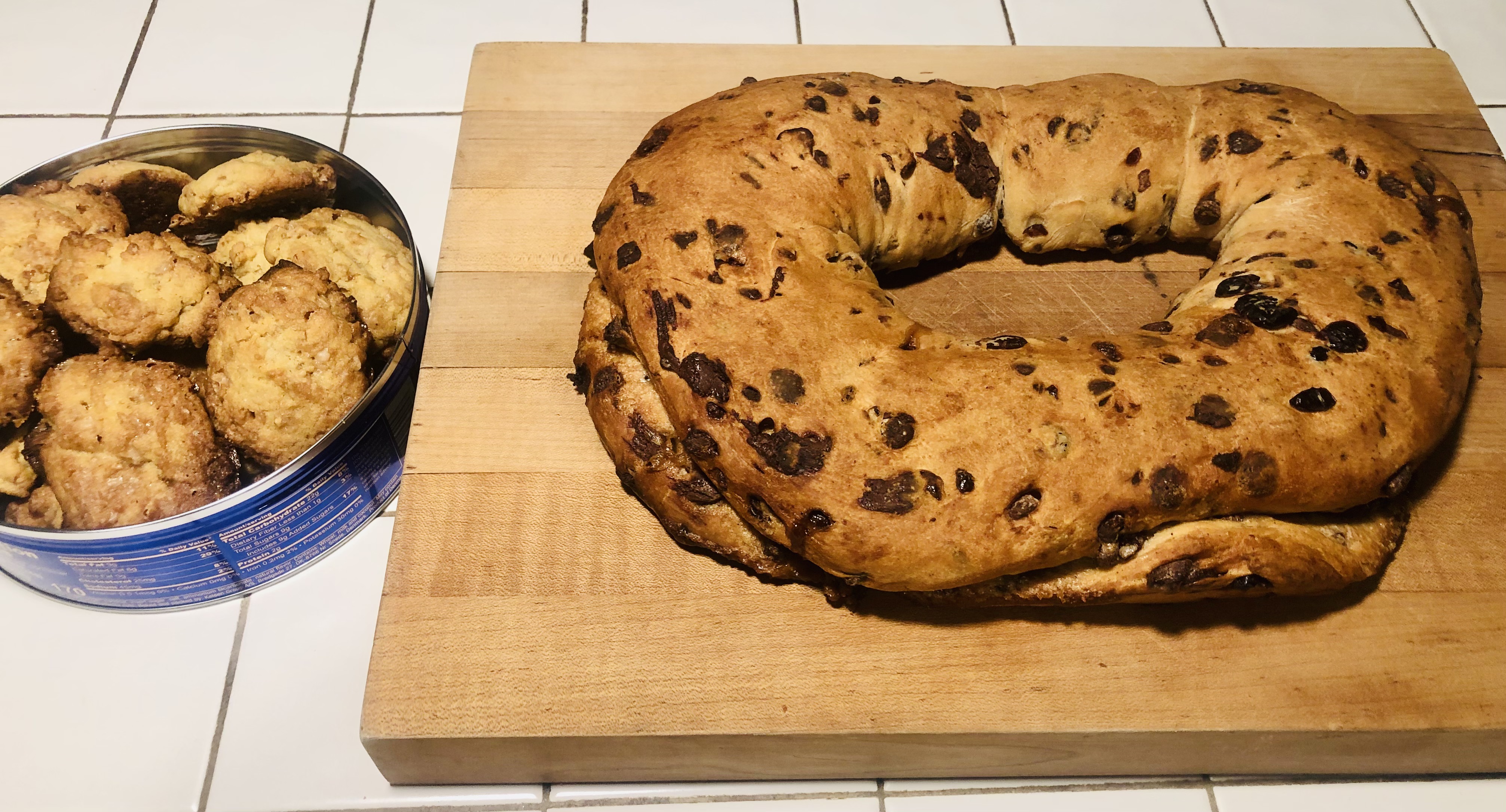
I did make Julkage, a traditional Christmas bread/cake from Scandinavia. So there's that, at least. Oh, and cookies: the "forbidden cookies" that my wife remonstrated against me making until late this afternoon, when she confessed she really wanted me to make her some. They're exactly like chocolate chip cookies except for substituting Heath bar crumble in place of chocolate chips. The last time I made a batch they were gone before I even got a single cookie. 

And though this went well back before Advent, I finished bottling the Christmas Mead. 


Yuletide

Today is the winter solstice -- tonight, actually, at 10:27 PM EST. Advent continues until Sunday, but the old Yuletide would begin today. The days get longer from here. 


UPDATE:
The Jólfaðr, or possibly myself in about five years.