

A Curious Question
President Donald Trump is expected to be indicted and charged with a crime soon, and reports are that "he Manhattan District Attorney's office will reach out to Trump and his Secret Service detail to make arrangements for his surrender[.]"
I admit it had not occurred to me to think about him having a Secret Service detail, but of course he does as do all Presidents during and after their term of service. This raises a question I find interesting: what would the Secret Service do in the event of his arrest and/or conviction and sentencing? Presumably as law enforcement officers themselves, they would want to cooperate with the court and penal system; but they also can't simply allow him to be sent to Rikers Island and put in the general population.
Other nations that have imprisoned opposition political leaders have sometimes resorted to house arrest. Aung San Suu Kyi spent 15 years under house arrest over a 21-year period. Since the Secret Service will be providing police officers to literally stand over the top of him all the time, there's no reason why a similar arrangement couldn't work here too: you wouldn't have to put him in a New York state-owned facility.
Since a lot of the point of this exercise seems to be public humiliation, however, I expect that the Secret Service will be asked to somehow work with his enclosure in a New York prison or jail of some sort -- certainly if a conviction is obtained, as it may well be given the poisoned jury pool in NYC, and maybe even as he awaits trial. I would expect the Secret Service to demand control over a cordoned-off part of the jail under those circumstances, with NY officers allowed to access Trump but only under observation.
Commentators seem convinced the case is hopelessly weak, but I wouldn't put much hope in the law or the courts here. Trump is a designated object of hate, perhaps the foremost one extant in our country, and he is unlikely to receive a fair trial in Manhattan of all places (only DC might be worse in terms of jury bias). His ability to obtain a dispassionate and fair trial according to our usual aspirational standards anywhere in America must be close to Osama bin Laden's, except that there are areas where it would be unfair in his favor as well. The odds of us having a Political Prisoner in Chief soon are nonzero, no matter what one thinks of the legal strengths or weaknesses of the charge. If I were the Secret Service, I'd be planning now for how to handle this.
"Backlash" exception to the 1st Amendment
I take minor comfort from the fact that this is a decision issued by a 3-judge panel of the Second Circuit, not en banc, but it has some pretty horrifying Constitutional law in it. The court dismissed an NRA complaint alleging that the New York Department of Financial Services bullied financial institutions into blacklisting the NRA on the ground of "reputational risk." The court explained that "backlash" against Second Amendment supporters was a legitimate reason for a state banking regulator to use threats to induce banks to blacklist customers with controversial advocacy records.
As Powerline suggests, the only right thing to happen now is for the Supreme Court to accept certioriari and punt this awful decision into the sun. In the meantime, however, it sure would be nice to see people cease to use New York banks. The risk there is very high, even beyond the general concern over concentrating the nation's financial system in any particular location.
Arkansas, Affirmative Action, and Walmart
Gail Heriot posted this on Instapundit. The comment thread there so far is a shining example of sheer ignorance and bad faith attacks on Arkansas Republicans. I don't care to create a Disqus account to comment there, so I thought I might say something useful here, even if it is by no means a complete answer.

Walmart is headquartered in Bentonville, AR, and is a chunk of the state economy. Whenever the Republican dominated legislature takes up conservative legislation to which the woke rulers of the Walmart empire object, Walmart implicitly threatens to take their money somewhere else.
I'm not saying the Republican politicians are right or wrong to take this into account. I'm just saying it's part of the political calculus there.
Rafe Heydel-Mankoo on Reparations
It's a British argument, but a good quick listen at 12 minutes. The title on YouTube ("Woke Cambridge Students HATE Historian's Facts") is misleading, I think -- the Cambridge students sit quietly and let him finish speaking, and there is some applause at the end.
More Weird Numbers
56.3% of liberal women 18-29 have been formally diagnosed with a mental health disorder, compared to 27.3% of conservative women and 16.3% of conservative men in the same age bracket.
There are several general trends visible here. Older people have fewer than younger; men have fewer than women; conservatives have fewer than liberals.
My sense about psychology is that you get diagnoses more or less because you ask for them, so these numbers may simply be explained as the willingness of these various groups to seek psychological counseling. You have to check however many boxes off for the current DSM, and then you get a diagnosis that will allow your insurance company to pay for the counseling you want. If someone doesn't believe in the value of such counseling, they won't go and they therefore won't get a diagnosis. I don't think this necessarily says anything about the actual mental health of these demographics.
Still, the delta is pretty big. There's an order of magnitude difference between the young liberal women and the oldest conservative men, and right at that big a difference between them and the oldest conservative women.
Shocking if True
NotTheBee has a summary of some propaganda being put out by a hockey team for some reason or other; of all the places to virtue signal, goalie-fighting hockey teams are a very strange choice. One of these things is actually shocking, though, assuming that the statistic is true.

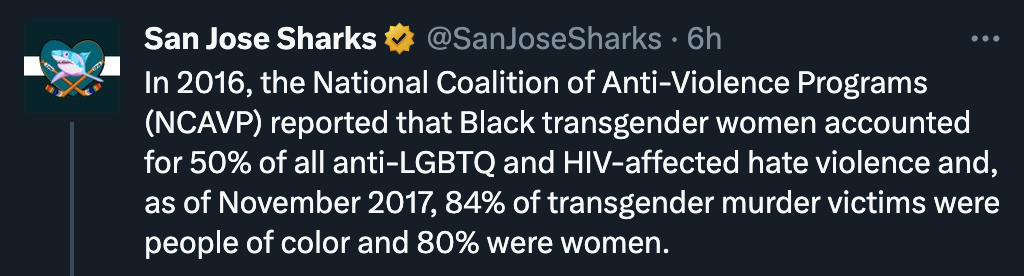
Now that would be amazing. I'm in no way an expert on the demographics here, but assuming that there is a roughly equal distribution of these qualities across various ethnic groups, black LGBTQ should account for around 13% of the total; and this Gallup poll suggests that trans-* should account for only 10% of that, so 1.3% of the total. But that's all sorts of trans-*, of which transgender women are an additional subset, presumably on the order of half of it. (And that's accounting for the doubling of the rate in the youngest generation, which is an additional weirdness to the numbers we'll ignore for now.)
So that would give us approximately (and admittedly according to very back-of-the-envelope math) 0.8% of the total population being the subject of 50% of the violence. If that's true, it's stunning.
I'll Allow It
Wretchard asked Chat GPT-4 who he was, to see what it knows. It's a plausible thing to do; what it knows is the internet, and we've published a great deal of content on the internet.
I decided to try it too, since I was messing with GPT last week.

Close enough for government work.
UPDATE:
I decided to try again, clueing in the GPT bot that I was asking about a blog. It was under the impression that the blog had closed, when in fact its own database ceases. However, it characterized the philosophy of the blog in this way:

That's actually a pretty good summary.
The Gods of the Copybook Headings
It's almost as if price controls led to supply crashes:
This regulatory environment explains why California insurers can’t charge rates that reflect their actual risks. It also shows why there’s so little competition in the state’s insurance industry. Over the long run, competition keeps rates low. Insurance commissioners can certainly hold premiums down by edict, but the result is a contracting market. Homeowners then have little choice but to buy inadequate policies in a government-run marketplace.Similarly, I made my living for years on the cleanup of the power grid crash in California, caused by regulators who were more interested in pretending that power doesn't cost what it costs than in ensuring that the grid produces power. Voters love the idea of putting bureacrats in charge of prices, until the goods disappear from the market. Then they always seem to like the idea of having the government step in to offer the product at a "fair" price. I call it the DMV-ization of the economy, my favorite examples being Obamacare and public schools. Source: Wall Street Journal, Insurance Companies Are Quietly Fleeing California (via DuckDuckGo search).
Cheap Delicacies
It's St. Patrick's Day, so I considered making a shepherd's pie. I ended up making jambalaya. Both of these dishes are alike in being cheap local to their point of origin, and rather expensive delicacies further afield. Shepherd's pie is made with lamb or mutton, which if you are a shepherd is the most readily available food; but if you are buying lamb in an American grocery store, it's not so very cheap at all.
Jambalaya meanwhile has shrimp in it (omitted in my version tonight), which is plucked free out of the bayou down where the stuff originated. Shrimp is a lot pricier in the mountains, and of dodgy quality if it isn't frozen.
Lots of famous foods are like this. You can't even make Scottish haggis in America unless you buy and butcher a sheep. Otherwise it's just not legal to sell you the heart, stomach, and lungs for food consumption. American haggis is mostly made with beef liver instead. You can't get the real thing at any price, but it too was meant to be a cheap food for the locals where it originated.
The jambalaya I made was all dry or frozen ingredients piled into a pressure cooker, except for the liquid chicken stock and some cayenne. It came out pretty great, and preserved the quality of being cheap that was the actual point of the original dish. Recommended.
Happy St. Patrick's Day
I always feel like I ought to include some religious content, it being a feast day, so here's a prayer called "the Deer's Cry," or "St. Patrick's Breastplate."
Here, after, is a Spotify playlist of St. Patrick's Day songs.
This is the way
"Universal school choice is growing in popularity across the United States, with Florida becoming the fourth in the nation to pass such legislation in the past year. A similar bill was passed in Iowa last month."
It's on the legislative agenda in this year's session in Texas. The state school monopoly may have pulled off one of the great boners in history in shutting down schools. If they had it to do over again, maybe they'd think of a way to avoid letting parents look over their kids' shoulders in ZOOM sessions.
Happy 20th Anniversary!
This afternoon Grim's Hall is 20 years old.
Looking back, the very first post was a call not to censor even a radical "jihadist" with proven ties to terrorists -- so we used to say in those days, still in the wake of the 9/11 and on the very eve of the Iraq War. It does call for the infiltration of the audience as a means of using the radical speaker as a kind of flypaper to attract the genuinely dangerous youth.
Both of those facets are still quite relevant twenty years on: free speech is under increasing attack as a way of counteracting radicals -- who turn out to be ourselves, and not the 'jihadists' we thought we would be concerned about. Meanwhile the government's shift of enemies from radical Islamists to old-fashioned Americans has caused the 'infiltration' strategy to shift to an actual construction of flypaper groups, organized and led by government informants. I do remember that Patriot Act opponents in those days warned us that these grand new powers would be turned against us; turns out they were right about every part of that.
A lot has changed since those days on the sunny slopes of long ago. Not all of the change was for the worse. Thank you for your company along the way.
Farmers fight back
No thanks to the mainstream press, which mostly depicts the Dutch farmers as budding Nazis if they cover the protests at all, but here's a bit of good news. Dutch voters just rose up somewhat against the recent wokista attempts to destroy their country's food production.
Ruy Texeira published a plea this week for Democratic messages that avoid the usual crazy-as-a-rat-in-a-coffee-can tone and concentrate on positions ordinary voters can embrace without embarassment or revulsion. He didn't mention things like "let's not destroy either the power grid or food production, because that might starve a lot of poor people in the immediate future," but he did come up with some unusually non-repulsive arguments:
Equality of opportunity is a fundamental American principle; equality of outcome is not.
Racial achievement gaps are bad and we should seek to close them. However, they are not due just to racism and standards of high achievement should be maintained for people of all races.
No one is completely without bias, but calling all white people racists who benefit from white privilege and American society a white supremacist society is not right or fair.
People who want to live as a gender different from their biological sex should have that right. However, biological sex is real and spaces limited to biological women in areas like sports and prisons should be preserved. Medical treatments like drugs and surgery are serious interventions that should not be available on demand, especially for children.Nah. Never happen.
The darling of clean-tech banking
While it's fun to lambast Silicon Valley Bank for having a risk manager who, shall we say, was focused in a less-than-helpful woke direction,
Kimberley Strassel points out a more fact-based criticism of the bank's woke infection.
SVB was the lender of choice for tech dreamers. It claims to have banked nearly half of all U.S. venture-backed tech and healthcare startups. Yet in recent years those clients have skewed ever more in one direction. “We serve those creating positive environmental change,” SVB’s website brags, noting that the bank worked with some 1,550 companies in the “climate technology and sustainability sector.”
Most of these companies weren’t filling some vital market need. Rather, as the Journal reported, SVB was beloved for its willingness to offer “banking services to startups that often weren’t profitable, in some cases didn’t have a product, and would otherwise have a hard time getting a line of credit or a loan from a larger bank.” One tech entrepreneur provided law.com a more scathing description of SVB’s products: “They’re basically subprime business loans. You’re talking about companies that have no credit profile, they’re burning cash and are unlikely to raise the same type of capital because of interest rates. . . . It was basically social credit.”Paywall issues? Try this link to a search page, which usually takes care of it. If you were willing to drop bucks on an online subscription, though, you could do worse than the OpEd page that employs both Ms. Strassel and Holman Jenkins.
Weirdness in Begging
I was in Asheville again yesterday, crossing east of the French Broad River as usual in support of my wife's artistic endeavors. While in town, two different leftist organizations approached me on the street to panhandle.... er, 'to seek donations,' as it is called when you are begging for your organization instead of yourself. The first one told me that she was collecting to try to feed some hungry children; I offered her the spare change I happened to have.
"We don't take cash," she said.
"Really?"
"Most nongovernmental organizations have gone away from accepting cash," she replied. "This is for our own safety."
Well, maybe, but she was carrying an iPad in order to process electronic donations. That was worth a lot more than the change I was going to give her, as a mugger would certainly know. Later that afternoon an environmentalist activist stopped me to ask the same thing, and also refused to accept cash.
Beggars cannot be choosers (a fact better understood by the actual homeless, or the various buskers playing instruments around Asheville, neither of whom refuse change when offered). I wonder if it is not allied to the general attempt to switch from cash to electronic funds, though, as those offer greater centralized control of our wealth as well as visibility on where and how we spend it. Left-leaning organizations gently nudge us towards electronic money, and offer us in return perhaps the virtue signal of having a donation to the Nature Conservancy showing up on our monthly statement.
Maybe it's just that they themselves want to collect our information so they can continue to dun us. A fistful of change, or even a $20 bill, is small potatoes compared to getting the credit card number and contact information of someone who proved willing to pay.
I guess they'll say anything
H/t Powerline: Imagine the pretzels you'd need to twist your brain into to come out with a rationale like this:
Last month the California Energy Commission thus determined that the state needs Diablo Canyon [Nuclear] Power Plant through 2030 to ensure electricity reliability in the face of energy supply shortfalls during extreme weather events driven by climate change.But hey, whatever gets them there, even if it's "nukes are the only path to a carbon-free future."In other good news, Georgia has managed to spin up a new nuclear reactor. I suppose the next step is to replace the new reactor's unexpectedly successful staff with wokistas until everyone is sufficiently distracted by nonsense to let the thing melt down. In the meantime, I suggest that everything that needs to get done be justified by stamping it with the message: "necessary in the face of shortfalls during extreme weather events driven by climate change." We may also wish to add ". . . and systemic marginalization of heteronormiacs." Troubled by the reasoning? "It's intuitively obvious even to the most casual observer." The explanation is left as an exercise for the reader.
Taters
A new recipe for baked potatoes from a new cookbook: slice them very thin, toss them in butter and rosemary, arrange them in a pan, and bake them at 375 for an hour and 20 minutes. They're all crunchy on top and soft underneath. The thinner they're sliced, the nicer the crinkly effect. They look like one of those beautiful open-faced apple tarts.The recipe called for a mandoline, but I just used a very sharp knife.

Tennessee Waltz
This is a song with an impressive recording history, including multiple hit versions and covers by great names. The thing is, I don’t think there actually is a “Tennessee Waltz,” only a country music song that features one. I wonder what waltz the original author was thinking of here?
Buy high, sell low
Banking isn't as mysterious as we make it out to be. Adam Kessler at the WSJ sums up Silicon Valley Bank neatly:
Management screwed up interest rates, underestimated customer withdrawals, hired the wrong people, and failed to sell equity. You’re really only allowed one mistake; more proved fatal.In case you hit the WSJ paywall and can't hop over it by Googling "Who Killed Silicon Valley Bank?"--here's a longer excerpt:
In January 2020, SVB had $55 billion in customer deposits on its balance sheet. By the end of 2022, that number exploded to $186 billion....
... There was no way SVB was going to initiate $131 billion in new loans. So the bank put some of this new capital into higher-yielding long-term government bonds and $80 billion into 10-year mortgage-backed securities paying 1.5% instead of short-term Treasurys paying 0.25%.
... SVB got caught with its pants down as interest rates went up.
Everyone, except SVB management it seems, knew interest rates were heading up. Federal Reserve Chairman Jerome Powell has been shouting this from the mountain tops. Yet SVB froze and kept business as usual, borrowing short-term from depositors and lending long-term, without any interest-rate hedging.People deposited tons of money in SVB over the federally insured limit. Uninsured deposits should be treated like any other risky investment, which people with more than a quarter of a million dollars they need to park should be considered competent to manage by diversification and otherwise. Naturally, however, the regulatory geniuses responded to SVB's failure by insulating large depositors from any consequences of choosing a risky bank to invest in. Otherwise, wealthy depositors might panic. They might even start evaluating depository banks according to their inherent safety, which would distract everyone from banks' important functions, such as DIE, ESG, and parting bonuses for deserving employees. Why manage risk the old-fashioned way when the regulators will manage it for you by imposing a tax on other banks instead?
Apparently Cross Cultural?
The BB had an amusing video series on Californians who moved to Texas. Apparently that’s just as real a divide if you’re also Mexican.
Some Friday Music
There is some good songwriting on display here.
Bluegrass covers of Simpson's existing music.
Jan. 6 Fact Sheet
From Julie Kelly.
Among the most disgusting claims about the January 6 riot is the notion that half a dozen officers were killed. One officer died the following day of a stroke, after suffering from pepper spray on the day of the riot. Several more officers committed suicide later. In contrast, four protesters died on the scene: one was shot by an officer and died immediately, while three others succumbed on the scene to some kind of violence that is less clear in the record. The official version seems to be that two died of heart attacks and the third from an overdose; the protester version is that the heart attacks could be attributed to excessive police force, while the third, an unarmed woman, was frankly clubbed to death. I am aware of at least one later protester who appears to have been hounded to suicide.
If the same standard of lethal causality were applied to the protesters as to the officers, the body count would be far different from what has been peddled by the powers that be for the last couple of years. For that matter, if the same standards of law and order were applied to the BLM and Antifa mayhem throughout 2020, the conviction count would alter drastically. It's hard to imagine a clearer example of "protesting while Republican."
The riot was a stain on conservative politics. The aftermath, especially this week's appalling attempt at censorship, is an even worse stain on this country's leadership, including most recently Senate Majority Leader Mitch McConnell. I've defended him for years, but I'm done. There can be no possible excuse for objecting to the airing of video evidence because it "contradicts" the way the police have chosen to "depict" the events. He has proved himself on a level with Senator Schumer.
Kudos to Jonathan Turley for continuing to point out the egregious Brady Rule violation of federal prosecutors in withholding exculpatory evidence for the last two years.
Women in Philosophy
The Cambridge Elements series on women in the history of philosophy is available for free download through the end of next week. They did a similar promotion a year or so ago, but at the time as I recall it was only part of the list that you could download.
I think several of you would enjoy Early Christian Women by Dawn LaValle Norman of Australian Christian University. It raises an interesting claim about the introduction of these women to philosophy and its effect on how philosophy was anthropomorphized. Probably many of you have read Boethius' Consolation, and are familiar with his picture of Lady Philosophy. It was common to depict Philosophy as a sort-of goddess, sought through difficult and heroic adventures, or found in tragedy like Boethius. That conception was changed by the women who came into the practice:
The personification of philosophy as a woman assumes that philosophers, her erotic desirers, are symbolically masculine. The binary of male lover–female beloved imagines that the target of such pleas are men who were inspired by the idea of choosing wisely between competing types of women. Yet in the third century CE, the Christian dialogue writer Methodius of Olympus reimagined the gendered relationships of allegorical females in educational ascent myths. Virtue, daughter of Philosophy, still dwelt on top of a mountain that was steep and dangerous. But instead of questing men who attempted to enter her secluded garden, educated women were invited to her garden party.
I can attest for the quality of at least one of the authors in this series, who is a dear friend of mine. I assume the others to be of similar quality.
AI Illustrations
OpenAI, the same company that put out Chat GPT, also has an illustrator. I asked it to give me illustrations of the Elric the Barbarian story in the style of N. C. Wyeth. This is what it came up with.


An older Elric.
These are obviously not anywhere near the quality of N. C. Wyeth illustrations, but they're good enough for a paperback cover. Hope you're not an illustrator, because you're out of work: there's no way a publisher will pay you hundreds or thousands of dollars when the job can be done 'well enough' for free.

"Elric the Barbarian," I suppose.

An older Elric.
These are obviously not anywhere near the quality of N. C. Wyeth illustrations, but they're good enough for a paperback cover. Hope you're not an illustrator, because you're out of work: there's no way a publisher will pay you hundreds or thousands of dollars when the job can be done 'well enough' for free.
Corruption is the Answer
This is an article with multiple significant insights about the problems of the moment. The conclusion is shocking to those of us from another era, but there may not be anything wrong with it.
Under conditions of bureaucratic dysfunction typical of a party-state, corruption isn’t a problem, it is the solution.
That was certainly my experience living in China, a party state of the sort he is describing. I had the wrong kind of visa to be employed, but I had a job. I didn't worry about it; the man who got me the job was the same man who signed for my visa renewal. I've told the story about getting paid in China before (although if you don't remember reading it, you should: it's one of my better stories). It was many months after I'd been working before I saw any of my promised pay. The problem wasn't that they weren't going to keep their word about paying me, it was that they had to build out a slush fund first. Once they'd solved the practical problem of arranging a corrupt solution, they paid me every single thing they promised.
As our system becomes captured by interests basically hostile to the people and the nation, we are all going to end up having to adopt these ways. They are like the illicit economies that prisoners develop, as a means of escaping the control of the guard towers. They are, in a way, a moral duty to embrace: just as a prisoner of war has a duty to try to escape out of loyalty to the country of his birth, so too do we.
"Elric the Barbarian"
So the third thing I asked Chat GPT to do -- as discussed in the immediately prior post -- was to write a short story in the manner of Robert E. Howard. Here is what it came up with.
The sun beat down on the dusty plains as Elric the barbarian rode towards the small village. He had been wandering for days, searching for a way to ease the restless fire that burned within him.
As he rode into the village, he could sense the tension in the air. The people were on edge, their eyes darting nervously at him as he passed by.
Ignoring their wary glances, Elric strode into the local inn, his hand resting on the hilt of his trusty broadsword. He knew he needed a stiff drink and a warm meal before he could continue his quest.
The innkeeper eyed him warily as he approached the bar. "What brings a man like you to these parts?" he asked, his voice trembling.
"I'm just passing through," Elric replied, his voice low and rumbling. "I need a meal and a place to rest."
The innkeeper nodded, his eyes flickering towards the door. "You best keep your wits about you," he warned. "There's trouble brewing in these parts."
Elric raised an eyebrow. "Trouble? What kind of trouble?"
The innkeeper leaned in close, his voice dropping to a whisper. "There's a group of bandits that have been raiding the nearby villages. They're ruthless, and they've already killed dozens of innocent people."
Elric's grip tightened on his sword. "I'll take care of them," he growled.
The innkeeper looked skeptical. "You're just one man," he said. "How do you plan to take on a group of bandits?"
Elric smiled grimly. "I've faced worse odds than this," he said. "And I've always come out on top."
With that, Elric left the inn and rode out towards the bandit's hideout. As he drew closer, he could see the flicker of torchlight and hear the sound of raucous laughter.
Elric drew his sword and charged towards the bandit's camp, his battle cry echoing across the plains. The bandits were caught off guard, and they fell quickly to Elric's mighty sword.
As the last of the bandits lay dying at his feet, Elric felt a sense of satisfaction. He had protected the innocent, and he had once again proved that he was the greatest warrior in the land.
With a fierce grin on his face, Elric rode off into the sunset, ready for whatever adventure lay ahead.
You can see elements that are right: the use of a fantasy-style name, the existence of swords, the attempt at dramatic tension leading to violent sword-based conflict. Nevertheless the story is terrible to the point of being ridiculous.
REH's works are in the public domain, so Chat GPT presumably can access large parts of them and map them. However, creating writing requires more than just getting a lot of the right words into the right order.
My guess is that this means we are doomed to even worse popular art than we have been subjected to already. Autotune proved attractive to the recording industry even though it is terrible, obvious, and offensive to the ear. This was because it allowed pop music stars (which now includes contemporary Nashville country music) to be selected for physical looks rather than the ability to sing. Since there are a lot more pretty faces than talented singers, that allowed the recording studios to shift more of the profit to themselves and pay less to the "talent" that is no longer talented.
AI generated visual art is already starting to pop up everywhere, and is having a similar negative function. Actual artists used to be well-paid because their talents took years to develop. Now you can generate something good-enough for free just by plugging a description into somebody's AI. It's not going to be great art, or even good art, but it will have the right elements more-or-less.
I expect we'll see a similar shift to crap like this in screenplays, especially for episodic TV but even for movies. It's free, and all they want is a consumable product to bring in money -- money they get to keep, since they don't have to pay anyone who actually knows how to produce something of genuine value. As a result, our popular entertainment will become even worse than it already is.
It's a depressing thought.
Playing with Chat GPT
I had read a bit about this here and there, but was not planning on messing with these Large Language Model "AIs" myself. However, I was explicitly asked to do so by a professional contact who wanted me to evaluate them. I ran three, which produced significantly different results.
One thing I asked it to do was to explain Aristotle's ethical theory. The answer it gave was plausible at about the college level, or even at the grad school level for people who weren't specialists. The mistakes it made are mistakes that even ethicists who haven't actually studied Aristotle closely might make: for example, it claimed that Aristotle's virtues are means between two extremes. I've heard even trained philosophers make that error, because it's very close to what Aristotle does say; it's just not quite right. I decided that wasn't a good test for Chat GPT, though, because it's too easy for the kind of model it is: if it's just mapping out what experts have said about Aristotle and regurgitating it in a slightly reordered format, that's what you'd expect. Actually understanding and being able to apply the knowledge, as humans do, that's hard. Chat GPT doesn't have to understand, it just has to know that there are very frequent connections between various words that imply that using those words together in the commonly-encountered order is correct.
So the next thing I asked it to do was to diagnose a problem with a 2007 Jeep Wrangler Rubicon that I just finished resolving. It involved a poltergeist-like failure of multiple electrical systems. The answer it gave was wrong but plausible: it started with the assumption that there could be multiple system failures and walked through how to diagnose possible issues with each in turn. In fact the problem was that the ECM had gone bad, which I told it. It said that was also a possible cause of the multiple failures I described, and said it was too complex for me to fix so I should take the Jeep to a shop. I told it the shop had refused the job because the ECM was discontinued, and therefore they couldn't get parts from an authorized source. It offered four ways to obtain a functional discontinued ECM, all of which were plausible, but cautioned me that it was too complex to try to fix without substantial technical knowledge.
In fact, it was the easiest car repair I've ever done: I bought a refurbished one from Flagship One, and just dropped it in. You do have to know which numbers are the right ones so you order exactly the right thing, and you have to take care to have it programmed to the right VIN, which you can do yourself if you buy the diagnostic software from Alfa Romeo (the parent company of Jeep, these days). But FS1 will be happy to do it for you, if you send them your VIN. Once you get the right part there are only three bolts and three electrical connections.
A plausible reason it might have been thought difficult, which Chat GPT did not mention when I asked why it thought the repair was difficult, is that the ECM is normally located against the firewall. Getting to it is already potentially a pain. This particular Jeep, however, has had it relocated to an easily-accessed space further forward. That's something Chat GPT couldn't possibly know, and didn't; but it didn't know that I ought to have worried about the firewall issue either.
So it was wrong on several points, but the answer was still useful if I had been someone who knew little about car repair. It's not terrible even with physical technology, because a lot has been published online in various help fora.
The third example was actually terrible, though, so I'll post it separately.
Another Afghanistan Failure
The Marine Corps' snipers are some of the best-trained in the world. The psychological operations team described is a capacity I'm less familiar with; the USMC did not field PSYOP units until very recently.
The real story here, though, is the fact that the command structure was in complete disarray.
On August 26, 2021, Vargas-Andrews was in position at HKIA when he noticed suspicious individuals outside the gate to the airport as thousands of people were attempting to flee Afghanistan as it fell to the Taliban, fearful for the future and what retribution anyone who'd helped American forces over the previous twenty years would face."I requested engagement authority when my team leader was ready on the M110 Semi-Automatic Sniper System," Vargas-Andrews said, testifying in his personal capacity. "The response: leadership did not have the engagement authority for us — do not engage."Vargas-Andrews said he requested that his battalion commander "come to the tower to see what we did. While we waited for him, psychological operations individuals came to our tower immediately and confirmed the suspect met the suicide bomber description," Vargas-Andrews recounted. When the battalion commander "eventually arrived," he was presented with the evidence and photos of two men, one who met the description of a suicide bomber. "Pointedly, we asked him for engagement authority and permission — we asked him if we could shoot," Vargas-Andrews told lawmakers. "Our battalion commander said, and I quote, 'I don't know.'"
"Myself and my team leader asked very harshly, 'Well, who does? Because this is your responsibility, sir," Vargas-Andrews explained. "He again replied he did not know but would find out. We received no update and never got our answer."
I find it absolutely astonishing that a battalion commander of a unit deployed at war would neither have the authority to approve a self-defense shooting nor even know who did have it. This is the most basic chain-of-command issue: who is in charge?
The story that has been emerging from the Afghan withdrawal continues to shock. These were professional military units with decades of combat experience, led by men and women who were educated and trained in what were once the finest military science programs in the world. Yet in every aspect of this story we see a complete failure to do even the most basic tasks:
- Plan an orderly retreat/retrograde.
- Secure and defend the appropriate facilities (for example, by holding Bagram as the final airhead, with its many heavy lift runways and secure perimeters, rather than withdrawing to a civilian airport with only one runway and a perimeter that let the enemy get within easy mortar range).
- Assign command authority with clear lines that everyone understands.
- Evacuate American citizens from a crisis zone.
There were many other failures as well, but some of those could be put down to the exigencies of the crisis. These were issues we had the capacity to control. We had all the time we needed to plan, because we didn't have to go at all. The enemy couldn't force us out. We had plenty of time and force to choose and secure the right airbase -- in fact, it was already secure until we abandoned it. We had plenty of time to clarify chains of command. We had plenty of time to round up all the American citizens before it became a crisis.
There is no excuse.
Oldest-yet Odin Inscription
I’m not sure how newsworthy this is, because my source is my wife sending me a Facebook link. However, I hadn’t heard of it before now.
That may be because it’s not exactly earth-shattering. It’s an older inscription than before, but in an area where younger inscriptions have been found. It was also supposed to be a challenging translation, which also means that there might be some doubts about it.
Still, it’s a subject of discussion here.
The Bobarosa Saloon

In fact everyone was perfectly nice. Armed society, polite society.

The exterior of the main bar.

Tree of shame by the French Broad River. Every time somebody loses a part, they use it to decorate.

"The Deplorables" is a crew of Vietnam Veteran bikers who meet there on Wednesday and Sundays. There's an on-site Vietnam memorial, pictured. The bar is extremely friendly to vets. Two of the bartender's sons are vets, one Army and one Navy.

They are not as friendly to politicians.

Main bar, interior. They also have a kitchen with a psychotic cook -- at least, her husband says she's psychotic.

Vietnam memorial by the river.
This is a good ride out US 70, also accessible by the Tennessee Foothills Parkway via a short jump on I-40. It's a long way from everywhere, but draws hundreds to more than a thousand bikers on a warm summer weekend. There's a motel and campground on site, so you can ride out there, stay for live music, and sleep off the cheap and mostly-American beer. $2.50 a bottle or can. "Froofy drinks" and imports are $3. Cash only.
Highly recommended for those of you who are the right kind of people to like it. You know who you are.
"Jaffa" Part II: Aristotle
One of the regular features of the article we are discussing is that it imagines the American Founding in a kind of dialogue with Aristotle. That is obviously a facet of the article that interests me particularly; it may interest a few of you. (Others will find it much less engaging!)
This will be quite long, so I will put it after a jump.
"Harry Jaffa vs. Willmoore Kendall Redivivus" Part I
This piece of D29's is too long to respond to in one sitting, so we'll break it up a bit for ease of discussion.
The first things I want to go into, before we get into his discussion of the factions he opposes and what he thinks is the right way forward, is his argument about what his real opponents are doing. This whole article is essentially an unfriendly fight among friends, as it were; debates among members of the right wing about a problem and how to address it. It's being conducted aggressively, this debate, but it's a debate with a common set of goals assumed, including restoring the American republic and preserving its principles.
His real enemies are the ones who are intending the opposite -- and they, he argues, are the people actually in power.
If America cannot recover the understanding of the founding in the way the founders understood the founding, then the crisis we face will forecast the destruction of the regime. But what right-thinking person can deny that America is truly the “last best hope” for the preservation of free government against the Biden Administration’s full-scale attempt to establish despotism in the name of preserving “democracy?”Every would-be despot knows that the quickest way to despotism is to promote anarchy: The reason is simple—anarchy is insupportable. Anarchy is the state of nature; civil society and the rule of law is designed to end the state of nature and the anarchy that makes human life “solitary, poor, nasty, brutish, and short.” Almost any rule is preferable to the state of nature and anarchy. People will choose any rule—even despotism—to prevent anarchy.Yet, we see the Biden Administration deliberately promoting crime and race war. It undermines the nation’s sovereignty with its policy of open borders, which promotes illegal immigration—itself a crime leading to further crime. The Biden Administration is also clearly working to destroy the middle class, a long-standing goal of Democratic administrations. Its politicization of the Justice Department and the intelligence agencies is evident, as is its use of government agencies to interfere illegally in American elections.Skewing the economy by inflationary pressures to benefit ruling class elites and corporations at the expense of the lower and middle classes, and ensuring that the same ruling elites benefit from corrupt dealing with China are but a few of the myriad ways the administration actively promotes anarchy.
The author (Edward J. Erler) is not very coherent in his remarks on the subject of anarchy, though I get where he's going with the idea. Anarchy is not 'the state of nature,' for example; it is still a form of human organization, just a voluntary one without coercive leadership. It may or may not be sufficient to hold back the dangers of the state of nature, and certainly faces challenges when it comes up against human forms of coercive organization. (Even on his own terms, the argument doesn't make sense; if the state of anarchy were the state of nature, it would not need to be supported in any case -- being natural, it would sustain itself.) We have to recognize that he's adopting a Hobbesian framework, and being imprecise in his discussion of alternatives.
In this framework, the aim of his enemies is to destroy the republic by destroying the order it establishes. This will cause ordinary people to fear the chaos around them, and therefore prime them to accept new despotic terms of rule instead of the constitutional republican order.
There has already been a long discussion of whether this view is plausible. Throughout the Obama administration the watchword was, "Never attribute to malice that which can be attributed to incompetence." We were, of course, assured of the intelligence of the President and his chosen band of friends, but the media assuring us of that intelligence would not know intelligence nor competence if it were bitten by them. (And that was the administration's opinion too: Obama's right hand man, Ben Rhodes, described journalists as '26 year olds who literally know nothing.')
Some reasons exist to think that the series of crises of the last few years were at least partly effected in order to create opportunity for political changes that would cement the power structure in ways that would insulate the elite. These changes did in fact rise nearly to the level of chaos, and they came from several directions at once. I can understand how some might even think that the COVID matter was a planned excursion, given that it most likely occurred from a lab leak (which could have been on purpose), followed years of war games on how to deal with pandemics (which should have been the mark of reasoned planning by officials, but which a paranoid sensibility could see as preparation), happened to coincide with riots actually abetted by the government at several levels in order to weaken the police response and which led to frightened citizens, and which pandemic was used to justify a number of changes to election systems that coincided with fortification efforts that resulted in Biden's election.
Yes, it all does look very suspicious; that doesn't mean the suspicions are accurate. Watching this crew handle the Afghanistan withdrawal, I am convinced they couldn't plan their way out of a paper bag. Even their military leadership seems somehow to have failed to learn how to plan a military operation. As weird as it may seem, veniality and senility, panic and in-group-thinking may explain the chaos better than any planned conspiracy. I don't think they have it in them: they may have sufficient ill will and evil intent, but they haven't the competence or intelligence.
If that part is wrong, it doesn't make the rest of the analysis wrong: he might still be right about the argument he's having with his friends. It does lower the temperature of the overarching conflict, though. America is not being strangled by an evil elite intent on destroying it; America is dying of old age, as its once-vital institutions ossify, fail, and dissolve into incoherence and disorder. That is a natural process, one that states suffer even as men.
Tyranny Loves Emergency
Syria's "President," Bashar al-Assad, has waged war against his own people for quite some time. In addition to abusive secret police and the ordinary human rights abuses, he has destroyed neighborhoods and villages in order to create waves of refugees. That served the double purpose of reducing the population of elements he thought disloyal to himself within Syria, while also burdening Europe to such a degree that he was able to use the threat of further refugee waves in order to compel some concessions to himself. In that sense, he has used his internal war against his own people to create a weapon against neighboring states -- even powers such as Germany have bent before it.
For a long time world leaders spoke in terms of him being a pariah who would, of course, eventually fall. However, since last month's devastating earthquake, there has been a move to deal with him because he's the only guy to deal with. If you want to help people in western Syria, you are going to have to talk with him.
Now in eastern Syria, where the Kurdish SDF exists and enjoys American support, it's possible to pass resources along lines that don't go through Assad's hands. Even there, though, Iranian-backed militia (including from Iraq) often control major river crossings. Since Iran supports Assad, it wouldn't hurt if you had his blessing to deliver aid even there.
These sorts of emergencies (and this one is a legitimate emergency for many thousands of people) end up being used to paper over the sins and violations of tyrants. Not only do they force other people to 'forget' about past wrongs, the emergencies themselves are often invoked to expand government powers. It's a tragic cycle that empowers the worst sorts of humanity.
Background Bluegrass and Beautiful Photos
This isn't normal fare for the Hall, but I often listen to music like this in the background when I'm working, and this particular video has some stunning pics of the Appalachians, as well as black and white photos of people and life there maybe a generation or two ago, I guess. I thought some others here might enjoy it.
I've only been to the Appalachians once for a week, though I've driven through several times after that. It is an incredibly beautiful place.
The Centrality of the Declaration
D29 asked me to read and review this article on natural rights as crucial to the American project. It's a long piece that critiques a number of current positions on the American right. As a prerequisite, anyone interested in that should also read the author's earlier pieces in which he engaged in a debate over whether the Declaration of Independence is, or is not, central to understanding the Constitution.
There are established positions on both sides here. The division is close to exactly how he frames it. Positive law lawyers and jurists prefer that it not be, and that the Constitution stand on its own. Those who believe (as the author) that natural law is necessary as a founding stone to give left-and-right limits to what positive law can morally and acceptably do prefer to read the documents together.
Readers probably know that I am of the school that makes the Declaration, and not the Constitution, the central document. The Constitution is not the first incarnation of the American project; it replaced the earlier Articles of Confederation. Even they were not the first incarnation, but the revolutionary governments which rejected British royal authority under the terms of the Declaration. The positive law formulations of any particular government are temporary and may be set aside when they cease to work; the principles of the Declaration are eternal, and explain how and when positive law governments may be set aside.
This is the principle the founders mentioned in the Federalist, which our author duly quotes:
“The first question is answered at once by recurring to the absolute necessity of the case; to the great principle of self-preservation; to the transcendent law of nature and of nature’s God, which declares that the safety and happiness of society are the objects at which all political institutions aim and to which all such institutions must be sacrificed.”
As he goes on to point out, the Articles were 'the institutions [which] must be sacrificed' on that occasion, and the reason that they had to be sacrificed rather than amended was that they were inadequate to the only real purpose of government according to the Declaration: defending the natural rights of the people.
In any case, it's some good preliminary reading for the bigger discussion to come.
The NYT Loves to Lecture Georgia
Maureen Dowd wrote in a classic genre this week, the genre of New York Times pieces looking down on Georgia (which is itself a subset of the larger genre of New Yorkers looking down on the South). I'm not going to link to it, because who cares what New Yorkers think about how Georgians ought to live? If they don't like Georgia, they can stay right up there in the cold. As the late Lewis Grizzard said of similar complaints in a famous column thirty years ago, "I live in one of the most progressive cities in the world. We built a subway to make Yankees feel at home."
It really is a venerable genre of American letters, though. I once read a piece from its early decades, if I recall correctly, criticizing the South for holding a tournament in the style of Ivanhoe. Harpers in the era said Ivanhoe was responsible for the Civil War. Mark Twain himself partly agreed with the charge, naming Sir Walter Scott 'at least partly responsible.'
There is some irony, though, in reading Dowd's lament for the Georgia that elected Jimmy Carter in favor of the one that exists today. The Georgia of those days was tightly divided between Democrats and other Democrats. The election of 1968 saw some Democrats (including Carter's successor as governor) voting for Republicans in order to vote against Democrat Lester Maddox, the noted segregationist who drove black men from the doors of his business with an axe handle. That Georgia had the Confederate battle flag on its state flag. The Georgia of today does not, and is apparently tightly divided between Democrats of Dowd's own sort and the Republicans she despises -- who, whatever else may be said of them, were never segregationists and never posed with the Confederate flag.
Many good things were true of that Georgia too; it was the one into which I was born, and where I grew up and lived many years. There are lots of things about it I miss. Yet the last person who should complain about the changes is a writer from the New York Times.
High Adventure
It is often hard to know if you've saved someone's life. I don’t always know with these search and rescue missions if we actually did save the people, just that they were alive when we put them on the ambulance; or, in other cases, if they were really in deadly danger. Mostly they're tourists and you never hear about them again, so you don't know how it went one way or the other.
That wasn't true today. This guy was succumbing to hypothermia when we got there, with a broken foot at the bottom of the second waterfall deep in a gorge. He was soaked to the bone because he fell in the river, and at three hundred pounds he was not coming out of there. His family knew where he was, but all of them together couldn't have brought him out. It was in the forties and more cold rain was falling.
The trails were precipices, slick with mud and sometimes so narrow that only one foot could step on it, with nothing but the gorge and the waterfall on the other side. It took hours to get him out, with ropes and pulleys and main strength, two feet at a time the whole way up. Then we had to carry him about a mile. That was as close as an ATV could get to where he had fallen, because for all that long distance the trails were too bad for one to travel.
He'll be ok now. A broken foot isn't that big a deal, not once you're safe and warm in a hospital instead of at the bottom of a cold, wet gorge. This time I know we brought somebody home.
Active lies
A HotAir article reports on Vanity Fair's discovery of a mildly encouraging trend at the New York Times, to resist woke staff's demands for censorship and cancellation of their colleagues. The reasoning is odd, though.
The editorial staff correctly asserts that the accurate reporting of facts cannot be presumed to create a "hostile workplace." Next, it assumes that the woke crowd is really objecting to expert journalistic decisions from upper management. Management then makes the wild and unsupported leap of equating its journalistic decisions with fidelity to facts. It goes on to strike an even weirder note by asserting that objecting to the accurate reporting of facts is "activism," which it will not tolerate. The conclusion is that the NYT can allow debate over journalistic controversies, but must prohibit attacks on the "journalism" of colleagues.
This is very confused. All journalists should pursue accuracy whether or not they're also activists. A partisan journalist might report nothing but true facts, then inject a lot of opinion in the service of activism, as long as the opinion is clearly identified as such. This approach need not be particularly balanced or fair: a partisan might also choose to dwell only on the (true) facts and issues that support his cause, but he need not publish lies if he understands at all the duty of honesty. Once a writer jettisons the need for accuracy and values only the success of his cause, however, he abandons journalism for propaganda. What's more, he is the lowest sort of propagandist: not just a selective partisan but a deliberate liar.
I suspect that NYT management correctly appraises its partisan reporters as habitually dishonest. It's not a big problem for management, however, unless management disagrees with the rank and file over whether their particular form of dishonesty serves management's overaraching journalistic goals, which are every bit as partisan as those of the most crazed junior staff. Similarly, the junior staff aren't agitating to force management to be more truthful, only to agree with them more closely on which truths must be suppressed, and how viciously the group will excommunicate anyone who steps out of line.
This is how you get mainstream newsrooms--and presidential administrations--arguing with a straight face for the censorship of facts, not because they are untrue, but because knowledge of them might have a "dangerous" effect on the behavior of the unwashed masses. As always, it puts me in mind of Screwtape's advice to his nephew, the junior tempter, always to advise his target to "believe this, not because it is true, but for some other reason."
Carl Schmitt
AVI links to a piece about Carl Schmitt, who might or might not be described as an important 20th century political philosopher. AVI says he hadn't encountered him before, and that is not surprising: I don't recall a single one of my philosophy professors ever saying his name or referring us to a reading of anything he wrote, not even the ones who apologized for Heidegger and included his work. Heidegger was an important 20th century philosopher who was also a devoted Nazi; Schmitt was a devoted Nazi who also engaged in philosophy (but more importantly to his own career, in law of a sort -- another devotee of the idea that 'legal' and 'lawful' might come apart, perhaps).
The article AVI links ends up making both cases: that he was an important philosopher, because his ideas were influential in his lifetime and have become important in ours due to being picked up by contemporary totalitarians in China and across the worldwide authoritarian Left; and that he was not, because he was never able to escape from the legacy of Hobbes that he meant to criticize.
I think there's ultimately some good philosophical advice about how to handle Schmitt at the end:
It should be no wonder, then, why despairing conservatives in the West might see echoes of Schmitt’s ideas in action everywhere, and then to logically look to him for understanding. And they absolutely should read him, just as they should read the cutting analyses of Marx. But, just as when reading Marx, they’d best do so while maintaining a very healthy wariness about his prescriptions...It’s possible they would be better off listening, as Schmitt might have, to Ernst Jünger. He despised totalitarianism (and in particular “the Munich version – the shallowest of them all”) as the worst manifestation of liberal modernity, a force capable only of turning men into soulless automatons. Like his estranged friend, Jünger would also ask himself during the war what one could “advise a man, especially a simple man, to do in order to extricate himself from the conformity that is constantly being produced by technology?” In contrast to Schmitt, the answer Jünger, an atheist, eventually settled on was: “Only prayer.” For, “In situations that can cause the cleverest of us to fail and the bravest of us to look for avenues of escape, we occasionally see someone who quietly recognizes the right thing to do and does good. You can be sure that is a man who prays.”
Schmitt's legal theories end up setting aside law in favor of power. The author is correct that this is also the position of many on the authoritarian Left today. The shift to a 'friend/enemy dynamic' instead of traditional American politics has intensified (which AVI often calls tribalism).
He is also correct that the rule by permanent emergency is becoming a feature that our government, and not only ours, cannot seem to walk away from. Witness Justin Trudeau in Canada, who set aside everything of Canadian civil liberties by embracing emergency powers that would allow him to freeze the bank accounts of citizens on suspicion alone. Thereby he forbade them from participating in the market, buying or selling even basic goods, making mortgage payments -- all for the unproven 'crime' of having made donations to a lawful charity approved for such donations by his own government.
So I agree the article is worth reading, and Schmitt as well. I also agree that it is crucial not to lose sight of the transcendent and the divine while you do so. Or, as Nietzsche warned, "When you look into an abyss, the abyss also looks into you."
Abyssus abyssum invocat. Beware.
"Debunked?"
With a hat tip to D29, a new book analyzes the election of 2020 with some care. The author is careful, for example, not to focus only on the one side of things: the book has chapters on fraud claims that obviously proved false, such as the 'Kraken' claims. The author is also careful to say that the Biden administration was the legal winner... just not the credible winner.
If you follow the third link, you'll find several excepts that give one claim each from each of the swing states. Some of them are pretty explosive even after all this time. I'll give just one of those, and leave you to read the rest if you find it intriguing. It's from Georgia, the one of these states I know best.
The number of unsupportable ballots found for [Atlanta's Fulton] county is forty-five times larger than Biden’s margin of victory for the entire state. Here are just five of the 15 findings:
- Although it takes one second to scan a ballot, there are over 4,000 ballots with precisely the same timestamp -- to the second. Not possible.
- 16,034 mail-in ballot authentication (sha) files were added several days after scanning. Also impossible.
- There are no ballot images to support 17,724 final certified recount presidential votes.
- There are no images to support 374,128 “certified” in-person votes, which is a violation of both federal and Georgia law.
- 132,284 mail-in ballot images have no authentication files.
I assume the author's description of Biden as the "legal" winner is an attempt to stay out of jail by warding off, say, an FBI investigation into himself. I notice that he identifies several law violations even in just the article excerpts. That certainly sounds like a lawless election to me, from which therefore there could be no lawful winner.
I suppose it is no surprise that a nation that can no longer define the difference between a man and a woman also makes fuzzy distinctions between lawful and legal.
Expert Advice

It would be a shame if a government shutdown were to cause us to have to do without such sage advice from expert professionals.
WARNO: Grim’s Hall 20th Anniversary Celebration
According to my calculations, St. Patrick’s Day of this year will mark the first full day of Grim’s Hall’s third decade. This happens to be a Friday, and St. Patrick’s Day. Prepare appropriately.

Unthinkable but Inevitable
Many times in life, physical forces make inevitable a thing that human beings find unthinkable. Some things are unthinkable because they don't seem logical, but reality doesn't obey strict logic (as physical objects are unique and logical objects are alike by kind). Other times the consequences of the thing are so horrible that the mind refuses to think about it. Yet there can come a point at which that thing, however impossible to consider, is no longer avoidable. The ship is going to sink, and nothing can save it now.
I think all this talk about a 'national divorce' is close to that category. Not for ordinary people; many and almost most of us not only can think about it, we can see the value of it.
...we’re almost certainly talking about somewhere between 100 and 150 million Americans who think it’s entirely possible the country may need to be split into red/blue sections or alternately, who expect a civil war to crank up. In other words, we’re not talking about a few cranks here. This is a mainstream belief, and it seems entirely possible that we could reach a MAJORITY of Americans that would like to see the country split up in the next few years.
The advantages of the Union are so powerfully compelling to the establishment, though, that neither party can entertain the thought. They can't talk about it as something that might really happen; and because they control the conventional levers of power, they think that settles the matter.
It doesn't, though. At some point if trends continue, the decision will be made without the government... in spite of the government... to put an end to the government. That does not necessarily entail violence. The government in Washington may continue to meet, but it will no longer rule because people will no longer obey -- and no power exists that can compel 330 million people to obey a power they no longer recognize.
I wouldn't go so far as to say that the matter is inevitable yet, but it's getting closer to becoming so. If people in power are serious about avoiding this they need to start thinking.
Smartphones, Social Media, and the Youth
I have observed several discussions about this subject led by some of you. I want to think about it in terms of the danger to military recruitment of a youth that seems increasingly to be struggling with mental illness (as well as obesity and drug use). This, then, is what we used to call a 'bleg,' i.e. a request by a blogger for links and information. What are your favorite pieces on these issues, which make and defend what you consider to be the most important points?
Overcharging
Alec Baldwin blew it big time when he carelessly shot his camerawoman on set, and shouldn't get kid-glove treatment just because he's a rich, powerful Hollywood celebrity. Still, "enhancing" his criminal charges because a firearm was involved looks to me like prosecutorial game-playing.We add firearms enhancements to other criminal charges on the theory that a firearm provides a criminal with a visible threat to use again his victims, and that its use converts an only moderately dangerous criminal enterprise into a deliberately deadly one. That reasoning shouldn't apply to an actor who is holding firearm as a prop on a film set. The prosecution hasn't argued that Baldwin intended to hurt the camerawoman, only that the gun had been negligently handled by a group of people that included Baldwin, partly because he should have checked it personally before pointing it at anyone, and partly because he was a principal in the production, rather than a mere actor with no effective control over safety procedures on the set. There was no alleged separate criminal enterprise for the firearm to enhance.
I'm satisfied, therefore, to see the "firearms enhancement" charge dropped.
Mashed turnips
We found a Palestinian cookbook with a recipe for mashed turnips with greens, onions, and feta cheese. We added the bacon on general principles.

Asheville Celtic Festival

Albannach throwing down. If I can’t hear tomorrow, this is why.

It’s good to see ladies attempting the Caber toss.
More snowflakes
We got what probably will be our last little cold snap. Today is sunny and mild, but the snowflakes keep coming.


Subscribe to:
Posts (Atom)