
On Aerosols
I wouldn’t link this if it was just another COVID piece, but it’s got a lot more going for it. There are lessons from scholars of the 1930s and 40s that were lost, from the beginning of germ warfare and the efforts to protect the lungs of miners. Much that we once knew might have helped, but some ideas become unpopular and are thus dismissed— even in hard scientific fields.

Enchiridion VI
VI
Be not elated at any excellence not your own. If a horse should be elated, and say, “I am handsome,” it might be endurable. But when you are elated and say, “I have a handsome horse,” know that you are elated only on the merit of the horse. What then is your own? The use of the phenomena of existence. So that when you are in harmony with nature in this respect, you will be elated with some reason; for you will be elated at some good of your own.
Eventually the first principle invoked there is going to encompass things like 'being hansdome' as well. It might be endurable for your horse to glory in being handsome because he is an irrational beast, but you ought not to do so: you didn't earn it.
Here the argument is that you should only be elated about internal accomplishments. For example, perhaps you successfully did a hard and virtuous thing instead of the pleasant thing you'd have rather done. That is something to feel good about, an honest accomplishment. Feeling good because you happen to have a pretty face -- which is only a semblance, after all -- is a mistake. That doesn't belong to you properly because it is not an accomplishment of your own.
Later we will find that this extends to not feeling bad about losing the things you didn't earn. Age robs many of beauty, and this is a source of great consternation to many. Epictetus is going to argue that they should not think it so; fate gave them beauty, not their own actions. Just as they have no cause to glory in what they did not earn neither should they mourn for having a thing they never earned taken away.
Whereas no one can take away your proper pride in a just and virtuous action. This is a point that Aristotle also makes in his writings on the capstone virtue of magnanimity (called 'pride' in that translation, but it is properly the quality of having a 'great soul'). The magnanimous man does what is right because it is worthy of honor, but he does not care if people of little honor praise him or condemn him. Should they condemn him, he knows internally that he has done the honorable thing; their attempt to pile dishonor on him does not attach to his own sense of honor, as he knows it is unjust. "The dogs bark, but the caravan moves on."
The narrative drifts
It's the End Times: Even in the New Yorker, Americans are now permitted to express the former heresy that pandemic measures have both costs and benefits that must be weighed together, that panicked over-reaction itself has costs, and that data do not always yield simple answers.
Ninjas
HRT 1, mysterious figure 0. We may never know what motivated this young man with a "British" accent that some might characterize as Middle Eastern to take four hostages during a Shabbat service and demand the release of a notorious Al Quaeda operative, but he has achieved stable ambient temperature. No hostages or law enforcement officers were injured.
I was just listening to a thriller on tape last night about jihadists taking hostages in the White House. It's nice to root for the rescuers in real life.
Enchiridion V
V
Men are disturbed not by things, but by the views which they take of things. Thus death is nothing terrible, else it would have appeared so to Socrates. But the terror consists in our notion of death, that it is terrible. When, therefore, we are hindered or disturbed, or grieved, let us never impute it to others, but to ourselves—that is, to our own views. It is the action of an uninstructed person to reproach others for his own misfortunes; of one entering upon instruction, to reproach himself; and one perfectly instructed, to reproach neither others nor himself.
This is an excellent section, challenging and complex in just a few words. There is a great deal to wrestle with here.
Snowfall
We're getting a bit of snow up here in the mountains overnight. I may or may not be around for a bit depending on how that goes. We've got chainsaws and chains on the truck, chains on the firetrucks, plenty of firewood and water. We're as ready as I know how to make us for it, so hopefully it will merely be a beautiful and pleasant interlude.
Obamacare tactics so nice, we had to try them twice
I assume everyone's already heard about Schumer's legislative ploy to get around the Senate filibuster on the Federalize Voting Fraud bill. The Senate passed a benign bill addressing the need to renew some leasing powers of NASA, which then went to the House, which stripped out ever word and filled the empty vessel with an unholy mixture of two pending "Enable All the Election Fraud" bills that have been floating around for the last year without getting enough support to pass. The House plans to pass this Trojan Horse with its slim majority, which I take it is feasible, and send it back to the Senate for final approval. The idea is that the filibuster doesn't apply in this situation, perhaps because it's supposed to be done under reconciliation rules? Even though it's clearly not a spending bill?
I'm a little lost, but here's what Neo has to say about it, and she tends to get this stuff right: the NASA empty-suit-filled-with-election-fraud-goodness scam bypasses only the need for 60 votes to bring the bill to the floor for debate, not the 60 votes needed actually to pass it. Whether Manchin would vote against bringing it to the floor for a vote—thus denying it even the 51-vote majority I guess is required for that purpose—I don’t know. He might be willing to have it debated even if he would refuse to vote for it on the merits in the end.
As for Manchin's vote on the merits, the word is that he initially supported a bill to make it more difficult for state legislatures to block Electoral College certifications, a measure that enjoys some bipartisan support. Nevertheless, he does not at all support the measures like outlawing voter i.d.'s, legalizing ballot-harvesting, etc., that Schumer deems necessary to preserve democracy as we know it.
If Neo is correct that in the end Fraudulus could not pass without 60 votes, I'm relieved. I'd rather not worry so much about Mr. Manchin's principles.
Enchiridion: An Aside
In the comments to the last post, J. Melcher writes:
It's a challenge to resist the human -- even animalistic -- urge to punish offenses against our instinctive sense of proper behaviors. Chickens will leave off feeding to enforce their status in the local pecking order. Canines defend their fair share of a carcass brought down in a pack hunt -- and enforce their rights to a hunting territory. Social animals will form mobs to drive away individuals who seem crazy or sick or challenging to the existing order.I trust there will be a recommendation coming up about how to find the balance between accepting the trivial and standing up for what seems important.
There are some considerations that need to be raised about this. Epictetus was a long-time slave, for one; much of his life was not the life of a free man. Second, even when he was free he was a Roman citizen in the era of Empire rather than in the old Republic. Marcus Auerilius has a lot of concern with the public sphere, being an Emperor of Rome. Epictetus has relatively little.
Our society of free men -- empowered to defend themselves and conduct citizens' arrests in cases of violence against the common peace and lawful order -- draws heavily on Medieval liberties that had not come to be in the time of Rome. The right to bear arms was a Medieval liberty of knights and lords, which came to be extended to free men in England through the process historian Sidney Painter described. The right of self-defense -- the right to defend one's home, because 'every Englishman's home is his castle,' the root of our Castle Doctrine -- these things arose in a later time, in the face of a weaker state that needed to reach out to ordinary people to support it and keep it stable. Sometimes these rights were compelled by rebellion against a state that tried to deny them, and could not successfully oppose its people, its knights, or its lords.
These rights have also not always flourished. In some generations they have waned, because even natural rights must be remade in every generation. Nature provides grapes, but we must in every generation make the wine ourselves.
If you read the introduction to the Enchiridion at the page we are using, they point out that the Stoics became of interest in the early Modern age precisely for this reason.
That there was a rebirth of Stoicism in the centuries of rebirth which marked the emergence of the modern age was not mere chance. Philosophical, moral, and social conditions of the time united to cause it. Roman Stoicism had been developed in times of despotism as a philosophy of lonely and courageous souls who had recognized the redeeming power of philosophical reason in all the moral and social purposes of life. Philosophy as a way of life makes men free. It is the last ditch stand of liberty in a world of servitude. Many elements in the new age led to thought which had structural affinity with Roman Stoicism. Modern times had created the independent thinker, the free intellectual in a secular civilization. Modern times had destroyed medieval liberties and had established the new despotism of the absolute state supported by ecclesiastical authority.
Emphasis added. It is worth noting that the 'ecclesiastical authority' enlisted to support the absolute monarchy often represented a fragmentation of the earlier Church: in Germany as in England, the Catholic Church's authority was rejected because it was a source of opposition to the throne. In France and Spain, king and bishop found ways to reinforce one another. The space for liberty arises when powers are opposed, as our Federal government and our states are in key cases opposed; as our Supreme Court is meant to oppose the Congress or the Executive, and so forth. In the early Modern era, those oppositions often failed.
The free mind is a space of liberty even when all else is constrained. Even if you are not free to stand up for what is right practically, you may still think what you will. Even if speaking your opposition would destroy you and your family, your means of making a living or perhaps even you actual freedom to exist outside prison walls -- or to exist at all -- your mind can remain free. This was true even of a Roman slave, who managed to inspire generations after him who came up in bad times.
It does not excuse us who are free from fighting for our practical freedom, nor does it excuse us from dying for it if necessary. Yet we should recognize Epictetus as a comrade in the fight for liberty, even if he never was as free as any of us have been.
I have another theory
A NYT writer muses (link is to HotAir, not NYT) on why people are having public tantrums:
Being told you can’t have x, y, or z is no longer just a disappointment, it’s a challenge and a reminder that you’re not in control of anything. And I think that when you cram a bunch of people already feeling that way into a tight space like an airplane, it’s not surprising that a lot more fights are breaking out than usual.Maybe something else to consider is why a lot of people failed to learn any life strategies for situations when they didn't get exactly what they want as soon as they demanded it.
Enchiridion IV
IV
When you set about any action, remind yourself of what nature the action is. If you are going to bathe, represent to yourself the incidents usual in the bath—some persons pouring out, others pushing in, others scolding, others pilfering. And thus you will more safely go about this action if you say to yourself, “I will now go to bathe and keep my own will in harmony with nature.” And so with regard to every other action. For thus, if any impediment arises in bathing, you will be able to say, “It was not only to bathe that I desired, but to keep my will in harmony with nature; and I shall not keep it thus if I am out of humor at things that happen.”
Obviously the example turns on a public bath, a Roman tradition. This is very urbane advice: if you should see some pilfering going on in the city, forget it, Jake. ("It's Chinatown.") The nature of the thing -- the city -- means that there will be a certain number of thieves about. You'll see a certain number of homeless. Beggars will confront you. The poor will always be with you. It's just the way it is.
Accepting the world as it is, according to the nature of the thing, is another core insight. The nature of the city is of course human nature, and the city is the environment that is in a sense the most human of all: the environment reformed by human will in accord with human nature. It is human nature that produces the thieves.
Trusting the experts
It appears to amaze some of my acquaintances, particularly constituents who don't know me very well and evidently pay no attention to information about the usual origin of my opinions, that I don't universally despise experts. Uncritically believe them, no, of course not, but there is an initial step required to induce enough doubt to justify a personal investigation. That initial step, contrary to popular view, involves facts rather than feelz.
In recent weeks, my community has been roiled by a series of podcasts and letters to the editor suggesting that an old "red bed" on the edge of the county is going to destroy our local environment. Red beds are disposal pits for the residue of smelting aluminum from bauxite ore. Very little aluminum smelting gets done in the U.S. any more, the local manufacturers having been subjected to new environmental standards that drastically reduced the more troublesome trace products in the residue, while simultaneously making the process so much more expensive that recycling is now more cost-effective. Apparently the U.S. currently relies more on recycled aluminum than mined, though China, for instance, is still smelting like crazy. Nevertheless, decades of previous smelting have left a lot of red beds full of bauxite residue.
Red beds don't take their lurid color from anything exotic, just a high proportion of iron oxide (rust) in the bauxite. The usual bad rap against aluminum smelting is not so much the chemical byproducts as the fact that it's an absolute electricity hog, because the smelting process is a kind of electrolysis, like a giant battery. In addition, however, red mud is extremely alkaline (pH 10 to 13), so you definitely do not want it to escape its confinement and flow into any waterways in high concentrations. In a few highly publicized disasters, such as one in Hungary, this has happened on a large enough scale to sterilize a waterway, at least temporarily. Dilution apparently clears the problem up eventually, but it's serious. What's more, although red beds that dispose of relatively new and cleaner smelting may be chemically fairly benign other than their alkalinity, the fact remains that residue from older or dirtier smelters may contain a variety of toxins such as mercury and various hydrocarbons, including flouride compounds. In the case of a smelter in the county to our north, the red beds were of a particularly vile sort that dumped enough mercury into the bay system to prompt a Superfund designation. The mercury levels have been reported to have dropped substantially in the years since the designation and remediation.
The red bed at issue in my own county today is on the other end, to the south, and is not a Superfund site. Until today, all I could find out from people with their hair on fire was that they feared this complex of red beds was like the red beds to the north, or like other worse examples elsewhere in the world. The state version of the EPA, called Texas Council on Environmental Quality (TCEQ) doesn't think so, but of course there is the usual suspicion that they're in league with industry flacks, as must be anyone who believes a word TCEQ says. Also, it's obvious that the red beds are deadly because the complex paid a lot of ad valorem taxes without ensuring that the locals participated somehow in their profits. I need more than the first argument to be excited into action, and the second argument I reject with contempt.
This morning, however, to my delight, someone forwarded me a genuinely helpful and informative document: a soil- and water-testing report, admittedly over 20 years old, attached to a TCEQ motion filed in 2016 in the federal bankruptcy proceedings of the former owner of the red beds. I can't tell offhand how serious are the problems it identified, but it did identify some, thus establishing that at least some of the red mud at this site came from some of the older and dirtier smelting sites, and some of the problems did make their way into some groundwater. With that lead, I can figure out what happened in the bankruptcy, including who is the current owner and what entities are still stuck with the clean-up liability, which was reported to have been estimated some years ago at $10MM minimum. Did TCEQ manage to find a solvent entity to undertake remediation, and was it effective? Have followup tests been done? The concerned citizens this time around allege that TCEQ is engaging in a "closure" rather than a remediation, which may be true; it may even be warranted. Evidently the most common strategy for red beds is to leave them alone and let them dry in place, while controlling red dust in dry and windy conditions. There's some effort to learn cost-effective ways to extract their more valuable trace elements, but I don't think anything like that is being attempted here.
In the meantime, people are posting podcasts showing the bright red ponds and letting that image work on the public's feelz. This is a state-law regulation issue, not a county one, but the concerned citizens believe, with some justification, that if TCEQ is dropping the ball then the county leadership should investigate and light a fire under them. I'm willing to do the investigation. I'd have been more willing sooner if I'd been approached with more light and less heat, and far less jumping to conclusions about the ulterior motives of anyone whose hair isn't equally on fire. Why do people think it's a winning strategy to appear at a public meeting to denounce motives? Even a skeptical governing body would be more likely to be brought on board if the concerned citizens concentrated on providing clear evidence of a problem instead of speculating about cover-ups for nefarious purposes. The defensive rage spurred by a question like "But what makes you conclude that TCEQ's remediation efforts have been ineffective to date?" is amazing. "Stop attacking me! You're part of the problem! You must think money is more important that preventing the poisoning of our bays!" There's also a serious difficulty in distinguishing between being attacked and not being believed uncritically--especially not being believed about things that even the concerned citizen hasn't investigated yet, let alone ones that I personally haven't investigated yet.
I'm not running for this office again, I'm done at the end of 2022. This has been enough service, I guess. I may paint and crochet for the rest of my life with a perfectly clear conscience.
Our Opponents are Psychopaths Part MCMLXIII
I suppose we should give some credit for willingness to declare that Trump-supporting was not the key metric. Still:
[W]e found that it’s not conservatives in general who tend to promote false information, but rather a smaller subset of them who also share two psychological traits: low levels of conscientiousness and an appetite for chaos. Importantly, we found that several other factors we tested for — including support for former President Donald Trump — did not reliably predict an inclination to share misinformation.
You can make of that what you want, I guess, but they claim that "in the early months of the pandemic, conservatives were more likely to believe Covid-19 was a hoax, and to downplay the virus’ severity." I seem to recall that, in the early months, it was the Nancy Pelosis of the world who declared that you should go join the Chinese New Year celebrations in your local town. Trump's ban on travel from China was painted as racist, and not by conservatives. His follow-on ban on travel from Europe was painted as wild-eyed.
Can LCCs be prevented from sharing falsities? One of the most common measures for combating misinformation is using accurate messaging or fact-checker interventions, which have been shown to reduce the sharing of misinformation. Unfortunately, in two studies, we found that fact-checking warnings were inadequate: LCCs continued to share fake news stories at a higher rate compared with liberals and high-conscientiousness conservatives, despite being told the news was inaccurate.
This would be more persuasive if the "fact-checkers" weren't so reliably pro-establishment propaganda. I can't recall one I've read recently that wasn't designed to short-circuit debate and reaffirm the position of the powerful.
At the same time, our research overall suggests a path forward. First, those seeking to combat false information online can now target their interventions toward a smaller subset of the population: LCCs. More targeted approaches have been shown to be effective in influencing individual behavior in the past.
Second, our research makes clear that anyone trying to reach LCCs needs to experiment with interventions that go beyond fact-checking. We believe the onus falls primarily on social media companies. There is plenty of evidence that a user’s personality and political ideology can be inferred based on their social media activity. If these companies can identify LCCs, that means they can also be proactive in making sure LCCs are presented with reliable information, and not with falsities.
Misinformation is a serious threat to American democracy that deserves serious attention.
This sounds like a desire to identify likely enemies and make sure they don't have access to any information that isn't approved by their betters. Thoughts must be controlled to protect democracy.
I have an alternative suggestion: why not have real debates in which people can put forward their views honestly as they understand them? I don't listen to podcasts, but Joe Rogan's apparently hosted an alternative viewpoint that embarrassed him -- and his response was to admit that his opponent was smart and well-informed, but then to cite his source for having believed otherwise.
Reasonable people are grappling with all this stuff as well as they can. If democracy is in fact the goal, you have to begin by accepting that ordinary people will be making decisions. While expert opinions may be helpful to them in areas where they are not themselves experts, they also don't know which experts are trustworthy and legitimate. The more the powerful seem to be trying to winnow the field to eliminate opposing views, the less trust they're going to have for the ones endorsed by the powerful.
Open and honest discussion is the only real way forward. Rogan is a mixed martial arts guy, not a scientist. But everyone is grappling with this, whatever their backgrounds. All of them have to come to individual decisions about what to do: that's real democracy. You've got to trust them to engage the discussion, and give them space to do it well. The more the powerful try to suppress and control, the more they end up delegitimizing their preferred speakers in the eyes of the ordinary person. They may not be expert enough to understand the science or to identify the true expert from the fake one, but they can definitely tell when pressure is being employed to try to keep them from reaching any but the approved conclusion.
Tech crash?
Or maybe just tech bailout? If they're woke enough. Linked by Powerline:
You have a certain fire in your 20’s. Ready to reform and change everything. You get noticed when you perform. Promoted, bonuses, etc. But eventually you keep hitting the same problems or gatekeepers over and over. I recall asking an older coworker (mid-thirties at the time) what drove him, and he said he just does it for the paycheck now. I’m at that point. Lost the fire for career and collecting my paycheck for other purposes in life where the fire has been rekindled.
I worked remote for 5 years at a prior job and this was never the case. There’s something special about this combo of remote and “your feelings are valid”.
I know this isn’t just my company because I’ve interviewed at many other companies (Big Tech and Unicorns). Awful conduct at interviews. Demoralized employees who show up late, unprepared, or absolutely do not want to be there.
Things my coworkers spend an enormous amount of their day on: – Coming up with a “clever” new Zoom background each day (something Harry Potter or Star Wars like children) – Clever Slack emojis – Reddit style responses in threads (“First!) and other low brow irony for the lulz.
Dog-eat-dog competition
From Arnold King:
If you think that competition for wealth in a capitalist economy is bad, consider the alternatives. In particular, think about competition for money and power in an economy where markets are weak and government is strong.
Recall Bryan Caplan’s aphorism:Free markets are awesome because they give business incentives to do good stuff that sounds bad. Governments are awful because they give politicians incentives to do bad stuff that sounds good.
The institutions that emerged out of the Enlightenment that set up competition in various realms, including scientific research and business, all worked well for a long time. But those institutions are threatened by people offering false utopian alternatives.
Dirty underwear
You've got to wonder when people are going to learn not to confess their corrupted professional ethics in emails.
The emails unveiled this week reveal no good scientific reason at all for why these leading virologists changed their minds and became deniers rather than believers in even the remote possibility of a lab leak, all in just a few days in February 2020. No new data, no new arguments. But they do very clearly reveal a blatant political reason for the volte-face. Speculating about a lab leak, said Ron Fouchier, a Dutch researcher, might ‘do unnecessary harm to science in general and science in China in particular’. Francis Collins was pithier, worrying about ‘doing great potential harm to science and international harmony’. Contradicting Donald Trump, protecting science’s reputation at all costs and keeping in with those who dole out large grants are pretty strong incentives to change one’s mind.And then they whine that no one will believe the science. I believe in science, but not in all scientists.
Enchiridion III
III
With regard to whatever objects either delight the mind or contribute to use or are tenderly beloved, remind yourself of what nature they are, beginning with the merest trifles: if you have a favorite cup, that it is but a cup of which you are fond of—for thus, if it is broken, you can bear it; if you embrace your child or your wife, that you embrace a mortal—and thus, if either of them dies, you can bear it.
This one moves quickly from the trivial to the most catastrophic losses. In that way it may seem to equate them, though Epictetus clearly intends to set a priority: begin with the most trivial, and continue all the long way.
Romans lost children a lot more often than we do, and wives as well due to the heightened likelihood of death in childbirth. A preparation for this likelihood of devastating experience is one of the things that people would have found attractive in Stoicism.
Among the dictates, this one in particular reminds me of Zen instruction. "See the cup as already broken," Zen advises, recognizing not only that it is the kind of thing that can be broken -- "remind yourself of what nature they are" -- but that its breaking is so certain that you should already be aware that it will ultimately not survive. For a while you may continue with it, but it is broken at some point in future time: when you get there, well, you were always going to get there.
Death is certain, too, your own and not only the deaths of others. Keeping that thought in the forefront of the mind will prove to be a crucial part of the Stoic approach. So too Zen, at least as expressed in bushido.
In Praise of Senator Sinema
Senator Sinema, defending the filibuster, sounds more like a statesman worthy of the body than anyone else sitting there. Democrats may not believe it today, but they will soon be grateful that she defended this tool that allows the minority to prevent sweeping legislation that lacks widespread consent.
Honesty is a Virtue
Being honest with yourself, especially; but being honest with the public in a public matter, also.
Had she been held to the previous criteria, she would have failed, according to her score sheet and memo. The change was so recent that her scores were still marked as a failure on electronic records when she took the test in late March 2021, since the grading database wasn’t updated with the new rubric, according to the paperwork and a source familiar with it....The author of the anonymous letter said the female airman has tried to quit training three times — twice in water confidence sessions and once during land navigation. Self-elimination has long meant that an airman’s attempt to join special tactics is over, yet documents show a different standard applied to the female captain.... She was allowed to continue despite the instructors’ objections, the trainer said.
It may well be that historians will record these diversity efforts as heralding the end of American military dominance, and with it the American-led global order. They may not be American historians, though.
Hate Speech at Facebook
This story at the Washington Post begins with a two-paragraph lurid example targeting 'the Squad,' followed by several paragraphs of Facebook 'balking' in a way that is described as 'on the side of racists.' The whole piece is structured to assert that Facebook is actively trying to expose black people especially to harmful views.
Yet there are two paragraphs in the middle that draw the eye.
The algorithm was aggressively detecting comments denigrating White people more than attacks on every other group, according to several of the documents. One April 2020 document said roughly 90 percent of “hate speech” subject to content takedowns were statements of contempt, inferiority and disgust directed at White people and men, though the time frame is unclear. And it consistently failed to remove the most derogatory, racist content. The Post previously reported on a portion of the project.Researchers also found in 2019 that the hate speech algorithms were out of step with actual reports of harmful speech on the platform. In that year, the researchers discovered that 55 percent of the content users reported to Facebook as most harmful was directed at just four minority groups: Blacks, Muslims, the LGBTQ community and Jews, according to the documents.
When human users report hate speech, then, 55% of reports are of speech targeting blacks, Muslims, the LGBTQ community and/or Jews; but when the machine blindly identifies and removes denigrating comments, 90% of them target white people and/or men.
The piece's clear perspective is that this shows that the algorithm is failing, as it is identifying content to remove that is different from what the human users think should be removed. The alternative is that our society has a clear bias towards allowing hate speech towards men and/or white people, and that it is only the other sorts of bias that violate our norms enough for people to report it.
Enchiridion II
II
Remember that desire demands the attainment of that of which you are desirous; and aversion demands the avoidance of that to which you are averse; that he who fails of the object of his desires is disappointed; and he who incurs the object of his aversion is wretched. If, then, you shun only those undesirable things which you can control, you will never incur anything which you shun; but if you shun sickness, or death, or poverty, you will run the risk of wretchedness. Remove [the habit of] aversion, then, from all things that are not within our power, and apply it to things undesirable which are within our power. But for the present, altogether restrain desire; for if you desire any of the things not within our own power, you must necessarily be disappointed; and you are not yet secure of those which are within our power, and so are legitimate objects of desire. Where it is practically necessary for you to pursue or avoid anything, do even this with discretion and gentleness and moderation.
What are the undesirable things that you can control? They are things like your attitudes towards events or people. Things occur that are outside your control, but you do get to decide how you react to them. Ray Wylie Hubbard put this in the end of his talking blues song "Mother Blues" as 'keeping his gratitude higher than his expectations.' The same things are happening to you externally, but the internal thing that you can control changes what the experience is like for you in crucial ways. You can shun the bad reactions, and pursue the good ones.
I saw someone remark the other day that if you choose not to find the joy in snowy days then your life will have less joy, but the same amount of snow. That is roughly the insight here.

Enchiridion I
THE ENCHIRIDION
I
There are things which are within our power, and there are things which are beyond our power. Within our power are opinion, aim, desire, aversion, and, in one word, whatever affairs are our own. Beyond our power are body, property, reputation, office, and, in one word, whatever are not properly our own affairs.
Now the things within our power are by nature free, unrestricted, unhindered; but those beyond our power are weak, dependent, restricted, alien. Remember, then, that if you attribute freedom to things by nature dependent and take what belongs to others for your own, you will be hindered, you will lament, you will be disturbed, you will find fault both with gods and men. But if you take for your own only that which is your own and view what belongs to others just as it really is, then no one will ever compel you, no one will restrict you; you will find fault with no one, you will accuse no one, you will do nothing against your will; no one will hurt you, you will not have an enemy, nor will you suffer any harm.
Aiming, therefore, at such great things, remember that you must not allow yourself any inclination, however slight, toward the attainment of the others; but that you must entirely quit some of them, and for the present postpone the rest. But if you would have these, and possess power and wealth likewise, you may miss the latter in seeking the former; and you will certainly fail of that by which alone happiness and freedom are procured.
Seek at once, therefore, to be able to say to every unpleasing semblance, “You are but a semblance and by no means the real thing.” And then examine it by those rules which [you have; and first and chiefly by this: whether it concerns the things which are within our own power or those which are not; and if it concerns anything beyond our power, be prepared to say that it is nothing to you.
In defining everything outside our own mind as a 'semblance,' Epictetus predicts the move that Immanuel Kant will make during the Modern era. For Kant, everything we know about the outside world has to go through a process of simplification he calls 'transcendental apperception.' For example, our mind takes the evidence of our five different senses about some outside event and unifies it into a single event. Thus, in an important way Epictetus is correct: our evidence about what is going on outside of our mind is a kind of semblance, something different from what the things out there really are. His claim that we can dismiss these things as 'merely' a semblance is more difficult, but even Kant will affirm that we can only know the semblances -- the phenomena -- and not the true world outside (the noumena).
In the first section we get the core charge, which is stunning in its difficulty. Who among us could really not care if we suffered in our body, for example? I ride motorcycles fully aware that I run the hazard of being crippled every time I do, but that does not imply that I have no concern about the matter. The same with horses; one might break one's back doing that, but the fact that one rides anyway does not imply that one does not care if one broke one's back. Nor, ordinarily, would we regard a failure to be concerned about dangers like this as if it were praiseworthy. Aristotle would call it a kind of rashness, not a true form of courage but its excess.
Once Lancelot conveyed his willingness to face injury or death in battle to a lady, though, saying, "All shall be welcome that God sends." Arguably this is the fault of Job, who endured losses such as are described here without complaint until the losses touched his own body (as Satan thought would be the case). By the end of the book he confesses that God's judgment, and not his own, is the righteous one; and Jesus, asking that 'this cup' might pass him, nevertheless adds that it should be according to the will of the Father and not his own. There is good warrant in myth and faith that Epictetus is on to something here.
In any case this is the heart of the thing: to divide the world into that which we can master, and that over which we ultimately have no control, and then to concern ourselves with the area of our own mastery. That is what principally concerns us, and the thing we have the power -- and perhaps the honor -- to perfect.
The Enchiridion
Last year we got through several works of Plato's here, and I think that was time well spent. This year I want to start with something a little different: a work of Stoicism. Stoicism is an approach to philosophy deeply informed by both Plato and Aristotle, but different in character and in expression. Like Plato and Aristotle, the Stoics are concerned with virtue. For the earlier thinkers, though, virtue was about action that was meant to shape the world. For Plato, virtue might enable the construction of a good society in which the heights of the human condition might be attained. For Aristotle, courage was the virtue that won wars, and magnanimity the virtue that shone the path to the highest and noblest accomplishments. By nature, wars and honorable accomplishments are public matters, and entail striving in the public sphere and sometimes against others who are in competition.
The Stoics are going to propose an inward looking approach to virtue, one that sets aside the outer world as being imperfectly (at best) within our sphere of influence. Thus, they will suggest, we should focus on that which we really do control: our attitudes, our reactions, our thoughts, ourselves. In this way we relinquish concern with that whose gain or loss we cannot really control, and become intimately concerned with what we can perfectly shape. Courage is not about winning wars, although you might win a war along the way. It is about learning to face danger and potential loss -- even of the body, as one might in war -- without being concerned about it.
The Stoics did sometimes nevertheless win public honors; Marcus Aurelius was a Roman Emperor, in fact, and accounted one of the good ones. We are going to begin with a work by Epictetus, who was born a slave. He attained his freedom sometime after the death of Nero, in Rome, and began to teach; later, Rome banned philosophers and he had to retreat to another corner of the empire.
The Enchiridion reads to me much more like Zen philosophy than the Greek philosophy from which it properly draws. There are fifty-one sections; some of them are only one sentence long. Nevertheless, like the Zen aphorisms they merit reflection and consideration. They are unlike the extended narratives of Plato, or the extended arguments of Aristotle. I do not think that I will need to comment nearly as extensively on them to make them accessible, but I will as I think appropriate. Mostly I will put them in front of you, and we can discuss them. I'll try to do one a day, which will take us through the two coldest months of the year with good thoughts as our company.
More good news
During Kyle Rittenhouse's trial, the prosecutor brought what I thought were vindictive charges against Rittenhouse's friend Dominic Black immediately after Rittenhouse testified to how Black supplied him with a rifle on the day of the shootings. The prosecutor appears to have thrown in the towel on those charges, or almost.
I can't find the original link, which may have been from PJ Media, but this NY Post article is similar.
Supply line blues
Our grocery store continues to have a slightly iffy inventory, but not too bad. What was surprising today was to find that Sherwin Williams may need a month or even two to supply us with the paint we want for a long-delayed project. The oil-based products, in particular, are arriving at stores in the Texas Coastal Bend only every few or weeks or even months. I briefly considered trying out one of the new latex trim paints, but can't quite make myself do it. Latex trim paint was a horrible product in my youth, but my youth is now several decades away. Supposedly the new ones dry to a very hard, durable finish, have better adherence to an undercoat of oil-based trim paint, and have much better flow. Nevertheless, if I'm going to give the newfangled latex product a try, it won't be in the most public room of my house.
So the painting project, which took me over six months to find a painter ready to work on it, will now be delayed for another month or two. On the plus side, we survived hosting our first political shindig last night and don't have to dive directly into boxing up hundreds of books today so as to get the bookcases ready to paint.
We conducted an indoor clean sweep fore and aft in preparation for the party, in case the weather chased us and our guests inside (which it didn't), so I've put away my craft oil-painting station at last. Because I'm starting an oil-painting class that will meet for 3 hours every Thursday morning for the next seven weeks, it's probably best to assume that will satisfy my painting urges for now. That left no choice, naturally, but to take up another crochet project. Whether or not my idle hands are the Devil's workshop, the fact remains that I pretty need to be doing something with my hands at all times.
Steps
Project Gutenberg's series of Biblical exegeses continue to engross me. Most recently I've been working on the Gospel of Matthew, learning lots of Greek and enjoying the technical challenges--but I'm always brought up short by the verses when Christ says, "Whatever you do to the least of these, you do to Me." "I was hungry, and you fed Me. I was thirsty, and you gave Me to drink." I thought of this message again while watching a clip of an interview with recently deceased Sidney Poitier, in which he recounts how a patron of the restaurant where he bussed tables taught him to read after hours. The man saw a need and addressed it personally with great simplicity. Six or seven decades later, Poitier could scarecely recount the story without choking up.
Businessmen
Here's a nice bit of news about my little town. Our county airport is one of the sanest spots in local government. The director attracts businessmen who have their heads screwed on straight, including this couple who moved here after the 2017 hurricane and started innovating. FAA rules make it quite difficult to run an airport-based B&B, but they managed to work it out.
Go, Mighty Bulldogs
Georgia has not won a National championship since 1980, when soon-to-be Senator Herschel Walker was carrying the ball. Georgia has been in a national championship game recently, versus Alabama which beat her in the second half after a massive Georgia lead in the first. Alabama also spoiled an undefeated Georgia year this year in an upset win over a UGA team that was considered a ready favorite.
So tonight the championship game comes down to these two again. Can Georgia defeat the Crimson Tide, given the huge psychological advantage Alabama has? We shall see.
UPDATE: Indeed they could. Congratulations to the National Champions, the mighty Georgia Bulldogs.
CDC Director Walensky on Comorbidity in COVID Deaths
NOTE: See the update at the bottom of this post for essential context.
According to Walensky, over 75% of COVID deaths occurred in people with 4 or more comorbidities.
4 plus is actually a surprise for me; I would have guessed 1 or more. I wonder what the percentage is for people with no comorbidities.
To compare with the flu, according to the CDC, anywhere from 12,000 to 52,000 people died in the US from the flu each year from 2010 to 2020. According to the WHO, the number is 290,000 to 650,000 worldwide. Presumably, most people who die from the flu also have comorbidities. According to the CDC, the US has had about 835,000 deaths from COVID since Jan. 21, 2020, or an average of roughly 417,500 annually.
UPDATE: Elise has very helpfully pointed out that the context for Walensky's remark was a discussion of COVID deaths among the vaccinated. Contrary to what I first thought, she was NOT saying that 75% of all deaths from COVID had 4+ comorbidities. Instead, among the tiny number of vaccinated people who have died from COVID, 75% had 4+ comorbidities. That's a big difference.
Return of Omerta
The new mayor of New York City appointed his brother to a high-paying NYPD leadership position. Asked if he understood that this provoked concerns about nepotism among taxpayers and voters, he responded:
I don’t understand that. Protection is personal. With the increase in anarchists in this city, we have a serious problem with white supremacy.
I admit that I was under the impression that 'white supremacists' were supposed to be fascists rather than anarchists in the current narrative, but whatever. The point is that this makes perfect sense. If you cannot trust anyone except blood kin with your safety, then of course it makes sense to appoint blood kin to manage your security arrangements.
It makes sense the way it makes sense for the mafia, anyway. Even in Dune, House Atreides trusted a non-family member -- Thurfir Hawat, Master of Assassins -- with the security of their core leadership.
How it makes sense in New York City is harder to say. Indeed, it seems to make nonsense of the whole idea of a community like New York City, which is predicated on the idea that people from all over can come together and form a community of mutual respect and common faith. If that is no longer true -- if 'white supremacy' means not only that white people cannot be trusted as ranking police, nor that people of your own race could suffice, but that no one but your own blood kin can be -- then the whole structure that made New York City possible has vanished. No city of the sort New York aspired to be could survive such a truth, if indeed it is true.
"Little" Evidence
The important caveat here is that there is "little scientific evidence" that biological males have advantages in sport. That merely means that relatively few studies have dared to consider the question, unsurprising in an environment in which studying it would quickly end your career.
There is, however, plenty of anecdotal evidence -- for example, the fact that they keep cleaning up in sports competitions. The case they open with is a great one. There's little scientific evidence that this person has advantages over biological females; however, 'she' just set two Ivy League records, thus out-competing every woman in that league who has ever competed in this sport.
"No Evidence" Again
I had never heard the phrase "mass formation psychosis" before it was apparently used on a popular podcast (which I did not hear, as I never listen to podcasts -- if you can't write it down for me so that I can read it quickly rather than dawdle over it for an hour or two, it can't be that important). I do notice that there is a rush to discredit the idea among the very people who would be responsible for it, however.
Reuters' approach is particularly amusing.
“Mass formation psychosis” is not an academic term recognized in the field of psychology, nor is there evidence of any such phenomenon occurring during the COVID-19 pandemic, multiple experts in crowd psychology have told Reuters.
"Term X doesn't mean anything" is actually incompatible with the claim that "there is no evidence that X is occurring." In order to measure whether or not X is occurring, we would have to know what X is well enough to study the question. Maybe it doesn't mean anything, but that only means that whatever is happening can't be described that way; it doesn't mean that nothing is happening.
There is definitely evidence that people have departed from reality on the question: Justice Sotomayor's claim that 100,000 children are on ventilators with Omicron is rooted in something, but it isn't reality. Yet I heard a very similar claim from my mother in our last conversation, which predated the SCOTUS hearing (the latter of which she won't have listened to anyway: she gets her news exclusively from morning TV shows on the major networks of her youth). She is prepared to come out of retirement to teach her granddaughter kindergarten so that the child will not be forced to return to school for another year, lest she be exposed to a disease that poses almost no risk at all to a five year old in good health. This, in spite of the clear and obvious benefits the child is experiencing from going to kindergarten -- hers has chickens they are raising, and many friends she's come to love after more than a year in isolation.
I don't know what "mass formation psychosis" is supposed to mean, or if it's a real term in use by psychologists in academia. But I do know that I worry about the level of paranoia I see from people about all this. I'm not talking about those who have legitimate concerns that are well-grounded in numbers. I'm talking about the Sotomayors and, well, my-mothers out there. They're clearly not grounded in reality, and they are causing harm while presumably meaning to help. Somehow mass culture is supporting them in this, because these people have no other obvious point of connection besides exposure to the mainstream press.

The dam breaks
We seem to be entering what you might call a preference cascade. Many unspeakable truths suddenly are being spoken all over the place.
In the Covid era, the Biden administration and its state-level allies have made a hard pivot away from the nudge approach towards an embrace of mandates. The presumed justification for this shift is that the severity of the Covid crisis required more drastic measures. But something else differentiates Covid technocracy from its predecessors: a remarkable incuriosity about whether the strictures it imposes actually work. This incuriosity has become all the more glaring in recent weeks, as Omicron has brought cases to unprecedented levels in cities like New York, where both vaccine passports and mask mandates are in effect.
The nudge approach, on the other hand, is at least ostensibly outcome-oriented: it assesses interventions on the basis of their measurable impact. So one of the problems with mandates, from the nudgers’ perspective, is that they risk conflating intention and outcome. Mandates are often difficult to enforce and generate backlashes, and thus may prove counterproductive. But they may remain in force, despite failing to achieve their objectives, because they demonstrate a moral commitment to a desired aim.
And as Zients’s holiday announcement demonstrated, when mandates fail to achieve the desired results, it is the fault of those who don’t follow the rules, not those who imposed them. A more empirical approach would treat the reality of noncompliance as part of what needs to be measured in order to assess the efficacy of a proposed policy. But such a strategy would imply that the technocrats themselves, rather than the anti-vaxxers or anti-maskers, should be held accountable for policy failures. Small wonder it has fallen out of favour.
Before last year it might have seemed obvious that the guiding ethos of technocracy was cold utilitarian calculus, but in the past two years it has become something like the opposite: moral fervour. Various factors brought about this shift, but the reaction of the technocrats and their constituency to Trump, with his “war on the administrative state” and love of the “poorly educated”, was arguably the crucial one. Tinkering behind the scenes, as was favoured in the Obama era, was no longer a viable approach for a class that felt its interests threatened.
Early on in the pandemic, the writer Alex Hochuli described the pandemic as “technocracy’s end-of-life rally”. At least temporarily, it had put the experts maligned over the previous half-decade back in the drivers’ seat. But the populist fervour that had driven the Trump movement re-energised itself in reaction to lockdowns and mask and vaccine mandates. Initially, this seemed to place the technocrats in an unassailable position, since they could impugn their allies as aiders and abettors of disease and death.
A boost
I'm agnostic about how dangerous the vaccines are; the signal is awfully noisy. Boy, oh, boy, though, I'm having a hard time seeing any doubt about their efficacy against serious illness. That's not a noisy signal.
I'm still completely uninterested in forcing anyone to get vaccinated or boosted, but I'm glad we did. We're exactly at the age when it makes sense.


Something must be done, this is something
It's discouraging when the Supreme Court of the United States has members who are demonstrably incapable of thinking through the legal sources of government power. No one on that court should ever be caught saying something like this:
Justice Elena Kagan said federal agencies have expertise in disease management and suggested OSHA has the authority to make the mandate because “this is a pandemic in which nearly a million people have died.”The government has a power the Constitution doesn't grant because a lot of people have died? It's a style of thinking called "A policy I favor" because "facts on the ground I hate." That's not even a good explanation for why she likes the policy, let alone a stab at an explanation for why the federal executive branch has the power to implement the policy. Was it an illusion that our society ever possessed the ability to consider two critical questions--(1) whether the policy will actually have the desired effect and (2) whether the proposed agent has the legal authority to implement the policy, even assuming it would have the desired effect?
I'm really losing patience with the argument that I have to agree to some policy of uncertain cost and benefit because otherwise I must not care about the bad things that are happening. Yes, it's a bad disease. Yes, I bitterly regret that it's hurting and even killing people. No, it doesn't follow that every harebrained scheme will make things better. Nor does it follow that everyone who objects to a harebrained scheme either denies that it's a bad disease or doesn't care about sick people. It's because it's a serious problem that's actually hurting and killing people that I insist that we find things to do about it, if we can, that don't make things worse. As in the case of global hot/cold/wet/dry mania, I advocate sticking to policies that are neither pointless, more harmful than beneficial, nor an illegal use of state power that will come back to bite us later--very possibly without even having helped in the crisis we argued was great enough to justify jettisoning both the Constitution and considerable material prosperity.
Illegal Parading Day
Since they had the misfortune to schedule it opposite a real holiday, I missed yesterday’s extravaganza.
Was it prudent for the President to call a protest that close to the building where the contested votes were being counted? No, though everyone who attended had a constitutional right to do so. Was it appropriate for a minority to march on Congress? Sure: that’s also constitutional, and they were there at the invitation of the President of the United States.
Was it ok for a small subset of those to batter the police lines? Obviously not. People who broke the law should take responsibility, and the courts are issuing punishments. Aside from some high profile cases, judges — though clearly offended by the affront to the majesty of government— are mostly assigning less jail time than prosecutors ask. The offenses were almost all misdemeanor ones. No one brought guns or knives, no one was killed by the rioters.
If they stuck to punishing the guilty according to the standards of the law, not a word of protest would they hear from the American right. Instead, they have to try to turn it into a bloody shirt to wave against tens of millions who never did anything wrong.
Greenwald is right, again, which is a phrase I would never have expected to type once let alone several times. This is an insult both ridiculous and dangerous, and far more of the latter than any threat posed by last year’s riot. (It may not be more ridiculous.) These people should all be ashamed.
Twelfth Night
The last day and night of Christmas is upon us. The evening is traditionally spent removing Christmas decorations, After this, the long and barren winter begins.
There are only a little more than seventy days until Spring, although for observant Christians the forty days of Lent are (sometimes only mostly) among them. It's a time of difficulty and discomfort, but also purification.
But one last pleasant day first. We are having a lasagna I made yesterday as a last feast, although I'm 'fasting' a bit already, having decided to do the Dry January thing this year. I did a dry April last year in preparation for a Strongman tournament and was happy with the experience, so I've decided to include it as an occasional thing.
UPDATE: My youthful participation in Christmas pageants had convinced me that all the events happened at once, the Wise Men and the angels and the shepherds all at once. But if this is the day for the Wise Men, it’s probably the day for this carol too.
Introducing the numbat
This little guy's name came up in a letter-scramble word game at the NYT that I'm addicted to working every morning. I'd never heard of him, but he looks like a mash-up between a possum, an armadillo, and a fox. He eats termites. Some really peculiar creatures developed on the isolated Australian continent.

Let the money follow the student
Vouchers and school choice just got a leg up in Arizona, where parents will receive $7K/year to send their kids to a private school if the public schools shut down again even for a day.
And no need for them ever to go back, I hope.


Stealing and Wealth
I am greatly bothered by an article that AVI linked to at his place with some additional discussion. I left a comment there outlining my objections, but I want to expand with at least one example I know well from personal experience and education.
The comment I left may be helpful in clarifying where I'm going with the historical discussion, so here is the relevant part.
Even granting that the real source of the increase is the free market -- things like the miracle of compound interest, or the ability to invest in growing industries and factories and the like -- the premise leaves out something very important about how one obtains the capital to make such initial investments. Let's say that, due to these economic miracles, we could become rich with an investment of merely $100,000 -- that this will produce an increase like she's discussing, so that it will become worth $2,500,000 in time (and that will continue to grow).Yet I do not have an extra $100,000 to invest. If, however, there is a legal and successful way for me to rob another man for it -- taking it out of him in labor, or a legally contrived way of stealing his house, or whatever else -- then I can make the investment. And then I will become rich, and my descendants even richer! He will become destitute, and his descendants will not enjoy the increase in wealth that mine do. They may become better off if 'a rising tide lifts all boats,' as they may become well-paid servants of my descendants. Nevertheless, the initial theft really matters and produces long-term differentials in wealth and power.
The particular example I'm going to discuss is the economic history of the American South, but I think the general issues outlined here apply also to the other examples the original author gives, e.g., British India, the West African slave trade, and so on. To quickly outline one of these examples: The West African slave trade enriched a lot of West African slavers, as the author notes; they did not become nearly as wealthy as some of the others it enriched because they did not plug that wealth into the new industrial-age free market and investment system like the owners of the slave ships in Boston and New York had done. Even granting her point about the importance of the free market and investment systems, though, the initial investment that made Boston and New York so wealthy compared to other places was provided at least in part by inputs from slaving in the famous Triangle Trade.
I. Antebellum Theft
America's South has long been its poorest and most benighted region, but this was not always the case. Before the Civil War, it was a tremendously prosperous region. This was driven by one of these forms of stolen wealth too, the slave system, whereby a man's whole life of labor was plugged into investments by another man who stole it.
America's South has long been its poorest and most benighted region, but this was not always the case. Before the Civil War, it was a tremendously prosperous region. This was driven by one of these forms of stolen wealth too, the slave system, whereby a man's whole life of labor was plugged into investments by another man who stole it.
This combination of theft and the new systems of compound interest and investment in emerging industries worked extremely well. Plantation houses built in the South were some of the finest homes being built anywhere in the world, and they were accompanied by beautiful gardens, fine churches, elegant cotton shipping cities like Savannah or Charleston or Mobile, colleges and education. One of the highlights of this period was the poet Sidney Lanier of Georgia. In addition to his own poetry, he was a scholar of music and a translator of works out of Middle French and Middle English. He was especially interested in popularizing the high civilization of the Middle Ages for boys, and one of his works -- The Boy's King Arthur -- was illustrated by N. C. Wyeth and is still in print today. (I highly recommend both this and The Boy's Froissart for anyone with boys old enough to read longer works.)
Now this land, so rich and prosperous, had been a positive wilderness not very long before. Indeed, parts of Alabama and Mississippi were still in the process of being settled and transformed even as the civilization was flourishing. Just a few decades earlier, at the time of the Revolutionary War, most of it was unsettled; King's Mountain in North Carolina was the site of a battle in which a militia of outright frontiersmen had defeated the British Army.
II. The Effects of Post War Theft
Just as illustrative of the principle of stolen wealth's effect on the system, though, is the story of what happened after the Civil War -- the transformation of this region from wealth and education into poverty and a lack of education that made it the mockery of America for generations (indeed, one sees it still). The war itself was devastating, but what really destroyed the South for generations was the economic system imposed upon it after the war. This was a form of economics also used in colonialist economies in South America and India, and will help to illustrate those cases too.
I've written about this before, for example in 2013 when discussing a mystery that bothers historians -- why were the slave narratives captured by the CCC in FDR's day inclined to describe the antebellum South as a happy time?
There are some other theories about why the former slaves had such positive things to say about their lives on the plantation. The one to which I am most inclined is that they were all much older when they gave the interviews, and spoke with the natural nostalgia of the old for the sunny days of youth. Memory paints the memories of those days, in nearly all of us, with rose colors.But there are other possibilities too. For one thing, economic conditions in the South cratered after the war, so that life after the war was markedly harder for everyone -- especially, as is usual, those on the bottom. The traditional market for Southern cotton was lost, as the English mills had turned to India during the war's blockade. The South's mills were destroyed, so it was relegated to being a producer of raw materials for Northern mills at rates set by Northern banks. The economic system imposed by the North was a brutal colonial-style monoculture built around cotton production, and colonial monocultures are notoriously harsh places to live (here as in Latin America, India, and elsewhere). Until the boll weevil collapsed the cotton economy in the late 1920s, the South was ground down by the usual effects of such economies: the price of the monocultural good (cotton, here) dropped every year, because supply increased every year as those commanding the economy forced ever-greater production of the single cash crop. Under those circumstances, quality of life dropped, again especially for the poorest and those most dependent on agriculture. Naturally those who had been slaves who had only known how to work cotton farms, or who were directly descended of slaves who had, were very likely to be a part of the very lowest agricultural classes tied to the cotton monoculture. They would have endured the worst conditions imposed by the economic system.So it is possible (indeed it doesn't seem unlikely) that happiness is greatly influenced by economic realities. When the interviews were conducted from 1936-8, the boll weevil had collapsed the cotton economy, and the Great Depression had followed on its heels. While the boll weevil eventually allowed the South to escape the monoculture economy, at first it meant a severe economic depression for the region, which was then followed on by a severe depression worldwide. The former slave speaking in 1937 would be looking back on a life that had, in economic terms, ground ever worse each year of his or her life, capped by ten years' complete economic failure. The pre-war plantations may really have seemed like a better place by comparison to that. They may really have been, if not a better place, a happier place.
Another thing the CCC was doing at that time was reforesting Warwoman Dell in northeast Georgia, which had been denuded by this system so the land could be used for cotton production -- required by the banks in order to obtain the loans, at interest. Warwoman Dell is in the mountains in land completely unsuited for cotton, but the system was totalizing and grinding.
All that money -- all that interest -- impoverished almost everyone in the South, black and white, except a few robber barons called the Bourbon Democrats who managed to sit atop the misery in comfort. The invented the deep racism and the Jim Crow system to keep the poor whites afraid of the poor blacks, with whom they shared almost every practical and political interest. Instead, they spun narratives -- two exemplars of this being Birth of a Nation and Gone With the Wind -- out of the bones of the old civilization, still widely visible a hundred years ago in ruined plantation houses and the remains of old mills. That civilization was indeed gone with the wind, destroyed not so much by the war as by the effects of seven decades of economic theft activity by northern banks and the aforementioned robber barons.
Nevertheless a lot of wealth was extracted from this system, even though it led to an ever-increasing decline in the price of the cotton it was over-producing (the ever-increasing supply being the reason for the ever-decreasing price). The ever-cheaper cotton went north to be turned into finished goods and sold at a profit. The interest on the loans went north and was added to the banks' capital, to be invested in emerging industries. Between the one form of extraction and the other, a great deal of investment was available to be invested for the miracles of the free market, from compound interest to new forms of technology. This partly explains how the United States became the richest nation in the world in the same period, capable of raising armies and navies that would be victorious in two World Wars.
These investments may eventually have produced a rising tide that lifts all boats; things are better in the South economically than they once were (although the last two years have reversed many recent gains). Yet the reason the South has long been the poorest and most benighted region of the United States is because of this economic theft; and the reason it was once extremely wealthy and profitable was because of another economic theft. The free market and these economic miracles it produces may well drive the vast increases in wealth; but whose children become wealthy is very much informed by acts of extraction.
Actuarial Data
I wasn't going to do any more COVID posts, on the assumption that it's endemic now and therefore something we just have to learn to live with rather than trying to organize our whole society to defeat. Since Tex has already done two this morning, though, what's one more?
This story is worrisome to me because it's based on actuarial data from insurance companies. Actuarial data is a form of statistics, and we all know Mark Twain's famous line about 'lies, damn lies, and statistics.' However, actuarial statistics are different from most of the statistics one sees in the news because they directly inform insurance industry bottom lines. These data have to be right or it costs money, lots of money, and therefore they tend to be as accurate as anyone knows how to make them. A professor of mine once said that insurance was a great business because the main issue was deciding how much money you wanted to make that year, and then setting your prices accordingly. That's not quite true, but to the degree it's true enough to sound clever it's only true because of the accuracy of actuarial data.
OneAmerica is a $100 billion insurance company that has had its headquarters in Indianapolis since 1877. The company has approximately 2,400 employees and sells life insurance, including group life insurance to employers in the state.Davison said the increase in deaths represents “huge, huge numbers,” and that’s it’s not elderly people who are dying, but “primarily working-age people 18 to 64” who are the employees of companies that have group life insurance plans through OneAmerica.“And what we saw just in third quarter, we’re seeing it continue into fourth quarter, is that death rates are up 40% over what they were pre-pandemic,” he said.“Just to give you an idea of how bad that is, a three-sigma or a one-in-200-year catastrophe would be 10% increase over pre-pandemic,” he said. “So 40% is just unheard of.”Davison was one of several business leaders who spoke during the virtual news conference on Dec. 30 that was organized by the Indiana Chamber of Commerce.Most of the claims for deaths being filed are not classified as COVID-19 deaths, Davison said.“What the data is showing to us is that the deaths that are being reported as COVID deaths greatly understate the actual death losses among working-age people from the pandemic. It may not all be COVID on their death certificate, but deaths are up just huge, huge numbers.”
Emphasis added. H/t: D29, who also cites a source which notes that the increase in death is coming late enough in the pandemic that the disease itself is not a likely explanation -- and that death rates from the disease seem to be down, even as much as half as last year. These deaths correlate with the vaccines' becoming widely distributed through society, though that correlation is not proof that there is a casual relationship. The leading proven cause of death for most of this population (18-45) is (suddenly) fentanyl overdose.
The fentanyl that is killing so many Americans of working age is being driven by Chinese production. Mexican fentanyl is not nearly so pure nor so deadly, but Chinese-produced fentanyl is being made available to the cartels in Mexico.
So here is another theory about the cause: the pandemic has driven higher illicit drug use among America's working age population of 18-45. This is also, please note, America's military age population. Chinese sources are providing large amounts of deadly chemicals to be added to the illicit drugs, which is thinning America's military population.
Why would they do that? Payback to the West for the opium wars and so forth, perhaps; or as a preparatory measure for the war they expect when they try to take Taiwan, reducing our potential fighting forces even in case of a draft; or just because it makes them money, and anything that makes money is a good thing -- whether it entails forced-labor/slavery of the Uighurs or the Tibetans, the brutal working conditions in their factories, or dead Americans.
I think it would be fair to characterize it as at least potentially a military attack on the American people, however, if it can be shown that the Chinese government is knowingly contributing to the flows of these drugs to Mexico. You might even regard it as the first shot, already fired, in the next World War.
Honesty sells when the idea is good
Every now and then I run into a COVID article written by a sane person, and I like to publicize it. It's so refreshing to read the thoughts of someone not addicted either to wishful thinking, to demonizing opponents, or to ignoring the impact of incentives on behavior. It's possible to believe that vaccines and masks are somewhat beneficial without concluding that they're either 100% bad or 100% good. It's even possible to believe that they're an OK idea for some people in some circumstances with also concluding that mandating them for all people in all circumstances is justified or even effectual for our ostensible purposes. It's possible to accept that a disease is sometimes quite dangerous, even deadly, without concluding that we can create a world in which that's no longer true, or that attempting to do so will be worth the considerable damage the corrective measures inevitably will cause. In fact, it's a lot like trying to discuss climate alarmism.
Above all, it's essential not to advocate policies we know to be sketchy because we secretly believe they'll nudge people into behavior we believe will help them despite themselves. That might work for a one-off emergency, but it's deadly if we ever want people to take our well-meaning advice on any other topic ever again. I speak now from a purely utilitarian standpoint, as if it weren't enough to realize that lying is simply wrong.
Here's an idea
From Andrew McCarthy:
Having finally discovered federalism, perhaps President Biden could take the next step and discover liberty. If he did, he’d accomplish more of what he wants — higher vaccination rates and lower incidence of serious illness and death, fewer disruptions and better economic performance — by trusting Americans to care for themselves. Trying to strong-arm reluctant people into compliance with increasingly irrational protocols is not working on them, and it is strangling all of us.The CDC reports COVID hospitalization rates in the U.S. by age group for all of 2020 and 2021:
Meat Pies
I made venison pies with compound herbal butter on New Year’s Eve, and homemade meat pizzas yesterday. They’re a traditional part of the holiday cheer.
A Timeline of Food
This is a pretty neat website, although it has the usual limits of history. Fried chicken is almost certainly older than the oldest source attesting to it, for example.
Still, it’s a lot of fun. Enjoy.
Haud Hogmanay
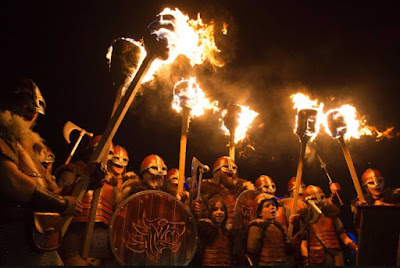
The Scottish government has forbidden the celebration of Hogmanay this year, which attentive readers will recall is the reason that Hogmanay came to be in the first place. The wild, three-day New Years' celebration became what it is because the Scottish government forbade the celebration of Christmas, finding their subjects entirely too inclined to drunken revelry on the feast of Christ's birth. Thus, the Scots simply moved it to the next weekend.
This year England is paying the price for the Scottish government's attempt at avoiding revelry. England is not that far a drive for Scots who want to conduct their outdoor torch parades in Viking gear, drinking and setting fire to stuff. (Drinking and setting fire to England is also an old Scottish custom.)
We will be celebrating here. I'm making venison steak pies, shortbread, and festive drinks like raw-egg eggnog.
Haud Hogmanay, and may you all have a much better New Year than either of the two past.
Authoritarianism's Appeal
For 'good' purposes only, of course.
The contemporary political theory literature—which largely conceptualizes legitimacy in terms of democracy or basic rights—would seem to suggest not. I argue, however, that there exists another, overlooked aspect of legitimacy concerning a government’s ability to ensure safety and security. While, under normal conditions, maintaining democracy and rights is typically compatible with guaranteeing safety, in emergency situations, conflicts between these two aspects of legitimacy can and often do arise. A salient example of this is the COVID-19 pandemic, during which severe limitations on free movement and association have become legitimate techniques of government. Climate change poses an even graver threat to public safety. Consequently, I argue, legitimacy may require a similarly authoritarian approach.
The idea that the government exists to keep you safe, and may violate your rights as necessary to do so, is pernicious. Government does exist to provide security in the sense of holding a space in the world that will not be overrun by those who would enslave or tyrannize you. If it does this by enslaving or tyrannizing you, however, it has already defeated the purpose for which security was wanted.
There are ultimately no limits to government power once you accept the principle that safety per se is a proper end of government. What could you regulate under the heading of climate change? Every economic activity, surely; and thus every activity whatsoever, since every choice one makes has economic consequences. Take an activity that has as few as possible: should I take a walk outside in the fresh air? If I do, I'm not doing other things that may be valuable in the fight against climate change. Perhaps I should be spending my exercise time generating power on one of those generator standing bicycles. Indeed, perhaps the government will find that we all have a duty to do so:
One bicycle could potentially provide a small village with electricity if each household spends on hour per day pedaling the bike.
So like Conan pushing the wheel, we could all be mandated to spend even our exercise time in a way that those with the whips have determined is in the interest of the common good.
Well, it worked out for him. Maybe it will be good for us too. Plato's Athenian would have liked the idea quite a lot.
For those who believe as the Declaration of Independence does that the sole function of government is to secure inalienable rights, this principle must be rejected. Granting governments extra powers in emergencies is unacceptable because governments can always make emergencies as necessary to continue their powers. Granting them extra powers for emergencies as broad as "climate change" whisks away any defense from having them regulate every aspect of everyone's life. It is the choice of the frogs who demanded a king.
Advice You Can Use
If you are a reader of Grim’s Hall, there is a good chance that you would enjoy opening champagne tonight with a sword. If you’ve never done it before, The Art of Manliness has a helpful graphic.
The Feast of the Holy Family
That is today's feast; I missed the Feast of Holy Innocents this year, but you can read prior posts about it. Likewise the Feast of St. John the Divine, which is remembered here.
Subscribe to:
Posts (Atom)