Weber II: Justifications of Legitimacy

Weber states that there are three justifications that states use to show that they are the legitimate locus of the sole right to use violence to dominate others.

Like the political institutions historically preceding it, the state is a relation of men dominating men, a relation supported by means of legitimate (i.e. considered to be legitimate) violence. If the state is to exist, the dominated must obey the authority claimed by the powers that be. When and why do men obey? Upon what inner justifications and upon what external means does this domination rest?

To begin with, in principle, there are three inner justifications, hence basic legitimations of domination. 

First, the authority of the 'eternal yesterday,' i.e. of the mores sanctified through the unimaginably ancient recognition and habitual orientation to conform. This is 'traditional' domination exercised by the patriarch and the patrimonial prince of yore. 

There is the authority of the extraordinary and personal gift of grace (charisma), the absolutely personal devotion and personal confidence in revelation, heroism, or other qualities of individual leadership. This is 'charismatic' domination, as exercised by the prophet or­­in the field of politics­­by the elected war lord, the plebiscitarian ruler, the great demagogue, or the political party leader. 

Finally, there is domination by virtue of 'legality,' by virtue of the belief in the validity of legal statute and functional 'competence' based on rationally created rules. In this case, obedience is expected in discharging statutory obligations. This is domination as exercised by the modern 'servant of the state' and by all those bearers of power who in this respect resemble him.

The United States of America rejects the first mode entirely. Itself a state borne of revolution, the 'eternal yesterday' is unavailable to it as a form of legitimation. Article I, Section IX, Clause 8 of its constitution forbids titles of nobility. The First Amendment forbids a state religion, which in other states serves the function of tying the temporal leadership to the eternal. At this point the Constitution itself is old enough to almost serve as a kind of 'eternal yesterday' legitimation, but only in an illusory way: all politicians refer to it, profess loyalty to it, but none obey it. 

There are no charismatic individuals in American leadership. Some argue that Donald Trump was one during his tenure, but that is over. No one currently in any position of leadership in the United States government has any sort of charisma or charm. Perhaps this is just as well; in fact, the Founders were quite worried about demagogues of the sort mentioned.

That leaves only the third justification, and it is the one that the United States has traditionally relied upon. The rule of law! Laws and, since FDR, rules created by executive 'experts' are supposed to be obeyed because they were crafted in a process itself supposedly legitimate and enforced evenhandedly upon all. 

Crises of legitimacy have occurred before now. FDR himself experienced one because his rules and rule-making bodies kept being rejected by the Supreme Court. This continued until his court-packing scheme, which although it failed had the practical effect of convincing the court to stop bucking his actions. The current Supreme Court, facing a similar court-packing scheme, seems to be avoiding conflict with the President and Congress pre-emptively. However, FDR paid a big price in terms of legitimacy in the eyes of the American people for this and other acts; had it not been for the Second World War uniting Americans behind his administration, that history might read differently. 

In the previous post I mentioned that we have entered a revolutionary moment on two fronts: 

Nevertheless it should be clear just from what has been said that we are in a revolutionary moment. The government is trapped between a segment that is openly contesting its claim to a monopoly on legitimate force -- or to having the legitimacy to police at all -- and a segment that questions whether the government continues to enjoy a more basic and fundamental legitimacy. The government's response to one side is cowering submission; to the other, an attempt to suppress their concerns rather than to address them. 

The BLM/Antifa faction, allied with the left broadly, has won some early rounds. Policing has become much more limited over the last year as the police withdraw into themselves and their precincts. The consequence is a murder rate that has risen to a degree with no modern precedent, in some cities up half again what it was only a year prior. Revolutions have their cost, though, and this one is not borne by the revolutionaries but by ordinary poor people in bad neighborhoods. As such, the revolutionaries can afford to pay such a cost forever; it does not even come onto their books.

On the right, the movement is outraged precisely by the failure of the law. The IRS in the Obama administration targeted right-wing TEA Party groups to prevent them from being effective politically. (If you Google this, you will learn that the media is telling you now that this was all 'fake news,' except that the government had to pay settlements for their wrongdoing.) The IRS coverup of this, which involved the 'accidental' destruction of many hard drives containing copies of emails, was never punished. The FBI built its whole investigation around the Clintons around clearing Hillary in time for her to become the Democratic Candidate for President; it then turned on the Republican candidate in a stunning fashion, creating an appearance of hostile foreign intelligence activity that enabled them to spy on his campaign, destroy his first National Security Advisor even though the FBI had cleared him during its investigation, and mire his administration in an illusion of scandal for the first two years. The 'interagency' community then arranged for his impeachment, precisely on the grounds of defying the unelected bureaucracy he had been elected to command. 

In the next election, the FBI bent over backwards to hide Hunter Biden's laptop (hey, another 'accidental' destruction!); the Secret Service seems to have worked to cover up his gun crimes. The powers that be turned a blind eye as a self-confessed conspiracy funded by major corporations in alignment with the Democratic party -- the conspiracy that gave an interview to Time magazine after the fact -- unconstitutionally and illegally changed election laws with an eye towards determining the outcome of the election. State and Federal police agencies refused to treat this as the serious crime of election fraud, and our court system refused to hear these cases: Dr. David Clements, a former District Attorney and a law professor in New Mexico, shows that not one single court had an evidentiary hearing at which evidence could be presented. In the news media, composed of more corporate participants, the 'rejection' by the courts was said to have shown that there was no evidence of fraud; in fact, none was allowed to be offered in any court venue.

At this point the United States' "rule of law" is so corrupted by the attempt to consolidate power that even the United States Postal Service is running a clandestine program to spy on Americans' social media activity. If the reports are accurate, they are engaged in domestic spying precisely targeting constitutionally-protected protest activity. This is the sort of thing that would have been rightly mocked as the fever-dreams of the paranoid drug-addled a few years ago.


Meanwhile the National Guard has been tasked to protect the politicians from the ordinary people (yes, the poor Joes are still there), though the violence targeting the Guard seems to be coming from people on the left affiliated with the anti-police movement.

So there is a general collapse of the rule of law associated with the success of the anti-policing movement; and an abandonment of the principle that the law should rule evenhandedly by those seeking to consolidate power. For these twin reasons, the United States government is on very thin ice on Weber's terms.

There remains a secondary source of submission to authority, however, even where legitimacy fails. That will be the subject of the next entry in this series. 

Weber I: Monopoly on Violence

I think this time I'll break it out by topic, starting with the one I mentioned in the introduction below. 

Weber begins by asking what "politics" is, and -- therefore -- what a "state" is, the state being the field of political activity.

But what is a 'political' association from the sociological point of view? What is a 'state'? Sociologically, the state cannot be defined in terms of its ends. There is scarcely any task that some political association has not taken in hand, and there is no task that one could say has always been exclusive and peculiar to those associations which are designated as political ones: today the state, or historically, those associations which have been the predecessors of the modern state.

Aristotle would object to this philosophical claim. For Aristotle, politics is the science of the highest human good: how we should order ourselves and our activities in order to maximize human flourishing. He says this right at the beginning of the Politics:

Every state is a community of some kind, and every community is established with a view to some good; for mankind always act in order to obtain that which they think good. But, if all communities aim at some good, the state or political community, which is the highest of all, and which embraces all the rest, aims at good in a greater degree than any other, and at the highest good.

Note that this embraces Weber's claim that lots of different "tasks" have been undertaken by various states; it disputes Weber's claim that these represent different "ends." Even the Communists, who brought about more human misery than all the others, claimed that they were acting for the good of humanity and indeed for its highest good as they understood it. 

One could also dispute Weber on a point where Aristotle agrees with him, to whit, that the state is the 'highest' level of such organizing activity. The European Union and the United Nations both imagine a supra-national level of organization. It may or may not be attainable or sustainable, given human nature; or it may not be capable of attaining the 'highest' human flourishing, if such things can only come in more intimate relationships. Nevertheless it is conceivable, at least.

In any event, Weber does not think we should define the state in terms of its end, but rather by its choice of means:  "[O]ne can define the modern state sociologically only in terms of the specific means peculiar to it, as to every political association, namely, the use of physical force." [Emphasis added.]

Now again, this would not be obvious to the ancients nor to the medievals. Aristotle and Plato worry continuously about the problem of family and clan producing factions within the political sphere that will turn to violence. The medievals tried to use political friendship between families as a way of organizing states, but it was in fact the families that often proved the most powerful -- as reflected in their literature, for example when the blood feud between Gawain's family and Lancelot's lays the groundwork for the destruction of Arthur's kingdom. If you read through the full version of Le Morte Darthur, or the long French cycles like the Prose Lancelot, these blood feuds are constantly pulling apart the feudal relationships on which the state of the day is based. 

Weber will talk at some length about the medievals and feudalism, but he is especially interested in "the modern state." Now by "modern" philosophers generally mean "the 18th Century," and to some degree the things that followed from that: thus, the American and French Revolutions, Kant and Hegel, and the consequences of Marx and Marxism, Nietzsche and Romanticism, and the fascists and Nazis as well. We are living at or just past the end of the modern period, and most of the states extant today remain modern states -- perhaps, it must be said, states that are also at or just past the end of their time. 

So, speaking of the claim that the modern state makes, Weber gives it thus:

'Every state is founded on force,' said Trotsky at Brest­-Litovsk. That is indeed right. If no social institutions existed which knew the use of violence, then the concept of 'state' would be eliminated, and a condition would emerge that could be designated as 'anarchy,' in the specific sense of this word. Of course, force is certainly not the normal or the only means of the state­­ - nobody says that - ­­but force is a means specific to the state. Today the relation between the state and violence is an especially intimate one. In the past, the most varied institutions­­ - beginning with the sib­ - ­have known the use of physical force as quite normal. Today, however, we have to say that a state is a human community that (successfully) claims the monopoly of the legitimate use of physical force within a given territory. Note that 'territory' is one of the characteristics of the state. Specifically, at the present time, the right to use physical force is ascribed to other institutions or to individuals only to the extent to which the state permits it. 

The state is considered the sole source of the 'right' to use violence. Hence, 'politics' for us means striving to share power or striving to influence the distribution of power, either among states or among groups within a state.

Notice that the current protests against police are a kind of double attack on the state on these terms. Groups like Antifa and BLM violate the laws, storming businesses or public transit (just last week, the Metro in DC was invaded by hundreds of BLM-aligned protesters who jumped the turnstiles and took over a train), invading people's space, clash with the police, use physical force. They claim they are doing so legitimately, and the state because of its injustice is illegitimate in resisting them. Likewise, in claiming that the police must be defunded and abolished, they claim that the state has no right to use physical violence at all -- not only no legitimate monopoly, but no legitimacy to use force to police its laws whatsoever. 


As I said in the introduction, the claim the state (n.b., not Weber, but the modern state) is making is fundamentally incompatible with the principle of the Declaration of Independence that the people may abolish the state if it becomes destructive to the end of protecting their rights. Actually, the Declaration is also against Weber's own claim that the state has no proper end: it holds that all states do have a proper end, specifically, the protection of the natural rights that human beings are endowed with by their Creator. If any state becomes destructive of that end, then the people have the right (and eventually the duty, the Declaration goes on to say) to alter or abolish the state. 

Therefore, if that principle is true, the state cannot ever have a legitimate monopoly on the use of force. 

Well, unless...

I propose that the citizen is an officer of the state.  More, if the American Declaration of Independence is morally correct, citizenship is the office in which the sovereign power resides. The sovereign power is originally all the power, some of which is delegated to the formal government. Even after delegation, however, the sovereign retains the power to determine when the rest of the government may exercise the powers delegated to it by the sovereign....

The citizen is the officer the Declaration of Independence is thinking of when they speak of the “Right of the People to alter or to abolish” any government that becomes destructive to the defense of their rights. The citizens, and only the citizens, have the right to make that awesome decision. No foreign power may dissolve the United States Constitution, and no elected nor appointed executive officer, nor a Congressperson, nor a judge nor Justice of any kind. The citizens alone have that sovereign right. They may delegate it to a constitutional convention, called by their other delegates in the legislatures. They may instead take up arms and do it themselves, as Washington and his generation abolished British rule. But whether they do it the one way or the other, no one may do it against their will nor without their consent.

That mechanism of treating citizens as a part of -- as the sovereign officers of -- the state ends up harmonizing Weber's description of the modern state with Hobbes' prescriptive idea that human beings desperately need a state to hold back the dangers of the world. If that is right, the 2nd Amendment's reliance on the militia of citizens as the last and best defense of 'a free state' makes a lot of sense.

Nevertheless it should be clear just from what has been said that we are in a revolutionary moment. The government is trapped between a segment that is openly contesting its claim to a monopoly on legitimate force -- or to having the legitimacy to police at all -- and a segment that questions whether the government continues to enjoy a more basic and fundamental legitimacy. The government's response to one side is cowering submission; to the other, an attempt to suppress their concerns rather than to address them. 

In the next segment, we will look at Weber's ideas about how state legitimacy is grounded, and why the United States' legitimacy is therefore in grave peril. 

You'll Get Further with a Kind Word and a 2x4....

...than with a kind word alone.

Max Weber: "Politics as Vocation"

For our next philosophical piece, you will be happy to know that I have selected a much shorter work that is almost contemporary. Max Weber's "Politics as Vocation" won't take very long to get through, but it will underline some real problems in our current politics. 

Now, Weber wasn't a bad guy. Per the first link to the SEP:
Weber’s political project also discloses his entrenched preoccupation with the willful resuscitation of certain character traits in modern society. [He was concerned about] great transformations that were undermining the social conditions necessary to support classical liberal values and bourgeois institutions, thereby compelling liberalism to search for a fundamental reorientation.... Weber’s own way was to address the problem of classical liberal characterology that was, in his view, being progressively undermined by the indiscriminate bureaucratization of modern society.
Weber's opening in this work is to define politics in terms of the state, which he describes as a territory-linked institution that has successfully claimed a monopoly on the legitimate use of force. I emphasize describes because I almost always encounter this in contemporary philosophers as if it were a prescription. Weber was not arguing that a good state ought to claim such a monopoly, nor (like Hobbes) that it would be to the common good to have a state that did; he was merely discussing what the modern state does, states that included Soviet Russia, Communist China, and Nazi Germany. 

As we will see, Weber is actually quite concerned about the necessary relationships of domination that occur when the modern state succeeds at claiming to be the only legitimate user of force. Note that the whole idea is in direct contradiction to the principle of the Declaration of Independence that the People should be free to 'alter or abolish' a state that ceases to defend their core liberties: if the state is solely capable of using force legitimacy, no revolutionary politics can be legitimate. 

Weber is clear from the beginning that he's talking about 'successful claims,' rather than actual legitimacy; and also he is clear about how dubious these claims actually are. You'll find it worth your time, I think. The whole thing is only 30 pages, and though it was originally in German, the translation provided is smooth. 

UN: Lockdowns Killed 228,000 Children in S Asia

This is just in six nations: Afghanistan, India, Pakistan, Nepal, Bangladesh, and Sri Lanka. 

BREXIT Recovery

Trade relations between the EU and UK did not suffer long. This is promising for any future decisions to depart from the EU, or similar super-national entity. 

A Free Life

Apparently a verdict has been reached in the trial of current moment, and will be announced shortly. I just want to take this quiet moment to reflect on how pleasant it is to live in a place where no mobs will riot regardless of the verdict, and any police strikes will go unnoticed because there are no police up here anyway. 

Conan was right about civilization. 

Corruption and Cars

A very slickly produced video, edited in a style to appeal to Millennial and younger viewers, nevertheless makes a fairly plausible case that a lot of corruption was involved in turning American cities into car-centric areas.


It may surprise you to learn that cars, in the four years immediately after World War I, killed more Americans than World War I. It's not going to surprise you at all to learn that the Feds stepped in to stop local governments from banning cars from cities, and instead imposed a new model Federal law designed by a 'safety commission' whose membership was almost entirely car manufacturing corporations. Nor will it surprise you that GM and others bought up all the streetcar firms serving American cities, so they could destroy them. You'll probably be surprised they were convicted for doing it, but not by the consequences they faced.

So give the kids your ear for a few minutes, 'cause they've got a point or two this time. 

Voter Integrity Project: Georgia Report

The public report redacts a lot of the actual data, because it contains specific details about voter registrations that could be used to harass people. They identified six illegal tranches of votes, of which their resources only permitted them to examine three. Even with those limitations, they identified more than enough illegal votes in just the three tranches in Georgia to overcome the margin of victory.

Note that this is different from the 'chain of custody' issue in Georgia, which 355,000 ballots appear to be lacking. These are specific ballots identified as illegal. 

Hiking


It’s getting pretty and warm. 

Paul Revere's Ride


Last night was the anniversary of Paul Revere's famous ride, which called the Minutemen to order to resist gun seizures by the British government. The above link provides both the famous poem, and some historical corrections to it. 

60 Minutes vs. the Oath Keepers

Last night, 60 Minutes ran an investigative piece into the Oath Keepers, the right-wing militia that is currently burning American cities and who opened fire on the Minnesota National Guard this weekend... er, wait, no, that was someone else. Oddly there seem to be no investigative reports into that group, whomever it may be. The Oath Keepers did, however, attend the 6 January protest in an unarmed fashion; and some of them did trespass in the Capitol, which they ought not to have done. 

Heads Up, Collaborators

Apparently mathematicians are police running dogs.


Now, it's my understanding that the argument against the police includes an argument that they are disproportionately targeting black Americans and other communities. If you want them to fix that, don't they need some mathematical input? 

If it's not true, wouldn't it be helpful to have the myth dispelled by trained mathematicians? It's a narrative that is doing a lot of damage to our country right now. We should surely either fix it if it's true, or dispel it if it's not. 

Sidebar Update

It's been a long time since I changed anything there, but I did add sections to the recent commentaries on Parmenides and the Laws. Hopefully I didn't screw any of the links up, but if I did please let me know. 

I don't know if I will take up reading through another work soon or not. I hadn't intended to do Parmenides, but it came up in discussion. 

Therapy Gives You Issues

Over half of liberal white women have 'a mental health issue' according to a recent study. Well, young ones.
White women, ages 18-29, who identified as liberal were given a mental health diagnosis from medical professionals at a rate of 56.3%, as compared to 28.4% in moderates and 27.3% in conservatives.
But of course, because the therapeutic mindset teaches them that it's normal to be traumatized and in need of treatment. This living in eternal therapy is, according to the one lady, human flourishing, happiness, eudaimonia!
Therapy seems to have absorbed not just our language but our idea of the good life; its framework of fulfillment and reciprocity, compassion and care, increasingly drives our vision for society. Writing this piece, I thought especially of the Greek concept of eudaimonia, or human flourishing. Some might call it blessedness. In any case, it seems worth talking about.

Embracing this mindset encourages one to describe one's experience in therapeutic terms; that's what your friends do, and your yoga instructor, your spiritual advisor, and the lady down the street who sells you candles and tarot readings. Naturally your therapist will go along with your desire to be diagnosed, since after all you're paying her hourly and will continue to do so if she provides you with a good reason to come back every week. 

The question is how many of these issues would manifest themselves as serious concerns in the absence of so much therapy and so much focus on 'trauma' and 'healing' and all that. I suppose the more serious mental health issues are mostly genetic or otherwise biological in nature, and probably there are a certain number of those that manifest regardless of cultural issues. More, if you have toxins like lead in the environment above a certain level.

UPDATE: Beyond the problem -- if it is a problem -- of having a large part of the population that thinks of itself as mentally ill (and the rest of us as undiagnosed mental patients-to-be, just as soon as they can arrange to rope us into therapy), there's a philosophical threat to civilization from this approach too. I saw one of these therapy-minded women suggesting recently that the United States, having been able to completely reorder itself for COVID, should be able to similarly reorder itself in order to address the historical traumas it caused to Native Americans, etc. 

First of all, that's a terrible model. Arguably the COVID response is the most destructive thing to happen to the United States since the Civil War, having devastated much of the economy and reordered it to the benefit of megacorporations like Amazon at the expense of small business. Politically, it saw the outright abrogation of basic liberties, to include freedom of assembly, freedom of expression, and free exercise of religion. The lesson we should take from the COVID response should be to defang government at the state and Federal level so that it can never do anything like that again.

But notice how the mindset that the proper business of adults is to 'heal their childhood trauma' drives us into the arms of those who want America to do nothing but meditate in shame on the evils of its ancestry. Here, as everywhere, the best answer is the opposite. The best thing to do with death is to ride off from it; the only thing to do with a tough history is to try to do better by people in the future, but you have to keep moving. The therapeutic mindset is unhealthy for the otherwise healthy individual, but its normalization as a philosophical model is deadly for a nation. 

A Professionally-Handled Pursuit

So, having expressed ideas that are critical of police and current training, it's fair to note a well-handled pursuit and arrest down in Forsyth County, Georgia. This is the county where I grew up, though it is nothing like it was when I was a boy:  it has more than ten times the population it did in the 1970s. As a consequence of becoming a rich suburb of Atlanta, it has a large and well-funded Sheriff's department. 

Here they apprehend a fleeing Dodge Charger with out of state plates, which proved to be full of armed felons from Chicago. Note not only the well-handled pursuit and takedown, but the manner in which they did not open fire in spite of having reasons to do so (e.g., the opaque windows preventing them from seeing into the vehicle, and its repeated attempts to escape them even after they had rammed it into a ditch). 


I don't know any of the deputies still serving on the force, although I grew up knowing quite a few because of my father's work with the Volunteer Fire Department. These young fellows responded well to provocation and excitement, and handled the matter with clear professionalism. 

American Spaghetti


This is from an album I missed until this week, which inspired a 2007 film that I also missed. (I was probably either in the Philippines or Iraq, depending on when it was released that year.) The album is clearly inspired by the work of Ennio Morricone, and has some good moments as well as some cheesy ones, much like Morricone himself. A worthy tribute.

Putting the Brakes on Riots

Not a terrible start, though deploying the Guard with orders to shoot looters might be faster.
The newspaper notes that Democrats and civil rights organizations specifically point to the provisions in the bill that "grant civil legal immunity to people who drive through protesters blocking a road; prevent people arrested for rioting or offenses committed during a riot from bailing out of jail until their first court appearance; and impose a six-month mandatory sentence for battery on a police officer during a riot."

The bill also states that a city cannot reduce its police budget without prior approval from the state, in an apparent response to the movement to redistribute some of the funding that goes towards police.

I'm pretty sure that last part goes against my ordinary principles, which are generally for localized control and adaptability as long as basic rights are not thereby threatened.  

Not DB: Special Operations Forces Full of Extremists

You know, the kind of people who -- like a majority of Americans -- believe the election was stolen. Perhaps coincidentally, US Special Forces in particular are likely to have operated in third world countries where dodgy elections are the norm; and they have significant insight into the behind-the-scenes operations of our own government too. But let's go with 'crazy conspiracy theories and QAnon,' says NBC.

The story is based on posts in 'secret Facebook groups,' whose membership is of course completely confirmed to be actual SOF. Definitely no stolen valor goes on with this internet thing.

By the way, how strong is the claim that SOF is rife with QAnon followers? Way down the article we get this: "QAnon followers aren't necessarily common among special operations forces. But if any member of the military believes in the conspiracy theory..."

Oh, OK.

Also amusing is the note that SOCOM experienced a "hiccup" in its "counter-extremism" training after their new Diversity and Inclusion chief was found to have compared Trump to Hitler in social media posts. But I mean, that's mainstream, right?

UPDATE: Relatedly, a genuine conspiracy theory spread through American journalism that Russia was paying bounties for dead American soldiers. "All they had was an anonymous leak from “intelligence officials” — which The New York Times on Thursday admitted came from the CIA — but that was all they needed."

Well, of course you can trust anonymous clandestine intelligence sources. That's mainstream, right? 

DB: Pentagon to Weed Out Extremists by Banning Marine Corps

They make a good case.
Defense Secretary Lloyd Austin [said:] "We had to understand how a person becomes radicalized. And Jesus Christ did you know what the Marine Corps is like?”

Laura Goodwin, a researcher for the Rand Corporation, shared some data that informed the panel’s decision.

“When we asked recruits why they served in the Air Force, 54% said ‘college money,’ and 34% said ‘Patriotism or service to country,’ When we asked the same question to Marine Corps recruits, 18% cited ‘shoot a giant ******* machine gun,’ and 88% said ‘kicking in Bin Laden’s door, sneaking up to his bedroom, shooting his ******* beard face, and throwing a grenade on his sleeping innocent wives..."

Joe (not his real name)... was exposed to radical propaganda in a YouTube ad late at night, “all [he] could think about was slaying dragons and wearing white gloves and a sword.” ...

“The Department of Defense has shared core values of service, honor, and integrity, based on a long tradition of just war, the Geneva Conventions, ethical conduct, escalation of force and law of armed conflict,” Austin said, though his remarks were drowned out by a passing Marine platoon singing about blood making the green grass grow and putting claymores in children’s playgrounds.

Not Even King Arthur Can Escape the Woke Wave

 Apparently King Arthur Flour has a new logo- and it's not *nearly* as nice as the old one.  Very disappointing.


Fake News Today

BB: "More Conservatives deciding not to get vaccinated after learning liberals will stay away from them."

DB: "Army says generals can substitute 2 minute plank in lieu of victory in Afghanistan."

HT: "Drag Queen overthrown in Drag Revolution by Drag Peasants." 

TO: "Police Department To Avoid Future Errors By Replacing All Equipment Officers Carry With Guns."

More on Poisoning Public Schools with CRT

From The Federalist, this time. 

Reforming Police Training

In the comments to the "Rabbit/Riot" post below, Larry made the following comment.
Larry said...
I agree, that phrase made me laugh, as well.

For as long as I’ve followed the posts in the Hall (I made my way to the Hall from Blackfive), deficiencies in the training of American police have been raised as a significant issue. I don’t know enough about their training to know where it’s deficient. Grim (and anyone else), can you give me more information about that?
It's been more than a decade that we've occasionally been treating this subject, so I thought perhaps it would be helpful to review the history. 

In general, I've tended to argue that the problem isn't a deficiency of training, but badly-founded training. More training is thus not the answer, because training people even more intensely to do the wrong thing will only intensify bad results. What is needed is a general reformation of police training based on the restoration of an older understanding of what police exist to do. 

My basic claim has been that there are two modes of understanding what police officers do: the 'peace officer' and the 'law enforcement' models. On the older 'peace officer' model, police are just full-time good citizens whose job is to help other citizens uphold the common peace. If you as a citizen should come across someone's livestock that has gotten out of their fence and into the road, it would be proper to stop and help them get it back inside the fence to protect travelers as well as property. If no other good citizens are around, the police exist as people you can call to come help you. Similarly, if you see someone being robbed or raped or murdered, a good citizen should put a stop to it. The police exist as full-time good citizens, spending all day working in the community to uphold the common peace.

The Norman Rockwell painting under the "older understanding" link idolizes this model. The police officer has options when he encounters a runaway (and truant). The one he chose was to take the boy for a snack, hear him out, and try to find solutions to his problems. It was not to slap him in juvenile for violating mandatory school attendance policies, or to bust up his family by sending him to the Department of Child/Family Services who will put him in foster care. The painting is idyllic, but the lesson is genuine. A peace officer can enforce the law, but that is only one tool. It is often not the right tool
Sir Thomas More [in claiming that the rule of law must be paramount] was speaking as an agent of the state. The argument that an officer of the state should 'give the Devil the benefit of the law' is an argument about the state recognizing legal limits to its power. Just as the play says, if we accept the state setting aside the lawful limits of its power to deal with evildoers, we will soon find it accepts no limits when it deals with anyone else.

The "we" who are accepting or rejecting the state's powers here are "We, the People." The distinction between the People and the State is that the People are those who retain the power described in the Declaration of Independence:

[T]hey are endowed by their Creator with certain unalienable rights, that among these are life, liberty and the pursuit of happiness. That to secure these rights, governments are instituted among men, deriving their just powers from the consent of the governed. That whenever any form of government becomes destructive to these ends, it is the right of the people to alter or to abolish it, and to institute new government, laying its foundation on such principles and organizing its powers in such form, as to them shall seem most likely to effect their safety and happiness.
"The rule of law" is therefore not a principle for the People to accept as a first principle. They are the judges of whether "the rule of law" has become destructive to "life, liberty, and the pursuit of happiness." Their first principles must be these three things.

The rule of law is a means to that end; when it becomes destructive to those ends, the law must be set aside in spite of itself.

If the law is unjust, "the rule of law" means the rule of injustice. Before we the People speak of 'giving the Devil the benefit of the law,' we must not forget that the Devil often has the best lobbyists. We should not commit to a moral principle that commits us to pursuing injustice on those occasions when the wicked have captured the law.

----------------------------------------

There is a second argument that applies even when the law is not unjust; even when it may be perfectly just.

The law is an exercise of the power of the state, and the power of the state is coercive -- it is based on violence, that is, even when an individual instance is not violent. Every act of "law enforcement" is an act of coercion.

Many times in life we find ourselves in disputes with others, and we could rely on rules and force to push people to accept our way. We might also be able to sit down, talk things through, and achieve a compromise position that everyone can live with. The second approach means that we do not get exactly what we wanted, but we do get a society that is more pleasant to live in. Very often, this second approach is the foundation of friendships and good relations with neighbors.

This is why we respect the old breed of "peace officers" more than the sort who consider themselves "law enforcement officers." A peace officer is preserving the order of society, but this often means letting certain things slide if an agreement can be reached between the parties in dispute. The law here is a tool, certainly, but he does not stand on 'the rule of law.' He mentions the law, and then talks people into sorting out their problems so that no one has to go to jail.
On the law enforcement model, the police are agents of the state who are set in opposition to the citizenry. Their job is to enforce unpopular laws (whose legitimacy is questionable in a democracy: by what right does any law exist if it is rejected by most citizens?), to collect fines to fund the state, and to put or keep people in prison. 

So that is one basic issue: conception of the role of the officer.

The second basic issue where police training is disordered is on the question of honor. Police work is inherently honorable just because it entails taking on risks to one's self in order to protect those who are weaker. However, police training on the use of lethal force -- especially in using handguns -- has become predicated on ensuring that the officer comes home alive. While it is desirable that the officer comes home alive, maximizing that outcome means pushing the risks of police work back onto the other people. If a police officer is trained to draw his firearm at the first potential sign of trouble, he protects himself more effectively; but it exposes the people he encounters to a higher degree of risk. That reverses the dynamic that made police work honorable, and makes it instead dishonorable: one becomes an armed agent of the state trained to shoot anyone who presents a potentially dangerous challenge. 

Police have a defensible case here in terms of how quickly things can go sideways. Someone with a knife can close the distance and kill you in seconds even from tens of feet away; someone with a hidden gun can kill you very quickly indeed. Knives and guns are, however, not illegal in the United States and ought not to become so. Whatever risk they pose, the mere possession of a weapon does not justify lethal force. (See discussion here.)

Likewise, the police training by focusing on their constant risk of death teaches them to overestimate how dangerous their job is. "[I]n a parallel discussion, somebody flipped the data: what about police killed by blacks vs. others? It looks like blacks represent about 4 in 10 cop killers, at 13% of the population. But again, how many police are killed? Not many! 126 out of 1.1 million, or 0.011%."

As a result, police are taught to respond much more aggressively than is prudent, against a population much less likely to hurt them than they are taught to believe. They end up shifting the status of their profession towards dishonor by choosing to prioritize self-defense over running risks to protect others; and they shift from being good fellow citizens to enemies of ordinary people by adopting the law-enforcement model over the peace officer model.

Finally, there is an issue about equipment.
I would say training reform begins with equipment reform. That's going to vary a bit by community, but we should have a conversation about what an appropriate level of force is for our communities. It may be that a shotgun ordinarily left in the car is all you need for many rural jurisdictions. In those cases when force was likely, you'd have more force than a handgun provides, but mostly you'd deal with people without weapons.

In more dangerous places, we might ask whether Tasers and CS gas are really needed. They don't seem to be very effective against dangerous people. They're just confusing the options and the legal after-game. Maybe the handgun is one option, and the nightstick or other melee weapon the primary choice for training. And that means a lot of training, because melee weapons are much harder to use well. There are lots of rewards to having a well-trained force that can leverage this capacity, though.

I think teams armed with military-grade gear should probably be almost done away with nationwide. We have the National Guard for that. If policing ordinarily requires that level of force in your community, we need to consider martial law until order can be restored. But that's a military problem, not a police problem.

I don't think the BLM people much like to consider that there may be neighborhoods -- even in majority black communities like those in South Chicago -- where martial law is the appropriate answer. But I think we could get to an eventual position in which less force on a day to day basis is required that way. When order is restored, it can be a much better kind of order.

We also need to address the separate issue of using police for revenue collection. That needs to stop. Maybe communities can be forbidden to collect revenue in this way -- all fines have to be donated to charities through a double-blind mechanism to prevent corruption, or something like that.

In addition to these global issues, there are localized issues that are beyond the scope of this blog to address. I spent the weekend with emergency personnel of my acquaintance who are local to the community, and they raised a number of complaints about the way Public Safety training is handled by the local community college (which handles a lot of the work of training EMTs, firefighters, and police, as the state has pushed a number of these duties off onto academia as 'training hours').  One example: There are issues about urban vs. rural America that crop up as the big city police/fire unions create demands for excessive training in order to try to drive up their departmental budgets (some of which gets diverted to their salaries, not that they don't deserve good pay). Poorer communities end up having fewer police and firefighters than they'd like as a result, because they just can't afford to keep up. 

Music and Measure Theory

James left this video in the last Parmenides post.


I'm raising it to the top because many of you may be interested. Piercello, if you're around, you should definitely watch it.

Counter Education in Public Schools

Bari Weiss published an article by one Paul Rossi arguing that the schools have become hostile to educating a free people in favor of teaching tribalism and racism.

My school, like so many others, induces students via shame and sophistry to identify primarily with their race before their individual identities are fully formed. Students are pressured to conform their opinions to those broadly associated with their race and gender and to minimize or dismiss individual experiences that don’t match those assumptions. The morally compromised status of “oppressor” is assigned to one group of students based on their immutable characteristics. In the meantime, dependency, resentment and moral superiority are cultivated in students considered “oppressed.”

All of this is done in the name of “equity,” but it is the opposite of fair. In reality, all of this reinforces the worst impulses we have as human beings: our tendency toward tribalism and sectarianism that a truly liberal education is meant to transcend.

Recently, I raised questions about this ideology at a mandatory, whites-only student and faculty Zoom meeting.

"A mandatory, whites-only" meeting? 

Aristotle warns in his Politics that an education must help to fit the citizens to the nature of their constitution. 

No one will doubt that the legislator should direct his attention above all to the education of youth; for the neglect of education does harm to the constitution. The citizen should be molded to suit the form of government under which he lives. For each government has a peculiar character which originally formed and which continues to preserve it. The character of democracy creates democracy, and the character of oligarchy creates oligarchy; and always the better the character, the better the government.

Again, for the exercise of any faculty or art a previous training and habituation are required; clearly therefore for the practice of virtue. And since the whole city has one end, it is manifest that education should be one and the same for all[.]

The education being provided is not proper to a democracy in which all are considered to be in some sense equals. It is an education fitted for balkanization, not harmony; to encourage division, not political friendship; and entirely opposed to the ends that the American republic was to strive to attain. 

Listen Up, You Primitive Rednecks

Or, outreach


Didn’t I hear of a vaccine being tabled this morning because it was causing inexplicable blood clots that doctors say they need more time to understand? 

You can’t know the long term effects of anything before the long term. 

Perfectly Clear

Instapundit quotes Althouse points out a 'news article' acting as propaganda:

 CNN reports, aggressively inserting the view that the [60% of Republicans who think the election was stolen] who were polled are wrong... 

What is perfectly clear, however, is that Republicans’ lack of faith in our current election infrastructure is a direct result of Trump’s historic efforts to undermine the legitimacy of the 2020 results.
It’s “perfectly clear” why people have this opinion? This is a news article, reporting a poll, and it’s making an absolute assertion about why human beings believe what they do. That doesn’t inspire confidence. It makes people suspicious, perhaps paranoid.

As the old saying goes, 'it isn't paranoia if they're really out to get you.' The ongoing case in Georgia has found 400,000 ballots that lack legally required chain of custody documentation; it's over 66,000 illegal ballots found in Michigan; Arizona is about to conduct an audit in its most populous county. 

Yet the government official in Georgia asserts that there's nothing wrong, and those 400,000 ballots shouldn't be questioned. 

"We've never found systemic fraud, not enough to overturn the election," Georgia Secretary of State Brad Raffensperger (R) said in December. "We have over 250 cases right now ... but right now we don't see anything that would overturn, you know, the will of the people here in Georgia."

That's kind of the question, Raff. What was the will of the people of Georgia? I notice that he filed papers to ask the judge handling the review not to allow auditors access to any of the actual ballots. He wants the audit to look only at the electronic 'images' of ballots cast. If you want to restore confidence in the elections being fair, putting up road blocks to audits and reviews is not the way to get there. Neither is aggressively talking over the people who are convinced that your side cheated, as CNN is doing.

Sixty percent of Republicans in Georgia is on the order of a third of the population of the state. That's not a percentage you can afford to ignore with a charge of this gravity. You need to prove to them that things are above board if you want the system to remain stable.

Ville de Bitche

A city in France loses its Facebook page. 

Rabbit... er, Riot Season

It occurs to me that, in an earlier era when we got our news from local papers, I would never know that we were experiencing another set of semi-annual riots in major cities. It could not be more peaceful out here in the countryside. Spring weather is beautiful, too. 

This one appears to be occasioned by a female cop who didn't know the difference between her taser and her pistol. Diversity is our strength! Not, apparently, training or competence. 

R.I.P. Prince Philip

 At last, a tribute to the late Prince Philip that is neither tawdry nor in execrable taste.

Bad Week for Michigan

"Trump vindicated in election claim" is not something Democrats want to read in the paper.
A judge in Michigan has vindicated President Trump by ruling that Secretary of State Jocelyn Benson, a Democrat, broke state law when she unilaterally changed election rules concerning absentee balloting in the 2020 election. This ruling legitimizes a key claim made by the Trump legal team in its challenges to the 2020 election....

Michigan was not the only state where Democrat state officials unilaterally changed election laws, so this ruling certainly raises legitimate doubts whether Biden truly won the election without invalid votes.

There will be more doubts raised as these matters continue to develop, I'll warrant, until no doubt remains.  

UPDATE: More.

Point to Alabama


Alabama's governor was lambasted for appealing to her citizens' personal responsibility instead of imposing mandates. Guess the worm has turned. 

Pattern

 The pattern part of my mind lights up when I see work like this:


Against Gun Control

Gun control has never been a great idea, but it is a worse idea now than ever before. In the wake of a disputed election, with a self-confessed 'conspiracy' having overturned election laws illegally, that is not the time to violate the rights of the citizenry of the United States as those citizens understand their rights. 

But as always, these people either don't understand the problem they're trying to fix or are lying about their intentions. Almost all gun violence in America is committed with handguns; they want to ban so-called 'assault weapons,' mostly rifles, which are used in a tiny fraction of illegal violence. Nearly a third of these handguns are stolen by the person who used them; the others are almost all bought on the black market or obtained from 'friends and family' (e.g. fellow gang members), meaning they were stolen along the line. "Ghost guns" are not even a statistical blip, it's a hobbyist phenomenon. Gun control laws will in no way affect the black market, and absent mass seizures of legal handguns -- which isn't even proposed by the current government -- it won't affect the ability of criminals to steal guns.

So no, none of this. It's bad timing, and badly considered anyway.

The Straightaway


The only section of this road straight enough to photograph more than one curve. 

Plato's Parmenides X, The One V: The End

This will be the final post on Plato's Parmenides. (If you missed the last one, take a moment to note that Parmenides gives a formulation of Newton's First Law of Motion in it). As in the last couple of posts, I'll give the text after the jump with occasional remarks. 

What Does "Heresy" Mean Anymore?

The matter came up yesterday, although I was disinclined to raise such a divisive question on Easter Sunday.
On Easter Sunday, Sen. Raphael Warnock (D-Ga.) — pastor of Ebenezer Baptist Church in Atlanta, the same church Martin Luther King, Jr. pastored — tweeted a message that subverted the gospel of Christianity and preached utter heresy, rejected by Christian churches for more than a millennium.

“The meaning of Easter is more transcendent than the resurrection of Jesus Christ. Whether you are Christian or not, through a commitment to helping others we are able to save ourselves,” Warnock tweeted.
In the year 1326, Meister Eckhart was called before the Inquisition -- the "only theologian of the first rank to be tried for heresy in the Middle Ages" -- beginning a prosecution that would outlast his life. Several of his teachings were deemed heretical, but he was not himself deemed a heretic. There is an ongoing process about rehabilitating those doctrines that you can read about at the link; but the Church has held that he, himself, needs no rehabilitation because he was never condemned. 

Eckhart avoided condemnation as a heretic through the simple defense that heresy is an act of the will, and he did not will to be a heretic. Rather, he had taught the truth to the best of his understanding; if he was wrong, he was open to correction, and would recant anything found to be in error. Pope John XXII issued a bull after Eckhart's death noting that defense and his recantation, and condemning the doctrines but not the man.

It is easy enough to say, then, that Warnock is probably a heretic by the Eckhart standard, i.e., that he has been informed of his error but continues to teach it. So, however, are all Protestant churches by the Eckhart standard, e.g. on the question of transubstantiation; and as far as I know, accusations of heresy are not regularly floated. 

Within the Protestant context, which Warnock occupies, it's not clear to me what even would be a standard for heresy. By what authority does one Protestant tell another that they are a heretic, and what is the standard for such an accusation to be justified? Who judges such a case, and by what standard? 

As with other theological questions, the contemporary age seems to have drifted away from the old answers. Sometimes this is for the good, and sometimes not, but I'm not sure how anyone besides the Church would even consider (let alone adjudicate) an accusation like this one today; and even the Church appears to have let the matter slide for the great majority of cases. 

Female Privilege

Last week a Pakistani legal immigrant, working hard for Uber and his family, was killed in the District of Columbia. He died when he was tasered by two teenage girls, which they did in order to steal his car. Neither one being old enough to drive, they unsurprisingly wrecked the car shortly thereafter; he was clinging to the door trying to save his car from being stolen. He died shortly thereafter. No one rendered any aid to him in the video of the incident. One of the girls worried, though, that she had left her phone in the wrecked car. 

Today, only about a week later, the justice system has already disposed of the case: the girls will endure no prison time, and will be entirely free of court supervision by age 21.

Under D.C. law, one of the girls was young enough that she couldn't have been tried as an adult, but the other was not. I can't imagine two teenage boys murdering someone while carjacking him, showing no remorse and rendering no aid, and it not being treated as an adult crime if possible. The speed with which this case was resolved in their favor is stunning to anyone familiar with the criminal justice system.

UPDATE: On the other hand, perhaps in the present circumstances it's unfair to send any women to prison. 

More on Excess Deaths

JAMA claims that suicide actually declined last year; deaths from overdoses etc. were up by 20,000. Reason reports; link to the JAMA study is there if you want the raw study. 

Some Thoughts on the Easter Celebration

It's always struck me as odd that Easter, as a holiday experienced by human beings, was so much less a cultural event than Christmas. It is liturgically the much more important feast, indeed the greatest feast of the year; but whereas our whole culture bends itself towards Christmas for a month every year (even in this more secular age), Easter has never been as big an event.

At Christmas we have grand feasts -- meat pies, every kind of cake and pastry, and as the song says, 'Hail to Christmas/ once a year/ when we may drink/ both ale and beer.' At Easter there is usually just a ham and some candies. At Christmas there is a huge festival of gift-giving; at Easter, children (only) get an Easter basket filled with fake grass and fake eggs, with more little candies or trinkets. At Christmas we sing Christmas Carols at Mass, and pageants involve the children merrily as shepherds or angels; at Easter, the services are interminable and children are forced to endure uncomfortable and unpleasant Easter costumes they will never wear a second time, but which they are nevertheless enjoined from playing in because they might get grass stains on the pure-white outfits. 

For a long time I thought it was just a kind of accident, or perhaps a pagan inheritance; we could have given gifts at Easter instead of Christmas, but the old pagan holiday of the Winter Solstice was the big gift-giving holiday, and that transferred. Christianity was hampered in its choice to celebrate the spring instead of the winter because the existing cultural assumptions were too hard to transform. 

I have come to realize, though, that the facts of the world inform this more than human culture. Christmas (or whatever Winter feast) comes right after the slaughter and harvest, when fresh meats and other good things are far more widely available. October was the season for the brewing of the best ale of the year, as we know from Robin Hood stories; those were readily on hand for the holiday. Also, the coming of the snows and the cold weather meant that there was less to do outside, so there was time on hand to commit to a big celebration.

This time of year we are still a long way from First Fruits. The winter stores are drained, and what remains needed to be stretched out -- summer was often the hungry time in the old days. A ham, cured last year, was the last festival item available; the alternative was to slaughter an Easter lamb, newborn just this year, to enjoy fresh meat. But that was quite a sacrifice, as you would be giving up the meat from the larger animal that would come later, as well as its wool. A poorer community, or those coming off a bad year (like last year!) could hardly afford it. 

Thus on Easter we dress in fresh clothes, eat more sparingly of lesser foods, and give smaller gifts. But it is in the Springtime that the hope of new life comes, warmth returns to the world, and green begins to spring anew. The time of year better fits the Gospel story, dramatically; and it is perhaps for this reason that the divine decision was made to orient the liturgical year to the physical one in this way.

Except that only works for the Northern hemisphere, and Jesus lived near the equator. I've never been to the Southern hemisphere. Is Easter there more like our Thanksgiving in how it is celebrated? I don't know. 

And Easter


No kids, so no Easter egg hunt, but I dyed some eggs for a centerpiece anyway, as a handful of neighbors will join us for Easter lasagna.


Easter


The Martyrs of Easter

As you celebrate today, spare a thought for your fellows in China

A Holy Saturday Meditation: CS Lewis Predicted Our World

Jared Whitley argues the proposition. Just one of his examples:

“Children who are fit to proceed to a higher class may be artificially kept back, because the others would get a trauma — Beelzebub, what a useful word! — by being left behind.”

Screwtape must be grinning at headlines about public schools eliminating gifted programs, knowing how much this hurts the segment of society most likely to build it up: the middle class. 

His closing example is good, too.

It is a troubling matter. If there remains any society opposed to the actual practice of slavery and genocide, it is surely this one; its self-criticisms on this score are so intense that it often misses that it has not engaged in either for a hundred years, and also that other nations are actively practicing both right now. Yet in this, as in all else, it has been turned from the apparently noble purpose to the destruction of the very forces that might be aligned against those evils. Evil somehow profits where it is actively pursued and also where it is apparently actively resisted. 

Holy Saturday is the day of the complete triumph of evil, at least to all appearances. Today is Holy Saturday, but not only today.

Bee Stings

 Sad: Day Of Remembrance For St. April O’Fool Reduced To A Day Of Pranks

Commercializing Christian holidays is, unfortunately, all too common. What was once a day of celebration marking a significant development in church history turns into a secular day for drinking, collecting candy, or getting a new Xbox.

April Fools' Day is no exception. The world celebrates this day by pranking each other, making fake announcements on the internet, and other such tomfoolery. But we Christians know the true meaning of the holiday, as we somberly recall the brutal martyrdom of St. April O'Fool in 723 A.D. ...


Trigger Warning

So this song features violence against women. It's Jerry Jeff Walker, though, so we can reason that he probably means it as a joke -- much as in his more famous song, "Up Against the Wall, Redneck Mother." Still, when I played it for my wife, she was like, "What did he just say?" We don't get that kind of thing around here. 


Really, it's a surprisingly inappropriate song that can only be justified in the name of comedy. Probably for that reason, I'd never heard it before this week, when Spotify came up with it in its weekly recommendations. (These have been surprisingly non-PC on a fairly consistent basis; if my social credit score is based on what Spotify thinks I'll like, I'm definitely doomed.) 

I'm passing it on to you in the spirit of resistance to cancel culture, over-sensitivity, and the glorious freedoms of speech and expression. You're warned, and you're adults. Do what you want.

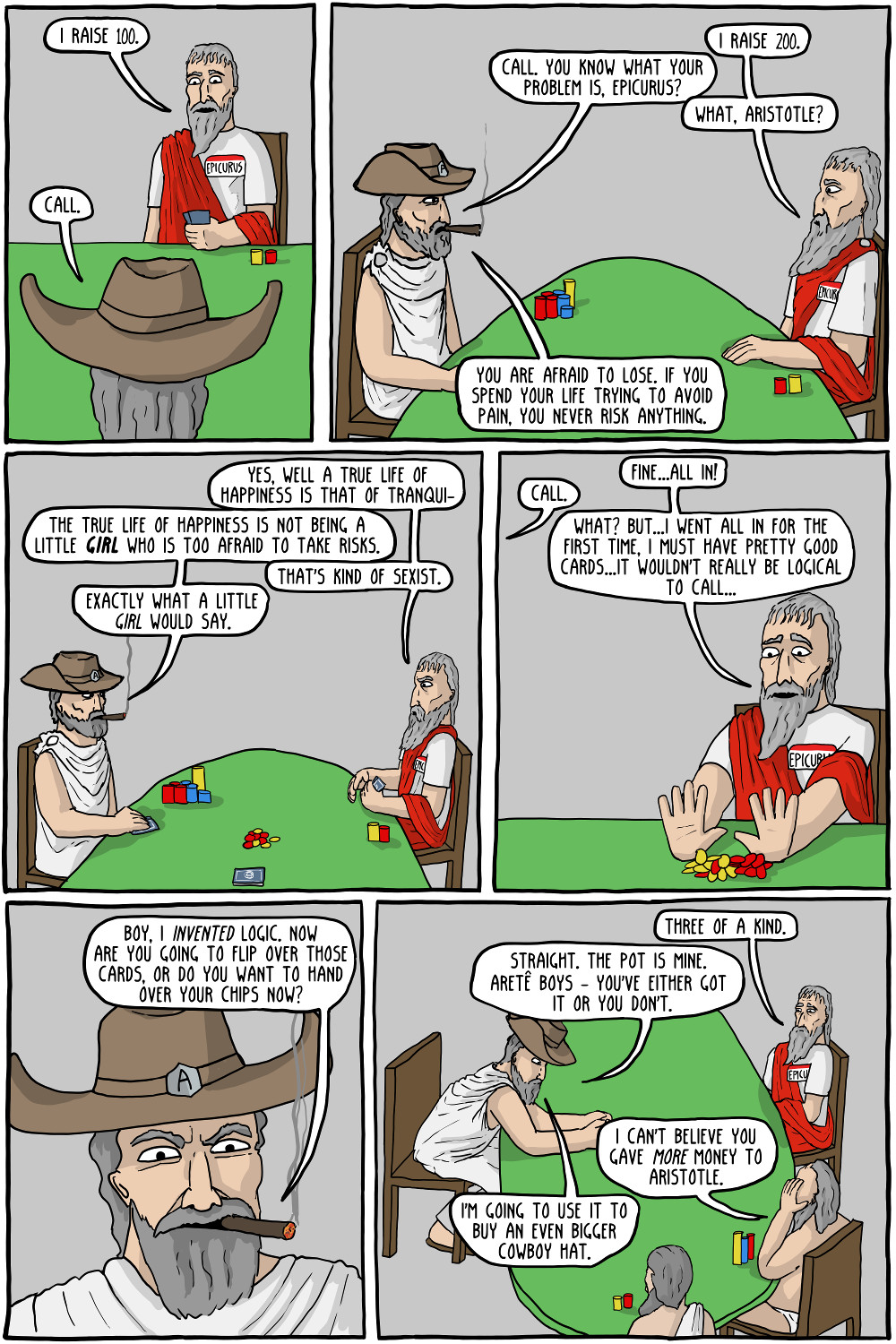
Arete, Boys

 You've either got it, or you don't.

From an often excellent comic called "Existential Comics." I think the author may be a Communist, but definitely also a philosopher. 

Now do basketball scholarships

After reading the Stasi-cancel tweet Grim referred us to, I scrolled down and read the next few entries, including this lame-brained cartoon:
It reminds me of the absurd dust-up over that poor 18-year-old Baltimore kid who was being made to go back to 9th grade because someone discovered he couldn't read. His mother was upset, not because he couldn't read, but because he couldn't get a diploma, which was bitterly unfair to him.

If we think of standardized testing as a way to hand out tickets to redeem for an equitable share of government largesse, then all we care about is whether the test is equally easy for everyone to pass. If we actually want to know whether students have learned something, it doesn't bother us that the test may reveal that some have and some haven't. It won't even be a fatal flaw in the test if we discover that some of the students are inherently able to learn the topic while others aren't.

Should an elephant and a fish be able to climb a tree as well as a monkey? Probably not, but then why would we put them all in a school designed to teach students to climb a tree? If anything, that cartoon is about silly choices in curricula. Once you put tree-climbing on the curriculum for whatever reason, then the last thing you should be thinking about is whether it's unfair to give a fish an "F" on a tree-climbing test. There's nothing wrong with the test.

Babylon Bee and the Letter "X"


Plato's Parmenides IX, The One IV

Again, I'll put this past the jump.  Just to remind you, this is a very extended discussion in which Parmenides proposes to talk through both sides of every part of the question. So the traps get run one way: "What if the One is not?" And then the other: "What if the One is?" Problems abound on every side. At this point the problems are going to start looking familiar, because we found them running the traps the one way; you'll see the same problems arising if we make the contrary assumption about the One.

With any luck we'll get through this in one more post after this one. 

"The Disintegration Directive"

I hate Twitter, but sometimes it's the place where important things get said. This thread on how cancel culture resembles less Mao's Cultural Revolution than a practice of the East German government is worth considering. 

As far as I know the government does not employ a Stasi-like secret police to harass ordinary citizens, although the actions against Trump core allies like Roger Stone looked rather similar. Yet there do seem to be cadres in our institutions and cities, which was a major similarity to the Cultural Revolution and its Red Guards. 

Someone else voices my usual rant

 From Hugo Gurdon, Washington Examiner editor-in-chief:

In 1985, singer Bob Geldof was interviewed backstage at London’s Wembley Stadium about the massive Live Aid rock concert he’d organized . . . raising money for famine relief in Ethiopia . . . .
At this moment, the greatest triumph in his already successful career, Geldof remarked with a note of bitter irony that Live Aid involved “the privatization of compassion.” He didn’t mean it as a compliment. “Privatization” had become a dirty word in the left-wing lexicon, as industries previously taken over by socialist governments were released from central control and sold to the public as businesses quoted on stock exchanges.
Geldof’s comment struck me forcefully at the time, for it was the precise opposite of what I took then and still take to be the gem-like truth stated by columnist T.E. Utley that one of the cruelest aspects of socialism is that it delegates compassion to the state. Socialism encourages individuals to think caring for their neighbor is not their responsibility but is, instead, a function of government.
Socialists often suggest that private provision of help for the needy is a failure of the state. [Senator Bernie] Sanders has spoken disdainfully of charity, as have many unappealing politicians elsewhere. They regard the care of others through individual acts of kindness as demeaning the recipient because they believe or at least declare that goods and services received should be taken as a right rather than accepted as a gift. One also suspects that socialists dislike charity because it places a claim on them as individuals, which they’d rather shrug off.

Eudaimonia is Not Therapy

I was going to leave this article alone, even though it addresses something I've been wondering about, until the last paragraph. The subject is the infusion of therapy-speak into everyday life. 

It's from the New Yorker, so 'everyday' means 'everyday upper-middle-class-and-higher life within certain fashionable communities.' Still, I know at least one person who services such a community, and runs a business doing it centered on Facebook and Instagram. She is all the time telling her clients how important it is to "heal" their "trauma." As far as I can tell her clients are at least relatively rich white women. Maybe some of them genuinely have trauma, but it seems to be the kind of stuff the article talks about:

During this exchange, Twitter served me an advertisement that urged me to “understand my trauma” by purchasing a yoga membership. Ridiculous, I thought. I’m not a sexual-assault survivor. I’ve never been to a war zone. But, countered my brain, after four years of Trump and four seasons of covid, are you not hurting? The earth is dying. Your mother issues! Your daddy issues! A clammy wave engulfed me. My cursor hovered over the banner.

So, as I said, I was going to leave it alone. After all, I don't want to beat up on fragile people, and these people are genuinely so fragile that they think they are being traumatized by living the life of a wealthy white woman in the better neighborhoods of the richest country on earth. There's definitely something wrong with them, but it isn't "trauma." Pointing out that their entire worldview is fundamentally unhealthy might seem like I was beating up on the weak.

But then that last paragraph:

Therapy seems to have absorbed not just our language but our idea of the good life; its framework of fulfillment and reciprocity, compassion and care, increasingly drives our vision for society. Writing this piece, I thought especially of the Greek concept of eudaimonia, or human flourishing. Some might call it blessedness. In any case, it seems worth talking about.

No, you thought wrong. 

Eudaimonia is often translated as "flourishing" or simply as "happiness," but the real thing it means is being fully engaged in pursuing excellence with all your vital powers. Now she says she's never been traumatized because she's never been to war; but in fact, war is the closest thing I've seen to eudaimonia.

Aristotle says that the goal of ethics is eudaimonia, a state of happy flourishing that you find when all of your vital powers are aligned in rational activity. More, he says, to fully experience this state you need a community that is set up to support it. The military deployed comes much closer to attaining Aristotle's ideal than anything else I've seen in the world. Everyone is working together towards some strategic good. They all have different jobs, but those jobs must align. Thus, there is constant rational communication and consideration of how to align different fires on a target, or different staff sections on a mission. This 'small, close knit' community is also a community that works together toward some goods that they pursue together through rational activity.

War being war, as Clausewitz says, 'everything is simple, and the simplest things are hard.' Thus, one needs all of one's vital powers in alignment to accomplish these goals. It is a very engaging sort of life.

It may well be that the broader society lacks a number of things that these smaller, close-knit and rationally ordered communities offer. Are these goods we can replicate? Certainly: any number of organizations could be set up to pursue goods in this way, although they will not all be as fully engaging of all of one's vital powers absent the extremes of war.

Are they goods that we do replicate? No, not really, not for the most part.

You develop tight knit friendships at war -- and then, if you study philosophy, you notice that Aristotle's ethics ends with a long discussion of the importance of friendship. 

If you want to find eudaimonia, stop ever going to therapy. Stop focusing on your problems, whatever they are. The only thing to do with death -- and whatever you disliked about your childhood -- is to ride off from it. Go join the local volunteer fire department, and work with them putting out fires or saving lives in medical emergencies. Study philosophy and argue about Truth and Justice with friends over beer. Take up an extreme sport with a good community that supports each other. Ride motorcycles. Ride horses. Learn a martial art and practice it intensely. 

Do everything you can except dwelling issues of 'care' and 'sensitivity' and all the 'hurts' and 'trauma' you've suffered. Stay away from anyone who tries to convince you that you're a suffering victim, or who is willing to treat you like one if you ask -- or so you'll pay them to help you dwell on your 'problems.' Dwelling on your problems is in fact the problem. Do great things instead.

Cause of death

The Chauvin trial is at last underway, with excellent daily reporting from PowerLine. The defendant is fortunate enough to have drawn a judge who takes his job seriously, almost alone in a city that appears unified in its desire to make this a show trial against an unjust society. As a result, to my amazement, the opening arguments largely stuck to the issue of what exactly it was that killed Mr. Floyd. After a disgraceful piece in the local rag arguing that the trial was a "vessel into which a splintered society places its rage, anxieties and hopes"--pretty much a recipe for lynch law--the same paper actually ran a fairly reasonable piece this week trying to sort through the conflicting evidence on the cause of death. It's hard to imagine how he got it past his editors.

If this were a civil case, it would be difficult to sort through the relative weight of the various contributing factors to Mr. Floyd's death. The picture is intolerably complicated by a fatal dose of fentanyl. I try to imagine how I'd view the evidence if it were myself being arrested, or someone from my own social circle that I knew and loved. Would I be thinking, "The person you're arresting is in clear medical distress; why are you so cavalier about the risks?" Or would I conclude that, if you resist arrest and act crazy and have to be restrained, then it turns out that you're dying of an OD, then it's just a slow-motion suicide by cop? Looking at it from the opposite perspective, if the defendant in this trial had for some reason forcibly administered the fatal dose of fentanyl to Mr. Floyd, then tried to argue that what really killed him was a knee on the neck, wouldn't I scoff? Wouldn't I reject the argument that the fentanyl wasn't all that dangerous, because Mr. Floyd, an addict, had such a high tolerance?

In a civil trial, the jury might be allowed to allocate percentages to the liability of the various people who created dangerous conditions, which in this fact pattern might well result in a very high percentage being allocated to the decision to swallow the fatal evidence of fentanyl. In a criminal trial, however, the jury has to resolve any reasonable doubt over whether Mr. Chauvin's actions were the effective cause of death. It can't help much that the jury will be allowed and/or instructed to take into account that there can be multiple causes of death, or that a potential fatal treatment can be considered the cause of death even if someone else (including the decedent) had contributed a cause of death that either took effect seconds before the action of the criminal defendant, or would have caused death within seconds in any case.

The only certain conclusion I can draw is that I wouldn't want to live there, and I certainly wouldn't want to serve on a police force in that city. It's a mystery how they keep a police force together at all. Frankly it's hard to see how such a broken city survives.