Looking back at the old Patriotism and Extremism post cited in the piece below, I realize that it barely said something I thought I had more fully explored. Perhaps I did elsewhere, but it's worth doing again even if so.
The idea is certainly mentioned in that piece: "It is necessary, in other words, to learn to forgive your ancestors: to recognize their flaws, their failings, and even their crimes, but to love them anyway.... in the end, patriotism proves to be a kind of health. As with other loves that forgive, it sets you free: free to honor the past, and to work for better in the future."
It is not for no reason that the root of 'patriotism' is 'patria,' meaning 'fatherland' in the Latin. It could be 'motherland' just as easily; in some languages the concept is captured that way (e.g., 'Mother Russia'). There is a strong analogy between the family and the state, as well as a clear relationship between the family you happen to come from and the coming-to-be of the particular state you are likely to inhabit. A few true immigrants leave family and culture behind, but more bring it with them; and even the assimilated descendants of 19th-century Italians or Irishmen belong now to a country that has learned from their culture as they have learned from it, and which has integrated their norms and patterns into its own.
Thus the question of how you feel about your country is rather like the question the Freudians used to ask about how you feel about your mother. You may have some very good reasons for animosity towards your mother. All the same, the existence of such animosity reliably predicts the presence of larger and more dangerous mental health issues. If you hate or despise your mother or father, you hate something of the root of your own being. This is going to manifest itself in many terrible ways, things that will cause you immense suffering.
A negative answer to that question of how you feel about the ground of your being also points out the treatment. The treatment is forgiveness and gratitude. It is not the adoption of ignorance about what they did wrong, which you likely did not deserve and which may have been the source of legitimate pain. Rather, the treatment is to forgive them for it. One needs to forgive them for one's self, because it is only in forgiveness -- easiest in the context of the recognition of one's own flaws -- that one can at last be liberated of the weight of carrying the anger.
This enables one to reflect anew on the good things one has gotten, also often undeserved, even from bad parents or nations. This does not require you to maintain ties to them; you can cut an abusive parent out of your life, and we are free as citizens ultimately even to dissolve a nation if we decide that is the right way to proceed. Even in doing so, though, it is helpful to one's self to recognize the goods they bestowed upon you: existence, some degree of protection and nurturing even in the worst relationships, education (even when learning from their mistakes or abuses). One becomes free in forgiving the faults without forgetting them, while being grateful for the goods they gave you in spite of their faults.
It is my sense that countries that cannot forgive their national ancestors wither away, as individuals do who cannot forgive their parents. I begin to think the same is true for individuals who cannot forgive their national ancestors. Aristotle says that we are social animals, and that the polis in a sense completes the work that the family can only begin.
Sometimes it is right to begin anew, but even then forgiveness and gratitude are appropriate. The United States separated from the United Kingdom, but for generations it looked back with honor upon Shakespeare and Sir Thomas Malory, Sir Walter Scott and Magna Carta. That sense of having grown from a fertile and happy ground was ultimately itself fecund, even though we had chosen the path of political separatism and independence.


Quite So
Responding to an assertion that the Women's Soccer team had "Nothing given, everything earned," a writer notes that most everything is unearned -- existence itself is, for example, as are any advantages that come from your particular genetics -- but that 'privilege theory' masks what is really owed behind a cartoon idea of who has (or hasn't) got 'privilege.'
In this case I am reminded of the brief discussion with LR1 in which a comment teased out a very privileged relationship at work here:
A lot was given. It was given explicitly to favor these women and develop their talents. They've been carefully taught not to see it, nor to express any gratitude to their society and culture for having nurtured them in this way.
In this way they are the opposites of Socrates:
Still, some sense of gratitude for what was given is wise and appropriate. A lot of people worked hard to create the system that made it possible for these particular individuals to excel. They were then sent forward as representatives of that system, and they might be expected to show by their conduct love and gratitude for the help they received in attaining their particular excellences. We might once have called such gratitude "patriotism," but whatever you call it, it is surely a duty of justice. The failure to be grateful is injustice, then; and like all vices, injustice (and ingratitude) harms the self as well as the others. It is a kind of poison.
In this case I am reminded of the brief discussion with LR1 in which a comment teased out a very privileged relationship at work here:
Almost no country in the world funds women's soccer to any serious degree. Our team is so great because it is drawn from feeder teams that are drawn from college programs that are hugely funded because -- via Title IX -- the colleges have to fund women's sports programs in order to justify their expenditures on their money-making college football teams.They're privileged because they live in a country that values women's equality to such a degree that it mandates colleges spend vast resources on female athletics, even though those colleges often lose money doing it. But they do it anyway, in order to be able to make money off college football. That process is what gives the WNT the talent pool that sets it above the rest of the world, which lacks such processes on anything like that scale.
It's doubly ironic, then, that the women's team is piggybacking off the greater popularity of another sport twice over. The college teams underlying their success wouldn't mostly exist except for government mandates for 'equal' spending, which they are now trying to replicate at the professional level.
A lot was given. It was given explicitly to favor these women and develop their talents. They've been carefully taught not to see it, nor to express any gratitude to their society and culture for having nurtured them in this way.
In this way they are the opposites of Socrates:
Soc. "Tell us what complaint you have to make against us which justifies you in attempting to destroy us and the State? In the first place did we not bring you into existence? Your father married your mother by our aid and begat you. Say whether you have any objection to urge against those of us who regulate marriage?" None, I should reply. "Or against those of us who regulate the system of nurture and education of children in which you were trained? Were not the laws, who have the charge of this, right in commanding your father to train you in music and gymnastic?"Socrates goes on to posit that this creates a master/slave relationship between the polis and the citizen, which any true American would reject. We would say that we created the state to do these things, and if it does them well, it is only doing a servant's work; if it does not, it is the state that can be fired and replaced, or 'destroyed' on Socrates' terms.
Still, some sense of gratitude for what was given is wise and appropriate. A lot of people worked hard to create the system that made it possible for these particular individuals to excel. They were then sent forward as representatives of that system, and they might be expected to show by their conduct love and gratitude for the help they received in attaining their particular excellences. We might once have called such gratitude "patriotism," but whatever you call it, it is surely a duty of justice. The failure to be grateful is injustice, then; and like all vices, injustice (and ingratitude) harms the self as well as the others. It is a kind of poison.
Politicians Need Chaperones
Male ones, at least, if meeting with unaccompanied female reporters.
Actually, a chaperone for politicians is a plausible idea. Instead of being there to prevent sexual harassment allegations, however, how about making them keep an ordinary American around to smack them every time they try to implement socialism?
Actually, a chaperone for politicians is a plausible idea. Instead of being there to prevent sexual harassment allegations, however, how about making them keep an ordinary American around to smack them every time they try to implement socialism?
Varmints
"Putting up a sign saying his farm is a coyote or feral hog free zone should do the trick, huh?"
Those are two species that aren't in much danger of extinction. Someday we'll regret killing off the red and gray wolves who might have helped us out with that project.
Those are two species that aren't in much danger of extinction. Someday we'll regret killing off the red and gray wolves who might have helped us out with that project.
An Age of Revolution Beckons
France's government rivals Britain's in its worthiness for a revolution.
Quadriplegic man reportedly ‘cried’ when told France has ordered him to be starved to deathFrom a utilitarian perspective, starving one quadripelgic man to death against his wishes does less harm than, say, hanging a few thousand politicians from the oak trees or lampposts most convenient to their places of business. However, the adoption of utilitarian ethics is exactly the problem with these cases. There are other ethical systems, and in some of the better ones a revolutionary movement is approaching the morally obligatory.
...The Court of Cassation’s final ruling means that Lambert, who is not otherwise ill or at the end of his life, would be removed from food and water and left to die slowly, which can take 14 days or more. The decision cannot be appealed in France, but his parents are fighting the order and have threatened to press charges for murder if his food is removed.... On Monday, Viviane renewed her plea for her son’s life. “He sleeps at night, wakes up during the day, and looks at me when I talk,” she said, according to Reuters. “He only needs to be fed through a special device and his doctor wants to deprive him of this so that he can die, while legal experts have have shown that this is not necessary.” She also emphasized that he has reacted to their voices, stating, “In May, when learning about his planned death, he cried.”
Science that cures
So much medical news seems to chronicle the many ways the health industry can make us miserable, but here is a medical advance I'd classify in the genuine miracle-cure category: surgical techniques to reattach nerves and tendons so that people with paralyzed arms and hands can regain function there. It's not like walking again, but what a difference use of one's hands makes.
Barbarians at the gate of the administrative state
The Chevron Doctrine is up for review at the Supreme Court this fall. Powerline has a good take on the dispute.
I recall the first line of Gary Lawson’s famous 1994 article on the Administrative State published in the Harvard Law Review that begins: “The post-New Deal administrative state is unconstitutional, and its validation by the legal system amounts to nothing less than a bloodless constitutional revolution.”
"Pathway to Citizenship"
Bill Barr is merciless in his choice of words.
Speaking of choice of words, Sec. Pompeo has decided to give "unalienable" a spin.
Speaking of choice of words, Sec. Pompeo has decided to give "unalienable" a spin.
Presidential Primary Updates
Arguably the worst candidate, Swalwell, bowed out today. So that's good. He will not be missed.
However, there's at least as good an argument that Kamala Harris is really the worst one -- and certainly she is the worst one remaining. It's not just people on the right who think so. Truthout has a big piece on her and her "record of injustice" today.
Tulsi Gabbard hit back at Harris for her deceptive practices today. That's good too.
However, there's at least as good an argument that Kamala Harris is really the worst one -- and certainly she is the worst one remaining. It's not just people on the right who think so. Truthout has a big piece on her and her "record of injustice" today.
Tulsi Gabbard hit back at Harris for her deceptive practices today. That's good too.
Round up the Usual Suspects
Venezuela has it down.
Venezuelan special forces have carried out thousands of extrajudicial killings in the past 18 months and then manipulated crime scenes to make it look as if the victims had been resisting arrest, the United Nations said Thursday in a report detailing wide-ranging government abuses targeting political opponents.Well, they do have Chinese advisers.
Special Action Forces described by witnesses as “death squads” killed 5,287 people in 2018 and another 1,569 by mid-May of this year, in what are officially termed by the Venezuelan government “Operations for the Liberation of the People,” U.N. investigators reported.
Hating the Market
I have not heard a living person voice the word "soccer" in the last year, so I think this is another one of those issues that's huge on Twitter and not in real America. Still, it does illustrate. People who understand economics point out that, in fact, women's soccer players in FIFA receive equitable pay even if they don't receive equal pay: they're paid disproportionately more than the men are, given their contribution to the economic game.
I don't think they fail to understand the economic argument. My sense is that this truly is a rejection of capitalism as a mode of social organization. Of course the men make boatloads more for the sport; of course it is already the men who are disproportionately underpaid compared with the women. That's not the point. The point is that pay should reflect moral, social values -- not economic ones.
That is of course how you get to a place like Venezuela, where enormous amounts of natural wealth still can't support a functional economic system. As someone pointed out this weekend, our socialists will tell you that they're aiming for Sweden or Norway, not Venezuela. What they forget is that Venezuelans were trying to be Sweden or Norway, too. (Also, they forget that Sweden and Norway largely abandoned socialist models; but that's a conversation more readily had at AVI's place, where he discusses it occasionally.)
In 2015, when the U.S. Women's National Team beat Japan to take the World Cup in Vancouver, the Women's World Cup brought in almost $73 million in revenue, of which the players got 13 percent — $10 million. In 2010, the men's World Cup in South Africa made almost $4 billion, of which 9 percent — $348 million — went to the players.What the activists want is not equitable pay, but equal pay -- even though there's nothing like an equal contribution to the pot. They act as if pay were an expression of their moral value as human beings, rather than their contribution to the economics.
The men simply make more money for FIFA — boatloads more money. The men's World Cup in Russia generated over $6 billion in revenue, with the participating teams sharing $400 million, less than 7 percent of the revenue. Meanwhile, the Women's World Cup was expected to earn $131 million for the 2019-2022 cycle and give out $30 million to participating teams. That's a whopping 22.9 percent!
In other words, the male players take home a smaller percentage of the money they earn for FIFA, even though they take home more money overall. The problem isn't FIFA being sexist against women — in fact, the percentage gap suggests a preference for women or at least an effort to make sure women make more money.
I don't think they fail to understand the economic argument. My sense is that this truly is a rejection of capitalism as a mode of social organization. Of course the men make boatloads more for the sport; of course it is already the men who are disproportionately underpaid compared with the women. That's not the point. The point is that pay should reflect moral, social values -- not economic ones.
That is of course how you get to a place like Venezuela, where enormous amounts of natural wealth still can't support a functional economic system. As someone pointed out this weekend, our socialists will tell you that they're aiming for Sweden or Norway, not Venezuela. What they forget is that Venezuelans were trying to be Sweden or Norway, too. (Also, they forget that Sweden and Norway largely abandoned socialist models; but that's a conversation more readily had at AVI's place, where he discusses it occasionally.)
Numbers
This is a Harvard-Harris poll. It's not finding what they'd like to find, so there's some reason to think it might be accurate; it's an argument against interests.
Some of these numbers are big. Some are titanic.
Some of these numbers are big. Some are titanic.
Let Me Tell You of the Days of High Adventure
Indeed, he has an interesting parallel with Tolkien:
[M]ost people accept the observation that America lacks its own mythology. To the extent the observation has any weight the same could be said of England. In fact, the lack of an indigenous English mythology is what motivated J.R.R. Tolkien to write the Lord of the Rings. Whether or not he accomplished that goal, he created stories that are loved all over the world.I think Joel is quite right; we've discussed Howard's works in this space fairly frequently over the years. My view of the Conan books has changed over time. Once I thought that Howard's race-realism defied evolution, since races like the Picts and the blacks and the Stygians retain recognizable characteristics across millennia. In more recent years I've rediscovered the central role that evolution plays in Howard's works: evolution and natural selection really are at the core of his vision of humanity, and even the race that becomes the Cimmerians is described as having fallen all the way back to animality at one point, only to evolve into men (and barbarians) again. Joel touches on that later in his essay. I would say that the centrality of race -- and its inescapable qualities -- are good evidence for his proposition that the Conan stories are the (or at least an) American mythology. America is also trapped in its racial categories.
However, an American author writing at about the same time as Tolkien did create an American mythology that continues to expand and thrive to the current day. The author was Robert E. Howard and the mythology he created centered on his most famous character, Conan.
Nevertheless, for the most part Joel's essay is not about the issue of race, but about the American virtues, and how they are expressed in Conan stories.
Walter Russell Mead, in his book “Special Providence,” identified five core values that formed the basis of Jacksonian culture created by the Scot-Irish settlers. These values were self-reliance, equality, individualism, financial adventurism, and courage. Unsurprisingly, Howard used these same values to flesh out the personal code of the mythological Conan.Virtue ethics is of course the correct ethics. Naturally, then, I strongly recommend that you read the essay in full, and that we should discuss it here.
They've already attacked Mom and apple pie
Glen Reynolds quotes a friend: "Trump maneuvered his opponents into attacking the Fourth of July."
You Can't Fight Betsy Ross
In the movie Fight Club, there's an extended sequence in which the guys explore who they'd choose to fight from historical periods. Lincoln is named: "Big guy, big reach. Skinny guys fight till they’re burger." Respect for the man who won the Civil War and gave his stunningly magnanimous Second Inaugural address is absent; the only measure of respect is how well he can fist-fight.
The current period has a similar feeling, except the once-honored dead are not present to fight back. Nevertheless, some few of them are strong enough to defend their reputations even from beyond the grave. Betsy Ross is likely one of these. For one thing, as a Quaker, she enjoys original abolitionist status. More than that, though, she occupies a particularly powerful archetype: she is America's Mother, as George Washington is America's Father. You cannot reject her without rejecting the whole, which is a road most Americans are unwilling to take.
Many years ago I read an article by a retiring professor of history, who for his whole career had surveyed incoming students about what they already knew about American history. He attested that, throughout his time, students had reliably volunteered the names of George Washington and Betsy Ross. Washington made sense, he said, because of the magnificence of his role; but Ross was unmentioned in the state curriculum except in very early primary education. Nevertheless, students who couldn't remember Cornwallis or Sam Adams would come up with Betsy Ross quite on their own. The human mind being what it is, a mother fits into a primal spot. America can't just have a father, or two fathers, or ten; like anything else, if it comes to be and flourishes, it must have had a mother too.
The President was prescient in his warning that allowing the Confederate statues to fall would call the whole into question. Thomas Jefferson may fall with the other secessionist slaveholders. But Washington won't, and Betsy Ross won't. America cannot let them go, and will not as long as she clings to life. Their enemies are fools, for they have chosen a foe too strong for themselves.
The current period has a similar feeling, except the once-honored dead are not present to fight back. Nevertheless, some few of them are strong enough to defend their reputations even from beyond the grave. Betsy Ross is likely one of these. For one thing, as a Quaker, she enjoys original abolitionist status. More than that, though, she occupies a particularly powerful archetype: she is America's Mother, as George Washington is America's Father. You cannot reject her without rejecting the whole, which is a road most Americans are unwilling to take.
Many years ago I read an article by a retiring professor of history, who for his whole career had surveyed incoming students about what they already knew about American history. He attested that, throughout his time, students had reliably volunteered the names of George Washington and Betsy Ross. Washington made sense, he said, because of the magnificence of his role; but Ross was unmentioned in the state curriculum except in very early primary education. Nevertheless, students who couldn't remember Cornwallis or Sam Adams would come up with Betsy Ross quite on their own. The human mind being what it is, a mother fits into a primal spot. America can't just have a father, or two fathers, or ten; like anything else, if it comes to be and flourishes, it must have had a mother too.
The President was prescient in his warning that allowing the Confederate statues to fall would call the whole into question. Thomas Jefferson may fall with the other secessionist slaveholders. But Washington won't, and Betsy Ross won't. America cannot let them go, and will not as long as she clings to life. Their enemies are fools, for they have chosen a foe too strong for themselves.
Americana
Some collected 'memes' on Independence Day. But definitely follow the flag link to the "Spirit of Rebellion" essay, which is the proper reading for today.


Don't Tempt Me
'Making fun of members of Congress should be prosecuted,' says Congresswoman. She actually seems to believe that it might already be against the law to do so.
The CBP and AOC
Well, yesterday was quite a day for agent provocateur and Congresswoman Alexandria Occasio-Cortez.
After the Abu Ghraib incident, I don't think anyone can rightly just outright refuse to believe it is possible that guards at an American detention facility could be engaged in brutal and humiliating acts against foreign detainees. For that matter, American prisons don't always treat actual American citizens very well either. Still, the CBP denies her basic claims about detainee treatment; and while there's no reason to doubt that a Border Patrol-celebrating secret Facebook group might contain some pretty nasty memes, at this point it's too early to suggest that CBP membership in the group is widespread. That could be true; it was true for the Marine Corps in similar circumstances.
At this point it's unclear how the facts will shake out. Treacher is right that we must have answers. However, it should be clear that the best thing to do is to close these camps -- by returning everyone to where they came from, as quickly as possible, accepting no new persons. If they come claiming to be a family unit, by all means return them as a family unit. We can avoid the danger of mistreatment of detainees by detaining no one.
After the Abu Ghraib incident, I don't think anyone can rightly just outright refuse to believe it is possible that guards at an American detention facility could be engaged in brutal and humiliating acts against foreign detainees. For that matter, American prisons don't always treat actual American citizens very well either. Still, the CBP denies her basic claims about detainee treatment; and while there's no reason to doubt that a Border Patrol-celebrating secret Facebook group might contain some pretty nasty memes, at this point it's too early to suggest that CBP membership in the group is widespread. That could be true; it was true for the Marine Corps in similar circumstances.
At this point it's unclear how the facts will shake out. Treacher is right that we must have answers. However, it should be clear that the best thing to do is to close these camps -- by returning everyone to where they came from, as quickly as possible, accepting no new persons. If they come claiming to be a family unit, by all means return them as a family unit. We can avoid the danger of mistreatment of detainees by detaining no one.
More on Marianne Williamson
Since she received such a rousing endorsement from Ymar, and Tex knows her family, perhaps she deserves a closer look. Here are a couple of pieces that dive deeper into the spirituality guru.
VICE: 'She knows you think she's a joke, but her campaign is not.'
VICE: 'She knows you think she's a joke, but her campaign is not.'
With over 3.5 million social media followers even before the debates (and 2.7 million on Twitter alone as of Sunday), Williamson qualified much earlier than many of the other candidates who made the stage last week. She’d reached the 65,000-donor threshold by early May, faster than half the field (many still aren’t there). In late May, she hit 1% in a third reputable national poll, double-qualifying for both the last debate and the next one....National Review has a dive into her background.
That’s also why she’ll be onstage at the next debate, and why she’s better-positioned than some other more seasoned politicians to reach the fall debates as well. Get a good laugh at Williamson’s expense? You’re not getting rid of her that easily.
Lunacy
I know it's Salon, and I shouldn't expect much, but even by those jaded standards, the explanation offered by Chauncey deVega (if that really is his name) for robust Trump support among "white voters" leaves me blinking rapidly.
Chauncey's whole argument is that, Trump being indisputably contemptible, there's only one explanation remaining for my support: I'm evil, too. And how are people evil today? Only in one way: racism. Q.E.D. Even my otherwise inexplicable sense of oppression by "non-believers" can be explained by racism, because if you scratch the surface, white evangelicals are simply terrified racists who hate brown people.
And then it seems I overlook Trump's "gross disregard for the Constitution." Where do people even get this stuff? Chauncey might as well be beaming Martian at me.
What to do? Chauncey advocates court-packing, "discarding any notions of civility and compromise," using social media to correct a pro-right advantage (you need special spectacles to detect that), and using
The idea behind white identity politics is that there is a subset of white voters and/or white Americans in general who feel a sense of attachment to their group. They feel a sense of solidarity. They think that their race and their racial identity is important to who they are, and that influences how they see and view the political world. Tied up in that sense of identity is the belief that whites are losing out in the United States and that their status and their power are somehow under threat. Subsequently, these white voters are responding to that politically by supporting policies and candidates that they view as protecting their group and preserving its status.I do support Trump's policies from a belief that they protect my interests, and I will grant that I perceive my interests as under threat. The source of the threat, nevertheless, doesn't take the form of dark skin, though it's true that a candidate who has nothing to point to but his skin (approvingly, and mine, disapprovingly) will arouse my suspicion. The argument has devolved to "Of course you only think that way because you're blinded by race, so listen to me while I obsess on race." Supposedly I'm motivated by fanatical loyalty to Social Security and Medicare (which I don't even like), primarily because they are the kinds of things white people like.
Chauncey's whole argument is that, Trump being indisputably contemptible, there's only one explanation remaining for my support: I'm evil, too. And how are people evil today? Only in one way: racism. Q.E.D. Even my otherwise inexplicable sense of oppression by "non-believers" can be explained by racism, because if you scratch the surface, white evangelicals are simply terrified racists who hate brown people.
And then it seems I overlook Trump's "gross disregard for the Constitution." Where do people even get this stuff? Chauncey might as well be beaming Martian at me.
What to do? Chauncey advocates court-packing, "discarding any notions of civility and compromise," using social media to correct a pro-right advantage (you need special spectacles to detect that), and using
simple, clear direct messaging which speaks to both emotions and the facts: The Republicans are trying to kill you. The Republicans are making you sick. Republicans don't care about your family. Republicans don't want you to vote. Republicans are stealing your money and giving it to rich people. Donald Trump thinks you are stupid.Would that primitive bludgeon of a message square any less with reality if you substituted "Democrats" for "Republicans"? Is there anything left in politics of this stripe but projection?
Don't Be Ridiculous
They're being ridiculous.
2) "Molon Labe" as a sentiment is opposed to overbearing governments; I take it to mean that this officer is refusing to enforce gun control laws he might see as unconstitutional. That's the opposite of fascism, when even the actual officers of the state posit limits to state authority they would refuse.
One of the arresting officers at yesterday's #NeverAgainAction can be seen sporting a Molon Labe tattoo, a prominent slogan of contemporary fascism.1) Those kids are only being arrested because they want to be arrested. It's a form of protest, probably negotiated with the police in advance to ensure they will receive light or dropped charges, good treatment, and short stays in detention that can be used as bragging rights as demonstrators.
2) "Molon Labe" as a sentiment is opposed to overbearing governments; I take it to mean that this officer is refusing to enforce gun control laws he might see as unconstitutional. That's the opposite of fascism, when even the actual officers of the state posit limits to state authority they would refuse.
Guns and the Anarchist
A left-leaning anarchist writes about guns.
There are two criticisms I would make, all the same.
1) It's hard to square 'designated... highly trusted' with 'protecting marginalized communities.' When you move from a universal individual right that can only be lost by demonstrated criminality (I agree with the domestic violence disqualification, for example), you allow space for marginalization to occur. In fact, that is exactly how the racist roots of gun control worked: through processes of restriction to 'trusted' members of the community, which just so happened to disqualify people of a particular race. This subject, of which she makes much in her essay, is extremely well-known to those of us on the right; it's been one of our chief arguments for at least a couple of decades.
If you want to protect marginalized communities, you have to prevent marginalization of individuals. Otherwise, you'll find that your marginalized community gets marginalized one individual at a time. There are some clear and acceptable reasons to marginalize an individual, but the defense of an individual right is necessary to ensure that distrusted communities aren't shut out of the right to the tools they need to defend themselves.
2) It would be wiser to make common cause with the gun-rights right than to try to set up against us. The temptation to do that is clear in the current culture wars; we're just used to thinking of each other as opponents at least, enemies at worst. That said, there's an opportunity not to be missed here. She's saying very little I haven't said myself in these pages, from praise for the original pre-criminal Black Panther project to a defense of the general idea (inherent in the NRA's original mission, which provided firearms and training to Freedmen in the South) that the individual right to keep and bear arms is a necessary part of the defense of human dignity. The argument that we can't rely on the police to protect us? Regular feature of the Hall. The argument that having only the servants of the state armed all but ensures tyranny? All the time here.
If we can't find a way to be allies, we'll end up killing each other. That won't protect anyone's community. The idea should be -- as it was framed by the Founders, even if they did not actually live it out this way -- to set up these local militia as guarantors of a state of liberty for all. That's harder to square with anarchism than it is with citizenship, because it is something like citizenship that creates and binds individuals together with common duties toward one another that wouldn't exist naturally. Minarchism makes more sense than anarchism, in other words.
In Stone Mountain, Georgia, when a group of us marched through the streets to celebrate the cancellation of a Klan rally on February 2, we were accompanied by local activists with rifles and ARs slung over their shoulders; the police kept their distance, which was an extraordinary sight for someone used to New York City’s ultra-aggressive, hyper-militarized NYPD. As the black militant liberation group the Black Panthers showed back in the 1960s, as the Zapatistas showed in the ’90s, and as anarchists in New Orleans showed during the aftermath of Katrina, when cops and other fascists see that they’re not the only ones packing, the balance of power shifts, and they tend to reconsider their tactics."Designated community patrols made up of well-trained, highly trusted individuals" is more or less exactly the original vision for local militias as the primary defense of a free state; and concerns about a militarized police are quite similar to the Founders' concerns about a standing army.
To be honest, the thought of a world in which the state and their running dogs are the only entities with access to firearms sends a shudder down my spine.
Leftist gun ownership is about protecting marginalized communities
Not everyone should have access to guns — domestic abusers, for example, have proven by their actions that they cannot be trusted with that kind of responsibility — and not everyone needs it. No one without a significant amount of training should be handling a firearm at all, which is why I think designated community patrols made up of well-trained, highly trusted individuals who are chosen by and held accountable to said community (and who do not hold any or less power than anyone else due to their position) is a far better and more equitable defense model than messy “everyone gets a gun!” rhetoric.
I’m also not interested in creating a parallel cultural universe wherein balaclava-clad “gun bunnies” pose for the ’gram (I’d much rather shore up support for Rojava’s all-women YPG Women’s Defense Unit). I’m interested in reclaiming the notion of armed self-defense from those who have long used it as a cudgel to repress dissent and terrorize marginalized communities, and emphasizing its potential as a transformative tool toward collective liberation.
There is a long history of leftist gun ownership, and a concurrent theme of state repression against it.
There are two criticisms I would make, all the same.
1) It's hard to square 'designated... highly trusted' with 'protecting marginalized communities.' When you move from a universal individual right that can only be lost by demonstrated criminality (I agree with the domestic violence disqualification, for example), you allow space for marginalization to occur. In fact, that is exactly how the racist roots of gun control worked: through processes of restriction to 'trusted' members of the community, which just so happened to disqualify people of a particular race. This subject, of which she makes much in her essay, is extremely well-known to those of us on the right; it's been one of our chief arguments for at least a couple of decades.
If you want to protect marginalized communities, you have to prevent marginalization of individuals. Otherwise, you'll find that your marginalized community gets marginalized one individual at a time. There are some clear and acceptable reasons to marginalize an individual, but the defense of an individual right is necessary to ensure that distrusted communities aren't shut out of the right to the tools they need to defend themselves.
2) It would be wiser to make common cause with the gun-rights right than to try to set up against us. The temptation to do that is clear in the current culture wars; we're just used to thinking of each other as opponents at least, enemies at worst. That said, there's an opportunity not to be missed here. She's saying very little I haven't said myself in these pages, from praise for the original pre-criminal Black Panther project to a defense of the general idea (inherent in the NRA's original mission, which provided firearms and training to Freedmen in the South) that the individual right to keep and bear arms is a necessary part of the defense of human dignity. The argument that we can't rely on the police to protect us? Regular feature of the Hall. The argument that having only the servants of the state armed all but ensures tyranny? All the time here.
If we can't find a way to be allies, we'll end up killing each other. That won't protect anyone's community. The idea should be -- as it was framed by the Founders, even if they did not actually live it out this way -- to set up these local militia as guarantors of a state of liberty for all. That's harder to square with anarchism than it is with citizenship, because it is something like citizenship that creates and binds individuals together with common duties toward one another that wouldn't exist naturally. Minarchism makes more sense than anarchism, in other words.
Funding the Trans*ition
It's the usual TIDES Foundation suspects, of course, but there's an interesting twist on why it's a priority.
To a certain degree technological change makes these kinds of things likely. William Gibson was imagining cyber and biotech allowing people to alter their bodies decades ago; one gang he envisioned replaced their teeth with animal fang implants. We will be in charge in a new way, and that means we can treat the body as an opportunity for a kind of art.
Against that challenge, of course, stands the Aristotelian philosophy we've been discussing. Because it sees nature as the source of the good, it will be predisposed to reject adopting a lifetime of pharmacology to suppress hormones or provide humans with wolf-like teeth. The role of art, for Aristotle, is to perfect the goods inherent in nature but imperfectly or incompletely realized. Dental surgery to fix improperly-grown teeth is good because it improves the perfection of a natural good; pulling out the teeth and replacing them with wolvish fangs that do not fit the natural diet of a human being is bad because it works against rather than with the goods of nature.
"Well, we can change our dietary tract too, someday, at least in principle; and we can grow 'meat' in vats that will avoid any ethical problems with switching to an all-meat diet; and we can force, with drugs and surgery, our bodies to accept all this, becoming artists of ourselves."
Perhaps. But there is something to be said for being able to sleep under the stars, with no medicine and no technology, to survive on natural strength rather than technological infrastructure. Aristotle has an advantage here, even in spite of all the long years and great changes.
Why do they care? The obvious answer is: money.The amounts being spent to advertise and advance this lifestyle choice seem vast until you compare it to the amounts that would be spent by a society that invests in a lifetime of additional medical supplies and treatments. If even an extra few percent could be convinced to do it, purveyors of such technologies would make back their investments many times over.
Melding this manufactured medical issue with civil rights frame entails the continuance and growth of the problem. Transgenderism is framed as both a medical problem, for the gender dysphoria of children who need puberty blockers and are being groomed for a lifetime of medicalization, and as a brave and original lifestyle choice for adults. Martine Rothblatt suggests we are all transhuman, that changing our bodies by removing healthy tissue and organs and ingesting cross-sex hormones over the course of a lifetime can be likened to wearing make-up, dying our hair, or getting a tattoo. If we are all transhuman, expressing that could be a never-ending saga of body-related consumerism.
To a certain degree technological change makes these kinds of things likely. William Gibson was imagining cyber and biotech allowing people to alter their bodies decades ago; one gang he envisioned replaced their teeth with animal fang implants. We will be in charge in a new way, and that means we can treat the body as an opportunity for a kind of art.
Against that challenge, of course, stands the Aristotelian philosophy we've been discussing. Because it sees nature as the source of the good, it will be predisposed to reject adopting a lifetime of pharmacology to suppress hormones or provide humans with wolf-like teeth. The role of art, for Aristotle, is to perfect the goods inherent in nature but imperfectly or incompletely realized. Dental surgery to fix improperly-grown teeth is good because it improves the perfection of a natural good; pulling out the teeth and replacing them with wolvish fangs that do not fit the natural diet of a human being is bad because it works against rather than with the goods of nature.
"Well, we can change our dietary tract too, someday, at least in principle; and we can grow 'meat' in vats that will avoid any ethical problems with switching to an all-meat diet; and we can force, with drugs and surgery, our bodies to accept all this, becoming artists of ourselves."
Perhaps. But there is something to be said for being able to sleep under the stars, with no medicine and no technology, to survive on natural strength rather than technological infrastructure. Aristotle has an advantage here, even in spite of all the long years and great changes.
Hearty and Hellish!
Per Gringo and my conversation, in the Jug of Punch post below, it turns out that "Hearty and Hellish!" was actually the name of the album -- recorded live at a nighclub in Chicago in 1962.
"Hellish," they said. Well, "-ish" is the ultimate in approximations.
"Hellish," they said. Well, "-ish" is the ultimate in approximations.
Deadly Force Authorized
You'll want to carefully consult your local laws to be sure how this works for you, but in most parts of America it would be considered reasonable to shoot someone if they tried to hit you with a crowbar or tire-iron. It would be less reasonable to shoot someone for throwing a milkshake at you, except if it became sufficiently commonplace that milkshakes were really chemical weapons.
Powerline wonders about how long this sort of thing will be allowed to go on. My guess is that it will go on for a while, until someone's patience wears out. Then, when the cost of this sort of behavior suddenly becomes much higher -- and especially if juries refuse to convict people for defending themselves, lowering the probable cost of defensive action -- suddenly it won't be necessary to worry about it that much.
UPDATE: Wretchard makes sense like always.
More and more, though, I think of the Conan quote from last week, and find that my eyes linger on my axe.
Powerline wonders about how long this sort of thing will be allowed to go on. My guess is that it will go on for a while, until someone's patience wears out. Then, when the cost of this sort of behavior suddenly becomes much higher -- and especially if juries refuse to convict people for defending themselves, lowering the probable cost of defensive action -- suddenly it won't be necessary to worry about it that much.
UPDATE: Wretchard makes sense like always.
It's not surprising that the French Terror began with the purge of the moderates and the urgency of virtue. As Robespierre put it, virtuous men have no choice but to employ any means necessary:He also says "the combativeness of the last few days alarmed those accustomed to regarding themselves as civilized." Well. Oddly once I thought of myself that way; I wrote that the essence of a gentlemen was "to bear arms, in defense of country and civilization." Surely I still think that, somewhere in my heart. I've spent many years becoming educated, if not precisely civilized; I pursued and gained advanced degrees in both history and philosophy. Whatever it means to have a civilization, history and philosophy are at the core of it.
If the basis of popular government in peacetime is virtue, the basis of popular government during a revolution is both virtue and terror; virtue, without which terror is baneful; terror, without which virtue is powerless. Terror is nothing more than speedy, severe and inflexible justice; it is thus an emanation of virtue; it is less a principle in itself, than a consequence of the general principle of democracy, applied to the most pressing needs of the patrie.
More and more, though, I think of the Conan quote from last week, and find that my eyes linger on my axe.
Ignoring Warning Signs
Bret Stephens issues a clear and sober warning:
How about Andrew Sullivan? Is he a Klansman too? He's actually asking that question, except he mentions "Japan" and "China" in place of his own name.
The thing is that these guys are really against Trump, and trying to keep the Democrats from making a massive mistake. This is as clear a warning as you could ask, from people who are your friends and want you to win. I've never seen this movie, but this clip has come up from time to time. It seems appropriate to the moment.
UPDATE: Colonel Kurt, who is less concerned what anybody calls him, sums up.
Promising access to health insurance for north of 11 million undocumented immigrants at a time when there’s a migration crisis at the southern border? Every candidate at Thursday’s debate raised a hand for that one, in what was surely the evening’s best moment for the Trump campaign.Did anyone listen? No, they called him a "white nationalist" like he was a member of the Aryan Brotherhood or something.
Calling for the decriminalization of border crossings (while opposing a wall)? That was a major theme of Wednesday’s debate, underlining the Republican contention that Democrats are a party of open borders, limitless amnesty and, in time, the Third World-ization of America.
Switching to Spanish?... Eliminating private health insurance[?]...
And then there are the costs that Democrats want to impose on the country. Warren, for instance, favors universal child care (estimated cost, $70 billion a year), Medicare-For-All ($2.8 trillion to $3.2 trillion annually), student-debt cancellation and universal free college ($125 billion annually), and a comprehensive climate action plan ($2 trillion, including $100 billion in aid to poor countries), along with a raft of smaller giveaways, like debt relief for Puerto Rico....
Throughout the debates, I kept wondering if any of the leading candidates would speak to Americans beyond the Democratic base.... [Nope!]
None of this means that Democrats can’t win in 2020. The economy could take a bad turn. Or Trump could outdo himself in loathsomeness. But the Democratic Party we saw this week did even less to appeal beyond its base than the president. And at least his message is that he’s on their — make that our — side.
How about Andrew Sullivan? Is he a Klansman too? He's actually asking that question, except he mentions "Japan" and "China" in place of his own name.
The thing is that these guys are really against Trump, and trying to keep the Democrats from making a massive mistake. This is as clear a warning as you could ask, from people who are your friends and want you to win. I've never seen this movie, but this clip has come up from time to time. It seems appropriate to the moment.
UPDATE: Colonel Kurt, who is less concerned what anybody calls him, sums up.
But it was the thought part where they came together in a festival of insane acclamation. They agreed on everything, and it was all politically suicidal. Yeah, Americans are thrilled about the idea of subsidizing Marxist puppetry students and getting kicked off their health insurance so that they can put their lives in the hands of the people who brought you the DMV.
Exactly who, outside of Manhattan and Scat Francisco, think Americans are dying to stop even our feeble enforcement of the border, make illegal immigration not illegal, never send illegals home once they get here and – think about this – take our tax money to give these foreigners who shouldn’t even be here in the first place better free health care than our vets get? That should go well in places like Wisconsin, Michigan and Pennsylvania. I eagerly await Salena Zito’s interview with a bunch of construction workers at a diner near Pittsburg who tell her, “It really bugs me, Lou and Joe here that those people coming into the country illegally aren’t getting free heath care on our dime. We all want to work an extra shift so we can give it to ‘em. We need a president who finally puts foreigners first! Also, we all agree we ought to give up our deer rifles because people in Cory Booker’s neighborhood can’t stop shooting each other.”
Spirituality and Such
A set of meditations from Presidential candidate Marianne Williamson (h/t Wretchard).
From 2010: The Boar's Head
This one's from Tex, being recipes for several classic pig's head dishes. We're a long way from Christmas, but since it crossed my screen tonight, I wanted to bring it forward.
Here's the carol, too, while we're on the subject. It's a long way to Christmas, but it's not bad to be reminded of it even at this distant hour.
Here's the carol, too, while we're on the subject. It's a long way to Christmas, but it's not bad to be reminded of it even at this distant hour.
From 2007: Choosing a Stetson
I came across this post while looking for something else. It's useful, practical advice that holds true still as far as I know. If you get one of the good ones they're good hats; I wore one to the Philippines (which I gave away to a member of the RP military) and another Iraq the whole time I was out there, and it served in the desert as well as in the wood.
The Jug of Punch
Before the merry month of June ends, we should have a listen to this beautiful piece.
Two from AL Daily
The first one wonders if AI means the end of anonymous authorship. Maybe looking backwards, but couldn't an AI serve to randomize your language just enough to ensure you weren't recognizable? Seems like more of an arms race than a finale.
On "The end of enchantment" and the Enlightenment. I obviously disagree that ending animism or enchantment is a necessary product of reason; panpsychism is as old as Plato, and inherent in the Neoplatonic philosophy that I think is the closest human beings have gotten to the truth. Praise for the Frankfurt school strikes me as short-sighted, but it's worth reading all the same because of this insight:
On the other hand, healing crystals are bunk, and the 'white witch' isn't really sending you a magic item with a bound jinn.
On "The end of enchantment" and the Enlightenment. I obviously disagree that ending animism or enchantment is a necessary product of reason; panpsychism is as old as Plato, and inherent in the Neoplatonic philosophy that I think is the closest human beings have gotten to the truth. Praise for the Frankfurt school strikes me as short-sighted, but it's worth reading all the same because of this insight:
[A] surprising 83.3 per cent of Americans believe in either guardian angels, demonic possession or ghosts, and there is evidence for similar belief patterns in western Europe. (I should note that disenchantment should not be confused with secularisation. The sociological evidence suggests that de-Christianisation, while usually equated with secularisation, often correlates with an increase in belief in spirits, ghosts and magic – not the reverse.) Nor are sociological surveys the only evidence. If one views Europe and North America through the same sort of anthropological lens that European and American anthropologists are used to directing abroad, it seems hard to defend the notion that the ‘modern West’ is straightforwardly disenchanted. There are plenty of examples.This pattern is older than the Frankfurt School, as it was known to Chesterton. Like Chesterton, we sit in a strange place with regards to it. On the one hand, Chesterton favored Roman Catholicism over some other variations of Christianity -- and especially materialism -- just because it offered him the opportunity to believe in faerie.
Walmart sells ‘Sage Spirit-Smudge Wands’ and clothing chains such as Urban Outfitters sell ‘healing crystals’ and tarot cards. You can go on eBay right now and pay an Australian ‘white witch’ to perform a ritual to summon a djinn and bind it to an object of your choice. Celebrities such as Anna Nicole Smith and Bobby Brown have publicly described having sex with ghosts. Coffee shops and co-ops throughout the US and much of western Europe display flyers advertising ‘palm readers’, ‘energy balancing’ and ‘chakra work’. Even if you ignore the Harry Potter craze and other fictionalised depictions of wizards, ghosts and witches, studies of American reading habits suggest that ‘New Age’ print culture is incredibly lucrative, with ‘non-fiction books’ about magic, guardian angels and near-death experiences frequently appearing in the upper echelons of Amazon’s bestseller lists. And the past 15 years have seen a proliferation of ‘reality’ television series that claim to report evidence for ghosts, psychics, extraterrestrials, monsters, curses and even miracles.
The Christian is quite free to believe that there is a considerable amount of settled order and inevitable development in the universe. But the materialist is not allowed to admit into his spotless machine the slightest speck of spiritualism or miracle. Poor Mr. McCabe is not allowed to retain even the tiniest imp, though it might be hiding in a pimpernel. The Christian admits that the universe is manifold and even miscellaneous, just as a sane man knows that he is complex. The sane man knows that he has a touch of the beast, a touch of the devil, a touch of the saint, a touch of the citizen. Nay, the really sane man knows that he has a touch of the madman. But the materialist’s world is quite simple and solid, just as the madman is quite sure he is sane.It seems as if there is a health that attends to belief in the imp, in the not-quite-settled and not-quite-understandable nature of reality. Which indeed there is; philosophy can sketch the limits of reason readily. Kant does so in his first critique, and prior philosophers come to the ineffable regularly. The worst thing to believe is that reality is purely rational, subject to human science, and completely comprehensible. Chesterton is not wrong to say that madness lies that way.
On the other hand, healing crystals are bunk, and the 'white witch' isn't really sending you a magic item with a bound jinn.
A Real Russian Information Operation
Vladimir Putin does not have "traditional values." Vladimir Putin is a former KGB agent turned gangster-government strongman. So when he says things like this, it's worth remembering that he's not advocating things he really believes in; he's advocating things he thinks will exacerbate divisions in the West.
It would behoove us to find a way to attain the stability associated with 'traditional values' without playing into the hands of people like Putin.
It would behoove us to find a way to attain the stability associated with 'traditional values' without playing into the hands of people like Putin.
Serious People
"Medicare for All" was already supposed to cost a nearly unfathomable amount of money. What if we were to pledge to add to it the costs of anyone from anywhere in the world who shows up here needing health care, regardless of whether or not they have any sort of visa or legal right to enter the country?

As I've said in this space before, I'd love to hear the plan to save the Medicare we have before they start telling me that they're going to institute Medicare for All. That was when I assumed that "all" meant "all Americans," rather than "∀." It's a logical principle easy to script: (∀x)Fx->Gx. That is, 'for all x, if x is a person who needs healthcare, x gets it for free.'
People ask, "But how will you pay for it?" They answer, "We'll print the money we need." Well, yes, you can print money. Can you also print the doctors you'll need? This way lies inflation, sure, but the bigger problem will be scarcity of medical resources -- just as our largest population of American citizens, the Boomers, reach the age at which their need for medical resources will be greatest.
It's madness. Every single one of them put their hands up for it.

As I've said in this space before, I'd love to hear the plan to save the Medicare we have before they start telling me that they're going to institute Medicare for All. That was when I assumed that "all" meant "all Americans," rather than "∀." It's a logical principle easy to script: (∀x)Fx->Gx. That is, 'for all x, if x is a person who needs healthcare, x gets it for free.'
People ask, "But how will you pay for it?" They answer, "We'll print the money we need." Well, yes, you can print money. Can you also print the doctors you'll need? This way lies inflation, sure, but the bigger problem will be scarcity of medical resources -- just as our largest population of American citizens, the Boomers, reach the age at which their need for medical resources will be greatest.
It's madness. Every single one of them put their hands up for it.
Just Not Getting It
The SCOTUS issued what strikes me as a completely weird decision today on the census. As I'm sure you've heard, they declared that the administration's explanation for wanting to ask whether counted people were citizens was "insufficient," and sent the case back down for more consideration once a fuller explanation was provided.
I'm unclear on exactly why any explanation is needed. This is surely what a census is supposed to do. What exactly is the census for if it isn't to count the number of citizens in each state? Is there some reason the United States government shouldn't be allowed to know how many people are inside a given state who aren't citizens? By law, all of those people should have a legal status registered with the government, after all: a visa or a permanent residency, for example. Conducting the census is an actual Constitutional duty of the Federal government. Why should the government need to explain itself at all?
I'm unclear on exactly why any explanation is needed. This is surely what a census is supposed to do. What exactly is the census for if it isn't to count the number of citizens in each state? Is there some reason the United States government shouldn't be allowed to know how many people are inside a given state who aren't citizens? By law, all of those people should have a legal status registered with the government, after all: a visa or a permanent residency, for example. Conducting the census is an actual Constitutional duty of the Federal government. Why should the government need to explain itself at all?
Political Courage in Contemporary America
Tim Young: I dont know about you guys, but I thought the bravest, most courageous moment of the #DemDebate was when Julian Castro defended a transgender woman's right to have an abortion.I wonder how long it will be before "Life of Brian" is held to be hate speech -- not because it makes fun of Christianity, but because of this scene:
Dan Crenshaw vs. Google
The tech giants seem determined to force a conflict in terms of their effect on our self-governing republic, and they're starting to get one.
Tulsi Beats Warren
Her argument that she is 'the most qualified to be commander-in-chief' is not quite right, but she is the most qualified of the ones who have any kind of chance. They're running a bunch of career politicians, so she's the closest thing: a real military officer, albeit one who served in a medical staff role rather than one who would have "commanded" in the ordinary military sense of the term.
She won the Drudge Poll and the Google Search quasi-poll, and Reason was impressed with her.
I like Tulsi, as I've said before. It's just hard to imagine turning the keys over to her given her courting gas-my-own-population Assad. On the other hand, she has been a strident defender of religious liberty at a time when that liberty is under heavy assault. We could certainly do worse than to have her head the Democratic ticket.
UPDATE: TNR strikes a measured tone:
She won the Drudge Poll and the Google Search quasi-poll, and Reason was impressed with her.
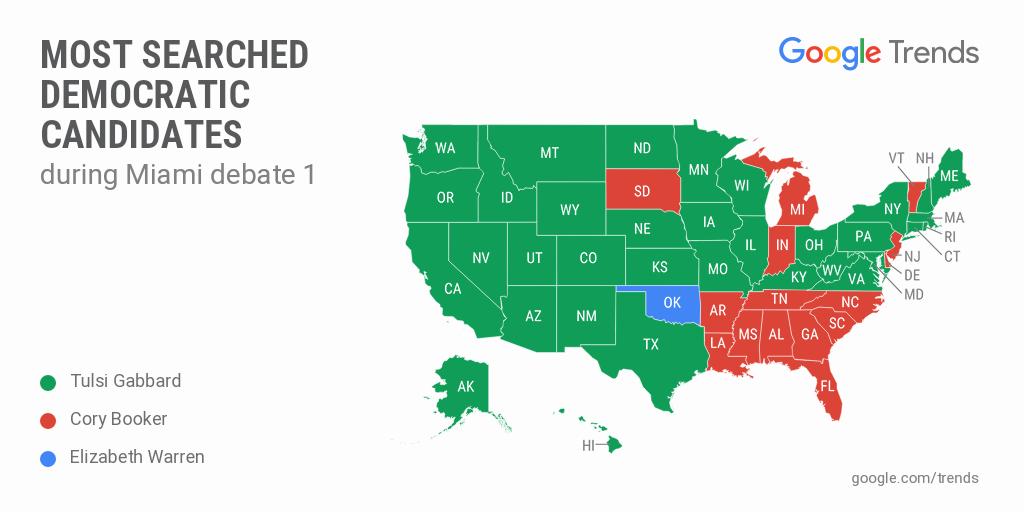
I like Tulsi, as I've said before. It's just hard to imagine turning the keys over to her given her courting gas-my-own-population Assad. On the other hand, she has been a strident defender of religious liberty at a time when that liberty is under heavy assault. We could certainly do worse than to have her head the Democratic ticket.
UPDATE: TNR strikes a measured tone:
Over the course of two hours, approximately seven minutes were devoted to the top existential threat facing humanity. And only four of the ten candidates on stage were asked directly about how they intend to rapidly reduce carbon emissions over the next eleven years—something that must be done to preserve a livable planet for future generations.... It was, to put it lightly, a disgrace—and not just because climate change was the number one issue that Democratic voters wanted to see discussed at the debate. The debate itself was held in Miami, Florida, a city that’s literally being swallowed by the rising ocean.If you are curious, Tulsi's "vision" says some very sweet things about the environment, but has zero specifics on exactly how to attain any of them.
The debates
John Podhoretz on the elevated tone we can expect:
The only way these debates will matter is if they are exciting. And the only way to ensure that people keep watching them as the months pass, and thereby create a sense that the Democratic Party is full of life, is if these first debates reward their interest with fireworks.
It’s the shmendricks who need to set the debate hall on fire — you know, the ones you’ve never heard of, like the governors of Climatechangiana and Potsmokia and the House members from Whereverdude and Freestuffistan.If only I had more confidence one of those guys wasn't going to end up with the nomination.
Bill Barr, Bagpiper
With the full marching band backing him up it's hard to hear how good he is, but it's a fine look for an Attorney General.
Study: Americans Angrier
Technically, the finding is that 84% of people think Americans are angrier than they used to be. VodkaPundit notes that this seems to be an artifact of the media, especially social media: "In real life, people don't seem much different."
Iowahawk was just making the same point, following a long round-the-country trip he's just finished. "You can learn a lot more about this country from a dashboard than from a keyboard.... The USA is an amazing, beautiful place, full of friendly people of all types and all political persuasions, who don't scream invectives at each other all day long in real life."
In general, I think most of America's problems are confined to small places with loud voices. There are some that are not: the opioid crisis is not; rural unemployment is not. Increasingly the immigration crisis is spilling out of the border regions and major cities and into the whole country. These things need to be addressed before they wreck the whole.
Still, for the most part the America I see from the back of the bike is much as they describe it. Anywhere you stop, people are friendly enough. You exchange pleasantries, and then ride on. If you should move and settle somewhere else, your neighbors make you welcome, and then largely leave you be. It's a pretty good place, most of the place and most of the time.
Nor can I easily recall the last time I saw someone, face to face, speak as rudely to another person as seems to be the standard on social media. I take Conan's position on this, as R.E. Howard related in The Tower of the Elephant.

A little more exposure to peril might improve our "civilized" class.
Iowahawk was just making the same point, following a long round-the-country trip he's just finished. "You can learn a lot more about this country from a dashboard than from a keyboard.... The USA is an amazing, beautiful place, full of friendly people of all types and all political persuasions, who don't scream invectives at each other all day long in real life."
In general, I think most of America's problems are confined to small places with loud voices. There are some that are not: the opioid crisis is not; rural unemployment is not. Increasingly the immigration crisis is spilling out of the border regions and major cities and into the whole country. These things need to be addressed before they wreck the whole.
Still, for the most part the America I see from the back of the bike is much as they describe it. Anywhere you stop, people are friendly enough. You exchange pleasantries, and then ride on. If you should move and settle somewhere else, your neighbors make you welcome, and then largely leave you be. It's a pretty good place, most of the place and most of the time.
Nor can I easily recall the last time I saw someone, face to face, speak as rudely to another person as seems to be the standard on social media. I take Conan's position on this, as R.E. Howard related in The Tower of the Elephant.

A little more exposure to peril might improve our "civilized" class.
Federal Prosecutors Warn Judge Not To Interfere
The victims are that much less important than the people being protected by DOJ's exercise of discretion in this case.
Starship Troopers tax
Instapundit reports that Robert Francis ("Call me Beto") O'Rourke is channeling Robert Heinlein and proposing a tax on households that lack current or past armed service members. The idea has a superficial appeal: fund veterans' benefits by putting an extra tax on the population that benefits from military service without personal sacrifice. On second thought, though, isn't it just another way of saying vets should get taxpayer-funded benefits, with the new wrinkle that vets and their famlies should get a tax break, too? Why not just fund vet benefits at a suitable level and, while we're at it, quit playing games that make the benefits unreasonably hard to get?
O'Rourke's proposal smuggles in the assumption that we can't treat vets properly unless we raise taxes. As usual, his mind goes straight to a tax that lands on some but not others, because that's the only way to achieve social justice. Someone always needs to pay reparations to someone else.
O'Rourke's proposal smuggles in the assumption that we can't treat vets properly unless we raise taxes. As usual, his mind goes straight to a tax that lands on some but not others, because that's the only way to achieve social justice. Someone always needs to pay reparations to someone else.
Consummatum Est
As announced recently, David Bellavia was awarded the Congressional Medal of Honor today.

He is the first living Iraq War veteran to receive this highest of awards.
Task & Purpose, like true enlisted men, frame the story in terms of the back pay to which SSG Bellavia is now entitled.
Congratulations to an American worthy of the name.

He is the first living Iraq War veteran to receive this highest of awards.
Task & Purpose, like true enlisted men, frame the story in terms of the back pay to which SSG Bellavia is now entitled.
Congratulations to an American worthy of the name.
That crazy Conway
AVI posted links to a number of old articles, many from 2016. I particularly enjoyed the WaPo October 2016 article dripping scorn on Trump's ridiculous PR team and their ignorant, probably insincere disregard of the prevailing wisdom in the "lamestream media." The article ends with this taunt:
And what happened? Conway was right about all the definitely-Clinton and definitely-Trump states. What's more, she didn't do badly on the toss-ups. Clinton took Conway's toss-up states of Nevada, Colorado, Maine, New Hampshire, and Virginia. Trump took the toss-up states of Iowa, Wisconsin, Michigan, Ohio, Pennsylvania, North Carolina, and Florida.
The WaPo's own "realistic" map blew not only the predicted states but the toss-ups. It assigned "weak Clinton" and "weak Trump" status to six states; Trump took them all home on election day. WaPo assigned toss-up status to only three states, all bagged by Trump in the end.
The final taunt turned out to be the best prediction in the piece.
How about this year? Are the polls any more competent? They sound a lot like the 2016 polls, just as the reports of amazing rally crowds remind me of 2016.
On Nov. 8, I fully expect Trump TV to say that Trump actually won. After all, Conway said they would. Unequivocally.Conway's electoral map predicted Clinton would take California, Oregon, Washington, New Mexico, Minnesota, Illinois, New York, Vermont, Massachusetts, Connecticut, Rhode Island, New Jersey, Delaware, and New Mexico. She assigned toss-up status to Nevada, Colorado, Iowa, Wisconsin, Michigan, Ohio, Pennsylvania, Maine, New Hampshire, Virginia, North Carolina, and Florida.
And what happened? Conway was right about all the definitely-Clinton and definitely-Trump states. What's more, she didn't do badly on the toss-ups. Clinton took Conway's toss-up states of Nevada, Colorado, Maine, New Hampshire, and Virginia. Trump took the toss-up states of Iowa, Wisconsin, Michigan, Ohio, Pennsylvania, North Carolina, and Florida.
The WaPo's own "realistic" map blew not only the predicted states but the toss-ups. It assigned "weak Clinton" and "weak Trump" status to six states; Trump took them all home on election day. WaPo assigned toss-up status to only three states, all bagged by Trump in the end.
The final taunt turned out to be the best prediction in the piece.
How about this year? Are the polls any more competent? They sound a lot like the 2016 polls, just as the reports of amazing rally crowds remind me of 2016.
Wonderful News
...if true.
The sprawling Democratic presidential field is incredibly diverse, but a new poll from The Associated Press-NORC Center for Public Affairs finds Democrats give a collective shrug to gender, race and age as factors they’re considering when supporting a candidate.
Instead, Democratic registered voters are yearning for experience in elected office. A whopping 73% cited that as a quality that would make them more excited about supporting a presidential candidate.
Citizens
One end of my county is stirred up over an annexation effort by a small town on our southern border. A bit further south sit three or four other smallish towns that are growing both commercially and industrially, and on the other side of them, across Nueces Bay, the larger town of Corpus Christi has quite a bit of industry. Our county, in contrast, watched industry pass it by during the 20th century, leaving it to develop primarily as a tourist and fishing spot and home for retirees. Jobs for young people aren't plentiful here. The commute to the greater employment opportunities to our south is doable but not obviously attractive, especially since our rent prices are pushed up by the coastal location and the tourist trade. The tourist trade, in turn, depends on our preservation of the bays and shores.
The town on our southern border, Aransas Pass, is the mainland twin to the barrier island's much more prosperous Port Aransas, covered with condos, bars, and restaurants. Aransas Pass struggles with its infrastructure and tax base. It also fears incursion and encirclement from its municipal neighbors to the south. It has constantly to reckon with the mixed blessing of industrial development, particularly to the south, tempting with its jobs and property values but threatening with its dirt.
In the southern, unincorporated part of my county, which has mostly scattered residential development, is the site of an old carbon-black plant. A new owner recently has invested a lot of cash into cleaning up the unsightly but largely inert crud left behind and has received state environmental clearance to redevelopment the property for commercial or industrial but not residential uses. The city of Aransas Pass, noticing this spring that Texas was about to pass a new law requiring the consent of the annexees, quickly took initial steps to annex an area that includes the old plant site. They hoped to be grandfathered under the old statute, thus avoiding the expense and uncertainty of a referendum.
The proposed annexees generally oppose the city's move, fearing that they'll pay much greater taxes without getting any services. Many city residents to the south applaud what they see as a chance to use a city's statutory land-use restrictions to control or prevent industrial development, powers that are largely denied to a county government. Opponents of the annexation are mixed on their view of the proposed industrial development, but some question whether the city genuinely will restrict it, given their current negotiations with industrial developers on the other side of town. Others view the developers and the annexing city with perhaps equal suspicion.
It is my painful duty to report the unsurprising news that public officials have not achieved the highest possible level of transparency and informed citizen involvement. Many citizens are only now beginning to pay attention. Accusations of smoke-filled-room tactics and hypocrisy are vying with charges that previously uninvolved citizens are belatedly second-guessing the beleaguered public servants.
In short, it's a dispute after my own heart. My neighbors are struggling with the trade-off between creating jobs and preserving habitat. If a site was used industrially for a century, what should be done with it now, and at whose expense? Should taxpayers buy it up and turn it into a bird sanctuary? Should it be set aside for industry, so we can concentrate on preserving other, still pristine coastal marshes? Do we have the right to insist that the owners fund a residential development--or even a nature preserve--instead? If they build a residential neighborhood, are we really sure that canals, lawns, septic tanks, pesticides, and fertilizer will affect the bays less than some kind of light industrial park? Should more houses be built practically at sea level in hurricane country? Did the city skip steps in its rushed annexation move, or must it start over and this time subject itself to the new resident consent process?
The public discussion of all these issues is confused, opaque, and fraught. There are now three lawsuits pending or threatened, one for defamation of the plant-site owners, another alleging the plant-site owners are pursuing the defamation action to squelch public participation in a legitimate policy dispute, and a third attacking the annexation process.
I'm in my element, attending meetings and hearings, writing them up, posting them on Facebook, doing my bit to keep the public discussion fact-based and focused, and trying to make the implicit trade-offs more explicit. I'm meeting some interesting new people and encouraging them to run for office.
The town on our southern border, Aransas Pass, is the mainland twin to the barrier island's much more prosperous Port Aransas, covered with condos, bars, and restaurants. Aransas Pass struggles with its infrastructure and tax base. It also fears incursion and encirclement from its municipal neighbors to the south. It has constantly to reckon with the mixed blessing of industrial development, particularly to the south, tempting with its jobs and property values but threatening with its dirt.
In the southern, unincorporated part of my county, which has mostly scattered residential development, is the site of an old carbon-black plant. A new owner recently has invested a lot of cash into cleaning up the unsightly but largely inert crud left behind and has received state environmental clearance to redevelopment the property for commercial or industrial but not residential uses. The city of Aransas Pass, noticing this spring that Texas was about to pass a new law requiring the consent of the annexees, quickly took initial steps to annex an area that includes the old plant site. They hoped to be grandfathered under the old statute, thus avoiding the expense and uncertainty of a referendum.
The proposed annexees generally oppose the city's move, fearing that they'll pay much greater taxes without getting any services. Many city residents to the south applaud what they see as a chance to use a city's statutory land-use restrictions to control or prevent industrial development, powers that are largely denied to a county government. Opponents of the annexation are mixed on their view of the proposed industrial development, but some question whether the city genuinely will restrict it, given their current negotiations with industrial developers on the other side of town. Others view the developers and the annexing city with perhaps equal suspicion.
It is my painful duty to report the unsurprising news that public officials have not achieved the highest possible level of transparency and informed citizen involvement. Many citizens are only now beginning to pay attention. Accusations of smoke-filled-room tactics and hypocrisy are vying with charges that previously uninvolved citizens are belatedly second-guessing the beleaguered public servants.
In short, it's a dispute after my own heart. My neighbors are struggling with the trade-off between creating jobs and preserving habitat. If a site was used industrially for a century, what should be done with it now, and at whose expense? Should taxpayers buy it up and turn it into a bird sanctuary? Should it be set aside for industry, so we can concentrate on preserving other, still pristine coastal marshes? Do we have the right to insist that the owners fund a residential development--or even a nature preserve--instead? If they build a residential neighborhood, are we really sure that canals, lawns, septic tanks, pesticides, and fertilizer will affect the bays less than some kind of light industrial park? Should more houses be built practically at sea level in hurricane country? Did the city skip steps in its rushed annexation move, or must it start over and this time subject itself to the new resident consent process?
The public discussion of all these issues is confused, opaque, and fraught. There are now three lawsuits pending or threatened, one for defamation of the plant-site owners, another alleging the plant-site owners are pursuing the defamation action to squelch public participation in a legitimate policy dispute, and a third attacking the annexation process.
I'm in my element, attending meetings and hearings, writing them up, posting them on Facebook, doing my bit to keep the public discussion fact-based and focused, and trying to make the implicit trade-offs more explicit. I'm meeting some interesting new people and encouraging them to run for office.
#CancelStudentDebt
Although I don’t intend to sell my vote, I do appreciate that the opening bid is in the six figures. I suppose it’s a sort of respect to assume the bribe would need to be quite high.
If bribery is the platform, Bernie’s going to be hard to beat. Maybe Kamala will promise to cancel my mortgage.
If bribery is the platform, Bernie’s going to be hard to beat. Maybe Kamala will promise to cancel my mortgage.
Aristotle’s Ethics: Politics and the Nature of Man
To quickly review the first post on the Hillsdale course Aristotle’s Ethics, there were three main points.
- We are looking for an appropriate level of precision and evidence. The precision and evidence expected of mathematics is different from that expected for biology, history, etc.
- There is a hierarchy of “good” in things, pursuits, methods, etc. Some things, pursuits, methods, etc., are more valuable than others. I think it is easier to think of it as a hierarchy of value, maybe, but the Nicomachean Ethics (EN) consistently calls it good, the good, goods, etc.
- This hierarchy is established first by the theory that if something exists for the sake of something else, that something else is a higher good, or more valuable.
The example was the work of the bridle maker, which, in ancient Athens,
was for the sake of having cavalry, and cavalry was for the sake of military victory,
and that was for the sake of preserving the city-state. So, the work of the
bridle maker is good, but that of the cavalryman is a higher good, that of the
general even higher, and the existence of the city-state yet higher. I surmised
that this would make the work of citizenship, political engagement, the highest
form of work.
The very highest goods exist for their own sake, like
happiness.
ThinkSpot
Sounds like Dr. Peterson has a new project aimed at securing freedom of speech and thought.
In a rambling column today, Martha Gill, one of The Guardian’s authoritarian scribes, attempts to take Dr. Jordan Peterson to task for launching Thinkspot—a new free speech-friendly social media platform.Well, thanks to the Guardian. I hadn't heard of this endeavor before now.
"The End of an Era"
I suppose eras are always ending these days. Quillette has an excerpt from a book by Phyllis Chesler, whose given name marks her era quite well. In the Baby Boom, close to ten thousand girls a year were given the name "Phyllis" some years; in 2012 it was 13.
This is a real change, but a small one. She has seen bigger things.
This is a real change, but a small one. She has seen bigger things.
After 9/11, I felt as if the Afghanistan I’d fled so long ago had followed me right into the future and into the West. That distant and dangerous country began to dominate American and European headlines. Muslim women started wearing burqas (head, face, and body coverings) and niqabs (face masks) on the streets of New York City, London, and Paris.The bulk of the work appears to be biographical tributes to the Second Wave feminists she worked with, as well as a sorrowful retrospective on what has become of their common work. I suppose she must be intending to close off her own era indeed, given some of her comments. She will not now be welcome on many a campus.
As global violence against women gained horrendous momentum, many Western feminists became increasingly afraid to criticize that violence lest they be condemned as colonialists and racists. This fear often trumped their concern for women’s human rights globally.... Many feminist academics and journalists now believe that speaking out against head scarves, face veils, the burqa, forced marriage, female genital mutilation, and polygamy is somehow racist. I did not foresee the extent to which feminists who, philosophically, are universalists would paradoxically become isolationists. Such timidity (presumably in the service of opposing racism) is perhaps the greatest failing of the feminist establishment.
The Army Loves Reflective Belts
T&P reports that the Army has finally realized that it isn't necessary for every soldier to wear one in the daytime. Now if only they could realize that it isn't necessary to wear one in a war zone. I suppose there were probably numbers to back up that being struck by a vehicle while inside the wire was a bigger threat than being shot by a sniper. Maybe.
What would we do without research
Actually, this research appears to have been pretty open-minded. The researchers left wallets all over the world and tried to figure out what influences people to try to return them to their owners. They found interesting trends in national location, level of average local education, and size of wad of cash (would you have guessed that the greater the cash, the greater the chance of return?).
I tried to do a thought experiment about finding a wallet. My first impression is that I'd never dream of failing to try to find the owner. When I try to imagine find a stash of money large enough to be seriously tempting, I also start imagining making myself a target for death from some cartel. Finding big money always gets people in trouble in movies and books.
I tried to do a thought experiment about finding a wallet. My first impression is that I'd never dream of failing to try to find the owner. When I try to imagine find a stash of money large enough to be seriously tempting, I also start imagining making myself a target for death from some cartel. Finding big money always gets people in trouble in movies and books.
The perception gap
This study concludes that people on both the left and the right overestimate the extreme views of their opponents. The effect is less marked for those who are not very engaged politically. The upshot is that people on either side of the political divide probably have more views in common than they realize.
Joltin' Joe and the Segregationists
As AVI points out, there's no reason for anyone to defend him; he has no principles, really, he just stuck his foot in it. Furthermore, he wouldn't defend any of us in similar circumstances. Still and all, I'm going to say a few words about it, just in the interest of speaking the truth.
NRO's Kevin Williamson attempts a kind of dance here that is not completely warranted. Not that he's wrong, exactly.
However, it's not just progressives who have to bear the weight of the segregationist history. The fact is the South had a lot of progressives who wanted to make progress on race, too. They wanted to do it a bit at a time, because if you moved too fast too far it could provoke dangerous disruptions. The history of lynching wasn't history quite yet, and they both wanted to do better by their black neighbors, and feared to go too fast. Pretty much every one of these figures was driven out of office after Brown v. the Board of Education.
The full-throated embrace of segregation was, then, reactionary rather than progressive. It was a reaction of exactly the kind the good-hearted moderates had warned about. For a generation or so, no one who wanted to be elected to office from the South could avoid being a segregationist. If you wanted a political career, you'd play along because it was what the majority strongly wanted.
Some people I generally think well of played along, and felt bad about it later. Zell Miller, for example, was a segregationist in his youth because he wanted to be a politician. He was a very successful politician, but by the time he had risen to the rank of governor, he began to try to fix his mistakes. Zell tried to remove the Confederate battle flag from Georgia's state flag, and it almost ended his career. (Later governors succeeded by trickery, rather than by getting a vote past the citizens; and actually, the current Georgia flag is almost identical to the first Confederate National Flag, which to my way of thinking is worse. At least the Confederate army had the virtues of brave soldiers; the Confederate government had no virtues I can see.) He did his best to heal the wounds he'd helped to cause, and I hope he managed to heal some of them.
I figure Zell is as close to a political progenitor as I have. He came out of the Jacksonian wing of the Southern Democrats, and while he believed in using government for progress (he created the Hope scholarship, which sent me to college), he was a conservative as much as anything. He gave the keynote speech at the 1992 Democratic National Convention, when Bill Clinton was supposed to be a new and more centrist kind of Democrat; he gave the keynote speech at the 2004 Republican National Convention, in which he personally burned John Kerry's presidential hopes to the ground as thoroughly as Sherman had burned the city where Zell later governed. He was an outstanding Senator, a good governor, and a fine lieutenant governor. I'm not much in favor of government or politicians as a rule, but he was as good a one as I ever knew.
And he was definitely at one time a segregationist.
Joe Biden may not really believe what he said (which, by the way, implied strict disagreement with segregationists). But it's exactly the kind of sentiment that made me feel better about Bernie Sanders. I can't think of two political positions that Bernie and I have in common, but his friendship with and respect for Jim Webb made me think he could be OK. The ability to look past even serious differences and find common ground is in fact praiseworthy. It's hard. There's no guarantee it will work, certainly not that it can work forever. But if we can show each other respect, sometimes we can develop friendships even when we disagree very deeply. And that's the only way a big, complex, diverse society like ours could possibly work.
If we really can't do that anymore, America is over. Joe Biden is right about this, even if he doesn't mean it. Bernie Sanders is right about it, by example. Those trying to make this kind of outreach unacceptable are plain wrong, and they're running us up on the rocks with their poison.
And that's the truth, as far as I can tell.
NRO's Kevin Williamson attempts a kind of dance here that is not completely warranted. Not that he's wrong, exactly.
Most of the segregationist Democrats of the FDR–LBJ era were committed New Dealers and, by most criteria, progressives. They largely supported welfare spending, public-works programs, the creation of the major entitlement programs, and, to a lesser extent, labor reform. They did work to ensure that African Americans were effectively excluded from many of the benefits of these programs, but they provided much of the political horsepower that carried forward the progressive project from the Great Depression on. This should not be terribly surprising: Many of the Democrats who were instrumental in the reforms of the Wilson years, the golden age of American progressivism, were virulent racists, prominent among them Woodrow Wilson himself. Given such figures as Wilson and Theodore Roosevelt, one might as easily write that progressives of both parties were racists.It's definitely true that progressives of the early 20th century were committed racists. That's where eugenics came from -- from the very same people who believed in evolution from the apes when most of the country still did not. The very same willingness to question tradition in the light of science was at work in both projects. Because man could evolve from an ape through breeding, man could revert to an ape via the same process. Abortion and careful selection were about ensuring the continued improvement of the species, and barring 'the wrong kinds' from breeding as much as possible was about the very same thing. You didn't have to believe in race, or use it as a proxy for excellent genetics, but people at that time generally did believe in it. Until the depth of evil was revealed by the Nazi embrace of eugenics, this was just another way of being scientifically minded, forward thinking, progressive.
However, it's not just progressives who have to bear the weight of the segregationist history. The fact is the South had a lot of progressives who wanted to make progress on race, too. They wanted to do it a bit at a time, because if you moved too fast too far it could provoke dangerous disruptions. The history of lynching wasn't history quite yet, and they both wanted to do better by their black neighbors, and feared to go too fast. Pretty much every one of these figures was driven out of office after Brown v. the Board of Education.
The full-throated embrace of segregation was, then, reactionary rather than progressive. It was a reaction of exactly the kind the good-hearted moderates had warned about. For a generation or so, no one who wanted to be elected to office from the South could avoid being a segregationist. If you wanted a political career, you'd play along because it was what the majority strongly wanted.
Some people I generally think well of played along, and felt bad about it later. Zell Miller, for example, was a segregationist in his youth because he wanted to be a politician. He was a very successful politician, but by the time he had risen to the rank of governor, he began to try to fix his mistakes. Zell tried to remove the Confederate battle flag from Georgia's state flag, and it almost ended his career. (Later governors succeeded by trickery, rather than by getting a vote past the citizens; and actually, the current Georgia flag is almost identical to the first Confederate National Flag, which to my way of thinking is worse. At least the Confederate army had the virtues of brave soldiers; the Confederate government had no virtues I can see.) He did his best to heal the wounds he'd helped to cause, and I hope he managed to heal some of them.
I figure Zell is as close to a political progenitor as I have. He came out of the Jacksonian wing of the Southern Democrats, and while he believed in using government for progress (he created the Hope scholarship, which sent me to college), he was a conservative as much as anything. He gave the keynote speech at the 1992 Democratic National Convention, when Bill Clinton was supposed to be a new and more centrist kind of Democrat; he gave the keynote speech at the 2004 Republican National Convention, in which he personally burned John Kerry's presidential hopes to the ground as thoroughly as Sherman had burned the city where Zell later governed. He was an outstanding Senator, a good governor, and a fine lieutenant governor. I'm not much in favor of government or politicians as a rule, but he was as good a one as I ever knew.
And he was definitely at one time a segregationist.
Joe Biden may not really believe what he said (which, by the way, implied strict disagreement with segregationists). But it's exactly the kind of sentiment that made me feel better about Bernie Sanders. I can't think of two political positions that Bernie and I have in common, but his friendship with and respect for Jim Webb made me think he could be OK. The ability to look past even serious differences and find common ground is in fact praiseworthy. It's hard. There's no guarantee it will work, certainly not that it can work forever. But if we can show each other respect, sometimes we can develop friendships even when we disagree very deeply. And that's the only way a big, complex, diverse society like ours could possibly work.
If we really can't do that anymore, America is over. Joe Biden is right about this, even if he doesn't mean it. Bernie Sanders is right about it, by example. Those trying to make this kind of outreach unacceptable are plain wrong, and they're running us up on the rocks with their poison.
And that's the truth, as far as I can tell.
Seven Riders Dead in Massachusetts
The Jarheads MC took a heavy blow this weekend, because of a pickup truck that was on fire when emergency services arrived.
UPDATE: A photo from a FB group I'm in, one of whose members went out to the scene.

Volodoymyr Zhukovskyy, 23, of West Springfield, Massachusetts, was behind the wheel of a 2016 Dodge 2500 with an attached trailer, officials said at a press conference. Zhukovskyy is not currently facing any charges, but officials said the crash remains under investigation.It's a tragedy for Jarheads MC, a Marine Corps veterans club. Ride safe, those of you who do. You just can't predict what the cagers will do.
UPDATE: A photo from a FB group I'm in, one of whose members went out to the scene.

Going to the Wild

Following my own recommendation, I went out to the Wild on Friday through today. There's some significant landscape in this photo. The highest peak you can make out is Clingman's Dome, which is the tallest peak in the Great Smoky Mountains National Park and one of the highest in the Eastern United States (Mount Mitchell, which you can see from atop it on a clear day, is slightly taller). The Appalachian Trail crosses there. If you're southbound, you'll climb three mountains that day to get to it, and then have a long decline to the closest shelter down by some springs below.
Back to the photo. If your eye should follow that ridge to the right, where the squiggly peaks are, the low point on the ridge is Newfound Gap. That's where the road between Gatlinburg and the Cherokee reservation passes. (Much of the valley you can see before the ridgeline is the Qualla Boundary Lands).
We'll pause for a musical interlude at the mention of Gatlinburg.
Far off to the left are the Unicoi mountains in Tennessee. The gap in the Clingman's Dome ridge headed that way is Deal's Gap, which is the location of the Tail of the Dragon, the most famous motorcycle road in the world.
I've ridden the Dragon quite a few times, but the hardest trip I ever had on it was in a Chevy whose power steering went out. I've seen guys ride right off the edge, though.
Aristotelian Warmup
While you're waiting for Tom's next post on the topic, here's something that turned up on Instapundit today. "Is human nature good or bad?" Since we talked about "the good" last week, the challenge (for those of you who wish to accept it) is to try to give an Aristotelian account of the answer. I think last week's discussion gave you enough mental furniture to do it.
I'll leave this for a few days and then come back and reply to any attempts. It's more important to think it through yourself than to have me tell you an answer.
I'll leave this for a few days and then come back and reply to any attempts. It's more important to think it through yourself than to have me tell you an answer.
"Pro-Choice" Socialism
Oliver Wendell Holmes smiles from beyond the grave.
The British government is long due to be overthrown as a tyranny. This is just part of what an earlier set of over-throwers called "a long train of abuses." Lately, the worst abuses are all at home.
A British judge ordered Friday that an abortion be performed on a mentally disabled woman who is 22 weeks pregnant, despite objections from the woman and her mother....She doesn't have the mental capacity to make her own decisions about religion? The Church allows confirmation at seven, which is in the 'six to nine' age range, and the British government doesn't see fit to tell children they can't make that call yet. If she can make that decision for herself, then her opposition to abortion follows.
“I am acutely conscious of the fact that for the State to order a woman to have a termination where it appears that she doesn't want it is an immense intrusion,” the justice said. “I have to operate in [her] best interests, not on society's views of termination."
The unnamed woman, a Roman Catholic, reportedly has developmental disabilities and the mental age of a 6- to 9-year-old.... The woman’s mother, a former midwife, opposes the abortion procedure and told the court that she could take care of the child with the support from the daughter, Sky News reported.
A social worker who works with the woman also said the pregnancy should not be terminated.
But the judge said the woman didn’t have the mental capacity to make her own decisions even it look like she wanted to continue the pregnancy.
The British government is long due to be overthrown as a tyranny. This is just part of what an earlier set of over-throwers called "a long train of abuses." Lately, the worst abuses are all at home.
Diminishing returns
Michigan's spending on roads increased even as road quality decreased. I think we've seen this same trend in school spending. Could there be a common thread?


Crime journalism
This report had to have been turned in by his partner, who's just jacking with him now.


Solstice
It's time to go to the Wild, as you are able. Pentecost is gone, and if you remembered you re-swore your oaths. So now it comes summer, and knights ride out for adventure in the forest. One thing comes and another, but only if you go out to meet them.
So go, as you are able.
An Invitation from a Polish MP
A propos a Congresswoman Alexandria Ocasio-Cortez (D, NY) scurrilous remark and a post below, I offer this from a Polish Member of Parliament.

It can be seen here, too, if that image isn't blow-up-able: https://twitter.com/D_Tarczynski/status/1141704905436160001/photo/1?ref_src=twsrc%5Etfw%7Ctwcamp%5Etweetembed%7Ctwterm%5E1141704905436160001%7Ctwgr%5E393039363b636f6e74726f6c&ref_url=https%3A%2F%2Fpjmedia.com%2Ftrending%2Fmember-of-polish-parliament-invites-ocasio-cortez-to-visit-real-concentration-camps%2F
Ocasio-Cortez won't trouble herself to visit the detention centers on our own border, though, so I doubt she'll do anything more than ridicule this invitation. If she has the grace to respond to it at all.
Eric Hines

It can be seen here, too, if that image isn't blow-up-able: https://twitter.com/D_Tarczynski/status/1141704905436160001/photo/1?ref_src=twsrc%5Etfw%7Ctwcamp%5Etweetembed%7Ctwterm%5E1141704905436160001%7Ctwgr%5E393039363b636f6e74726f6c&ref_url=https%3A%2F%2Fpjmedia.com%2Ftrending%2Fmember-of-polish-parliament-invites-ocasio-cortez-to-visit-real-concentration-camps%2F
Ocasio-Cortez won't trouble herself to visit the detention centers on our own border, though, so I doubt she'll do anything more than ridicule this invitation. If she has the grace to respond to it at all.
Eric Hines
Subscribe to:
Posts (Atom)