


The Education of a Free People
[O]f all the things which I have mentioned that which most contributes to the permanence of constitutions is the adaptation of education to the form of government, and yet in our own day this principle is universally neglected. The best laws, though sanctioned by every citizen of the state, will be of no avail unless the young are trained by habit and education in the spirit of the constitution, if the laws are democratical, democratically or oligarchically, if the laws are oligarchical....
Now, to have been educated in the spirit of the constitution is not to perform the actions in which oligarchs or democrats delight, but those by which the existence of an oligarchy or of a democracy is made possible. Whereas among ourselves the sons of the ruling class in an oligarchy live in luxury, but the sons of the poor are hardened by exercise and toil, and hence they are both more inclined and better able to make a revolution. And in democracies of the more extreme type there has arisen a false idea of freedom which is contradictory to the true interests of the state. For two principles are characteristic of democracy, the government of the majority and freedom. Men think that what is just is equal; and that equality is the supremacy of the popular will; and that freedom means the doing what a man likes. In such democracies every one lives as he pleases, or in the words of Euripides, 'according to his fancy.' But this is all wrong; men should not think it slavery to live according to the rule of the constitution; for it is their salvation.
-Aristotle, Politics V.9
In the comments to a post below, I remarked that Tex once said that they want to turn America into the security zone of an airport, but that public schools are run much the same way.
Our public school system is terribly designed for educating a free people. All the rights of citizens are suspended while you are on school grounds. You have no freedom of speech, but may be punished for speaking without permission on any topic. You may certainly not publish and post flyers critical of the government authorities. You have no freedom of movement: you have assigned seats in assigned classes, and to skip school is punishable by law as well as administratively. You certainly have no right to keep and bear arms, nor even to self defense -- our local high school has the policy of having all parties to a fight arrested by the school resource officers, and charged with assault, even if the were clearly defending themselves from a bully with a record of harassing them. There is no freedom from unreasonable search and seizure -- just like at the airport, all bags are subject to search and seizure at any time.
There is no right to a fair trial, or any trial; punishments are meted out by administrative fiat. There is no guarantee the punishment will not be cruel or unusual. Every right an American has by birth and the grace of God is suspended by the schools, and the children are educated that way for a dozen years and more.
A free people needs a different education. Our system is unfit for our purposes. Aristotle said the same thing about his own, and it was in the next generation that democracy was swept away for almost two millennia. One of his students, indeed, was the author of that: someone who'd gotten the education Aristotle thought worthy of a prince rather than a democrat.
It is a powerful thing, education. We allow its corruption at our peril.
Jacobin Not Impressed
As you will infer by the name if you aren't already familiar with the publication, Jacobin is a formally-left aligned magazine. They have reviewed Ms. Harris' economic plans, and the top flight ones are not impressive to them.
1. A $25,000 subsidy for first-time homebuyersThis is a bad idea. It is unfair to people who, even with the subsidy, cannot afford to buy a home and those who prefer to rent. Because it is a demand subsidy without any corresponding price controls, some of the money will also just get captured as higher home prices, negating the affordability goals of the policy....2. A tax credit for building starter homesThis is a bad idea. There is absolutely no reason to believe that the proximate barrier to building more housing is that it is not sufficiently profitable and that we need to therefore sweeten the pot with public subsidies. This is just a waste of money. Moreover, conditioning the receipt of the tax credit on whether the person who buys the home turns out to be a first-time homebuyer, as this proposal does, makes no sense. Home builders do not typically know in advance who they are going to sell it to....3. A ban on price gouging for groceries and foodIt is unclear what this even means.
As noted, these haven't been getting good reviews anywhere. If even Jacobin is against them, it's hard to know who the audience is supposed to be.
Rasmussen: Biden did not win Georgia in 2020
So they say, citing the ongoing refusal by Fulton County to comply with open records laws and lawsuits demanding the unsealed ballots.
This is something that was obviously true for me as a longtime resident of Georgia who has been writing about its election fraud problem since 2018. Some would rather not continue to discuss this, but as they point out election security is an ongoing issue. It's not like any of the problems were fixed. Work is ongoing on several fronts, but it's also important that the truth gets out. People need to understand that the government isn't legitimate if the elections aren't legitimate: you owe no loyalty to a government that was imposed upon you by fraud or force.
UPDATE: Rasmussen wasn't done.
Let's Review: Georgia 2020 Trust DeficitForensic audit blocked100 drop boxes lack surveillance videos20K ballot images - vanished13 election routers - vanished10 Dominion tabulators - vanished148,000 Fulton Cty Mail-ballot signatures unverified
Nor yet done:
Georgia: No records were created capturing 148,000 2020 mail-in ballot outer envelope signatures for matching to Fulton County records because their new electronic sig verification equipment - wasn't used.
Here the wording is actually "Nothing was scanned, your honor." Uh Oh
Nor yet:
Georgia:We have an electronic verification system, but we didn’t use it.We have records of voter signatures, but we didn’t use them.We could check our records for you, but it would take forever.Aside from that, judge, is there anything else you’d like?
"...And It Has to Stop."
Also from the same fellow, a video clip of Kamala Harris calling for an end to free speech and freedom of the press, at least for social media. See if you read it differently.
"He has lost his privileges and it [X.com] should be taken down.... The same rule has to apply, which is that there has to be a responsibility that is placed on these social media sites to understand their power. They are directly speaking to millions and millions of people without any level of oversight, or regulation, and that has to stop."
Coors Beer Joins Harley Davidson
...and Tractor Supply, John Deere, and others, in giving in to pressure to abandon DEI and similar programs. This Starbuck guy is getting results. I'm sure they're trying to find ways to sneak the stuff in, but they're clearly responding to the public pressure. No doubt the Silver Bullet doesn't want to join the Blue Can beer in losing its place in the rankings.
The Dangerous Constitution
As an update to Saturday's post about the NYT asking whether the Constitution is "dangerous," ("And so am I, very dangerous," said Gandalf), a reader on Twitter points out that this has been a constant theme there lately.
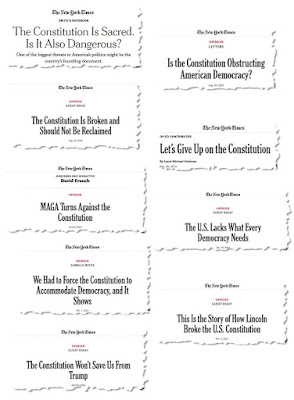

Free speech and inquiry are important values, so I don't object to them publishing such things; but by the same token, one should pay attention and take note of it as well.

"Spark" and School Reform
The headline reads, "With his 1776 Commission on patriotism, Trump helped spark a culture war." The very first paragraph gives the lie to the headline: he was responding, they note, to the 1619 Project. The theme continues throughout.
Trump ripped into “left-wing indoctrination in our schools,” slammed the 1619 Project and asserted that “propaganda” in schools was making students ashamed of their history.To fix all this, he had a solution: a new 1776 Commission that would promote patriotic education.
A national curriculum is probably a bad idea, but so too are almost all existing state and local curricula. We really need to abolish the public school system and start over. In any case, the idea that this 'divisive' 'culture war' is his fault is silly. It was the earlier revisionism that he was reacting to, angrily because it was based on some outright lies. (The link is to a set of criticisms by no less than the World Socialist; the 1619 Project later admitted that it was "not a history" but a fight to "control the national narrative.")
Replacing public schools with private ones sounds radical to a lot of people, but the earlier schools were better than the ones we have now. Consider this very early school on what was at that time the frontier:
The first recorded school in Jackson County actually predates the formation of the county by 31 years, as a school was started in Cullowhee Township in 1820.... the East LaPorte school started by Professor A.M. Dawson was renowned for its rigor and quality. A summary written for the Historical Committee of Jackson County NCEA in 1954 recounted, “Prof. A.M. Dawson who with Prof. Hughes, Misses Amaria and Jardedie Dawson, and Misses Ida and Lula Rogers, as assistants, conducted a high school at East LaPorte. This school… was the most notable and efficient one ever taught in this county before 1881.“Dawson had graduated from Western Reserve University in Cleveland, Ohio. He came to Jackson County from Tennessee. “With well-balanced scholarship, being equally at home in mathematics, history, science and the languages, and with established reputation, Professor Dawson auspiciously began his four-year remarkable career in Jackson County. Arithmetic, Latin, Greek, philosophy and English grammar were the principal subjects of the curriculum taught. Geography and reading were also taught… Mr. Dawson was a strict disciplinarian and exacted thoroughness from his students. Intolerant of laziness, negligence, disobedience or disorder, he was a stern, unrelenting schoolmaster… There were two Literary Societies. They were the Olympiam, which meant ‘lovers of games,’ and the Phylomathin, which meant ‘lovers of learning.’ These societies met on Friday evenings. Dawson was also the first to introduce baseball as a school sport.”
Emphasis added.
This was not a public school but a private "subscription school," but its presence on the frontier showed that it was not limited to the elites of the day. Voucher programs that aim to replace public school with independent funding would begin to address the downfall our education has suffered by being brought under control of government.
Switching to a model that provided parents with the means to subscribe to a 'subscription school' would not change the fact that we have a class of teachers who are miseducated themselves; finding the right people to instruct the children could be the chief problem.
UPDATE: Dad29 sends an eighth-grade final exam from 1895. The arithmetic section's difficulty sometimes turns on the use of what are now unusual forms of measure (bushel, rod), but clearly students were expected to manage complex calculations for the exam. I'm curious what the measure for 'bushel' was myself; the exam treats it both as a measure of volume and a measure of weight. Question 2 expects you to calculate the number of bushels from a given volume; the third one asks you to calculate it from weight. That implies some specialized knowledge that most of us wouldn't have.
Still, pretty interesting to examine.
The New Yorker on Soldier of Fortune
If you never expected to see The New Yorker write a warm and positive piece about Soldier of Fortune magazine, today is a surprising day!
Some years ago now Susan Katz Keating, the editor of Soldier of Fortune, at that time an independent journalist, interviewed me at length for a book she was writing about a project with which I was involved. The book she was writing didn't come off, which in a way is a shame because it would have exposed some serious problems with US intelligence in Afghanistan. Given how Afghanistan ultimately turned out, it might have been nice to know sooner. I asked her about it a year or so ago, and she told me that the laptop she had her notes on had crashed and burned, and she was left with nothing useful.
All the same, I found her to be an insightful and committed independent journalist of the old fashion. It's nice to see her considered opinion on the potential for violence in our current moment:
Not long after their meeting, Donald Trump was wounded on the ear in an assassination attempt. Keating provided an update on her violence forecast: she had become surprisingly sanguine.“There have not been any follow-on attacks or counterattacks, which I think would have happened by now if this had been an Archduke Ferdinand moment,” she said. “I see the hit on Trump as another iteration of the school-shooter, mall-shooter phenomenon, and not as a political flash point. We are not headed for a civil war.”
“Of course," she added, "I could be wrong.”
Interesting Political Videos
From Nicole Shanahan (RFK Jr's VP choice):
From the American Independent Party (whom I'd never heard of before):
They seem to be saying the military industrial complex assassinated both Kennedys. It's well-produced and the TH White quotes are a nice touch. The AIP claims to be the "fastest growing political party in California."
Here's one from the RFK Jr campaign, posted 2 days before he endorsed Trump:
The references to civil war and unity are interesting, but I wonder how he thought he could achieve unity. Or was it just campaign blather?
Is the Constitution Dangerous?
The New York Times publishes a book review that asks the question.
The Constitution Is Sacred. Is It Also Dangerous?One of the biggest threats to America’s politics might be the country’s founding document.
The content here is not going to surprise you; it turns out that the Constitution is uncomfortably difficult to amend (if you want to change things fundamentally, especially so). It tends to empower courts to resolve questions that the political branches find difficult (it doesn't, actually; that was a seizure of power during and following Marbury v. Madison). It has a lot of "compromises" that the NYT would like to track to slavery, especially the Electoral College, which is really not about slavery so much as the desire of the Founders not to concentrate power in the cities just as they sought the separation of powers elsewhere. (They were, after all, scholars of Greek and Roman history, and worried about exactly the transformations warned about by Aristotle and witnessed at the end of the Roman Republic.)
The weirdness about these sorts of articles is how they don't seem to grasp that a very similar set of compromises would be necessary even if you were to renegotiate the terms today. You couldn't get the rural parts of America to give up the Electoral College, or the equal representation of states in the Senate (another regular bugaboo by those who resent that Wyoming gets equal representation with California or New York). You couldn't get them to give away the Second Amendment. If you sat down in a Convention of the States and asked the people to work out a deal they could agree to accept, it would look very similar to the deal that you have now. These so-called historical reviews just lament that compromise with the non-urbane and non-urban is a necessary feature of peace and stability.
You could try to force the issue, just as the urban elites might have in 1787. Wise men and educated, though deeply divided on certain issues they elected to compromise rather than fight among themselves.
Well, for a while.
You might think that such disputes would have been laid to rest by a bloody Civil War and the Reconstruction amendments, which outlawed slavery and granted all men the right to vote, regardless of race. Not to mention that the Constitution continued to change in the century after: Senators were to be directly elected; women were granted the right to vote.
You might well think so, since none of those items is in dispute. I would prefer to reverse the unmentioned 16th and the mentioned 17th Amendment, and the 18th we've already disposed of, but as far as I know there is no contest from anywhere to the 13th, 15th, or 19th. The 14th is argued about over its interpretation; very few ever suggest its repeal.
The clear tone of the article, though, is that the sweeping away by violent victory in the Civil War is the preferred mode; the continued compromises by courts interested in considering Originalism is as bad as having ever compromised at all. Victory and not peace is the desideratum.
Sadly easy to find, the end of peace by those who seek violent victory over their opponents. Victory itself may prove to be more elusive.
Do You Know Something I Don't Know?
It's a well-known fact that social media companies spy on you relentlessly. They use this information to pump ads in your direction that they believe are relevant to your life. I get lots of ads for motorcycle gloves and knives and camping equipment, but also some that are weirdly specific.
For example, last week my doctor prescribed a new medicine for me she thought might be helpful, and noted out loud that it had a specific side effect she didn't think I'd find too bothersome. She prescribed the drug, and I ordered it from the Amazon pharmacy. By the time I got home, Facebook was offering up ads from numerous companies offering herbal remedies for the condition or else for the side effect.
Most likely Amazon sold me out as a customer; less likely, my iPhone is listening in and Apple is reporting it to Facebook. Somehow, however, they knew almost as soon as I did that I had a new hook for their advertisers.
I mention this because, in the last couple of days, I've received a similarly aggressive spur in ads for expunging my criminal records so that I can seek gainful employment again. Readers, I have never been arrested for anything nor charged with anything more serious than speeding or improper backing of a vehicle. Do you think they know something I don't know?
The Ship-Knife
Many years ago, while I lived in China, a much younger version of me wrote but never published a novel about Vikings in the Byzantine Empire. This novel, The Ship-Knife, seemed appropriate to me to write at the time because I was like the Varangians present in an alien and ancient civilization, a foreigner enmired in strange architecture, food, culture, values. I was also writing my Master's (European history) thesis, and it was a pleasant break from the academic work while also being a way of exploring allied themes.
It involves among other things a retelling of the adventures of Harald Hardrada in Sicily, the original being in the Heimskringla by Snorri Sturluson. He was also the author of the Prose Edda, which was itself a retelling of older stories he had encountered and wanted to formalize. I had copies of both with me in China and was familiarizing myself with them at the same time.
I located a copy of the thing recently. Looking through it I realize how much I've changed in the ensuing 25 years. I don't know that I can even edit it now, or if it's worth bothering to edit. My thoughts as a younger man might not even be worth preserving (indeed, it predates even the oldest entries of Grim's Hall, which date to 2003 after the China expedition).
If any of you would like to read it, and possibly help to edit it, please feel free to say so. I can't promise that it's great; it's probably not worse than most. It might at least be on a subject that interests some of you.
Evil Simpliciter Does Not Exist
Over at the Orthosphere, a propositional argument for the existence of God.
The syllogism is simple. Let P = God is ultimate; let Q = there is evil. Then:
- ¬ P → ¬ Q
- ¬ ¬ Q
- ¬ ¬ P
In English:
- If God is not ultimate, then there is no evil.
- It is false that there is no evil.
- It is false that God is not ultimate.
Clever, but wrong. It has been the position since St. Augustine that evil does not in fact exist because it cannot exist; and it cannot exist precisely because of God's ultimate status as creator of all, combined with God's goodness. Evil simpliciter would be a created thing that was not in any way good; but everything that follows from God must be good, because God is perfectly so (and in a way that is higher and better than things we encounter in the world are).
The orthodox position is that "evil is a privation," that is, a failure of the material to realize God's perfect design. Thus, all evil turns out to be is an imperfect realization of the good. Everything that exists must be good to some degree just because God created it.
[Even more emphatically in the later Aristotelian Christianity of Aquinas and his era, God's existence and his goodness are a mere prioritization of thought about the same quality. God's essence is existence: and as existence is the thing that all things desire, existence is just another name for the good (per Aristotle; because all things desire to continue to exist, to reproduce, to perfect their health and thus their existence, etc, 'the good' simpliciter is existence). Therefore, everything is good insofar as it has being; and evil thus cannot exist because it cannot have being, i.e. goodness.]
Then the syllogism doesn't work:
- ¬ P → ¬ Q
- ¬ Q
- ¬ P
That syllogism is a known fallacy, "Affirming the Consequent" or the "converse error." It doesn't prove anything because the form is invalid. For example, you could give the argument:
- If she screams, someone pinched her.
- She screamed.
- Therefore, someone pinched her.
In fact it's obvious that there could have been several additional causes for the scream; she might have seen a dead body instead of being pinched.
Of course one can take the position that orthodoxy is wrong, and evil simpliciter does exist: that's the Manichaeist position, which in Christianity is traditionally considered a heresy. It doesn't work out logically to have two basic creative principles, as Avicenna explains: either one is really superior, or there must a third thing that holds them together and allows them to interact, in which case that thing is the ultimate creative principle (and you're back to one). Since this is the case, any syllogism that asserts that 'God is ultimate' but that evil simpliciter also exists as a countering force will prove to be illogical.
One could further take the position that logic does not give you access to knowledge, but only preservation of knowledge, and that knowledge about God is ultimately ineffable at best (and thus inadmissible to logical forms). This is close to the Buddhist position, which might be true but won't be logical. At that point there's just no reason to even talk about syllogisms.
Eyeball Numbers
We have fairly reliable Nielsen numbers, as that technology was invented in the golden age of America when television was the gold-standard of that golden age. It's had to adapt to changes since it was new, but it's had both time and resources to do so. So these figures are probably close:
The nearly 6 million viewers [of the Harris interview] is CNN’s best performance in the 9 p.m. ET hour since more than 9.5 million people tuned in for the June 27 debate between President Joe Biden and Republican nominee Donald Trump.
Internet numbers are wildly contested today, especially when the claim is made by a widely-detested figure like Elon Musk and the contest is coming from an outlet that is outright hostile to him. These figures are therefore not as reliable.
Later on in the interview, Trump appeared to be looking at the views on his post that shared the Space, which was at around 60 million views at the time. Post views on X function more like impressions, tracking each instance a post appears in front of a user, whether they actively clicked on it — or it just appeared on their feed as they scrolled.
The live audio Space itself between Trump and Musk peaked at around 1.4 million concurrent viewers.
Musk has leaned into Trump's inaccurate viewership references though.
"Combined views of the conversation with @realDonaldTrump and subsequent discussion by other accounts now ~1 billion," Musk said on X, calculating the total of all post views or impressions about the Space chat.
As of publishing time, the X Space between Trump and Musk has roughly 24 million views, which includes the live viewership numbers as well as replays. The post itself, however, claims 183 million views or impressions.
That's a pretty big delta, between a billion and 24 million.
I notice, however, that even the lowest figure is four times the Nielsen figure.
Does it matter? Who knows. The thing about the internet is people from everywhere could be watching it (making "a billion" more plausible than it would be if limited to the USA, while Nielsen numbers are localized to America). Most of those people don't vote; and anyway, just having an interest in what they have to say doesn't mean you're going to vote for them. I'd guess that most supporters of either candidate are planning to vote for them without regard to what they might say.
Still, it's interesting to see how much more attention there is for the one candidate than the other.
A Soaking Rain
After two hot days, rain broke the heat and made it nice out. I decided to take an evening walk. Well, the rain came back and I was quite wet by the time I got back under shelter.
That’s fine. In the late August, even a cooling soak is welcome.
Chicken Killing Dog
Conan killed one of the chickens, for no apparent reason. Any of my grandparents, kind and gentle people though they were, would have shot him for that. Of course, they came up in the Great Depression when chicken-killing dogs were a life or death matter potentially. I didn't shoot him or hurt him at all, but it raises a dilemma about what ought to be done -- or how to teach him not to do it without harming him.
My wife suggested the old folk trick of tying the dead bird around his neck and leaving it there until it rots, but that also seemed pretty horrible to me.
What do you think should be done? Ultimately I would miss having the fresh eggs if he killed all the chickens, but it wouldn't hurt my family's prosperity much. On the other hand, I do think there's an issue about having a dog who kills for pleasure. Back on the first hand, though, my last dog killed cats whenever he could, and he was a great dog. I'm a little mystified about how to approach this problem, and would like your advice.
Heresy
Dad29, who is having a lot of trouble with the recent commenting problems from Google, would like to draw your attention to this article on Heresy.
The basic idea is that heresy is the removal of one of the planks of a systematic understanding of the world; Newtonian physics is an example. So too Euclidean geometry, which in fact we know is false. Well, and Newton's physics also.
So on this model heresy isn't necessarily wrong or even a mistake; it could be a step forward towards a better system. Yet it isn't obviously so; it could just be a new error.
Selah, as they say.
Subscribe to:
Posts (Atom)