The Hunter Biden plea deal proves that in our two-tiered justice system, only the connected are protected.


The Study of Beauty
These give me hope; in spite of the ugliness of contemporary music and society, at least a few of the young study to keep the secret fire alive.
An Important Day
Today marks both the 21st birthday of my only son, and also my 24th wedding anniversary.
I spoke to my son this morning and congratulated him on making it to legal adulthood. "It only gets harder from here," I warned.
"Oh, I know," he said, which was the worst possible thing to say. Thank God he does not know how much harder it gets.
Unfortunately all the planned festivities are offline because my truck decided to break down last night -- initially it looks like more computer troubles, the bane of my existence because I can easily repair simple mechanical problems -- and it is going to pour rain for days here in western North Carolina. Nobody's much inclined to ride motorcycles in a downpour for hours.
It's a big day anyway.
UPDATE: Relatively good news about the truck. In spite of showing all the signs of a computer issue, it was a mechanical failure after all. Got it back running this afternoon.

A Pleasant Day in Western North Carolina
Yesterday my wife and I rode out to Franklin, where the annual Scottish festival was underway. Ethnic festivals are always interesting in terms of what they have to say about the story the group likes to tell about itself and the kind of people they are. Scottish heritage festivals invariably feature Highland strength sports -- I believe the sheaf toss is underway in the background of this photo.

In addition, there was free axe throwing, and Atlas stone lifting. Stone lifting is one of the ancient strength sports of Scotland, which is also a major sport even today in Iceland. These are with natural stones, however. The Atlas stone is a spherical 'stone' made of concrete, which is quite hard to lift because it wants to roll out of your arms. It is a regular feature of Strongman competitions. There were about six of us there who were both Strongman competitors and also regulars at Scottish Highland Games, and we had fun lifting the big 250 pound stone. (My inner arms are quite abraded this morning, a feature that is called 'stone kisses' in the games.)
Then my wife and I rode up through the Cullasaja Gorge, and through various mountain back roads.

Cullasaja Falls
We went to both the city of Highlands and the unincorporated town of Cashiers. There we stopped for dinner at the Whiteside Brewing Company in order to attend a concert I'd heard about. This was by The Maggie Valley Band, which is built around a pair of sisters. They sing Americana with a psychedelic twinge. Their stuff is available on YouTube and Spotify, though I have to admit that the polished stuff there doesn't sound as good to me. Live, they have a very nice sound that is reminiscent of Mazzy Star.
They know their stuff, too. They covered standards like Jolene and The Long Black Veil, as well as their own work. Every time they'd start a song I'd be wrong about which one they were going to do, because they were adept enough to adapt standard songs to other melodies or meters, giving a pleasant element of surprise to the listening audience. I'd still know the song, if it was one of the covers, but it'd be set to a tune I expected to be a different song.
Overall, a nice day for riding.
More Lies
The Firearms Policy Coalition is a fighting organization.
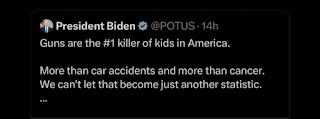
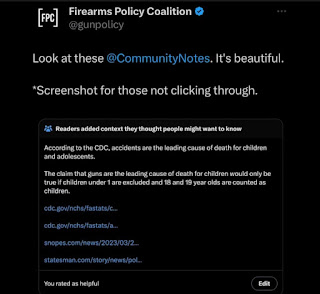


If you include Americans under one, the leading cause of death is abortion. In fact, if unborn Americans count, abortion is the leading cause of death for all Americans. Heart disease is right around 700,000/year; abortion, per Guttmacher (which compiles its statistics through a direct count made by contacting all providers in the country) is over 960,000.
Just to keep the numbers consistent, there were about 48,000 gun deaths for all Americans in 2021, the vast majority of which were suicides rather than crimes or accidents. Accidental gun deaths are fairly rare these days, especially among children.

Come Off It, Washington Post
Today's attack on Americana is an attempt to tar the Gadsden flag by comparing it to... some other flag that nobody has used in a hundred and sixty-three years.
The rattlesnake motif, along with "Don't Tread on Me," have been widely used by Americans for various purposes over various years. My favorite version -- which is on my annual Independence Day post, the flag pictured on the right atop the sidebar -- is the flag of the Veteran's Exempt. These guys fought in the American Revolution under the Declaration of Independence. They were Americans under the Articles of Confederation. They were Americans under the Constitution. Then, as men too old to be drafted in the war of 1812, they volunteered and fought for the American project again. Nobody is more American than they were: to date, they are the only ones of all of us to have lived under all the American systems, and to have supported all of them.
It is also the only American flag to feature a skull and crossbones, which is particularly appropriate given the long connection of pirates and privateers to the success of our democratic ideals. This is likewise not popularly recognized by the elites of the nation, but it is so all the same.
A Materialist Looks at Chesterton
One does not expect to find an essay praising G. K. Chesterton that begins with this sort of assertion.
When you die — when these organized atoms that shimmer with fascination and feeling — disband into disorder to become unfeeling stardust once more, everything that filled your particular mind and its rosary of days with meaning will be gone too. From its particular vantage point, there will be no more meaning, for the point itself will have dissolved — there will only be other humans left, making meaning of their own lives, including any meaning they might make of the residue of yours.
These are the thoughts coursing through this temporary constellation of consciousness as I pause at the lush mid-June dandelion at the foot of the hill on my morning run — the dandelion, now a fiesta of green where a season ago the small sun of its bloom had been, then the ethereal orb of its seeds, now long dispersed; the dandelion, existing for no better reason than do I, than do you — and no worse — by the same laws of physics beyond meaning: these clauses of exquisite precision punctuated by chance.
Nevertheless this is an essay that particularly appreciates Chesterton's insights into the wonder of the world. The author cites his autobiography, but ironically the admired thoughts are nowhere better expressed than in one especially astonishing chapter of Orthodoxy: "The Ethics of Elfland." I am likewise inclined to agree that the issues he addressed there have never been better described than by him, and that they are exactly as he says of fundamental importance.
Indeed the autobiographical quote the author pulls makes a lot of optimists and pessimists right after making the point of astonishment at natural beauty, a move that follows the narrative structure of Orthodoxy exactly. Chesterton goes right on from "The Ethics of Elfland" to "The Flag of the World." If the essay's author should wish to consider the issue both further and deeper, that work is the one to consult.
Chesterton himself is thus described: "philosopher, impassioned early eugenics opponent, prolific author of several dozen books, several hundred poems and short stories, and several thousand essays." I think Chesterton himself might have lead with "Catholic" or "Christian," perhaps even with "lover and husband," but certainly it is pleasing to see his opposition to eugenics correctly recognized as deserving of praise.
The Flag Code
Although part of the US Code, the Flag Code is a non-enforceable law because it lacks any sort of punishment. This happens more often than you might expect. A lot of laws governing the behavior of the government itself lack any sort of punitive clauses, so that -- for example -- if a government should conduct its election in an unconstitutional manner, there's just nothing to be done about it. The Flag Code is like that.
Nor was it any surprise to me to see articles to the effect the Biden Administration had violated it by presenting the Trans-* flag in the position of honor in a vertical flag arrangement. I was more surprised by Forbes' claim that this wasn't a violation because, however the vertical flags were arranged, there was an American flag atop the building that was in an even more elevated position and that somehow saved the day.
Is Forbes right about that? They are not. The ordering of displays considers the display as a group, not the presence or absence of other flags that are not connected to the display. If I were to arrange a display of fifty national flags that put America's in the last place, the fact that there was a flag somewhere else nearby that was on a taller pole wouldn't have any bearing on my display's intent or effect.
The flagpole atop the building was not part of the group that made up this display, and thus is not relevant to the question. It is a permanent feature, whereas this display was arranged as a unit for a particular event at a particular time for a particular purpose. That is why the offending flags were always photographed together: they were a display meant to be seen together, to create their particular effect. Nobody noticed the flag pole twenty feet up because it wasn't part of the display or the event; it was just a permanent feature of the building.
The fact is that the question never occurred to these people, for whom the matter is not even of idle interest and never has been. It never occurred to them that they shouldn't put the Trans-* flag at the center of the display, since that was of course the center of the event. It never occurred to them that the United States flag should not be displayed as supporters of the Trans-* flag, as the whole point of the event was in fact that the United States government was in support of the Trans-* movement. It makes perfect sense according to the symbolic logic of their actual system of beliefs, which just don't happen to be the same ones that were held by the earlier generation of Americans who wrote the Flag Code. They are not Americans in the same sense.
Buying Your Way Out of the Constitution
“This report makes it clear that the government continues to think it can buy its way out of constitutional protections using taxpayers’ own money," says Chris Baumohl, a law fellow at [Electronic Privacy Information Center].
That's a good line. It's a nice statement of the problem, which the article explores: the government has decided it needs no warrants for persistent, universal surveillance -- even of people never suspected of any crime -- just as long as it buys the data on the market. If your name ever comes up later, well, they'll already have a ready file with which to prosecute you.
This Rescue Brought to You by the Number 8
I hadn't realized how many times the Number 8 comes up in this stuff. Just in rescue knots:

The Figure 8 On a Bight (aka "Figure 8 Double Loop")
The Figure 8 Follow Through (almost the same as the Figure 8 Bend, but tied with one rope as a hitch rather than as a means of joining two ropes, which is what a 'bend' is)
But wait, there's more! The rappelling descender of choice for distances of not more than 75-100 feet is "The Rescue 8," so called because of the rabbit-ear design that prevents the rope from slipping over the top of the larger 8 into a girth hitch (which we, in the old Boy Scout days, used to called the 'Lark's Head,' but which is also called a 'cow hitch').

A Rescue 8 descent device
I feel like I should put up one of those Sesame Street videos: "This Rescue brought to you by the letters E, M, S and the Number 8."
Heads must have rolled
Someone at Fox News must have been having fun with the Chyron machine. For nearly half a minute the fresh new post-Dominion-settlement face of the formerly conservative news outlet was marred by the statement "WANNABE DICTATOR SPEAKS AT THE WHITE HOUSE AFTER HAVING HIS POLITICAL RIVAL ARRESTED." Fox quickly reported that “the chyron was taken down immediately and was addressed.” I'll bet it was!
Who can forget the rogue teleprompter operators who got ditzy left coast news anchors to announce with a straight face the purported names of the pilots of the Asiana Flight 214, including "Sum Ting Wong and Wi Tu Lo"?
Make Way, Women!
Lesbian:
A non-man attracted to non-men. While past definitions refer to ‘lesbian’ as a woman who is emotionally, romantically, and/or sexually attracted to other women, this updated definition includes non-binary people who may also identify with the label.
I was going to link this to the old joke about the biker who realized that he was a lesbian, but he's actually still excluded from this definition. It's only males who aren't men who are now eligible to be lesbians. Women have to move over to make room for them, here as elsewhere.
Red Balloon Work Ad
RedBalloon.work seems worthwhile if you're looking for a non-woke work environment.
It could complement PublicSq, a site for shopping at businesses that align with more conservative values (or for selling, if you own such a business).
Update: Just because it's a good story about work, here's "Welding in the Desert."

A Biography of Plato
We know little about the famous philosopher for certain, including whether or not he was ever enslaved -- or, if so, by whom:
Contrary to many people’s perception of him, Plato did not spend his entire life listening to Socrates philosophising in colonnades in Athens or writing dialogues meandering through complex ideas. He was once captured in the middle of the Mediterranean Sea and put up for sale in a slave market....The enslavement allegedly occurred while Plato was travelling home from Sicily in 384 BC. A number of ancient biographers claim that the philosopher boarded a ship with a Spartan who enslaved him on the orders of the tyrant of Syracuse, but Plato’s new biographer, Robin Waterfield, suggests it’s more likely that he was on board a merchant ship which caught the eye of pirates. The seas were full of marauders in this period and it is entirely possible that Plato sailed into treacherous waters. His luck changed after he was spotted in the market by an admirer who agreed to pay a ransom to secure his release.Plato never mentioned any of this in his own writings, but then he rarely wrote about himself at all... Waterfield is reluctant to dismiss the episode of Plato’s capture as pure fallacy because the circumstances are credible and the chronology seems to fit with what we know of his movements.
Well, the story certainly isn't a fallacy because a fallacy is an error in logic, not an error of fact. That is on the reviewer, though, not the author. The author sounds like he's done a creditable job at constructing a history of Plato, which is a task well worth doing even if it is not always as exciting as the stories about Plato.
Computers Still Learning
I was reading a piece about GPT and humor the other day (which I won't bother to look up again to link because I don't remember where I saw it and all it said is what I'm about to tell you) that said that these large language models are good at explaining jokes, but not good at making new ones. It's interesting how those are different projects. Analytical understanding of why something is funny really is different from the ability to craft an emotional experience that will provoke laughter. It's easier after the fact to process why it worked, and harder to do the thing.
Whatever Spotify is using to categorize songs is imperfect in a similar way. It likes to do 'mood' playlists, and it often produces notable failures. For example, on today's "Romantic" playlist the first song was this one:
That's a beautifully sung song, but it is not a romantic song. It's about the heartbreaking failure of a romance.
Likewise, they recently had a "Happy" playlist that headlined with this piece:
This song kind of sounds happy, because of the band's signature strategy (which I believe they adopted from the Blues Brothers) of marching through blues pieces in major chords. It's definitely not a happy song, though: it's about a man who is dying of alcoholism, and finds himself powerless to stop it.
I guess it's good that it's still easy to fool the Terminator.
Bluegrass Genocide
I realize not everyone here reads Instapundit, but here's a piece linked there (by one of Glenn's co-bloggers) that merits attention.
In his terrific Shiny Herd substack, Ted Balaker interviewed me on the mania for eugenic sterilization of those deemed “unfit to reproduce” for the first 75+ years of the 20th century. As Ted and I discussed:
“They were forced to undergo hysterectomies. Their tubes were tied and they were given vasectomies, sometimes without anesthesia.”
The scientific and political communities in America were solidly behind the project. Those performing the sterilizations were considered humanitarian heroes, and academics who questioned the idea were subject to vilification, loss of employment, and loss of academic funding. The press and political activists formed a solid phalanx to protect the pro-eugenics side....Then I heard of the Family Planning Services Act and began to wonder if there was in 1971 a federally-funded bias toward sterilizing poor young women in Appalachia. Is this why I never had siblings and face being the sole caretaker and provider for my aging mother?But I can only wonder because I can’t find any research or data or even articles inquiring about changes in birth and sterilization rates among women in Appalachia before/after the Family Planning Services Act took hold.Maybe the Act didn’t make a difference at all. Or maybe it was a quiet Bluegrass Genocide....This writer’s expression, “bluegrass genocide,” is a marvel of imagery, simplicity, and power. Nowhere to be found on the internet (till now), the term lashes an arcadian adjective to a dystopian noun. Just two words and five syllables describe a sweeping saga, imparting both sense of place and sense of horror. It starkly captures the inhumanity that, for the better part of the last century, exerted a vise grip over science, medicine, culture, politics, journalism, and public policy—the notion that experts are entitled to play God with lives in pursuit of their favored social goals. The writer’s addition of “quiet”—”a quiet Bluegrass Genocide”—makes the events described all the more vile.Sometimes, the word “genocide” is used in a hyperbolic and, in my view, inappropriate ways, but here, the term is more than apt.
Usually one hears about the eugenics movement in terms of the eugenics crowd's fascination with the idea of 'race,' and the desire to limit the growth of 'races' that they deemed inferior; or one hears about the sterilization of those deemed mentally inferior. Here, though, it's really often just poor folks from Appalachia; useless eaters in the eyes of the Wise of that era, I suppose.
Subscribe to:
Posts (Atom)