Different Cultural Norms

Joe Biden gave an interview last night in which he was directly asked about the genocide against the Uighur being conducted by the People's Republic of China. He said there were "different cultural norms," which is true -- the PRC's culture is apparently perfectly OK with genocide -- but a shocking and awful thing to have said. 

Jack Posobiec points out that some of these cultural norms embrace kidnapping the children from their mothers, putting them in camps, and making them proclaim their love for Mother China.  A German study suggests forced sterilization is ongoing; the State Department has reported on systematic rape. Presumably this is the same idea as in Braveheart: "The problem with Scotland is that it's full of Scots... we'll breed them out." Except, of course, in the movie it was only for one night; on China's "New Frontier," it's every night, while you're held in a camp rather than allowed to go home. 

The Thirty Tyrants (sadly far more than thirty of them this time) are hard at work to praise their true friends and allies, the leadership of the People's Republic of China. For our own sake as well as that of the suffering Uighur, we must not let them get away with this. At least the truth about what is happening must be spoken. 

"Why No One Believes Anything"

An article at National Review today addresses the general collapse of trust in news reports.
Andrew Cuomo, the Emmy Award–winning governor that a swooning press held up as the enlightened standard for an effective pandemic response... may have covered up nursing-home fatalities....

The Lincoln Project, the great conquering super PAC of the 2020 election, hailed as the work of geniuses and lavished with attention on cable news, has imploded upon revelations that it is a sleazy scam.

And the widely circulated story of the death of Officer Brian Sicknick, a key element of Trump’s second impeachment, is at the very least murky and more complicated than first reported.
You could extend the list a lot longer than that, and I'm sure each of you has your own favorite example. 

When speaking of the wilder conspiracy theories like Qanon, I've lately been proposing that they're successful because they actually are more plausible than the official story. The official story is that Jeffrey Epstein killed himself. 

The author says there are no ready solutions, but there are: there just aren't ready actors. The solutions are to speak the truth, to stop treating journalism as a front for cultural warfare, and to stop believing that 'your team' are the good guys. Not 'playing for the team' is apparently not an option, however; 'winning' or 'advancing the ball' seems to be what journalism has become. 

Costs exist, however. Credibility and attention are the currency, and if you become incredible people stop paying attention, too. Then what have you got? You've got people looking for alternative sources, and some of those sources believe in lizard people.

Nonpreppers

My little coastal county doesn't fare well in extreme cold. We do have Yankee transplants here, but there's no accounting for citizens who appear to think that "rare freezes" are the same as "impossible freezes." This was an unusual cold spell in that many people have lost power not just for a few hours but for days on end, so the simplest coldproofing steps suddenly proved inadequate. Pipes will freeze now that would have been OK if house heat had stayed on. Not many thought to empty the pipes when the heat went off, and a day or two later--when it became clear that the outages weren't "rolling"--it was too late.

To make matters worse, when everyone drips pipes, or when pipes burst, water pressure goes to nothing. When the municipal water system loses power it can't make the treatment plant work and can't maintain water pressure. Many are outraged to be told that they should boil water, which they can't do because they are helpless without electrical power to boil water with. Or a few have power to boil with, but now no water pressure and so no water to boil. Seems like they would join forces with the contingent on the next block and get some water boiled.

You wouldn't believe how many people haven't got the means even to light a cooking fire in a grill. This cold snap didn't exactly sneak up on us, but many lost water pressure last night without having filled a single container. The stores lack power and haven't been restocked this week--no bottled water! There is no gasoline for sale; too many pumps are still without power. And this is in a county that's not even five years past its last hurricane-related weeks-long power outage.

Communications are strangely stable. I assume people are using smartphones and charging in their cars.

As uncomfortable as this all is, our temperatures have not been what you would call dangerous: upper teens, at the worst. There's no reason for anyone to risk exposure as long as they have dry shelter out of the wind. I doubt there's anyone reading this post who hasn't camped outside in worse. A few large buildings, like churches, have generators, but most are simply larger versions of the cold, uncomfortable boxes that the homes have become, and so are useless as shelters. Better to pile on the blankets at home and wait it out, assuming you keep some food and water in the house.

The weirdest thing I've heard all week: it's barely risen above freezing for several days now, but people are letting food go bad in their unpowered refrigerators. I just read about someone in another town worried about the safety of her insulin supply. What do they think refrigerators do?

One thing I'm pleased about: we had very few wrecks on icy roads. I dreaded hearing that people would skid off the causeway into the bay.

A few look at this situation and think: I should plan right now for improved backup systems in case something like this happens again. The rest want to know the name and phone number of someone they can call and complain to about the lousy service at this hotel.

Six Days on the Road

All right, so after Aggie mentioned it in the comments on Friday night, I decided to extend this series long enough that we could do this song on the sixth day after "Six Decks to Darwin." 

So here you go: the great trucker classic.


Although in fairness you shouldn't wind up a trucker song series without "Convoy," so here it is too.


And, really, something from the late, great Jerry Reed. 

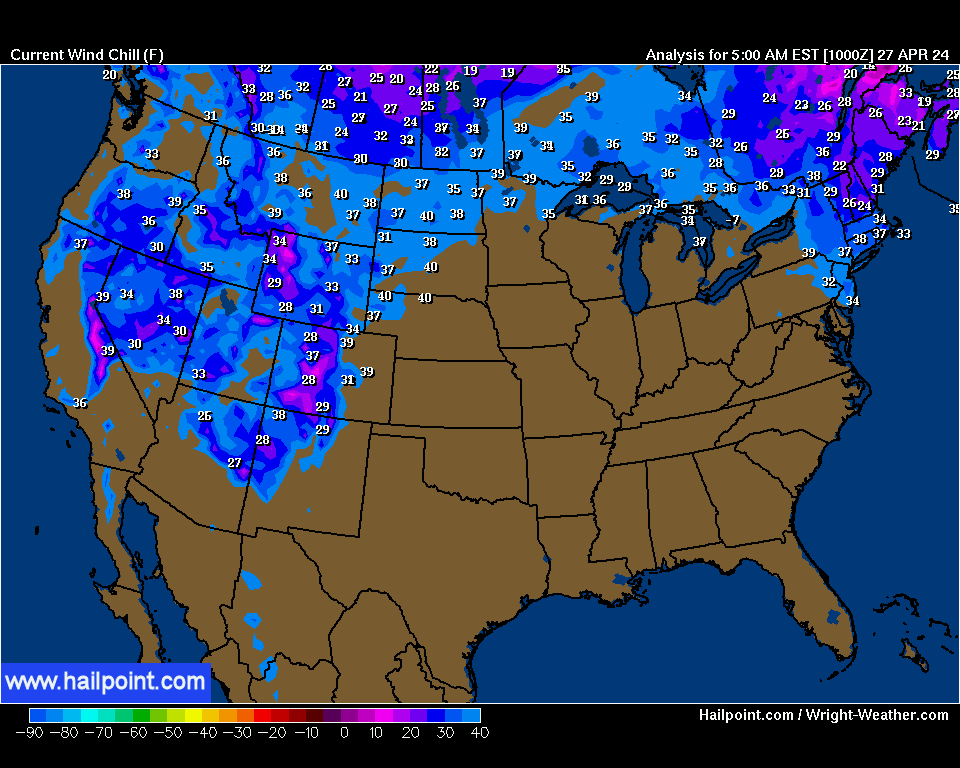
Chill Map

In case you want it for comparison, or just to see how cold it really is out there.

"The Models Work"

Some of you may have followed a long discussion at AVI's place on the validity of weather models. I learned quite a bit about what weather predictors think they are doing, and why their models are so bad. I'm not sure it's worth your time to read through it, but essentially they're confident enough in computer modeling in which they are only estimating the initial conditions that they think they can run computer models of weather that are as accurate as computer models of gambling games. The probability model they're using is simplistic and non-Bayesian. 

Because it's non-Bayesian, it's impossible to distinguish between 'the model worked, but the unlikely event occurred' and 'the model was full of crap.' If the event you predicted happened, the model was accurate. If the event you predicted wasn't likely to occur happened, the model was still right -- it predicted a chance of something else happening, after all. The models are never wrong.

A Dark Time in America

The calls for gun control were always expected, because disarming the American people has been at or near the top of the to-do list for the left forever. Yet there is no crisis to reference; gun violence is in fact way up, but not gun violence of the type they'd like to ban. Almost all of the spike in gun murders is committed with handguns that are already illegally possessed, and usually stolen. The left wants to ban civilian possession of semiautomatic rifles, among other things, but rifles of all kinds put together are used only in a tiny fraction of gun violence (about two-thirds of which 'violence' is suicide, causing gun control advocates to suddenly become anti-suicide advocates when the left normally embraces euthanasia as it does abortion).

So they're reaching back three years to a school shooting that happened -- the one where the police cowered outside instead of attacking the gunman. 

Yet what a strange thing to do: propose a law to address a problem that has completely ended. There are no school shootings in America anymore, because in-person instruction has largely ended. We've found a 100% effective solution to the problem, and it doesn't involve gun control. All we need to do is shift public education permanently to a virtual model, which the teacher's unions seem to want to do anyway.

So you can solve the problem, please the unions, and not create a massive affront among the citizenry who believes (accurately) that you're violating their most basic Constitutional rights. Win-win-win! Why not do that? 

You know why not. Solving the problem isn't the real issue; the real issue for them is disarming their victims, or at least turning them into criminals against whom state violence can be lawfully used.

Of course you can call your Congressfolk to ask them to oppose all this, but none of them can actually stop any of it. You're already effectively disenfranchised in America at the Federal level. Real resistance will have to be at the state and local level, there are already attempts to organize efforts to block enforcement of unconstitutional Federal laws, refuse to cooperate with the Federal law enforcement agencies (as the left was already refusing to cooperate with ICE), elect sheriffs who refuse to enforce such laws, or even arrest them for violating our constitutional rights. 

These mechanisms explain the push to purge "extremists" from both police agencies and the military. Note that this "there is no room in society for people to hold extremist views" rhetoric extends to all Americans:

“There is zero room, not only in society, but more so in professions of public trust and service, for people to have extremist views, regardless of ideology,” said Art Acevedo, the Houston police chief and president of the Major Cities Chiefs Association[,]

We are staging up for an ugly time, it appears: having 'fortified' the election, the new government has literally fortified the capital, and is now moving on to the part where they pass unconstitutional laws meant to disarm the populace. The suppression of speech is ongoing as well. This is no longer the America that I was born in; it's very rapidly turning into something else. 

More from Georgia's Fulton County

Fulton County just fired its election manager

Former President Donald Trump falsely alleged irregularities in Fulton County voting including the counting of ballots after a water line break at State Farm Arena and other unproven claims.

Falsely, you say? So why was the guy fired?

"Issues cited were his handling of the 2020 elections & firing of whistleblowers Bridget Thorne & Suzi Voyles, who testified in Georgia fraud hearings," http://VOTERGA.ORG's Garland Favorito said.

Georgia has competing investigations into election fraud, including one that alleges wrongdoing by newly-minted Senator Warnick (from an earlier election, however). The State Election Board just filed 35 cases for prosecution by local DAs or state officials; Fulton County's Democratically-elected DA is trying to prosecute, you guessed it, Donald Trump.

Monday Night Truckin'


 This one's originally by Claude Gray, but I default to the Outlaw Coe whenever he's got a version. 

Happy Barack Obama Day

It used to be "Presidents' Day," but at this point he's the only one you're really allowed to celebrate. You may be allowed to wink past Clinton's actions, but that's getting thinner and thinner each year. You are allowed to pretend that Joe Biden really won the election, though that will get thinner each year too.

Sunday Night Truckin'


 Gotta get the truck's perspective, to be fair to all parties involved.

Saturday Night Truckin’


Plato's Laws XI, 2: Of Sound Mind

The second matter from Book XI that draws my attention is the question of disposing of one's property in a last will and testament. Now, before we even look at this we know that the Athenian is going to be interested in preserving a proportionate equality among the 5,040 households. Thus, without reading a word of what he has to say, we're going to expect him to require the citizens to pass their legacy on to their lawful heir, and not to dispose of it as they may prefer. Inheritance is inherently political.

This was a substantial issue during the Middle Ages, for example, when nobility would often donate large holdings to the Church -- with the Church's encouragement -- in return for regular prayers for their souls. The family might have preferred that this not occur as often as it did, but the Powers that Be included the Church, and the Church was eager to receive such donations. The Church and the various royalties were mutually supporting, whereas the royalty often found its greatest practical competitor in the nobility --- though that should not have been true under the form of feudalism; in theory, the nobility and the royalty should have been mutually loyal and supportive, as the nobility grew out of the war band that upheld the king. Yet as time passed, the comitatus who became the Comes and then the Counts, and the Dux Bellorum who became the Dux and then the Duke, had their own competing interests. The kings were on the side of the Church both because the Popes tended to support kings, and because it bled off some of the wealth and power of their chief competitors and most dangerous potentially rebellious subjects. 

So too we will find here.

Ath. we must begin with the testamentary wishes of the dying and the case of those who may have happened to die intestate. When I said, Cleinias, that we must regulate them, I had in my mind the difficulty and perplexity in which all such matters are involved. You cannot leave them unregulated, for individuals would make regulations at variance with one another, and repugnant to the laws and habits of the living and to their own previous habits, if a person were simply allowed to make any will which he pleased, and this were to take effect in whatever state he may have been at the end of his life; for most of us lose our senses in a manner, and feel crushed when we think that we are about to die.

Cle. What do you mean, Stranger?
Ath. O Cleinias, a man when he is about to die is an intractable creature, and is apt to use language which causes a great deal of anxiety and trouble to the legislator.

Cle. In what way?
Ath. He wants to have the entire control of all his property, and will use angry words.

Cle. Such as what?
Ath. O ye Gods, he will say, how monstrous that I am not allowed to give, or not to give my own to whom I will-less to him who has been bad to me, and more to him who has been good to me, and whose badness and goodness have been tested by me in time of sickness or in old age and in every other sort of fortune!

Cle. Well Stranger, and may he not very fairly say so?
Ath. In my opinion, Cleinias, the ancient legislators were too good-natured, and made laws without sufficient observation or consideration of human things.

Cle. What do you mean?
Ath. I mean, my friend that they were afraid of the testator's reproaches, and so they passed a law to the effect that a man should be allowed to dispose of his property in all respects as he liked; but you and I, if I am not mistaken, will have something better to say to our departing citizens.

Two guesses what that 'something better' is, and the first one doesn't count.

It's a fairly intricate set of dispositions, actually, but it preserves the basic point. The original lot, from the 5,040, is to preserved intact to the son who is named heir. Other sons may be adopted off or granted portions of any additional wealth that has been accumulated -- remember that you could get up to four times the original lot before the state instituted its 100% tax, so you might have enough for up to four sons. The other sons may receive that much wealth, but it won't be in land, so they'll need to head off to other countries and colonies to set themselves up. If any of them have managed to set themselves up with lots already, they should not further partake of the patrimony.

Daughters should be married off, and if it happens that a man dies with only daughters, the legislator gets to pick out a good husband for her to take over the family lot. Oh, but this part is pretty ugly, as the Athenian himself admits; but he makes it much uglier by insisting that the marriage be of near-kin if at all possible, cousins or suchlike, in order to keep the wealth in the family. The woman is only consulted, instead of the state, if no suitable kin exist. "[I]f there be a lack of kinsmen in a family extending to grandchildren of a brother, or to the grandchildren of a grandfather's children, the maiden may choose with the consent of her guardians any one of the citizens who is willing and whom she wills, and he shall be the heir of the dead man, and the husband of his daughter."

Now, in fairness, cousin-marriage is much more ordinary in human history than we always understand; and genetics were as yet unknown to science and philosophy alike at the time. Keeping wealth united via cousin-marriage was (and remains, in some places) an ordinary consideration, not an idea that originates with Plato. Marriage-for-love was probably a Medieval innovation, whereas ancient marriage was always a family negotiation -- here the state is entering into the role the father has abandoned by dying before securing his own heir.

Still, the Athenian concludes, Now we must not conceal from ourselves that such laws are apt to be oppressive and that there may sometimes be a hardship in the lawgiver commanding the kinsman of the dead man to marry his relation... Persons may fancy that the legislator never thought of this, but they are mistaken; wherefore let us make a common prelude on behalf of the lawgiver and of his subjects, the law begging the latter to forgive the legislator, in that he, having to take care of the common weal, cannot order at the same time the various circumstances of individuals, and begging him to pardon them if naturally they are sometimes unable to fulfil the act which he in his ignorance imposes upon them.

Forgive us, citizens; we know exactly what we do.

Jackson Crawford on Not Being Called "Dr. Crawford."


It's clear from the length and rambling nature of this that he's uncomfortable talking about why he's abandoning use of the title "Dr.", but the basic facts are honorable. 

1) He never thought that a title like this would make him 'better than my grandfather, which is absurd,' but now that it seems people do think so he doesn't want any part of that.

2) He detests academic pretense -- as he puts it, 'even grad students' often look down on him because he's 'not the right kind.' He's done the work, and merits the title, but he doesn't want to be part of their world any more than they want him there. 

3) He doesn't want to detract from the honor due to medical professionals, who deserve special respect in his view, by claiming an equivalent title. 

Now, in fairness I appreciated his early use of the title on his YouTube channel just because it signaled that this guy might actually know what he was talking about. It's a subject that interests me, as it interested Tolkien and others, and yet it's also an area where a lot of people are making stuff up. It was nice to know that you'd get some grounded information if you listened to this guy. Sometimes he's not willing to go as far as even I am in making deductive leaps; but I know that what he does say is going to be solidly grounded.

Also, as I've mentioned here before, the medical professionals are the ones glomming on to the title; its medieval usage was far closer to what he's doing than what they're doing. It's interesting that he doesn't mention the source of the debate we were having that motivated him to make this decision, i.e., Dr. Jill Biden. He's clearly not siding with her, and backing off of his own better claim (as a Ph.D., who were more or less the original 'doctors,' rather than the far-less-rigorous and ancient Ed.D.) to avoid the pretentiousness of which she is accused. 

In any case, I think the general point holds: this is a courtesy title, and thus you should use it for someone who has merited it if it is important to you to pay them a courtesy. Since Jackson Crawford, Ph.D., no longer wishes this courtesy to be paid to him, it would be polite not to use it for him. Yet he has a better claim to it than he admits, perhaps even to himself. 

Let Them Die

Per D29, the UK has decided to issue Do Not Resuscitate orders for COVID patients with 'learning disabilities.' 

People with learning disabilities have been given do not resuscitate orders during the second wave of the pandemic, in spite of widespread condemnation of the practice last year and an urgent investigation by the care watchdog.

Mencap said it had received reports in January from people with learning disabilities that they had been told they would not be resuscitated if they were taken ill with Covid-19....

The disclosure comes as campaigners put growing pressure on ministers to reconsider a decision not to give people with learning disabilities priority for vaccinations. 

Iceland had famously almost eliminated Downs Syndrome through a similar approach, although they've become shy about it since it got a lot of press.

Friday Night Truckin


Appropriate Civility

A nice change from the rhetoric of recent years.

UPDATE: Jack Posobiec claims the article is fake, though he links to no evidence. 

Plato's Laws XI

You might have thought that we'd adequately covered business transactions in previous books, but no, it's the subject of Book XI as well. Now that we have the apparatus in place to punish people for wrongdoing, we need to re-examine punishments for immoral business practices -- which, surprise!, are often going to be treated as incidents of either blasphemy or treason.

In spite of this harshness, the book contains first principles that are really reasonable and moral. Here's the very opening, for example:

Ath. In the next place, dealings between man and man require to be suitably regulated. The principle of them is very simple:-Thou shalt not, if thou canst help, touch that which is mine, or remove the least thing which belongs to me without my consent; and may I be of a sound mind, and do to others as I would that they should do to me.

Who could object to these simple principles? I would like others to respect my property, and not handle or dispose of it without my consent; and, as a rational being, I recognize that I ought to extend this same protection to others since I want it myself. This is John Wayne stuff.


The Athenian immediately departs into a place more Beowulf than The Shootist. What to do if a man has laid up treasure in a tomb, and it is discovered, and none of his family remain behind? As we all know from the Beowulf (and The Hobbit) the best thing to do is not to touch it, not even one cup of it, lest you bring down the dragon. For Plato this isn't a literal dragon, nor even a literary one, but the punishment of the gods upon the soul of the man who 'takes up what he did not lay down.' You will not, the Athenian warns, do better financially than you will suffer in the quality of your soul if you steal treasure from the dead.

Similarly, when considering the trades -- innkeepers are his particular example here -- the Athenian lays down what at first sounds like a very moral and correct first principle. Trade is good! After all, it's just how we deal with the fact that Citizen A has lots of timber, more than he needs; and Citizen B has more honey than he can use, but might want some timber. Trade is how we get these inefficiencies dealt with, and goods distributed to those who need them. 

Ath. Retail trade in a city is not by nature intended to do any harm, but quite the contrary; for is not he a benefactor who reduces the inequalities and incommensurabilities of goods to equality and common measure? And this is what the power of money accomplishes, and the merchant may be said to be appointed for this purpose. The hireling and the tavern-keeper, and many other occupations, some of them more and others less seemly-alike have this object;-they seek to satisfy our needs and equalize our possessions.

Yes, he admits, we look down on these merchants; but if good and moral people were in these trades, they'd do so well that we'd think as well of these trades as of institutions like motherhood that are the business of the best kind of people.

Ath. For if what I trust may never be and will not be, we were to compel, if I may venture to say a ridiculous thing, the best men everywhere to keep taverns for a time, or carry on retail trade, or do anything of that sort; or if, in consequence of some fate or necessity, the best women were compelled to follow similar callings, then we should know how agreeable and pleasant all these things are; and if all such occupations were managed on incorrupt principles, they would be honoured as we honour a mother or a nurse. But now that a man goes to desert places and builds bouses which can only be reached be long journeys, for the sake of retail trade, and receives strangers who are in need at the welcome resting-place, and gives them peace and calm when they are tossed by the storm, or cool shade in the heat....

That's a wonderful service, as he correctly points out; the only problem is that innkeepers are greedy (he claims) and want to be paid extortionate prices for their hospitality, rather than treating their guests as friends. 

Now it might seem as if he has the principles in place to construct an admirable solution: assign these duties a special honor, and make them a part of the business of the kind of wealthy citizens for whom hospitality can be generous and profit from the service need not be tremendous. Of course he does not come to that conclusion, but the opposite one: no citizens should be allowed to participate in these ventures "either voluntarily or involuntarily," but only foreigners and resident aliens. Any citizen who runs an inn, or other tradesman-like ventures, is to be imprisoned for a year, and the punishment doubled and redoubled for any repeat offenses. 

Then, having restricted innkeeping etc. to the very class that will most need to make a profit from it, as they haven't other lands and ways of drawing incomes like the citizens do, we simply regulate them by law so that they must behave the way a generous citizen might. 

So, instead of following the argument to what seems like its natural conclusion, we follow the logic of the social class prejudice inherent in ancient Greece. These things are lowly; they would be better done if better people did them; therefore, no better people may do them, but only poor people who must be punished if they don't act as if they were richer than they are. 

Plato wasn't a businessman, and we've seen the Athenian's hostility to business throughout this work. Still, in a work that is supposedly structured to order society in such a way as to bring about moral improvements, here is a clear missed opportunity that his own stated principles might have led him to endorse.

Silly Governor

He should have known he had nothing to fear from Federal prosecutors. Not even now. 

Vaccinated people are both contagious and not contagious

The CDC now says that people who have completed their two-dose course of the vaccination and waited two weeks no longer need to quarantine if they are exposed to a known COVID case. They do, however, need to continue wearing masks all the time and continue social distancing, because reasons. Up to now, I'd have thought that the purpose of quarantine and masks was roughly the same, but a matter of degree: we treat everyone as a potential carrier who's deadly to those with whom he comes into contact, because even though non-symptomatic transfer is minimal, the new rule is life has to be 100% safe or we can't live it at all. What's more, if someone has actually been exposed to a known carrier, it's not enough to wear a mask and stay six feet from everyone: he has to lock himself in his home.
“Vaccinated persons with an exposure to someone with suspected or confirmed COVID-19 are not required to quarantine if they meet all of the following criteria.”
The criteria include having had both shots of either the Pfizer or Moderna vaccines — the two shots that are available to the U.S. public at the moment — and that at least two weeks have gone by since the second dose was administered. Studies have shown that full immunity is not built up until a couple of weeks after finishing the vaccine regimen.
* * *
The agency maintained that vaccinated people should continue following all other health guidance, including wearing a mask and social distancing when possible. Studies have shown that those who have been inoculated could still hold the virus in their noses and throats and transmit it to those around them.
So now, if you've been vaccinated, you don't have to lock yourself up, because you're not dangerous. You only have to avoid exposing your exhalations to anyone, forever, because you're dangerous. Is the idea supposed to be that you're still contagious, just not very? Because that argument hasn't worked so far in any attempt to make our pandemic policy adhere to reason or evidence.