Nonpreppers

My little coastal county doesn't fare well in extreme cold. We do have Yankee transplants here, but there's no accounting for citizens who appear to think that "rare freezes" are the same as "impossible freezes." This was an unusual cold spell in that many people have lost power not just for a few hours but for days on end, so the simplest coldproofing steps suddenly proved inadequate. Pipes will freeze now that would have been OK if house heat had stayed on. Not many thought to empty the pipes when the heat went off, and a day or two later--when it became clear that the outages weren't "rolling"--it was too late.

To make matters worse, when everyone drips pipes, or when pipes burst, water pressure goes to nothing. When the municipal water system loses power it can't make the treatment plant work and can't maintain water pressure. Many are outraged to be told that they should boil water, which they can't do because they are helpless without electrical power to boil water with. Or a few have power to boil with, but now no water pressure and so no water to boil. Seems like they would join forces with the contingent on the next block and get some water boiled.

You wouldn't believe how many people haven't got the means even to light a cooking fire in a grill. This cold snap didn't exactly sneak up on us, but many lost water pressure last night without having filled a single container. The stores lack power and haven't been restocked this week--no bottled water! There is no gasoline for sale; too many pumps are still without power. And this is in a county that's not even five years past its last hurricane-related weeks-long power outage.

Communications are strangely stable. I assume people are using smartphones and charging in their cars.

As uncomfortable as this all is, our temperatures have not been what you would call dangerous: upper teens, at the worst. There's no reason for anyone to risk exposure as long as they have dry shelter out of the wind. I doubt there's anyone reading this post who hasn't camped outside in worse. A few large buildings, like churches, have generators, but most are simply larger versions of the cold, uncomfortable boxes that the homes have become, and so are useless as shelters. Better to pile on the blankets at home and wait it out, assuming you keep some food and water in the house.

The weirdest thing I've heard all week: it's barely risen above freezing for several days now, but people are letting food go bad in their unpowered refrigerators. I just read about someone in another town worried about the safety of her insulin supply. What do they think refrigerators do?

One thing I'm pleased about: we had very few wrecks on icy roads. I dreaded hearing that people would skid off the causeway into the bay.

A few look at this situation and think: I should plan right now for improved backup systems in case something like this happens again. The rest want to know the name and phone number of someone they can call and complain to about the lousy service at this hotel.

Six Days on the Road

All right, so after Aggie mentioned it in the comments on Friday night, I decided to extend this series long enough that we could do this song on the sixth day after "Six Decks to Darwin." 

So here you go: the great trucker classic.


Although in fairness you shouldn't wind up a trucker song series without "Convoy," so here it is too.


And, really, something from the late, great Jerry Reed. 

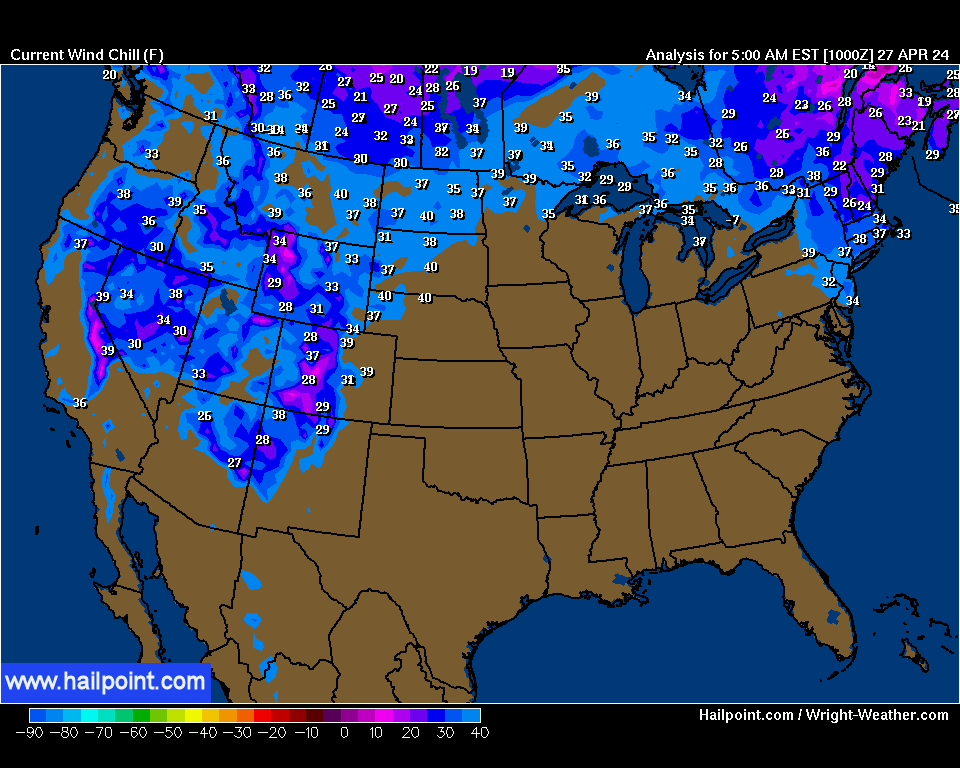
Chill Map

In case you want it for comparison, or just to see how cold it really is out there.

"The Models Work"

Some of you may have followed a long discussion at AVI's place on the validity of weather models. I learned quite a bit about what weather predictors think they are doing, and why their models are so bad. I'm not sure it's worth your time to read through it, but essentially they're confident enough in computer modeling in which they are only estimating the initial conditions that they think they can run computer models of weather that are as accurate as computer models of gambling games. The probability model they're using is simplistic and non-Bayesian. 

Because it's non-Bayesian, it's impossible to distinguish between 'the model worked, but the unlikely event occurred' and 'the model was full of crap.' If the event you predicted happened, the model was accurate. If the event you predicted wasn't likely to occur happened, the model was still right -- it predicted a chance of something else happening, after all. The models are never wrong.

A Dark Time in America

The calls for gun control were always expected, because disarming the American people has been at or near the top of the to-do list for the left forever. Yet there is no crisis to reference; gun violence is in fact way up, but not gun violence of the type they'd like to ban. Almost all of the spike in gun murders is committed with handguns that are already illegally possessed, and usually stolen. The left wants to ban civilian possession of semiautomatic rifles, among other things, but rifles of all kinds put together are used only in a tiny fraction of gun violence (about two-thirds of which 'violence' is suicide, causing gun control advocates to suddenly become anti-suicide advocates when the left normally embraces euthanasia as it does abortion).

So they're reaching back three years to a school shooting that happened -- the one where the police cowered outside instead of attacking the gunman. 

Yet what a strange thing to do: propose a law to address a problem that has completely ended. There are no school shootings in America anymore, because in-person instruction has largely ended. We've found a 100% effective solution to the problem, and it doesn't involve gun control. All we need to do is shift public education permanently to a virtual model, which the teacher's unions seem to want to do anyway.

So you can solve the problem, please the unions, and not create a massive affront among the citizenry who believes (accurately) that you're violating their most basic Constitutional rights. Win-win-win! Why not do that? 

You know why not. Solving the problem isn't the real issue; the real issue for them is disarming their victims, or at least turning them into criminals against whom state violence can be lawfully used.

Of course you can call your Congressfolk to ask them to oppose all this, but none of them can actually stop any of it. You're already effectively disenfranchised in America at the Federal level. Real resistance will have to be at the state and local level, there are already attempts to organize efforts to block enforcement of unconstitutional Federal laws, refuse to cooperate with the Federal law enforcement agencies (as the left was already refusing to cooperate with ICE), elect sheriffs who refuse to enforce such laws, or even arrest them for violating our constitutional rights. 

These mechanisms explain the push to purge "extremists" from both police agencies and the military. Note that this "there is no room in society for people to hold extremist views" rhetoric extends to all Americans:

“There is zero room, not only in society, but more so in professions of public trust and service, for people to have extremist views, regardless of ideology,” said Art Acevedo, the Houston police chief and president of the Major Cities Chiefs Association[,]

We are staging up for an ugly time, it appears: having 'fortified' the election, the new government has literally fortified the capital, and is now moving on to the part where they pass unconstitutional laws meant to disarm the populace. The suppression of speech is ongoing as well. This is no longer the America that I was born in; it's very rapidly turning into something else. 

More from Georgia's Fulton County

Fulton County just fired its election manager

Former President Donald Trump falsely alleged irregularities in Fulton County voting including the counting of ballots after a water line break at State Farm Arena and other unproven claims.

Falsely, you say? So why was the guy fired?

"Issues cited were his handling of the 2020 elections & firing of whistleblowers Bridget Thorne & Suzi Voyles, who testified in Georgia fraud hearings," http://VOTERGA.ORG's Garland Favorito said.

Georgia has competing investigations into election fraud, including one that alleges wrongdoing by newly-minted Senator Warnick (from an earlier election, however). The State Election Board just filed 35 cases for prosecution by local DAs or state officials; Fulton County's Democratically-elected DA is trying to prosecute, you guessed it, Donald Trump.

Monday Night Truckin'


 This one's originally by Claude Gray, but I default to the Outlaw Coe whenever he's got a version. 

Happy Barack Obama Day

It used to be "Presidents' Day," but at this point he's the only one you're really allowed to celebrate. You may be allowed to wink past Clinton's actions, but that's getting thinner and thinner each year. You are allowed to pretend that Joe Biden really won the election, though that will get thinner each year too.

Sunday Night Truckin'


 Gotta get the truck's perspective, to be fair to all parties involved.

Saturday Night Truckin’


Plato's Laws XI, 2: Of Sound Mind

The second matter from Book XI that draws my attention is the question of disposing of one's property in a last will and testament. Now, before we even look at this we know that the Athenian is going to be interested in preserving a proportionate equality among the 5,040 households. Thus, without reading a word of what he has to say, we're going to expect him to require the citizens to pass their legacy on to their lawful heir, and not to dispose of it as they may prefer. Inheritance is inherently political.

This was a substantial issue during the Middle Ages, for example, when nobility would often donate large holdings to the Church -- with the Church's encouragement -- in return for regular prayers for their souls. The family might have preferred that this not occur as often as it did, but the Powers that Be included the Church, and the Church was eager to receive such donations. The Church and the various royalties were mutually supporting, whereas the royalty often found its greatest practical competitor in the nobility --- though that should not have been true under the form of feudalism; in theory, the nobility and the royalty should have been mutually loyal and supportive, as the nobility grew out of the war band that upheld the king. Yet as time passed, the comitatus who became the Comes and then the Counts, and the Dux Bellorum who became the Dux and then the Duke, had their own competing interests. The kings were on the side of the Church both because the Popes tended to support kings, and because it bled off some of the wealth and power of their chief competitors and most dangerous potentially rebellious subjects. 

So too we will find here.

Ath. we must begin with the testamentary wishes of the dying and the case of those who may have happened to die intestate. When I said, Cleinias, that we must regulate them, I had in my mind the difficulty and perplexity in which all such matters are involved. You cannot leave them unregulated, for individuals would make regulations at variance with one another, and repugnant to the laws and habits of the living and to their own previous habits, if a person were simply allowed to make any will which he pleased, and this were to take effect in whatever state he may have been at the end of his life; for most of us lose our senses in a manner, and feel crushed when we think that we are about to die.

Cle. What do you mean, Stranger?
Ath. O Cleinias, a man when he is about to die is an intractable creature, and is apt to use language which causes a great deal of anxiety and trouble to the legislator.

Cle. In what way?
Ath. He wants to have the entire control of all his property, and will use angry words.

Cle. Such as what?
Ath. O ye Gods, he will say, how monstrous that I am not allowed to give, or not to give my own to whom I will-less to him who has been bad to me, and more to him who has been good to me, and whose badness and goodness have been tested by me in time of sickness or in old age and in every other sort of fortune!

Cle. Well Stranger, and may he not very fairly say so?
Ath. In my opinion, Cleinias, the ancient legislators were too good-natured, and made laws without sufficient observation or consideration of human things.

Cle. What do you mean?
Ath. I mean, my friend that they were afraid of the testator's reproaches, and so they passed a law to the effect that a man should be allowed to dispose of his property in all respects as he liked; but you and I, if I am not mistaken, will have something better to say to our departing citizens.

Two guesses what that 'something better' is, and the first one doesn't count.

It's a fairly intricate set of dispositions, actually, but it preserves the basic point. The original lot, from the 5,040, is to preserved intact to the son who is named heir. Other sons may be adopted off or granted portions of any additional wealth that has been accumulated -- remember that you could get up to four times the original lot before the state instituted its 100% tax, so you might have enough for up to four sons. The other sons may receive that much wealth, but it won't be in land, so they'll need to head off to other countries and colonies to set themselves up. If any of them have managed to set themselves up with lots already, they should not further partake of the patrimony.

Daughters should be married off, and if it happens that a man dies with only daughters, the legislator gets to pick out a good husband for her to take over the family lot. Oh, but this part is pretty ugly, as the Athenian himself admits; but he makes it much uglier by insisting that the marriage be of near-kin if at all possible, cousins or suchlike, in order to keep the wealth in the family. The woman is only consulted, instead of the state, if no suitable kin exist. "[I]f there be a lack of kinsmen in a family extending to grandchildren of a brother, or to the grandchildren of a grandfather's children, the maiden may choose with the consent of her guardians any one of the citizens who is willing and whom she wills, and he shall be the heir of the dead man, and the husband of his daughter."

Now, in fairness, cousin-marriage is much more ordinary in human history than we always understand; and genetics were as yet unknown to science and philosophy alike at the time. Keeping wealth united via cousin-marriage was (and remains, in some places) an ordinary consideration, not an idea that originates with Plato. Marriage-for-love was probably a Medieval innovation, whereas ancient marriage was always a family negotiation -- here the state is entering into the role the father has abandoned by dying before securing his own heir.

Still, the Athenian concludes, Now we must not conceal from ourselves that such laws are apt to be oppressive and that there may sometimes be a hardship in the lawgiver commanding the kinsman of the dead man to marry his relation... Persons may fancy that the legislator never thought of this, but they are mistaken; wherefore let us make a common prelude on behalf of the lawgiver and of his subjects, the law begging the latter to forgive the legislator, in that he, having to take care of the common weal, cannot order at the same time the various circumstances of individuals, and begging him to pardon them if naturally they are sometimes unable to fulfil the act which he in his ignorance imposes upon them.

Forgive us, citizens; we know exactly what we do.

Jackson Crawford on Not Being Called "Dr. Crawford."


It's clear from the length and rambling nature of this that he's uncomfortable talking about why he's abandoning use of the title "Dr.", but the basic facts are honorable. 

1) He never thought that a title like this would make him 'better than my grandfather, which is absurd,' but now that it seems people do think so he doesn't want any part of that.

2) He detests academic pretense -- as he puts it, 'even grad students' often look down on him because he's 'not the right kind.' He's done the work, and merits the title, but he doesn't want to be part of their world any more than they want him there. 

3) He doesn't want to detract from the honor due to medical professionals, who deserve special respect in his view, by claiming an equivalent title. 

Now, in fairness I appreciated his early use of the title on his YouTube channel just because it signaled that this guy might actually know what he was talking about. It's a subject that interests me, as it interested Tolkien and others, and yet it's also an area where a lot of people are making stuff up. It was nice to know that you'd get some grounded information if you listened to this guy. Sometimes he's not willing to go as far as even I am in making deductive leaps; but I know that what he does say is going to be solidly grounded.

Also, as I've mentioned here before, the medical professionals are the ones glomming on to the title; its medieval usage was far closer to what he's doing than what they're doing. It's interesting that he doesn't mention the source of the debate we were having that motivated him to make this decision, i.e., Dr. Jill Biden. He's clearly not siding with her, and backing off of his own better claim (as a Ph.D., who were more or less the original 'doctors,' rather than the far-less-rigorous and ancient Ed.D.) to avoid the pretentiousness of which she is accused. 

In any case, I think the general point holds: this is a courtesy title, and thus you should use it for someone who has merited it if it is important to you to pay them a courtesy. Since Jackson Crawford, Ph.D., no longer wishes this courtesy to be paid to him, it would be polite not to use it for him. Yet he has a better claim to it than he admits, perhaps even to himself. 

Let Them Die

Per D29, the UK has decided to issue Do Not Resuscitate orders for COVID patients with 'learning disabilities.' 

People with learning disabilities have been given do not resuscitate orders during the second wave of the pandemic, in spite of widespread condemnation of the practice last year and an urgent investigation by the care watchdog.

Mencap said it had received reports in January from people with learning disabilities that they had been told they would not be resuscitated if they were taken ill with Covid-19....

The disclosure comes as campaigners put growing pressure on ministers to reconsider a decision not to give people with learning disabilities priority for vaccinations. 

Iceland had famously almost eliminated Downs Syndrome through a similar approach, although they've become shy about it since it got a lot of press.

Friday Night Truckin


Appropriate Civility

A nice change from the rhetoric of recent years.

UPDATE: Jack Posobiec claims the article is fake, though he links to no evidence. 

Plato's Laws XI

You might have thought that we'd adequately covered business transactions in previous books, but no, it's the subject of Book XI as well. Now that we have the apparatus in place to punish people for wrongdoing, we need to re-examine punishments for immoral business practices -- which, surprise!, are often going to be treated as incidents of either blasphemy or treason.

In spite of this harshness, the book contains first principles that are really reasonable and moral. Here's the very opening, for example:

Ath. In the next place, dealings between man and man require to be suitably regulated. The principle of them is very simple:-Thou shalt not, if thou canst help, touch that which is mine, or remove the least thing which belongs to me without my consent; and may I be of a sound mind, and do to others as I would that they should do to me.

Who could object to these simple principles? I would like others to respect my property, and not handle or dispose of it without my consent; and, as a rational being, I recognize that I ought to extend this same protection to others since I want it myself. This is John Wayne stuff.


The Athenian immediately departs into a place more Beowulf than The Shootist. What to do if a man has laid up treasure in a tomb, and it is discovered, and none of his family remain behind? As we all know from the Beowulf (and The Hobbit) the best thing to do is not to touch it, not even one cup of it, lest you bring down the dragon. For Plato this isn't a literal dragon, nor even a literary one, but the punishment of the gods upon the soul of the man who 'takes up what he did not lay down.' You will not, the Athenian warns, do better financially than you will suffer in the quality of your soul if you steal treasure from the dead.

Similarly, when considering the trades -- innkeepers are his particular example here -- the Athenian lays down what at first sounds like a very moral and correct first principle. Trade is good! After all, it's just how we deal with the fact that Citizen A has lots of timber, more than he needs; and Citizen B has more honey than he can use, but might want some timber. Trade is how we get these inefficiencies dealt with, and goods distributed to those who need them. 

Ath. Retail trade in a city is not by nature intended to do any harm, but quite the contrary; for is not he a benefactor who reduces the inequalities and incommensurabilities of goods to equality and common measure? And this is what the power of money accomplishes, and the merchant may be said to be appointed for this purpose. The hireling and the tavern-keeper, and many other occupations, some of them more and others less seemly-alike have this object;-they seek to satisfy our needs and equalize our possessions.

Yes, he admits, we look down on these merchants; but if good and moral people were in these trades, they'd do so well that we'd think as well of these trades as of institutions like motherhood that are the business of the best kind of people.

Ath. For if what I trust may never be and will not be, we were to compel, if I may venture to say a ridiculous thing, the best men everywhere to keep taverns for a time, or carry on retail trade, or do anything of that sort; or if, in consequence of some fate or necessity, the best women were compelled to follow similar callings, then we should know how agreeable and pleasant all these things are; and if all such occupations were managed on incorrupt principles, they would be honoured as we honour a mother or a nurse. But now that a man goes to desert places and builds bouses which can only be reached be long journeys, for the sake of retail trade, and receives strangers who are in need at the welcome resting-place, and gives them peace and calm when they are tossed by the storm, or cool shade in the heat....

That's a wonderful service, as he correctly points out; the only problem is that innkeepers are greedy (he claims) and want to be paid extortionate prices for their hospitality, rather than treating their guests as friends. 

Now it might seem as if he has the principles in place to construct an admirable solution: assign these duties a special honor, and make them a part of the business of the kind of wealthy citizens for whom hospitality can be generous and profit from the service need not be tremendous. Of course he does not come to that conclusion, but the opposite one: no citizens should be allowed to participate in these ventures "either voluntarily or involuntarily," but only foreigners and resident aliens. Any citizen who runs an inn, or other tradesman-like ventures, is to be imprisoned for a year, and the punishment doubled and redoubled for any repeat offenses. 

Then, having restricted innkeeping etc. to the very class that will most need to make a profit from it, as they haven't other lands and ways of drawing incomes like the citizens do, we simply regulate them by law so that they must behave the way a generous citizen might. 

So, instead of following the argument to what seems like its natural conclusion, we follow the logic of the social class prejudice inherent in ancient Greece. These things are lowly; they would be better done if better people did them; therefore, no better people may do them, but only poor people who must be punished if they don't act as if they were richer than they are. 

Plato wasn't a businessman, and we've seen the Athenian's hostility to business throughout this work. Still, in a work that is supposedly structured to order society in such a way as to bring about moral improvements, here is a clear missed opportunity that his own stated principles might have led him to endorse.

Silly Governor

He should have known he had nothing to fear from Federal prosecutors. Not even now. 

Vaccinated people are both contagious and not contagious

The CDC now says that people who have completed their two-dose course of the vaccination and waited two weeks no longer need to quarantine if they are exposed to a known COVID case. They do, however, need to continue wearing masks all the time and continue social distancing, because reasons. Up to now, I'd have thought that the purpose of quarantine and masks was roughly the same, but a matter of degree: we treat everyone as a potential carrier who's deadly to those with whom he comes into contact, because even though non-symptomatic transfer is minimal, the new rule is life has to be 100% safe or we can't live it at all. What's more, if someone has actually been exposed to a known carrier, it's not enough to wear a mask and stay six feet from everyone: he has to lock himself in his home.
“Vaccinated persons with an exposure to someone with suspected or confirmed COVID-19 are not required to quarantine if they meet all of the following criteria.”
The criteria include having had both shots of either the Pfizer or Moderna vaccines — the two shots that are available to the U.S. public at the moment — and that at least two weeks have gone by since the second dose was administered. Studies have shown that full immunity is not built up until a couple of weeks after finishing the vaccine regimen.
* * *
The agency maintained that vaccinated people should continue following all other health guidance, including wearing a mask and social distancing when possible. Studies have shown that those who have been inoculated could still hold the virus in their noses and throats and transmit it to those around them.
So now, if you've been vaccinated, you don't have to lock yourself up, because you're not dangerous. You only have to avoid exposing your exhalations to anyone, forever, because you're dangerous. Is the idea supposed to be that you're still contagious, just not very? Because that argument hasn't worked so far in any attempt to make our pandemic policy adhere to reason or evidence.

Six Decks Bound for Darwin

Thanks to James (h/t AVI) for this Australian trucking song. 

Now, I grew up with trucking thanks to my grandfather, but 'I've got six decks' isn't a part of the lingo that's familiar to me from American sources. I'm pretty sure this points to one of the substantial differences between American and Australian trucking:  the road train.

The biggest one of these you're likely to see in the United States is only two deep, what we usually call "a double bottom." In the Australian Outback they often run road trains far larger than any North American setup. One driver can pull a lot of freight a long way. In the song, he's headed with cattle to the seaport at Darwin, where it may be floating to feed hungry mouths in China or elsewhere. 

Plato's Laws X, 6

This will be the last bit on the tenth book, after which we will move on to the final sixth of the Laws.

The Athenian returns to the idea of 'evil souls,' though not necessarily to 'the evil soul,' in a myth he decides to tell the people in order to enjoin good behavior. This is one of two mechanisms he sets up to try to apply external pressure to people to do right. His argument that no one will do wrong if he or she really believes in the gods, coupled with the proof of the gods, was supposed to eliminate the need for this. He found it embarrassing that people so well brought-up in the paths of righteousness as his colony's citizenry would even need punishments at all. But we're going to get reinforcing, overlapping systems -- which proves, I think, that Plato knows that such an approach will be necessary (and probably not even adequate) over and above right religion and philosophy.

The first system is mythic. In The Republic, a similar myth is proposed for the same reason: social control. However, in The Republic the system was intended for the ordinary people -- the elite Guardian class would understand that it was a myth that was constructed to ease the task of government. Here, the idea is that the myth should be taught to everyone, and they should all be encouraged to believe in it as firmly as they can be convinced to be, at every level of society.  It is, if anything, more important that the executors of the legislator's will be convinced of the myth that says that what they are doing is right and divinely warranted. 

So the myth is simply that our souls are transformed by our actions, and that they shall after death 'find their place' among the souls of the dead. Some of these souls are better, because they did right, and 'their place' is 'higher,' that is, they enjoy a sort of ascension to heavenly realms of the sort that the older stories say are populated by the gods. Worse souls 'sink' 'lower,' closer to the center of the earth, where the old stories say the realm of the unblessed souls lay: think of Achilles' shade in Hades, miserable and angry. 

Wait -- Achilles was a great hero, wasn't he? One of the best? Well, yes; this is part of Plato's problem with Homer. No getting around that, because the Athenian  has to endorse the old stories as part of upholding the ancient ways and civic pride. 

In any case, this is the answer to the 'evidence of our eyes.' Justice will be meted out after death, where we can't see it, but must believe it was done.

Ath. This is the justice of the Gods who inhabit Olympus. O youth or young man, who fancy that you are neglected by the Gods, know that if you become worse you shall go to the worse souls, or if better to the better, and in every succession of life and death you will do and suffer what like may fitly suffer at the hands of like. This is the justice of heaven, which neither you nor any other unfortunate will ever glory in escaping, and which the ordaining powers have specially ordained; take good heed thereof, for it will be sure to take heed of you. If you say:-I am small and will creep into the depths of the earth, or I am high and will fly up to heaven, you are not so small or so high but that you shall pay the fitting penalty, either here or in the world below or in some still more savage place whither you shall be conveyed. This is also the explanation of the fate of those whom you saw, who had done unholy and evil deeds, and from small beginnings had grown great, and you fancied that from being miserable they had become happy; and in their actions, as in a mirror, you seemed to see the universal neglect of the Gods, not knowing how they make all things work together and contribute to the great whole. 

Now one thing I want to say about this higher/lower thing is that it fits very nicely with Aristotle's physics, which transformed but was rooted on the physics of those who came before him. The idea of 'natural place' is key to understanding why this physics was so plausible to the Greeks, and to many who came after Aristotle. 

It was a thing you could prove. There were supposed to be four elements: earth, air, fire, and water. You can encounter these things in nature, and see that they are each quite different from the others. You could see that each one had a natural place, too: light a fire, and the fire goes up toward the heavens. Drop a rock into the water, and it falls through it to a lower place yet. Air stays in between the ground and the heavens to which the fire seems to rush, where lights like fires burn in the sky. 

So what is being proposed about souls is that they are either purifying themselves of base compositions, or taking on such compositions, by their decisions in life. They are becoming lighter or heavier, we might say; but more purely aethereal, or else more weighted with the base elements. They will, after death, find their natural place among the better and worse souls. It's a model that would have seemed very natural to Greeks of the period because it matches how they understand the natural world. 

(Note that the implications here are the opposite of the ones you usually hear, i.e., that this model was 'arrogant' because 'it put earth at the center of the universe.' No, it put earth at the center because (a) the Greeks knew they were on a sphere, having calculated its circumference, and (b) things made of earth always fell towards the center of the sphere, whereas fire ran away from it. The earth wasn't put at the center because it was religiously special, but because scientific observations of the era proved that was where it belonged; and not because it was glorious, but because it was base.)

This myth carries on:

Ath. Perhaps they might be compared to the generals of armies, or they might be likened to physicians providing against the diseases which make war upon the body, or to husbandmen observing anxiously the effects of the seasons on the growth of plants; or I perhaps, to shepherds of flocks. For as we acknowledge the world to be full of many goods and also of evils, and of more evils than goods, there is, as we affirm, an immortal conflict going on among us, which requires marvellous watchfulness; and in that conflict the Gods and demigods are our allies, and we are their property. Injustice and insolence and folly are the destruction of us, and justice and temperance and wisdom are our salvation; and the place of these latter is in the life of the Gods, although some vestige of them may occasionally be discerned among mankind. But upon this earth we know that there dwell souls possessing an unjust spirit, who may be compared to brute animals, which fawn upon their keepers, whether dogs or shepherds, or the best and most perfect masters; for they in like manner, as the voices of the wicked declare, prevail by flattery and prayers and incantations, and are allowed to make their gains with impunity. And this sin, which is termed dishonesty, is an evil of the same kind as what is termed disease in living bodies or pestilence in years or seasons of the year, and in cities and governments has another name, which is injustice.

On this model human beings are not rightly free, but are property of the gods. Some of that property does rightly and well, like a good dog assisting a shepherd. Other dogs fawn upon their masters (i.e., the gods) and pretend to be good, but steal eggs or kill chickens when they think the master isn't watching. The life of the righteous is the life of being a good dog, as it were; which, honestly, good dogs are surely favored by heaven, as everyone knows. I am less confident about how good the analogy is for people and gods, or the divine in general.

In any case, the myth isn't going to be enough either. Neither philosophy nor religion will really ensure obedience to the law. Both are used to reinforce the law. At this point the Athenian has, however, made enough arguments to be able to assert that every sort of lawbreaking is a kind of impiety and blasphemy: and thus, that punishments for any violation of the law should be quite harsh, since blasphemy is a worse crime on this model than even treason.

Ath. After the prelude shall follow a discourse, which will be the interpreter of the law; this shall proclaim to all impious persons:-that they must depart from their ways and go over to the pious. And to those who disobey, let the law about impiety be as follows:-If a man is guilty of any impiety in word or deed, any one who happens to present shall give information to the magistrates, in aid of the law; and let the magistrates who. first receive the information bring him before the appointed court according to the law; and if a magistrate, after receiving information, refuses to act, he shall be tried for impiety... 

There shall be three prisons in the state: the first of them is to be the common prison in the neighbourhood of the agora for the safe-keeping of the generality of offenders; another is to be in the neighbourhood of the nocturnal council, and is to be called the "House of Reformation"; another, to be situated in some wild and desolate region in the centre of the country, shall be called by some name expressive of retribution. Now, men fall into impiety from three causes, which have been already mentioned, and from each of these causes arise two sorts of impiety, in all six, which are worth distinguishing, and should not all have the same punishment. For he who does not believe in Gods, and yet has a righteous nature, hates the wicked and dislikes and refuses to do injustice, and avoids unrighteous men, and loves the righteous. But they who besides believing that the world is devoid of Gods are intemperate, and have at the same time good memories and quick wits, are worse... the other who holds the same opinions and is called a clever man, is full of stratagem and deceit-men of this class deal in prophecy and jugglery of all kinds, and out of their ranks sometimes come tyrants and demagogues and generals and hierophants of private mysteries and the Sophists, as they are termed, with their ingenious devices. 

There are many kinds of unbelievers, but two only for whom legislation is required; one the hypocritical sort, whose crime is deserving of death many times over, while the other needs only bonds and admonition.... let those who have been made what they are only from want of understanding, and not from malice or an evil nature, be placed by the judge in the House of Reformation, and ordered to suffer imprisonment during a period of not less than five years. And in the meantime let them have no intercourse with the other citizens, except with members of the nocturnal council, and with them let them converse with a view to the improvement of their soul's health. And when the time of their imprisonment has expired, if any of them be of sound mind let him be restored to sane company, but if not, and if he be condemned a second time, let him be punished with death. 

As to that class of monstrous natures who not only believe that there are no Gods, or that they are negligent, or to be propitiated, but in contempt of mankind conjure the souls of the living and say that they can conjure the dead and promise to charm the Gods with sacrifices and prayers, and will utterly overthrow individuals and whole houses and states for the sake of money-let him who is guilty of any of these things be condemned by the court to be bound according to law in the prison which is in the centre of the land, and let no freeman ever approach him, but let him receive the rations of food appointed by the guardians of the law from the hands of the public slaves; and when he is dead let him be cast beyond the borders unburied... 

And if a person be proven guilty of impiety, not merely from childish levity, but such as grown-up men may be guilty of, whether he have sacrificed publicly or privately to any Gods, let him be punished with death, for his sacrifice is impure. Whether the deed has been done in earnest, or only from childish levity, let the guardians of the law determine, before they bring the matter into court and prosecute the offender for impiety.

So the best case is someone who doesn't understand the philosophical arguments; he should be sent to prison for five years, and if he still doesn't understand that the gods are real afterwards, he should be executed. However, he might be readmitted to society if he proves to have developed the correct opinions and is able to repeat the myths convincingly. 

The ordinary person who commits offenses is a hypocrite, having affirmed right philosophy and religion and then betrayed it. Death.

The worst sort of all, though, is the one who affirms the teachings but distorts them in practice. People who claim to speak with the dead, or to make prophecies, or to reveal philosophical teachings at variance with the legislator's ("Sophists") are to be imprisoned for life in miserable conditions, and then subjected to the worst sort of public shaming after death. Like Hector until Priam came to beg for him, they are to be left for the birds and beasts to tear apart, beyond the borders of their civic society, without honors of any sort.

In the end, the philosophy and the religion and the myth all turn out to reinforce human-made law and the power of the state. A very sad conclusion to this book, in my opinion; unless, of course, Plato is speaking 'ironically,' and trying to get us all to see through the Athenian how the mechanisms of state power adopt what is truly and righteously highest and best, i.e., philosophy and our relationship to the divine. Unless, that is, the point of the Athenian dramatically is to reveal the way the state steals and distorts the human interest in what is good and true, and turns it into just another set of justifications for its own power.