Not to be cynical, but I can't help but notice that Georgia gas prices have dropped below $3/gal for the first time in years. In the last month, suddenly they fell from $3.30 a gallon to well under three bucks, and as low as ~$2.50 in some places. There was very little fluctuation over the whole previous year, but at the same time that this hotly-contested election comes up, gas prices drop and become substantially cheaper for the whole month before election day.
Doubtless a coincidence, but a curious one.


More on the Georgia Elections
This SurveyUSA poll suggests that Perdue is in the lead, although under the margin of victory (perhaps due to the libertarian candidate drawing some of the votes). But as interesting to me is the huge lead that Republicans have in generating early votes. 54% of those who intend to vote for David Perdue already have: 53% of those who intend to vote for the Republican, Nathan Deal, in the gubernatorial race. The numbers for the Democrats in these two races are at 44% in both races.
The Democratic party is the one that works so heavily to organize communities, but the Republicans have a real advantage here. My guess is that it's because Republicans are so often older, and have learned to organize themselves. If the state goes red in this election it may well be simply because more Republicans than Democrats showed up early and locked in their votes. The younger and more liberal college kids may well forget about the election: this weekend is the Georgia/Florida game, commonly known as "the Cocktail Bowl."
The Democratic party is the one that works so heavily to organize communities, but the Republicans have a real advantage here. My guess is that it's because Republicans are so often older, and have learned to organize themselves. If the state goes red in this election it may well be simply because more Republicans than Democrats showed up early and locked in their votes. The younger and more liberal college kids may well forget about the election: this weekend is the Georgia/Florida game, commonly known as "the Cocktail Bowl."
Justice is Not Blind
There have been two recent cases in which no-knock SWAT-style drug raids have led to the death of raiding police officers. Both men who killed raiding officers had prior run-ins with the law. In one case, no drugs found in the raid. In the other, drugs were found. One of these men is going to be tried for capital murder, with prosecutors seeking the death penalty. The other one the grand jury refused to indict.
One is black, one is white. Guess which one?
These cases look a lot a like, at first, and we might be tempted to say that the grand jury is probably informed by racism in electing to prosecute the one and not the other. But there are differences, too, which we have to consider.
The first difference is the presence of drugs. But that, if anything, seems to mitigate in favor of Guy: he was the one who didn't have any drugs! On the other hand, "drug paraphernalia" was found, so the police and prosecutors may simply believe they were unlucky in the date of the raid. Still, you can't prosecute the guy for what you didn't catch him doing, and as far as the raid is concerned, no drugs were found.
The second difference is in the kind of prior trouble the men encountered with the law. Magee had two prior DUIs and two prior marijuana possession: and even though we take DUI very seriously as a society now, it's still an offense without violent intent (though it may, by sad accident, have violent result). Guy's priors were a little different: robbery, theft, burglary, and possessing a firearm while a felon (itself against the law).
Now you might say that we should judge their guilt or innocence based on the current facts of the current case, not on their priors. Even if we grant that point for argument's sake, though, we can't ignore the priors insofar as they are directly relevant to the current case. To whit, Magee was entitled to defend his home with a firearm, whereas Guy was committing a crime by even making arrangements to do so.
In that light, the grand juries' differential behavior begins to make a kind of sense. Magee could be said to be making a very honest and understandable mistake in defending his home with his rifle; Guy cannot be held to have been innocent of plotting to commit a crime with his firearm, because arming himself in that manner was itself a crime.
All that said, capital murder strikes me as an excessive charge for defending your home against violent intrusion by attackers who do not even bother to identify themselves as police with a lawful warrant. Such actors take their lives in their hands, and citizens should not be put on trial for their lives if the police's choice to run this risk ends up with them getting shot. Reason magazine notes a similar case that ended up with the man in prison for ten years. That's an injustice, when the police purposefully elect to raid your home at an hour when they expect to rouse you out of a sound sleep, dazzle you with a flash-bang grenade, and then storm your home before you can think. They must be held to be assuming the risks of such a rash course of action.
Even so, we don't have to appeal to racism to explain the difference in these cases. The cases are relevantly similar in some respects, but relevantly different in very important ones. A different outcome is not proof of injustice.
One is black, one is white. Guess which one?
Guy is black, Magee white. And while Magee was found to have acted in self-defense, prosecutors are seeking the death penalty for Guy. He remains in jail while he awaits trial.Aristotle says that justice is treating relevantly similar cases similarly. That's helpful in a way, but it's purely formal: we still end up having to use judgment and rhetoric to reason about what constitutes relevant similarity. We can't go into justice with a blindfold on, because if we do we'll end up unable to do the work of justice at all.
Historically, police serving warrants were required to knock on a door, announce their presence, and wait for an answer. But in SWAT raids, this is often no longer the case. Police aren't required to announce themselves if they believe the circumstances present a threat of physical violence, or if they believe evidence would be destroyed. According to a study by the American Civil Liberties Union, no-knock warrants are used in around 60 percent of drug searches.
Like Guy, Magee was initially charged with capital murder, which is punishable by death. But before Magee's trial, a grand jury found there was not enough evidence for him to stand trial on that charge. "In essence it was a ruling in self-defense," DeGuerin said. Guy has been through the grand jury process as well, his attorney said, but in his case, the grand jury allowed prosecutors to move ahead with capital murder charges. So while Magee awaits trial for felony possession of marijuana, Guy awaits potential execution.
These cases look a lot a like, at first, and we might be tempted to say that the grand jury is probably informed by racism in electing to prosecute the one and not the other. But there are differences, too, which we have to consider.
The first difference is the presence of drugs. But that, if anything, seems to mitigate in favor of Guy: he was the one who didn't have any drugs! On the other hand, "drug paraphernalia" was found, so the police and prosecutors may simply believe they were unlucky in the date of the raid. Still, you can't prosecute the guy for what you didn't catch him doing, and as far as the raid is concerned, no drugs were found.
The second difference is in the kind of prior trouble the men encountered with the law. Magee had two prior DUIs and two prior marijuana possession: and even though we take DUI very seriously as a society now, it's still an offense without violent intent (though it may, by sad accident, have violent result). Guy's priors were a little different: robbery, theft, burglary, and possessing a firearm while a felon (itself against the law).
Now you might say that we should judge their guilt or innocence based on the current facts of the current case, not on their priors. Even if we grant that point for argument's sake, though, we can't ignore the priors insofar as they are directly relevant to the current case. To whit, Magee was entitled to defend his home with a firearm, whereas Guy was committing a crime by even making arrangements to do so.
In that light, the grand juries' differential behavior begins to make a kind of sense. Magee could be said to be making a very honest and understandable mistake in defending his home with his rifle; Guy cannot be held to have been innocent of plotting to commit a crime with his firearm, because arming himself in that manner was itself a crime.
All that said, capital murder strikes me as an excessive charge for defending your home against violent intrusion by attackers who do not even bother to identify themselves as police with a lawful warrant. Such actors take their lives in their hands, and citizens should not be put on trial for their lives if the police's choice to run this risk ends up with them getting shot. Reason magazine notes a similar case that ended up with the man in prison for ten years. That's an injustice, when the police purposefully elect to raid your home at an hour when they expect to rouse you out of a sound sleep, dazzle you with a flash-bang grenade, and then storm your home before you can think. They must be held to be assuming the risks of such a rash course of action.
Even so, we don't have to appeal to racism to explain the difference in these cases. The cases are relevantly similar in some respects, but relevantly different in very important ones. A different outcome is not proof of injustice.
Monte Carlo
A point I think about often, as a motorcycle rider:
I rode in Tampa's rush-hour traffic, day in and day out, hours a day during the summer a few years ago. In retrospect, that may not have been the best idea I ever had.
The odds drop a lot, though, on these country backroads. They're more fun to ride on anyway.
One lesson of New Guinea life Diamond takes personally concerns small, recurring dangers – “hazards that carry a low risk each time but are encountered frequently”. Once, on a field trip, he proposed setting up camp under a beautiful old tree, but his New Guinean colleagues refused. It was dead, they explained, and might kill them in the night. The chances were tiny – but if you sleep under trees many nights a year, they add up. The biggest dangers in his LA life today, Diamond believes, are slipping in the shower, tripping on uneven paving stones and car accidents. Even if the chance of serious injury or death in the bathroom is one in 1,000, that is far too big for something you do every day.Is that right? Do the chances 'add up'? Not according to probability theory; and yet it seems plausible to say that if you run against 1,000-1 odds a thousand times...
I rode in Tampa's rush-hour traffic, day in and day out, hours a day during the summer a few years ago. In retrospect, that may not have been the best idea I ever had.
The odds drop a lot, though, on these country backroads. They're more fun to ride on anyway.
"The Bell Curve" +20
Joseph W. sometimes refers to this book by names like 'Mephistopheles' Handbook of Evil,' but the authors say that their intent was to make a very limited, modest claim. The explosion results from the fact that even a modest amount of antimatter doesn't mix:
Fifty years from now, I bet those claims about “The Bell Curve” will be used as a textbook case of the hysteria that has surrounded the possibility that black-white differences in IQ are genetic. Here is the paragraph in which Dick Herrnstein and I stated our conclusion:The solution set doesn't sound like the hardest-right radicalism either. He proposes a guaranteed basic income for all Americans, for one thing.
If the reader is now convinced that either the genetic or environmental explanation has won out to the exclusion of the other, we have not done a sufficiently good job of presenting one side or the other. It seems highly likely to us that both genes and the environment have something to do with racial differences. What might the mix be? We are resolutely agnostic on that issue; as far as we can determine, the evidence does not yet justify an estimate. (p. 311)
That’s it. The whole thing. The entire hateful Herrnstein-Murray pseudoscientific racist diatribe about the role of genes in creating the black-white IQ difference. We followed that paragraph with a couple pages explaining why it really doesn’t make any difference whether the differences are caused by genes or the environment. But nothing we wrote could have made any difference.
Something For Everyone
Really, how could you do better than "The Anglo-Saxon War-Culture and The Lord of the Rings: Legacy and Reappraisal"?
Considering the scarcity of the Anglo-Saxon influence in modern war-literature in general, one may wonder and stop by a work like The Lord of the Rings or Silmarillion, which few would be willing to categorise as serious war-literature. The fictional writings of J.R.R. Tolkien are said to have revived the genre of fantasy and magic-realism, and they have been readily assimilated into the new genre of popular literature. What seems to have been forgotten in this process is Tolkien’s own passionate and critical engagement with the war-literature of the Anglo-Saxons, which has gone into the making of his otherwise ‘fantastic’ creation of the ‘Middle Earth’.Tolkien's description of the fight between the Rohirric cavalry and the Uruk-Hai is as good a picture of a disciplined medieval infantry-cavalry skirmish as exists.
Quarantine quarrels
Congress took testimony on the controversy over whether travel bans or quarantines might impede efforts to contain Ebola at its source:
I thought the bowling doctor in New York was a little complacent, but at least he didn't (as far as I know) go back to work at his ER while he was self-monitoring for 21 days.
Rabih Torbay, senior vice president at International Medical Corps, testified that imposing quarantines would strongly discourage volunteer healthcare workers from assisting in the relief effort.
As an example, he said, the IMC requires a six-week minimum commitment to treat Ebola patients. Adding a 21-day quarantine would stretch doctors' furloughs to nine weeks, a period of leave that few hospitals would allow.
"We cannot recruit staff from the U.S. or anywhere else in the world if there is not a chance they could come back to their families and their [jobs]" quickly, Torbay told lawmakers.
"Putting people in quarantine goes against our ability to recruit and retain [staff], and therefore, it will go against our ability to fight against the virus in West Africa."Wait, so the problem with quarantine is that travelers from Africa who have been treating large numbers of Ebola patients under primitive conditions need to be able to go right back to work at their American hospitals as soon as they return, without waiting 21 days to see whether they're unlikely to have contracted the disease?
I thought the bowling doctor in New York was a little complacent, but at least he didn't (as far as I know) go back to work at his ER while he was self-monitoring for 21 days.
Do Police Kill Blacks At The Same Rate as Lynching?
So, I encountered the following badge on Facebook:
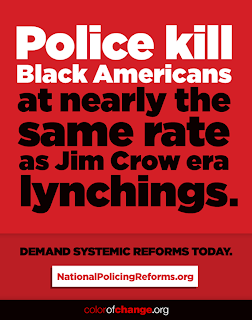
That is a shocking claim, isn't it? I decided to try and see if it was true.
The source for the claim seems to be this article in the UK Guardian. Here's the fuller version of the claim:
However, there's an ambiguity at work. The American black population in 1900 was 8.8 million; today, it is over 38 million. Thus, the "rate" in the statistical sense is only 0.231 the rate of lynchings in 1900 (assuming that 1900 is a good proxy for her claim about when lynchings were once-every-four-days, and that all her numbers are right).
So is the claim true? Yes, and at the same time also no.

That is a shocking claim, isn't it? I decided to try and see if it was true.
The source for the claim seems to be this article in the UK Guardian. Here's the fuller version of the claim:
Not terribly long ago in a country that many people misremember, if they knew it at all, a black person was killed in public every four days for often the most mundane of infractions, or rather accusation of infractions – for taking a hog, making boastful remarks, for stealing 75 cents. For the most banal of missteps, the penalty could be an hours-long spectacle of torture and lynching. No trial, no jury, no judge, no appeal. Now, well into a new century, as a family in Ferguson, Missouri, buries yet another American teenager killed at the hands of authorities, the rate of police killings of black Americans is nearly the same as the rate of lynchings in the early decades of the 20th century.So the "rate" that she's talking about is "once every three or four days."
About twice a week, or every three or four days, an African American has been killed by a white police officer in the seven years ending in 2012, according to studies of the latest data compiled by the Federal Bureau of Investigation. That number is incomplete and likely an undercount, as only a fraction of local police jurisdictions even report such deaths – and those reported are the ones deemed somehow “justifiable”. That means that despite the attention given the deaths of teenagers Trayvon Martin (killed by neighborhood watchman George Zimmerman) and Jordan Davis (killed by a white man for playing his music too loud), their cases would not have been included in that already grim statistic – not only because they were not killed by police but because the state of Florida, for example, is not included in the limited data compiled by the FBI.
However, there's an ambiguity at work. The American black population in 1900 was 8.8 million; today, it is over 38 million. Thus, the "rate" in the statistical sense is only 0.231 the rate of lynchings in 1900 (assuming that 1900 is a good proxy for her claim about when lynchings were once-every-four-days, and that all her numbers are right).
So is the claim true? Yes, and at the same time also no.
Religious Tests
Matt Walsh writes:
The answer is clear. We object to the baker or the photographer refusing to service gay weddings because we’ve deemed that expression to be anti-gay. And anti-gay expression is always wrong. Remember what we’ve said time after time: it has no place in our society. Churches are in our society, aren’t they?...
We force chapels to marry gays and bakers to bake cakes for gay weddings because we find Christianity abhorrent and detest the very thought of anyone attempting to live by its tenets.
That’s all. That’s it. That’s what everything comes down to. Nothing more, nothing less.
If we have banned people from practicing their faith in their private lives because we disagree with it, why wouldn’t we try and eradicate the hive itself?
If Christians are barred from running their private businesses according to their religious convictions, then haven’t we made a statement about those convictions? They’re unwelcome. Illegitimate. There’s no place in a civilized society for them.
No Common Ground
This is a fairly basic principle, and it's hard to see how you can work around the disagreement.
Is there any American who doesn't believe that? Is it possible to be an American, in the spiritual sense, without believing it? The 14th Amendment makes citizens of everyone born here, but perhaps that isn't wise: perhaps it isn't birth but faith that makes Americans.
The alternative positions are pretty hostile. Really, some of the ones linked by Memeorandum are so hostile and vile that I won't link to them. But here's Ed Kilgore, at least:During an National Rifle Association event in Iowa in 2012, state Sen. Joni Ernst, now the Republican nominee for Senate in the state, said she carries a 9-millimeter gun around everywhere and believes in the right to use it even if it’s against the government if they disregard her rights.
“I have a beautiful little Smith & Wesson, 9 millimeter, and it goes with me virtually everywhere,” Ernst said during a speech at the NRA’s Iowa Firearms Coalition Second Amendment Rally in Searsboro, Iowa, as flagged by The Huffington Post on Thursday. “But I do believe in the right to carry, and I believe in the right to defend myself and my family — whether it’s from an intruder, or whether it’s from the government, should they decide that my rights are no longer important.”
As opposed to what exactly? The opposite of this statement is the following:
“I do not believe in the right to carry, and I do not believe in the right to defend myself and my family — whether it’s from an intruder, or whether it’s from the government, should they decide that my rights are no longer important.”
Is there any free person anywhere that doesn’t reserve the right to defend himself against a person who would do him harm, or who believes that, should the government turn, he would be better off going quietly into the night?
Now this is a guaranteed applause line among Con Con audiences, for reasons that have relatively little to do with gun regulation. The idea here is to intimidate liberals, and “looters” and secular socialists, and those people, that there are limits to what the good virtuous folk of the country will put up with in the way of interference with their property rights and their religious convictions and their sense of how the world ought to work. If push comes to shove, they’re heavily armed, and bullets outweigh ballots. It’s a reminder that if politics fails in protecting their very broad notion of their “rights,” then revolutionary violence—which after all, made this great country possible in the first place—is always an option. And if that sounds “anti-democratic,” well, as the John Birch Society has always maintained, this is a Republic, not a democracy.I can understand not appreciating what you are reading as an attempt to intimidate you, personally. Still, the principle sounds reasonable to me. In fact, if I were going to articulate it, I'd not focus as she does on a right to defend. The right -- the one the Founders asserted -- is not limited to defense from the government's depredations. It is a right "to alter or to abolish it, and to institute new Government, laying its foundation on such principles and organizing its powers in such form, as to them shall seem most likely to effect their Safety and Happiness."
Is there any American who doesn't believe that? Is it possible to be an American, in the spiritual sense, without believing it? The 14th Amendment makes citizens of everyone born here, but perhaps that isn't wise: perhaps it isn't birth but faith that makes Americans.
Smart, Smart Diplomacy
Secretary of State John Kerry:
We've said from day one that if North Korea wants to rejoin the community of nations, it knows how to do it. It can come to the talks prepared to discuss denuclearization. And the United States is fully prepared -- if they do that and begin that process, we are prepared to begin the process of reducing the need for American force and presence in the region because the threat itself would then be reduced.Secretary of Defense Chuck Hagel, a few hours later:
We the United States do not intend to change our policy on deployment of our forces in the Republic of Korea. In fact, I think it's just the opposite. We continue to strengthen and advance that policy we've had for over 60 years. We are upgrading it, adjusting on deployments, on rotational deployments. We think there is more stability, more security, more continuity in those deployments.
Bowling with Ebola
If you've been wondering how thoroughly an Ebola case in New York City would convulse the nation's media outlets, wonder no more. Just turn on any cable new show or google "New York Ebola doctor." It's going to be wall-to-wall for the duration.
Who Doesn't Benefit From A New Racial Slur?
So apparently in the confines of academia, there's a sense that it would be really nice if we could come up with a good racial slur to use against whites. Well, non-Southern whites, that is: everyone already knows a mess of slurs for uppity Southerners.
What is really wanted is a good way to insult the rest of the white community. The first author takes a stab at it -- given that he's looking for a good way to insult white, left-leaning college students at his own university, I was amused to see that we'd gotten there first.
Still, it's not good enough, argues a second thinker. The problem is that it's possible to avoid being slandered by changing behavior, which is not how racial slurs are supposed to work. They're supposed to taint you forever, no matter what you do:
So, motion carried. Good to know that our fine academic minds are still working on solving the hard problems bedeviling the nation! Thanks to their tireless efforts, we've devised a new racial slur. Surely there's nothing America needed more.
I cajole a few of them into “Cracker” and “Red Neck.” We can usually get to “Hillbilly” or “Trailer Trash” or “White Trash,” possibly even “Peckerwood,” before folks recognize the “Cletus the slack-jawed yokel” pattern of class discrimination here. And being that we are at a top ranked west coast university, not only do we all share basic middle class aspirations, but we can feel pretty safe in the fact that there are no “Red Necks” here to insult.There probably are quite few. Southern poor whites are as underprivileged -- and as poor -- as almost any minority group. So naturally, of course, they're the one the culture is readiest to insult should they break out of their hills and come down into town where they don't belong.
What is really wanted is a good way to insult the rest of the white community. The first author takes a stab at it -- given that he's looking for a good way to insult white, left-leaning college students at his own university, I was amused to see that we'd gotten there first.
Still, it's not good enough, argues a second thinker. The problem is that it's possible to avoid being slandered by changing behavior, which is not how racial slurs are supposed to work. They're supposed to taint you forever, no matter what you do:
It is a label that denies the individuality of the target and forces him to into a set of predefined stereotypes. And there is nothing the target to can do to exempt himself. It is beyond achievement, effort, or choice. You just *are* are Black or Latino or Jewish or “white privileged”. Definitively, a person of Euro-Caucasian descent can never stop being white privileged.There's some merit to this suggestion. No one should be expected to take seriously an argument framed around a racial slur, which would dismiss 'privilege' arguments on the same terms. Further, it justifies a response exactly similar to the response we expect should we call someone of a given race by a slur. If that ends badly for you, most people will agree that you brought it on yourself.
And just like those other racial slurs, being white privileged undercuts anything a person individually accomplishes. Maybe he can be the nicest of the White Privileged that his Black and Latino friends know. Maybe he can be “one of the good ones” who “knows his place” as the beneficiary of American institutional racism. But he can never be other than white privileged. White privileged is the Bizarro-world version of the presumption that a Black student was accepted to an exclusive university because of his skin-color. If you are white privileged, it means that — although you might have never treated anyone inequitably based on their race, creed, or national origin, although you might have even shown a degree of favoritism to races different than your own, although you might have had no valuable socio-economic connections when starting out, although you might have worked very hard and risked much to achieve whatever you have — but still you vicariously share in the sin of every cop (white or black or brown) who stops and tickets a black man in an expensive car because he stood out on the highway. And it asserts you have even reaped unspecified rewards from those encounters—rewards not shared by other categories.
White privileged is the true white racial slur, and no one has been slow to throw it around. It is used the same as any other racial slurs: To deny the target his individuality, to brand him with the failures of the worst member of his category and with the stereotypes in the minds of others, to disparage the quality of his achievements and potential, and to implicitly demand more from him than others.
So, motion carried. Good to know that our fine academic minds are still working on solving the hard problems bedeviling the nation! Thanks to their tireless efforts, we've devised a new racial slur. Surely there's nothing America needed more.
Better microscopes
I heard recently that a Nobel Prize had been given for advances in light microscopy, and wondered why we would be fooling around with light after determining some time back that really detailed pictures required electromagnetic radiation with smaller wavelengths. The answer turns out to be that those smaller wavelengths really tear up whatever we're trying to look at, particularly living cells. The new microscopy uses some kind of system of multiple passes that makes possible fantastic videos of living processes such as cell division, as you can see in the remarkable videos here.
Travel monitors
This actually strikes me as a pretty sane measure: state health officials will be trying to monitor all incoming travelers from the Ebola-stricken countries for 21 days. It's not airtight, obviously, and I have real doubts about whether the health officials will have the resources or the determination to follow through instead of treating this like a public-relations box to check off, but it's a step. All our experience, including our good luck with the families of Thomas Duncan, Nina Pham, Amber Vinson, and the Spanish nurse, points to the probability that Ebola doesn't spread very readily early on. If we keep a sharp eye on the people most likely to be developing symptoms in the next few weeks, we increase our chances of getting them into isolation before they're most dangerous. At least, I'd like to hope that no one on this "watch list" could be turned away unthinkingly from an ER.
Sergeant at Arms, Do Your Office
The Sergeant at Arms is an ancient office that, for quite some time, has been chiefly ceremonial. Not today.
UPDATE: Confirmation.
According to reports, most of downtown Ottawa has been locked down as at least one suspect is still reportedly on the loose. The gunman reportedly first attacked the soldier at the National War Memorial and then went into the Canadian parliament building. Canadian Prime Minister Stephen Harper is safe. Harper reportedly was to meet with Malala Yousefzai, who was recently named a co-recipient of the 2014 Nobel Peace Prize....Well done, brother.
Media reports now indicate that police are searching for multiple gunmen, and are also trying to block bridges into Quebec. One gunman who entered the Canadian parliament building was reportedly killed by Parliament's sergeant at arms.
UPDATE: Confirmation.
Fantino said parliament's head of security, Sergeant-at-Arms Kevin Vickers, a former member of the Royal Canadian Mounted Police (RCMP), had shot a suspect dead.UPDATE: "Sergeant at Arms gets standing ovation after shooting terrorist while wearing tails."
"All the details are not in, but the sergeant-at-arms, a former Mountie, is the one that engaged the gunman, or one of them at least, and stopped this," Fantino said. "He did a great job and, from what I know, shot the gunman and he is now deceased."
Why Would Any Man Vote Democrat?
So asks Dr. Gordon Finley, via Dr. Helen, via Dr. Glen Reynolds. Since such a well-educated consort wants to know, allow me to answer.
As a citizen of the Great State of Georgia, allow me to say that I am seriously considering voting for Michelle Nunn. My reasons are the same reasons she is doing very well across the state.
Partly I think the length of his service in Washington is responsible, as it detached him from his state for so long and attached him to powerful national interests instead. A man who had spent more time at home would not have bungled last year's blizzard so badly, because any native son of Georgia should have known how huge a disaster even a few inches of snow and ice would be for the state.
Setting all that aside, however, how can you excuse the worst unemployment rate in the entire nation? This isn't Detroit! A Republican governor with a Republican legislature, if he accomplishes nothing else, ought at least to be a spur to the economy. If he can't do that -- and very manifestly he cannot -- how can he possibly put himself forward for a second term?
Well, I know the arguments against voting Democratic, because they are helpfully mailed to me by various interest groups. Presumably a Democratic governor and Senator cannot be trusted on gun rights, and will try to drive Georgia against its grain on social issues. A Democratic Senate is harmful in terms of court appointments, including to the Supreme Court in the event that a vacancy should occur. It is also harmful in terms of oversight, and there is perhaps even a positive national program that a unified Congress could push on a reluctant, lame-duck President.
The issues Dr. Helen and her cohort raise frankly don't rise to the same level of consideration. I don't dismiss them, but they pale beside the issues of national destiny and character we face.
Why might a man vote Democratic? I have not decided that I will, because the national concerns especially are very pressing. But now you know why I might: because the Democrats have recruited better candidates, and the Republicans currently serving at the state level have done a disgraceful job.
As a citizen of the Great State of Georgia, allow me to say that I am seriously considering voting for Michelle Nunn. My reasons are the same reasons she is doing very well across the state.
The reason Michelle Nunn is running more-or-less even with Perdue is that she comes from a family famous in the state for excellent service in the Senate. Her father is almost a watchword for what a good Senator should look like. In addition, she's made her career working with the Bush family ever since the first Bush administration. So Republicans can look at her and see a woman who can reach across the aisle, has plenty of respect from their own party, and has a kind of life-long apprenticeship from the man whose Senate career Georgia voters already most respect.For that matter, I am considering voting for Jason Carter, Jimmy Carter's grandson. This is not because I am enthusiastic about him as a candidate. It is because Nathan Deal, the Republican incumbent, has been a terrible governor. Longtime readers of the page will remember that I supported his candidacy in 2010, on the strength of his having been a perfectly decent congressman (in my district) for a long time. His performance as governor ought to be disqualifying for a second term.
David Perdue comes from the same family as Sonny Perdue, a recent governor who broke key election promises to base voters, and was unimpressive as governor. David Perdue has no experience in politics from which to judge, but he made his career on Wall Street, a place whose name normally turns up in Georgia elections as a curse: e.g., 'If elected, I will defend the values of Main Street against Wall Street.'
Partly I think the length of his service in Washington is responsible, as it detached him from his state for so long and attached him to powerful national interests instead. A man who had spent more time at home would not have bungled last year's blizzard so badly, because any native son of Georgia should have known how huge a disaster even a few inches of snow and ice would be for the state.
Setting all that aside, however, how can you excuse the worst unemployment rate in the entire nation? This isn't Detroit! A Republican governor with a Republican legislature, if he accomplishes nothing else, ought at least to be a spur to the economy. If he can't do that -- and very manifestly he cannot -- how can he possibly put himself forward for a second term?
Well, I know the arguments against voting Democratic, because they are helpfully mailed to me by various interest groups. Presumably a Democratic governor and Senator cannot be trusted on gun rights, and will try to drive Georgia against its grain on social issues. A Democratic Senate is harmful in terms of court appointments, including to the Supreme Court in the event that a vacancy should occur. It is also harmful in terms of oversight, and there is perhaps even a positive national program that a unified Congress could push on a reluctant, lame-duck President.
The issues Dr. Helen and her cohort raise frankly don't rise to the same level of consideration. I don't dismiss them, but they pale beside the issues of national destiny and character we face.
Why might a man vote Democratic? I have not decided that I will, because the national concerns especially are very pressing. But now you know why I might: because the Democrats have recruited better candidates, and the Republicans currently serving at the state level have done a disgraceful job.
Excellent News
A paralyzed man is able to walk again, thanks to cells taken from an adult's nose.
It may even be possible for this to be replicated, "if funding can be raised." A comment on the story says:
It may even be possible for this to be replicated, "if funding can be raised." A comment on the story says:
"Raisman, who hopes to see at least three more patients treated in Poland over the next three to five years if the funding can be raised, said"You would think.
Wait - what? "if the funding can be raised"? If this report is accurate, there should be no question of funding. The procedure surely should be repeated in a careful study of 30 to 50 people, with funding from the NHS.
The cost is trivial - if we have (as we do) fixed budgets, then cut back on varicose vein surgery and gender-reassignment surgery to cover the costs of this research, No brainer.
Subscribe to:
Posts (Atom)