Sigh no more

My linguistics reading of late is alerting me to survivals of archaic forms in popular culture.  The genius of Shakespeare and the King James Bible translation ensures that we never quite stop incorporating the English of 500 years ago into modern speech.  Last night I spent enjoyable hours watching Joss Whedon's recent production of Shakespeare's comedy "Much Ado About Nothing," staged in the present but using the original text.  Beatrice and Benedick are two young misfits everyone knows have to get together, though they think they hate each other.  They ultimately join forces to solve the problems of the secondary couple, Claudio and Hero, who have been tricked into an apparent tragedy that all comes right in the end.

Shakespeare often included bits of doggerel or folksong into his plays, with language that was archaic even in his time.  Modern adaptations tend to set them to tunes either in a style they take to be period-appropriate or in a style that's current for the production.  The song that caught my ear last night was "Sigh No More" (or, as we'd say today, with our Celtic restructuring of Germanic grammar:  "Baby Don't You Cry").  It uses the old-fashioned trochaic meter (DAH-duh), to which Shakespeare often switches from his usual iambic (dah-DUH) when giving voice to the old powers, like the witches in "Macbeth" ("Double, double, toil and trouble/Fire burn and cauldron bubble") or the fairies in A Midsummer Night's Dream ("Lord, what fools these mortals be!").

"Sigh no more" is a lament over the inconstancy of men, the counterpoint about male infidelity set into a play about the deadly consequences of even a false suspicion of female unchastity:

Sigh no more, ladies, sigh no more;
    Men were deceivers ever;
One foot in sea and one on shore,
    To one thing constant never;

        Then sigh not so,
        But let them go,
    And be you blithe and bonny;
Converting all your sounds of woe
    Into "Hey nonny, nonny!"

Sing no more ditties, sing no more,
    Of dumps so dull and heavy;
The fraud of men was ever so,
    Since summer first was leavy.

        Then sigh not so, 
        But let them go,
    And be you blithe and bonny;
Converting all your sounds of woe
    Into "Hey, nonny, nonny!"

Kenneth Branagh's "Much Ado" of a few years back set "Sigh, No More" to a pretty, old-fashioned tune and has the partygoers break into a fine barbershop-quartet performance.  Great stuff.


Joss Whedon adapts the same song to a nice jazzy lounge number, suitable for some relaxing entertainment at an elegant house party, with pretty acrobats out by the pool.  (The film was shot in twelve days at Whedon's home while he was taking a break from final editing on "The Avengers."  The actors are many of his regulars.)


Here's a snappy 1940's take:


Branagh directed a playful "Love's Labour's Lost" (a financial flop) set in the 1939 and using show tunes and modern dance, including the "Charleston."  He emphasized the play's iambic beat by setting the lines "Have at you now, affection's men at arms" to a tap-dance exercise, then breaks into Irving Berlin's "Cheek to Cheek":


I'm sorry that film didn't do well.  It's the kind of thing that makes my husband run out of the room, but I love dramas in which people spontaneously burst into song and dancing.


Aristotle on Causality

I'm moving into Aristotle's Physics and it depends heavily on his theories of causality, so I thought I'd start with Andrea Falcon's SEP article on that.

According to Falcon, Aristotle proposes that we have knowledge of a thing only when we understand its causes, and he proposes four possible causes: material, formal, efficient, and final.

The material cause: “that out of which”, e.g., the bronze of a statue. 
The formal cause: “the form”, “the account of what-it-is-to-be”, e.g., the shape of a statue. 
The efficient cause: “the primary source of the change or rest”, e.g., the artisan, the art of bronze-casting the statue, the man who gives advice, the father of the child. 
The final cause: “the end, that for the sake of which a thing is done”, e.g., health is the end of walking, losing weight, purging, drugs, and surgical tools.

The final cause for a statue is the statue itself.

With the final cause, Aristotle's theory is teleological; the purpose of a thing is a kind of cause of it. Because of this, he has been accused of anthropomorphizing nature, attributing to it psychological reasons for the way things are. However, while the theory can take desire, intention, etc., into account, the final causes of natural things don't require psychological causes. For example, Aristotle explains that the 'final cause' for why frontal teeth are sharp and back teeth are flat is because that is the best arrangement for the survival of the animal.

A couple of other key points are that, in studying nature, we should look for generalities. We aren't concerned about exceptions; we are trying to discover the rules. He also doesn't require that we use all four causes. In some cases,  like the bronze statue, the formal and final causes are the same. In some cases the efficient cause is enough. For example, Aristotle explains a lunar eclipse with an efficient cause: the earth comes between the moon and sun.

The idea of a final cause was controversial in Aristotle's day. (I think it became controversial again in the 18th or 19th century.) Many philosophers* proposed that material and efficient causes were good enough. Aristotle claimed that material and efficient causes alone failed to account for regularity. If we ask, why are front teeth sharp and back teeth flat, material and efficient causes alone leave us with coincidence; animals produce offspring like themselves, and that's it. There is no reference to this arrangement making survival easier. Final causes, on the other hand, allow us to say that teeth are arranged that way to make survival easier; they explain the regularity in ways that material and efficient causes do not.

Leaving Falcon behind for a moment, why did final causes become controversial in the 18th or 19th century? Because teleological explanations seem to imply Nature has a personality. Before this time, Christian philosophers who adopted Aristotle would often point to God to provide final causes: Why were front teeth sharp and back teeth flat? God designed the animal that way to improve its chances of surviving. But God had to be killed in the Enlightenment (Hegel proclaimed it long before Nietzsche) and all that sort of thing removed. Biology today still uses teleological terms, but they intend them in reverse: the animal survives better because the teeth are arranged that way, and survival means a better chance of reproducing, which produces offspring with teeth arranged that way.

Next up, a dive into the Physics.

---

* Science as the organized / methodical study of nature was a branch of philosophy up through the Scientific Revolution, and some branches of science (such as physics) were still called 'natural philosophy' up into the 19th century.

Pix

Some great nature shots at this Atlantic website, but the last one is truly amazing.

Lost arts

From the 1911 Encyclopedia Britannica entry on "Turkey" (the bird kind).   You can't find genteel trashtalk like this any more:
The bibliography of the turkey is so large that there is here no room to name the various works that might be cited.  Recent research has failed to add anything of importance to what has been said on this point by Buffon (Oiseaux, ii. 132-162), Pennant (Arctic Zoology, pp. 291-300)--an admirable summary--and Broderip (Zoological Recreations, pp. 120-137)--not that all their statements can be wholly accepted.  Barrington's essay (Miscellanies, pp. 127-151), to prove that the bird was known before the discovery of America and was transported thither, is an ingenious piece of special pleading which his friend Pennant did him the real kindness of ignoring.

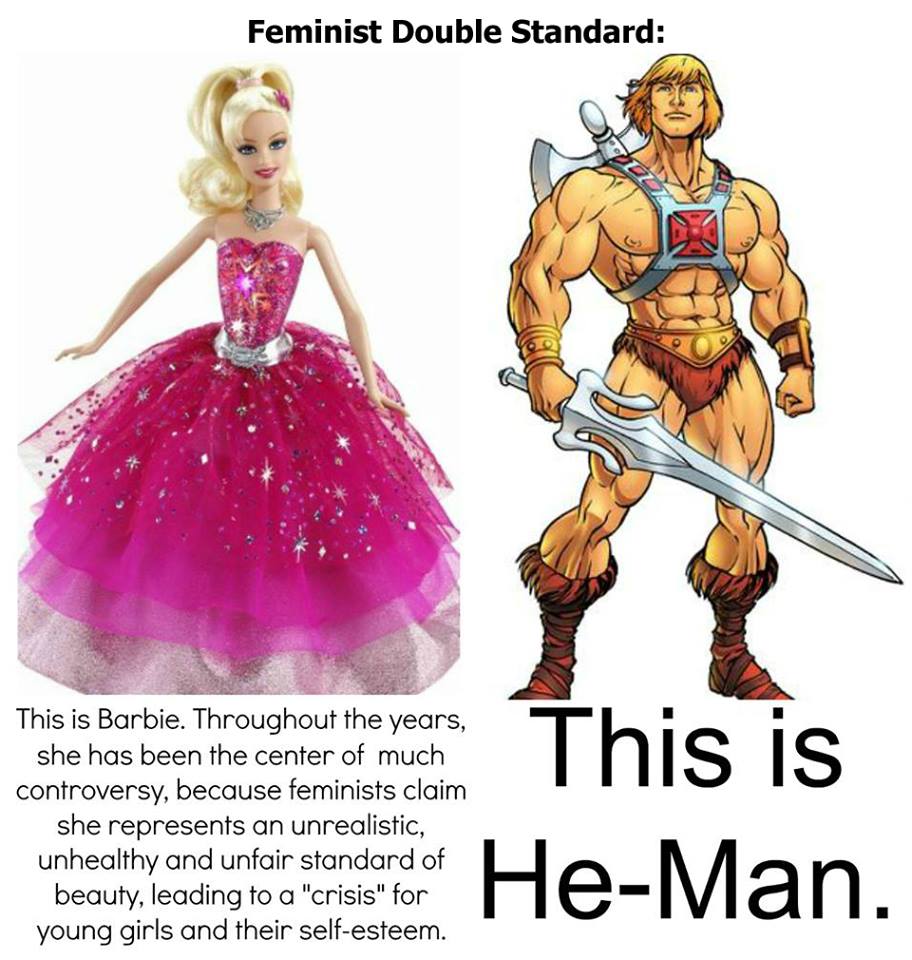
It's Not A Double-Standard If You Never Thought Of It

A friend of mine sent me this picture, which I found rather surprising. I don't think it's a double standard, so much as their just not being interested in the quality of boys' toys to the same degree. I had honestly never thought of their point at all. Of course I remember He-Man, who was just a cleaned-up kids version of Conan, a physically similar character.

All three are really popular, which may say something about what is really going on here. When we talk about Conan books, the usual screed against them is that they represent a simple kind of male wish-fulfillment. I think that's unfair: at least the original R. E. Howard stories are really quite good. But it might be true for He-Man.

My New Favorite Syllogism

The moon is made of green cheese. Therefore, either it is raining in Ecuador now or it is not.

In our earlier discussions of logic, the failure of modern logic to take relevance into account seemed to me a great failure. Specifically, I maintain that the forms of natural language cannot be entirely separated from the content, no matter how many logicians deeply pine for such a situation.

Now, to the extent that modern logic is a branch of mathematics, I have no problem with it. It has found uses in computer programming and probably other fields, and it's an interesting intellectual exercise in itself. It is to the extent that modern logic attempts to use natural language to create or understand meaning that it fails.

Relevance / Relevant logicians have tried to develop formal expressions of relevance and have come closer to making premises and conclusions relevant to each other, but they haven't solved the problem entirely.

As for me, while I fully understand there are practical uses for modern logic, it seems that Aristotelean logic is superior for analyzing arguments in natural language. Else, it is either raining in Ecuador, or it is not, because the moon is made of green cheese.

Project Euler and Self-Directed Learning

Problem 2

Each new term in the Fibonacci sequence is generated by adding the previous two terms. By starting with 1 and 2, the first 10 terms will be:

1, 2, 3, 5, 8, 13, 21, 34, 55, 89, ...

By considering the terms in the Fibonacci sequence whose values do not exceed four million, find the sum of the even-valued terms.

Apropos of Tex's recent post on child-centered learning, I thought I'd add this.

Computer programming is a hobby of mine and something I am very interested in getting better at, but I was never good at math. Call me lazy, but the most difficult thing in math classes was keeping my eyes open; after missing the instruction, the problems were often impossible. (If it's impossible, it's not difficult, you see.) The textbooks were even more boring than the teachers, so they were no help, either.

In the last few years I've become increasingly interested in learning more math, but the problem is where to begin and how to approach it. I dread taking university math courses, an expensive cure for insomnia in my experience. Then I read James Somer's article, How I Failed, Failed and Finally Succeeded in Learning How to Code, where he introduces Colin Hughes, a British math teacher and the creator of Project Euler.

The core of Project Euler is a set of math problems designed to be solved by simple computer programs. Currently, there are more than 400 and Mr. Hughes adds a new one each weekend during the school year (he takes summers off). Interestingly, other than a simple explanation like the one above, he provides no instruction in math with the problem, but after you give the correct answer, it opens up a discussion thread for everyone who has solved the problem to share their solutions and comments with each other.

My route to solving these problems has generally been either to just start writing the program, if I immediately grasped the problem (like Problem 2 above), or if I didn't, to look up related math topics on Wikipedia, which has a surprisingly large number of helpful articles. I try to find a principle that will allow me to solve that type of problem (I avoid simply searching for  the problem itself; some unsporting types have posted their solutions publicly). After solving the problem, I go through a dozen or so solutions from others who have also solved it.

Hughes explains his method like this: "The problems range in difficulty and for many the experience is inductive chain learning. That is, by solving one problem it will expose you to a new concept that allows you to undertake a previously inaccessible problem. So the determined participant will slowly but surely work his/her way through every problem."

That seems to be how it's working for me. While the problems have gotten more difficult, I've become quicker to pick up on patterns in numbers and, when I don't understand a problem, I have a better idea of how to approach finding the answer. I've built up a better understanding of how numbers work together, a clearer understanding of some math concepts, an appreciation for different types of math (number theory, graph theory, combinatorics, etc.) and am solving the problems faster. I am, in fact, learning math.

My proudest achievement there so far has been solving problem 15. Wikipedia was entirely useless (I later found out that I was looking in the wrong articles), so I had to sit down with pen and paper and work through simpler versions of the problem until I found a pattern. Then I created my own formula to solve the problem, implemented it, and it worked. It took me nearly a week of spare time. Then I went into the discussion forum for that problem and found two vastly simpler ways to solve it, and of course I got a good laugh out of that. Then it was on to the next problem.

Are Republican insurgents reactionary?

To the contrary, Richard Fernandez argues that they're the only ones looking forward:
The elite can only continue to sustain itself by borrowing.   That was what the crisis was about, borrowing. Obama’s basic demand was simple:  let me borrow and borrow without limit.  His ‘victory’, if so it can be called, is the victory of a bankrupt who has compelled his relatives to mortgage the farm so he can return to his losing streak at the casino.

. . . It has been argued and proved by natural disasters that the entire fabric of civilization is but nine meals from anarchy.  After 3 days without food most people are willing to do anything to anybody to get a meal.  The hard reality is that the current deficit system will inexorably create a situation when the grub literally runs out. 
. . . [William Galston's OpEd at the WSJ] argues that the conservative insurgency is rooted in some kind of atavism; that it arises from a nostalgic hankering after an America long past in the face of new demography.  Nothing could be further from the truth.  The hell with demography.  People would be just fine with changes in demography if only times were good.  When times are bad homogeneity is irrelevant.  Rats of the exact same breed will fight to the death over the last piece of cheese. 
It’s the cheese that matters.  The conservative insurgency is rooted in a lack of money.  And so will the coming liberal one.  The unrest is not driven by a desire to return to the past.  On the contrary it is propelled almost entirely by the growing belief that there is no future.

Government work in its purest form

More on yesterday's subject of how the executive training for President that consists of running a successful campaign doesn't necessarily translate into the expertise needed to run the nation's healthcare system:
Complex regulations, the flexibility of peanut brittle, and a system that rewards rule-followers and connections, not ability to do good work?  Now that the problem has been identified, we learn that it couldn’t be fixed because of fear of transparency and political liability, and that no one will be held accountable for it.  That’s not an isolated problem of government function.  That’s a distillation of government function, a metaphor for the entire thing, and again, it was faith in this entity that animated Obamacare.

The budget that isn't

Peter Schiff nails it:  "Whatever the crisis, the real one will be much worse because we did raise the debt ceiling. . . . The debt ceiling is not a ceiling.  We should just call it the debt sky!"   I'm increasingly impatient with stories about the cost of the government shutdown, the danger of default, the "gridlock" in Washington, and all the rest of it.   Yes, it's all unappealing, but it pales in comparison with the alternative, which is a cheerful, cooperative status quo. When a boat is about to go over the falls, a snag in the river is the least of its worries.  I feel more like Michael Walsh at PJ Media:
The GOP is not, in any meaningful sense, a conservative, first-principles, Constitutionalist party — and unless it’s subsumed by the Tea Party, it never will be.  Rather, it’s content to be the lesser half of the Permanent Bipartisan Fusion Party as long as it can collect some of the pork scraps from underneath the table of the Permanent Bipartisan Fusion Government.  No wonder they keep losing — they like it.
Update:  While Fitch generated some spookified coverage earlier this week by putting the U.S. credit rating on a downgrade watch, the Chinese rating agency Dagong went ahead and made it official.  One big difference between the two, besides decisiveness, is that Fitch blamed its action on "political brinksmanship," as if a soothing compromise could fix the problem.  Dagong, for its part, issued the downgrade after everyone got chummy on a compromise:
[T]he temporary fix of the debt issue would not defuse the fundamental conundrum of the U.S. fiscal deficit or improve repayment ability in the long-term, but could trigger defaults at any time in the future. 
"The deal means only an escape from a debt default for the time being, but hasn't changed the fact that the growth of government borrowing has largely outpaced overall economic growth and fiscal revenues". . . .
Who care what China thinks?   Admittedly I don't look to a Communist regime for economic wisdom.   On the other hand,
Dagong estimated that the U.S.'s foreign creditors could have suffered an estimated loss of $628.5 billion between 2008 and 2012 due to a weakening of the U.S. dollar. 
China, sitting on the largest stockpile of foreign exchange reserves in the world, is the biggest holder of U.S. treasuries.
For now, China seems not to have much choice but to invest in U.S. treasuries.  It will be interesting to find out what happens when that changes.

The martial metaphor

Jonah Goldberg takes on the question of how government can be so good at somethings and so inept at others.
Whenever I make the argument that government is very bad at doing things like Obamacare, the liberal response is invariably to offer counter-examples.  "The military is awesome! . . . "We sent a man to the moon!" 
What liberals never appreciate is that in all of these counter-examples there's something else going on.  The institutional cultures that won World War II or put a man on the moon or that discover some new protein are not strictly speaking government cultures.  While none of them are immune from bureaucratic stupidity and inefficiency, ultimately higher motivations win out. 
How the Marines' esprit de corps differs from the post office's esprit de corps should be pretty obvious.  But even in the other examples, the cultural core of excellent government institutions is driven by something greater than a mere paycheck and significantly different from simple "public service."  The NASA that sent men to the moon was imbued with a culture not just of excellence and patriotism but the kind of awe and wonder that cannot be replicated by the Department of Health and Human Services.  Moreover, for scientists passionate about space and the race to get there, there was simply no place else to be.  That meant the very best people were attracted to NASA.  Even if, for some strange reason, you're passionate about writing billions of lines of code for a website and managing health-insurance data, there are still better things to do with your time than work on Obamacare. 
I want to be fair to government workers.  Many individuals who work for government are dedicated to doing excellent work for the public good.  But I'm talking about culture here.  President Obama talks as if, absent a war or other national crisis, the entire government can still be imbued with the spirit of sacrifice and excellence that won World War II or put a man on the moon.  And that's just crazy talk. 
Obama, the permanent campaigner, believes that governing should be more like campaigning.  Everyone unified towards a single -- Obamacentric -- purpose.  Everyone loyal to his needs.  Everyone in agreement with his agenda.  In 2008, when asked what management experience he had, he said that running his campaign proved he was ready for the presidency.  That should have been the moment when we all heard the record-scratch sound effect and said "What's that now!?"  Even if Obama deserved all of the credit for his campaign's successes, campaigning and governing are fundamentally different things.  Campaign culture allows for people to be fired.  It also rewards excellence, which is why some very young people rise very quickly in the campaign world, while it's far more rare in civil service.  Campaigns have a deadline-driven, crisis-junky energy and sense of team loyalty that is at least somewhat analogous to a war or some other crisis.  That's why the Obama campaign website was great.  It's also why the Obamacare website's error page has an error page.

Re-poop-ulation

It's funny how much easier it is to talk about this kind of thing as long as we call it "probiotics."

Not fit to print

The L.A. Times isn't in the least embarrassed to admit that it censors all letters to the editor that challenge climate-change orthodoxy.  You might wonder if that's not even more extraordinary in light of the recently updated IPCC climate-change report, which nearly comes right out and admits that the evidence for recent warming isn't there and that something is drastically wrong with the models.  Not so.  The only important part of the new IPCC report apparently is the conclusory statement that scientists are 95% certain that they're right about at least half of climate change.  So what should we think about the fact that the IPCC's third, fourth and fifth assessment reports, with their increasingly strident warnings, were published against a background of rising CO2 levels combined with a complete absence of detectable warming?  Shut up, the L.A. Times editorial staff explains. This isn't politics. This is science. Everything else is conspiracist ideation of the sort that you might expect from free-market enthusiasts.

Consensus is a great thing when you can screen out all the dissenting voices.  What do they know, anyway?  Are they on the approved government-funded commissions?  No?  Then they're politically suspect anarchists, and it's a shame that the First Amendment can't be revised to shut them up.  Speaking of consensus, if we get to use that as a substitute for logic and evidence, Anthony Watts helpfully compares his traffic against anti-denier sites like Real Climate and Skeptical Science.   Presto!   He wins, so he must be right.

What do these people want?

More fun as Ivy Leaguers try to come to grips with a Tea Party that won't go away.  We have the classic Yalie approach in the post below.  For another view of Tea Partiers, equally distorted by a prism of malice but not so ignorant, try Harvard professor Theda Skocpol's interview at Salon.  To an impressive degree, she's allowing data about Tea Partiers to moderate her knee-jerk assumptions.  For instance, while she spouts the usual line that a streak of racist xenophobia infects the movement, she also acknowledges that the more powerful meaning of symbols like the Confederate Flag is "regional resistance to federal power" and nullification.  She also doesn't buy the usual accusation that the movement is Astroturfed, though she's alarmed by the big-money organization that allows a group like Jim DeMint's Heritage Foundation to scare the pants off of squishy Republicans who are thinking of caving on a vote, because the legislators know what's coming at them in the next primary if they do.  (The TPs may not have the big numbers, but they're ferociously active in primaries.)  Skocpol would like to think that moderate Republicans are going to start pouring money and organization into counterattacks at the primary level, but she's not fooling herself enough to predict it yet.  She also warns that it's a mistake to predict a Democratic or moderate-Republican sweep in 2014, because mid-term behavior traditionally favors highly engaged activists.

There's an amusing section in which she struggles to understand what's got everyone's dress up over his head about a benevolent and moderate law like Obamacare.  On that subject, she hasn't quite brought herself to look honestly at what motivates her opponents.  To her credit, she's gone as far as to understand that the law is fundamentally redistributionist, and that some people don't much care for that aspect.  Otherwise she's drawing a blank.

Skocpol closes with a doleful (and slightly sour-grapes) view of the Left's ability to go toe-to-toe with extremist Republicans:
There’s also a whole series of reasons why older conservative voters, backed by ideologues, have this combination of apocalyptic moral certitude with organization that really gets results.  Especially in obstructing things in American politics. 
I don’t happen to think that the left and the center-left could imitate this.  For one thing, they don’t have the presence across as many states and districts.  But it’s also not clear it’s a model worth imitating.  I think the real problem that you’ve got right now on the left is how to defeat this stuff, how to contain it, how to beat it — given the permeability of American political institutions to this kind of thing.  And I don’t think it’s clear what’s going to happen.

Those people

Yale's Daniel Kahan doesn't know any Tea Partiers, but disapproves of them heartily, so he was shocked to discover that there is a slight statistical correlation between Tea Party beliefs and scientific comprehension.  Not that he lets this get in the way of his abiding faith in the inferiority of their beliefs:
Of course, I still subscribe to my various political and moral assessments--all very negative-- of what I understand the "Tea Party movement" to stand for.  I just no longer assume that the people who happen to hold those values are less likely than people who share my political outlooks to have acquired the sorts of knowledge and dispositions that a decent science comprehension scale measures. 
I'll now be much less surprised, too, if it turns out that someone I meet at, say, the Museum of Science in Boston, or the Chabot Space and Science Museum in Oakland, or the Museum of Science and Industry in Chicago is part of the 20% (geez-- I must know some of them) who would answer "yes" when asked if he or she identifies with the Tea Party.    If the person is there, then it will almost certainly be the case that that he or she [and] I will agree on how cool the stuff is at the museum, even if we don't agree about many other matters of consequence.
But, as Bookworm Room points out, it doesn't even occur to him that this means he might want to look more carefully at the basis for the political views of these people who, to his surprise, turn out not to be ignorant fools.   The comments on Kahan's blogpost are brutal; apparently he got linked by Politico, Watts Up with That, and Ace of Spades.  As one commenter said:
And they said George Bush [w]as incurious.   If my business was studying the intelligence of the population, I'd be embarrassed admitting I hadn't met such a large swath of the population.  Yet, this author takes joy in the fact.  Or else he's just laying the groundwork to defend his findings from his peers.  Either way, such a shame there's so little curiousity in academia these days.

Burros in wells

Wired explores child-directed education.  I never know what to think of these proposals, which sometimes sound like such obvious good sense and at other times degenerate into stupid chaos.  If the article is at all accurate, though, one dirt-poor school in Matamoros stumbled onto a winning formula.  The class did have the advantage of one clearly exceptional student:
To test her limits, [the teacher] challenged the class with a problem he was sure would stump her.  He told the story of Carl Friedrich Gauss, the famous German mathematician, who was born in 1777. 
When Gauss was a schoolboy, one of his teachers asked the class to add up every number between 1 and 100. It was supposed to take an hour, but Gauss had the answer almost instantly. 
“Does anyone know how he did this?” Juárez Correa asked. 
A few students started trying to add up the numbers and soon realized it would take a long time.  Paloma, working with her group, carefully wrote out a few sequences and looked at them for a moment.  Then she raised her hand. 
“The answer is 5,050,” she said. “There are 50 pairs of 101.”
Not only this budding little Gauss but the whole class responded well to the teacher's style of provoking their curiosity and then making them figure things out on their own.  After a year of his approach, standardized tests showed a decrease in failing math scores from 45% to 7%, and in failing language skills from 31% to 3.5%.  Excellent scores increased from 0% to 63%. Paloma's score was the highest in Mexico.  I liked this story, which the teacher told his class:
One day, a burro fell into a well, Juárez Correa began.  It wasn’t hurt, but it couldn’t get out.  The burro’s owner decided that the aged beast wasn’t worth saving, and since the well was dry, he would just bury both.  He began to shovel clods of earth into the well.  The burro cried out, but the man kept shoveling.  Eventually, the burro fell silent.  The man assumed the animal was dead, so he was amazed when, after a lot of shoveling, the burro leaped out of the well.  It had shaken off each clump of dirt and stepped up the steadily rising mound until it was able to jump out. 
Juárez Correa looked at his class.  “We are like that burro,” he said.  “Everything that is thrown at us is an opportunity to rise out of the well we are in.”

"What am I missing?"

It's a minor improvement, surely, that this poor child posting at the Daily Kos is confronting the painful task of reconciling data with mental models.  He's discovering to his horror that, although he was promised that Obamacare would reduce his health insurance costs, in fact his premiums are about to double.  How can this be, he wails?

He should start with the understanding that all that business about lowering premiums was complete balderdash intended to tamp down the fires of resistance long enough to get through a couple of election cycles.  It's impossible to believe anyone was serious about floating those claims.  Then our callow young poster should consider the real aim of collectivized medicine, considered in the most favorable light to its proponents, which is to even out the good and bad luck of a population with a mix of sicker, healthier, younger, and older members, some of whom are exposed to the expense of pregnancy (their own or a dependent's), or heart disease, or cancer, and some of whom are less so.  If such a motive is confronted honestly, it should be blindingly obvious that young, healthy people are going to take it in the shorts in terms of increased costs.  How else could it work?

But as usual, this young fellow was hoping that things could get cheaper for all those unlucky people without getting more expensive for people in his relatively fortunate position.  His consent was bought cheap, without his ever having to consider the cost.  Now he has to think about what it's worth to him to be compassionate.

Lately, I'm noticing something else odd.  A lot of the outrage over the newly-rolled-out premiums is over the horrifying discovery that the only way to keep premiums down is to have high deductibles and co-pays.  As my husband noted, all you have to do is add in health-savings accounts and you get a proposal that W might have floated.  Maybe my high-deductible, low-premium policy is going to survive this debacle after all.  What's more, maybe a lot more people are going to get used to the idea of buying insurance for cash, rather than having their employer purchase it for them with invisible money.  Maybe they're also going to get used to buying most of their medical care with cash (in all but the most medically disastrous years), so that they start noticing price signals again.  Heck, maybe we'll even start getting price signals again.

Wouldn't it be ironic if Obamacare didn't destroy the American health system, after all, but avoided doing so only by destroying what collectivists imagined were the functional bits?

Whirlygigs

In the comments section to an earlier post I gave my initial guess about how a helicopter must work. The part about each rotor blade acting like a fixed wing in terms of the general Bernoulli lift principle was right. The guess about the tail rotor counteracting the spin that the main rotor otherwise would put on the body was right.  There are other ways to skin that cat, such as mounting two counterrotating main rotors.  Sometimes those are fore-and-aft, or side-by-side, but they can also be mounted on the same axle, one over the other.  They can even be side by side and so close that they must be carefully timed to avoid collision between the intermeshed blades.  Yikes.

But my intuition about how the main rotor could be made to tilt the body (to go forward/backwards/right/left) was completely wrong.  It turns out each rotor blade can tilt on its long axis, in two ways.  They can be tilted all in lockstep, which affects their general lifting power.  But what's really nifty, and what I never would have guessed, is that the machine will automatically cause each rotor to tilt individually just as it reaches the point in its cycle that's in the direction the pilot wants to go, and then flip back when it passes that point.  Now that's a fast adjustment!   I had vaguely in mind that the whole rotor system, including its axis, must be tiltable, but then on reflection that couldn't have been right.  Tilt each rotor blade one at a time as it reaches a particular point in its superfast rotation!  Very clever.  No wonder helicopters need such obsessive levels of maintenance.

And now for Bernoulli, and my indistinct memory of reading a quibble about the explanation for lift that we carry around in our heads:  the wing is shaped with a big curve on top and a much flatter one below, so when air passes it must go faster on top in order to traverse the same distance, resulting in higher pressure below the wing and lower pressure above, ergo lift.  But, you ask, who says the the air on top has to get to the back of the wing at the same time as the air below? And in fact it doesn't:  it gets there a lot faster; the air on the bottom never catches up.  Hmm.


The Wiki lift article claims that the Bernoulli equation itself just describes what will happen if you assume a speed differential above and below the wing, which can be observed experimentally.  In order to explain and predict the observed speed differential, you need a more involved treatment of conservation of momentum, mass, and energy, and Navier-Stokes equations that can't readily be solved, and simplifying assumptions about viscosity that allow them to be approximated for some conditions.  I'll just have to take their word for it:  experimentation tells us that if you mold a proper wing shape and use the right angle of attack at a good speed, you'll get an airspeed differential and lift.  In my brain, that gets filed under "magic."

Vigilantes


The alleged facts of the case are unpleasantly familiar, though that in itself can lead to misjudgment. There will be no trial, though the accused allegedly admitted the rape. He is a popular football player, a relative of an influential politician. The family claims to have been driven out of town by the community because they wouldn't let it drop. The mother lost her job, and the charges were dropped in spite of the confessions and the conviction of the sheriff that the crime had occurred.

The American way is to move on. Let it go, as the sheriff says. There will be no trial, so there can be no overcoming of the presumption of innocence.

It's interesting that Anonymous is making these kinds of rape cases one of its forefront issues. In a way that's praiseworthy, but it's worth remembering that the KKK did just the same thing. Vigilante groups that hunt down and destroy alleged rapists often come to enjoy huge community support, as the Klan did during the height of its lynching program.

That's not to say that Anonymous are the same as the Klan. They certainly aren't. They aren't going to turn up at this kid's door and hang him. They aren't motivated by racism, but somewhat more purely by outrage over the repeated failure of the American system to address this kind of rape case.

It's an interesting problem. The system certainly has failed, repeatedly and consistently, in cases like this.

Sometimes I think vigilantes are really the answer to the failures of the system. Sometimes -- as in the case of the Klan -- they're a worse problem. Where are we here, I wonder?

Bored on a plane

I loved these.  My husband sent them to me, knowing they'd punch my buttons.

Weeds

It's only just beginning to get cool enough that it's pleasant to work in the garden again.  That leaves me with an impressive stand of weeds four feet high and sunflowers twelve feet high in many areas of the garden.  I'm chipping away at them, but it's slow going.

I blame the government shutdown.

Price signal opacity & third-party payors

Louisiana WalMart shoppers go feral when the food-stamp computer shuts down, stores become unable to verify whether any benefits are left on EBT cards, and one store decides to put its shoppers on the honor system for the duration.  It was looting without guns.

Return to New York

Some months ago, Cassandra (and others) took sharp issue with Grim and me over the striking down of New York's stop'n'frisk laws, on the ground that we were blithely underestimating those laws' effectiveness in making many areas of New York fit to live in.  This article very much takes her side of the argument, attributing the recent uptick in horrific Big Apple crime to the "ongoing dialog between police and criminals" that sends a clear message about what will be tolerated.  I'd still like to see cops exercise their discretion without using racial rules of thumb, but there probably is a lot to be said for not requiring them to explain too much about their gut hunches, and especially for not dragging them into endless racial-grievance tribunals over it.

H/t Maggie's Farm.

Locks

Part four:  in which it becomes clear why I've never learned to pick a lock.  Nearly all the locks I encounter in daily life are some form of a cylinder within a cylinder.  The outer cylinder (green in the diagram below) is attached to a fixed door, while the inner cylinder (yellow) is meant to rotate freely within the door when unlocked.


[Corrected per Doug's comment:]  When locked, the inner cylinder is prevented from rotating past the outer cylinder by little "driver pins" (blue) protruding radially through the boundary between the two cylinders.  The driver pins are lined up in a row along the shared axle of the cylinders.  There is some kind of spring mechanism that snaps the driver pins into place, each being brought up snug up against a "plug pin" (red).  The driver- and plug-pins together make a smooth shape that exactly fits a shaft that's radial to the axle shared by the cylinders.

When each red plug pin is pushed just far enough, the point where it meets the blue driver pin will line up exactly with the "shear" boundary between the yellow inner cylinder and the green outer cylinder, at which point the blue driver pin can slide sideways past the red plug pin, and the yellow inner cylinder can rotate past the green outer cylinder.  But each red plug pin must be pushed a slightly different distance in order to make it line up properly, and the cylinder will not move unless all of the plug pins are lined up at the same moment.

A key typically takes the form of a rod intended to be inserted along the shared axle of the two cylinders, one edge of which is notched up and down in a pattern that, when fully inserted, will push each spring-loaded plug pin just far enough to move it out of the way and let the inner cylinder rotate with the twisting action of the key.  This rotation is connected in a variety of ways with a lever or cam that retracts a bolt out of the doorframe and back into the door lock.


If a cylinder lock is not constructed carefully, its plug pins can be pushed back one at a time until they're just at the release point.  The cylinder will then turn just enough to keep that pin from slipping back, while the other pins continue to obstruct rotation.  A lock picker exploits this weakness to push each pin back one at a time until all are released, using a variety of springy bent wires and a delicate sense of touch to detect when each pin has been pushed into the right position.

I tried to find information on how fast professionals can really pick locks, but it's hard to sort through the anecdotal evidence and casual bragging on the Internet.  On TV, the pros from Dover can do it in just a few seconds.

Action

Part three:  being an examination of the many parts of my piano's action that I never gave any thought to.  Here's something that seems obvious in retrospect:  the piano has to be constructed so that depressing a key makes a hammer not just land on a string but strike it and immediately rebound; otherwise all that happens is a dull thud.  At the moment of the "strike" the hammer has become a free projectile.

At about the turn of the 18th century, a bright fellow named Bartolomeo Cristofori worked out the piano action that allowed musicians to produce both soft (piano) and loud (forte) notes by striking strings instead of plucking them harpsichord-style.  His early model embodied many principles still in use, such as the interaction of levers to translate a small finger motion into a larger percussive impact on a string some distance away, and a mechanism to keep the hammer from bouncing and restriking, called an "escapement."  The original single-escapement device was improved by the nineteenth-century double-escapement, which allowed the musician to repeat notes very quickly without waiting for the key to come fully back to its resting position.

Among the prized characteristics of a good piano action are the immediacy of the connection between the key and the string (no simple matter considering the Rube-Goldberg intervening mechanism), the smoothness of the action throughout the range of motion of the key, and the responsiveness of the key to the whole range of volume from piano to forte.

Pictured below is a grand-piano action.  For some reason, it never occurred to me before this instant that a grand piano hammer strikes from below the string, even though that should have been clearly visible to me all along; it's right out there in the open.  The link above at "double-escarpment" provides the key for all the little parts as well as helpful animations.


What should piano actions be made of?  Some experts are coming around to the acceptance of composite materials instead of wood.  In that connection, I was surprised to read this expert's glowing praise of a brand I've never heard of:  the Fazioli piano, apparently outstanding for all of its sound qualities, not just the superb responsiveness of its action.

Siphon power

Part two of my exploration of things I thought I understood but didn't, really:  the water closet or flush toilet.  Even before looking it up to write this piece, I guess I had a fairly decent understanding of the easily accessible drain-and-refill mechanisms located under the lid of the toilet tank.  It's a big tank with small, straightforward moving parts whose function is easily observed and understood.  The flush handle pulls a "piston" out of position at the bottom of the tank, allowing gravity to drain several gallons of tank water quickly through a large opening at the bottom.  As the water level falls, a float valve drops, operating another lever that opens a refill valve connected to the house's water supply.  (This resupply valve being a very small opening, the refill takes a minute or so while the draining operation takes only a few seconds.)  When the tank is full again, the float-ball lever should come back into position and shut off the refill valve.  Just in case, there's a little overflow pipe that lets excess refill water drain harmlessly down the drain, so that the worst that can happen is that you hear the refill water continue to run long after the flush cycle should have been completed.  That's called "The toilet won't stop running" or "why is the water bill so high this month?"


What was a little more mysterious to me was the bowl mechanism, which has no moving parts except water.  This part is a clever use of the siphon principle to provide waste-moving power with a built-in gas-trap seal.  While some commercial toilets use the building's water pressure to compress air gradually between flushes so that it can be used for moving power, most domestic water closets rely entirely on the potential energy stored in the raised water tank.  The clever part is the sideways-S-shaped wiggle built into the bottom of the bowl, which for some reason is called a "P-trap."  The S-shaped drain goes down from the bottom of the bowl, then up a few inches higher than the bottom of the bowl, then down again into the drainage system.  The high point of the bump-up is called a "weir," just like the dam-like affair that allows a pond to overflow when it reaches a certain level.  When the bowl is in stable "ready" mode, its water level is just high enough to fill the P-trap to the level of the weir, thus forming the gas seal that so contributes to our domestic comfort.  (Our sinks have P-traps for the same reason.)  If, at this point, we spill small amounts of liquid into the bowl, they will simply rise slowly over the weir and drain rather than flood the bathroom floor.  But if instead we dump several gallons quickly into the bowl, we activate a siphon that exerts a strong pull on the contents of bowl for several seconds until the siphon is broken again.  Assuming the drainpipe isn't clogged, we would be hard-pressed to pour enough water into the bowl quickly enough to make it overflow; it's a robust failsafe device.

No doubt many of us have learned that, when the water supply is temporarily off, the toilet can be made to flush pretty well simply by pouring a two-gallon bucket of water into it.  The bucket substitutes for the capacitor action normally performed by the water tank.  In normal action, though, a well-designed toilet tank adds two mechanisms that the emergency bucket does not duplicate:  it sends part of the water through "rim holes" near the top of the bowl, which wash down the sides, and it sends the rest through a siphon-jet hole near the bottom of the bowl, in order to jump-start the siphon mechanism.  Either way, unless the drainpipe is clogged (a melancholy prospect), all it takes to complete a flush is to introduce a couple of gallons of water quickly into the bowl.  To get this done in a pinch, we don't need water pressure, let alone a gas or electrical connection.  It's one of the things that works well in post-hurricane/zombie apocalypse conditions, if you've remembered to fill some bathtubs with water and the floodwaters outside remain lower than your bowl's weir.

All the finicky stuff inside the tank is just a much more convenient way of schlepping a couple of gallons of water into the bathroom for each flush, dumping it into the bowl quickly and without splashing when we want it to happen and not otherwise, and then refilling the tank slowly (while we leave the room and go on about our day) without much risk of overfilling the tank and flooding the floor.  Modern toilets do have extra wrinkles mandated by code, such as anti-siphon devices built into the refill water supply.  We're more careful now than we used to be about preventing back-flow from faucets or toilets into the house's clean water supply.  It's true that we're still using the potable water supply to transport our sewage, which is pretty primitive and wasteful, but that's another subject.

This video isn't bad except for its annoying sound effects; I recommend watching it with the sound off.

Exaggerated confidence

My newly purchased book, "The Invisible Gorilla," discusses how we over-estimate our mental powers. Tests like the "gorilla on the basketball court" show not only that people fail to see the gorilla (because they're concentrating on adding up the number of passes made by players), but also that they are terrible at predicting how well they'd be likely to do on this and many other cognitive/attention tests. The section I'm reading now asks how well we think we understand seven basic gadgets: (1) a bicycle, (2) a zipper, (3) a flush toilet, (4) a cylinder lock, (5) a car speedometer, (6) a piano key, and (7) a helicopter.

Now, that gives me pause!  I'm pretty confident of my understanding of a bicycle.  The author claims that people challenged to make a sketch of its workings do things like omit the chain, or connect the chain to both wheels, or draw the pedals outside the chain, but I don't believe I'd make any of those mistakes.  On the other hand, if zipper technology were erased tomorrow, the world would be using buttons and hooks for a long time if they were relying on me to re-invent that mainstay of modern fashion.  I know a flush toilet has something to do with siphon power, but that's about where I quit.   Years of dusting the perfectly visible workings of the hammers in my piano have left me a bit vague about how all the levers fit together, though I do understand generally that the key tilts on a lever and that eventually translates that motion to a final hinged piece that strikes a string.  All I really know about speedometers is that they know what fraction of a mile represents one revolution of my tire; years ago I was warned that putting the wrong size of tire on your car will make your speedometer mislead you about your speed.   Helicopters and cylinder locks might as well be black magic.

So perhaps some education is in order, beginning with the onomatopoetic zzzzzzzipper.  


The basic idea is a row of interlocking teeth that fit tight when in a straight line but loosely when bent into an arc.   If the row is in a spiral shape, it generally is made of polyester, while "ladder-type" arrangements typically are made of metal.  According to Wikipedia, "A special type of metal zipper is made from pre-formed wire, usually brass but sometimes other metals too.  Only a few companies in the world have the technology."  This is the sort of thing that sets one's conspiracy-detectors buzzing, but a helpful Forbes article explains how one Japanese firm came to dominate the zipper business by the early years of this century, including a charming anecdote about growing pains as an Asian company attempts to expand overseas:
Yoshida told the employees he sent abroad to melt into the local population as much as possible.  In one incident an employee sent to Holland spent months studying Dutch so that he could make an opening day speech to his employees in their own language.  After his speech the workers are reported to have said, “Wow, Japanese sure sounds a lot like Dutch.”
Of course, no sooner had Japanese entrepreneurs sewed up the zipper market than China began to give them a run for their money.

Here are some do-it-yourself repair guides for a broken zipper, which should be easy to complete with our newfound understanding of the mysterious mechanism.

DNA molecules operate very much like a zipper.  In fact, all enzymes employ the trick of opening up a clasp so that an interlocking shape can be inserted or removed before the clasp springs back.

Return to sender

Barrycades are being carried across town and dumped at the White House.


One of the Zero Hedge commenters adds: "BREAKING: Washington Redskins drop "Washington" from their name because it's embarrassing." Ross Douthat, on the other hand, probably would say their methods are unsound. And Glenn Beck organizes volunteers to clean the Mall up, because the National Park Service has been too busy harassing veterans to do its job.

Suspending the critical faculty

Robert Weissberg, Professor of Political Science, Emeritus, at The University of Illinois-Urbana, outlines a cure for what ails the American university.
Now here's my plan. The Koch brothers will secretly underwrite a version of the traditional "Junior Year Abroad" with a strong Peace Corp component.  Have students live among the locals, on small stipends, eat their food and so on.  University credit will be given and everything will be totally free, including transportation.  Meanwhile, there will generous "supervision" fees (i.e., bribes) to the university and professors.  For a start, send out perhaps a hundred students from each of the top 25 universities. 
... 
We'll use a seductive name--"Promoting Economic Justice, One Village at a Time" or "Peace Through Understanding." ...  Locals, including the wise village elders will teach the courses with lots of hands-on experience working in the fields harvesting crops, clearing brush and similar Peace Corps-like activities (recall the early 1960s glory years of helping in the Cuban sugar cane harvest was the ultimate liberal status symbol).  For pedagogical purposes, illnesses will be exclusively treated with traditional, natural remedies (no Big Pharma pills, no greedy doctors!) while all disputes will likewise be settled in accord with indigenous customs.  Critically, students will be told that they are there to learn, not proselytize Western values, and so if men beat their wives, don't criticize; try to understand.  The model is participant-observer anthropology, not the Western missionary.
Once the graduates of the new program return and start raising uncomfortable questions in class about the evils of American society and the socialist paradise on other shores, Weissberg has an even more brilliant and cost-effective plan for dealing with the outraged professors.

H/t Maggie's Farm.

The Everything Store

We rely on Amazon out here for a great many things, from tablecloths to appliances to whatever food our (single) local grocery store doesn't carry.  Bloomberg is running excerpts from a fascinating new book about this useful company and the surprising life story of its founder, Jeff Bezos, who recently bought the Washington Post and moonlights once a week on a company that's trying to establish affordable commercial space flight.

What keeps me coming back to Amazon?  I rarely shop for anything I can't find somewhere on its website.  They offer a year's reliable two-day shipping at a flat rate.  Their customer reviews are reliable.  They make it easy for me to check out, without any of the tiresome repetitive logging in or glitchy "shopping cart" pages that plague so many other e-tail sites.   In every way, they focus on pleasing customers.
Jeff Bezos has a public e-mail address, jeff@amazon.com.  Not only does he read many customer complaints, he forwards them to the relevant Amazon employees, with a one-character addition: a question mark. 
When Amazon employees get a Bezos question mark e-mail, they react as though they’ve discovered a ticking bomb.  They’ve typically got a few hours to solve whatever issue the CEO has flagged and prepare a thorough explanation for how it occurred, a response that will be reviewed by a succession of managers before the answer is presented to Bezos himself.  Such escalations, as these e-mails are known, are Bezos’s way of ensuring that the customer’s voice is constantly heard inside the company. 
... 
Amazon employees live daily with these kinds of fire drills.  “Why are entire teams required to drop everything on a dime to respond to a question mark escalation?” an employee once asked at the company’s biannual meeting held at Seattle’s KeyArena, a basketball coliseum with more than 17,000 seats.  “Every anecdote from a customer matters,” Wilke replied.  “We research each of them because they tell us something about our processes. It’s an audit that is done for us by our customers.  We treat them as precious sources of information.”

On the Feast of St. Edwin


Columbus Day may be right out, and anyway it was one of those days that chases a Friday or Monday in the hope of making a day off for people. But there's no reason to concede that the 12th of October is just some ordinary day. It's also the feast day of one of the great Anglo-Saxon saints, the kind Tolkien might have loved: St. Edwin of Northumbria, a worthy man whose life exemplifies the virtues of hospitality, clear thought, friendship, and defense of the innocent.

Tough review

A Slate contributor takes the ever-popular pop-psy author Malcolm Gladwell to task:
Accessorizing your otherwise inconsistent or incoherent story-based argument with pieces of science is a profitable rhetorical strategy because references to science are crucial touchpoints that help readers maintain their default instinct to believe what they are being told.  They help because when readers see "science" they can suppress any skepticism that might be bubbling up in response to the inconsistencies and contradictions.  I believe that most of Gladwell’s readers think he is telling stories to bring alive what science has discovered, rather than using science to attach a false authority to the ideas he has distilled from the stories he chooses to tell.
Malcolm Gladwell's name inexplicably tends to take up the space that more properly in reserved in my memory for Matt Ridley, an excellent author who deserves considerably more attention.  (My favorite popular science writer, however, remains Nick Lane.)  This Slate review also suggests to me that a better use of my time than reading Gladwell's latest ("David and Goliath") would be to read the reviewer's own "The Invisible Gorilla." The title refers to a video experiment many of us probably have watched, in which viewers are asked to count the number of passes in an excerpt from a basketball game, and uniformly fail to notice a man in a gorilla suit who runs through the players in the middle of the action.  The book is about our deceptive intuitions concerning our powers of attention and memory.

"I don't know what that means"

And yet, the Senate Majority Leader employed words adapted to the meanest understanding:
"Don't screw this up."
He was responding to the brash decision of the Mayor of D.C. to walk across the lawn and horn in on Sen. Reid's press conference to demand that the Senate pass the House's measure to fund D.C. during the government shutdown.  Sen. Reid walked off in a huff, leaving the Mayor and another flack to try to pour a little oil on the waters.  What did he think Reid meant by "Don't screw this up"?   He couldn't imagine.


How thick is your bubble?

It's Friday, and that means it's Quiz Time!  For once, I've found a quiz where I score right smack in the middle of the road.  Apparently I'm neither working class nor upper class, but truly middlebrow.  Score:  44.

Focussing the mind wonderfully

I love recalls.  Legislators are way too complacent without them.  Legislators should live in either constant fear of their constituents, or serene indifference to staying in office.

Citizens step up when government throws a tantrum

I encourage donations to Fisher House.

An Occasional Lapse in Absence

I would like to thank Tex especially, and the rest of you also, for carrying on so well in my absence. I will continue to be mostly not around for a while, but today I have had some time to catch my breath and look around a bit. I don't know if it will last, but it has given me a chance to come by and see what you have been doing.

Thank you all who have written to inquire about my beloved wife. She is doing better. It will still be a while before she is fully recovered, but I hope that in a few weeks she will at least be more mobile. For now, as Tex put it, I am much occupied with her care; but this is good, in a way. It is a chance to honor my oath, and to focus on love in sickness -- or, at least, in injury -- as well as in the joy of robust health.

On which subject, more or less, a set of word clouds broken up by various ages, by sex (far less interesting differences are discovered here than usual, this time), and by various emotional states. I think there is an interesting correlation between the positive emotional states and certain age groups. See what you think.

Grownups only

Gov. Christie often alienates me with his statism, but I have to admit it's an unusually sensible and honest brand of statism.  He also charms me with his ability to step out of traps and ruts and think on his feet.  You can watch him here demolishing his opponent in a debate, without veering one step from the path of truthfulness and courtesy.  She's left looking like a snide teenager who stumbled into an event meant for adults.  Ronald Reagan couldn't have done it better.

What do Tea Partiers want?

Our rulers are as clueless on this subject as Freud about women.  From Kevin D. Williamson this morning:
But our so-called liberals are committed Hobbesians.  Argue for a reduction in taxes, or a more restrictive interpretation of delegated powers, or allowing the states to take the lead on health care and education, and they’re sure that the next step is a Hobbesian hootenanny in which all of our rump roasts are crawling with bacteria, somebody snatches Piggy’s glasses, and, worst of all, there’s no NPR to ask what it all means.  Like Hobbes, they believe that you hold your property at the sufferance of the state, and that you should pipe down and be grateful for whatever you are allowed to keep.  But the American creed is precisely the opposite:  The state exists at our sufferance, not the other way around, and while few of us actually hold the beliefs that Senator Reid attributes to us and long to abolish the state as a general principle, more than a few of us are interested in making some deep changes to this state.  We may not want to shut it down entirely, but we aren’t sure we want it to load another few trillion dollars in debt onto us.  We aren’t throwing bombs, but we aren’t going to give it everything it demands, either.  Not 40 percent of the last dollar, not a dime to subsidize abortions, not control over our children’s educations or our own consciences.  Hobbes wrote about subjects.  We’re citizens.
It might be more accurate to say we have a tradition of aspiring to be citizens, which has never been universally honored among us and is not guaranteed to survive if we persist in agreeing to act more like subjects in return for physical security and our share of the plunder.

Not talking like a Martian

Thomas Sowell sums up our frustration with conservative leaders who can't communicate a simple point to save their lives:
When the government was shut down during the Clinton administration, Republican leaders who went on television to tell their side of the story talked about “OMB numbers” versus “CBO numbers”—as if most people beyond the Beltway knew what these abbreviations meant or why the statistics in question were relevant to the shutdown.  Why talk to them in Beltway-speak? 
When Speaker Boehner today goes around talking about the “CR,” that is just more of the same thinking—or lack of thinking.  Policy wonks inside the Beltway know that he is talking about the continuing resolution that authorizes the existing level of government spending to continue, pending a new budget agreement.
I've worked with way too many lawyers like this: addicted to meaningless acronyms. Would it kill Boehner to get in the habit of calling it a "blank check" instead of a clean CR?

"Sir, you are recreating."

If you know anyone who was caught outside the country on 9/11 and unable to fly back home for several days, you know what it's like to be caught up in a national emergency and temporarily inconvenienced.  You probably never expected to be locked in a hotel at gunpoint in Yellowstone Park, though, or forbidden to take snapshots of buffalo from your bus window.  "Stop recreating this instant!"

I think the park rangers in this story are the spiritual brothers of our local game warden, whose mission in life is to use his tiny police power to harass golf cart drivers.

Mutt language

A thoroughly enjoyable "Great Courses" lecture got me interested in John McWhorter's many books on liguistics.  This week I've been reading "Our Magnificent Bastard Tongue" and "The Power of Babel."  The first is about the mixed-up roots of English, while the second treats more generally the theories of how languages evolve, but still with a lot of emphasis of English's peculiar history.

Most of us notice early on, I suppose, that English generally has three broad choices in expressing an idea:  an earthy Teutonic word, a polite French alternative, and a technical Latin expression.  We think, reason, and cogitate; we fight, combat, and altercate.  It's easy enough to see how Old English arrived on the shores of Great Britain in an early Germanic form with Anglo-Saxon invaders who overwhelmed the native Celts; later, we got another dose of Germanic influence from the Vikings.  Latin came over with Julius Caesar and was preserved by the Church.  French enjoyed a brief supremacy after the Norman invasion.  These influences explain much of English's "hybrid" flavor.

McWhorter makes a case, however, for two additional influences that are more controversial and get less press.  First, he believes that English grammar, if not its vocabulary, was heavily influenced by Welsh and Cornish.  These Celtic languages, which are Indo-European but from a completely different branch from either Latin or the Germanic languages, share a highly unusual grammatical structure with English:  the "meaningless do" that causes modern English speakers to say "do you see the bird," whereas King James or earlier English styles would have followed the trend common to the rest of Europe, and said "saw you the bird."  Welsh and Cornish also share with Enblish a heavy reliance on the progressive tense to express ordinary action in the present, such as "I'm drinking the coffee," whereas our Germanic and Romance cousins (and our Old English ancestors) would say "I drink the coffee."

Second, McWhorter traces a surprising fraction of English vocabulary to a very old collision in Northern Europe between the proto-Germanic language and certain unidentified settlers who may well have been Phoenician/Carthaginians.  This influence is strongest in vocabulary having anything to do with the sea or fishing; thus, we have Latin-rooted words like mariner right alongside "seafarer," though (according to McWhorter) "sea" is of a mysterious linguistic ancestry neither Latin nor Germanic.  The Phoenicians are known for some surprisingly wide-ranging navigation.  As McWhorter acknowledges, however, the specific archeological evidence for Phoenician inroads into Northern Europe is quite slim.  Still, he makes an interesting linguistic case.

Much of "The Power of Babel" describes a long, slow, inevitable background of cyclical change that's something like the predictable but opposed geological forces of erosion and uplift.  Over centuries, auxiliary words abbreviate and glue themselves as prefixes and suffixes to other words, often in the form of case and gender endings.  (He gives the example of the French "pas," which originally signified merely a step, as in "he didn't walk a step," but later transformed itself into a piece of abstract grammatical machinery expressing general negation, not limited to physical motion, as in "il ne parle pas.")  At the same time, the natural tendency to swallow an unaccented syllable tends to erode many prefixes and suffixes over time, leaving word roots scraped clean again and ready to undergo the next cycle of accretion.

Against this background is another kind of change that results from the collision of cultures.  In McWhorter's view, vocabulary often is shared any time two languages rub up against each other, but the most fundamental grammatical shifts happen when large numbers of influential people are forced to learn a language as adults, as often happens when invaders take root and settle down.  People who learn a language in adulthood rarely master its most subtle intricacies, and one of the first things to go is a lot of fussy case and gender endings.  English's proto-Germanic ancestor may well have undergone such a simplification in the very distant past.  The evidence is even clearer that the Vikings more recently left English a less inflected language than its European neighbors, with scarcely anything remaining of that nominative-genetive-dative-accusative-male-female-neuter-singular-plural business that afflicts students of Latin, Greek, Russian, German, and to a lesser degree the modern Romance languages like French or Spanish.

Like most linguists, McWhorter is impatient of the notion of a "correct" form of any language.  He analogizes it to the idea that a popular song can have a canonical form.  The only thing he would characterize as an "error" is a usage that marks a speaker as non-native, like saying "We'd all prefer to go to the store now, isn't it?"  (He calls it talking like a Martian.)  Other variations in spelling, vocabulary, or grammar merely reflect local variations in dialect that are slowly developing into independent languages in the same imperceptible way that species differentiate from common ancestors.  At the same time, he's a great believer in the difference between clumsy and skillful communication within a particular dialect, and both writes and speaks in an extremely clear and standard English.

M/Patriarchy

Sarah Hoyt asks today, if women marry the government, from whom will they sue for divorce?

The mind of a Justice

New York Magazine is running an interview with Antonin Scalia.  The interviewer's not bad, though a bit callow.  She is unused to talking to conservatives.  There is a wonderful exchange on the value of testing one's opinions against a dissenting voice--without, of course, hoping to lose the argument:

[Scalia:]  I am something of a contrarian, I suppose.  I feel less comfortable when everybody agrees with me.  I say, “I better reexamine my position!”  I probably believe that the worst opinions in my court have been unanimous.  Because there’s nobody on the other side pointing out all the flaws. 
Really?  So if you had the chance to have eight other justices just like you, would you not want them to be your colleagues? 
No.  Just six. 
That was a serious question! 

The interviewer is also startled to hear that Justice Scalia is serious about his Catholic faith.  That may be another kind of creature she's not used to encountering.

H/t Maggie's Farm.

It's a floor wax AND a dessert topping

An article on HotAir mentioned a constititional wrinkle I was not familiar with:
There is lingering confusion over the limits on the Senate regarding budgets.  It’s true that the House has to originate bills that raise revenue (Article I Section 7 of the US Constitution), but either chamber can originate spending bills.  Since the debt ceiling is not a tax, the Senate can originate it.
This seems a bit odd, as if increasing the federal piggy bank by borrowing were not "raising revenue" in the same way that imposing taxes is.   It's plausible, perhaps, given the Founders' probable inability to imagine that the U.S. would become the world's reserve currency and gain the ability to borrow seemingly unlimited amounts, right up to the point where the currency collapses.   I found what seems to be a thoughtful Constitutional website, with this to say:
In Federalist 66, for example, Alexander Hamilton writes, "The exclusive privilege of originating money bills will belong to the House of Representatives." This phrase could easily be construed to include taxing and spending.  The Supreme Court has ruled, however, that the Senate can initiate bills that create revenue, if the revenue is incidental and not directly a tax.  Most recently, in US v Munoz-Flores (495 US 385 [1990]), the Court said, "Because the bill at issue here was not one for raising revenue, it could not have been passed in violation of the Origination Clause." The case cites Twin City v Nebeker (176 US 196 [1897]), where the court said that "revenue bills are those that levy taxes, in the strict sense of the word." 
However, the House, it is explained, will return a spending bill originated in the Senate with a note reminding the Senate of the House's prerogative on these matters.  The color of the paper allows this to be called "blue-slipping."  Because the House sees this as a matter of some pride, the Senate is almost guaranteed not to have concurrence on any spending bill which originates in the Senate.  This has created a de facto standard, despite my own contention (and that of the Senate) that it is not supported by the Constitution.
That's an interesting issue if we're wondering about how to think of Obamacare, by the way, which originated in the Senate, now that the Supreme Court has explained to us that it's a tax, not a penalty, sort of.   In fact, there's a new challenge mounting to Obamacare on just that point, which may eventually turn on whether the revenue raised by the tax is incidental rather than direct.   Now that taxes no longer are viewed primarily as revenue-raising tools but as carrots and sticks, it's very hard even for smart Supreme Court justices to work out what "taxes, in the strict sense of the word" is supposed to mean.  So much effort is spent publicizing goodies in each new entitlement program, that our Congressional leaders are quite adept at obfuscating what a tax is.  Even if that confusion were to be cleared up any time soon, I'm not aware that the Supreme Court has ever tried to help us understand the fine Constitutional gradations of meaning that separate "raising revenue" from "borrowing great huge pots of money in order to facilitate an endless avalanche of increased spending."

Until recently, I never noticed the debt ceiling or understood why it might be important.  In a political climate in which people (including our chief executive) argue with a straight face that Congress can pass all the crazy spending obligations it wants, and never worry about how to pay for them, then berate their opponents for threatening to "dishonor" the country's financial "obligations" if they object to breaking a hard-and-fast limit on borrowing, the debt ceiling increasingly seems like a red line to me.  More than that:  an Angel with a fiery sword.

O.P.M.

Some California supporters of Obamacare are getting a rude shock.
Vinson, of San Jose, will pay $1,800 more a year for an individual policy, while Waschura, of Portola Valley, will cough up almost $10,000 more for insurance for his family of four. 
. . . 
"Of course, I want people to have health care," Vinson said. "I just didn't realize I would be the one who was going to pay for it personally."

The traffic-cone wars

We take these humble guardians of civilization for granted.  Now an organization has sprung up to correct that injustice:
Until the late 20th century, traffic cones were not thought worthy of scientific study.  It is the Society's mission to counteract these centuries of neglect.  By preserving and studying these "Helpers of Humanity," we hope to allow future generations the opportunity to enjoy these magnificent creatures in their natural habitats.
Not a moment too soon. The sturdy traffic cone has exploded onto the public scene as the pointy end of the spear in our government's attempt to educate the public about what happens when they get uppity. That's not to say that all of the public is taking its lesson in the proper spirit:  some citizens are embracing outright anarchy.


Schemes are being hatched on some of the darker corners of the Internet to corner the market in orange cones and begin deploying them strategically against federal bureaucrats, perhaps even cordoning off the entirety of the District of Columbia.  Because of Congress's failure to regulate this market, traffic cones are freely available on the Internet for purchase by authorized personnel from a variety of corporate manufacturers (see here and here).  Buyers don't need to pass any background checks or secure a license first.  All they need is money.

Did you know traffic cones were invented in 1914?  They've come a long way, not only in manufacturing standards but also in their critical role in the body politic.  Sadly, many did not survive the transition to a new world order.  Those that did, however, are poised to take their place in the current showdown over just who's in charge of whom here:
The Automobile Age was a time of profound and rapid change for Conus.  Burgeoning road construction attracted cones, and most left the valleys and the fields to live on the new roads. They flocked to construction work sites, potholes, and other road hazards.  Unfortunately, these new environs did not favor all cones.  Species of grey and black cones that had previously flourished were rendered almost extinct, as automobiles were much less likely to see them upon the asphalt.  Nature began to favor only the brightest and most visible of cones, which tended to be red, yellow, and orange.
Some traffic cones are less tangible.  The Dept. of Justice briefly concluded, for instance, that it would be a good idea to shut down its Amber Alert website as "non-essential," while keeping open the federally-owned golf course favored by our President.  It didn't take long for someone to realize what a bad idea that was, and now the DOJ has crawfished.  In order to make up for the tax expenditures, however, the Dept. of the Interior announced that it would officially withdraw its permission for Old Faithful to operate.


. . . no, of course not

Snopes is all sniffy about the silly story that's circulating claiming that the National Park Service is blocking views of Mt. Rushmore with tarps.


Obviously this picture is photoshopped, you mouth-breathing troglodytes, it explains.  Bad people clearly ginned the story up to create outrage.  Next they'll be saying that NPS personnel put up traffic cones on October 1 to block people from pulling over on the viewing spots on the side of the nearby highways:


OK, admittedly, according to Snopes, that one's sort of true.
The National Park Service placed cones along highway viewing areas outside Mount Rushmore, barring visitors from pulling over and taking pictures of the famed monument. 
The cones first went up Oct. 1, said Dusty Johnson [South Dakota] Gov. Dennis Daugaard's chief of staff.  The state asked that they be taken down, and federal officials did so with some of them.  The state was told the cones were a safety precaution to help channel cars into viewing areas rather than to bar their entrance. 
"I think reasonable people can disagree about that," Johnson said. 
The cones were down again [three days later] as a blizzard hit the Black Hills and plows needed access to the roads, Johnson said.  He said the state would be monitoring to see whether the cones are put back along viewing areas.  "Once the snow's off the ground, we're going to be keeping an eye on how the cones go up," Johnson said.

Breaking the back of summer

Yesterday was in the 90s, but the low this morning dipped in the 50s.  We haven't have lows in the 50's since spring.  Although hot weather surely will return before long, this is the sign that summer doesn't last forever, much as it seems that way after four solid months of opening the front door onto a sauna every morning.

Now we come into the six months of the year that make people want to live here.  A lot of weeding chores have been piling up!  And the neighborhood can resume its spring schedule of outdoor dinners and relaxing on the porch with drinks.

Own goal

It looks as though the Obamacare software simulated a denial-of-service attack on itself, through clumsy architecture.

These are not people we should let creep closer to a monopoly on anything critical to our lives.