Historiography

Historiography:

Fox News reports that President Obama botched a Bible verse.

"Those who wait on the Lord will soar on wings like eagles, and they will run and not be weary, and they will walk and not faint," the president said during a speech to several thousand people at the breakfast.

But the actual passage, from Isaiah 40:31, states: "But they that wait upon the Lord shall renew their strength; they shall mount up with wings as eagles; they shall run, and not be weary; and they shall walk, and not faint."
The implication Fox wants you to draw from this is almost certainly backwards. Historians normally take an error of that sort to be evidence that someone was quoting from memory, as memory often contains minor errors. For example, Aristotle frequently misquotes Homer; this is usually thought to prove that Aristotle had spent a lot of time reading and thinking about Homer, so that he didn't feel it was necessary to look up the passage he wanted to reference.

So, the President's misquote is probably evidence that he's spent a fair amount of time reading the Bible. That's just the opposite of what is being implied, but it's the normal conclusion we would draw from someone who gives a close misquote.

Lost Music Found

Lost Music Found

When we were kids, my sister and I listened to a four-record set night and day, full of great folk songs. We lost it long ago and couldn't find it online. Although we could remember many of the songs, we were sure we remembered that it was called the Newport Folk Festival of some year or another. Now and then we'd find a recording of one of these festivals, but never what we remembered.

The other day a synapse tripped while my sister was trolling YouTube videos of old music recordings: the record set was called "Folk Songs and Minstrelsy." With this clue, we found a copy of the boxed set on eBay. It was a Book of the Month Vanguard recording; only the fourth record is marked "Newport Folk Festival." Googling it, I noticed that every few years someone writes an article about how much they remember loving this set and how sorry they are it was never released on CD. Some of the artists, like Odetta, were prominent enough that particular tracks, or similar ones, showed up on CDs. But, oh! this boxed set has everything I remember, and cuts I've never been able to find again:

SIDE 1

  1. Sumer Is Icumen In: The Deller Consort
  2. He That Will an Alehouse Keep: The Deller Consort
  3. Greensleeves: The Deller Consort
  4. We Be Soldiers Three: The Deller Consort
  5. Come All Ye Fair and Tender Ladies: Leon Bibb
  6. Squirrel: Leon Bibb
  7. Cotton Eyed Joe: Leon Bibb
  8. Darlin': Leon Bibb
  9. Poor Lolette: Leon Bibb

SIDE 2

  1. The Golden Vanity: Ronnie Gilbert
  2. Go From My Window: Ronnie Gilbert
  3. Johnny Is Gone for a Soldier: Ronnie Gilbert
  4. Spanish Is a Loving Tongue: Ronnie Gilbert
  5. House of the Rising Sun: Ronnie Gilbert
  6. East Texas Red: Cisco Houston
  7. The Sinking of the Reuben James: Cisco Houston

SIDE 3

  1. Meet The Johnson Boys: The Weavers
  2. The Wild Gooses Grasses: The Weavers
  3. Aweigh, Santy Ano: The Weavers
  4. Get Along, Little Dogies: The Weavers
  5. The Erie Canal: The Weavers
  6. We're All Dodgin': The Weavers
  7. The State of Arkansas: The Weavers
  8. Greenland Whale Fisheries: The Weavers
  9. Eddystone Light: The Weavers

SIDE 4: Odetta

  1. I've Been Driving on Bald Mountain/Water Boy
  2. Saro Jane
  3. God's A-Gonna Cut You Down
  4. John Riley
  5. John Henry
  6. All The Pretty Horses
  7. No More Auction Block for Me

SIDE 5: Odetta

  1. The Foggy Dew
  2. No More Cane on the Brazos
  3. The Fox
  4. He's Got the Whole World in His Hands
  5. The Ox Driver
  6. Another Man Done Gone
  7. I'm Going Back to the Red Clay Country

SIDE 6: Cisco Houston

  1. Talking Guitar Blues
  2. Danville Girl
  3. Old Dan Tucker
  4. The Buffalo Skinners
  5. The Streets of Laredo
  6. Hard Travelin'
  7. Bonneville Dam
  8. Do Re Mi
  9. The Wreck of the Old 97
  10. John Hardy

SIDE 7

  1. The Bold Fisherman: Ed McCurdy
  2. When Cockle Shells Turn Silver Bells: Ed McCurdy
  3. Frankie and Johnny: Ed McCurdy
  4. Lang A-Growin': Ewan MacColl
  5. Virgin Mary Had One Son: Joan Baez/Bob Gibson
  6. Wayfaring Stranger: Bob Gibson
  7. The Hangman: John Jacob Niles
  8. I Know an Old Lady: Alan Mills

SIDE 8

  1. Johnny, I Hardly Knew Ye: Tom Makem
  2. The Whistling Gypsy: Tom Makem
  3. The Cobbler's Song: Tom Makem
  4. Railroad Bill: Cisco Houston
  5. The Cat Came Back: Cisco Houston
  6. East Virginia Blues: Pete Seeger
  7. Old Joe Clark: Jimmy Driftwood
  8. The Unfortunate Man: Jimmy Driftwood

Reviewer Jim Clark notes:

One of the frequent memories of those older than about 30 is how free childhood was back then. Most of us went outside in the morning, returned briefly for dinner, and returned to the world until bedtime. Games were organized by the kids playing them, streets were avenues to the far corners of the known world, and parents were arbitrary and bizarre creatures who appeared only to bring bad news. We lived free, had fun, and learned life's lessons at our pace and in our way. And most of us made it.

But no longer. No, today's kids are protected from germs, weather, competition, failure, loss, disappointment, and anything distasteful. Who would let their children listen to "The Cat Came Back" today? "They dropped him in the hopper when the butcher wasn't round, the cat disappeared with a blood-curdling shriek, and the town's meat tasted furry for a week."

My neighbor's Christmas present this year included equipment and software for transferring LPs to digital format. If she'll help me digitize this box set, I think I'll even learn how to upload it to YouTube.

Japenese Sword INferor

On the Inferiority of Japanese Swords:

An account:

Some doubts of the temper of these swords arose in consequence of a playful encounter which happened on board one of the ships, in which a Japanese sword suffered some injury from the cuts of an English one, which had received several cuts from the Japanese sword without receiving any dents...
FWIW.

Irish Crochet Lace


Irish Crochet Lace

I've finished my first project from the Irish Crochet Lace book that my sister sent me for Christmas. What fun! This is a christening cap for my newest grand-nephew.

Four Loko = Ethanol

"How Four Loko Became Ethanol"

A video by Mary Katherine Ham examines the way that a popular drink -- one people were eager to buy -- has been banned by the government, and is now being subsidized as ethanol.

If the people were really in charge of the government, this would not happen: not because of Four Loko, which is popular only with the young and foolish, but because we don't want ethanol in our gasoline. This wonderful product absolutely destroys small engines, such as those in chainsaws, and turns gasoline into something like varnish in about a month. I lost a chainsaw to it last year; and when I spoke with several small engine repairmen in the course of trying to get it fixed, I learned that the problem is epidemic.

(Another great idea from the EPA: make chainsaw manufacturers craft engines that run on 50:1 oil mix instead of the richer 40:1 mix. The extra oil in older small engines is of great benefit to keeping those engines from tearing themselves apart when run with the new ethanol mix. Pity they're not allowed to make them that way anymore! Environmentalists who are high-fiving each other can take a few minutes to reflect on the additional coal being burned to power the plants that are making new chainsaws, because the old ones are being destroyed and have to be replaced. Meanwhile, for your average American who just wants a small engine that works reliably? Tough luck, buddy. The government's not in the business of considering your requirements. It's in the business of telling you what to do.)

These ethanol subsidies are great for the massive agricultural corporations that dominate the corn industry. They are terrible for the average American who wants to mow his lawn or cut his own firewood. The poor college kids are getting sucked in as well. None of this is about what we want. All of it is about the government having the power to control our personal decisions, and have the power to choose winners and losers in the market. That power means they can readily command the bribes that have come to define the American political and regulatory system, whether those bribes are paid in the form of campaign contributions, plush honorariums for speeches, or generously-paid jobs or consultancies after their political career.

This activity is framed as beneficial, but it is really parasitic.

Gratuitous Gender Wars Provocation

Gratuitous Gender Wars Provocation

A reader wrote to a favorite word-maven columnist of mine with a question about word usage. Because the usage was called to mind by an episode of Laurel & Hardy, he stopped to muse about why women never seem to like either Laurel & Hardy or The Three Stooges. He said that women of his acquaintance found the humor too "mean." The word maven agreed, and extended the principle to the Marx Brothers.


Now there I have to protest. My sister and I always have been crazy for the Marx Brothers. The word maven defined genuine enthusiasm for this peerless comedy team as "being willing to watch Duck Soup three times a year." I'd happily watch it once a month, and the same goes for "A Night at the Opera." It's my husband that stares a little blankly when they come on. I have to admit that I'm no more than moderately amused by Laurel & Hardy and The Three Stooges, but I can't say they're any "meaner" than the Marx Brothers. It's true I have a high threshold for meanness as long as no animals are involved.

How about it, Hall members? Does the Y chromosome control the slapstick reflex, by and large, in your experience? Am I an outlier, corrupted by my elder sister?

Snow Strategies

Snow Strategies

Chicago is using a fleet of snowmobiles to transport patients from inaccessible homes or cars to waiting ambulances. The snowmobiles pull the patients on a kind of basket-sled behind them.


Lake Shore Drive was no place to be. This is some AP footage. Be prepared to be annoyed at the attitude struck by the TV crew.

The Revolution Will Be Tweeted

The Revolution Will Be Tweeted

I've been meaning to read this piece at The American Thinker since DL Sly recently included the link in a comment. It's hard to know what to make of the account, but it certainly provides a perspective I haven't been reading elsewhere. The author, described as an Egyptian student, sees the uprising as a popular backlash against moderately capitalist reforms by Mubarak's heir apparent, Gamal, which were never sold effectively to a population used to nanny-state control of the economy and a lot of socialist security. He also attributes the uprising almost entirely to the organizational tools of Twitter. He believes that, although the initial "flash" mobs were exaggerated, they were big enough to panic a crusty old autocracyinto shutting down the Internet. Paradoxically, the populace responded with emboldened ridicule of a repressive government running scared of modern communications.

Perhaps most interesting is the account of how, between the withdrawal of the security forces and the arrival of the army, the population took advantage of the power vacuum to storm every police station and prison in the country, free the prisoners, and confiscate the weapons. Then, as widespread looting broke out, neighborhoods spontaneously organized to protect each block with their new weapons. The author feels that the mass of the people have stopped demonstrating and are looking to the army to shut down the Islamist troublemakers. He also feels, however, that the neighborhoods will not soon forget that they took their security into their own hands, and successfully.

The author closes with a strange combination of predicting that nothing important will change, while at the same time suggesting that everything has changed. In the meantime, Egypt's economy won't soon recover, and capitalist reforms (if that is in fact what's been going on there) are at an end for the foreseeable future.

Monster Storm

Monster Storm

This thing was really huge. Even way down here it's giving us several days of hard freeze, with ice and even snow possibly on the way in the next day or two. It's a good thing we prepared for the paradoxical effects of global warmening by wrapping the citrus trees and laying in a supply of firewood.

St. Raymond

St. Raymond of Fitero:

Dad29 sends this story of a warrior monk.

Apparently St. Raymond was a model monk, for he was elected as the prior of the new monastery of Nienzabas on land granted by the King Alfonso VII of Castile and afterwards became abbot, relocating the house to Fitero around 1150.

It is here that St. Raymond’s military career begins. At the death of King Alfonso in 1158, St. Raymond went to Toledo to confirm Fitero’s privileges with the new king, Sancho III, taking with him to court Diego Velásquez, a knight turned Cistercian lay brother. At the same time, the Kinghts Templar had given up hope of holding the stronghold of Calatrava, which sat at the southern border of Christian Spain, and had withdrawn. In desperation, Sancho offered Calatrava to whoever could hold it.
We might consider doing that with Detroit -- at least, if there remain any Cistercians who think they could make it work.

Evil

Evils Done:

Some commentary:

When asked how long a girl might have to wait to get back to the work of the sex trade after an abortion, two weeks minimum is the answer. He protests, “We’ve still got to make money.” The clinic worker understands his predicament and so advises that the girls can still work “Waist up, or just be that extra action walking by..." to advertise[.]
For a long time I was persuaded that, however personally opposed I might be to abortion, it was a matter of decent respect to let the individuals involved make such an intimate decision according to their private moral conscience. Here we see no such example. The girl, if she has a private moral conscience kept intact despite the trauma, is not really being consulted. She is left at the mercy of a pimp and his accomplice -- one who probably thinks of herself as a defender of something like "women's rights," at the same time she consorts in the slavery of women.

The American project is conscious of the importance of individual liberty, which is what has allowed the practice of abortion to survive our moral good sense. The rot that has followed from that infection -- is that language too strong? -- now poisons us. Probably this woman got into her line of work thinking she was doing good. This is what she is doing instead.
Ayo Gurkhali!

It's OK to bring a knife to a gunfight, if you know what to do with the knife.

A 35 year-old Gurkha soldier named Bishnu Shrestha was riding a train when he suddenly found himself in the middle of a massive robbery. 40 men armed with knives, swords and guns stormed the train and began robbing the passengers.

Bishnu kept his peace while the gang snatched cell phones, jewelry and cash from other riders. But then, the thugs grabbed the 18 year-old girl sitting next to him and forcefully stripped her naked. Before the bandits could rape the poor girl in front of her helpless parents, Bishnu decided he had enough.

“The girl cried for help, saying ´You are a soldier, please save a sister´,” Shrestha recalled. “I prevented her from being raped, thinking of her as my own sister.”
"One man shall drive a hundred, as the dead kings drave."

Obama Invokes the Kerry Doctrine

Watching various members of the Obama administration twist themselves into rhetorical pretzels over the individual mandate, erstwhile admirers of the former Junior Senator from Massachusetts might be forgiven for wondering whether we're not witnessing the return of the Kerry Doctrine? Here's a short history lesson for those of you who need a refresher:
''There are those trying to say somehow that Democrats should be admitting they were wrong'' in opposing the gulf war resolution, Kerry noted in one Senate floor speech. But he added, ''There is not a right or wrong here. There was a correctness in the president's judgment about timing. But that does not mean there was an incorrectness in the judgment other people made about timing.''

For you see, Kerry continued, ''Again and again and again in the debate, it was made clear that the vote of the U.S. Senate and the House on the authorization of immediate use of force on Jan. 12 was not a vote as to whether or not force should be used.''

In laying out the Kerry Doctrine -- that in voting on a use-of-force resolution that is not a use-of-force resolution, the opposite of the correct answer is also the correct answer -- Kerry was venturing off into the realm of Post-Cartesian Multivariate Co-Directionality that would mark so many of his major foreign policy statements.

Back in 2008 our Fave Constitutional Law Prof was inclined to oppose the individual mandate on the grounds that such measures grant Congress far too much power:
...in 2008, then-Senator Obama supported a health care reform proposal that did not include an individual mandate because he was at that time strongly opposed to the idea, stating that, ‘If a mandate was the solution, we can try that to solve homelessness by mandating everybody to buy a house,’” Judge Vinson wrote in a footnote toward the end of his 78-page ruling Monday.

Of course, the beauty of evolving standards of Constitutionality is that legal scholars like the President need wait only a year or two before heaping scorn on their own arguments!
Much of Judge Vinson‘s ruling was a discussion of how the Founding Fathers, including James Madison and Thomas Jefferson, saw the limits on congressional power. Judge Vinson hypothesized that, under the Obama administration‘s legal theory, the government could mandate that all citizens eat broccoli.

White House officials said that sort of “surpassingly curious reading” called into question Judge Vinson‘s entire ruling.

“There’s something thoroughly odd and unconventional about the analysis,” said a White House official who briefed reporters late Monday afternoon, speaking on the condition of anonymity.

One wonders: did that "anonymous" White House official realize that his boss had made precisely this argument just a short time ago? Ah well... this is hardly the first time the Obama administration has been caught talking out of both sides of its mouth. Why, just a few months ago the individual mandate was not - we repeat, NOT - a tax:
... Mr. Obama refused to accept the argument that a mandate to buy insurance, enforced by financial penalties, was equivalent to a tax.

...When Mr. Stephanopoulos said the penalty appeared to fit the dictionary definition of a tax, Mr. Obama replied, “I absolutely reject that notion.”

Congress anticipated a constitutional challenge to the individual mandate. Accordingly, the law includes 10 detailed findings meant to show that the mandate regulates commercial activity important to the nation’s economy. Nowhere does Congress cite its taxing power as a source of authority.

It took only few months for that argument, too, to become "surpassingly curious", if not downright "odd and unconventional":
When Congress required most Americans to obtain health insurance or pay a penalty, Democrats denied that they were creating a new tax. But in court, the Obama administration and its allies now defend the requirement as an exercise of the government’s “power to lay and collect taxes.”

And that power, they say, is even more sweeping than the federal power to regulate interstate commerce.

Administration officials say the tax argument is a linchpin of their legal case in defense of the health care overhaul and its individual mandate, now being challenged in court by more than 20 states and several private organizations.

Here we see the beauty of the Kerry Doctrine, in which the administration and Congressional Democrats can argue that the individual mandate is NOT - we repeat, NOT A TAX - while claiming that it is justified under Congress's well known power to collect things-that-are-NOT-taxes for the general welfare. The severability argument is likewise disposed of by the Kerry Doctrine. Judge Vinson's finding that the individual mandate cannot be severed from the overall bill without fatally compromising the bill's overall objective is plainly an unwarranted and unreasonable judicial power grab:
... both the administration, which is implementing the law and defending it in court, and Congress, which wrote and passed the law, have made clear that the individual mandate is an absolutely critical provision. Vinson explains:

The defendants have acknowledged that the individual mandate and the Act’s health insurance reforms, including the guaranteed issue and community rating, will rise or fall together as these reforms “cannot be severed from the [individual mandate].” As explained in my order on the motion to dismiss: “the defendants concede that [the individual mandate] is absolutely necessary for the Act’s insurance market reforms to work as intended. In fact, they refer to it as an ‘essential’ part of the Act at least fourteen times in their motion to dismiss.” [bold added]

Vinson provides several examples, and also notes that Congress itself, in drafting the law's text, put forth a similar claim:

Congress has also acknowledged in the Act itself that the individual mandate is absolutely “essential” to the Act’s overarching goal of expanding the availability of affordable health insurance coverage and protecting individuals with pre-existing medical conditions.

Of course, when both Congress and the administration made the same argument the searing, Kerryesque logic was impossible to refute.

Lesser minds might see hypocrisy in the administration's toffee nosed condemnation of its own arguments, but discerning intellects know that false dichotomies like "right/wrong" or "then/now" cannot withstand the compelling logic of one John Foragainst Kerry:

Kerry has made clear that if he is elected president, the nation will never face a caveat shortage. He has established the foragainst method, which has enabled him to be foragainst the war in Iraq, foragainst the Patriot Act and foragainst No Child Left Behind. If you decide to vote for him this year, there would be a correctness in that judgment, but if you decide to vote for George Bush, that would also be correct.


How conveeeeeeeeeeeeeenient.

Militia SH

A Militia Stalking Horse?

This maneuver is likely to teach everyone the wrong lesson.

Five South Dakota lawmakers have introduced legislation that would require any adult 21 or older to buy a firearm “sufficient to provide for their ordinary self-defense....”

The measure is known as an act “to provide for an individual mandate to adult citizens to provide for the self defense of themselves and others.”

Rep. Hal Wick, R-Sioux Falls, is sponsoring the bill and knows it will be killed. But he said he is introducing it to prove a point that the federal health care reform mandate passed last year is unconstitutional.

“Do I or the other cosponsors believe that the State of South Dakota can require citizens to buy firearms? Of course not. But at the same time, we do not believe the federal government can order every citizen to buy health insurance,” he said.
This is a highly problematic approach for two reasons.

1) It blurs the distinction between what a state government can do, and what the Federal government can do. The argument that the Federal government cannot issue a mandate of this type is based on a reading of the Commerce Clause plus the 10th Amendment. There is no similar argument that a state government cannot do so. Indeed, under the 10th Amendment, they could possibly have the power precisely because the Federal government is forbidden it.

2) The militia is the one case where even the Federal government has clear Constitutional authority to require you to provide yourselves with positive goods. The argument against the health care bill's individual mandate arises from the Commerce Clause limitation on Federal authority; but there is specific language in Article I, Section 8 that authorizes Congress to do things precisely like ordering individuals to own a proper weapon for militia service.
The Congress shall have Power.... To provide for organizing, arming, and disciplining, the Militia, and for governing such Part of them as may be employed in the Service of the United States, reserving to the States respectively, the Appointment of the Officers, and the Authority of training the Militia according to the discipline prescribed by Congress[.]
As an act of grandstanding, then, this misses the point on every possible level. If I didn't have such a generous character, I'd suspect this representative is running a stalking horse operation intentionally to muddy the water between these kinds of cases. Instead, I'll simply assume that he hasn't studied the issue enough to know how dumb his idea his.

UPDATE: InstaPundit put up a post on the same subject sixteen minutes after I posted this. I mention that not to boast about scooping Professor Reynolds -- his contributions to speedy blogging are certainly beyond my ability to contest -- but to make a point about the nature of the TEA Party movement. The idea behind the TEA Party is that the citizen can (and should be able to) understand the Constitution and its foundations, and thus judge whether and how a given law is genuinely an appropriate exercise of government authority. InstaPundit is a law professor; I am not a lawyer at all. He writes:
I don’t think this bill makes the constitutional point its sponsor intends — state governments, unlike the federal government, are not limited to enumerated powers. But even the federal government could require citizens to own guns under its militia power, as opposed to the commerce power. In fact, it did just that in the Militia Act of 1792, but I rather doubt that this power would extend to requiring ObamaCare under that clause, which empowers Congress “To provide for organizing, arming, and disciplining, the Militia, and for governing such Part of them as may be employed in the Service of the United States, reserving to the States respectively, the Appointment of the Officers, and the Authority of training the Militia according to the discipline prescribed by Congress.”
The benefit of being a law professor is obvious in his citation of the Militia Act, which was a concrete example of the general principle. Still, if you had simply read and studied the Constitution itself, you would have everything you needed. It provides both the distinction between state and Federal authorities; and makes clear that in only one of the two cases is there clear enumerated power to do what is proposed.

That's not to disparage the value of a legal education, nor to scorn the contributions of those who have one. It is only to demonstrate that this is the kind of thing that ordinary citizens really can do -- it's not that hard. There's a question about why elected officials don't seem to be able to do it! Yet it is clear that the Constitution is not the province of an elite. It belongs to the citizens, both those living today, and those who crafted it over the centuries.

Kitchen Nostalgia

Kitchen Nostalgia

Megan McArdle has posted a piece on changes in food technology over the last century or so, which has sparked a lively discussion in her comments thread. Commenters obviously hail from all points on the spectrum, from people who can remember their grandparents' ways with cooking stoves and food they raised themselves, to others who rely mostly on restaurants and microwaves and don't see what the fuss is about.

Because of my persistent flirtation with TEOTWAWKI thinking, and our hobby of fiddling around with old-fashioned food preservation techniques like canning and pickle-brining and home-raised ingredients, I find this subject endlessly fascinating. I particularly enjoy reading about people's assumptions regarding the only feasible sources of some kinds of food. It reminds me of my trip to the grocery store a few years ago. I was checking out with some strawberries and some heavy cream. The young checker, chatting me up, asked what I was going to do with the cream, and I explained that I would whip it to go with the strawberries. She was enchanted. It had never occurred to her that you could create whipping cream at home.

We've never lived in a primitive cabin, but we often used to go on brief camping trips in kayaks, where it was impossible to bring much in the way of ice or cooking gear or even potable water, so we learned some tricks of primitive cooking. If need were, we could cook quite well in a fireplace. We also like to learn ways to make things at home, against the day when we might not be able to get supplies, and just because it's fun.

It takes a lot of time, of course. You'd better enjoy doing it, or it never will be worth the trouble. What's more, there's no denying that some modern conveniences eliminate drudgery that no one wants to return to. One commenter, for instance, cracked me up by asking innocently whether anyone had ever personally waxed a floor. It's true that some years back we replaced the linoleum with a hard tile, never again to face the unappealing job of stripping and waxing a kitchen floor, but -- hey -- it hasn't been that long ago. These days, if I were building a new house and couldn't fit tile floors into the budget, I'd be installing a concrete floor sloped toward a center drain: something you could get clean with a garden hose. No more floor wax for this 21st century gal.

Egypt

Egypt:

It's difficult to know what to make of the Egypt situation. It is clear that there is a genuinely popular movement kicking off there; our instincts ought to be to support such a movement. On the other hand, there are clearly some radical elements in that movement -- and we all remember how well it worked out when we backed the popular movement led by the radical Fidel Castro in Cuba. What happens to be popular at any given moment may not be virtuous, and there are good reasons to be suspicious about the virtues of some of the leadership elements here.

One might be inclined to look to guiding stars, but they are giving mixed signals on this issue. For example, John Kerry is strongly in favor of backing the democracy movement.

...tear gas canisters marked “Made in America” fired at protesters, United States-supplied F-16 jet fighters streaking over central Cairo.
Normally when Kerry starts talking like that, I know just which way to lean; but then comes Richard Cohen, another man whose judgment is highly reliable.
The dream of a democratic Egypt is sure to produce a nightmare.

Egypt's problems are immense. It has a population it cannot support, a standard of living that is stagnant and a self-image as leader of the (Sunni) Arab world that does not, really, correspond to reality. It also lacks the civic and political institutions that are necessary for democracy. The next Egyptian government - or the one after - might well be composed of Islamists. In that case, the peace with Israel will be abrogated and the mob currently in the streets will roar its approval.
The man I really want to consult I don't know how to reach. Our translator/interpreter in Iraq -- he was also my roommate for a while -- was a man from Egypt. He was an older man, just old enough to have only white hair, and a poet in his native Arabic: he was working on a Ph.D. in his spare time. I remember watching President Obama's inauguration with him, on AFN. He was crying -- literally with tears streaming down his face. I asked him why, and he said it was because "This could never happen in my country."

By "this," I took him to mean the peaceful transfer of authority between parties and individuals who disagreed about the right thing to do (peaceful and friendly, even -- Bush was quite jovial about getting to get on that helicopter and get out of town).

My sense is that he would want us to back the movement, because it offers hope instead of only stability. Hope includes the possibility of disappointment: it is hope, after all, not certainty. Still, it is one of the great virtues. Perhaps we should practice it now.

Constitutionalism

Constitutional Tea:

I didn't have time to read the decision in yesterday's Obamacare case, though I was pleased to learn from news reports that it had voided the entire act. Now that I've had more time, I'm fairly pleased with it. The judge has done precisely what a member of the elite should do: refer to the Constitution and the original principles explicated in the Federalist Papers (or, in the case of later amendments, similar documentation); examine the current case in the light of those principles; and issue a decision that forces adherence to those principles.

That's what the Constitution is for. The law means just what it meant when it was enacted and nothing else; if you want to change the law, that's fine, but you must do so according to Article V (which is also part of the original law). Judges who catch the government trying to pull a fast one on that should slap it down. If the elite -- that is, if Congress and federal judges and administrators and so forth -- consistently did this, there would be little need for a TEA Party, and little reason for it to concern them.

The most impressive aspect of the ruling is that it starts with Federalist 51; it is delightful to see that it includes wording from then-candidate Obama. This was a good line too, and one that shows where the man's heart is:

It is difficult to imagine that a nation which began, at least in part, as the result of opposition to a British mandate giving the East India Company a monopoly and imposing a nominal tax on all tea sold in America would have set out to create a government with the power to force people to buy tea in the first place.
That's a very good point. The tea mattered then, and it matters now.

Pathetic Youngsters Going to Die

Pathetic Youngsters Going to Die:

This is framed as a gender story, but it's really a story about rising incompetence among the young. That's too bad, because we needed them to survive to pay all these debts we're putting on their shoulders.

BASIC "female" skills are becoming endangered with fewer young women able to iron a shirt, cook a roast chicken or hem a skirt.

Just as more modern men are unable to complete traditional male tasks, new research shows Generation Y women can't do the chores their mothers and grandmothers did daily....
That's all well and good, if the reason is that they are acquiring other skills that will let them pay others to roast their chickens and hem their skirts. Too, it's not like you couldn't pick those skills up in short order if you found that you needed them.

Still, today's xkcd flowchart suggests that the problem may be real. How many youngsters can operate a chainsaw? Change a tire, or fix a flat? Hit a man-sized target with a rifle at 300 yards? Fight with a knife? Write a poem?

Is it a big deal that they can't? What can they do instead?

Careful

Ya'll Be Careful Out There:

Jousting re-enactor killed in freak accident.

Paul Allen, 54, died when the shard from his wooden lance flew through the eye slit in his helmet and pierced his eye socket, inflicting horrific brain injuries.

The tiny balsa wood splinter was sent flying through the air when a joust struck his shield at Rockingham Castle near Corby, Northants.
Balsa wood!
A Beautiful Day in January:

The temperature today topped at seventy-one degrees. I spent the morning splitting wood -- for next winter -- and then devoted the afternoon to a motorcycle ride.


The photo is from last April, as I forgot to take the camera today, but it was much the same. What a glorious day. All the good things: fine weather, hard work, family, a good ride, and an evening fit for reading philosophy by a bit of wine. If every day were like this, ah!

Western Civ

Western Civ:

InstaPundit has an interesting post today recommending Western Civ "courses" for those who didn't get them in school. There's a lot there, and probably none of it would have occurred to me as the right way to approach the problem.

The best suggestion of the several is the endorsement of St. John's college reading list. I probably would not have thought of their list, although their fame is well known to me (and well deserved, from all I've heard). It was recommended to me as a school when I was young enough to be looking, but I could not afford it. It's a good list they've put together, though it is too heavy on Enlightenment and modern thinkers, whose importance I have come to believe is overrated.

Fascinating that they decide to wind up the four year program with two classes on Virginia Woolf, for example. Instead of leaving the Medievals in the middle of the second year, I would have spent the whole of the second year on them, as well as part of the third year on them, the rest on the early moderns (Shakespeare, etc); and wrapped up the Enlightenment and moderns in the fourth year only, leaving some weeks at the end for a review of how it all tied together.

You probably do need a year and a half of the program for the ancients; a year at least for the Medievals; half a year for the early moderns; and then the fourth year for the Enlightenment and moderns.

Except in physics, the great ideas are the old ones. The rest is commentary.

Laughter

Merry Men:

The Politico reports on certain lawsuits:

The federal lawsuits against last year’s health care overhaul were greeted with eye-rolling and snickers from many conventional legal scholars.

Nobody’s laughing now.
That's not true at all!

It's an interesting argument, and an encouraging one. Some of these efforts are wiser than others: may they prevail.

Tzeitel's Wedding

Tzeitel's Wedding

I was reminded by something at Assistant Village Idiot of my idea of the perfect wedding. This scene makes me weep with happiness. -- It's funny to see "Motel" spelled that way. It's not "Motel" as in "Hotel and Motel Management" but "Maht-el," pronounced the way Mid-lanticans used to say "bottle," with a swallowed "t" sound.

Feast

A Feast in the Hall:

Today was a special day, not for any holiday, but because my sister came. I always try to prepare something delicious, as she loves good food and good wine, and might therefore come more often.

The First Course.


The Main Course.


This matters to the Hall because it gives me an opportunity to give especial thanks and praise to one of you who deserves it. The centerpiece of today's feast was provided by Mark, whose generous heart was moved by the fact that I was unable to eat the Christmas Duck we so long discussed here. He sent me a large number of pheasants instead. Two of these -- one cut up, and one served whole -- were the main course.

Basque Pheasant.


I made Basque Pheasant, a cake common to Transylvania, and a honey wheat bread. The pheasant was by far the star of the show. Here are the ingredients as listed in this extraordinary reference guide and cookbook:
Basque Pheasant

2 pheasants, cut up
1/3 cup packed brown sugar
3/4 cup white whine
1/2 cup olive oil
1/2 cup vinegar
1 cup medium pitted prunes
1 cup pitted medium Spanish green olives
1/4 cup capers with liquid
3 cloves garlic, minced
2 bay leaves
2 tablespoons snipped fresh parsley
2 tablespoons dried basil leaves
As for preparation, I simply put the pheasant in a cast iron dutch oven, mixed all the other ingredients together and poured them on as a marinade. After several hours, put them in to roast at 350 degrees for an hour; then remove the lid from the dutch oven, turn the temperature up to 425 and finish browning the skin and ensuring proper internal temperature (165 degrees in the thickest part of the meat).

It's an interesting flavor, similar to coq au vin for the obvious reasons, but with a sweetness to match the savor that is not found in the French recipe. If you're looking for something new, you might give it a try.

Many thanks to Mark for his generous gift, part of which we greatly enjoyed this evening. I award him "The Hero's Portion" for today, although he could not be here to share it!
Sidepork Pandemonium.


I don't know. Don't ask.

Responses

Responding to Bachmann:

Continuing yesterday's discussion on the TEA Party's challenge to the extant Republican party, some Republican thoughts on Rep. Bachmann:

When Minnesota Rep. Michele Bachmann was named to the House Intelligence Committee earlier this year, one of her Republican colleagues responded this way: “Is that a punchline?” Another simply said, “Jumbo shrimp. Oxymoron.”

Neither dared to attach his name to his comment.
That's not very impressive, guys.

The best response -- from Rep. Walsh -- is still not really an argument.
“She was out of line. She had no business stepping on the official Republican response to the State of the Union,” Walsh said in an interview with POLITICO. “I can say that to you saying I’m a fan of Michele Bachmann’s. She and I think the same on virtually probably every darn issue.”
I say that this isn't an argument because it doesn't answer the question: if it is "out of line" to step on the "official Republican response," why is it out of line? What gives the Republican leadership the legitimate authority to claim the exclusive right to frame a response?

Our party system isn't based on authority, but rather on free association. In many states, you can elect to run as a member of a party without anyone's permission -- for example, in South Carolina, the Democratic Party probably would not have agreed to this.


Mr. Greene paid his money and took his shot, as a free citizen freely choosing to align himself with his party. What if he had won? He would go to the Senate, where he would again freely choose to caucus with the Democratic Party. That second choice is not binding either.
Pennsylvania Sen. Arlen Specter said Tuesday he is switching parties, almost certainly giving President Barack Obama and the Democrats the ability to build a filibuster-proof majority in the Senate.

The Specter announcement, coming on the eve of the president's 100th day in office, secured the Democrats a 59th seat in the Senate, counting two independents who caucus with the party.
If this is the system, there's nothing like a chain of command that has the authority to assert control over messaging. There is no oath taken, and no legal structure in place. You associate with the party of your choice, only for as long as you want to do so.

That leaves open the question of whether Congressmen should adhere to party discipline even though they do not have to do so. There are two kinds of arguments that could be made for why it would be proper.

1) Money: the national party may have supported your candidacy with cash or other mechanisms. Even though you associate with them on a free basis, you owe them for helping you.

2) Effectiveness: a disciplined party structure is more likely to achieve its agenda than one riven by infighting.


The problem with (1) is that it perverts the intent of the American electoral system. We call members of the House "representatives" because it is descriptive of their duty. They are meant to serve as the representative from their district. The interest of the people who voted for them needs to be their guiding star. To the degree that they let the money flowing through the system distort that guidance, they are off course.

Senators have a slightly different duty, which is to serve as the representatives of their states. That includes their constituents, but also the interests of the state government at the Federal level. If the Senator turns away from those interests in service to a national party, he is failing in his real duty.

The only truly Federal elected officials are the President and Vice-President. These two might reasonably take the will of the national party as some sort of proxy for the will of their whole constituency (although there are still problems with doing so, insofar as the party structure has been captured by wealthy interests). Senators really are not free to do that, if they take their duty to serve their state seriously.

As for (2), it's a very solid point insofar as the party's agenda aligns with your constituents'. If you were elected by a movement like the TEA Party, whose entire point is to force reform, naturally your duty lies in trying to force reform rather than in pursuing an agenda your constituents don't share. Your duty is to try and move the party toward your constituents' agenda.

That may sometimes -- may usually -- involve compromise and negotiation, but it probably doesn't involve submission. A good example might be the Congressional Black Caucus, which generally votes with the party, but certainly makes clear that it has its own reasons for doing so. The difference is that the CBC is an isolated movement unlikely to garner wider support; thus the Democratic leadership can shrug it off. The Republican Party is genuinely threatened with being overthrown and replaced, as its mainline constituents have more reason to align with the TEA Party's populism than with the business interests that long ago captured its leadership. It may be up to the older interests to prove their value to the populists, rather than the other way around.

The Well-Dressed Viking

The Well-Dressed Viking:

Eric sends a book for those of you who enjoy well-known Viking pursuits like sewing.

Khan

Genghis Khan, Environmentalist:

It's amazing how little we appreciate his extraordinary achievements.

So how did Genghis Khan... earn such a glowing environmental report card?... [T]he same way he built his empire — with a high body count.

Over the course of the century and a half run of the Mongol Empire, about 22 percent of the world's total land area had been conquered and an estimated 40 million people were slaughtered by the horse-driven, bow-wielding hordes. Depopulation over such a large swathe of land meant that countless numbers of cultivated fields eventually returned to forests.

In other words, one effect of Genghis Khan's unrelenting invasion was widespread reforestation, and the re-growth of those forests meant that more carbon could be absorbed from the atmosphere.
In this he set a shining example for today's advocates of DDT-banning in Africa, the one-child policy in China, and abortion everywhere.

Gators

We have gators, too, but not like this. One of the nice things about winter is that the gators and snakes lie low for a while. The tape dates from last summer, in Okeefenokee.

Shhhhhh

Shhhhhhhh

Remember when the mainstream media scarcely could bring themselves to acknowledge that there was such a thing as a grassroots movement called the Tea Party? Demonstrations could be held all over the country involving hundreds of thousands of people, but reporters would dismiss them as "a few dozens malcontents" whose aims and wishes were simply incomprehensible.

I was surprised, therefore, to read on HotAir that voices are rising up against CNN's shocking decision to air Michelle Bachman's separate Tea Party response to the State of the Union earlier this week. Liberals worry

that it could create a fundamental imbalance — two Republicans responding to one speech from Obama — and that there’s no way CNN would allow a liberal Dem to offer a response from the left, as Bachmann is doing from the hard right.
Republicans, in turn, are said to worry that having two responses from the right would dilute their message. CNN itself took the radical position that it made sense to run the speech because it was newsworthy -- itself a newsworthy development:
The Tea Party has become a major force in American politics and within the Republican Party. Hearing the Tea Party’s perspective on the State of the Union is something we believe CNN’s viewers will be interested in hearing and we are happy to include this perspective as one of many in tonight’s coverage.
Maybe it's time for the FCC to turn its sights on CNN.

Idjits

Embarrassment:

It's amazing what people find embarrassing.

"It's an embarrassment to the state to have as a symbol that was used only a few weeks ago to kill innocent people," Gunn said.
There's something to be embarrassed about here, but I don't think he and I agree about what it is.

Eric's Knife

A Knife for Eric:

From ancient Rome, a pretty nifty piece of camp equipment.

SOTU

State of the Union:

There's a surprising amount of skepticism in the media about last night's speech. I expected a more bland reaction given that it was a pretty normal Democratic SOTU speech: the usual insincere framing comments ("The era of big government is over," "The rules have changed") combined with the business-as-usual Democratic Party agenda (massive new spending projects, cuts in the defense budget).

Is it a good sign that they finally realize that they can't just report the competing claims with a straight face, but have to admit that the number don't add up? I mean to say: even the press now realizes it must admit that?

WR Mead

Puritanism and President Obama:

I'm beginning to be impressed by this Walter Russel Mead. He's making good and interesting points fairly consistently.

[F}ar from being dead and buried, the Puritan political tradition in America is best represented by our current president; intellectually and morally, President Obama is a distinguished representative of Boston at its best.

New England government was charged with the creation of a moral society. There was nothing that was not its business: how much did a master pay his apprentices? Who celebrated Christmas? Who was cheating on his or her spouse? The duty of government was to make society live right; the university, the pulpit, the newspaper — these were to be the allies of government in the struggle for good.
This really is the frame we're getting from the Obama left: the state as having a duty to ensure a moral society, which requires regulation of every aspect of life. Those in the professions mentioned are supposed to fall in line with turning out a moral society on their terms: a society whose businesses pay wages that are described in moral terms, whose members have all the nice things we might all like to have, whose tone is appropriately respectful of the wise, and where those who know best are reliably at the top.

Mead notes that this project has a mixed history, which we should consider fairly.
Many of their causes today look prescient: the abolition of slavery and voting rights for women. Others, prohibition, eugenics and various forms of food-nuttery matching the changing scientific fashions of the day, look weird.

...

“Political correctness” and tortured attitudes toward language and gender have long been part of the New England Way. Victorian New Englanders pioneered feminist ideas and daring new styles of dress — but enforced rigid standards of ‘political correctness’ that stifled American literature, restricted its range of subjects, and drove authors like Mark Twain to paroxysms of rage and frustration. In the nineteenth century Bostonian literary puritanism was so focused on sex that “Banned in Boston” was a label that helped sell books around the country. Today’s Puritans want to regulate “hate” speech on college campuses and engage in tortured debates over topics like “heteronormative” discourse not unlike the hair-splitting theological debates their ancestors were famous for.

But there was never any doubt in the New England mind that the State was the chosen instrument of the righteous in the ongoing mission to make a better world.
He finishes by noting, "In any case, nobody should expect blue thinking to go away.... A rich heritage, deeply woven into American life for more than 300 years, will not vanish away."

Fair enough! The TEA Party project does not even aspire to make them go away; it just wants them to relocate their activity to the state governments, instead of trying to force their ideals on everyone using the Federal government. If Massachusetts wants universal health care, they can legislate as much as they prove to be able to afford. If Georgia wants jobs instead, that's our call.

Some among the blues (as Mead calls them) believe that this is a false dichotomy: that legislating health care is precisely the best way to ensure jobs. If so, prove it at the state level and you'll find other states will follow. Of course, they'll do it because it's economically effective -- not because they feel a moral society requires it. It's distressing to realize, but other Americans may have different ideas about the structure and function of morality.

I wonder if that would be satisfying to the blue mind: to get what they want, but not for the reason they wanted it? Would such a society be "moral" enough for them? Or is it important not just to do the right thing, but to feel the right way?

So What's Bill Up To?

What's Bill Up To These Days?

Teaching the Iraqis how to fly through canyons, apparently.


That's way more exciting than digging trucks out of the mud.

UPDATE: A competitor in the comments posts this video... which, actually, is also pretty cool.

Non-Current Events

Non-Current Events

Something is wrong with my brain, lately; I can't engage with current events. I thought instead I would write about some things I've been reading. First, inspired by the NPH's lovely Christmas gift of five George Eliot novels set to DVD, I began re-reading one of my favorite novels, "Middlemarch." I have a nice copy with one of those ribbons attached to the spine that can be used as a page-marker. What terrific brief portraits Eliot paints of even her secondary characters. This is Mrs. Cadwallader, the rector's wife, expostulating with her amiable but somewhat wiggly landowning neighbor, who was developing a taste for politics in the early 19th century just as Reform was gathering steam:

. . . Such a lady gave a neighbourliness to both rank and religion, and mitigated the bitterness of uncommuted tithe. A much more exemplary character with an infusion of sour dignity would not have furthered their comprehension of the Thirty-nine Articles, and would have been less socially uniting.

Mr Brooke, seeing Mrs Cadwallader's merits from a different point of view, winced a little when her name was announced in the library, where he was sitting alone.

"I see you have had our Lowick Cicero here," she said, seating herself comfortably, throwing back her wraps, and showing a thin but well-built figure. "I suspect you and he are brewing some bad politics, else you would not be seeing so much of the lively man. I shall inform against you: remember you are both suspicious characters since you took Peel's side about the Catholic Bill. I shall tell everybody that you are going to put up for Middlemarch on the Whig side when old Pinkerton resigns, and that Casaubon is going to help you in an underhand manner: going to bribe the voters with pamphlets, and throw open the public-houses to distribute them. Come, confess!"

"Nothing of the sort," said Mr Brooke, smiling and rubbing his eye-glasses, but really blushing a little at the impeachment. "Casaubon and I don't talk politics much. He doesn't care much about the philanthropic side of things; punishments, and that kind of thing. He only cares about Church questions. That is not my line of action, you know."

"Ra-a-ther too much, my friend. I have heard of your doings. Who was it that sold his bit of land to the Papists at Middlemarch? I believe you bought it on purpose. You are a perfect Guy Faux. See if you are not burnt in effigy this 5th of November coming. Humphrey would not come to quarrel with you about it, so I am come."

"Very good. I was prepared to be persecuted for not persecuting -- not persecuting, you know."

"There you go! That is a piece of clap-trap you have got ready for the hustings. Now, do not let them lure you to the hustings, my dear Mr Brooke. A man always makes a fool of himself, speechifying: there's no excuse but being on the right side, so that you can ask a blessing on your humming and hawing. You will lose youself, I forewarn you. You will make a Saturday pie of all parties' opinions, and be pelted by everybody."

"That is what I expect, you know," said Mr Brooke, not wishing to betray how little he enjoyed this prophetic sketch -- "what I expect as an independent man. As to the Whigs, a man who goes with the thinkers is not likely to be hooked on by any party. He may go with them up to a certain point -- up to a certain point, you know. But that is what you ladies never understand."

"Where your certain point is? No. I should like to be told how a man can have any certain point when he belongs to no party -- leading a roving life, and never letting his friends know his address. 'Nobody knows where Brooke will be -- there's no counting on Brooke' -- that is what people say of you, to be quite frank. Now, do turn respectable. How will you like going to Sessions with everybody looking shy on you, and you with a bad conscience and an empty pocket?"

"I don't pretend to argue with a lady on politics," said Mr Brooke, with an air of smiling indifference, but feeling rather unpleasantly conscious that this attack of Mrs Cadwallader's had opened the defensive campaign to which certain rash steps had exposed him. "Your sex are not thinkers, you know -- varium et mutabile semper -- that kind of thing. You don't know Virgil. I knew" -- Mr Brooke reflected in time that he had not had the personal acquaintance of the Augustan poet -- "I was going to say, poor Stoddart, you know. That was what he said. You ladies are always against an independent attitude -- a man's caring for nothing but truth, and that sort of thing. And there is no part of the county where opinion is narrower than it is here -- I don't mean to throw stones, you know, but somebody is wanted to take the independent line; and if I don't take it, who will?"

"Who? Why, any upstart who has got neither blood nor position. People of standing should consume their independent nonsense at home, not hawk it about. And you! who are going to marry your niece, as good as your daughter, to one of our best men. Sir James would be cruelly annoyed: it will be too hard on him if you turn round now and make yourself a Whig signboard."

I usually like to have an upstairs book and a downstairs book. I've just finished a book I've been meaning to read since someone here recommended Matt Ridley, oh, a year or so ago. The recommendation actually was for his newest book, which I haven't read yet, but I picked up two earlier ones first: "Genome," which was quite good, and this one, "The Origins of Virtue." Many books treating human ethics from the perspective of evolutionary biology drive me crazy, but I did enjoy this one. Ridley covers developments in game theory that I know you've all heard about elsewhere, and often here, such as the wrinkles on the Prisoner's Dilemma and modifications such as "tit-for-tat" and "tit-for-tat-with-forgiveness." What he added that I hadn't run into before was attention to game theory experiments in which the players were allowed to play repeatedly and develop reputations, coupled with the freedom to agree or refuse to play with certain players. He ends with a theory of what cooperative characteristics are peculiar to humankind. Not specialization and the division of labor, because insects do that, too. Not the ability to form coalitions and use cooperation as a weapon in social relations, including the defense of territory or assets by a group, because chimpanzees do that. Not even the use of alliances between groups to combat third groups, because bottlenose dolphins do that. What he thinks only humans do is exploit the law of comparative advantage between groups: that is, specialize at the group level, and engage in trade between groups. For him, therefore, the free market is the essence of humanity, which makes him a man after my own heart.

Here's a book I've been slowly reading for a very long time: "Power, Sex, Suicide," by Nick Lane, subtitled "Mitochondria and the Meaning of Life." Power, because mitochondria, which started life as separate bacteria-like organisms that were engulfed and internally "farmed" by other bacteria, are today the powerhouses of our own cells, pumping protons tirelessly across membranes. Sex, because of something that I haven't understood yet about the need to avoid recombination of mitochondrial DNA from our own DNA, which has led to the concentration of mitochondria in the egg and its strict exclusion from the sperm, which is the biological essence of gender distinctions. Suicide, because mitochondria brought with them the mechanism for orderly cell death that is crucial to the welfare of a multicellular organism if each cell is not constantly to attempt a selfish coup d'etat in the form of cancer. You can't go wrong with a popularized science work by Nick Lane. He's a fine writer who knows how to organize his ideas.

But I think I'm going to set all these aside for a while and read a couple of romps that just came in the mail. One is "War in Heaven," by Charles Williams, a Holy-Grail Brit whodunnit from the 1960s that is the anti-Da Vinci Code, and the other is "Night of Thunder," by Steven Hunter, a Nascar-sniper mashup. I recently read about both of these on Lars's excellent site, Brandywine Books.

Warm Weather

Warm Weather:

The stuff has me thinking of spring. I spent the afternoon digging a truck out of the mud -- it got hung up on a tree stump at the bottom of a muddy hill, so I had to take the tire off and cut the stump with a chainsaw. Then the truck slipped back, so the drum and axle went into the mud. Once I got that jacked up, it still wasn't enough to let me put the tire back on, so I had to get a shovel and dig it all out.

Bit of a pain. It was warm, though, even into the early evening.

So I am thinking of spring, and that means St. Patrick's Day. To me that means Kevin Barry's Pub down Savannah way; and good old Harry who sings thereabouts.


Might have to make a trip down there this year. Anybody want to come?

Bwahaha

Lessons in Reality:

Greyhawk notes a small collision.

Off they went to see Bradley, bringing a petition with 42,000 signatures demanding he be released from solitary confinement. But then...The Guardian:
...the pair were stopped by military police and Hamsher's car impounded after guards found the vehicle's license plates had expired and Hamsher was unable to produce insurance papers.
The Washington Post:

Quantico spokesman Col. Thomas V. Johnson says the car was towed after the pair could not provide proof of insurance and guards found the vehicle's license plates had expired.
This reminds me of that reporter in Iraq who was so put out by having the Ugandan guards demand his ID. I always liked the Ugandans, but even though they normally saw me twice a day every day, if I had shown up without my CAC card for identification they would not have let me in -- not to the DFAC, not to the PX, not to anything they were assigned to guard.

(In fact, shortly after coming back from Iraq, I went into WalMart and had a moment of panic when I saw the greeter standing there at the door. Where's my CAC card??? She won't let me in!)

Of course, I wasn't delivering pizza important signatures expressing support for a suspected traitor, either. That kind of business is too important to get bogged down with little things like paying your tax-and-tag taxes, or keeping up with the automobile-insurance mandate you'd so eagerly like to extend to my health-insurance bills.

Ten Bucks

When You've Got Ten Bucks that You Can Blow...


We're getting close to the State of the Union, which is the right time for this political warning about incivility.

Names

The Names of Things:

There is some law at work in Georgia that requires names of places to worsen over time. I don't know if it works the same way elsewhere, but a student of history quickly learns that Georgia used to have interesting and descriptive place names, and now has bland and uninteresting names. For example, one of the modest-sized cities in Georgia used to be called "Mule Camp Springs," as it lay at the first good springs for mule trains making the trek over the mountains on the way north; it is now known as "Gainesville."

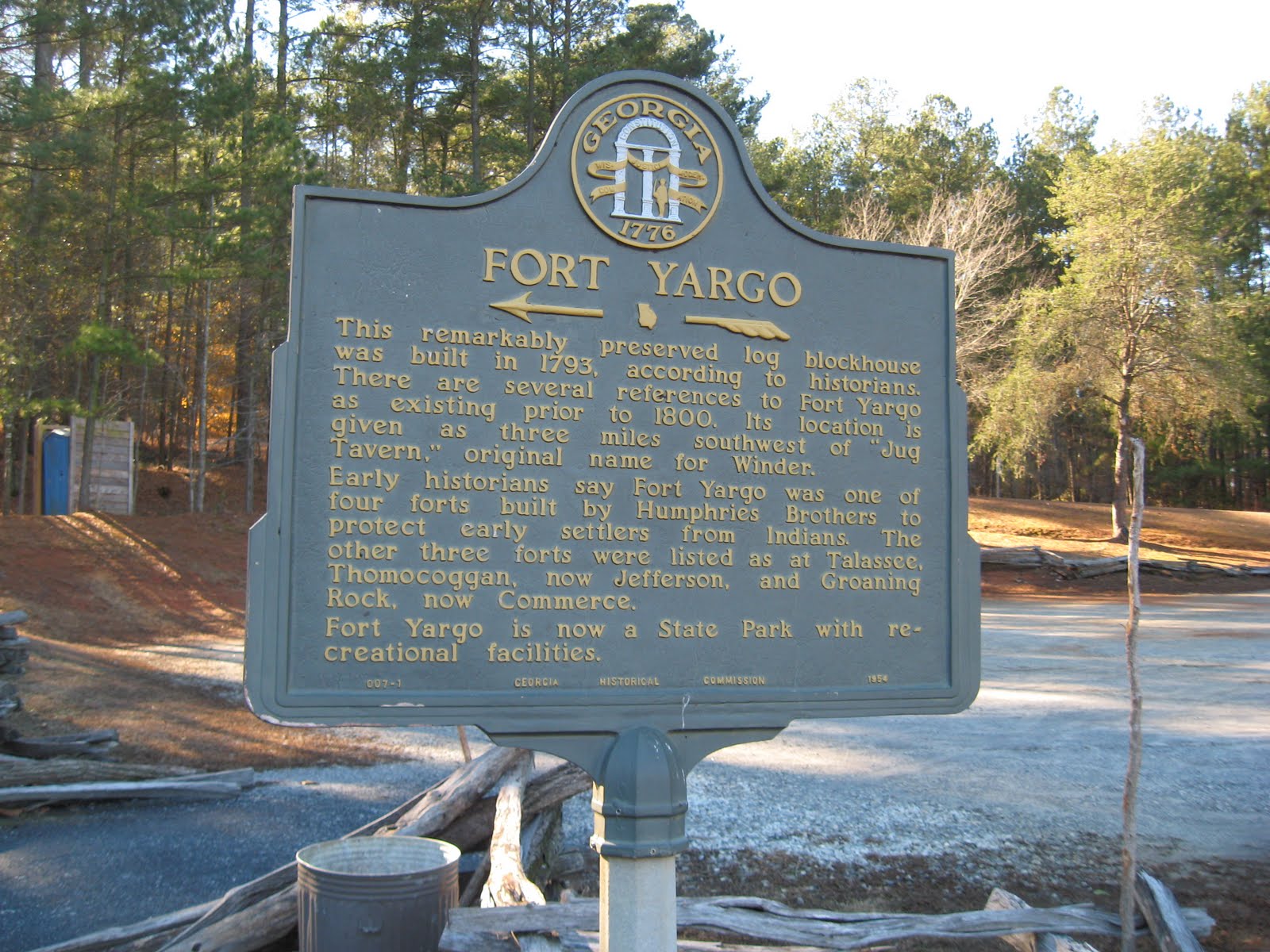
I was reminded of this on a trip to Fort Yargo.


I mean, come on: "Jug Tavern"? "Groaning Rock"? Those are much better names. You'd want to live in a place called "Jug Tavern."

Here's the old fort, by the way:


Doesn't seem like much, does it? Apparently it was enough.

Confucious

Confucius:

This is the most interesting thing from China in quite a while, from my perspective.

In a ritual equal only to that of the church, last week China placed a statue of Confucius in its political heart, Tiananmen Square, before Mao Zedong's portrait and near the modern obelisk to the People's Heroes, two symbols that materially defined China's national identity for 60 years.

This is a political statement, not a celebration of art, and it reshapes the country's ideological mission.
That's certainly right. It also represents a significant retreat from Maoism -- not so far as to repudiate him, but as far as one can go without repudiating him. Whereas the mission of the Maoists was to undo traditional society and radically alter it in new directions, the elevation of Confucius is a restatement of the importance of his teachings as a foundation of Chinese society. If China is now looking for the middle way between radical rejection of the lessons of the past, and adherence to strong traditions with a positive heritage, it is doing something very different from what Mao wanted to do. It is also doing something better.

Gender Equality


Gender Equality

I don't feel I've been holding up my end lately on the gender war discussions. I derived new inspiration from Megan McArdle's latest post, which started out as something incomprehensible about the First Lady, pedestrian deaths, and those smug high-fructose-corn-syrup ads about how it's "natural, and fine in moderation," but quickly shifted in the comments to a useful discussion about gender roles:

Why, just this morning as I was enjoying one of the blueberry muffins my wife had made, I remarked about how glad I was to be having her home-cooked food, b/c it's blessedly free of high-fructose corn syrup, transfatty acids, & other commonly maligned bogeymen of our foody-age. Well, she came right back at me with all of the facts & figures that she had dug up last night during one of her regular exhaustive visits to the Corn Refiners Association website. I gotta tell you, it really opened my eyes about a few things . . . Mostly it made me question why I had ever thought marrying such a pedantic bore might be a good idea. Well, at least there's the blueberry muffins, I suppose.

A commenter responded:

It's appalling to witness such rigid gender role assignment in this day and age. Shame on you (in a self-esteem promoting way, of course) for not holding a family meeting to discuss a less discriminatory and more unisex arrangement. For starters, consider banishing such outdated strictures as "wife" and "husband" in favor of "Spouse 1" and "Spouse A."
To which came the reply:
That is an excellent suggestion. I particularly like "Spouse 1 & Spouse A" even though it perpetuates the long-held discrimination in favor of the allegedly 'first' numbers & letters. In that respect, "Spouse 67Q and Spouse %6y" might be even better, though perhaps a bit unwieldy in everyday usage.

Regardless, my Spouse 67Q is a perhaps unenlightened, old-fashioned sort. She even changed her name after we got married. She changed it to "Rogers" rather than mine, but still, it's the thought that counts.

End Times

End Times

Doesn't this photograph evoke Judgment Day? This shot of a Montana supercell, which is today's home page for the Bing search engine, is part of a series of photographs from a National Geographic 2010 contest, which you can find here.

The NOAA explains that most supercells will produce some ugly weather, but only about a third will mature into a tornado. This kind of impressive rotation is associated with the head-on collision of cold air and warm air along a front, which results in a kind of breaking-wave effect, as shown in this graphic:


Nonviolence

Nonviolence:

Advocated by the paper in Richmond.

Republicans and Democrats have lamented the frequency of violent rhetoric in politics. Fewer seem to have regrets about the actual use of violence itself....

But what about violence by the state? Liberals and conservatives alike often embrace it as a means to an end they desire.

Government, as Max Weber famously put it, is distinguished from other social organizations by its claim to a monopoly on the legitimate use of force. A church or club might invite you to join, but cannot conscript you as government can. A developer cannot take your property by eminent domain; only government can. Acme might try to persuade you to buy widgets through advertising. A gay-rights group might try to coerce Acme to adopt gay-friendly personnel policies by organizing a boycott of Acme's products. But Acme cannot make you buy widgets at the point of a gun, and gay-rights groups cannot change Acme's employee policies by kidnapping the CEO's daughter.

Acme must rely on your consenting however grudgingly to buy its widgets, and the rights group must rely on other people consenting to join their boycott. Only the government can make you buy its products on pain of imprisonment. (Just ask actor Wesley Snipes, currently doing a three-year stretch for tax evasion.) Only government can force you to "boycott" products it declares off-limits, such as heroin, and arrest you if you don't.

The debate over the size and scope of government, then, is an argument over when to use violence to change things and circumstances consensual activity cannot.
I would contest the claim of government to a monopoly on the use of force; either that, or recognize that all citizens end up having a role to play, as citizens, in the governance of the nation. Nevertheless, there is broadly speaking a good point to be made here.

Don't Give Me That

Alexander the Great Conquered Afghanistan:

Not in his own lifetime... by proxy:

Though Alexander the Great could not totally conquer this rugged northeastern flank of the Persian Empire in the fourth century B.C., he is credited with leaving behind the drug that ultimately would. Actual cultivation of poppy shows up in Afghanistan's recorded history about 300 years ago. It was a crop well suited to the loamy soils of Badakhshan and the eastern province of Nangarhar, where it was first grown—requiring little fertilization and rainfall, a short growing season, and about as much expertise as it takes to hand-scatter seeds and cut slits in a bulb. Poppy occupied a benign niche in the country's agrarian culture throughout the 18th and 19th centuries, even as India's stranglehold over the opium trade later gave way to Turkey and then to the highlands of Southeast Asia, thanks to the growing market for heroin in Europe and the United States.

Only in the middle of the 20th century did Afghanistan become an opium exporter. At the request of the United Nations, which Afghanistan joined in 1946, King Mohammad Zahir Shah temporarily halted cultivation. The subsistence poppy farmers of Badakhshan and Nangarhar persuaded him to reverse his decision. In the meantime the crops for which Afghan farmers achieved renown were pistachios, almonds, pomegranates, cotton, and grapes.

So it was, until the Soviet invasion of December 1979 upended Afghanistan's landscape.
King Mohammad Zahir Shah was clearly the bright spot of recent Afghan history. Every good word anyone has to say about its history seems to center on his reign.