I never knew this existed until this evening.


An Injustice
A paramedic is being sent down for five years for miscalculating a dose during an emergency.
Peter Cichuniec on Friday was sentenced to five years in prison. But Cichuniec was not the officer who first physically accosted McClain within 10 seconds of exiting a patrol car, despite that no crime had been reported and that McClain had no weapon.... Nor was Cichuniec one of the two officers who joined Woodyard shortly thereafter, helping him forcibly subdue and arrest McClain, notwithstanding the fact that they had not met the constitutionally required standard to do so....Cichuniec, who didn't arrive until about 11 minutes later, was the lead paramedic, ultimately administering too large a dose of a sedative after miscalculating McClain's size and hearing from police that McClain was allegedly experiencing "excited delirium".... while it remains unclear what exactly caused McClain to go into cardiac arrest, an amended autopsy attributes McClain's death to "complications of ketamine administration following forcible restraint."
So, we can't say for sure that his action caused the death; the action was at most an error; the error was brought on by poor information given him by responding officers; and those officers had also assaulted the victim.
I realize that being able to administer drugs is a significant responsibility, but this seems to me like an extraordinary injustice. Paramedics work extremely hard to receive a credential that merely allows them to work harder than nurses in worse conditions for less money. They are a crucial link the chain of emergency medicine, the difference between basic and advanced life support while you are being transported to a hospital.
We should not be sending them to prison for mistakes, which is not to say that there shouldn't be accountability for mistakes. Accountability need not entail sending a paramedic to prison for having screwed up a dosage because he was given bad information at a chaotic scene.
The Reason article notes that the police received far less accountability for their actions, which has been a hot button for some years now. I'll leave the police issue to the side. This isn't how a decent society should treat a paramedic even if he made a deadly error.
Super Tuesday
I can't recall ever being less excited to vote in an election. My normal heuristic for primaries -- vote against every incumbent, according to the apocryphal Mark Twain quote that 'politicians like diapers should be changed frequently, and for the same reason' -- has been disabled by a lack of competition in seats with incumbents. Instead, the only competitive races in this year's Democratic Primary in North Carolina are to fill seats that will be empty.
Thus, a new heuristic for this primary election: always vote against the activist. For example:
On Tuesday, voters will also choose between two Democrats seeking their party’s nomination for a seat on the state Supreme Court. Currently that seat is occupied by Justice Allison Riggs, a voting rights attorney who was appointed to fill a vacancy on the court by Gov. Roy Cooper in 2023. Riggs has said she is not just running her race, but campaigning to build a pipeline so Democrats can win back control of the high court in 2028. Riggs’ campaign received more than $80,000 in individual donations in the first quarter of 2024. She ended that reporting cycle with more than $178,000 in the bank.Riggs’ opponent in the primary is Lora Cubbage, a former prosecutor who also worked in the Attorney General’s Office handling workers’ compensation claims before becoming a Superior Court judge. Cubbage received about $50,000 in individual donations. Among them: a $250 donation from Brent Barringer, husband of state Supreme Court Associate Justice Tamara Barringer, a Republican. She also received $250 from Robert Broadie, a Superior Court judge in Davidson and Davie counties. Cubbage had about $90,000 left in the bank as of mid-February.
The activists come in two varieties, both of them bad. The first variety is a party loyalist who is lying about having activist principles -- Republican voters will be very familiar with this type -- but merely wants to court large campaign donations from organizations outside the state. These people, in other words, are corrupt. America has a surplus of corrupt politicians already; no more are wanted.
The second variety is a true believer in the activism that has washed over the Democratic Party. These people are not corrupt, and indeed are well-meaning according to their lights. The problem is that the activist ideas are often barking mad; even when they are not, they are destructive to the foundations of our society.
Too, North Carolina is politically quite divided. No activist politics is going to lead to sustainable progress on any issue. Even now the governor vetoes almost every bill the legislature passes, while the state Supreme Court reverses its predecessor and finds 'unconstitutional' things constitutional, while rethinking their predecessors' decisions on the constitutional to find those things unconstitutional. It is chaos and madness. The only effective politics the Democratic Party could engage in here is one focused on non-activist, traditional Democratic ideas about improving life for workers and supporting labor. What they want to do is chase Google Gemini's vision -- because, it should be said, Google and similar tech firms are now major donors to the Democratic Party.
Indeed the two parties support the same basic interest, which is the megacorporation(s?*) that own(s?*) everything. The Republican Party supports the Chamber of Commerce interest in lowering American wages and increasing competition by increasing immigration, which by coincidence also creates a labor base that has no legal status -- and thus no legal recourse when abused. The Democratic Party supports, well, the same thing. They used to be on the side of labor, which would hotly oppose being driven out of work and having their wages effectively lowered by being put into competition with illegal aliens; now they promise welfare leading to a 'universal basic income' for former workers, who will be replaced by the class of people lacking legal standing to seek redress for their grievances.
I don't know how much good can still be accomplished with elections. However, I shall do my duty as a citizen, and vote strategically as best as I can.
UPDATE: I voted "No Preference" for President, which is not strictly speaking true but was the only option given.
* The question intended by the "(s?)" has to do with whether or not there is an important separation between the megacorporations given that their stock is chiefly owned by each other. As a result they all share the same basic interests politically, and thus rather than being in competition often end up looking like the different branches of a monopoly. Legally they are different "persons," but actually they look a lot like a monolith. Can't vote your way out of that one, either.
"We Must Dissolve [The Supreme Court]"
So says Keith Olbermann, on the X platform, following a unanimous ruling from all wings of a divided Court on a contentious topic.
I have long argued that Twitter (as it was formerly known) was the worst thing to happen to American self-governance. It offers just enough room for snarky, disrespectful, or explosive comments, and not nearly enough room to engage seriously with problems. As a result, it transformed the national discourse into a series of insults and contemptuous speech, and gave the elites a platform to air their disdain for each other and everything else.
Maybe I should rethink my position. Getting all this contempt and disdain out in the open is probably the worst thing for keeping the country together; but it might be healthy, insofar as it destroys the very institutions that the elite were using to control us all. Keith Olbermann used to be considered a serious man, an heir to Walter Crokite and the other powerful-and-serious news anchors of the previous century. Now everyone can see him and his business for the jokes that they are.
The Supreme Court, like it or hate it, is the last branch of the Federal government that is unambiguously legitimate. Only the one justice appointed by Biden, whose election was illegal and therefore unconstitutional, is tainted by the recent tomfoolery with elections. The other eight were appointed and confirmed by governments whose legitimacy to do so was not in question. The whole Federal bureaucracy derives its power by delegation from the President, sometimes supported by Congressional legislation that supports its creation and existence. The "fortification" of our elections thus calls the legitimacy of the whole into question, except for the Supreme Court. If you could dissolve the last branch with clear authority, what would be left to convince anyone to obey the dictates of the state?
Force, obviously: naked force. Olbermann nevertheless believes that it is his opponents who are "fascists."
Nice try
As Ed Morrisey says, "the 13th, 14th, and 15th Amendments exist to limit states' powers, not to add to them." The Supreme Court unanimously rejected Colorado's attempt to use the 14th Amendment to remove Trump from the state's presidential ballot.
This case raises the question whether the States, in addition to Congress, may also enforce Section 3. We conclude that States may disqualify persons holding or attempting to hold state office. But States have no power under the Constitution to enforce Section 3 with respect to federal offices, especially the Presidency.
Gateway Drugs to Country Music
Fair Warning: I don't think there is any actual country music in this post.
Ferocity
Congratulations to the dog, whose name is also Conan (Gaelic: "Little wolf"), on surviving to his first birthday.
Gigantic Melancholies
The other day AVI had a post on self-observation. AVI himself raised the issue that it can tie one in knots, and is 'no picnic.' Although he comes down in favor of self-observation and self-criticism, this comment by JM Smith stood out to me:
I'd add that self-examination has morbid and healthy forms.... Morbid self-examination is one form of what traditional psychology called melancholy. I'm innately melancholic and this has always been weakeneing.
Naturally this reminded me of the introduction Robert E. Howard wrote for his Conan:
Hither came Conan the Cimmerian, black-haired, sullen-eyed, sword in hand, a thief, a reaver, a slayer, with gigantic melancholies and gigantic mirth, to tread the jeweled thrones of the Earth under his sandalled feet.
Conan too was weakened by his melancholies. As a literary figure, they provide us with the adagio moments that counterbalance the allegro and fortissimo aspects of the tales. As a living being, however, they are not desirable moments to live out.
It may also be that they aren't helpful. Joanne Jacobs, writing about educating the young, mentions that children are easily bogged down by being asked to reflect on negative feelings. This may account for some of the degredation of early education (along, of course, with the bad educational theories that have come to predominate). But she ends here, talking about adults:
By the way, at least for adults, dancing, jogging, yoga, lifting weights and aerobics are "as effective as cognitive behaviour therapy – one of the gold-standard treatments for depression," writes researcher Michael Noetel on Conversation.
That, I think, is correct. Years ago, writing at BlackFive, I advised veterans with PTSD to take up horseback riding for its positive effects, one of which is making you stop thinking about the war and focus on the horse and the world around you. Getting out of your head and being in the moment is extremely healthy -- riding motorcycles also has this effect.
Another of the helpful effects of horseback riding is learning to encounter and make peace with an entirely different kind of mind, which has the capacity to improve your ability to deal with people who are different from yourself as well. The self-mastery that is necessary to work with a horse often involves stopping thinking, stopping feeling, and focusing on the necessity of doing. Later, when you have time to think and feel again, you've done the things that needed doing in the moment.
For those of us who are overly inclined to self-observation and criticism, these may be the most helpful things to learn. For those who are utterly not inclined to it, they may yet benefit from being taught to ask searching questions. If you are a man of gigantic melancholies, however, it may be helpful to lift more weights and ride more horses.
Songs from my Father’s Atlanta
Antiquity
Just to illustrate the longetivity of this casting scheme, I'd like to tell a funny story that was told to me nearly thirty years ago by a professor of political science.
He was a young man (at the time), and appropriately liberal for an academic in the social sciences. Naturally, he was supportive of one of Jesse Jackson's presidential campaigns. Therefore he went to hear Jackson speak at Emory University while Jackson was in Atlanta to campaign. It is important to the story to note that the professor was white.
Now in that election cycle, the form of "white rural rage" that was in vogue was called "the angry white man," who was of course typically rural and archetypically Southern.
Unfortunately for our protagonist, the night Jackson spoke our professor had a plane he had to catch, so he could only attend part of the speech. He listened raptly until his watch informed him that it was time to go if he was to get to the airport and catch his plane.
Just as he checked his watch, though, by coincidence Jackson shifted into the part of the speech aimed at "the angry white man." Nervously our hero sat on the bench for a couple of minutes longer than he'd planned in the hope that the topic would change again, but it was clear that Jackson was settling in to deliver a long oratory on the subject.
And so, with intense embarrassment, our professor had to stand up and walk out of that speech -- a white Southern male, with all the hateful eyes of the congregation upon him.
Charged with being Guilty
I keep pointing out the Joe Bob Briggs lecture called "How the Rednecks Saved Hollywood," in which he explains that once you couldn't make cowboy-and-indian flicks because of guilty feelings and the Nazi war movies were getting old, Hollywood settled on rural white Americans as the designated villain for all of its stories. The reason I keep pointing this out is that the rest of the culture followed suit, and just keeps making the same movie over and over.
New book: White Rural Rage: the Threat to American Democracy.Tom, we'll start with you: why are white rural voters a threat to American Democracy?Tom: We lay out the four-fold threat...1) They're the most racist, xenophobic, anti-immigrant and anti-gay...2) They're the most conspiracist group, Qanon support, election-denialism...3) Anti-democratic sentiments; they don't believe in an independent press... white nationalist, Christian nationalist...4) Most likely to excuse or justify violence as an acceptable alternative to peaceful...
In fairness the Native Americans had to endure decades of being the designated villians before anybody started making movies that attempted to treat them fairly or sympathetically (like 1948's Fort Apache or 1953's Hondo) and even longer before they began to enjoy being represented wholly positively (probably the 1960s with Little Big Man, but definitely it became the standard after 1990s Dances With Wolves -- ironically both named after the white character in the film).
Likewise, just as Hollywood employs very few Southerners to play villanious Southerners -- the racist Texan sheriff in Smokey and the Bandit was played by Jackie Gleason of Brooklyn, New York -- a lot of the "Indians" in the old films were just white guys with painted faces. Hondo's Vittorio, the noble Apache leader, was played by an Australian of English descent. You not only can't expect fair representation, you can't expect representation.
All of these charges are tendentious formulations at best, but they're central casting's role for us. This is the only role we're going to be offered, and if we won't play it they'll find someone who will -- probably FBI agents dressed up like "white nationalists" with khakis and tiki torches, or "Christian nationalists" with bibles, or whatever name focus-groups well this cycle.
UPDATE: Matt Taibbi finds that this trope is far older than I had realized.
Legislative versus Judicial
The Supreme Court's questioning on this 'bump stock' case suggests that they're getting bogged down on the question of whether there should be a law against bump stocks. That's not really the issue in the case, and it's not the Supreme Court's business to legislate. The issue in the case is whether the President or an executive agency can change the law by fiat without the bother of consulting the legislative branch.
Cargill’s attorneys emphasize that for nearly a decade, between 2008 and 2017, the federal government did not count later versions of the devices — without the internal spring — as machine guns. During that time, Americans bought 520,000 bump stocks.President Donald Trump’s bump stock ban gave owners until March 2019 to destroy or turn over their devices. Gorsuch and Justice Brett M. Kavanaugh expressed concern about the possibility that a half-million people could be prosecuted if they purchased the devices before the rules changed. But Fletcher sought to reassure them that ATF does not have the power to make something a crime that was not a crime before.
Well, indeed, and neither does the Court.
The Court instead chose to question why someone would need a weapon that could fire 700-800 rounds a minute (the state originally misspoke and claimed they could fire '600 rounds a second'), which in fact they cannot do. 700-800 rounds per minute is the cyclical rate for the AR-15/M16 family of rifles, not a practical rate of fire that can actually be achieved or sustained. It's a theoretical calculation based on how fast the action can cycle; it doesn't take into account practical realities like the need to reload, or the fact that heat would melt your barrel.
That's not the controversy at issue: the AR-15 is perfectly legal, and the M16/M4 is legal to own if you have the appropriate license. The question is whether the ATF or a president by bare executive order can change the status of a weapon from 'perfectly legal' to 'banned without a permit.'
For the record, I think bump stocks are stupid. I would never put one on a weapon because they reduce accuracy even if they increase the rate of fire. Shot placement is what it's all about. I don't know if I'd even oppose a law designed to move bump stocks into the National Firearms Act.
However, I definitely oppose letting Federal agencies change the law without the bother of asking Congress. I'm not a big fan of Congress either, but it's their job to legislate if legislation has to be done.
Vice Falls Down
I used to enjoy Vice, back in the days when it was more like this:
For young people trying to break into TV, pitching to every other media outlet, from the BBC to Channel 4, felt like an endlessly demoralising grind. Patronising boomers would asphyxiate any remotely fun idea you dreamt up. Meanwhile, Vice was covering cannibal warlords in Liberia and sending reporters to see what it was like to do stand-up comedy on acid. It even had a dedicated drugs correspondent called Hamilton Morris!... At its height, Vice was the most contrarian and unconventional publication out there. Much of this is owed to co-founder Gavin McInnes. He fell out with co-founder Shane Smith and left Vice in 2008, long before I was trying to become part of the cult. Still, it was undoubtedly Gavin’s irreverence that gave the magazine its unique flavour. When it launched its British edition in London in 2002, McInnes said: ‘We will have no taboos. Vice has never been about shocking people, we’re just shocking in nature.’By the 2010s, that punk attitude forged by McInnes had attracted huge corporate interest.
McInnes apparently went on to found the Proud Boys after he left Vice; the article thinks it was done as an ironic joke on his former employers' sudden twist to corporate-style wokeness.
Was it the corporates' fault, though? Did they impose 'wokeness' on Vice, or did the audience come to demand it? Another article suggests the latter: it was the generational shift in what young people wanted that transformed Vice from a punk rock shop into a woke preacher, killed the fun and eventually the brand.
The simple fact is that Vice, once an effective and witty member of the alternative media, ran up against an epochal change it was never destined to survive. The audience for alternative media still exists, but the progressive audience for alternative media does not. The dissident energy, for good or ill, has gone over to the right, where audiences, commentators and provocateurs from a wildly dissonant series of belief systems share a rather confused exile. Some dissident leftists forced out of their old niche simply go full tilt to the other extreme, some stand in proud isolation, most end up, uneasily, somewhere in the middle. But even the most principled progressive dissidents have woken up to a drastically changed audience, with very different interests and demands. Vice’s golden age of being offensive, effortlessly cool and still courted by legacy media is never coming back, and was never going to.
The only punk rockers left are on the right.
Building the Motte
Apparently the new "white nationalism," which later became "white supremacy" (but not white supremacy the way the Klan understood it -- it just meant everything America normally does) is going to be "Christian Nationalism." That's what we'll all be hearing about through the election, I suppose.
Now these sorts of things are always motte and bailey attacks, so it's important to build a good motte. David French took this on in the pages of the NYT.
Anyone may disagree with Christian arguments around civil rights, immigration, abortion, religious liberty or any other point of political conflict. Christians disagree with one another on these topics all the time, but it is no more illegitimate or dangerous for a believer to bring her worldview into a public debate than it is for a secular person to bring his own secular moral reasoning into politics. In fact, I have learned from faiths other than my own, and our public square would be impoverished without access to the thoughts and ideas of Americans of faith.The problem with Christian nationalism isn’t with Christian participation in politics but rather the belief that there should be Christian primacy in politics and law. It can manifest itself through ideology, identity and emotion. And if it were to take hold, it would both upend our Constitution and fracture our society.
So that nicely illustrates both the motte and the bailey. The highly defensible motte is that he's only talking about radicals who want to establish some sort of theocracy in the United States in place of the First Amendment. As far as I know, there is no group of significant size attempting to revoke the Constitution in favor of a theocratic form of government. Nor would there be: there's no large church I know of that is happy enough with its own leadership to want to import it to the Federal government.
The bailey is 'of course Christians are willing to bring their diverse, deeply-felt opinions to the public square' -- as long as they don't insist that Christianity's vision win in establishing anything like enforceable laws. Of course you can feel that way, as long as we agree that the law cannot reflect your vision.
Thus, while we're defending the bailey, everything that Christianity has a fairly stable theological opinion about is off the table for US law. The First Amendment now means that nothing that happens to align with a Christian doctrine is allowed to be a law in the United States. If you disagree, you're a Christian Nationalist.
Well, until someone experiences some success at pushing back on that, at which point they'll retreat to the motte. Of course we're only trying to preserve the Constitution against the theocracy that no one is actually trying to establish.
UPDATE: To whit.
The fight for religious freedoms in the United States has become progressively more intense in the last three years, as the government has been chipping away at the Establishment Clause by catering to special interest groups that champion causes like child gender mutilation, sexual grooming of children, prohibition of public prayer, and more that are antithetical to many mainstream religious doctrines. The First Amendment is first for a reason, and Thomas Jefferson was clear on the topic. The wall between the Church and the State was not created to constrain religion, but rather to constrain the government. It protects us from the government creating laws demanding a single theology; but equally prevents the government from demanding the elimination of religious practices.
They got a rabbi to write this, which underlines that these standards are mere Christian without being merely Christian. Nevertheless, having laws on moral values that are basically in accordance with doctrine will be the bailey.
A Genuinely Festive Occasion
I don't know why Google Photos is bringing these photos forward now; I haven't seen them in years. This one is from a tribal compound near Mahmudiyah, and in spite of the body armor and barely-visible rifles it was a good time. They were a family led by three brothers, one of whom was US-educated, and we felt pretty welcome and secure there. Many of the "Sons of Iraq" were former insurgents, but their militia were tribal fighters who'd always loyal to the family.

Here we're dining on boiled sheep and Iraqi bread, rice and many other good things.
On a couch in this house I once talked with a nephew or a cousin who had studied philosophy at the University of Paris. He barely spoke English and I barely speak French, but between the two of us we had a conversation about Jeffersonian democracy. It was the most hopeful moment of my time in Iraq.
An Evening of Live Music
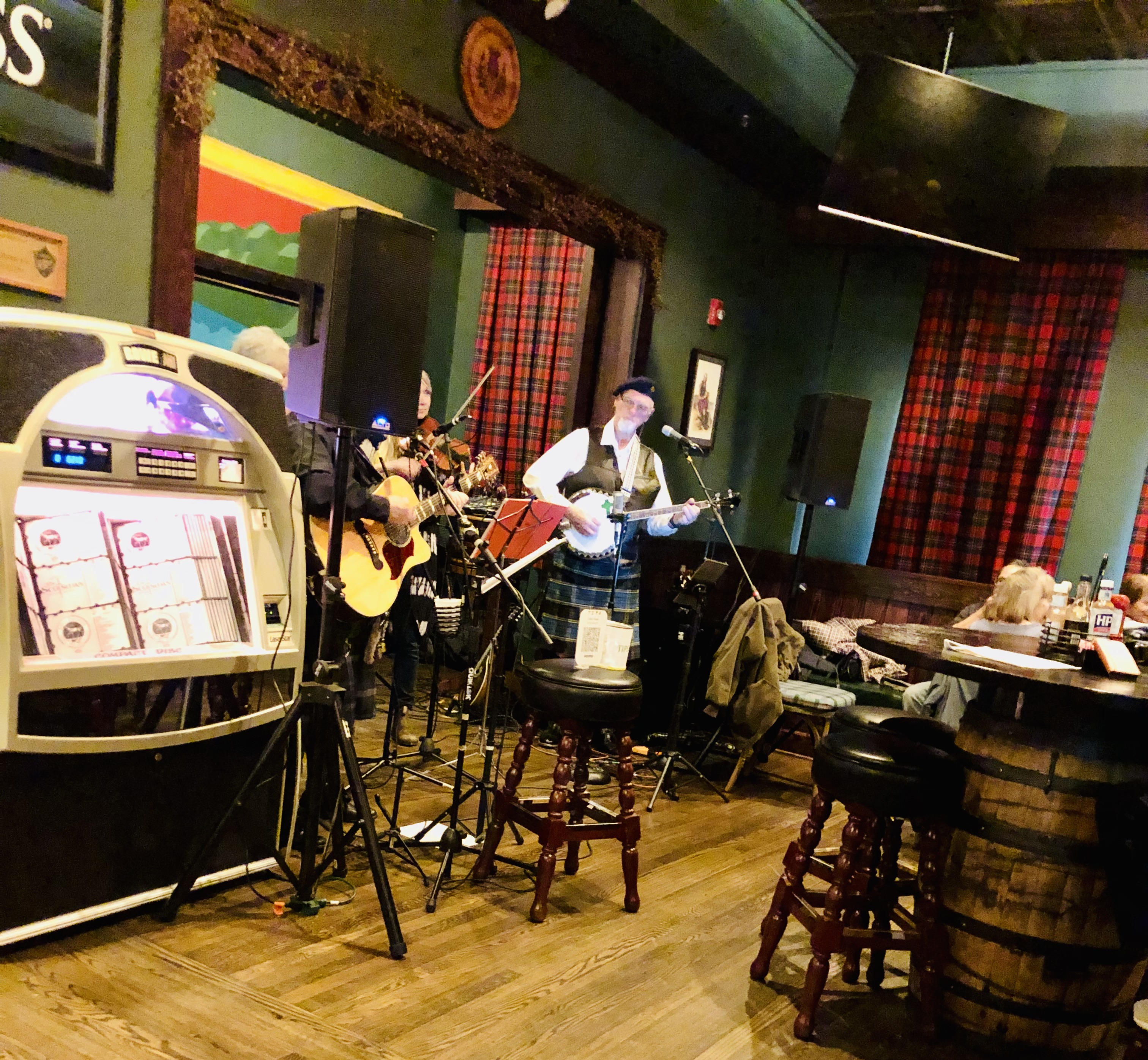
The Scotsman Public House featuring live Celtic music.

“Frog Level” Brewing Company Americana.

Back to the Scotsman for Ben & the Borrowed Band, a cover country act.

Local funk act the Mike Rhodes Fellowship.
The Last Frontier
Although so far she's not winning many votes, Nikki Haley is leading the unnamed real estate magnate in fundraising. So too is Joe Biden running away in the political donations race.
In an environment in which inflation has drained away the ordinary person's ability to feed their families and make their bills, it's no surprise that only the rich can really donate to political campaigns. The rich are sure about where their interests lay, too, which is with the Establishment -- they may differ or perhaps not even care about which party, but the Establishment for certain.
The class difference is understandable. The real wages of average Americans did better under the real estate guy than they'd done in decades (a fact willfully obscured by including the Covid collapse in his numbers). This occurred because of two signature policies: cracking down on illegal immigration, which depresses the wages of working class Americans; and the full-throated embrace of the shale oil boom that gave America back its energy independence -- even making us a net exporter again.
Average Americans found their gasoline bill was down, which meant all their bills were down: fuel to transport goods to market is baked into the price of everything. Meanwhile, their employers were forced to pay Americans to do the jobs that they needed done in America. That was more of the jobs than expected, too, thanks to the death of the Trans-Pacific Partnership that would have helped ship more jobs to Asia, and the Transatlantic Trade and Investment Partnership, which also kept jobs home instead of abroad.
It's no wonder those who run major corporations would rather have an Establishment figure in office, one who will keep the borders open and costs down. They have little to fear even from Biden's environmentalism, as he has quietly allowed shale to trickle back up to where it was before.
It's also sensible that working class and middle class Americans would prefer to keep that particular tap shut, not merely for economic reasons but for more basic reasons of human meaning. The economics are aligned with their interest in stable communities, relationships, neighborhoods (as shown by the exact similarity in the complaint against gentrification as against mass immigration).
Marxist analysis would suggest that this is obvious: economics drive history, they say. It's the most basic of their analytical tools. Yet for some reason we don't really hear people talk about this in these terms: people on both sides prefer a cultural overlay to the economic analysis. It flatters the left to think that they're on the side of progress and their values, rather than the side of importing people who will be paid less and granted no worker protections in order to suppress the wages of fellow Americans in service to the rich. It flatters the right to think they are standing up for Christianity and Western traditions instead of a fair wage and a better life for their family (those selfish things!).
So we end up talking about what everyone wants to talk about instead of this important aspect; and we end up casting aspersions on each other that are not the ones most genuinely deserved. The most true and applicable complaints are left out of the conversation.
Hilarity Ensues
Google apologizes after its new AI generated “racially diverse” images of Nazis.
As the article explains, the diversity is limited because the AI really doesn’t like to include white people; so you can imagine the results. It would have generated everything except accurate results.
UPDATE: Related.
El Dorado
This was one of three versions of the plot of Rio Bravo, of which the original was best but each had its charms. For example, John Wayne rode his prettiest horse in this one.
Cf. Ivanhoe:
Having expressed himself thus confidently, he reined his horse backward down the slope which he had ascended, and compelled him in the same manner to move backward through the lists, till he reached the northern extremity, where he remain stationary, in expectation of his antagonist. This feat of horsemanship again attracted the applause of the multitude.
Horses really don’t like to do what Ivanhoe and John Wayne just did. It’s a mastery.

Subscribe to:
Posts (Atom)