
Another Feast
The twelve days of Christmas are all feasts, but the 30th of December is not always the same feast. Some years (but not usually, and not this year: only when Christmas is on a Sunday) it's the Feast of the Holy Family. But this year you can pick from some several, just as you prefer.

A Chicken-Killing Day
My wife’s chicken population was reduced by two this afternoon, as she has finally conceded the necessity of eating some of the monsters. Whilst she thought of them as sort-of pets they were untouchable. Killing a chicken is otherwise a trivial matter.
New Years Day should feature a roast chicken dinner. I’ll have to decide what to make alongside.
The Feast of St. Thomas of Becket
Christmas continues with a celebration of "Thomas a Becket." In Ivanhoe his bones are sworn by on occasion by Prince John and the other Normans. The Holy Clerk of Copmanhurst -- i.e. Friar Tuck -- calls him on him as "Thomas a Kent," Kent being the location of Canterbury Cathedral.
Unprepared for War
One might reasonably ask whether America wants to fight a war on three fronts, or indeed on any fronts if it can be avoided. The author seems to think that there won't be a chance to opt out.
[O]ur moment has thrown up conflicts across the globe: Israel versus Hamas, Russians versus Ukrainians, or Chinese democrats versus the Communist Party. But these disparate battles are in fact part of one whole – a struggle to dominate the future.The new wider war includes attempts by great powers, notably China, to secure natural resources by securing alliances with authoritarian regimes around the world.... This de-facto alliance, a modern version of the World War Two “pact of steel”, is truly global in scope. It extends from Ukraine to the shutting off of the Red Sea by Yemen’s Houthis, and even Venezuelan plans to conquer much of oil-rich Guyana....The wider war pits on one side the revanchist powers – China, Russia, Islamist, Latin American and African countries – who feel they have been wronged by the West and liberal capitalism. On the other side are the West and non-European allies like Japan, South Korea and perhaps most importantly Modi-led India.
I wouldn't count too much on India, actually. If that's your 'most important' ally, you're in worse shape even than you think. India has been emphatically non-aligned since their inception, and at this point is closer to Russia.
The author is right, of course, that the US and the West are failing on all fronts in terms of military readiness. He even identifies them fairly succinctly. How do you fix them, though? The powers are all against it, and some of the problems -- like the collapse of faith in the West among the youth, or the need to rebuild American manufacturing almost from the ground up -- are generational.
The Proximate Cause
Over at InstaPundit, Ed Driscoll is pointing out how foolish Nikki Haley is to have fallen for the perennial trap of a Republican being asked about the causes of the Civil War. A Republican in particular cannot afford to answer this question otherwise than briefly and dogmatically; it is for others to explore the nuances. Even then, it is often said that a high school student will tell you that the war was over slavery; a grad student will tell you about nuances of economics and power; but a professor will explain again that all of those nuances were rooted in slavery.
There is a question worth exploring -- and this election cycle of all times -- about the proximate cause of the Civil War. What caused the war to become a thing that had to be fought, replacing a tense situation with the necessity of so very many Americans killing each other?
One answer could be the election of Abraham Lincoln -- or, to put it in terms relevant to today, the very narrow election of a candidate who did not come from the major established political factions, to whose power a large part of the country was intensely opposed. Had one of the other three(!) candidates won, the war might have not occurred (or at least not at that time). As it was, Lincoln took power with less than forty percent of the vote, though a convincing majority in the electoral college.
Lincoln's election was, I think, definitely the cause of secession -- at least, the first wave of secession, which was only seven states in the Deep South. I don't think it was the proximate cause of the war. As he was inaugurated he was escorted by both cavalry and infantry, with sharpshooters covering his approach. A similar scene followed the election in 2020, when the government similarly deployed a large military force to protect itself against assumed violence (which in fact never appeared, neither in 1861 nor 2021).
This did not necessarily mean that war was inevitable. Lincoln's inauguaral address promised not "to interfere with the institution of slavery in the States where it exists. I believe I have no lawful right to do so, and I have no inclination to do so." If slavery was the cause of the war simpliciter, you might then say that this should have prevented violence from springing out. It might have given a window for negotiating a new vision with the Southern states that did not leave the Union, which if it had succeeded might have eventually persuaded the seven that did to return.
Yet war followed very quickly. There are two other answers to the question of the proximate cause that occur to me. The first one is the general collapse of trust in the government under Lincoln to obey the Constitution. Southern states had moved to seize armories with their state militias, as they no longer believed the Federal government would respect their Second Amendment right to maintain armed militias. If they had trusted the courts to protect their rights, or had trusted Lincoln not to violate their rights, this might not have occurred. If they had sent lawyers instead, the country could have remained in a period of tension but not war.
Alternatively, you can blame Lincoln's response to the seizure of the armories and fortifications. While he pledged not to interfere with slavery, he did assert in his inauguration that he planned to defend the Federal government's property rights. He did so with the deploment of troops. You might think that the South, which was in a large part going to war to defend a property claim as inviolable, might have been persuaded that the Federal government had a right to the buildings and land (if not the arms within them, that might be seized for militia purposes). These buildings included not just armories but harbor forts -- most famously Fort Sumpter. Allowing the President to reassert physical control over armories or armed batteries that could close the harbors meant, effectively, submission to Federal authority. There was just no trust left for that: the South decided that it had to resist while it still had arms and could seize back control of the fortifications that could either protect its harbors or close them.
That last sentence ends up collapsing the two possible proximate causes into one: the collapse of trust in each other, without which it is impossible to accept being governed by the other side. War became necessary when force was used because trust was absent.
In our own present case, the Trump side has proven its willingness to accept being governed by a side that seems hostile to it. They stood down even after a highly disputed election and allowed the other side to take power over them. That side has certainly been hostile to them in rhetorical terms, but also seems to be bent to using Federal power to dominate and control that side. Trump himself has not promised to forswear a similar use of such power if he should get the opportunity to use it. Even if he did promise, though, it is likely that his opponents would trust it as little as was trusted Lincoln's promise not to interfere with slavery. It is not clear to me that their side would similarly accept his election, trusting to their lawyers instead of to force.
If there is another civil war blessedly it won't be caused by slavery, which our ancestors wisely put an end to long ago. The final cause of a second war may well be a conflict between power and liberty, in which the established and entrenched bureacracy will not allow itself to be dissolved or even restricted by an elected government it does not trust.
The proximate cause is apt to be the same, however. That is a matter that ought to concern us.
Vehicular Advice
By coincidence my son and I happened upon some women with a dead battery. They were trying to jump it but had hooked the jumper cables to something besides the donor vehicle battery.
I politely pretended not to notice that they were hooked up to the air conditioner rather than the battery, and just said “You look like you’ve got this, but if you need any help we’d be happy to assist.” No Mansplaining here!
They likewise were wise enough to admit that they didn’t know at all what they were doing, and to graciously accept the offered help. They were also hooked incorrectly on the receiver side, but it hardly mattered since there was no electricity coming from the donor.
I disassembled the battery connections and cleaned the corrosion that was all over them, then hooked my truck up and got her vehicle started in a few minutes. I enjoy the chance to help people, and they were grateful and kind.
Anyway, probably here it’s preaching to the choir but always carry a toolbox and jumper cables. Know how to do simple roadside repairs. Even if you don’t have trouble yourself, you never know when you might meet someone in need.
Language drift
It's surely a sign of age to be increasingly irritable about changes in grammar and usage. Does anyone else notice that published pieces increasingly find it difficult to use phrases like "much less" and "no less" and "if worse comes to worst" and "sauce for the goose, sauce for the gander" properly? It's as if the authors had all suffered strokes. "Much less" quite often has the two elements reversed, so instead of "I was so tired I could barely walk, much less (or let alone) run" it comes out "scarcely run, much less walk," which makes no sense. "No less" should mean "fully as great as," as in "my presentation received rave reviews from the national expert on my topic, no less." It has nothing to do with the "much less" idiom, but gets wound in somehow. The worse/worst expression appears in reverse or in doubles of worse/worse or worst/worst. The "sauce" idiom, especially in speech, tends to sound like "sauce for the . . . [pause]" followed by lame muttering of something indecipherable.I realize this is part of the natural progression of language. An idioms that is too hard to recall either falls out of use or is replaced with something that sounds familiar, even if it no longer has the sense of the original. Another take, however, is that there's no such thing as an editor any more, not even in formal book publishing, let alone online sites. (See, it's not that difficult.)Don't get me started on rein/reign, regime/regimen, principal/principle, or affect/effect. These young whippersnappers. If the shoe fits, you must acquit.
Restoration and new life
Notre Dame de Paris may be fully repaired by next Christmas. The rooster weathervane atop the destroyed spire was heavily damaged during the fire and is being replaced by a new device that is something of a cross between a rooster and a phoenix. Here are the original rooster, before and after the damage, and the new bird:


Dog joy
Several months ago we built three spacious 6x12 kennels for foster dogs that had to be rescued from the county shelter's kill list. Since then we've been struggling with how to let them safely out of their kennels, other than on leashed walks, without conflicts among themselves, with our 3 dogs, or with the cats. I also had concerns about our perimeter fence, which is only four feet high at best and in some unexplored areas is either definitely or probably compromised by downed trees. This made it nerve-wracking to wonder what inexperienced foster dog might be over the fence and harassing neighbors' pets or chickens.
Finally last week our contractor finished putting in an adjacent dog exercise yard with a nice, tall, secure fence. About half of it is sodded and half woodsy brush. Now the foster dogs can come out in whatever groups I can arrange without quarreling, with no danger that they'll test the perimiter fence, mess with our home dogs, or mess with the cats. The cats were really complicated, as they need to come out of the garage where they're kept safe at night, but if they come out soon after sunrise and go back in soon before sunset, that doesn't leave much time to supervise loose dogs in shifts in the daylight. Now the time constraints are all relaxed and the foster dogs aren't cooped up so many hours every day. I'm also getting good video to post on social media to drum up interest in adoption.
I'm trying to post video, but can't make the format work. Here's a stillshot grab: 

The High Feast of Christmas

The storm that blew in last night brought hard winds and rain, and knocked out the power on the mountain. Some poor lineman is doubtless having to spend his Christmas morning out in dreary weather. Here at the Hall there is warmth and fire. I made coffee over living flame.
Merry Christmas to all!
In the Last Hours of Advent
While I have been preparing for Christmas for a month, there was much to do in the final day of Advent. I prepared the feast for tomorrow, which itself took hours. It's an unusual one: none of the Christmas standards, no roast beast nor ham nor turkey, not even a Great Pie like I often make.


This year I decided to make my wife a lobster-chipotle corn chowder that a friend of mine taught me how to make. It's not the sort of thing I'd ever normally make, as it involves not only seafood (not something to which I am accustomed, as a mountain man) but a seafood from distant cold waters. Nevertheless I bought her a frozen lobster and made it for her because I thought she'd like it, and perhaps all the more as it is a rare thing.
For my son and myself, I made a very common dish: venison chili. That's what he said he wanted. When he was a little boy he used to fuss so much about me making chili. He grumbled endlessly about being made to eat it regularly, as it's my go-to beef stew. Yet, just as I told him (and as he emphatically denied was possible) in time he came to love and value it. So, at his request, that's what I made.
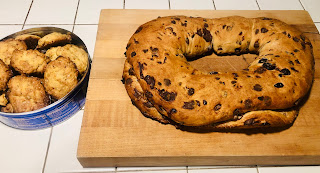
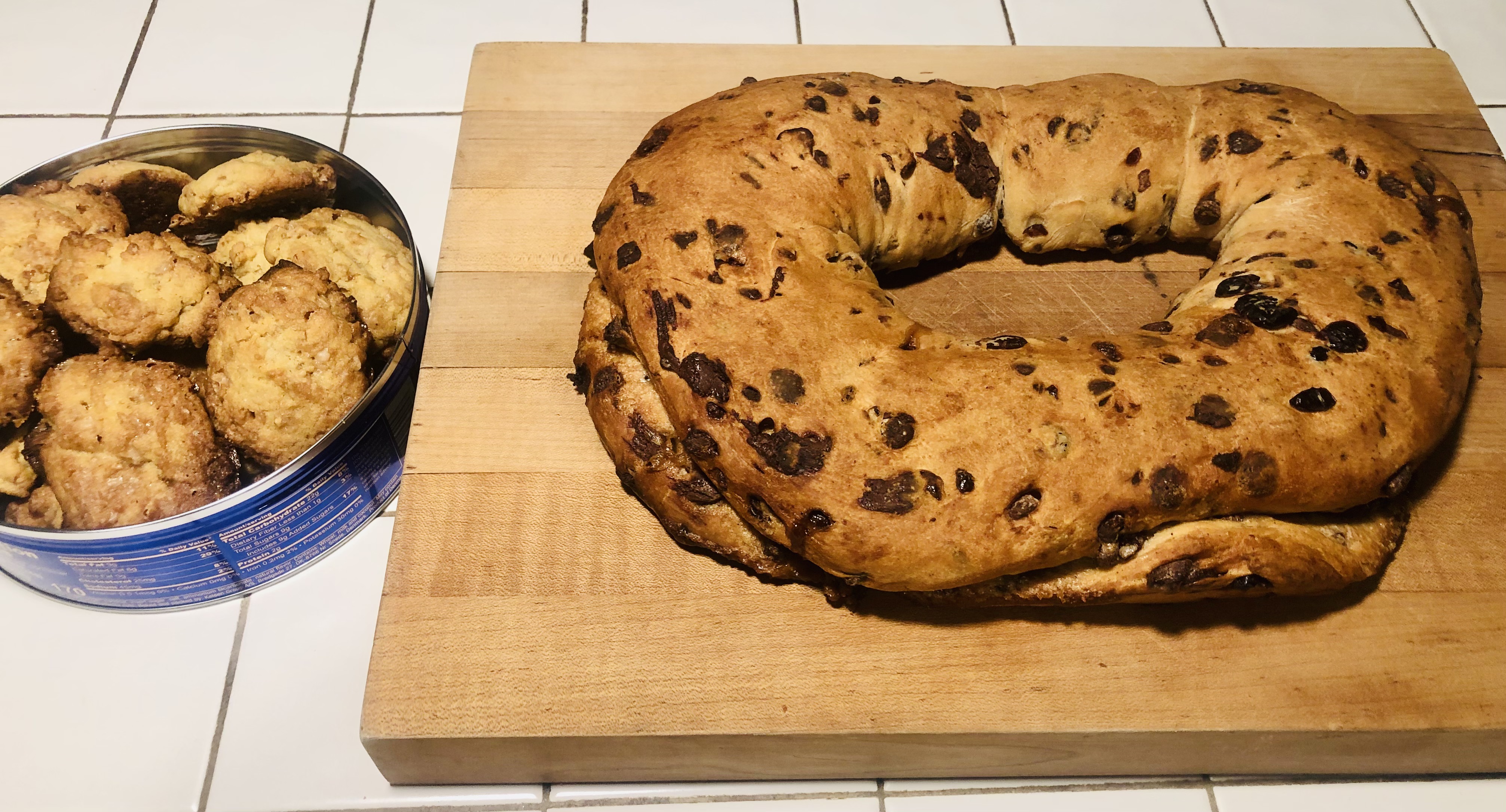
I did make Julkage, a traditional Christmas bread/cake from Scandinavia. So there's that, at least. Oh, and cookies: the "forbidden cookies" that my wife remonstrated against me making until late this afternoon, when she confessed she really wanted me to make her some. They're exactly like chocolate chip cookies except for substituting Heath bar crumble in place of chocolate chips. The last time I made a batch they were gone before I even got a single cookie.
And though this went well back before Advent, I finished bottling the Christmas Mead.


Philosophers Under Fire
A mass shooting in Prague happened at the philosophy department of a major university.
An armed man opened fire in a university building in downtown Prague on Thursday, killing at least 15.... The bloodshed took place in the philosophy department building of Charles University, where the shooter was a student....Police gave no details about the victims or a possible motive for the shooting.... Czech Interior Minister Vit Rakusan said investigators do not suspect a link to any extemist ideology or groups.
The Czech Republic has a constitutional right to bear arms, although you have to take a test to show you are worthy. Many US states -- including North Carolina, where I live -- impose such a test on concealed carry licenses, but allow ownership without testing as long as you aren't disqualified by being a felon or similar.
The Czech system generally works very well: as the second article points out, in a country with a population larger than New York City that had only seven gun-related homicides the previous year. There will of course be a push to enact further restrictions after this, since gun control advocates all think alike and can never resist using any tragedy to push their agenda. The fact that this system is normally highly effective while also respecting a key human right is of no interest to them, because they are devoted to eliminating that right from existence.
Philosophy departments are normally argumentative spaces, where people clash about the most important ideas in sometimes stark ways. It is perhaps surprising that there isn't more violence associated with them. However, philosophers generally understand the value of freedom of speech and thought, and usually tolerate such differences well -- even conservatives can exist in a philosophy department, which is basically not true in most liberal arts academia. I always admired that aspect of the thing: you could hear a Marxist field their arguments, followed by a conservative Jew, followed by a utilitarian who formally rejects both of their frameworks; and you could then think, freely, about which of their arguments really made the most sense.
I also carried a pistol in my jacket, just in case. Fortunately no recourse to it was ever required.
Now That’s How They Do It in Egypt!
I was an election monitor in Egypt in 2018. The election was conducted in a verifiably secure and honest manner, as well it could be since they’d disallowed all opposition. The only other candidate was the President’s best friend, who — I am not making this up — ran on the promise that if he won he’d resign immediately in favor of said President.
If you’re losing as obviously as they are, and you feel as they do that this is the biggest threat facing humanity, I guess you go all the way. ‘Our side can’t win, so let’s not play the game.’
For a scholarly discussion of this question, here’s Eugene Volokh. UPDATE: A counterargument by Lawrence Tribe and J. Michael Luttig. I think Volokh is stronger on the merits, but consider both views.
Cleaning the Augean Stables
Commenter juvat asked the other day if it was possible to redirect the Potomac to wash away DC. Turns out they’re already on it. When they were building the African American Museum in DC, they broke through a subterranean barrier and unleashed hydraulic forces that threaten to destroy the Federal district.
No really. It’s the lead story in the Washington Post.
Philosophy and Pseudonyms
Aeon publishes a piece that, inter alia, points out that philosophers have often liked to use pseudonyms.
[W]hat might the forging of a work of philosophy be, beyond attributing the work to someone else, à la pseudo-Augustine or pseudo-Aristotle? If faking a painting gets you something and faking a passport gets you somewhere, what does a fake work of philosophy get you?Presumably, what we care about most in a philosophical text are its arguments, its attempts to get at the truth and its means of getting there. If the argument is what interests us, then should the authorship matter, given that the argument is exactly the same, regardless who wrote it? Of course, historical context is important, both for understanding how the text might have come to be and what the text means. But unless this exploring of context is employed in the service of understanding and elucidating the arguments, we are treating the work as a historical curiosity rather than a source of insight. In the case of the Ḥatäta Zera Yacob, this would be a mistake, for the arguments are powerful and abidingly relevant. These arguments – about the causes of human suffering and conflict, the epistemology of disagreement and the twin temptations of relativism and blind absolutism, the relation between the world and our cognitive faculties – are precisely what tends to fall out when the discussion of the Ḥatäta focuses exclusively on the topic of authenticity.
There's a whole tradition of philosophical interpretation that turns on the idea that philosophers often speak ironically in order to avoid actual death. It goes back to Plato:
Irony is both a figure of speech and a mode of existence or attitude toward life. Deriving from the ancient Greek term eironeia, which originally referred to lying, irony became a complex philosophical and rhetorical term in Plato’s dialogues. Plato (428/427 or 424/423–348/347 BCE) depicts Socrates deploying the method of elenchus, where, rather than proposing a theory, Socrates encounters others in conversation, drawing out the contradictions and opacities of their arguments. Often these dialogues would take a secure concept and then push the questioning to a final moment of non-knowledge or aporia, exposing a gap in a discourse that his interlocutors thought was secure. Here, Socratic irony can be thought of as a particular philosophical method and as the way in which Socrates chose to pursue his life, always questioning the truth of key ethical concepts.
Socrates famously did not manage to avoid death even through the use of this method. The fact is that philosophy done seriously is very dangerous: speaking the truth always is. There are times and places in which it can be done without fear -- I think Immanuel Kant is especially sincere and fearless, partly because he had nothing to fear. It is not only Socrates who was actually killed for speaking what he took to be the truth. Of course in this season we also think of Jesus, and it was not only the two of them either.
The adoption of a pseudonym, perhaps more properly a nomme de guerre, offers a better defense than irony. It offers an ability to limit the negatives of speaking honestly and freely. It is imperfect, but in an important sense it is better than irony because it doesn't mean speaking indirectly or deceptively. One can be straightforward.
Diplomacy and peacemaking also has sometimes turned on the incognito, in which even a sovereign can say outright what they could never say while performing their role as king or president. The President nor his ambassador may never say certain things, but a nameless man can do so; and sometimes those are the things that desperately need to be understood, and therefore have to be said for the utmost benefit of all. A mode that allows a king or the President to speak freely for a moment without attribution can save the lives of many.
Philosophy is much the same. It can be a desperate business even in relatively good times. In the times when it is needed most, all the more.
Subscribe to:
Posts (Atom)