


Sensitivity / Care Ethics III: Rhetoric and Politics
It is possible, I said, to make a distinction between moral philosophy and rhetoric, which is to say a distinction between the pursuit of truth and the pursuit of politics. Rhetoric is the methodology of politics, at least the happier side of politics. Von Clausewitz was right that war is politics 'by other means,' but rhetoric can be more persuasive than an army with guns. This has been true since at least Aristotle's time.
Of old, the demagogue was also a general, and then democracies changed into tyrannies. Most of the ancient tyrants were originally demagogues. They are not so now, but they were then; and the reason is that they were generals and not orators, for oratory had not yet come into fashion. Whereas in our day, when the art of rhetoric has made such progress, the orators lead the people, but their ignorance of military matters prevents them from usurping power; at any rate instances to the contrary are few and slight.
What that means is that superior generals were unable to use their skill at war to overthrow a popular leader, and the popular leader was incapable of managing a competent military action.
This is probably true today. Should the US military decide to overthrow the government by coup the populace would reject it, and they would do so because of the many fine words that they were raised with about the value of democracy. The military would be faced by titanic protests in the street, and even if they responded with force they would only see the population shift to other means of resistance. That is true, I think, even though our great orators are all dead, and our current leaders mouthing slogans that they do not really believe.
Nor can these people successfully host a coup, being ignorant; their clear attempt to convey their preferred outcome in 2020 has led only to a hapless "January 6th Panel" dragging on forever, while effective systems of response are being derived to prevent such 'fortification of democracy' from occurring again. There was a moment when Washington D.C. looked like an armed encampment, with soldiers and walls drawn up about the Capitol, but they eventually did not understand how to cement their revolution. They just kept tottering on the road they thought they knew.
So, rhetoric is much more powerful than people sometimes believe; and if it often empowers incompetent but persuasive people, at least they are less able to cause harm than a talented general might be.
Thus it is reasonable to look at rhetoric as a way of responding to advocates of Care/Sensitivity Ethics, even if the ethics themselves do not merit great consideration.
Sensitivity/Care Ethics II: Moral Philosophy
In the comments to last week's post, Tom raises a concern that the discussion did not point to a way forward. I thought it had; my sense was that we already have several ethical systems that insist on the supremacy of morality, all of which include some way of handling the issue of caring or sensitivity. I think the logic of reducing a moral concern like 'speak the truth' to a level playing field with social concerns about expressing feelings of care is sufficiently deadly that no further consideration should be given to the proposition that Care Ethics be taken to be a serous alternative to existing moral philosophies.
Tom says that he thinks that you have to find a way to give them something in order to be persuasive. It is possible to distinguish between the work of moral philosophy (on the one hand) and rhetoric (on the other). Moral philosophy can dispose of views that prove to be incoherent or unworkable, at least a philosopher can do so. Utilitarianism, one of the three major schools of moral philosophy in the West, somehow continues to have a certain number of proponents who keep trying to find ways to make it work even though it is expressly incoherent (i.e., it requires you to judge actions by their results, which in fact you can't know at the time you have to take the actions). I don't feel the need to take it seriously or consider that it might prove to be workable if you kept fiddling with it, but I do like J.S. Mill all the same.
This one is also incoherent: its stated goal is to increase social harmony and general caring/empathy, but by dethroning the practical reason that we all share in common they remove the only standard of judgment that is the same for everyone. By shifting these conflicts to the irrational areas of feeling, conflict is assured because feelings differ (and often strongly): the social harmony they take as their goal dissolves into the kinds of endless disputes we were talking about last time; the appeal to empathy for 'others' leads to people saying the worst sort of offensive things to the person they are actually talking with right now.
The Humbling River
In truth almost nothing I’ve ever done was as humbling as my Swiftwater rescue technician certification. I earned it, but I earned it the hard way.


Probably not mask time again
If I did a chart of frantic media messaging on COVID (or, increasingly, random respiratory disease panic) over the last couple of months, the spike would hit the stratosphere. The CDC reports of COVID hospitalizations, however, show essentially no trend for those under 75, and a hummock dwarfed by last winter's spike for those 75 and over.


On the Road
I shall be traveling to DC for a few days. This is the first time in three years. I don’t believe that any of you reside there, but shout out if you do.
Some Thoughts on Sensitivity Ethics
A number of interactions and observations online lately have me thinking about sensitivity to others' feelings as an ethical duty. By chance these both arise from the intersection of fantasy worlds and women, though I don't mean to suggest that the women are responsible: in at least one case, it seems to be entirely or almost-entirely men fighting with each other about the portrayal of women.
One of these has to do with an interpretative theory I have about the scene in the Lord of the Rings where Eowyn and the Witch-King of Angmar fight.* I will describe only at the end and after the jump as I have observed that it upsets some people. You can read it if you want, or not. The point is that some people, both women and men who think themselves to be standing up for women, strongly object to this theory. I advance it only because I think it is the correct view of this particular scene, not as part of a broader agenda to speak about the role of women in Tolkien, and especially not to speak about the role of women in general. Yet some women, especially feminists who love Tolkien and for whom this is Tolkien's redeeming moment, strongly object to this theory. Men (who, I believe, mostly want the attention of these women) often also stridently object to it without showing an ability to produce strong evidence against it.
The other one has to do with a group on FB that is for people who grew up playing D&D in the 70s and 80s. It is chiefly a place for nostalgia among what are now middle aged or older men, and my own nostalgic love of the old books and works is strong enough that I continue to show and and look at it even in spite of the several problems I shall describe.** One of the things that people are often nostalgic about is the artwork they remember from these works, on the covers of books, or in allied works like Conan and Red Sonja comics. This occasions regular, indeed almost endless, objections as those works often posed women in improbable forms of maille armor, chain, scale, or otherwise. There is both a Woke group of older men (one imagines bald men with grey ponytails, but perhaps that is unfair) and a Christian*** one who objects to such displays as being an affront to the virtue of chastity. Given the demographic -- 70/80s D&D players -- there are almost no women involved, just as there were almost none involved back then. They can't seem to shut up about it and leave it alone, neither the side that likes to post the old artwork, nor either of the sides that object to them.
More winter traditions
The whooping cranes arrived several weeks ago. A friend just posted this picture on Facebook to show how truly huge they are. This picture was taken within a mile or two or us, I think, where they've been hanging out pretty consistently:
 You can see that our local oaks are still looking a little beat up on top, but they're slowly recovering from the hurricane five years ago.

Christmas prep
Strictly speaking, "Christmas prep" is "Advent," but I'm talking about housekeeping matters. I was just about to post an account of our latest foray into pepper sauces when I saw Grim's post about mango hot sauce, which happens to be one of the two we made this year, along with a sweet-and-sour chile sauce. Actually, both are sweet and sour, but the second sauce is tomato-based. Greg made it into a killer sweet-and-sour pork last night, quite fiery. The pork was flour-dusted rather than batter-fried, and I was skeptical, but it was great. If we ever try to serve it to guests, we may tone down the heat a bit. This ended up about as hot as Vindaloo, which suits us both.
We mailed off batches of both kinds of hot sauce to various relatives. (All parcel mailing complete by Dec. 12, a record!) The sauces we've been making since the pepper harvest began to arrive are from this fermented hot sauce cookbook. These are easy recipes, using either with a specialized crock or just a Mason jar that you burp daily for the week or two of the ferment. Usually you cook or blend up the ferment with fresh ingredients when its time is up. You can use fresh or dried peppers.
In other holiday prep news, I set up a dog-proof miniature tree grove on top of the piano for all the little disks I painted last year. They didn't seem to blend well with the crystals and snowflakes on the bigger trees. One display is transparent, lacy, and pastel while the other is large, opaque, regular, primary-colored, and blunt-edged.
 I continue to produce about one snowflake a day.


Grim's Christmas Barbecue Sauce

Cast iron cooking gives the best flavor.
A year or so ago I posted a recipe for barbecue sauce. I have a Christmas version that differs slightly, which I made today in order to ship as gifts. I've also refined my technique slightly as I will explain. Here are the recipes, both the Christmas version and the original for ease of reference.
Grim's Christmas Barbecue Sauce
Tomato powder (see note) or 1 can (8oz) tomato paste
Several cups brewed black coffee (more if using tomato powder)
1 tbsp packed brown sugar
1 tbsp blackstrap molasses
1 tbsp onion powder
1 tbsp garlic powder
1 tbsp chipotle powder (a smaller amount of cayenne would be more typical for a Georgia sauce, but the larger quantity of chipotle adds to the smoky flavor)
1 tbsp smoked paprika
1 tsp chili powder (or just ancho chili powder)
1 tsp black pepper
Small shot, Apple cider vinegar
Full shot, Rye whiskey
Salt to taste
The major differences from the original are the addition of Rye whiskey, the increase in smoked paprika to a whole tablespoon, and the use of tomato powder.
This last is an innovation my wife and I have discovered as part of our ongoing Victory Garden efforts. I always make many gallons of spaghetti sauces and various salsas at tomato harvest time, which I can in an over-the-top water bath as it is sufficiently acidic for that method. We still have lots of tomatoes. In the past I've run these through a dehydrator and sealed up like sun-dried tomatoes, but this year my wife learned to make them into tomato powder instead. By crushing the dehydrated tomato slices into powder, you can seal them up with an oxygen absorber that can almost entirely eliminate oxidation. The powder is then shelf-stable for up to 25 years.
At first I didn't know what I'd do with tomato powder, but it turns out to be a real advantage in the kitchen. It allows for a very fine control over both the tomato-y-ness of the sauce, stew, chili, or whatever else you are making; and it's a great thickener. You can add another dash, a teaspoon, a cup, or whatever else you'd like to achieve the desired thickness and tomato flavor. I highly recommend it.

Tomato Powder.
I also learned to make Hungarian Chicken Paprikash this year, and learned thereby that you can use much larger quantities of paprika to create a richer sauce. I thus tripled the amount of smoked paprika (and only smoked for this version: with the chipotle, it gives the sauce a spicy, smoky kick).
The original sauce was a Georgia-style spicy tomato-based barbecue sauce. The major difference between that style and the eastern Tennessee style is whiskey. This version is for gifting, and all my family is from east Tennessee. I tried Tennessee whiskey in it, but the corn flavor is unpleasant to me. Rye whiskey compliments the spiciness nicely. I used Bulleit Frontier Whiskey Rye.
If you use the 8oz of tomato paste, you'll only need maybe four cups of coffee; if you use the tomato powder, you'll need to add quite a bit more (or hot water if you prefer to keep the coffee content near the original). Once it's all cooked together, adding water and/or tomato powder to give it the desired flavor and thickness, this should produce almost exactly one quart of sauce. I recommend dividing this into two pints and over-the-top water canning it, which allows it to be stored or shipped as gifts to appreciative family or friends.
The original recipe is below for ease of reference and comparison.
Grim's Barbecue Sauce (Original)
1 can (8 oz) tomato paste
Several cups brewed black coffee
1 tbsp packed brown sugar
1 tbsp blackstrap molasses
1 tbsp onion powder
1 tbsp garlic powder
1 tbsp chipotle powder (a smaller amount of cayenne would be more typical for a Georgia sauce, but the larger quantity of chipotle adds to the smoky flavor)
1 tsp smoked or hot paprika
1 tsp chili powder (or just ancho chili powder)
1 tsp black pepper
Small shot, Apple cider vinegar
Salt to taste
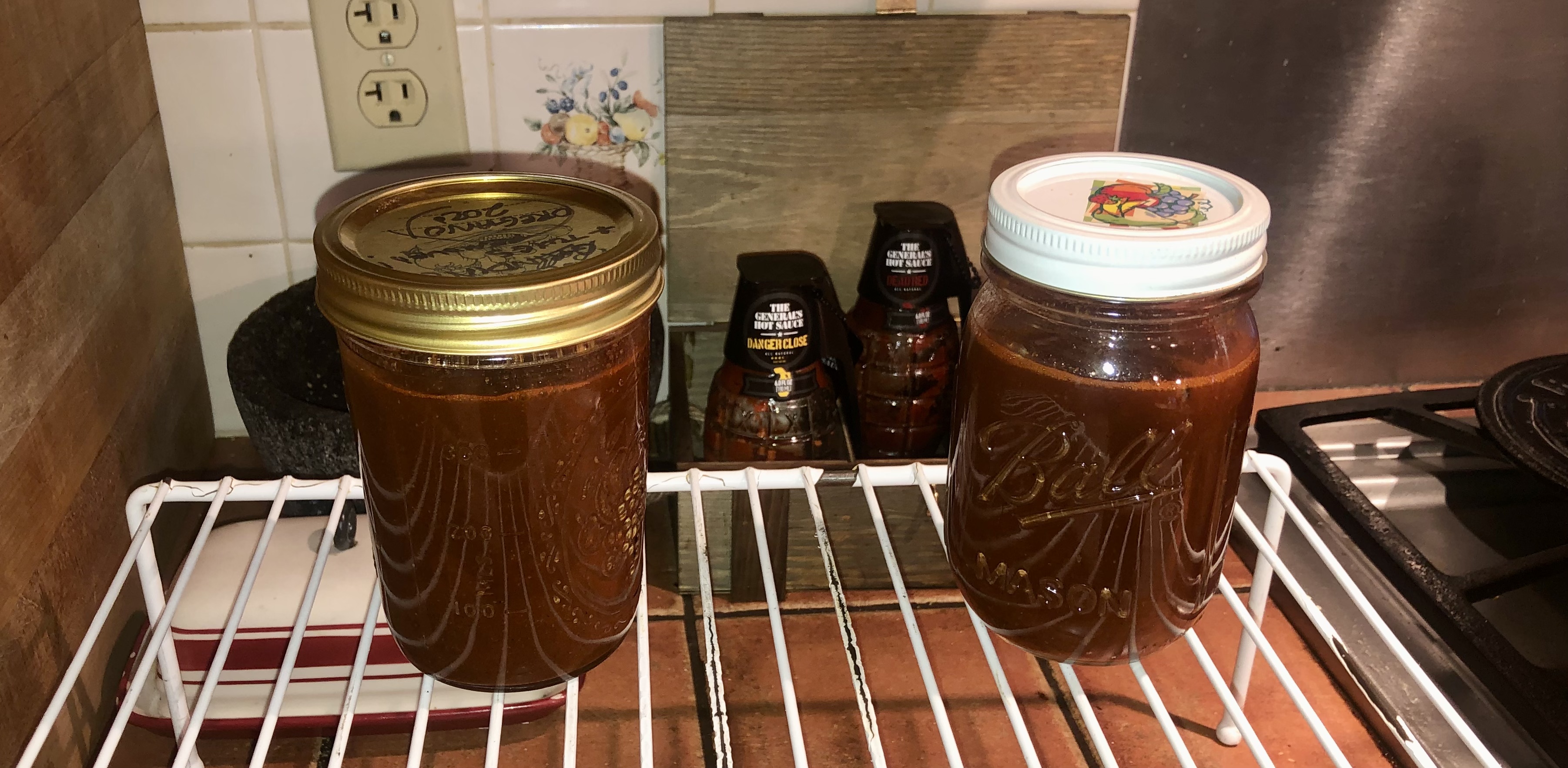
Canning complete.
UPDATE:


草泥馬
When we lived in China many years ago now, my wife and I encountered a form of Chinese humor that is really quite dominant there: the homophonic pun. Chinese is a monosyllabic language: every character is named by a syllable, and there being only so many monosyllabic sounds you can make, many of them sound exactly or almost exactly alike. Some of them differ in tone -- Chinese is a heavily tonal language, with a big difference in meaning possible if you employ this tone instead of that one in sounding the word. Others of them don't differ at all, and you just have to know that two different meanings are possible.
An interesting work project lately has been researching Chinese anti-regime online protest language. An important figure is the mythical Grass Mud Horse, which fights the evil River Crab. The words for "River Crab" are a homophone for "Harmony," the excuse the regime uses for censorship online; and the words for "Mud Grass Horse" are a homonym for "F*** your Mother."
Also, the Chinese Communist Party is colloquially referred to as "Mother."
The Cantonese dialect -- like many dialects -- uses the same writing system as Mandarin and all* the other Chinese languages, but the characters are pronounced differently by verbal speakers. What that means practically is that a whole different set of puns are possible if you speak Cantonese, like they do in Hong Kong, and the Mandarin-speaking Party elites can't really censor them because they don't understand the jokes. They don't realize what is being said, and so Cantonese protest puns are going wild right now in spite of the whole PRC Great Firewall effort.
* Except Cantonese as used in Taiwan. This uses the original, traditional form of the written language; all of the People's Republic parts have switched to 'Simplified' Chinese characters. For example, the Chinese people is written in Simplified Chinese as 汉人; in traditional Chinese 漢人.
Easy tree
Putting up and decorating a large, natural Christmas tree was fomenting domestic discord, so for the last several years I've been experimenting with faux bare-branch beech trees. This tree uses mostly crocheted snowflakes, paper Froebel stars, and crystal pendants.


A Partial Defense of E-Cars
The author is not successful in establishing his thesis, which would require a defense of the massive issues around batteries and e-waste. He does, however, have an interesting claim about power generation. A regular critique is that electrical cars are powered mostly by electricity generated with coal. He points out that, even if it were 100% coal-generated power, e-cars would still have a significant advantage.
Even if you only ever burned coal to create the electricity to power EVs, that's still less CO2 than is released by burning gasoline.... ICE ['internal combustion engine'] vehicles only send between 16 to 25 percent of the energy created from burning gasoline to the wheels. The other 75 to 84 percent is lost due to inherent inefficiencies. Most of the loss is heat and noise, although about 10 percent is sacrificed to stuff like drivetrain losses, essentially the difference between crank horsepower and wheel horsepower....
Electric vehicles (eventually) send 87 to 91 percent of the energy in the battery to the wheels. I say "eventually" because 22 percent of that energy needs to be "recaptured" through regenerative braking. Put another way, 31 to 35 percent of the energy stored in the battery is lost for various reasons, but 22 percent can be regenerated by the "brakes."... To summarize, replacing gasoline with coal (which, for the record, is an abysmal idea) would reduce energy usage by 31 percent. Another way to think about it: Right now, Americans use about 9 million barrels of oil a day for our automotive transportation needs. Magically switching to EVs charged via burning coal would result in only needing the equivalent of about 6 million barrels. That's a big reduction.
That seems like a significant rebuttal on the one point, at least.
Subscribe to:
Posts (Atom)