I propose that points be awarded on a scale of how many vehicles are able to pass relative to how many stupid climate protesters have been removed.Video of competitive performances at the link.

Plonkerdump
A new sport takes shape (h/t Instapundit).

The Feast of St. Andrew, 'Là Naomh Anndrais'
Today is the Feast of St. Andrew, which is also a national holiday in Scotland. For those few Scots who still speak Gaelic, which has not been taught as a nationalistic project as in Ireland, the day is called 'Là Naomh Anndrais.'
The relationship between St. Andrew and Scotland is a little attenuated, somewhat like the relationship between England and the Holy Grail. That latter depends on the person of Joseph of Arimathea, who supposedly brought the Holy Grail to Glastonbury for safekeeping. In Andrew's case, some of his remains were supposedly brought to Scotland long after his death, and a Pictish king once asked him for a favor in return for naming him the patron saint of the land, and the king felt like the saint had kept his part of the bargain.
Emergency!

Today we had an emergency medical call to a house in a remote mountain community, one where most of the houses are out of sight of the main road. The address was garbled by the radio, which doesn’t always work well among the mountains anyway.
The house was easy to find, though, because of the correct use of the inverted American flag. I’ve never seen that signal used properly before, but this is exactly correct.
Shattering lies
I've been reading excerpts from Vaclav Havel's work for decades, so I guess it's time I read his epochal book, The Power of the Powerless. A Maggie's Farm link took me to an Australian site called The Quadrant, where I found this rumination on Havel:
The sense of personal responsibility—together with the refusal to accept the ideology’s lies— provides many small opportunities to begin to live authentically, honouring one’s own and other people’s better nature. The rulers cannot tolerate this honesty; their system is built on falsehoods, so any truth proclaimed anywhere is a danger. The proclamations may be small; for example, someone says that the state-run brewery produces terrible beer; or that the concerts organised by authorities are tedious compared to amateur music nights; or that elections are farcical. These truths are prosaic—beginning to live in truth usually is—but they signify a shift. And they have an odd, disproportionate potential because any system founded on falsehoods will always be subject to recurrent social, cultural, economic or legal crises barely restrained by the crust of lies. A small truth enacted “in the ‘hidden sphere’, in the semi-darkness where things are difficult to chart or analyse” may have huge effects with surprising speed. This hidden sphere—of real human vocation involving communication, trust, choice and freedom—is obscure but omnipresent; it’s the everyday sphere where the genuine aims of life burst beyond the aims set by the system. It’s the powerful ally of truth.From the book itself:
What is this independent life of a society? The spectrum of its expressions and activities is naturally very wide. It includes everything from self-education and thinking about the world, through free creative activity and its communication to others, to the most varied, free, civic attitudes, including instances of independent social self-organisation. In short, it is an area in which living within the truth becomes articulate and materialises in a visible way.The strongest thread in my personal political philosophy is the primal importance of voluntary human institutions: "independent social self-organisation." Government can facilitate them by imposing a certain amount of order and coordination, but it can't replace them and must never crowd them out. No system of external order can make up for the chaos and violence that emanages from empty people with empty lives. We have to be responsible for ourselves and deal with each other on the ground of "communication, trust, choice and freedom." This is why I trust a free market over any other economic system: it requires people to bargain and persuade rather than dictate. It can't relieve us of our duty of generosity and disinterested mutual support, but then neither can a supposedly compassionate socialist safety net.
Electric Vehicle Revolution
It's probably less significant than you think, even if you're a skeptic.
A Knoxville Girl
My mother was one, more or less. Technically she was from Bearden -- "Bear den" -- which is a bit south of the city limits. If you know the Ballad of Thunder Road, the closing action happens there: down Kingston Pike, at Bearden is where the Federal police 'made the fatal strike.'
The family history around moonshining is simple: none of my kin made moonshine, but my father's father was a welder who spent Prohibition welding stills. Given the overlap with the Depression, it was the only paying work.
Early Decorations

I had wanted to locate the tree more centrally, but a certain fuzzy grey bandit requires that I keep it lashed to the wall if I don’t want to clean it up every morning.
He’s not even sorry, the scoundrel.

“Gandalf,” obviously.
Advent Begins
I never realized before now that the beginning of Advent also begins the liturgical year, but that makes a great deal of sense.
Hard on Equipment
As I may have mentioned before, a good friend of mine builds electric motorcycles as a hobby. (He and I have a lot in common -- I met him in the philosophy program some years ago, and he's the one who got me into Strongman competitions.) He's been doing everything out of his home shop with hand tools, and was mentioning today that a fender he installed required 21 bolts. I suggested a mini-impact wrench and some impact sockets for a Yuletide gift to himself.
Since some of you may be looking for gift ideas for a man in your life (or a statistically-unusual but not unheard-of woman), here is what I use.

The blue one is the Makita XDT11. The smaller red one is their XDT15. The smaller one is a better choice for bikes because it also has three power levels, which can help make sure you don’t strip or round off smaller bolts/screws. The bigger blue one is great for larger axle bolts on bikes, or general work on your truck.
My son prefers the American-made Milwaukee alternatives; they're heavier, but he thinks also stronger and more powerful. My sense is that there's plenty of power already for motorcycle bolts, which are often quite small. If anything I think the key issue is to balance the power you bring to the task with the risk of damaging the equipment (e.g. the bolt-stripping/rounding I was talking about).
That boy is, now that I think of it, hard on equipment. There's an appropriate Corb Lund song.
Maybe it's one of those things you learn with age and experience.

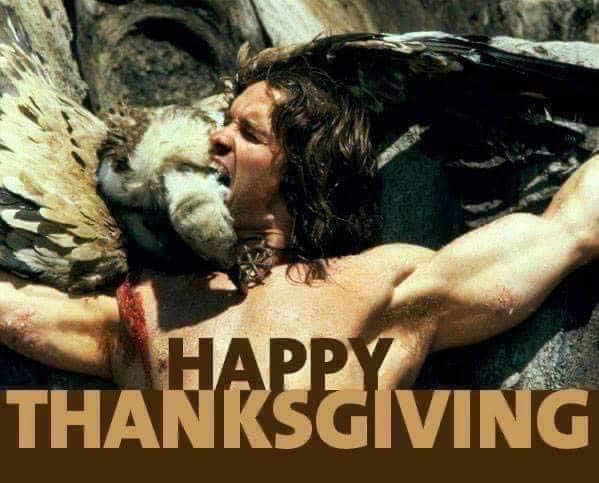
Go to the threat
It's not what I would do, I'm sure. It's a good thing everyone isn't like me. And here is my problem child, the most recent dog, who still can't get along with the others:
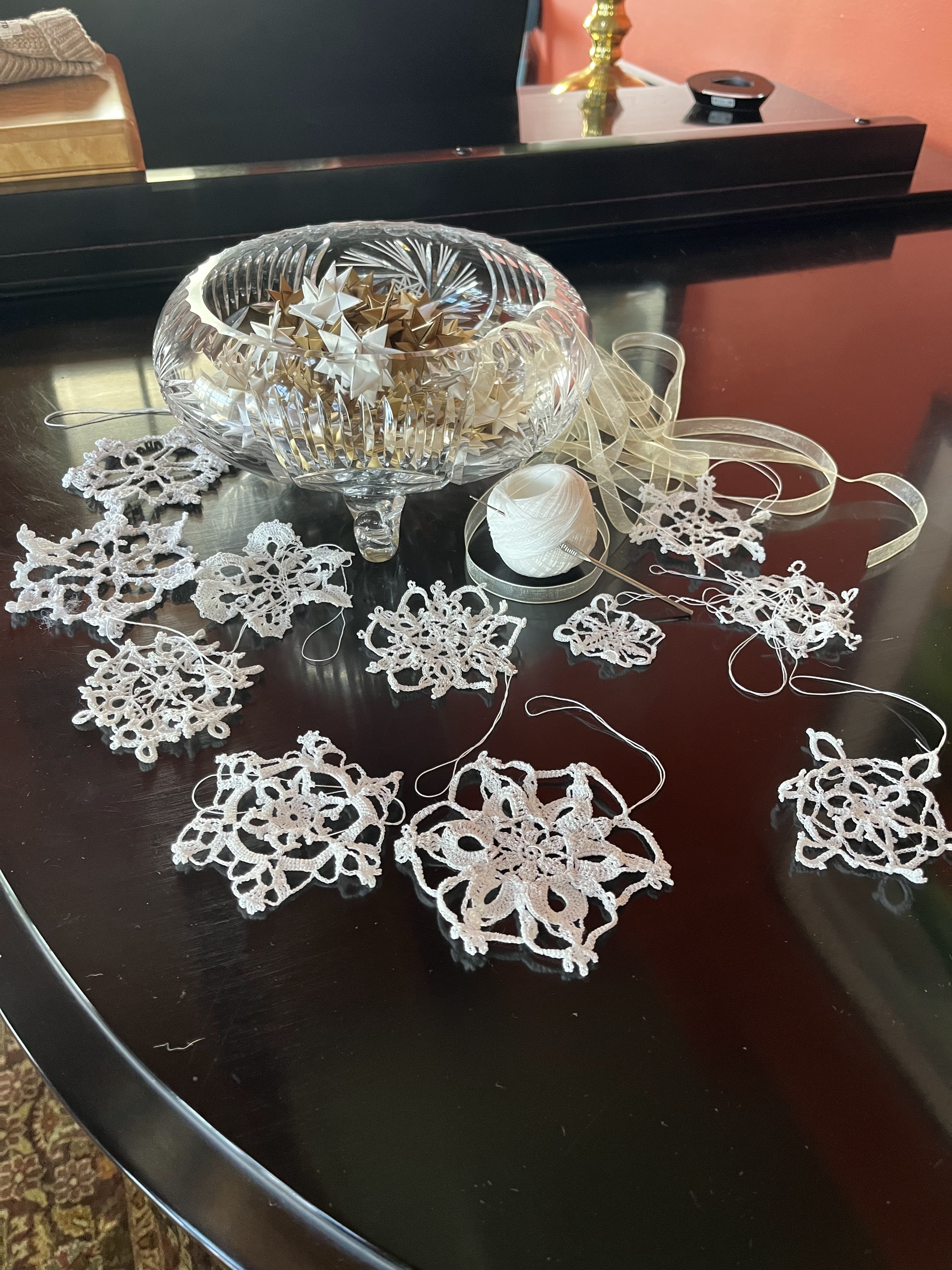
 One last picture: my production so far this season of Froebel stars and crocheted snowflakes:
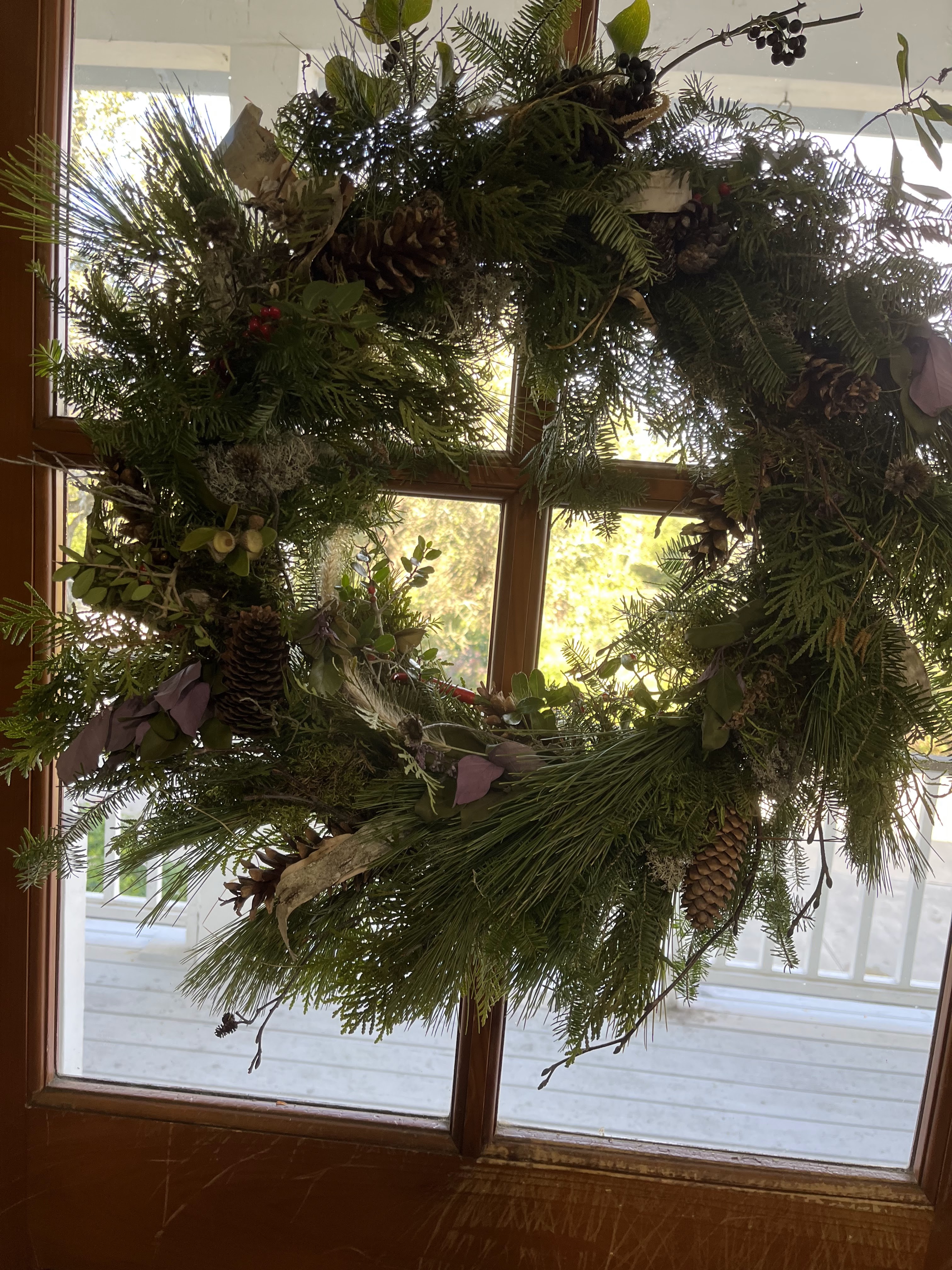
“It’s the reflex. Go! Go to the fire. Stop the action. Stop the activity. Don’t let no one get hurt. I tried to bring everybody back,” he said Monday outside his home in Colorado Springs, where an American flag hung from the porch.Funny how I see this story as about an eelbrain who was kicked back on the street last year for no good reason but finally stopped in his tracks by a random good citizen trained to use violence quickly and decisively for the public good. The press sees it as about the victimization of an imperiled voting bloc by a guy they'd love to portray as a member of the alt-right. Happy Thanksgiving to all. As we often do, we're having a three-household gathering with our nextdoor neighbors, potluck. Greg is roasting a second turkey today. He wants to try a new recipe but felt I would object to abandoning the traditional one, which is fair. He's been brining and spice-curing a turkey for decades, now, and it's inimitable, but I'm looking forward to seeing how a John Besh recipe turns out. We'll bring over Spinach Madeleine and Presbyterian Green Beans. I made a little cranberry relish the way I like it, though probably no one else will eat it: fresh cranberries and a whole orange in the blender, with some sugar, crystallized ginger, and something for heat--in this case a dash of sambal manis. No need to cook it. So far November has looked more like February: gray, drizzly, and rather cold. The winter vegetable crops are loving it. We may even get a crop of fall tomatoes. Today the sun has come out, so now it does look like November in South Texas. After a fresh wreath arrived in the mail this week, I scoured the yard for interesting berries and husks to add to it.
 And here is my problem child, the most recent dog, who still can't get along with the others:

Actual "Journalistic Integrity"
A reporter assigned to craft a hit piece mistakes her job for actual journalism, and does that instead. There's a man-bites-dog story for you.
Never Try to Intimidate a Man in a Tam O'Shanter
"A man walks down the street in that hat, people know he's not afraid of anything."
-Wash
The Hunter Biden laptop story is likely to take on a new life when the Republican House takes its seat next year and gains investigatory powers. A central figure in that story is the laptop repairman, John Paul Mac Isaac, who turned the laptop over to the FBI, and eventually a copy of it to the press after the FBI "lost" their copy. Apparently he had some reason to suspect that they might given their treatment of him.
Mac Isaac described one of his first interactions with an FBI agent as "chilling." He said he was "overjoyed" when the agents handed him a subpoena, and he made a comment that he would change their names when he eventually wrote his book."That's when Agent Mike turned around and told me that, in their experience, nothing ever happens to people that don't talk about these things[.]" ... The comment, Mac Isaac suggested, was a warning against speaking out about what was going on.And while Mac Isaac has said that Americans should be able to go to authorities without fear of retribution, he has experienced otherwise."I have been dealing with retaliation from multiple fronts for the past two years when what I did was leaked to the country."
I don't know if he was wearing that hat when the FBI talked to him, but if he was they were fools to try to threaten him. You don't tug on a man's kilt for much the same reason.
Notes from Gutenberg
I came across this in a Gutenberg project I'm working on, about pictures:
"... Rossetti saw the Blessed Damosel leaning from the gold bar of Heaven with eyes farPainting and poem here.Deeper than the depth Of waters stilled at even; She had three lilies in her hand, And the stars in her hair were seven."
“We Are All Different…”
…just like everybody else.
The article, if you like, is about why nonconformists like hipsters end up looking just alike even as they're trying not to conform. There can be mild variations, but they end up affecting a style that is quite conformist within its subset. A fellow has a mathematical model that seems to show that in any such case, conformity ends up resulting.
I don't know how good the model is, and I don't know what its assumptions are. But nonconformist groups -- defined as groups that reject mainstream society in some significant way -- have a lot more need to be able to identify each other than mainstream people do. If you're part of the mainstream, you can just assume that most people you meet will be on the same page. If you're very much not, it can be a matter of survival, flourishing, or even just comfort to be able to identify the few individuals out there who might broadly agree with you.
The visual cues exist in these subcultures because they're important, in other words. They have real natural selection value. So yeah, hipsters pretty much all look alike; and so do skinheads; and so do people who join the punk rock or metal fronts; and so forth and so on. So do highly orthodox religious dissenters, and not just for religious reasons. It's a matter of survival, and over untold generations humanity has learned it.
Two Views of Winter Trenches
I have no idea of how typical these two videos of the Ukrainian and Russian armies winter diggings-in are, but to the extent they are at least a little representative (I suspect they're actually extremes but that they do indicate essential differences), they indicate why a Ukrainian winter offensive would be highly successful, whereas a Russian offensive would...not be.
A Ukrainian trench: https://twitter.com/DefenceU/status/1593929751693258753?s=20&t=7kAnEz4gmLqqWZ8iqzIBMg
From a Russian surface camp: https://twitter.com/BorlandTrubo/status/1593931319427440641
The Russian text claims that, at the time the video was taken, it was -25 outside. Omsk is about 65 mi from Kazakhstan, so it's not an entirely fair comparison, but if this is typical of the preparation the Russian soldiers are getting enroute to the Ukrainian cauldron, I don't see how they can be effective.
Hence the barbaric assault on the Ukrainian civilian infrastructure, in an attempt to deny Ukrainians the fuel, power, and food necessary for winter survival.
Eric Hines
Drunken Poet's Dream
It takes some courage, as a poet, to substitute for a rhyme what is really an identity (as it does to substitute a near-rhyme, or a not-very-near one). I love that he acknowledges it in the text of the poem.
The Reverend Horton Heat chose to rhyme gas-oh-leen with sev-uhn-teen, which would have worked for mesk-ah-leen just as well. RWH has the standing to defy petty conventions.
Agency and Determination
The Orthosphere hosts a philosophical argument that skips an important step.
We theists recognize two general categories of causation: mechanistic (i.e., “cause-and-effect”) and agency (“ground-and-consequent”). Most people, including most God-deniers, will initially agree that these two categories are real, and distinct, and unbridgeable … until they see where the argument is going.From recognition of the unbridgeable distinction between mechanism and agency, I argue that agency cannot “arise” from mechanism – this is what the God-deniers who haven’t denied agency from the start will then deny and this denial can then be shown absurd and thus false – and thus that agency is, and must be, fundamental to [the] nature of reality.
The important step is the proof that agency cannot arise from mechanism (as he puts it); it is not obvious that this is true, and the fact that people might 'initially agree' to it doesn't establish it as more than an unchallenged assumption.
(By the way this frame is older than monotheism in the West: Aristotle explains causality in just this way in the second book of the Physics.)
Consider that, as far as we can tell, atoms have no agency. An atom of carbon or of hydrogen or oxygen seems to decide on nothing; it joins into bonds, such as hydrogen and oxygen forming water, for purely chemical and physical reasons. This is 'mechanistic' determination on the Orthosphere's model.
Yet water has properties that its components, hydrogen and oxygen, did not. Both of these are gaseous at room temperature, for example; water is liquid at the same range of temperatures. Water has the property of 'wetness,' then, which has somehow arisen from the bond between the things that both lack that property. We can say some things about how and why this happens, but that it happens is clear enough. New properties emerge from combinations that happen mechanistically.
Why, then, should not agency be a property that emerges from things that happen mechanistically? Other properties, even complex ones, seem to do this. The carbon joins into long protein chains, the water is joined with it, and (skipping a long discussion) eventually you have DNA. This has a new property -- the capacity to order things it encounters mechanistically into a design that is not random but follows a kind of 'intention.' This ability to take from the world and put things into the order that is also 'you' is called life (as explained by philosopher Hans Jonas).
If this kind of proto-intention can arise from what appear to be mechanistic actions, why not a real intention? Why shouldn't it be true that living beings of certain kinds have the property of agency, even though none of their components had it before they were joined and ordered into that form?
This is, by the way, a good reason to reject materialism: it is not merely the material that matters. All the same material -- all the same atoms of oxygen and hydrogen and carbon, etc -- if not ordered in this way lack the properties of life and agency. These only seem to arise when the right order is brought to them. Thus, the form -- which is not material, but the way in which the material is ordered -- exists and is causally important, and not only the material. Reality is not materialistic but hylomorphic as the ancients said.
This is not an anti-theistic argument or a theistic one; you can make both arguments from this ground. Perhaps a God is then unnecessary, and being unnecessary should be excluded according to Occam's Razor. Yet what explanation is there for reality having this strange quality, such that thinking agents can and do apparently automatically arise from deterministic material processes? Why should reason and decision be inherent in a material that does not need them, existing whether or not agents do? Occam's Razor is only a tool for gamblers, not a proof; and here it seems clear that unnecessary things do exist, because we experience being one of those things all the time.
Perhaps, then, reality has this order because the order was wanted; and if it was wanted, there must have been someone who wanted it. Someone who had the power to set this basic structure of reality, either through design or through will, or possibly merely through longing.
The AARP on Pineapple Express
I don’t think most of us who were involved are quite old enough for the AARP, but they have a personal and compelling story from Scott Mann, a Green Beret who was at the center. His book on the subject is soon to be published.
In fact it’s the same book that was coauthored by James Gordon Meek, the journalist who disappeared abruptly after an FBI raid on his house. He has been seen in the last two weeks, so I guess he’s not in GitMo, but there are still no answers to the questions produced by the raid.
Subscribe to:
Posts (Atom)