
One Would Need A Heart of Stone
It’s not nice to laugh at the sincere and earnest youth, but sometimes it can’t be helped.

The General’s Hot Sauce
Even by the standard of veteran-owned companies with a veteran-owned theme, the packaging here is super kitschy. Nevertheless I am going to recommend it because the product is high-quality.


Many commercial sauces use only around twenty percent pepper matter, and make up the heat with refined capsaicin oil so the sauce is thinner and hotter but not as thick and delicious. Others use engineered peppers like Carolina Reapers that are not as flavorful as the natural peppers. This one is more expensive than a bottle of big-brand sauce from the store, but it's pretty great.
Perfecting Nature through Reason
This came up at D29's place a couple of weeks ago, and I was reminded this morning when briefly noticing an article about Democrats making fun of Republicans for being gay. Both of the issues that raised this matter are small by comparison to the matter itself, which is a titanic thread of philosophical history that is in grave danger of being washed away by opposition to some of its conclusions.
In a country as divided as our own has become, even to describe the position as 'the right's position' is to immediately set much of the world against it before they've heard it, so they will spend their time looking for things to object to about it rather than first understanding it. But it is also being described as 'the left's position' -- the concern about mRNA being raised at D29's place is that it aims to perfect nature rather than accepting the consequences of living in a fallen world, and that this is a sort of Gnosticism. Both sides end up primed to reject a really important idea without thinking it through.
The idea is at least as old as Aristotle and Plato, was argued for by St. Thomas Aquinas, and in the Enlightenment by Immanuel Kant. It could still be wrong, but the best minds of human history have found it persuasive. In its basic form I can see nothing wrong with it. You may object to some of the outlying conclusions without rejecting the foundational idea; it is more likely, I think, that someone went wrong along the way to one of those outlying conclusions than that the heart of the idea is wrong.
So, the idea is that human beings have a nature; that nature includes access to reason, as well as parts that are not rational; and that the correct approach is to apply the rational part to trying to understand the irrational parts and correct them where they aren't quite right.
You can state this idea in ancient terms, Medieval terms, Enlightenment terms, and contemporary terms. There are important differences in how you frame it: for example, Aristotle would say that the parts of our nature each aim at some good, for example eyes aim at sight and the goods that come of seeing. A contemporary would want to say that nature doesn't properly "aim" at anything; yet even here, there is some good that explains why the random mutation that supposedly gives rise to sighted beings is a quality that persists and becomes a normal part of that kind of beings' nature via natural selection. The contemporary position is differently stated, but it is mostly so in terms of applying a technical layer of clarification to eliminate anthropomorphism.
It's not really harmful to understanding the point to say it just like Aristotle did, so long as you have the mental capacity to apply the various filters as necessary. Indeed, the best thing of all is to be able to phrase it in all four of these ways, appreciate why they are preserving the same idea, and entertain that each of them makes sense of the facts in ways that are compatible even though they differ on metaphysical conceptions of reality. It's just as likely as not that the contemporary way will be rephrased in the future, but I think this core idea will survive.
Crucial to this core idea is that the rational part of our nature can identify and correct the irrational parts. Our eyes are not, themselves, rational. It is reason that helps us grasp what the good is at which they 'aim' (or at which they were accidentally aimed by mutation and yet which has survived because the good they ended up 'aiming' at was a real good). Once we do that, we can use reason, and therefore technology, to improve the acquisition of the good.
Eyes as we all know see well or badly, some of them better than others; and typically they worsen as we get older. We are able to correct for many of these things with technology, restoring or improving the sight of our eyes to a high degree. This is a positive good. You can say that the Medieval way: because it is a natural good, recognized by natural reason and brought into alignment with the purpose of nature. You can say it the contemporary way: because sight is useful and why should anyone suffer who could be made to see better?
This gives us then a standard by which to judge the whole process of applying technology to people. This is where people come apart currently, especially on sexuality: the older view holds that you can recognize the good of the natural process by reason, and with sex there are multiple goods (Aquinas names three). Some people think that reproduction is the obvious choice, and object to technological meddling that interferes with or outright destroys the natural capacity to reproduce -- especially in the young, who may not be fully in possession of their reason yet and might not therefore be clear on what their own good really entails.
Other people think that reproduction is not, at least not currently, a good: the climate scare especially has many people thinking that virtue lies in not reproducing, but pursuing the pleasures that are another good of sex as if those were the primary good, and then passing peacefully into extinction with their whole family line. Even if it is not climate that motivates, a young person might decide they prefer pleasure to the long labors of parenthood; and not just in matters of sex. 'I want my life to be about me, not someone else,' means taking the pleasures and personal accomplishments of life as the primary good, and applying your reason to the question of how to obtain those.
In the long term the right will end up winning that debate because they will disproportionately survive into future generations. This process has been underway in Israel, for example, for generations now. It was founded by secular Jews, many of them socialists or Communists; it has trended ever rightward as they died off and were not replaced at the same rates as the Orthodox. Ironically this process proves which good is the 'real' good aimed at by nature on natural selection grounds especially; it is those who prefer the contemporary account who ought to be most inclined to recognize that the matter is settled on their own terms.
In any case, one should not walk away from the idea of reasoning from nature, in order to improve our lives through rational activity and thus technology. It is reasonable to be skeptical of new technology; it is reasonable to take time with it, to see how its long term effects play out before making a final decision about whether it is really rational to incorporate it into your life. It is not merely Gnosticism to do so, however; and it is not irrational to prefer the version of this account on which reproduction and future life are primary goods to guard.
New Appalachian Country Music
Outlaw rag Whiskyriff has a collection of some of the younger artists working today. I don't like all of it, I do like some of it, and I'll let you decide for yourselves if any of it appeals to you.
Heck of a Speech, Ma'am
Now you're talking. Her name is Giorgia Meloni.
I expect her references to 'speculators' will be said to be anti-Semitic, especially since she is openly Catholic and Christian. That was likely enough a hundred years ago when Europeans spoke of speculators, bankers, or even capitalists; these days it's not a code word for a race or a religious group, because there are speculators from all over the world. The objection to them undoing sources of human dignity as a way of making us rootless and helpless before wealth and power is reasonable.
She mentions how she is no longer allowed to be a mother, just 'Parent 1' or 'Parent 2.' I actually just filled out a Federal form today that insisted on using that exact formula for me and my wife.
UPDATE: A report from the opposition on their interpretation of your interpretation of this person many of you, like me, hadn't heard of before yesterday.
In the way of such things, I gather that 'most far-right leader since Mussolini' must have gone out in a distribution list as the approved way to describe her: the line appears here also, as well as 'first fascist PM since Mussolini.' So must have 'anti-LGBTQ' rather than 'pro-traditional family.' I didn't hear in the clip anything about gay rights, either for or against them; I did hear her talk emphatically about being a mother and not just a number.
Of perhaps greater interest, she's a big Tolkien fan. That piece of writing is around twenty-five years old, when she was quite young, so don't judge it too harshly. If she found her way from a youthful embrace of Tolkien and his fantasy to full-fledged Catholicism, she followed a well-worn path that was exactly what he'd hoped people would find in his work.
Halfway There
An essay called 'On the Idea of Equality' makes some important points. Equality is badly understood.
When I say, “One should not confuse equality with sameness,” my interlocutor frequently responds that such a banal truism is unworthy of articulation. I wish this were true, and that this moral principle were self-evident. But it is not.
Just a few days ago, the Atlantic published an essay skeptical of sex segregation in sports which concluded with the assertion that, “…as long as laws and general practice of youth sports remain rooted in the idea that one sex is inherently inferior, young athletes will continue to learn and internalize that harmful lesson.” The unstated premise of this argument is that empirical claims about differences between men and women are also moral claims about the relative value (inferior vs superior) of men and women.
Equality is said in many ways, and as he points out two people may be equally valuable as moral beings without being equally good at basketball. That points up the fact that equality of moral value requires someone who has the right standing to value someone: in the Declaration's formula, the Creator stands in that relationship. God values everyone equally, and bestows dignity and rights in one motion and in the same way for everyone. That kind of equality is true equality.
In the absence of God, the majestic State or the Law has to do this work. But the law does not, empirically, value everyone equally. The Law exists to discriminate between the honest man and the thief, the murderer and the victim. Justice such as laws and states are even capable of are not forms of equality, but forms of balancing: taking life or freedom or property from one, and bestowing it on another. Even when this is done as justly as possible, it is an act of discrimination and differently-valuing. It can of course be done quite unjustly.
The author is not concerned about that.
At one time, many believed that humans were equal because they were equal “in the eyes of God.” Then Darwin and secularism arrived, and today many people no longer believe in a literal human creator. But that does not vitiate the force of the moral claim that humans are equal. In fact, most of us would be appalled by the assertion that, “Since we know that humans are just evolved creatures, they do not deserve equal moral consideration.” Our endorsement of metaphysical equality is not tethered to belief in a benign creator. This is why we can continue to celebrate the eloquent defense of human equality expressed in the US Declaration of Independence while embracing evolution.
It's a bigger problem than he admits. Evolution is what has given rise to all these inequalities, especially the heritable ones he mentions as central. If people who are mathematically and empirically un-alike are to be truly equals, the equality has to be a bestowal. There aren't many metaphysical candidates who stand in the right relationship to us all to be positioned to make such a bestowal, to have both the power and the right.
Shape Note Singing


This is one of Tex’s things, and she can doubtless speak more intelligently about it than I can. All the same, here is a photo from today’s Mountain Heritage Festival at Western Carolina University. I tried to upload a video but it didn’t work.
A Cure for the Wokeness Problem in Corporate America?
TheNational Center for Public Policy Research may have found a brilliant solutionto the problem of woke corporate America- they are taking Starbucks to
court, arguing its discriminatory policies put shareholders at risk- Turning
the very woke programs they enacted favoring certain races against them, and
all of them at once, rather than piecemeal.
Perhaps we have finally figured out the terrain we are fighting on and
how to fight back.
The lawsuit, filed on August 30 by the public interest law firm the American Civil Rights Project, will showcase a novel legal approach to challenging the race-conscious policies of publicly owned corporations. Typically, the plaintiffs in such cases are employees or job applicants who say the policies violated their civil rights. Here, however, the plaintiff is a conservative nonprofit, the National Center for Public Policy Research, that owns shares in Starbucks.
The group is arguing that the coffee giant’s programs endanger "Starbucks and the interests of all its shareholders"—which the company’s officers have a legal duty to protect—by inviting "nearly endless" civil rights litigation that could force Starbucks to pay out damages.
If they are successful, corporations would have to steer clear of racial preference policies of any type- and go back to being race blind. What an improvement that would be!
Outlaw Country
So I've been seeing a lot of commentary online about how contemporary Nashville country is not very much like country music has been historically. I didn't know how seriously to take it because I don't listen to the radio and don't watch TV.
Yesterday, however, rain forced me into a bar in what was styled as a "Barn & Grill," which bar turned out to be marble and which was playing contemporary country on its audio system. Good gracious. That is the worst stuff I have heard in ages.
Guess the Dallas Moore band was right.
Teachers as Moral Exemplars
Today I read about a school teacher who was fired from her job because she had taken up a second career online.
For about six years, Sarah Juree worked full-time as a teacher in South Bend, Indiana.... [b]ut the single mother of twins said she was unable to support her family on the modest salary of $55,000 per year, especially as the cost of living continues to rise across the U.S.Juree said her rent alone cost nearly half of her income and her employer didn’t offer health insurance.
Rent is going up, and mortgage rates are skyrocketing, food costs are outrageous and gasoline continues to be expensive. One can easily sympathize with the problem.
The teacher's alternative concept for bringing in some extra money apparently upset her leadership, however, presumably because it makes her seem less moral they wanted a fifth-grade teacher to be. On the other hand, however, fifth graders are presumably not her market -- both because they are too young and because they have no money. Her intent was surely to keep these spheres separate.
Back on the first hand, one can argue that nothing can be kept secret from fifth-graders with internet connections.
Still, it is striking to me that this kind of thing would get one fired at a time when the schools seem bent on increasing the amount of similar content in what they are pleased to call 'education.' Why forbid this to teachers you've got wearing badges around the school with QR codes that link to such content? You've already got them selling the content; why object if they want to make a little money off the sales?
Is capitalism the real offense here? Is South Bend, Indiana all that different from Hilliard City, Ohio?
The Use of Trucks as Hate Crimes
In North Dakota, a man has run down and killed another, claiming that the dead man was a "Republican extremist."
Brandt admitted to consuming alcohol before the incident, and stated he hit Ellingson with his car because he had a political argument with him. Brandt also admitted to deputies that he initially left the crash scene, then returned to call 911, but left again before deputies could arrive.
This reminds me of a Wisconsin incident in 2020, in which a man used his truck to murder a motorcyclist on the assumption that he was a Republican and Trump supporter, and therefore a racist of some sort surely.
[Sheriff] Waldschmidt said Navarro told detectives he targeted Thiessen because he was riding a Harley and “in Wisconsin white people drive Harley-Davison motorcycles and that the Harley culture is made up of white racists."... “Navarro said that if President Donald Trump and white people are going to create the world we are living in he has no choice and that people are going to have to die,” Waldschmidt said.
Of course it also reminds me of the Nice, France murders by an Islamist who killed 86 people and injured several hundred more. Gun massacres get all the media attention, but they rarely kill a dozen people; the largest in American history, the Vegas one where the guy was in a barricaded room at an elevated position over a very large crowd of people who could not seek cover, killed only fifty. Trucks are both more ubiquitous and more dangerous, but they cannot be banned from cities because they are absolutely necessary to the survival of cities.
Be careful out there.
Putin Reminds NATO that Russia is a Nuclear Power
It has been striking to see how openly NATO has been interfering in this war, sometimes in ways that cross the traditional lines for combatant status. Selling weapons to Ukraine is one thing; funding Ukraine and then 'selling' them weapons with the money you gave them, then providing trainers so they can use those weapons effectively, then providing actionable intelligence and targeting solutions... at some point you've crossed the line. (That leaves as unknowable the truth of reports of NATO special operations forces being more directly involved even than that.)
So Putin, who is now seeing attacks inside Russia itself, mentioned that defending Russia is the reason for his nuclear force array. As indeed it is.
I wish I had some confidence that there was anyone in charge on our team who understood any of this, and wasn't just blundering along. "We mustn't underestimate American blundering. I was with them when they blundered into Berlin in 1918." Yes, and if we blunder into Moscow, we may blunder into a nuclear war as well.
Tolkien as Painter
Smithsonian Magazine has a brief article with a few images from his lesser-known hobby of painting. He was also, of course, a cartographer. Of greater interest than the article itself is the set of links it contains, which go to other collections of his work.
Aristotelian Men's Fashion
Michael Anton, whom I've met several times through a mutual friend, wrote a book on men's fashion that drew its inspiration from Machiavelli's philosophy. Now Anton, I note, is much more inclined to fashionable attire than I am myself. I am however inclined to philosophy, and I realize on reflection that he has a model that with a slight adjustment proves to be much more broadly applicable. With this one small adjustment, it becomes a unified theory for dressing well as a man.

In entirely too brief a summary, Anton suggests that men's fashion (at least for the DC/NYC types such as himself) is a continuum with two poles: the ultra-conservative pole of strict propriety, and the fop. At the one pole is the charcoal grey suit with a white Oxford shirt and a tie that is red, blue, or a mixture of neutral colors that includes charcoal; it should be knotted according to your neck, with those who have long and thin necks wearing Full Windsor knots and those with short thick necks wearing four-in-hands. The foppish pole includes potentially very wild variations, up to and including purple suits and ostrich feathers.
The goal, according to Anton's theory, is to get as close to the foppish pole as you can without looking ridiculous. By remaining rooted in a continuum that traces to the conservative, you can add variations until you get as far away as possible without looking like you are wearing a pimp costume from a 70s exploitation film. In this way you will have an attire that is striking, bold, and develops an internal confidence. If you go too far, you will be a laughingstock. Yet by going as far as possible, you will develop a personal style that is unique and demonstrative.
Now on this base model, different people can go more-or-less far on the scale. A big muscular man can probably wear a purple suit if he wants without anyone laughing at him. One sufficiently physically terrifying can wear broad stripes and carry a skull-tipped walking stick. A weaker man may wish to add only one or two flamboyant touches, but even he should not adhere to the perfectly conservative.
What occurs to me is that this model can be usefully varied by varying the poles. For example, you can hold the one pole steady at conservatism, and replace the fop with the cowboy. Years ago now -- 2004 -- I attended a fundraiser at the Cosmos Club in DC in such an outfit: a charcoal grey suit, but a gambler's vest, cowboy boots, and a bolo tie.
I had never heard of the Cosmos Club. The email invitation I got mentioned the address of the place, and the name, but nothing more about it. Emailed invitations are particularly informal; this one came from a US Marine, for a time after business hours; and it was at a place called a "club." So, naturally I assumed it was a bar of some sort.It happened that I had another engagement in town that required semiformal dress, so I figured I'd take a bit of ribbing. Still, I had no way to change, so I planned to go in my suit. It's charcoal grey, in a traditional cut. I wore it with my black Ariat boots, my black Stetson hat, and a bolo tie.The Cosmos Club turns out not to be a bar at all. It turns out to be...the place where the National Geographic Society was founded in the 19th century. It is contained in a mansion with Second Empire architecture. The interior is as rich as the exterior, and includes numerous treasures of great value, brought back from the corners of the earth and donated by the members.Well, I'm a gambler from way back, so I simply put on my best poker face and walked right in. The doorman bowed as I entered, and I went upstairs to the gathering.After a few minutes, a gentleman came up to me and shook my hand. He introduced himself as LtCol Couvillon, United States Marines, and former military governor of Wasit province."I had to shake the hand of any man," he said, "who could get in here wearing cowboy boots and a bolo tie."
It worked really well, in other words. You could look ridiculous if you overdo the cowboy thing: if I'd shown up in Wrangler jeans tucked into fancy-stitched cowboy boots, with a pearl-snap shirt and a big sombrero, I probably wouldn't have gotten in. But by blending the styles and pushing the alternate pole as far as you can get away with without looking like you're wearing a costume, you have a striking style that carries you.
You can also swap both poles out for other ones. I was thinking about this over the weekend because of the rather piratical style I adopted for the barbecue, which was coupled (excepting the VFD-issued t-shirt) with my more usual biker boots and jeans. You can look ridiculous if you look like you're wearing a biker costume or a pirate costume. John Travolta did the one in Wild Hogs (2007):

If everything you are wearing was bought at a motorcycle shop, you will probably look like a poser wearing a costume. Yet if you swap out the black pants for jeans, the 'biker' wrap for a silk scarf, and so forth, suddenly your aren't wearing a biker costume or a pirate costume. You have a style of your own.
This is similar to Aristotle's approach in his Nicomachean Ethics to finding virtue as the right mean between two extremes. It's not the perfect middle; it will differ for different persons in different situations. Some should go more one way, some more the other. Yet by finding the balance point between two different poles, the one that is right and appropriate for yourself, you come to the best place in matters of fashion as in matters of ethics.
Nor should this be surprising; as I have always said in this space, aesthetics is a division of ethics. The confluence should be expected.
On Human Nature
A professor of psychology writes on studying 'human nature,' as she calls it, in the LA Times. It may be behind a paywall, but here is the part I wanted to discuss.
In the past months, a growing choir of popular media has voiced impassioned concerns with the so-called innateness dogma. These critiques question the possibility that females are instinctively maternal, that biological sex (a notion distinct from gender) is binary, and that biology shapes society... At the root of the anxiety, however, are not the technical scientific merits of these proposals but their social consequences — their potential to elicit harm and perpetuate injustice.
...these concerns have moved to curbing the scientific process itself. In a recent editorial in the journal Nature Human Behavior — one of the leading scientific outlets — the editors have stated that they may request modifications or, in severe cases, refuse publication of “content that is premised upon the assumption of inherent biological, social or cultural superiority or inferiority of one human group over another.”
...Indeed, the notion of inherent cultural differences is not only morally objectionable but also conceptually bankrupt. But inherent biological differences — the topic of much active research — is a different matter. In fact, there is evidence that individual differences in IQ and reading and musical skills are heritable. In the eyes of some, however, this research is socially harmful.
Will restricting investigation into the science of human nature effectively prevent harm and cure the social ills that propagate injustice and prejudice?
Now, her answer to this assumes materialism, which directly defies the largest part of the 'human nature' discussion over the centuries. The Greek version is hylomorphic, with an assumption that there is some kind of form (or Form, for Platonists) governing and organizing the matter. For Christians and similar religious thinkers from the other Western monotheistic religions, this form takes on a spiritual context: it is a God-made or -shaped soul of some description. The author identifies in the piece as a Jew, but her answer dismisses the religious character of the form or the possibility of anything immaterial at work.
It appears that people wrongly consider the psyche as ethereal, distinct from the body. So, they assume that psychological traits cannot be inborn, coded in our bodies from birth. To anyone operating with that assumption, the notion of inborn psychological differences seems frivolous — it smacks of discrimination. It is no wonder, then, that the very talk of human nature seems offensive....
But science says no such thing. First, science tells us that our bodies and minds (or psyches) are one and the same; so, the possibility that a woman’s genes shape her personality ought to be no more controversial than acknowledging their role in shaping her body.
Nor is she willing to go all-in on the idea of seeking the truth wherever it leads in any case:
First, when science directly inflicts harm on people, there is no question that science must yield. Second, talk of inborn group differences can inflict harm. Claims about human nature have been misused to hurt, discriminate and exterminate people... [f]or example, when abortions are curtailed, it is natural for women to fear that talk of “maternal instincts” can be exploited to further limit their reproductive rights.
I suppose it's a baby step in the right direction, at least. It still excludes the bulk of the philosophical tradition, which underlies the whole field that gave rise to the sciences she is interested in -- not merely psychology but biology. I think, and have defended in a paper, that hylomorphism is a better solution than many to many current problems in science from chemistry to biology. That there might be a set of forms inherent in reality that matter is inclined to adhere to would explain, for example, why crabs seem to have evolved multiple times. It makes sense of the relatively rapid timeframe for evolution in general: it's hard to credit a purely random process of occasional mutation with such rapid evolution.
Still, there remain "HERE BE DRAGONS" areas of things that cannot be thought, or at least not expressed -- not even in journals of scientific research. Well, one step at a time.
"The Pandemic is Over"
So says the President, demonstrating clearly that the question was always political rather than medical. The medical facts, whatever they are, do not even get mentioned; there are no statistics quoted. What you hear is that the trade show is back on, and 'look around, nobody is wearing a mask.'
Meanwhile, h/t Wretchard, can we finally get a real investigation into the origins?
Prof. Sachs recently co-authored a paper in the Proceedings of the National Academy of Sciences calling for an independent inquiry into the virus’s origins. He believes that there is clear proof that the National Institutes of Health and many members of the scientific community have been impeding a serious investigation of the origins of COVID-19 and deflecting attention away from the hypothesis that risky U.S.-supported research may have led to millions of deaths. If that hypothesis is true, the implications would be earth-shaking, because it might mean that esteemed members of the scientific community bore responsibility for a global calamity.
"Inconceivable!" says the little Sicilian with the Spaniard and the giant.
Also, Stephen Miller points out, Biden just used the COVID emergency as the legal excuse for enacting a trillion dollar student loan relief plan. But there's no emergency -- only the 'state of emergency' he extended in order to retain extra powers.
VFD Barbecue

For those few of you who know the way, Little Canada’s barbecue is today. Noon to six or until we sell out.
UPDATE: Your hero after many hours of shoveling flaming charcoal into those huge barbecue ovens.

"We Can Read the Scoreboard"
Texas A&M invited Appalachian State University over for a 'tune up' game.
Texas A&M came into this season with a ton of hype, bringing in the number one recruiting class because of all that oil money... A&M head coach Jimbo Fisher almost had an aneurism when Alabama coach Nick Saban called the school out for paying players....A&M has this tradition called the “Midnight Yell,” where every Friday night when the clock turns 12, one of these “hype guys” goes and tries to hype up the crowd by saying the lamest things about the team they’re playing on Saturday.“I Googled this team to make sure they’re even real. I was really confused, because Appalachia is definitely not a state. But, sure enough I found them, and they’re located deep, and I mean deep in the backwoods, just like you would think any hillbilly college that names themselves the ‘Mountaineers.’I just hope that these guys can get here tomorrow alright, because I know for a fact that half of their football team can barely even read the name on their jerseys, let alone read a map.It’s a shame that the only two brain cells that all these guys have left are gonna get knocked out by our wrecking crew defense tomorrow.”
The final score was Appalachian State 17, Texas A&M 14. Better luck next year, 'wrecking crew.'
Logical Engineering in an Analogical World
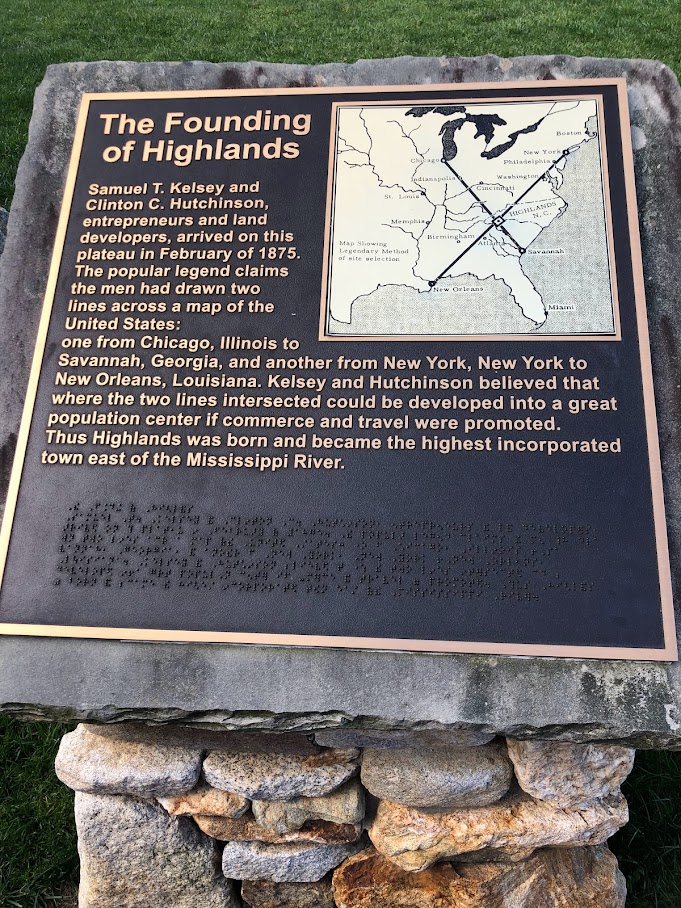
On the subject of local plaques, here is one I love about the founding of Highlands, NC. It describes the story as a 'local legend,' but it makes perfect sense. If you drew the lines just as shown on the map, logic would seem to dictate that there would be a nexus point exactly where Highlands happens to be.
The only problem is that it's four thousand feet up from Savannah to Highlands, and you can avoid that problem by going through Atlanta instead. Atlanta, whose original name was 'Terminus' because so many different railroads terminated there, already existed in 1875: in fact, it was on its second incarnation. The need for the nexus point was real, real enough that even Sherman couldn't obliterate the city forever. In the physical world we inhabit, though, geography as well as math and logic must be considered.
Here's a shot of the Old Edwards Inn in Highlands. I left in the street in front of it so you could get a sense of how steep the hills are. That's one thing in San Francisco, where the steepness is justified by the fact that there's an excellent natural harbor right there. It's another thing in Highlands, which was just never going to be a commercial hub. It is a resort, though, allowing richer people from the real terminus to escape the summer heat through the miracle of elevation.

Subscribe to:
Posts (Atom)