
Another reason to impeach Trump
He's causing Betelgeuse to to nova by tweeting too much and producing carbon dioxide.

Asheville: Guess the Line of Business
If it helps, the same block on the facing street is bracketed by a store selling tarot card readings and witch supplies, and a crystal shop. So guess what kind of business this one is:

By the way, I passed through “Historic West Asheville” today as well. Now I better understand AVI’s complaints that he couldn’t find waffles in West Asheville. I think of West Asheville as a biker would, i.e., as an area of about ten miles across. I am morally sure that there is a Waffle House there somewhere. But Historic West Asheville has only head shops, a vinyl record outlet I’ve actually been to before, a holistic medicine training center, and hipster farm-to-table joints.

By the way, I passed through “Historic West Asheville” today as well. Now I better understand AVI’s complaints that he couldn’t find waffles in West Asheville. I think of West Asheville as a biker would, i.e., as an area of about ten miles across. I am morally sure that there is a Waffle House there somewhere. But Historic West Asheville has only head shops, a vinyl record outlet I’ve actually been to before, a holistic medicine training center, and hipster farm-to-table joints.
Flushing out political operatives
Roger Stone is not a nice man, so I'm not spending a lot of time weeping over his fate. Still, I don't like seeing political vindictiveness in a criminal prosecution. If his prosecutors were political operatives, which is what it looks like to me, I rejoice that they're quitting in a mass huff.
On Tomboys
Apropos of yesterday's post on Xena-type characters, another writer at the NYT -- this time Ms. Lisa Selin Davis -- laments the loss of "tomboy" characters. It's interesting that the Strong Female Lead character rose just as the tomboy character vanished. In a way they might seem like tokens of a type, in that both are female characters who express themselves in part through what Ms. Marling described as "masculine modalities." Davis denies that they are tokens of a type, however:
What strikes me here is that the tomboy character (and, I suppose, my wife) is even more masculine than the Xena-type character. Like Davis, insofar as I watched those shows as a kid (and we had much more limited options in those days), the tomboy characters were my favorite of the girls. It makes sense; there was a lot more to relate to with them, and they seemed like people you could have fun with doing things you liked to do anyway. Probably that dynamic explains the success of my marriage to some degree; we have always gone hiking, motorcycling, and with horses she always liked trail riding rather than the display sports like dressage (which was once a highly masculine sport, but now is generally not).
So it's not a desire to enforce rigid gender roles that bothers me about the Xena-type. Nor was it Xena herself; partly because of the ridiculous Beijing-opera wire work, I just found that show too silly to bother with back when it was around. But the proliferation of that type of character, long now a source of irritation, is here too recognized by a female writer and thinker as somehow harmful to women as well.
...the tomboy I refer to is Jo Polniaczek, from the 1980s sitcom “The Facts of Life.” That Jo was a working-class kid on scholarship at a fancy girls’ boarding school. Her signature hairstyle was two little ponytails that connected to a big one in the back. Her signature outfit was a leather jacket — once she even dressed up as Peter Fonda in “Easy Rider” for Halloween — and jeans. Her signature ride was a motorcycle — which she fixed herself....Emphasis added. I was struck by that because it could just as easily be a description of my wife. Mostly I fix her motorcycle, actually, but she's not afraid to do it if I'm not available and has performed field repairs and adjustments on a number of occasions.
When Jo joined “The Facts of Life” in 1980 for its second season, she was among many tomboys on the big and small screen in that era.... These were often my favorite characters, living examples of the feminist zeitgeist that told me I did not have to be feminine to be female: I could, and maybe should, dress and act like boys and have access to their domains...
But this kind of tomboy began to recede in the mid-1980s.... This was followed by the pink-hued “Girl Power” of the 1990s, which moved away from the more masculine-presenting tomboy toward an image that seemed to comfort the male gaze. Jo gave way to Sporty Spice, Xena, Buffy — coifed, petal-lipped and sometimes baring midriff — with the message that one didn’t need to sacrifice femininity to have power.
What strikes me here is that the tomboy character (and, I suppose, my wife) is even more masculine than the Xena-type character. Like Davis, insofar as I watched those shows as a kid (and we had much more limited options in those days), the tomboy characters were my favorite of the girls. It makes sense; there was a lot more to relate to with them, and they seemed like people you could have fun with doing things you liked to do anyway. Probably that dynamic explains the success of my marriage to some degree; we have always gone hiking, motorcycling, and with horses she always liked trail riding rather than the display sports like dressage (which was once a highly masculine sport, but now is generally not).
So it's not a desire to enforce rigid gender roles that bothers me about the Xena-type. Nor was it Xena herself; partly because of the ridiculous Beijing-opera wire work, I just found that show too silly to bother with back when it was around. But the proliferation of that type of character, long now a source of irritation, is here too recognized by a female writer and thinker as somehow harmful to women as well.
"Diversity" and "Fairness"
Via Instapundit, a university promotes a diversity of opinions and viewpoints -- as long as one of the sides is willing to pay to be heard.
"Doing Something" in Wuhan
This video is from The People's Daily, so it's the imagery that the PRC wants you to see about their response in Wuhan. For me it provokes a series of questions:
* What are these substances they are spraying with trucks all over town?
* What is the stuff they are spewing with hand sprayers? It's not the same stuff, judging by the much more dense fog.
* Is any of this stuff safe to breathe? Is it better for you than the virus?
* Why are they washing the outside of a jet plane?
* What are these substances they are spraying with trucks all over town?
* What is the stuff they are spewing with hand sprayers? It's not the same stuff, judging by the much more dense fog.
* Is any of this stuff safe to breathe? Is it better for you than the virus?
* Why are they washing the outside of a jet plane?
A Welcome Voice
As is well known to readers, this particular archetype -- the Xena Warrior Princess one, transposed into everything -- has long irritated me. Ms. Brit Marling, a former actress and filmmaker, writes of her own reasons for rejecting it.
I acknowledge those things, as well as the ways in which her feelings -- whether or not they are supported by facts -- are widely shared by many women. I don't want to do more than acknowledge those disputes, because what I want to do is recognize a point of agreement. I also want, and long for, movies that celebrate feminine strength on its own real terms. I miss that as much as she does, because I'm a man who loves women. I want women around, strong women, feminine women.
I long for the days when our movies once again can show women who are strong in the way that Isabeau was strong in Ladyhawke.
UPDATE: A ‘paradox’ of greatest unhappiness.
Enter, stage right: the Strong Female Lead.There's a lot in her piece that I am not quoting, some of which some of you may find highly sympathetic; some of which some of you will outright reject. I myself am always amazed when a woman thinks that women are the disposable sex in America, for example; she writes of domestic violence, which is a real problem, but men are far and away exposed to much more violence without anyone even thinking of it as a problem. The statistics she quotes on rape are long disproven, but even with rape, American men are more exposed to it than women thanks to our vast prison culture and disparities in just who gets sent to prison.
She’s an assassin, a spy, a soldier, a superhero, a C.E.O. She can make a wound compress out of a maxi pad while on the lam. She’s got MacGyver’s resourcefulness but looks better in a tank top.
Acting the part of the Strong Female Lead changed both who I was and what I thought I was capable of. Training to do my own stunt work made me feel formidable and respected on set. Playing scenes where I was the boss firing men tasted like empowerment. And it will always feel better to be holding the gun in the scene than to be pleading for your life at the other end of the barrel.
It would be hard to deny that there is nutrition to be drawn from any narrative that gives women agency and voice in a world where they are most often without both. But the more I acted the Strong Female Lead, the more I became aware of the narrow specificity of the characters’ strengths — physical prowess, linear ambition, focused rationality. Masculine modalities of power....
It’s difficult for us to imagine femininity itself — empathy, vulnerability, listening — as strong. When I look at the world our stories have helped us envision and then erect, these are the very qualities that have been vanquished in favor of an overwrought masculinity.
I acknowledge those things, as well as the ways in which her feelings -- whether or not they are supported by facts -- are widely shared by many women. I don't want to do more than acknowledge those disputes, because what I want to do is recognize a point of agreement. I also want, and long for, movies that celebrate feminine strength on its own real terms. I miss that as much as she does, because I'm a man who loves women. I want women around, strong women, feminine women.
I long for the days when our movies once again can show women who are strong in the way that Isabeau was strong in Ladyhawke.
UPDATE: A ‘paradox’ of greatest unhappiness.
Now That's Socialism!
Real Headline: "Rep. Ilhan Omar promotes call for GI Bill to apply to all Americans."
No limits on redistribution, apparently.
No limits on redistribution, apparently.
Who Doesn't Want to Depose Trump These Days?
Technically accurate headline: "Amazon wants to depose Trump after losing $10 billion Pentagon cloud contract."
Oh, right, homonyms.
Oh, right, homonyms.
Neuromancer
“We monitor many frequencies. We listen always. Came a voice, out of the babel of tongues, speaking to us. It played us a mighty dub.”In the story it was an AI. It's not hard to see how an AI could be optimized for something like this.
Hate and Anger
A worry, from David French:
But perhaps you want to stand on hate and try to banish it from Christian life. Well, then, a word from G. K. Chesterton describing the Saxon war against the Viking. King Alfred of the Saxons has received a thoughtless blow from a woman cooking cakes that leaves a red scar on his head, and for a moment he is angry with her and thinks of returning it.
Yet then he takes his anger and transforms it into an expression of hate. His hate is not against her, but against those who have deserved to be hated in the way that Aristotle suggests there are some who deserve our anger. This transformation is a kind of miracle in that it is an intervention that protects her from wrath. This little miracle enables the greater miracle of the victory to come:
In the end, you know, he brought the leader of the Danish army to Christ -- so the story goes. And if you believe the story, that which was done more sweetly for hate had a good end, indeed many good ends for many people. Salvation for some, if you believe the story, in which salvation of the soul is the most valuable prize of all. At minimum the victory brought stability for England, unity, prosperity, if you believe only demonstrable fact. But French wants to speak within the story, as Chesterton did.
Hate has no place in pro-life America. None. And embracing or defending hate—even hatred of the movement’s most vigorous opponents—for the sake of life contradicts the spirit of the movement and stands to do more harm than good to the political cause that so many Christians value the most.To what degree are you conflating "hate" with "anger"? Anger can be rational. So says Aristotle:
American Evangelicals represent one of the most powerful religious movements in the world. They exercise veto power over the political success of any presidential candidate from one of America’s two great parties. Yet they don’t wield that power to veto the selection of a man who completely rejects—and even scorns—many of their core moral values.
I fully recognize what I’m saying. I fully recognize that refusing to hire a hater and refusing to hire a liar carries costs. If we see politics through worldly eyes, it makes no sense at all. Why would you adopt moral standards that put you at a disadvantage in an existential political struggle? If we don’t stand by Trump we will lose, and losing is unacceptable.
With regard to anger also there is an excess, a deficiency, and a mean. Although they can scarcely be said to have names, yet since we call the intermediate person good-tempered let us call the mean good temper; of the persons at the extremes let the one who exceeds be called irascible, and his vice irascibility, and the man who falls short an inirascible sort of person, and the deficiency inirascibility.It's possible to be excessively prone to anger, and that is a vice; but notice that it's also possible to be deficiently prone to anger, and that is also a vice. The right soul is angry when anger is appropriate.
But perhaps you want to stand on hate and try to banish it from Christian life. Well, then, a word from G. K. Chesterton describing the Saxon war against the Viking. King Alfred of the Saxons has received a thoughtless blow from a woman cooking cakes that leaves a red scar on his head, and for a moment he is angry with her and thinks of returning it.
Yet then he takes his anger and transforms it into an expression of hate. His hate is not against her, but against those who have deserved to be hated in the way that Aristotle suggests there are some who deserve our anger. This transformation is a kind of miracle in that it is an intervention that protects her from wrath. This little miracle enables the greater miracle of the victory to come:
Then Alfred laughed out suddenly,Chesterton is here a poet, and 'anger' has two syllables while 'hate' has one. But he has a 'for' there that is disposable; he could have easily composed the line, "More sweet for anger and heart's desire," with no loss to the poetic form. He seems to be saying 'hate' on purpose, and in an explicitly Christian context in which one is commanded to love one's enemy. Alfred refuses to return a blow he has received, and instead turns his justified wrath against another more deserving.
Like thunder in the spring,
Till shook aloud the lintel-beams,
And the squirrels stirred in dusty dreams,
And the startled birds went up in streams,
For the laughter of the King.
And the beasts of the earth and the birds looked down,
In a wild solemnity,
On a stranger sight than a sylph or elf,
On one man laughing at himself
Under the greenwood tree—
The giant laughter of Christian men
That roars through a thousand tales,
Where greed is an ape and pride is an ass,
And Jack's away with his master's lass,
And the miser is banged with all his brass,
The farmer with all his flails;
Tales that tumble and tales that trick,
Yet end not all in scorning—
Of kings and clowns in a merry plight,
And the clock gone wrong and the world gone right,
That the mummers sing upon Christmas night
And Christmas Day in the morning.
"Now here is a good warrant,"
Cried Alfred, "by my sword;
For he that is struck for an ill servant
Should be a kind lord.
"He that has been a servant
Knows more than priests and kings,
But he that has been an ill servant,
He knows all earthly things.
"Pride flings frail palaces at the sky,
As a man flings up sand,
But the firm feet of humility
Take hold of heavy land.
"Pride juggles with her toppling towers,
They strike the sun and cease,
But the firm feet of humility
They grip the ground like trees.
"He that hath failed in a little thing
Hath a sign upon the brow;
And the Earls of the Great Army
Have no such seal to show.
"The red print on my forehead,
Small flame for a red star,
In the van of the violent marching, then
When the sky is torn of the trumpets ten,
And the hands of the happy howling men
Fling wide the gates of war.
"This blow that I return not
Ten times will I return
On kings and earls of all degree,
And armies wide as empires be
Shall slide like landslips to the sea
If the red star burn.
"One man shall drive a hundred,
As the dead kings drave;
Before me rocking hosts be riven,
And battering cohorts backwards driven,
For I am the first king known of Heaven
That has been struck like a slave.
"Up on the old white road, brothers,
Up on the Roman walls!
For this is the night of the drawing of swords,
And the tainted tower of the heathen hordes
Leans to our hammers, fires and cords,
Leans a little and falls.
"Follow the star that lives and leaps,
Follow the sword that sings,
For we go gathering heathen men,
A terrible harvest, ten by ten,
As the wrath of the last red autumn—then
When Christ reaps down the kings.
"Follow a light that leaps and spins,
Follow the fire unfurled!
For riseth up against realm and rod,
A thing forgotten, a thing downtrod,
The last lost giant, even God,
Is risen against the world."
Roaring they went o'er the Roman wall,
And roaring up the lane,
Their torches tossed a ladder of fire,
Higher their hymn was heard and higher,
More sweet for hate and for heart's desire,
And up in the northern scrub and brier,
They fell upon the Dane.
In the end, you know, he brought the leader of the Danish army to Christ -- so the story goes. And if you believe the story, that which was done more sweetly for hate had a good end, indeed many good ends for many people. Salvation for some, if you believe the story, in which salvation of the soul is the most valuable prize of all. At minimum the victory brought stability for England, unity, prosperity, if you believe only demonstrable fact. But French wants to speak within the story, as Chesterton did.
Dog Faced Soldiers, Pony Soldiers
Joe Biden may or may not have been thinking of these Redcoats, as the piece suggests, but the phrase "pony soldiers" is used in Hondo to refer to the US Cavalry. It differs, though, from "Dog-Faced Soldiers," who are infantry -- specifically the 3rd Infantry Division. It's their Division song; I learned it from them while working with their headquarters element in 2007 because their commanding general made them stand up and sing it to him every morning at the Battle Update Briefing.
That commanding general was Rick Lynch, who seemed very much to be attempting to reprise the role of George Patton. In spite of his cigar-chomping theatrics 3ID had a tremendous run of success during his time there, during which the entire division -- not just the headquarters but all four brigades -- were deployed from Anbar to the Mada'in, and from Baghdad to Al Hillah. The counterinsurgency campaign in that period saw violence drop by about ninety percent.
I guess he went on to become a Lieutenant General before he retired, which is pretty good. He once gave me one of his "challenge coins," which just for fun I dug out tonight to show you.

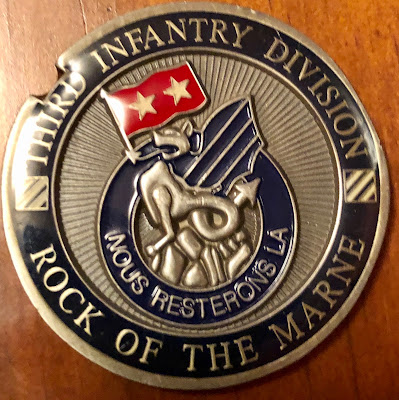
UPDATE: A reasonable comment on the 3ID page's apology for the Dog Face Soldier song:
That commanding general was Rick Lynch, who seemed very much to be attempting to reprise the role of George Patton. In spite of his cigar-chomping theatrics 3ID had a tremendous run of success during his time there, during which the entire division -- not just the headquarters but all four brigades -- were deployed from Anbar to the Mada'in, and from Baghdad to Al Hillah. The counterinsurgency campaign in that period saw violence drop by about ninety percent.
I guess he went on to become a Lieutenant General before he retired, which is pretty good. He once gave me one of his "challenge coins," which just for fun I dug out tonight to show you.

The dog is "Rocky," created by Walt Disney personally and donated to the division in what I imagine was a fit of patriotism. The coin has a notch in it, I was told, "Because Rocky took a bite out of it."

"Nous Resterons La" is a line from the First World War's deployment of the Third Division as a part of the American Expeditionary Force. It means "We'll stay here," which at the Second Battle of the Marne is just what they did.
I don't know how you get the two concepts confused, although I spent some time with various 1st Cavalry units too and it could be that they're more alike than either of them would like to admit. Maybe Joltin' Joe can throw in a "Buffalo Soldier" reference next time just for good measure.
The trouble with “honest” soldier songs is that they are generally unprintable parodies of other songs, while the trouble with “official” soldier songs is that they are generally phony-sounding, slick productions which completely lack spontaneity. At the beginning of World War II there was a need for a soldier song which could be accepted by the mud-slogging foot soldiers as well as civilian concert audiences – a song in the happy medium between “honest” and “official”.Fake but accurate, I think we call that these days.
The dichotomy we never tire of
Robert Plomin, in "Blueprint," compared popular assumptions about the heritability of various traits to the best we can do for scientific evidence for each trait. In every case but one, traits were much more heritable than people liked to think. The exception was breast cancer, whose heritability is overestimated 5x.
Table 2 How much are these traits influenced by genetics? [%] The first column of results shows the average opinions of 5,000 young adults in the UK. The second column shows results from genetic research.
Eye colour 77 95
Height 67 80
Breast cancer 53 10
Schizophrenia 43 50
Autism 42 70
General Intelligence 41 50
Weight 40 70
Reading disability 38 60
Personality 38 40
Spatial ability 33 70
Remembering faces 31 60
Stomach ulcers 29 70
School achievement 29 60
Verbal ability 27 60
Centrists and Democracy
A study suggests that support for democracy is weakest among centrist voters, not extremists.
A Real Crisis
The city and country face “wartime conditions,” Ms. Sun said. “There must be no deserters, or they will be nailed to the pillar of historical shame forever.”
Subscribe to:
Posts (Atom)