
Spirituality and Such
A set of meditations from Presidential candidate Marianne Williamson (h/t Wretchard).

From 2010: The Boar's Head
This one's from Tex, being recipes for several classic pig's head dishes. We're a long way from Christmas, but since it crossed my screen tonight, I wanted to bring it forward.
Here's the carol, too, while we're on the subject. It's a long way to Christmas, but it's not bad to be reminded of it even at this distant hour.
Here's the carol, too, while we're on the subject. It's a long way to Christmas, but it's not bad to be reminded of it even at this distant hour.
From 2007: Choosing a Stetson
I came across this post while looking for something else. It's useful, practical advice that holds true still as far as I know. If you get one of the good ones they're good hats; I wore one to the Philippines (which I gave away to a member of the RP military) and another Iraq the whole time I was out there, and it served in the desert as well as in the wood.
The Jug of Punch
Before the merry month of June ends, we should have a listen to this beautiful piece.
Two from AL Daily
The first one wonders if AI means the end of anonymous authorship. Maybe looking backwards, but couldn't an AI serve to randomize your language just enough to ensure you weren't recognizable? Seems like more of an arms race than a finale.
On "The end of enchantment" and the Enlightenment. I obviously disagree that ending animism or enchantment is a necessary product of reason; panpsychism is as old as Plato, and inherent in the Neoplatonic philosophy that I think is the closest human beings have gotten to the truth. Praise for the Frankfurt school strikes me as short-sighted, but it's worth reading all the same because of this insight:
On the other hand, healing crystals are bunk, and the 'white witch' isn't really sending you a magic item with a bound jinn.
On "The end of enchantment" and the Enlightenment. I obviously disagree that ending animism or enchantment is a necessary product of reason; panpsychism is as old as Plato, and inherent in the Neoplatonic philosophy that I think is the closest human beings have gotten to the truth. Praise for the Frankfurt school strikes me as short-sighted, but it's worth reading all the same because of this insight:
[A] surprising 83.3 per cent of Americans believe in either guardian angels, demonic possession or ghosts, and there is evidence for similar belief patterns in western Europe. (I should note that disenchantment should not be confused with secularisation. The sociological evidence suggests that de-Christianisation, while usually equated with secularisation, often correlates with an increase in belief in spirits, ghosts and magic – not the reverse.) Nor are sociological surveys the only evidence. If one views Europe and North America through the same sort of anthropological lens that European and American anthropologists are used to directing abroad, it seems hard to defend the notion that the ‘modern West’ is straightforwardly disenchanted. There are plenty of examples.This pattern is older than the Frankfurt School, as it was known to Chesterton. Like Chesterton, we sit in a strange place with regards to it. On the one hand, Chesterton favored Roman Catholicism over some other variations of Christianity -- and especially materialism -- just because it offered him the opportunity to believe in faerie.
Walmart sells ‘Sage Spirit-Smudge Wands’ and clothing chains such as Urban Outfitters sell ‘healing crystals’ and tarot cards. You can go on eBay right now and pay an Australian ‘white witch’ to perform a ritual to summon a djinn and bind it to an object of your choice. Celebrities such as Anna Nicole Smith and Bobby Brown have publicly described having sex with ghosts. Coffee shops and co-ops throughout the US and much of western Europe display flyers advertising ‘palm readers’, ‘energy balancing’ and ‘chakra work’. Even if you ignore the Harry Potter craze and other fictionalised depictions of wizards, ghosts and witches, studies of American reading habits suggest that ‘New Age’ print culture is incredibly lucrative, with ‘non-fiction books’ about magic, guardian angels and near-death experiences frequently appearing in the upper echelons of Amazon’s bestseller lists. And the past 15 years have seen a proliferation of ‘reality’ television series that claim to report evidence for ghosts, psychics, extraterrestrials, monsters, curses and even miracles.
The Christian is quite free to believe that there is a considerable amount of settled order and inevitable development in the universe. But the materialist is not allowed to admit into his spotless machine the slightest speck of spiritualism or miracle. Poor Mr. McCabe is not allowed to retain even the tiniest imp, though it might be hiding in a pimpernel. The Christian admits that the universe is manifold and even miscellaneous, just as a sane man knows that he is complex. The sane man knows that he has a touch of the beast, a touch of the devil, a touch of the saint, a touch of the citizen. Nay, the really sane man knows that he has a touch of the madman. But the materialist’s world is quite simple and solid, just as the madman is quite sure he is sane.It seems as if there is a health that attends to belief in the imp, in the not-quite-settled and not-quite-understandable nature of reality. Which indeed there is; philosophy can sketch the limits of reason readily. Kant does so in his first critique, and prior philosophers come to the ineffable regularly. The worst thing to believe is that reality is purely rational, subject to human science, and completely comprehensible. Chesterton is not wrong to say that madness lies that way.
On the other hand, healing crystals are bunk, and the 'white witch' isn't really sending you a magic item with a bound jinn.
A Real Russian Information Operation
Vladimir Putin does not have "traditional values." Vladimir Putin is a former KGB agent turned gangster-government strongman. So when he says things like this, it's worth remembering that he's not advocating things he really believes in; he's advocating things he thinks will exacerbate divisions in the West.
It would behoove us to find a way to attain the stability associated with 'traditional values' without playing into the hands of people like Putin.
It would behoove us to find a way to attain the stability associated with 'traditional values' without playing into the hands of people like Putin.
Serious People
"Medicare for All" was already supposed to cost a nearly unfathomable amount of money. What if we were to pledge to add to it the costs of anyone from anywhere in the world who shows up here needing health care, regardless of whether or not they have any sort of visa or legal right to enter the country?

As I've said in this space before, I'd love to hear the plan to save the Medicare we have before they start telling me that they're going to institute Medicare for All. That was when I assumed that "all" meant "all Americans," rather than "∀." It's a logical principle easy to script: (∀x)Fx->Gx. That is, 'for all x, if x is a person who needs healthcare, x gets it for free.'
People ask, "But how will you pay for it?" They answer, "We'll print the money we need." Well, yes, you can print money. Can you also print the doctors you'll need? This way lies inflation, sure, but the bigger problem will be scarcity of medical resources -- just as our largest population of American citizens, the Boomers, reach the age at which their need for medical resources will be greatest.
It's madness. Every single one of them put their hands up for it.

As I've said in this space before, I'd love to hear the plan to save the Medicare we have before they start telling me that they're going to institute Medicare for All. That was when I assumed that "all" meant "all Americans," rather than "∀." It's a logical principle easy to script: (∀x)Fx->Gx. That is, 'for all x, if x is a person who needs healthcare, x gets it for free.'
People ask, "But how will you pay for it?" They answer, "We'll print the money we need." Well, yes, you can print money. Can you also print the doctors you'll need? This way lies inflation, sure, but the bigger problem will be scarcity of medical resources -- just as our largest population of American citizens, the Boomers, reach the age at which their need for medical resources will be greatest.
It's madness. Every single one of them put their hands up for it.
Just Not Getting It
The SCOTUS issued what strikes me as a completely weird decision today on the census. As I'm sure you've heard, they declared that the administration's explanation for wanting to ask whether counted people were citizens was "insufficient," and sent the case back down for more consideration once a fuller explanation was provided.
I'm unclear on exactly why any explanation is needed. This is surely what a census is supposed to do. What exactly is the census for if it isn't to count the number of citizens in each state? Is there some reason the United States government shouldn't be allowed to know how many people are inside a given state who aren't citizens? By law, all of those people should have a legal status registered with the government, after all: a visa or a permanent residency, for example. Conducting the census is an actual Constitutional duty of the Federal government. Why should the government need to explain itself at all?
I'm unclear on exactly why any explanation is needed. This is surely what a census is supposed to do. What exactly is the census for if it isn't to count the number of citizens in each state? Is there some reason the United States government shouldn't be allowed to know how many people are inside a given state who aren't citizens? By law, all of those people should have a legal status registered with the government, after all: a visa or a permanent residency, for example. Conducting the census is an actual Constitutional duty of the Federal government. Why should the government need to explain itself at all?
Political Courage in Contemporary America
Tim Young: I dont know about you guys, but I thought the bravest, most courageous moment of the #DemDebate was when Julian Castro defended a transgender woman's right to have an abortion.I wonder how long it will be before "Life of Brian" is held to be hate speech -- not because it makes fun of Christianity, but because of this scene:
Dan Crenshaw vs. Google
The tech giants seem determined to force a conflict in terms of their effect on our self-governing republic, and they're starting to get one.
Tulsi Beats Warren
Her argument that she is 'the most qualified to be commander-in-chief' is not quite right, but she is the most qualified of the ones who have any kind of chance. They're running a bunch of career politicians, so she's the closest thing: a real military officer, albeit one who served in a medical staff role rather than one who would have "commanded" in the ordinary military sense of the term.
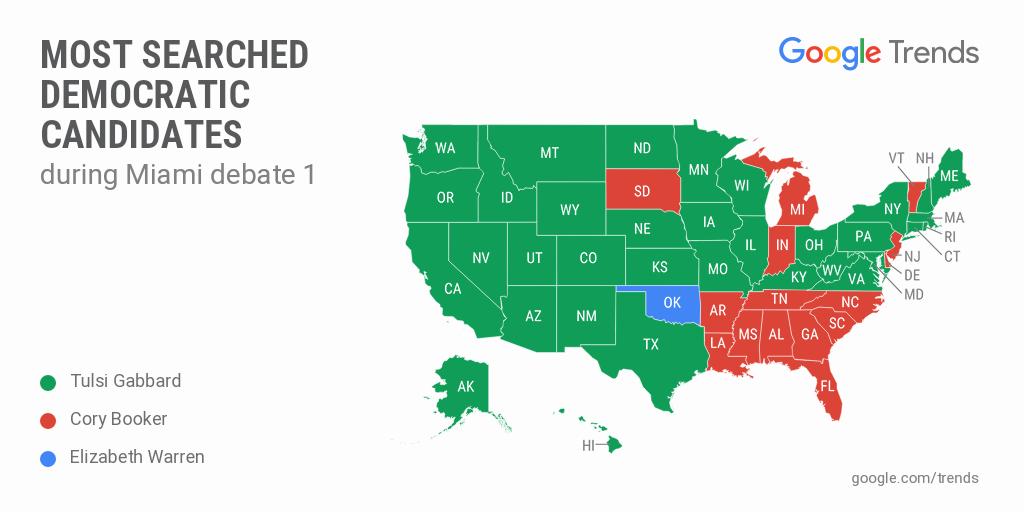
She won the Drudge Poll and the Google Search quasi-poll, and Reason was impressed with her.
I like Tulsi, as I've said before. It's just hard to imagine turning the keys over to her given her courting gas-my-own-population Assad. On the other hand, she has been a strident defender of religious liberty at a time when that liberty is under heavy assault. We could certainly do worse than to have her head the Democratic ticket.
UPDATE: TNR strikes a measured tone:
She won the Drudge Poll and the Google Search quasi-poll, and Reason was impressed with her.
I like Tulsi, as I've said before. It's just hard to imagine turning the keys over to her given her courting gas-my-own-population Assad. On the other hand, she has been a strident defender of religious liberty at a time when that liberty is under heavy assault. We could certainly do worse than to have her head the Democratic ticket.
UPDATE: TNR strikes a measured tone:
Over the course of two hours, approximately seven minutes were devoted to the top existential threat facing humanity. And only four of the ten candidates on stage were asked directly about how they intend to rapidly reduce carbon emissions over the next eleven years—something that must be done to preserve a livable planet for future generations.... It was, to put it lightly, a disgrace—and not just because climate change was the number one issue that Democratic voters wanted to see discussed at the debate. The debate itself was held in Miami, Florida, a city that’s literally being swallowed by the rising ocean.If you are curious, Tulsi's "vision" says some very sweet things about the environment, but has zero specifics on exactly how to attain any of them.
The debates
John Podhoretz on the elevated tone we can expect:
The only way these debates will matter is if they are exciting. And the only way to ensure that people keep watching them as the months pass, and thereby create a sense that the Democratic Party is full of life, is if these first debates reward their interest with fireworks.
It’s the shmendricks who need to set the debate hall on fire — you know, the ones you’ve never heard of, like the governors of Climatechangiana and Potsmokia and the House members from Whereverdude and Freestuffistan.If only I had more confidence one of those guys wasn't going to end up with the nomination.
Bill Barr, Bagpiper
With the full marching band backing him up it's hard to hear how good he is, but it's a fine look for an Attorney General.
Study: Americans Angrier
Technically, the finding is that 84% of people think Americans are angrier than they used to be. VodkaPundit notes that this seems to be an artifact of the media, especially social media: "In real life, people don't seem much different."
Iowahawk was just making the same point, following a long round-the-country trip he's just finished. "You can learn a lot more about this country from a dashboard than from a keyboard.... The USA is an amazing, beautiful place, full of friendly people of all types and all political persuasions, who don't scream invectives at each other all day long in real life."
In general, I think most of America's problems are confined to small places with loud voices. There are some that are not: the opioid crisis is not; rural unemployment is not. Increasingly the immigration crisis is spilling out of the border regions and major cities and into the whole country. These things need to be addressed before they wreck the whole.
Still, for the most part the America I see from the back of the bike is much as they describe it. Anywhere you stop, people are friendly enough. You exchange pleasantries, and then ride on. If you should move and settle somewhere else, your neighbors make you welcome, and then largely leave you be. It's a pretty good place, most of the place and most of the time.
Nor can I easily recall the last time I saw someone, face to face, speak as rudely to another person as seems to be the standard on social media. I take Conan's position on this, as R.E. Howard related in The Tower of the Elephant.

A little more exposure to peril might improve our "civilized" class.
Iowahawk was just making the same point, following a long round-the-country trip he's just finished. "You can learn a lot more about this country from a dashboard than from a keyboard.... The USA is an amazing, beautiful place, full of friendly people of all types and all political persuasions, who don't scream invectives at each other all day long in real life."
In general, I think most of America's problems are confined to small places with loud voices. There are some that are not: the opioid crisis is not; rural unemployment is not. Increasingly the immigration crisis is spilling out of the border regions and major cities and into the whole country. These things need to be addressed before they wreck the whole.
Still, for the most part the America I see from the back of the bike is much as they describe it. Anywhere you stop, people are friendly enough. You exchange pleasantries, and then ride on. If you should move and settle somewhere else, your neighbors make you welcome, and then largely leave you be. It's a pretty good place, most of the place and most of the time.
Nor can I easily recall the last time I saw someone, face to face, speak as rudely to another person as seems to be the standard on social media. I take Conan's position on this, as R.E. Howard related in The Tower of the Elephant.

A little more exposure to peril might improve our "civilized" class.
Federal Prosecutors Warn Judge Not To Interfere
The victims are that much less important than the people being protected by DOJ's exercise of discretion in this case.
Starship Troopers tax
Instapundit reports that Robert Francis ("Call me Beto") O'Rourke is channeling Robert Heinlein and proposing a tax on households that lack current or past armed service members. The idea has a superficial appeal: fund veterans' benefits by putting an extra tax on the population that benefits from military service without personal sacrifice. On second thought, though, isn't it just another way of saying vets should get taxpayer-funded benefits, with the new wrinkle that vets and their famlies should get a tax break, too? Why not just fund vet benefits at a suitable level and, while we're at it, quit playing games that make the benefits unreasonably hard to get?
O'Rourke's proposal smuggles in the assumption that we can't treat vets properly unless we raise taxes. As usual, his mind goes straight to a tax that lands on some but not others, because that's the only way to achieve social justice. Someone always needs to pay reparations to someone else.
O'Rourke's proposal smuggles in the assumption that we can't treat vets properly unless we raise taxes. As usual, his mind goes straight to a tax that lands on some but not others, because that's the only way to achieve social justice. Someone always needs to pay reparations to someone else.
Consummatum Est
As announced recently, David Bellavia was awarded the Congressional Medal of Honor today.

He is the first living Iraq War veteran to receive this highest of awards.
Task & Purpose, like true enlisted men, frame the story in terms of the back pay to which SSG Bellavia is now entitled.
Congratulations to an American worthy of the name.

He is the first living Iraq War veteran to receive this highest of awards.
Task & Purpose, like true enlisted men, frame the story in terms of the back pay to which SSG Bellavia is now entitled.
Congratulations to an American worthy of the name.
That crazy Conway
AVI posted links to a number of old articles, many from 2016. I particularly enjoyed the WaPo October 2016 article dripping scorn on Trump's ridiculous PR team and their ignorant, probably insincere disregard of the prevailing wisdom in the "lamestream media." The article ends with this taunt:
And what happened? Conway was right about all the definitely-Clinton and definitely-Trump states. What's more, she didn't do badly on the toss-ups. Clinton took Conway's toss-up states of Nevada, Colorado, Maine, New Hampshire, and Virginia. Trump took the toss-up states of Iowa, Wisconsin, Michigan, Ohio, Pennsylvania, North Carolina, and Florida.
The WaPo's own "realistic" map blew not only the predicted states but the toss-ups. It assigned "weak Clinton" and "weak Trump" status to six states; Trump took them all home on election day. WaPo assigned toss-up status to only three states, all bagged by Trump in the end.
The final taunt turned out to be the best prediction in the piece.
How about this year? Are the polls any more competent? They sound a lot like the 2016 polls, just as the reports of amazing rally crowds remind me of 2016.
On Nov. 8, I fully expect Trump TV to say that Trump actually won. After all, Conway said they would. Unequivocally.Conway's electoral map predicted Clinton would take California, Oregon, Washington, New Mexico, Minnesota, Illinois, New York, Vermont, Massachusetts, Connecticut, Rhode Island, New Jersey, Delaware, and New Mexico. She assigned toss-up status to Nevada, Colorado, Iowa, Wisconsin, Michigan, Ohio, Pennsylvania, Maine, New Hampshire, Virginia, North Carolina, and Florida.
And what happened? Conway was right about all the definitely-Clinton and definitely-Trump states. What's more, she didn't do badly on the toss-ups. Clinton took Conway's toss-up states of Nevada, Colorado, Maine, New Hampshire, and Virginia. Trump took the toss-up states of Iowa, Wisconsin, Michigan, Ohio, Pennsylvania, North Carolina, and Florida.
The WaPo's own "realistic" map blew not only the predicted states but the toss-ups. It assigned "weak Clinton" and "weak Trump" status to six states; Trump took them all home on election day. WaPo assigned toss-up status to only three states, all bagged by Trump in the end.
The final taunt turned out to be the best prediction in the piece.
How about this year? Are the polls any more competent? They sound a lot like the 2016 polls, just as the reports of amazing rally crowds remind me of 2016.
Wonderful News
...if true.
The sprawling Democratic presidential field is incredibly diverse, but a new poll from The Associated Press-NORC Center for Public Affairs finds Democrats give a collective shrug to gender, race and age as factors they’re considering when supporting a candidate.
Instead, Democratic registered voters are yearning for experience in elected office. A whopping 73% cited that as a quality that would make them more excited about supporting a presidential candidate.
Citizens
One end of my county is stirred up over an annexation effort by a small town on our southern border. A bit further south sit three or four other smallish towns that are growing both commercially and industrially, and on the other side of them, across Nueces Bay, the larger town of Corpus Christi has quite a bit of industry. Our county, in contrast, watched industry pass it by during the 20th century, leaving it to develop primarily as a tourist and fishing spot and home for retirees. Jobs for young people aren't plentiful here. The commute to the greater employment opportunities to our south is doable but not obviously attractive, especially since our rent prices are pushed up by the coastal location and the tourist trade. The tourist trade, in turn, depends on our preservation of the bays and shores.
The town on our southern border, Aransas Pass, is the mainland twin to the barrier island's much more prosperous Port Aransas, covered with condos, bars, and restaurants. Aransas Pass struggles with its infrastructure and tax base. It also fears incursion and encirclement from its municipal neighbors to the south. It has constantly to reckon with the mixed blessing of industrial development, particularly to the south, tempting with its jobs and property values but threatening with its dirt.
In the southern, unincorporated part of my county, which has mostly scattered residential development, is the site of an old carbon-black plant. A new owner recently has invested a lot of cash into cleaning up the unsightly but largely inert crud left behind and has received state environmental clearance to redevelopment the property for commercial or industrial but not residential uses. The city of Aransas Pass, noticing this spring that Texas was about to pass a new law requiring the consent of the annexees, quickly took initial steps to annex an area that includes the old plant site. They hoped to be grandfathered under the old statute, thus avoiding the expense and uncertainty of a referendum.
The proposed annexees generally oppose the city's move, fearing that they'll pay much greater taxes without getting any services. Many city residents to the south applaud what they see as a chance to use a city's statutory land-use restrictions to control or prevent industrial development, powers that are largely denied to a county government. Opponents of the annexation are mixed on their view of the proposed industrial development, but some question whether the city genuinely will restrict it, given their current negotiations with industrial developers on the other side of town. Others view the developers and the annexing city with perhaps equal suspicion.
It is my painful duty to report the unsurprising news that public officials have not achieved the highest possible level of transparency and informed citizen involvement. Many citizens are only now beginning to pay attention. Accusations of smoke-filled-room tactics and hypocrisy are vying with charges that previously uninvolved citizens are belatedly second-guessing the beleaguered public servants.
In short, it's a dispute after my own heart. My neighbors are struggling with the trade-off between creating jobs and preserving habitat. If a site was used industrially for a century, what should be done with it now, and at whose expense? Should taxpayers buy it up and turn it into a bird sanctuary? Should it be set aside for industry, so we can concentrate on preserving other, still pristine coastal marshes? Do we have the right to insist that the owners fund a residential development--or even a nature preserve--instead? If they build a residential neighborhood, are we really sure that canals, lawns, septic tanks, pesticides, and fertilizer will affect the bays less than some kind of light industrial park? Should more houses be built practically at sea level in hurricane country? Did the city skip steps in its rushed annexation move, or must it start over and this time subject itself to the new resident consent process?
The public discussion of all these issues is confused, opaque, and fraught. There are now three lawsuits pending or threatened, one for defamation of the plant-site owners, another alleging the plant-site owners are pursuing the defamation action to squelch public participation in a legitimate policy dispute, and a third attacking the annexation process.
I'm in my element, attending meetings and hearings, writing them up, posting them on Facebook, doing my bit to keep the public discussion fact-based and focused, and trying to make the implicit trade-offs more explicit. I'm meeting some interesting new people and encouraging them to run for office.
The town on our southern border, Aransas Pass, is the mainland twin to the barrier island's much more prosperous Port Aransas, covered with condos, bars, and restaurants. Aransas Pass struggles with its infrastructure and tax base. It also fears incursion and encirclement from its municipal neighbors to the south. It has constantly to reckon with the mixed blessing of industrial development, particularly to the south, tempting with its jobs and property values but threatening with its dirt.
In the southern, unincorporated part of my county, which has mostly scattered residential development, is the site of an old carbon-black plant. A new owner recently has invested a lot of cash into cleaning up the unsightly but largely inert crud left behind and has received state environmental clearance to redevelopment the property for commercial or industrial but not residential uses. The city of Aransas Pass, noticing this spring that Texas was about to pass a new law requiring the consent of the annexees, quickly took initial steps to annex an area that includes the old plant site. They hoped to be grandfathered under the old statute, thus avoiding the expense and uncertainty of a referendum.
The proposed annexees generally oppose the city's move, fearing that they'll pay much greater taxes without getting any services. Many city residents to the south applaud what they see as a chance to use a city's statutory land-use restrictions to control or prevent industrial development, powers that are largely denied to a county government. Opponents of the annexation are mixed on their view of the proposed industrial development, but some question whether the city genuinely will restrict it, given their current negotiations with industrial developers on the other side of town. Others view the developers and the annexing city with perhaps equal suspicion.
It is my painful duty to report the unsurprising news that public officials have not achieved the highest possible level of transparency and informed citizen involvement. Many citizens are only now beginning to pay attention. Accusations of smoke-filled-room tactics and hypocrisy are vying with charges that previously uninvolved citizens are belatedly second-guessing the beleaguered public servants.
In short, it's a dispute after my own heart. My neighbors are struggling with the trade-off between creating jobs and preserving habitat. If a site was used industrially for a century, what should be done with it now, and at whose expense? Should taxpayers buy it up and turn it into a bird sanctuary? Should it be set aside for industry, so we can concentrate on preserving other, still pristine coastal marshes? Do we have the right to insist that the owners fund a residential development--or even a nature preserve--instead? If they build a residential neighborhood, are we really sure that canals, lawns, septic tanks, pesticides, and fertilizer will affect the bays less than some kind of light industrial park? Should more houses be built practically at sea level in hurricane country? Did the city skip steps in its rushed annexation move, or must it start over and this time subject itself to the new resident consent process?
The public discussion of all these issues is confused, opaque, and fraught. There are now three lawsuits pending or threatened, one for defamation of the plant-site owners, another alleging the plant-site owners are pursuing the defamation action to squelch public participation in a legitimate policy dispute, and a third attacking the annexation process.
I'm in my element, attending meetings and hearings, writing them up, posting them on Facebook, doing my bit to keep the public discussion fact-based and focused, and trying to make the implicit trade-offs more explicit. I'm meeting some interesting new people and encouraging them to run for office.
Subscribe to:
Posts (Atom)