Two different right-wing media personalities got suspended tonight, one for backing up the President's claims of a wiretap, and one for a philosophical difference that is widely shared by millions of Americans -- even some conservatives.
Both suspensions are defensible, even though they are in another sense completely opposed. One is backing his side in apparent absence of facts; the other is differing from her side, in a place where complete facts would be inadequate even in principle. Moral reason doesn't turn only on facts, after all: tell a computer all the facts about a case, but give it no moral rules, and it might not even understand that you were asking it a question. It certainly would not have any method for coming to a reasonable answer.
It is good for organizations to enforce standards, as it is good for people to uphold ideals. Which one of these seems best to you? Does either seem wrong? Can you say why?


The Comey/Rogers Hearing
The headlines I'm seeing everywhere: "FBI confirms Trump campaign being investigated for Russia ties! Trump's wiretapping lies refuted!"
The actual news, as far as I can see, is that the FBI confirmed an investigation into something by someone having something to do with Russia, but refused to comment.
Then, the FBI and the NSA chiefs both confirmed that a number of serious felonies had definitely been committed.
So, in the Russia matter, it may yet prove that someone connected in some way to Team Trump did something wrong. However, it is definitely the case that at least one person in high position committed serious felonies -- and the list of people to investigate is not all that long. Most of them were ranking political appointees in the previous administration.
This is the point at which a smart, thoughtful opposition would ask itself, "Do we really want to have this fight, or might we quietly reach an accommodation that would let all this slide into the rear view mirror?"
I doubt that is what is going to happen here.
The actual news, as far as I can see, is that the FBI confirmed an investigation into something by someone having something to do with Russia, but refused to comment.
Then, the FBI and the NSA chiefs both confirmed that a number of serious felonies had definitely been committed.
NUNES: Would an unauthorized disclosure of FISA-derived information to the press violate 18 USC 798, a section of the Espionage Act that criminalizes the disclosure of information concerning the communication and intelligence activities of the United States?Gowdy's second line of questioning, which is too long to excerpt, went through a list of candidates for the honor of having committed that felony.
COMEY: Yes[.]
...
COMEY: All FISA applications review by the court collection by us pursuant to our FISA authority is classified.
GOWDY: The dissemination of which is a felony punishable by up to 10 years in prison?
COMEY: Sure, dissemination -- unauthorized dissemination.
GOWDY: Unauthorized dissemination of classified or otherwise legally protected material punishable by a felony up to 10 years in federal prison.
COMEY: Yes. Yes, as it should be.
So, in the Russia matter, it may yet prove that someone connected in some way to Team Trump did something wrong. However, it is definitely the case that at least one person in high position committed serious felonies -- and the list of people to investigate is not all that long. Most of them were ranking political appointees in the previous administration.
This is the point at which a smart, thoughtful opposition would ask itself, "Do we really want to have this fight, or might we quietly reach an accommodation that would let all this slide into the rear view mirror?"
I doubt that is what is going to happen here.
Sauflied
A sauflied is a drinking song, in the same way that the Nibelungenlied is the song of the Nibelungs.
DB: HVT Disappointed to be Raided by Rangers Instead of SEALs
Aminullah, who has countless books and films on the elite naval special operations forces, says being raided by a bunch of guys he had never heard of was a big let down....
"It's b******t. SEALs raided my brother's and cousin's houses just last month," he said. "They're probably gonna write books about that.... And seriously, my mother could graduate from Ranger School with a cloth over her eyes — which there is at all times — because she would be beaten otherwise."
RIP Chuck Berry
I'm sure in the long series of musical deaths of 2016, you probably saw this image:
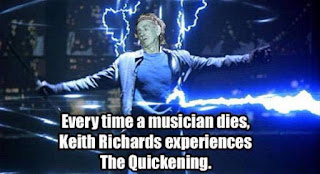
This time, there's a genuine violent connection.
Chuck Berry was one of the greats, though, as Richards himself says at some length in the clip as a whole. We were lucky to know his work.

This time, there's a genuine violent connection.
Chuck Berry was one of the greats, though, as Richards himself says at some length in the clip as a whole. We were lucky to know his work.
A Lack of Faith
Yours is disturbing.
That's how you got Trump in the first place. Congress wouldn't step up and do anything to stop this stuff, so people on the right picked someone who seemed unconstrained by norms of civility or honor.
A failure of respect for the institution of the President will be followed, almost immediately, by a failure of respect for the office of judge. Those positions cannot function without respect, except through the raw exercise of power. And power, frankly, doesn't get you all that far. It's a very big country to try to rule by force.
The lengthy recitations of large numbers of perfectly objectionable presidential statements about Muslims coexist with a bunch of other textual indicia showing not merely that the judges doubt Trump’s secular purpose but that they doubt the good faith of his purpose at all—indeed, that they suspect that he is simply lying about his own motivations....Left-leaning judges now feel about the President the way that conservatives did after Lois Lerner, in other words: we no longer trusted a word of their explanations about their conduct, but believed our eyes about what their real intent and purpose was. One of the reason that the email scandal dogged Clinton so much was that the IRS has already burned the bridges of public trust on mysteriously-vanishing email records, inexplicable failures to back up servers as required by both law and contract, and an administration-led legal process that somehow just never found anyone accountable even when it couldn't avoid admitting that something had been done wrong.Imagine a world in which other actors have no expectation of civic virtue from the President and thus no concept of deference to him. Imagine a world in which the words of the President are not presumed to carry any weight. Imagine a world in which far more judicial review of presidential conduct is de novo, and in which the executive has to find highly coercive means of enforcing message discipline on its staff because it can’t depend on loyalty. That’s a very different presidency than the one we have come to expect.
It’s actually a presidency without the principle that we separate the man from the office. It’s a presidency in which we owe nothing to the office institutionally and make individual decisions about how to interact with it based on how much we trust, like, or hate its occupant.
That's how you got Trump in the first place. Congress wouldn't step up and do anything to stop this stuff, so people on the right picked someone who seemed unconstrained by norms of civility or honor.
A failure of respect for the institution of the President will be followed, almost immediately, by a failure of respect for the office of judge. Those positions cannot function without respect, except through the raw exercise of power. And power, frankly, doesn't get you all that far. It's a very big country to try to rule by force.
Friday night MMV
Stumbled across this; not a bad use of the song. I didn't see the movie, but I probably don't need to now.
A St. Patrick's Day Roundup
From the Hall's 2012 archive, here is a list of several good Irish tunes appropriate for the holiday.
"Campaign Pledges Haunt Trump in Court"
So says the NYT, correctly enough for a change. It's a major change in jurisprudence, as up until now campaign rhetoric has been off-limits for judicial interpretation. The idea is that it would be bad for democracy if politicians couldn't speak freely in election campaigns, out of fear of being constrained by courts after-the-fact.
On the other hand, it also makes a kind of sense. Trump has been taking his campaign promises relatively seriously compared to previous presidents. It may be the reason that judges have been so willing to wink at campaign rhetoric in the past is the sense of, c'mon, it's just talk for the rubes. Nobody's seriously going to do that stuff in office. They just have to say it to get elected.
What happens when somebody comes along who maybe really is going to 'do that stuff in office'? It's easy to understand the panic. Nothing terrifies a cynic more than sincerity.
Nevertheless, I think Powerline has it right (previous link):
However great this idea is as a pure theory, it's completely impossible in practice. There is no mechanism for making it work other than forcing the executive branch to completely relinquish the relevant power for as long as Trump is president. It's not that, since Trump is a bad guy in certain ways, the courts will delegate the powers to someone else they do trust -- Mattis or whomever. It's that America, not just Trump, would lose the capacity to make national security decisions based on immigration for four years.
That's unworkable. Many people might argue that other bits of campaign rhetoric make Trump unacceptably dangerous as commander in chief. (Indeed, one person who made that argument repeatedly was Hillary Clinton.) So does that mean the courts should prevent him from taking any military actions -- meaning, that America should stop defending herself for four years? Maybe just against the Muslim world, plus China, if those are the areas where Trump's rhetoric was especially explosive?
Obviously that isn't acceptable. Neither is it workable for every executive policy to have to satisfy each of the several hundred Federal judges out there in order to go into effect. This is going to cause problems, though, because the judges appear to be committed to the idea that they should have that power.
On the other hand, it also makes a kind of sense. Trump has been taking his campaign promises relatively seriously compared to previous presidents. It may be the reason that judges have been so willing to wink at campaign rhetoric in the past is the sense of, c'mon, it's just talk for the rubes. Nobody's seriously going to do that stuff in office. They just have to say it to get elected.
What happens when somebody comes along who maybe really is going to 'do that stuff in office'? It's easy to understand the panic. Nothing terrifies a cynic more than sincerity.
Nevertheless, I think Powerline has it right (previous link):
The states’ argument is in essence that Trump is a bigot, and thus his winning presidential campaign in fact impeaches him from exercising key constitutional and statutory powers, such as administering the immigration laws.I kind of like the idea that you could elect a partial-president, one whose powers are limited by the flaws in their character. As a purely theoretical idea, it would be great if people who had the right virtues to execute the powers well were the ones entrusted with those powers. If someone without the right virtues was elected, it would be great -- in theory -- if the powers were temporarily entrusted in someone else who had those virtues.
However great this idea is as a pure theory, it's completely impossible in practice. There is no mechanism for making it work other than forcing the executive branch to completely relinquish the relevant power for as long as Trump is president. It's not that, since Trump is a bad guy in certain ways, the courts will delegate the powers to someone else they do trust -- Mattis or whomever. It's that America, not just Trump, would lose the capacity to make national security decisions based on immigration for four years.
That's unworkable. Many people might argue that other bits of campaign rhetoric make Trump unacceptably dangerous as commander in chief. (Indeed, one person who made that argument repeatedly was Hillary Clinton.) So does that mean the courts should prevent him from taking any military actions -- meaning, that America should stop defending herself for four years? Maybe just against the Muslim world, plus China, if those are the areas where Trump's rhetoric was especially explosive?
Obviously that isn't acceptable. Neither is it workable for every executive policy to have to satisfy each of the several hundred Federal judges out there in order to go into effect. This is going to cause problems, though, because the judges appear to be committed to the idea that they should have that power.
"St. Patrick Was An Immigrant"
The Irish PM intends to slam Donald Trump, but ends up defending Ben Carson.
St. Patrick's 'immigration' to Ireland came at the hand of Irish pirates, who kidnapped him from his family's estate in Britain and sold him to work as a slave tending sheep. Is that 'immigration'? Well, in a way; in the way that Carson (and Obama) used the word.
St. Patrick's 'immigration' to Ireland came at the hand of Irish pirates, who kidnapped him from his family's estate in Britain and sold him to work as a slave tending sheep. Is that 'immigration'? Well, in a way; in the way that Carson (and Obama) used the word.
A Sadly Predictable Outcome Awaits
Headline: "Venezuela has a bread shortage. The government has decided bakers are the problem."
UPDATE: "Speculators who hide the bread from the people."
Why doesn't that happen in America, I wonder?
UPDATE: "Speculators who hide the bread from the people."
Why doesn't that happen in America, I wonder?
Wearin' o' the Green

My great-nephew, not only Scots-Irish on our side but half genuine Irish via his immigrant Dad, who has the adorable accent and everything.
Cleaning Up History
Josh McKoon, whom longtime readers may recall from previous yearly sessions of the Georgia Legislature, has decided to spend some time cleaning up old segregationist language passed by earlier legislatures.
The resolutions themselves are purely symbolic, but the Columbus Republican said they have no place in Georgia’s code.
One would rescind a 1958 resolution that censured President Dwight Eisenhower for federalizing the National Guard to enforce integration at Central High School in Little Rock. The resolution said Eisenhower “sacrificed the honesty and integrity of our highest executive office on an altar of political expediency to appease the NAACP and other radical, communist-sympathizing organizations.”
A second would roll back a 1956 resolution that criticized the Justice Department and FBI for “flagrant invasion” into local affairs with an investigation of a black man convicted in a controversial trial of raping a white woman. He was later executed.
And a third targets a 1956 resolution adopted in the wake of the landmark Brown v. Board of Education decision by the U.S. Supreme Court, which Georgia lawmakers declared “null, void and of no effect.”
UGA Study on Hispanic Buying Power
The University of Georgia has just produced a study that claims to show Hispanics in America have a buying power that exceeds Mexico's entire GDP.
NYPD Calls for Federal Cash
The Trump budget, which is causing much wailing and gnashing of teeth, has a lot to like about it if you are one of us who really wants the Federal government to stop doing a lot of things. Some of those things are worth doing, of course: but it isn't the Federal government who ought to be doing them. Case in point.
If taxes need to go up, raise taxes. Once we've cut the Federal government down to size, especially if we ever manage to tackle entitlements, there should be plenty of room for taxes at the state or local level to go up a bit.
I understand that the NYPD's counterterrorism division provides an important service. However, they work for the city of New York. That's who should pay them. It makes no sense to push the cost off onto the American taxpayer more broadly, nor is 'providing funds for local police' anywhere to be found in Article I, Section 8.
“Under the president’s proposal, nearly all federal funding to the NYPD would be eradicated. This funding is absolutely critical. It is the backbone of our entire counter-terrorism apparatus,” NYPD Commissioner James P. O’Neill said during a press briefing....For a billion dollars, I would certainly like to see measurable results. The larger point, though, is that it should very rarely be the case that a local police department -- even the NYPD -- should be Federally funded. There are two levels of government between the NYPD and the Feds. New York is a tremendously rich city, the home of Wall Street and many millionaires. It can't pay for its own police department? The state of New York can't make up whatever shortfalls remain?
The White House budget proposal states that it reduces or eliminates $667 million for Federal Emergency Management Agency (FEMA) programs "that are either unauthorized by the Congress ... or that must provide more measurable results."
The blueprint lists the Homeland Security Grant Program as an example of a program requiring "more measurable results." The program had more than $1 billion in overall funding in 2016, according to FEMA's website.
If taxes need to go up, raise taxes. Once we've cut the Federal government down to size, especially if we ever manage to tackle entitlements, there should be plenty of room for taxes at the state or local level to go up a bit.
I understand that the NYPD's counterterrorism division provides an important service. However, they work for the city of New York. That's who should pay them. It makes no sense to push the cost off onto the American taxpayer more broadly, nor is 'providing funds for local police' anywhere to be found in Article I, Section 8.
A Word from The Spokesman of Marines United
We've considered various takes on this USMC photo-sharing scandal. It turns out the group has appointed a spokesman, who would like to address concerns about his organization.
The headline is unfair to his argument, I think: it suggests that he is opposed to women serving. That's not actually what he said at all.
The headline is unfair to his argument, I think: it suggests that he is opposed to women serving. That's not actually what he said at all.
Murder is illegal on the streets of America, but people still do it. So sexual crimes are still going to happen in the military regardless of how they [Pentagon and Congress] try to clamp down on it or revise [policies]. It’s still going to happen and at that point, I don’t really question the physicality of women. I question the logistics of the Marine Corps and if they will be able to keep up with it...This would be a strong point if and only if the complications of integration are going to be long term problems and not (as with racial integration) short term problems; and if and only if those complications are going to make the Marine Corps less effective as a fighting force. Are either of those 'if and only if' criteria implausible?
“Sen. Elizabeth Warren was a prime example, pushing for a co-ed boot camp and she questioned the commandant on why we’re not doing that,” he told the Daily Beast. “So I think it’s coming down from civilian leadership and I think the Marine Corps should stand up for itself and say, ‘Look, we have been winning wars for America since 1775. Why should we continue to change the wheels when they’re not broke? We need to look at American defense first before looking at integration.”
Paglia in Tablet
This is a fairly compelling interview at times. This part sounds to me a lot like some of Tex's regular points:
Especially this is true for the young, I think: past a certain age it is easier to set aside. The young need jobs too: indeed, they need them more, as they lack the stored or inherited wealth of the older. And we need them to have jobs more, too, if we expect them to pay for their elders through various entitlements or public pension programs.
You can tell people in their 20s and early 30s that they have to act completely asexually in the professional environment, but telling them that it is obligatory doesn't make it attainable. At minimum, you need to support them with standards that minimize the temptation to think sexually about those with whom they share a workplace. Yet even the military, considered as a workplace, has failed to do this. How will the civilian workplace manage what military discipline has failed to accomplish, or even in many cases to find the will to attempt?
The Industrial Revolution, a capitalist phenomenon, created low-level jobs for women that allowed them for the first time to be truly self-supporting, freed from economic dependence upon father or husband. Over the past century, women have gained access to higher-status jobs, many with real power and authority over men. But the main issue is that men and women are working side by side in the workplace in a way they have never done before, except in outdoor field work during the agrarian era. This is something new in human experience, and I believe it is destabilizing sexual relations in ways that we have scarcely observed, much less analyzed.Keeping the workplace 'neutral' may be impossible, though, if she is right about her broader argument. Sexuality is at least partially irrational, arising without will from the subconscious. Control over expression can be rationally determined, at least sometimes and to some degree, but stripping it completely out of any area of life may be a bridge too far.
First of all, too much familiarity may undercut sexual passion. When mystery goes, so does the sizzle. Second, despite a brief fad in the 1970s for the asexual uniform of John Molloy’s “dress for success” look, affluent women professionals today (with their svelte skirts and pricey Louboutin stilettos) are clearly still using their own sexual appeal to gain power in the workplace—while at the same time oddly forbidding male co-workers to notice or, Venus forbid, comment (which would spark an instant kangaroo court). What I have been saying throughout my work is that sexual tension and conflict may be built into human life (by virtue of women’s monopoly over procreation) and that women, in order to be truly free, must stop relying on the bureaucratic regulatory state to manage their relations with men. Men too have an inherent right to be free—to think and express their own views and desires without women’s hectoring oversight and censorship. However, the workplace must remain a neutral zone, where the professional (and not the personal) should rule.
Especially this is true for the young, I think: past a certain age it is easier to set aside. The young need jobs too: indeed, they need them more, as they lack the stored or inherited wealth of the older. And we need them to have jobs more, too, if we expect them to pay for their elders through various entitlements or public pension programs.
You can tell people in their 20s and early 30s that they have to act completely asexually in the professional environment, but telling them that it is obligatory doesn't make it attainable. At minimum, you need to support them with standards that minimize the temptation to think sexually about those with whom they share a workplace. Yet even the military, considered as a workplace, has failed to do this. How will the civilian workplace manage what military discipline has failed to accomplish, or even in many cases to find the will to attempt?
Rights for Rivers
New Zealand has just granted legal personhood to a river.
UPDATE: A piece from my cousin, who is a pro-life doctor, on why unborn children might plausibly be extended legal personhood.
In a world-first a New Zealand river has been granted the same legal rights as a human being....Unborn children in New Zealand do not enjoy legal personhood, but rivers do. Got it.
On Wednesday, hundreds of tribal representatives wept with joy when their bid to have their kin awarded legal status as a living entity was passed into law.
“The reason we have taken this approach is because we consider the river an ancestor and always have,” said Gerrard Albert, the lead negotiator for the Whanganui iwi [tribe].
“We have fought to find an approximation in law so that all others can understand that from our perspective treating the river as a living entity is the correct way to approach it, as in indivisible whole, instead of the traditional model for the last 100 years of treating it from a perspective of ownership and management.”
The new status of the river means if someone abused or harmed it the law now sees no differentiation between harming the tribe or harming the river because they are one and the same.
UPDATE: A piece from my cousin, who is a pro-life doctor, on why unborn children might plausibly be extended legal personhood.
Subscribe to:
Posts (Atom)