Murder Rate Dropping Sharply

These statistics are subject to some manipulation, though mostly at the local level,* so it is less likely than with the 'happy-happy-joy' economic talk that the Feds are just blustering to try to re-elect Uncle Joe.
The new fourth-quarter numbers showed a 13% decline in murder in 2023 from 2022, a 6% decline in reported violent crime and a 4% decline in reported property crime. That’s based on data from around 13,000 law enforcement agencies, policing about 82% of the U.S. population, that provided the FBI with data through December.

“It suggests that when we get the final data in October, we will have seen likely the largest one-year decline in murder that has ever been recorded,” said Jeff Asher, a former CIA analyst who now studies crime trends.
They would like to blame the pandemic for the anomaly. 
Asher and other experts say the biggest factor behind the drop in crime may simply be the resumption of anti-crime initiatives by local governments and courts that had stopped during the pandemic.

“After a terrible period of underfunding and understaffing caused by the pandemic, local governments have, by most measures, returned to pre-pandemic levels,” wrote John Roman, a criminologist at the University of Chicago. In an interview, Roman said, “The courts were closed, a lot of cops got sick, a lot of police agencies told their officers not to interact with the public. Teachers were not in schools, not working with kids.”

Asher said, “The tools that we ordinarily have used to interrupt these cycles of violence were gone in 2020 [and] 2021.”

While the social chaos caused by all the pandemic emergency measures may have had some effect, I strongly suspect that the real reason for the increase was the BLM movement's success at making police afraid to do their jobs, while undermining government funding for policing. Suddenly police were in danger of prosecution if a stop went bad, risking decades in prison or potentially capital charges. Suddenly, Democratic hostility to police was so stiff that, e.g., the city council in Asheville refused to pay for police body armor -- at once increasing the risk of policing, and demonstrating clearly that police did not have and could not expect the support of their own government. 

So yeah, they pulled back. Small wonder. Since the risk of being caught was down, the perceived cost of the crime was lower. That being the case, it's simple economics why the murder rate went up.


* The FBI Uniform Crime Report has been an occasional topic of this blog from the early years. It's a problematic report in a lot of ways, most especially in that it depends on local reporting. Local agencies don't collect the data in the same way, which means that it's not at all clear that there's an apples-to-apples comparison from one jurisdiction to another. Only some crimes are tracked, so a difference in standards between jurisdictions in how to charge an offense can create noise. 

There is also some outright manipulation. Tourist towns and college towns especially tend to manipulate by doing things like reporting burglary, a tracked crime, as 'trespassing,' which doesn't make the report. "Rape" is often reclassified by college police as "sexual assualt" in order to keep campus rape numbers apparently low. The FBI occasionally messes with the numbers as well, but it's more commonly corrupt local police chiefs who want to artificially decrease their numbers. 

Freaknik

As this NYT article summarizes, Freaknik was a party in Atlanta in the springtime that involved very large crowds of young people, almost entirely black, taking over the streets and having a festival. I was myself young and in Atlanta during those years, and I attended one once. From what I saw of it, it was mostly just young people hanging out, doing drugs and drinking while driving, and generally using the mass of the crowd to violate the sorts of laws that restrict young people from such things. 

There was definitely an element of racial pride at work. Several people expressed to me that I wasn't safe and ought to leave right away, although in fact no one attempted any violence against me. It was clearly in the air, though, that this was a black festival, and that they were the ones who had the power to take over the streets for a while and do what they wanted there. Again, however, no one made any sort of attempt against me; what I received there were warnings that I wasn't safe, not acts of violence. 

I've been to a few things since then that had a similar kind of lawlessness, but without the element of race. Large enough crowds completely overwhelm policing, and tend to produce liberation from ordinary bothersome laws. I've always enjoyed those occasions, though being so liberated I don't find that I actually take any liberties. I like the feeling that comes from the recognition of being free, and being free I do what I want -- which is what I do anyway. I like the absence of law, but not because it changes my behavior. 

In any case I didn't have any bad feelings about it. Just kids having fun, as Crocodile Dundee said.

UPDATE: If you can’t read the article because of a paywall, its major theme is that the once-youthful participants are now 30-40 years older and quite abashed about the whole thing. A new documentary has them worrying about how they might have been caught behaving in that pre-cellphone era when people didn’t expect to be on camera. Now older and respectable, they look back on the event being revealed with trepidation. That’s charming, in a way. 

Reason on Jackson

Reason magazine says that Jackson's words on free speech are being misconstrued. You can consider their arguments if you like.
The government, of course, does not have the right to punish someone criminally for the vast majority of speech. But does it have the right to persuade?

Jackson may think it does. Her "hamstringing" comment came attached to a hypothetical scenario she posed to Benjamin AguiƱaga, Louisiana's solicitor general, who argued the Biden administration had overstepped when it contacted social media platforms and attempted to pressure them to remove posts it found objectionable. Suppose a challenge circulated on social media concerning "teens jumping out of windows at increasing elevations," Jackson said. Could the government try to persuade those platforms to remove that content?

No, AguiƱaga said, because that's still protected speech, no matter how dangerous.

That might very well be the correct interpretation. But Jackson's take—that such a view could place too much restraint on the government—is one that's held by many, including, it appears, some of her more conservative colleagues. Kavanaugh, for example, invoked his experience working with government press staff, who regularly call reporters to criticize them and try to influence their coverage. 

The cases are different: Kavanaugh is talking about the government attempting to persuade reporters to alter their own speech. This is a case about trying to use government "persuasion" to get outlets to ban other people's speech. It's really an attempt to use the publisher to silence opinions the government doesn't like, i.e., to censor by proxy.

I don't think the government should have the power to do by proxy what it is forbidden from doing by itself. However, the SCOTUS has long accepted massive 4th Amendment invasions by a similar argument: that the government can dodge its ordinary duty to obtain a warrant before spying on your communications simply by going to your ISP or cell phone provider and asking them to provide your content out of their free will. 

Trying to get the government to actually respect its constitutional limits in those cases has so far proven impossible; I suspect the SCOTUS will find that the government can violate the first amendment, too, so long as it does it by proxy.

More Tomfoolery on Guns

Chicago is suing Glock, manufacturer of one of the most popular lines of handguns in the world, because criminals have figured out a way to illegally modify Glock's products. 
Glock does not manufacture or sell auto sears, which are illegal. The lawsuit claims that some auto sears are marketed and sold with Glock’s name and logo, but that there is no evidence Glock has tried to protect its trademark from third-party manufacturers.

What, I wonder, is one supposed to do to 'protect one's trademark' from criminal organizations carrying out illegal activity? Sue their nonexistent corporations over trademark violation? Have your lawyers send 'cease and desist' letters to their nonexistent address? 

If you don't know what an auto sear is, the Post would also like to misinform you about that too.

Called “auto sears,” the metal or plastic pieces are fitted inside the firearms and can be purchased on the Internet or made on 3-D printers. They allow weapons to fire up to 1,200 bullets a minute.

It is absolutely not the case that you could fire 1,200 bullets in a minute using any Glock handgun, auto sear or not. Even if you managed to build a couple of magazines that held 600 bullets each, which would reach to the ground, you still couldn't do it. Heat issues alone would destroy the frame of the thing. 

What you can do with an auto sear is fire 15 or 17 bullets at a cyclic rate of 1,200/minute. You won't hit anything you were aiming at, probably, but you can create an impressive display. That's really what the street gangsters are trying to accomplish; it's an elaborate sort of peacocking, dangerous mostly to innocent bystanders who happen to be in the neighborhood.

So they're a bad idea and you shouldn't install one. Should we ban them? We already did. Nobody's trying to repeal the ban. Chicago just wants to force Glock to spend a lot of money redesigning its whole line of products and then retooling its factories; it's just another attempt by people who oppose the Second Amendment to try to damage manufacturers of legal products that are normally used lawfully and responsibly.

I don't think the lawsuit's claim that Glock pistols are uniquely susceptible to these modifications is accurate. It is true that the Glock 18 is a select-fire weapon, manufactured for special police and military units in Europe. However, it's possible to generate automatic fire with a 1911 either intentionally or through accidentally bad gunsmithing. Semi-automatic weapons in general should be modifiable to perform automatic fire. Thus, one of the core claims of the lawsuit seems to be factually false -- and also the camel's nose, should the lawsuit succeed, in going after any other semiautomatic firearm manufacturer. 

Equinox


It’s unusual for the equinox to arrive on the 19th, but Spring began at 11:06 PM local time. The winter was mild, and there were several good rides. Still and all, I look forward to the weather. 

Health (and healthy) skepticism

HotAir sings the praises of Vinay Prasad today, a man remarkable chiefly for his insistence on data and properly conducted experiments before he buys into the daily exciteable expert pronouncement. The feds probably need to round this guy up.

Rio Bravo

It’s 65 years ago this classic came to be. 


The film was a response to High Noon, which Howard Hawks and John Wayne considered against the American spirit. The idea that ordinary people would not step up to resist tyranny offended them. 

It’s a great movie. Maybe give it a try if you haven’t seen it lately, or at all. 

Steak & Guinness Pie

A day late for St. Patrick’s feast, but delicious all the same. 

Unclear on the concept

Ya think?

Politico is struggling to understand the voters' response to the lawfare against ex-President Trump. For months there has been the disconcerting news that Trump rises in the polls every time a new criminal prosecution is launched against him, or a huge civil judgment is imposed for $100MM or more.

Today's news is that the polls show what might be a signal that some voters, at least, would not completely ignore a criminal conviction in one of the pending criminal cases. The disquieting news in the detailed poll data is in two parts. First, the prospect of a criminal conviction moves the needle surprisingly little. About 44% of all voters would shrug it off, while almost 1/3 say it would reduce their likely support. Among independents, the results are similar. As far as I can tell, that could mean mostly that independents are composed of likely Trump supporters and likely Biden supporters, and that one group would dislike Trump even more if he were convicted, while another group would be largely indifferent.

Second, it's clear that poll respondents are answering without any particular reference to the precise lawsuit the poll was trying to ask about. It's almost, the article muses, as if voters were making no effort to think about the relative merits of the various lawsuits. Perhaps there is a group that is thinking "all the lawsuits are fine and no treatment is too harsh for this man I execrate," while the other is thinking "all the lawsuits are equally balderdash, so a conviction in any of them would have about the same (non)effect on me." As the author puts it:
First, it is possible that at least some Americans — perhaps very large numbers of them — are not clearly distinguishing the cases against Trump from one another or do not care about the sorts of distinctions that have occupied some legal commentators, including yours truly. Second, their opinions on Trump’s guilt may be a proxy for their views on Trump more generally and more evidence that we live in a 50-50 politically polarized country.
What the author does not grapple with directly is what it means for this multitude of lawsuits to be eliciting primarily a partisan response on the subject of guilt and innocence. Lawfare undermines the justice system's ability to persuade the public that justice is on the menu. When someone forfeits his credibility, he loses his ability to make his point outside his echo chamber. I think this particular lawfare's point is a bad one, so I'm pleased people are proving somewhat deaf to it, but it's a dangerous game for the broader future.

It occurs to me, as well, that we have been stuck at close to 50/50 for a while, but recent polls suggest we may be tilting. If that's the case, it will not necessarily be suffcient to throw just about any garbage on the wall in the confidence that it will stick with half the electorate. In November, if the stick rate is more like 48/52, Trump's opponents may have to figure out a way to criticize him in a way that can be heard by more than his bitterest and most entrenched enemies.

Has This Happened to Anyone Else?

Or is it just me? Cuz this is exactly how spring works here.

More Guns, Less Crime

In New Jersey as elsewhere, the gun crime rate has declined as gun carry permits have sharply increased.

One point of interest in the NJ report is that black permit applicants nearly tracked their population percentage, which isn't always the case. Often black Americans have felt uncertain about joining America's 'gun culture,' which was presented by the Democratic political party to them as being the sort of place that racists and Klansmen were likely to be found. Progress would come from disarming people, they were told, and good progressives should favor that. 

As we see the chokehold of the party on the black community's vote diminishing, maybe we're seeing some more willingness to try out alternatives. Old ones, as it happens: arming and training Freedmen was one of the NRA's original missions when it was founded right after the Civil War.

Migration and its Challenges

Nearby Asheville is having soaring population growth since COVID taught Americans that (a) some of them could work from anywhere, and (b) the government would lock you down if it wanted, which sucks a lot more in a major city than it does somewhere where there is easy access to outdoor enjoyments. As a consequence -- mirroring areas like Jackson Hole and Denver, but at an even faster pace -- Asheville has had massive migration made up of rich people: the city's median income has soared 36%!

The downside to that is that prices are also soaring, as more dollars chase a more-or-less fixed amount of goods. It now costs more to live in Asheville than in Chicago or Atlanta. Even the homeless can't afford Asheville's cost of living; those who want to own a home, well, good luck with that. One of the big challenges is that the people the rich want to work for them can't afford to live nearby. The rich migrants bring tax revenue, so you can invest in schools and public transit and public safety. Your workers and their families won't profit much from this, because they'll have to live out of town -- and since they're the people you'd need to be your public safety workers and schoolteachers, it'll be hard to draw them even at relatively generous salaries. 

Meanwhile, here in a far-flung and rural county, we have a different kind of migration. My informal survey of car passengers taken whenever we have to direct traffic around accidents or fires and the like indicates that about a third of the population is now non-English-speaking Hispanic. At the last census, just four years ago, the population of Hispanics of all races was about two percent. I don't know how many of these people the census missed -- I'd guess almost none of them have legal status, and while the census is desperate to capture them it's very hard to do so. Still, plainly there has been a massive population change in these four years.

Unlike the rich people moving into Asheville who are driving out the indigenous population that they want to service them, these poor people from Latin America came to work but can't add to the tax base. As a result, a recent survey of the school system shows it under extreme strain -- it suddenly has to serve a much larger number of children than was predicted five years ago, on a tax base that if anything has shrunk due to inflation and economic hardship. 

Nevertheless, we also have a housing crisis, because these people need to live somewhere and various government agencies and charities are willing to pay for that. Thus, the cost of living here has skyrocketed even well outside the city. If you wanted to live here and commute to Asheville, you'd still find it tough to buy a home. 

Asheville gets the better deal: it at least has the ability to plan for the problem and fund those plans with increased taxes on people who can afford to pay them. Here, there's no more money to pay for increased services, but the array of service needed has suddenly increased quite a bit: for example, we need a lot of teachers, nurses, and government workers of all kinds who can speak Spanish. We don't really have any, not to speak of. Students who don't speak English still need to be taught, somehow, but that means that teachers are scrambling to try to figure out how to do that -- to the detriment of those students they were planning to teach, who get much less attention because it has to be divided. Those students were already badly served by the school system even before this crisis. Now it's struggling to feed everyone with its insufficient number of lunchrooms and kitchens. 

I've written about all this before. Notice that while language matters significantly, otherwise many of the challenges of mass migration are the same whether the migrants are rich fellow Americans or poor folk from awa'. Wealth can be a buffer, but it creates its own distortions (and indeed another wave of mass migration as current residents are driven out by rising prices). Mass migration is disruptive in and of itself
It's not really an objection to the people coming in as if they were inferior people: it's an objection to communities and cultures being destroyed, when those things are where we get almost all of the sense of meaning we derive from human life. 

A culture is defined as "a way of life." Ways of life exist among people who live together and share personal connections. You don't know and can't know everyone, but you do know the nice lady at your favorite coffee shop, or library, or bar; you know the people you met at church, or work, or school. You grew up participating in institutions like a church or the Boy Scouts or your town in your home state, with its local sports teams and friends you know from interactions around the place where you live. Together you have built a culture, and it really does depend on the stability of all those things. 

While you get a certain amount of your sense of meaning in life from philosophy or your personal engagement with religion, most of your sense of meaning and being important comes from your interactions with other people. Those are the people who are part of your culture, including your family. When the institutions, including the family, are badly disrupted you lose the connections that make your life meaningful and worth living. 

Publications are run by people who favor migration; Republican ones seem to want us to accept that this is economically rational behavior, and Democratic ones pretend it's about justice when it's really about driving down their political donors' labor costs. Leaving aside talk about crime, or race, all of this is really destructive and imposes vast costs. It's nothing personal. I like the Mexican migrants much better than the rich Yankees.* I would far rather work on my Spanish to converse with the former than have to endure listening to the latter lecturing, in perfectly good English, about how much they're going to need to change things down here so things won't be so backwards and ignorant. 

A little more cultural stability would be a good thing for everybody. I'm not suggesting that people shouldn't be allowed to move, but I am suggesting that we need a new way of thinking about all this that takes this basic human good into account. It doesn't seem to fit anywhere in our national dialogue, but it needs to because it's having significant destructive effects that we don't know how to think about, talk about, plan for, or address. 

UPDATE: A very old post from 2006 on the same topic. There's a lot of harmony in spite of the nearly-twenty years that has passed, though back before the decades of sporadic mass migration I was more open to the idea of it than I have become. The depressive effect on American wages was apparently less clear to me then, too.


* I use the term in the specific sense of 'disagreeable loud-mouthed rich folk from up North who moved down here for the weather even though they hate the South and want very much to abolish it' rather than the more respectable use intended by some of our valued and respected comrades from New England. I gather the term means something honorable there. 

The Border

On his new album, Willie Nelson covers Rodney Crowell's "The Border."


Here's the original.

Getting Past Roman Immigration

 Just in case you need to travel to the Roman empire ...


They Didn't Need Him Around Anyhow

Neil Young comes crawling back to Spotify after his alternatives also pick up the Joe Rogan podcast, which occasioned his departure as he views it as 'disinformation.' 

Pity. I was enjoying his absence. 

Misplaced Priority

Washington Post headline: "Whistleblower death compounds bad news for Boeing."

Ah, yes. "Poor Boeing!" is exactly what we all thought when we read the story of the whistleblower who 'committed suicide' right before his second round of testimony against Boeing. How unfortunate for them!

UPDATE: Whistleblower told family and friends that ‘if anything happens it’s not suicide.’

Definitely not exonerated

The spin on Hur's testimony is not impressing me, except with its gall.
MR. HUR: So during this time when you were living at Chain Bridge Road and there were documents relating to the Penn Biden Center, or the Biden Institute, or the Cancer Moonshot, or your book, where did you keep papers that related to those things that you were actively working on?
PRESIDENT BIDEN: Well, um .. . I , I, I, I, I don’ t know. This is, what, 2017, 2018, that area?
MR. HUR: Yes, sir.
PRESIDENT BIDEN: Remember, in this timeframe, my son is either been deployed or is dying, and, and so it was and by the way, there were still a lot of people at the time when I got out of the Senate that were encouraging me to run in this period, except the President. I’m not — and not a mean thing to say. He just thought that she had a better shot of winning the presidency than I did. And so I hadn’t, I hadn’t, at this point — even though I’m at Penn, I hadn’t walked away from the idea that I may run for office again. But if I ran again, I’d be running for President. And, and so what was happening, though – what month did Beau die? Oh, God, May 30th –
MS. COTTON: 2015.
UNIDENTIFIED MALE SPEAKER: 2015.
PRESIDENT BIDEN: Was it 2015 he had died?
I don't doubt that the President has a sharp memory of the terrible day his son died. But no one claimed he'd forgotten the death, only that he couldn't accurately place it within a couple of years, not even by considering whether it was before or after 2017, when he stopped being Vice President. Most people can place recent presidential administrations in their proper annual timeframes, even if they weren't actually in the White House at the time. For this reason among others, Hur concluded that, although the evidence of Biden's habitual mishandling classified documents was unmistakeable, it was too much to expect a (biased, DC-based) jury to look past his obvious mental decline. Calling this "exoneration" is appalling, as is the allegation that Hur's extremely soft-pedaled description of Biden's entirely relevant decrepitude was overly harsh. Nor is it possible to argue with a straight face that Hur dragged in Beau Biden's death unnecessarily; Joe Biden popped it into the conversation in his usual manner of changing a dangerous conversational focus to a more sympathetic context. Pure squid ink.

As for Adam Schiff's take on this, if he were capable of shame, I'd say he ought to be ashamed. Even he must know the difference between including information in a special prosecutor's report that might prejudice a potential defendant's to a fair trial, versus information that might prejudice his success in a current or future political campaign. Hur rightly nailed Schiff on this point.

Purity and the Holy Grail


Tom and I were talking about purity and its discontents a while ago in a post on theology. I want to talk about it a little more, in terms of the Quest for the Holy Grail and then in terms of practical societies. The quest for purity seems like a good ethical norm at first, but it reliably leads even very good men to destruction -- and normal men to truly terrible things. 

I'm starting with the Arthurian fiction because that's what I want to think and talk about today, much more than I want to think or talk about the practical societies of today. The Arthurian vision is one that inspired me for much of my life, adding beauty and meaning to existence. The knights of the Round Table were recognizably human, motivated by love and lust, family and kinship bonds that occasionally contested with their bonds of political loyalty or honor, virtues and vices. Yet they were recognizably good men, too, in spite of their flaws. Their society led men to strive for what was good and just, and to sacrifice of themselves to realize that kind of goodness and justice that was capable of being realized in the world. Their adventures nearly always began with an appeal from someone who had been wronged, and involved them striving and sacrificing to bring about a just ending to the adventure. 

So when they were granted a vision of the Holy Grail, most of these knights decided to go on that adventure too. It was a divine vision, one that called them to achieve the very highest things, things that could only be achieved through actual human perfection. As a consequence, the Round Table was destroyed, most of the knights killed or savaged; in Malory the few who proved good enough all died, one of them because he prayed to God to be allowed to die to avoid having to return to the impure world. In other versions Perceval achieves the Grail, but alone and only through tremendous suffering (the name per ce val seems to mean 'through the valley,' i.e. the famous one from the 23rd Psalm). Sometimes he dies afterwards, too.

In later literature partly inspired by all this, Fritz Leiber has a wizard tell his heroes: 

"Never and forever are neither for men/
You'll be returning again and again."

So too perfection and actual purity, which belong in Christian theology only to God. Like "never" and "forever," these perfections exist in the realm of ideas rather than in the real world. The character of Galahad in Malory is a kind of blasphemy because he is an imagination of what Lancelot might have been like if he had been morally perfect. Galahad is Lancelot's son, conceived ironically out of wedlock; but the king's daughter who was Galahad's mother tricked Lancelot by enchantment into thinking she was Guinevere. Now that means that Lancelot didn't conceive his son while intending to commit the sin that he was committing, only a different sin of which he wasn't actually guilty (i.e. adultery with Guinevere); and somehow this is as close as Lancelot can get to a blameless union. His son, who descends on his mother Elaine's side from the lineage, King Pelles', that is associated with the Grail's keeping, is therefore allowed to be perfect. Perceval, more human, does not end up having as good a time in search of the Grail.

Yet all these sinful knights had been having a wonderful time up until this quest for perfection. They went from success to success in their wars, until no more wars needed to be fought. Then they had joyous tournaments and feasts, punctuated by occasional and successful quests for practical justice. The striving appropriate to the human condition -- as opposed to the devotion to true metaphysical perfection that is impossible for men -- brought about Aristotelian flourishing, eudaimonia, happiness.

"Was it something I thought?"

PowerLine asks this question about a City Journal article by Martin Kulldorff, formerly of Harvard University and the CDC, who lost both positions by committing heresy.

What Harvard and the CDC lost was their credibility.

Firefighters and Hussars

There's a commonplace in Russian humor about Hussars, cavalrymen whose lives of adventure and danger -- and livestock -- have given them a straightforward manner of speaking, one that clashes with the sensitivities of the nobility.

This theme culminates in the following joke, sometimes called "the ultimate Hussar joke":

Countess Maria Bolkonskaya celebrates her 50th anniversary, the whole local Hussar regiment is invited, and the Countess boasts about the gifts she has received: "Cornet Obolensky presented me a lovely set of 50 Chinese fragrant candles. I loved them so much that I immediately stuck them into the seven 7-branch candlesticks you see on the table. Such auspicious numbers! Unfortunately there is a single candle left, and I don't know where to stick it..."  
The whole Hussar regiment takes a deep breath... but the Hussar colonel barks out: "Hussars!!! Silence!!!"

Rather a similar situation going on in New York just now. What were those people thinking, putting a vain and sensitive politician in front of a bunch of firefighters?

Imagining LotR as 1950s Hollywood


Here’s a good use of these graphics AIs. What a film this might have been, had the timing been right to make it. 


The Rats are all High

New Orleans police have a rat problem, which has created an evidence problem. 

The Scariest of All

One animal frightens the beasts of Africa even more than lions. 

Small wonder. 

The Numbers Aren't Real

Now this is an interesting argument, with graphs to back it up: the Gaza numbers aren't real.

Even if you take the numbers at face value, they put paid to the idea that this represents a 'genocide' by the Israelis; 30,000 is 0.2% of the Palestinian population, after four months of fairly intense urban warfare. If they really wanted to wipe out the 14MM people, they'd need to be working a lot harder at it than this. 99.8% of them are still alive, even if we accept the Gaza Health Ministry's numbers.

But we shouldn't, as the article lays out. The mathematical anomalies are such that the numbers look invented, not natural.

Brutality in Philosophy: An Appreciation

A columnist named Kathleen Stock has penned a piece on what's wrong with academia, which she summarizes as a failure to replace the kind of professors who would destroy each other's weak arguments. 
In academic publishing too, there was scope to be savagely biting. In battles over theories of mind, one might find Colin McGinn feuding bloodily in the reviews section with Ted Honderich: “This book runs the full gamut from the mediocre to the ludicrous to the merely bad”, began one notorious review...
I also come out of the more spirited tradition of creative destruction in philosophy, which remains in force in some schools. It was once thought crucial to get over the distress of having your ideas savaged by professors with keen wits and tongues alike; you would learn to make better arguments by seeing what was weak in what you already thought. I remember one distraught young woman being approached after such a savaging by the professor, who asked, "If you had argued the other side, I'd have come at you just as hard." It's nothing personal; it was the job. 

I recommend her article for its insight; also this one of hers, which addresses a question we used to argue over quite a lot back in the early days. That question was whether or not there was a 'female brain,' appreciably distinct from a 'male brain,' and what it might mean if there were. Those of you who remember the grand feuds we used to have at Cassandra's place will find that the two pieces line up: she and I used to go hammer-and-tongs at each other's ideas, without ever failing to respect and honor each other personally. That was the spirit of the thing, back in the old days when this blog was headed by a quote from Chesterton's "The Last Hero":
How white their steel, how bright their eyes! I love each laughing knave,
Cry high and bid him welcome to the banquet of the brave.
Yea, I will bless them as they bend and love them where they lie,
When on their skulls the sword I swing falls shattering from the sky.
The hour when death is like a light and blood is like a rose, --
You never loved your friends, my friends, as I shall love my foes.

Perhaps there was wisdom in that.

Tennessee River


We live in the birthplace of headwaters. The creek that runs by my house joins the Tuckasegee river, which flows to the little Tennessee and thus to the Tennessee, Mississippi and the Gulf of Mexico. Just a few miles away is the headwaters of the Chatooga, which flows to the Savannah and the Atlantic Ocean. Likewise the headwaters of the Pigeon, which joins the mighty French Broad River; and likewise the French Broad itself, which originates in forks within a few miles of my home. 

To love a land is to know its rivers, their origin, course, and rifts. You’ll know a man who loves his country when you meet one who can tell you how its rivers flow. 

Alternatives to the state

Texas Monthly, a supremely annoying publication, is sad about the "lurch to the right" in this week's Texas primaries. The problem, you see, is that capitalism can't function properly unless counterbalanced by other institutions--especially, in the author's view, the Democratic Party and unions.

This is a distorted shadow of something I've always believed, which is that government can't function properly unless counterbalanced by private institutions, some of the most important being families, churches, private enterprise, and voluntary civic organizations of all stripes. I'll lump unions in there if they're truly voluntary and not just tools to extract dues from unwilling members to be money-laundered for the Democratic Party. As a stretch, I'll include political parties, as long as we're not pretending there's only one.

Whatever one thinks about the voters' recent destruction of Texas RINO careers, it's not about capitalism triumphing over private institutions. Republican primary voters wanted school choice, border security, and an end to the war on Attorney General Ken Paxton, whose initiatives, especially his court-thwarted attempt to investigate election fraud, were quite popular in the Lone Star State. They'd also had it right up to here with current Texas House Speaker Dade Phelan, who tends to appoint Democrats to head House committees and smothers conservative legislation in its crib when he can. Texas Republican primary voters had an immeasurably low interest in ensuring that either the Democratic Party or unions retained any power to hamstring the Texas legislature, but they're pretty open to measures to strengthen the role of families, churches, and private enterprise as a counterweight to government overreach.

Big Bear


Stack Up Or…

FPC has a proposition. 

We usually avoid that sort of language around here, out of courtesy and a desire to accommodate people of gentle temper. Still and all, the demand is hereby rejected. 

Biloxi by Two

Might as well keep on riding if you manage it. 


The Skies Above

This essay begins with an interesting set of questions and observations:
Is a god, or any divine power, only a mirage of the human-made political structures that oppress us? This understanding of religion, popularized by 19th-century thinkers like Karl Marx and Ɖmile Durkheim, has become received wisdom among the anthropologists and sociologists studying the origins and functions of religious life. We sense that we live under forces of authority that constrain us, and yet we cannot precisely locate or understand them. Needing to give some shape or form to this coercion, we project it onto the clouds, fashioning heavenly beings...

Yet the existence of societies without chiefs or kings, or any vertical political organization, challenges this picture. In communities that traditionally recognized no rulers or government, from Tierra del Fuego to the Central Arctic to the Philippines, we still find complex concepts of celestial hierarchies, metahuman authorities, and bureaucracies of deities and spirits with no correspondence to the human social order. Where do these ideas come from, which reflect no living conditions on the ground? 

The stories in the essay are also noteworthy, but the basic question is striking. It seems as if our sense of hierarchy doesn't reflect social or material conditions. It might still be materialist in its origin -- perhaps it represents an inherited sense of reality as played out in the DNA or genes of our evolved bodies. If so, it ought to be a pretty basic sort of inheritance given that it is expressed by all human societies; but if that is the case, why are the expressions also so different and varied? Why do some believe in a heavenly father, but others in mercenary spirits that have to be placated to avoid bad luck? 

In a sense the question is allied to another question, that of whether our attempts to track back the Indo-European language's evolution can similarly let us reconstruct an earlier proto-religion among the peoples who spoke those languages. I think it's well known that Thor looks a lot like pagan deities both Celtic and Slavic, just as one can find common ur-roots for Celtic and Germanic and Slavic words. Our words continue to evolve all the time, so perhaps it is no surprise to find Tacitus saying that he thinks of Woden as being the Germanic sort of Mercury, whereas to another Woden looks more like Bacchus. Just as words slip and change in meaning, perhaps so too the ideas speakers have about the divine. 

Even today, how we talk about these things follows the pattern described here:

If “power descends from heaven to earth,” Sahlins writes, “human political power is necessarily and quintessentially hubris, the appropriation of divinity in one form or another.” The charisma of politicians is always given by the gods, such as the mana handed down to legions of Melanesian chiefs. In his essay, Sahlins touches upon the interesting point that hubris, or overstepping the boundaries between the human and the divine, also underlies structures of class, with elites often seen as possessing or appropriating spirit-power. In turn, any emancipatory movement must mobilize the metahuman as “the necessary precedent of political action.”

Quite so. The Communists, who followed Marx's misunderstanding of all this, nevertheless ended up appointing "scientific materialism" to the role of explaining the necessary, unavoidable workings out of a dialectic embedded in humanity's material evolution -- what our own political left likes to call "the arc of history." Thus History, and Science, become the metahuman powers watching over our destiny and motivating us along towards it. 

If the exercise of political power is always hubris, then the mythic forms says that the exercise of power is always punished. More, that this punishment is a matter of divine justice, a restoration of the proper relationship between the human and the divine. Certainly as a matter of empirical fact all such human political powers collapse and are brought low. Christianity speaks of Christ the King, who will come and exercise such power directly and properly as a divine figure for whom it is not hubris, the only sort of rule that could even be imagined to last forever. 

Election Followup

So the activists swept the contests; apparently those big money donations really help you in getting your name out. For the example I gave yesterday, the activist won by almost 70/30.

This means that the state government is condemned to remain in chaos unless there's a wave election in November that allows one side's activists to dominate the whole government, which will merely push the chaos off until the counter-wave election to follow. 

Michigan made news when, on its election day, "Uncommitted" got 100,000 votes, 13% of the total. This was supposed to be because of Muslims in Dearborn voting in protest of the war against Hamas. However, North Carolina put up 88,000 "No Preference" votes -- 12.68% of the total -- in spite of having a statewide Muslim population of only about one percent. In my county, "No Preference" was 19.43% of the Democratic vote with a zero-percent Muslim population and no evidence of other Hamas-supporting communities in the area. 

I infer, then, that there's a much bigger issue -- looking across the several states that voted yesterday, I see that Biden got into the 90+% range in only a few of them. Even in states like ours, which refused to allow any of the other candidates running for the Democratic nomination onto the ballot, he's not breaking 90% while running unopposed in his own party's primary.

The school board races were lost by conservative candidates across the board, but the schools here are so bad that there's no saving them anyway. Besides, the chief problem they face is not ideology but immigration: they have now to deal with an exploded and unplanned-for population that brings no extra tax base with it to accommodate further school development. 

That's a problem with no solutions. Every other area of governance also faces increased costs associated with the migration, without an increase in the tax base that would allow them to offset those costs and in a terrible economy in which inflation has eaten up any ability of the existing base to sustain more taxes. At some point we'll have to start doing triage on what the government can actually do, in the context of a government led by warring activists who are opposed to compromise. 

Wednesday Motivation

 A metal version of Anvil Of Crom to get you over the midweek point.


Nasty Dan

There’s a chance you might not know this one either. 


The Chicken in Black

 I never knew this existed until this evening.

An Injustice

A paramedic is being sent down for five years for miscalculating a dose during an emergency. 
Peter Cichuniec on Friday was sentenced to five years in prison. But Cichuniec was not the officer who first physically accosted McClain within 10 seconds of exiting a patrol car, despite that no crime had been reported and that McClain had no weapon.... Nor was Cichuniec one of the two officers who joined Woodyard shortly thereafter, helping him forcibly subdue and arrest McClain, notwithstanding the fact that they had not met the constitutionally required standard to do so....

Cichuniec, who didn't arrive until about 11 minutes later, was the lead paramedic, ultimately administering too large a dose of a sedative after miscalculating McClain's size and hearing from police that McClain was allegedly experiencing "excited delirium".... while it remains unclear what exactly caused McClain to go into cardiac arrest, an amended autopsy attributes McClain's death to "complications of ketamine administration following forcible restraint."

So, we can't say for sure that his action caused the death; the action was at most an error; the error was brought on by poor information given him by responding officers; and those officers had also assaulted the victim. 

I realize that being able to administer drugs is a significant responsibility, but this seems to me like an extraordinary injustice. Paramedics work extremely hard to receive a credential that merely allows them to work harder than nurses in worse conditions for less money. They are a crucial link the chain of emergency medicine, the difference between basic and advanced life support while you are being transported to a hospital. 

We should not be sending them to prison for mistakes, which is not to say that there shouldn't be accountability for mistakes. Accountability need not entail sending a paramedic to prison for having screwed up a dosage because he was given bad information at a chaotic scene. 

The Reason article notes that the police received far less accountability for their actions, which has been a hot button for some years now. I'll leave the police issue to the side. This isn't how a decent society should treat a paramedic even if he made a deadly error.

Super Tuesday

I can't recall ever being less excited to vote in an election. My normal heuristic for primaries -- vote against every incumbent, according to the apocryphal Mark Twain quote that 'politicians like diapers should be changed frequently, and for the same reason' -- has been disabled by a lack of competition in seats with incumbents. Instead, the only competitive races in this year's Democratic Primary in North Carolina are to fill seats that will be empty.

Thus, a new heuristic for this primary election: always vote against the activist. For example
On Tuesday, voters will also choose between two Democrats seeking their party’s nomination for a seat on the state Supreme Court. Currently that seat is occupied by Justice Allison Riggs, a voting rights attorney who was appointed to fill a vacancy on the court by Gov. Roy Cooper in 2023. Riggs has said she is not just running her race, but campaigning to build a pipeline so Democrats can win back control of the high court in 2028. Riggs’ campaign received more than $80,000 in individual donations in the first quarter of 2024. She ended that reporting cycle with more than $178,000 in the bank.

Riggs’ opponent in the primary is Lora Cubbage, a former prosecutor who also worked in the Attorney General’s Office handling workers’ compensation claims before becoming a Superior Court judge. Cubbage received about $50,000 in individual donations. Among them: a $250 donation from Brent Barringer, husband of state Supreme Court Associate Justice Tamara Barringer, a Republican. She also received $250 from Robert Broadie, a Superior Court judge in Davidson and Davie counties. Cubbage had about $90,000 left in the bank as of mid-February.
The activists come in two varieties, both of them bad. The first variety is a party loyalist who is lying about having activist principles -- Republican voters will be very familiar with this type -- but merely wants to court large campaign donations from organizations outside the state. These people, in other words, are corrupt. America has a surplus of corrupt politicians already; no more are wanted.

The second variety is a true believer in the activism that has washed over the Democratic Party. These people are not corrupt, and indeed are well-meaning according to their lights. The problem is that the activist ideas are often barking mad; even when they are not, they are destructive to the foundations of our society. 

Too, North Carolina is politically quite divided. No activist politics is going to lead to sustainable progress on any issue. Even now the governor vetoes almost every bill the legislature passes, while the state Supreme Court reverses its predecessor and finds 'unconstitutional' things constitutional, while rethinking their predecessors' decisions on the constitutional to find those things unconstitutional. It is chaos and madness. The only effective politics the Democratic Party could engage in here is one focused on non-activist, traditional Democratic ideas about improving life for workers and supporting labor. What they want to do is chase Google Gemini's vision -- because, it should be said, Google and similar tech firms are now major donors to the Democratic Party.

Indeed the two parties support the same basic interest, which is the megacorporation(s?*) that own(s?*) everything. The Republican Party supports the Chamber of Commerce interest in lowering American wages and increasing competition by increasing immigration, which by coincidence also creates a labor base that has no legal status -- and thus no legal recourse when abused. The Democratic Party supports, well, the same thing. They used to be on the side of labor, which would hotly oppose being driven out of work and having their wages effectively lowered by being put into competition with illegal aliens; now they promise welfare leading to a 'universal basic income' for former workers, who will be replaced by the class of people lacking legal standing to seek redress for their grievances.

I don't know how much good can still be accomplished with elections. However, I shall do my duty as a citizen, and vote strategically as best as I can.

UPDATE: I voted "No Preference" for President, which is not strictly speaking true but was the only option given.


* The question intended by the "(s?)" has to do with whether or not there is an important separation between the megacorporations given that their stock is chiefly owned by each other. As a result they all share the same basic interests politically, and thus rather than being in competition often end up looking like the different branches of a monopoly. Legally they are different "persons," but actually they look a lot like a monolith. Can't vote your way out of that one, either.

"We Must Dissolve [The Supreme Court]"

So says Keith Olbermann, on the X platform, following a unanimous ruling from all wings of a divided Court on a contentious topic.

I have long argued that Twitter (as it was formerly known) was the worst thing to happen to American self-governance. It offers just enough room for snarky, disrespectful, or explosive comments, and not nearly enough room to engage seriously with problems. As a result, it transformed the national discourse into a series of insults and contemptuous speech, and gave the elites a platform to air their disdain for each other and everything else. 

Maybe I should rethink my position. Getting all this contempt and disdain out in the open is probably the worst thing for keeping the country together; but it might be healthy, insofar as it destroys the very institutions that the elite were using to control us all. Keith Olbermann used to be considered a serious man, an heir to Walter Crokite and the other powerful-and-serious news anchors of the previous century. Now everyone can see him and his business for the jokes that they are.

The Supreme Court, like it or hate it, is the last branch of the Federal government that is unambiguously legitimate. Only the one justice appointed by Biden, whose election was illegal and therefore unconstitutional, is tainted by the recent tomfoolery with elections. The other eight were appointed and confirmed by governments whose legitimacy to do so was not in question. The whole Federal bureaucracy derives its power by delegation from the President, sometimes supported by Congressional legislation that supports its creation and existence. The "fortification" of our elections thus calls the legitimacy of the whole into question, except for the Supreme Court. If you could dissolve the last branch with clear authority, what would be left to convince anyone to obey the dictates of the state? 

Force, obviously: naked force. Olbermann nevertheless believes that it is his opponents who are "fascists." 

Nice try

As Ed Morrisey says, "the 13th, 14th, and 15th Amendments exist to limit states' powers, not to add to them." The Supreme Court unanimously rejected Colorado's attempt to use the 14th Amendment to remove Trump from the state's presidential ballot.
This case raises the question whether the States, in addition to Congress, may also enforce Section 3. We conclude that States may disqualify persons holding or attempting to hold state office. But States have no power under the Constitution to enforce Section 3 with respect to federal offices, especially the Presidency.

Gateway Drugs to Country Music

Fair Warning: I don't think there is any actual country music in this post.


Ferocity

Congratulations to the dog, whose name is also Conan (Gaelic: "Little wolf"), on surviving to his first birthday.


Gigantic Melancholies

The other day AVI had a post on self-observation. AVI himself raised the issue that it can tie one in knots, and is 'no picnic.' Although he comes down in favor of self-observation and self-criticism, this comment by JM Smith stood out to me:
I'd add that self-examination has morbid and healthy forms.... Morbid self-examination is one form of what traditional psychology called melancholy. I'm innately melancholic and this has always been weakeneing.
Naturally this reminded me of the introduction Robert E. Howard wrote for his Conan:
Hither came Conan the Cimmerian, black-haired, sullen-eyed, sword in hand, a thief, a reaver, a slayer, with gigantic melancholies and gigantic mirth, to tread the jeweled thrones of the Earth under his sandalled feet.

Conan too was weakened by his melancholies. As a literary figure, they provide us with the adagio moments that counterbalance the allegro and fortissimo aspects of the tales.  As a living being, however, they are not desirable moments to live out. 

It may also be that they aren't helpful. Joanne Jacobs, writing about educating the young, mentions that children are easily bogged down by being asked to reflect on negative feelings. This may account for some of the degredation of early education (along, of course, with the bad educational theories that have come to predominate). But she ends here, talking about adults:

By the way, at least for adults, dancing, jogging, yoga, lifting weights and aerobics are "as effective as cognitive behaviour therapy – one of the gold-standard treatments for depression," writes researcher  Michael Noetel on Conversation.

That, I think, is correct. Years ago, writing at BlackFive, I advised veterans with PTSD to take up horseback riding for its positive effects, one of which is making you stop thinking about the war and focus on the horse and the world around you. Getting out of your head and being in the moment is extremely healthy -- riding motorcycles also has this effect. 

Another of the helpful effects of horseback riding is learning to encounter and make peace with an entirely different kind of mind, which has the capacity to improve your ability to deal with people who are different from yourself as well. The self-mastery that is necessary to work with a horse often involves stopping thinking, stopping feeling, and focusing on the necessity of doing. Later, when you have time to think and feel again, you've done the things that needed doing in the moment. 

For those of us who are overly inclined to self-observation and criticism, these may be the most helpful things to learn. For those who are utterly not inclined to it, they may yet benefit from being taught to ask searching questions. If you are a man of gigantic melancholies, however, it may be helpful to lift more weights and ride more horses. 

Songs from my Father’s Atlanta


Dad moved to Atlanta in the early 1970s to work for Southern Bell after he got out of the Army. These are the kind of songs he would have heard there at that time. 

Antiquity

Just to illustrate the longetivity of this casting scheme, I'd like to tell a funny story that was told to me nearly thirty years ago by a professor of political science. 

He was a young man (at the time), and appropriately liberal for an academic in the social sciences. Naturally, he was supportive of one of Jesse Jackson's presidential campaigns. Therefore he went to hear Jackson speak at Emory University while Jackson was in Atlanta to campaign. It is important to the story to note that the professor was white.

Now in that election cycle, the form of "white rural rage" that was in vogue was called "the angry white man," who was of course typically rural and archetypically Southern. 

Unfortunately for our protagonist, the night Jackson spoke our professor had a plane he had to catch, so he could only attend part of the speech. He listened raptly until his watch informed him that it was time to go if he was to get to the airport and catch his plane. 

Just as he checked his watch, though, by coincidence Jackson shifted into the part of the speech aimed at "the angry white man." Nervously our hero sat on the bench for a couple of minutes longer than he'd planned in the hope that the topic would change again, but it was clear that Jackson was settling in to deliver a long oratory on the subject.

And so, with intense embarrassment, our professor had to stand up and walk out of that speech -- a white Southern male, with all the hateful eyes of the congregation upon him.

Charged with being Guilty

I keep pointing out the Joe Bob Briggs lecture called "How the Rednecks Saved Hollywood," in which he explains that once you couldn't make cowboy-and-indian flicks because of guilty feelings and the Nazi war movies were getting old, Hollywood settled on rural white Americans as the designated villain for all of its stories. The reason I keep pointing this out is that the rest of the culture followed suit, and just keeps making the same movie over and over.
New book: White Rural Rage: the Threat to American Democracy.

Tom, we'll start with you: why are white rural voters a threat to American Democracy?

Tom: We lay out the four-fold threat...

1) They're the most racist, xenophobic, anti-immigrant and anti-gay...
2) They're the most conspiracist group, Qanon support, election-denialism...
3) Anti-democratic sentiments; they don't believe in an independent press... white nationalist, Christian nationalist...
4) Most likely to excuse or justify violence as an acceptable alternative to peaceful...

In fairness the Native Americans had to endure decades of being the designated villians before anybody started making movies that attempted to treat them fairly or sympathetically (like 1948's Fort Apache or 1953's Hondo) and even longer before they began to enjoy being represented wholly positively (probably the 1960s with Little Big Man, but definitely it became the standard after 1990s Dances With Wolves -- ironically both named after the white character in the film). 

Likewise, just as Hollywood employs very few Southerners to play villanious Southerners -- the racist Texan sheriff in Smokey and the Bandit was played by Jackie Gleason of Brooklyn, New York -- a lot of the "Indians" in the old films were just white guys with painted faces. Hondo's Vittorio, the noble Apache leader, was played by an Australian of English descent. You not only can't expect fair representation, you can't expect representation.

All of these charges are tendentious formulations at best, but they're central casting's role for us. This is the only role we're going to be offered, and if we won't play it they'll find someone who will -- probably FBI agents dressed up like "white nationalists" with khakis and tiki torches, or "Christian nationalists" with bibles, or whatever name focus-groups well this cycle. 

UPDATE: Matt Taibbi finds that this trope is far older than I had realized.

Legislative versus Judicial

The Supreme Court's questioning on this 'bump stock' case suggests that they're getting bogged down on the question of whether there should be a law against bump stocks. That's not really the issue in the case, and it's not the Supreme Court's business to legislate. The issue in the case is whether the President or an executive agency can change the law by fiat without the bother of consulting the legislative branch.
Cargill’s attorneys emphasize that for nearly a decade, between 2008 and 2017, the federal government did not count later versions of the devices — without the internal spring — as machine guns. During that time, Americans bought 520,000 bump stocks.

President Donald Trump’s bump stock ban gave owners until March 2019 to destroy or turn over their devices. Gorsuch and Justice Brett M. Kavanaugh expressed concern about the possibility that a half-million people could be prosecuted if they purchased the devices before the rules changed. But Fletcher sought to reassure them that ATF does not have the power to make something a crime that was not a crime before.

Well, indeed, and neither does the Court. 

The Court instead chose to question why someone would need a weapon that could fire 700-800 rounds a minute (the state originally misspoke and claimed they could fire '600 rounds a second'), which in fact they cannot do. 700-800 rounds per minute is the cyclical rate for the AR-15/M16 family of rifles, not a practical rate of fire that can actually be achieved or sustained. It's a theoretical calculation based on how fast the action can cycle; it doesn't take into account practical realities like the need to reload, or the fact that heat would melt your barrel. 

That's not the controversy at issue: the AR-15 is perfectly legal, and the M16/M4 is legal to own if you have the appropriate license. The question is whether the ATF or a president by bare executive order can change the status of a weapon from 'perfectly legal' to 'banned without a permit.' 

For the record, I think bump stocks are stupid. I would never put one on a weapon because they reduce accuracy even if they increase the rate of fire. Shot placement is what it's all about. I don't know if I'd even oppose a law designed to move bump stocks into the National Firearms Act.

However, I definitely oppose letting Federal agencies change the law without the bother of asking Congress. I'm not a big fan of Congress either, but it's their job to legislate if legislation has to be done.

Vice Falls Down

I used to enjoy Vice, back in the days when it was more like this:
For young people trying to break into TV, pitching to every other media outlet, from the BBC to Channel 4, felt like an endlessly demoralising grind. Patronising boomers would asphyxiate any remotely fun idea you dreamt up. Meanwhile, Vice was covering cannibal warlords in Liberia and sending reporters to see what it was like to do stand-up comedy on acid. It even had a dedicated drugs correspondent called Hamilton Morris!

... At its height, Vice was the most contrarian and unconventional publication out there. Much of this is owed to co-founder Gavin McInnes. He fell out with co-founder Shane Smith and left Vice in 2008, long before I was trying to become part of the cult. Still, it was undoubtedly Gavin’s irreverence that gave the magazine its unique flavour. When it launched its British edition in London in 2002, McInnes said: ‘We will have no taboos. Vice has never been about shocking people, we’re just shocking in nature.’

By the 2010s, that punk attitude forged by McInnes had attracted huge corporate interest. 
McInnes apparently went on to found the Proud Boys after he left Vice; the article thinks it was done as an ironic joke on his former employers' sudden twist to corporate-style wokeness. 

Was it the corporates' fault, though? Did they impose 'wokeness' on Vice, or did the audience come to demand it? Another article suggests the latter: it was the generational shift in what young people wanted that transformed Vice from a punk rock shop into a woke preacher, killed the fun and eventually the brand. 
The simple fact is that Vice, once an effective and witty member of the alternative media, ran up against an epochal change it was never destined to survive. The audience for alternative media still exists, but the progressive audience for alternative media does not. The dissident energy, for good or ill, has gone over to the right, where audiences, commentators and provocateurs from a wildly dissonant series of belief systems share a rather confused exile. Some dissident leftists forced out of their old niche simply go full tilt to the other extreme, some stand in proud isolation, most end up, uneasily, somewhere in the middle. But even the most principled progressive dissidents have woken up to a drastically changed audience, with very different interests and demands. Vice’s golden age of being offensive, effortlessly cool and still courted by legacy media is never coming back, and was never going to. 

The only punk rockers left are on the right.

Building the Motte

Apparently the new "white nationalism," which later became "white supremacy" (but not white supremacy the way the Klan understood it -- it just meant everything America normally does) is going to be "Christian Nationalism."  That's what we'll all be hearing about through the election, I suppose. 

Now these sorts of things are always motte and bailey attacks, so it's important to build a good motte. David French took this on in the pages of the NYT.
Anyone may disagree with Christian arguments around civil rights, immigration, abortion, religious liberty or any other point of political conflict. Christians disagree with one another on these topics all the time, but it is no more illegitimate or dangerous for a believer to bring her worldview into a public debate than it is for a secular person to bring his own secular moral reasoning into politics. In fact, I have learned from faiths other than my own, and our public square would be impoverished without access to the thoughts and ideas of Americans of faith.

The problem with Christian nationalism isn’t with Christian participation in politics but rather the belief that there should be Christian primacy in politics and law. It can manifest itself through ideology, identity and emotion. And if it were to take hold, it would both upend our Constitution and fracture our society.
So that nicely illustrates both the motte and the bailey. The highly defensible motte is that he's only talking about radicals who want to establish some sort of theocracy in the United States in place of the First Amendment. As far as I know, there is no group of significant size attempting to revoke the Constitution in favor of a theocratic form of government. Nor would there be: there's no large church I know of that is happy enough with its own leadership to want to import it to the Federal government.

The bailey is 'of course Christians are willing to bring their diverse, deeply-felt opinions to the public square' -- as long as they don't insist that Christianity's vision win in establishing anything like enforceable laws. Of course you can feel that way, as long as we agree that the law cannot reflect your vision. 

Thus, while we're defending the bailey, everything that Christianity has a fairly stable theological opinion about is off the table for US law. The First Amendment now means that nothing that happens to align with a Christian doctrine is allowed to be a law in the United States. If you disagree, you're a Christian Nationalist. 

Well, until someone experiences some success at pushing back on that, at which point they'll retreat to the motte. Of course we're only trying to preserve the Constitution against the theocracy that no one is actually trying to establish.

UPDATE: To whit
The fight for religious freedoms in the United States has become progressively more intense in the last three years, as the government has been chipping away at the Establishment Clause by catering to special interest groups that champion causes like child gender mutilation, sexual grooming of children, prohibition of public prayer, and more that are antithetical to many mainstream religious doctrines. The First Amendment is first for a reason, and Thomas Jefferson was clear on the topic. The wall between the Church and the State was not created to constrain religion, but rather to constrain the government. It protects us from the government creating laws demanding a single theology; but equally prevents the government from demanding the elimination of religious practices.
They got a rabbi to write this, which underlines that these standards are mere Christian without being merely Christian. Nevertheless, having laws on moral values that are basically in accordance with doctrine will be the bailey.

A Genuinely Festive Occasion

I don't know why Google Photos is bringing these photos forward now; I haven't seen them in years. This one is from a tribal compound near Mahmudiyah, and in spite of the body armor and barely-visible rifles it was a good time. They were a family led by three brothers, one of whom was US-educated, and we felt pretty welcome and secure there. Many of the "Sons of Iraq" were former insurgents, but their militia were tribal fighters who'd always loyal to the family.


Here we're dining on boiled sheep and Iraqi bread, rice and many other good things. 

On a couch in this house I once talked with a nephew or a cousin who had studied philosophy at the University of Paris. He barely spoke English and I barely speak French, but between the two of us we had a conversation about Jeffersonian democracy. It was the most hopeful moment of my time in Iraq. 

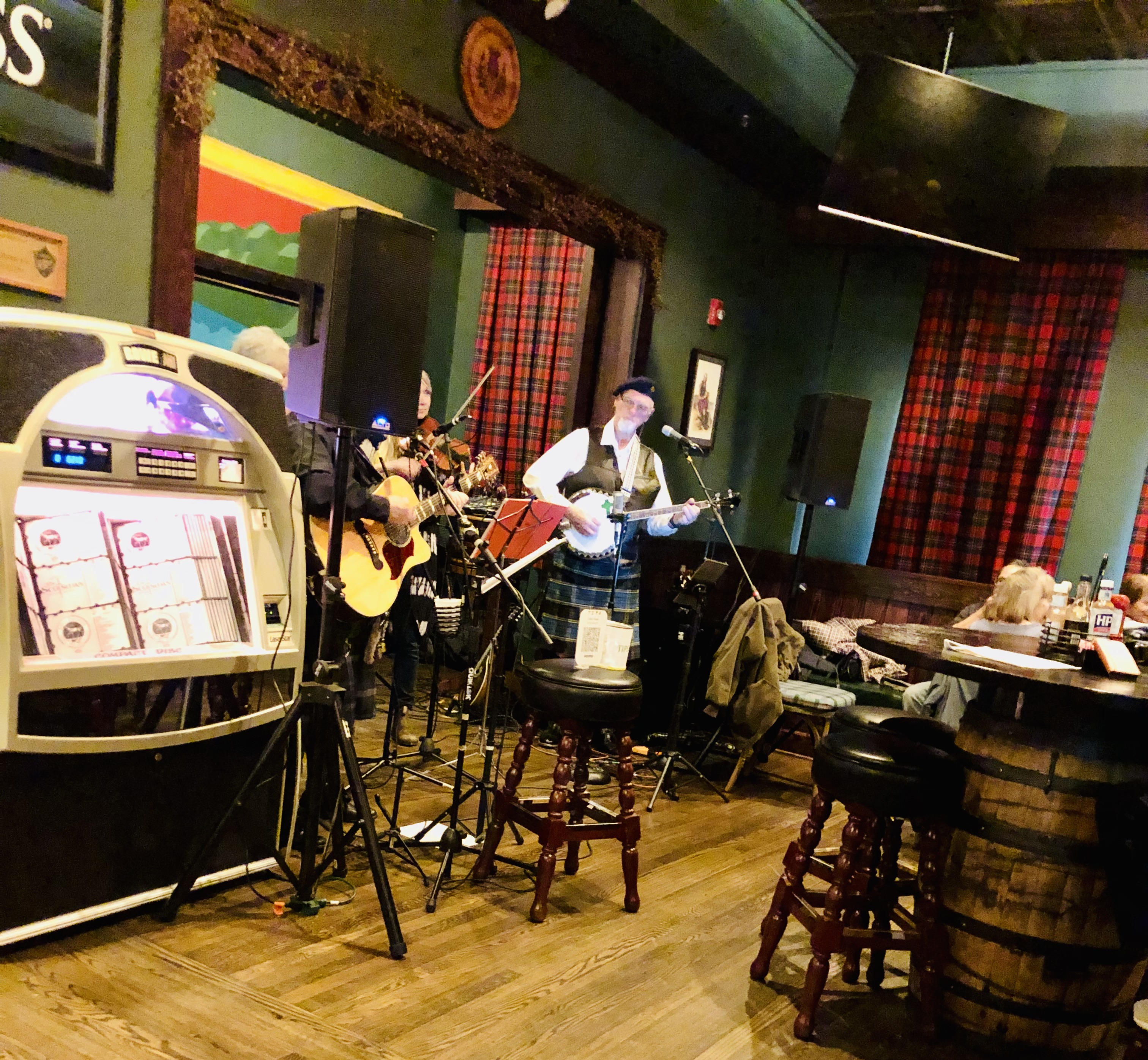
An Evening of Live Music

The Scotsman Public House featuring live Celtic music.

“Frog Level” Brewing Company Americana. 

Back to the Scotsman for Ben & the Borrowed Band, a cover country act. 

Local funk act the Mike Rhodes Fellowship.

The Last Frontier

Although so far she's not winning many votes, Nikki Haley is leading the unnamed real estate magnate in fundraising. So too is Joe Biden running away in the political donations race.

In an environment in which inflation has drained away the ordinary person's ability to feed their families and make their bills, it's no surprise that only the rich can really donate to political campaigns. The rich are sure about where their interests lay, too, which is with the Establishment -- they may differ or perhaps not even care about which party, but the Establishment for certain.

The class difference is understandable. The real wages of average Americans did better under the real estate guy than they'd done in decades (a fact willfully obscured by including the Covid collapse in his numbers). This occurred because of two signature policies: cracking down on illegal immigration, which depresses the wages of working class Americans; and the full-throated embrace of the shale oil boom that gave America back its energy independence -- even making us a net exporter again. 

Average Americans found their gasoline bill was down, which meant all their bills were down: fuel to transport goods to market is baked into the price of everything. Meanwhile, their employers were forced to pay Americans to do the jobs that they needed done in America. That was more of the jobs than expected, too, thanks to the death of the Trans-Pacific Partnership that would have helped ship more jobs to Asia, and the Transatlantic Trade and Investment Partnership, which also kept jobs home instead of abroad.

It's no wonder those who run major corporations would rather have an Establishment figure in office, one who will keep the borders open and costs down. They have little to fear even from Biden's environmentalism, as he has quietly allowed shale to trickle back up to where it was before.

It's also sensible that working class and middle class Americans would prefer to keep that particular tap shut, not merely for economic reasons but for more basic reasons of human meaning. The economics are aligned with their interest in stable communities, relationships, neighborhoods (as shown by the exact similarity in the complaint against gentrification as against mass immigration).

Marxist analysis would suggest that this is obvious: economics drive history, they say. It's the most basic of their analytical tools. Yet for some reason we don't really hear people talk about this in these terms: people on both sides prefer a cultural overlay to the economic analysis. It flatters the left to think that they're on the side of progress and their values, rather than the side of importing people who will be paid less and granted no worker protections in order to suppress the wages of fellow Americans in service to the rich. It flatters the right to think they are standing up for Christianity and Western traditions instead of a fair wage and a better life for their family (those selfish things!).

So we end up talking about what everyone wants to talk about instead of this important aspect; and we end up casting aspersions on each other that are not the ones most genuinely deserved. The most true and applicable complaints are left out of the conversation.

Hilarity Ensues

Google apologizes after its new AI generated “racially diverse” images of Nazis. 

As the article explains, the diversity is limited because the AI really doesn’t like to include white people; so you can imagine the results. It would have generated everything except accurate results. 

UPDATE: Related.

El Dorado

This was one of three versions of the plot of Rio Bravo, of which the original was best but each had its charms. For example, John Wayne rode his prettiest horse in this one. 


Cf. Ivanhoe:

Having expressed himself thus confidently, he reined his horse backward down the slope which he had ascended, and compelled him in the same manner to move backward through the lists, till he reached the northern extremity, where he remain stationary, in expectation of his antagonist. This feat of horsemanship again attracted the applause of the multitude.

Horses really don’t like to do what Ivanhoe and John Wayne just did. It’s a mastery.  

Thanks Google Photos

…but this was not as festive as you might be imagining.