Bin Laden's Letter to America

There is controversy over this becoming popular with many of the young, who do not remember 9/11 and have been raised to believe in such narratives. As such, it is being pulled down in many places. 

I reject censorship and embrace freedom of speech and expression from first principles, so even though Osama bin Laden was an enemy of mine and I participated in the wars of revenge against him and his for 9/11, I will reprint the entire letter below the fold. Everyone who wishes to read it and understand his perspective should do so. It is far from the worst thing that enemies should understand each other: not only does it sometimes create the possibility of peace, it is also a necessary condition for successful war. As Sun Tzu said, to be successful in a thousand battles one must know one's self, and also one's enemy.

Separately I would note that his argument in section (3) -- as to why it is justified to attack American civilians and not just American military forces -- is a part that these young people should consider. With the exception of (3)(f), those arguments all apply to the people of Gaza, who have accepted Hamas as their leaders, allegedly elected them and certainly not attempted to overthrow them, and supported them with their tax revenue. If you are one who thinks that maybe 'Osama had a point,' well, that same argument applies to the civilians now caught in the war in Israel. If you think we need a ceasefire to protect those civilians, then you are in fact rejecting Osama's model of 'resistance,' or Jihad, or whatever you'd like to call it. He calls it both.

What follows past the break is his letter. 

Confidence in Government

So today I saw this chart, which claims that Americans' confidence in government is 'far below the global average.'


You can see at the bottom that the source is the Gallup World Poll. Obviously there are a lot more dots below the line than above it, which led me to wonder how the poll was weighted. I thought perhaps it was population, as maybe big countries in terms of population counted more but only represented one dot. China doubtless expresses massive confidence in government, because otherwise you lose social credit and can't get loans or a job, so that would undermine the idea that the poll is fair.

Here are the top countries expressing high confidence in government:

1) Tanzania (!)
2) Uzbekistan (!!!)
3) Singapore
4) Bangladesh (!)
5) Mail (!)

The one they chose to label was "Finland," but the top five are -- with the exception of Singapore -- dysfunctional hellholes. In the next ten you get real governments like Switzerland and Luxembourg, but also Kazakhstan and Mozambique (most famous cultural contribution: the 'Mozambique drill,' a triple-tap shooting pattern that involves putting one in the head and two in the chest "to be sure"). 

So maybe the fact that Americans express distrust in their government should ironically be confidence-boosting: at least we're still free to say that the government stinks on ice. It does, and more so every day. At least we're still free to talk about it. 

Tolkien and the Italian Right

Anybody who has watched a few spaghetti westerns knows that Italy's take on American stories is going to be wildly different from the American one -- recognizable, but still very different. Japanese takes on American westerns (often in the guise of samurai films) are also this way. 

Now, it turns out that the Italians also have their own take on J.R.R. Tolkien. (There's a paywall, so I'll quote enough to give you the idea.)
Italian Prime Minister Giorgia Meloni quoted an unlikely source: Faramir, son of Denethor, who battled the orc hordes at Osgiliath.

“I do not love the bright sword for its sharp edge, nor the arrow for its swiftness, nor the warrior for its glory,” Meloni, referencing J.R.R. Tolkien’s Lord of the Rings, told an April conference in London. “I only love that which I defend.”

Italy’s first female prime minister — and its most far right since World War II — has channeled Daenerys Targaryen from “Game of Thrones,” posing atop a smoke-spewing dragon at a 2018 comic convention in Rome. During last year’s election campaign, she briefly posted an image of herself next to an Iron Throne alongside the caption: “A mass invasion of foreigners? Not today.” Her far-right brethren from the Brothers of Italy party retreat each year to Atreyu, a summerfest named after the dragon-riding warrior in “The NeverEnding Story.”

Yet for Meloni and a horde of fantasy-loving politicians in Italy’s far right, nothing is more precious than the works of Tolkien, in whose writing they see themselves as a ragtag fellowship battling the Lidless Eye of the European left. Italy’s post-fascist far-right hosted “Hobbit Camps” for young conservatives as far back as the 1970s. In her autobiography, Meloni concedes to a lifelong adoration of Tolkien’s works, including dressing as the hobbit Samwise Gamgee with other politically aspirant youth.

Now, Meloni’s government has transformed her greatest literary passion into a massive new Tolkien exhibition at Rome’s National Gallery of Modern and Contemporary Art. 

"Post-fascist," eh? So, progress, then?

I have to admit that I never considered identifying myself with Samwise Gamgee, but rather with Gandalf or -- obviously -- Beorn and his son Grimbeorn. I wouldn't think that someone whose takeaway from the story was that Sam was the real hero would be much of a threat to anyone -- rather, perhaps, that they were unusually clear-eyed observers of the book. 

The opposition is not amused.

“The problem is not Tolkien or the Lord of the Rings or the Hobbit, but the fact that this is being put through a political lens and used as a tool for revenge by right-wing culture,” said Matteo Orfini, a national lawmaker from the opposition Democratic Party.

He added, “I mean, I loved the book too … when I was 15.”

That's the sort of claim to being too sophisticated for Tolkien that one often sees from people who would like to think of themselves as intellectuals, forgetting that he was himself a scholar of great depth, who wrote large parts of the Oxford English Dictionary as well as the best scholarly article ever penned on the Beowulf

It's somewhat akin to the take mocked in this parody video, in which a contemporary fantasy writer claims to be 'Rock 'N Roll" compared to Tolkien. The riposte the authors wrote for Tolkien is outstanding.

The Shepherd of the Hall

Proudly modeling his new collar.

A Reshuffling of Alliances

It's noteworthy that the present war in Israel is producing so much turmoil within nations that are not properly involved in the war at all. For example, in Russia:
Russian President Vladimir Putin called for a high-level meeting of security officials immediately following the recent anti-Israeli riots in Dagestan and elsewhere in the North Caucasus....  Perhaps more notable is what appears to be a major purge of security officials in Dagestan itself and the beginning of major preventative measures among the youth in Russia to prevent any recurrence of such actions....

Moscow is clearly trying to present itself as being on the right side of condemning anti-Semitism.... In addition, these moves clearly reflect unease in the Kremlin. There is fear that the situation in the North Caucasus and other non-Russian regions is rapidly coming to a boil.... The anti-Semitic, anti-Israeli attacks in the North Caucasus could well be followed by attacks on ethnic Russians and Russia itself, especially as the war in Ukraine grinds on, a war in which North Caucasians and non-Russians have suffered large and disproportionate losses[.]

 Also in France.

On Sunday afternoon thousands of people heeded a call from the Speakers of the two houses of parliament to show their support for French "Republican" values and their rejection of antisemitism - this in the face of a steep rise in antisemitic actions since 7 October.... For decades French politics erected a bulwark against the far right, whose views - not least on Jews - were deemed "anti-Republican". The old National Front under Marine's father Jean-Marie Le Pen was seen as beyond the pale, and it was shunned.

The far left meanwhile - the Communists, the Trotskyists and the new formations like Mr Mélenchon's LFI - were certainly attacked for their views, but they were never excluded. They were part of the broad political family, in a way that the Le Pen franchise clearly wasn't.

A few years ago, for a far-left party not to have been part of a march against antisemitism would have been unthinkable. For a far-right party to have been there instead would have been unconscionable.

Also in the UK.

To appreciate the depths of the ideological cesspit that Britain’s cops have climbed into, consider this. This week, police in Northumbria interrogated a woman, a lesbian, under caution, for tweeting that ‘trans women are men’. ‘What did you mean by this?’, the Orwellian creeps asked the lady whose only speechcrime was to state biological facts every six-year-old knows. Meanwhile, in London, the Metropolitan Police ruled that ‘no offence’ was committed by an imam at the Greenwich Islamic Centre who, 13 days after Hamas’s 7 October pogrom, preached about ‘the usurper Jews’. ‘Curse the infidels’, he said. ‘Destroy their homes.’

So in 21st-century Britain the cops will come knocking if you say people with penises are men but they’ll leave you alone if you demean Jews. They’ll drag you to a station and grill you on your separation of the letters LGB from TQ – as those tyrants in Northumbria did – but shrug if you issue curses against Jewish people. The ideological capture of our police is complete. 

Also in America (although the US has deployed thousands of troops and thus may not be considered "uninvolved").

Sympathy for Israel tends to be far higher among conservative and older voters, who remember the Holocaust, at least from their parents’ telling, and usually embrace the Judeo-Christian tradition. Contrast their attitudes with those of younger people, who are notably ignorant about history. Little wonder perhaps that voters under 34 are far more likely to support Palestinians and even Hamas over Israel than older voters.

Remarkably, it’s under a Democratic president, not some imagined white nationalist right-winger, that Jewish people in America feel threatened in ways not seen since the 1930s. Jews are finding colleges and public space in places like New York uniquely hostile. In schools, ‘anti-white’ identity politics has now been extended to justify the murder of Jews.

I note the inversion between the last sentence and the Russian concern: "The anti-Semitic, anti-Israeli attacks in the North Caucasus could well be followed by attacks on ethnic Russians and Russia itself." In the famous poem, 'first they came for the Jews,'* and Russia is worried that Russians and Russia might be somewhere down the line. Here they came for "white" Americans and America first, and the Jews are down the line. 

Wild to see Le Pen's crew wising up to that and getting themselves ahead of the problem, at least if you know the history of antisemitism in France. 

UPDATE: Related.

"We need to start making people who support Israel actually afraid to go out in public," Chambers said in a Friday Instagram post. "We need to make all of white America afraid that everything they have stolen is going to be burned to the ground. That's what makes them listen."


* In the poem socialists and trade unions were before the Jews, which is perhaps more similar to the present case here: first it was the Confederate statues. I recall a certain orange-haired President warning that they'd come after Washington and Jefferson if you let that domino fall, and everyone laughed; but they did come after Washington and Jefferson, and later the whole thing. 

Fire College

The Hazardous Materials course I attended this last four days was part of a larger 'Fire College' being held. This was a pretty impressive event, what I saw of it in breaks between class sections. Lots of different departments from all over came out to practice everything from high-rise firefighting to flammable bulk liquid firefighting, to rescue things like rope rescue rappelling or dealing with bombs and booby traps. 


Saturday Night Western Swing

Seems right to start with Bob Wills and the Texas Playboys

Leaving Tulsa, Some Asleep at the Wheel ...


Happy 248th Birthday Marine Corps

 A day for remembrance and celebration. 


Smoke on the Mountains

I took this shot exactly where I took the earlier sets showing autumn color. 


In the earlier set, you can see a morning shot with the usual "Smoky" mists that normally attend these mountains. The whole world is full of this smoke, for miles and miles in every direction, as wildfires burn all around us. Some of them are reported contained.

It's not a great weekend to send people out of the fire district, but several of us have long been scheduled for a big training thing this weekend. I'll be leaving at 0430 to attend that, and gone until Sunday night.

World on Fire

There are wildfires all over. There’s been so little rain that there’s a state burn ban, a county burn ban, and people are still out burning. Some idiot burning trash set off a huge fire that’s now burned a building in spite of many hours of firefighting efforts (in which I participated in an entirely minor and inconsequential way). The Smoky Mountains really are right now. 

This is the sort of thing that troubles my hopes for human freedom. We should not need a ban; it should be totally obvious that burning anything is irresponsible and stupid. All the same, people are out here starting fires. I’m not much for telling people what to do or how to live, but this kind of thing makes me wonder. 

Cooking Club Short Ribs

I made the beef short ribs according to Cowboy Kent Rollins recipe, which Grim recommended some posts ago. I had to use a slow cooker instead of a Dutch oven, and I went with an Argentinian Malbec instead of Merlot. Turned out well. It went for 5 hours on high, but could have used another hour, I think. It did in fact fall off the bone and tasted great, but at the thickest part was just a tad dry. Rollins suggests mashed potatoes as a side, and I second that. The thick broth makes a good gravy for it.


Saturday Night Electro-Swing

Apparently, 20-somethings are listening to a lot of this hybrid swing these days. Youngsters these days. (You'll have to imagine the eye roll there.)


The next would have been good for Halloween.


It's kinda catchy, though ...

Comments Policy

Since we have been getting so many anonymous comments lately, I thought I should repost the comments policy. It's very old: in 2015 it was nine, so it must now be a teenager. Anonymous comments are allowed, but must be signed with some kind of pseudonym that you'll stick by so that we can keep everybody straight. It's hard to carry on a conversation with three different "Anonymous" at once, not being sure which one said what or if they're all the same guy. 

Anyway, here it is.
Please be welcome, so long as you will adhere to this form.
I adopted [this policy] from the sadly-defunct Texas Mercury, a fringe publication but one whose bold assertion of well considered and unusual ideas I always enjoyed:
As we see it, modern society has all the important ideas of life exactly backwards: we are completely against the belief in sensitivity and tolerance in politics and raffish disregard in private life. The Texas Mercury is founded on the opposite principles- our idea is of tolerance and polite sensitivity in private life and ruthless truth in politics. Be nice to your neighbor. Be hell to his ideas.
Comments failing to uphold those principles run the risk of being deleted without warning. In the year and some months since I adopted that as the policy here, I've added one additional point: hit-and-run comments, as well as anonymous comments, will generally be deleted. If you're a regular here, and willing to stand up and fight for what you believe, you can say pretty much anything that isn't a personal attack on a fellow reader. If you're just wandering through, or unwilling to leave your name (even a false name you'll stand by will do, e.g., "Grim"), pass on. This is a hall, and regular readers are honored guests not to be troubled by cowards.
Fair enough? Well, fair or unfair, those are the rules.

The only thing that's been added since is that off-topic comments may be marked as SPAM, which will cause them to disappear from user's experience. I don't delete them, but I do sometimes so mark them because we've had some people over the years who proved it necessary. 

Try not to do anything that will make me add to this list. I liked it better when it was simpler.  

We’re at War

If you were wondering if things are moving behind the scenes this should tear it for you
United States Marine Corps Major Gen. Chris A. McPhillips reportedly announced Tuesday that the 248th Marine Corps Ball has been canceled by U.S. Central Command as a result of “unforeseen operational commitments.”

There are other matters you don’t know about if it’s gotten that far. Like it or not, saddle up.  

A Good Sharp Knife

The Orthosphere:

Rod Dreher has written another thumb-sucker about the evil that lurks in the hearts of all men, which is true enough but not particularly useful when another man, his lurking evil leaping into view, chases you down an alleyway with an axe in his hand.  Dreher naturally quotes Alexander Solzhenitsyn’s lines about the “bridgehead of good” that remains within hearts “overwhelmed by evil,” and the “small corner of evil” that remains in “even in the best of all hearts.”   Which is, as I said, all true enough; but hardly helpful to a man encircled by a menacing mob.

What exactly does Dreher expect me to do with the reflection that the man who proposes to slay me is on other occasions kind to animals, a devoted son, a skilled musician, a fellow with whom I might gladly enjoy a beer?

Well, go have a beer with him, if you can. If you can't, here's some practical advice.


Even a pretty devoted man may reconsider in favor of the beer if he is aware of the keen knife on your belt. That's been my experience, anyway.

The Scourge of the Hour

...decade, century-so-far, etc...
President Biden ran for office to restore the soul of the nation. He is unequivocal: there is no place for hate in America against anyone. Period.

Today, he and Vice President Harris are announcing that their Administration will develop the first-ever U.S. National Strategy to Counter Islamophobia in the United States. 

How is it possible that the U.S. is only now developing its first-ever strategy to its most favorite problem besides racism and climate change? I would have thought we'd be on the fifth or tenth edition by now.

I'll take the path of magnanimity on the subject of 'President Biden ran for office to restore the soul of the nation,' an entity which has no soul... I mean the nation, of course. Nations are theoretical entities, not ensouled beings, thank God. When people start thinking of nations as beings with things like souls and destinies, they do terrible things indeed. 

The Feast of All Saints

For further reflection, the Pope’s remarks on holiness

On the Occasion of Halloween

I want to speak on this occasion to a comment left by our friend Lars Walker in the Níðstöng Pole post below. Halloween seems like the right time to discuss it.
Lars Walker said...
Speaking purely as a saga reader, without any more credentials than a lifetime of interest in the subject, I have a theory that putting a head on an inanimate object (Viking ships would be an example) transformed them magically into magical creatures, which would be empowered by the magic of the runes. Thus the nidstang becomes a living witch-being, constantly cursing the object of the curse.

I grieve over the slide of the Icelanders, and other Europeans, into pre-Christian magic. They will suffer for this, not only in eternity, but in this life. I take no pleasure in saying it.

To the first point, I definitely think there is something to that. I wrote an essay years ago called The Smell of Death that also spoke to the power of the severed head, both to create the impression of a being and to destroy it: 

Today, among Americans, only hunters have encountered this directly. It comes in the time when you are cleaning a kill. You cut the head from the body, and hold it in your hand. Though you slew the beast yourself, though your own knife did the cutting, seeing the head disjoined from the body is the most disquieting experience it is easy to know.

Indeed, the hunter finds, it is as if the whole power of the animal were in the head. The body, with the head set aside, no longer really resembles an animal at all. It is plainly dinner, and a hide to use as a blanket in winter.

We do not react to the severed leg as we do a severed head: a drumstick is a delight to the eye; the haunch of a deer or a pig both looks and smells fine as it roasts on the fire. Or think of a fish, if you have ever had one served as they serve it in China: with the head still attached. It is a very different experience to eat such a one, than to eat a fillet.

This is why some hunters take the heads of their beasts, and place them as trophies upon the wall. It is why the ancient Gael took the head of his famous and noble foe, and tied it by its own braids to his chariot as a warning to others. It is why the more ancient Celt built temples to the severed head, with alcoves and emplacements specially constructed for displaying honored skulls.

It is why we have legends of Mimir, and Celtic tales of other severed heads that spoke wisdom to the wise. They conversed with us from the realm of death; they kept the power of great men.

The second of his points, though, is the one I wanted to discuss on Halloween, that day of Celtic rather than Icelandic carry-over of magic and surviving echoes of pre-Christian traditions (well, and Yule; but we'll get there in due time). 

For one thing, Icelandic magic has flourished throughout the Christian period: consider the Galdrabók. Scholars estimate it to be from around 1600, which is to say six centuries after Iceland was Christianized (by elective choice, rather than conquest or imposition from a ruling king). It retains the names of some pre-Christian beings, but also uses names that are explicitly from the Christian tradition. I wouldn't say that the thing that is wrong with it is that it isn't Christian enough; indeed, the beseeching of the aid of Satan in working one's will on the world is far more troubling than any reference to an elder god. 

Tonight I will perform Halloween celebrations in that most-American, and least-religious, way: I will be at the VFD distributing candy to children dressed up in costumes. There is exactly nothing of the religious aspect left there: we are neither burning fires to welcome the darkest time of the year, nor attending midnight Mass to celebrate the Feast of All Souls. Yet I don't think there's anything wrong with this at all; we are giving some joy to children in a way that lets their parents know that the gifts they are receiving will be safe and trustworthy. 

Theologically and metaphysically, I think of Matthew 18:18. The power to bind and loose is a kind of magic, too: a divine grant of it, an assent to support a working of the will that will hold in this world and the next. There is some debate about who precisely was granted this power. I think the Orthodox position is that it belongs to the Church by apostolic succession (leaving aside the practical dispute among the churches about which one is entitled to wield it). Yet I have heard even a Roman Catholic priest -- a Franciscan -- suggest that the power there belongs to any Christians acting in concert; the next verse seems to say that explicitly, although in such matters interpretation even of the apparently explicit is always contentious. 

Such a wide interpretation is defensible: perhaps, being commanded to love one another as ourselves and even our enemies as ourselves, we might all wish for a broad power to loose. Yet then there is also the question of what to bind, which would be similarly broadly granted on that interpretation. The Church's stronger position makes more practical sense: if there is an authority that alone has the power, then you won't get the problem of one group of nuns deciding to bind something and another one deciding to loose it. 

I think there are more pragmatic than theological problems with a broad notion of forgiveness. It is plausible to me that God would want Hell to be empty, and would not wish to see anyone suffer eternally. Here on earth, however, we seem to need some controls on human behavior: it would be helpful to enlist the church in that, many societies have thought; it would even be decent, as it would provide an alternate source of authority to counterbalance that of the state where the state grows overweening. Of course there is the problem that the church could merely choose to reinforce the overweening state: that was what Mussolini wanted, more or less. In such a case, a rebel tradition that preaches wild forgiveness would be welcome. 

I leave all of this as matter for reflection, and discussion if you like, on this All Hallows Eve. 

Grim’s Hall Cooking Club

Let’s try something different. Most of you probably have enough ground to dig a hole in. If not, you can substitute an oven. 


Let’s do this Friday, and compare notes. That’s plenty of time to shop and make preparations. 

Saturday Night Swing

 The first two are fun to watch, too.


Níðstöng Poles

An old custom is showing a revival in Iceland. 
Nithing poles such as this have been popping up in Iceland more and more over the last few decades. Anna Björg, CEO of the Museum of Icelandic Sorcery and Witchcraft in Hólmavik, says nithing poles are “pointed against someone you want revenge on” and considered deeply personal. She explains that it’s more serious when directed at an individual as opposed to a larger entity, such as an industry or the government. Björg says, “People take it like a death threat.”

It is, approximately. The word is a cognate of “nothing,” and is a declaration that the cursed is considered no better than nothing in the eyes of the one issuing the curse. Just to call someone that verbally was a punishable offense under the old laws, requiring you to pay a portion of their wergild. Apparently current Icelandic law handles it exactly like issuing a threat against someone’s life, if it is pointed at a person instead of an organization. 

The most famous example is from Egils saga Skallagrímssonar

Master of Magic and Occult Studies

So I saw an article about this program that the UK's Exeter University is offering, but they're really burying the lede here:
The new post-graduate program will be housed within the university’s Institute of Arab and Islamic Studies. The placement will help students understand “the Arabo-Islamic cultural heritage back where it belongs” with “decolonisation, the exploration of alternative epistemologies, feminism, and anti-racism…at the core” of the program....

Emphasis added. I can't imagine any place more likely to receive such a program with intense interest, especially the attempts to "place the Arabo-Islamic cultural heritage back where it belongs... with... feminism... at the core." Adding in actual witchcraft is going to make for an exciting time down at the Islamic Studies department!

Even in the much more staid University of Georgia, the Religious Studies program generated more complaints than any other department according to the officer from the Civil Rights department I spoke with some years ago. 

GWAR


I went to see GWAR in Asheville. It was cartoonishly violent and profane, much akin to a heavy metal Looney Toons as influenced also by He Man (the band originated forty years ago!) and Hong Kong cinema. 

The concept of the band is that they are barbaric space mercenaries, who engage in battle on stage as they play rock music. Sprays of blood are spewed out from the wounds created by rotary saws, swords, spiked hammers, and the like. There were many occasions for multicolored blood to spray across the audience: fights to the death, executions, murders, and vivisections were all luridly portrayed. 

It was, without doubt, the most amazing spectacle I have ever seen at a concert. At one point they chopped up Vladimir Putin, to the howls of the crowd; later, they beheaded Joe Biden, and the laughing citizens of Asheville danced in the sprays of his blood. 

The Days of High Adventure

A short retelling of the story of Guthred, whose tale has similarities to that of the famous Cimmerian.
Simeon wrote that a local abbot was visited, in a vision, by Cuthbert, an Anglo-Saxon Saint (who had once resided at the monastery on Lindisfarne). Holy Cuthbert advised the monk to seek out a slave who had been sold to a widow....

What can be historically verified, thanks in part to financial records, was that a Guthred was acquired by what appears to be an Anglo-Saxon nobleman named Æthelstan. Legend has it that this nobleman recognized young Guthred's leadership potential and set him free. 

Whether Æthelstan had received any visits from a monk with a bizarre tale of a saintly vision, or if we take Æthelstan's kindness at face value is hard to gauge centuries after the fact, but it appears that Guthred was indeed set free coinciding (coincidentally or not, we may never know) with the toppling of Halfdan from the throne of Northumbria.

Aside from gaining his freedom, Guthred soon, through a combination of his apparent charisma and hard work, gained the trust and support of the local community. In fact, in little more than a year, he had filled the large void in the kingdom by ascending to the throne. 

It seems that Cuthbert's foreshadowing had come to fruition, and a former slave became the second Viking King of Northumbria.

High Color

This is the same location as a week ago, but now at the height of autumn. 

The afternoon sun is golden at this hour this time of the year, adding to the glory of the display. It’s the most beautiful moment of the year. 

Firgive vus sinna vora sin vee Firgive

A Scottish form of Norse called "Norn" long existed, especially in the Islands. The last native speaker died in the 19th century, but it survives in many place names. It was replaced by Scots, not Gaelic nor English. A form of the Lord's Prayer in the tongue survives, and you can read it at the link: at least some of the words will be decipherable to you.

What is the Norn language?

Originally known as Norrœna, Norn is an extinct North Germanic language that was a variant of Old Norse. It was mostly spoken in the Northern Isles of Scotland in Orkney and the Shetland islands but was also found in the Scottish mainland in Caithness.

Vikings who came from West Norway first started building settlements on Scotland’s archipelagos around 850 AD and this is seen as the startpoint of the Norn language evolving from Old Norse. Scottish place names with Old Norse motifs can be found scattered throughout the entire country but the “amount of place names with a Norn element” in regions like Shetland reflect how such regions were heavily colonised by Norsemen.

"NorrÅ“na" also happens to be the name of a society that was founded by the kings of Sweden and Norway for the purpose of “resurrecting, reproducing, collecting and collating or indexing every thing that pertained to the early history of the Anglo Saxon, Celtic, Teutonic, and Scandinavian races—to furnish the people of Northern Europe with their own vital history.” The wide-ranging interest is well-captured by this NorrÅ“na Library edition of their collection that we inherited from my wife's mother's family, who had it in Alaska in the middle of the 20th century.


My set is 15 volumes, but there were sets with a 16th on early American history.

Saxo Grammaticus wrote on early Denmark; the Volsung (Völsunga ) Saga was discovered in Iceland but is clearly related to the Medieval High German Nibelungenlied; the Heimskringla is a history of Norse (chiefly Norweigan) kings.

Again, Iceland, Iceland, two general collections of folklore widely sourced, and Sir Thomas Malory of England drawing on French sources.

It is lushly illustrated; here is a plate from the Völsunga Saga.

It's actually quite difficult to tease apart the history of the "Anglo Saxon, Celtic, Teutonic, and Scandinavian races," especially in the British Isles. The Normans who conquered and ruled (and intermarried with) both Anglo-Saxons and Celts were originally Scandinavian before they came to France; the Celtic-French collaboration we call the Arthurian cycle was later adopted by the Normans as their especial favorite mythology because it provided ancient warrant for a kingdom both in the British Isles and the French-speaking continent. 

All of this heroic Northwestern European literature was fodder for the NorrÅ“na Society, as it is for we ourselves. 

The Collective vs. the Individual in "Nordic Philosophy"

Recently I was explaining to a college man studying history seriously for the first time the facts of the Enlightenment and the rise of what we once called political liberalism. Medieval political philosophy, I explained, often likened the society to the human body; sometimes it likened subsets of society to a body, which gave rise to the word "corporation" from the Latin word corpus meaning body. As a member of society (or such a society), your duty was derived from your function as related to the collective: just as the eye's function is to see so that food can be found, and the hand's function to grasp so that food can be obtained, the teeth, stomach, blood, etc., all have individual functions -- but they are all ordered to the common good of the whole. An eye that decided not to perform its function in a way that led to the good of the collective could be said to be diseased (is so said, by Aristotle and the Medievals who followed him). Your duty was thus defined by your function relative to the collective, so that a knight fought by right and duty, and a peasant labored by right and duty; your liberties were defined by your position in the social order, and aligned with the duties you had to fulfill. 

Liberalism inverted the idea that the individual was defined by his assigned place in the collective, and instead had a sort-of equality of rights and duties (allowing for individual differences in abilities, etc). Thus the Founders here spoke in the Declaration of Independence as later in the Bill of Rights of the rights of individuals that the collective had no legitimate power to transgress, and indeed existed wholly to ensure. Similarly, the French Revolution sat down and concocted the Declaration of the Rights of Man and Citizen shortly after defeating the king's attempt to restore his power over them, and to reduce them back from the sort-of equality they had gained into members of his collective with each their assigned place.

Strikingly, I finished this discussion, both of the modern reactions to liberalism -- communism and fascism -- attempt to restore the collective's priority over the individual. Mussolini explained fascism as a sort of 'corporatism,' drawing on the same Latin as above; all the people belonged to all the institutions, but all of the individuals and all of the institutions were to be ordered to the good of the state which was the collective whole. Communism, of course, establishes a collective which claims the sole right to own property -- no individualist ownership is permitted, nor is your work to give rise to any self-improvement of your station because 'from each according to his abilities,' but 'to each according to his needs.' 

I was thinking about this the other day when I came across this article on the "Nordic philosophy" of Jante, which is built around variations of the rule that “You’re not to think you are anything special.” The article praises the concept as helpful in building better workers; i.e., the worth of the concept is judged from its usefulness in adapting individuals into being better servants of the collective.

How different from that earlier "Nordic philosophy" embodied by Rögnvald Kali Kolsson, Earl of Orkney from 1129 to 1158. You might be inclined to reason that the Viking age was made up of pagans rather than humble Christians, but this is not the case: he was a Christian, and in fact went raiding against the Saracens in Spain and as far as Jerusalem. I own a copy of the book of his poems reviewed there (Crimsoning the Eagle’s Claw by Ian Crockatt), and it is striking how they are so often built around celebrating exactly how this individual is special. The review gives two examples that are on point, one a self-description:
Who’ll challenge my nine skills?
I’m champion at chess,
canny recalling runes,
well-read, a red-hot smith –
some say I shoot and ski
and scull skilfully too.
Best of all, I’ve mastered
harp-play and poetry.
The second is praise of another very special person, a lady of beauty and charm.
Who else hoards such yellow
hair, bright lady – fair as
your milk-mind shoulders,
where milled barley-gold falls?
Chuck the cowled hawk, harry
him with sweets. Crimsoner
of eagles’ claws, I covet
cool downpours of silk; yours.
The other two examples -- and most of the poems not sampled in the review -- are of the type. He praises his crew's special prowess; he praises his ship's special sleekness. He praises his extraordinary journey, unique and special, in traveling from Orkney as far as the Holy Land. 

These two philosophies are ironically placed: the Medieval Norse poet is celebrating individual specialness in the era of collective politics, whereas the Danish workers are celebrating non-specialness and collectivism in the era of liberalism. Perhaps both are in some sense needed, and the reaction of the individual in the corporatist era matches the desire for a collective in an individualist time.

The workers are said to be 'happier' according to the collective philosophy, but perhaps that is so only in comparison to other 20th century workers to which they are compared. The Viking seems to me to be happier than both.

Men of Harlech

This recording is apparently of the Royal Regiment of Wales Band, sung on the 120th anniversary of the Battle of Rorke's Drift, in the church at Rorke's Drift.


Alas, for fans of the movie Zulu, it is unlikely this was sung at that battle. The regiment was not renamed the South Wales Borderers until two years after that battle, the regimental march at the time was "The Warwickshire Lads," and while there were a number of Welsh soldiers there, it seems likely that the majority were English.

Still, a rousing song for an army defending its people from murderous invaders.

By Wolf Lake


A Medieval Tattoo

A Chi-Rho with Alpha and Omega has been discovered on preserved flesh from a burial at the Medieval Christian site Ghazali in Africa. It’s thought to be early Medieval, when the Chi-Rho was a popular Christian symbol: the earliest accounts of King Arthur have him using one on his shield, not the Crusader crosses that became popular centuries later and are more commonly pictured in Arthurian art. 

Can't Get Enough Outlaw Tunes


A Stroll in Downtown Asheville


This was from yesterday. That’s one block from the Mellow Mushroom, so I know where they were headed. 

Outlaw Songs

It's a fine Friday. We'll sing some good songs.


Sing It

A Federal judge knows some lyrics.
People have heard about the Robb Elementary School shooting in Uvalde, Texas. They have heard about Sandy Hook, Parkland, the Pulse nightclub, and other tragic mass shootings. But they do not hear of the AR-15 used in Florida by a pregnant wife and mother to defend her family from two armed, hooded, and masked home intruders. As soon as the armed intruders entered the back door of her home they pistol-whipped her husband — fracturing his eye socket and sinus cavity. Then they grabbed the 11-year old daughter. The pregnant wife and mother was able to retrieve the family AR-15 from a bedroom and fire, killing one of the attackers while the other fled.

It does not require much imagination to think what would have happened next if the woman had lived in California and could not possess such a firearm. People do not remember the disabled 61 year-old man living alone on a 20-acre property in Florida with dense woods and a long dirt driveway. After the homeowner had gone to bed, three men armed with a shotgun, pistol, and BB gun invaded. One wore a “Jason” hockey mask. The disabled victim said he was awakened by a loud noise and grabbed the AR-15 laying near his bed. He saw the masked man and a second man coming toward him inside his home. Gunfire was exchanged. By the time police arrived, one attacker had run away, one lay wounded outside, and one was dead on the dining room floor. Police found the disabled man in his bedroom alive, but bleeding from a gunshot wound to the stomach. The AR-15 lay across his legs. Without his modern rifle, the victim would have become an evidence tag and a forgotten statistic.

People do not hear about the AR-15 used by a young man in Oklahoma to defend himself from three masked and armed home invaders clothed in black. The three intruders broke through a rear glass door. Though outnumbered, the homeowner put up a successful defense with his AR-15.People do not hear about the AR-15 that was needed when seven armed and masked men burst through a front door at 4:00 a.m. firing a gun. Outnumbered seven to one, it took the resident 30 rounds from his AR-15 to stop the attackers.

But he did, though. 

Populist Songs

VDH has a discussion of Oliver Anthony, the artist Douglas introduced us to just before he became a sensation.

After Anthony rails against high taxes, a worthless dollar, and ossified wages, he suddenly and strangely pivots both to Jeffrey Epstein—as the incarnation of the corrupt rich—and the subsidized morbidly obese as proof of the baleful effects of the entitlement industry on the poor. Variatio in themes and expression, as the ancients remind us, is the key to good prose and poetry, and Anthony’s song is anything but predictable in its targeting of both the masters of the universe and the welfare class.

That set of lines drew most of the wrath, but it makes a lot of sense. If the anger at the system is appropriate, as it certainly is, you should be able to show both that those who run the system are bad, and that those who are affected most by the system are harmed by it. The accusation is not that the poor on welfare are bad people, but that they are being actively harmed by the system that allegedly benefits them.

One libertarian critic, David Henderson, writing for the website Econlib, complained that Anthony doesn’t understand that “some rich people want to reduce the amount of power the government has over us.” Finally, another commentator on the right, Stephen Daisley, writing for The Spectator, penned an article that was subheaded “Roger Scruton would have thought this country hit was worthless.” The Scottish opinion journalist further groaned of the song’s lyrics, “That is dreck. Doggerel. Objectively bad writing. . . . ‘North of Richmond’ is a squall of hoary nostalgia and pedestrian populism.” Daisley apparently assumes that Anthony should have been a polished literary polemicist rather than a talented failure turned wildly successful singer who wrote from the underbelly of America—a vantage point quite different from Daisley’s own perch.

Well, it wasn't for them. It was for everybody else. 

For this particular elite, rural America’s assumed bias, racism, and sexism offer a tempting target for virtue-signaling, airy lectures, and self-righteous stereotyping. Through a near-medieval sort of exemption, elite progressives relieve the burdens of their own racial guilt by transferring the charge of supposedly unearned white “privilege” to those who rarely had any innate advantage at all.

This is the best insight of the piece. The fact is that working man's wages aren't less affected by these disastrous policies if they're white or if they're black. What he's angry about isn't the things that his critics would like him to be angry about. He's angry that the government is actively harming its citizens rather than actually helping them. It's a betrayal of the mutual loyalty that government is supposed to entail. 

Arguing in favor of that mutual loyalty is, for this elite, itself an affront. The idea that the American government should principally help Americans to prosper and live safe, meaningful lives is described in negative terms like "populist," "white supremacist" (though many Americans are not white, and would benefit right alongside those who are) and even "fascist." 

The concept is actually a necessary condition for any legitimate governance. Even in a feudal society, the king depends upon the knights who, in return for their establishment, keep the king in power. The knights depend upon the king, but also upon the people who farm the land. The knights provide protection in both directions, when the system is legitimate: they protect the king and his order, but also the people from bandits and predation. When that works ideally, the system has a kind of legitimacy.

Lately the idea has become fashionable among the elite that universality rather than loyalty is the mark of legitimacy. We should all live under the same rules, not favoring Americans more than Iranians or the People's Republic of China. That shows we aren't prejudiced, they say; and the fact that the Chinese or Iranian governments don't feel the same way (Iran still holds an annual "Death to America" day) just proves that we are the more evolved and better.

If that sounds like madness, it is. It's all bad philosophy. They read Kant, but they didn't grasp that Kant's attention to the universal didn't mean that he wouldn't believe that you owed more to your father than to any random stranger on the street. 

For those who still believe in bonds of honor, there's this song.

Worldwide Caution

The State Department today issued a worldwide alert for Americans traveling abroad. It's an Orange Alert worldwide; in the Middle East it's Red

The President's decision to hug Netanyahu for the cameras has put a target on the back of every American everywhere. I don't know if any of you are traveling abroad soon, but take care if you are. 

Amazingly, we're also sending "Gaza," meaning Hamas, a bunch of money.
The humanitarian assistance, along with $100 million in new U.S. funding for Gaza and the West Bank announced by Biden, could provide a critical lifeline to Palestinians in the besieged territory where water, food, fuel and medicine are in desperate need.

I suppose it could do that, like the six billion to Iran could have been used for "peaceful purposes."  It's been obvious for a long time that we are governed by fools, but it doesn't seem to get better as time goes along.


The Hermit Saint Seraphim of Sarov

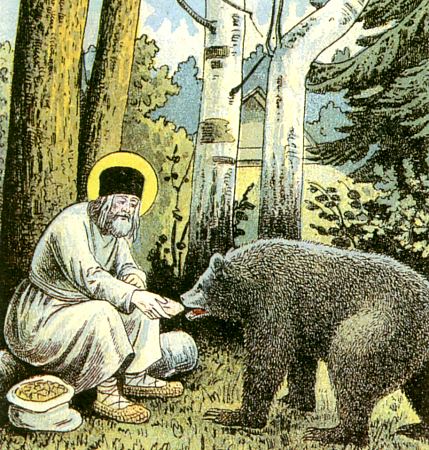
Grim sent me scrambling off to learn what eremetic means, and I ran into this drawing of St. Seraphim of Sarov, which just seemed appropriate for the Hall.


He is said to have spent 25 years in the wilderness, although a wilderness near a monastery.

The Autumn and the Winter

An incredible photo from the mountains above Waynesville shows snow on the autumn color

The Evening and the Morning

Two shots from the same location today. 


A New Law of Nature

For a long time it's been clear that Darwinian Natural Selection and random mutation-based Evolution couldn't be the whole story. For one thing, progress is too quick for the process to be purely random; there has to be something informing what kinds of mutations arise, not just a brute-force extinction mechanism to wipe out nonadaptive ones. Likewise there are examples like the multiple evolutions of crabs (five separate times we know of). Something must be guiding the process along lines that make a kind of sense.

Today I see that scientists have proposed an answer to this problem. 

[N]ine scientists and philosophers on Monday proposed a new law of nature that includes the biological evolution described by Darwin as a vibrant example of a much broader phenomenon, one that appears at the level of atoms, minerals, planetary atmospheres, planets, stars and more.

It holds that complex natural systems evolve to states of greater patterning, diversity and complexity.

"We see evolution as a universal process that applies to numerous systems, both living and nonliving, that increase in diversity and patterning through time," said Carnegie Institution for Science mineralogist and astrobiologist Robert Hazen....

Titled the "law of increasing functional information," it holds that evolving systems, biological and non-biological, always form from numerous interacting building blocks like atoms or cells, and that processes exist - such as cellular mutation - that generate many different configurations. Evolution occurs, it holds, when these various configurations are subject to selection for useful functions.

It's going to take a while to see if this holds water, as is the way with the scientific method. The problem they're treating is real enough, though, so it's good to see them trying out a new theory.

There are a number of second and third order questions that will arise if it does. It's going to have implications for the Fermi Paradox, for example. Of greater interest to me, it has implications for panpsychism and other questions around 'the hard problem' of consciousness. 

M-SAR

Yesterday AVI had a post called "Mountains and Nature" that was, I think, allied with his series of posts about naturalism, vegetarianism, and the like being aligned with Germanic paganism and therefore nazism (of the real sort, not the MSNBC sort). In it he quite correctly argued that early Christians viewed the city as the model for heaven rather than the Wild -- think of St. Augustine's City of God

Mountains have not always been considered beautiful. The Psalmist says that he lifts up his eyes unto the hills, and only then asks, "From whence cometh my help?" He never says that the hills are where his help comes from.  That is an entirely modern interpretation, post Romanticism.  

It was the Romantics who believed that we learned about God through Nature. They had gotten the idea from Puritans and other NW European Protestants, who indirectly inherited it from the concept of Wyrd among the pagans of that region. I discussed that in detail in 2010. (Be warned.  It's a series) 

I commented yesterday in agreement, noting that the Medievals and even Tolkien had made much of the garden, but viewed forest and mountain with grave suspicion -- at best, as places for adventure and spiritual development; at worst, places for madmen and outlaws. Somewhere in between the spiritual and the mad lies the hermit/eremetic ("desert") tradition that is said to have given rise to monasticism, but the monks built gardens and not wildernesses: not even St. Francis did that. 

...wonderful places like Rivendell and Beorn's hall are kinds-of gardens 'on the edge of the Wild,' where travelers can rest and regain strength after a challenging passage through dangerous mountains and forests. Forests, especially Mirkwood but even the old forest right by the Shire, follow the medieval presentation of being dangerous, frightening places.

And so they are; I have been through the certification course for Wilderness Rescue, which comes up regularly out this way. People get lost, hurt, and need rescuing when they go into the wilderness: not every time, but all the time.

I had the opportunity to reflect on this discussion last night, when a Mountain Search and Rescue call went out for a lost hiker, with the weather coming on 35 degrees and humid. We were out past 2 AM doing tight grid searches in a region of mountain wilderness, replaced by others who searched until dawn when we returned for another round. The hiker was eventually found alive, cold and rather viciously scratched up by the thickets of rhododendron and thorn. 

One can say without question that Bilbo Baggins or the Arthurian knights would hardly have been the admirable figures they became without the testing hardship of the Wild. In Tolkien, too, there is a third mode available to the elf whose faerie-like ability to live with the Wild is something like the hermit's, a kind of sacred existence that embraces the genuine wilderness in a way ordinary people can not do. Clearly Tolkien presents his elves as being metaphysically closer to God, beings among whom the angelic maiar walk and even marry. Even the fairy wants for a higher-fairy bride!

It's the sort of place a man can love, though; and for some of us, who hate the cities, the Wild is a happier place. It does require much from a man, and is more difficult to love in the middle of a cold night in a thicket on a steep mountainside. Even then, it is not entirely without its joys. 

We did find a bear on that midnight search. He was above hip-high when sitting down, and not especially inclined to run as many of them are. Eventually, he let us continue our search without incident.

Student Life as a Con

In an article AVI linked from the New Criterion, there is an aside that happens to align with something I was thinking about myself recently.
In the university context, such an inquiry might explore why student debt has gone up from $300 billion in 2000 to $2 trillion today. The cop-out answer is that the $2 trillion of student debt went to pay for $2 trillion worth of lies about how great education is. In my view this reading is too generous. How much of that $2 trillion actually went to education as opposed to room and board? If you analyze the universities in economic terms, you might even conclude that the dorms and residences are the profit center driving an elaborate real-estate racket. And this is not to mention the web of offices and administrators tasked with overseeing not education but “student life.” Scale this model up, and you begin to understand why it’s so hard to exist outside of a big city in the United States—a vast country with swaths of empty space and lots of affordable housing—and why those deplorables who leave the reservation are viewed with such disdain.

When I was walking around the local university, with the very-nice-looking dorms with racy slogans in the windows, I was reflecting on how much the university experience has become a kind of con. Take out the student loans, and you get to start your adult life -- the first time you live away from home -- in a nice little apartment with excellent gym facilities, trash pick-up, plumbing and utilities included, nicely kept grounds, football games and other sporting events available, regular plays and a cheap/free cinema, etc., etc. Your introduction to adult life in America leads you to believe that this is what life is like.

Then you get out and you have to start paying those debts back. Cheap housing in the cities is increasingly impossible to find. Even outside the cities, AirBnB and other short-term rentals have made even small towns expensive places to live, if you can find rentable spaces at all. (Just try it in Jackson, WY -- or even out this way in one of the little towns like Cashiers or Sylva).

Can you get a job with that degree you got? Maybe, if you were savvy in choosing your major. If not, you can always go to grad school and try to get a doctorate so you can teach whatever it was -- for another six figures in student loans, that is, entering into a job market for Ph.D.s that often sees hundreds of applicants for every tenure track position. Nobody explains this to the prospective students, who are sold the line that 'if you choose to do something you love, you'll never work a day in your life.' That may be true in the ironic sense that you'll never find a job! 

Even for those who succeed in getting a white-collar position that pays reasonably well, it's going to be hard to recapture the quality of life that they became accustomed to in college life. Setting their expectations that campus life was what adult life is like -- and with all these attendant luxuries now, paid for by those ever-increasing fees they can charge because they are covered by student loans -- sets them up for disappointment, anger, and a lifelong load of debt that is functionally just another tax they have to pay to the government (who now owns all student loans).

The promises of the university are increasingly fraudulent. It's still possible to go to school and get a job and life a decent life that way, but only if you dodge the system they have set up for you and are very choosy about the parts you accept. The cost of even that successful model is also going to be a lot higher than anyone will explain to you.

Atholl Brose

Speaking of drinks and history, here is an article on a Scottish oat-milk-whiskey concoction with a folk tale background. Along the way you’ll learn a lot more about the history of mixed drinks. 


Self-Hate Embraces Hate

A British writer notes a long, appalling trend. 

La France

My associate in France — Cannes— sent this picture this morning:

They’ve deployed 7,000 soldiers to their streets following a stabbing attack. Infantry units are kind of “disproportionate” to a knife attack, unless you are following the technical use of the term (see comments here).

Tasting History

Tasting History is a worthwhile YouTube channel on historical cooking. He presents historical recipes with some background and then tries them out.

Here's one for mead and one for a medieval outlaw's table.


His current medieval cooking playlist has 52 videos, and he has a lot of others as well.

War Hippies

 A band to keep an eye on?

Weird


Mirabile dictu: nobody in Western North Carolina has mentioned it to me either. I'm fielding a lot of questions about it from friends elsewhere, but locally it seems to be of no great concern. 


One of the request was from someone traveling on business in France. Did I have any advice on avoiding violence? Yeah, put "mosque" into your phone's map app, and don't go to any neighborhoods that have one. Friday afternoon is the most likely time for violence, because that's when the weekly sermons are. If you get through Friday and you're not in a neighborhood with mosques, enjoy your trip. It'll probably be all right.

That's not to say that Muslims can't, aren't, blah, blah, blah. It's just a straight risk assessment. CNN's Amanpour asked her guest if 'its possible to hold two thoughts in mind' (4:10)-- this is an Aristotelian inquiry about mental sophistication -- that the slaughter was as bad as it gets, but also that 'everyone has the right to live with rights and dignity... legitimate aspirations of the Palestinian people...', etc. Sure, Muslims can aspire to political liberalism, and adopt a view of the Rights of Man and Citizen. Absolutely, if you are a political liberal, there's nothing more fundamental than the view that all people deserve dignity and rights. The question is what you do when your neighbors are not political liberals. Some neighbors don't accept that you have dignity, or even believe in political rights; and indeed, hold that it's not only fine but desirable to kill you, your children and your elderly. 

There's no logical contradiction here that would entail Aristotelian sophistication to entertain. If they were liberals, then you could live in a liberal order. Muslims can be, have been, liberals too. It only works out if that prerequisite has been satisfied. Otherwise, you're down to keeping out of the wrong neighborhoods when you can, and being well-armed when you can't. And really that's good advice anyway and all the time: Havamal 38, Lk. 22:36.

Mead

It’s made of honey.

Since I’m doing Beorn’s Hall this week, I decided to brew a batch of mead. I do this in five-gallon batches. This is ten pounds of honey, water, and wine yeast — I use champagne yeast because it tolerates a high degree of alcohol.

Grimbeorn’s Honey Cakes

Beorning Honey Cakes.

Recipe first, then I'll talk about it after the jump.

1 cup warm water
2 1/4 teaspoons yeast
1 stick plus 2 tablespoons room-temperature butter
1 cup honey
3 eggs
1 tablespoon heavy cream
3 cups flour, King Arthur White or alternative
1 tablespoon salt

First, dissolve the yeast in the warm water and set aside.

In a mixing bowl, cream the butter and honey together, whipping in plenty of air. We're going to use both air and yeast to create a cake-like texture. Add the yeast-water and combine so that the yeast can begin digesting some of the honey.

Whip in the eggs one at a time, at first slowly until combined, and then very briskly to add more air. Add the heavy cream at this time and whip as if it were another egg.

Add the flour and salt, stirring until combined and then whipping one more time. Allow to rise in a warm, undisturbed place for at least an hour before baking. Towards the end of the rising time, preheat your oven to 325 degrees Fahrenheit. 

You will get a batter rather than a kneadable dough, so it will be transferred for baking with a scoop or spoon. I used my æbleskiver pan for this, but you could bake them as whole cakes or muffins as well. Bake at this low temperature, so as not to burn the honey, until they are fully golden brown on the top. Baking times will vary by altitude -- I am on the shoulders of a mountain here -- but it should be under an hour if you make cakes like these, more if you make a single cake. You'll have to keep an eye on it to be sure; don't pull it out too soon. Make sure it's turned yellow and then gold, and darkened just a little bit. That will ensure they are thoroughly cooked but not dry.

UPDATE: I had batter left over so I covered it and let it mature overnight, then baked another batch this morning. Due to the extra time the yeast had with the honey they are significantly lighter and fluffier, and while they are less strongly honeyed, the butter flavor pops through better now. Therefore, for best results I recommend setting the batter the night before and baking in the morning. You’ll get hot honey cakes for breakfast. 

UPDATE: I am reminded of John Wayne's Hondo, in which the female lead at one point says that she 'has to set the batter for the morning.' It must have been a yeast batter like this, to ensure good hotcakes over the morning fire. 

More Math on Guns

Today's anti-gun front-page story at WaPo is titled, "Guns are found in US schools each day. The number is soaring." 

The number proves to be 1,150, almost all of them found by security without being fired. That's actually a tremendous success story about the way our schools have become safer by instituting security practices that effectively address a threat. A very good tale! If all beggars could tell such a good one, they might find me kinder.

There are over 128,000 schools in America, so this number also means that in 99.17% of American schools, no guns appeared -- and in the 0.83% where they did, they were mostly recovered without incident.

According to ATF data, there are 474 million guns in private hands in America, so that means that 99.9998% of American guns were not so involved, whereas only 0.0002% of those guns ended up in such (mostly successful) incidents.

Really, those numbers ought to be astonishing in exactly the opposite of the way the Post would like.

UPDATE: The ability to conceptualize numbers and scale is something gun control advocates often seem to actively work against
“The Massachusetts League of Women Voters supports HD.4607,” Art Desloges, speaking on behalf of the group, told the committee. “Statistically we have the lowest gun death rates nationwide, but gun violence archive reports 83 people killed by firearms in the Commonwealth through July of this year. We must get to zero. Even one person lost to gun violence is too many.”
The economic Law of Diminishing Returns suggests that getting from "the lowest in the nation" to "zero" will require approximately infinite effort. 

Here's a good round number, though: how about 100% opposition to this gun control law from the police? 
The state’s police chiefs do not support the Legislature’s efforts to strengthen Massachusetts gun laws — and it’s unanimous.

Mark Leahy, former chief of the Northboro Police Department and the executive director of the Massachusetts Chiefs of Police Association, said his organization recently met and voted to come out against Bill HD.4607, or An Act modernizing firearm laws.

The bill simply won’t reduce crime, Leahy said.

“Earlier today our membership met. We ultimately polled our members concerning HD.4607 and the result was an unprecedented unanimous vote to not support this bill,” Leahy told the House Ways and Means Committee Tuesday.

Representing all 351 Bay State cities and towns and more than 100 university police departments, the law enforcement organization was joined by dozens of gun rights advocates and constitutionalists in opposing the gun control bill during a hearing held Tuesday.