Permanent National Interests

George Washington's Farewell Address is increasingly relevant today. One of its three lessons was that faction must not come to dominate American political life lest the "alternate domination of one faction over another, sharpened by the spirit of revenge, natural to party dissension" should destroy the institutions of liberty. This would, he argued, incline people to prefer the dominion of one powerful enough never to lose power again, so that the hated other could be suppressed forever; this is the very issue at play in yesterday's discussion of the suppression of protected political speech for factional reasons.

Truly, there are many matters here worthy of discussion. Just one: "Of all the dispositions and habits which lead to political prosperity, religion and morality are indispensable supports. In vain would that man claim the tribute of patriotism, who should labor to subvert these great pillars of human happiness, these firmest props of the duties of men and citizens."

Another: "As a very important source of strength and security, cherish public credit. One method of preserving it is to use it as sparingly as possible... avoiding likewise the accumulation of debt, not only by shunning occasions of expense, but by vigorous exertion in time of peace to discharge the debts which unavoidable wars may have occasioned, not ungenerously throwing upon posterity the burden which we ourselves ought to bear."

Most famously, though, Washington warned against entangling alliances and permanent animosities or friendships with foreign nations. Rather, he advocated a commercial approach to foreign affairs, guided by commerce, seeking peace when possible wherever in the world American merchants could do business. "Harmony, liberal intercourse with all nations, are recommended by policy, humanity, and interest. But even our commercial policy should hold an equal and impartial hand; neither seeking nor granting exclusive favors or preferences; consulting the natural course of things; diffusing and diversifying by gentle means the streams of commerce, but forcing nothing[.]"

Within a few years, we had a Navy in practice as well as in name, and were at war with the Barbary Pirates.


Partly this was due to the change of administrations, and indeed of factions: Washington was roughly aligned with the Federalists, and the war was led by Jefferson (founder of what was then called the Republican faction, but which later became the Democratic Party). Yet partly it was a fulfillment of Washington's vision: a permanent American interest, just because it aimed to be a nation of international commerce, was the freedom of shipping. This was especially true for American ships, but also for any ships of any nation that were involved in trade with the United States.

The United States had tried Washington's approach, and had treaties with all four of the Barbary States. Indeed Jefferson had himself helped negotiate those treaties, and later -- as Secretary of State -- had reported to Congress on their violation. It was not Jefferson, but the pasha, who declared the war and initiated hostilities. Yet Jefferson had long ago realized that it would be necessary to use force to secure the freedom of the seas. 

This is an interest of a nation like America that is so permanent that I cannot see how it can ever be surrendered except with nationality itself; even then, whatever succeeds the nation will retain the interest and will have to find ways to pursue it. Thus the Constitution establishes a permanent Navy, even as it warns against a standing Army. One way or another, commerce must flow if a nation founded on peaceful commerce is to flourish, or even to survive. Washington's gentle vision may be coupled to an isolationist bent in terms of involvement in foreign wars, but the capacity to defend our shipping and secure the sea lanes is something we cannot lay down.

In Honor of the Late Hurricane


What Political Speech is Protected?

Congressman Jim Jordan (R-OH) says that he is being told by FBI insiders that there is a purge against whistleblowers criticizing the FBI's pursuit of politicized "law enforcement." 
The FBI is allegedly engaging in a "purge" of employees with conservative viewpoints and retaliating against whistleblowers who have made protected disclosures to Congress by revoking security clearances, the top Republican on the House Judiciary Committee Rep. Jim Jordan told Fox News Digital.
Generally one might doubt a partisan's word in a partisan debate, but on this occasion there is good reason to believe him: Attorney General Merrick Garland explicitly said that he would go after anyone in DOJ who spoke to Congress about their concerns. He claims it is illegal to talk to your Congressman about your concerns.
Mr. Garland wrote that all communication with Congress must be conducted through the department’s office of legislative affairs.

The policy is “to protect our criminal and civil law enforcement decisions, and our legal judgment from partisans or other inappropriate influences, whether real or perceived or indirect,” he said in the memo, sent late Tuesday.

He stressed that the new policies “are not intended to conflict with or limit whistleblower protections” and that “Congress may carry out its legislative oversight functions.”

Kurt Siuzdak, a former FBI agent and a lawyer who represents bureau whistleblowers, said the memo is targeting employees who want to speak out against misconduct.

“There’s no whistleblower status, per se. If you make a protected disclosure of criminal wrongdoing or serious misconduct, and then they retaliate, you go to the office of attorney recruitment and management and they basically will remove any personnel actions after two to five years, and people know it’s two to five years. And they know the office of general counsel is going to fight and cause [sic] them lots of money,” he said.

“‘So if it’s not a whistleblower, then we’re coming after you’ is what they would say,’” he said. “‘If we determine you’re not a whistleblower, then we’re going to retaliate. … Because if you’re going to report misconduct to the Congress, and that doesn’t rise to the level of misconduct, then we’re going to take action.’’’
The First Amendment clearly intends to protect political speech above all forms of speech; and the right to appeal to Congress, which is the branch the Founders addressed in Article I of the Constitution before they gave a thought to the executive or judicial, is surely the most important subset of this kind of political speech. The representative branch is the first branch, and the right to petition it for redress of grievances is part of the first freedom.

It seems to me Congress ought to impeach any executive branch official who bars employees from talking with their elected legislator about concerns of executive branch misconduct. That ought to be a bipartisan, nonpartisan front that Congress cared about as a defense of its own prerogatives as a co-equal Constitutional branch (or even, one could readily argue from the Founding commentary and very organization of the Constitution, the primus inter pares of the three Constitutional branches).

Unfortunately, partisanship is now stronger than the interests of the different branches in protecting their part of the division of powers. This indicates a serious disease in the bone structure of the republic; that the courts increasingly appear to be dividing on the partisan lines of judges' personal politics is another symptom.

Sunset on the far Wall

The rain was still in Savannah at sunset, but the farthest cloud wall was visible in the south. Rain originally was predicted to start tonight, but now it sounds like the afternoon or evening of Friday. We should be perfectly ready. 

Bank Robbery by the FBI

Legal Insurrection cites the LA Times: In asking for a warrant to search private safe deposit boxes, FBI did not disclose its intention to steal everything it found worth more than $5,000.

The language in the two versions differs, as one would expect, but it is pretty strong even in the LAT version which can be expected to have no right-wing sympathies (but, probably, connections to aggrieved rich LA people who lost property in the raid). I'll quote from that one.

FBI misled judge who signed warrant for Beverly Hills seizure of $86 million in cash

The privacy invasion was vast when FBI agents drilled and pried their way into 1,400 safe-deposit boxes at the U.S. Private Vaults store in Beverly Hills.

They rummaged through personal belongings of a jazz saxophone player, an interior designer, a retired doctor, a flooring contractor, two Century City lawyers and hundreds of others....

Eighteen months later, newly unsealed court documents show that the FBI and U.S. attorney’s office in Los Angeles got their warrant for that raid by misleading the judge who approved it.

They omitted from their warrant request a central part of the FBI’s plan: Permanent confiscation of everything inside every box containing at least $5,000 in cash or goods, a senior FBI agent recently testified.

The FBI’s justification for the dragnet forfeiture was its presumption that hundreds of unknown box holders were all storing assets somehow tied to unknown crimes, court records show.

Now, I'm not a lawyer, but that looks like a prima facie, plain language violation of the 4th Amendment

The right of the people to be secure in their persons, houses, papers, and effects, against unreasonable searches and seizures, shall not be violated, and no warrants shall issue, but upon probable cause, supported by oath or affirmation, and particularly describing the place to be searched, and the persons or things to be seized.

No warrants shall issue except on probable cause of a crime, not a presumption that unknown crimes may have occurred; and property to be seized is to be particularly described, not just generally entailed by a broad warrant. 

That police are not supposed to keep from the judge that the purpose of the raid is to collect vast wealth and then keep it didn't make it into the text, probably because the Founders thought you'd need a letter of marque and reprisal for that kind of wholesale privateering and seizure. That was already covered in Article I, Sec. 8:

"To declare war, grant letters of marque and reprisal, and make rules concerning captures on land and water[.]"

This should have required issuance of such a letter by Congress, following a declaration of war on the people (citizens of Los Angeles, I suppose) who were to be subject to such piratical predations by armed agents of the state. 

Massive Hells Angel Funeral Addressed by... Tucker Carlson

D29 wrote to ask if I'd known about this. I knew about Sonny Barger's death, which was memorialized here, and about the massive funeral being planned for it. I did not know, and would not have imagined, that Tucker Carlson would be invited (or even allowed) to speak there. Maybe they didn't know who he was. 

I'm amused that he thought he needed to explain to bikers that Maine was "at the other end of the country," as if they didn't know the physical layout of America better than anyone except perhaps truckers. 

UPDATE: There is surprisingly minimal coverage of this event, because the press generally wasn't welcome. Video of the event was controlled by the biker community, available online on a pay-per-view basis; I haven't seen any pirated clips floating around, which is indicative of how self-supporting the community is. Nobody seems to be giving interviews.

Here's a local TV station who found a vendor from inside the event who was willing to talk to them; and the police, who of course spent "millions of dollars" on whatever it was they did to 'secure' a perfectly peaceful memorial gathering.


One Would Need A Heart of Stone

It’s not nice to laugh at the sincere and earnest youth, but sometimes it can’t be helped

The General’s Hot Sauce

Even by the standard of veteran-owned companies with a veteran-owned theme, the packaging here is super kitschy. Nevertheless I am going to recommend it because the product is high-quality.  


My sister sent me these, which is lucky because I probably would not have bought them for myself. However, I'm really impressed. The pepper sauce is 86% ripe peppers, the rest being small amounts of garlic, vinegar, and salt. Even though this is their hottest version, it is not super hot because they are using natural peppers -- from left to right, cayenne, a mixture of cayenne and habanero, and pure habanero. 

Many commercial sauces use only around twenty percent pepper matter, and make up the heat with refined capsaicin oil so the sauce is thinner and hotter but not as thick and delicious. Others use engineered peppers like Carolina Reapers that are not as flavorful as the natural peppers. This one is more expensive than a bottle of big-brand sauce from the store, but it's pretty great.

Perfecting Nature through Reason

This came up at D29's place a couple of weeks ago, and I was reminded this morning when briefly noticing an article about Democrats making fun of Republicans for being gay. Both of the issues that raised this matter are small by comparison to the matter itself, which is a titanic thread of philosophical history that is in grave danger of being washed away by opposition to some of its conclusions. 

In a country as divided as our own has become, even to describe the position as 'the right's position' is to immediately set much of the world against it before they've heard it, so they will spend their time looking for things to object to about it rather than first understanding it. But it is also being described as 'the left's position' -- the concern about mRNA being raised at D29's place is that it aims to perfect nature rather than accepting the consequences of living in a fallen world, and that this is a sort of Gnosticism. Both sides end up primed to reject a really important idea without thinking it through.

The idea is at least as old as Aristotle and Plato, was argued for by St. Thomas Aquinas, and in the Enlightenment by Immanuel Kant. It could still be wrong, but the best minds of human history have found it persuasive. In its basic form I can see nothing wrong with it. You may object to some of the outlying conclusions without rejecting the foundational idea; it is more likely, I think, that someone went wrong along the way to one of those outlying conclusions than that the heart of the idea is wrong. 

So, the idea is that human beings have a nature; that nature includes access to reason, as well as parts that are not rational; and that the correct approach is to apply the rational part to trying to understand the irrational parts and correct them where they aren't quite right. 

You can state this idea in ancient terms, Medieval terms, Enlightenment terms, and contemporary terms. There are important differences in how you frame it: for example, Aristotle would say that the parts of our nature each aim at some good, for example eyes aim at sight and the goods that come of seeing. A contemporary would want to say that nature doesn't properly "aim" at anything; yet even here, there is some good that explains why the random mutation that supposedly gives rise to sighted beings is a quality that persists and becomes a normal part of that kind of beings' nature via natural selection. The contemporary position is differently stated, but it is mostly so in terms of applying a technical layer of clarification to eliminate anthropomorphism. 

It's not really harmful to understanding the point to say it just like Aristotle did, so long as you have the mental capacity to apply the various filters as necessary. Indeed, the best thing of all is to be able to phrase it in all four of these ways, appreciate why they are preserving the same idea, and entertain that each of them makes sense of the facts in ways that are compatible even though they differ on metaphysical conceptions of reality. It's just as likely as not that the contemporary way will be rephrased in the future, but I think this core idea will survive.

Crucial to this core idea is that the rational part of our nature can identify and correct the irrational parts. Our eyes are not, themselves, rational. It is reason that helps us grasp what the good is at which they 'aim' (or at which they were accidentally aimed by mutation and yet which has survived because the good they ended up 'aiming' at was a real good). Once we do that, we can use reason, and therefore technology, to improve the acquisition of the good.

Eyes as we all know see well or badly, some of them better than others; and typically they worsen as we get older. We are able to correct for many of these things with technology, restoring or improving the sight of our eyes to a high degree. This is a positive good. You can say that the Medieval way: because it is a natural good, recognized by natural reason and brought into alignment with the purpose of nature. You can say it the contemporary way: because sight is useful and why should anyone suffer who could be made to see better? 

This gives us then a standard by which to judge the whole process of applying technology to people. This is where people come apart currently, especially on sexuality: the older view holds that you can recognize the good of the natural process by reason, and with sex there are multiple goods (Aquinas names three). Some people think that reproduction is the obvious choice, and object to technological meddling that interferes with or outright destroys the natural capacity to reproduce -- especially in the young, who may not be fully in possession of their reason yet and might not therefore be clear on what their own good really entails. 

Other people think that reproduction is not, at least not currently, a good: the climate scare especially has many people thinking that virtue lies in not reproducing, but pursuing the pleasures that are another good of sex as if those were the primary good, and then passing peacefully into extinction with their whole family line. Even if it is not climate that motivates, a young person might decide they prefer pleasure to the long labors of parenthood; and not just in matters of sex. 'I want my life to be about me, not someone else,' means taking the pleasures and personal accomplishments of life as the primary good, and applying your reason to the question of how to obtain those

In the long term the right will end up winning that debate because they will disproportionately survive into future generations. This process has been underway in Israel, for example, for generations now. It was founded by secular Jews, many of them socialists or Communists; it has trended ever rightward as they died off and were not replaced at the same rates as the Orthodox. Ironically this process proves which good is the 'real' good aimed at by nature on natural selection grounds especially; it is those who prefer the contemporary account who ought to be most inclined to recognize that the matter is settled on their own terms. 

In any case, one should not walk away from the idea of reasoning from nature, in order to improve our lives through rational activity and thus technology. It is reasonable to be skeptical of new technology; it is reasonable to take time with it, to see how its long term effects play out before making a final decision about whether it is really rational to incorporate it into your life. It is not merely Gnosticism to do so, however; and it is not irrational to prefer the version of this account on which reproduction and future life are primary goods to guard.  

New Appalachian Country Music

Outlaw rag Whiskyriff  has a collection of some of the younger artists working today. I don't like all of it, I do like some of it, and I'll let you decide for yourselves if any of it appeals to you. 

Heck of a Speech, Ma'am

Now you're talking. Her name is Giorgia Meloni.

I expect her references to 'speculators' will be said to be anti-Semitic, especially since she is openly Catholic and Christian. That was likely enough a hundred years ago when Europeans spoke of speculators, bankers, or even capitalists; these days it's not a code word for a race or a religious group, because there are speculators from all over the world. The objection to them undoing sources of human dignity as a way of making us rootless and helpless before wealth and power is reasonable. 

She mentions how she is no longer allowed to be a mother, just 'Parent 1' or 'Parent 2.' I actually just filled out a Federal form today that insisted on using that exact formula for me and my wife. 

UPDATE: A report from the opposition on their interpretation of your interpretation of this person many of you, like me, hadn't heard of before yesterday.

In the way of such things, I gather that 'most far-right leader since Mussolini' must have gone out in a distribution list as the approved way to describe her: the line appears here also, as well as 'first fascist PM since Mussolini.' So must have 'anti-LGBTQ' rather than 'pro-traditional family.' I didn't hear in the clip anything about gay rights, either for or against them; I did hear her talk emphatically about being a mother and not just a number.

Of perhaps greater interest, she's a big Tolkien fan. That piece of writing is around twenty-five years old, when she was quite young, so don't judge it too harshly. If she found her way from a youthful embrace of Tolkien and his fantasy to full-fledged Catholicism, she followed a well-worn path that was exactly what he'd hoped people would find in his work.

Halfway There

 An essay called 'On the Idea of Equality' makes some important points. Equality is badly understood.

When I say, “One should not confuse equality with sameness,” my interlocutor frequently responds that such a banal truism is unworthy of articulation. I wish this were true, and that this moral principle were self-evident. But it is not.

Just a few days ago, the Atlantic published an essay skeptical of sex segregation in sports which concluded with the assertion that, “…as long as laws and general practice of youth sports remain rooted in the idea that one sex is inherently inferior, young athletes will continue to learn and internalize that harmful lesson.” The unstated premise of this argument is that empirical claims about differences between men and women are also moral claims about the relative value (inferior vs superior) of men and women.

Equality is said in many ways, and as he points out two people may be equally valuable as moral beings without being equally good at basketball. That points up the fact that equality of moral value requires someone who has the right standing to value someone: in the Declaration's formula, the Creator stands in that relationship. God values everyone equally, and bestows dignity and rights in one motion and in the same way for everyone. That kind of equality is true equality.

In the absence of God, the majestic State or the Law has to do this work. But the law does not, empirically, value everyone equally. The Law exists to discriminate between the honest man and the thief, the murderer and the victim. Justice such as laws and states are even capable of are not forms of equality, but forms of balancing: taking life or freedom or property from one, and bestowing it on another. Even when this is done as justly as possible, it is an act of discrimination and differently-valuing. It can of course be done quite unjustly.

The author is not concerned about that.

At one time, many believed that humans were equal because they were equal “in the eyes of God.” Then Darwin and secularism arrived, and today many people no longer believe in a literal human creator. But that does not vitiate the force of the moral claim that humans are equal. In fact, most of us would be appalled by the assertion that, “Since we know that humans are just evolved creatures, they do not deserve equal moral consideration.” Our endorsement of metaphysical equality is not tethered to belief in a benign creator. This is why we can continue to celebrate the eloquent defense of human equality expressed in the US Declaration of Independence while embracing evolution.

It's a bigger problem than he admits. Evolution is what has given rise to all these inequalities, especially the heritable ones he mentions as central. If people who are mathematically and empirically un-alike are to be truly equals, the equality has to be a bestowal. There aren't many metaphysical candidates who stand in the right relationship to us all to be positioned to make such a bestowal, to have both the power and the right.

Shape Note Singing


This is one of Tex’s things, and she can doubtless speak more intelligently about it than I can. All the same, here is a photo from today’s Mountain Heritage Festival at Western Carolina University. I tried to upload a video but it didn’t work.  

A Cure for the Wokeness Problem in Corporate America?

TheNational Center for Public Policy Research may have found a brilliant solutionto the problem of woke corporate America- they are taking Starbucks to court, arguing its discriminatory policies put shareholders at risk- Turning the very woke programs they enacted favoring certain races against them, and all of them at once, rather than piecemeal.  Perhaps we have finally figured out the terrain we are fighting on and how to fight back.

The lawsuit, filed on August 30 by the public interest law firm the American Civil Rights Project, will showcase a novel legal approach to challenging the race-conscious policies of publicly owned corporations. Typically, the plaintiffs in such cases are employees or job applicants who say the policies violated their civil rights. Here, however, the plaintiff is a conservative nonprofit, the National Center for Public Policy Research, that owns shares in Starbucks.

The group is arguing that the coffee giant’s programs endanger "Starbucks and the interests of all its shareholders"—which the company’s officers have a legal duty to protect—by inviting "nearly endless" civil rights litigation that could force Starbucks to pay out damages.

If they are successful, corporations would have to steer clear of racial preference policies of any type- and go back to being race blind.  What an improvement that would be! 

Outlaw Country

So I've been seeing a lot of commentary online about how contemporary Nashville country is not very much like country music has been historically. I didn't know how seriously to take it because I don't listen to the radio and don't watch TV. 

Yesterday, however, rain forced me into a bar in what was styled as a "Barn & Grill," which bar turned out to be marble and which was playing contemporary country on its audio system. Good gracious. That is the worst stuff I have heard in ages.

Guess the Dallas Moore band was right.

Teachers as Moral Exemplars

Today I read about a school teacher who was fired from her job because she had taken up a second career online
For about six years, Sarah Juree worked full-time as a teacher in South Bend, Indiana.... [b]ut the single mother of twins said she was unable to support her family on the modest salary of $55,000 per year, especially as the cost of living continues to rise across the U.S. 

Juree said her rent alone cost nearly half of her income and her employer didn’t offer health insurance.
Rent is going up, and mortgage rates are skyrocketing, food costs are outrageous and gasoline continues to be expensive. One can easily sympathize with the problem.

The teacher's alternative concept for bringing in some extra money apparently upset her leadership, however, presumably because it makes her seem less moral they wanted a fifth-grade teacher to be. On the other hand, however, fifth graders are presumably not her market -- both because they are too young and because they have no money. Her intent was surely to keep these spheres separate.

Back on the first hand, one can argue that nothing can be kept secret from fifth-graders with internet connections. 

Still, it is striking to me that this kind of thing would get one fired at a time when the schools seem bent on increasing the amount of similar content in what they are pleased to call 'education.' Why forbid this to teachers you've got wearing badges around the school with QR codes that link to such content? You've already got them selling the content; why object if they want to make a little money off the sales? 

Is capitalism the real offense here? Is South Bend, Indiana all that different from Hilliard City, Ohio?

The Use of Trucks as Hate Crimes

In North Dakota, a man has run down and killed another, claiming that the dead man was a "Republican extremist." 
Brandt admitted to consuming alcohol before the incident, and stated he hit Ellingson with his car because he had a political argument with him. Brandt also admitted to deputies that he initially left the crash scene, then returned to call 911, but left again before deputies could arrive.
This reminds me of a Wisconsin incident in 2020, in which a man used his truck to murder a motorcyclist on the assumption that he was a Republican and Trump supporter, and therefore a racist of some sort surely.
[Sheriff] Waldschmidt said Navarro told detectives he targeted Thiessen because he was riding a Harley and “in Wisconsin white people drive Harley-Davison motorcycles and that the Harley culture is made up of white racists."... “Navarro said that if President Donald Trump and white people are going to create the world we are living in he has no choice and that people are going to have to die,” Waldschmidt said.
Of course it also reminds me of the Nice, France murders by an Islamist who killed 86 people and injured several hundred more. Gun massacres get all the media attention, but they rarely kill a dozen people; the largest in American history, the Vegas one where the guy was in a barricaded room at an elevated position over a very large crowd of people who could not seek cover, killed only fifty. Trucks are both more ubiquitous and more dangerous, but they cannot be banned from cities because they are absolutely necessary to the survival of cities. 

Be careful out there.

Mamas Don’t

At a music festival devoted to Waylon Jennings, two sons sing their fathers’ song. 

Putin Reminds NATO that Russia is a Nuclear Power

It has been striking to see how openly NATO has been interfering in this war, sometimes in ways that cross the traditional lines for combatant status. Selling weapons to Ukraine is one thing; funding Ukraine and then 'selling' them weapons with the money you gave them, then providing trainers so they can use those weapons effectively, then providing actionable intelligence and targeting solutions... at some point you've crossed the line. (That leaves as unknowable the truth of reports of NATO special operations forces being more directly involved even than that.)

So Putin, who is now seeing attacks inside Russia itself, mentioned that defending Russia is the reason for his nuclear force array. As indeed it is.

I wish I had some confidence that there was anyone in charge on our team who understood any of this, and wasn't just blundering along. "We mustn't underestimate American blundering. I was with them when they blundered into Berlin in 1918." Yes, and if we blunder into Moscow, we may blunder into a nuclear war as well.

Tolkien as Painter

Smithsonian Magazine has a brief article with a few images from  his lesser-known hobby of painting. He was also, of course, a cartographer. Of greater interest than the article itself is the set of links it contains, which go to other collections of his work.

Aristotelian Men's Fashion

Michael Anton, whom I've met several times through a mutual friend, wrote a book on men's fashion that drew its inspiration from Machiavelli's philosophy. Now Anton, I note, is much more inclined to fashionable attire than I am myself. I am however inclined to philosophy, and I realize on reflection that he has a model that with a slight adjustment proves to be much more broadly applicable. With this one small adjustment, it becomes a unified theory for dressing well as a man.

In entirely too brief a summary, Anton suggests that men's fashion (at least for the DC/NYC types such as himself) is a continuum with two poles: the ultra-conservative pole of strict propriety, and the fop. At the one pole is the charcoal grey suit with a white Oxford shirt and a tie that is red, blue, or a mixture of neutral colors that includes charcoal; it should be knotted according to your neck, with those who have long and thin necks wearing Full Windsor knots and those with short thick necks wearing four-in-hands. The foppish pole includes potentially very wild variations, up to and including purple suits and ostrich feathers. 


The goal, according to Anton's theory, is to get as close to the foppish pole as you can without looking ridiculous. By remaining rooted in a continuum that traces to the conservative, you can add variations until you get as far away as possible without looking like you are wearing a pimp costume from a 70s exploitation film. In this way you will have an attire that is striking, bold, and develops an internal confidence. If you go too far, you will be a laughingstock. Yet by going as far as possible, you will develop a personal style that is unique and demonstrative.

Now on this base model, different people can go more-or-less far on the scale. A big muscular man can probably wear a purple suit if he wants without anyone laughing at him. One sufficiently physically terrifying can wear broad stripes and carry a skull-tipped walking stick. A weaker man may wish to add only one or two flamboyant touches, but even he should not adhere to the perfectly conservative. 

What occurs to me is that this model can be usefully varied by varying the poles. For example, you can hold the one pole steady at conservatism, and replace the fop with the cowboy. Years ago now -- 2004 -- I attended a fundraiser at the Cosmos Club in DC in such an outfit: a charcoal grey suit, but a gambler's vest, cowboy boots, and a bolo tie. 
I had never heard of the Cosmos Club. The email invitation I got mentioned the address of the place, and the name, but nothing more about it. Emailed invitations are particularly informal; this one came from a US Marine, for a time after business hours; and it was at a place called a "club." So, naturally I assumed it was a bar of some sort.

It happened that I had another engagement in town that required semiformal dress, so I figured I'd take a bit of ribbing. Still, I had no way to change, so I planned to go in my suit. It's charcoal grey, in a traditional cut. I wore it with my black Ariat boots, my black Stetson hat, and a bolo tie.

The Cosmos Club turns out not to be a bar at all. It turns out to be...the place where the National Geographic Society was founded in the 19th century. It is contained in a mansion with Second Empire architecture. The interior is as rich as the exterior, and includes numerous treasures of great value, brought back from the corners of the earth and donated by the members.

Well, I'm a gambler from way back, so I simply put on my best poker face and walked right in. The doorman bowed as I entered, and I went upstairs to the gathering.

After a few minutes, a gentleman came up to me and shook my hand. He introduced himself as LtCol Couvillon, United States Marines, and former military governor of Wasit province.

"I had to shake the hand of any man," he said, "who could get in here wearing cowboy boots and a bolo tie."
It worked really well, in other words. You could look ridiculous if you overdo the cowboy thing: if I'd shown up in Wrangler jeans tucked into fancy-stitched cowboy boots, with a pearl-snap shirt and a big sombrero, I probably wouldn't have gotten in. But by blending the styles and pushing the alternate pole as far as you can get away with without looking like you're wearing a costume, you have a striking style that carries you.

You can also swap both poles out for other ones. I was thinking about this over the weekend because of the rather piratical style I adopted for the barbecue, which was coupled (excepting the VFD-issued t-shirt) with my more usual biker boots and jeans. You can look ridiculous if you look like you're wearing a biker costume or a pirate costume. John Travolta did the one in Wild Hogs (2007):


If everything you are wearing was bought at a motorcycle shop, you will probably look like a poser wearing a costume. Yet if you swap out the black pants for jeans, the 'biker' wrap for a silk scarf, and so forth, suddenly your aren't wearing a biker costume or a pirate costume. You have a style of your own.

This is similar to Aristotle's approach in his Nicomachean Ethics to finding virtue as the right mean between two extremes. It's not the perfect middle; it will differ for different persons in different situations. Some should go more one way, some more the other. Yet by finding the balance point between two different poles, the one that is right and appropriate for yourself, you come to the best place in matters of fashion as in matters of ethics. 

Nor should this be surprising; as I have always said in this space, aesthetics is a division of ethics. The confluence should be expected. 

On Human Nature

A professor of psychology writes on studying 'human nature,' as she calls it, in the LA Times. It may be behind a paywall, but here is the part I wanted to discuss.

In the past months, a growing choir of popular media has voiced impassioned concerns with the so-called innateness dogma. These critiques question the possibility that females are instinctively maternal, that biological sex (a notion distinct from gender) is binary, and that biology shapes society... At the root of the anxiety, however, are not the technical scientific merits of these proposals but their social consequences — their potential to elicit harm and perpetuate injustice.

...these concerns have moved to curbing the scientific process itself. In a recent editorial in the journal Nature Human Behavior — one of the leading scientific outlets — the editors have stated that they may request modifications or, in severe cases, refuse publication of “content that is premised upon the assumption of inherent biological, social or cultural superiority or inferiority of one human group over another.”

...Indeed, the notion of inherent cultural differences is not only morally objectionable but also conceptually bankrupt. But inherent biological differences — the topic of much active research — is a different matter. In fact, there is evidence that individual differences in IQ and reading and musical skills are heritable. In the eyes of some, however, this research is socially harmful.

Will restricting investigation into the science of human nature effectively prevent harm and cure the social ills that propagate injustice and prejudice?

Now, her answer to this assumes materialism, which directly defies the largest part of the 'human nature' discussion over the centuries. The Greek version is hylomorphic, with an assumption that there is some kind of form (or Form, for Platonists) governing and organizing the matter. For Christians and similar religious thinkers from the other Western monotheistic religions, this form takes on a spiritual context: it is a God-made or -shaped soul of some description. The author identifies in the piece as a Jew, but her answer dismisses the religious character of the form or the possibility of anything immaterial at work. 

It appears that people wrongly consider the psyche as ethereal, distinct from the body. So, they assume that psychological traits cannot be inborn, coded in our bodies from birth. To anyone operating with that assumption, the notion of inborn psychological differences seems frivolous — it smacks of discrimination. It is no wonder, then, that the very talk of human nature seems offensive....

But science says no such thing. First, science tells us that our bodies and minds (or psyches) are one and the same; so, the possibility that a woman’s genes shape her personality ought to be no more controversial than acknowledging their role in shaping her body. 

 Nor is she willing to go all-in on the idea of seeking the truth wherever it leads in any case:

First, when science directly inflicts harm on people, there is no question that science must yield. Second, talk of inborn group differences can inflict harm. Claims about human nature have been misused to hurt, discriminate and exterminate people... [f]or example, when abortions are curtailed, it is natural for women to fear that talk of “maternal instincts” can be exploited to further limit their reproductive rights.

I suppose it's a baby step in the right direction, at least. It still excludes the bulk of the philosophical tradition, which underlies the whole field that gave rise to the sciences she is interested in -- not merely psychology but biology. I think, and have defended in a paper, that hylomorphism is a better solution than many to many current problems in science from chemistry to biology. That there might be a set of forms inherent in reality that matter is inclined to adhere to would explain, for example, why crabs seem to have evolved multiple times. It makes sense of the relatively rapid timeframe for evolution in general: it's hard to credit a purely random process of occasional mutation with such rapid evolution.

Still, there remain "HERE BE DRAGONS" areas of things that cannot be thought, or at least not expressed -- not even in journals of scientific research. Well, one step at a time.

"The Pandemic is Over"

So says the President, demonstrating clearly that the question was always political rather than medical. The medical facts, whatever they are, do not even get mentioned; there are no statistics quoted. What you hear is that the trade show is back on, and 'look around, nobody is wearing a mask.'

Meanwhile, h/t Wretchard, can we finally get a real investigation into the origins?
Prof. Sachs recently co-authored a paper in the Proceedings of the National Academy of Sciences calling for an independent inquiry into the virus’s origins. He believes that there is clear proof that the National Institutes of Health and many members of the scientific community have been impeding a serious investigation of the origins of COVID-19 and deflecting attention away from the hypothesis that risky U.S.-supported research may have led to millions of deaths. If that hypothesis is true, the implications would be earth-shaking, because it might mean that esteemed members of the scientific community bore responsibility for a global calamity.

"Inconceivable!" says the little Sicilian with the Spaniard and the giant. 

Also, Stephen Miller points out, Biden just used the COVID emergency as the legal excuse for enacting a trillion dollar student loan relief plan. But there's no emergency -- only the 'state of emergency' he extended in order to retain extra powers.

VFD Barbecue


For those few of you who know the way, Little Canada’s barbecue is today. Noon to six or until we sell out. 

UPDATE: Your hero after many hours of shoveling flaming charcoal into those huge barbecue ovens.

"We Can Read the Scoreboard"

Texas A&M invited Appalachian State University over for a 'tune up' game
Texas A&M came into this season with a ton of hype, bringing in the number one recruiting class because of all that oil money... A&M head coach Jimbo Fisher almost had an aneurism when Alabama coach Nick Saban called the school out for paying players....

A&M has this tradition called the “Midnight Yell,” where every Friday night when the clock turns 12, one of these “hype guys” goes and tries to hype up the crowd by saying the lamest things about the team they’re playing on Saturday.
“I Googled this team to make sure they’re even real. I was really confused, because Appalachia is definitely not a state. But, sure enough I found them, and they’re located deep, and I mean deep in the backwoods, just like you would think any hillbilly college that names themselves the ‘Mountaineers.’ 

I just hope that these guys can get here tomorrow alright, because I know for a fact that half of their football team can barely even read the name on their jerseys, let alone read a map.

It’s a shame that the only two brain cells that all these guys have left are gonna get knocked out by our wrecking crew defense tomorrow.”

The final score was Appalachian State 17, Texas A&M 14. Better luck next year, 'wrecking crew.'  

Logical Engineering in an Analogical World


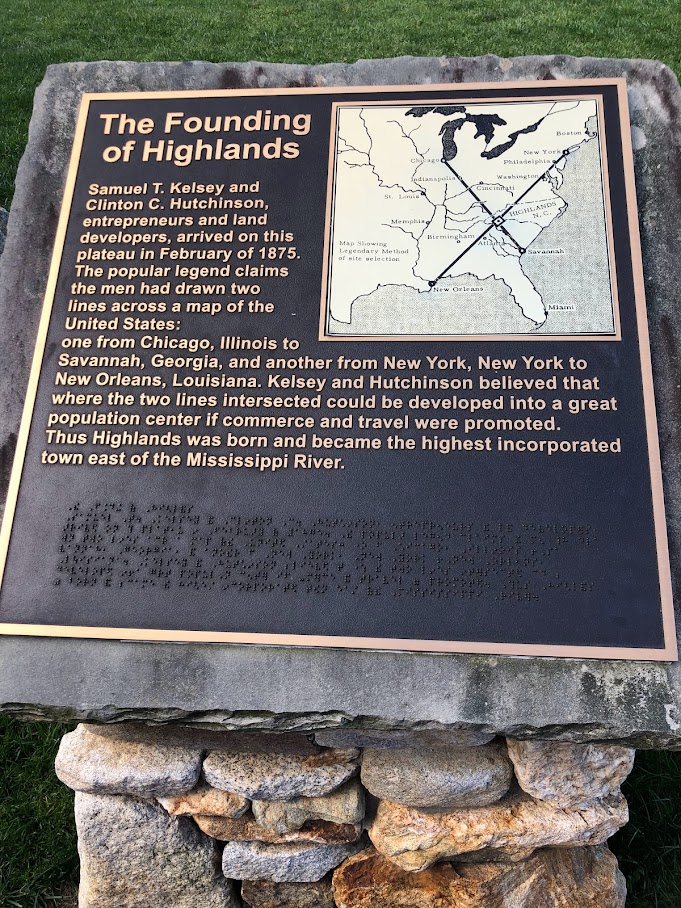
On the subject of local plaques, here is one I love about the founding of Highlands, NC. It describes the story as a 'local legend,' but it makes perfect sense. If you drew the lines just as shown on the map, logic would seem to dictate that there would be a nexus point exactly where Highlands happens to be.

The only problem is that it's four thousand feet up from Savannah to Highlands, and you can avoid that problem by going through Atlanta instead. Atlanta, whose original name was 'Terminus' because so many different railroads terminated there, already existed in 1875: in fact, it was on its second incarnation. The need for the nexus point was real, real enough that even Sherman couldn't obliterate the city forever. In the physical world we inhabit, though, geography as well as math and logic must be considered. 

Here's a shot of the Old Edwards Inn in Highlands. I left in the street in front of it so you could get a sense of how steep the hills are. That's one thing in San Francisco, where the steepness is justified by the fact that there's an excellent natural harbor right there. It's another thing in Highlands, which was just never going to be a commercial hub. It is a resort, though, allowing richer people from the real terminus to escape the summer heat through the miracle of elevation.

The Rutherford Expedition

On the grounds of the Federal courthouse in Waynesville, North Carolina, stands a statue that bears this plaque:


The Rutherford Expedition was, depending on which sources you consult, either a formative frontier experience that may have been crucial to the success of the American Revolution, destroying dozens of villages and driving hundreds of Cherokee into Tennessee and Florida; or a minor and halting action that burned an empty town at Cullowhee [or Cowee -- see comments] and maybe as many as five more. 

What is clear is that it was a reprisal, though, for Cherokee raids following their decision to align with the British against the frontier settlements. Cherokee leadership decided to align with the distant British in order to drive out the proximate settlers, struck first, and lost in the resulting action. That's not a moral judgment against the Cherokee, for whom that might have made strategic sense had the British proven a reliable ally that could help them against the frontiersmen they decided to try to drive out.  The British power in the back country was not great, however, and the Cherokee found themselves having the war brought back to them by angry frontiersmen organized into irregular light horse and infantry. 

There are several other monuments in the region to this expedition. For now, at least, they aren't related to the Civil War -- when the Cherokee Nation allied with the Confederacy -- so they are not being targeted for removal.

FBI Whistleblowers: "White Supremacy" Threat Way Overblown

The President of the United States is opening a forum at the White House to discuss the danger of white supremacism, but FBI insiders are saying that the threat is already greatly overblown for political reasons. 
[These insiders] say bureau analysts and top officials are pressuring FBI agents to create domestic terrorist cases and tag people as White supremacists to meet internal metrics.

“The demand for White supremacy” coming from FBI headquarters “vastly outstrips the supply of White supremacy,” said one agent, who spoke on the condition of anonymity. “We have more people assigned to investigate White supremacists than we can actually find.”

The agent said those driving bureau policies “have already determined that White supremacy is a problem” and set agencywide policy to elevate racially motivated domestic extremism cases as priorities.

“We are sort of the lapdogs as the actual agents doing these sorts of investigations, trying to find a crime to fit otherwise First Amendment-protected activities,” he said. “If they have a Gadsden flag and they own guns and they are mean at school board meetings, that’s probably a domestic terrorist.”
The Gadsden flag is not, of course, a symbol of 'white supremacism' but of the American Revolution; more recently, it was adopted by the TEA Party as a protest against excessive American taxation.

As I've said before, the South I grew up in had occasional Klansmen appear in robes on the courthouse square to recruit and pass out literature. I haven't seen one since I was a boy. Even in the area of the country most inclined to Confederate sympathy, the Klan and its ilk are no longer welcome: haven't been in a very long time. This is wholly to the good, but it's a sea change since the days of my grandfather when they were a secret society with real power in the South. 

If that's true here, I can't imagine it's not true a fortiori everywhere else. There are white supremacist prison gangs because of the unethical way in which we operate our prisons, creating a space in which banding together by ethnicity is both necessary for physical protection (because we allow the prisons to be so dangerous that joining a racist criminal gang seems like a sensible thing to do) and not disrupted by officials (who doubtless know exactly who is in what gang, but permit it to go on). These gangs are dangerous in a few communities in which there are enough former prisoners that there's out-of-prison overlap with the prison gang; they're not a big threat to mainstream America, but insofar as they deserve police attention it should be focused on the specific problem that actually exists. 

Trying to paint the whole culture as if it were racist and wicked is the real point, though. That kind of widespread wickedness is said to require and justify widespread, and deep, control over the lives of everyone. Yet for the most part Americans have rejected all this and are determined to get along, and for the most part we do just that -- as we ought, as is right and proper, both good and very welcome as a change from the days of my grandfather. We make progress in decency in spite of our authorities' attempts to divide us and control us.

The No Justice Department

The Durham investigation has entered its terminal phases with little to show, occasioning celebration from the left. It looks like no more charges will be brought over the lies to the FISA court by the FBI, the spying on a presidential campaign, or the bending of the whole system into a corrupt servant of one political party. The process just drug everything out until it could close past the statute of limitations. 

Meanwhile Carter Page, whose name was defamed by the lies used to spy on the presidential campaign -- and himself -- is likely to receive no compensation in civil court either. The fatal flaw for him was an inspector general report that described all the FBI lies as "errors" caused by a "sloppy" process: in other words, like the Durham investigation, the system protected itself from accountability. 

Such is the best we can hope for out of the system: it is operating exactly as designed and intended. 

UPDATE: DOJ obstructed its own investigation into HRC, argues RealClearInvestigations. The investigation into Team Trump is being handled differently, with an eye towards not just prosecution but shutting down the whole organization as a political force.

UPDATE: DOJ issues subpoena to conservative group in Alabama demanding: “any draft legislation, proposed legislation, or model legislation.” This included all their communique on the subject, e.g., “any social media postings.” All such would be protected First Amendment activity.

Bounty of Summer, Promise of Fall

Pinto beans drying in the sun, with new greens started that need cooler weather for growing. 

I put up another gallon of salsa yesterday, fire roasted tomatoes, homegrown habaneros. 

Exclusive Scene from the Rings of Power


Good boys

You can try to ruin them, but some of them will insist on being good human beings anyway.

Jupiter in the East

All month, but especially around the 26th, Jupiter will be especially visible and clear in the eastern sky. 

House Republicans: Nobody's Keeping Election Records

It is very unlikely that a letter from House Republicans is going to produce any motion at the Justice Department, but they're trying anyway.

In the letter, first obtained by the Daily Caller, the lawmakers mention an America First Policy Institute (AFPI) report titled “National Review of Retaining Election Records from the 2020 Election,” which concluded that many of the most heavily populated jurisdictions across the country are not complying with the records retention requirement under the Civil Rights Act of 1960.

AFPI’s report states that only six of 100 of the most heavily populated counties that were contacted by AFPI for information were able to give them their actual voter files from the 2020 election as required by law. Some of the counties failed to retain the records while others did not have timestamped records going back to the 2020 election. The lawmakers were, to put it mildly, displeased.

You can't audit the results if there aren't any records of the results. This is a misdemeanor offense, but it's a Federal offense: failure to retain records is supposedly punishable by up to a year in prison and a thousand dollar fine. Yet apparently almost no jurisdictions are bothering to obey the law.

Happiness is an Activity

The Spectator article says 'a choice,' but it's not just a choice: having made the choice, you must also do the thing. It is an activity, as Aristotle says, one that produces a happy and honorable life through action.

This subject was raised here in 2006, by the way. I happen to know that because I was trying to find an old argument in the archives, but was not able to do so. I was an almost unimaginably different person in 2006, which was before I went to Iraq and before returning to the careful study of philosophy. Yet I can see a clear link in the text between who I was and who I have become. 

The Stamp Act


A new report says that Americans spend more on taxes, on average, than on food, clothing, and health care combined.

What do we get for all that money, again? Not food or clothing or health care. A military that can't win its wars and that is currently fighting a war against pronouns; a justice system that is increasingly targeting political opposition as actual criminals; an education system that turns our youth against their nation and its heritage, with a negative correlation between the cost of the system and its ability to produce people who can read and write and do mathematics; roads, I guess. Some of them are all right. Not so much around here, but the interstate system is fairly nice. The Post Office works reasonably well, but it's been privatized. 

No, what we mostly get are massive transfer payments to people who don't work. This is exactly what Aristotle warned against happening in a democracy: the people voting themselves access to other people's money. It was important that an oligarchy should operate this way, he says in the Politics; that's the only way people will put up with having no power over their situation, if you make sure they are at least made comfortable at public expense. In a democracy it is supposed to be destabilizing, as the (relatively) wealthy will come to resent it and will want to replace the system with one that protects them from being plundered. 

That raises the question, once again, of whether this is in fact in an Aristotelian sense a democracy: this is not the 'democracy versus republic' debate, but merely a question about whether this is a government in which power is widely distributed, a government of the many. Is it that, or is it now a government in which real power is concentrated among a few? If the former, this approach is destabilizing. If the latter, it's the very root of the government's stability.

How Does One Cheat at Chess?

In an article with an obscene title, it is revealed that the reigning chess grandmaster withdrew after defeat at a recent tournament. Speculation is that he thinks his opponent is cheating.

Now I can see how you could cheat at chess in a one-on-one match where your opponent had been drinking and wasn't paying very close attention to the board. Otherwise, and especially in a tournament with all eyes on the board, I think it's a game that is robustly resistant to cheating. Are you going to slip pieces onto or off of the board while no one is watching? You are not. Are you going to peer into your opponent's brain to see what they're planning? You are not. 

The speculation -- which is where the obscenity comes from -- is that maybe someone else is secretly watching the game and cuing him in on how to move. You still need someone who is better at chess than the reigning grandmaster to accomplish this, and if that person exists why wouldn't they just come win the game themselves? 

Games where cheating is possible are more likely to feature cheating, and the more you make cheating possible and convenient the more cheating you are likely to get. On which subject:
An independent panel of experts on computer systems and election security issues has concluded a lengthy investigation into the voting systems currently in place in the state of Georgia and sent recommendations to the State Election Board and Georgia Secretary of State Brad Raffensperger. The current system primarily relies on touchscreen voting machines produced by Dominion Voting Systems. The audit must not have gone very well because they advise that the state discontinue the use of the Dominion machines and move immediately to hand-marked paper ballots. They are also recommending a much broader series of mandatory audits of the results after the initial count is concluded. These changes, they say, will not only afford greater accuracy but increased public confidence in the outcome. But at least initially, it doesn’t sound as if Raffensperger and the rest of the board are warming up to the idea. 
You don't say.

If you want public confidence in elections, you should do the things that make cheating harder -- or impossible, insofar as you are able. The more you make it easy to cheat, such as putting control of the elections on machines with invisible processes which machines are in the control of partisans to the election, the more likely it is that there will be cheating and the less confidence people will have in the election anyway. It is first nature for human beings to cheat their way to power, especially if it is easy to do and there are protections against being caught. Only a few develop their second natures -- trained Aristotelian virtues -- so highly as to overcome the first-nature tendency.

Politicians are not generally among these people. Chess grandmasters might hopefully be.

Venison Steak Pie


Inspired by the earlier discussion of venison recipes, I decided to make a great big steak pie this morning. This one features venison browned to a light sear in iron with salt and pepper, then added brown mustard and Worcestershire, then a bunch of mushrooms and onions that survived a cube steak meal earlier this week, then some leftover Guinness gravy from the same cube steak meal. To this I then added chunks of sharp Cheddar, so they would melt into gooey sections of cheese without becoming homogenous with the gravy and venison. The pie is short crust, high protein whole wheat mixed with reserved bacon grease and suet for the fat. Spring water dough, as our water comes from one of the springs here on the mountain.

A Healthy Conversation About Free Drinks

Now I've bought many drinks for others in my lifetime, but mostly these were rounds for the boys, or occasionally a girl who was there as part of comradery. These are not the free drinks that Ms. Brown wants to talk about. She wants to talk about the ones that are purchased as a sort of cheap courtship. I found the discussion somewhat astonishing, as well as a welcome reminder that getting older is not all bad because it excuses us from this sort of thing.

On the one hand, gender justice!
On one hand, accepting a drink can be a no-brainer — especially for women. In a country where female employees are paid just 89 cents for every dollar their male counterparts earn, why wouldn’t you take a free drink from a stranger you hardly know? “Men spend more on drinks than women because women are, a lot of the time, getting bought drinks,” says economist, influencer, and self-described “financial pop star” Haley Sacks (better known by her alias Mrs. Dow Jones). “Which I’m all for because there is a wage gap. As long as you feel comfortable, I think that’s totally fine.”
So it's women, then, who get bought drinks? These champions of human equality don't buy men drinks? 
In a VinePair study that polled dozens of subjects across the gender spectrum about their experiences buying and receiving drinks at bars, 83 percent of women and gender non-conforming respondents said they’d never bought a potential romantic interest a drink. When asked the reason, responses ranged from “drinks are expensive and I’m a girl,” to “because the patriarchy owes me” to “I hate men.”
If I'm following this discussion, 'gender non-conforming' has just been admitted to be a synonym for 'women,' and a large number of them don't buy drinks for potential romantic partners because they hate the entire opposite sex. That ought to work out well.

Lest you think this economic justice issue resolves the matter, though, there remains the injustice of the men thinking they might be buying a chance at some interest from the women accepting their free drinks. Well, "women" turns out to need more elaboration in the eyes of the author.
In a sense, accepting these drinks without reciprocating can act as a way for femme-presenting individuals to take power back.... With that in mind, a “free” drink can always come with a price — even those that haven’t been altered in any way. Some folks may see the act as a transactional one and therefore expect something in return, whether that be sex or simply prolonged chatting. “Just because you bought me a drink, I still don’t owe you a conversation,” Cockson says. “But there’s this weird pressure that sets in.”

Our poll respondents tended to agree. “It just seems to place a weird expectation — even though I know I don’t owe the person anything in return beyond a ‘thank you,’ I’m never sure if they’ll be thinking the same way,” one woman commented. “It just feels awkward to carry on a conversation with a stranger out of obligation.”
Two things that strike me immediately about this bit:

1) "Femme-presenting" sounds like it entails a different set of ethical issues, especially insofar as this is seen as being a precursor or preliminary to some sort of romantic or sexual relationship. You may not be obligated to go down the path at all, not even as far as conversation; but some of you in the 'femme-presenting' category are going have an additional set of discussions you need to have with the man from the bar somewhere along the way.

2) Carrying on awkward, obligatory conversations with people who won't go away is one of the more difficult parts of life, but strangers are the easiest variation. Wait until it's your neighbor who just loves to bend your ear for hours at a time while not leaving your front porch, or that cousin you were trying to avoid who also wants to borrow more money.

The piece goes on after this to explore the duties of bartenders towards their guests and more fretting about feminism. It does end on some sensible advice, though:
If your gut is telling you “no,” consider heeding Cockson’s advice: “Pay for your own drinks.”

Generally you can't go far wrong in life if you're figuring out how to pay your own freight. 

On the Passing of Elizabeth II

Tolkien in his later years professed that he had become, in his political philosophy, either a monarchist or an anarchist. I am obviously not inclined to monarchy. Few among us living today can even rule himself: who among us is fit to rule another, let alone all others? The British would do well to cast off the monarchy rather than to go along with the farce of King Charles III (the first of whose name got himself killed by his own people, recall, though the second did fairly well), though perhaps for them there is something in Tolkien's wish, and they might yet hope for better kings again.

Sic transit gloria mundi, but even after the pageantry is gone there is something worthy to remember about this one. On her 'Diamond Jubilee' I tried to express what it was.

Is the FBI Using the Patriot Act vs Donald Trump?

In the ongoing J6 trial of the Oath Keepers, a striking admission has come up.

The government has obtained, and of course leaked, a list of 38,000 members of the Oath Keepers. Only around 500 of these are current police, law enforcement, or politicians -- and that includes aspiring politicians. (A politician who kept his oath would be rara avis indeed.) Their lawyer was arrested this week in Texas, but will be prosecuted in D.C. in accord with the standard practice for all of this J6 business.

Of greater interest is that the warrant to search her phone was obtained via the Patriot Act, which allows the DOJ to seek such warrants from magistrates anywhere in the country, which in this case also means in DC.
Federal investigators probing the extremist group Oath Keepers on charges of seditious conspiracy last year invoked the provision that permits the government to obtain a search warrant from a U.S. magistrate judge anywhere in the country rather than one located where the search is to be executed in a domestic terrorism investigation, according to the newly unsealed court records.

The 18-page opinion revealed that in July 2021, prosecutors asked a U.S. magistrate judge in D.C., rather than one in Texas, to approve a court-authorized search of a cellphone owned by a person who appears to match the description of an attorney for the Oath Keepers, Kellye SoRelle. The lawyer was arrested last week in Texas and was with the group’s founder, Stewart Rhodes, outside the Capitol on Jan. 6, 2021.
Emphasis added. Now one of the subjects of significant commentary since the Mar-a-Lago raid was the use of a magistrate rather than an Article III Federal judge to obtain a search warrant. The Federalist says such magistrate-issued warrants are a late 20th century practice, without support in most of American history.
The problem is that Reinhart is a so-called magistrate judge. Many commentators have focused on his personal history and political leanings, but much more significant is that he is not really a judge. 

To be precise, he is not a judge of a court of the United States. The judicial power of the United States is vested in its courts. In the exercise of this power, judges of those courts can issue search warrants. But a magistrate judge is just an assistant to a court and its judges. Not being a judge of one of the courts of the United States, he cannot constitutionally exercise the judicial power of the United States. That means he cannot issue a search warrant.

The Patriot Act does state that magistrates -- and anywhere -- can issue search warrants, and those warrants can be quite broad like the one the FBI executed here. That raises the question of whether the investigation into Trump is a "domestic terror" investigation, as the Oath Keepers are being treated as domestic terrorists and seditious conspirators. 

Trump's fundraising arm has recently received several subpoenas, indicating that the DOJ is looking into his whole organization as conspirators of some sort or other. Ty Cobb, who served under Trump, thinks the whole investigation is ultimately about January 6th (and, it should be noted, thinks Trump is guilty and should be disqualified under the 14th Amendment from seeking the Presidency). This is also coherent with Andy McCarthy's general theory that the M-a-L raid was a J6 fishing expedition. 

That's swinging for the fences, though. I guess if you hate a guy enough to impeach him twice after failing to get him with a Special Counsel, the Patriot Act and the 14th Amendment are not unthinkable escalations. Trying your political opponents as domestic terrorists is new, but as the Alien & Sedition Acts show, treating your opponents as more-or-less traitors is almost as old as the Republic. 

Best Practices for Military-Civilian Relations

For all that military leaders talk about the importance of keeping out of politics and allowing the elected civilian leadership to serve, the sight of an open letter signed by many former generals or admirals has become a standard part of our politics. This happens on both left and right, though the left is generally able to organize larger numbers. Just a brief survey of some recent ones:


So today's letter signed by multiple former Secretaries of Defense and Joint Chiefs of Staff is an escalation, but it is not a surprising one. The tactic is well-known and at this point well-worn.

They lay out sixteen 'best practices' for civilian control over the military, including when and how it is appropriate for the military to challenge civilian officers. I think everyone should read what they have to say. 

This is a critical topic, and one that has been much in absence of late: the Afghanistan debacle was occasioned in part by military leaders not challenging their elected leadership, but instead blithely ignoring every lesson of military strategy (along with the intelligence community lying, perhaps to itself but certainly to the rest of us, about the Taliban's evident strength). 

Civilian leaders 'have the right to be wrong' the document says, and that's true: but notice that it's true about policy. Bad strategy -- abandoning Bagram, trying to run the evacuation off of Kabul's single landing strip, ceding control of Kabul to the Taliban while attempting to evacuate (now under enemy guns and mortars) -- is not outside the military's professional duty to object. If the policy objective is 'abandon Afghanistan, even if it means abandoning American citizens,' there are still right ways and wrong ways to do that. The leadership's failure to take responsibility for this is a continuing poison in our veins.

So consider what these former top leaders have to say about the situation they presided over creating. A lot of it is good insight, even if their collective records might give you reason to doubt their commitment to the principles they advocate here.

Ouch

H/t Instapundit:


Pot Smokers for Guns

Speaking of the latter, the Biden administration's DOJ is also trying to ensure that legal medicinal marijuana patients in Florida can be disarmed -- like Catholics

Or Native Americans. No, really, that's their own argument, except they said "Indians."
In England and in America from the colonial era through the 19th century, governments regularly disarmed a variety of groups deemed dangerous. England disarmed Catholics in the 17th and 18th centuries.

Many American colonies forbade providing Indians with firearms…. During the American Revolution, several states passed laws providing for the confiscation of weapons owned by persons refusing to swear an oath of allegiance to the state or the United States. States also have disarmed the mentally ill and panhandlers.

I wonder if they're planning to get back around to 'confiscation of weapons owned by persons refusing to swear an oath of allegiance' to the government.

There is a difference between a historical tradition and a thing that was actively set aside on purpose. Georgia's original charter banned three classes of persons: slaves, lawyers, and Catholics. (Two out of three ain't bad.) Clearly a lawyer who wanted to move to Georgia would today not be barred from doing so, as that charter was set aside by the Revolution and the US Constitution which allows such movement if the person is a US Citizen. Slaves, meanwhile, were clearly allowed by positive action of the legislature later; but that, too, was formally set aside by the 13th Amendment. Religious equality was enacted by the 1st Amendment. It no more makes sense to appeal to the disarming of Catholics by England in the 17th and 18th centuries than it would make sense for someone to argue that the Confederate tradition of slavery justified the current practice as if there had not been a formal, constitutional process -- backed in both cases by the successful prosecution of a war -- precisely intended to override those traditions and replace them with a charter of liberties.