Now, that's what I call architecture

Chand Baori in Abhaneri, India:


The walls are staircases down to a well.  Not suitable to my local geology, unfortunately.

I find it hard to resist clickbait like "20 places you didn't believe could exist."  Here's another, a fairy-home in Romania.  Lately there's been a rash of links to eye-popping waterfalls in that part of the world.  You have to wonder how this one didn't show up in the Lord of the Rings:


China is unimaginably big and various.  If this site were in the West, we'd have been seeing images of it more often than we see the Grand Canyon, but it's a first for me:


Islamic Society of Boston Cultural Center

So, a few days ago you probably saw that police and the FBI had shot dead a guy who was carrying a knife. Details were sparse, but it was an intriguing story. Turns out possession of the knife played in to what they were looking for: a conspiracy to behead police officers.

What caught my eye was that the dead man worked for the Islamic Society of Boston Cultural Center as a guard. (They say he didn't "regularly" pray there.) Now that's a mosque whose name I happened to know, thanks to my old friend "Uncle Jimbo" Hanson of BLACKFIVE fame. These days he's gotten a bit more respectable and is the Executive Vice President for the Center for Security Policy. They put out a video about this mosque just recently.


You can see some of the old "Uncle J" touch at work in the video. I love that he actually had them use the word "subversives," which is the kind of thing that causes McCarthy-era liberals to pop blood vessels. It's hard to argue the point, though, given the immediate follow-up visual.

The Poetry of the Enemy

Wake us to the song of swords,
and when the cavalcade sets off, say
farewell.
The horses’ neighing fills the desert,
arousing our souls and spurring them
onward.
The knights’ pride stirs at the sound,
while humiliation lashes our foes.
We should listen to it. To know your enemy, as Sun Tzu says; but also to know yourself, as he also says. It is in the poetry that you can see most clearly what they find lacking in the world our nations offered them.

Luck

Another comic book view of production and sharing.  The contrast raises the question:  even if you assume productive people are just lucky, does someone else's good luck entitle us to his stuff?

Freedom On, HuffPo!

Hear that eagle scream.

Let's Not Go To Portland

You know why not.

You Should Know More about Beowulf

And thanks to Medievalists, you can easily learn.

"Lottery Winners"

A question asked by a writer at Forbes:
Winning a lottery doesn’t make a person worthy of respect. A lottery winner wins despite engaging in an impulsive act. A lottery winner wins only because others lose. A lottery winner who won’t give back, therefore, is a lucky bastard....

Was it an unintentional slip to call successful Americans “lottery winners,” or was it a window into the President’s worldview on wealth, poverty and injustice? If it’s the latter, we’re in new territory. I don’t recall another American President who had such a sarcastic view of success. President Franklin Roosevelt thought and said that big business and bankers opposing his New Deal were “malefactors of great wealth,” but he stopped short of making snarky comments about successful people being lucky.
The answer to that question, I believe, is that the President said what he meant. This is a widely-shared worldview on the subject of "wealth, poverty, and injustice."

It's not wholly ridiculous, either.

There ought to be a way to synthesize those views that is useful. Both of them have a part of the truth.

Kipnis Cleared

Those of you who have been following the absurd application of Title IX to free debate at Northwestern University will be pleased.

If you aren't familiar with the backstory, Dr. Kipnis told her side of it here. It's a remarkably byzantine and opaque process, even where (as here) it leads to correct final results. The opacity of the process is reason enough to object to it.

Military Life

There's so many letdowns.

A Rhetorical Question

Since 1970, the number of “Hispanics of Mexican origin” in the U.S. has jumped from fewer than 1 million to more than 33 million. If all these Mexicans were a state, it would be the second largest in population in the country, trailing only California.

Did you vote to approve that immigration policy? Did anyone?

A Better Balance Is Needed

Two stories from this week suggest to me that, without endorsing gun control, we need to think harder about how to balance firearm rights and responsibilities.

The first is from today's Washington Post, on the massive number of fatal shootings by police we're having right now. Most of them occur when the police encounter someone with a weapon:
The vast majority of victims — more than 80 percent — were armed with potentially lethal objects, primarily guns, but also knives, machetes, revving vehicles and, in one case, a nail gun. [The number is 221 out of 385. -Grim]

Dozens of other people also died while fleeing from police, The Post analysis shows, including a significant proportion — 20 percent — of those who were unarmed. Running is such a provocative act that police experts say there is a name for the injury officers inflict on suspects afterward: a “foot tax.”

Police are authorized to use deadly force only when they fear for their lives or the lives of others. So far, just three of the 385 fatal shootings have resulted in an officer being charged with a crime — less than 1 percent.

The low rate mirrors the findings of a Post investigation in April that found that of thousands of fatal police shootings over the past decade, only 54 had produced criminal ­charges. Typically, those cases involved layers of damning evidence challenging the officer’s account. Of the cases resolved, most officers were cleared or acquitted.
It sounds like more restrictions on shooting people who are running away might be reasonable, but the real issue appears to be how officers are trained to respond to armed citizens. Yet increasingly it is perfectly legal for citizens to be armed.

The second story was the protest outside the mosque that produced the home-grown terrorists who attacked the 'Draw Mohammed Day' in Texas. In spite of the heat this protest generated online, it seems to have gone off very well as an exercise in free speech. There was no trouble, counter-protesters showed up to support the Muslims in roughly equal numbers, but it seems as if many of the counter-protesters and the protesters may have been able to exchange views and even pray together. The police seem to have handled themselves admirably in a tense situation.

What concerns me is a discussion I had with some friends about whether it was reasonable for police to check weapons carry permits for those bringing rifles to the protest. Now, the bringing of the rifles isn't the problem from my perspective. For one thing, there was a clear free speech reason to do it: part of the message being sent to this mosque, which had been the home for the gunmen who attacked the Texas event, was that the American people will defend their free speech rights with force if necessary. That's a useful message to send to potential terrorists: that it is not merely police or soldiers you have to worry about, but a society hardened to resist attempts at imposing tyranny through terror.

The second reason the rifles don't bother me is that the last 'Draw Mohammed' event was actually attacked by body-armored, rifle-wielding terrorists. Under those circumstances, it's a reasonable precaution to have a rifle or two (indeed, sell your coat if you need money to buy one).

However, for exactly the same reason, I'd think it would be very reasonable for police to check carry permits. They also have reason to expect rifle-wielding gunmen who are planning criminal violence. It ought to be perfectly acceptable for them to ask to see the permit of anyone bringing a rifle to the event, just to make sure that individual is on the up-and-up.

Turns out that's a moot point in Arizona, where there are no such things as weapons permits. There's nothing to check. Arizona, by the way, is one of the standout leaders in lethal police shootings per capita: it and Oklahoma have such shootings at twice the rate common to other states.

So we've got a situation in which the police are trained to respond to armed citizens with lethal force, at the same time that armed citizens are being more common as right-to-carry laws spread. The middle ground, a permit that would give officers some sense that your background had recently been investigated and found clean, is not always present. Even in states where it is present, according to the argument from 4th Amendment cases, the police shouldn't be able to ask for the permit anyway:
In those 14 states (soon to be 15) where open carry requires a permit or license, the answer is not as crystal clear but is still a resounding “No!” The United States Supreme Court addressed a similar question in Delaware v. Prouse (440 U.S. 648) (1979). In that case, the issue articulated by the court was:

[W]hether it is an unreasonable seizure under the Fourth and Fourteenth Amendments to stop an automobile, being driven on a public highway, for the purpose of checking the driving license of the operator and the registration of the car, where there is neither probable cause to believe nor reasonable suspicion that the car is being driven contrary to the laws governing the operation of motor vehicles or that either the car or any of its occupants is subject to seizure or detention in connection with the violation of any other applicable law.

Now … let’s change just a few words and we have the issue before us:

[W]hether it is an unreasonable seizure under the Fourth and Fourteenth Amendments to stop a person open carrying in public, for the purpose of checking the carry permit of the open carrier, where there is neither probable cause to believe nor reasonable suspicion that the firearm is being carried contrary to the laws of the state or that either the firearm or the carrier is subject to seizure or detention in connection with the violation of any other applicable law.

So how did the court answer the question in Prouse? They held that it is unreasonable under the Fourth Amendment to seize someone to check the status of a license except where there is at least reasonable suspicion that the person is unlicensed or otherwise subject to seizure for the violation of some other law.
This isn't going to work. Reiterating that the police in Arizona did a fine job at the protest, the statistics indicate that there's a problem arising from the way police are trained to deal with armed citizens combined with no-permit open carry.

Something's got to give here, and perhaps something on both sides. The police are going to have to accept more personal risk by not trying to instantly control, disarm, or take down citizens who are bearing arms. Yet I think we who are on the gun-rights side should reconsider our opposition to permits, as long as those permits are shall-issue on the finding of a background not including violent felony convictions. This seems as if it is a reasonable middle ground, one that ensures that rights are being exercised by those who are still entitled to the rights -- i.e., not felons -- and which would give police the capacity to verify that. That would increase police comfort with the idea of armed citizens, and perhaps cut down on some of these fatal shootings.

A Gun Ban That Makes No Sense

What the heck is this?
The regulations range from new restrictions on high-powered pistols to gun storage requirements. Chief among them is a renewed effort to keep guns out of the hands of people who are mentally unstable or have been convicted of domestic abuse.... Aside from these issues, some gun rights advocates have also raised concerns about upcoming ATF rules that would require gun dealers to report gun thefts, provide gun storage and safety devices, and place restrictions on high-powered pistols, among other things.
'High-powered' pistols? I'm guessing this means pistols powerful enough to overcome Level III ballistic armor, or possibly even IIIA. The same logic would seem to require us to ban all rifles. However, these handguns aren't going to be fielded by professional criminals in any numbers. They just aren't well suited to crime.

Consider the Ruger Vaquero, which is a single-action cowboy gun like the ones Colt used to make back in the 19th century except for the incorporation of modern safety features, such as those designed to prevent accidental discharges. It's perhaps the least likely firearm in the world to cause accidental harm.

It's a firearm almost uniquely unsuited to crime. It only holds six rounds. It's extremely slow to reload as you have to reload each round one by one. Not only does it only fire one round per pull of the trigger, you have to manually cock the hammer before it will fire even that one round. I favor it because, if you're riding a horse and get thrown, or a motorcycle and are involved in a wreck, it's physically impossible for it to fire on impact.

Can it defeat body armor? Well, it depends on the ammunition you put in it. Because it's made out of modern cold-rolled steel, and because it is built strong and sturdy for safety reasons, it can handle very high pressures. Thus, it can fire +P or even +P+ ammunition in the magnum ranges.

If you really wanted to overcome body armor with it, you can buy these cartridges. Almost no one does, even among the relatively small part of the gun-owning community that shoots .45 Long Colt (as opposed to the very common .45 Automatic Colt Pistol, a much smaller and less powerful cartridge made for semiautomatic handguns). This round is hard cast and features +P force. It is designed for penetration.

Should we ban the ammunition, then? Well, no. It's not designed for anti-personnel use, you see. It has far too much penetration to be of much good against a human target. All that force will pass through the body and be wasted on the other side. Body armor or not, it's not very likely to kill a man because it won't dump much energy inside his body and it won't expand in his body.

What this ammunition is designed for is the biggest of North American big game. I own some because I take my family hiking in bear country -- I'm just about to go out to Wyoming, where one encounters grizzly bear and moose (who are even more aggressive than grizzlies).

Usually gun-control advocates go after cheaply made firearms that will blow up in your hand, but whose cheapness means that they can be found in large quantities in America's poorer neighborhoods. Or they go after firearms that fire rapidly, or that have large quantities of ammunition before they must be reloaded. Or they go after firearms that are regularly used by criminals, or at least in theory are particularly suited to criminal activity.

This class of firearms would seem to me to be the least likely class to satisfy any of those requirements. Who came up with this idea?

The Late Beau Biden

Condolences to the family of the Vice President on the death of their son, Beau Biden, formerly Captain Biden of the United States Army.
Biden’s unit was activated to deploy to Iraq on October 3, 2008, and sent to Fort Bliss, Texas, for pre-deployment training, the day after his father participated in the 2008 presidential campaign’s only vice presidential debate. His father was on the record as saying, “I don’t want him going. But I tell you what, I don’t want my grandson or my granddaughters going back in 15 years, and so how we leave makes a big difference.”
The caption on the second photo says "Beau Biden in Iraq," but I never saw any part of Iraq with grass and trees like that.

The young gentleman died of brain cancer, at the age of 46. I extend my sympathies in particular to the Vice President, who has buried more than one of his children.

The line-up


Jonah Goldberg and Kevin Williamson want to add a couple more.

Ranger School Update

Ranger School is really hard. The Darby phase is still pretty early in the training.
At the end of Darby phase your squad will evaluate your efforts within the squad and someone has to be last, just as someone has to be first. Ranger candidates will explain to RI’s how the members of the squad are when they think no one is looking: This one of the most important parts of Ranger School. It is set up specifically to challenge the weak link and to see if that link strengthens or if it breaks. By the time the RI’s decide your fate at the end of Darby phase, people begin to question their reasons for being there.

This is where people start to miss home, talk about how their families need them or how they have to quit in order to go to combat with their unit. These candidates have yet to walk mount Yonah, pass the knot test, or conquer the nighttime descents of mountaineering. They have yet to enter the copper head inhabited Yellow river of Florida where alligators will swim next to their zodiac or have upward facing tree stumps ravage their legs as their bodies battle hyperthermia. On average, about 45 percent of Ranger School students will graduate.
Yet it is the Darby phase that has defeated all of the female candidates in the one-time trial program to introduce women to Ranger School. Eight of them were recycled, but they have all failed again. Of these, two will be permitted to retry a third time. That sets the maximum success rate for the Darby phase at 10% for the female candidates, if those two manage to do on the third try what they have twice failed to do. And that just gets them to the Mountain phase at Frank D. Merrill.

The Havok Journal celebrates this, not out of disdain for the women, but because it means the standards have not been lowered. High standards in an elite combat unit save lives on the battlefield.

Others feel otherwise.
But there is another opinion quietly being voiced as well: that Ranger School is more akin to a rite of passage – an opportunity for men to “thump their chest,” as one Ranger puts it – than a realistic preparation for leading in war. That women can actually make Ranger units more effective. And that the standards that keep them out are outdated....

The question, he adds, is: Are these standards a fair measure of the challenges of combat?

Dempsey recalls being in violent Kunar province in Afghanistan and hiking up to the rugged Pakistan border. Along for the mission was a male first sergeant who was also a Ranger-tabbed Golden Gloves boxer. The unit had to stop for the first sergeant because he needed to rest during the strenuous march.

“No one’s going to say that the first sergeant is a deadbeat. We need him, and we’re just going to take a break.”

On other occasions, he adds, the combat patrols would simply make the decision not to bring along their heavy packs.

“The equipment we carry is just insane,” Amerine says. “We all have back injuries at the end of our careers.”

The No. 1 Department of Veterans Affairs claim – made by 58 percent of all claimants – is muscular-skeletal injuries.

“If we really are serious about integrating the force, the equipment we carry is going to be one of the things we have to have a hard conversation about,” Amerine says. “It’s in our grasp technologically to make things a lot lighter.”
That doesn't sound like an argument that the standard is outdated, but that until we make huge changes in how we outfit our troops the standard points to a very real issue. If it's already a huge problem even for men, and we haven't yet made things any lighter, why wouldn't the ruck march at Ranger School be a practical test? First Sergeant's an E-8, so he's probably in his thirties somewhere. At one time he was able to make the ruck march. As a Golden Gloves guy he was at one time in fantastic shape. As an NCO in an infantry unit, he's kept himself in at least pretty good shape for a thirty-something. If even this guy is having trouble later in his career, and back injury rates are so high across the force, why would we think that people more prone to such injuries (and other allied injuries) would be a wise addition?

We should thank everyone who participated for exploring this with us, and declare the experiment closed.

Now There's Something You Don't See Everyday

According to the monitor, the Christian fighter, a member of the minority Assyrian community, found the jihadist in the local village of Tal Shamiram.

"He took him prisoner and when he found out he was a member of IS, the Assyrian fighter beheaded him in revenge for abuses committed by the group in the region," Observatory chief Rami Abdel Rahman said.

Justification

The dog in this article is a beautiful animal.
After meeting up with Crystal, Ashlee examined the kittens, who were approximately three weeks old. The little cats were covered in fleas and were in very poor condition.

“They were just skin and bones – completely emaciated,” Ashlee recalled. “I immediately treated them for fleas and worms and then took them home. I fed them and gave them a nice warm place to sleep.”
What you mean when you say that you 'treated them for fleas and worms' is that you poisoned the fleas and the worms. In other words, we found in nature three sets of animals struggling to survive, chose one of them, and destroyed the other two for the benefit of the one.

What's the justification for that? We feel perfectly justified in doing it because we like cats (very much) more than fleas and worms. We certainly have the power to do it, so if power is its own justification -- might makes right -- then our aesthetic preferences coupled with our power are enough.

Religious folks like myself can appeal to Genesis 1, of course, but that's not going to serve as a legal justification under a regime that does not allow for the establishment of religion.

Will the EPA someday prevent us from picking up kittens and "treating" them for fleas and worms? If not, why not? Just because the aesthetic preference is so common?

An Excellent Question

Byron York: "If Hillary becomes president, who will make her obey the law?"

It appears to be the case that no one can make the President obey the law, though a united Congress can impeach him (or her, in Hillary's case). However, there's no reason to believe that Congress will unite on the point in the supermajority required.

So: no one will make her obey the law. Next question: what are the consequences of turning her loose from all legal restraints, coupled with the power invested in a President?

UPDATE: Related.

American Trains Iranian Fighter Pilots

I expect that this guy and I must know some of the same people, because I've been hearing this story too. It's certainly not implausible, given the tight ties between the Iranians and the Iraqi Security Forces right now. It would be a little surprising if there weren't infiltration by Iranian agents.

Clinton Cash

The amounts are very large.
According to Sirota’s accounting from public records, the Clinton-led State Department authorized $165 billion in sales to 20 nations that donated to the foundation. State also authorized another $151 billion in “Pentagon-brokered deals” with 16 nations that coughed up cash for the family charity. Some of the defense contractors involved also donated to the foundation, and a few of them paid big money to Bill Clinton for speeches.

The US routinely conducts arms sales to allies, but this wasn’t a case of business as usual. Comparing the three full fiscal years of Hillary’s tenure at State to the corresponding timeframe of the Bush administration’s second term, Sirota found that the State Department nearly doubled the sales to those nations, and increased the amount of Pentagon sales by 143 percent.
On the other hand, it is possible to push this point too far.
Sirota notes that the Clinton Foundation took cash from regimes like Saudi Arabia, Oman, Algeria, and Hamas’s diplomatic ally Qatar while approving large arms sales. The Israelis objected strenuously to a $29 billion arms sale to the Saudis, and even Clinton warned about their lack of cooperation on counterterrorism strategy. Qatari cooperation against terrorism was “considered to be the worst in the region,” Hillary also declared in internal memos exposed by Wikileaks years later.
Qatar is also a key US ally, and the home of US Central Command's forward-deployed headquarters. Painting them as merely Hamas's ally obscures that the picture is not as clean. They are also our diplomatic go-between when we want to talk with the Taliban. Sometimes, in diplomacy as in war, you have to work with actors whose motives are dubious from your position. Probably our motives appear dubious at times to them.

The story is powerful enough as a painting of the appearance of massive corruption and conflict of interests. Trying to make it into a 'Clintons have ties to terrorist supporters' story is too far. As a diplomat, it was her job to have ties with people who support terrorism. Sometimes diplomacy means routing them something they want. It's the nature of the business, and it's a necessary business for nations to engage in sometimes.

Eternal Punishment

Generally a sentence to punishment like this has been practically reserved to the divine, and for good reasons. Some things it would be better not to invent.

Schlock Mercenary did a bit with an AI that was trapped in isolation for "megayears."

The Problem with American Intelligence

In my experience, this author is exactly right.
Let’s be honest about what it would mean to fix the problems Morell describes. CIA officers would have to get out of protected enclaves to spot and recruit the principal agents who, in turn, could find sources within the jihadist lair. Staying “inside the wire” isn’t just ineffective, it’s dangerous...

The agency has been wary of sending case officers onto the streets in war zones without bodyguards from the paramilitary Global Response Staff. But John Maguire, a veteran of many dangerous CIA assignments, says officers traditionally understood the rubric that “you will not be captured.” Under a special training program called Case Officer Defensive Action, operatives were taught to evade surveillance and, if that failed, shoot their way out of trouble. This course was abolished, Maguire says....

For decades, the CIA and the military have tried to fix intelligence problems by relying on National Security Agency surveillance. But the jihadists have gone to school on the leaks about U.S. capabilities and learned to mask their operations. Gathering intelligence against this 21st-century jihadist adversary, paradoxically, will require the kind of old-fashioned spying and resistance operations we associate with the CIA’s founding generation in the OSS.

The British Press

They have their moments and their flaws, but they do know how to write a great headline.

Cultural Domination

An excellent paper from the English Historical Review asks, "Why did the Anglo-Saxons not become British?" (H/t: Medievalists.) The question may be of interest to us today, not merely for historical reasons, but because of our own mass immigration from very different cultures than our own: different in language, education, poverty, and so forth. What prevented the Anglo-Saxons from fading into the British culture?

The 19th century idea, which the paper considers and rejects, was that the Anglo-Saxons had simply destroyed the native population or driven it out -- rather like early Americans did with the Cherokee. We did not become Cherokees because we cleared the land of them and their civilization, and thus there was little chance that we would intermarry or become subsumed. (I'm told that, in Latin America, genocide against the native population is euphemistically called "the North American solution" to the problems their cultures still today face integrating Spanish civilization and the native ones.) The 19th century thinkers found this view plausible because of the racial theory of the day. Unlike other peoples, those descended from good Anglo-Saxon blood were of a moral character fit for self-government; and since much of moral character was thought to be carried in the blood, obviously the Anglo-Saxon bloodline must be substantially different from, say, the Welsh.

That turns out to disagree with both the historical record and the genetic one. What happened instead was that the Britons intermarried with their conquerors. Rather than the Anglo-Saxons becoming British, the British became Anglo-Saxons in those areas where the new culture could command. In regions further flung, the native culture continued to dominate in spite of intermarriage.

Importantly, then, the issue has to do with language. So why did the Anglo-Saxons not become Frenchmen after the Norman conquest, when French became the official language of court and law?

In an important sense, they did: they became "frank" and free men who were fit for the "franchise." Their old thanes became "franklins." Amusingly, the very concept of being a people whose moral character fitted them for self-government that was fielded by the 19th century scholar with pride in his Anglo-Saxon roots was a French import. It was because they were "frank" that the English were fit to be free men.

(And that of course is true, in a way: the virtues of honor and forthrightness that the Franks saw in themselves are indeed a necessary condition for sustainable self-governance. What is not true is that they are especially French virtues, or especially Anglo-Saxon ones.)

The French language didn't come to dominate in England the way that English did, however. There simply were too few of the Anglo-Normans, and they spread themselves thinner yet: they went to Scotland and became Anglo-Norman-Scots, like Robert the Bruce, whom today we think of as the very model of a Scot. They went to Ireland and became Anglo-Irish, and while today the Normans are referred to by the Irish as "the Old English," even by the day of Elizabeth I they were more Irish than the Irish themselves. They were also the locus of Irish resistance to English rule, as they were the locus of Scottish resistance to English rule. I suspect Tolkien's concept of Black Numenorians is rooted here, in spite of his own stated preference for "Anglo-Saxon" characteristics more like the Eorlings and the Hobbits than like his Numenorians. The Normans like the Numenorians went everywhere the sea would take them, conquered and intermarried, and came to be the ruling element of different and disparate peoples. In the West, they were the leaders of the defense against Sauron; in the East and Harad, they were commanders of his legions.

The lessons for today are... well, again, obvious, aren't they?

Emergency? Why Didn't We Do This All Along?

A story from our friends across the pond, who like us are trying to use their central government to reform local schools' lunch menus.
Pupils at a Bath primary may have to be fed sandwiches from the local pub as an emergency measure while the school struggles to upgrade its kitchens to comply with the expansion of the government's free school meals programme.
The Devil you say! Sandwiches from the pub? Why, it's monstrous. Could the pubs just take over feeding all the students, do you think?

I'd endorse the idea here in America, only we haven't got enough pubs. Though perhaps if they were given responsibility for feeding all the students, we might get pubs in every town....

Call your Senator!

What's a Little Anthrax Between Friends?

Oops!

Wise Advice

Elizabeth Price Foley and Naomi Schaeffer Riley agree that this behavior is problematic, and that it is an excuse:
But this idea that it doesn’t look right for a male boss to be alone with a female employee sounds like it comes straight out of Victorian England. And it’s probably just an excuse.

More likely the congressmen, like the professors I’ve spoken to, don’t want to leave themselves open to claims of sexual harassment and the lawsuits that might result.
I don't think it's an excuse at all. I think "it wouldn't look right" means that some people might think that something sexual is going on, and the point is to dispel any possibility of people coming to that conclusion. It's not just that you might harass someone sexually, it's that the two of you might be doing something perfectly consensual that violates your wedding vows or even just the spirit of the workplace. This was the advice I got from my father decades ago on how to deal with women in the work place: do it in the public eye, so that people come to understand that you never leave yourself room for anything inappropriate.

Once a sufficient bond of trust or friendship forms, of course, things can change. Still, it's hard to be friends with a superior or someone who reports to you directly, just as it was hard for a king to have friends. So the best thing, if you're dealing with someone who reports to you, might well be to deal with them only with the doors open.

The Venerable Bede

In addition to being Memorial Day, Monday was the Feast of St. Bede of England. I assume you all know his history, and its influence. You may not know how he came by the title "Venerable." No one does, really, but tradition holds:
The title Venerabilis seems to have been associated with the name of Bede within two generations after his death. There is of course no early authority for the legend repeated by Fuller of the "dunce-monk" who in composing an epitaph on Bede was at a loss to complete the line: Hac sunt in fossa Bedae . . . . ossa and who next morning found that the angels had filled the gap with the word venerabilis. The title is used by Alcuin...
...from the house of Charlemagne.

Discretion

The Libyan Adventure and 2016

It seems as if 2016 will feature former-Secretary of State Hillary Clinton in a prominent role. The debate over her tenure in that job is turning more and more toward the Libyan adventure, as it appears to have been her special project, and it appears to line up neatly several arguments about her corruption and incompetence. The most important aspect of the Libyan adventure, though, was that it was conducted as an exercise of pure executive power without any permission from Congress.

Clinton may have been the primary proponent in the administration of overthrowing a foreign government without consulting with the People's representatives. That she did so at the behest of a corrupt adviser who personally profited from it is bad; that the planning and execution of the adventure led to a failed state now functioning as a colony of the Daesh Caliphate is worse. The key thing, though, is the degree to which she proved to have contempt for the division of powers, or the seeking of permission from the People before taking us to war.

Had she sought a debate, I would probably have been on her side. This post is cryptic only if you do not know me: it cites Gadaffi's use of rape rooms as a tool of state policy without commentary from me. Yet the use of rape rooms as state policy was my reason for supporting the Iraq war, a fully sufficient justification for overthrowing Saddam in my opinion without regard to any questions about WMD. I wrote something very similar about Iran's use of rape in state policy. There are just reasons not to go to war in such cases, as for example if you believe you cannot win the war (for then you would be bringing about the harms of war without the hope of victory). However, if you think you can win such a war, it is always morally just to wage war against a state that uses rape as a tool of its policy. That is too deep a violation of human nature to be compatible with just government. Such governments are wicked and ought not to survive.

It ought to be most important in our consideration of her qualifications that she did not care for the limits of the law or the Constitution on such a mighty question.
We live in an hour in which we are told that democracy is the answer to political problems; and therefore, we should be interested in the great questions of the day. Yet the systems are such that, short of breaking the systems, we can have no hope of affecting the questions at issue. The law means nothing -- as we have seen in the case of the war in Libya, where the War Powers Act has proven toothless. I am in favor of that war, and indeed of a more emphatic approach to it, but the law is broken here. The administration shows no deference to the law.... It isn't right to say that we can do nothing; but I wonder if we can do anything meaningful that is also lawful. If democracy is the answer, the Stoic philosophy is of less use; we are bound to be involved, and engaged. Should we say that these matters are nothing to us? The laws are carefully crafted to keep our efforts from having an effect; and where they are not, they are ignored outright.
Democracy can ill afford another such administration. Is there no candidate for office who believes in obeying the limits of the Constitution? Are there no candidates who will feel bound by the laws they swear to enforce?

Happy Birthday, John Wayne

The Philosophical Structure of the New Sexuality

In the wake of the recent vote in Ireland, there is some concern about what the Church's teachings can say to the new generation. To understand what can be said, first you must understand what the new generation is endorsing. It is not (merely) a different position on a few discrete issues. There's a developed and unified mode of thought at work behind it. It tracks to John S. Mill, but has filled out over time.

The first assumption of this new philosophy is Mill's assumption, which is that the important element in human life is the individual. Where Aristotle thought (correctly, I believe) that societies are formed by families, Mill took the Modern position that the thing that comes before society is a state of nature made up of radical individuals. This assumption is unquestioned in the new philosophy as far as I can tell. The individual and the individual's will is the thing that matters.

The second assumption follows from the first: the individuals we are talking about are fully-formed adults. The first assumption means that the wishes of an individual will always be selected for when they come into conflict with the interests of families considered as a whole. The second means that the wishes of adults will be placed before the wishes of non-adults: abortion is at the will of the adult individual who is pregnant, without other considerations. The family structure that is best for children is the one that is best for the adult individual parent given custody of them, so long as that structure does not produce adults who are out of line with the new philosophy. Homeschooling is a questionable practice; single motherhood is not.

Those are assumptions, as I said: they are not argued for, but taken as given.

Proceeding, then, given those assumptions, the philosophy is that sexuality should be regulated this way:

1) Adult individuals should be free to choose.

2) Freedom to choose is not compatible with any sort of coercion.

3) Therefore, sex is fine as long as it is consented to freely, verbally, and enthusiastically.

It's a very simple philosophy, but it is coherent. Many on the right make the mistake of assuming there is some conflict between the left's position that women are the equals of men in all respects, and that they need special protections in college, in the office, in the workplace in general, from harsh language or offensive terms. All of it follows from what has been said above. Both the man and the woman are equals in that they are free to choose. However, men are physically bigger and stronger; in addition, it is argued, society provides men with unearned power over women in various ways. Thus, to ensure that sex is always only fully consensual, we must regulate all sexual interactions to ensure that there was no power relationship providing any sort of coercion. We should ensure that there was clear, explicit, verbal consent and that such consent was really desired in a deep way.

The reason you get 'gay marriage' out of this is that there's absolutely nothing in this philosophy to speak against it. It's fully consensual, and an association of adults, so it's perfectly fine. There's not only no reason to be opposed to it here, there's no room for a reason. The principles are clear bright lines, and they admit of no exceptions.

From this, then, you will not get bestiality and pedophilia in spite of right-leaning arguments to the contrary. Kant thought you would, so it's not a foolish position, but it depends on assuming that the bright lines of the old system are the only possible ones. There the bright line was human nature, and it is obvious that sex fills a natural and necessary function. You can draw a bright line between those acts that do and those that do not fill natural functions. That was the old position, and it is a rational one. The new argument rejects the concept of human nature, however, in favor of individual will. There is just no room in the system for a concept of nature that should constrain will.

You will not get bestiality because consent is not possible. There is no slippery slope there. You will not get pedophilia because of consent issues, and the underlying assumption that this is a system for adults. The slippery slope there is limited to arguments about just how young you have to be before you can't clearly consent, but there's no danger of that line falling beyond a certain point.

What you will get is polyamory and plural marriage, and all of the trans-* desiderata. Those things are perfectly in line with this philosophy, and there is no reason to oppose them possible within the system.

Now, the reason to spell all this out is to address the question: what can the Church say to people who believe this philosophy? Well, you can't persuade them to adopt the old standards without first persuading them to abandon this entire mode of thinking about sexuality (which they will call "my sexuality," because everything is fully individualized in this philosophical structure). You have to show that the whole mode of thought is to be rejected, and then begin again showing why the traditional mode is a rational and proper substitute.

What you need not do, and ought not do, is argue for the rules. The rules follow from the structure. What you have to do is argue against their structure, and in favor of the traditional structure of reasoning from things we can observe about human nature.

How do you argue against the structure of the new philosophy? There are two general modes of argument that can be effective.

1) Argue against the assumptions. It happens that the assumptions are both badly wrong, so a lot of headway can be made here. Point out that these assumptions exist, and that the structure depends on both of them being true. Show that they are false. Human beings do not come into the world as radical individuals. We come into the world dependent on those who brought us into the world, and who care for us until we are able to take care of ourselves. That is to say, we come into the world not as clean actors free to choose anything that they want so long as it does not harm others, but as members of a pre-existing society who carry debts and obligations to those who helped them when they were weak. Those debts point forward to the next generation. We are duty bound to think about what is best for them, and not only about ourselves.

2) Argue against the good being pursued. The good is pleasure. Mill's philosophy believes that life is properly structured around pursuing pleasure and avoiding pain, according to rules (such as the three rules of the new philosophy) that make sure that these opportunities are as widely available as possible. But pleasure is a terrible standard for ethics. It is opportunity for pleasure and pain that ethics needs to control, because it is in temptation of pleasure or danger of pain that we are most likely to do wrong against others. Ethics needs to focus on how to ensure that we don't give in to our temptations to pleasure as much as it needs to talk about how we stand true to our duty in spite of the occasion of pain. Mill's rules are inadequate because they leave in place the idea that we should chase pleasure and flee pain as much as possible without being unfair to others. What we should be chasing and fleeing is something else entirely.

We might begin by saying that we should chase what is honorable and flee dishonor. (Aquinas says that, in his treatment of the virtue of magnanimity). Honor and dishonor are not personal like pleasure or pain, but have to do with relationships between human beings. They are the first answer to the idea of radical individualism as the proper seat of the good. The honorable is always about what you do from duty, and the dishonorable is always about letting others down who had a right to depend upon you.

Of course the Church will not wish to stop with honor and dishonor. It has something more to say, something that can become clearer to those who have begun following you on this road. When you have begun them in this direction, so that they see that their lives have some better end than pleasure, you will be doing again your ancient service to humankind.

Memorial Day

Cattle die, kindred die,
Every man is mortal:
But the good name never dies
Of one who has done well.

Cattle die, kindred die,
Every man is mortal:
But I know one thing that never dies,
The glory of the great dead.

-The Havamal

Remembering


Airborne Beer All the Way!

A good story from Stars and Stripes that I stole from Ace:

It took 65 years for Vincent Speranza to find out that his actions in Belgium during World War II had been immortalized — for his ingenuity with the beverage that the country is famous for producing.

...

Speranza joined the Army in 1943 right after graduating from high school. He was assigned to Company H, 501st Parachute Infantry Regiment, 101st Airborne Division, as a replacement in November 1944 while the unit licked its wounds from the devastating failure of Operation Market-Garden.

Within weeks, Speranza would be in a foxhole in Bastogne, Belgium — cold, running short on supplies and ammo and surrounded by German troops.

...

On the second day of the siege, a friend named Joe Willis was wounded with shrapnel in both legs and brought to a makeshift combat hospital in a blown-out church. When Speranza tracked him down, the fellow paratrooper asked him to get him something to drink.

Speranza explained they were surrounded and no supplies were coming in. The soldier asked him to check a devastated tavern nearby.

Speranza found a working beer tap there. He filled his helmet — the same one he had used as a foxhole toilet — and made two trips to the wounded in the church. He was caught by an angry major and told he would be shot if he did not stop, for fear he would kill the wounded.

Visiting Bastogne in 2009, Speranza found his foxhole still there, but Dutch and Belgian military officials told him that the legend of the soldier filling his helmet with beer for the wounded is still told — and had been immortalized on the label of Bastogne’s Airborne beer.

The beer is typically consumed from a ceramic helmet.
So, I had to find  the beer. The website Untappd gives enough information that I should be able to order it. I wonder about the helmet mugs, though. (Pics at the linked page.)

There is more about Speranza's service and a video of him telling the story at Stars and Stripes.

Pentecost


The king stablished all his knights, and gave them that were of lands not rich, he gave them lands, and charged them never to do outrageousity nor murder, and always to flee treason; also, by no mean to be cruel, but to give mercy unto him that asketh mercy, upon pain of forfeiture of their worship and lordship of King Arthur for evermore; and always to do ladies, damosels, and gentlewomen succor upon pain of death. Also, that no man take no battles in a wrongful quarrel for no law, ne for no world’s goods. Unto this were all the knights sworn of the Table Round, both old and young. And every year were they sworn at the high feast of Pentecost.

-Le Morte Darthur

1 The hand of the Lord came upon me, and he led me out in the spirit of the Lord and set me in the center of the broad valley. It was filled with bones.
2 He made me walk among them in every direction. So many lay on the surface of the valley! How dry they were!
3 He asked me: Son of man, can these bones come back to life? “Lord God,” I answered, “you alone know that.”
4 Then he said to me: Prophesy over these bones, and say to them: Dry bones, hear the word of the Lord!
5 Thus says the Lord God to these bones: Listen! I will make breath enter you so you may come to life.
6 I will put sinews on you, make flesh grow over you, cover you with skin, and put breath into you so you may come to life. Then you shall know that I am the Lord.
7 I prophesied as I had been commanded. A sound started up, as I was prophesying, rattling like thunder. The bones came together, bone joining to bone.
8 As I watched, sinews appeared on them, flesh grew over them, skin covered them on top, but there was no breath in them.
9 Then he said to me: Prophesy to the breath, prophesy, son of man! Say to the breath: Thus says the Lord God: From the four winds come, O breath, and breathe into these slain that they may come to life.
10 I prophesied as he commanded me, and the breath entered them; they came to life and stood on their feet, a vast army.

-Ezekiel 37:1-10

Some Details Leak Out

What's in the secret treaty? An economist writes:
Companies can sue governments for full compensation for any reduction in their future expected profits resulting from regulatory changes.

This is not just a theoretical possibility. Philip Morris is suing Uruguay and Australia for requiring warning labels on cigarettes. Admittedly, both countries went a little further than the US, mandating the inclusion of graphic images showing the consequences of cigarette smoking.

The labeling is working. It is discouraging smoking. So now Philip Morris is demanding to be compensated for lost profits....

The proceedings are so expensive that Uruguay has had to turn to Michael Bloomberg and other wealthy Americans committed to health to defend itself against Philip Morris. And, though corporations can bring suit, others cannot. If there is a violation of other commitments - on labor and environmental standards, for example - citizens, unions, and civil-society groups have no recourse.
I can't see why we'd want to further mortgage our democratic institutions to major corporations. Don't they exercise enough control over our form of government already, without granting them a unique right to sue us for any new laws that interfere with their "expected" profits?

Useful...

We have accomplished what no one said can be done, which is to be a trip for peace, for reconciliation, for human rights and a trip to which both governments agreed,” Steinem, 81, told South Korean media after crossing. “We were able to be citizen diplomats.”
Who said it couldn't be done? North Korea was delighted with the opportunity to help you stage their propaganda.

Lyric Inanity

Ten years ago, the most popular songs read between a third and fourth grade level, but the inanity only increased with time, and after a five-year downward tumble ending in 2014 (the last year of the study), chart-topping hits had a reading level equivalent to second or third grade. Broken into genres, the levels measured just 2.6 for Hip-hop/R&B, a tie of 2.9 for Rock and Pop, and faring best was Country at 3.3[.]
In fairness, it seems like the popular singers only read at that level.

Accounting

At some point on this side of the grave, I may learn to stop regretting all the things I never took the time to study properly in my youth.  This week, I've spent nearly every waking hour trying to learn to think like QuickBooks, once again exposing the gap in my education where some simple business finance belongs.  By very good luck, one of my first clients was very good at explaining the most basic principles of bookkeeping to me, in order to help me decipher a real estate closing statement when we bought our first house.  Once you get used to the idea of debt entries balancing credit entries, it's not too bad--sort of a double vision, from your viewpoint and the view point of the other.  Nevertheless, many aspects of GAAP will likely remain mysterious forever.

In a weak moment recently, I raised my hand for the job of treasurer in the local Woman's Club.  Like many such organizations, it's hard to find people willing to serve as officers every year.  The job of cheerleader or vision developer is decidedly not for me, but I thought I could handle the checkbook.  It turns out that, a couple of years ago, the club acquired a QuickBooks program, so I dived into figuring out how to use this small-business accounting software.

The previous treasurer had confined herself to the checkbook-register functions, keeping the members' running accounts on a separate Excel spreadsheet.  Because this offends my sense of efficiency (i.e., laziness), by requiring the treasurer to enter everything twice, I tried experimenting with the other functions and reading various manuals online.  Soon I broke down and bought a month's worth of tech support by telephone, thus embarking on an exciting half-week of lengthy conversations with nice young people from the Asian subcontinent, most of whom couldn't be brought to understand just how s-l-o-w-l-y they were going to have to talk in order to surmount both the language barrier and my lack of digital and accounting sophistication.  What jobs they must have.

It's a startling pleasure finally to master something like how to collect a bushelful of miscellaneous payments for dues and cookbooks in the form of cash and checks, enter them into each member's account, and tell the program to batch all the payments into a single deposit in a particular bank.  Et voilà!  A deposit entry pops up automatically in the bank register with a "split" to explain all 50-odd individual elements, all properly encoded by type for the summary reports that will be distributed at each monthly meeting.  At the same time, an accounts receivable page shows me who's paid dues and who still owes.  I'll be able to prepare an annual budget and produce monthly budget-vs.-actual reports.  It's becoming clear how double-entry book-keeping brought commercial life out of the dark ages.

I'm still barely using a small corner of this program, which can handle things like payroll that our club doesn't need.  How amazing that such a product is available for about $200.

Animal vid fix

You've all been thinking, "Hasn't it been a long time since Tex posted a good animal video?"  Fresh from Maggie's Farm:  dogs hooked on soda siphons.

Humility

Fed Head (Head of the Fed! Banks in Red! Got to get their coffers fed!) Janet Yellen speaks the truth:
I am describing the outlook that I see as most likely, but based on many years of making economic projections, I can assure you that any specific projection I write down will turn out to be wrong, perhaps markedly so.
The only thing that will never happen is the thing you planned for.

Reshaping Ownership

No, I don't think so, General Motors.
GM has joined with John Deere in asking the government to confirm that you literally cannot own your car because of the software in its engine.

Like Deere, GM wants to stop the Copyright Office from granting an exemption to the Digital Millennium Copyright Act that would allow you to jailbreak the code in your car's engine so that you can take it to a non-GM mechanic for service, or fix it yourself. By controlling who can service your car, GM can force you to buy only official, expensive parts, protecting its bottom line.

As Consumerist quips, GM wants you to know that the car in the driveway is "literally not your father's Oldsmobile."
With one exception, all my cars and trucks have been Chevrolets. The only way I'd be willing to "license" a vehicle I wasn't allowed to work on myself was if you agreed to fix it for free or replace it for free, for however long the "license" lasts. Those are the terms I get when I rent a car, and they're acceptable. I'm not about to 'buy' a car from you without owning it.

Best Behavior

With the Waco dust-up just behind us, the Mongols MC is taking unusual steps to reach out to the community ahead of their annual meeting.
The president of a motorcycle club gathering in Excelsior Springs this weekend promises it will be peaceful. In an interview with KMBC 9 News, Mongol Gary tried to ease concerns of violence in the wake of last weekend’s shootings...

Excelsior Springs police said they’ve known about the event for months, have had conversations with Mongols leaders and expect an easy weekend, even though they’ll be preparing for the worst.
If you watch the video, it sounds like the Mongols didn't just grant an interview, they may have sought it out. Talking their plans over with law enforcement is also a little unusual, but the police appear to have appreciated the courtesy.

The Mongols may be on their best behavior in part because they have a court case coming up soon that is of tremendous importance to them.
As part of a plea deal, the club president forfeited rights to the Mongol trademark to the Department of Justice, and a federal judge granted an injunction prohibiting club members from wearing, licensing, selling, or distributing the any materials depicting the Mongolian warrior.

At the time, only Uncle Sam was legally entitled to wear the Mongols' leather vest -- known as a "cut" -- as a jacket without sleeves.

Federal Judge Florence-Marie Cooper ruled that upon presentation of the court's order by police, "defendants and all their agents, servants, employees, family members, and other persons in active participation with them, must surrender all products, clothing, vehicles, motorcycles, books, posters, merchandise, stationery, or other materials bearing the Mongols trademark."

While another judge partially lifted that injunction a few years later, Uncle Sam and the Mongol Nation are headed back to federal court June 2 in Los Angeles to reargue the case and determine who now owns the trademark.

The Mongols mount a First Amendment defense, arguing in court papers the "government's sole purpose in filing the indictment is to crush the Mongols Nation Motorcycle Club by seizing the intellectual rights to the 'Rider' and 'Mongol' marks and thereby quash the Club and its members rights to freedom of expression and association." ... To Davis, the DOJ actions are "unprecedented and unconstitutional." He said the Mongol's insignia is a "collective membership mark" that's "on a par with the Christian cross, the Masonic compass, or the Jewish star."
Maybe the Masonic compass. I don't think the other two are good analogies.

It'll be an interesting case, especially with the Waco shootout so close in memory. It seems like there's something special about the government seizing a trademark. Free speech rights are against the government and not against other citizens. As a result, you have a right to violate a trademark in the sense that the government can't stop you from saying whatever you're going to say. However, the government can enforce someone else's copyright by requiring you to pay damages to them for violating that copyright. In this case, the government would essentially be requiring you to pay damages to them -- making it hard to discern a difference between the civil damages and a fine.

Can the government use this power more broadly to fine you for saying something it doesn't want you to say? Could the government, in principle, decide to seize the copyrights of a book they didn't like, and forbid anyone from printing copies of it? How about a religious book -- various translations or editions of the Bible, say? It's the same Amendment where all these protections cluster, so it seems as if they're all in danger together.

Ordinarily I'd think the Mongols were likely to win a case like this, but after last week it's hard to say. It's a moment at which it may be hard to get the judge to think about the more theoretical questions regarding how the precedent could be more broadly applied, and less about the very public and concrete example of violence.

"Public" Comments

Did you know there's a surge of interest in giving the EPA expanded authority?
When the Environmental Protection Agency proposed a major new rule intended to protect the nation’s drinking water last year, regulators solicited opinions from the public. The purpose of the “public comment” period was to objectively gauge Americans’ sentiment before changing a policy that could profoundly affect their lives.

Gina McCarthy, the agency’s administrator, told a Senate committee in March that the agency had received more than one million comments, and nearly 90 percent favored the agency’s proposal.
Amazing! Who knew the American public was so committed to expanding the range of the EPA's authority?
But critics say there is a reason for the overwhelming result: The E.P.A. had a hand in manufacturing it.

In a campaign that tests the limits of federal lobbying law, the agency orchestrated a drive to counter political opposition from Republicans and enlist public support in concert with liberal environmental groups and a grass-roots organization aligned with President Obama.
Oh.

Oddly enough we were just talking about the difficulty for citizens in influencing the bureaucratic rule-making processes. Pretty much the only way is through the public comment period, when the agency happens to ask for one. If they are now permitted ("required," it sounds like) to game the system by flooding themselves with positive comments from full-time policy organizations that favor their position, that tiny bit of influence will be diluted out of existence.

Once again, the Obama administration is making a mockery out of the ordinary forms of our democratic republic. Rule of law can be set aside by prosecutorial discretion. Rule making comment periods can be gamed. The IRS can be tasked with paying special attention to your enemies. Pervasive surveillance replaces the need for warrants before prying into private communications.

It's a disturbing pattern, and one that will be hard to reform.

Ms. Steinem in North Korea

Ah, the march of dignity. It's always worth reading direct translations of the original Korean KCNA articles.

Fortunately, I'm told that elder stateswomen are not required to answer questions.

Should We Privatize Police?

The British are apparently considering it, which is funny since they mocked it as an American idea a few years ago:

The breathtaking list of policing activities up for grabs includes investigating crimes, detaining suspects, developing cases, responding to and investigating incidents, supporting victims and witnesses, managing high-risk individuals, patrolling neighbourhoods, managing intelligence, managing engagement with the public, as well as more traditional back-office functions, such as managing forensics, providing legal services, managing the vehicle fleet, finance and human resources... The contract notice does state that "bidders should note that not all these activities will necessarily be included in the final scope, and that each police force will select some activities from these areas where they see the best opportunities for transformation".
Very often we see cities hire a police force rather than depending on the elected county sheriff, as many city councils (and even some county commissions) prefer to own the police department and its leadership rather than having to deal with elected officials who answer to the voters rather than to them. I wonder if this doesn't introduce a similar disconnect in accountability.

On the other hand, private corporations working for the US Federal government can be disciplined quite quickly compared to civil bureaucracies. Compared with disciplining rogue activities at the IRS or CIA, we can pull a contract and hire another firm with relative ease. We're not very good at holding individuals accountable in either case, but civil service employees are notoriously difficult to fire.

"You Can't Be Reasoned Out Of...

...what you were never reasoned into."
Last year, UCLA grad student Michael LaCour and Columbia political scientist Donald Green published a startling finding, based on a experiment they ran: going door to door to try to persuade voters to support same-sex marriage works, they found, and it works especially well when the canvasser delivering the message is gay. They even found spillover effects: people who lived with voters who talked to a gay canvasser grew more supportive of same-sex marriage, too.

This was a really exciting conclusion, for political scientists and laypeople alike. Past research has suggested that people's political views are tribal and largely impervious to rational persuasion. Dartmouth political scientist Brendan Nyhan and the University of Exeter's Jason Reifler have conducted multiple studies that show correcting people's incorrect views about, say, the presence of WMDs in Iraq can actually backfire and make them hold their wrong beliefs even more firmly.
Turns out, this exciting conclusion was a complete fraud.

But persuasive!

The thing is, you really can engage reason and change people's minds about things. You just can't do it quickly. I've changed my mind about very many political questions over time, to include free trade (which sounded plausible before the evidence came in), abortion (I was against the practice personally but totally pro-choice before I began to study philosophy, and it is precisely thinking through the issue rationally that has convinced me that we should have much tighter legal restrictions on the practice), foreign policy (as a teenager and twenty-something I had isolationist sentiments that I've been reasoned out of over time), and so forth.

In the course of a single election cycle, though, you probably can't. Those tribal issues are algorithms we use to decide issues quickly, and most people don't pay attention to politics enough to do otherwise than decide when they really have to decide. So you get political responses that are more like, "Oh, yuck, he's in favor of it? I'm against it totally." Push people on this, and they'll push back harder because now you're trying to force them to do something they find gross and disgusting.

There's still reason to hope that persuasion and patient argument, or new evidence, will become persuasive over time. If there were not, there would be little reason to favor democratic forms of government.

Not Quite

Megan McArdle would like you to believe that this is all your fault. Certainly there's an element of truth to the argument, and I am sure she really believes what she's writing here.

However, the blame for the radical change in economic conditions for new American workers is not merely the result of rational choices made by ordinary citizens in the marketplace or at the voting booth. It's true that Americans as consumers buy a lot of stuff from places that get their stuff from China. Some of those Americans have the option of buying American-made goods instead. Those things are now a luxury good, but they didn't used to be: it used to be that American-made clothing factories were all around the South, and it wasn't particularly more expensive to buy American-made and American-grown cotton.

Still, the major changes to the law that enabled globalization to undercut worker wages weren't enacted because of wide popular support. They were enacted because of lobbyists from wealthy interests. Did the massive losses of American jobs and family farms following NAFTA result in a net transfer of wealth from American workers to Mexican ones? No! It turns out it resulted in a net transfer of wealth from the workers of both countries to the wealthy interests, as the interests could more easily undercut workers on both sides of the border.
[I]t is easy to see that NAFTA was a bad deal for most Americans. The promised trade surpluses with Mexico turned out to be deficits, some hundreds of thousands of jobs were lost, and there was downward pressure on US wages – which was, after all, the purpose of the agreement.... But what about Mexico? Didn't Mexico at least benefit from the agreement? Well if we look at the past 20 years, it's not a pretty picture. The most basic measure of economic progress, especially for a developing country like Mexico, is the growth of income (or GDP) per person. Out of 20 Latin American countries (South and Central America plus Mexico), Mexico ranks 18, with growth of less than 1% annually since 1994. It is, of course, possible to argue that Mexico would have done even worse without NAFTA, but then the question would be, why?

[Long analysis of why NAFTA didn't help Mexico clipped, but available at the link. -Grim]

It's tough to imagine Mexico doing worse without NAFTA. Perhaps this is part of the reason why Washington's proposed "Free Trade Area of the Americas" was roundly rejected by the region in 2005 and the proposed Trans-Pacific Partnership is running into trouble. Interestingly, when economists who have promoted NAFTA from the beginning are called upon to defend the agreement, the best that they can offer is that it increased trade. But trade is not, to most humans, an end in itself.
The American public isn't against trade, either. The author is right, though, to say that while we're happy to trade, we don't think 'free trade' or even 'more trade' is an end in itself. Economic activity is a means to our ends, and for American and Mexican workers those ends have been harmed rather than helped by the free trade pact.

So the blame for the 'great reset' is only partly on the people who, in 2000 or so, bought the cheap shirts from Bangladesh instead of the slightly more expensive ones made in South Carolina. The blame is mostly on those who lobbied for this law, then used the advantages it gave them to put workers in competition with each other. Very little of the 'savings' got passed on to you as a consumer: inflation was pretty strong during that period, up until the financial collapse of 2008. Your money wasn't going further.

Also, buying American didn't become a luxury good slowly over time, as a result of the buildup of rational choices made by individuals in the marketplace. It happened suddenly, as a choice made by corporate entities that forced the consumers' hand. You can't buy American goods from South Carolina at near the same prices if all the factories were closed in a rush to take advantage of wage competitions enabled by the new law. "We" didn't make that choice at all.

Neither the economic choices nor the political ones are really in the hands of ordinary Americans. Possibly we can make the political choices going forward, though quite possibly not: the entrenched interests are very strong here. Still, let's not make the mistake of thinking that Americans are just having to live with the effects of their choices as consumers. Their choices as consumers had very little to do with the forces at work here. Not nothing, to be sure: but not nearly as much as economists like McArdle would like to believe.

Easy as Riding a Bike

That is to say, not at all easy.

"Father" "Marries" "Son"

I suppose this represents a sort of progress, since what they are doing is more like marriage than it is like being father and son:
Norman MacArthur and Bill Novak, father and son, though not biologically, will soon be husband and … whatever, reports the Patch of Bucks County, Pennsylvania.

The pair, both in their 70s, have been together for 50 years and registered in New York City as domestic partners in 1994. But when they moved to Pennsylvania, they discovered their domestic partnership wasn’t recognized, and legalized same-sex marriage was nowhere on the horizon.

Needing to take care of estate-planning issues, the pair pursued a novel legal approach. Novak adopted MacArthur in 2000. The fact their parents were deceased removed any legal objection.
That's the problem with pendulum swings. The 'domestic partner' law might have been stable, except it ran into places that refused to grant any status at all. So first they had to 'adopt' a ridiculous legal fiction, and now we're going to radically alter the institution of marriage for a while.

The Safety of Israel

Possibly in the long term it will prove to be the most dangerous place on earth, standing as it does under a Sword of Damocles in the form of a surrounding Middle East that nurtures a very deep grudge against its very existence. Still, for today, this is true.
Rep. Barry Loudermilk, a Republican from Georgia, says he felt safer during a recent trip to Israel than he would “in certain parts of New York City or Chicago.... The whole time we were there, of course, we had security with us, but there was no restrictions on travel, we never felt threatened one bit... In fact, I can say that we felt safer in Israel than we would in certain parts of New York City or Chicago,” Loudermilk said.

“Yeah — or Baltimore, I would think, as well,” interjected host Tony Perkins.
I had no security with me at any time, indeed was walking completely alone, and still felt perfectly safe. Even in East Jerusalem, even in the Arab parts of town. Several of the Arabs told me I was very welcome, I think because they want Americans to come and see the situation for ourselves. No one during the entire trip was even mildly threatening, except the Israeli security officer who pulled me aside to question me very intensely about my business in Israel when I first arrived. That was only his duty, and I took no offense.

UPDATE: I guess my radar's a little off. I realize this afternoon that the reason these comments are a story is that the authors are implying some sort of racism in the guy's commentary. "Certain parts of New York City or Chicago"... "or Baltimore" is supposed to be code, I guess.

Well, maybe. All the same, I've been to New York, I've been to Chicago, I've been to Baltimore, and there are certain parts of those cities that are objectively unsafe. They were having riots in Baltimore just recently, and Chicago's murder rate is periodically higher than Afghanistan's. I've also been to Jerusalem, and walking around Jerusalem even alone and late at night felt perfectly safe to me.

So, for what it's worth, if you're reading racism into his remarks it may not be appropriate. He may have been making a comment about Israel, not about race in America. That's how I read it at first.

UPDATE: Not to put too fine a point on it, but last weekend: 27 shootings, 9 fatal in Baltimore. Chicago? 56 shot over the same weekend, including a child. I don't see any for Jerusalem in the same period.

UPDATE: Murders are up in Manhattan too. And according to this list, Israel's total murder rate is 1.7 per 100,000 if you discount the deaths from the war; 1.8 per 100,000 if you don't. That's not great: most of Europe does much better than this, having rates in the zero-point range. The USA is 4.7 per 100,000. The Americas are the worst place in the world overall, even worse than Africa, with an average rate of 16.3. If you break it down by cities, all the worst places in the world are in the Americas, including two US cities: New Orleans and Baltimore.

So yeah. I think dude was objectively correct in his statements.

...As If A Million Voices Cried Out, And Never Shut Up...

Apparently the Waco dust-up has created a storm of mockery.
Over in a corner of Twitter that most of white America doesn't visit (because apparently our social media networks are about as segregated as they are in real life), snark took over. Many tweeted ironically about the corrosive influence of biker culture on weekend warriors and the imperative need for white leaders to denounce the broader scourge of “white on white crime” in front of hashtags like, “#stuffthemedianeversays." Pictures of Sarah Palin and in leather biker gear popped up along below tweets about “radical white politicians, who “coddle,” and commune with, “thugs.” The subtext of all of it was clear: This is what the world’s paid and volunteer shouter corps say when the tragedies involve black people, not white.

"9 killed in Waco biker gang shootout - where are the white leaders decrying this white-on-white violence?" #stuffthemedianeversays

— John Fugelsang (@JohnFugelsang) May 18, 2015
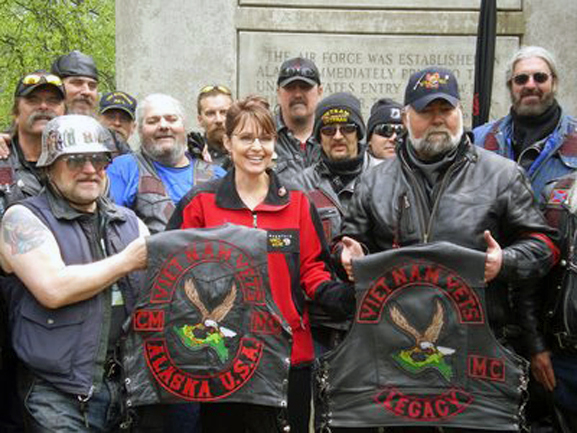
Well, here's a picture of Sarah Palin being cozy with some bikers. Tough guys, too, the kind who look like they know their way around an automatic weapon. You'd have to think twice before giving one them a gun, right?

Twitter-space may be segregated, but military/veteran motorcycle clubs are not. Those are the ones you usually see with political figures. Whatever is wrong with race in America, this kind of biker isn't it.

UPDATE: Among what is mostly a critique of media tone:
It started as a fist fight in the bathroom of the restaurant. The fight spread. People used clubs and chains and knives and guns. By one estimate, there were 30 people shooting. At least five gangs took part – six, if you count the police.

Amazingly, no bystanders were hurt or killed, even though it took place at a shopping centre on a Sunday afternoon where people were shopping and celebrating graduations.

This comes when the riots in Baltimore on April 27th over the death of Freddie Gray at the hands of police is still fresh in everyone’s mind. The difference in how the police and the press acted is striking.
I often criticize the police if I think they have over-deployed power against Americans. I think this person's argument is highly uncharitable given the performance of the police in Waco. It's also not justified by what follows in the article. A lot of ink is spilled on the difference in the way the media talks and thinks about Baltimore versus Waco, but there's nothing to justify the claim that the police acted in a "different" way.

Before the brawl -- let's call it a "riot" to avoid treating the cases as essentially 'different' in the way the article hates -- police tried to get the bar to refuse service to the clubs. When that failed, they deployed officers in overwatch positions around the gathering. They fired on the club members who were involved, and may well have killed some of the "rioters" (as they did not do in Baltimore). They mass-arrested nearly two hundred people, just as in Baltimore, and appear poised to charge nearly all of them with at least some crime. At least some of the charges look to be capital murder. If so, unlike in Baltimore, the government is planning to put people to death for participating in this riot.

Now, not to put too fine a point on it, but that's how you stop a riot. Shooting the rioters used to be the ordinary standard for dangerous rioting. It was clearly justified here.

Deeply Dishonest

[A]nyone who has read the text of the [TPP] agreement could be jailed for disclosing its contents. I’ve actually read the TPP text provided to the government’s own advisors, and I’ve given the president an earful about how this trade deal will damage this nation. But I can’t share my criticisms with you....

The government has created a perfect Catch 22: The law prohibits us from talking about the specifics of what we’ve seen, allowing the president to criticize us for not being specific. Instead of simply admitting that he disagrees with me—and with many other cleared advisors—about the merits of the TPP, the president instead pretends that our specific, pointed criticisms don’t exist.
Emphasis added.

No lying salesmen.

No secret treaties.

Liberation

A clever matching of perspective makes windows into the past in Paris, 2014/1944.


Odd Split

What kind of controversy gets the Supreme Court to line up Alito, Roberts, Kennedy, Breyer, and Sotomayor against Ginsburg, Scalia, Kagan, and Thomas?  A suit over whether Maryland counties (and the city of Baltimore) must give credits to Maryland residents who pay taxes to other states for income they earn across state lines.  This looks like a classic quarrel over whether the problem with a law is that it's lousy policy or that it violates the Constitution.  What Constitutional principle limits taxes, you may wonder, and where has it been all our lives?  In this case, the idea is that double-taxation across state lines amounts to a tariff on interstate commerce.  If you don't find that convincing, you may side with strict-interpretationists Scalia and Thomas, and wish that the problem would be solved at the ballot box instead.

The press is generally reporting this as problematic because Maryland counties and the city of Baltimore need lots of cash, which apparently is the only useful consideration when it comes to taxation policy or the Constitutional limits on state power.  Myself, I'd worry more about having to mediate disputes between states over who has the best right to glom onto every penny of income they can identify in the hands of people who are energetic enough to earn money in interstate commerce--but I suppose they've been facing that issue for a long time now, given that most states already have a system of interstate credits in place.  Ah, for the days when I paid income tax to California, New Jersey, and the State and City of New York while living in (income-tax-free) Texas.  I'm sure they put the money to good use.

From Your Lips...

I think this is right, but we'll see how it goes.