I've got a friend who really, really hates Tim Tebow. I've been enjoying watching him foam at the mouth at various points during the season. He's a huge Broncos fan too, from Denver -- it's really Tebow that he hates, hates, hates.
So, naturally, I just sent him an email.


Woosh...
...and there goes the Christmas tree, which we left up a little longer than usual this year. I'd normally make some remarks about a long, cold and joyless winter ahead; but lately it's been more like March than January. Daffodils are up, and the frogs are singing by night. I feel like I ought to be able to jump on the motorcycle and take off for wherever with tent and Bowie knife, as the blood suggests in the springtime.
Speaking of Women and Jews...
...which we were doing both in the last post and in the recent post on Medieval Islamic poetry, Haaretz reports on Jewish prayer from 1471. Just to keep the accounting clear, though both are "medieval" these prayers are several hundred years later than the period in Spanish history in which female Jewish poets were absent (it's also 246 years after Magna Carta, which is to say, a little longer than America has existed as a nation):
In her better-known writings, Arendt speaks sharply against those who allow themselves to be defined by others, and brightly of those who seize upon the categories of their birth and use them to construct an identity that is theirs alone. Thus, in The Origins of Totalitarianism (pp 81-5 in this edition), she has hard words for "inverts" (i.e., homosexuals) and "Jewish" men who hid in salons; but very high praise for Proust and Disraeli, who each took one of those qualities and constructed something worthy of a true individual. In Disraeli's case, for example, he was in no way satisfied with being 'Jew-ish' -- he insisted on being a Jew, and in a way that was his very own.
Her position thus guards against the ravages of our modern identity politics, in which people are taught to think of themselves as members of a group -- she wants you to take whatever your genetic or cultural identity happens to be, and find a way to do something new and unique. The quality of being Jewish or an invert, she says in OT, is "meaningless" when it is a way of putting people into groups: it can only be valuable if it flourishes as a part of the character of an individual of worth.
That isn't the limit of her insight, however. In her letters, she expressed a profound sense of gratitude for every kind of human difference that is truly, genuinely impossible to bridge. It is my belief that you can find her reasoning for this in her horror at the Nazi movement -- which she encountered first hand, arrested by the Gestapo and later spending time in a concentration camp in France. She writes of how Hitler was so proud of the SS for turning a thousand men into 'examples of the same type.' That there are differences we cannot bridge is therefore something to be grateful for: they provide sources of resistance to tyranny.
More than that, though, such differences also provide a unique perspective. This is crucial to our ability to believe in our own perceptions of the world -- after all, our sense perceptions are often wrong. Our eyes may fail us, or we may not be sure we heard correctly. It is in hearing or seeing our perceptions confirmed by an independent observer, another person, that we gain confidence in our impressions. The more independent the observer -- that is, the more genuine and deep the differences between them and us -- the more confidence we can have from their confirmation of our thoughts and impressions.
For that reason, it is right to feel gratitude for being a woman and not a man, and it is right to feel gratitude for being a man and not a woman. It is right to feel gratitude for any difference given to us that cannot be bridged. These things make us stronger, in that they give us access to parts of the world that our own perspective does not, and in that they can help us know how much weight it is safe to place on our own perceptions.
This -- Arendt calls it "plurality" -- is a strength that arises from human nature. Therefore, it is a virtue: one of the absolute ones. It is a virtue for anyone, and a weakness in those who will not have it.
According to the Jewish Theological Seminary (JTS), the 600-year-old siddur replaces the traditional prayer recited by women, “Blessed are You, Lord our God, Master of Universe for Creating me According to your Will”, with “Blessed Are You Lord our God, Master of the Universe, For You made Me a Woman and Not a Man.”
The prayer offered by the 1471 siddur stands as a clear counterpart to the morning prayer recited daily by observant Jewish men: "Blessed are You For Not Creating Me a Woman".The article runs with this in several directions, but let me offer something from a thinker -- who happens to have been both a woman and of Jewish extraction -- whose approach to this question strikes me as the right one. I'm speaking of Hannah Arendt, who wrote quite a bit about the differences that define us. She has a pretty sophisticated approach, so bear with me as I try to explain it, because I may not convey it quite right the first time.
In her better-known writings, Arendt speaks sharply against those who allow themselves to be defined by others, and brightly of those who seize upon the categories of their birth and use them to construct an identity that is theirs alone. Thus, in The Origins of Totalitarianism (pp 81-5 in this edition), she has hard words for "inverts" (i.e., homosexuals) and "Jewish" men who hid in salons; but very high praise for Proust and Disraeli, who each took one of those qualities and constructed something worthy of a true individual. In Disraeli's case, for example, he was in no way satisfied with being 'Jew-ish' -- he insisted on being a Jew, and in a way that was his very own.
Her position thus guards against the ravages of our modern identity politics, in which people are taught to think of themselves as members of a group -- she wants you to take whatever your genetic or cultural identity happens to be, and find a way to do something new and unique. The quality of being Jewish or an invert, she says in OT, is "meaningless" when it is a way of putting people into groups: it can only be valuable if it flourishes as a part of the character of an individual of worth.
That isn't the limit of her insight, however. In her letters, she expressed a profound sense of gratitude for every kind of human difference that is truly, genuinely impossible to bridge. It is my belief that you can find her reasoning for this in her horror at the Nazi movement -- which she encountered first hand, arrested by the Gestapo and later spending time in a concentration camp in France. She writes of how Hitler was so proud of the SS for turning a thousand men into 'examples of the same type.' That there are differences we cannot bridge is therefore something to be grateful for: they provide sources of resistance to tyranny.
More than that, though, such differences also provide a unique perspective. This is crucial to our ability to believe in our own perceptions of the world -- after all, our sense perceptions are often wrong. Our eyes may fail us, or we may not be sure we heard correctly. It is in hearing or seeing our perceptions confirmed by an independent observer, another person, that we gain confidence in our impressions. The more independent the observer -- that is, the more genuine and deep the differences between them and us -- the more confidence we can have from their confirmation of our thoughts and impressions.
For that reason, it is right to feel gratitude for being a woman and not a man, and it is right to feel gratitude for being a man and not a woman. It is right to feel gratitude for any difference given to us that cannot be bridged. These things make us stronger, in that they give us access to parts of the world that our own perspective does not, and in that they can help us know how much weight it is safe to place on our own perceptions.
This -- Arendt calls it "plurality" -- is a strength that arises from human nature. Therefore, it is a virtue: one of the absolute ones. It is a virtue for anyone, and a weakness in those who will not have it.
And Here I Thought I Was Old-Fashioned
House Bill 1580 is the product of such a brainstorming session this summer between three freshman House Republicans: Bob Kingsbury of Laconia, Tim Twombly of Nashua and Lucien Vita of Middleton. The eyebrow-raiser, set to be introduced when the Legislature reconvenes next month, requires legislation to find its origin in an English document crafted in 1215.
"All members of the general court proposing bills and resolutions addressing individual rights or liberties shall include a direct quote from the Magna Carta which sets forth the article from which the individual right or liberty is derived," is the bill's one sentence.
Can we start with getting them to cite the Constitution?
Some version of this concept might be a very good idea, although if you were going to pick one document the Magna Carta is probably not it. A large number of its provisions pertain to issues like scutage, dowries, and feudal relief payments. In general these no longer pertain to how we organize society (although perhaps we should reconsider the feudal system, which at least required that all recipients of government support provide the government with clear public services in return). There are also some disabilities for women and Jews that force us not to consider the Magna Carta as the be-all, end-all of our rights.
On the other hand, there's something wholesome about the idea of requiring the government to prove its claims. Rights language has been abused by those who favor an expansive government role (e.g., 'education is a right!', 'decent housing is a right!', 'health care is a right!', etc). If the Magna Carta is not sufficient by itself, it might serve as one of a list of documents that show a given liberty or right to be well-recognized and of long standing. The protection of rights and liberties of that sort ought to be one of our chief concerns.
For example, provisions 38-9 would be problematic for the administration's current policy toward assassination or indefinite detention of US citizens without trial:
In future no official shall place a man on trial upon his own unsupported statement, without producing credible witnesses to the truth of it.
No free man shall be seized or imprisoned, or stripped of his rights or possessions, or outlawed or exiled, or deprived of his standing in any other way, nor will we proceed with force against him, or send others to do so, except by the lawful judgment of his equals or by the law of the land.
These Are The Worst Pirates We've Ever Seen
Rear Adm. Craig S. Faller, who commands the carrier strike group, looked at the chart and radar images of the Sunshine’s location with something like disbelief. The Sunshine and the Stennis were only a few miles apart. “These might be the dumbest pirates ever,” he said.It proved a chance to rescue some Iranian fishermen -- a good deed freely rendered to a people who have probably been told to expect no such from us.
Santayana wrote of England at her height as the "sweet, just, boyish master," and -- though there were times and places when England was fierce, and her justice was administered without remorse -- there are many examples that prove his point. Much of what was said in honest praise then can be said in honest praise now, not of England alone, but of our combined navies operating to keep the sea lanes safe and free.
Shelob vs. the Sandworm
 And glowing red eyes, to boot. Well, they're not actually huge (yet), but they are genetically modified hybrids of silkworms with spider genes added to make their silk stronger. I think the GM engineers added the glowing red eyes just to freak us out.
Some commenters to this "Not Exactly Rocket Science" article raised the specter of escaped silkworm super-hybrids wreaking havoc in the natural world, only to be reassured that silkworms have been domesticated for so long they can't survive in the wild. Oh, sure: that's what they said about the lysine contingency.
We have some friends who raised silkworms long ago in California. They haven't tried it here in Texas; something about the food supply or the climate. Anyway, it sounds at least as wonderful as beekeeping, another seductive hobby. But now it seems my attention is to be diverted by the spiders, and I'm going to have to put my hands on Leslie Brunetta's "Spider Silk," which offers information about the fascinating proteins that make up this amazing substance. (Ha! It's available on Kindle, and I can have it instantly! -- as if I didn't already have a high enough pile of books to read.)
It was a touch of genius to get the silkworms to start spinning spider silk, because they produce their fibers in the more useful form of long, continuous strands wrapped around a cocoon, unlike the tangles favored by most spiders. Someone is even working on worm genes that will impregnate the modified silk with bacteriocides, so that it will make a better wound suture. Can elf-cloaks be far behind? Beanstalks?
Abortion Restrictions Up Substantially in 2011
It's interesting to me that the states continue to push this point, since SCOTUS has so often attempted to assert that almost no restrictions are acceptable. Nevertheless, I suppose every time you pass a law, someone has to go to the trouble of challenging it in court; perhaps over time they expect to convince the federal courts that an unrestricted access to abortion is not acceptable to the people of many states within the United States.
Also, some of these "restrictions" are just restrictions on who has to pay for abortions. Given the deep moral issues involved, it is surely reasonable to say that no one should be forced to contribute to abortion against their will. That means no taxpayer funding, and it also means that conscience exceptions ought to be thought reasonable. We often hear from the pro-choice party that a woman's right to make a decision on the morality of abortion for herself ought to be respected; but surely we ought also to respect the moral choices of others who are horrified by the practice, and not force them to enable, participate in, or fund what they regard as a killing of an innocent.
Of course, it's also problematic to suggest that a woman's right to choose should be unilateral; it runs up against the common sense notion that it is not wise to allow someone to be the judge in their own case. It is not that people mean to be unfair, or even think that they are judging unfairly; it is just that we all have unconscious tendencies to over-emphasize our interests when we are judging in our own cases. This is a well-known fact of human nature that applies to all people at all times; naturally it applies here as well.
Thus, even though I am sure that most women who go through this decision believe they are carefully judging the matter, it should neither be surprising nor controversial to suggest that these sub-conscious processes lead them to judge their own interests above those of the father or those of the child. The father may or may not want the child, but the child's interest will surely often be best served by being born even if it is then given up for adoption. Sadly, we find that all these new restrictions occur in a context in which too often abortion numbers remain at near record highs, and adoption referrals decline.
Also, some of these "restrictions" are just restrictions on who has to pay for abortions. Given the deep moral issues involved, it is surely reasonable to say that no one should be forced to contribute to abortion against their will. That means no taxpayer funding, and it also means that conscience exceptions ought to be thought reasonable. We often hear from the pro-choice party that a woman's right to make a decision on the morality of abortion for herself ought to be respected; but surely we ought also to respect the moral choices of others who are horrified by the practice, and not force them to enable, participate in, or fund what they regard as a killing of an innocent.
Of course, it's also problematic to suggest that a woman's right to choose should be unilateral; it runs up against the common sense notion that it is not wise to allow someone to be the judge in their own case. It is not that people mean to be unfair, or even think that they are judging unfairly; it is just that we all have unconscious tendencies to over-emphasize our interests when we are judging in our own cases. This is a well-known fact of human nature that applies to all people at all times; naturally it applies here as well.
Thus, even though I am sure that most women who go through this decision believe they are carefully judging the matter, it should neither be surprising nor controversial to suggest that these sub-conscious processes lead them to judge their own interests above those of the father or those of the child. The father may or may not want the child, but the child's interest will surely often be best served by being born even if it is then given up for adoption. Sadly, we find that all these new restrictions occur in a context in which too often abortion numbers remain at near record highs, and adoption referrals decline.
Britain Looks Abroad
Since we were thinking the other day about inviting the UK into NAFTA -- or possibly even forming a wider Anglosphere alliance that was both economic and military -- these remarks from the British Secretary of State for Foreign and Commonwealth Affairs may be of interest. They are from the Bangkok Post, and intended for audiences in Asia, which is also where our own administration appears to believe our future focus should be located.
Structuring an alliance that is designed to enrich as well as empower an ally suggests being careful to pick allies with broadly aligned cultures and values, as well. The UK is clearly thinking along those lines already; so must we.
Our commercial relationships in the region are strongest with our Commonwealth partners, Singapore and Malaysia who between them account for a commanding majority of our bilateral trade in goods. While continuing to strengthen these important relationships we should also be looking for opportunities in Thailand, Vietnam and elsewhere. We also need to continue to work with EU partners to secure free trade agreements with Asean countries which will open up markets and boost trade.
And lastly we need to do more to promote two-way investment. The UK offers attractive investment opportunities for emerging economies. International institutions regularly rate the UK as the easiest place to do business in Europe, with the strongest business environment on the continent and the lowest barriers to entrepreneurship in the world.
Our relationship, however, is about more than trade and investment. We have shared interests in maintaining security in a region which straddles some of the world's most important shipping routes and to tackling together common threats such as terrorism, nuclear proliferation, cyber-crime and climate change.
The UK therefore maintains a stake in regional security and defence cooperation through our 40-year commitment to the "Five Power Defence Arrangements". This agreement between the five Commonwealth partners of UK, Singapore, Malaysia, Australia and New Zealand is unique for East Asia and enables our countries to undertake joint exercises and to share information on issues from piracy to illegal fishing. There are a number of separatist or other domestic conflicts within Asean and tensions remain in the South China Sea. The UK has experience which we are keen to share to help promote stability and we are already part of a small group of countries formally supporting the Philippine government and Mindanao groups in their efforts to end conflict in the south of that country.
Externally, the voices of Asean leaders will be increasingly influential in regional and global affairs. Indonesia's impressive democratisation and Malaysia's strong stand against violent extremism are examples of where the experiences of countries in the region can be of great value to the international community.This may be the way that the future looks, especially as we ourselves are apparently going to cut hundreds of thousands of ground forces and hundreds of billions of dollars from our security posture. That means we need to make sure that the economic interests of our security partners align with our own -- otherwise, they won't play in a game we no longer can play on our own.
Structuring an alliance that is designed to enrich as well as empower an ally suggests being careful to pick allies with broadly aligned cultures and values, as well. The UK is clearly thinking along those lines already; so must we.
The Female Glories of Islamic Spain
In an article on poets from Al Andalus, an interesting lesson: Muslim but not Jewish women wrote significant poetry. Another, then: women were among the great poets of Islam at the period when it was at its height.
What is surprising is that during this period, there were numerous Muslim women whose poetry has been preserved. Although Muslims refer to the Jews as ahl al-kitab or “people of the book,” Muslim women seem to have been more successful in creating lasting poetic works.
It is rather difficult to account for this discrepancy, for it seems odd to imagine that Muslim women in medieval Spain were far more educated than their Jewish counterparts. Arabic became the lingua franca following the Muslim conquest of the country in 711. When Jewish poets began to compose in Arabic and later in Hebrew, were the women entirely excluded?
There are very few extant poems written by Jewish women dating to this period. Although only a fraction of all poems from that time have survived, this does not mean more were not written. The poems that are available are of a high quality, but the problem of quantity cannot be ignored.
Kasmunah (“little charming one” or “one with a beautiful face”) of Andalusia in southern Spain was the daughter of Isma’il ibn Bagdala “the Jew.” Her Arabic verses were included in a 15th-century anthology of women’s verses (compiled by an Egyptian). Little is known about her; there are debates as to whether she lived in the 11th or 12th century. Some of those favoring the earlier date contend that she was none other than the daughter of Samuel Hanagid, who was also known as ibn Nagrella (he indeed had a daughter). The assumption is that Bagdala and Nagrella are similar enough to have been confused.
At any rate, Kasmunah’s father taught her by means of intellectually creative collaboration. He composed two lines; she needed to respond in kind.
The style he chose is known as muwwashah, a rather difficult genre of poetry in which both he and his protégé excelled. Reading her verses reveals a tremendous originality and expertise in Arabic poetry, as well as the gentleness of this cultured woman.
The wife of Dunash ibn Labrat lived at the end of the 10th century; very little is known about her. Her husband was born in Fez, studied in Baghdad with Rabbi Sa’adia Gaon and spent time in Cordoba in the court of the eminent diplomat Hasdai ibn Shaprut. Her name is not recorded anywhere, but this does not detract from the fact that her erudition and expertise in Hebrew poetry are astounding.
In truth, the scholars of medieval Hebrew poetry, such as Haim Shirman and Ezra Fleischer, were convinced that this was a field entirely reserved for men. However, a series of discoveries of fragments from three different collections in the Cairo Geniza produced evidence to the contrary.
In 1947, a fragment of a poem was found and published by Nehemia Allony, who surmised that it dealt with a bride and groom, or possibly a separation. In 1971, the tables turned when a complete copy of this poem appeared (albeit with the lines in the incorrect order); the missing lines revealed that it referred to a couple and their child. The husband had left his beloved wife and child behind in Spain, and their future was unclear. A third discovery solved the mystery of the poem’s authorship because of its header: “from the wife of Dunash ibn Labrat to him.” This fragment included a second poem written by the absentee husband, defending himself and professing his love to “an erudite woman like you” (see Ezra Fleischer, “About Dunash Ibn Labrat and his wife and son,” Jerusalem Studies in Hebrew Literature, 5 (1984) in Hebrew).
This detective work revealed beautiful poetry and the correct identity of the sources; it reflected the talents of the eminent poet’s wife as well as that of her husband. Mr. and Mrs. ibn Labrat, although separated, and Kasmunah were creative and impressive poets who made important contributions to the medieval Spanish literary heritage.
Medieval Islamic Spain seems to me to hold much that we ought to try to recover. Modern Islam would find in it much native pride, as it represents the height of their religion's worldwide civilization. The rest of the world would find it a means of helping guide their Islamic neighbors onto a more wholesome course than is sometimes the case.
These End is Nigh
These boys -- with one noteworthy exception, all boys -- are good for morale. If I believed any of this was true, I'd be feeling pretty good about the future.
Unfortunately, I have trouble buying it. They are taking counsel from their fears, not from wisdom; I do not believe that the danger is nearly as great as they say. More's the pity!
Unfortunately, I have trouble buying it. They are taking counsel from their fears, not from wisdom; I do not believe that the danger is nearly as great as they say. More's the pity!
Hip-Hop Music in the Age of Our Current President
Ya'll may remember the author better from a '90s hit that is still in current play during sporting events.
Same guy. New era. It's gotta be hard for the President, seeing the hip-hop demographic turn on him.
Sorry, Ma'am
I wanted her to do well. She brought it on herself, but she also made some solid points in the many debates, and advanced some strong arguments on how to think about the Constitution. It's a loss to all of us that she couldn't carry the good parts home.
"Those Hands Dug Freedom For Me"
A pretty good speech, from last night's real winner.
It'll be a miracle if he manages to overcome the weight of the establishment, and the wealth, that is ranked against him. But he believes in miracles; I suppose it's part of his job.
It'll be a miracle if he manages to overcome the weight of the establishment, and the wealth, that is ranked against him. But he believes in miracles; I suppose it's part of his job.
Rivals in Archaeology
A little less flamboyant than the Indiana Jones / Belloc feud, but it's close to home.
There are some very interesting prehistoric sites in Georgia, but this is the first time I've ever heard it floated that they might be Mayan. I'd wager that Dr. Williams is right: this sounds more like cashing in on the 2012 Maya-mania than a highly probable theory. Nevertheless, here's the article; the author claims he'll answer questions on his website. Maybe I'll ride up there sometime soon and take a look.
Thornton declares that an area near Brasstown Bald is “possibly the site of the fabled city of Yupaha, which Spanish explorer Hernando de Soto failed to find in 1540, and (is) certainly one of the most important archaeological discoveries in recent times.”
Thornton uses Williams’ research on Indian mounds and the studies of archaeologist Johannes Loubser, who excavated the north Georgia site, to bolster his claims.
Williams couldn’t disagree more. “This is total and complete bunk,” Williams wrote on Facebook. “There is no evidence of Maya in Georgia. Move along now.”
Williams’ reaction brought forth legions of bloggers and Internet experts calling him “arrogant” and “dismissive.”It was certainly the latter!
There are some very interesting prehistoric sites in Georgia, but this is the first time I've ever heard it floated that they might be Mayan. I'd wager that Dr. Williams is right: this sounds more like cashing in on the 2012 Maya-mania than a highly probable theory. Nevertheless, here's the article; the author claims he'll answer questions on his website. Maybe I'll ride up there sometime soon and take a look.
Almost There
A young Oklahoma mother shot and killed an intruder to protect her 3-month-old baby on New Year's Eve, less than a week after the baby's father died of cancer. Sarah McKinley says that a week earlier a man named Justin Martin dropped by on the day of her husband's funeral, claiming that he was a neighbor who wanted to say hello. The 18-year-old Oklahoma City area woman did not let him into her home that day.The only thing left is to convince the dispatchers that they can tell her it's OK to shoot. Twenty-one minutes isn't unreasonable for a police response time, all things considered. We should work that reality into how we train people to think about cases of home invasion, and how we train 911 dispatchers to advise people to react.On New Year's Eve Martin returned with another man, Dustin Stewart, and this time was armed with a 12-inch hunting knife. The two soon began trying to break into McKinley's home. As one of the men was going from door to door outside her home trying to gain entry, McKinley called 911 and grabbed her 12-gauge shotgun.
McKinley told ABC News Oklahoma City affiliate KOCO that she quickly got her 12 gauge, went into her bedroom and got a pistol, put the bottle in the baby's mouth and called 911. "I've got two guns in my hand -- is it okay to shoot him if he comes in this door?" the young mother asked the 911 dispatcher. "I'm here by myself with my infant baby, can I please get a dispatcher out here immediately?"
The 911 dispatcher confirmed with McKinley that the doors to her home were locked as she asked again if it was okay to shoot the intruder if he were to come through her door.
"I can't tell you that you can do that but you do what you have to do to protect your baby," the dispatcher told her. McKinley was on the phone with 911 for a total of 21 minutes.
When Martin kicked in the door and came after her with the knife, the teen mom shot and killed the 24-year-old. Police are calling the shooting justified.
"You're allowed to shoot an unauthorized person that is in your home. The law provides you the remedy, and sanctions the use of deadly force," Det. Dan Huff of the Blanchard police said.
Stradivari v. The Moderns
This survey itself is not that interesting, but there are two minor points that caught my eye.
A less respectful view of Dr. Fritz’s study is offered by the violinist Earl Carlyss, a longtime member of the Juilliard String Quartet. “It’s a totally inappropriate way of finding out the quality of these instruments,” he said. The auditions, he noted, took place in a hotel room, but violinists always need to assess how an instrument will project in a concert hall. He likened the test to trying to compare a Ford and a Ferrari in a Walmart parking lot.
“The modern instruments are very easy to play and sound good to your ear, but what made the old instruments great was their power in a hall,” he said.The anti-Walmart snobbery aside, that's a good point. However, I am reminded of Eric Blair's remarks that it is recording -- and not concert halls -- that offer us the real power of music in our current age. Just in the last two weeks, we've listened to recordings of songs that we might not ever have heard before the internet age; now, they're free for exploration. Thus, the "power in a hall" standard may need to be rethought, even by concert musicians. The question may become "How optimized is it for our best current recording and playback techniques?" The other remark that I found amusing was this defense by the study's author:
Dr. Fritz acknowledged that her study used few violins. But it is quite difficult, she noted, to get owners to lend out their million-dollar instruments to be played by blindfolded strangers.That surely must be true. It must be doubly true that it is hard to get such loans when the purpose of the study is to undermine the legend on which the value of their million-dollar investment is based!
Addendum on National Myths
I've been away from here for a few days, but was glad to see Grim raising that topic of perennial importance: national myths. The highly successful (the Chinese have one of the most successful national myths in the world; and their beastly treatment of the Uighurs and Tibetans comes along with it), the once successful (for I can dimly remember a time when public schools in this country taught an American national myth, and I've read enough old things to know it was once very strong), and the decidedly troubled.
Now, what Grim's saying in these discussions, and especially in the second one, I entirely agree with. In fact, if I had to pick a single factor that really makes a recognizable "people," a national myth is that factor. A common language helps; a common government helps; a common religion helps; but it is the national myth (that may well be bound up with all these things) that really does the trick.
Michael Totten has two recent posts, highly apropos. To the first. In this and comments, he discusses Newt Gingrich's characterization of the Palestinians as an "invented" people. And he links to this article by Lee Smith, who opines:
"The real question, then, is not whether Palestinian nationalism is 'authentic,' but whether this particular national fiction is useful."
And I think he is on the right track. Smith however concludes that the Palestinian myth is not "strong enough" because their leadership is unwilling to accept a limited state that coexists with its Israeli neighbors. But I think that is not a sign of the myth's weakness, but simply its character. For better or worse, and mainly for worse, the Palestinians have indeed become a people because they have got a national myth. It's just a barren and ugly one. It is of recent vintage - that is the kernel of truth in Mr. Gingrich's statement (which I used to agree with) - but that doesn't invalidate it. All national myths have got to start somewhere.
In his post and especially in comments, Mr. Totten goes further in opposing the notion of the Arabs as a "people" - which Mr. Gingrich accepts in rejecting the Palestinians as an "invented" subset. And in my view, he's right there, insofar as the Pan-Arab ideologies (Ba'athism, and whatever-you-call-it that was supposed to create the overarching UAR) - didn't catch on; they were unsuccessful myths, and given the character of the regimes that used them, that is probably just as well. Mr. Totten, however, declares the idea not only pernicious ("National Socialism for Arabs") but simply false:
Anyway, it isn't hard to see that for a country with any kind of consensual government, a national myth is a precious possession - hence the second post, on Claire Berlinski's determination to violate a Turkish law by referring to the Armenian genocide as "genocide," and a French law by denying it was genocide. In these places, I think, and especially the first, the governments are trying to defend the national myths in their current forms, and are curtailing free speech to do it. (Which is what Ms. Berlinski is opposing, and by referring to a French figure of mythic proportions.)
What makes our own myth remarkable is the way it rests on ideas and laws, more than any race or religion. The complaints that led to independence for certain grew out of the British constitution, and its common-law way of developing rights. Let colonists vote for the assemblies that tax them, as Britons vote for the Parliament that taxes them, and they'll pick up the idea that they have a right to it - not in the civil-law sense that someone formally granted it, but in the common-law way, that the unifying theory is to be discerned from the actual decisions made. And our myth certainly relies on the idea of these things as rights - yet is blessedly detached from any continued racial identity. Our national identity is not weakened if we admit that Anglo-Saxons can commit beastly atrocities - the document that started it all is filled with such accusations. More remarkably, if we admit that the ideas are noble, and the men who made them law were doing noble acts, we can admit much more wihtout weakening the myth at all - that they carried flaws with their nobility, as true heroes always do, and that Americans have done many awful things since by not living up to those ideas.
(The Jewish "national myth" of the Old Testament shows some strong parallels - 1 Chronicles and 2 Chronicles recast, often with some pretty heavy shading, the history of the Northern and Southern Kingdoms as a matter of "We did well when we kept the commandments and we did very badly when we didn't.")
To the Turkish government, it seems, if you deny that "the Turkish people, as such, are too noble to have committed genocide," you're striking too hard at an idea bound up with their race and religion (for it certainly precedes their current constitution) that they believe holds them together.
P.S. - Yes, I know, I'm oversimplifying by writing as if there's one unchanging successful myth among each people. I oversimplify to be able to write at all.
Now, what Grim's saying in these discussions, and especially in the second one, I entirely agree with. In fact, if I had to pick a single factor that really makes a recognizable "people," a national myth is that factor. A common language helps; a common government helps; a common religion helps; but it is the national myth (that may well be bound up with all these things) that really does the trick.
Michael Totten has two recent posts, highly apropos. To the first. In this and comments, he discusses Newt Gingrich's characterization of the Palestinians as an "invented" people. And he links to this article by Lee Smith, who opines:
"The real question, then, is not whether Palestinian nationalism is 'authentic,' but whether this particular national fiction is useful."
And I think he is on the right track. Smith however concludes that the Palestinian myth is not "strong enough" because their leadership is unwilling to accept a limited state that coexists with its Israeli neighbors. But I think that is not a sign of the myth's weakness, but simply its character. For better or worse, and mainly for worse, the Palestinians have indeed become a people because they have got a national myth. It's just a barren and ugly one. It is of recent vintage - that is the kernel of truth in Mr. Gingrich's statement (which I used to agree with) - but that doesn't invalidate it. All national myths have got to start somewhere.
In his post and especially in comments, Mr. Totten goes further in opposing the notion of the Arabs as a "people" - which Mr. Gingrich accepts in rejecting the Palestinians as an "invented" subset. And in my view, he's right there, insofar as the Pan-Arab ideologies (Ba'athism, and whatever-you-call-it that was supposed to create the overarching UAR) - didn't catch on; they were unsuccessful myths, and given the character of the regimes that used them, that is probably just as well. Mr. Totten, however, declares the idea not only pernicious ("National Socialism for Arabs") but simply false:
If Egyptians, Syrians, Lebanese, etc, stopping viewing the Palestinians as part of some great Arab “mass,” the Israeli-Palestinian conflict would instantly become localized and would eventually become solvable. The minute Lebanese people, etc, insist the Israeli-Palestinian conflict is somebody else’s problem, we’ll be 80 percent of the way to where we need to be...Arab nationalism is built on a lie and must die.And there he misses the mark (as Mr. Smith does not) - the idea that the Arabs should see themselves, and attempt to act, as one people is simply a myth that didn't catch on. (And would, I suppose, have been as perniciously used as Panslavism, if it had.) The preamble to the current Iraqi Constitution is a deliberate effort to foster a national myth in that country - if Mr. Totten's reports in this book still hold, the Kurds are not buying it at all just now.
Anyway, it isn't hard to see that for a country with any kind of consensual government, a national myth is a precious possession - hence the second post, on Claire Berlinski's determination to violate a Turkish law by referring to the Armenian genocide as "genocide," and a French law by denying it was genocide. In these places, I think, and especially the first, the governments are trying to defend the national myths in their current forms, and are curtailing free speech to do it. (Which is what Ms. Berlinski is opposing, and by referring to a French figure of mythic proportions.)
What makes our own myth remarkable is the way it rests on ideas and laws, more than any race or religion. The complaints that led to independence for certain grew out of the British constitution, and its common-law way of developing rights. Let colonists vote for the assemblies that tax them, as Britons vote for the Parliament that taxes them, and they'll pick up the idea that they have a right to it - not in the civil-law sense that someone formally granted it, but in the common-law way, that the unifying theory is to be discerned from the actual decisions made. And our myth certainly relies on the idea of these things as rights - yet is blessedly detached from any continued racial identity. Our national identity is not weakened if we admit that Anglo-Saxons can commit beastly atrocities - the document that started it all is filled with such accusations. More remarkably, if we admit that the ideas are noble, and the men who made them law were doing noble acts, we can admit much more wihtout weakening the myth at all - that they carried flaws with their nobility, as true heroes always do, and that Americans have done many awful things since by not living up to those ideas.
(The Jewish "national myth" of the Old Testament shows some strong parallels - 1 Chronicles and 2 Chronicles recast, often with some pretty heavy shading, the history of the Northern and Southern Kingdoms as a matter of "We did well when we kept the commandments and we did very badly when we didn't.")
To the Turkish government, it seems, if you deny that "the Turkish people, as such, are too noble to have committed genocide," you're striking too hard at an idea bound up with their race and religion (for it certainly precedes their current constitution) that they believe holds them together.
P.S. - Yes, I know, I'm oversimplifying by writing as if there's one unchanging successful myth among each people. I oversimplify to be able to write at all.
A Boy, His Dog, and His Sword
Something else on a lute:
The large number of strings on this lute allows a cascade of notes at a very low tempo and across a wide range, which is an interesting effect. We are more used to hearing it done on fewer strings, and at a higher tempo, in American bluegrass.
Inside the Myth of Europe
Dr. John Gray echoes Mr. Blair's writings on the dangers of mythology.
Those dangers are real; the difference I have with these gentlemen on the point is that I think the danger means that you have to take control of the process. Myths are indispensable to human consciousness. We are most vulnerable to the baleful effects just when we -- as the modern Europeans -- think we are disposing of myths and living a new, regulated, scientific life.
We last saw Dr. Gray here writing in response to Dr. Stephen Pinker's new book, which argues a very similar myth: that humanity is engaged in moral progress that is bringing us to a state of less violence, the world wars notwithstanding. Here is Timothy Synder at Foreign Affairs rejecting Dr. Pinker (hat tip Arts & Letters Daily):
It would be striking, then, if we couldn't read history as an arc leading to our own moral values: and that will be true whoever we are, and whatever our moral values happen to be! This is a basic fallacy, an error in logic, that arises from a failure to recognize the fact that human beings learn much of their moral code from each other.
What's much more interesting to me are the counterexamples. One of the things that amazes in reading Chaucer, or Averroes, or Plato, is the degree to which we can find common ground with people centuries removed. This points to a small but crucial moral core that doesn't change, but that is accessible to human reason in every generation. There is no "progress" from this place because it is the destination: the best we can hope for, in any generation, is to reach it and to remain there for the brief space of our life. If we can also guide our children to it, and our friends, we have done all that morality can be asked to do for humankind.
[The European Union's founders] were swayed by a myth - a myth of progress in which humanity is converging on a universal set of institutions and values. The process might be slow and faltering and at times go into reverse, but eventually the whole of humankind would live under the same enlightened system of government.
When you're inside a myth it looks like fact, and for those who were inside the myth of the end of history it seems to have given a kind of peace of mind. Actually history was on the move again. But since it was clearly moving into difficult territory, it was more comfortable to believe that the past no longer mattered.
Those dangers are real; the difference I have with these gentlemen on the point is that I think the danger means that you have to take control of the process. Myths are indispensable to human consciousness. We are most vulnerable to the baleful effects just when we -- as the modern Europeans -- think we are disposing of myths and living a new, regulated, scientific life.
We last saw Dr. Gray here writing in response to Dr. Stephen Pinker's new book, which argues a very similar myth: that humanity is engaged in moral progress that is bringing us to a state of less violence, the world wars notwithstanding. Here is Timothy Synder at Foreign Affairs rejecting Dr. Pinker (hat tip Arts & Letters Daily):
A principle of the scientific method is to arrange experiments so that one's own prior beliefs can be challenged. Pinker's natural experiment with history generates instead a selective rereading, in which his own commitments become the guiding moral light for past and future. But of course libertarianism, like all other ideologies, involves a normative account of resource distribution: those who have should keep. There is nothing scientific about this, although again, like all other ideologies, libertarianism presents itself simply as a matter of natural reason, or, in Pinker's case, "intelligence." Pinker goes so far as to suggest that libertarianism is equivalent to intelligence, since holding libertarian views correlates with high IQ scores. Since he believes that the need to regularly adjust IQ tests to preserve an average score of 100 means that we are growing more intelligent generation by generation, he deduces that we are becoming more libertarian. Pinker also conflates libertarian ideology with ethics, allowing him to conclude that we are therefore becoming increasingly moral. Each step in this argument is shaky, to say the least. As Pinker might have learned from Kant or Hume or any of the other Enlightenment figures he mentions, one cannot jump from reason to morals in this way. Even if each generation is brighter than the last, as Pinker believes, being smart is not the same thing as being just. To have an account of ethics, one needs to begin from ideas of right and wrong, not simply from mental habits that happen to be widespread in one's own milieu and moment.My own critique of the whole 'moral progress' argument -- not merely Dr. Pinker's contribution to it -- is along similar lines. We obtain much of our morality from rubbing against other people, who in turn get theirs from rubbing against the people in their circles. Thus it should normally be expected to be the case that groups of people closer to each other, in time or in space, will have moral opinions more similar to each others' than groups of people who are further removed from each other.
It would be striking, then, if we couldn't read history as an arc leading to our own moral values: and that will be true whoever we are, and whatever our moral values happen to be! This is a basic fallacy, an error in logic, that arises from a failure to recognize the fact that human beings learn much of their moral code from each other.
What's much more interesting to me are the counterexamples. One of the things that amazes in reading Chaucer, or Averroes, or Plato, is the degree to which we can find common ground with people centuries removed. This points to a small but crucial moral core that doesn't change, but that is accessible to human reason in every generation. There is no "progress" from this place because it is the destination: the best we can hope for, in any generation, is to reach it and to remain there for the brief space of our life. If we can also guide our children to it, and our friends, we have done all that morality can be asked to do for humankind.
Good reason to carry a gun and a knife
. . . In case some guy goes into an icy river with three kids in his car, including one still strapped into a car-seat. Chris Willden, a former cop from a family full of cops, military, and EMTs, shot out one of the windows, cut loose the car-seat, and got all three kids out of the car. Two weren't breathing any more, but bystanders got them going again with CPR, and all are now recovering from hypothermia. Way to go, Chris.
Speaking of being the sort of fellow people would like to have around in an emergency, I've just finished "Extreme Fear," written by the guy who inspired my recent post about the inexplicable Air France disaster. It contains the perfect antidote story: an aerobatics expert whose right wing strut buckled during a strenuous stunt. With seconds to live, he remembered a pilot who popped a damaged wing back into place by flying upside down, so he flipped over. Then his engine cut out. Still flying upside down at low altitude, he coolly carried out the checklist for starting the engine back up. Next he considered whether to land upside-down in the water or in some trees, and instead lit on the idea of flipping his plane back over at the last second and landing on solid ground before the wing could buckle again. He walked away.
Definitely not the deer-in-the-headlights sort. Kudos to those who can keep their heads in situations where I'd be thinking about as clearly as the average lizard.
The Old Year Now Away is Fled...
A gentle version providing some of the verses:
The old year now away is fled,
The new year it is entered;
Then let us all our sins down tread,
And joyfully all appear.
Let's merry be this holiday,
And let us run with sport and play,
Hang1 sorrow, let's cast care away
God send us a merry new year!
...
And now let all the company
In friendly manner all agree,
For we are here welcome all may see
Unto this jolly good cheer.
I thank the master and his dame,
The which are founders of the same,
To eat, to drink now is no shame:
God send us a happy new year!
But somehow they skipped my favorite lines:
Come lads and lasses every one,
Jack, Tom, Dick, Bess, Mary and Joan,
Let's cut that meat unto the bone,
For welcome you need not fear.
And here for good liquor you shall not lack,
It will whet the brains and strengthen the back;
This jolly good cheer it must go to wrack:
God send us a happy new year!
Come, give's more liquor when I do call,
I'll drink to each one in this hall,
I hope that so loud I must not bawl,
So unto me lend an ear.
Good fortune to all do send,
And to our dame who is my friend,
Lord bless us all, and so I end:
God send us a happy new year!
Amen!It's early in the morning, and that of a new year: so let's have the Children's Meledy.
Hogmanay
It's not often that I get the feeling of really missing out, but man...
Well, maybe next year!
Here in Atlanta we ring in the New Year with the Peach Drop, but fancy being decked out like a Viking and wielding lit torches to burn your Viking long ship – that is how the folks from Edinburgh in Scotland carry out their Hogmanay celebrations.
Dressed as Vikings in their helmets and warm wrappings, locals carried torches and reenacted traditions for ringing in the New Year to include their Viking past....
Edinburgh's Hogmanay celebrations featured the longest firework display in the history of the event. A total of 5.5 tonnes of fireworks, producing more than 15,000 stars, will be let off during the display over Edinburgh Castle.
Well, maybe next year!
Hooah
Arts & Letters Daily posts this:
Liu Xiaobo is charged by the Chinese government with the “crime of incitement to subvert state power.” He has the honor of being guilty...Now that's rightly said.
The Biased Law
Probably several of you saw the recent dustup over the question of whether marriage law has become so unfair to men that it is unconscionable to recommend marriage to a young man today. There were a number of responses to that, including this one from Catholic Bandita, a woman who has come out on the other side of the ledger. I am indebted to the lady for this picture, below, which says something I truly believe is right.

Smitty at the Other McCain suggests a return to first principles, and a re-examination of what the institution was for in the first place. We have just completed such an examination here, in our autumn debate on polygamy, so it is not necessary to do it again; if you want to revisit the discussion, though, Elise has kindly gathered all of my posts and her own into a category.
I do want to say something about the bias in the law, though, because I find this particular bias to be an interesting one. I think it represents a real challenge to our idea that equality before the law is a goal towards which we should strive: this seems to me to be a clear case in which equality before the law would be wrong.
First, though, we need to narrow the field a bit. There are so many different ways in which men and women are treated differently by the law in family matters that it would be wise to choose a couple of clear-cut cases, with minimal ambiguity, so that we don't end up lost in anecdotes. I can think of two examples that are paradigms of unequal treatment by the law, and that illuminate the problem well.
The first is the law of termination of parental responsibility. The woman has a legal right to abortion in this country that is essentially unfettered; she may thus terminate her duties at will, and for any reason, up until the moment of birth (and even afterwards, in the case of partial-birth abortion). The man has no right to demand the termination of the baby; whereas the patria in ancient Rome made the call on exposure and infanticide, in America it is the mother.
There remains some disparity after birth. In cases in which the child is born, in 49 states and Puerto Rico, it is lawful to abandon the child for adoption at a recognized safe haven. However, in four of those states only the mother can do it.
That is the first matter. The second -- a law currently under discussion, rather than actualized, but a good and illuminating example -- is this proposal to restrict mens' right to stop living with a woman they have gotten pregnant if he is doing so to try to compel her to have an abortion.
HB 5882 [CAPA] actually makes it a crime for a man to "change or attempt to change an existing housing or cohabitation arrangement" with a pregnant significant other, to "file or attempt to file for a divorce" from his pregnant wife, or to "withdraw or attempt to withdraw financial support" from a woman who he has been supporting, if it is determined that the man is doing these things to try to pressure the woman to terminate her pregnancy.What would we get out of equality before the law in the first case? Something rather worse than what we have now: a situation in which fathers were either empowered to demand the death of a child they didn't want (as mothers already are); or, failing that, the right to abandon responsibility for a child that they sired, leaving the woman financially alone to raise it. One thing seemed to agree on with Aquinas' philosophy of matrimony, which we encountered in our discussion of marriage and polygamy, is that the principal end of marriage is procreation -- not merely in the sense of having a child, but seeing that the child is raised to achieve its capacity to fulfill a role as a member of, and defender of, our civilization. Equality before this law would only further damage that principal end.
The first case is a case in which equality before the law is wrong because the law itself is wrong. Asking for an equal right to perform an injustice is to ask for more injustice. That is against reason.
It might be possible to ask for equality in the other direction without violating reason -- i.e., by limiting access to abortion. However, at least so far the Supreme Court has refused to entertain almost any such limits. Unless the Court changes its mind, or we change the Constitution, we do not have that option. We have only the option of asking for more injustice, or accepting inequality before the law. Of these options, inequality before the law is the wiser, and the morally better, choice.
What do we get out of equality before the law in the second case? Should we accept a situation in which a man is free to try to force a woman to kill her child by starvation or poverty? It's the same problem we had in the first case. Of course it should not be legal to abandon your child or its mother. Since our country has abandoned the requirement of marriage, naturally this is going to intrude upon those who go about siring children without bothering to marry.
Yet can we ask for equality in the other direction here? Can we morally state that a woman is not free to leave a man who has gotten her pregnant? Of course not: especially if he is furious about the business of the child. It may put her in terrible danger, and the baby as well. Her freedom to leave is necessary.
Thus we have a situation in this case in which inequality before the law is actually necessary for justice. If justice is -- as Aristotle put it -- to treat relevantly similar cases similarly, the sex divide presents us with a very relevant difference. Inequality before the law is thus necessary for a just result.
But let us return to the image above. True justice between men and women lies not the in the law, but in chivalry: in that willful, loving sacrifice of self for the beloved other. This, at least, is a symmetrical relationship: both the man and the woman must be ready to give of themselves for the other for it to flourish. When it does, however, it is the glory of the world, and the joy of life.
So, is it right to speak of marriage to the young man? Surely so, if the boy has the guts for the big game: for a love that speaks to thunder, and answers the principal end. And if he doesn't, well, what's the point of living at all? A man dies soon enough. Why wrap anyone else up in it, if you don't have what it takes to play for the real thing?
So, is it right to speak of marriage to the young man? Surely so, if the boy has the guts for the big game: for a love that speaks to thunder, and answers the principal end. And if he doesn't, well, what's the point of living at all? A man dies soon enough. Why wrap anyone else up in it, if you don't have what it takes to play for the real thing?
The City of Legions
Once Rome built a fortress in the west of Britain. It was called Deva Victrix, goddess of victory, and indeed there remains today a shrine to Minerva there. It was the sometime home of Legio XX, and is located in what is modern day Chester, England.
Some believe that this was the "City of Legions" where Arthur fought his ninth battle, although Caerleon in Wales is a competitor for that honor. Caerleon also has a significant Roman fortress. The University of Wales at Newport has built a working 3-D model of the Roman works, which you can explore to get an idea of the scale of the fortifications.
The map is pretty neat, even if one can easily think of significant improvements that could be made -- it would be nice to have some sort of hypertext tagged to the building objects, for example, that would lead to explanations of just what they were and what historical or archaeological sources are at work in our understanding. A bibliography or a list of recent research into the works would be welcome as well.
Still, even at this early stage, it's pretty nifty stuff. They're apparently putting one together for the Newport Ship, as well. That one -- a 3-D model of a fifteenth-century sailing vessel -- should be fun to play with.
Some believe that this was the "City of Legions" where Arthur fought his ninth battle, although Caerleon in Wales is a competitor for that honor. Caerleon also has a significant Roman fortress. The University of Wales at Newport has built a working 3-D model of the Roman works, which you can explore to get an idea of the scale of the fortifications.
The map is pretty neat, even if one can easily think of significant improvements that could be made -- it would be nice to have some sort of hypertext tagged to the building objects, for example, that would lead to explanations of just what they were and what historical or archaeological sources are at work in our understanding. A bibliography or a list of recent research into the works would be welcome as well.
Still, even at this early stage, it's pretty nifty stuff. They're apparently putting one together for the Newport Ship, as well. That one -- a 3-D model of a fifteenth-century sailing vessel -- should be fun to play with.
Bring the UK into NAFTA?
It's not a bad idea, really. Alliances should be based not merely on economic interest, but ideally on a shared vision. If you're going to help make someone rich, why not someone who supports the same basic values that you do?
It would make a certain amount of sense to turn the Anglosphere into an economic free trade zone as well as a military alliance.
It would make a certain amount of sense to turn the Anglosphere into an economic free trade zone as well as a military alliance.
La Rotta di Tristano
"Tristano" here is Tristan, the knight who loved Isolde. This harper has some talent, sadly obscured once the solo ends. I wouldn't mind hearing the whole piece on the harp only.
Here is a more traditional reading of the same tune. If you become impatient with it, skip to about 4:30, and you'll find it comes alive when they introduce a pipe.
Here is a more traditional reading of the same tune. If you become impatient with it, skip to about 4:30, and you'll find it comes alive when they introduce a pipe.
The Language of Birds
Some backstory on Wren Day, from Peter Berresford Ellis' The Druids (p. 223 in the 1994 edition):
From native Celtic sources comes confirmation that bird augury was widely used. An Irish version of the Historia Brittonum, by the Welsh historian Nennius, includes an ancient poem which refers to six Druids who lived at Breagh-magh and who practised 'the watching of birds.' ... The name of the wren was given in Cormac's Glossary as drui-en -- the bird of the Druids. Certainly an Irish name for the wren was drean, and a Life of St Moling confirms the etymology of the Glossary. The wren has come down to us as a bird of some significance and on St Stephen's Day (26 December) in Ireland, Scotland and the Isle of Man, and even in parts of Essex and Devon, it was hunted and killed by local boys before being carried in procession[.]This is a subject that has been of interest to me for a long time. In the old Norse poem Rígsþula, a mortal grandson of Heimdall learns the tongue:
43. Soon grew up | the sons of Jarl,
Beasts they tamed, | and bucklers rounded,
Shafts they fashioned, | and spears they shook.
44. But Kon the Young | learned runes to use,
Runes everlasting, | the runes of life;
Soon could he well | the warriors shield,
Dull the swordblade, | and still the seas.
45. Bird-chatter learned he, | flames could he lessen.,
Minds could quiet, | and sorrows calm;
. . . . . . . . . .
The might and strength | of twice four men.
46. With Rig-Jarl soon | the runes he shared,
More crafty he was, | and greater his wisdom;
The right he sought, | and soon he won it,
Rig to be called, | and runes to know.
47. Young Kon rode forth | through forest and grove,
Shafts let loose, | and birds he lured;
There spake a crow | on a bough that sat:
"Why lurest thou, Kon, | the birds to come?
48. " 'Twere better forth | on thy steed to fare,
. . . . . | and the host to slay.
49. "The halls of Dan | and Danp are noble,
Greater their wealth | than thou bast gained;
Good are they | at guiding the keel,
Trying of weapons, | and giving of wounds.
Hilda Ellis Davidson describes several more examples of Celtic and Norse mythic figures for whom learning to speak the language of birds is a part of the initiation into wisdom that allows for heroic success. (Pages 86-7.)
Understanding the speech of birds could give a hero entry into the world of ravens and valkyries, where defeat and victory were ordained, or in more everyday terms it could mean an ability to interpret calls and movements of birds and thereby receive warning of future events. Such aspects of bird lore are referred to in the Edda poems and in the ninth century Hrafnsmal [i.e., "The Tale of the Raven" -- Grim] the stanzas form a dialogue between a raven and a valkyrie. She is said to account herself wise because she understood the language of birds, and is herself described as 'the white-throated one with bright eyes,' which suggests that she herself was in bird form. Goddesses, as well as Odin himself, travel in the form of birds, and the same is true of the battle-goddesses of Ireland. One bears the name of Badb (Crow), while the Morrigan, an ominous figure who encounters Cu Chulainn in various shapes, is called Battle Crow (an badb catha). Cu Chulainn once sees her as a crow on a bramble bush and takes this as an ill omen: 'A dangerous enchanted woman you are!'...
A note in a Middle Irish manuscript in Trinity College, Dublin, lists the various cries of the raven which indicate that visitors are approaching, and attention is paid to the number of calls, the position of the bird, and the direction from which the calls come. Young warriors must have been trained in such skills... Two birds on a tree warn Sigurd against the wicked smith[.]
Thus it appears there are two levels of skill being described here. One is what you might call a 'Louis L'amour' skill, because it is the kind of awareness of nature that he often uses to endow his own heroes with special success in battle. This level is the skill of understanding the birds well enough to know what it means that they call when they do, and how they do; to know that noisy birds fall silent when something fearful or strange approaches, say, or that a flock of birds starting from a ridgeline may mean that there is a predator or a man approaching from that quarter. This is the kind of knowledge the Middle Irish note contains. This aspect represents a skill that probably was ordinarily taught to the sons of the fighting classes, as Davidson notes, and it's a skill that you can teach to your own sons if you take the trouble to learn it.
The other level is a genuinely mystical ability to speak with the birds and engage their reason in conversation. This is assumed to be a capacity available to gods and valkyrie (who very likely were goddesses themselves in the proto-myth, as the Morrigan is in the Irish myth). I find this aspect to be interesting chiefly because it assumes that the order of reason extends to crows and ravens, and wrens, at least.
That aligns with my own investigations into philosophy; if it fact it proves to be true, it ought to expand our view of how broadly consciousness is spread within the universe. We share a lot of genetic similarities with birds, but they are quite significantly different from us as well. In order for there to be a common language, even in theory, we would have to be able to work out the rules of each others' games: and success at that means that we participate in the same order of reason, even if we have different levels of access to it. We can teach birds to play some of our games, as for example in training a parrot to speak. How much does it understand? I don't know, but my father tells the story of a parrot who lived with an old woman he once went to visit. It watched him for a while, and then said: "Goodbye!" After a moment, it said again, "Goodbye!" A third time it said, "Goodbye!" After a moment more, it turned to the old woman and said, "He won't go."
As I Was Going to Kill And All
...I met a wren upon a wall:
...In the tree, the holly tree, where all the boys do follow me...
Happy Wren Day!
...In the tree, the holly tree, where all the boys do follow me...
Happy Wren Day!
Not very Christmasy
 But I couldn't resist posting this picture of this cloud-monster reaching over the horizon to grab us.
Merry Christmas from the Hall

The Hall Skull Bedecked for the Yuletide
A Song of Joy
A Song of Feasting
A Song of Wassailing
A Song of Making Merry
The Evisceration of the Uighurs
The thing that bothers me more than anything else, these last few years, is the question of how to respond to matters like these.
A small medical team and a young doctor starting a practice in internal medicine had driven up from Sun Yat-sen Medical University in a van modified for surgery. Pulling in on bulldozed earth, they found a small fleet of similar vehicles—clean, white, with smoked glass windows and prominent red crosses on the side. The police had ordered the medical team to stay inside for their safety. Indeed, the view from the side window of lines of ditches—some filled in, others freshly dug—suggested that the hilltop had served as a killing ground for years.That is only to set the stage. We understand about harvesting organs from executed prisoners, yes, but what about people who were never prisoners -- who were summarily executed by China's armed police?
Thirty-six scheduled executions would translate into 72 kidneys and corneas divided among the regional hospitals. Every van contained surgeons who could work fast: 15-30 minutes to extract.
[T]he armed police saw the ambulance and waved him over.What about the ones who were butchered alive?
“This one. It’s this one.”
Sprawled on the blood-soaked ground was a man, around 30, dressed in navy blue overalls. All convicts were shaved, but this one had long hair.
“That’s him. We’ll operate on him.”
“Why are we operating?” Enver protested, feeling for the artery in the man’s neck. “Come on. This man is dead.”
Enver stiffened and corrected himself. “No. He’s not dead.”
“Operate then. Remove the liver and the kidneys. Now! Quick! Be quick!”... As Enver’s scalpel went in, the man’s chest heaved spasmodically and then curled back again.... Enver worked fast, not bothering with clamps, cutting with his right hand, moving muscle and soft tissue aside with his left, slowing down only to make sure he excised the kidneys and liver cleanly.
[I]t took years for him to understand that live organs had lower rejection rates in the new host, or that the bullet to the chest had—other than that first sickening lurch—acted like some sort of magical anaesthesia....
Nijat finally understood. The anticoagulant. The expensive “execution meals” for the regiment following a trip to the killing ground. The plainclothes agents in the cells who persuaded the prisoners to sign statements donating their organs to the state. And now the medical director was confirming it all: Those statements were real. They just didn’t take account of the fact that the prisoners would still be alive when they were cut up.What about ethnic cleansing via the murder of babies?
If a Uighur couple had a second child, even if the birth was legally sanctioned, Chinese maternity doctors, she observed, administered an injection (described as an antibiotic) to the infant. The nurse could not recall a single instance of the same injection given to a Chinese baby. Within three days the infant would turn blue and die. Chinese staffers offered a rote explanation to Uighur mothers: Your baby was too weak, your baby could not handle the drug.What bothers me isn't the existence of evil: the structure of the world is not our fault. What bothers me is the lack of a way to respond to it without creating a worse evil: economic sanctions could collapse China, leading to millions of innocent deaths and civil war; smiting the wicked with the sword would lead to an international war. This is what bothers me about the world.
A True Victory
The NRA's Institute for Legislative Action normally trumpets their successes on law-making matters; given the general turn against anti-gun legislation, these are less crucial than they were twenty years ago. However, this report is not about legislation, but about an even more substantial victory:
To bring the rate of accidental gun deaths down to so low a level requires influencing the behavior of millions. This required a commitment to gun safety in perhaps a hundred million households nationwide; it required discipline and education on the part of all those families. Nevertheless, quietly, it was achieved.
Data recently released by the National Center for Health Statistics shows that in 2008, the number and per capita rate of firearm accident deaths fell to an all-time low. There were 592 firearm accident deaths (0.19 such accidents per 100,000 population) in 2008, as compared to 613 accidents (.20 per 100,000) in 2007. In 2008, the chance of a child dying in a firearm accident was roughly one in a million.
Firearm accidents accounted for 0.5% of all accidental deaths; well below the percentages accounted for by motor vehicle accidents, falls, fires, poisonings, and several other more common types of mishaps.I say this is more substantial because it relies upon moving a far greater number of people. To achieve a victory in Congress, as difficult as that can be, requires affecting the behavior of fewer than 300 people -- often far fewer, since bad bills can often be killed in committee.
To bring the rate of accidental gun deaths down to so low a level requires influencing the behavior of millions. This required a commitment to gun safety in perhaps a hundred million households nationwide; it required discipline and education on the part of all those families. Nevertheless, quietly, it was achieved.
Canceling the Mass in Christmas
The sorting out of Iraq's internal tensions was inevitable given our rapid departure; but the threats against Christians are not new.
Chaldean Archbishop Louis Sako of Kirkuk in northern Iraq told the agency Aid to the Church in Need that Christians will spend Christmas in "great fear" because of the risk of new attacks.
All services and Masses have been scheduled for daylight hours, he said in an interview with Rome-based AsiaNews.
"Midnight Christmas Mass has been canceled in Baghdad, Mosul and Kirkuk as a consequence of the never-ending assassinations of Christians," he said, citing the Oct. 31, 2010, attack on the Syrian Catholic cathedral that left 57 people dead in the Iraqi capital.Something to think about, this Christmastide.
Yuletide: Scottish Shortbread

The following bit of history is from The King Arthur Flour 200th Anniversary Cookbook. The book is an outstanding example of what a cookbook should be, and by far the finest one I've ever seen when it comes to any sort of bread. I think they're more experts on baking than history, but so far everything else they've written about bread has proven to be right. So why not 'history of bread'?
Scottish shortbread was originally made from oatmeal and was served on the Winter Solstice, the shortest day of the year. The edges of the round "cake" were notched, symbolizing the sun which was being entreated to return. Nowadays in Scotland, shortbread is mostly made with wheat flour but the edges are still marked with those symbolic notches. It is served on Hogmanay (New Year's Eve) and New Year's morning to "first-footers," those revelers who have stayed up all night to see the New Year and are the first to go from house to house, visiting and celebrating.

Stuff the Net Is Good at
Here's something interactive websites are really useful for: walking us through concepts in geometry. If you're trying to home school a kid, this sure would be a helpful tool. There are clear and well-organized explanations, too, better than the gibberish we often encounter in printed textbooks. I linked to the parabola page, but the site is broad.
Cherry-Picked Climate Emails Explained
We can all relax; ClimateGate2 was completely overblown. The University of East Anglia has posted explanations of some of the troubling quotations taken unfairly out of context, such as: "I too don’t see why the schemes should be symmetrical. The temperature ones certainly will not as we’re choosing the periods to show the warming," “Getting people we know and trust [into IPCC] is vital," and "Any work we have done in the past is done on the back of the research grants we get - and has to be well hidden."
Yeah, I still don't get it, either.
Yeah, I still don't get it, either.
North Korea Goes Dark in Mourning
 Wait, that's not mourning, that's just Kim Jong Il's legacy. Meanwhile, the Cuban government declared three days of mourning, presumably because he made them look good. (On the same principle, Nicaragua and Venezuela expressed sincere condolences.) I suppose he gets points, too, for reducing North Korea's carbon footprint, reducing light pollution for stargazers, and all but eliminating income inequality in his country in the only way we know from experience to be possible.
I keep looking at that satellite photograph. What would that area of the world have looked like if the U.S. hadn't gotten into the Korean War? On the other hand, why weren't China and North Viet Nam dumb enough to achieve the same fate? They certainly tried hard enough.

The Washington Post (h/t Maggie's Farm) explains it in a succinct chart:

Orientis Partibus
This version is from Hungary. The song is in Latin, so that pilgrims from anywhere might have understood it if they had learned enough of the language to appreciate the Mass.
Most of these old Latin songs are called by their first few words. "Orientis Partibus" means, "Out of the east came..." Well, what came? This version from Italy gives you a good idea:
We are a little early for the Feast of the Ass, but this will give you time to plan.
[The 14th of January] is a particularly bittersweet feastday with a vivid, raucous history of celebration worthy of the medieval epoch. It is that of the Flight in Egypt, also known as Festum Asinorum, the Feast of the Ass....
This event, amongst others, was celebrated in the Middle Ages as a play, inspired by the pseudo-Augustinian "Sermo contra judaeos, paganos, et Arianos de Symbolo," (a sermon which I burn to read, being an adjuration both to Jews and Gentiles--historial, philosophical, and prophetic). At the climax of the lively procession, the ass exchanged the wizard Balaam, who was marching to curse God's chosen people, for the virgin Mother of God, who was flying into Egypt to save her Son. All fittingly culminated in the Mass, at the end of which the officiating priest did not say 'Ite Missa est' nor did the congregation respond 'Deo gratias.' Instead there was a startling exchange of: 'Heehaw, heehaw, heehaw!'You can read more about the Feast -- which was chiefly a French festival, though we have seen the appeal of the Latin song far afield -- in this article.
Songs from All Saints
The notes say that All Saints' choir was a children's choir until 1968, at which point the school that fed the choir closed, and the choir became one of adult sopranos.
Fish Fraud
 Restaurant-goers no doubt will be shocked to learn that fish are sometimes mislabeled on menus. According to an expose in the Boston Globe,
The rampant mislabeling of fish that consumers buy can be largely traced to this: the lack of anything like the regulations imposed on meat suppliers.OK, call me a bomb-throwing anarchist, but I'd probably trace the problem to several other factors before I called in the regulators. First, fish are known by a bewildering variety of names, so it's hardly fraud to call escolar "white tuna" if that's a common euphemism. Second, the average patron would scream and run out of the room if the fish showed up on his plate still looking like a fish. Eek! Eyes! Fins! So most of us are used to seeing our fish show up filleted and anonymous, barely identifiable as fish any more, let alone a specific species. Whose fault is that? Third, not that many palettes can distinguish one roughly similar fish from another by taste and texture. My husband can; I can't. I may need an educated palette more than I need a regulator.
So this isn't a problem I'm eager to see Congress solve. I'll all for rating agencies of the Michelin variety who are willing to award stars to restaurants who practice truth in fish, but I'm really not interested in seeing federal regulators show up to harass my local restaurateurs. If the fish isn't carrying dangerous pathogens and I can't tell the difference by eating it, then I feel I ought to be left to the task of frequenting the restaurants that do the best job of winning my confidence regarding the source of their food.
One for Eric Blair
Apparently the tomb of Scipio Africanus, and others of his lineage, is now open to visitors for the first time in two decades.
For those of you not familiar with the general who defeated Hannibal, here is his biography. He was noted not only for his military excellence, but for his attention to virtue.
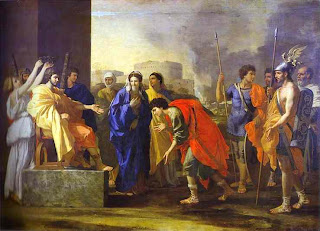
This painting of him celebrates his reunion of a captured maiden and her fiance, when under the prevailing law he had every right to take her as a war prize. Not only that, he gave back the ransom her parents had sent to buy her liberty.
For those of you not familiar with the general who defeated Hannibal, here is his biography. He was noted not only for his military excellence, but for his attention to virtue.

This painting of him celebrates his reunion of a captured maiden and her fiance, when under the prevailing law he had every right to take her as a war prize. Not only that, he gave back the ransom her parents had sent to buy her liberty.
Driving is a Grandfathered Liberty
Frank J. is a comedy writer, but I think he's really on to something here.
Imagine if cars hadn’t been around for a century, but instead were just invented today. Is there any way they’d be approved for individual use? It’s an era of bans on incandescent bulbs; if you suggested putting millions of internal-combustion engines out there....
“So you’re proposing that people speed around in tons of metal? You must mean only really smart, well-trained people?”
“No. Everyone. Even stupid people."
“Won’t millions be killed?”
“Oh, no. Not that many. Just a little more than 40,000 a year.”
“And injuries?”
“Oh . . . millions.”
There’s no way that would get approved today.
Driving is basically a grandfathered freedom from back when people cared less about pollution and danger and valued progress and liberty over safety.The next question is, how long will this grandfathered freedom last?
Ignorance is Bliss
Wired talks about a study that appears to demonstrate that ignorance is good for democracy.
Not surprisingly, when the majority of animals had a strong preference to move to one location, the group moved there. Even when the majority’s preference was equal in strength to the minority’s preference, the majority won out. However, when the strength of the minority’s preference was increased past a certain threshold, the minority could dictate the group’s behavior. These results suggest that an opinionated minority can win out over a majority with weaker convictions.
Things got more interesting when the researchers added animals without a preference to the model. Under these conditions, even when the minority’s preference was extremely strong, the presence of the “uninformed” individuals actually returned control to the majority. The more uninformed individuals there were, the stronger this effect became (up to a point; eventually noise took over).
The researchers then used an experimental approach to ask the same questions using golden shiners, a very social species of fish known for their schooling behavior. Some fish were trained to swim to a yellow target in the tank, and some were trained to move toward a blue target. Intrinsically, the fish preferred the yellow target—even after training, their preference for the yellow target was stronger than their preference for the blue target. This created an natural way to test the researchers’ theories.
The results from these lab tests mirrored the findings of the computational model. When the minority of fish in the tank were those trained to go to the yellow target (meaning they had a strong preference for the option), they won out and the group went there. When untrained fish were introduced into the tank, however, the majority regained control, even though their preference for the blue target was weaker.In this country, we seem to move toward whatever a vocal minority wants, unless there is an opposing vocal minority: then, it has been my observation, the minority usually wins that has the worse idea. Perhaps we need more ignorance to straighten things out, although I'm also increasingly thinking that we just need less social tolerance for vocal minorities.
Rabbit in the Headlights
Author Jeff Wise specializes in the human response to fear. His book "Extreme Fear" examines how many people have coped with paralyzing danger, from wild animal attacks to forest fires to aircraft emergencies. He notes that exercise helps the brain cope with anxiety; nervous parachuters on their way to a drop perform better on mental puzzles like crosswords in proportion to their physical fitness. Another trick is either to be in control, or at least to visualize oneself in control. (I learned decades ago that imagining myself behind the throttle in a commercial aircraft cut way down on the fear of flying that used to afflict me from time to time.) Staying warm is surprisingly effective, too. Scuba divers without wetsuits tend to have more panic-related mishaps.
In a recent article for Popular Mechanics, Wise tries to unravel how an Air France co-pilot over the tropical Atlantic in 2009 could have responded so disastrously to anxiety-provoking severe weather and a relatively minor icing-up incident by putting his aircraft into a completely unnecessary and deadly stall. Part of the explanation may be that most of us lose our higher brain functions under the influence of extreme fear and must fall back on rote training. Repetitive training under high stress can be a life-saver, but the Air France pilot, unfortunately, fell back on a singularly inappropriate routine.
These recommendations are nothing very startling or new, except for one: studies show that having sex cuts down measurably on the fear of public speaking. Now they tell me.
I'm not sure if the movie "Three Kings" is one I'd recommend to this audience without reservations, but one line did stick with me. George Clooney counsels a terrified young recruit by explaining: "Here's how it works. You do the thing you're scared ****less of, and you get the courage afterwards, not before."
Subscribe to:
Posts (Atom)