
Cutchogue, Long Island (North Fork)

Westhampton Farmer's market, Long Island, South Fork (below)

A leftover from San Fran (below)

Another from San Fran

...and finally...


Having been raised Presbyterian, I encountered the concept of saints fairly late -- initially just as honorifics associated with certain people who had either known Jesus directly (St. Mark, St. Luke, St. John, etc.), or people who were important thinkers about the nature of God (St. Augustine, St. Thomas Aquinas, etc).
I learned about other ways that people became saints later in boyhood, though still within the context of a church that didn't really believe in the idea of saints in Catholic terms. Still, I learned that some saints had become saints by overseeing the baptism of many people -- for example, St. Vladimir, St. Edwin of Northumbria, and St. Olaf. Others became saints by allowing themselves to become martyrs for the faith -- including the patron saints of England and Scotland. The one is St. George, about whom not very much beyond martyrdom can safely be said; the other is St. Andrew, who also qualified as an Apostle and one who was close to Jesus in his lifetime. (Most confusing of all is St. Michael, for whom the title almost seems like a demotion.)
The idea of martyrs didn't make much sense to me as a boy. I think that is unusual: I gather what normally doesn't make sense to people are the St. Olafs and St. Edwins, who achieved their sainthood by the sword. For someone raised in the Appalachian Scots-Irish tradition, that part made perfect sense. For that matter, there was no trouble about understanding -- since we were just talking about The Alamo, below -- martyrs who went down fighting. Of course those are heroes of the faith!
The idea that my boyhood self found confusing was that of martyrs who went placidly to their deaths. I think I understood that the idea was that this behavior was in emulation of Jesus himself; but (as I recall my childhood thoughts) the point of Jesus doing it was so that the rest of us didn't have to. I was under the impression that Jesus hadn't wanted us to emulate him in that particular way; and furthermore, I reasoned later in life, hadn't he told his disciples to arm themselves with swords precisely to avoid being martyred with him?
By the same token, however, Jesus' remarks when the sword is used to defend him are interesting. There are two versions, one clear and the other unclear. In Luke, the followers ask if they should strike with their swords, and one does; Jesus says, "No more of this," heals the would given, and goes off with his captors. In Matthew, Jesus rebukes the disciple who strikes directly, saying that all will die with the sword who slay with it.
The Matthew version appears to suggest that Jesus intended to license self-defense and defense of the human community from physical dangers; but not the use of the sword to protect him personally. By extension, the suggestion is that he would not approve of war for religion -- whether Crusades or conquests of the type St. Olaf led.
The Luke version is unclear; we are left as mystified as his own followers about whether to use the swords or not, in general terms. We just know that he wanted us to have them, but thought the one blow given in his defense was enough -- or was irrelevant to his purpose.
In any case, martyrs have been from the earliest days among the most beloved and venerated of saints. What was puzzling to me as a boy was natural and obvious to very many others.
The idea of having a day for celebrating all the saints. It's a good reminder that the tradition contains many people who have contributed to the faith in different ways. Some of these ways are puzzling -- martyrdom to me, sword-bearing to others -- but we have a certain debt to each of them. It is wise to reflect on that.
UPDATE: Martyrs are made today, at a church in Baghdad.
If we are speaking of virtue, bravery and Fortune, we might take a moment to remember some of our brave and virtuous men who have suffered from her ill winds. Project VALOUR-IT aims at helping them in the hard first moments, and giving them a better shot at the rest of their lives.
It isn't only their virtue that matters in facing down the winds of Fortune. It's ours too: our friendship, our sense of justice, and honor. Please consider donating if you have the means.
A talk on facing Fortuna in the modern world:
Today, conspiracy theory has gone mainstream, and many of its most vociferous promoters can be found in radical protest movements and amongst the cultural left. Increasingly, important events are viewed as the products of a cover-up, as the search for the ‘hidden hand’ manipulating a particular story comes to dominate public life. Conspiracy theory constructs worlds where everything important is manipulated behind our backs and where we simply do not know who is responsible for our predicament. In such circumstances, we have no choice but to defer to our fate.The Roman idea about Goddess Fortune is not the only one superior to mere conspiracy theory, however: the Medieval ones were also superior. The two basic answers, St. Augustine's and Boethius', are quite different. Each has something to recommend itself. Compare Boethius' account with the Book of Job, for example.
It is through conspiracy theories that Fortuna reappears – but it does so in a form that is far more degraded than in Roman times. To their credit, the Romans were able to counterpose virtus to Fortuna. In a precautionary culture, however, fortune favours the risk-averse, not the brave.
There's a piece on the anniversary of John Wayne's classic at Big Hollywood today.
The Alamo was a Grim's Hall Movie Club movie back in April 2006. If you're interested in rereading our discussion, we talked about the mythic themes that Wayne explored.
In the Iliad, these heroes are Agamemnon, Achillles, and Odysseus. In the Alamo, they are Col. Travis, Jim Bowie, and Davy Crockett.
Travis asserts his authority through military discipline, and right of command. He is willing to speak insultingly to Jim Bowie to shut down challenges to his orders ('You were drunk at the last officer's call, and I do not wish to discuss my plans until the next'). He is willing to publicly slur the credibility of friendly Mexican caballeros....
Bowie and his men (like Achilles' Myrmidons) are volunteers, and can leave when they wish. Travis needs them to hold until aid can arrive. He also needs the help of another body of volunteers who arrive under the command of another hero, Davy Crockett.
Crockett appears less of a hero to Travis than his reputation would suggest. Travis is not happy to find his Crockett and his men brawling and drinking, and he refers to Crockett's usual manner of speech as a 'bumpkin act.' Yet when he hears Crockett's speech about the Republic, he is taken aback. So it was said of Odysseus:
One might have taken him for a mere churl or simpleton; but when he raised his voice, and the words came driving from his deep chest like winter snow before the wind, then there was none to touch him.

How about a little Irish legendry appropriate to the Feast of Samhain?
Fionn decided that he was ready to become a warrior and he went to the High King Cormac Mac Art at his hall in Tara, Co. Meath and announced that he was Fionn son of Cumhail and that he had come to take his place among the Fianna and to serve Cormac. Cormac took Fionn into the Fianna although Goll Mac Morna and his brothers murmured against this particularly Goll who was now the captain of the Fianna having helped to kill Cumhail, Fionn's father.Not every encounter with the faery is reported to have gone badly. Edmund Spenser's Faerie Queene was the lady who held St. George's service and fealty; and she did well by him, the poet tells us.
It was nearing Samhain and every year for the past nine years a warrior from the Sidhe Finnachaidh of the Tuatha De Danann by the name of Aillen Mac Midhna came to Tara to cause havoc among the Fianna. He had burned the roof of Tara with his magic and had caused all the warriors to fall into a deep sleep with his Faery music.
When he heard this Fionn went before Cormac Mac Art and promised to rid him of this nuisance providing that his right of inheritance to the title of captain be honoured. Cormac swore to fulfill this request on the surety of all the tributary kings of Ireland and all his royal Druids.
The night before the warrior of the sidhe was going to appear, one of Cormac's men Fiacha Mac Conga, who had served with Fionn's father and was therefore protective towards him, came to Fionn and offered his help. He gave Fionn a magical spear which made the sound of battle when it was unsheathed and when it was laid on the forehead of the warrior who carried it he would be protected from evil magic.
So Fionn took the magical spear and went out against Aillen Mac Midhna and killed him. He struck off his head and carried it back to Tara and put it up on a pole for all to see.
When dawn broke and the High King and all his retinue awoke from their enchanted sleep, Cormac called Fionn before him and invested him with the captaincy of the Fianna in accordance with his promise.
My wife and I were walking this morning (being in Plano, it was a city walk and not a proper walk), and she commented that the sun felt good, but it wasn't warm enough to suit her. Being a lizard (some have said snake) myself, I agreed with her. Then my grasshopper mind leapt into action. "Behold," I said, "the power of 2."
"Huh?" she sneered. You might wonder about sneering that word, but if you've ever heard my wife disagree with one of my pronouncements, you'd understand.
So I explained. It's that time of year. As the sun approaches, the intensity of its light grows stronger directly with the lessening distance. But that same energy, due to the tilt of our axis, now is spread out over a larger area, according to the square of the area's radius, thereby lessening in intensity by that power.
Hop.
"My strength is as the strength of two,
Because my heart it tilted."
We spent the rest of our walk in reflective silence.
Eric Hines
It's time again. This year Carrie is the Marine Corps team leader. You can read her thoughts on the value of this project here.
I'm terrible at fundraising, and every year I warn people that I don't know how much help I could possibly be. Nevertheless, I always agree to help because the program does so much that is good, for those we as a nation owe the very most.
All of you know what Project VALOUR-IT is, and how much difference it has made to injured servicemembers. It helps them in those most difficult hours when they are separated from family, and coming to grips with the reality of their injury. 
I trust you'll do what you can.
An interesting piece expanding on what we are learning about how language informs thought.
What it means for a language to have grammatical gender is that words belonging to different genders get treated differently grammatically and words belonging to the same grammatical gender get treated the same grammatically. Languages can require speakers to change pronouns, adjective and verb endings, possessives, numerals, and so on, depending on the noun's gender. For example, to say something like "my chair was old" in Russian (moy stul bil' stariy), you'd need to make every word in the sentence agree in gender with "chair" (stul), which is masculine in Russian. So you'd use the masculine form of "my," "was," and "old." These are the same forms you'd use in speaking of a biological male, as in "my grandfather was old." If, instead of speaking of a chair, you were speaking of a bed (krovat'), which is feminine in Russian, or about your grandmother, you would use the feminine form of "my," "was," and "old."There are doubtless consequences for poetry, but it seems that this kind of thing would tend to color your impressions of the whole world. How interesting, for a native speaker of English, to imagine all the colors that we don't see.
Does treating chairs as masculine and beds as feminine in the grammar make Russian speakers think of chairs as being more like men and beds as more like women in some way? It turns out that it does. In one study, we asked German and Spanish speakers to describe objects having opposite gender assignment in those two languages. The descriptions they gave differed in a way predicted by grammatical gender. For example, when asked to describe a "key" — a word that is masculine in German and feminine in Spanish — the German speakers were more likely to use words like "hard," "heavy," "jagged," "metal," "serrated," and "useful," whereas Spanish speakers were more likely to say "golden," "intricate," "little," "lovely," "shiny," and "tiny." To describe a "bridge," which is feminine in German and masculine in Spanish, the German speakers said "beautiful," "elegant," "fragile," "peaceful," "pretty," and "slender," and the Spanish speakers said "big," "dangerous," "long," "strong," "sturdy," and "towering." This was true even though all testing was done in English, a language without grammatical gender.
Winter is coming, though it has warmed in the last few days: wet air from the Caribbean. Still, the animals know, and have begun to work harder than ever to feed up for the long slumber.
Especially the lizards. We have lots of them. The big skinks are spending their days chasing the smaller anoles, trying to eat them up.
It's a hard day's work. At the end, the survivors are downright bushed. They don't even try to get away from a man with a camera.
After all, I don't eat lizards. Not as a habit, you know.
This man has them wrong.
The Washington state man who's on a 60-day all-potato diet wishes he had set a goal of one month instead of two.We all know the proper answer to that, I assume?
Chris Voigt told the Tri-City Herald that — as good and healthy as potatoes are — there's only so many ways they can be prepared. And, about halfway through his tuber diet, which began Oct. 1, he's had them boiled, baked, steamed, grilled, fried, marinated and mashed...
"Tuesday was a rough day for me," he told the Herald "I really, really wanted a pickle."
Mixed results, in my case. The Daily Caller linked to this article, which itself was a reaction to a Ricochet article, about elitism. My results on the “How Plebe are You?” quiz:
1. Can you talk about “Mad Men?” No.
2. Can you talk about the “The Sopranos?” Sure.
3. Do you know who replaced Bob Barker on “The Price Is Right?” Not even.
4. Have you watched an Oprah show from beginning to end? No.
5. Can you hold forth animatedly about yoga? Not animatedly or in any other way.
5. How about pilates? No.
5. How about skiing? No.
6. Mountain biking? No.
7. Do you know who Jimmie Johnson is? No.
8. Does the acronym MMA mean nothing to you? Nothing at all.
9. Can you talk about books endlessly? Sure.
10. Have you ever read a “Left Behind” novel? No.
11. How about a Harlequin romance? No, but do I get partial credit for Diana Gabaldon and "Out of Africa"?
12. Do you take interesting vacations? I don't take any vacations. I like it here.
13. Do you know a great backpacking spot in the Sierra Nevada? Nope.
14. What about an exquisite B&B overlooking Boothbay Harbor? Where?
15. Would you be caught dead in an RV? We lived in ours for the better part of a year while building this place, with three big dogs, yet.
16. Would you be caught dead on a cruise ship? No (crowds).
17. Have you ever heard of of Branson, Mo.? Yes, but I wouldn't go there (crowds).
18. Have you ever attended a meeting of a Kiwanis Club? No.
19. How about the Rotary Club? No.
20. Have you lived for at least a year in a small town? Does living outside one count?
21. Have you lived for a year in an urban neighborhood in which most of your neighbors did not have college degrees? If this includes "suburban neighborhood," I'd guess some did and some didn't; the subject rarely came up.
22. Have you spent at least a year with a family income less than twice the poverty line? Not as far as I know, since school.
23. Do you have a close friend who is an evangelical Christian? Yes.
24. Have you ever visited a factory floor? Yes, but only as bankruptcy counsel.
25. Have you worked on one? No.
Yeesh. I'm afraid I may be at least partly an elitist. In my defense, I love Sarah Palin, nearly all my clothing comes from WalMart, I enjoy pork rinds, I own guns, and I'm an avid NCIS watcher. Oh, and I'm a knuckle-dragging Tea Partier. Speaking of which, who's looking forward to next Tuesday?
I suspect there should be a third category: neither elitist nor plebeian but just sort of "out of it."
 Magic Carpets
Another plug for the Bing search engine. Yesterday's home picture was an arresting shot, similar to the one here, of something right out of Lothlorien. I can't figure out how to download a high-quality version, but I can do these two links. First, a website belonging to the photographer, Louie Psihoyos (which will give you a finer-grained version of the picture on the right), and second, go to Bing, move your cursor to the little icons in the bottom right of the screen, and choose "previous image" (which will give you something similar by the same photographer).
These are not some kind of fairy habitat but a camping system known as "portaledges," developed for climbers on multi-day rock-wall ascents. I don't think the guys who market portaledges are fully tuned into the visual possibilities of their product. Their website provides admirable detail about cost and construction but misses the chance to show portaledges in all their beautiful heart-stopping context.


I've always wanted one of those romantic mosquito-netted beds that evoke colonial Africa, but I'm afraid they wouldn't last two minutes in my doggified household.


This looks like a useful hammock with a mosquito net and fly.
I have a piece at BLACKFIVE, on a not-very-impressive piece of philosophy that somehow got published by the Chronicle of Higher Education.


Venus in an instant:
A new meta-analysis study conducted by Syracuse University Professor Stephanie Ortigue reveals falling in love can elicit not only the same euphoric feeling as using cocaine, but also affects intellectual areas of the brain. Researchers also found falling in love only takes about a fifth of a second.Interesting from a perspective of what they used to call 'phenomenology.' It doesn't answer the question of whether you can know enough about the other person to truly love them, of course. This study only treats the sensory experience.
Results from Ortigue's team revealed when a person falls in love, 12 areas of the brain work in tandem to release euphoria-inducing chemicals such as dopamine, oxytocin, adrenaline and vasopression. The love feeling also affects sophisticated cognitive functions, such as mental representation, metaphors and body image.
The findings raise the question: "Does the heart fall in love, or the brain?"
"That's a tricky question always," says Ortigue. "I would say the brain, but the heart is also related because the complex concept of love is formed by both bottom-up and top-down processes from the brain to the heart and vice versa.
I'm sure you've all read the latest from Bill, but if you missed it, he's been juggling rockets again.
Keep your head down, Bill. We need you to generate clever puns in the comments.
We caught the tail end of a PBS show tonight about smart crows solving a puzzle that required them to pull up a string, extract a short stick tied to its end, use the short stick to get a longer stick from behind some bars, and use the long stick to remove a treat from the end of a tube. Unfortunately I can't find that clip on YouTube, but here's something similar in one of those great TED talks. The crows do several tricks, of which one of the best is early on. If the narrator is serious (and correct) that the crow doing that trick really figured out that trick with the wire for himself, I'm impressed.
I'm sorry I haven't posted much -- or responded to many thoughtful comments, below -- but I have been busy visiting with an old friend who stopped in.
The birds are hybrids between saker falcons and gyrfalcons. They belong to my friend, who has a business doing bird abatement in airports, vinyards and other areas that need to drive off lots of birds. These larger falcons are better choices for the work than American hawks like the Red Tail or Harris, because they hunt from the air rather than from trees. Thus, pigeons and such see them soaring, and head for other country -- so he was telling us, in any case.
Instead of productive work, that's meant a weekend of cooking steaks over an open fire, helping him sight in his rifle, and so forth. I'll try to get back to thinking seriously about things tomorrow.
Hope you've been well.
 Piano Envy
A friend who can scarcely afford it is making the plunge to buy a 9-foot Baldwin concert grand for her 14-year-old son, who's delighting her by developing into a fine pianist. My friend is an excellent musician herself (flute) who homeschools her boy and has encouraged his musical talents. They live in an extraordinary collection of tiny buildings on a couple of acres in a town of about 300 souls halfway between Houston and Austin. Only one of the buildings, which normally houses many aspects of the architectural photography business that my friend runs with her husband, is even remotely capable of housing this gorgeous instrument. It's used, but in good condition; I think the picture here that I pulled from the Net probably is a good representation. (And it's a good thing it's used, because they retail new for $89K, decidedly not in the budget. I think she's going to get it for $20K, already a crazy number.)
I hope the piano thing works out well for my friend's son, because I think she just blew the college fund. Well, they can always sell it if his passion dissipates, and there are worse marketable skills to have than the ability to play the piano at a professional level. As for the non-monetary advantage: that's incalculable. Not many kids are lucky enough to have both musical talent and a parent who's fanatically devoted to excellence in instruments.
She called her mother with the news first, only to receive a disappointing response. She knew if she called me she'd get the drooling, panting, frantically approving attitude she was looking for.
A favorite movie of mine is on Hulu:
If any of you have dodged my earlier attempts to get you to watch it, take a couple hours this weekend.
 Mustard
We started harvesting our mustard seed last year and making prepared mustard by grinding the seeds with vinegar and a bit of salt and sugar. I found an article that advised leaving it at room temperature until it reached the desired mildness, then refrigerating it. The article also warned that it would taste like toxic waste on the first day, which is true, but don't give up! -- after only a few days it tastes great. Like many members of the Brassica family, mustard is ridiculously easy to grow. After it produces a very pretty set of small yellow flowers, the seeds form in a tiny pod that's like a miniature black-eyed pea pod, only about an inch long. I laboriously zipped open the fresh pods until it finally dawned on me that once they were thoroughly dry they could be crumbled open; the chaff is then easily blown away, leaving the tiny seeds.
I don't recommend a mortar and pestle for the blending process. My ordinary blender did a good job, though it took the better part of twenty minutes to convert a cup or so of seeds to a blender-full of prepared mustard. You just keep adding vinegar until the mixture blends properly, and add bits of salt and sugar to taste. This makes an absolutely killer mustard for spreading on the outside of a ham in cooking, along with brown sugar and crumbled ginger cookies, à la Alton Brown.
Last year's crop was brown mustard, the medium kind. Mild American mustards are made with white seed. Crazy-hot Indian food is made with black mustard, which is the kind of seeds that just came in the mail, and which will go into one of our newly prepared beds this weekend, mustard being a cool-weather crop.
One of the interesting parts of our discussion below, on Hegel and love, is the question of whether you can in fact know your wife as anything more than an idea. Hegel's position is that you really can't; although that doesn't mean she isn't real. Hegel lets himself out of this trap by asserting that 'the real is rational, and the rational is real' -- and, therefore, that the more you improve the rationality of your ideas, the more it doesn't matter whether you have 'the rational idea' of your wife, or 'the real' wife. The two approach, and in the mind of God attain, identity.
The idea is that our minds (these days, internalists like to say, "our brains" or "our nervous systems") interpret reality, and therefore add a layer to it that it doesn't really have. For example, we interpret light waves in certain ranges as color.
Thus, we cannot know what the things are really like in themselves (as Kant says in his Critique of Pure Reason). We're sort of trapped in our minds.
Mr. Hines supports this idea in relation to his wife:
Even after 89 years of close marriage, we can never know the other person, we only will have learned a lot about that person. Since we cannot merge our selves, we can never completely know the other, and so we can never really know the other. And so we are left with "just" the idea of the other--our perception of who the other is.There are some good reasons to doubt this picture, even though it comes with a pedigree as exalted as Kant and Hegel. Hillary Putnam raised some of them in some thought experiments that will seem a little odd when you first encounter them, but which make the serious point that the meanings of words don't relate to our mental -- or even our brain -- states. You can explore that at your leisure, if you wish: For example, see his paper "Meaning and Reference." There are now many rational, detailed, analytic arguments against the internalist model.
This post arises out of reading Hegel's philosophy of mind, which makes a fairly extraordinary claim about the nature of passionate love. I'd like to explore it with you.
The claim begins in paragraph 448, on the mental faculty of attention. The issue of attention is that you are free to give it, or not; and therefore, if you are to have a passion, it is because you have chosen to give it your attention.
But what is the thing to which you are giving your attention? It is an idea: and, therefore, it is your idea. After all, it exists in your mind, and the thoughts you have are your own. He offers an example:
Thus we know, for example, that if anyone is able to form a clear picture to himself, say in a poem, of the feelings of joy or sorrow that are overwhelming him he rids himself of the thing that was oppressing his mind and thereby procures for himself relief or complete freedom. For although by contemplating the many aspects of his feelings he seems to increase their power over him, yet he does in fact dimnish this power by making his feelings into something confronting him, something that becomes external to him. Goethe, for instance, particularly in his Werther, brougth himself relief while subjecting the readers of this this romance to the power of feeling.The book he mentions, The Sorrows of Young Werther, sparked a wave of suicides across Europe. The title character is a suicide, killing himself over losing his love.
[P]assion is neither good nor bad; the title only states that a subject has thrown his whole soul -- his interests of intellect, talent, character, enjoyment -- on one aim and object. Nothing great has been and nothing great can be accomplished without passion. It is only a dead, too often, indeed, a hypocritical moralizing which inveighs against the form of passion as such.So to have thrown your whole soul into a vision of beauty, that is passion. To have passion for a woman is, then, not to have some physical longing alone; that belongs to mere appetites, which rank much lower on his scale of mind. Rather, what you have is a longing for an idea of what the woman would be if she were as perfect as you wish her to be.
There are doubtless many who would say that we shouldn't spend a lot of time on the American Civil War at all, it being ancient history and all that. Nevertheless, it was one of the most crucial moments in the American story, and we need to know how to think about it.
This story about the Virginia textbook shows one wrong way of handling the matter.
The author, Joy Masoff, who is not a trained historian but has written several books, said she found the information about black Confederate soldiers primarily through Internet research....Excuse me.
'You know who's dumb? That Sarah Palin. What an air head she is. Did you hear she said Tea Partiers were going to party like it was 1773? What a moron! We all know... ummmm....'

So, we've all been thinking about the problem of female politicians, right? To whit, sexist remarks appear to be highly effective against them.
Especially among women. Look at any poll you like, and you'll find that the Sarah Palins and Christine O'Donnells poll far worse among women than men. Men are willing to give them a chance, along partisan lines -- in other words, as ready to vote for them as for any other person who came along in their preferred party. Women are much less willing.
Is this related to why women prefer a male boss? (Not just in the UK.)
Now, as far as men pushing sexist attacks -- think of Candidate Obama talking about how Sen. Cliton 'periodically' -- we could resolve the problem by restoring the old codes of honor and violence. The best restraint on men's bad behavior is other men; and as gentlemen are more disciplined than other men, they will tend to win out given time and the liberty to employ their arms.
Failing that, you get boors. Since apparently boorishness is highly effective against female candidates... well, do the math.
What to do about women who won't give women an even break, though? I don't have an answer to that, being opposed to violence against women; I think you ladies may have to sort that one out on your own.
I understand that some of you may think that these female candidates aren't exactly your very best foot being put forward. Well, let me just say that I can't think of a single male politician who represents what is best about manhood. Or mankind. I'm thrilled when we can find one who represents something that is even pretty good. Most of the time we make do with one who is corrupt in a way that doesn't cause serious problems.
Far too much of the time, we can't get even that.
Give them an even break. I don't like my politicians either, men every one of them. So far, they're the best I can do.
MKH posts a video, and a retraction. I kind of liked the video.
The lady writes:
As a matter of policy, I don’t comment on my personal life in public, but I will clarify that his tirade thoroughly mischaracterizes my political views. For instance, I do not believe that laws against assault should be repealed — nor do I think there should be an exception in cases when one’s ex-boyfriend behaves unacceptably on national television, though I admit that’s a tougher question.Now that's just too bad. As longtime readers know, I've often favored just such a repeal -- at least for consensual fistfights between gentlemen, and perhaps for more serious (but equally consensual) affairs.
A good time was had by all.
Top that, Vegas girl.
(Of course the baby wasn't really drinking the whisky. I was there when they put the bottle in the chair with her, for humorous effect. She's a sweet kid, though; and she was just sacked out come Sunday afternoon.)
Socrates's problems were our own. He lived in a city-state that was for the first time working out what role true democracy should play in human society. His hometown – successful, cash-rich – was in danger of being swamped by its own vigorous quest for beautiful objects, new experiences, foreign coins....
Rather than a brainiac grey-beard, we should think of him as his contemporaries knew him: a bustling, energetic, wine-swilling, man-loving, vigorous, pug-nosed, sword-bearing war-veteran: a citizen of the world, a man of the streets.
Watson derives the German genius from deep springs. Germanness as a notion long predated an all-German state. German protestantism, high literacy, well organised universities and a Jewish citizenry devoted to German high culture all played their role. How all that ended in Hitler is one of the questions of historiography. Watson devotes many pages to German soul-searching over the Third Reich, and the "treason" of a cultured middle class in voting him in and turning against the Jews and the west.
Germany’s attempt to create a multi-cultural society has failed completely, Chancellor Angela Merkel said at the weekend, calling on the country’s immigrants to learn German and adopt Christian values.I expect to see the same thing happen in America, as we've discussed; so let's go ahead and hash it out. Is this a new sort of the "treason" of the Third Reich, where the mainstream culture is turning hard against internal elements that are non-Christian, non-"German"? Or is this is the start of a rebirth, a rekindling of the German nation that gave us Beethoven?
Merkel weighed in for the first time in a blistering debate sparked by a central bank board member saying the country was being made “more stupid” by poorly educated and unproductive Muslim migrants. …
This approach has failed, totally,” she said, adding that immigrants should integrate and adopt Germany’s culture and values.
“We feel tied to Christian values. Those who don’t accept them don’t have a place here,” said the chancellor.
So, about thirty years ago video games were still in their early stages. There was a kind of video game that as far as I know has faded almost entirely from modern efforts: and of them all, the greatest was Zork I: The Great Underground Empire. It starts outside a house, with a mailbox; inside the house there is an elvish sword, a lantern, and a trapdoor hidden beneath a rug. You can play it here.
Obviously Iowahawk was a fan.
WELCOME TO ADVENTURE! WOULD YOU LIKE INSTRUCTIONS?H/t: Dad29.
>YES
YOU ARE SOMEWHERE IN BELTWAY FOREST, WHERE SOME HAVE FOUND TREASURES OF GOLD ALTHOUGH SOME HAVE ENTERED AND NEVER BEEN SEEN AGAIN. MAGIC IS SAID TO WORK IN THE FOREST. I WILL BE YOUR EYES AND HANDS. DIRECT ME WITH SIMPLE COMMANDS.
YOU ARE IN AN OVAL OFFICE. THERE IS SNOW OUTSIDE. YOU ARE BEHIND A DESK. ON DESK THERE IS A BUST OF CHURCHILL.
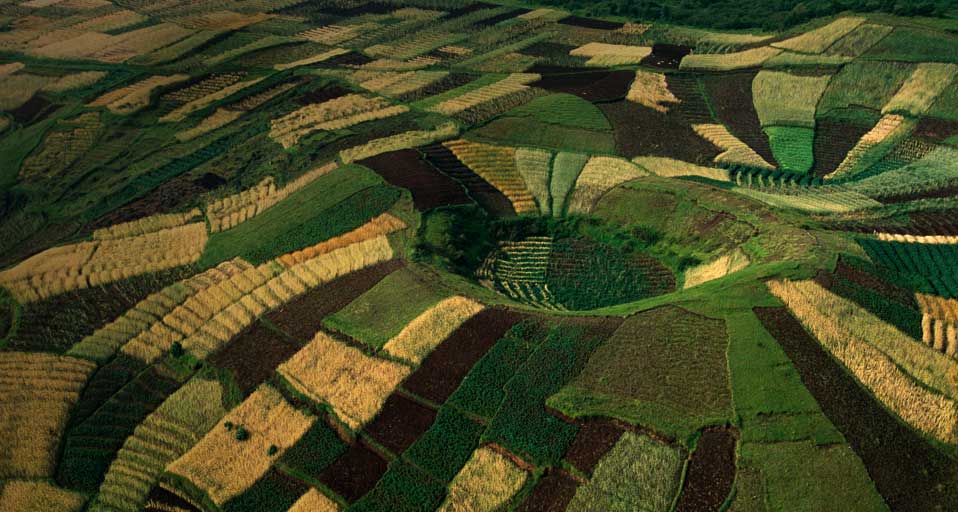 Life Among the Volcanoes
I like to use Bing's search engine as my default page, so every morning I'm greeted with a new interesting image. This morning's is a beautiful patchwork of crops planted over a dormant volcano field in or near the Virunga Mountains in Rwanda, just west of Lake Victoria. Near my home in the Coastal Bend of Texas, you mostly see cotton and sorghum in flat fields that reach to the horizon. Rwanda's fields are more interesting. I don't know what these crops are, but typical crops for the region might be coffee, tea, beans, sorghum, bananas, and pyrethrum-producing daisies. Rwanda is slowly recovering from the paroxysm of murderous hatred that engulfed it in the mid-90s and nearly destroyed the export agriculture and tourism business on which nearly its entire economy depends.
The little icons in the bottom right of each day's Bing picture give you background information and the option to scroll back through the last week's images. There are also little pop-up squares here and there in each image with links to related information.

