A Propos Absolutely Nothing

My wife and I were walking this morning (being in Plano, it was a city walk and not a proper walk), and she commented that the sun felt good, but it wasn't warm enough to suit her. Being a lizard (some have said snake) myself, I agreed with her. Then my grasshopper mind leapt into action. "Behold," I said, "the power of 2."

"Huh?" she sneered. You might wonder about sneering that word, but if you've ever heard my wife disagree with one of my pronouncements, you'd understand.

So I explained. It's that time of year. As the sun approaches, the intensity of its light grows stronger directly with the lessening distance. But that same energy, due to the tilt of our axis, now is spread out over a larger area, according to the square of the area's radius, thereby lessening in intensity by that power.

Hop.

"My strength is as the strength of two,

Because my heart it tilted."

We spent the rest of our walk in reflective silence.

Eric Hines

A Relic

A Relic of A Bygone Era:


By the way, who's playing that game this year?

Project VALOUR-IT

Project VALOUR-IT Annual Fundraiser:

It's time again. This year Carrie is the Marine Corps team leader. You can read her thoughts on the value of this project here.

I'm terrible at fundraising, and every year I warn people that I don't know how much help I could possibly be. Nevertheless, I always agree to help because the program does so much that is good, for those we as a nation owe the very most.

All of you know what Project VALOUR-IT is, and how much difference it has made to injured servicemembers. It helps them in those most difficult hours when they are separated from family, and coming to grips with the reality of their injury.

learn more

I trust you'll do what you can.

More on Language

More on Language and the Mind:

An interesting piece expanding on what we are learning about how language informs thought.

What it means for a language to have grammatical gender is that words belonging to different genders get treated differently grammatically and words belonging to the same grammatical gender get treated the same grammatically. Languages can require speakers to change pronouns, adjective and verb endings, possessives, numerals, and so on, depending on the noun's gender. For example, to say something like "my chair was old" in Russian (moy stul bil' stariy), you'd need to make every word in the sentence agree in gender with "chair" (stul), which is masculine in Russian. So you'd use the masculine form of "my," "was," and "old." These are the same forms you'd use in speaking of a biological male, as in "my grandfather was old." If, instead of speaking of a chair, you were speaking of a bed (krovat'), which is feminine in Russian, or about your grandmother, you would use the feminine form of "my," "was," and "old."

Does treating chairs as masculine and beds as feminine in the grammar make Russian speakers think of chairs as being more like men and beds as more like women in some way? It turns out that it does. In one study, we asked German and Spanish speakers to describe objects having opposite gender assignment in those two languages. The descriptions they gave differed in a way predicted by grammatical gender. For example, when asked to describe a "key" — a word that is masculine in German and feminine in Spanish — the German speakers were more likely to use words like "hard," "heavy," "jagged," "metal," "serrated," and "useful," whereas Spanish speakers were more likely to say "golden," "intricate," "little," "lovely," "shiny," and "tiny." To describe a "bridge," which is feminine in German and masculine in Spanish, the German speakers said "beautiful," "elegant," "fragile," "peaceful," "pretty," and "slender," and the Spanish speakers said "big," "dangerous," "long," "strong," "sturdy," and "towering." This was true even though all testing was done in English, a language without grammatical gender.
There are doubtless consequences for poetry, but it seems that this kind of thing would tend to color your impressions of the whole world. How interesting, for a native speaker of English, to imagine all the colors that we don't see.

Unacceptable

Conduct Not Befitting a Gentleman:

Or, even, any man worthy of the name.

Lizard sleeps

The Lizard Sleeps Tonight:

Winter is coming, though it has warmed in the last few days: wet air from the Caribbean. Still, the animals know, and have begun to work harder than ever to feed up for the long slumber.

Especially the lizards. We have lots of them. The big skinks are spending their days chasing the smaller anoles, trying to eat them up.

It's a hard day's work. At the end, the survivors are downright bushed. They don't even try to get away from a man with a camera.


After all, I don't eat lizards. Not as a habit, you know.

Priorities

Priorities:

This man has them wrong.

The Washington state man who's on a 60-day all-potato diet wishes he had set a goal of one month instead of two.

Chris Voigt told the Tri-City Herald that — as good and healthy as potatoes are — there's only so many ways they can be prepared. And, about halfway through his tuber diet, which began Oct. 1, he's had them boiled, baked, steamed, grilled, fried, marinated and mashed...

"Tuesday was a rough day for me," he told the Herald "I really, really wanted a pickle."
We all know the proper answer to that, I assume?


The underlying tune to that, by the way, is the same as the theme to Sesame Street. It's even clearer in this version.

How Plebe Are You?

How Plebe Are You?

Mixed results, in my case. The Daily Caller linked to this article, which itself was a reaction to a Ricochet article, about elitism. My results on the “How Plebe are You?” quiz:

1. Can you talk about “Mad Men?” No.

2. Can you talk about the “The Sopranos?” Sure.

3. Do you know who replaced Bob Barker on “The Price Is Right?” Not even.

4. Have you watched an Oprah show from beginning to end? No.

5. Can you hold forth animatedly about yoga? Not animatedly or in any other way.

5. How about pilates? No.

5. How about skiing? No.

6. Mountain biking? No.

7. Do you know who Jimmie Johnson is? No.

8. Does the acronym MMA mean nothing to you? Nothing at all.

9. Can you talk about books endlessly? Sure.

10. Have you ever read a “Left Behind” novel? No.

11. How about a Harlequin romance? No, but do I get partial credit for Diana Gabaldon and "Out of Africa"?

12. Do you take interesting vacations? I don't take any vacations. I like it here.

13. Do you know a great backpacking spot in the Sierra Nevada? Nope.

14. What about an exquisite B&B overlooking Boothbay Harbor? Where?

15. Would you be caught dead in an RV? We lived in ours for the better part of a year while building this place, with three big dogs, yet.

16. Would you be caught dead on a cruise ship? No (crowds).

17. Have you ever heard of of Branson, Mo.? Yes, but I wouldn't go there (crowds).

18. Have you ever attended a meeting of a Kiwanis Club? No.

19. How about the Rotary Club? No.

20. Have you lived for at least a year in a small town? Does living outside one count?

21. Have you lived for a year in an urban neighborhood in which most of your neighbors did not have college degrees? If this includes "suburban neighborhood," I'd guess some did and some didn't; the subject rarely came up.

22. Have you spent at least a year with a family income less than twice the poverty line? Not as far as I know, since school.

23. Do you have a close friend who is an evangelical Christian? Yes.

24. Have you ever visited a factory floor? Yes, but only as bankruptcy counsel.

25. Have you worked on one? No.

Yeesh. I'm afraid I may be at least partly an elitist. In my defense, I love Sarah Palin, nearly all my clothing comes from WalMart, I enjoy pork rinds, I own guns, and I'm an avid NCIS watcher. Oh, and I'm a knuckle-dragging Tea Partier. Speaking of which, who's looking forward to next Tuesday?

I suspect there should be a third category: neither elitist nor plebeian but just sort of "out of it."

Magic Carpets

Magic Carpets

Another plug for the Bing search engine. Yesterday's home picture was an arresting shot, similar to the one here, of something right out of Lothlorien. I can't figure out how to download a high-quality version, but I can do these two links. First, a website belonging to the photographer, Louie Psihoyos (which will give you a finer-grained version of the picture on the right), and second, go to Bing, move your cursor to the little icons in the bottom right of the screen, and choose "previous image" (which will give you something similar by the same photographer).

These are not some kind of fairy habitat but a camping system known as "portaledges," developed for climbers on multi-day rock-wall ascents. I don't think the guys who market portaledges are fully tuned into the visual possibilities of their product. Their website provides admirable detail about cost and construction but misses the chance to show portaledges in all their beautiful heart-stopping context.


I've always wanted one of those romantic mosquito-netted beds that evoke colonial Africa, but I'm afraid they wouldn't last two minutes in my doggified household.


This looks like a useful hammock with a mosquito net and fly.

War & Conservatives

War & Conservatives:

I have a piece at BLACKFIVE, on a not-very-impressive piece of philosophy that somehow got published by the Chronicle of Higher Education.

American Brass Quintet 50th Anniversary Performance

Speaking of music, I had the pleasure of attending this most wonderful event. The husband of a good friend is one of the performers. I've never heard an exclusively brass performance. I tend to love the strings or a full orchestra but this was amazing. I particularly was taken with the Gabrieli piece that culminated the event. Wow! It was an orchestra of brass instruments, broken into five groups of five, all with one of the professionals from the American Brass Quintet accompanying four Julliard School student performers. What a truly special evening.

Of course I thought of all of you, especially when the Three Fantasias in Church Modes started. It was lovely.

My friend met her husband later in life, after they were each already divorced and had children from previous marriage. Her son, a horn player himself, bought her a private lesson from one of the horn players in this quintet, because he's kind of a big deal (they both play French horn). And voila! Both of them: hook, line, and sinker.

She plays in the best amateur orchestra in New York City, the Park Avenue Orchestra, which has four performances in their season that cost $20 a piece, and they take place in an old church! That's a nice New York moment.


New York Premiere for Fixated Nights:

New York Premiere for Chants and Flourishes. I happened to be standing in line for drinks at intermission wtih this composer. Together we lamented the lack of adequate student help behind the bar!


The last piece, Gabrieli, was just tremendous!

A Knight's Tale

A Knight's Tale:

Venus in an instant:

A new meta-analysis study conducted by Syracuse University Professor Stephanie Ortigue reveals falling in love can elicit not only the same euphoric feeling as using cocaine, but also affects intellectual areas of the brain. Researchers also found falling in love only takes about a fifth of a second.

Results from Ortigue's team revealed when a person falls in love, 12 areas of the brain work in tandem to release euphoria-inducing chemicals such as dopamine, oxytocin, adrenaline and vasopression. The love feeling also affects sophisticated cognitive functions, such as mental representation, metaphors and body image.
The findings raise the question: "Does the heart fall in love, or the brain?"
"That's a tricky question always," says Ortigue. "I would say the brain
, but the heart is also related because the complex concept of love is formed by both bottom-up and top-down processes from the brain to the heart and vice versa.
Interesting from a perspective of what they used to call 'phenomenology.' It doesn't answer the question of whether you can know enough about the other person to truly love them, of course. This study only treats the sensory experience.

Playing Catch

Playing Catch:

I'm sure you've all read the latest from Bill, but if you missed it, he's been juggling rockets again.

Keep your head down, Bill. We need you to generate clever puns in the comments.

The Birds

The Birds

We caught the tail end of a PBS show tonight about smart crows solving a puzzle that required them to pull up a string, extract a short stick tied to its end, use the short stick to get a longer stick from behind some bars, and use the long stick to remove a treat from the end of a tube. Unfortunately I can't find that clip on YouTube, but here's something similar in one of those great TED talks. The crows do several tricks, of which one of the best is early on. If the narrator is serious (and correct) that the crow doing that trick really figured out that trick with the wire for himself, I'm impressed.


Smart critters. They readily teach their tricks to other crows, which means they have something like a transmissible culture, as humans do.

Weekend

A Slow Weekend:

I'm sorry I haven't posted much -- or responded to many thoughtful comments, below -- but I have been busy visiting with an old friend who stopped in.


The birds are hybrids between saker falcons and gyrfalcons. They belong to my friend, who has a business doing bird abatement in airports, vinyards and other areas that need to drive off lots of birds. These larger falcons are better choices for the work than American hawks like the Red Tail or Harris, because they hunt from the air rather than from trees. Thus, pigeons and such see them soaring, and head for other country -- so he was telling us, in any case.

Instead of productive work, that's meant a weekend of cooking steaks over an open fire, helping him sight in his rifle, and so forth. I'll try to get back to thinking seriously about things tomorrow.

Hope you've been well.

Piano Envy

Piano Envy

A friend who can scarcely afford it is making the plunge to buy a 9-foot Baldwin concert grand for her 14-year-old son, who's delighting her by developing into a fine pianist. My friend is an excellent musician herself (flute) who homeschools her boy and has encouraged his musical talents. They live in an extraordinary collection of tiny buildings on a couple of acres in a town of about 300 souls halfway between Houston and Austin. Only one of the buildings, which normally houses many aspects of the architectural photography business that my friend runs with her husband, is even remotely capable of housing this gorgeous instrument. It's used, but in good condition; I think the picture here that I pulled from the Net probably is a good representation. (And it's a good thing it's used, because they retail new for $89K, decidedly not in the budget. I think she's going to get it for $20K, already a crazy number.)

I hope the piano thing works out well for my friend's son, because I think she just blew the college fund. Well, they can always sell it if his passion dissipates, and there are worse marketable skills to have than the ability to play the piano at a professional level. As for the non-monetary advantage: that's incalculable. Not many kids are lucky enough to have both musical talent and a parent who's fanatically devoted to excellence in instruments.

She called her mother with the news first, only to receive a disappointing response. She knew if she called me she'd get the drooling, panting, frantically approving attitude she was looking for.

Angel

Angel & The Badman

A favorite movie of mine is on Hulu:


If any of you have dodged my earlier attempts to get you to watch it, take a couple hours this weekend.

Mustard

Mustard

We started harvesting our mustard seed last year and making prepared mustard by grinding the seeds with vinegar and a bit of salt and sugar. I found an article that advised leaving it at room temperature until it reached the desired mildness, then refrigerating it. The article also warned that it would taste like toxic waste on the first day, which is true, but don't give up! -- after only a few days it tastes great.

Like many members of the Brassica family, mustard is ridiculously easy to grow. After it produces a very pretty set of small yellow flowers, the seeds form in a tiny pod that's like a miniature black-eyed pea pod, only about an inch long. I laboriously zipped open the fresh pods until it finally dawned on me that once they were thoroughly dry they could be crumbled open; the chaff is then easily blown away, leaving the tiny seeds.

I don't recommend a mortar and pestle for the blending process. My ordinary blender did a good job, though it took the better part of twenty minutes to convert a cup or so of seeds to a blender-full of prepared mustard. You just keep adding vinegar until the mixture blends properly, and add bits of salt and sugar to taste. This makes an absolutely killer mustard for spreading on the outside of a ham in cooking, along with brown sugar and crumbled ginger cookies, à la Alton Brown.

Last year's crop was brown mustard, the medium kind. Mild American mustards are made with white seed. Crazy-hot Indian food is made with black mustard, which is the kind of seeds that just came in the mail, and which will go into one of our newly prepared beds this weekend, mustard being a cool-weather crop.

The Peons Get Uppity

The Peons Get Uppity

Last night there was a debate between candidates for Congress from the Illinois 8th District. The moderator was asked if the event would start with the Pledge of Allegiance. "No," she answered briefly. The audience began to murmur, which prompted her to begin a lecture about the lack of precedent. The audience simply leapt to its feet and recited the pledge, probably in less time than she was going to spend arguing about it:


The moderator was displeased. “I hope that will be the last time I am disrespected,” she said.

Mmmmm, probably not.

Internalism and Externalism

Internalism and Externalism:

One of the interesting parts of our discussion below, on Hegel and love, is the question of whether you can in fact know your wife as anything more than an idea. Hegel's position is that you really can't; although that doesn't mean she isn't real. Hegel lets himself out of this trap by asserting that 'the real is rational, and the rational is real' -- and, therefore, that the more you improve the rationality of your ideas, the more it doesn't matter whether you have 'the rational idea' of your wife, or 'the real' wife. The two approach, and in the mind of God attain, identity.

The idea is that our minds (these days, internalists like to say, "our brains" or "our nervous systems") interpret reality, and therefore add a layer to it that it doesn't really have. For example, we interpret light waves in certain ranges as color.

Thus, we cannot know what the things are really like in themselves (as Kant says in his Critique of Pure Reason). We're sort of trapped in our minds.

Mr. Hines supports this idea in relation to his wife:

Even after 89 years of close marriage, we can never know the other person, we only will have learned a lot about that person. Since we cannot merge our selves, we can never completely know the other, and so we can never really know the other. And so we are left with "just" the idea of the other--our perception of who the other is.
There are some good reasons to doubt this picture, even though it comes with a pedigree as exalted as Kant and Hegel. Hillary Putnam raised some of them in some thought experiments that will seem a little odd when you first encounter them, but which make the serious point that the meanings of words don't relate to our mental -- or even our brain -- states. You can explore that at your leisure, if you wish: For example, see his paper "Meaning and Reference." There are now many rational, detailed, analytic arguments against the internalist model.

I don't propose to make another one here, though I'll be glad to discuss Putnam's (or another) with you if you like. The idea of being 'trapped in the head' and never being epistemically certain of what is around you strikes me as a kind of nonsense. So too the concept that we know things only as ideas. There's a way of knowing what a horse is as an idea: you can read about horses, study their makeup and their structure, learn about the diseases that afflict them, read about their gaits, and so forth. That's an intellectual knowledge, an improving of your rational understanding of the idea of a horse.

You can also go out on a misty morning, with a rope in your hand, walk up to a black horse and set your hand on its nostrils. I did that this morning when the neighbor's beasts broke down their fence again, and had migrated down the road toward my place.

Once you put a rope on a horse, you can do many things with it. You can train it to the saddle. You can sit in the saddle, and feel it move beneath you. You can learn how it thinks, and experience the mind of a prey animal firsthand by how it moves and starts underneath you. You will realize -- not think, but know -- that other kind of mind.

You can know when it trusts you, and then you can see as a new world opens for the horse as well as for you: the two of you can do things that neither of you could have done alone. Just as you know its mind, it comes to know yours, and loses some of the fear that lies in its own nature.

You can then ride together, wherever you wish.

That's not my idea of the horse interacting with the horse's idea of me. It's me, and the horse, together. We know each other. The experience does not suggest atomic intelligences that can only know each other as ideas. It suggests living beings that have a certain capacity to merge, at the level of soul.

Hegel II

Hegel, II:

Be sure to read Cassandra's response to our thread below.

Confer

Confer:

How to Love a Woman

Hegel on How To Love a Woman:

This post arises out of reading Hegel's philosophy of mind, which makes a fairly extraordinary claim about the nature of passionate love. I'd like to explore it with you.

The claim begins in paragraph 448, on the mental faculty of attention. The issue of attention is that you are free to give it, or not; and therefore, if you are to have a passion, it is because you have chosen to give it your attention.

But what is the thing to which you are giving your attention? It is an idea: and, therefore, it is your idea. After all, it exists in your mind, and the thoughts you have are your own. He offers an example:

Thus we know, for example, that if anyone is able to form a clear picture to himself, say in a poem, of the feelings of joy or sorrow that are overwhelming him he rids himself of the thing that was oppressing his mind and thereby procures for himself relief or complete freedom. For although by contemplating the many aspects of his feelings he seems to increase their power over him, yet he does in fact dimnish this power by making his feelings into something confronting him, something that becomes external to him. Goethe, for instance, particularly in his Werther, brougth himself relief while subjecting the readers of this this romance to the power of feeling.
The book he mentions, The Sorrows of Young Werther, sparked a wave of suicides across Europe. The title character is a suicide, killing himself over losing his love.

Why was his love worth dying over, though? She was an idea -- that is to say, she was not just a girl, with all the problems any individual girl might have. She was an ideal girl: it was his mind which had made her an ideal that was worth dying over.

We remember here our discussion around Chaucer's A Knight's Tale, and the objection raised by female readers that the young knights didn't know -- and therefore could not love -- the lady at all. Hegel seems entirely subject to that line of attack.

But now consider his further remarks on passion.
[P]assion is neither good nor bad; the title only states that a subject has thrown his whole soul -- his interests of intellect, talent, character, enjoyment -- on one aim and object. Nothing great has been and nothing great can be accomplished without passion. It is only a dead, too often, indeed, a hypocritical moralizing which inveighs against the form of passion as such.
So to have thrown your whole soul into a vision of beauty, that is passion. To have passion for a woman is, then, not to have some physical longing alone; that belongs to mere appetites, which rank much lower on his scale of mind. Rather, what you have is a longing for an idea of what the woman would be if she were as perfect as you wish her to be.

Well, and she is not; so is this not a lie? And are you not betraying her, if you will not take her as she is rather than demanding some perfection no one can possess?

Here I am reminded of Cassandra's wise words, directed towards men: that biology is not an adequate excuse for bad behavior. It is not what you are that makes you worthy of love, but what you could be; and the fact of trying to be that better thing.

Or we may turn to the Christian admonition to love the sinner, and hate the sin: this is nothing more than to love the idealized vision of the person, separated from their (actual) sin. You are asked to love them not as they are, but as they should be.

Now I wonder if Hegel isn't on to something. I hate to ascribe anything good to German Idealism: but let's talk it over, and see if there isn't something here.

Can't wait till this shows up on netflix. Heh.


Getting the Civil War right

Getting the Civil War Right:

There are doubtless many who would say that we shouldn't spend a lot of time on the American Civil War at all, it being ancient history and all that. Nevertheless, it was one of the most crucial moments in the American story, and we need to know how to think about it.

This story about the Virginia textbook shows one wrong way of handling the matter.

The author, Joy Masoff, who is not a trained historian but has written several books, said she found the information about black Confederate soldiers primarily through Internet research....
Excuse me.

[Bangs head on wall for a few minutes.]

WHY do we have people who are not trained historians writing history textbooks? Is there some shortage of people with degrees in history? The last I heard there was such a glut of Ph.D.'s in history that few could find jobs.

OK. So, one bad approach: quoting Wikipedia and the Sons of Confederate Veterans' website, uncited, in a textbook.

The inclusion of alternative claims is not bad, if they are properly sourced and the controversy around them is explained. The Civil War remains highly controversial in terms of our understanding of it, even among professional historians -- a fact the article plays down to an unhappy degree. There is not general agreement about any of the basic questions of the war. There are probably more books written about it than any other topic in American history.

We went down to Stone Mountain for the Highland Games this weekend, as recently mentioned. I had occasion to point out the relief sculpture on the mountain to a child. I told him the three riders were important men from the war's history, Confederate generals. Could he guess which ones?

"Fredrick Douglass?" he guessed. On examination, this proved to be the only name he knew to be associated with the war.

There are two further errors in that approach: not teaching the controversies, yes, but apparently not even teaching the allegedly 'settled' history. All that the schools appear to convey is the politically correct narrative.

That's not to say that children shouldn't learn about Frederick Douglass, who was a wise and interesting man -- Eric was citing him in an email he sent me just the other day. Absolutely they should know who he was, and what he had to say. I just want them to know a little more, too.

Illustrations

An Illustration:

'You know who's dumb? That Sarah Palin. What an air head she is. Did you hear she said Tea Partiers were going to party like it was 1773? What a moron! We all know... ummmm....'

Avalon:

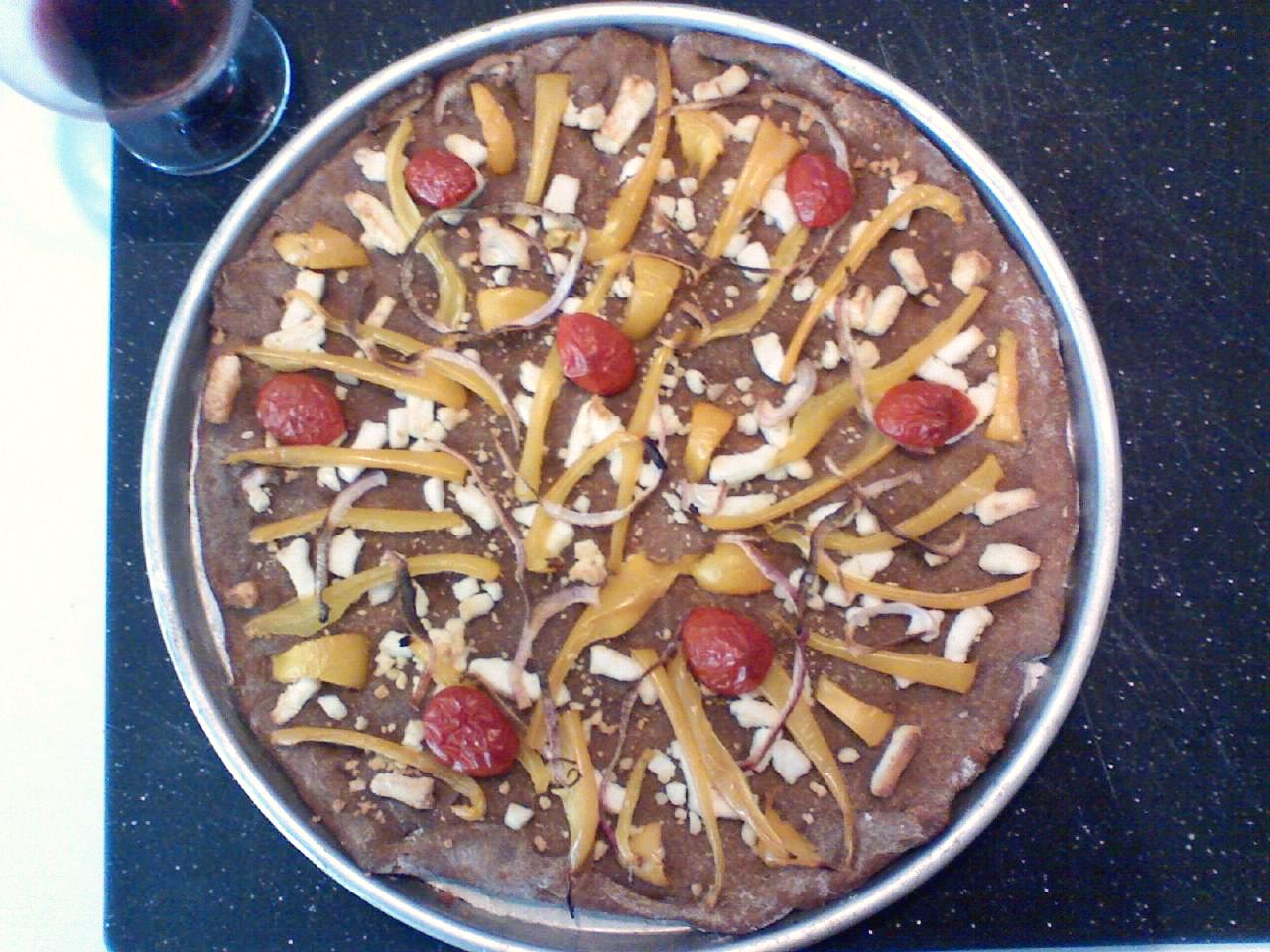
Pizza Pizza

Scuze me while I interject women's work.


I highly recommend a pizza stone. Makes a much better homemade pizza than a regular pan. This particular recipe (above) called for feta cheese, goat cheese and yellow peppers (doesn't sound like much but the two cheeses work well together). I added some thinly sliced red onion and halved cherry tomatos, but not the section belonging to a certain fifteen year-old.

Below is the whole wheat version, which met its end on a regular pan.  Even though the pan was floured, it came out like a cookie that wasn't worth scraping off.


A Related Problem

A Related Problem:

So, we've all been thinking about the problem of female politicians, right? To whit, sexist remarks appear to be highly effective against them.

Especially among women. Look at any poll you like, and you'll find that the Sarah Palins and Christine O'Donnells poll far worse among women than men. Men are willing to give them a chance, along partisan lines -- in other words, as ready to vote for them as for any other person who came along in their preferred party. Women are much less willing.

Is this related to why women prefer a male boss? (Not just in the UK.)

Now, as far as men pushing sexist attacks -- think of Candidate Obama talking about how Sen. Cliton 'periodically' -- we could resolve the problem by restoring the old codes of honor and violence. The best restraint on men's bad behavior is other men; and as gentlemen are more disciplined than other men, they will tend to win out given time and the liberty to employ their arms.

Failing that, you get boors. Since apparently boorishness is highly effective against female candidates... well, do the math.

What to do about women who won't give women an even break, though? I don't have an answer to that, being opposed to violence against women; I think you ladies may have to sort that one out on your own.

I understand that some of you may think that these female candidates aren't exactly your very best foot being put forward. Well, let me just say that I can't think of a single male politician who represents what is best about manhood. Or mankind. I'm thrilled when we can find one who represents something that is even pretty good. Most of the time we make do with one who is corrupt in a way that doesn't cause serious problems.

Far too much of the time, we can't get even that.

Give them an even break. I don't like my politicians either, men every one of them. So far, they're the best I can do.

Half a Hooah

Half a Hooah, Lady:

MKH posts a video, and a retraction. I kind of liked the video.


The lady writes:

As a matter of policy, I don’t comment on my personal life in public, but I will clarify that his tirade thoroughly mischaracterizes my political views. For instance, I do not believe that laws against assault should be repealed — nor do I think there should be an exception in cases when one’s ex-boyfriend behaves unacceptably on national television, though I admit that’s a tougher question.
Now that's just too bad. As longtime readers know, I've often favored just such a repeal -- at least for consensual fistfights between gentlemen, and perhaps for more serious (but equally consensual) affairs.

And maybe even when it's not entirely consensual, in cases where it's genuinely deserved.

SMHG

The Stone Mountain Scottish Highland Games:

A good time was had by all.


Top that, Vegas girl.

(Of course the baby wasn't really drinking the whisky. I was there when they put the bottle in the chair with her, for humorous effect. She's a sweet kid, though; and she was just sacked out come Sunday afternoon.)

Socrates:

A book review:

Socrates's problems were our own. He lived in a city-state that was for the first time working out what role true democracy should play in human society. His hometown – successful, cash-rich – was in danger of being swamped by its own vigorous quest for beautiful objects, new experiences, foreign coins....

Rather than a brainiac grey-beard, we should think of him as his contemporaries knew him: a bustling, energetic, wine-swilling, man-loving, vigorous, pug-nosed, sword-bearing war-veteran: a citizen of the world, a man of the streets.

2 AL D

Treason, or Renaissance?

On Germany:

Watson derives the German genius from deep springs. Germanness as a notion long predated an all-German state. German protestantism, high literacy, well organised universities and a Jewish citizenry devoted to German high culture all played their role. How all that ended in Hitler is one of the questions of historiography. Watson devotes many pages to German soul-searching over the Third Reich, and the "treason" of a cultured middle class in voting him in and turning against the Jews and the west.

Confer
:
Germany’s attempt to create a multi-cultural society has failed completely, Chancellor Angela Merkel said at the weekend, calling on the country’s immigrants to learn German and adopt Christian values.

Merkel weighed in for the first time in a blistering debate sparked by a central bank board member saying the country was being made “more stupid” by poorly educated and unproductive Muslim migrants. …

This approach has failed, totally,” she said, adding that immigrants should integrate and adopt Germany’s culture and values.

“We feel tied to Christian values. Those who don’t accept them don’t have a place here,” said the chancellor.
I expect to see the same thing happen in America, as we've discussed; so let's go ahead and hash it out. Is this a new sort of the "treason" of the Third Reich, where the mainstream culture is turning hard against internal elements that are non-Christian, non-"German"? Or is this is the start of a rebirth, a rekindling of the German nation that gave us Beethoven?

I expect we largely agree about the answer, but I'm interested in proofs. So: Why? Can you prove it?

The Orcs of Zork

The Orcs of Zork:

So, about thirty years ago video games were still in their early stages. There was a kind of video game that as far as I know has faded almost entirely from modern efforts: and of them all, the greatest was Zork I: The Great Underground Empire. It starts outside a house, with a mailbox; inside the house there is an elvish sword, a lantern, and a trapdoor hidden beneath a rug. You can play it here.

Obviously Iowahawk was a fan.

WELCOME TO ADVENTURE! WOULD YOU LIKE INSTRUCTIONS?

>YES

YOU ARE SOMEWHERE IN BELTWAY FOREST, WHERE SOME HAVE FOUND TREASURES OF GOLD ALTHOUGH SOME HAVE ENTERED AND NEVER BEEN SEEN AGAIN. MAGIC IS SAID TO WORK IN THE FOREST. I WILL BE YOUR EYES AND HANDS. DIRECT ME WITH SIMPLE COMMANDS.

YOU ARE IN AN OVAL OFFICE. THERE IS SNOW OUTSIDE. YOU ARE BEHIND A DESK. ON DESK THERE IS A BUST OF CHURCHILL.
H/t: Dad29.

Life Among the Volcanoes

Life Among the Volcanoes

I like to use Bing's search engine as my default page, so every morning I'm greeted with a new interesting image. This morning's is a beautiful patchwork of crops planted over a dormant volcano field in or near the Virunga Mountains in Rwanda, just west of Lake Victoria. Near my home in the Coastal Bend of Texas, you mostly see cotton and sorghum in flat fields that reach to the horizon. Rwanda's fields are more interesting. I don't know what these crops are, but typical crops for the region might be coffee, tea, beans, sorghum, bananas, and pyrethrum-producing daisies. Rwanda is slowly recovering from the paroxysm of murderous hatred that engulfed it in the mid-90s and nearly destroyed the export agriculture and tourism business on which nearly its entire economy depends.

The little icons in the bottom right of each day's Bing picture give you background information and the option to scroll back through the last week's images. There are also little pop-up squares here and there in each image with links to related information.

Freedom

Freedom:

As gas prices remain unstable, it's nice to have an option besides a big truck. So, I decided to take Major Leggett's longstanding advice and buy a motorcycle. This one was for sale locally, at a very reasonable price.


It even has a security system.


Thanks to Mr. Wolf of BLACKFIVE, who was very helpful as always.

$1 Billion Doesn't Buy As Much House As It Used To

Maybe I have unrealistic expectations, but for a billion bucks I'd want more than 27 stories, three helipads with air-traffic control office, a six-floor parking garage, a ballroom, a 50-seat cinema, rooftop gardens, three floors of hanging gardens, a health spa, a dance studio, swimming pools, lounges, a vehicle maintenance area, and guest rooms. I think that budget would also entitle me at least to a state-of-the-art operating theater complete with MRI, a 20,000-sq.-ft. Roman bath with mosaic murals done in gold and lapis lazuli, a monorail, and a small nuclear reactor.

It turns out the house didn't cost a billion dollars to build, only about $77 million (real estate inflation in Mombai, where land goes for $10,000/sq. meter, accounts for the rest), which I guess explains why they had to do without some amenities.

The home's tycoon builder is just my age. Hey, when did I fall off the fast track?

Calico Jack

Calico Jack:

Probably many of you have not heard of "Calico Jack" Rackham, a pirate famous mostly because of his crew. Specifically, he is famous for having the two most famous female pirates in history aboard his ship when it was captured: Anne Bonny and Mary Read. (Both women were excluded from the general death sentence for piracy on account of being pregnant. Calico Jack himself was not so excused.)

That's his flag on the truck at 0:07 and 3:05.


They don't know it. In a way, though, I have to think that his spirit would be pleased.

Ants

What Do You Know About Ants?

It's probably wrong.

The interesting question, though, is why it's wrong.

Quasi

"Quasi"

I've long been sanguine about China's rise; but it's a matter that needs watching and some management from us, as there is a potential for disruption. The two chief dangers are internal pride leading to unnecessary conflicts; and, on the other side, a demographic collapse resulting from the One Child policy that may lead to internal instability.

This story is about the second problem.

In a speech to the Chinese Communist Party (CCP) politburo on the eve of the October 1 National Day, Hu urged party cadres to "boost [society's] harmonious factors to the maximum degree" through implementing policies that "match the wishes of the people, that take care of the people's worries, and that can win over the hearts of the people".
That doesn't sound so bad, right? Except...
To fully understand the import of Hu's message, it is instructive to compare the background of Mao Zedong's 1957 landmark address - "On the correct handling of contradictions among the people" - and the situation unraveling today.

The late chairman's speech on fomenting unity among the nation's disparate sectors was made in the wake of the Hungarian Incident of 1956, an early climax of Eastern Europe's rebellion against the communist yoke.

In China too, intellectuals were beginning to have misgivings about the dictatorial rule of Mao and his comrades. By and large, Mao proposed reconciliatory measures to iron out differences among social groupings. He indicated that while there were signs of disaffection with the authorities, these were "contradictions among the people" because even oppositionists shared "the fundamental identity of [all] the people's interests". He recommended that the CCP "use the democratic method of persuasion and education" to woo the disgruntled elements.

Hu is invoking Mao's authority at a special juncture in his career - and in the country's development.
There's a little bit of the mailed fist in the velvet glove. 'Just like Mao, I'd like to propose that we put aside our differences and get along. Just. Like. Mao.'

Gnashing

And There Shall Be Wailing and Gnashing of Teeth:

Here's a story that is going to produce some upset in the hearts and stomachs of many a liberal blogger. How can it be?

As to which, let me assure you that the Republicans really aren't very much captured by us extremists. Yet.

When they are, you'll know it: they'll be carefully following the Constitution.

Swords and Idiots in Prague:

It is a well known fact that more people are killed by their mouths than anything other single object.

Bogus Bank, Member F.D.I.C.

Did you think it was bad enough that mountains of money was loaned to homeowners who couldn't even remotely be expected to keep up their mortgage payments, on the strength of blatantly fraudulent mortgage applications? That's only half the problem. Some of the mortgages, at least, should have been worth real money, if not necessarily 100% of the face amount. But it now seems that a scary number of banks did the equivalent of throwing their mortgage assets on the campfire and dancing around the flames.


Back in the Stone Age of home finance, a buyer borrowed cash to buy a house. The cash went to the seller, who used part of it to pay off his mortgage and pocketed any excess. The buyer got title to the home: a nice, official, signed original document that was duly filed in the local county real estate records. The buyer's bank got a signed promissory note (i.e., an IOU) along with a signed deed of trust that basically said, "I, the owner of this home, agree that if I don't pay the IOU, the bank can foreclose on my home." The bank then put the original IOU and deed of trust (together, a "mortgage") in its vault and filed a formal, signed, notarized notice of the deed of trust in the same county real estate records where the title was filed. Some years later, either the process repeated itself upon sale of the home, or the owner finished paying off the IOU and obtained a signed, original "release" document from the bank, which was also filed in the county real estate records.

Way back when, it wasn't terribly common for the bank to sell its mortgage. When it did happen, the buyer traded money for the original mortgage documents and filed a notice of the transfer in the county records. A couple of decades ago, this process really got into gear as a lot of lenders started selling truckloads of their mortgages wholesale, either to Fannie and Freddie or just to corporate entities set up to sell "mortgage-back securities." Suddenly all that fusty old procedure got very inconvenient, especially since the same mortgage might be sold and resold repeatedly -- each transfer requiring a physical trip to the county office and the payment of a fee. And then someone has to take custody of the mortgages themselves and remember where they are, at least for a few weeks or months, until they're sold again.

This part of the story is commonplace. We've been hearing dark reports for years that a lot of the closings in this churning frenzy might not have been scrupulously carried out, with the result that buyers on the tail-end might not actually be able to put their hands on the purpose of the whole exercise: the original mortgages. When news began to come out in recent weeks of every single state's attorney general joining in actions to address fraud in the foreclosure process, I assumed that the main problem was that the documents were stacked at the back of some warehouse, like the Ark of the Covenant, and nobody could remember which aisle they were on. I thought that banks had been skating through foreclosures without being challenged to produce the originals, and were now looking blank as more and more homeowners and courts were forcing them to dot their i's and cross their t's.

But it's worse than that. Banks found it so inconvenient to file evidence of mortgage sales in the real estate records that many of them began to use a substitute, called the Mortgage Electronic Registration Systems (MERS), which may or may not have any legal validity in the absence of a physical transfer of the underlying documents. MERSCORP, the operator of the system, is not what you would call a solid institution. It has no employees. It licenses employees of its customers to use the title "VP of MERSCORP" in foreclosure proceedings. Customers can buy the right to use its corporate seal on foreclosure paperwork for twenty-five bucks. It's a pretty shady operation, and its computer techs are perhaps not strictly from the top drawer. Banks liked MERS so much, however, that they took to shredding the original foreclosure documents as soon as they were electronically registered in MERS.

Then came the housing crisis, with its flood of defaulted mortgages that necessitated foreclosure proceedings on an unprecedented scale. In the 23 states that require all foreclosures to proceed by lawsuit, a lender must represent formally to the court, generally under penalty of perjury, that it holds a valid mortgage, something that in most states probably requires possession of an original document. In the 27 states that allow "non-judicial foreclosure," like Texas, a bank does not file a lawsuit to initiate a foreclosure. It simply sends a series of form letters to the borrower and, if no timely cure payment is received, the home is auctioned off after a specified number of days (in Texas, 21). It's up to the borrower to contest the foreclosure with a lawsuit seeking a temporary restraining order and injunction (or bankruptcy) if he believes the bank is foreclosing in error. At some point in that lawsuit, the bank would be called upon to prove it holds a valid mortgage, perhaps by coughing up an original document. In practice, however, most borrowers lack the knowledge or the resources to file a lawsuit contesting a foreclosure, and they would be unlikely to suspect the lender's faulty title, anyway.

It's surprising, however, how seldom lenders actually do produce their original documents in court proceedings. Documents filed in court, and particularly documents produced in response to opposing counsel's discovery requests, generally are copies. Of course, it's fraud for a bank to assert that a copy is a true copy of an existing original if the original does not, in fact, exist. Up to this point, however, you can imagine that most foreclosing lenders actually believe they have the originals and are simply too rushed or disorganized to have checked in 100% of cases.

Not so for the banks who shredded their documents, or who never managed to get originals of whole batches of mortgages in sloppy closings of mortgage-backed securities transactions. These banks quickly began to realize there was a little something missing in their paper trail. No problem! An enterprising company called "DOCX" sprang onto the market. They specialized in filling gaps in the documentation, ostensibly by creating certificates to reflect the true state of the electronic mortgage title record. Only, these documents didn't look like certificates of an electronic status; they looked a lot like what purported to be original mortgages or mortgage assignments. It's just that they were made up out of whole cloth, with faked details like notarizations. What's more, sometimes the electronic record was distressingly buggy and full of holes. Increasingly, DOCX began to fix that problem by engaging in pure fiction. Nor was DOCX the only contributor to a fantasy edifice of legal documents. A rash of lawsuits is working its way through the system now alleging that banks made up foreclosure authorization documents, including notices to borrowers of a summons to court, and presented them to local law enforcement officials to induce them to evict the home's occupants -- some of whom didn't even have a mortgage and never received a summons to anything (the paper-pushers were not always scrupulous in getting the address right). The DC Caller article linked above has some examples that will curl your hair, like the widespread use of bogus social security numbers of military personnel. Between the mortgage-assignment mills and the foreclosure mills, it's unbelievable what blatant fraud low-level employees are now beginning to testify to.

Lest you think I'm enlisting your sympathy in favor of homeowners who simply want to skip their mortgage obligations, bear in mind that it's very important to ensure that a foreclosing lender is the right foreclosing lender, because otherwise there's still a lender out there that holds the true right to foreclose and that didn't collect the proceeds of the foreclosure sale. If a borrower truly has defaulted and should be foreclosed on, we want the buyer at the foreclosure sale to get good title so the home can go back into the market. But title insurance companies around the country are starting to throw up their hands and say, "If you think we're issuing a policy to insure title in these circumstances, you're dreaming." The whole process is about to grind to a halt.

The state of the law in most if not all parts of this country is that shredding an original mortgage has much the same effect as tearing up a check written on a bank account, subject to some technical exceptions and cure processes that are extremely unsuitable for high-volume portfolios. I'd like to think that some banks kept things kosher and can produce the unshredded documents that prove they own a real mortgage. Those banks can take over the business of the banks that shredded their assets and/or engaged in outright fraud. What worries me is the question of how many banks, if any, were doing it right. Bank of America recently was advised to set aside $10 to $20 billion to buy back properties sold in botched foreclosures. This could be a really big crash -- and taxpayers, via Fannie and Freddie, are on the hook for a very large piece of it.

Grim's

Grim's... er, Grimm's Fairy Tales:

Details, details:

The most profound contrast between the Grimms’ Snow White and Disney’s is the ending. In both versions, the stepmother dies. Her death is necessary for the “happy ending” to take place — namely, the marriage of Snow White and the prince. It is necessary for our hope not to be disappointed, and we cheer it however it comes. In the Disney version, the stepmother is chased to a mountain precipice by the dwarfs and the animals of the forest. While trying to roll a boulder onto the dwarfs, lightening strikes the precipice, she falls, and dies. In the Grimm tale, the stepmother attends the wedding of Snow White, where she is made to put on a pair of red-hot iron shoes and dance to her death.

My New Sign

The Sign on my Office Door:

Sovay, whom some of you will remember from the early days of the blog, sent me this today. I liked it so much it went up on the door to my office.


Better get started.

Pathetic

Pathetic, Arrogant, Alarming:

This is a Congresswoman?


The questioner asks: So, ma'am, what is the Constitutional basis for the individual mandate?

'I don't see where in the Constitution it lets us build an interstate highway system.'

The questioner rightly points out that Congress is specifically authorized to build post roads in Article I, Section 8.

'I don't see where in the Constitution we're empowered to do civil rights legislation.'

Really? You've never seen the 14th Amendment? If you're in a hurry: read the first and last sections.

Section 1. All persons born or naturalized in the United States, and subject to the jurisdiction thereof, are citizens of the United States and of the State wherein they reside. No State shall make or enforce any law which shall abridge the privileges or immunities of citizens of the United States; nor shall any State deprive any person of life, liberty, or property, without due process of law; nor deny to any person within its jurisdiction the equal protection of the laws.

Section 5. The Congress shall have power to enforce, by appropriate legislation, the provisions of this article.
I'm astonished and alarmed by this line of argument. The political class apparently believes the Constitution is irrelevant; and in spite of having taken an oath to uphold it, time and again we find that they are deeply ignorant of what it says.

You would have thought that someone elected to Congress would have been curious to know just what powers the Constitution gave them. Apparently, at some point, they stopped asking the question.

What's even worse is that a Federal judge just issued a ruling that purports to provide an answer to the question. All you'd have to say is, "As you know, the question is before the courts, but the initial ruling held that the interstate commerce clause is broad enough to embrace that power."

Insofar as that's true, we need a Constitutional amendment to restrict the interstate commerce clause. The more crucial issue here, though, is the attitude that it simply doesn't matter: that any citizen asking for you to account for the Constitutionality of your actions is to be treated dismissively, and indeed angrily.

Free Association

Free Association:

Gallup asks: what word or words come to mind when we say, "Federal Government"?

The word cloud looks about right to me.

I Am Not a Witch

I Am Not a Witch

Christine O'Donnell is reported to think this SNL parody is very funny. I do, too.


Music That's in My Head Tonight

Music That's in My Head Tonight

Tonight was my church's annual amateur stage show. I sang a version of "Barbara Allen" that I can't find an example of on YouTube, though there must be a dozen other tunes represented. My version is one I learned from a Ewan MacColl recording. Since I couldn't find that, this is the incomparable Mr. MacColl doing "Press Gang":


I chose Barbara Allen because I could sing it alone and a cappella, since my neighbor who sometimes plays with me is out of town. If I'd been able, I'd have gotten together a group of two or three to sing something suitable for parts. I'm crazy about Voice Squad, with their three-part a cappella arrangements; here they are doing Robbie Burns's "Ae Fond Kiss." Oddly enough, they finish the song a little sharp rather than a little flat, the usual tendency.


And finally, here is the delightful closing duet from "Master and Commander" (La Musica Notturna delle Strade di Madrid No. 6 by Boccherini). A perfect way to end the film:

Lars

Here You Go, Lars:

A "Pompeii" in Norway.

By the way, I don't know if you've noticed, but our boy Lars has been in the news a bit lately.

Dum Vivimus, Vivamus

Dum Vivimus, Vivamus

I've just begun a new biography of Robert Heinlein, which has this epigraph from Robert Louis Stevenson's essay "Aes Triplex":

To be overwise is to ossify; and the scruple-monger ends by standing stockstill. Now the man who has his heart on his sleeve, and a good whirling weathercock of a brain, who reckons his life as a thing to be dashingly used and cheerfully hazarded, . . . keeps all his pulses going true and fast, and gathers impetus as he runs, until, if he be running towards anything better than wildfire, he may shoot up and become a constellation in the end. . . . .

Every heart that has beat strong and cheerfully has left a hopeful impulse behind it in the world, and bettered the tradition of mankind. . . . The noise of the mallet and chisel is scarcely quenched, the trumpets are hardly done blowing, when, trailing with him clouds of glory, this happy-starred, full-blooded spirit shoots into the spiritual land.

It's not an essay I'd read before. Here's more:
For surely the love of living is stronger in an Alpine climber roping over a peril, or a hunter riding merrily at a stiff fence, than in a creature who lives upon a diet and walks a measured distance in the interest of his constitution. . . .

As courage and intelligence are the two qualities best worth a good man's cultivation, so it is the first part of intelligence to recognise our precarious estate in life, and the first part of courage to be not at all abashed before the fact. A frank and somewhat headlong carriage, not looking too anxiously before, not dallying in maudlin regret over the past, stamps the man who is well armoured for this world.

And not only well armoured for himself, but a good friend and a good citizen to boot. We do not go to cowards for tender dealing; there is nothing so cruel as panic; the man who has least fear for his own carcass, has most time to consider others. That eminent chemist who took his walks abroad in tin shoes, and subsisted wholly upon tepid milk, had all his work cut out for him in considerate dealings with
his own digestion.

Fun with Quizzes

Fun with Quizzes

A friend sent this link to a civics quiz, with the information that 96% of high school seniors and 50% of Americans over 50 couldn't get 24 out of the 30 questions right. I found it a little tougher than most civics quizzes of its type -- but at least I could beat a score of 24!