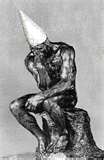
We are about to enter into the real blood-letting of the work. You may say, "Haven't we seen some blood-letting heretofore?" No, indeed! All this, and all the legal settlements of the various killings, have only been a prelude. Starting next week, we will read of the days when Gunnar has had all he cares to take.
An interesting point about Gunnar, going into this. He has what you might call a bifurcated reputation. We see this a lot in our own time, especially in politics. A given figure is understood by his supporters to be a saint and a hero; the other side says he is a demon, or a monster.
Gunnar is viewed by one side as weak and easy to torment. That seems strange, as he is a demonstrated killer and a man who has offered those who came to him at law the alternative of 'going to the island' (Holmgang). But he doesn't resort to killing right off, as some men do, and it has led some in that era to view him as a man they can bull. We will soon see him lament:
"I would like to know," says Gunnar, "whether I am by so much the less brisk and bold than other men, because I think more of killing men than they?"
The circumstances of his complaint will not make it seem much like whining.
Someone at Bookwoom Room linked to an old 1941 Harper's essay that's been posted on the web, part of that magazine's effort to bring its 148-year history into its electronic archives. Dorothy Thompson (1893-1961), a journalist, was kicked out of Nazi Germany in 1934 and over the next seven years watched Hitler's power spread to France. Writing in Harper's in 1941, before it was clear whether the U.S. would join the war, she proposed the parlor game of imagining which party guests would go Nazi when the time came. "Nazism," she says, "has nothing to do with race and nationality. It appeals to a certain type of mind."
Thompson felt that the post-WWI "lost generation" had been "treated to forms of education which have released him from inhibitions. His body is vigorous. His mind is childish. His soul has been almost completely neglected." As if setting up a country-house mystery, she examines thirteen people:
a contented blue-blood with a classical education,
a pragmatist who "fits easily into whatever pattern is successful,"
a social climber who is "bitterly anti-Semitic because the social insecurity of the Jews reminds him of his own psychological insecurity,"
a "spoiled only son of a doting mother,"
a masochist looking for someone other than her bored husband "before whom to pour her ecstatic self-abasement,"
a warm ex-actress "full of sound health and sound common sense,"
a cheerful young man studying engineering in night school at City College,
a contrarian intellectual whose "brain operates quite apart from the rest of his apparatus,"
a "good-natured and genial man" ready at any time to "grab a gun and fight,"
a young German emigre who left the Nazi Youth to escape to Switzerland on foot,
an assimilated and wealthy pro-business Jew who is skeptical of the criticisms of Hitler,
a sad, quiet Southern Jew who loves his country "in a quiet, deep, unostentatious way," and
a powerful, predatory labor leader.
Thompson considers which of the guests will make the right choice and concludes: "Those who haven’t anything in them to tell them what they like and what they don’t -- whether it is breeding, or happiness, or wisdom, or a code, however old-fashioned or however modern, go Nazi."
It's oddly reassuring to read this essay, written by a thoughtful journalist with enough experience in 1930s Europe to know just what the world was up against. In 2010, we're facing discouraging trends in education, social dissolution, and moral unraveling, but no more than Thompson saw.
Ed Schultz, the MSNBC commentator, made waves this week by complaining that President Obama gave an interview in his time slot to Fox News after all the hardcore shilling he'd done for ObamaCare. He made another revealing complaint, too, as reported by John Fund in the Wall Street Journal, in his pep talk to Netroots attendees: "The White House has a war room. I think they have a sissy room too."
I've been noticing a lot of this lately. The party of peace, love, and understanding can get pretty butch when it lets its hair down among friends. Anyone would think they'd concluded that violence is sometimes morally justified in a good cause.
Expect blowback this week from the sissy lobby. ". . . All We Are Saaayyyy-ing . . . ."
Ann Althouse quotes from Maureen Dowd's loopy analysis of l'affaire Sherrod, including her approving citation to the even wilder loopiness of Congressman James Clyburn of South Carolina. Clyburn's suggestion? "[Obama] needs some black people around him.” Per Dowd, Clyburn explained that
Obama’s inner circle keeps “screwing up” on race: “Some people over there are not sensitive at all about race. They really feel that the extent to which he allows himself to talk about race would tend to pigeonhole him or cost him support, when a lot of people saw his election as a way to get the issue behind us. I don’t think people elected him to disengage on race. Just the opposite.”
Ms. Althouse's commenters dismantle this claptrap instantly in at least two ways. To begin with, as commenter Paul Zrimsek noted: "The NAACP's reaction was of a piece with the White House's. Does the NAACP need more black people too?"
What's more, as commenter Bagoh20 pointed out, how do you "get the [race] issue behind us" by expecting the President to engage obsessively on race?
Darleen at Protein Wisdom strikes a blow for Austen fans. "Is that your blood?" "Oh -- yes. Some of it." Actually I've read more than one pomo critical essay on Jane Austen that didn't diverge much from this video in intellectual style, minus the humor. The second video ("Dad Club") is worth watching, too. But now I've blown a good fraction of my satellite download ration for the day.
The Way:
Next morning Alveric came up the tower to the witch Ziroonderel, weary and frantic from searching all night long in strange places for Lirazel. All night he had tried to guess what fancy had beckoned her out and whither it might have led her; he had searched by the stream by which she had prayed to the stones, and the pool where she had prayed to the stars; he had called her name up every tower, and had called it wide in the dark, and had no answer but echo; and so he had come at last to the witch Ziroonderel.
"Whither?" he said, saying no more than that, that the boy might not know his fears. Yet Orion knew.
And Ziroonderel all mournfully shook her head. "The way of the leaves," she said. "The way of all beauty."
-Edward Plunkett, Lord Dunsany, The King of Elfland's Daughter
A new book examines the Kaiser's attempt to provoke a global Jihad in order to undermine the British Raj.
Helping to whip up passions was one of history’s most unlikely jihadists, Baron Max von Oppenheim, who directed the Kaiser’s “jihad bureau” for the duration of the war. The scion of a Jewish banking family, an archaeologist, writer, and veteran Near East hand, Oppenheim thundered that Muslims “should know that from today the Holy War has become a sacred duty and that the blood of the infidels in the Islamic lands may be shed with impunity”. (Germans, Austrians, and Hungarians were granted exceptions, of course.)
Oppenheim supervised a crack team of Orientalists, among them Alois Musil, cousin of the novelist Robert, who trekked to central Arabia in 1915 to enlist Arab tribal sheikhs, and Oskar von Niedermayer, who made a perilous journey across the Persian desert to spur the Emir of Afghanistan into attacking the Indian Raj.
Did it work? Well...
Almost everywhere – Persia, the Shia strongholds of southern Mesopotamia, Afghanistan and the Hejaz – German agents found themselves contending with endless logistical traps. With the British Navy in control of the seas, the still incomplete railway took on a vital importance. There was simply no way for the Ottomans to ship arms and materiel across vast distances to supply their would-be allies. The “jihad”, in actuality, turned into a series of cash transactions, with the Germans (and British) resorting to subventions, financial blandishments, and outright bribery.
The Billy Carter Gas Station is privately owned, but its ownership would be transferred to the government if the legislation is approved. The gas station has old gasoline pumps, stacked tires outside, colorful articles from Carter’s closet, commendations from around the world and “Billy Beer” paraphernalia.
And it was such a good time to re-examine our opinion of the Carter years, too.
Global Warming Crusaders Target Marmots in Cruel Genocide
Or is it "zoocide"? Whatever: they can't wash the blood off their hands this time.
"I didn't intend to spend 40 years studying marmots, but new questions kept coming up," confesses a researcher whose professional life was hijacked by this under-reported drama. His perseverance paid off for us all with his "groundbreaking study, published in Nature," revealing to a stunned scientific community that "mountain rodents called marmots are growing larger, healthier and more plentiful in response to climate change." The longer growing season has boosted the plucky creatures' size, strength, and numbers. Unless. Unless we let Al Gore back out of his cage, in which case decades of hard-fought progress in the marmot community could be senselessly undone.
Snapping Back to the Narrative. Someone must have handed our scientist a note from off-camera during the interview, because he hastens to add: "This benefit to marmots is probably short-lived. . . . [I]f there's less snowmelt to nourish plants that marmots forage in the summer, it will severely affect them. In droughts, we've had very high mortality." Marmots cannot catch a break.
The next time you thoughtlessly exhale, or wait to exhale, consider that you're dooming a marmoset to the Scylla and Charybdis of obesity and starvation. Here's a site where you can support marmot research. Look into your hearts and dig into your wallets.
I understand federal pre-emption. I support federal pre-emption in the areas where it applies. I even agree that it applies with particular force and reason in areas like immigration. It's just that I think the federal law that enjoys pre-emptive power should be the actual federal law that's been passed by Congress and stuff.
Here's the money quote from the DOJ's July 6 brief in the Alternative Universe that is the Arizona immigration enforcement lawsuit:
Although a state may adopt regulations that have an indirect or incidental effect on aliens, a state may not establish its own immigration policy or enforce state laws in a manner that interferes with federal immigration law.
That actually sounds pretty good to me. The part I don't get is why the feds who happen to be in office this year get to establish their own version of "federal immigration law" without complying with all those tiresome procedures for amending the laws on the books.
Here's how it seems to work: You're a Sanctuary City? No problem of any kind. You're doing the Lord's work. You're in accord with the Immigration Law As It Would Exist in a Just Universe. We, the feds, have the exclusive right to ordain what that is using only the power of our own minds. But over there, you're a Non-Sanctuary State? Knock it off. You're acknowledging the force of the law as written, which is an intolerable intrusion into the majesty of our federal powers.
The fact is, though, I'm pretty encouraged today by the tone of the federal district judge's questions, which show a healthy skepticism about the DOJ's case.
Remember the summer of $4 gas and the Lehman bankruptcy, when things seemed so crazy that we elected a wannabe Socialist without adult experience and watched a nominally Republican administration push nearly a trillion dollars in bailouts? I didn't like TARP at the time, but I held my nose and swallowed because the alternative seemed equally unthinkable. Now that opening those particular floodgates seems to have ushered in an endless round of mindboggling "stimulus" spending, I suppose I'll be wondering for the rest of my life what might have happened if we'd just said "no" and taken our lumps.
It's a daunting job to imagine, but I have been appreciating Bill Bonner's essays on the need for an honest global deleveraging, painful but unavoidable. He argues that what the world opted to try in 2008 was to replace private debt with public debt rather than destroy the bad private debt once and for all. The experience of Japan, however, shows that you can avoid the pain of deleveraging only by accepting an unconscionably extended stagnation instead. I realize this opinion is not original with Bonner, but he expresses himself clearly enough for me to follow, which is not true of most economists:
After Lehman went down, the whole street was ready to fall. Households, businesses, banks - trillions in debt might have been wiped out overnight; we'll never know.
Instead, we're headed for Tokyo where they've had bailouts, boondoggles and counter-cyclical fiscal stimulus for 20 years. And for what?
"It would have been worse had the Japanese authorities not acted," say the neo-Keynesians.
How they know that is a mystery to us. As it turned out, Japanese investors lost nominal wealth equal to three entire years' GDP. And the economy today hasn't grown in 17 years or created a single new job.
Nor has the debt been reduced. Instead of permitting the private sector to destroy and pay off its debt, the public sector fought against it...borrowing heavily to try to bring about a recovery. Result: no recovery . . . and almost exactly the same amount of debt. But while the private sector paid off its debt, the public sector picked up the borrowing. Now it's the government that owes money all over town.
Is that progress, or what?
What. In the U.S., 24 million households own their homes outright, 51 million have a mortgage, and 37 million rent. (I focus on home mortgages here because our banks seem now to have nothing but mortgages and sovereign debt left in their portfolios.) Of the homeowners with mortgages, 11 million are under water. Bonner quotes an estimate that it will take more than eight years to clear the market of foreclosed, distressed, and defaulted homes so that supply-and-demand forces can kick back in and start driving housing prices back up. If we keep propping the housing prices up with more "Cash for Cottages" programs, maybe we can stretch that period to a Japanese-flavored 17 years.
More cheerfulness from ZeroHedge, which notes that bonds are signaling deflation while stocks are signaling inflation:
[U]nlike a Schrodinger Thought Experiment, you can't live in a world in which assets predict both inflation and deflation at the same time. Perhaps all it takes is for some person with a dose of common sense to "observe" this discrepancy and collapse the wave function of the insanity that our market has become. The snap back will be violent.
The comments to that last thread are memorably bleak. Here's my favorite: "As long as they keep the box closed we can't see the dead cat. So maybe in order to prevent this from going any further someone were to shake the f*** out of the box." Another commenter believes the bizarre shape of the market results from banks drawing cash from the Fed window and using it, not to loan into the economy, but to buy treasuries. I keep reading about that last one and wondering about what it means, too.
Even though the warrior was probably only in his mid-20s he appears to have suffered several serious wounds in earlier fights. Indeed, he may have been living for some time with a large arrowhead in his chest. Bone re-growth around a dent in the front of the skull suggest he had recovered from a severe blow, possibly from an axe. The fatal wound, however, occurred when something, possibly a sword, sliced through his nose and jaw.
The unknown warrior, who lived in or around the early 1400s, was laid to rest under the floor of a chapel near the castle’s royal apartments. Peter Yeoman, Historic Scotland head of cultural resources, said: “We know little about this burial area but the evidence suggests it was sometimes used during extreme circumstances, for example to bury the dead during a siege. However, by using modern analysis techniques we have started to discover quite remarkable information about this man. It appears he died in his mid-20s after a short and violent life. His legs were formed in a way that was consistent with spending a lot of time on horseback, and the upper body points to someone who was well-muscled, perhaps due to extensive training with medieval weapons."
...
In addition to the three serious wounds, it seems the man had also lost a number of teeth – perhaps from a blow, or a fall from a horse. A large, tanged arrowhead was found in skeleton and appears to have struck through the back or under the arm.
Now, some of that is just that archaeologists are usually somewhat softer than Dr. Indiana Jones. I think most of us gentlemen who read this blog could post a tally of injuries that would make them think we'd led a "short, violent" life. Still, it shows a man who fought hard and often; was long in the saddle; and whose early death was answered by all the honor that his companions at arms could afford to show him.
Sectarian violence, ethnic conflict, religious politics, are all prominent features of the current situation in many Middle Eastern countries. Thriving Jewish communities came to an end in every country after the inauguration of the state of Israel and the subsequent wars. Christian communities, integral to the population and society of many countries, and prominent participants in the politics of Arab and regional nationalism, are now increasingly under pressure....
A common theme in public discourse, in both the region and the West, is that these patterns of conflict have deep historical roots in the ‘mosaic society’ of the region, conflicts being only suppressed by imperial impositions, whether of the Ottomans or the British, and subsequently by violent dictatorships such as that of the Ba`th regimes. When these are removed, as in the case of Iraq, then the deep-seated schisms are given a free reign and manifested in conflict and violence. The opposite reaction comes from more liberal quarters of Middle Eastern as well as some Western commentators, who point to past periods of co-existence and harmony, as well as the lowering or even the erasure of communal barriers under the impact of modernity. Many Iraqis, for instance, appear bewildered at the sharpening of Sunni-Shi`i conflict, and protest that in their days nobody knew or cared who was Sunni or Shi`i in their circles, and point to the many inter-marriages. The current conflicts, then are explained in terms of imperialist manipulation...
Who's right? Both parties, the author says: but they are descendants of two different parts of society, one of which won, and one of which lost. The cosmopolitans lost.
What is going on out there? The tiny city of Maywood (1.2 sq. mi.), just southeast of downtown Los Angeles, made the national news when it recently fired all city employees and outsourced everything, from city hall staff to street crossing guards to maintenance workers to fire and police service. And the residents so far couldn't be happier.
“We don’t want to be the model for other cities to lay off their employees,” said Magdalena Prado, a spokeswoman for the city who works on contract. “But our residents have been somewhat pleased.”
Maywood's colorful history of municipal descent into Mad Max territory includes the conviction of a deputy city clerk for hiring a hit man to knock off a city councilman.
Although Maywood, like many American (and especially California) cities, has suffered from a dropoff in tax revenues, its biggest problem was its police force, which inspired so many lawsuits that the city was about to lose its liability insurance. The police department's $8 million annual budget was eating up half the municipal funds. Police service now is being provided by contract with the Los Angeles County Sheriff's Department at half the price, a change that also allowed the insurance bill to drop from $1 million to $200,000. City hall staff are now provided by contract with a nearby small city:
an estimated 100 employees and contract with neighboring Bell, which will handle other city services such as finance, records management, parks and recreation, street maintenance and others. Maywood will be billed about $50,833 monthly, which officials said will save $164,375 annually.
The city of Bell has received its own unusual media attention this week. Local residents of this tiny working-class community (median income is about $40,000, and 65% of residents over 25 do not have a high school diploma) were startled to learn that their city officials were the highest-paid in the country. Bell's City Manager Robert Rizzo earns $787,637 a year. In comparison, President Obama makes $400,000, L.A. City and County's chief executives earn $338,000 and $257,000 respectively, and Governor Schwarzenegger declines to accept his $174,000 salary.
Bell has roughly the same population as Maywood but about twice the area (2.5 sq. mi.). Both communities are predominantly Hispanic with a high proportion of displaced foreign travelers, as they're now called among the enlightened (h/t Bookworm). Bell council members defend Rizzo's salary, explaining that
the city was near bankruptcy when Rizzo came aboard 17 years ago. Since then, they said, he has put Bell on sound financial footing, with its general fund nearly tripling to about $15 million.
Rizzo, 55, would be entitled to a $659,252-a-year pension for the rest of his life, according to retirement calculations made by The Times that were reviewed by pensions experts. . . . That would make him the highest-paid retiree in the CalPERS system. . . .
I don't live in a city, but I've read my county budget, which is pretty lean. We don't expect our county officials to do a whole heck of a lot here. I can't really draw a bead on this Bell situation. Is it like Kansas City before the Great War, where the city bosses were utterly corrupt but kept a clean, pleasant city nevertheless? Bell is neither a basket case nor a paradise on Earth. The salaries are a caricature of out-of-control government spending, yet the city stays solvent without provoking its residents to a tax revolution or its deputy clerks to take out contracts on councilmen. Will they really get rid of Rizzo and all the other unusually highly paid officials, and if they do, will they find someone to do a better job for less? At the very least, maybe the residents will wake up and take some interest in their local governance.
How About If the USDA Helps Farmers Spread Dirt Around Instead of Wealth?
Here's what I don't get. The new take is: Sherrod sounded racist at first, but then the story turned into a sweet, totally acceptable riff on how federal agencies shouldn't be obsessing about black-vs.-white, they should be obsessing about poor-vs.-rich, so now she shouldn't have been fired after all.
Wait a minute. When did it become the U.S. Dept. of Social Justice and Wealth Redistribution via Agriculture Policy? How about if she obsesses about agriculture instead?
Update: I keep writing "Sharron" when I mean "Sherrod." Sheesh.
Republican efforts to hold the governor’s office in Georgia may well rest on the shoulders of former secretary of state Karen Handel, who became the leading vote getter in Tuesday’s primary after she received an endorsement from Sarah Palin. Handel won 34 percent of the vote and will now face former congressman Nathan Deal in an Aug. 10 runoff....
Palin picked Handel on July 12, calling her a “common-sense conservative” even as the former Alaska governor acknowledged Handel was an underdog. Handel also does not have the backing of some Georgia conservatives.
Georgia has an open primary, so that you must decide whether to vote in the Democratic Party primary or the Republican Party primary. I have done both in different years -- in 2000, for example, I voted in the Republican primary in order to vote for John McCain. In 2004 and 2008, I voted in the Democratic Party primary. (I don't recall what I did in 2002).
This year I voted in the Republican Primary because the major race was the race for governor; the Senate race is going to go to whoever the Republican nominee happens to be, and as he's running unopposed, we can be pretty sure who that will be. The governor race was important and wide open, though, and there were two good reasons not to vote in the Democratic primary.
1) Roy Barnes was obviously going to win it, as he did handily. Now, those of you who were around Georgia long enough to remember the last time he was governor understand that he must not be allowed to resume the office, as he is a lying, faithless scoundrel. If another candidate were running close, I'd have been glad to vote against Barnes; but as he took two-thirds of the vote, that was not the case.
2) My former Congressman of many years, Nathan Deal, was running in the Republican primary. As much as I disdain Congress in general, I was always fairly well satisfied by Deal as Congressmen go. If he wants to be governor, I'm reasonably glad to support him given the other options.
I had thought the race was going to be between Deal and John Oxendine (who ended up much further back in the field than I expected -- perhaps Ms. Palin's influence touched his supporters especially). I honestly wasn't considering the former secretary of state at all, as I'm not aware of any thing she ever did that greatly improved the state of Georgia. I'm not sure why Ms. Palin decided to jump in on this, and I'm still not sure after reading her statement. Maybe she just wanted to see if she could swing another election? Looks to me like the answer is, "Yes -- so please exercise that power with more care and caution."
I'm quite sure that my endorsement means a great deal less than Ms. Palin's, but for what it's worth, if you're interested I still think Deal is the best of the candidates remaining on the field. I intend to continue to support him in the runoff on the 10th of August.
Actually, I may be a little past-due. I meant to update my education rant when I read that the main upshot of the recent fracas over Texas counting failing students as passing was to suggest putting an asterisk by the improved school ratings that resulted. The spokesman in the story where I read this seriously addressed the issue of whether the schools could or could not be expected to find room for the asterisk and the explanation (*rating may be based on meaningless and/or fraudulent massaging of actual test results) on the schools' public marquees. No, I am not making this up.
But today's fresh inspiration for an education update came from Big Government, where I saw that American Federation of Teachers’ president Randi Weingarten is outraged that “suddenly, everyone’s an education expert.” Big Government's response:
If your union can figure out a way to pay for the system yourselves, then we’ll let you run the show and gladly seek school alternatives. Until then, taxpayers WILL have the final say – and what are you going to do about it? Have another protest? Brandish your brass knuckles?
Via Little Miss Attila, who has some of the best links I've run into lately, the IMAO site weighs in on the newest concepts in racism.
By the way, IMAO's host is pretty upset about Breitbart's lifting his "race card" graphic (image left), so I want to be sure to give it appropriate credit here. Selected IMAO one-liners to follow:
The White House saw part of the video and thought Sherrod was racist. Then they found out she was a reformed racist and fired her.
Remember that Black Panthers at your polling place are more scared of you than you are of them. Especially if you’re a cracker.
Context matters when charging someone with racism? Weird. When did that happen?
Make your choice on the Sherrod issue, liberals: Do you stand with Andrew Breitbart or Glenn Beck?
A conservative racist will never get credit for reforming. A liberal racist will be assumed to have reformed just by being for higher taxes.
I have to say: It’s quite fascinating what liberal journalists say when they think no one else is listening. Funny. Privately, I tend to express things more sympathetic to the left than I say publicly.
IMAO has a periodic photo-caption contest that looks entertaining. He asks that contestants keep their captions to a reasonable length, with ten as a maximum, and suggesting that the humor content will increase exponentially as the number of words approaches "one."
Also, this brilliant advice on ObamaCare if the Republican take back Congress:
* Repeal Obamacare. Once again, probably can’t do this the normal way without Obama’s vote, but if the Republicans get together and burn every physical copy and delete every soft copy of the Obamacare bill, that will effectively be a repeal since no one will know what the law was to follow it. It was thousands of pages no one read; it will be gone forever.
Well look, I mean, I think that prayer and holy water, and things like that are all fine. They don’t do any good, but they don’t necessarily do any harm. It’s touching to be thought of in that way. It makes up for those who tell me that I’ve got my just desserts. It’s, I’m afraid to say it’s almost as well-founded an idea. I mean, I don’t, they don’t know whether prayer will work, and they don’t know whether I’ve come by this because I’m a sinner.
I don't hold it against any man that he believes what he believes; I don't know how much control he has over it in any case. It strikes me that atheism is as likely to seem rational and right to some, and wrong to others, in just the way that Nominalism and Realism seem right or wrong, emphatically, to different people, across centuries. It may be that the truth is neither, but that human minds cannot reach it; and so we need both perspectives to fence off the strange area where the truth lies.
That is a more radical claim than it may seem on its face. Logic requires one or the other to be true: either "Fairness" is a real thing in the world, or it is a name we give to a concept we have; or even stronger, either God Is or Is Not. That last can be written in symbolic modal logic, in the strongest possible way:
Pv~P
That is, "It is necessary that P is the case, or that not-P is the case." For P and ~P to both be true is a logical contradiction; it cannot logically be the case that God both does and does not exist, or that Realism is both false and true.
If I say that it is not true that God exists, nor is it true that he does not exist, I'm saying something that appears to be logically impossible. One of us should be right, and the other wrong. Yet I'm not sure that is how it is. Logic is a feature of human consciousness, and consciousness remains one of the great mysteries. It is not at all clear to me that it is what it appears to be; indeed, scientific evidence shows us that our experience of consciousness is different from reality. Logic is also based heavily on conventions of language, as Peter Abelard, Gottlob Frege, and others have explored. Logic therefore may not be the reliable guide that we believe it to be.
If it is not, however, that leaves us with little else beyond faith. I have a great faith in natural theology -- in trying to understand God's purpose by examining the truth, as well as it can be established by science, of the world we are in. Yet I also think it is rational to have faith in a God that is and is not: perhaps he is in ways we do not expect, and therefore is not what we do expect.
Or perhaps it is even more difficult: one of those things of which we cannot speak, and must therefore avoid. If that is so, we may differ on these questions with no harm, and indeed, possibly with great good.
All of which is to say: May God save Christopher Hitchens. He may have to walk the valley alone, but at least he can do it in the knowledge of friendship. That is only what we will want when -- so soon -- we walk in the valley ourselves.
Six in ten workers expect nothing from Social Security when they retire. Count me among them; I've never expected to see a red cent of the money they have taken from me and my family over the years.
The numbers are sixty-six percent up to age 55, and nearly eighty percent under the age of 35.
When you consider FICA as a line item expense, it is going to rank up there with your biggest monthly expenses. This is especially true if you are "self-employed," and paying fifteen-point-three percent of your income, pre-tax! Even if you are not self-employed, because the tax is figured into your wages, the tax is depressing your pay as well as swiping cash from your pocket.
In return for your other major expenses, you get some sort of positive good: food to eat, or a roof over your head. In return for this one, however, you are probably going to receive nothing at all if you are not already over 55 years of age. Furthermore, you know perfectly well that you are not likely to receive these benefits; and they are brought to your attention regularly, perhaps twice a month when you inspect your pay stub, or quarterly when you have to write a massive check to Uncle Sam.
My entire life I've watched the Congress spend every dime of the "trust fund," and leave a big IOU in the empty chest. I've watched the guarantors of Social Security treat those IOUs as if they were real money, when they should have been raising the roof with protests. They have given the henhouse to the foxes.
It's nothing but theft. Legal or not, it's just plain theft.
Could this Episcopalian youth counselor be any more wrongheaded? He sees that young people are forever experiencing pregnancy scares and unwanted pregnancies, but what a depressing set of conclusions he's drawn about what we need to teach them on the subject. Why, he wonders, do so many "bright, educated young people" find "such flimsy excuses for not using contraception, even when contraceptive devices are easily available"? After passing de rigueur observation that we as a society haven't managed to make contraception cheap enough, he concludes that other compulsions are operating: young people more or less consciously choose to forgo contraception, in part because they cling to "myths" about the meaning of sex.
He explains his own state of mind as a reckless young teenager knocking up his girlfriend. The stirring words from Macbeth were in his mind: "But here, on this bank and shoal of time, we’d jumped the life to come." What this meant to him was:
It seemed desperately romantic (remember, I was 17). As awful and as risky as what Macbeth and his wife were doing, they were doing it together, as a couple, bonding themselves together in their mutual sin. And as my girlfriend and I wrapped ourselves around each other, unable to get enough of one another, I remember thinking “I’m willing to risk everything for this — and the life I’m willing to jump is my own, my future.” Like so many young people in this same situation, I was briefly intoxicated with thoughts of a life together with a baby. My gal and I would always be together, would be unable to part, if we made a child together, or so I believed.
So he knocked her up, and a couple of months later he was doing the responsible thing, paying for her abortion. The moral he draws?
But we often forget that for some young people, the use of contraception not only symbolizes caution, it can come to symbolize a lack of complete and utter trust. . . . [What we need is] honest discussion about the romantic myths we attach to sex, particularly to intercourse: myths about fusion, myths about commitment, myths about what it means to have sex without barriers. . . . The sex education we need is about more than “protection.” It’s about more than providing access to abortion as a last resort, thought that remains an important component of justice-centered sex ed. Proper education will center on what sex means and what it doesn’t. And we can start by gently, firmly, and lovingly tearing down the myth that unprotected heterosexual intercourse represents the most intimate and magical expression of trust and love. Until we deconstruct that lie, we only tempt the unprepared to jump too quickly the lives they have to come.
Wow. Abortion is an important part of justice-centered sex ed. But not as important as disabusing young people of any notions that sex is about fusion, commitment, responsibility, love, or engendering helpless infants who will deserve loving protection from both parents. Glad we cleared that up! But I think I'd rather spend time with the kids who haven't gotten the message yet.
I confess to never having received a flu vaccination in my life. I can't explain why. It may be a friend's experience with Guillain-Barre syndrome some years ago, or a strong aversion to visiting any doctor when I can possibly avoid it, or the fact that either I've never had the flu or I've only ever contracted versions too mild to worry about. Or it could be that, like many Americans apparently, I have a lingering fear of needles. I don't have the strong reaction to them that I suffered from as a child, but I seem to find ways to avoid them, though for some odd reason I don't at all mind having my blood drawn.
Anyway, alert scientists are on the job. They've come up with a new vaccine delivery system that not only avoids syringes but has several additional advantages. It's a patch with such tiny, micron-sized needles that you can't feel them. They dissolve in your skin, leaving behind only the vaccine in your system, and a water-soluble patch on your skin that can be disposed of without creating any "sharps" hazard. Avoiding needles also avoids the dangers of re-use and contamination, particularly in impoverished countries where this has been a terrible problem. The immune response from the skin delivery system is even better than from an intramuscular injection, something to do with the prevalence of the right kind of immune cells there. Because the little micron-needles use a dry form of vaccine, it is more stable in storage than the injectable sort. The patch could be administered by non-experts or even sent home to be applied privately by the patient.
The patch has been testing well in animals. It will be a while before it is available for people.
We are reading The Saga of Burnt Njal, and this week we are discussing sections 21-37. Next week we will talk about sections 38-53.
Now we're starting to get into the meat of the story. Sea battles! Murders! But also lawsuits, with poetry:
"Yes, so must it be, this morning -- Now my mind is full of fire -- Hrut with me on yonder island Raises roar of helm and shield. All that bear my words bear witness, Warriors grasping Woden's guard, Unless the wealthy wight down payeth Dower of wife with flowing veil."
I imagine that some of you found it very satisfying to see Hrut repaid in kind by Gunnar. Note that Gunnar is a good man, though, and treats Hrut this way largely because it was how Hrut behaved himself. Toward Njal, his friend, Gunnar takes no advantage: they strive hard to be fair with each other, and to make peace on terms the other can manage.
Here we also begin to encounter the feuding of the wives. It is important to note that Bergthora is entirely in the right -- it may not be obvious, because they seem to be going eye-for-an-eye in murdering each other's servants and friends. However, the initial cause of the dispute was Hallgerda taking offense at Bergthora asking her to move down the table to make room for another guest in Bergthora's hall. Bergthora had a perfect right to order her own household, and to settle questions of precedence. Hallgerda's insults escalate the issue, and are repaid in kind. Gunnar refuses to fight in her unjust cause, but takes her home: so she escalates further, to sending a wicked man to murder a well-loved member of Njal's household.
This feud will continue to escalate through next week's readings. It is important to keep track of the quality of men on each side: both their social standing and reputation. So, ask yourself both: are they thrall or free? Are they honored men, or men distrusted and scorned?
Instapundit put up a poll asking about the design of this new DOJ website. I'm not sure that design is all that important in a DOJ website; but if we are going to talk about it, the one point of the design that bothers me is the quote they put up at the top of the page:
Apparently this phrase is carved in stone on the DOJ building, so putting it on the website is not a big deal by comparison; but what a strange sentiment! Common law (which is to say, the decisions of courts and precedents) has little to do with "Mankind" or "the People," and everything to do with judges and lawyers. It is their will, in other words, insofar as it is "will" instead of the interpretation of positive law.
Insofar as it is "will" in the judicial sense, American "common law" should be entirely guided by our Constitutional law. It is the Constitution that is the expressed will of the People -- not "Mankind," which includes a lot of folks who are not part of the American "We, the People." It is the upholding of the Constitution that the DOJ ought to be thinking of as its chief mission.
Apparently the quote drew other eyes than mine. The Spectator asked after it, and came up with the following answer.
Another DOJ lawyer says, "It's taken from an inscription along one of the outer walls of the department ["The common law derives from the will of mankind, issuing from the life of the people, framed by mutual confidence, and sanctioned by the light of reason"], but no one is sure where the quote came from."
The quotes that ring the building were selected during the construction process back in the administration of President Franklin Delano Roosevelt. Some attorneys believed the quote is pulled or adapted from the writing of Sir William Blackstone, the 18th Century British jurist, who wrote the Commentaries on the Laws of England, which influenced not only British law, but also the American constitutional and legal system. But other Department of Justice employees say the quote originates from British lawyer, C. Wilfred Jenks, who back in the late 1930s and after World War II was a leading figure in the "international law" movement, which sought to impose a global, common law, and advocated for global workers rights. Jenks was a long-time member of the United Nation's International Labor Organization, and author of a number of globalist tracts, including a set of essays published back in 1958, entitled The Common Law of Mankind.
Most telling: Jenks, as director of the ILO is credited with putting in place the first Soviet senior member of the UN organization, and also with creating an environment that allowed the ILO to give "observer status" to the Palestinian Liberation Organization, and to issue anti-Israeli statements, which precipitated efforts by the U.S. Congress to withdraw U.S. membership from the ILO. The U.S. actually did withdraw in the mid-1970s due to the organization's leftist leanings.
"It was Jenks's efforts that helped make the ILO a tool of the socialist and communist movement," says one of the DOJ lawyers. "We used to joke about how fitting it was that this was Janet Reno's favorite quote to use in speeches, and now the Obama folks think it encapsulates out department's mission."
Suggestions to highlight quotes from the U.S. Constitution or Bill of Rights or quotes from the Founders, the Federalist Papers or prominent American jurists were quickly shot down by the Department of Justice's media and new media teams, according to DOJ sources familiar with the design process, and the White House communications shop was given input to the overall design as well.
So it's an old quote, from a source no one can quite identify: the Spectator's attribution to Communists is weak, though not wholly implausible. It is a quote that apparently is highly inspirational to people like Janet Reno and the current White House.
Perhaps a small matter; perhaps just a window into their thoughts.
On The Borderline Sociopathic Blog For Boys, a one-minute tutorial for homemade potato chips from the microwave. "Sometimes, when a real man is standing in his tidy-whities in the kitchen watching football and eating cold Beefaroni from the can, he gets the urge for a second course. This is that man. That is this course."
Other excellent video clips there, too. A 30-second clip of Sam Rockwell dancing reminds me to say that "Moon," a 2009 film starring Rockwell and directed by Davie Bowie's son, Duncan Jones, is well worth watching if you're trying to think what to order from NetFlix.
Assistant Village Idiot never seems to fail to have something interesting and useful to say. This week, he mined a couple of excellent comments from a discussion at Volokh about whether libertarians' natural home was with liberals or conservatives:
[M]ost liberals compare real markets to idealized governments.
and
A benevolent government is better than a malevolent market, but neither of those extremes exist.
If you scroll a little further down in his site, you'll be treated to a wonderful YouTube song.
While pundits in the U.S. prattle about the epidemic of obesity among the poor, North Korea shows us what real poverty looks like. In the mid- to late 1990s that country managed to starve something like 10% of its population to death. While conditions had been slowly improving over the next ten years, the government destroyed its tiny fledgling private markets last November. Per the Guardian, "With less than 24 hours notice, all of the money in circulation was abolished and the markets closed. People were issued with a limited quantity of new money to buy subsidised food from state stores."
Now famine looms again. After the currency was destroyed, inflation caused an abrupt doubling in food prices. Even privileged officials who used to appreciate gifts of Scotch from visiting aid workers are now begging for rice on the next visit. North Korea's per capita spending on healthcare (which is theoretically provided free of charge) is 50 cents a year, one-tenth of Burma's. Surgeries, such as amputations, are performed without anesthesia. Five percent of the population is infected with tuberculosis.
It takes many years of effort to produce this kind of failure. In the late 1950s North Korean farms were collectivized. For some decades, subsidized imports from the USSR permitted a conversion to electrically driven irrigation, chemical fertilizers,diesel-powered tractors, and massive earth-moving to create terraced fields. After the collapse of the Soviet Union, however, the subsidized imports were cut off.
In 1992-1993 the North Korean media began to argue the benefits of having only two meals a day as opposed to the traditional three, claiming the latter was unhealthy and excessive. . . . However, the North Korean government did not follow the example of China or Vietnam, where the return to private agriculture led to an instant revival in food production. In the early 1990s the Pyongyang leaders saw how the reformist Communist governments of East Europe had been wiped out, and they considered any reform potentially dangerous to their own survival.
In 1995, the entire Korean peninsula was struck by disastrous floods. While the economic impact on South Korea was negligible, North Korea never recovered. Its already meager food production was cut in half.
The most recent plunge into famine seems to have been caused by pure human stupidity, with scant help from natural disasters. Per a March 2010 L.A. Times article:
The idea behind the [November 2009] currency exchange, economists say, was to confiscate the cash of people who had become relatively rich selling on the private market and to restore the equality espoused by the communist system. . . . Immediately after the currency revaluation was announced, police shut down the markets where people had been buying most of their food. In theory, people were supposed to buy it from state stores at subsidized prices. But the state stores had no food and people were forced to scrounge for whatever they could purchase at exorbitant prices from black marketeers. . . . By the end of December, North Korean authorities had retracted the ban on markets. But the merchants had lost all their cash and couldn't restock their merchandise.
Several months later, a 77-year-old apparatchik was blamed for the currency-destroying policy and executed by firing squad, an action that, despite its popular appeal, did nothing to address the famine.
Will anything change this time? A woman from the border town of Musan told the L.A. Times: "My son thinks that something might happen. I don't know what, but I can tell you this: People have opinions. . . . It is not like the 1990s when people just died without saying what they thought." But a 28-year-old North Korean, who told of children starving, offered a different take: "I don't doubt [Kim Jong-Il's] good intentions. It is the people under him who are corrupt." The L.A. Times reported that North Koreans on the whole blamed the 1990s famine on U.S. sanctions. As one escapee to China explained, in North Korea "even little children know you are a bad person if you talk that way about the leadership. It is hard to change that mind-set."
On Dr. Codevilla's Article: "America's Ruling Class and the Perils of Revolution"
Dr. Angelo Codevilla, professor emeritus of international relations at Boston University, has written an interesting piece. Some of it will occasion much argument and debate about how to refine, or whether to reject, parts of his picture; but some of it is very clear and difficult to argue against. I will excerpt those parts here, as a foundation.
On the Ruling Class:
Today's ruling class, from Boston to San Diego, was formed by an educational system that exposed them to the same ideas and gave them remarkably uniform guidance, as well as tastes and habits. These amount to a social canon of judgments about good and evil, complete with secular sacred history, sins (against minorities and the environment), and saints. Using the right words and avoiding the wrong ones when referring to such matters -- speaking the "in" language -- serves as a badge of identity. Regardless of what business or profession they are in, their road up included government channels and government money because, as government has grown, its boundary with the rest of American life has become indistinct. Many began their careers in government and leveraged their way into the private sector. Some, e.g., Secretary of the Treasury Timothy Geithner, never held a non-government job. Hence whether formally in government, out of it, or halfway, America's ruling class speaks the language and has the tastes, habits, and tools of bureaucrats. It rules uneasily over the majority of Americans not oriented to government.
On the relative success of our political parties:
When pollsters ask the American people whether they are likely to vote Republican or Democrat in the next presidential election, Republicans win growing pluralities. But whenever pollsters add the preferences "undecided," "none of the above," or "tea party," these win handily, the Democrats come in second, and the Republicans trail far behind. That is because while most of the voters who call themselves Democrats say that Democratic officials represent them well, only a fourth of the voters who identify themselves as Republicans tell pollsters that Republican officeholders represent them well. Hence officeholders, Democrats and Republicans, gladden the hearts of some one-third of the electorate -- most Democratic voters, plus a few Republicans....
On the relationship of the majority to the government:
The polls tell us that only about a fifth of Americans trust the government to do the right thing. The rest expect that it will do more harm than good and are no longer afraid to say so.
While Europeans are accustomed to being ruled by presumed betters whom they distrust, the American people's realization of being ruled like Europeans shocked this country into well nigh revolutionary attitudes.
On why laws are so long today:
Laws and regulations nowadays are longer than ever because length is needed to specify how people will be treated unequally. For example, the health care bill of 2010 takes more than 2,700 pages to make sure not just that some states will be treated differently from others because their senators offered key political support, but more importantly to codify bargains between the government and various parts of the health care industry, state governments, and large employers about who would receive what benefits (e.g., public employee unions and auto workers) and who would pass what indirect taxes onto the general public. The financial regulation bill of 2010, far from setting univocal rules for the entire financial industry in few words, spends some 3,000 pages (at this writing) tilting the field exquisitely toward some and away from others. Even more significantly, these and other products of Democratic and Republican administrations and Congresses empower countless boards and commissions arbitrarily to protect some persons and companies, while ruining others. Thus in 2008 the Republican administration first bailed out Bear Stearns, then let Lehman Brothers sink in the ensuing panic, but then rescued Goldman Sachs by infusing cash into its principal debtor, AIG. Then, its Democratic successor used similarly naked discretionary power (and money appropriated for another purpose) to give major stakes in the auto industry to labor unions that support it.
On clearing the decks:
Reducing the taxes that most Americans resent requires eliminating the network of subsidies to millions of other Americans that these taxes finance, and eliminating the jobs of government employees who administer them. Eliminating that network is practical, if at all, if done simultaneously, both because subsidies are morally wrong and economically counterproductive, and because the country cannot afford the practice in general. The electorate is likely to cut off millions of government clients, high and low, only if its choice is between no economic privilege for anyone and ratifying government's role as the arbiter of all our fortunes. The same goes for government grants to and contracts with so-called nonprofit institutions or non-governmental organizations. The case against all arrangements by which the government favors some groups of citizens is easier to make than that against any such arrangement.
On the difficulties facing both sides in forcing the other to bend to its will:
Sweeping away a half century's accretions of bad habits -- taking care to preserve the good among them -- is hard enough. Establishing, even reestablishing, a set of better institutions and habits is much harder, especially as the country class wholly lacks organization. By contrast, the ruling class holds strong defensive positions and is well represented by the Democratic Party. But a two to one numerical disadvantage augurs defeat, while victory would leave it in control of a people whose confidence it cannot regain.
Certainly the country class lacks its own political vehicle -- and perhaps the coherence to establish one.
Indeed, what he is calling the "country class" is a "class" only in the sense that it is the class of people not part of what he is calling the "ruling class." It has some common interests as a result of being left out of the power structure; but aside from that, much that is incoherent.
One thing barely alluded to, but important: there is one national-level force that is not captured by the ruling class, which has internal coherence and an ethic that is drawn from and reverenced by the 'country class'; and of which the ruling class is extremely suspicious as a consequence.
Jonah Goldberg wonders whether the political world is on the verge of important change for the better:
For nearly a century now, the rules have said that tough economic times make big government more popular. For more than 40 years it has been a rule that environmental disasters -- and scares over alleged ones -- help environmentalists push tighter regulations. According to the rules, Americans never want to let go of an entitlement once they have it. According to the rules, populism is a force for getting the government to do more, not less. According to the rules, Americans don't care about the deficit during a recession. . . . And yet none of these rules seem to be applying . . . . Clinton proclaimed the era of Big Government was over, and left office quite popular. Barack Obama said, in effect, "Oh no it's not" . . . .
Maybe President Obama really can make the tides run backwards.
Probably the worst part was the ending. The British/German story arc gets boring, so they tie it up quickly, have the villain kill himself (on Walpurgisnacht of all days, not exactly subtle) and then totally switch gears to a battle between the Americans and the Japanese in the Pacific. Pretty much the same dichotomy - the Japanese kill, torture, perform medical experiments on prisoners, and frickin' play football with the heads of murdered children, and the Americans are led by a kindly old man in a wheelchair.
The comments are good, too, going on to review spin-off series like the life and career of Richard Feynman, and the Korean conflict.
Let's do three history pieces in a row: here's one on Jeffersonian thinking and its return to relevance. Consider it in light of our discussion from yesterday.
“No person shall…be deprived of life, liberty, or property without due process of law.” So reads a portion of the Fifth Amendment to the Constitution, part of the Bill of Rights passed by the First Congress and ratified by state legislatures, sponsored originally by Thomas Jefferson’s friend and political ally James Madison. It echoed, of course, Jefferson’s words in the Declaration of Independence: “We hold these truths to be self-evident, that all men are created equal, that they are endowed by their creator with certain unalienable rights, that among these are life, liberty, and the pursuit of happiness.”
Madison and Jefferson followed the tradition of John Locke, the British philosopher whose Two Treatises on Government was taken as the justification for the transfer of power known as the Glorious Revolution of 1688-89—the subject of my 2007 book, Our First Revolution: The Remarkable British Upheaval That Inspired America’s Founding Fathers. Locke believed that men could be free only if their lives, liberty, and property were protected by the rule of law. And he believed that only men with property could be relied on to self-govern.
So, having just entertained a theory about feudal England, let's consider a question about Rome. Eric, I'm looking at you.
The problems facing the Roman Republic in the 1st Century BC were obvious for several generations before they resulted in the final crisis that lead to imperial rule. There were a large number of proposed solutions, some more fanciful than others, but it was precisely the apparent inability of the state to address problems that everyone recognized existed that destroyed the existing institutions. At the core, the Roman Republic faced two problems.
First, the growth of Roman power and the acquisition of an empire stressed the existing structure for managing provinces. The lack of a well developed colonial bureaucracy combined with the practice of annually appointing new provincial governors from the ranks of recent senior magistrates created massive instability. Significant elements of provincial administration – notably tax collection – were outsourced to private companies, and provincial governors saw their postings as an opportunity for self-enrichment, which was both a cause and consequence of the increasing cost of running for political office. The result was endemic corruption in Rome, and frequent instability in provinces as a consequence of the rapacious practices of tax farmers and governors. Particularly in the more recently acquired provinces in and around Anatolia and the Levant, this instability led to revolts and opportunities for external actors to weaken Roman control.
Second, for a variety of reasons that economic historians continue to debate, there was increasing income inequality....
As Roman historian in residence, what do you think of all this?
I've encountered today an interesting article on the subject of how the Anglo-American tradition of liberty arose. We are keenly aware of the Greek, Roman, and even Germanic/Norse influences, but there is also an important fact arising from the Norman Conquest. The late Sidney Painter argues, in his article "Liberty and Democracy," contained within Feudalism and Liberty (Johns Hopkins Press, 1961) that our liberties arose from the rights of feudal vassals -- that is, that originally these rights were earned by military service, and were protected as part of that contract. In the case of a dispute between the king and a vassal about the terms of the contract, the question was resolved by the vassals in common; and feudal service was very much a two way street, with each side owing the other certain duties.
In much of Europe, the nobility and knighthood remained a separate and special class. Not so in England:
When William the Conqueror took possession of the English crown he organized it as a complete feudal state. But England had a large population of freemen in addition to the mass of the unfree and the Norman kings never made any legal distinction between knights and other freemen. The freedoms which were inherent in feudal vassalage went to all freemen as vassals, direct or indirect, of the king...
The right of all freemen to the privileges of vassals was clearly accepted in England from the Conquest, but found its first clear expression in the Magna Carta. This document was stated to apply to all freemen. It also contained in specific form a statement of the most basic of all liberties -- the right to due process of law.
Thus in England as the unfree became free they acquired the same legal status as knights of the feudal world. Individual liberty was part of the fundamental law.
He goes on to point out some exceptions to his general thesis: for example, no one had the right to 'freedom of religion' until after the Reformation; freedom of the press is likewise a much later invention (and indeed, there was no printing press in 1066).
The English kings went on to further conquests in Scotland, Ireland, Wales, and so forth; thus they spread this idea abroad.
It's an interesting thesis by a historian of the Medieval period. Now compare it to Starship Troopers, which is on the recommended reading list for Marines and the Navy both. The idea being put forth always had a kind of intrinsic appeal, didn't it? The things we call the rights of citizens feel like they ought to be earned, through service -- especially military service.
Perhaps this is why: because that was always the original bargain.
There seems to be a scripting error with the site; T99 reported it, and I've encountered it as well. The screen suddenly goes white, and sometimes a popup window says something about needing to enclose a script in body tags.
I've looked at the code, and removed all the scripts except the one for the comments, which is within the body tags. I'll continue to see if I can figure out why this is happening.
LUBLIN, Poland (Reuters) – Just like his Medieval counterparts 600 years ago armourer Tomasz Samula has hardly any time to outfit his knights before battle commences.
Samula is racing to add the final touches to the metal breastplates, helmets, gloves and other accoutrements needed by the Lublin knights before they take part in re-enacting Grunwald, one of the largest battles of the Medieval age.
I imagine Lars and Grim will appreciate this item.
I've been following Cassandra's despair over this nonsense, and it occurs to me that someone should point out a couple of things to any vulnerable young men in danger of believing in Roissy. The first is that Roissy may be dumb enough to believe what he's writing, but his picture of human psychology isn't even accurate when he's describing himself. He says, that is, that all male 'attention seeking' is really about trying to obtain sex.
In fact, however, all his writing about sex is really to obtain attention. His attempt to reduce all human activity to sexual longing is false on its face.
The second thing that ought to be pointed out, to a young man despairing of finding love, is that the model is entirely wrong about what women want. What women look for in a man is respect.
I do not mean merely the obvious: that women want a man who respects them, or that they want a man who respects women. What is at least important is that they want a man who respects himself. They want a man who aspires to things, because he wouldn't respect himself if he didn't. They want a man who treats himself like a man of honor, which means that he behaves like a man of honor. That means he takes his word seriously, and does his duty. If he also treats women with honor and respect, he will not lack for love from women of worth.
That is simply said, but done with much labor. It is far harder than trying to fool them into thinking you might be worthwhile. Yet you can fool even a foolish person only for so long; the price of relying on that tactic is that you cast away the thing that really mattered, which was love. Oh, I know you're supposed to believe that love isn't what you "really" want; but deep down, you know the truth.