Escape from New York


They're riding high at the moment, but they're not paying attention to the polls. You can win a Democratic primary election in New York City at 62/38 college/no-college, with exactly opposite numbers for no-college/college. You can't win a real election that way, because 2/3rds of citizens didn't go to college. 

This is good, surprisingly, given the stupid ideas people seem to learn at college. Education ought to be a positive, and can still be if you are discerning. Most people are better off without it, sadly, given the state of the thing.

Iron John: An Appreciation

Chronicles published a retrospective review by Mark Judge of Iron John: A Book About Men by the late poet Robert Bly. The book came out thirty-five years ago. Bly was something of a kook, as poets often tend to be (especially the sort who get published these days, publishing being what it is). He got to writing about men after a long time writing about women.
In 1975, Bly organized a Great Mother Conference. Throughout the nine-day event, poetry, music, and dance were practiced to examine human consciousness. The conference has been held annually; since 2003 in Nobleboro, Maine. In the early years, one of its major themes was the goddess or "Great Mother", as she has been known throughout human history. Much of Bly's collection Sleepers Joining Hands (1973) is concerned with this theme. In the context of the Vietnam War, a focus on the divine feminine was seen as urgent and necessary. Since that time, the Conference has expanded its topics to consider a wide variety of poetic, mythological, and fairy tale traditions. In the 1980s and 1990s, there was much discussion among the conference community about the changes which contemporary men were going through, so "The New Father" was added to the Conference title.

Why would a man be the one to organize a "Great Mother Conference"? It was the thing to do in the '70s for New Age Men, I suppose. Anyway, he eventually got to thinking about how to apply the same sort of "mythopoetic" approach to the problems of men. It produced some genuine insight.

Iron John is described adequately at the link. Star Wars' success had made 'the Hero's Journey' a standard of literary education (even now almost every highschooler is required to learn about it). The Iron John myth is a Germanic variation of it that incorporated some elements Bly found helpful and instructive. The ones the review focuses on are the influence of the Wild and the need for masculine strength. This is where I want to add something that was missed:

At one conference Bly asked men to re-enact a scene from The Odyssey, in which Odysseus is told to lift his sword as he sails towards Circe, “the symbol of matriarchal energy.”
Journalist Tom Butler-Bowden described what happened next:

Peace-loving men were unable to carry out the lifting of the sword, so fixed were they on the idea of not hurting anyone. These were men who had come of age during the Vietnam War, and they wanted nothing to do with a manhood which, to feel its aliveness, required an enemy. Instead of the single-mindedness of the 1950s male, they had a receptivity to different viewpoints and agendas. The world is a much better place for these “soft males”—they are lovely human beings, Bly admits—but such harmony-minded men are also distinguished by their unhappiness, caused by passivity. Bly tried to teach these men that flashing a sword didn’t necessarily mean you were a warmonger, but that you could show “a joyful decisiveness.”

It's a little strange to describe Circe as "the symbol of matriarchal energy," but she does practice polypharmakos (she is, in other words, a sorceress as well as the daughter of a god). Hermes tells Odysseus he needs to show her the sword in order to begin the process of escaping her, and it works (combined with some other steps). 

This was an important insight of Bly's that the study of myth and poetry produced. It is even more clear in Iron John. When the king's son wants to free the Wild Man in order to go on his adventure of coming-of-age and transformation, his mother the Queen holds the key to the cage. She will not under any circumstances give him the key to let him free the Wild Man and become a man himself. 

Bly quotes the story's claim that the child steals the key from his mother, and then explains that the boy has to steal the key from his mother. It will never be given to him by permission. At some point, if he is to become a man, he has to learn to break her rules, defy her authority, and do what he has to do. Indeed he has to learn to break rules in general, to defy authority in general, and assert his own rights and legitimate power. He has to leave the safety and care Mother represents, against her will, and go to the Wild to face challenges and hardships.

Thirty-five years ago I was just the right age to encounter such a work at a useful period of time. I forget which teacher made us read it, or why; maybe just because it was a sensation at the time, maybe because it was about coming-of-age and we were all doing that. Perhaps the teacher hoped, as the Arts & Humanities crowd does, that boys could be usefully transformed with poetry and literature.

Indeed they were right. What I got out of it was that it was time to leave them behind for a while as well, defy my mother and her commitment to safety, and go out and have adventures. Obviously I eventually came back, as the Hero's Journey entails a return by the now-adult hero on his own terms. Just as we find in Aristotle, however, it isn't enough to know what is heroic; it isn't enough to lift a symbolic sword. The poem can only show you the way, as the good upbringing taught the youth stories of what courage and justice look like. To become courageous and just, you have to go and do the thing. You have to practice until it becomes habit, eventually second nature.

In learning to defy maternal authority to seek the truth of his own nature, the young man becomes a true man who is worthy of women. The adult women will need him to have his own seat of authority and power too, to not just be another boy they have to mother. They may at times value his ability to set limits, definitely upon himself, perhaps sometimes even upon them. 

So kooky or not, I have warm regards for the poet Robert Bly. It was a helpful book, with some real insights. I wonder now if today's youth could read it, not because it isn't still potentially helpful, but because of the severe degradation of attention-span brought on by smart phones and such. Perhaps that, too, is another key you have to steal if you want to make the journey. 

A Real Trade War


I'm related to a lot of men in the trades and this is both funny and informative. The video is useful for anyone considering the trades and the comments fill out a lot of information on other trades (like carpenter, machinist, etc.) that he doesn't mention as well as more info on some of the trades he does.

That said, I know a few welders and no way that's S tier. Maybe A, maybe, just for the coolness factor.

Assassination and the Laws of War

There are two judgments to be made in the laws of war, and the first amounts to assigning the crime of aggression. This amounts to "who started it." Technically this is called jus ad bellum, or justice towards war.

The recent "12-Day War" has, typically, two very different conceptual claims about that. On one view, the belligerents were involved in a longstanding war that just rushed into a high kinetic phase for a few days. This view is my own; I personally had an Iranian 107mm rocket strike and explode within a few feet of me during a bombardment by Shia militias Iran had armed and trained back in 2007. This was not the only such rocket attack I encountered, to say nothing of the daily mortar attacks we had for a while. I didn't really resent it; I understood that we were there in Iraq without their consent, either the militias or Iran's. The US could have claimed such a thing as a provocation if it had wanted to, legally, but didn't want to expand the war at that time. Other proxy forces, like Hamas of "October 7th" infamy, and Hezbollah, and the Houthis, have been shooting at us (and us back at them) for a very long time. 

On this view, Revolutionary Iran 'started it' declaring war on the United States by seizing our embassy and diplomats; or the US 'started it' by backing the Shah and his tyranny; or, more likely, the British 'started it' in the colonial era that we walked into on the back end. As is often the case in war, this judgment is complicated by competing claims and tangled history; it is usually the case that the victor gets to decree that the loser was the one who 'started it.' The justice of such claims is therefore suspect.

The second view of this first judgment, the judgment about aggression, is that the 12-Day War was a discrete entity that started when Israel assassinated a lot of Iranian leaders in the act of aggression (note definite article). Opponents of Israel paint this, even, as unprovoked in spite of the long history of continuous violence; by treating the 12-Day War as a discrete entity with a clear beginning (and, hopefully!, end), they can omit that long history of proxy warfare as background noise and focus on the clear state-to-state violence. This approach allows for a cleaner claim, but it is also suspect as a matter of justice because it intentionally ignores so much that is relevant.

Once this first judgment is made, however it is made, there remains a second judgment about how the war was fought. This is technically called jus in bello, or justice within war. On this point, assassination is clearly over the line into war crimes -- at least, as the laws of war have traditionally been known.

As this article points out, however, assassination has become a standard practice for both the United States and Israel. Assassination is against the rules of war but so is the use of civilian-dressed proxy forces. It may be that the rules themselves are so outdated that they need to be revised in recognition of new realities. 

It also always struck me that the ban on assassinations in the 'laws' of war was totally self-serving on the part of the politicians and military leaders. Of course we'll have a rule that we are untouchable; you have to restrict your killing to the unimportant blue-collar dudes we conscripted and sent to fight you on our behalf. I've always been suspicious of the subset of the laws of war that protect politicians, royalty, and the like. 

There might be a justice condition for reversing that ban. Assassination at least targets the genuinely guilty rather than the poor conscripts. The reason I have praised the restraint against assassinating the Ayatollah is not that it would be unjust to kill him after all he has done, but that it would be pragmatically unwise to do so. It is helpful to preserve a leader who can negotiate an end to the war from a position of recognized authority. 

By the same token, killing so much of the military chain of command may have made it harder to get the ceasefire into effect by the deadline: there are some practical downsides to disabling such linkages once you get to the point that you want to end the fighting, though it is pragmatically wise to do it while fighting continues.

Since the rules haven't been formally revised, technically one could probably defend a prosecution at the Hague for the round of assassinations. However, doing so would run into its own pragmatic difficulties: it would be rejected by the leadership of most nations, since the United States and Russia as well as Israel would find themselves in danger from such prosecutions. 

Dad29 points out by email (he brought the linked articles to my attention this morning, though I had been researching the issue yesterday separately) the claim that Israel may have effected a strategic advance by one killing that might have been an assassination: 
Similarly, Chinese columnist Bin Hua noted that Iran had recently tilted towards India and away from China.

These apparent shifts in Iranian foreign policy may have now proven disastrous for the country and seem likely to have been propelled by a crucial change at the top of Iran’s government.

Following his 2021 election, hardline Iranian President Ebrahim Raisi had enjoyed close relations with Russia and China, but in May 2024 he had died in a highly-suspicious helicopter crash along with his foreign minister, and given subsequent events, it now seems quite likely that Mossad had been responsible. Raisi’s successor Masoud Pezeshkian was a far more moderate political figure eager to restore good relations with America and the rest of the West and he deliberately avoided drawing closer to Russia or China lest such steps alienate Western leaders.

Thus, it seems quite possible that a Mossad assassination had successfully diverted Iranian foreign policy in a direction that ultimately had dire strategic consequences for the country.

If that's true, it would be an unusual success for an assassination. They normally have only small effects, as personnel are easily replaced. They could have larger-scale effects in special cases, though: for example, the attempt on Trump in Butler would, had it succeeded as it almost did, have had titanic effects. 

UPDATE: Apparently China has chosen to back Iran more forcefully recently, regardless of the policy change. 

Nicomachean Ethics II.1

We will continue to take it slowly for now. This is one of the most important books in human history, and there's groundwork to do to understand almost every chapter. This one not least!

Virtue, then, being of two kinds, intellectual and moral, intellectual virtue in the main owes both its birth and its growth to teaching (for which reason it requires experience and time), while moral virtue comes about as a result of habit, whence also its name (ethike) is one that is formed by a slight variation from the word ethos (habit).

It is enlightening to learn that "ethics" and "ethos" come from a word that originally meant "habit." It almost means "habitat," as it can be used for a dwelling place. It is the moral place where you live, and where therefore you are most comfortable. Home is where the habit is, the place where everything is done just the way you think is best.

From this it is also plain that none of the moral virtues arises in us by nature; for nothing that exists by nature can form a habit contrary to its nature. For instance the stone which by nature moves downwards cannot be habituated to move upwards, not even if one tries to train it by throwing it up ten thousand times; nor can fire be habituated to move downwards, nor can anything else that by nature behaves in one way be trained to behave in another. Neither by nature, then, nor contrary to nature do the virtues arise in us; rather we are adapted by nature to receive them, and are made perfect by habit.

Natural place is one of Aristotle's core ideas from the Physics and Metaphysics. It makes a lot of sense, can be directly verified by your own personal experiment, and by the way explains the idea that the earth is at the center of the universe -- it wasn't, as you have probably heard, arrogance on the part of mankind; it was rather an empirical observation about how things made of earth moved in the world. This idea suffused educated Europe: here's an example from 12th century 'science fiction.' 

Again, of all the things that come to us by nature we first acquire the potentiality and later exhibit the activity (this is plain in the case of the senses; for it was not by often seeing or often hearing that we got these senses, but on the contrary we had them before we used them, and did not come to have them by using them); but the virtues we get by first exercising them, as also happens in the case of the arts as well. For the things we have to learn before we can do them, we learn by doing them, e.g. men become builders by building and lyreplayers by playing the lyre; so too we become just by doing just acts, temperate by doing temperate acts, brave by doing brave acts.

The senses come to be as potential in gestation, in other words, and are actual by childhood. The virtues exist in us naturally, Aristotle thinks, but only as potentials (and not, we shall see, in everyone equally). Practice is necessary to bring them out. 

Note the interesting analogy between art and these moral virtues. Art/artistry/technology (techne) is actually one of the intellectual virtues, which comes to us (we have just read) by teaching more than by practice. You won't become a very good lyre-player by picking one up and, having never heard a good lyre-player nor met one, just fooling around with it. You learn building by studying with those who understand architecture, not just by going out and getting some rock and piling them up.

This returns us again to the idea that a good upbringing is needed for the development of moral virtue. You do have to do the work of practicing, but you also do have some initial learning to do. It's not that there is no learning involved in moral virtue, only practice: it is that you must first know what you are aspiring to do, but then you must also do the hard work of practicing the difficult thing until it becomes -- well, "second nature" as we will discover.

This is confirmed by what happens in states; for legislators make the citizens good by forming habits in them, and this is the wish of every legislator, and those who do not effect it miss their mark, and it is in this that a good constitution differs from a bad one.

As mentioned before, this is a disconnect between Aristotle's idea of politics and our own.  

Again, it is from the same causes and by the same means that every virtue is both produced and destroyed, and similarly every art; for it is from playing the lyre that both good and bad lyre-players are produced.

Indeed if you never play a lyre, you'll never be bad at it.  

And the corresponding statement is true of builders and of all the rest; men will be good or bad builders as a result of building well or badly. For if this were not so, there would have been no need of a teacher, but all men would have been born good or bad at their craft. This, then, is the case with the virtues also; by doing the acts that we do in our transactions with other men we become just or unjust, and by doing the acts that we do in the presence of danger, and being habituated to feel fear or confidence, we become brave or cowardly. The same is true of appetites and feelings of anger; some men become temperate and good-tempered, others self-indulgent and irascible, by behaving in one way or the other in the appropriate circumstances.

The above further clarifies the analogy between art and moral virtue, and also the similarity between intellectual and moral virtue more broadly. Upbringing gets another mention at the end: 

Thus, in one word, states of character arise out of like activities. This is why the activities we exhibit must be of a certain kind; it is because the states of character correspond to the differences between these. It makes no small difference, then, whether we form habits of one kind or of another from our very youth; it makes a very great difference, or rather all the difference.

Nicomachean Ethics Book I Roundup

Before we move on to Book II, here is a place for any last questions or thoughts about Book I. I'll start on Book II probably later today. Maybe tomorrow, because the MIT site I use to easily access the text is down right now. 

Talk Loudly & Carry a Big Stick

 Apparently the big stick is really the key to this whole thing.


Frankly Israel deserves a lot more credit than anyone, if this holds. Credit is due chiefly to their decapitation massacre of the Iranian regime, their secret drone base that took out many air defenses, their airstrikes that cleaned up the rest, their assassination program that proved so intimidating. Of course it was chiefly their fight, so it's perfectly fitting that they did the heavy lifting. Still, they deserve credit for carrying that weight and for doing so effectively. 

Yet the big stick on Fordow seems to have broken Iranian resistance. They lost the only thing left worth fighting for except their survival, which is apparently theirs to be had for the simple price of surrendering after a token, face-saving reprisal strike.

Before we committed, I wrote this:

Thus I suspect that, dissembling aside, Trump intends to issue the order.... Trump [reportedly] asked Israel not to assassinate the Ayatollah Khamenei. The reasoning given in the brief quote aside, a better reason to leave him alive is that he is the only one who can plausibly negotiate a surrender. You have to leave someone alive that the losing side recognizes as their legitimate leader if you are to have any hope of getting them to accept the legitimacy of the order to lay down arms. 

With the air defenses already effectively destroyed, a US air campaign will face relatively easy sailing. I would expect the Fordow strike to be done in more than sufficient force to leave it obviously and permanently destroyed. The psychological effect of having that fortress reduced to ash in one night might compel the aging Ayatollah to consider surrender, especially if more generous terms than "unconditional" are truly on offer behind the scenes. 

I feel pretty good about that prediction. All the same, as I noted just a bit below, Trump fooled me too on the timing: I thought he'd wait for the three carriers to be on station before sending the B-2s. He didn't; and he also didn't launch from Diego Garcia, which was a whole lot closer, perhaps to preserve OPSEC. The British would have had to have known if we'd flown from there; flying from Kansas City, Missouri meant that nobody but Americans would have witnessed any preparations. 

We'll see if the peace holds, but if it does, a hard decision by the President may have spared the world a nuclear Iran. I understand why that was worth doing, though I hope very much that this is the end of the matter. It's a lot harder to stop the rolling stone than to start it. 

UPDATE: An aside: has any American President ever before said, "God bless Iran"?

UPDATE: The Iranian Foreign Minister denies, but admits, that there is a ceasefire that may lead to peace in another face-saving move.


"Until the very last minute, at 4am" is a concession that there's a ceasefire starting at 4 AM. 

That's ok. Face-saving is often crucial to de-escalation; making room for them to say yes on their own terms is fine. As long as we get to peace, with a de-nuclearized Iran to boot, it's a win.

UPDATE: Reports say there were some early ceasefire violations, but that's not necessarily important yet. Iran's chain of command is badly disrupted. Their foreign minister confirmed the ceasefire, but that doesn’t mean every line unit has received the orders. Disrupting their chain of command is one of the roads to victory, but it does have the side-effect that it can also make it harder to stop the fighting.

Hezbollah: Good Luck, Iran!

Hezbollah joins Russia in waving goodbye to their old friends. "Iran is a strong country capable of defending itself." 

Dark Humor


 Just in case any of you don't get the joke, here's the reference.

If You Can't Beat 'Em, Join 'Em

Vladimir Putin: 'Actually, Israel is basically a Russian-speaking country, so we were always pulling for them.' 


As Wretchard points out, everyone now has to revisit their priors on Trump and Russia. Putin was totally opposed to this. 100% of the "Trump/Russia" stuff is now demonstrably proven false. People need to account for how they misread the Trump/Putin relationship before they figure out what they think now, because that whole nexus of thinking was wrong.

Trump fooled everybody. Even me; I thought he'd wait for the carriers to be on station. Nope.

Grim was in Luck


It's usually a lucky day that takes you by the Bobarosa, but in addition to that...

The Bobarosa Reborn

Paradise Lost but Rediscovered.

US 25/70 is also the road that goes by the Bobarosa Saloon, hard by the confluence of the Pigeon and the French Broad rivers. Because their destruction was more complete than Hot Springs', they had nothing to rebuild; as a result, they have gotten back underway more quickly and completely. In place of the historic bar and compound, they simply put down new gravel, threw up a pole barn to serve as a bar, and also brought in a food truck to replace their kitchen.


The staff survived the hurricane and has returned to the place now that it's back in service. There's a bandstand on one side of the bar, picnic tables outside in place of the restaurant they used to have, and a campground they are still restoring a bit at a time. Still, there's food, drink, and music by the river, and a large number of bikers passing in and out. The beer is American and inexpensive, as is the food. (As for the music, the singer said that he'd had many requests, but was going to keep playing anyway.)

Their old rules still apply: In God we Trust; all others, cash only. They do have an ATM.

View of the pole-barn bar and the river.

Food truck and restroom trailer.

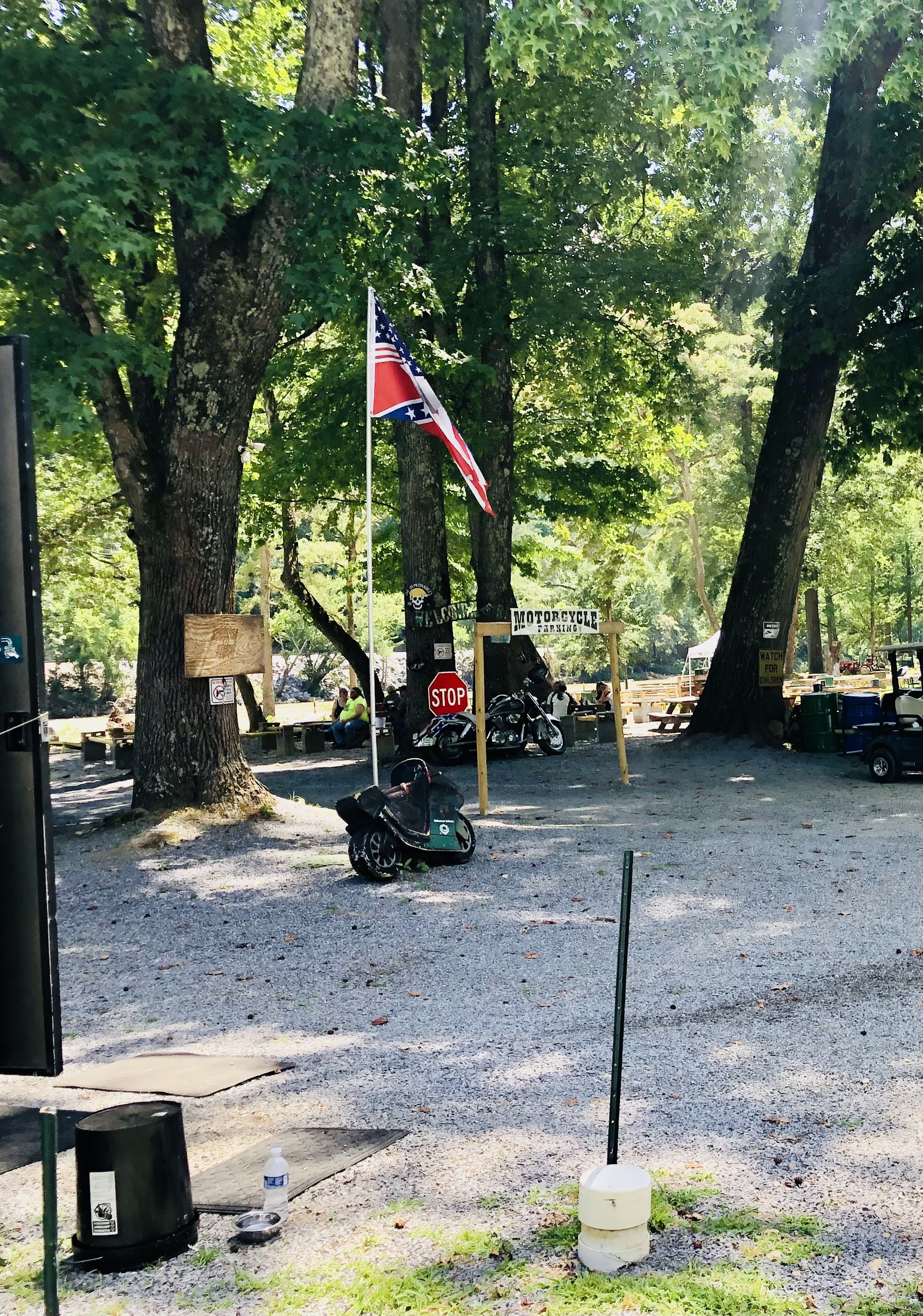
Ragged old flag, which survived Helene and was cleaned but not restored.

Riding Report: The Rattler


I wanted to ride to Hot Springs, NC today, which I had heard was a fun mountain town on a pretty creek.(More about this later.) The road between here and there entails a section of NC 209 that is one of the 'named' motorcycle roads locally, called "The Rattler." 

One of the things that draws tourists to the area are the twisty roads of the mountains, which are basically old mule trails someone later paved. Sports car enthusiasts as well as motorcycle riders flock to the Appalachians to ride the twisties, and some of the roads become famous enough to gain a name. By far the most famous of these is the Tail of the Dragon, which is US 129 at the TN/NC border. I've mentioned it several times here. There are many others, though, of great to modest fame.

The Rattler is actually fairly tame for a named road; there are plenty of far more twisty and dangerous roads around here than it. Having ridden it out and back, I can only assume that it became famous enough to get a name because it links the resort communities of Lake Junaluska and Hot Springs. There are short sections that are fairly twisty at each end, especially in the north in the Pisgah National Forest. There are a few surprises here and there in the middle. There was one curve marked with a warning for fifteen miles an hour that I took at thirty, for example. Nevertheless, there are also long sections where you can get to top gear and go just as fast as you'd like. I exceeded seventy-five at points on this route; on the Tail of the Dragon, there is no section where that speed is even possible. 

However! It is a very pretty ride through lovely valleys and gorges. Not having quite so many curves means that you can spend more time enjoying the scenery. Especially in the Pisgah it is quite beautiful. 

Hot Springs, by the way, is not a fun town at all right now. It must have been once. Hurricane Helene flooded that pretty creek to the point that it devastated the whole of the small downtown, gutting the historic buildings and leaving misery in her wake. They have not rebuilt enough to reopen almost any of them. Some that had patios have now brought in food trucks since their kitchens are long gone; others remain closed. 

In spite of that it is plagued by massive and terrible traffic. The recent closure of I-40 means that US 25/70 from Asheville to Knoxville, which passes through Hot Springs, is now the major artery of NC/TN traffic. There are lines of cars miles long trying to pass through the town in either direction on that road, barely creeping along through the central intersection of a dead town.

Solstice

A beautiful shot from Stonehenge Dronescapes.

Today marks the coming of astronomical summer -- also astrological summer, as the sun enters Cancer at 10:42 PM EST. I remember Thomas was curious about that terminology the last time around.

I saw several pictures of Arthur Uther Pendragon of the Loyal Arthurian Warband, the biker turned druid and wielder of the movie sword Excalibur, as well as a couple of quick interviews as well. I'm always glad to see he's still doing his thing. We used to run into members of the Loyal Arthurian Warband at Scottish Highland Games around the South sometimes. 

Today is also my son's birthday. The guy hosting his birthday party was excited to meet me. He made Beowulf remind him of his last name so he could call me "Mister," respectfully, and then came down and offered me his hand. 

I used to accidentally surprise people with my handshake, as some readers may recall, so I've learned to be more gentle (while still of course being firm). But once I took his hand he started to squeeze as hard as he could. He was definitely a weightlifter.

Once I realized that he wanted to play I gave it to him, and when he finally relented he told me he'd been wanting to try that since my son showed him a video of me lifting in my home gym. He said he wanted to have one like it some day. I wish him well in his quest. 

Summer is a season of questing in the Arthurian tradition; in the South it was often a little hot. The Grandfather Mountain Highland Games are upcoming shortly in the very high mountains of North Carolina, where even mid-July is temperate (although MUCH wetter than I imagine Merry England to have been). The massive heat wave predicted for next week is expected to top out at 87 here, which would be if true three degrees hotter than I've ever seen it locally. You only have to go down to the valley to get into the 90s, though. Go just a bit south into Georgia, and you can find the low hundreds this time of year. 

"Carefully Explain What You're Going to Do....

...then when you move, fall like a thunderbolt." For those with a subscription, the NYT explains exactly how this B-2/GBU-57 plan works, with diagrams. 

Actually, if you can pull this off it's much more terrifying than Sun Tzu's approach. "Here's what's coming. There's not a thing you can do to stop it." 


Reading the Iliad after October 7

With thanks to AVI, a story about the war in Israel from another perspective.
Major Amir Skoury entered my class in October 2022. He was 30 years old, married with two daughters, and an officer in Israel Defense Forces’ (IDF) special forces. Like many officers, he took a leave to attend college... Like all students at Shalem, he began his studies reading Homer’s Iliad, the great epic about the Trojan War. By the time Amir took the seminar, I’d been teaching it for nine years. 

Amir approached me after the second class and said he was frustrated. He couldn’t get into the Illiad. We had a short conversation, and by the next meeting he came prepared like a skilled warrior, not a young man enjoying a cultural experience. He learned the text as an officer would learn a map before navigating his company to its destination. I expected to meet him again on October 9, 2023, at the opening of his sophomore year, but instead, I stood before his grave and eulogized him. Two days earlier, Amir had led a team of soldiers toward the Gaza border communities that were being attacked by terrorists. He was one of the Israelis killed on October 7.
The reason I have friends in Israel is because of their devotion to Western civilization, which caused them to invite me to travel there in 2014 to attend a conference. We usually hear about 'Judeo-Christian civilization,' a concept which may hide as much as it illuminates given the deep divisions in both theology and history (as well as the more obvious connections). Israel, though, is unique in the region as being an outpost of Western civilization. 

They are deeply interested in the Greeks. They study Abraham Lincoln. The long diaspora exposed their predecessors to generations of being embedded in parts of the West, from France and Germany to Poland and Russia. They also participated in the Renaissance and the Enlightenment, and though their experiences of those things were different they were part of the overall experience. 

You can see that in the fact that every student at this college begins their studies with Homer, as is proper. If you want to study philosophy, Homer is a good start because Plato and Aristotle both quote him and make analogies to him. If you want to study anything else, Homer, Plato, and Aristotle are still good places to begin. Natural philosophy gave rise to all the modern sciences, and Aristotle gave the foundations for most of them -- after he finished studying with Plato. 

The Iliad is also a worthy study for warriors because it treats its enemies as human beings throughout. This is unusual and valuable in a study of war. Read on in the linked piece for more on that subject.

An Alternative to Targeting Iran

 I think he has some good points. Let's hear him out.

Juneteenth

I still haven't gotten used to this holiday; I was working at my desk for an hour this morning before I realized that I was supposed to have the day off. Well, a liberating holiday after all! I wrote about Aristotle for you instead. 

I-40 Closed Again

Recent spring rains and flooding have closed I-40 again at the pass through the mountains between Tennessee and North Carolina. Be advised if any of you were planning to visit the Great Smoky Mountains soon.

The price of despotism

From Seth Mandel:
The price Iran has paid has not, in fact, been steep or cruel and unusual. In the history of mankind, no nation’s civilians have been safer while an enemy state controls their airspace during a live war. There’s nothing really to even compare it to. We are watching something no one has ever watched before. Israel, in response to Iran’s pursuit of the destruction of the Jewish people, not to mention its role in the worst daylong mass murder of Jews since the Holocaust, took control of Iran’s airspace and used that to patiently eliminate the sources of the Iranian regime’s power to oppress its people.
Trump supports this.