
Nicomachean Ethics Book I Roundup

Talk Loudly & Carry a Big Stick
Apparently the big stick is really the key to this whole thing.

Frankly Israel deserves a lot more credit than anyone, if this holds. Credit is due chiefly to their decapitation massacre of the Iranian regime, their secret drone base that took out many air defenses, their airstrikes that cleaned up the rest, their assassination program that proved so intimidating. Of course it was chiefly their fight, so it's perfectly fitting that they did the heavy lifting. Still, they deserve credit for carrying that weight and for doing so effectively.
Yet the big stick on Fordow seems to have broken Iranian resistance. They lost the only thing left worth fighting for except their survival, which is apparently theirs to be had for the simple price of surrendering after a token, face-saving reprisal strike.
Before we committed, I wrote this:
Thus I suspect that, dissembling aside, Trump intends to issue the order.... Trump [reportedly] asked Israel not to assassinate the Ayatollah Khamenei. The reasoning given in the brief quote aside, a better reason to leave him alive is that he is the only one who can plausibly negotiate a surrender. You have to leave someone alive that the losing side recognizes as their legitimate leader if you are to have any hope of getting them to accept the legitimacy of the order to lay down arms.
With the air defenses already effectively destroyed, a US air campaign will face relatively easy sailing. I would expect the Fordow strike to be done in more than sufficient force to leave it obviously and permanently destroyed. The psychological effect of having that fortress reduced to ash in one night might compel the aging Ayatollah to consider surrender, especially if more generous terms than "unconditional" are truly on offer behind the scenes.
I feel pretty good about that prediction. All the same, as I noted just a bit below, Trump fooled me too on the timing: I thought he'd wait for the three carriers to be on station before sending the B-2s. He didn't; and he also didn't launch from Diego Garcia, which was a whole lot closer, perhaps to preserve OPSEC. The British would have had to have known if we'd flown from there; flying from Kansas City, Missouri meant that nobody but Americans would have witnessed any preparations.
We'll see if the peace holds, but if it does, a hard decision by the President may have spared the world a nuclear Iran. I understand why that was worth doing, though I hope very much that this is the end of the matter. It's a lot harder to stop the rolling stone than to start it.
UPDATE: An aside: has any American President ever before said, "God bless Iran"?
UPDATE: The Iranian Foreign Minister denies, but admits, that there is a ceasefire that may lead to peace in another face-saving move.


That's ok. Face-saving is often crucial to de-escalation; making room for them to say yes on their own terms is fine. As long as we get to peace, with a de-nuclearized Iran to boot, it's a win.
UPDATE: Reports say there were some early ceasefire violations, but that's not necessarily important yet. Iran's chain of command is badly disrupted. Their foreign minister confirmed the ceasefire, but that doesn’t mean every line unit has received the orders. Disrupting their chain of command is one of the roads to victory, but it does have the side-effect that it can also make it harder to stop the fighting.
Hezbollah: Good Luck, Iran!

If You Can't Beat 'Em, Join 'Em
Grim was in Luck


The Bobarosa Reborn

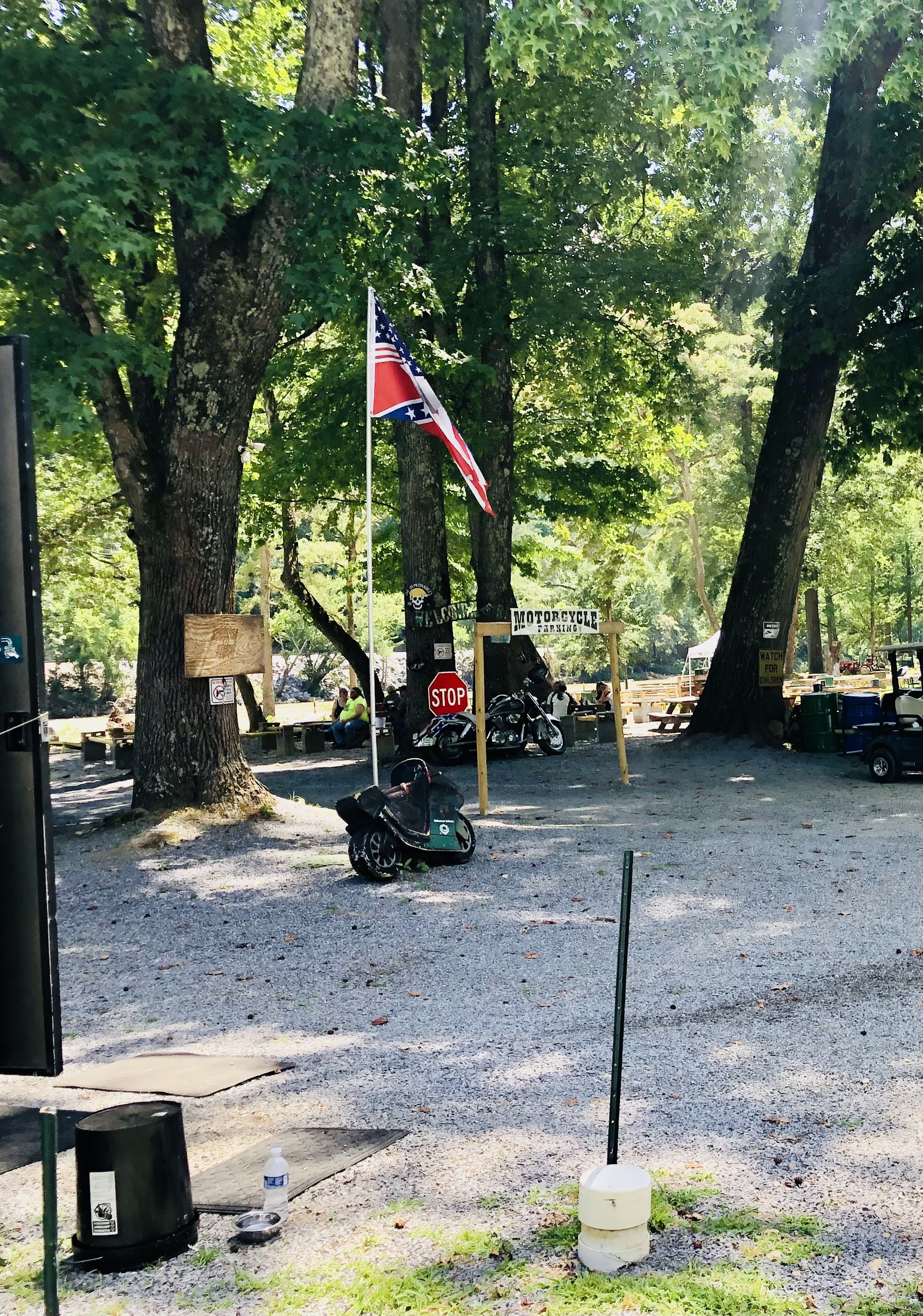
The staff survived the hurricane and has returned to the place now that it's back in service. There's a bandstand on one side of the bar, picnic tables outside in place of the restaurant they used to have, and a campground they are still restoring a bit at a time. Still, there's food, drink, and music by the river, and a large number of bikers passing in and out. The beer is American and inexpensive, as is the food. (As for the music, the singer said that he'd had many requests, but was going to keep playing anyway.)


Riding Report: The Rattler

I wanted to ride to Hot Springs, NC today, which I had heard was a fun mountain town on a pretty creek.(More about this later.) The road between here and there entails a section of NC 209 that is one of the 'named' motorcycle roads locally, called "The Rattler."
Solstice

"Carefully Explain What You're Going to Do....
Reading the Iliad after October 7
Major Amir Skoury entered my class in October 2022. He was 30 years old, married with two daughters, and an officer in Israel Defense Forces’ (IDF) special forces. Like many officers, he took a leave to attend college... Like all students at Shalem, he began his studies reading Homer’s Iliad, the great epic about the Trojan War. By the time Amir took the seminar, I’d been teaching it for nine years.Amir approached me after the second class and said he was frustrated. He couldn’t get into the Illiad. We had a short conversation, and by the next meeting he came prepared like a skilled warrior, not a young man enjoying a cultural experience. He learned the text as an officer would learn a map before navigating his company to its destination. I expected to meet him again on October 9, 2023, at the opening of his sophomore year, but instead, I stood before his grave and eulogized him. Two days earlier, Amir had led a team of soldiers toward the Gaza border communities that were being attacked by terrorists. He was one of the Israelis killed on October 7.
Juneteenth
I-40 Closed Again
The price of despotism
The price Iran has paid has not, in fact, been steep or cruel and unusual. In the history of mankind, no nation’s civilians have been safer while an enemy state controls their airspace during a live war. There’s nothing really to even compare it to. We are watching something no one has ever watched before. Israel, in response to Iran’s pursuit of the destruction of the Jewish people, not to mention its role in the worst daylong mass murder of Jews since the Holocaust, took control of Iran’s airspace and used that to patiently eliminate the sources of the Iranian regime’s power to oppress its people.
Trump supports this.
Nicomachean Ethics I.13
Since happiness is an activity of soul in accordance with perfect virtue, we must consider the nature of virtue; for perhaps we shall thus see better the nature of happiness.
This answers some of the objections that have been raised in the comments. We have now a definition of happiness, but it entails a definition of virtue. We need to study the virtues now, in order to better understand even the defined concept of "happiness."
The true student of politics, too, is thought to have studied virtue above all things; for he wishes to make his fellow citizens good and obedient to the laws.As an example of this we have the lawgivers of the Cretans and the Spartans, and any others of the kind that there may have been. And if this inquiry belongs to political science, clearly the pursuit of it will be in accordance with our original plan.
Emphasis added. The student of politics isn't studying virtue to make himself better, note, but to make his fellow citizens good and obedient to the laws. This is a point of discontinuity between Aristotle and American society, and to some degree between the Modern world and Aristotle. Americans think of virtue as a private matter. The function of the law is not to make us good people, but to set the most minimal limits possible on human behavior in order to enable us to be free within those limits. What we choose to do with that freedom is where we find out whether or not we are virtuous. It isn't anyone else's business.
Among the other Moderns, a less-strong version of this idea prevails. Kant, for example, divides his Metaphysics of Morals into two Doctrines: the Doctrine of Right, and the Doctrine of Virtue. The dividing point between those two is whether or not the state has the right to use physical force against you to require you obey. The Doctrine of Right is where force is permitted -- interestingly, marriage law is included here -- and the Doctrine of Virtue is where no one is allowed to force you to do the right thing. There is still a right thing, but it is yours to decide whether to be good or bad.
That is not true for Aristotle. As we will see when we reach his discussion of Justice, the point of the laws is to mandate virtuous behavior, to make everyone behave as if they were virtuous. You may not get genuinely virtuous people that way, but you at least get a society in which people are treating each other as if they were the virtuous people they aren't really.
Aristotle also wants people to develop the internal virtues, and to come to that point we have already discussed in which they want to be virtuous and find it pleasant to be. However, virtue is a matter of habituation; being forced to be better for a while can help you internalize the habits, and at least takes care of some of the bad behavior.
But clearly the virtue we must study is human virtue; for the good we were seeking was human good and the happiness human happiness. By human virtue we mean not that of the body but that of the soul; and happiness also we call an activity of soul.
Thus, this will not be a book on weightlifting or fast running, but on courage and justice.
But if this is so, clearly the student of politics must know somehow the facts about soul, as the man who is to heal the eyes or the body as a whole must know about the eyes or the body; and all the more since politics is more prized and better than medicine; but even among doctors the best educated spend much labour on acquiring knowledge of the body. The student of politics, then, must study the soul, and must study it with these objects in view, and do so just to the extent which is sufficient for the questions we are discussing; for further precision is perhaps something more laborious than our purposes require.
Socrates would have taken this and made a problem out of it for showing that the inquiry wasn't working well. Aristotle manfully accepts that we have to understand the subordinate questions in light of our inquiry into the prior questions. This is a difference between him and his predecessors.
This is a longer chapter, so I will put the rest after a jump break. There's an important new concept here, so don't skip it.
On the Eve of War

Nicomachean Ethics I.12
Another short chapter today.
These questions having been definitely answered, let us consider whether happiness is among the things that are praised or rather among the things that are prized; for clearly it is not to be placed among potentialities.
As I've mentioned in the discussion of I.2 and I.6b, this is following a parallel argument from the Rhetoric. Aristotle holds, I said, that when "incomparable things are being weighted against each other -- should I prefer this meal, or that victory at war? -- honor provides the common ground for valuation." Here we are going to talk about things like that, but we have a further mechanism for differentiating them into the merely 'praised' versus the more valuable 'prized.'
Everything that is praised seems to be praised because it is of a certain kind and is related somehow to something else; for we praise the just or brave man and in general both the good man and virtue itself because of the actions and functions involved, and we praise the strong man, the good runner, and so on, because he is of a certain kind and is related in a certain way to something good and important. This is clear also from the praises of the gods; for it seems absurd that the gods should be referred to our standard, but this is done because praise involves a reference, to something else. But if if praise is for things such as we have described, clearly what applies to the best things is not praise, but something greater and better, as is indeed obvious; for what we do to the gods and the most godlike of men is to call them blessed and happy. And so too with good things; no one praises happiness as he does justice, but rather calls it blessed, as being something more divine and better.
So when we praise strength or bravery, a fast runner or even a just man, we are celebrating those qualities because they point to the easier acquisition of something that is a good in itself. Strength is good because it lets you do more work, which is good because it obtains whatever the end result of the labor was meant to be. Bravery is good because it can help you obtain victory in war and peace through strength -- but victory is good because it can bring a just peace, whereas such peace is good because it enables the best kind of human life.
This is to be contrasted with the truly prized things, the things we really want for themselves rather than as a mere means to something else.
Eudoxus also seems to have been right in his method of advocating the supremacy of pleasure; he thought that the fact that, though a good, it is not praised indicated it to be better than the things that are praised, and that this is what God and the good are; for by reference to these all other things are judged.
This thread will grow only stronger in the Christian period, though Aquinas and others will have to point out that the Goodness of God is not equivalent to the goodness of men; rather, that the word 'good' just has a different and categorically lesser meaning when applied to any created thing. Eudoxus was another head of the Academy, one of Aristotle's teachers as Iakovos was one of mine. Sadly, all of his works have been lost.
Praise is appropriate to virtue, for as a result of virtue men tend to do noble deeds, but encomia are bestowed on acts, whether of the body or of the soul. But perhaps nicety in these matters is more proper to those who have made a study of encomia; to us it is clear from what has been said that happiness is among the things that are prized and perfect. It seems to be so also from the fact that it is a first principle; for it is for the sake of this that we all do all that we do, and the first principle and cause of goods is, we claim, something prized and divine.
So there you have it. There's a little bit of an ambiguity in this discussion, as even the things that are prized are also praised, and encomia turn out to be just higher and more formal forms of praise.
The real issue is whether you seek the thing in order to obtain other things, or if the thing itself is your end. Happiness is an end in itself. Bravery gives you the victory, which combined with justice can give you a lasting peace, which itself enables the conditions for the best kind of life. The thing you are seeking in such a life is happiness, eudaimonia.
Nicomachean Ethics I.11
That the fortunes of descendants and of all a man's friends should not affect his happiness at all seems a very unfriendly doctrine, and one opposed to the opinions men hold; but since the events that happen are numerous and admit of all sorts of difference, and some come more near to us and others less so, it seems a long- nay, an infinite- task to discuss each in detail; a general outline will perhaps suffice.
It is strange to see the philosopher weigh in against a doctrine as being "unfriendly." That is also how Terence Irwin gives it, though, in his translation. In the Greek original it is ἄφιλον, which is usually 'friendless' rather than 'unfriendly,' but I trust either of these translators' Greek more than my own very limited Greek. Harris Rackham's translation gives it as "heartless."
In any case it's not a proof or a logical argument; it's a sense that the doctrine isn't desirable and that it is widely rejected and without popularity. That doesn't mean it isn't true.
If, then, as some of a man's own misadventures have a certain weight and influence on life while others are, as it were, lighter, so too there are differences among the misadventures of our friends taken as a whole, and it makes a difference whether the various suffering befall the living or the dead (much more even than whether lawless and terrible deeds are presupposed in a tragedy or done on the stage), this difference also must be taken into account; or rather, perhaps, the fact that doubt is felt whether the dead share in any good or evil.
That sentence could use some analysis. If some misadventures have more or less weight than others, then also our friends' misadventures may be more or less important to them. Also, it seems to Aristotle that it matters whether the misfortunes happen to a living or a dead man.
That's sensible enough. It would bother almost anyone if a financial disaster befell them that cost them literally everything they own; but every dead man immediately yields up all his worldly goods, and seems not to suffer from it much at all. The ancients sometimes buried men and women with grave goods, but not all of their goods; and even in the famous Viking funeral sequence recorded by Ibn Fadhlan at least some was left to the inheritance.
Aristotle says that this living/dead distinction is even more important than the truth/fiction distinction: a dead man seems to suffer less than a fictional one from the loss of his goods, say. So perhaps the dead do not suffer any evil, or any good. That was the unfriendly doctrine. It might be true.
For it seems, from these considerations, that even if anything whether good or evil penetrates to them, it must be something weak and negligible, either in itself or for them, or if not, at least it must be such in degree and kind as not to make happy those who are not happy nor to take away their blessedness from those who are. The good or bad fortunes of friends, then, seem to have some effects on the dead, but effects of such a kind and degree as neither to make the happy unhappy nor to produce any other change of the kind.
Some Sober Reflection on Trans Issues
[T]he one thing that’s maybe different here is there’s a set of narrow policies, like nondiscrimination, and then a broader cultural effort — everybody should put their pronouns in their bio or say them before they begin speaking at a meeting — that was more about destabilizing the gender binary.And there people had a much stronger view. Like: I do know what it means. I’ve been a man all my life. I’ve been a woman all my life. How dare you tell me how I have to talk about myself or refer to myself!And that made the metaphor break. Because if the gay marriage fight was about what other people do, there was a dimension to this that was about what you do and how you should see yourself or your kids or your society.I think that’s an accurate reflection of the overplaying of the hand in some ways — that we as a coalition went to Trans 201, Trans 301, when people were still at a very much Trans 101 stage....I think some of the cultural mores and norms that started to develop around inclusion of trans people were probably premature for a lot of people. We became absolutist — not just on trans rights but across the progressive movement — and we forgot that in a democracy we have to grapple with where the public authentically is and actually engage with it. Part of this is fostered by social media.We decided that we now have to say and fight for and push for every single perfect policy and cultural norm right now, regardless of whether the public is ready. And I think it misunderstands the role that politicians and, frankly, social movements have in maintaining proximity to public opinion, of walking people to a place....
I will say, while the left made this mistake of fostering an illiberalism based on a false sense of cultural victory, the right is now making the exact same mistake. I think they’re overplaying their hand.
They’re interpreting the 2024 election to be a cultural mandate that is much greater than what it actually is. And if they continue to do that, there will be a backlash to the illiberalism — the cultural illiberalism, not just the legal illiberalism — of the right, in the same way that there’s been a backlash to the cultural illiberalism of the left.
In general people like to be left alone. Making everyone put pronouns out there was not leaving them alone. That wasn't really the issue, though it was aligned to it. Telling parents that the state would take their children away and then castrate their children was intolerable. That's not just the sort of thing that causes you to lose elections; governments get overthrown over things like that. As well they should, since that action violates natural law in such a clear and deep way. Telling fathers they had to watch their daughters beaten up in sports arenas by physically more powerful males was intolerable. Telling parents they would lose their parental rights for not going along with all this was intolerable.
McBride may be correct that the cultural right is going to far the other way. It is good to see some actual reflection on all this, and likewise the admission that they went too far and were in fact illiberal. It's a genuine start.