Antiquity
Charged with being Guilty
New book: White Rural Rage: the Threat to American Democracy.Tom, we'll start with you: why are white rural voters a threat to American Democracy?Tom: We lay out the four-fold threat...1) They're the most racist, xenophobic, anti-immigrant and anti-gay...2) They're the most conspiracist group, Qanon support, election-denialism...3) Anti-democratic sentiments; they don't believe in an independent press... white nationalist, Christian nationalist...4) Most likely to excuse or justify violence as an acceptable alternative to peaceful...
In fairness the Native Americans had to endure decades of being the designated villians before anybody started making movies that attempted to treat them fairly or sympathetically (like 1948's Fort Apache or 1953's Hondo) and even longer before they began to enjoy being represented wholly positively (probably the 1960s with Little Big Man, but definitely it became the standard after 1990s Dances With Wolves -- ironically both named after the white character in the film).
Likewise, just as Hollywood employs very few Southerners to play villanious Southerners -- the racist Texan sheriff in Smokey and the Bandit was played by Jackie Gleason of Brooklyn, New York -- a lot of the "Indians" in the old films were just white guys with painted faces. Hondo's Vittorio, the noble Apache leader, was played by an Australian of English descent. You not only can't expect fair representation, you can't expect representation.
All of these charges are tendentious formulations at best, but they're central casting's role for us. This is the only role we're going to be offered, and if we won't play it they'll find someone who will -- probably FBI agents dressed up like "white nationalists" with khakis and tiki torches, or "Christian nationalists" with bibles, or whatever name focus-groups well this cycle.
UPDATE: Matt Taibbi finds that this trope is far older than I had realized.
Legislative versus Judicial
Cargill’s attorneys emphasize that for nearly a decade, between 2008 and 2017, the federal government did not count later versions of the devices — without the internal spring — as machine guns. During that time, Americans bought 520,000 bump stocks.President Donald Trump’s bump stock ban gave owners until March 2019 to destroy or turn over their devices. Gorsuch and Justice Brett M. Kavanaugh expressed concern about the possibility that a half-million people could be prosecuted if they purchased the devices before the rules changed. But Fletcher sought to reassure them that ATF does not have the power to make something a crime that was not a crime before.
Well, indeed, and neither does the Court.
The Court instead chose to question why someone would need a weapon that could fire 700-800 rounds a minute (the state originally misspoke and claimed they could fire '600 rounds a second'), which in fact they cannot do. 700-800 rounds per minute is the cyclical rate for the AR-15/M16 family of rifles, not a practical rate of fire that can actually be achieved or sustained. It's a theoretical calculation based on how fast the action can cycle; it doesn't take into account practical realities like the need to reload, or the fact that heat would melt your barrel.
That's not the controversy at issue: the AR-15 is perfectly legal, and the M16/M4 is legal to own if you have the appropriate license. The question is whether the ATF or a president by bare executive order can change the status of a weapon from 'perfectly legal' to 'banned without a permit.'
For the record, I think bump stocks are stupid. I would never put one on a weapon because they reduce accuracy even if they increase the rate of fire. Shot placement is what it's all about. I don't know if I'd even oppose a law designed to move bump stocks into the National Firearms Act.
However, I definitely oppose letting Federal agencies change the law without the bother of asking Congress. I'm not a big fan of Congress either, but it's their job to legislate if legislation has to be done.
Vice Falls Down
For young people trying to break into TV, pitching to every other media outlet, from the BBC to Channel 4, felt like an endlessly demoralising grind. Patronising boomers would asphyxiate any remotely fun idea you dreamt up. Meanwhile, Vice was covering cannibal warlords in Liberia and sending reporters to see what it was like to do stand-up comedy on acid. It even had a dedicated drugs correspondent called Hamilton Morris!... At its height, Vice was the most contrarian and unconventional publication out there. Much of this is owed to co-founder Gavin McInnes. He fell out with co-founder Shane Smith and left Vice in 2008, long before I was trying to become part of the cult. Still, it was undoubtedly Gavin’s irreverence that gave the magazine its unique flavour. When it launched its British edition in London in 2002, McInnes said: ‘We will have no taboos. Vice has never been about shocking people, we’re just shocking in nature.’By the 2010s, that punk attitude forged by McInnes had attracted huge corporate interest.
The simple fact is that Vice, once an effective and witty member of the alternative media, ran up against an epochal change it was never destined to survive. The audience for alternative media still exists, but the progressive audience for alternative media does not. The dissident energy, for good or ill, has gone over to the right, where audiences, commentators and provocateurs from a wildly dissonant series of belief systems share a rather confused exile. Some dissident leftists forced out of their old niche simply go full tilt to the other extreme, some stand in proud isolation, most end up, uneasily, somewhere in the middle. But even the most principled progressive dissidents have woken up to a drastically changed audience, with very different interests and demands. Vice’s golden age of being offensive, effortlessly cool and still courted by legacy media is never coming back, and was never going to.
The only punk rockers left are on the right.
Building the Motte
Anyone may disagree with Christian arguments around civil rights, immigration, abortion, religious liberty or any other point of political conflict. Christians disagree with one another on these topics all the time, but it is no more illegitimate or dangerous for a believer to bring her worldview into a public debate than it is for a secular person to bring his own secular moral reasoning into politics. In fact, I have learned from faiths other than my own, and our public square would be impoverished without access to the thoughts and ideas of Americans of faith.The problem with Christian nationalism isn’t with Christian participation in politics but rather the belief that there should be Christian primacy in politics and law. It can manifest itself through ideology, identity and emotion. And if it were to take hold, it would both upend our Constitution and fracture our society.
The fight for religious freedoms in the United States has become progressively more intense in the last three years, as the government has been chipping away at the Establishment Clause by catering to special interest groups that champion causes like child gender mutilation, sexual grooming of children, prohibition of public prayer, and more that are antithetical to many mainstream religious doctrines. The First Amendment is first for a reason, and Thomas Jefferson was clear on the topic. The wall between the Church and the State was not created to constrain religion, but rather to constrain the government. It protects us from the government creating laws demanding a single theology; but equally prevents the government from demanding the elimination of religious practices.
A Genuinely Festive Occasion
Here we're dining on boiled sheep and Iraqi bread, rice and many other good things.
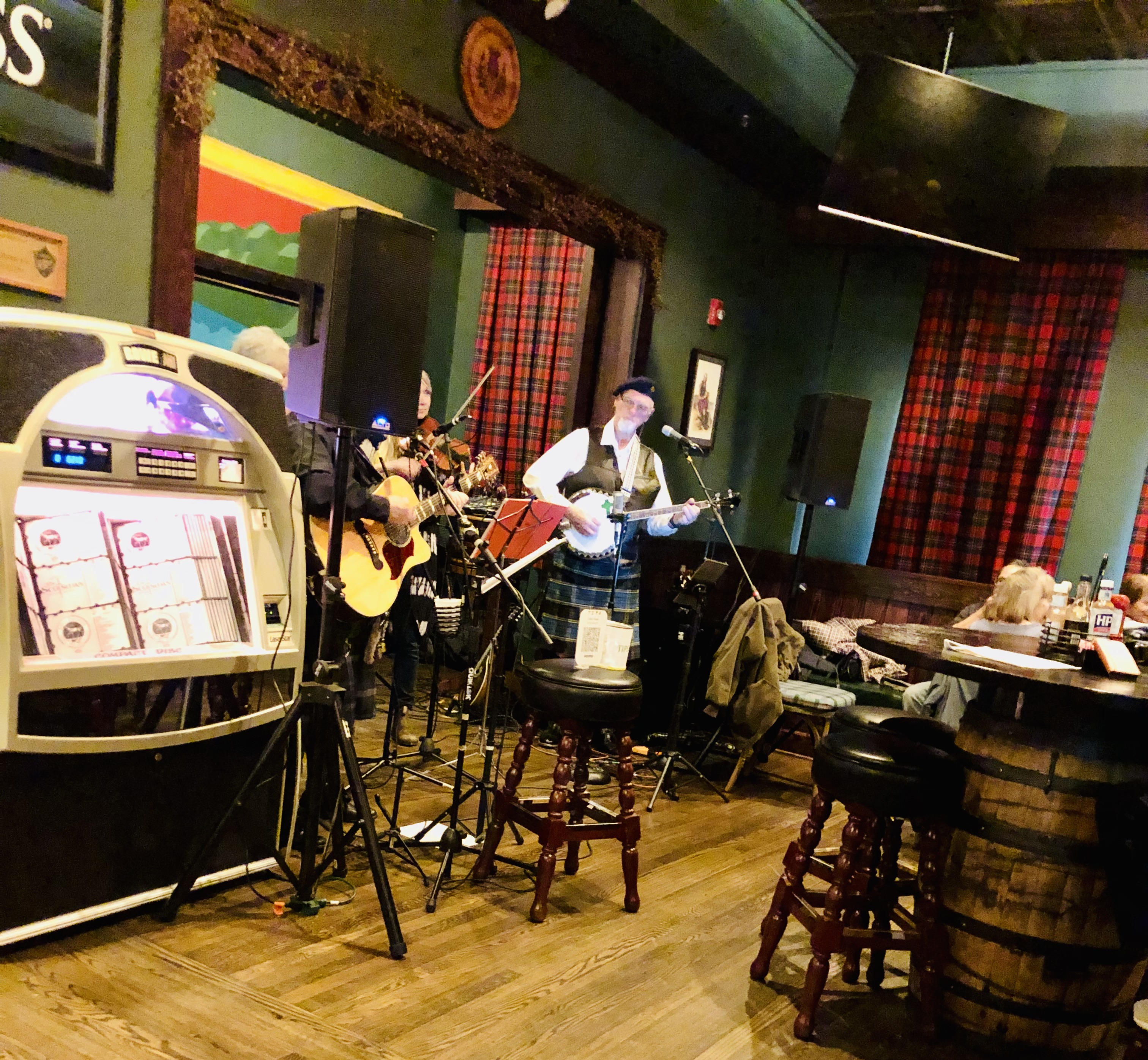
An Evening of Live Music
The Last Frontier
Hilarity Ensues
El Dorado
This was one of three versions of the plot of Rio Bravo, of which the original was best but each had its charms. For example, John Wayne rode his prettiest horse in this one.
Cf. Ivanhoe:
Having expressed himself thus confidently, he reined his horse backward down the slope which he had ascended, and compelled him in the same manner to move backward through the lists, till he reached the northern extremity, where he remain stationary, in expectation of his antagonist. This feat of horsemanship again attracted the applause of the multitude.
Horses really don’t like to do what Ivanhoe and John Wayne just did. It’s a mastery.
Insurrection and the American Project
More Such Apparent Impropriety
The Appearance of Impropriety
The appearance of impropriety is a phrase referring to a situation which to a layperson without knowledge of the specific circumstances might seem to raise ethics questions.
NYT: "No One Deserves Citizenship"
Experiencing Eternity and the Divine II
Last week's post in response to James' post garnered an interesting discussion, with Tom entering in towards the end to add the Orthodox perspective. What came out of that was a recognition for me that, while the Catholic Church incorporated Neoplatonic ideas early and then found a way to modify its theology later to accomodate Aristotelian ideas, the Orthodox are essentially applying Neoplatonism's approach to Christianity directly.
This concept that Tom is talking about, theosis, involves using the parts of ourselves that are 'like' God as a road to returning to God. In Greek philosophy, that part is the energia or activity as opposed to the matter: the word form is also sometimes used to translate the concept. Matter is ordered and structured so that it becomes a table or a dog or a particular human being, and the order is a kind of activity imposed on the matter.
(An aside: This 'order is an activity' is really true, too, at least for organisms -- Jonas' point -- because what it is to be an organism is to be an activity of taking matter from the world, as by eating or breathing, and organizing it in to the form that is also yourself.)
Since God is (incompletely) conceived of as pure energia, in that sense we have 'the image of God' in ourselves, and that likeness provides a bridge to the divine which we can follow.
Wikipedia helpfully draws out how this Orthodox concept differs from the strict Neoplatonic approach.
Naturally, the crucial Christian assertion, that God is One, sets an absolute limit on the meaning of theosis: even as it is not possible for any created being to become God ontologically, or even a necessary part of God (of the three existences of God called hypostases), so a created being cannot become Jesus Christ, the Holy Spirit nor the Father of the Trinity.
Most specifically creatures, i.e. created beings, cannot become God in his transcendent essence, or ousia, hyper-being (see apophaticism). Such a concept would be the henosis, or absorption and fusion into God of Greek pagan philosophy. However, every being and reality itself is considered as composed of the immanent energy, or energeia, of God. As energy is the actuality of God, i.e. his immanence, from God's being, it is also the energeia or activity of God. Thus the doctrine avoids pantheism while partially accepting Neoplatonism's terms and general concepts, but not its substance (see Plotinus).
To put it even more simply, Iamblicus or Plotinus thought that the matter was just another spun-out emanation from the One, and thus that everything that had proceeded from the One could (would!) return to it. Iamblicus, the later thinker, worked out a mode for attempting to approach the One by seeking grace from those spin-offs that were closer to the One than we are ourselves. This system of seeking grace from an intermediary to help you come closer to the One is obviously readily adaptable to seeking the Father through the Son, whose being is closer to God -- he is God -- but also more like us than the Father because the Son is also man.
The Standford Encyclopedia of Philosophy has an excellent article on Neoplatonism that comes from a contemporary, skeptical perspective.
The result of this effort was a grandiose and powerfully persuasive system of thought that reflected upon a millennium of intellectual culture and brought the scientific and moral theories of Plato, Aristotle, and the ethics of the Stoics into fruitful dialogue with literature, myth, and religious practice. In virtue of their inherent respect for the writings of many of their predecessors, the Neoplatonists together offered a kind of meta-discourse and reflection on the sum-total of ideas produced over centuries of sustained inquiry into the human condition....
Today, the Neoplatonic system may strike one as lofty, counterintuitive, and implausible, but to dismiss it out of hand is difficult, especially if one is prepared to take seriously a few fundamental assumptions that are at least not obviously wrong and may possibly be right.
Indeed, Einstein's revision of Newtonian physics began with a return to Plato and Platonic ideas; the problem is always that these ideas strike modern thinkers as 'lofty, counterintuitive, and implausible,' but that they often turn out to be right. Jonas too, as I said in the aside above, is really restating a truth that the Greeks had apprehended, even if Plato and Aristotle differed on how to apply it.
So it might be worth starting with that article on Neoplatonism, so we can get a sense of what the different Christian churches were bringing forward in their two very different ways. It is a very fertile field, one that produces almost every time it is sought.
Who Thought They'd Get as far as Lincoln?
A Flattering Afternoon
Today I went to the Asheville Celtic Festival to see Albannach. The Festival has a mini-Highland Games out back, and many of my Strongman friends participate. I knew my friend Noel would be competing so I went out to see him on the sidelines. He hugged me and introduced me to the other competitors.
While we were talking, the announcer saw me with him and started announcing to the crowd, “I see the stonelifters have started moving in! I don’t know if there’s a connection between lifting stones and ugliness, but if so it’s in full effect today!” Then he came over and hugged me too.
Finally one of the Master Strongmen came over and asked me how old I was. I told him, and he said, “Dude, you’re thick as ****! You should be competing!” Noel explained our friendship and that turned into a nice conversation.
I love the Strongman community, which dovetails with the Scottish Heavy athletics. It’s a great community of mutual respect, support, and friendship.
A Vagueness Problem
And while I know there will be, and already have been, complaints about the fact that this “isn’t a country song” and Beyoncé “isn’t a country artist,” I’d say the vast majority of what’s heard on country radio isn’t exactly that, either, so this really isn’t any different in my opinion.As a side note, she’s also been rocking a cowboy hat pretty regularly since the Grammy’s, if that gives you any indication on the marketing aspect[.]