Firgive vus sinna vora sin vee Firgive

A Scottish form of Norse called "Norn" long existed, especially in the Islands. The last native speaker died in the 19th century, but it survives in many place names. It was replaced by Scots, not Gaelic nor English. A form of the Lord's Prayer in the tongue survives, and you can read it at the link: at least some of the words will be decipherable to you.

What is the Norn language?

Originally known as Norrœna, Norn is an extinct North Germanic language that was a variant of Old Norse. It was mostly spoken in the Northern Isles of Scotland in Orkney and the Shetland islands but was also found in the Scottish mainland in Caithness.

Vikings who came from West Norway first started building settlements on Scotland’s archipelagos around 850 AD and this is seen as the startpoint of the Norn language evolving from Old Norse. Scottish place names with Old Norse motifs can be found scattered throughout the entire country but the “amount of place names with a Norn element” in regions like Shetland reflect how such regions were heavily colonised by Norsemen.

"Norrœna" also happens to be the name of a society that was founded by the kings of Sweden and Norway for the purpose of “resurrecting, reproducing, collecting and collating or indexing every thing that pertained to the early history of the Anglo Saxon, Celtic, Teutonic, and Scandinavian races—to furnish the people of Northern Europe with their own vital history.” The wide-ranging interest is well-captured by this Norrœna Library edition of their collection that we inherited from my wife's mother's family, who had it in Alaska in the middle of the 20th century.


My set is 15 volumes, but there were sets with a 16th on early American history.

Saxo Grammaticus wrote on early Denmark; the Volsung (Völsunga ) Saga was discovered in Iceland but is clearly related to the Medieval High German Nibelungenlied; the Heimskringla is a history of Norse (chiefly Norweigan) kings.

Again, Iceland, Iceland, two general collections of folklore widely sourced, and Sir Thomas Malory of England drawing on French sources.

It is lushly illustrated; here is a plate from the Völsunga Saga.

It's actually quite difficult to tease apart the history of the "Anglo Saxon, Celtic, Teutonic, and Scandinavian races," especially in the British Isles. The Normans who conquered and ruled (and intermarried with) both Anglo-Saxons and Celts were originally Scandinavian before they came to France; the Celtic-French collaboration we call the Arthurian cycle was later adopted by the Normans as their especial favorite mythology because it provided ancient warrant for a kingdom both in the British Isles and the French-speaking continent. 

All of this heroic Northwestern European literature was fodder for the Norrœna Society, as it is for we ourselves. 

The Collective vs. the Individual in "Nordic Philosophy"

Recently I was explaining to a college man studying history seriously for the first time the facts of the Enlightenment and the rise of what we once called political liberalism. Medieval political philosophy, I explained, often likened the society to the human body; sometimes it likened subsets of society to a body, which gave rise to the word "corporation" from the Latin word corpus meaning body. As a member of society (or such a society), your duty was derived from your function as related to the collective: just as the eye's function is to see so that food can be found, and the hand's function to grasp so that food can be obtained, the teeth, stomach, blood, etc., all have individual functions -- but they are all ordered to the common good of the whole. An eye that decided not to perform its function in a way that led to the good of the collective could be said to be diseased (is so said, by Aristotle and the Medievals who followed him). Your duty was thus defined by your function relative to the collective, so that a knight fought by right and duty, and a peasant labored by right and duty; your liberties were defined by your position in the social order, and aligned with the duties you had to fulfill. 

Liberalism inverted the idea that the individual was defined by his assigned place in the collective, and instead had a sort-of equality of rights and duties (allowing for individual differences in abilities, etc). Thus the Founders here spoke in the Declaration of Independence as later in the Bill of Rights of the rights of individuals that the collective had no legitimate power to transgress, and indeed existed wholly to ensure. Similarly, the French Revolution sat down and concocted the Declaration of the Rights of Man and Citizen shortly after defeating the king's attempt to restore his power over them, and to reduce them back from the sort-of equality they had gained into members of his collective with each their assigned place.

Strikingly, I finished this discussion, both of the modern reactions to liberalism -- communism and fascism -- attempt to restore the collective's priority over the individual. Mussolini explained fascism as a sort of 'corporatism,' drawing on the same Latin as above; all the people belonged to all the institutions, but all of the individuals and all of the institutions were to be ordered to the good of the state which was the collective whole. Communism, of course, establishes a collective which claims the sole right to own property -- no individualist ownership is permitted, nor is your work to give rise to any self-improvement of your station because 'from each according to his abilities,' but 'to each according to his needs.' 

I was thinking about this the other day when I came across this article on the "Nordic philosophy" of Jante, which is built around variations of the rule that “You’re not to think you are anything special.” The article praises the concept as helpful in building better workers; i.e., the worth of the concept is judged from its usefulness in adapting individuals into being better servants of the collective.

How different from that earlier "Nordic philosophy" embodied by Rögnvald Kali Kolsson, Earl of Orkney from 1129 to 1158. You might be inclined to reason that the Viking age was made up of pagans rather than humble Christians, but this is not the case: he was a Christian, and in fact went raiding against the Saracens in Spain and as far as Jerusalem. I own a copy of the book of his poems reviewed there (Crimsoning the Eagle’s Claw by Ian Crockatt), and it is striking how they are so often built around celebrating exactly how this individual is special. The review gives two examples that are on point, one a self-description:
Who’ll challenge my nine skills?
I’m champion at chess,
canny recalling runes,
well-read, a red-hot smith –
some say I shoot and ski
and scull skilfully too.
Best of all, I’ve mastered
harp-play and poetry.
The second is praise of another very special person, a lady of beauty and charm.
Who else hoards such yellow
hair, bright lady – fair as
your milk-mind shoulders,
where milled barley-gold falls?
Chuck the cowled hawk, harry
him with sweets. Crimsoner
of eagles’ claws, I covet
cool downpours of silk; yours.
The other two examples -- and most of the poems not sampled in the review -- are of the type. He praises his crew's special prowess; he praises his ship's special sleekness. He praises his extraordinary journey, unique and special, in traveling from Orkney as far as the Holy Land. 

These two philosophies are ironically placed: the Medieval Norse poet is celebrating individual specialness in the era of collective politics, whereas the Danish workers are celebrating non-specialness and collectivism in the era of liberalism. Perhaps both are in some sense needed, and the reaction of the individual in the corporatist era matches the desire for a collective in an individualist time.

The workers are said to be 'happier' according to the collective philosophy, but perhaps that is so only in comparison to other 20th century workers to which they are compared. The Viking seems to me to be happier than both.

Men of Harlech

This recording is apparently of the Royal Regiment of Wales Band, sung on the 120th anniversary of the Battle of Rorke's Drift, in the church at Rorke's Drift.


Alas, for fans of the movie Zulu, it is unlikely this was sung at that battle. The regiment was not renamed the South Wales Borderers until two years after that battle, the regimental march at the time was "The Warwickshire Lads," and while there were a number of Welsh soldiers there, it seems likely that the majority were English.

Still, a rousing song for an army defending its people from murderous invaders.

By Wolf Lake


A Medieval Tattoo

A Chi-Rho with Alpha and Omega has been discovered on preserved flesh from a burial at the Medieval Christian site Ghazali in Africa. It’s thought to be early Medieval, when the Chi-Rho was a popular Christian symbol: the earliest accounts of King Arthur have him using one on his shield, not the Crusader crosses that became popular centuries later and are more commonly pictured in Arthurian art. 

Can't Get Enough Outlaw Tunes


A Stroll in Downtown Asheville


This was from yesterday. That’s one block from the Mellow Mushroom, so I know where they were headed. 

Outlaw Songs

It's a fine Friday. We'll sing some good songs.


Sing It

A Federal judge knows some lyrics.
People have heard about the Robb Elementary School shooting in Uvalde, Texas. They have heard about Sandy Hook, Parkland, the Pulse nightclub, and other tragic mass shootings. But they do not hear of the AR-15 used in Florida by a pregnant wife and mother to defend her family from two armed, hooded, and masked home intruders. As soon as the armed intruders entered the back door of her home they pistol-whipped her husband — fracturing his eye socket and sinus cavity. Then they grabbed the 11-year old daughter. The pregnant wife and mother was able to retrieve the family AR-15 from a bedroom and fire, killing one of the attackers while the other fled.

It does not require much imagination to think what would have happened next if the woman had lived in California and could not possess such a firearm. People do not remember the disabled 61 year-old man living alone on a 20-acre property in Florida with dense woods and a long dirt driveway. After the homeowner had gone to bed, three men armed with a shotgun, pistol, and BB gun invaded. One wore a “Jason” hockey mask. The disabled victim said he was awakened by a loud noise and grabbed the AR-15 laying near his bed. He saw the masked man and a second man coming toward him inside his home. Gunfire was exchanged. By the time police arrived, one attacker had run away, one lay wounded outside, and one was dead on the dining room floor. Police found the disabled man in his bedroom alive, but bleeding from a gunshot wound to the stomach. The AR-15 lay across his legs. Without his modern rifle, the victim would have become an evidence tag and a forgotten statistic.

People do not hear about the AR-15 used by a young man in Oklahoma to defend himself from three masked and armed home invaders clothed in black. The three intruders broke through a rear glass door. Though outnumbered, the homeowner put up a successful defense with his AR-15.People do not hear about the AR-15 that was needed when seven armed and masked men burst through a front door at 4:00 a.m. firing a gun. Outnumbered seven to one, it took the resident 30 rounds from his AR-15 to stop the attackers.

But he did, though. 

Populist Songs

VDH has a discussion of Oliver Anthony, the artist Douglas introduced us to just before he became a sensation.

After Anthony rails against high taxes, a worthless dollar, and ossified wages, he suddenly and strangely pivots both to Jeffrey Epstein—as the incarnation of the corrupt rich—and the subsidized morbidly obese as proof of the baleful effects of the entitlement industry on the poor. Variatio in themes and expression, as the ancients remind us, is the key to good prose and poetry, and Anthony’s song is anything but predictable in its targeting of both the masters of the universe and the welfare class.

That set of lines drew most of the wrath, but it makes a lot of sense. If the anger at the system is appropriate, as it certainly is, you should be able to show both that those who run the system are bad, and that those who are affected most by the system are harmed by it. The accusation is not that the poor on welfare are bad people, but that they are being actively harmed by the system that allegedly benefits them.

One libertarian critic, David Henderson, writing for the website Econlib, complained that Anthony doesn’t understand that “some rich people want to reduce the amount of power the government has over us.” Finally, another commentator on the right, Stephen Daisley, writing for The Spectator, penned an article that was subheaded “Roger Scruton would have thought this country hit was worthless.” The Scottish opinion journalist further groaned of the song’s lyrics, “That is dreck. Doggerel. Objectively bad writing. . . . ‘North of Richmond’ is a squall of hoary nostalgia and pedestrian populism.” Daisley apparently assumes that Anthony should have been a polished literary polemicist rather than a talented failure turned wildly successful singer who wrote from the underbelly of America—a vantage point quite different from Daisley’s own perch.

Well, it wasn't for them. It was for everybody else. 

For this particular elite, rural America’s assumed bias, racism, and sexism offer a tempting target for virtue-signaling, airy lectures, and self-righteous stereotyping. Through a near-medieval sort of exemption, elite progressives relieve the burdens of their own racial guilt by transferring the charge of supposedly unearned white “privilege” to those who rarely had any innate advantage at all.

This is the best insight of the piece. The fact is that working man's wages aren't less affected by these disastrous policies if they're white or if they're black. What he's angry about isn't the things that his critics would like him to be angry about. He's angry that the government is actively harming its citizens rather than actually helping them. It's a betrayal of the mutual loyalty that government is supposed to entail. 

Arguing in favor of that mutual loyalty is, for this elite, itself an affront. The idea that the American government should principally help Americans to prosper and live safe, meaningful lives is described in negative terms like "populist," "white supremacist" (though many Americans are not white, and would benefit right alongside those who are) and even "fascist." 

The concept is actually a necessary condition for any legitimate governance. Even in a feudal society, the king depends upon the knights who, in return for their establishment, keep the king in power. The knights depend upon the king, but also upon the people who farm the land. The knights provide protection in both directions, when the system is legitimate: they protect the king and his order, but also the people from bandits and predation. When that works ideally, the system has a kind of legitimacy.

Lately the idea has become fashionable among the elite that universality rather than loyalty is the mark of legitimacy. We should all live under the same rules, not favoring Americans more than Iranians or the People's Republic of China. That shows we aren't prejudiced, they say; and the fact that the Chinese or Iranian governments don't feel the same way (Iran still holds an annual "Death to America" day) just proves that we are the more evolved and better.

If that sounds like madness, it is. It's all bad philosophy. They read Kant, but they didn't grasp that Kant's attention to the universal didn't mean that he wouldn't believe that you owed more to your father than to any random stranger on the street. 

For those who still believe in bonds of honor, there's this song.

Worldwide Caution

The State Department today issued a worldwide alert for Americans traveling abroad. It's an Orange Alert worldwide; in the Middle East it's Red

The President's decision to hug Netanyahu for the cameras has put a target on the back of every American everywhere. I don't know if any of you are traveling abroad soon, but take care if you are. 

Amazingly, we're also sending "Gaza," meaning Hamas, a bunch of money.
The humanitarian assistance, along with $100 million in new U.S. funding for Gaza and the West Bank announced by Biden, could provide a critical lifeline to Palestinians in the besieged territory where water, food, fuel and medicine are in desperate need.

I suppose it could do that, like the six billion to Iran could have been used for "peaceful purposes."  It's been obvious for a long time that we are governed by fools, but it doesn't seem to get better as time goes along.


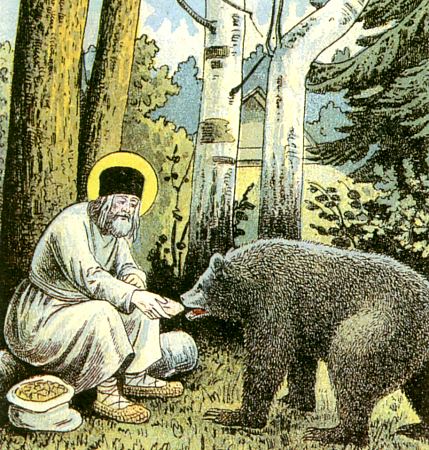
The Hermit Saint Seraphim of Sarov

Grim sent me scrambling off to learn what eremetic means, and I ran into this drawing of St. Seraphim of Sarov, which just seemed appropriate for the Hall.


He is said to have spent 25 years in the wilderness, although a wilderness near a monastery.

The Autumn and the Winter

An incredible photo from the mountains above Waynesville shows snow on the autumn color

The Evening and the Morning

Two shots from the same location today. 


A New Law of Nature

For a long time it's been clear that Darwinian Natural Selection and random mutation-based Evolution couldn't be the whole story. For one thing, progress is too quick for the process to be purely random; there has to be something informing what kinds of mutations arise, not just a brute-force extinction mechanism to wipe out nonadaptive ones. Likewise there are examples like the multiple evolutions of crabs (five separate times we know of). Something must be guiding the process along lines that make a kind of sense.

Today I see that scientists have proposed an answer to this problem. 

[N]ine scientists and philosophers on Monday proposed a new law of nature that includes the biological evolution described by Darwin as a vibrant example of a much broader phenomenon, one that appears at the level of atoms, minerals, planetary atmospheres, planets, stars and more.

It holds that complex natural systems evolve to states of greater patterning, diversity and complexity.

"We see evolution as a universal process that applies to numerous systems, both living and nonliving, that increase in diversity and patterning through time," said Carnegie Institution for Science mineralogist and astrobiologist Robert Hazen....

Titled the "law of increasing functional information," it holds that evolving systems, biological and non-biological, always form from numerous interacting building blocks like atoms or cells, and that processes exist - such as cellular mutation - that generate many different configurations. Evolution occurs, it holds, when these various configurations are subject to selection for useful functions.

It's going to take a while to see if this holds water, as is the way with the scientific method. The problem they're treating is real enough, though, so it's good to see them trying out a new theory.

There are a number of second and third order questions that will arise if it does. It's going to have implications for the Fermi Paradox, for example. Of greater interest to me, it has implications for panpsychism and other questions around 'the hard problem' of consciousness. 

M-SAR

Yesterday AVI had a post called "Mountains and Nature" that was, I think, allied with his series of posts about naturalism, vegetarianism, and the like being aligned with Germanic paganism and therefore nazism (of the real sort, not the MSNBC sort). In it he quite correctly argued that early Christians viewed the city as the model for heaven rather than the Wild -- think of St. Augustine's City of God

Mountains have not always been considered beautiful. The Psalmist says that he lifts up his eyes unto the hills, and only then asks, "From whence cometh my help?" He never says that the hills are where his help comes from.  That is an entirely modern interpretation, post Romanticism.  

It was the Romantics who believed that we learned about God through Nature. They had gotten the idea from Puritans and other NW European Protestants, who indirectly inherited it from the concept of Wyrd among the pagans of that region. I discussed that in detail in 2010. (Be warned.  It's a series) 

I commented yesterday in agreement, noting that the Medievals and even Tolkien had made much of the garden, but viewed forest and mountain with grave suspicion -- at best, as places for adventure and spiritual development; at worst, places for madmen and outlaws. Somewhere in between the spiritual and the mad lies the hermit/eremetic ("desert") tradition that is said to have given rise to monasticism, but the monks built gardens and not wildernesses: not even St. Francis did that. 

...wonderful places like Rivendell and Beorn's hall are kinds-of gardens 'on the edge of the Wild,' where travelers can rest and regain strength after a challenging passage through dangerous mountains and forests. Forests, especially Mirkwood but even the old forest right by the Shire, follow the medieval presentation of being dangerous, frightening places.

And so they are; I have been through the certification course for Wilderness Rescue, which comes up regularly out this way. People get lost, hurt, and need rescuing when they go into the wilderness: not every time, but all the time.

I had the opportunity to reflect on this discussion last night, when a Mountain Search and Rescue call went out for a lost hiker, with the weather coming on 35 degrees and humid. We were out past 2 AM doing tight grid searches in a region of mountain wilderness, replaced by others who searched until dawn when we returned for another round. The hiker was eventually found alive, cold and rather viciously scratched up by the thickets of rhododendron and thorn. 

One can say without question that Bilbo Baggins or the Arthurian knights would hardly have been the admirable figures they became without the testing hardship of the Wild. In Tolkien, too, there is a third mode available to the elf whose faerie-like ability to live with the Wild is something like the hermit's, a kind of sacred existence that embraces the genuine wilderness in a way ordinary people can not do. Clearly Tolkien presents his elves as being metaphysically closer to God, beings among whom the angelic maiar walk and even marry. Even the fairy wants for a higher-fairy bride!

It's the sort of place a man can love, though; and for some of us, who hate the cities, the Wild is a happier place. It does require much from a man, and is more difficult to love in the middle of a cold night in a thicket on a steep mountainside. Even then, it is not entirely without its joys. 

We did find a bear on that midnight search. He was above hip-high when sitting down, and not especially inclined to run as many of them are. Eventually, he let us continue our search without incident.

Student Life as a Con

In an article AVI linked from the New Criterion, there is an aside that happens to align with something I was thinking about myself recently.
In the university context, such an inquiry might explore why student debt has gone up from $300 billion in 2000 to $2 trillion today. The cop-out answer is that the $2 trillion of student debt went to pay for $2 trillion worth of lies about how great education is. In my view this reading is too generous. How much of that $2 trillion actually went to education as opposed to room and board? If you analyze the universities in economic terms, you might even conclude that the dorms and residences are the profit center driving an elaborate real-estate racket. And this is not to mention the web of offices and administrators tasked with overseeing not education but “student life.” Scale this model up, and you begin to understand why it’s so hard to exist outside of a big city in the United States—a vast country with swaths of empty space and lots of affordable housing—and why those deplorables who leave the reservation are viewed with such disdain.

When I was walking around the local university, with the very-nice-looking dorms with racy slogans in the windows, I was reflecting on how much the university experience has become a kind of con. Take out the student loans, and you get to start your adult life -- the first time you live away from home -- in a nice little apartment with excellent gym facilities, trash pick-up, plumbing and utilities included, nicely kept grounds, football games and other sporting events available, regular plays and a cheap/free cinema, etc., etc. Your introduction to adult life in America leads you to believe that this is what life is like.

Then you get out and you have to start paying those debts back. Cheap housing in the cities is increasingly impossible to find. Even outside the cities, AirBnB and other short-term rentals have made even small towns expensive places to live, if you can find rentable spaces at all. (Just try it in Jackson, WY -- or even out this way in one of the little towns like Cashiers or Sylva).

Can you get a job with that degree you got? Maybe, if you were savvy in choosing your major. If not, you can always go to grad school and try to get a doctorate so you can teach whatever it was -- for another six figures in student loans, that is, entering into a job market for Ph.D.s that often sees hundreds of applicants for every tenure track position. Nobody explains this to the prospective students, who are sold the line that 'if you choose to do something you love, you'll never work a day in your life.' That may be true in the ironic sense that you'll never find a job! 

Even for those who succeed in getting a white-collar position that pays reasonably well, it's going to be hard to recapture the quality of life that they became accustomed to in college life. Setting their expectations that campus life was what adult life is like -- and with all these attendant luxuries now, paid for by those ever-increasing fees they can charge because they are covered by student loans -- sets them up for disappointment, anger, and a lifelong load of debt that is functionally just another tax they have to pay to the government (who now owns all student loans).

The promises of the university are increasingly fraudulent. It's still possible to go to school and get a job and life a decent life that way, but only if you dodge the system they have set up for you and are very choosy about the parts you accept. The cost of even that successful model is also going to be a lot higher than anyone will explain to you.

Atholl Brose

Speaking of drinks and history, here is an article on a Scottish oat-milk-whiskey concoction with a folk tale background. Along the way you’ll learn a lot more about the history of mixed drinks. 


Self-Hate Embraces Hate

A British writer notes a long, appalling trend. 

La France

My associate in France — Cannes— sent this picture this morning:

They’ve deployed 7,000 soldiers to their streets following a stabbing attack. Infantry units are kind of “disproportionate” to a knife attack, unless you are following the technical use of the term (see comments here).