Grim's Christmas Barbecue Sauce

Cast iron cooking gives the best flavor.

A year or so ago I posted a recipe for barbecue sauce. I have a Christmas version that differs slightly, which I made today in order to ship as gifts. I've also refined my technique slightly as I will explain. Here are the recipes, both the Christmas version and the original for ease of reference. 

Grim's Christmas Barbecue Sauce

Tomato powder (see note) or 1 can (8oz) tomato paste
Several cups brewed black coffee (more if using tomato powder)
1 tbsp packed brown sugar
1 tbsp blackstrap molasses
1 tbsp onion powder
1 tbsp garlic powder
1 tbsp chipotle powder (a smaller amount of cayenne would be more typical for a Georgia sauce, but the larger quantity of chipotle adds to the smoky flavor)
1 tbsp smoked paprika
1 tsp chili powder (or just ancho chili powder)
1 tsp black pepper
Small shot, Apple cider vinegar
Full shot, Rye whiskey
Salt to taste

The major differences from the original are the addition of Rye whiskey, the increase in smoked paprika to a whole tablespoon, and the use of tomato powder. 

This last is an innovation my wife and I have discovered as part of our ongoing Victory Garden efforts. I always make many gallons of spaghetti sauces and various salsas at tomato harvest time, which I can in an over-the-top water bath as it is sufficiently acidic for that method. We still have lots of tomatoes. In the past I've run these through a dehydrator and sealed up like sun-dried tomatoes, but this year my wife learned to make them into tomato powder instead. By crushing the dehydrated tomato slices into powder, you can seal them up with an oxygen absorber that can almost entirely eliminate oxidation. The powder is then shelf-stable for up to 25 years.

At first I didn't know what I'd do with tomato powder, but it turns out to be a real advantage in the kitchen. It allows for a very fine control over both the tomato-y-ness of the sauce, stew, chili, or whatever else you are making; and it's a great thickener. You can add another dash, a teaspoon, a cup, or whatever else you'd like to achieve the desired thickness and tomato flavor. I highly recommend it. 

Tomato Powder.

I also learned to make Hungarian Chicken Paprikash this year, and learned thereby that you can use much larger quantities of paprika to create a richer sauce. I thus tripled the amount of smoked paprika (and only smoked for this version: with the chipotle, it gives the sauce a spicy, smoky kick).

The original sauce was a Georgia-style spicy tomato-based barbecue sauce. The major difference between that style and the eastern Tennessee style is whiskey. This version is for gifting, and all my family is from east Tennessee. I tried Tennessee whiskey in it, but the corn flavor is unpleasant to me. Rye whiskey compliments the spiciness nicely. I used Bulleit Frontier Whiskey Rye.  

If you use the 8oz of tomato paste, you'll only need maybe four cups of coffee; if you use the tomato powder, you'll need to add quite a bit more (or hot water if you prefer to keep the coffee content near the original). Once it's all cooked together, adding water and/or tomato powder to give it the desired flavor and thickness, this should produce almost exactly one quart of sauce. I recommend dividing this into two pints and over-the-top water canning it, which allows it to be stored or shipped as gifts to appreciative family or friends.

The original recipe is below for ease of reference and comparison. 

Grim's Barbecue Sauce (Original)

1 can (8 oz) tomato paste
Several cups brewed black coffee
1 tbsp packed brown sugar
1 tbsp blackstrap molasses
1 tbsp onion powder
1 tbsp garlic powder
1 tbsp chipotle powder (a smaller amount of cayenne would be more typical for a Georgia sauce, but the larger quantity of chipotle adds to the smoky flavor)
1 tsp smoked or hot paprika
1 tsp chili powder (or just ancho chili powder)
1 tsp black pepper
Small shot, Apple cider vinegar
Salt to taste
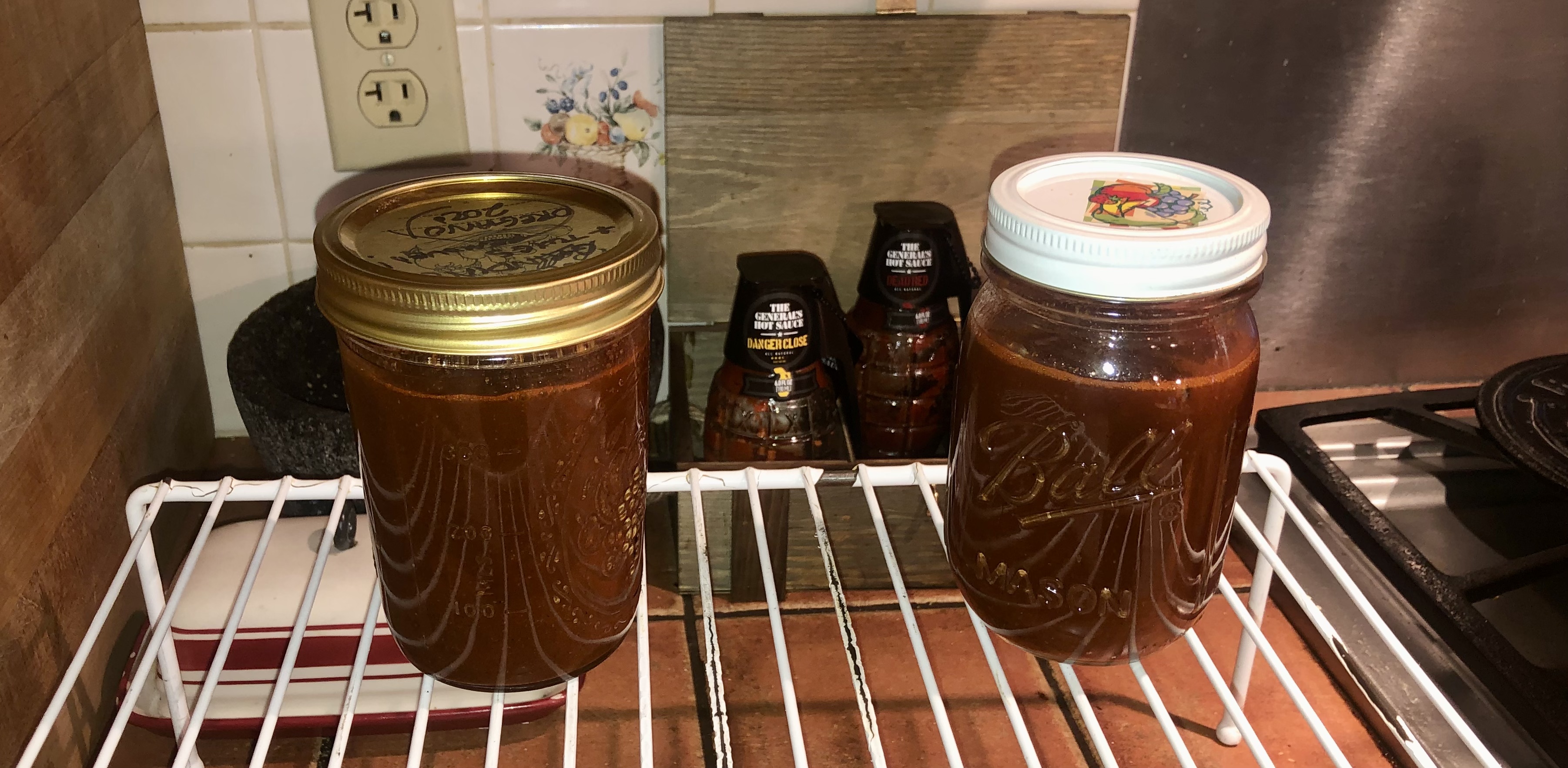
UPDATE:
Canning complete. 

UPDATE:
While I had the canning gear out, I also whipped up some fire-roasted mango habanero salsa. That’s not a secret recipe or anything. 

草泥馬

When we lived in China many years ago now, my wife and I encountered a form of Chinese humor that is really quite dominant there: the homophonic pun. Chinese is a monosyllabic language: every character is named by a syllable, and there being only so many monosyllabic sounds you can make, many of them sound exactly or almost exactly alike. Some of them differ in tone -- Chinese is a heavily tonal language, with a big difference in meaning possible if you employ this tone instead of that one in sounding the word. Others of them don't differ at all, and you just have to know that two different meanings are possible. 

An interesting work project lately has been researching Chinese anti-regime online protest language. An important figure is the mythical Grass Mud Horse, which fights the evil River Crab. The words for "River Crab" are a homophone for "Harmony," the excuse the regime uses for censorship online; and the words for "Mud Grass Horse" are a homonym for "F*** your Mother." 

Also, the Chinese Communist Party is colloquially referred to as "Mother."

The Cantonese dialect -- like many dialects -- uses the same writing system as Mandarin and all* the other Chinese languages, but the characters are pronounced differently by verbal speakers. What that means practically is that a whole different set of puns are possible if you speak Cantonese, like they do in Hong Kong, and the Mandarin-speaking Party elites can't really censor them because they don't understand the jokes. They don't realize what is being said, and so Cantonese protest puns are going wild right now in spite of the whole PRC Great Firewall effort.


* Except Cantonese as used in Taiwan. This uses the original, traditional form of the written language; all of the People's Republic parts have switched to 'Simplified' Chinese characters. For example, the Chinese people is written in Simplified Chinese as  汉人; in traditional Chinese 漢人.

Easy tree

Putting up and decorating a large, natural Christmas tree was fomenting domestic discord, so for the last several years I've been experimenting with faux bare-branch beech trees. This tree uses mostly crocheted snowflakes, paper Froebel stars, and crystal pendants.

A Partial Defense of E-Cars

The author is not successful in establishing his thesis, which would require a defense of the massive issues around batteries and e-waste. He does, however, have an interesting claim about power generation. A regular critique is that electrical cars are powered mostly by electricity generated with coal. He points out that, even if it were 100% coal-generated power, e-cars would still have a significant advantage.
Even if you only ever burned coal to create the electricity to power EVs, that's still less CO2 than is released by burning gasoline.... ICE ['internal combustion engine'] vehicles only send between 16 to 25 percent of the energy created from burning gasoline to the wheels. The other 75 to 84 percent is lost due to inherent inefficiencies. Most of the loss is heat and noise, although about 10 percent is sacrificed to stuff like drivetrain losses, essentially the difference between crank horsepower and wheel horsepower.... 
Electric vehicles (eventually) send 87 to 91 percent of the energy in the battery to the wheels. I say "eventually" because 22 percent of that energy needs to be "recaptured" through regenerative braking. Put another way, 31 to 35 percent of the energy stored in the battery is lost for various reasons, but 22 percent can be regenerated by the "brakes."... To summarize, replacing gasoline with coal (which, for the record, is an abysmal idea) would reduce energy usage by 31 percent. Another way to think about it: Right now, Americans use about 9 million barrels of oil a day for our automotive transportation needs. Magically switching to EVs charged via burning coal would result in only needing the equivalent of about 6 million barrels. That's a big reduction. 

That seems like a significant rebuttal on the one point, at least. 

Scaramouche

After Captain Blood, I decided to give Sabatini another try and read Scaramouche.

I definitely learned more reading this book than the prior one, whose background material was well-known to me. I had never really encountered the Italian theatrical tradition commedia dell'arte on which it draws so heavily (including for its title). The form uses stock characters who, instead of having lines, are put into scenarios and asked to improvise a performance that is different every time. Because the stock characters are well known to the audience and have obvious costumes to designate their role, the audience can quickly ascertain the motivations at work on stage and understand the comedy. 

Sabatini decided to draw heavily on this for his own storytelling. He regularly refers to a character as being "a Rhodomont" or "our Pantaloon" in order to convey to his audience what role to expect them to play. This conveys nothing but confusion until you study the form enough to have some notion of who those stock character are. A Scaramouche is a 'skirmisher,' one who engages in or provokes fights but then flees from them -- somewhat like the little dog that will start a fight among the big dogs and then go hide while they have it out. 

I shall put the rest after the jump, to avoid spoilers in case any of you want to read the work.

Herschel Walker Loses in Georgia

I would not have thought that Herschel Walker could lose an election in Georgia, but he did. A friend points out that he might have simply waited too long to run: the median age in Georgia is 38, meaning that most voters weren't even born when he was leading the Bulldogs on the gridiron to their national championship. They wouldn't have been old enough to know who he was until he was long gone from Georgia. 

It is also true that he is not well-spoken.  His English is poor at times, and his ability to express his thoughts is limited. He can come across as unintelligent.  On Saturday Night Live, Dave Chappelle -- whose comedy is praiseworthy for its courage and truthspeaking, generally -- called him stupid. He made that remark in a performance that otherwise attempted to save the career of Kanye West for remarks that were surely as stupid as anything Walker ever said.

Chappelle also used to give a performance designed to show O.J. Simpson in his best light. While acknowledging that Simpson surely killed his wife, Chappelle could praise him for his remarkable football career and manners. No similar accord is granted Walker, who was accused of far less serious things than murder. The media has done much to find women who would often simply say that he wasn't nice to them. "One, who was involved with him in 2006, said: 'Having Herschel Walker lose this very important Senate race tonight not only vindicates that democracy has won but the women that he betrayed, have won.'" I suppose he was a philanderer, like Bill Clinton; or perhaps like Ted Kennedy, who like the Juice actually also killed a woman. It is no matter, though, because they were favored by our cultural institutions. 

His opponent, meanwhile, could go on television and literally claim that Jesus favors abortion and only receive laudatory remarks for it. Indeed he ran on it and was portrayed as saintly for his views.

Ultimately I am saddened to see that a boyhood hero has not proven to be as good a man as my boyish self might have hoped him to be; and deeply dismayed to see that support for abortion -- not merely as an occasionally-necessary but tragic medical procedure but as if it were somehow a good and desirable thing -- has taken root in the state of my birth. It is a sad day to see self-described men of God claiming it in the name of God, and being rewarded with praise and power. I left Georgia quite a few years ago now, and will never be back except perhaps to visit; but it is sad to see the moral state into which it is falling.

Pearl Harbor Day

This year the main story out of Pearl Harbor is Red Hill. Built after the Japanese raids, it is an under-mountain fuel facility that is proof against aerial bombardment. It is also now very old, and subject to fuel leaks and toxic spills affecting the water table. 

It is understandable that the people want it cleaned up, but the strategic importance of a secure fuel facility hasn’t changed. If anything we are closer to renewed attacks on Pearl Harbor being possible than at any time since the end of the Cold War, maybe even since the end of WWII. Instead the plan is to move fuel to ships at sea, which are vulnerable to air attacks and submarines. 

Thirteen Silver Dollars


The Evil State

In the discussion to the Riddle of Steel post below, a matter has come up that deserves its own discussion.  

Blogger jabrwok said...

The State is just a way of organizing human beings. It's neither intrinsically good or evil, any more than a gun or automobile or whatever.

A definition of "evil" would be useful here. I'd say "evil" is any action which undermines social trust (some actions do so more than others, hence greater and lesser evils). States can certainly *engage* in evil, and have a lot more power to do so than individuals, but I wouldn't say that a State is *inherently* evil.

E Hines said...

States can certainly *engage* in evil....

This is another misapprehension. States do nothing at all; they're merely, as noted, a means of organizing. That organization, though, is populated by particular men and women. It is those men and women who engage (no quote marks needed) in any action, and those men and women can use or abuse that organization's power to more or less good (however defined) or more or less evil (however defined).

It's important, too, to keep in mind that those definitions of good and evil, while perhaps originally the definitions of the population who created their State organization, quickly become the changing definitions of the changing men and women who populate the organization.

Grim said...

St Augustine says that evil is, purely, a privation from the good intended by God in creation. I think the administrative nation state we have today is an evil in that pure sense. Humanity organizes naturally into families; Aristotle claims that it organizes even more naturally into polities, because (he claims) that is the only place where humanity's full range can be realized. In a polity, one can be free of oppression by other families or clans or bandits; one can enjoy a sort of equality with others that is not found in nature; one can take actions as a member of that polity to govern one's self and to express one's virtues through practical action. One can help others in the community express their own virtues by electing them to other offices to which they are well-suited.

Weber's criticism of the administrative state -- you can read my notes on it by following the links at the sidebar -- shows clear privation from these goods. The need of the elected officials to constantly run for office means that they have to defer their powers to administrators who aren't elected; this means that the good of self-governance is lost, because the people we elected don't end up being the ones with power over our lives.

The need for money for those campaigns means that the elected officials also end up chasing donations instead of doing good to deserve election; that means they don't actually end up doing even their limited duties, or exercising their limited virtues.

The need to use power to perform favors for donations is inherently corrupt. It also draws into the political class not the virtuous, but the most successful at corruption.

It also creates an administrative class that is both unelected and really powerful, thus eliminating the sort-of equality that free citizens had with each other.

Thus, all the goods intended by human nature -- according to Aristotle -- end up being achieved either not at all or only privatively. Thus, per Augustine, the state is evil: and really evil, not just rhetorically evil.

E Hines said...

Except it's not the State doing any of that. It's the men and women populating the State. The State is just a tool.

Grim said...

Yes, but at the same time also no. It's true that only living beings, and not formal organizations, can act -- yes, in that sense. But it's also true that the form of organization creates effects, even they aren't willed actions. One form of organization has a structure that does the one thing; the modern administrative state's structure does the other. It's not that the right people, choosing the right things, could fix it. The right people won't be successful in obtaining offices under this structure; should they by accident, they couldn't keep them over successive cycles without becoming corrupt; the elected offices don't end up having the power to fix the problems anyway because it gets delegated to administrators; and the administrators interests are necessarily separated from those of the governed so they are sorted into separate classes.

It's similar to the materialist/immaterial issue. One can say that 'only material things exist,' and in a way that seems true: everything we can observe is composed of material parts. But it really matters how those parts are organized. The same parts can be organized into a table, and it will function as a table and provide the goods for which a table was wanted. Or they can be organized into a loose heap on the floor, in which case it's all and only the same parts -- but the form of organization prevents them from attaining any of the goods that they might have if they'd been organized into a table instead of a heap.

My sense is that the Conan-style band of adventurers is a kind of political organization, non-family members choosing a leader and striving towards a common goal, each contributing according to their own virtues and by voluntary participation. That's an ideal, more Homeric than Aristotelian as it does not attempt (nor really contemplate) the sort of organization that would entail all of the human goods that Aristotle wants from the polis

Dying in a flood

For some reason we got dramatically better at preventing coastal flood deaths just at the turn of the millenium. I can't think of a good explanation, especially for worldwide statistics. Otherwise climate risks look pretty steady.

Medical Research and Safer Motorcycle Rallies

Although a bit dark, the article does have some mild suggestions to make motorcycle rallies safer:


The research, which appears Nov. 28 in JAMA Internal Medicine, shows that in the regions where the seven largest motorcycle rallies were held throughout the United States between 2005 and 2021, there were 21 percent more organ donors per day, on average, and 26 percent more transplant recipients per day, on average, during these events, compared with days just before and after the rallies.

...

Bike rallies are generally large, crowded events that take place in rural areas or small towns with traffic infrastructure intended for much smaller populations and far less traffic, the researchers noted.

This means that to increase overall safety for all motorists and pedestrians, event organizers should pay close attention to overall traffic management in addition to encouraging wearing of helmets and safe motorcycle operation.

Von Mises Learns the Secret of Steel

A post at the Foundation for Economic Education on our favorite riddle
It was not until many years later, while studying Ludwig von Mises’ text Human Action, that Thulsa Doom’s answer made complete sense to me. Mises, like Thulsa Doom, understood that power comes from action, and ideas are what drive human action.

“Ideologies have might over men,” Mises wrote. “Might is the faculty or power of directing actions.”

When Thulsa Doom, with a mere word, beckens a beautiful young woman to throw herself from a cliff, he’s showing Conan his power, or what Mises called “might.”

“Might is the power to direct,” Mises wrote. That power, Mises understood, stems not from swords or “steel,” but ideas.
“He who is mighty, owes his might to an ideology. Only ideologies can convey to a man the power to influence other people's choices and conduct. One can become a leader only if one is supported by an ideology which makes other people tractable and accommodating. Might is thus not a physical and tangible thing, but a moral and spiritual phenomenon.”
This is what Thulsa Doom meant when he says it’s not steel that’s strong, but flesh. The person who can use ideas to command people is a person who has true power, true might.

Unlike Thulsa Doom, Mises of course saw power as a dangerous and corrupting force, which is why he opposed concentrating might in the most powerful, and deadly institution in modern history: the state.

Doom too, in fairness:  he was intending, at the time of his death, to sweep away all the governments of the world in an epic of murderous assassination. There is no reason to think he meant to replace them, as their continuing absence would eliminate any institution with the ability to oppose him and his cult. 

Ironically that is the only defense for the existence of any state: such things are inherently evil, but they are effective forms of organization for opposing other organizations that are also evil. You end up having to set the evils against each other: the state against the corporation, the cartel, the mafia, the murderous cult. 

The question is whether there is a way to organize along voluntary lines, as Conan's band of adventurers, to hold back the other evils without needing courts and police, law and taxation, prisons and gallows.

Alternative Eugenics

The Orthosphere offers a striking proposal on the fall of Rome. It was at one time a commonplace among historians that Rome had failed for demographic reasons, but these were usually said to be matters of the will. Romans wouldn't serve in the Legions anymore as they became wealthy and lazy (to summarize entirely too quickly), and thus foreign mercenaries had to be recruited as auxiliaries. These auxiliaries came to be powerful enough that the various Germanic tribes were ultimately in position to seize whole portions of the Western Empire, and finally Rome itself. 

Since these histories were being written during the age in which eugenics was a popular theory among the scientifically-minded, one might have expected them to argue that the Romans' superior stock was out-bred by or cross-bred with inferior foreigners. For the English-speaking and German-speaking and French-speaking communities of historians, which together were most of the whole community of historians in that age, such talk was absurd. They were racists, of course, but talk of Germanic tribes like their own being inferior to Italians (often described in period documents as "swarthy," itself a Germanic word with racist connotations) would have been rejected out of hand. Obviously, for an early 20th century eugenicist, the Romans must have been improved by the association.

The Orthosphere's proposal is at once eu/dysgenic and yet not racist. That's what I find striking about it.
There was more than one cause of this depopulation and degeneration, but the greatest cause was removal of virile males from the breeding population so they could fight and die in distant lands.  As the great classical historian (and eugenicist) Otto Seeck explained,
“Only cowards remained, and from their brood came forward the new generation. Cowardice showed itself in lack of originality and in slavish following of masters and traditions.”***
Imperialism is profoundly dysgenic because when you “send forth the best ye breed,” you can no longer breed the best.  The American sage Benjamin Franklin saw the dysgenic effect of mass conscription and believed it must invariably undermine a militaristic people with depopulation, degeneration and collapse.  While he was ambassador to France, Franklin observed:
“A standing army not only diminishes the population of a country, but even the size and breed of the human species.  For an army is the flower of the nation.  All the most vigorous, stout, and well-made men in a kingdom are to be found in the army, and these men in general cannot marry.”†

This differs of course from our own standing army, in which one of the first things young soldiers tend to do is marry in order to get out of the barracks. Still, they do have a point to make about our own society as well as ancient Rome: the fact that we are putting off marriage and childbirth for the most intelligent and successful of our young men and women may well be having a negative effect on the quality of the population overall. 

Eugenics in terms of selective breeding is discredited in politics, but widely practiced in animal husbandry. Setting aside silly notions like race, different people like different animals are differently able and intelligent, and we know that these qualities are heritable to a degree. If the less able and intelligent are breeding early and often, and the moreso later and less, over time it will tend to result in a population that is weakened. 

It's a challenging idea, one that I advance for discussion with caution given the evils plainly associated with human eugenics. Regular readers of the Hall are a good group, though, and can be trusted to handle such ideas with due care. 

A Fearsome Prediction for Taiwan

Japan in 1941 wasn't always bent on war with the United States; but it was bent, from the late 19th century, on becoming a high tech economy. Following the Meiji Restoration the Japanese culture began inviting Westerners to come consult on everything from banking and policing to ship design -- they beat Russia in the Russo-Japanese War -- and redesigned its whole society accordingly. Then they began imperialistic expansion, which pressed further and further into territories the United States felt weren't acceptable. When we cut off their access to modern steel, it threatened Japan's whole model. War was the result of these sanctions as much as anything else.

The Biden administration introduced crippling sanctions on Chinese semiconductor production this year, which go so far as to threaten to strip the citizenship of Americans who work for Chinese industry. (It is not at all clear that move is constitutional, but what else is new.) There has been some speculation that China might follow the midcentury Japanese road to war, likewise to recapture its capacity to drive forwards to economic power.

Now a former American ambassador states that, should China attempt to capture Taiwan, the United States would not allow Taiwan's semiconductor production facilities to be taken intact. 
Speaking at the Richard Nixon Foundation’s Grand Strategy Summit on 10 November, former US National Security Advisor Ambassador Robert O’Brien appeared to lend credence to reports the US will disable Taiwan’s semi-conductor chip manufacturing capabilities if China attempts to reunify the island with the mainland.

“If China takes Taiwan and takes those factories intact – which I don’t think we would ever allow – they have a monopoly over chips the way OPEC has a monopoly, or even more than the way OPEC has a monopoly over oil,” said O’Brien.

The US Army War College Press published a paper in November 2021 recommending that the US make credible threats to destroy Taiwan Semiconductor Manufacturing Company (TSMC) facilities, eliminating the most important supplier of micro-processing chips to China and the World.

The paper by Jared McKinley and Peter Harris, Broken Nest: Deterring China from Invading Taiwan, became the most highly downloaded paper from the US Army War College of 2021, and suggested that the US lay plans in Taiwan for a targeted scorched-earth strategy that would render the island “not just unattractive if ever seized by force, but positively costly to maintain.” 

Of course it is the job of the Army War College to consider what might eventuate in war, and how to deter a war. This is strikingly similar to the road that Russia has been forced down with Ukraine, though: increasingly they are facing a scenario in which even managing to attain their goals will only saddle them with a costly new stronghold, with only destroyed infrastructure, and likely to harbor insurgency.  

Plonkerdump

A new sport takes shape (h/t Instapundit).
I propose that points be awarded on a scale of how many vehicles are able to pass relative to how many stupid climate protesters have been removed.
Video of competitive performances at the link.

The Feast of St. Andrew, 'Là Naomh Anndrais'

Today is the Feast of St. Andrew, which is also a national holiday in Scotland. For those few Scots who still speak Gaelic, which has not been taught as a nationalistic project as in Ireland, the day is called 'Là Naomh Anndrais.' 

The relationship between St. Andrew and Scotland is a little attenuated, somewhat like the relationship between England and the Holy Grail. That latter depends on the person of Joseph of Arimathea, who supposedly brought the Holy Grail to Glastonbury for safekeeping. In Andrew's case, some of his remains were supposedly brought to Scotland long after his death, and a Pictish king once asked him for a favor in return for naming him the patron saint of the land, and the king felt like the saint had kept his part of the bargain.

Emergency!


Today we had an emergency medical call to a house in a remote mountain community, one where most of the houses are out of sight of the main road. The address was garbled by the radio, which doesn’t always work well among the mountains anyway. 

The house was easy to find, though, because of the correct use of the inverted American flag. I’ve never seen that signal used properly before, but this is exactly correct.